Category Archives: Steps & Figures

Reconstructing Isaac’s Rigadoon

After several sessions, I have finally learnt the whole of Isaac’s Rigadoon and I am beginning to feel comfortable enough with the choreography to work on shaping it as if for performance.

Isaac focusses on the changing rhythms and shifting dynamics of the Rigadoon’s steps. The footwork is not complicated, there are no quasi-theatrical steps but they are difficult to perform clearly and accurately, particularly at speed. The dance does need to be quite fast to make its proper effect. Isaac repeats steps and even short sequences, but he never exactly replicates sequences elsewhere in the choreography. I have found The Rigadoon quite hard to learn and I am still struggling to find the best way to perform the basic steps. How far should these travel? How much spring should there be in the jettés that come at the end of so many of them? I have performed many of the notated theatrical dances, which need amplitude and force even in basic steps. The Rigadoon requires neither, although it certainly demands swift and lively dancing.

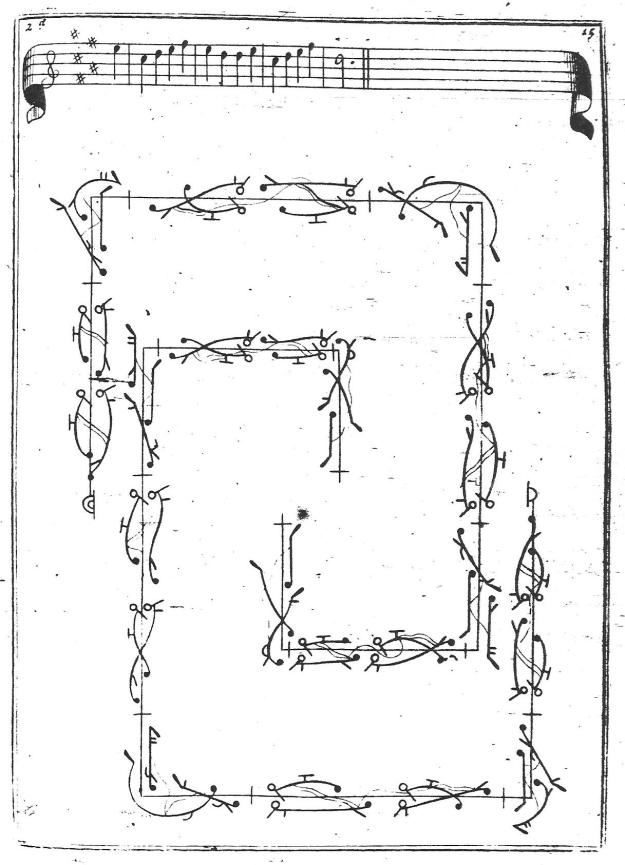
The famous figure with glissades, that according to Kellom Tomlinson ‘forms a perfect Square’ (The Art of Dancing, p. 56), is very hard to get right.
Isaac Rigadoon 2

Isaac, The Rigadoon (1706), plate 2/15.

Each bar has two glissades and so has two mouvements and two steps with glissé. These need fast reactions in feet and ankles and downward pressure, without being heavy. The notation of the pas de bourées used to turn the corners is interesting. Each is different and three of them apparently require the first demi-coupé to move on an outward diagonal. I haven’t got this right yet, but it must surely serve to align the partners within the dancing space as well as with each other. The perfect square is formed by the paths of both dancers, who should end where they began but facing each other up and down the room instead of across it. I would love to work on this figure with a partner.

It is hard to get a proper sense of the figures in a duet when working on it alone. This is particularly true of the asymmetric figure in The Rigadoon, in which the man performs three quarter-turn sprung pirouettes as the woman dances around him with pas de bourées and he then moves around her with a coupé, a contretems with a bound and a pas de bourée as she does a coupé to first position, a half-turn pirouette and a coupé.
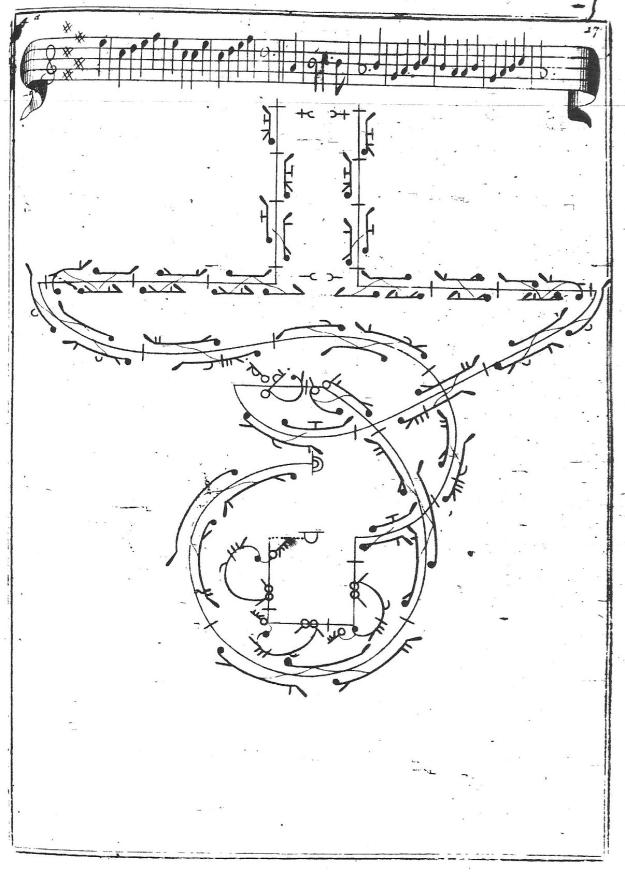
Isaac Rigadoon 4

Isaac, The Rigadoon (1706), plate 4/17

It is such a shame that I am unlikely to get to work on this dance with a partner. I would love to sort out exactly what happens in this section and how it should be performed.

I can’t really analyse the whole dance within a single blog post, so I will just look at those of Isaac’s choreographic effects that I really enjoy (from the point of view of the lady, as this is the side I have been working on). One is his use of the coupé to first position, in the second B section and the third A section. It brings the dancer to a dynamic stop after a lively sequence of pas de bourées. In both cases it is followed by a pirouette. The two B sections in the third AABB repeat reveal Isaac’s love of rhythm as well as his wit. The first B sequence comes at the top of the page, just below the music, in the plate illustrated above. There is a little game with the mouvement in demi-coupés, coupé and pas de bourée. Then in the second B (on the next plate of the dance, not shown here) there is a contrast between sliding steps and springs in two consecutive pas de bourée. I love the way Isaac has the couple bound towards one another before turning to face the back in order to travel away from the presence. Even though I can’t try this out with a partner, it always makes me smile.

The point is, of course, that Isaac’s Rigadoon isn’t simply a difficult dance exercise. It is a challenging choreography that is rewarding to learn and wonderful fun to perform. The same is true of the other dances by him that I have performed, including The Richmond, The Saltarella, The Pastorall and even The Union.
 

What’s in a name: Gallini’s forty-four cotillons

Somebody recently mentioned one of Gallini’s cotillons to me, with particular reference to its name. I thought it might be interesting to take a look at his dance titles to see if any patterns emerge. Meaningful analysis is difficult without access to a comprehensive list of cotillon titles, French as well as English, throughout the period when this contredanse was popular. However, a little while ago I compiled a list of the titles of the earliest English cotillons which might help.

All but one of Gallini’s titles are French. The exception is La Graziosetta which is, presumably, Italian. The same is true for all the other early cotillons published in London, although Gherardi occasionally adds English versions, for example La Poison d’Avril or the April Fool.  Thomas Hurst who was insistent that his dances were ‘New English Cotillons’ nevertheless gave his titles first in French and then in English, as Le Moulinet. The Windmill and La Belle Angloise. The British Beauty.

There are a fair number of titles which include place names, perhaps hinting at the fashionable pastimes to be enjoyed there. Gallini has Les Amusements de Spa and Le Bois de Boulogne, among others. Gherardi is more inclined to London and its environs, for example Les Folies d’Ormond Street and Les Plaisirs de Tooting.

There are plenty of titles which are commonplaces, such as Gallini’s La Belle Paisanne and Les Quatre Saisons (Siret also has a cotillon entitled Les Quatre Saisons). It would be interesting to know how many of the cotillons that share a title also use the same music and, conversely, how many use the same music but have different titles. A few cotillons have titles that are the same as those of much earlier contredanses, for example Le Pistolet and La Pantomime (both in collections by music publishers). Are there any links between the dances or their music?

There are allusions to royalty, as in Gallini’s Le Prince de Galles and La Royale. There are also acknowledgements of other dancing masters. Gallini has Les Plaisirs de Carel, but his Le Rondeau de Fischer may refer to the composer and oboist Johann Christian Fischer who spent some time in London. Carel also features in the 1768 cotillon collection by the music publishers Thompson (La Carel and La Nouvelle Carel). Villeneuve includes the cotillon La Dubois in his collection.

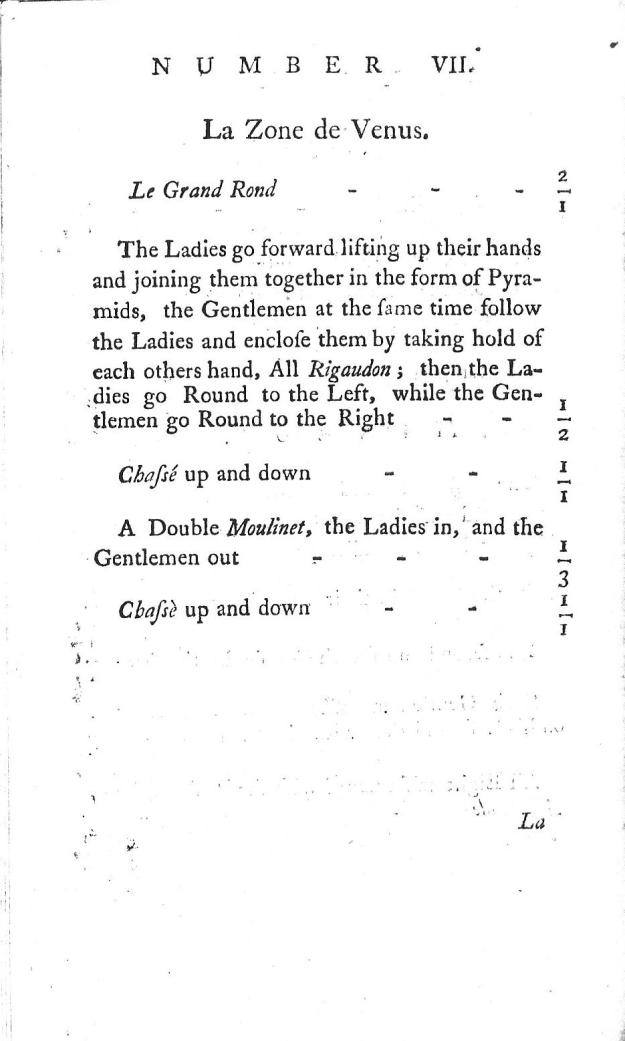
There are, of course, many allusions to love, in keeping with the galanterie inseparable from the cotillon. Gallini has L’Amour Fidelle and L’Amour du Village as well as, less obviously, Les Plaisirs Enchantés and La Pouvoir de la Beauté. The cotillon mentioned to me was La Zone de Venus. The Figure goes as follows:

Gallini Zone of Venus 1

Gallini’s Instructions for La Zone de Venus

Is it intended to represent homage to Venus and to love? In the 18th century the ‘Zone’ of Venus was identified as her girdle or ‘Cestus’, which was decorated to encourage desire. There is a painting by Sir Joshua Reynolds entitled ‘Cupid untying the Zone of Venus’, which shows him undoing the ribbon around her waist. It seems that the ‘Cestus’ became an object of interest (if indeed it was not invented) during the early 1700s. So, was Gallini’s title innocently referring to youthful love or was it intended to be risqué?

The Fundamental Step of the Cotillon

In his Le Repertoire des Bals of 1762 de La Cuisse set down the steps to be used in cotillons, although he did not explain how to perform them. One of these steps is:

‘Le Pas de Gavote ou Demi-Contretems … un Pas naturel; C’es le Pas fondamental de la Contredanse; C’est enfin avec ce Pas que se font les Ronds, les Moulinets, les Courses, et prèsque toutes les figures des Contredanses. Chacun de ces Pas vaut une demie-mesure de Musique.’

So, the demi-contretems was much used in France when dancing cotillons. As the name, as well as de La Cuisse’s explanation, implies, there were two demi-contretems to each bar of music.

Gallini made no mention of the demi-contretems among the steps in his A New Collection of Forty-four Cotillons. Perhaps this was a deliberate omission, for he writes ‘it is intended here to explain only those [steps] which are used in the following cotillons’. Gherardi included ‘Demi contre-tems d’un Pied et de l’autre’ within his list of ‘The Names of the French Country Dance Steps’ in his Fourteen Cotillons or French Dances published around 1767, repeated in his subsequent collections. Contrary to what I said in my post Dancing the Cotillon: Gherardi’s Steps, the dancing master did list some individual steps among the sequences. However, he did not explain how this, or any other, step should be performed. Hurst says nothing about steps and Siret also remains silent. Villeneuve’s list of steps does not include the demi-contretems.

The demi-contretems is a step for travelling forwards in a variety of figures, as recommended by de La Cuisse. This is how it is recorded in the 1705 dance for four Le Cotillon. This is also how it has been used in those modern reconstructions of cotillons which I have danced. I don’t know why it was ignored by some of the dancing masters publishing in London – unless the cotillons in their collections hold the answer.

In the dance manuals of the early 18th century, the first mention by name of the demi-contretems seems to be in Pierre Rameau’s Abbrégé de la nouvelle méthode published around 1725. He includes notated versions of the step, with its name, in his table ‘Suitte des contretems’ (p.65) but he does not describe it. In Rameau’s Le Maître a danser it is not mentioned by name, but its manner of performance may be taken from the description of the contretems de gavotte (translation by John Essex, The Dancing-Master, p. 97):

‘To make one with the right Foot, the Body must be on the Left in the fourth Position, the Heel of the right behind up; then sink upon the Left, and rise upon it with a Spring; but at the same Time the right Leg, which was ready to go, moves forwards in the fourth Position and on the Toes, both Legs well extended; …’

Instead of making the second step, to perform a contretems de gavotte, the dancer should transfer his or her weight onto the right foot to repeat the demi-contretems on the left.

The instruction ‘rise upon it with a Spring’ (Rameau writes ‘se relever en sautant dessus’) has resulted in two different modes of execution by dancers today. One is simply a hop followed by a step (usually onto a flat foot). The other begins with a small spring onto the ball of the foot, much like a rélevé in classical ballet, followed by step onto the ball of the foot and a quick sink into plié. The latter is more difficult and travels less, but gives a pleasing vivacity and crispness to both the step and the figures in which it is used. The demi-contretems can also be performed with a pas rond, in which the working leg traces a small half circle in the air as it passes from back to front. This little embellishment suits the rococo elegance of the cotillon very well.

‘Of the Close beating before …’ Tomlinson, The Art of Dancing (1735)

Kellom Tomlinson devotes chapter XXX of Book 1 of The Art of Dancing to one particular pas composé, ‘the Close beating before and falling behind in the third Position, upright Spring changing to the same before, and Coupee to a Measure’. The ‘Close beating before and falling behind’ appears in Feuillet’s Choregraphie in the ‘Table des Pas de Sissonne’ (p. 81) – in modern ballet terminology the step is an assemblé battu. The ‘upright Spring changing to the same before’ does not appear in Choregraphie – it is the equivalent of the modern changement. The coupé is, of course, one of the fundamental steps of la belle danse. As Tomlinson says, all three elements must be performed within a single bar of music. He provides notation for the pas composé in his Plate I.

Tomlinson Art of Dancing Plate I (detail)

Tomlinson, The Art of Dancing (1735), Plate I (detail).

Tomlinson also refers to two dances where this pas composé is used. Both can be identified as choreographies by Guillaume-Louis Pecour from the 1704 Recueil de dances, the first published collection of his entrées de ballet. One is the Entrée pour deux hommes ‘Dancée par Mr. Piffetau et Mr. Cherrier au Ballet de l’Europe galante’, for which the music is a loure – the ‘Air pour les espagnols’ from the Entrée ‘L’Espagne’. The other is the Entrée Espagnolle pour un homme et une femme ‘Dancée par Mr. Balon et Mlle. Subligny au Ballet de l’Europe galante’, for which the music is the ‘Air. Rondeau’ also from ‘L’Espagne’ – the music is in triple time but is not identifiable with a particular dance type. Is it simply coincidence that both are ‘Spanish’ dances?

Tomlinson adds that this pas composé is usually followed by a coupé avec ouverture de jambe, to allow it to be repeated on the other foot. In the Entrée pour deux hommes, it is followed by a coupé avec ouverture de jambe ornamented with an additional ‘tour de jambe’ (Feuillet’s term for a pas rond with no transfer of weight). In the Entrée Espagnolle pour un homme et une femme, the coupé avec ouverture de jambe incorporates a beat. In neither dance is Tomlinson’s pas composé then repeated.

Is this pas composé widely used? Does it appear in dances without ‘Spanish’ connotations? I looked through the three published collections of theatre dances, together with Feuillet’s 1700 Recueil of his own choreographies (which are not described as theatrical, but have close links to the genre of stage dances). The step does not appear at all in Feuillet’s 1700 collection, although some of the men’s dances include what is obviously a related sequence over two bars of music. Using modern terminology, this is an assemblé battu followed by a changement in the first bar and either a pas de bourée or a coupé in the second. This and other variants occur in a number of stage choreographies. Here I will look only at occurrences of the step as described by Tomlinson.

In Pecour’s Recueil de dances of 1704, apart from Tomlinson’s two examples, the step appears in the following dances.

Passacaille pour une femme, music from Gatti’s Scylla (1701). The onstage characters are Plaisirs. (plate 31)

Sarabande à deux, a male-female duet to music from Campra’s Tancrède (1702). The onstage characters are Plaisirs. (plate 131)

Loure pour deux hommes, music from Gatti’s Scylla (1701). The onstage characters are Candiots. In the loure, each bar contains two distinct pas composés – this occurs as the second. (plate 175)

Chaconne de Phaeton pour un homme, music from Lully’s Phaeton (1683, latest revival before this collection of dances 1702). This solo was not danced at the Paris Opéra, so we do not know which (if any) character was danced. (plate 186)

L’Aimable Vainqueur, a solo for a man to music from Campra’s Hésione (1700). This solo was not danced at the Paris Opéra and the character danced (if any) is unknown. (plate 209)

Sarabande pour un homme, music otherwise unknown and not danced at the Paris Opéra. (plate 215)

Folies d’Espagne pour un homme, to the well-known tune. (plate 224)

In all the dances, the pas composé is followed by a coupée avec ouverture de jambe, with a variety of ornaments. In six cases, it comes towards the end of the choreography although in three of these a variant version appears earlier in the dance.

In Pecour’s Nouveau Recueil de Dance de Bal (c1713), the step appears in one dance only – the Passacaille pour une femme to music from Lully’s Armide (1686, latest revival before this collection 1703. The 1713 revival must have come after the collection was prepared for publication). This solo is stated to have been ‘dancée par Mlle. Subligny en Angleterre’. In the opera the character is a demon disguised as an Amante Fortunée. The choreography apparently belongs to the period 1701-1702, when Mlle Subligny danced in London, where this dance may have been performed simply as a virtuosic belle danse solo. The pas composé appears twice (plates 84, 86). The second time the following bar has three jettés backwards (the first a jetté battu), since the pas composé itself initiates the dancer’s final retreat as she ends her solo.

Pecour Passacaille Armide 86

Pecour, Nouveau Recueil de Dance de Bal [c1713], ‘Passacaille pour une femme’, final plate.

Tomlinson’s version of this pas composé is not used in L’Abbé’s A New Collection of Dances (c1725), although it appears in variant versions in several of the choreographies.

Does all of this tell us anything about how baroque dance vocabulary was used? It seems that Tomlinson’s ‘Close beating before and falling behind in the third Position, upright Spring changing to the same before, and Coupee to a Measure’ is a step used in theatre dance, but it has few ‘Spanish’ connotations. In its basic form it seems to have been most popular in the early 1700s, according to the evidence provided by the musical sources as well as the notated dances. By the 1710s, it was more often used in variant forms. Perhaps it provides evidence of changing choreographic tastes, unless it simply indicates differences in style between individual dancing masters.

‘Spanish’ dancing and the dance treatises

Spanish dancing features very little in the early 18th-century dance treatises. Feuillet makes no reference to Spanish styles and techniques of dancing in Choregraphie, except for a section ‘De la batterie des Castagnettes’ towards the end of the manual. He provides notation for the arm movements as well as castanet beats to accompany steps danced to the Folie d’Espagne melody. His little 16-bar choreography does not correspond to any of the four Folie d’Espagne dances that survive in notation. In particular, it does not have the 8-bar repeat structure found in those but is through-composed. Feuillet says nothing about castanets being Spanish, but his choice of the Folie d’Espagne music for his example suggests the link. In his translation Orchesography, John Weaver omits Feuillet’s section on castanets altogether.

In his Neue und Curieuse Theatrialische Tantz-Schul of 1716, Lambranzi includes a plate showing a solo male dancer performing to the Folie d’Espagne tune. He says only:

‘In this dance pas de courante, pas graves, ballonnés, pas de sissonne and pas de chaconne must be employed, together with such other pas as the dancer may select.’

There is nothing inherently Spanish about the steps listed (except that the chaconne has a Spanish origin) and the dancer is not shown holding castanets. So is the dance ‘Spanish’ at all, apart from its music?

Lambranzi Folie 1-3

Lambranzi, Neue und Curieuse Theatrialische Tantz-Schul (1716), Part 1, plate 3

In his 1717 treatise Rechtschaffener Tantz-Meister, Taubert includes notation for five Folie d’Espagne variations for a solo woman. These were presumably taken directly from Feuillet’s choreography in his 1700 Recueil de dances. Taubert includes it as an example of ‘high theatrical’ dance. He says nothing about it being Spanish, but he probably assumed that the title of the music would speak for itself.

Pierre Rameau makes no mention of Spanish steps or dances in either of the treatises he published in 1725, Le Maître a danser and Abbrégé de la nouvelle méthode. This is possibly because his focus was solely on ballroom dancing. At that period, ‘Spanish’ dances were almost all intended for the stage.

By contrast, in The Art of Dancing Kellom Tomlinson refers several times to ‘Spanish’ dances, all of them stage choreographies. In his explanation of ‘the Close beating before and falling behind in the third Position, upright Spring changing to the same before, and Coupee to a Measure’ he cites Pecour’s ‘Spanish Entree for two Men’ and ‘Entree Espagnole for a Man and a Woman’ as dances within which this pas composé was used. Was there anything particularly ‘Spanish’ about this combination, or were the two dances merely ones with which Tomlinson was familiar as sources for a step sequence he liked? I will come back to this sequence in a later post.

In his 1762 A Treatise on the Art of Dancing, Giovanni-Andrea Gallini comments:

‘In Spain, they have a dance, called, Les Folies d’Espagne, which is performed either by one or by two, with castanets. There is a dress peculiarly adapted to it, which has a very pleasing effect, as well as the dance itself.’

His remarks are picturesque but, apart from the linking of castanets with ‘Spanish’ dancing and the tantalising reference to the dress ‘peculiarly adapted to it’, they are not particularly informative.

Far more helpful is Gennaro Magri in his Trattato Teorico-Prattico di Ballo published in Naples in 1779. Magri discusses ‘Spanish’ positions alongside the long-established true and false positions (which feature in Feuillet’s Choregraphie). They correspond to the five true positions, except that the feet are in parallel and not turned out. Magri also points out that both false and Spanish positions occur in pas tortillés, which are recorded in early 18th-century treatises and notations. This suggest another possible line of enquiry.

So, there are some pointers to the style and technique of ‘Spanish’ dancing in the 18th century. I should make it clear that my interest here is in ‘Spanish’ dancing as it might have been performed on the London stage in the early 1700s, where it was most likely filtered through ‘French’ dancing.


Isaac’s Rigadoon: the choreography

Isaac’s Rigadoon is one of 31 notated dances which either are or include a rigaudon (three more dances are labelled as rigaudons but are in fact gavottes). Among these 14 were published in London, of which 8 (Including Isaac’s Rigadoon) are rigaudons throughout. As I said in my previous post on this dance, it was first published in 1706 but may have been created some years earlier. Isaac choreographed a second rigaudon, The Rigadoon Royal, in 1711.

What made Isaac’s Rigadoon so admired and, apparently, so popular? Music theorists of the time characterised the rigaudon as ‘rustic’ and suggested that it was a fast dance. I have a delightful recording (made for rehearsal purposes some years ago) which is both and really brings the duet to life. The dance, in duple time, is quite long. The musical structure is the conventional AABB (A has 4 bars and B has 6) played through four times, so there are 80 bars of dancing. The choreography is lively. More than half of the steps incorporate small jumps, which are notated as such. There are no demi-jettés and only a few steps with a terminating demi-coupé to give a sense of suspension rather than a lilt. The step vocabulary is relatively limited, but Isaac’s use of variants on basic steps and his combinations of these demand swift reactions and rhythmic clarity. This can only be achieved through good underlying technique, particularly placement (or aplomb) and control over the mouvements that provide vertical articulation between and within the steps. The music needs some rustic heaviness (though not too much) but the steps need a feeling of upward spring. If the Rigadoon is as fast as I think it should be, it is not an easy dance and needs much practice to get it right. It must have been an agreeable challenge to able amateur dancers.

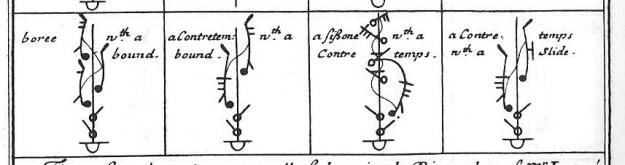
John Weaver identified four steps in Isaac’s Rigadoon that were rarely, if ever, found in other dances. All occur on the first plate of the notation, the first AABB section of the dance. Was Weaver (if not Mr Isaac himself) deliberately appealing not only to the contemporary love of novelty but also to a desire for ‘English Dancing’?

Weaver Step Suplement detail

Feuillet transl. Weaver. Orchesography (1706), ‘A Suplement of Steps’, detail.

Isaac Rigadoon 1 detail

Mr Isaac. The Rigadoon (1706), first plate, detail.

Weaver’s reference to ‘the so frequent use of them’ in the Rigadoon is a little puzzling. The ‘boree wth. a bound’ does appear throughout the dance. Feuillet gives notations for a large number of variants on the pas de bourée but none has either a final demi-jetté or jetté, even though Rameau refers to the former in Le Maître a danser. Weaver makes no reference to Isaac’s variant pas de bourée which has a pas glissé as the final step. The ‘contretem wth. a bound’ is used only four times by the man in the Rigadoon (the lady has three). There is nothing similar in Feuillet’s ‘Table des Contre-temps’. Although Rameau refers to a ‘contre-tems à deux mouvemens’ he actually means a contretemps balonné. My impression, from working through quite a number of notated choreographies over the years, is that the ‘contretem wth. a bound’ is quite widely used elsewhere, but I need to check this out. The ‘sissonne wth. a Contre temps’ occurs only at the very beginning of the Rigadoon. All the other sissonnes in the dance are the conventional version, as notated by Feuillet at the beginning of his ‘Table des Pas de Sissonne’ and described by Rameau. Isaac’s ‘contretems wth. a slide’ occurs only once, in the first B section near the beginning of the dance’. It is not recorded by either Feuillet or Rameau.

The contradiction between Weaver’s statement about ‘the so frequent use’ of these steps and the actual inclusion of them in his notation of Isaac’s Rigadoon raises questions. Could Weaver’s notation be inaccurate in some places? Did he perhaps use Feuillet’s standard notation instead of recording Isaac’s variant steps? Or was the dance as notated made more conventional to accommodate a greater range of amateur dance skills?

I meant this post to be a discussion of the difficulties, and the pleasures, to be encountered while learning Isaac’s Rigadoon, but I am still only about half-way through the choreography. A proper appraisal will have to wait for a little while longer.


‘Jouissons les plaisirs’

My work in baroque dance has always had a strong practical element. I find it easier to understand and write about the dances I have reconstructed. Much of my earlier work was based around dances I actually performed. Performance opportunities are few and far between nowadays, for a variety of reasons, but I try to continue reconstructing notated choreographies as part of my research.

I’ve recently been working on a loure, a duet to the air ‘Jouissons les plaisirs’. The music is identified on the notated ‘Entrée pour un homme et une femme Dancée par Mr Balon et Mlle Subligny au Ballet des Fragments de Mr de Lully’ in the Recüeil de dances contenant un tres grand nombres, des meillieures Entrees de Ballet de Mr. Pecour published in Paris in 1704. The work of reconstruction has had its difficulties – I have a recording of the music which is beguiling but otherwise not great and I have nobody to partner me, which all too easily leads to misinterpretation of the notation. Yet, I have found this little dance to be utterly charming. It is so prettily evocative of the early 18th century that it has been a delight to learn. I would love to see it in a good performance.

I like to know about the original contexts for the notated dances I reconstruct. In this case the air seems to have been written for the 1670 comédie-ballet Les Amants Magnifiques – the ballet in which Louis XIV apparently did not after all make his final performances as a dancer. The notated choreography, and its music, are instead associated with the Ballet des Fragmens de M. Lully first given at the Paris Opéra in 1702. This ballet brought together pieces of Lully’s music from the ballets de cour and comédies-ballets of the late 17th century into several entrées arranged by Campra. Its popularity was such that it was revived in 1708, 1711, 1717 and 1722. In Les Amants Magnifiques ‘Jouissons les plaisirs’ was a vocal duet by shepherdesses, in the Ballet des Fragmens it was entitled ‘[Air] des Jeux Pithiens’ and formed part of the first entrée, a ‘Fête marine’, as a vocal duet by female sailors accompanied by the dance. I can’t quite relate either the song or the dance to the later context, but I’m probably missing something.

I have been looking at ‘Spanish’ loures, but this dance surely falls into the ‘pastoral’ category. It is short, with only 54 bars, and the music is a rondeau (ABACA, A has 9 bars, B has 12 and C has 16 bars). The music has the time signature 3, in common with the famous ballroom duet Aimable vainqueur. It is quite unlike the ‘Spanish’ loures in 6/4. Although it is a stage dance, there are no difficult steps in this little entrée. Many of the pas composées incorporate quarter, half or (occasionally) full turns and nearly half include small jumps, so the sequences are flowing and lively. There are coupés avec ouverture de jambe which provide a pleasing suspension of movement and several other steps with a similar feel of extension. I like to draw on ballet’s ronds de jambes, even demi grand ronds de jambe, to give a greater sense of amplitude. The little jumps woven throughout add energy and make the pas de bourée and other ‘walking’ steps feel light and playful rather than languid. I haven’t yet mastered the musicality of this choreography, but I’m sure that if and when I do it will add to the pleasure of dancing it.

Perhaps the most important aspect of the dance is its figures, not so much the movement of the dancers within their stage space as the continually changing spatial relationships between them. They turn towards and then away from each other, face or turn their backs on one another, approach and retreat as they dance. On the page, the floor patterns look completely conventional, even banal, but they are transformed by the way the dancers turn on their own axis and move around each other. Without a partner it is difficult to be sure, but my guess is that the figures are quite tight and the couple stay close to one another much of the time, particularly when they circle and cross. There are many opportunities for interaction, through glances, turns of the head and épaulement as they move through their shared space. Even without a partner, the choreography conjures up the graceful flirtation of a fête galante. It brings to mind the paintings of Watteau, Lancret and Pater. It would be so easy to perform as a tiny drama of pastoral love and pleasure.

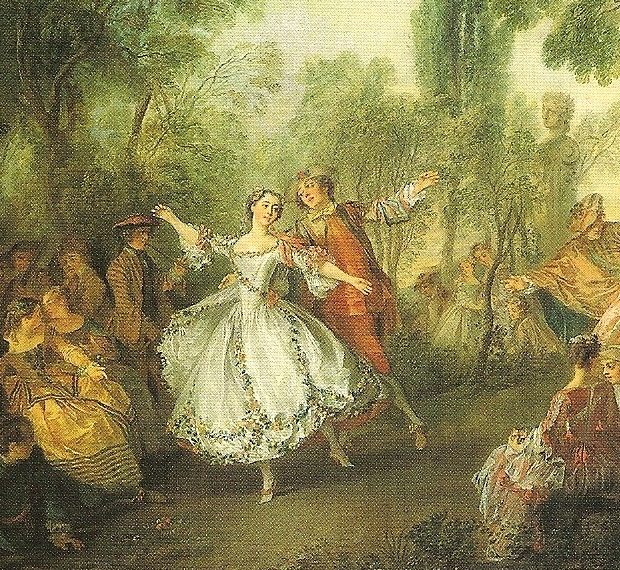
Lancret’s painting of Mlle Camargo and her partner is some thirty years later than the dance to ‘Jouissons les plaisirs’, but it gives a good idea of the style and affect of such a duet.

Nicolas Lancret, La Camargo Dancing (c1730)

Nicolas Lancret, La Camargo Dancing (c1730)

Feuillet’s Sarabands

Six of the surviving notated sarabands are by Raoul Auger Feuillet. All are solo dances. He included two in his 1700 collection of his own choreographies, both to the ‘Spanish’ saraband in the Ballet des Nations from Le Bourgeois gentilhomme. I’ll look at those later, alongside Feuillet’s versions of the Folie d’Espagne. The other four sarabands are from a manuscript collection possibly compiled between 1710 and 1720. Three are solos for a woman and the fourth is a solo for a man.

As I said in my last post, I’ve been working on one of the sarabands for a woman – the Sarabande de Polixène. I’ve been wondering how the three female solos relate to one another, given that they are all by the same choreographer. I’ve long been interested in the very different choreographies created for male dancers (the complexities of most of these suggest that they were created for male professionals). These four sarabands provide an opportunity for some analysis. Unfortunately, I only have recorded music for the Sarabande de Polixène which makes reconstruction of the other solos difficult. I feel that such reconstruction is always the best basis for any analysis. I’ll just have to see what the notations themselves can tell me.

None of these solos is long. The Sarabande de Mr. Feüillet for a woman, whose music remains unidentified, has 40 bars. The Sarabande de Mr. Feüillet to music from act 1 scene 5 of Gatti’s opera Scylla (1701) has only 36 bars – I’ll refer to this dance as the Sarabande de Scylla. The Sarabande de Mr. Feuillet for a man, also with unidentified music, has 48 bars. The Sarabande de Polixène is the longest, with 64 bars of music taken from act 3 scene 5 of Colasse’s opera Polixène et Pirrhus (1706). All the music for these dances has a basic AABB structure with a B section longer than the A section. However, the Sarabande de Scylla has an AABBB’ structure in which both A and B have 8 bars and B’ has 4.

I find it useful to do some basic analysis to start with, looking at how many steps in a choreography incorporate jumps or beats or turns. Sometimes such ornamentations can point to a dance for the stage rather than the ballroom. In all three of the female solos around one-third of the steps include one or more jumped elements. The inclusion of beats runs from only 3% of steps in the Sarabande de Scylla to 11% in the Sarabande de Polixène. Both the female solo Sarabande de Mr. Feüillet and the Sarabande de Scylla add turns to around 45% of their steps, but the Sarabande de Polixène does this with only 22%. Does this suggest that the last is more presentational than the other two? Well, it might depend on where the dancer most often faces at the end of individual steps. The number of basic, unornamented steps ranges from 35% in the female Sarabande de Mr. Feüillet to 50% in the Sarabande de Scylla. Are there any conclusions that can safely be drawn from this?

The male solo saraband both overlaps with and radically departs from the step vocabulary of the other three dances, so I will devote a separate post to it. I will also look at the pas composés shared by these four solos, by which I mean those steps formed from two or more basic steps with or without further ornamentation.

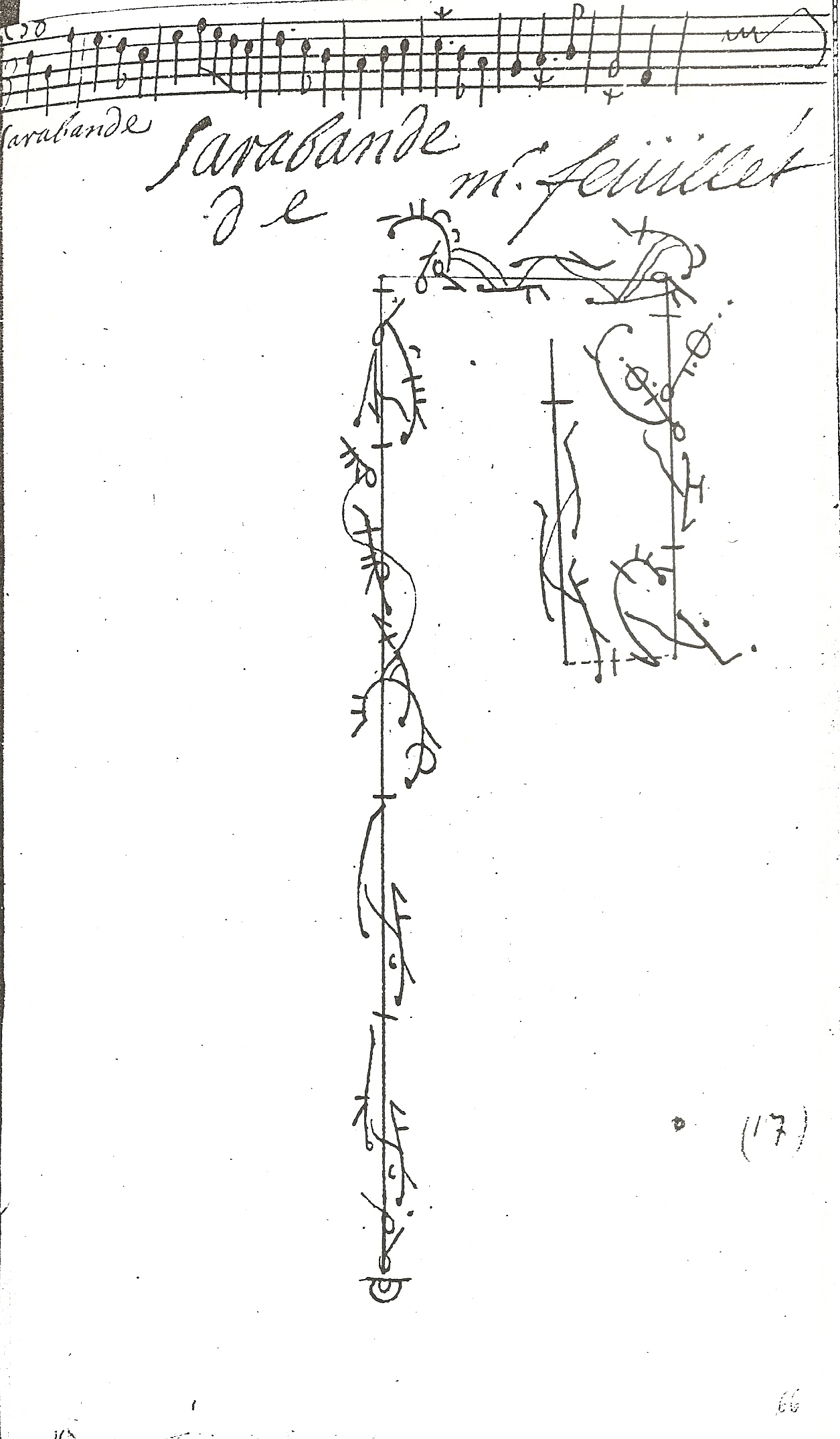
In the meantime, here is some notation from one of the female solos. Note the pirouette on both feet with a full turn towards the end of this section.

Sarabande de Mr. Feüillet (undated). First plate

Sarabande de Mr. Feüillet (undated). First plate

Reconstructing Ballroom Dances: La Mariée

I am currently reconstructing La Mariée, one of the most famous ballroom dances of the early 18th century. I have performed many notated ballroom dances over the years, but this is my first encounter with Pecour’s much-loved duet. So far, it has been a bit of a struggle! In my own defence, one hour a week with no dancing partner is not the easiest way to learn such a long and complex choreography.

When I began on La Mariée, I had been working on a couple of English solos ‘for a Girl’. Turning to Pecour’s dance I felt like I was grappling with a completely different language – which, of course, I was. The only recording of the music I could find initially was too fast to use while I was learning the steps. I subsequently found another much slower version, but it only had the music once through instead of twice as required by the choreography. Such problems, of tempo and repeat structure, are all too common with commercial recordings of baroque dance music. Still, at least I have the music. There are far too many dances for which there is no recorded music at all.

After several weeks, I am finally getting to grips with this dance. I’ve pretty well committed to memory the steps and figures and my body is beginning to learn these too. Now, I’m ready to make decisions about how I want to perform the steps and sequences. Since I began to take baroque dance seriously, I have worked with many different teachers – all of whom have their own approaches to dance style and technique. I have drawn something from each of them. The various ways in which steps might be performed provide a wide range of interpretations for individual choreographies. Even in a single dance, I might perform particular step differently when it occurs within new context, although I do try to find a unified style.

My version of La Mariée will be shaped by the fast recording. At my last session working on the dance, I found myself considering how I should perform the pas de sissonne that punctuate the choreography. Should I follow the teacher who took the first assemblée to a small fourth position with the working leg on the following saut in a low attitude? Or should I go back to my earlier lessons (and, apparently, the notation) with an assemblée into fifth position and the raised foot on the saut close to the supporting ankle? I obviously need to go back to Rameau’s Le Maître a danser to see what he says. At the moment, I’m inclining to the more compact approach with an emphasis on the upward motion of the springs.

Whatever I decide to do with the individual steps, I want to create a lively and dynamically varied performing version of a teasing and witty choreography.


L’Ecossoise

L’Ecossoise is the eighth of the nine dances in Dezais’s Premier livre de contredances of 1725. It is particularly unusual among country dances for its line-up of four men and two women. In his Avertissement at the beginning of the book, Dezais says that the contredance can also be performed by four women and two men.

The music is a gavotte. Dezais notates a few of the steps, mainly pas de rigaudon but also (for the men only) half-turn sprung pirouettes.  Apart from its unorthodox line-up, L’Ecossoise is also interesting for its successive formations. At the opening of the dance, the performers face one another across the dance space in two lines with the women between the men. Although they continue to face one another for much of the choreography, there are three places where they all turn to face their audience. On two occasions they are in perpendicular or ‘right’ lines one behind the other, the first time with the women at the back and the second time with them at the front. On the third occasion, they form one ‘diametrical’ line across the space. (The terminology comes from Feuillet’s Choregraphie, via Weaver’s translation). The first ‘right’ line is immediately followed by the ‘diametrical’ line. At the end of L’Ecossoise, the dancers are in a rectangular formation, with the women top and bottom and the men to either side. The contredance has conventional country dance figures, including left-hand and right-hand stars, right and left hand turns and circles, but some of the formations suggest that it might have originated as a display dance.

The title, L’Ecossoise (Scottish lady)may come from the music, but could the dance and its music have originated on the French stage? I wondered whether it might have come from a piece given at the Paris fair theatres or the Théâtre Italien, but I can’t find anything obvious among the titles of their respective repertoires. Voltaire wrote a play L’Écossaise, but that did not reach the stage until 1760.

Was there a London connection? ‘Scotch’ dances had been popular in London’s theatres from at least 1700, but there is little to link these with dancing on French stages. One danced entertainment, The Dutch and Scotch Contention; or, Love and Jealousy, which features a Highland couple, was performed in Paris as well as London, but it dates to 1729.

There are, of course, ‘Scotch’ and ‘Highland’ dances in the many editions of Playford’s The Dancing Master as well as elsewhere. I won’t pursue these here. However, one dance did catch my eye as I was looking through various sources. Confess was published in 1651 in The English Dancing Master. It isn’t a ‘Scotch’ dance but its line-up is two men and four women. The dancing master Confess had links with the English court in the early 17th century, so perhaps this dance was intended to have an element of display. There is also a figured minuet for six ladies by Mr Shirley in Pemberton’s 1711 An Essay for the Further Improvement of Dancing, but that takes me a little too far from my original topic.

Research into possible connections and influences between the dances of the 18th century is endlessly fascinating, but there is nothing like performing these choreographies to provide real insights. Here is one version of L’Ecossoise in performance.