Tag Archives: Baroque Dance

LOUIS DUPRÉ – MARS

What of Louis Dupré, who was a newcomer to the London stage? How did he portray Mars?

Dupré is still too often identified with ‘le grand’ Dupré of the Paris Opéra. Some years ago, I published an article that disproved this idea on the simple grounds that the two men were performing on opposite side of the English Channel simultaneously.

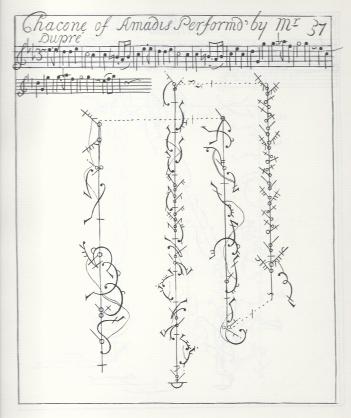
A dancer named Dupré is first advertised on 22 December 1714 at the Lincoln’s Inn Fields Theatre and appeared there regularly during the 1714-1715 season. He then moved to Drury Lane, where he danced for the next two seasons, appearing in The Loves of Mars and Venus during that period. Dupré’s skills are often solely identified with the serious style, but from soon after his arrival in London he regularly performed a Harlequin dance. There is even a notated Harlequin choreography dedicated to him, which claims to include some of his characteristic steps and moves. The dancing skills that Dupré was able to bring to the character of Mars are amply demonstrated by the ‘Chacone of Amadis’ created for him by Anthony L’Abbé, probably around the time of The Loves of Mars and Venus. This solo contains a panoply of early 18th-century male virtuosity, from entrechats-six to multiple pirouettes and tours en l’air.
chacone-of-amadis-1

L’Abbé, ‘Chacone of Amadis’, A New Collection of Dances, [c1725], first plate

Dupré returned to Lincoln’s Inn Fields for the 1717-1718 season and continued to dance with John Rich’s company until he died in 1734 or 1735.

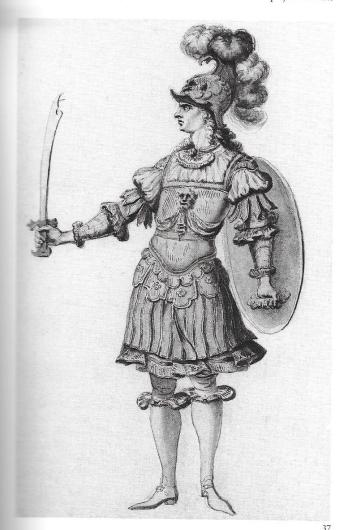
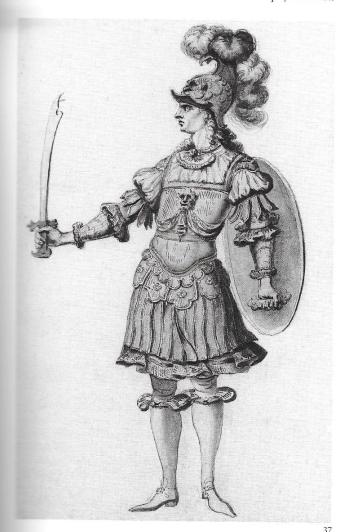
There is no known portrait of London’s Louis Dupré. This design reflects contemporary ideas about the appearance of a classical warrior.
mars

A late 17th-century costume design for a ‘Combattant’. 

Although the London Dupré was obviously more than just a serious dancer of the type that Weaver criticised for lack of expression in his Essay towards an History of Dancing, Mars is given fewer explicitly formal gestures than either Vulcan or Venus. Weaver describes the character thus in his scenario for the ballet:

mars-in-words

Weaver, The Loves of Mars and Venus (1717), p. xv

In scene 1, Mars dances an ‘Entry’, probably intended to show his power through a display of virtuosity, and a ‘Pyrrhic’ mimicking hand-to-hand combat with his Followers. In scene 4, he woos Venus in mime but his gestures (as well as those of the other dancers who take part in this scene) ‘are so obvious, relating only to Gallantry, and Love; that they need no Explanation’. Mars is asked to show ‘Gallantry, Respect; Ardent Love; and Adoration’ before Venus, a sequence that creates a crescendo of feeling. In scene 6, after being caught in the net with the goddess, Mars shows ‘Audacity; Vexation; Restlessness; and a kind of unwilling Resignation’. Weaver describes ‘Resignation’ as ‘To hold out both the Hands joyn’d together’ adding that it is ‘a natural Expression of Submission and Resignation’. Were ‘Audacity’ and ‘Vexation’ perhaps modified versions of ‘Threats’ and ‘Impatience’?

The way in which Weaver depicts Mars is reflective of the God of War as a man of action rather than one of thought or feeling. This may have had more to do with Weaver’s concept of his ballet and its characters than with Dupré’s supposed limitations when it came to gesture.
HESTER SANTLOW – VENUS

In the 1716-1717 season, Hester Santlow was Drury Lane’s leading dancer and one of the company’s leading actresses. Who was she and how might she have danced Venus?

Hester Santlow’s date and place of birth and, indeed, her origins remain unknown. Her name seems to be French in derivation (St Loe) and her family were, apparently, not connected with the theatre. What evidence there is suggests that she was born in 1693 or 1694 (see my 2007 book The Incomparable Hester Santlow). She made her stage debut as a dancer in 1706, adding acting to her professional skills in 1709 when she appeared as Miss Prue in Congreve’s comedy Love for Love. Thereafter, she pursued a double career as both a dancer and an actress. Her acting roles show her as a light comedienne – her most popular roles included Harriet in Etherege’s The Man of Mode and Miranda in Mrs Centlivre’s The Busy Body. She was much admired in breeches roles such as Hellena in Aphra Behn’s The Rover. In tragedy, she was best suited to such roles as Ophelia in Hamlet and Cordelia in Nahum Tate’s version of King Lear, both of which she played for many years.

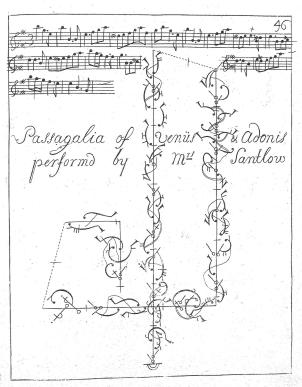
As a dancer, Hester Santlow had no peer on the London stage. She was trained by the Frenchman René Cherrier and had dances created for her Anthony L’Abbé, royal dancing master and a leading choreographer. L’Abbé’s solo ‘Passagalia of Venüs & Adonis’ (to music from the opera by Desmarets), published in notation in the mid-1720s, remains a testimony to her virtuoso technique and her expressive powers.

passagalia-1

L’Abbé, ‘Passagalia of Venüs & Adonis’, A New Collection of Dances, [c1725], first plate

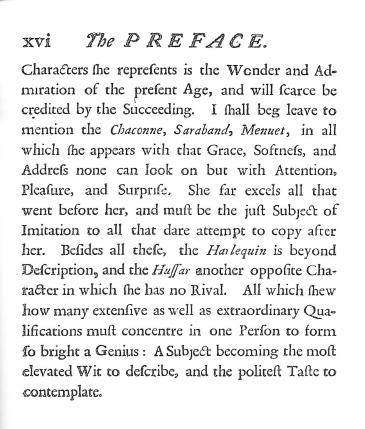
Her impact is well described by the dancing master John Essex in his Preface to The Dancing Master (his translation of Rameau’s Le Maître a danser).

essex-santlow-1

essex-santlow-2


Hester Santlow married her fellow actor and Drury Lane manager Barton Booth in 1719. Her career ended in 1733, following the death of her husband. During her final season on the London stage, she created the role of Helen of Troy in Weaver’s last ballet The Judgment of Paris.

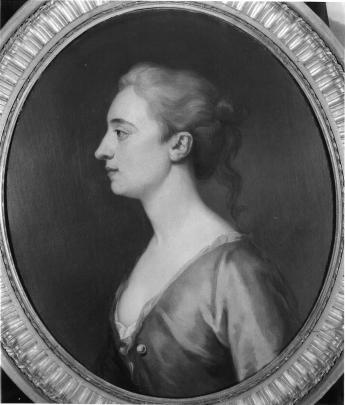
In Hester Santlow, Weaver had a Venus ‘Goddess of Love and Beauty’ who could both dance and act. Unsurprisingly, she has the greatest range of gestures in the ballet after Weaver himself as Vulcan. He used her dancing skills and her expressive abilities to the full. He also took every chance to show off her beauty. Another contemporary described Mrs Santlow as ‘a beautiful Woman, lovely in her Countenance, delicate in her form’. She is one of the very few dancers of the 18th century for whom we have several portraits.

vanderbank-santlow

John Vanderbank, Hester Santlow, c1720

Venus is first shown ‘in her Dressing-Room at her Toilet’ surrounded by the Graces with Cupid and the Hour (probably Flora). She ‘rises and dances a Passacaile’ first solo and then with the other women. The choreography could have shared features with L’Abbé’s ‘Passagalia’. The ‘Dance … of the Pantomimic kind’ with Vulcan which follows is worth its own post. Weaver entrusted a significant number of gestures to Venus, although she has a far narrower range of ‘Passions’ which have less powerful physical expressions. She is, however, allowed to improvise ‘Coquetry. … seen in affected Airs, given herself throughout the whole Dance’. In scene 4, with Mars, Mrs Santlow’s gestures are again improvisatory – ‘reciprocal Love’ and ‘wishing Looks’. Were these expressions stock-in-trade for Mrs Santlow the actress, or were they new to her?

In the final scene, Venus has to express ‘Shame’, ‘Confusion’ and ‘Grief’. Weaver provides gestures for the first and last of these, leaving her to find her own way of showing ‘Confusion’. How and with whom did Venus dance in the closing ‘Grand Dance’? Were there echoes of her ‘Pantomimic’ dance with Vulcan in scene 2 and of her gestures and dancing with Mars in scene 4? If there were, with her breadth of dance repertoire and her acting skills, Hester Santlow could surely have encompassed them all.

JOHN WEAVER – VULCAN

Who was John Weaver? How did he create the role of Vulcan in his ballet The Loves of Mars and Venus?

John Weaver was born in 1673 in Shrewsbury, the son of a dancing master. By the mid-1690s, he was himself a dancing master in the same town, but by the end of that decade he was probably in London working in the theatre as a professional dancer. His earliest known billing is at the Drury Lane Theatre on 6 July 1700, when he appeared in ‘a new Entry’ with two other dancers. Few advertisements for theatrical performances survive from this period, so it is very difficult to chart individual performers’ careers, but the bill suggests that Weaver was an established member of the Drury Lane company. The handful of advertisements that mention Weaver in the first years of the 18th century indicate that his forte was comic dancing, although as a dancing master he would surely have had a thorough knowledge of the serious or ‘French’ style and technique of dancing for both the ballroom and the stage. He returned to Shrewsbury to teach dancing in late 1707 or early 1708.

Weaver returned to Drury Lane for the 1716-1717 season to create and dance in The Loves of Mars and Venus. We do not know whether he danced in his own early pantomimes, The Shipwreck and Harlequin Turn’d Judge, but his later repertoire of entr’acte dances included English Clown, Lads and Lasses, Irish Trot and Sailor and His Lass. None suggest the sophisticated refinements of the serious style of dancing. Weaver went on dancing at Drury Lane until the end of the 1728-1729 season, when he was 55 years old. His last visit to London came in 1733, when he created his final work for the stage The Judgment of Paris, after which he returned to Shrewsbury and his dancing school for good.

There is no known portrait of John Weaver.

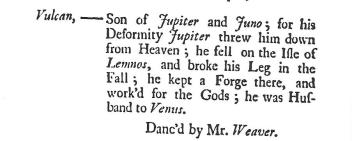
In the scenario for The Loves of Mars and Venus, Weaver provides a pen-portrait of Vulcan drawn from classical authors.

vulcan-in-words

John Weaver, The Loves of Mars and Venus (1717), p. xv

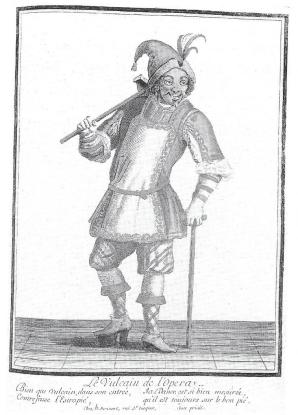
The description suggests that he portrayed Vulcan as lame in his ballet, following contemporary depictions of the god.

vulcan

A late 17th-century depiction of a stage Vulcan.

Weaver continues to draw Vulcan’s character throughout The Loves of Mars and Venus. The god first enters part way through scene 2 to a ‘wild rough air’. When he joins with Venus in the ‘Dance being altogether of the Pantomimic kind’, Vulcan’s passions are powerful – jealousy, anger, anguish are among them – and strongly expressed. Anger has ‘The left Hand struck suddenly with the right; and sometimes against the Breast’. His accustomed habitat is ‘Vulcan’s Shop, to which scene 3 opens showing the Cyclops as they work to ‘a rough Consort of Musick … adapted to the particular Sounds’ hammering and filing arms and armour for the gods. This provides the soundscape for the Entry danced by Vulcan and his workmen.

A different side of Vulcan appears when the shop is shown again, with the god ‘leaning in a thoughtful Posture on his Anvil’. Weaver is not explicit about his mood when he dances alone as the Cyclops complete the net that will enable his revenge on his wife and her lover. Did he maintain Vulcan’s lameness as he danced? Did he express pleasure, as Weaver’s gesture ‘Pleas’d at some Contrivance’ indicates, or something darker?

Vulcan must have dominated the final scene of The Loves of Mars and Venus. His control of the action reaches its highest point in the ‘insulting Performance’ he and the Cyclops give before the imprisoned Mars and Venus. Even after the arrival of the other gods, Vulcan remains the most active figure on stage as Weaver performs ‘Triumphing’, described as ‘To shake the Hand open, rais’d above our Head, is an exulting expression of Triumph’. How did Weaver show Vulcan’s responses as Neptune tries to persuade Vulcan ‘at length’ to forgive Mars and Venus? Vulcan must have taken part in the ‘grand Dance’ which concludes the ballet. Was this dance in the serious style or was it closer to a country dance in its steps and figures?

Vulcan’s dances post questions of genre, style and technique which are not easy to answer. All of them must have been ‘comic’ but what did this mean in practice? I will try to return to the subject of comic dancing in a later post.

THE DRAMATICK ENTERTAINMENT OF DANCING IN ACTION

The only surviving evidence for The Loves of Mars and Venus is the scenario written by John Weaver to accompany the first performances of the ballet. There were probably several reasons for its publication. Weaver writes in his Preface ‘I know it will be expected that I should give the Reader some Account of the Nature of this kind of Entertainment in Dancing, which I have here attempted to revive from the Ancients in Imitation of their Pantomimes’, thereby presenting himself as a scholar as well as a dancing master. The detail within the scenario suggests that he was rather more concerned that the audience might not understand the story, and the gestures used by the dancers, without some help. He acknowledges that ‘I have not been able to get all my Dancers equal to the Design’, admitting that ‘I have in this Entertainment too much inclin’d to the Modern Dancing’. So, what does the scenario tell us about Weaver’s dance drama?

The ballet unfolds in six scenes, for each of which Weaver describes the action – dance, gesture and even music – quite closely. The first scene is devoted to Mars and is preceded by a ‘Martial Overture’.

mars

A late 17th-century costume design for a ‘Combattant’. Did Weaver’s Mars look something like this?

The four ‘Followers of Mars’ enter to perform a ‘Pyrrhic Dance’ which Weaver explains as an exercise in training for combat. After a ‘Warlike Prelude’, Mars joins them. He dances a solo ‘Entry’ and then performs the Pyrrhic Dance with them.

The second scene provides a complete contrast, as Venus is discovered ‘at her Toilet’ surrounded by Cupid, the Graces and ‘one of the Hours’ (this character is probably one of the ‘Horae’ or Seasons, most likely Flora).

venus

A mid-17th century costume design for Venus (danced by a man). Nothing in her dress declares that she is a goddess.

She is introduced by a ‘Simphony of Flutes’ and rises to dance a passacaille, in which she is joined by the Graces and the Hour. They have just finished their dance when a ‘Wild Rough Air’ heralds the arrival of Vulcan. Everyone except Venus hastily departs. There follows what Weaver describes as a ‘Dance being altogether of the Pantomimic kind’ – a mute quarrel between Venus and Vulcan, for which Weaver specifies in great detail their gestures. This duet surely reaches to the heart of Weaver’s ambition to recreate the ‘surprizing’ performances of the mimes and pantomimes of classical antiquity.

The third scene belongs to Vulcan and his workmen the Cyclops.

vulcan

A late 17th-century depiction of a stage Vulcan. Did Weaver make his god lame?

It begins with a set piece probably familiar from other works on the London stage. Vulcan ‘strikes at the Scene’ and it opens to show the Cyclops, blacksmiths like Vulcan himself, at work to a ‘Rough Consort of Musick’. Four Cyclops dance an ‘Entry’, joined by Vulcan. The ‘Entry’ is, of course, very different from the one performed by Mars in the first scene. The pantomime, as Vulcan plans his revenge on his wife and her lover, differs from that between Venus and Vulcan in scene two.

As well as setting the plot in motion, these three scenes introduce, successively, the principal characters in the drama, through contrasting music, dance and gestures.

Scene four brings Mars and Venus together for the first time. Weaver explains that ‘This Performance is alternate, as representing Love and War’, adding ‘As to the Gestures made use of in this Scene; they are so obvious, relating only to Gallantry, and Love, that they need no Explanation’. Mars and Venus meet and embrace, and Mars woos the goddess in mime. The two deities and their respective Followers then dance another ‘Entry’ which, Weaver says, portrays ‘Strength and Softness, reciprocally, and alternately’. The dance, and the scene, end ‘with every Man carrying off his Woman’.

In scene five, the Cyclops are again shown at work and Vulcan dances a solo showing his pleasure as his plan moves to fruition. The final scene of the ballet begins with a ‘soft Symphony of Flutes’, to which the scene opens showing Mars and Venus sitting together. Their ‘pleas’d Tenderness which supposes past Embraces’ is rudely interrupted as Vulcan and the Cyclops enter and catch the two in a net and then give an ‘insulting Performance’. After that, ‘Jupiter, Apollo, Neptune, Juno, Diana, and Thetis’ arrive to witness the humiliation of Mars and Venus. Finally, Neptune persuades Vulcan to forgive the lovers and release them. Much of this scene was played in gestures, again described by Weaver. The ballet concludes as ‘Mars, with the rest of the Gods, and Goddesses, dance a Grand Dance’. This choreography was, presumably, for nine. Weaver’s wording suggests that Mars danced alone, with the other gods and goddesses in couples. Although it is surely likely that Mars, Venus and Vulcan came together for a trio at some point.

The action of The Loves of Mars and Venus was a mixture of old and new. The dancing of Mars and Venus seems to have used the current French stage style and technique and the final ‘Grand Dance’ followed a well-established convention. Vulcan and the Cyclops probably danced in a comic style commonly seen in the entr’actes in London’s theatres. However, Weaver went well beyond accepted ideas in his use of dance to establish the individuality of his characters. His use of gesture and, apparently, its combination with conventional dance steps was completely new and was, for the first time, the means through which a story was told. Weaver was boldly experimental and innovative, despite his use of a great deal of ‘Modern Dancing’ and the justification of his work through an appeal to classical antiquity.

I will say more about the dances and Weaver’s gestures in future posts on The Loves of Mars and Venus.

WHY A ‘DRAMATIC ENTERTAINMENT OF DANCING’?

As a dancer and a dancing master, John Weaver had deep concerns about the status of dancing. In An Essay Towards an History of Dancing, published in 1712, he tried to address these. His ‘Prefatory Introduction’ set out Weaver’s underlying aim:

‘an undeserved Contempt has been cast unwarily on this Art, as Low and Mechanick; I have here endeavour’d to set it in its true Light; and to shew, that it is an Art both Noble and Useful; and not unworthy the Encouragement of all Lovers of Elegance and Decorum; …’

His strategy for establishing dancing as an ‘Art’ was to link not only its past but also its current practice to classical antiquity.

In the final chapter of his Essay, entitled ‘Of the Modern Dancing’, Weaver laid the foundations for what he would call a ‘Dramatic Entertainment of Dancing’. He wanted the London stage to present dancing that was something more than the ‘Motion, Figure and Measure’ seen in the technically accomplished French dancers who were so successful there. Weaver’s ambition was to present dancing that could rival drama. Appealing to classical antiquity, he wrote:

‘Stage-Dancing was at first design’d for Imitation; to explain Things conceiv’d in the Mind, by the Gestures and Motions of the Body, and plainly and intelligibly representing Actions, Manners and Passions; so that the Spectator might perfectly understand the Performer by these his Motions, tho’ he say not a Word.

Weaver’s concept of the mute art of dancing was one in which the body provided a means of expression as powerful as the spoken word. He wished to imitate (and improve upon) ‘that surprising Performance of the Pantomimes’ he had written about in his Essay Towards an History of Dancing.

There had, of course, been ballets well before Weaver’s The Loves of Mars and Venus. The English masque of the early 1600s and the French ballet de cour, which reached its apogee in the mid-17th century, gave a central place to dancing. However, both were dependant on spoken and sung words to express emotions as well as unfold the story. The same was true of French opera, from the tragedies en musique of Lully to the opéra-ballets of Campra and others. The English semi-opera, which became popular in the 1690s thanks to Purcell’s music, used dance simply as part of divertissements alongside the drama. In none of these works did dance stand alone.

Weaver must have been familiar with the semi-operas and obviously knew a great deal about French dancing, even if his experience of French opera was limited. The underlying reason for his dissatisfaction must surely have been that all the dancing he saw was merely decorative. It embellished the arts of music and drama, but fell short of being an art itself. Weaver’s appeal to the ‘Pantomimes of the Ancient Greeks and Romans’ who (in his Preface to the published scenario for The Loves of Mars and Venus) he characterised as ‘Dancers that represented a Story or Fable in Motion or Measure; Imitators of all things, as the Name of Pantomime imports’ offered a way forward.

He had an example closer to hand in the commedia dell’arte, whose exponents were once again finding their way into London’s theatres in the early 1700s. In his Essay, Weaver wrote of ‘that surprising Performance of the Pantomimes, the Ruins of which remain still in Italy; but sunk and degenerated into Pleasantry, and merry conceited Representations of Harlequin, Scaramouch, …’ describing the players as ‘these modern Mimes inimitable’. He could not help admiring their expressive abilities, depending on actions not words. He admired (grudgingly) the French dancing of his own time, too. In ‘Of the Modern Dancing’ he set down its virtues as well as what he saw as its vices.

John Weaver worked in theatres where drama and dance were juxtaposed and intertwined at almost every performance. He was that rarest of combinations, a scholar as well as a dancer. His ambitions for dancing, and the means by which he chose to pursue them, sprang out of both his theoretical reading and his practical experience. Weaver’s bold experiment of 1717 was enough of a success for him to follow it with another ‘Dramatic Entertainment of Dancing’, Orpheus and Eurydice in 1718. This failed and he did not return to the genre until 1733, when he created The Judgment of Paris in which he abandoned his early ideals by introducing songs.

My focus in these posts is his first great venture with his new genre, The Loves of Mars and Venus, the very first modern ballet.

A VERY IMPORTANT DANCE ANNIVERSARY

Next year marks the 300th anniversary of John Weaver’s The Loves of Mars and Venus. His ‘dramatic entertainment of dancing’ was first performed at the Drury Lane Theatre on 2 March 1717.

Loves Title Page Detail

John Weaver, The Loves of Mars and Venus, detail from title page

Why is this often overlooked dance work so important? It is the first modern ballet – the first theatrical work to tell a story and represent its characters solely through dance, mime and music. Unlike all the ballets that had come before it, including the much celebrated French ballets de cour and English masques, there were no spoken or sung words. The Loves of Mars and Venus was a dance work, nothing more and nothing less.

Weaver’s ballet tells the story of the love affair between the goddess Venus and Mars, the god of War, and the revenge enacted on them by her husband Vulcan. It draws on classical mythology, but contemporary passions abound. Despite Weaver’s appeal to the revered performances of the ‘mimes and pantomimes’ of classical antiquity, who he wished to emulate, his ballet was a thoroughly modern work in tune with the sophisticated comedies of his own time.

The Loves of Mars and Venus has six short scenes. Mars appears with his soldiers and performs a war dance. Venus is shown surrounded by the Graces and displays her allure in a sensual passacaille, but when Vulcan arrives she quarrels with him in a ‘dance of the pantomimic kind’. Vulcan retires to his smithy to devise revenge with the help of his workmen the Cyclops. Mars and Venus meet and, with their followers, perform dances expressive of love and desire. Vulcan completes his plan of revenge against the lovers. In the final scene, Vulcan and the Cyclops catch Mars and Venus together and expose them to the derision of the other gods, until Neptune intervenes and harmony is restored in a final ‘Grand Dance’. The entire ballet took, perhaps, about 40 minutes.

John Weaver was a dancer as well as a choreographer. He is also one of the very few dance practitioners who have written about their art. He was Vulcan. Venus was Hester Santlow, also an actress and a dancer of consummate skill and expressiveness. Mars was Louis Dupré, a virtuoso dancer who was probably French (although not Louis ‘le grand’ Dupré, with whom he is still often confused). Weaver’s bold experiment had the best dancers on the London stage.

This first modern ballet was a remarkable work and enjoyed success in its own time. It was subsequently far more influential than many realise. It may well have been seen by the young dancer Marie Sallé, who would herself later experiment with narrative and expressive dancing. Sallé, of course, influenced Jean-Georges Noverre when he came to create his ballets d’action. They led to the story ballets of the romantic period and onwards to today’s narrative dance works.

Has Weaver’s The Loves of Mars and Venus been consigned to history or can it be recovered? I will explore this innovative ballet further in later posts.

Prince Frederick

Prince Frederick, ‘A New Dance’ by Anthony L’Abbé, was notated and published in 1725 by Edmund Pemberton.

Prince Frederick Title Page

L’Abbé, Prince Frederick (1725), Title Page

The title indicates that the dance was dedicated to the eldest son of the Prince and Princess of Wales (who would soon become King George II and Queen Caroline). The publication of the dance was advertised in the Evening Post for 9-11 March 1725. The date links it to Caroline’s birthday on 1 March, although the bare description of it as ‘A New Dance’ suggests that it was not performed at court. I have not been able to find any record of a court ball in honour of the Princess’s birthday that year.

Prince Frederick was still in Hanover, where he had remained as the representative of the electoral family when his parents travelled to England in 1714 following the accession of his grandfather (Elector of Hanover) to the British throne as George I. In 1725, Frederick turned 18 and thus officially came of age. This event was celebrated in Hanover, where the festivities included a ball at which Frederick opened the dancing with the Countess Amalie von Platen (who may have been the daughter of George I). Perhaps L’Abbé intended his ballroom dance to honour Frederick’s majority and be a compliment to the prince’s mother. If so, it was unlikely to have found favour in London – both of the prince’s parents disliked him.

L’Abbé’s Prince Frederick is described on the notation as a ‘Slow Minuet’. The music has been identified as a song The Beauteous Cloe. The single-sheet version is undated (although ascribed a date of 1715 or 1720 in some sources). It also appears in A Choice Collection of English Songs Set to Musick by Mr Handel, published by John Walsh around 1730. It has been further identified as a reworking of Teofane’s aria ‘S’io dir potessi’ in act 2 of Handel’s 1723 opera Ottone. If, as has been suggested, Handel himself transformed the aria into the song, he must have been happy to do so soon after the first performances of Ottone on the London stage. Did he perhaps revise the music for the ball dance first? Handel was employed by George I at the same period as L’Abbé was dancing master to the King’s grand-daughters. The two must have known one another, and Handel – like L’Abbé – may have wished to honour Prince Frederick, who would in due course become Prince of Wales and might one day be king.

The description ‘Slow Minuet’ on the notation cannot be taken too literally, but it accords more with the slow sad aria of Ottone than the lively light-hearted song The Beauteous Cloe. I am currently working on L’Abbé’s Prince Frederick so I will return to the choreography and its interpretation in a later post.

Reconstructing Isaac’s Rigadoon

After several sessions, I have finally learnt the whole of Isaac’s Rigadoon and I am beginning to feel comfortable enough with the choreography to work on shaping it as if for performance.

Isaac focusses on the changing rhythms and shifting dynamics of the Rigadoon’s steps. The footwork is not complicated, there are no quasi-theatrical steps but they are difficult to perform clearly and accurately, particularly at speed. The dance does need to be quite fast to make its proper effect. Isaac repeats steps and even short sequences, but he never exactly replicates sequences elsewhere in the choreography. I have found The Rigadoon quite hard to learn and I am still struggling to find the best way to perform the basic steps. How far should these travel? How much spring should there be in the jettés that come at the end of so many of them? I have performed many of the notated theatrical dances, which need amplitude and force even in basic steps. The Rigadoon requires neither, although it certainly demands swift and lively dancing.

The famous figure with glissades, that according to Kellom Tomlinson ‘forms a perfect Square’ (The Art of Dancing, p. 56), is very hard to get right.

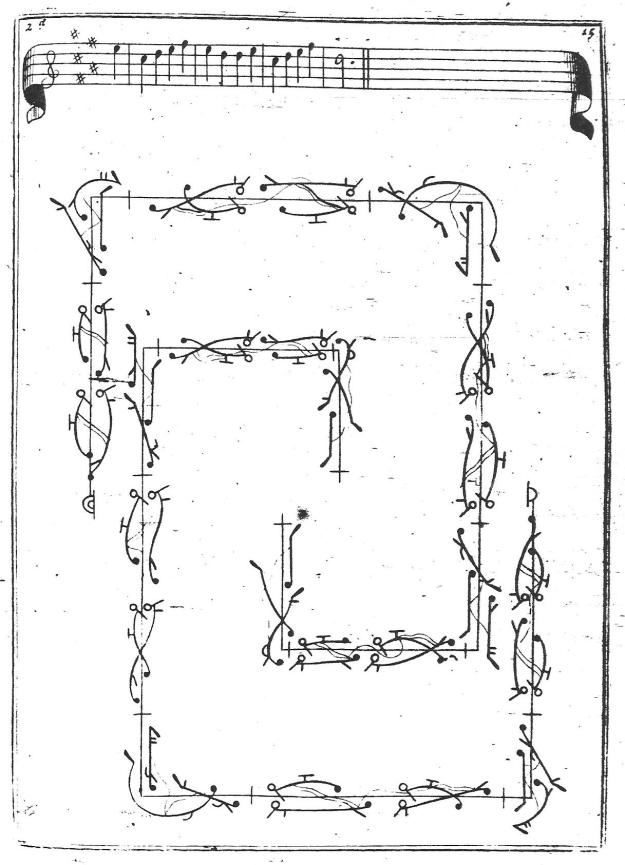
Isaac Rigadoon 2

Isaac, The Rigadoon (1706), plate 2/15.

Each bar has two glissades and so has two mouvements and two steps with glissé. These need fast reactions in feet and ankles and downward pressure, without being heavy. The notation of the pas de bourées used to turn the corners is interesting. Each is different and three of them apparently require the first demi-coupé to move on an outward diagonal. I haven’t got this right yet, but it must surely serve to align the partners within the dancing space as well as with each other. The perfect square is formed by the paths of both dancers, who should end where they began but facing each other up and down the room instead of across it. I would love to work on this figure with a partner.

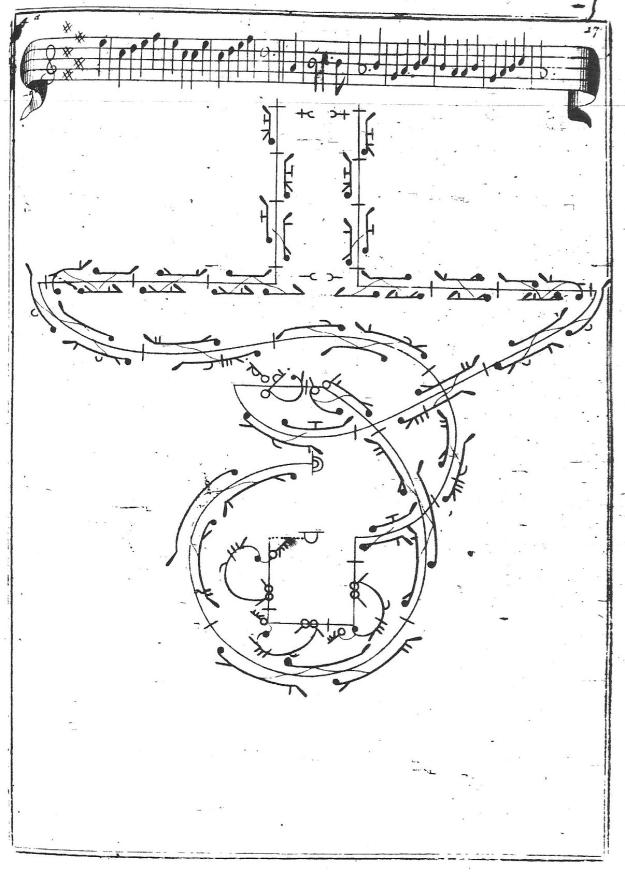
It is hard to get a proper sense of the figures in a duet when working on it alone. This is particularly true of the asymmetric figure in The Rigadoon, in which the man performs three quarter-turn sprung pirouettes as the woman dances around him with pas de bourées and he then moves around her with a coupé, a contretems with a bound and a pas de bourée as she does a coupé to first position, a half-turn pirouette and a coupé.

Isaac Rigadoon 4

Isaac, The Rigadoon (1706), plate 4/17

It is such a shame that I am unlikely to get to work on this dance with a partner. I would love to sort out exactly what happens in this section and how it should be performed.

I can’t really analyse the whole dance within a single blog post, so I will just look at those of Isaac’s choreographic effects that I really enjoy (from the point of view of the lady, as this is the side I have been working on). One is his use of the coupé to first position, in the second B section and the third A section. It brings the dancer to a dynamic stop after a lively sequence of pas de bourées. In both cases it is followed by a pirouette. The two B sections in the third AABB repeat reveal Isaac’s love of rhythm as well as his wit. The first B sequence comes at the top of the page, just below the music, in the plate illustrated above. There is a little game with the mouvement in demi-coupés, coupé and pas de bourée. Then in the second B (on the next plate of the dance, not shown here) there is a contrast between sliding steps and springs in two consecutive pas de bourée. I love the way Isaac has the couple bound towards one another before turning to face the back in order to travel away from the presence. Even though I can’t try this out with a partner, it always makes me smile.

The point is, of course, that Isaac’s Rigadoon isn’t simply a difficult dance exercise. It is a challenging choreography that is rewarding to learn and wonderful fun to perform. The same is true of the other dances by him that I have performed, including The Richmond, The Saltarella, The Pastorall and even The Union.


What’s in a name: Gallini’s forty-four cotillons

Somebody recently mentioned one of Gallini’s cotillons to me, with particular reference to its name. I thought it might be interesting to take a look at his dance titles to see if any patterns emerge. Meaningful analysis is difficult without access to a comprehensive list of cotillon titles, French as well as English, throughout the period when this contredanse was popular. However, a little while ago I compiled a list of the titles of the earliest English cotillons which might help.

All but one of Gallini’s titles are French. The exception is La Graziosetta which is, presumably, Italian. The same is true for all the other early cotillons published in London, although Gherardi occasionally adds English versions, for example La Poison d’Avril or the April Fool.  Thomas Hurst who was insistent that his dances were ‘New English Cotillons’ nevertheless gave his titles first in French and then in English, as Le Moulinet. The Windmill and La Belle Angloise. The British Beauty.

There are a fair number of titles which include place names, perhaps hinting at the fashionable pastimes to be enjoyed there. Gallini has Les Amusements de Spa and Le Bois de Boulogne, among others. Gherardi is more inclined to London and its environs, for example Les Folies d’Ormond Street and Les Plaisirs de Tooting.

There are plenty of titles which are commonplaces, such as Gallini’s La Belle Paisanne and Les Quatre Saisons (Siret also has a cotillon entitled Les Quatre Saisons). It would be interesting to know how many of the cotillons that share a title also use the same music and, conversely, how many use the same music but have different titles. A few cotillons have titles that are the same as those of much earlier contredanses, for example Le Pistolet and La Pantomime (both in collections by music publishers). Are there any links between the dances or their music?

There are allusions to royalty, as in Gallini’s Le Prince de Galles and La Royale. There are also acknowledgements of other dancing masters. Gallini has Les Plaisirs de Carel, but his Le Rondeau de Fischer may refer to the composer and oboist Johann Christian Fischer who spent some time in London. Carel also features in the 1768 cotillon collection by the music publishers Thompson (La Carel and La Nouvelle Carel). Villeneuve includes the cotillon La Dubois in his collection.

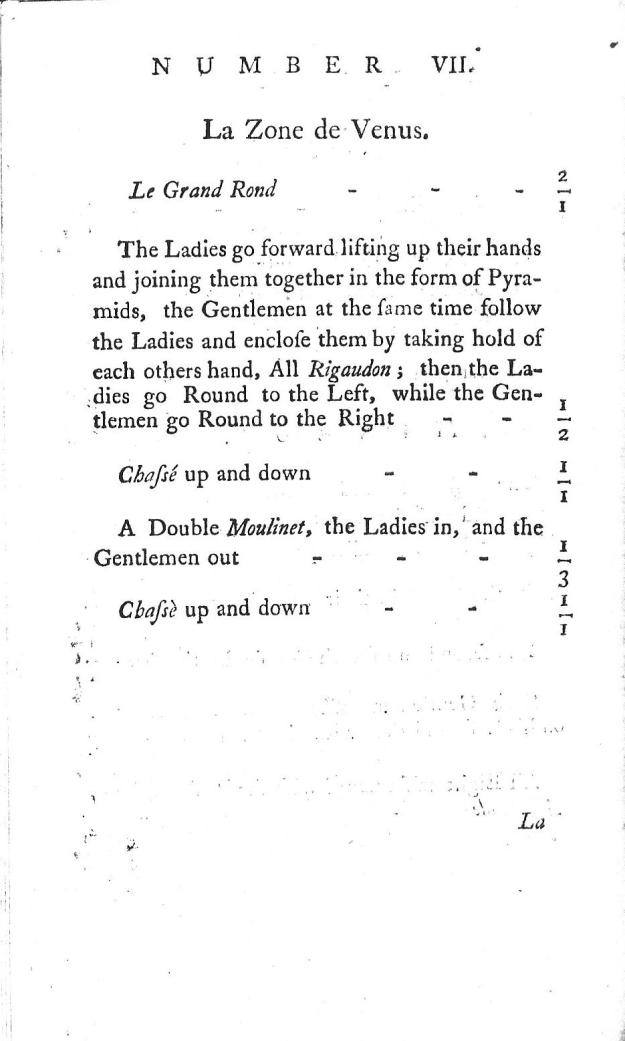
There are, of course, many allusions to love, in keeping with the galanterie inseparable from the cotillon. Gallini has L’Amour Fidelle and L’Amour du Village as well as, less obviously, Les Plaisirs Enchantés and La Pouvoir de la Beauté. The cotillon mentioned to me was La Zone de Venus. The Figure goes as follows:

Gallini Zone of Venus 1

Gallini’s Instructions for La Zone de Venus

Is it intended to represent homage to Venus and to love? In the 18th century the ‘Zone’ of Venus was identified as her girdle or ‘Cestus’, which was decorated to encourage desire. There is a painting by Sir Joshua Reynolds entitled ‘Cupid untying the Zone of Venus’, which shows him undoing the ribbon around her waist. It seems that the ‘Cestus’ became an object of interest (if indeed it was not invented) during the early 1700s. So, was Gallini’s title innocently referring to youthful love or was it intended to be risqué?

The Fundamental Step of the Cotillon

In his Le Repertoire des Bals of 1762 de La Cuisse set down the steps to be used in cotillons, although he did not explain how to perform them. One of these steps is:

‘Le Pas de Gavote ou Demi-Contretems … un Pas naturel; C’es le Pas fondamental de la Contredanse; C’est enfin avec ce Pas que se font les Ronds, les Moulinets, les Courses, et prèsque toutes les figures des Contredanses. Chacun de ces Pas vaut une demie-mesure de Musique.’

So, the demi-contretems was much used in France when dancing cotillons. As the name, as well as de La Cuisse’s explanation, implies, there were two demi-contretems to each bar of music.

Gallini made no mention of the demi-contretems among the steps in his A New Collection of Forty-four Cotillons. Perhaps this was a deliberate omission, for he writes ‘it is intended here to explain only those [steps] which are used in the following cotillons’. Gherardi included ‘Demi contre-tems d’un Pied et de l’autre’ within his list of ‘The Names of the French Country Dance Steps’ in his Fourteen Cotillons or French Dances published around 1767, repeated in his subsequent collections. Contrary to what I said in my post Dancing the Cotillon: Gherardi’s Steps, the dancing master did list some individual steps among the sequences. However, he did not explain how this, or any other, step should be performed. Hurst says nothing about steps and Siret also remains silent. Villeneuve’s list of steps does not include the demi-contretems.

The demi-contretems is a step for travelling forwards in a variety of figures, as recommended by de La Cuisse. This is how it is recorded in the 1705 dance for four Le Cotillon. This is also how it has been used in those modern reconstructions of cotillons which I have danced. I don’t know why it was ignored by some of the dancing masters publishing in London – unless the cotillons in their collections hold the answer.

In the dance manuals of the early 18th century, the first mention by name of the demi-contretems seems to be in Pierre Rameau’s Abbrégé de la nouvelle méthode published around 1725. He includes notated versions of the step, with its name, in his table ‘Suitte des contretems’ (p.65) but he does not describe it. In Rameau’s Le Maître a danser it is not mentioned by name, but its manner of performance may be taken from the description of the contretems de gavotte (translation by John Essex, The Dancing-Master, p. 97):

‘To make one with the right Foot, the Body must be on the Left in the fourth Position, the Heel of the right behind up; then sink upon the Left, and rise upon it with a Spring; but at the same Time the right Leg, which was ready to go, moves forwards in the fourth Position and on the Toes, both Legs well extended; …’

Instead of making the second step, to perform a contretems de gavotte, the dancer should transfer his or her weight onto the right foot to repeat the demi-contretems on the left.

The instruction ‘rise upon it with a Spring’ (Rameau writes ‘se relever en sautant dessus’) has resulted in two different modes of execution by dancers today. One is simply a hop followed by a step (usually onto a flat foot). The other begins with a small spring onto the ball of the foot, much like a rélevé in classical ballet, followed by step onto the ball of the foot and a quick sink into plié. The latter is more difficult and travels less, but gives a pleasing vivacity and crispness to both the step and the figures in which it is used. The demi-contretems can also be performed with a pas rond, in which the working leg traces a small half circle in the air as it passes from back to front. This little embellishment suits the rococo elegance of the cotillon very well.