Category Archives: Dance Treatises & Notations

Famous French Ballroom Dances

Among the many ballroom dances published in Beauchamp-Feuillet notation in the early 1700s, eight choreographies have a claim to be famous. All were published in notation and recorded in manuscript collections numerous times. Almost all of them survived well beyond the first decades of the 18th century. All are by Guillaume-Louis Pecour and all were originally notated and published by Raoul Auger Feuillet. Whether or not these dances continued to be performed in the ballroom, they were known to dancing masters who went on teaching them long after the style and technique they exemplified had gone out of fashion.

These are the dances, with their first date of publication:

La Bourée d’Achille (1700)

La Bourgogne (1700)

La Forlana (1700)

La Mariée (1700)

Le Passepied (1700)

Aimable Vainqueur (1701)

L’Allemande (1702)

La Bretagne (1704)

Most were long-lived, but were they really that famous?

Two of these dances, Aimable Vainqueur and La Mariée, enjoyed extended lives on the London stage and I have looked at them in earlier posts. Five of the dances (including La Mariée) come from Feuillet’s very first collection of Pecour’s ballroom dances, published in 1700 alongside his treatise Choregraphie which explains the new notation system. That treatise and its associated collections of dances were reissued in 1709 and again in 1713. Significantly, these dances (together with the other three) were all included in Pierre Rameau’s Abbrégé de la nouvelle méthode dans l’art de d’ecrire ou de traçer toutes sortes de danses de ville, first published in Paris around 1725 and intended to introduce his revised version of Beauchamp-Feuillet notation. Rameau’s Abbrégé was reissued around 1728 and again around 1732. The dances must have become more widely known through the successive reissues of both works.

Two of the dances, La Bourée d’Achille and La Bourgogne, may have had more limited afterlives than the others. Neither featured in later printed treatises and were recorded only in what are thought to be early manuscript collections of notated choreographies. Although La Bourgogne does appear in I.H.P. Maître de Danse oder Tantz-Meister published in Leipzig in 1705, indicating that it quickly became known outside France. It is interesting to note that both of the choreographies have become familiar to modern practitioners of baroque dance, as they are often taught to beginners.

Le Passepied and La Bretagne were published as late as 1760 in Madrid, within Pablo Minguet’s El Noble Arte de Danzar a la Francesa. Le Passepied had also been included in I. H. P. Maître de Danse oder Tantz-Meister, while La Bretagne appeared in the translations of Choregraphie issued in London by Siris and Weaver between 1706 and 1730. L’Allemande, which I have also mentioned in an earlier post, appeared as late as 1765 in Magny’s Principes de Choregraphie, alongside more recent dances. Magny provided it with new music, perhaps to bring it more up-to-date. The choreography with the longest life of all was La Forlana, published around 1780 in Paris in a new notation by Malpied.

These dances probably owed their fame and longevity to a variety of factors, including their music, their original performers, their associations with particular people or places and perhaps the desire of individual dancing masters to find favour in court circles. They underline Europe’s (including Britain’s) widespread and enduring fascination with French court culture and not least its expression through dancing. I hope to be able to say more about them, particularly within an English context, in future posts.


Enjoying the Minuet ‘à Quatre’

About three years ago, I wrote some posts about dances for four. With the earlier ones, I speculated that they were more enjoyable than the danses à deux because they were less technically demanding. This very obviously applied to the minuets ‘à quatre’ of which five survive in notation.

Le Menuet à Quatre. Anonymous, 1706.

Minuet & Jigg. Mr Holt, 1711

Menuet à Quatre. Pecour, c1713

Minuet aquatre figuret. Pecour, [1700-1725? Manuscript collection compiled 1751]

La Carignan, Menuet à Quatre. Dezais, 1725

I discussed Mr Holt’s Minuet & Jigg back in 2015, so this time round I will look just at the four French choreographies.

Unlike the English dance, the French ones are all simply minuets using the pas de menuet pretty well throughout. Before I analyse each of them in more detail, here are some facts and figures for comparison.

The anonymous Menuet à Quatre appears in Feuillet’s Vme Recueil de danses de bal pour l’année 1707 published in 1706. It is the last of the three dances in that collection, the other two being danses à deux. The source of the music has not been identified, although it does appear in a set of ‘Suites de danses … qui se joüent ordinairement à tous les bals chez le Roy’ dated to the first decade of the 18th century. In his Avertissement for the collection, Feuillet says that the minuet is ‘si en vogue qu’il ne se fait aucune assemblée où il ne soit dansé’, adding that he has ‘pris le 1er air qui m’a tombé sous la main car tous les menuets y sont également bons’. The choreography has the musical structure AABBAAB (A=B=4) and is short, with only 28 bars in 6/4.

Pecour’s Menuet à Quatre appears in the Nouveau recüeil de dance de bal et celle de ballet published by Gaudrau around 1713. This collection brings together 9 ballroom dances and 30 theatre choreographies, with the Menuet à Quatre as the last but one of the ballroom dances. The musical source has not been identified. The choreography has the musical structure ABACABACA (A=B=C=8) giving a rondeau form and 36 bars in 6/4 (the music is written in 3). Again, this dance is short. In his Preface to the collection, Gaudrau tells us that Pecour’s choreography was danced at the last ball at Marly (Louis XIV’s country retreat, where the King could relax away from the rigorous etiquette of Versailles).

Dezais includes La Carignan, Menuet à Quatre in his Premier livre de contredances published in 1725. Little or no research has been done on this collection (which does not feature either in the Little & March 1992 catalogue La Danse Noble or Lancelot’s La Belle Dance of 1996) so I cannot tell whether there is a concordance for the music. This choreography uses a musical structure 3 x AABB (A=B=4). At 48 bars of 6/4 music it is a little longer than its predecessors.

The Minuet aquatre figuret by Pecour is recorded in the manuscript compiled by the dancing master Felix Kinski in Oporto in 1751. It appears among other French ballroom choreographies, presumably brought together (and taught) by Kinski. This minuet for four is very different from the others. The choreography’s music, for which no source has been identified, has the structure 7 x AABB + AA (A=8 B=16) with 120 bars in 6/4 (the music is written in 3). The dance has a ‘Change’ and ‘Figure’ structure very much like a cotillon. As I mentioned in posts back in 2014, the form of the cotillon goes back at least as far as 1705 and Feuillet’s ballroom dance for four entitled Le Cotillon. Such dances seem to have been popular around 1715-1725, so perhaps Pecour’s choreography belongs to that period.

What do these facts and figures tell us? The evidence confirms a couple of things. One is that menuets à quatre were danced at French royal balls and were popular lower down the social scale. Another is that, like the menuet à deux, they could be danced to any minuet music (though, perhaps, the A, B and, sometimes, C strains needed to be the right length).

I will address other questions in later posts, for example how the menuets à quatre relate to the menuet à deux as recorded by Pierre Rameau in his 1725 treatise Le Maître a danser and how they relate to each other.

Anon Menuet a Quatre 1

Anonymous. Le Menuet à Quatre (Paris, 1706), First plate.

The Passacaille

As every musician knows (but not necessarily every dancer), the passacaille is a set of variations over a repeated 4-bar bass line. It shares this musical form with the chaconne, although the notated dances surviving from the 18th century reveal several differences between them. In her recent book Dance and Drama in French Baroque Opera, Rebecca Harris-Warrick looks at passacailles and chaconnes from various perspectives. Her observations are of interest in relation to the appearance of these dances on the London stage. Harris-Warrick points out that passacailles have a slower tempo than chaconnes and that they are often found in association with women ‘not infrequently when seduction is involved’ (p. 60). She also explains that they are the longest of the dances performed on stage and usually feature soloists and groups of dancers in their choreography (although this is not the case with the notated dances).

Passacailles are indeed the longest of the surviving recorded choreographies, in particular two solos created for female professional dancers: Anthony L’Abbé’s ‘Passagalia of Venüs & Adonis’ for Hester Santlow to music from Desmaret’s 1697 opera Vénus et Adonis, 209 bars; Guillaume-Louis Pecour’s ‘Passacaille pour une femme’ for Marie-Thérèse Subligny to music from Gatti’s 1701 opera Scylla, 219 bars. In all six passacailles survive in notation, published between 1704 and the mid-1720s. All are to music from French operas, four are female solos, one is a female duet and one is a duet for a man and a woman.

Advertisements indicate that the passacaille was performed in the entr’actes at London’s theatres quite regularly between the 1705-1706 and 1735-1736 seasons. It was given either as a solo or a duet but not, apparently, as a group dance. The solos are exclusively performed by women, from Mrs Elford at the Queen’s Theatre on 13 June 1706 (when she danced a ‘Chacoon and Passacail’) to Mrs Bullock at Goodman’s Fields on 13 October 1735. Duets were quite rare, although four different couples were billed between 1715-1716 and 1725-1726. After 1735-1736, the dance type disappears from the bills, except for a single performance of ‘A New Dance call’d Le Passecalle de Zaid’ by Anne Auretti at Drury Lane on 26 March 1754 (the occasion was her benefit). The passacaille reappears in the early 1770s for occasional performances until the mid-1780s.

For most of the passacailles performed in London, it is all but impossible to know what was danced either in terms of the music or the choreography. There are exceptions. The earliest is Pecour’s version of the passacaille from Lully’s 1686 opera Armide, created as a solo for Mlle Subligny and performed by her ‘en Angleterre’ during the winter of 1701-1702 – the only time she visited London. This demanding solo (a mere 149 bars) was published in notation around 1713.

Pecour Passacaille Armide 1

Guillaume-Louis Pecour, ‘Passacaile’, Nouveau recueil de danse de bal et celle de ballet (Paris, [c1713]), pl. 79

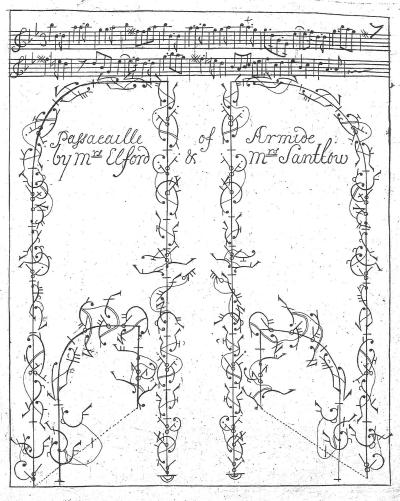
Anthony L’Abbe’s version of the passacaille from Lully’s Armide was created as a female duet, and must have been danced late in the 1705-1706 season in the brief interval between Mrs Santlow’s debut and Mrs Elford’s retirement.

Labbe Passacaille Armide 1

Anthony L’Abbé, ‘Passacaille of Armide’, A New Collection of Dances (London, c1725]), pl. 7

In his Preface to The Art of Dancing, the manual of dancing he published in 1735, Kellom Tomlinson referred to ‘Miss Frances, who, on the Theatre Royal in Little Lincoln’s Inn Fields, performed the Passacaille de Scilla, consisting of above a thousand Measures or Steps, without making the least Mistake’. He seems to be referring to the music from Gatti’s Scylla, if not to the choreography created by Pecour for Mlle Subligny (although neither the music nor the notated dance extends to a thousand bars). A Miss Francis did in fact dance a ‘new Passacaille’ at the Lincoln’s Inn Fields Theatre on 19 March and again on 27 April 1719. The other exception is, of course, L’Abbé’s solo for Mrs Santlow referred to above. Although no date or place for a performance of this choreography is known, it is a stunning example of the challenges of such a dance.

Was the music for the other passacailles billed in the early 18th century invariably French? There are some beautiful examples of the dance type (usually titled chaconnes but with the features of passacailles) among late 17th-century music by English composers. Some of these were undoubtedly danced in the semi-operas of the period. Did any of the other performers billed in passacailles dance the choreographies that have survived? Mrs Bullock is known to have been a virtuoso dancer. She danced a passacaille with Charles Delagarde at Lincoln’s Inn Fields on 7 May 1716 as well as her later solo, either of which could have drawn on notated dances. Since they were showpieces, it is not surprising that most passacailles were billed for benefit performances, although not always the dancer’s own. It is interesting that not one of the named performers, male or female, of passacailles given in London up to 1735-1736 is French. There are many puzzles about French dancing in London’s theatres in the early 18th century.

Serious Dancing

In his An Essay towards an History of Dancing (1712), John Weaver described three distinct genres of stage dancing ‒ serious, grotesque and scenical. He drew on all three in The Loves of Mars and Venus, beginning with serious dancing in the first two scenes of the ballet, which introduce in turn Mars and Venus. I have quoted this passage from Weaver’s Essay before, in a piece about stage dancing posted more than two years ago, but it is worth repeating:

Serious Dancing, differs from the Common-Dancing usually taught in Schools, as History Painting differs from Limning. For as the Common-Dancing has a peculiar Softness, which would hardly be perceiveable on the Stage; so Stage-Dancing would have a rough and ridiculous Air in a Room, when on the Stage it would appear soft, tender and delightful.’

Weaver was drawing attention to the greater power and amplitude in the performance of dancing on stage. His list of ‘some Steps peculiarly adapted to this sort of Dancing’ reveals its innate tendency to virtuosity, for he mentions ‘Capers, and Cross-Capers of all kinds; Pirouttes [i.e. pirouettes], Batteries, and indeed almost all Steps from the Ground’. These are among the more difficult steps recorded in Feuillet’s Choregraphie and Weaver had himself recorded them in notation for his translation of that work.

Is he contradicting himself when, in his next paragraph, he declares that serious dancing is ‘the easiest attain’d’ of the genres, even if he adds that ‘a Man must excel in it to be able to please’?

Despite his dismissal of serious dancing, at least so far as his ambitions for dance drama are concerned, Weaver provides further insights into its demands.

‘There are two Movements in this Kind of Dancing; the Brisk, and the Grave; the Brisk requires Vigour, Lightness, Agility, Quicksprings, with a Steadiness, and Command of the Body; the Grave (which is the most difficult) Softness, easie Bendings and Risings, and Address; and both must have Air and Firmness, with a graceful and regulated Motion of all Parts; but the most Artful Qualification is a nice Address in the Management of those Motions, that none of the Gestures and Dispositions of the Body may be disagreeable to the Spectators.’

He is, of course, talking about the rigours of classical dancing, the genre that strives for formal technical perfection.

Weaver is forced to admit that ‘the French excel in this kind of Dancing’ and he singles out Guillaume-Louis Pecour, ballet master at the Paris Opéra, as an exemplar in the genre. It is interesting that Weaver lauds Pecour for his mastery of ‘the Chacoone, or Passacaille, which is of the grave Movement’. In London, Anthony L’Abbé created two highly virtuosic solos: the ‘Chacone of Amadis’, to music from Lully’s 1684 opera Amadis, for Louis Dupré – Weaver’s Mars; and the ‘Passagalia of Venüs & Adonis’, to music from Desmarets 1697 opera Venüs & Adonis, for Hester Santlow – Weaver’s Venus. Both choreographies post-date Weaver’s Essay and perhaps date to shortly before The Loves of Mars and Venus. They reflect the tradition of French serious dancing to which Weaver’s two principal dancers, and indeed Weaver himself (as a teacher at least), belonged.

Strathy’s Elements

Alexander Strathy’s Elements of the Art of Dancing was published in Edinburgh in 1822. In his introduction, Strathy observes ‘Dancing may be said to be to the body, what reading is to the mind … It embellishes and perfects the work of nature, and enables us to present ourselves in society with an amiable and becoming ease’. He ends by explaining ‘Although the elementary steps described in this essay apply to dancing in general, I have more especially in view that style of dancing denominated La Danse de la Ville, or the Quadrille’. Despite his emphasis on social dancing, Strathy’s treatise makes considerable demands on amateur dancers.

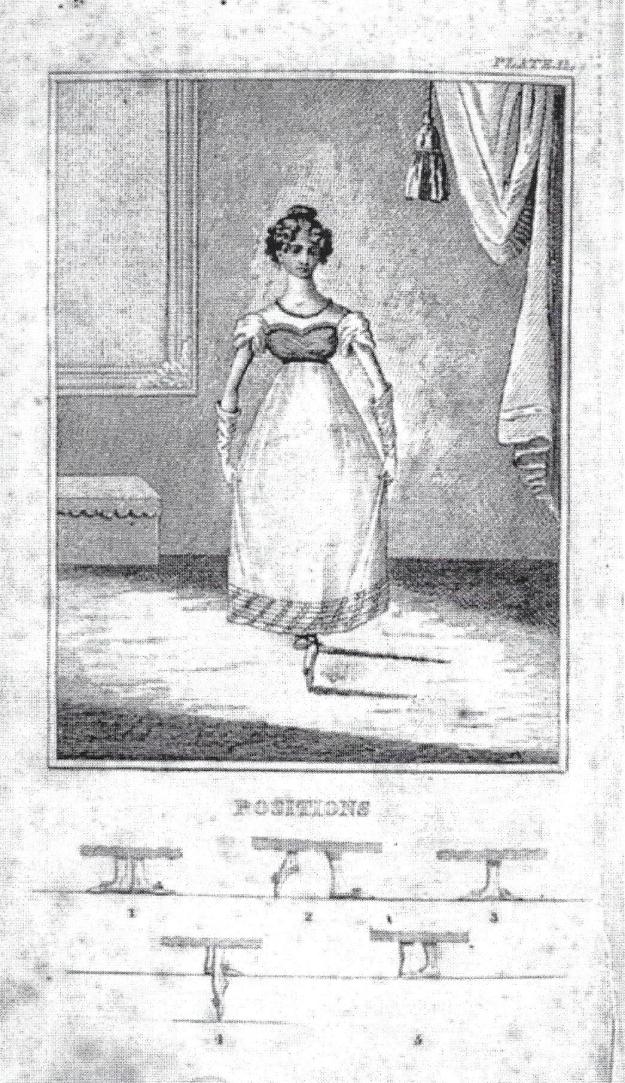
A first clue to these demands appears in the second plate, showing a young lady ready to dance. The positions of the feet at the bottom of the page are recognisably derived from ballet, and require a full ninety-degree turnout.

Strathy Plate Lady

Strathy. Elements of the Art of Dancing (1822), plate II.

Strathy does indeed describe these positions (which had been established in the mid-17th century) and emphasises the importance of proper turnout of the legs. He goes on to describe several training exercises, from bends and rises to various grand battements and petit battements while holding on to a support for balance. Many of these still form part of the barre work in a ballet class today.

Strathy’s steps include assemblés, jetés, glissades, sissonnes, temps levés, chassés and changements. Some of these relate closely to their modern ballet equivalents while others differ in certain respects. One important difference is the omission of the jump from assemblés and jetés. These are performed with a sink and rise, which provides a similar effect but makes them more elegant and provides a contrast with the other jumped steps. Some steps seem to have been taken from the stage, for example the pas de Zéphyre (which I will explore further in a later post).

Strathy’s little treatise is a good place to start for dancers willing, and with the skill, to add more demanding steps to their quadrilles. It is also a great introduction to early 19th-century dance for those with some background in ballet.

Reconstructing Isaac’s Rigadoon

After several sessions, I have finally learnt the whole of Isaac’s Rigadoon and I am beginning to feel comfortable enough with the choreography to work on shaping it as if for performance.

Isaac focusses on the changing rhythms and shifting dynamics of the Rigadoon’s steps. The footwork is not complicated, there are no quasi-theatrical steps but they are difficult to perform clearly and accurately, particularly at speed. The dance does need to be quite fast to make its proper effect. Isaac repeats steps and even short sequences, but he never exactly replicates sequences elsewhere in the choreography. I have found The Rigadoon quite hard to learn and I am still struggling to find the best way to perform the basic steps. How far should these travel? How much spring should there be in the jettés that come at the end of so many of them? I have performed many of the notated theatrical dances, which need amplitude and force even in basic steps. The Rigadoon requires neither, although it certainly demands swift and lively dancing.

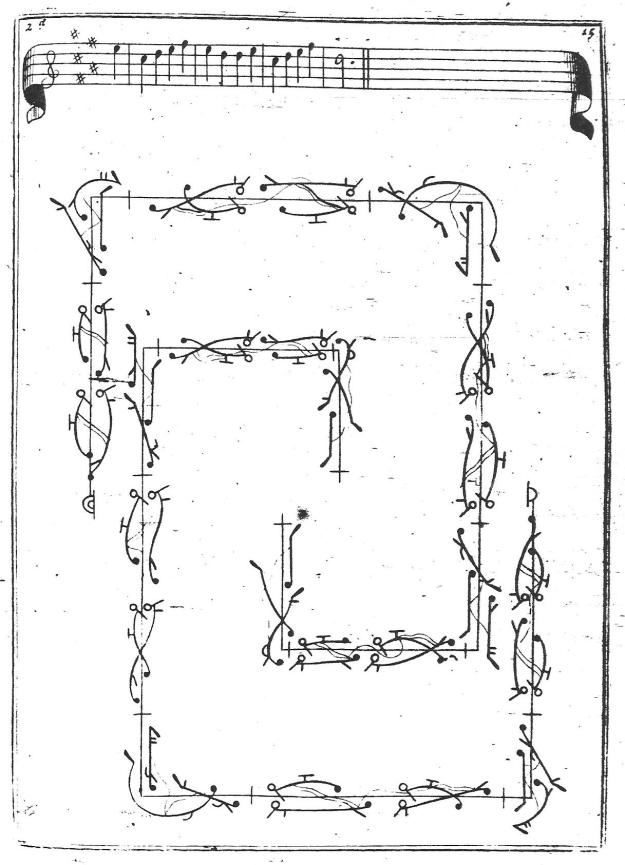
The famous figure with glissades, that according to Kellom Tomlinson ‘forms a perfect Square’ (The Art of Dancing, p. 56), is very hard to get right.

Isaac Rigadoon 2

Isaac, The Rigadoon (1706), plate 2/15.

Each bar has two glissades and so has two mouvements and two steps with glissé. These need fast reactions in feet and ankles and downward pressure, without being heavy. The notation of the pas de bourées used to turn the corners is interesting. Each is different and three of them apparently require the first demi-coupé to move on an outward diagonal. I haven’t got this right yet, but it must surely serve to align the partners within the dancing space as well as with each other. The perfect square is formed by the paths of both dancers, who should end where they began but facing each other up and down the room instead of across it. I would love to work on this figure with a partner.

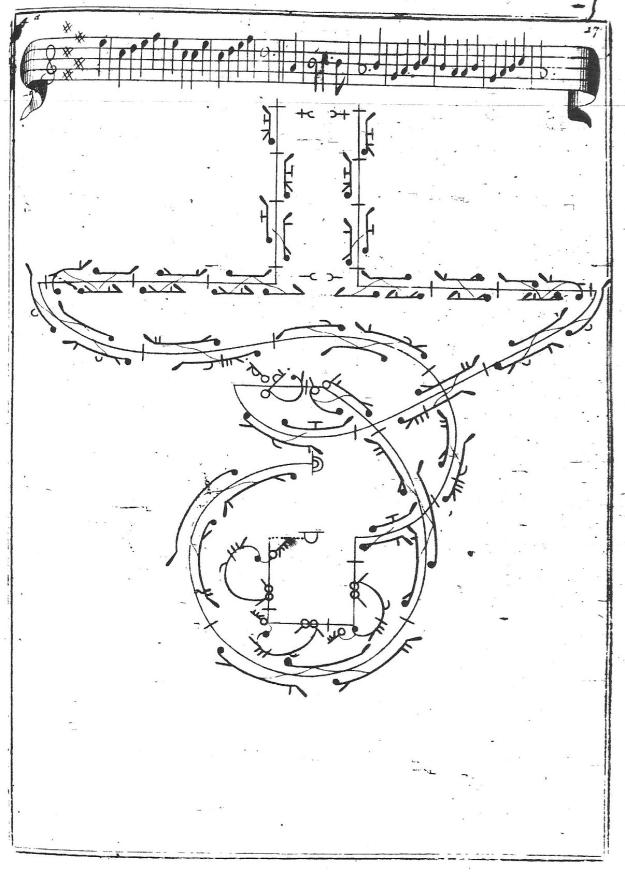
It is hard to get a proper sense of the figures in a duet when working on it alone. This is particularly true of the asymmetric figure in The Rigadoon, in which the man performs three quarter-turn sprung pirouettes as the woman dances around him with pas de bourées and he then moves around her with a coupé, a contretems with a bound and a pas de bourée as she does a coupé to first position, a half-turn pirouette and a coupé.

Isaac Rigadoon 4

Isaac, The Rigadoon (1706), plate 4/17

It is such a shame that I am unlikely to get to work on this dance with a partner. I would love to sort out exactly what happens in this section and how it should be performed.

I can’t really analyse the whole dance within a single blog post, so I will just look at those of Isaac’s choreographic effects that I really enjoy (from the point of view of the lady, as this is the side I have been working on). One is his use of the coupé to first position, in the second B section and the third A section. It brings the dancer to a dynamic stop after a lively sequence of pas de bourées. In both cases it is followed by a pirouette. The two B sections in the third AABB repeat reveal Isaac’s love of rhythm as well as his wit. The first B sequence comes at the top of the page, just below the music, in the plate illustrated above. There is a little game with the mouvement in demi-coupés, coupé and pas de bourée. Then in the second B (on the next plate of the dance, not shown here) there is a contrast between sliding steps and springs in two consecutive pas de bourée. I love the way Isaac has the couple bound towards one another before turning to face the back in order to travel away from the presence. Even though I can’t try this out with a partner, it always makes me smile.

The point is, of course, that Isaac’s Rigadoon isn’t simply a difficult dance exercise. It is a challenging choreography that is rewarding to learn and wonderful fun to perform. The same is true of the other dances by him that I have performed, including The Richmond, The Saltarella, The Pastorall and even The Union.


‘Spanish’ dancing and the dance treatises

Spanish dancing features very little in the early 18th-century dance treatises. Feuillet makes no reference to Spanish styles and techniques of dancing in Choregraphie, except for a section ‘De la batterie des Castagnettes’ towards the end of the manual. He provides notation for the arm movements as well as castanet beats to accompany steps danced to the Folie d’Espagne melody. His little 16-bar choreography does not correspond to any of the four Folie d’Espagne dances that survive in notation. In particular, it does not have the 8-bar repeat structure found in those but is through-composed. Feuillet says nothing about castanets being Spanish, but his choice of the Folie d’Espagne music for his example suggests the link. In his translation Orchesography, John Weaver omits Feuillet’s section on castanets altogether.

In his Neue und Curieuse Theatrialische Tantz-Schul of 1716, Lambranzi includes a plate showing a solo male dancer performing to the Folie d’Espagne tune. He says only:

‘In this dance pas de courante, pas graves, ballonnés, pas de sissonne and pas de chaconne must be employed, together with such other pas as the dancer may select.’

There is nothing inherently Spanish about the steps listed (except that the chaconne has a Spanish origin) and the dancer is not shown holding castanets. So is the dance ‘Spanish’ at all, apart from its music?

Lambranzi Folie 1-3

Lambranzi, Neue und Curieuse Theatrialische Tantz-Schul (1716), Part 1, plate 3

In his 1717 treatise Rechtschaffener Tantz-Meister, Taubert includes notation for five Folie d’Espagne variations for a solo woman. These were presumably taken directly from Feuillet’s choreography in his 1700 Recueil de dances. Taubert includes it as an example of ‘high theatrical’ dance. He says nothing about it being Spanish, but he probably assumed that the title of the music would speak for itself.

Pierre Rameau makes no mention of Spanish steps or dances in either of the treatises he published in 1725, Le Maître a danser and Abbrégé de la nouvelle méthode. This is possibly because his focus was solely on ballroom dancing. At that period, ‘Spanish’ dances were almost all intended for the stage.

By contrast, in The Art of Dancing Kellom Tomlinson refers several times to ‘Spanish’ dances, all of them stage choreographies. In his explanation of ‘the Close beating before and falling behind in the third Position, upright Spring changing to the same before, and Coupee to a Measure’ he cites Pecour’s ‘Spanish Entree for two Men’ and ‘Entree Espagnole for a Man and a Woman’ as dances within which this pas composé was used. Was there anything particularly ‘Spanish’ about this combination, or were the two dances merely ones with which Tomlinson was familiar as sources for a step sequence he liked? I will come back to this sequence in a later post.

In his 1762 A Treatise on the Art of Dancing, Giovanni-Andrea Gallini comments:

‘In Spain, they have a dance, called, Les Folies d’Espagne, which is performed either by one or by two, with castanets. There is a dress peculiarly adapted to it, which has a very pleasing effect, as well as the dance itself.’

His remarks are picturesque but, apart from the linking of castanets with ‘Spanish’ dancing and the tantalising reference to the dress ‘peculiarly adapted to it’, they are not particularly informative.

Far more helpful is Gennaro Magri in his Trattato Teorico-Prattico di Ballo published in Naples in 1779. Magri discusses ‘Spanish’ positions alongside the long-established true and false positions (which feature in Feuillet’s Choregraphie). They correspond to the five true positions, except that the feet are in parallel and not turned out. Magri also points out that both false and Spanish positions occur in pas tortillés, which are recorded in early 18th-century treatises and notations. This suggest another possible line of enquiry.

So, there are some pointers to the style and technique of ‘Spanish’ dancing in the 18th century. I should make it clear that my interest here is in ‘Spanish’ dancing as it might have been performed on the London stage in the early 1700s, where it was most likely filtered through ‘French’ dancing.


Isaac’s Rigadoon

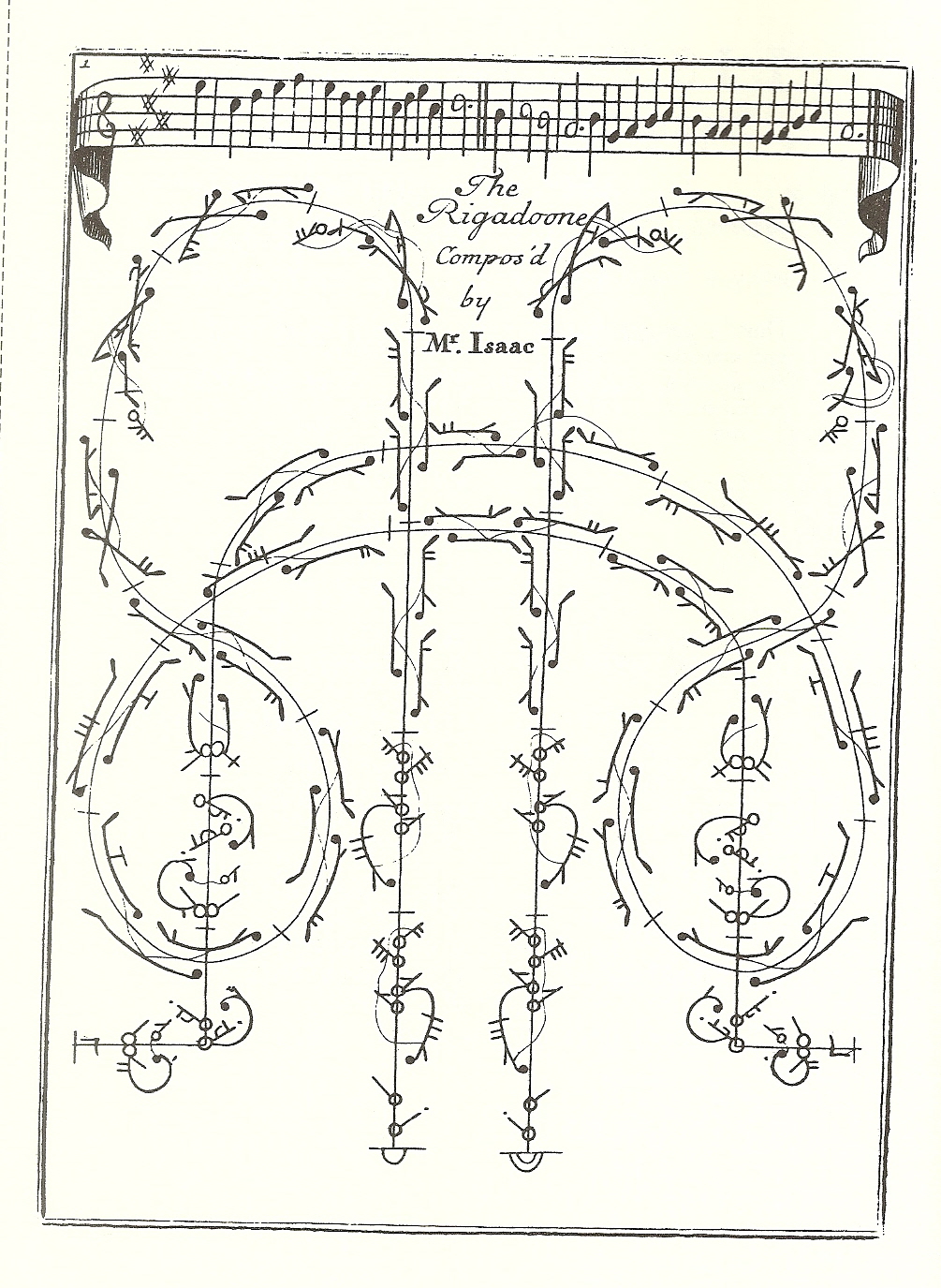
I am currently learning another of the most famous ballroom dances of the 18th century, Mr Isaac’s The Rigadoon. I first worked on this lively duet some years ago, but I never performed it and I’ve had to start on it afresh. The Rigadoon, like much of the rest of the ‘English’ baroque dance repertoire, rarely (if ever) features in workshops in the UK. Perhaps this is because these dances are choreographically idiosyncratic – and difficult. This is a pity, since they have much to offer in helping us to understand the dancing of the period and they are sheer pleasure to dance.

Mr Isaac. The Rigadoon (1706), first plate

Mr Isaac. The Rigadoon (1706), first plate

The duet is, of course, a rigaudon. The music has been attributed to James Paisible, the French recorder player who made his career in London, but this is by no means certain. Mr Isaac’s The Rigadoon has been dated as early as 1695. It was first published in 1706 in A Collection of Ball-Dances perform’d at Court, notations by John Weaver of six of Isaac’s choreographies. That same year, the dance also appeared in a different version notated by the dancing master Siris and published in his The Art of Dancing alongside Pecour’s ball dance La Bretagne. Siris’s The Art of Dancing was a rival to Weaver’s translation of Feuillet’s Choregraphie.

Weaver evidently passed his notations (or rather, the plates on which they were engraved) to the music publisher John Walsh, who reissued The Rigadoon along with other dances by Isaac around 1708 and again about 1712. Walsh published a second edition of Weaver’s Orchesography around 1722. In a late response to Siris, Weaver added notations of The Rigadoon, The Louvre (Pecour’s ball dance Aimable Vainqueur) and The Bretagne. Orchesography was reissued, with its dances, around 1730. Within thirty years of its first appearance in print, Isaac’s The Rigadoon had gone through at least six editions.

Weaver drew particular attention to Isaac’s dance in Orchesography, by including four steps from it in a ‘Suplement of Steps’ at the end of his step tables.

Raoul Auger Feuillet transl. John Weaver, Orchesography (1706), ‘A Suplement of Steps’

Raoul Auger Feuillet transl. John Weaver, Orchesography (1706), ‘A Suplement of Steps’

The steps, and Weaver’s comment on how graceful and unusual they are, provide a glimpse of English choreographic taste as exemplified by The Rigadoon.

Isaac’s The Rigadoon seems to have been continued to be taught and given in the ballroom for many years. In his 1729 poem The Art of Dancing, Soame Jenyns (referring to the invention of dance notation) wrote:

‘Hence with her Sister-Arts shall Dancing claim

An equal Right to Universal Fame,

And Isaac’s Rigadoon shall last as long

As Raphael’s Painting, or as Virgil’s song.’

A few years later, in 1735, Kellom Tomlinson referred to The Rigadoon several times in his manual The Art of Dancing. In describing ‘the Slip’, i.e. the glissade, Tomlinson wrote:

‘ … twice slipping behind, is in the Rigadoon of the late Mr. Isaac, where, in the Beginning of the Tune, the second Time of playing over, it forms a perfect Square, which is no small Addition to the Beauty of the said Dance; …’

Tomlinson mentions a number of notated dances in The Art of Dancing. Are these the choreographies he taught to his own pupils, including Isaac’s The Rigadoon?

Twelve years later, in his Essay on the Advantage of a Polite Education published in 1747, Stephen Philpot also referred to Isaac’s The Rigadoon since he featured the dance in his own teaching practice. The ball dance may well have survived into the 1750s. On 19 March 1752 at the Covent Garden Theatre, Cooke and Miss Hilliard gave ‘A Ball Dance call’d the Rigadoon concluding with a Minuet’. The performance was a benefit for Cooke.  On 12 May 1753 at Drury Lane, Mr and Miss Shawcross danced ‘The Rigadoon and Minuet’ for his shared benefit. If these performances were indeed Isaac’s The Rigadoon, then the dance must have continued to be taught in dancing schools for more than fifty years.

I will take a closer look at the choreography of The Rigadoon in a later post.


Country Dancing Further Improved

The publication history of For the Further Improvement of Dancing, John Essex’s translation of Feuillet’s 1706 Recueil de contredances, is not entirely straightforward and raises some interesting questions.

For the Further Improvement of Dancing is dated 1710 on its title page. The earliest advertisement I know is in the Tatler for 23-25 March 1710. A third edition was advertised in the Spectator (the successor publication to the Tatler) for 5 March 1712. I have not yet come across an advertisement for a second edition. Indeed, there is no explicit evidence for the successive editions in any of the surviving copies of this collection. The first edition was sold by the music publishers Walsh, Randall, Hare and Cullen, together with the author. According to the Spectator advertisement, the third edition was ‘to be had nowhere but at the Author’s House in Rood-lane, Fenchurch Street’. How should this be interpreted? Had Essex simply taken over the remaining copies printed in 1710 to sell himself as a ‘third’ edition? Or had he fallen out with the music publisher John Walsh, as others were to do later?

There is just one copy of For the Further Improvement of Dancing which is indisputably a new edition, or, to be more precise, a reissue of the original edition in a different format with additional dances. Essex’s translation had originally been printed in the small, duodecimo format. This reissue is a much larger folio. It uses the original plates (For the Further Improvement of Dancing is printed throughout from engraved copper or pewter plates), but these are placed four to a page.

John Essex, For the Further Improvement of Dancing [1715?], plates 1 - 4

John Essex, For the Further Improvement of Dancing [1715?], plates 1 – 4

The newly added dances are readily identified by their larger format. There is one ballroom duet, The Princess’s Passpied, which shows the new layout:

John Essex, The Princess's Passpied, [1715?], first plate

John Essex, The Princess’s Passpied, [1715?], first plate

There are five new country dances, also in the new layout:

Liberty & Property

The Lottery

Mr La Gard’s Royall Swede

The Careless Husband

The Little Whigg

I will return to the titles of these in a subsequent post.

The volume is dedicated to the ‘Princess of Wales’, dating it to after the Hanoverian accession on 1 August 1714. The Princess is Caroline, wife of George Augustus the son of King George I. Essex praises her ‘Patronage and Encouragement’ of the art of dancing and offers her the dances he has added to his original treatise. I suggest that The Princess’s Passpied was intended for performance by Caroline’s eldest daughter Anne, the Princess Royal aged around seven, who would be the dedicatee of several more notated ballroom dances. The sole surviving copy of this folio edition of For the Further Improvement of Dancing, now in the British Library, may well be a presentation copy made especially for Caroline, Princess of Wales.

It is interesting to note that this unique copy, which has been dated to 1715, has an imprint claiming that it was to be sold by Walsh, Hare and ‘the Author’.  By this time, John Essex was presumably well-known as a dancing master. He was certainly careful to ensure that the title page specified that he ‘taught all the Ball Dances of the English and French Court’, probably meaning those that had been published in Beauchamp-Feuillet notation. The inclusion of The Princess’s Passpied would have underlined his expertise. Was he trying to recommend himself as dancing master to the new royal family?

Country Dancing Improved

A little while ago, I attended a ball where one of the country dances was The Busie Body. When I was told that it was by John Essex, I thought I ought to explore further.

In 1710, Essex translated Feuillet’s 1706 Recueil de contredances as For the Further Improvement of Dancing. What he translated was Feuillet’s introductory treatise on the simplified notation system used to record country dances. Instead of merely reproducing Feuillet’s collection of 32 country dances, Essex selected 10 from various sources. Three come from Feuillet’s 1706 Recueil: Pantomime; Gasconne; and The Female Saylor (La Matelotte in Feuillet). Two more dances are also French: Micareme and The Diligent, both from Feuillet’s VIme. Recüeil de danses et de contredanses pour l’Année 1708. The other five dances were, as Essex tells us in his Preface, ‘my own composing’. These are the dances titled Trip to the Jubilee, The Great Turk, The Busie Body, The Tatler and The Tost.

If the French were acknowledged as the masters of ballroom and stage dancing, la belle danse, the English claimed primacy in country dancing. Essex was happy to wave the flag in his Preface to For the Further Improvement of Dancing.

John Essex, Preface, For the Further Improvement of Dancing (1710), first page

John Essex, Preface, For the Further Improvement of Dancing (1710), first page

In this post, my interest lies in the titles of Essex’s own country dances and their links with stage and society in London.

Trip to the Jubilee must refer to Farquhar’s play The Constant Couple; or, The Trip to the Jubilee, first performed (so far as we know) at the Drury Lane Theatre on 28 November 1699. Farquhar’s play was one of the most popular of the early 18th century and was performed regularly until the 1790s. The ‘Jubilee’ was the Pope’s Jubilee year to be celebrated in Rome in 1700 – a trip to this event was a running joke throughout The Constant Couple. The dance and its music were first published in 1701 in the 11th edition of The Dancing-Master, described ‘as ‘tis Danced at the Play-House’. So it seems that Essex actually created this country dance for Farquhar’s play. He is certainly recorded as a professional dancer at Drury Lane in the first years of the 18th century.

The Great Turk uses music from the Turkish Entrée in Campra’s 1697 opéra-ballet L’Europe galante. Anthony L’Abbé made use of the same piece for his Türkish Dance in the early 1720s. Essex’s use of the music suggests that it was already familiar in London some years earlier. It is worth noting the danced entr’acte ‘Entertainment after the Turkish Manner’ given at Drury Lane on 2 February 1710. Did this perhaps also use Campra’s music?

The title of The Busie Body is taken from Mrs Centlivre’s play of the same name, first given at Drury Lane on 12 May 1709. This was another successful comedy played regularly in London’s theatres until the end of the century.  The published play has ‘A Dance’ towards the end, in accordance with the convention of a country dance performed by a play’s characters as the plot concludes. Could Essex’s dance have been performed in the original production of The Busie Body, even though he makes no mention of this?

The Tatler, obviously, refers to the famous periodical launched by Sir Richard Steele in 1709 and published three times a week until 1711. It dealt in news, gossip and the manners of the day and was frequently reprinted in collected editions throughout the 1700s.

The title The Tost was corrected to The Toast when Essex reissued For the Further Improvement of Dancing around 1715. (I will talk about this reissue in a later post). Essex may well have had in mind the ‘Toast’ as explained by Steele in the Tatler for 4 June 1709. She is:

‘… the Lady we mention in our Liquors, … call’d a Toast. … The Manner of her Inauguration is much like that of the Choice of a Doge in Venice: it is perform’d by Balloting; and when she is so chosen, she reigns indisputably for that Year; but must be elected anew to prolong her Empire a Moment beyond it.’

Was this dance implicitly dedicated to a well-known ‘Toast’ of the Kit-Cat Club (of which Steele was a member and to which he was referring)? Or was it meant as a compliment to the Duchess of Bolton, to whom Essex dedicated his collection? She was Henrietta née Crofts (c1682-1730), the illegitimate daughter of James, Duke of Monmouth. She married the second Duke of Bolton in 1697.

With his dances in For the Further Improvement of Dancing Essex is surely trying to appeal to a fashionable, London-based élite – the beau monde – members of which he hoped to attract as pupils.