Category Archives: Ballroom Dancing

A Year of Dance: 1714

A while ago, I had the idea of looking at significant dance events year by year, placing them within a wider context and slowly developing a more detailed chronology than most dance histories can provide. 1714 seems as good a place to start as any. The year was notable for the death of Queen Anne, on 1 August, and the accession to the British throne of her protestant cousin the Elector of Hanover as King George I.

At the English court the social calendar revolved around royal birthdays, the accession and coronation days of the current monarch, New Year’s Day and Twelfth Night. All were occasions for dancing. Queen Anne’s birthday on 6 February had been the occasion of festivities throughout her reign. 1714 was no exception, with music, a ball and a ‘splendid entertainment’ at Windsor in the presence of the Queen herself. Her dancing master Mr Isaac created a new dance in her honour, The Godolphin named for Lady Harriot Godolphin the grand-daughter of the Duke and Duchess of Marlborough and (at the age of fifteen) a lady of the bedchamber to the Queen. The dance was published in notation on 11 February 1714.

Mr Isaac. The Godolphin (London, 1714). Title page.

Mr Isaac. The Godolphin (London, 1714). Title page.

The status of another dance, published on 4 March 1714, is uncertain. The only surviving copy of The Siciliana by Siris has no title page but, like Isaac’s choreography, it was published by John Walsh and may have been intended to capitalise on the Queen’s birthday celebrations.

George I arrived in England before the end of September 1714, with his son the new Prince of Wales. His daughter-in-law Princess Caroline arrived in London, with her three daughters, in October. The coronation took place in late October 2014. There are no records of any balls at court or the publication of any dances until the following year, when the usual festivities were resumed.

One other event of note was the re-opening of the Lincoln’s Inn Fields Theatre, renewing theatrical competition in London. This led very quickly to a great deal more dancing in the playhouses.  It seems that there was dancing at the first performance at Lincoln’s Inn Fields and there were at least six dancers (two women and four men) in the company. They appeared regularly throughout the season.

In London, dances were often published singly in notation whether or not they had a royal connection. In Paris, small collections of dances were published ‘pour l’année’ in time for the balls held during the carnival season (between Twelfth Night and the beginning of Lent). The XIIe Recueil de danses pour l’année 1714, published by Jacques Dezais, contained three duets – La Gavotte de Seaux and a Rigaudon by Claude Ballon and Dezais’s La Chamberi.

The Château de Sceaux was the venue for an experiment in dancing. At one of the duchesse du Maine’s ‘Grands Nuits’ of entertainments during 1714, Mlle Prévost and M. Ballon (leading dancers at the Paris Opéra) gave a scene from Corneille’s tragedy Les Horaces as a ‘danse caracterisée’. They performed with such intensity that they reduced themselves, as well as their audience, to tears. This event calls into question the idea that French stage dancing was fundamentally inexpressive. By 1714, Louis XIV’s long reign was drawing to a close and changing times were signalled at the Paris Opéra by the production of its first lyric comedy, Mouret’s Les Fêtes de Thalie.

Were all these events quite separate? Surely not, although the influences that flowed between them have yet to be explored.

Solos for Girls

Among the 18th-century dances surviving in notation are fourteen solos for unnamed female dancers. Who were these solos created for? What sort of choreographies are they?

Four of these dances are probably for young girls. Mr Isaac’s Chacone and his Minuet, published in 1711 in Pemberton’s An Essay for the Further Improvement of Dancing, are usually seen as one dance (following Pemberton’s title page) but may have been originally created independently. The anonymous La Cybelline, to music by Charles Fairbank, dates to 1719. Thomas Caverley’s Slow Minuet for a Girl, which shares its title page design with La Cybelline, has been dated to 1729. However, it may have been choreographed before 1720 since there is another version of the dance by Kellom Tomlinson. This was probably written down between 1708 and 1714 when Tomlinson was apprenticed to Caverley.

Two solos are from Feuillet’s 1700 Recueil de dances, a collection of his own choreographies. No dancers are named. The Sarabande pour femme, to music by Lully for Le Bourgeois gentilhomme, and the Folie d’espagne pour femme are among the easiest of the dances in Feuillet’s collection.

Two of the solos are from the 1704 Recueil de dances, a collection ‘des meillieures Entrées de Ballet de Mr. Pecour’. There is the Sarabande pour une femme, to the same music as Feuillet’s Sarabande pour femme, and the Chacone pour une femme, to music from Lully’s opera Phaéton. Of the six female solos in this collection, only these two have unnamed performers.

One solo is from the Nouveau recueil de dance de bal et celle de ballet, choreographies by Pecour published around 1713. The Gigue pour une femme seule non dancée a Lopera, to music from Alcide by Louis Lully and Marin Marais, is the only one of the female solos in this collection that has an unnamed performer. All the others were performed by leading dancers at the Paris Opéra.

Turning again to the English choreographies, L’Abbé’s solo Passacaille to music from Lully’s opera Armide followed Isaac’s Chacone and Minuet in Pemberton’s Essay of 1711. It is derived from the duet he had created for the professional dancers Mrs Elford and Mrs Santlow around 1706 (which was not published until about 1725).

L’Abbé’s Passacaille from Pemberton’s Essay (1711), plate 1.

L’Abbé’s Passacaille from Pemberton’s Essay (1711), plate 1.

The remaining three solos are all entitled Sarabande and are ascribed to Feuillet. They appear in a manuscript which has been dated to the first decades of the 18th century. The music for one of these dances has not yet been identified, but the other two are from Gatti’s opera Scylla and Colasse’s Polyxène et Pyrrhus respectively. The great majority of dances in this source (24 out of 28) are solos and most are by Feuillet.

The status of each of these solos for girls is difficult to determine. They may have been theatrical dances for the stage or display dances for the ballroom. They may have been created for amateurs, apprentice dancers or young professionals. Closer investigation of the choreographies, their music and the sources within which they appear might shed further light on them.


Dancing the cotillon: the allemande step

In his A Second Book of Cotillons or French Dances (1768), Gherardi lists the steps and then adds ‘And the steps necessary for the Country Dance in Allemande’. He says nothing more. Similarly, he says nothing about the steps in his collection Twelve New Allemandes, probably published in 1769, despite claiming to include ‘Instructions and Advice respecting the Allemandes’. Instead, he tantalisingly refers to ‘Boiteuse’, ‘Troteuse’ and ‘Sauteuse’ allemandes. His omissions were probably deliberate. On the title page of his Twelve New Allemandes, Gherardi made clear that the collection was aimed at the scholars of his Academy, who would of course be taught the necessary steps for a fee.

I don’t really know my way around the dance collections and treatises of the later 18th century, so it took me a while to track down descriptions of the allemande steps even with the help of modern studies of this dance. I couldn’t find them in La Cuisse’s Le Repertoire des bals, although he explains the steps suitable for cotillons in volume one (1762) and in the ‘Avertisement’ to volume three (1765) he talks about the growing popularity of the allemande and the necessity of learning the steps that go with it.

Guillaume, in his Almanach dansant ou positions et attitudes de l’allemande, published in 1770 and dealing with the duet, describes two different steps for use in the dance and explains how he teaches the step.

‘Le vrai Pas pour l’Allemande ordinaire ou de deux quatre, se fait par une espece de Pas de bourée-jetté, & marque trois tems.

Je leur fais faire un petit jetté à la quatrieme position sur le pied droit, le gauche marque le deuxieme tems en se rapprochant du droit à la troisieme, & le droit se détache en avant entre la troisieme & quatrieme. Les genoux pliés pour recommencer le jetté sur la jambe gauche. Ce Pas se fait de la même maniere de côté & en arriere; & pour lui donner plus d’agrément, on peut faire une petite ouverture de jambes en faisant le jetté, la pointe bien en dehors & le cou du pied tendu.’

Guillaume continues:

‘L’autre Pas, … en trois huit, se fait en posant la pointe du pied droit & sautant dessus, ce qui forme deux tems, ensuite la même chose du pied gauche, soit en avant soit en arriere: ce qu’on appelle balancers dans les Danses Allemandes, n’est autre chose qu’un Pas en avant, & un autre en arriere sans quitter sa place, ou un de côté à droite, & un autre à gauche.’

The only other description of an allemande step I was able to locate comes from the 1776 Supplement to the famous French Encyclopédie, in the entry for ‘Contredanse’.

‘Cette danse [the allemande] n’admet qu’une seule espece de pas boiteuse, formé par un plié & deux pas marchés.’

Was this the step to which Gherardi was referring with his allemande ‘Boiteuse’?

La Brone and La Blonde on the London Stage

A dance entitled La Brone and La Blonde was danced by ‘Vallois, Mlle Vallois, &c’ at the end of act one of Nicholas Rowe’s tragedy Jane Shore in a booth at London’s Bartholomew Fair on 23 August 1733. The venue was not quite as down-market as it seems. The proprietors of the booth were regular members of the Drury Lane Theatre company and many of the players were drawn from there and the Covent Garden Theatre. William Jovan de Vallois had made his London debut at the Lincoln’s Inn Fields Theatre on 13 April 1732, billed as ‘lately arrived from the Opera at Paris, the first Time of his dancing in England, a Scholar to M. Marcelle’. These credentials link him to one of the leading dancers and dancing masters in Paris. I have yet to discover whether Monsieur de Vallois pursued his earlier career at the Paris Opéra itself or at the Opéra-Comique (the successor to the theatres in the Paris fairs).

La Brone and La Blonde seems to have been danced in London only that once. The ‘&c’ suggests that there were more than two dancers, but there is no way of guessing how many. Could the dance have had any connection with the choreographies recorded and published by Dezais in his Premier Livre de Contre-Dances in 1725? There is a concordance for the tune for La Blonde, in Contre-Danses et Branles qui se danse aux bals de l’opera published in Paris around the same time. This suggests that Dezais might have been drawing on (or perhaps aiming his collection at) dancing in the public balls given at the Paris Opéra. This same music had also been used for The Siciliana by Siris, a ballroom duet published in London in 1714. Both La Blonde and La Brunne are in 6/8 and their music is titled ‘Gigue’, although La Brunne has an upbeat which identifies it as a Canarie. Both choreographies are for four and in the Dezais collection La Blonde is immediately followed by La Brunne and then repeated after it to conclude the dance.

The choreographies recorded by Dezais go a bit beyond straightforward contredanses. He notates steps for two sections within La Blonde. The little enchainement performed by each of the two couples, balonné, coupé battu starting with the right foot and then the left while taking right and then left hands, is familiar from a number of ballroom duets. Its earliest recorded use (if not its origin) is in the 1702 L’Allemande by Guillaume-Louis Pecour, ballet master at the Paris Opéra. This choreography was danced by Claude Ballon and Marie-Thérèse de Subligny in the ballet Fragments de Mr. De Lully the same year as the dance appeared. La Brunne has a right and left allemande turn which might also echo the same source, although no steps are notated (L’Allemande has two balonnés, a pas de bourée and an assemblé for each turn, which would fit).

If there is a link between the London dance La Brone and La Blonde and Dezais’s little suite of contredanses, it is perhaps more likely to lie within the music than the choreography. Yet, the use of motifs from L’Allemande (if that is indeed what is happening) suggests other possibilities. Did the dance performed at Bartholomew Fair in 1733 also derive some of its choreography from L’Allemande, perhaps via the contredanses published by Dezais?

Here is a nice performance of Dezais’s La Blonde and La Brunne. The dancers choose to do pas de bourées for their allemande turns. This is, after all, a contredanse.

Dezais, Premier Livre de Contre-Dances: a closer look

I have been curious about the choreography for La Blonde and La Brunne for a long time, because a dance with much the same name was performed on the London stage in the early 1730s. Before I pursue that dance, I want to take a closer look at the Premier Livre de Contre-Dances published by Dezais in 1725. Unfortunately, the collection seems to have been unknown to the dance historians and musicologists who have done such valuable work on the dance notations surviving from the 18th century. So far as I can tell, nothing has been published on it and few concordances for the tunes have so far been identified.

The collection helps to fill a gap in the history of the cotillon, between Le Cotillon des Fêtes de Thalie published by Dezais in 1716 and the 1762 Le Repertoire des Bals by De la Cuisse. There must have been many cotillons danced between those two dates, but the interruption in the publication of notated dances means that they were never recorded in print.

Among the dances in the Premier Livre, the following have the ‘Change’ and ‘Figure’ structure familiar from the later cotillons (although the first two are for four and not eight dancers):

Cotillon Hongrois

L’Inconstante

L’Infante

Cotillon de Surenne

L’Esprit Follet

All are recorded in a way that shows their structure explicitly, i.e. the ‘Figure’ is notated in full the first time round and the successive repeats are merely noted after each ‘Change’. I haven’t gone so far as to analyse the choreographies for these dances, but such work would undoubtedly shed light on the early development of the cotillon.

The other dances in the collection – La Blonde, La Brunne, L’Ecossoise and La Carignan – are also worth closer investigation. L’Ecossoise is for six, four men and two women (although Dezais says in his Avertissement ‘qu’a la place de 4.  hōmes et 2. fēmes que l’on peut mettre quatre femmes et 2. hommes’.  How unusual are those line-ups among the surviving dances? La Carignan is one of several minuets ‘à quatre’, choreographies worth considering as a group.

There is much to learn from the Dezais Premier Livre de Contre-Dances.

Dances for four: Dezais, Premier Livre de Contre-Dances (1725)

Since my first blog post on dances for four, I have acquired a copy of the Premier Livre de Contre-Dances by Jacques Dezais, published in Paris in 1725. This collection contains the following dances:

Cotillon Hongrois à quatre

L’Inconstante à quatre

L’Infante à 8

Cotillon de Surenne à 8

La Blonde à quatre

La Brunne à quatres

L’Esprit Follet à 4 [in fact à 8]

L’Ecossoise à six

La Carignan menuet à quatre

So, there are five dances for four in this collection.

Dezais uses the simplified form of notation developed by Feuillet for contredanses, notating just a few steps in each dance. The pas de rigaudon appears in nearly every dance and several dances include half-turn pirouettes, balancé, pas de bourée and assemblé. Dezais obviously classified these choreographies as contredanses. He describes them as such on the title page and, as well as using the simplified notation, he refers readers to Feuillet’s 1706 Recueil de contredances for the ‘principes’ needed to read and perform each dance. Indeed, he goes further by offering to notate and publish any ‘contre-dances des Provces. [Provinces]’ he may receive. According to Dezais, then, these are definitely contredanses, for the ballroom. Nevertheless, I will take a closer look at some of them in future posts within other contexts.

There is one other interesting aspect to this collection. The Premier Livre de Contre-Dances was engraved by Mlle Louise Roussel. When cotillons began to be published in large numbers in Paris in the 1760s, one name prominent on their title pages was Mlle Castagnery. Both she and Mlle Roussel are worth further investigation.


Ballroom Dancing in the 18th Century

It is not widely known that, in the early 18th century, ballroom dancing (duets by a man and a woman) reached a height of sophistication probably not seen again until the 20th century. These dances were, of course, very different to their modern counterparts. The couple danced side by side, performing the same steps and floor patterns often in mirror image. They did not touch except occasionally to take hands.

The only one of these dances still known today (although it is widely misunderstood) is the minuet, which dominated the ballroom for around 100 years from the late 1600s to the late 1700s. However, there were also the ‘danses à deux’ or ‘double dances’, many of which were created for important occasions at court and then more widely disseminated through their publication in notation. These appeared over a shorter period, roughly the first third of the 18th century. A handful of choreographies became so famous that they were danced throughout the 18th century and are referred to many times in contemporary writings.

Beauchamp-Feuillet notation, the system developed at the court of Louis XIV in the 1680s, published in 1700 and used to record these ballroom duets, will be the subject of a later post. The duets themselves have been catalogued by Meredith Little and Carol Marsh in La Danse Noble (1992) and by Francine Lancelot in La Belle Dance (1996).

The danses à deux use the steps, style and technique of what is now recognised as an early form of ballet. They range over a variety of different dance types – the saraband, the loure, the passsepied, the bourée, the rigaudon, the English hornpipe among others. Some of them bring together two or more dance types within their choreographies. Although they vary in difficulty, some are as complex as stage dances while others are short and simple, even the most straightforward of these duets require much practice if they are to be performed with the requisite skill and ease.

There has been much disagreement over the appropriate style and technique for these dances, not least because the original sources can be obscure and contradictory. That, and the need for would-be dancers to have had some formal dance training as well as the time and patience to practise, has deterred most from learning these choreographies. They are currently rarely taught or performed in the UK. Most people, even those closely concerned with dance or dance history, will never have seen them.

Yet, these duets provide a window onto a vanished world of dancing. They are an integral part of the history of dance. As well as looking in detail at the ballroom minuet, I will analyse individual choreographies and pursue the stories behind them in future posts.

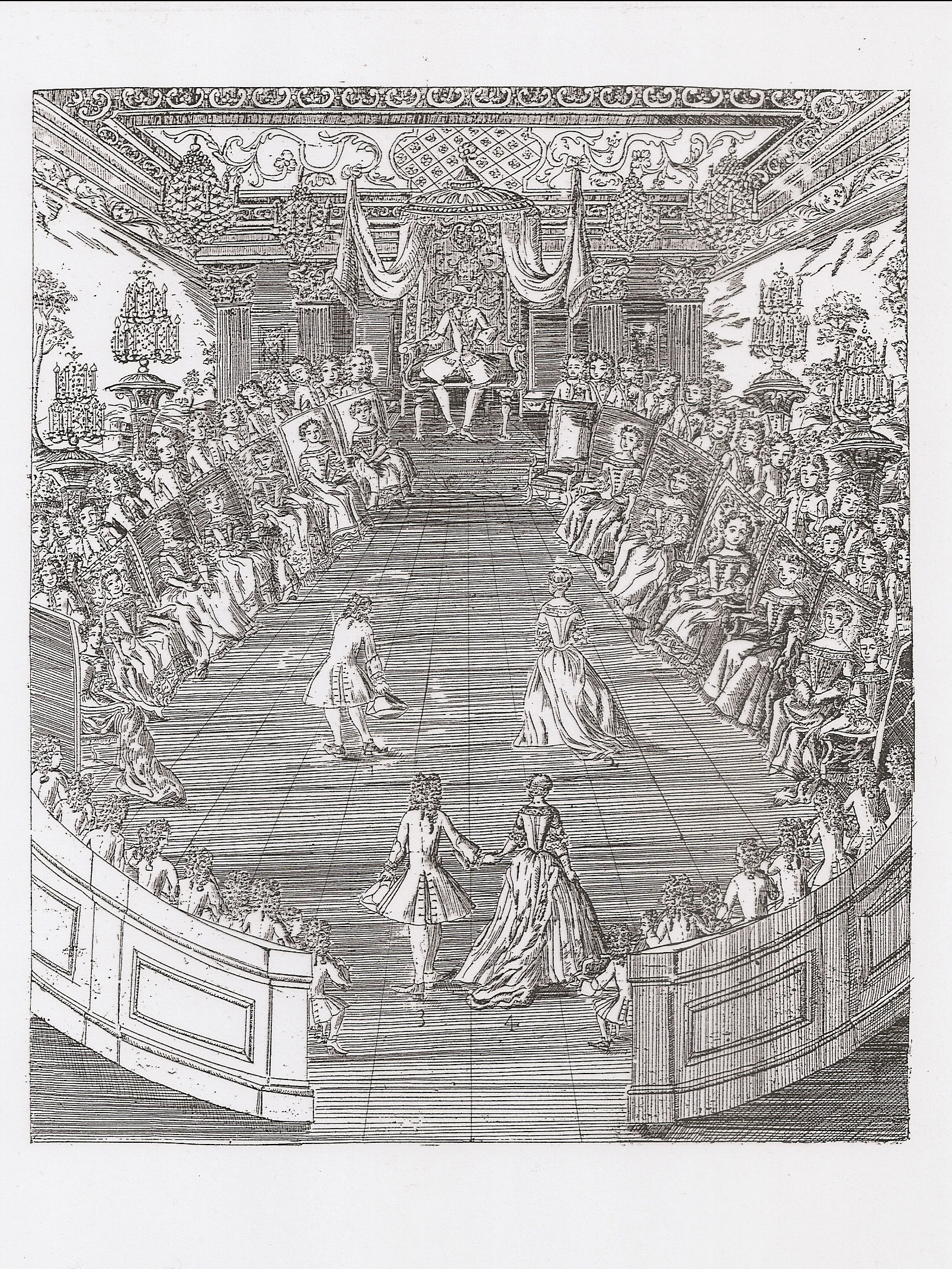
The illustration shows where these ballroom duets began.

A ball at the court of Louis XIV. Pierre Rameau. Le Maître à danser (Paris, 1725).

A ball at the court of Louis XIV. Pierre Rameau. Le Maître à danser (Paris, 1725).


Dances for four: Le Cotillon (1705)

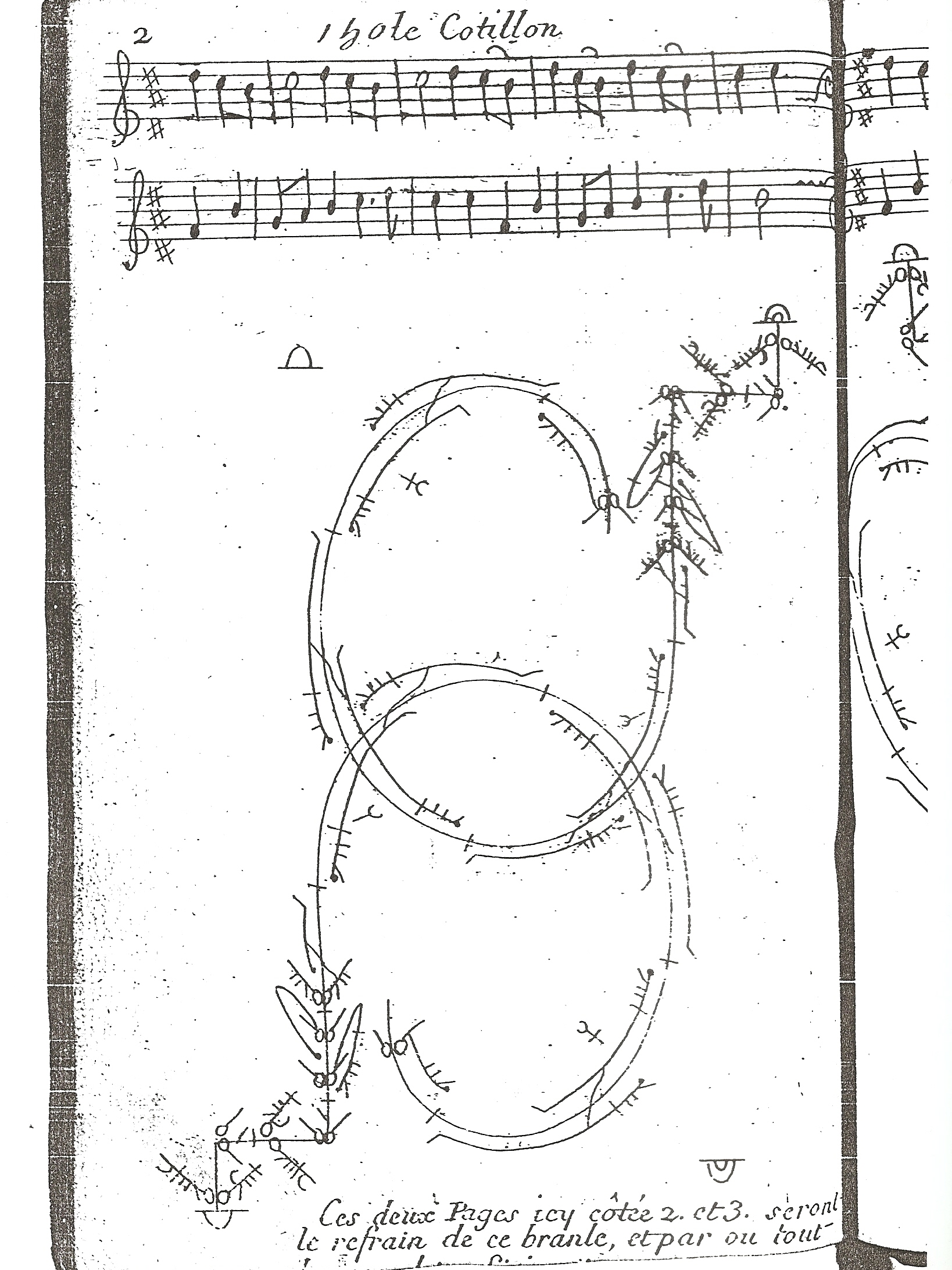
The first dance for four to be published in the new system of dance notation was Le Cotillon, which appeared in Feuillet’s IIIIe Recueil de dances de bal pour l’année 1706. In his first such collection, for 1703, Feuillet promised that they would appear towards the beginning of November each year to allow time to learn the dances before the winter season of balls began. This little collection had just three dances, two danses à deux and a danse à quatre:

La Bavière, a menuet and forlane, choreography by Guillaume-Louis Pecour.

La Fanatique, a sort of rigaudon to a ‘marche des Fanatiques’ by Lully, choreography by Feuillet.

Le Cotillon, a branle (in fact a gavotte) by an unknown choreographer.

In his Avertissement to his latest annual collection, Feuillet wrote:

‘Le Cotillon, quoi que Danse ancienne, est aujourdhui si a la mode a la Cour, que j’ay cru ne pouvoir me dispenser de la joindre à ce petit Recüeil, c’est une maniere de branle a quatre que toutes sortes de personnes peuvent danser sans même avoir jamais appris.’

[The Cotillon, although an old dance, is so fashionable at court, that I thought I had to include it in this little collection, it is a sort of branle for four that anyone can dance without having learnt it beforehand]

He reminded his readers that he would continue to publish his collections of ball dances each November for the forthcoming year. He also announced the publication of his Recueil de contredances at the beginning of 1706 – ‘les Contredanses d’Angleterre … aussi fort à la mode’.

Le Cotillon is an earlier form of the contredanses françaises – cotillons – that would become a dance craze in the 1760s in both France and England. The musical structure for the dance is AABABA x 6 (A = B = 4). There are a series of Changes, to each AA, between which the same Figure is danced, to the BABA music. The terminology ‘Change’ and ‘Figure’ is that used when the cotillon, a dance for four couples facing inwards around a square, reached London in the mid-1760s.

The 8-bar changes in Le Cotillon are as follows:

Forward and back (in couples)

Siding (in couples)

Taking right hands and left hands (in couples)

Taking both hands (in couples)

Right hand star (all four dancers)

Left hand star (all four dancers)

Circle left and right (all four dancers)

These are recognisably related to English country dance conventions.

The 16-bar figure is much simpler than those to be found in the later cotillons. One man and his opposite lady perform a sequence of steps taking right hands and then their partners do the same.

Feuillet notates all the steps in Le Cotillon. These, too, anticipate the vocabulary of the later cotillons. Dancers use pas de gavotte (contretemps to first position, jump and step) when moving forwards and backwards and demi-contretemps when moving in a circle. Sequences usually end with an assemblé. The figure uses a sequence beginning with a jump on two feet with a quarter-turn and then back, pas de rigaudon and a jump on two feet, a step and then a series of demi-contretemps ending with an assemblé.

The steps are easy and the sequences are straightforward and predictable. As Feuillet promised, dancers could perform Le Cotillon with no prior practice.

Le Cotillon (1705). First plate. Opening Change.

Le Cotillon (1705). First plate. Opening Change.

Le Cotillon (1705). Second plate. First half of Figure.

Le Cotillon (1705). Second plate. First half of Figure.


Mr Holt’s Minuet and Jigg in Performance

There are at least three versions of Mr Holt’s Minuet and Jigg on YouTube. In my opinion, this is the best of them.

The dancers are well costumed and they dance nicely. However, we have two men and two ladies, rather than the four ladies specified by the original notation. One of the videos I was able to find has four ladies, but this version has much better dancing.

The figures are accurately performed and the steps are neat, although the performance is perhaps rather too contained and even a bit stiff. Is that how they thought it should be danced? It is very difficult to find a happy medium between our conflicting ideas of 18th-century politeness and extravagance. Although there is some interaction within each couple, each pair less often acknowledges the other – which underplays the social dimension of this choreography. The second figure of the Minuet looks to me, on paper at least, to refer to the S-reversed of the ballroom minuet, a possibility that these dancers do not acknowledge. Other figures are danced prettily, particularly the circle in the second part of the Minuet where the dancers use to good effect the shoulder shading called for in the pas de menuet to the left.

The steps used in the Jigg don’t always quite work. Mr Holt calls for only a few steps in specific figures, leaving the others to the dancers’ choice. Those chosen, or rather the sequences of steps, don’t always seem choreographically quite right to me. I’m not sure why. I do like the concluding figure and the way the dancers open out into a half-circle to face their audience. This must have been charming at the time, when the dance was performed by four young ladies.

I wonder if this performance does represent the style and technique of 18th-century social dancing. There is simply no way we can tell. It is nicely danced, and those wishing to perform Mr Holt’s Minuet and Jigg can learn much from it, but I would prefer a little more freedom and liveliness – within the bounds of politeness, of course.


Mr. Holt and his Minuet and Jigg for four ladies

The first and only dance for four to appear in an English source was Mr Holt’s Minuet and Jigg. Who was Mr Holt and why did he create this choreography?

This dance for four was published in London in 1711, in Edmund Pemberton’s An Essay for the Further Improvement of Dancing. The collection of ‘Figure Dances’ was entirely for female performers, although Pemberton never mentions this fact. The title page says nothing. The Preface focuses almost exclusively on the significance and value of the new system of dance notation used to record the choreographies. Even the dedication to Thomas Caverley, noted as a teacher of young ladies, avoids any reference to female dancers.

Mr Holt was obviously deemed worthy of a place among ‘the most Eminent Masters’ (according to the title page) whose dances were published in Pemberton’s collection. There were several Holts, dancing masters and musicians, working in London during the early 1700s. Which of them created this Minuet and Jigg? Among the subscribers to the publication (who had paid in advance for copies in order to finance the printing) are Walter Holt and William Holt. The choreographer must have been one of them, but which one?

Various dancing masters named Holt subscribed to dance treatises and collections of dances in the early eighteenth century. In 1706, Walter Holt ‘Senior’ and Walter Holt ‘Junior’, together with Richard Holt, subscribed to John Weaver’s Orchesography (his translation of Feuillet’s Choregraphie) and A Collection of Ball-Dances Perform’d at Court (his notations of choreographies by Mr Isaac). In 1721, Walter Holt and William Holt subscribed to Weaver’s Anatomical and Mechanical Lectures upon Dancing (which were delivered at ‘Mr Holt’s Dancing-Room, at the Academy in Chancery-Lane’ according to the Daily Post for 31 January 1721). In the early 1720s, too, Walter Holt, William Holt and ‘Mr. Holt Junior’ subscribed to Anthony L’Abbé’s A New Collection of Dances.  I suggest that Walter Holt ‘Senior’ was the ‘Musician’ who died in 1706 (his will survives in the National Archives at Kew) and that Walter Holt ‘Junior’ was his son, another ‘Musician’, probably born in 1676 who died in 1738 (his will is also in the National Archives). Richard and William Holt are likely to be the brothers of Walter Holt ‘Junior’, born in 1678 and 1691 respectively. William, who died in 1723 (his will is in the National Archives), was the choreographer of a ballroom duet Le Rigadon Renouvele published around 1720. ‘Mr. Holt Junior’ may well be another Walter, the son of Walter Holt ‘Junior’, born in 1701.

The only real candidate for choreographer of the Minuet and Jigg is Walter Holt ‘Junior’ (1676-1738). He is surely the ‘Mr. Holt’ listed among the dancing masters named by John Weaver in his 1712 An Essay towards an History of Dancing as ‘happy Teachers of that Natural and Unaffected Manner, which has been brought to so high a Perfection by Isaack and Caverley’. He was a contemporary of Weaver and must have been very well-established as a dancing master, unlike his much younger brother William. When he died in 1738, Walter Holt was described as ‘Mr. Holt, sen. a very wealthy and famous Dancing-Master’ (Weekly Miscellany, 15 September 1738).

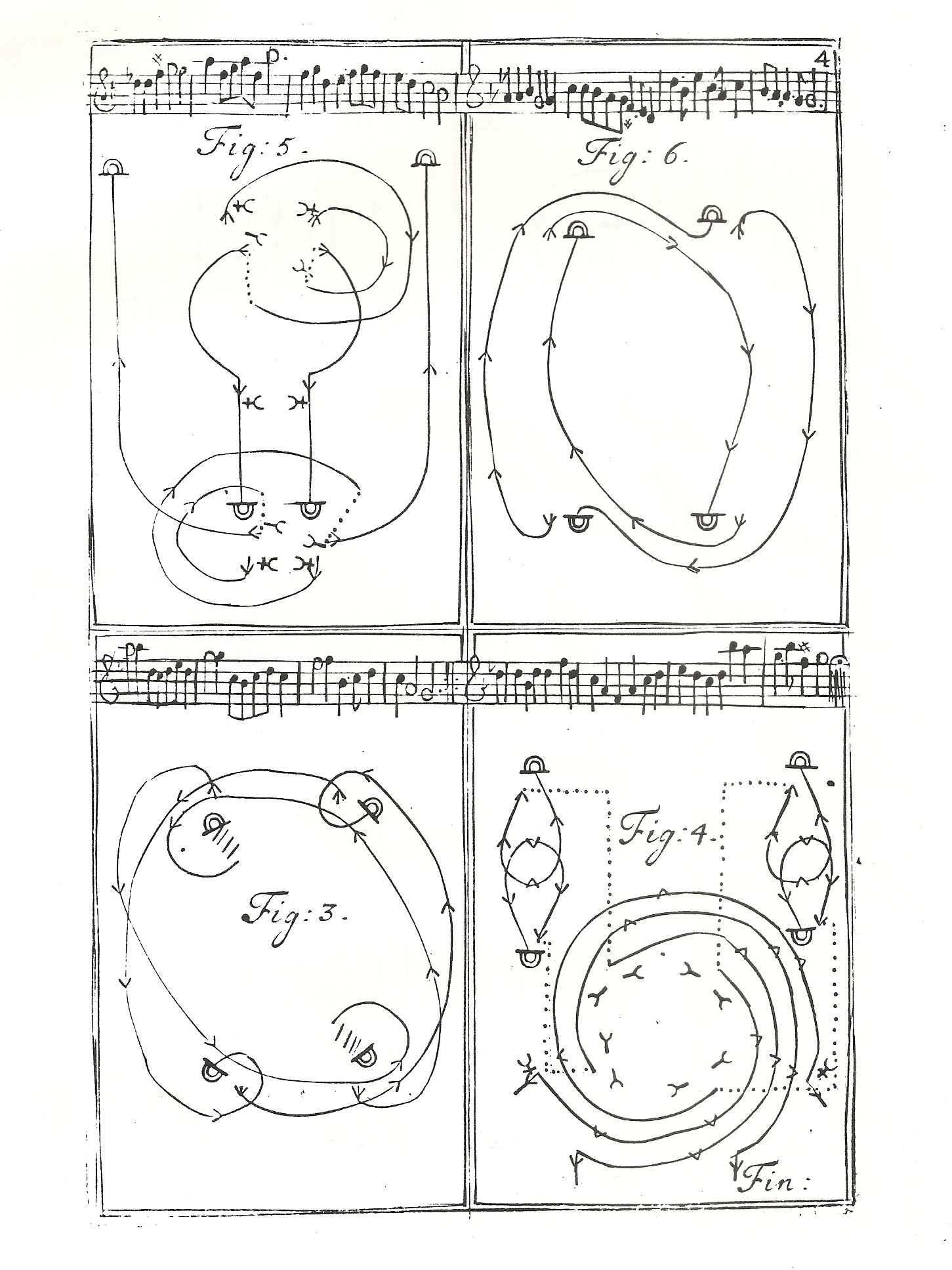
What of the Minuet and Jigg itself? I will not analyse the choreography in detail, for there are others who are far more expert in this genre than I. The minuet has 48 bars and the jigg 32 bars, so the dance is quite long. The four ladies begin as two couples facing one another (two of the dancers have their backs to the audience). They face towards each other, in the manner of a country dance, for much of the choreography. The minuet section draws on the familiar figures of the ballroom minuet, including the S-reversed, taking right hands and taking left hands. It also uses figures from country dances, for example the square hey and the dos-à-dos. Only one step is specified in the notation – the pas de sissonne used in the jigg. Pemberton gives no advice about steps, but his reference to John Essex’s For the Further Improvement of Dancing (a translation of Feuillet’s 1706 Recueil de contredances), published in 1710, implies that he expects readers to look at that treatise for advice. The ladies complete the dance by opening into a semi-circle to face their audience.

Mr Holt's Minuet and Jigg, first plate.

Mr Holt’s Minuet and Jigg. First plate.


Mr Holt's Minuet and Jigg.  Last plate.

Mr Holt’s Minuet and Jigg. Last plate.


This choreography for four is simultaneously a means of teaching the genteel style and technique of both ballroom and country dances expected in English polite society and a contrivance for displaying the skills that could be learnt from the best dancing masters. It was probably created for performance by his female scholars, before an audience, at Walter Holt’s Academy.