Category Archives: Ballroom Dancing

Mr. Holt and his Minuet and Jigg for four ladies

The first and only dance for four to appear in an English source was Mr Holt’s Minuet and Jigg. Who was Mr Holt and why did he create this choreography?

This dance for four was published in London in 1711, in Edmund Pemberton’s An Essay for the Further Improvement of Dancing. The collection of ‘Figure Dances’ was entirely for female performers, although Pemberton never mentions this fact. The title page says nothing. The Preface focuses almost exclusively on the significance and value of the new system of dance notation used to record the choreographies. Even the dedication to Thomas Caverley, noted as a teacher of young ladies, avoids any reference to female dancers.

Mr Holt was obviously deemed worthy of a place among ‘the most Eminent Masters’ (according to the title page) whose dances were published in Pemberton’s collection. There were several Holts, dancing masters and musicians, working in London during the early 1700s. Which of them created this Minuet and Jigg? Among the subscribers to the publication (who had paid in advance for copies in order to finance the printing) are Walter Holt and William Holt. The choreographer must have been one of them, but which one?

Various dancing masters named Holt subscribed to dance treatises and collections of dances in the early eighteenth century. In 1706, Walter Holt ‘Senior’ and Walter Holt ‘Junior’, together with Richard Holt, subscribed to John Weaver’s Orchesography (his translation of Feuillet’s Choregraphie) and A Collection of Ball-Dances Perform’d at Court (his notations of choreographies by Mr Isaac). In 1721, Walter Holt and William Holt subscribed to Weaver’s Anatomical and Mechanical Lectures upon Dancing (which were delivered at ‘Mr Holt’s Dancing-Room, at the Academy in Chancery-Lane’ according to the Daily Post for 31 January 1721). In the early 1720s, too, Walter Holt, William Holt and ‘Mr. Holt Junior’ subscribed to Anthony L’Abbé’s A New Collection of Dances.  I suggest that Walter Holt ‘Senior’ was the ‘Musician’ who died in 1706 (his will survives in the National Archives at Kew) and that Walter Holt ‘Junior’ was his son, another ‘Musician’, probably born in 1676 who died in 1738 (his will is also in the National Archives). Richard and William Holt are likely to be the brothers of Walter Holt ‘Junior’, born in 1678 and 1691 respectively. William, who died in 1723 (his will is in the National Archives), was the choreographer of a ballroom duet Le Rigadon Renouvele published around 1720. ‘Mr. Holt Junior’ may well be another Walter, the son of Walter Holt ‘Junior’, born in 1701.

The only real candidate for choreographer of the Minuet and Jigg is Walter Holt ‘Junior’ (1676-1738). He is surely the ‘Mr. Holt’ listed among the dancing masters named by John Weaver in his 1712 An Essay towards an History of Dancing as ‘happy Teachers of that Natural and Unaffected Manner, which has been brought to so high a Perfection by Isaack and Caverley’. He was a contemporary of Weaver and must have been very well-established as a dancing master, unlike his much younger brother William. When he died in 1738, Walter Holt was described as ‘Mr. Holt, sen. a very wealthy and famous Dancing-Master’ (Weekly Miscellany, 15 September 1738).

What of the Minuet and Jigg itself? I will not analyse the choreography in detail, for there are others who are far more expert in this genre than I. The minuet has 48 bars and the jigg 32 bars, so the dance is quite long. The four ladies begin as two couples facing one another (two of the dancers have their backs to the audience). They face towards each other, in the manner of a country dance, for much of the choreography. The minuet section draws on the familiar figures of the ballroom minuet, including the S-reversed, taking right hands and taking left hands. It also uses figures from country dances, for example the square hey and the dos-à-dos. Only one step is specified in the notation – the pas de sissonne used in the jigg. Pemberton gives no advice about steps, but his reference to John Essex’s For the Further Improvement of Dancing (a translation of Feuillet’s 1706 Recueil de contredances), published in 1710, implies that he expects readers to look at that treatise for advice. The ladies complete the dance by opening into a semi-circle to face their audience.

Mr Holt's Minuet and Jigg, first plate.

Mr Holt’s Minuet and Jigg. First plate.
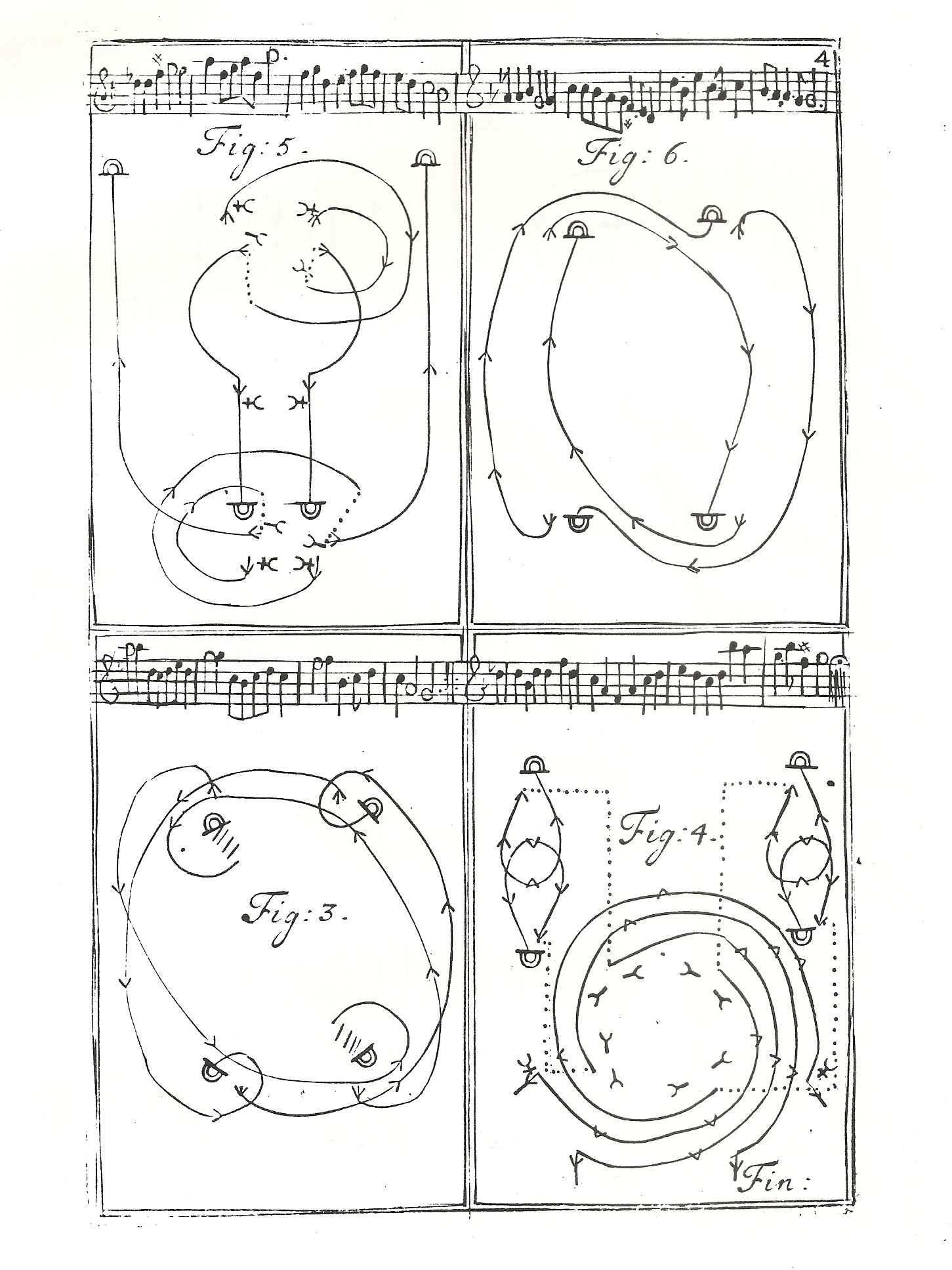
 

Mr Holt's Minuet and Jigg.  Last plate.

Mr Holt’s Minuet and Jigg. Last plate.


This choreography for four is simultaneously a means of teaching the genteel style and technique of both ballroom and country dances expected in English polite society and a contrivance for displaying the skills that could be learnt from the best dancing masters. It was probably created for performance by his female scholars, before an audience, at Walter Holt’s Academy.

Thinking About: Dances, Dancing and History

I recently began to learn the Viennese waltz. I am a newcomer to ballroom dance, but it seems very different to the modern ballroom waltz. I couldn’t help wondering about its history. I have been told it is earlier than its modern counterpart, but how far back does it go? How does it relate to the early 19th-century waltz I was dancing just a few weeks ago?

The early 19th-century waltz raised another question. How does it relate to the minuet? The waltz step we used seemed to share the rhythmic characteristics of the French minuet step (called ‘One and a Fleuret’ by the dancing master Kellom Tomlinson). The man steps onto his left foot and does a quarter-turn pirouette in the first bar, followed by three steps in the next bar (the waltz, like the minuet, is in 3 / 4). The woman does the opposite. Of course, the couple revolve in a clockwise direction, while travelling anti-clockwise around the ballroom, quite unlike the minuet with its serene floor patterns and its fixed front. This waltz was in a hold which was obviously moving towards the modern ballroom hold. The waltzes (French, sauteuse, jetté-sauteuse and German) described by Thomas Wilson in his 1816 treatise seem very different both in steps and hold. So what was going on? How was the waltz developing and changing during the 19th century? Where does the Viennese waltz fit in?

I’ve also been struggling with Argentine tango. At the workshop I went to recently, we were taught a small number of basic steps, and told that these were all we needed to dance tango – everything else was derived from them. My mind immediately flew both to baroque dance and to modern ballroom and Latin. Don’t they all rest on just a few basic steps, which can be joined together, varied and decorated in all sorts of ways to produce an extensive and rich vocabulary of movements? Modern ballroom and Latin dances, as well as Argentine tango, are social dance forms intended for the ballroom, and all are improvisational – like the 18th-century minuet. Modern dances for the stage, or for competitions, have fixed routines – just like the baroque ballroom and theatrical choreographies.

Thinking about the different ballroom and Latin dances, with their various shared vocabularies of steps and their very different musical and stylistic qualities, my mind jumped again to baroque dance and its several dance types. These also share the same steps but are otherwise distinct, musically at least. I am wondering whether being able to grasp the differences between the modern waltz, the foxtrot and the quickstep, and between the rumba and the cha-cha, might help me as I try to differentiate the saraband, the loure, the bourée and rigaudon? The differences between all these dances might seem obvious (at least to the initiated), but they can be hard to interpret in performance unless one is an expert.

So, is all this dancing divisible into ancient and modern, where never the twain shall meet, or is it all actually variations on a shared theme?


Dances for four: the sources

The earliest notated and published dances for four appear in the recueils or collections of dances published in Paris annually from 1702.

Le Cotillon is from IIIIe Recueil de dances de bal pour l’année 1706.

Le Menuet à quatre is from Vme Recueil de danses de bal pour l’année 1707.

Feuillet’s Le Passepied à quatre is from IX. Recueil de danses pour l’année 1711.

Another fourteen such recueils were published, the last being the XXIII Recueil de dances pour l’année 1725 issued by Dezais. Many of these later collections focussed on choreographies by the dancer and dancing master Balon. Only two include dances for four.

Balon’s La Gavotte du Roy is from XIIIIe Recueil de danses pour l’année 1716.

Dezais’s L’Italiene is from XVII. Recueil de dances pour l’année 1719.

Dezais must have recognised that these choreographies belonged to a different genre among the dances for the ballroom. In 1725 he issued a Premier livre de contre-dances, with at least five dances (out of nine) for four – Cotillon Hongrois à Quatre, L’Inconstante à Quatre, La Blonde à Quatre, La Brunne à Quatre and La Carignan, Menuet à Quatre. Was he responding to changes in fashion? Or was he aware that amateur dancers were tiring of the difficulties of the danses à deux and turning instead to less technically demanding and more sociable choreographies for larger groups?

The publication of dances in notation followed a very different pattern in England (another topic for a later post). Only one dance for four was ever published in London, Mr Holt’s Minuet and Jigg which appears in Edmund Pemberton’s An Essay for the Further Improvement of Dancing of 1711. This collection of eleven dances was probably targeted at dancing masters specialising in the teaching of girls, who are the intended performers of all the choreographies. The dances are for three to twelve female dancers, with three female solos added in the second part of the collection. Only Mr Holt’s dance is for four.

A couple of years later, around 1713, The Nouveau recueil de dances de bal et celle de ballet included two dances for four, Pecour’s Menuet à Quatre and his Rigaudon à Quatre. These were among nine ballroom dances included at the beginning of what was, predominantly, a collection of theatrical choreographies performed by leading stars at the Paris Opéra.

The publication of dances in notation all but ceased after 1725. Among other factors contributing to their demise, they had perhaps become less popular with the provincial dancing masters who seem to have formed an important market for these publications. Over a twenty-year period times, and tastes, had changed.

No more dances are known to have appeared in notation until 1765, when Magny’s Principes de Choregraphie was published in Paris. Magny included eleven choreographies in his treatise. Several of them were old favourites – duets from the early 1700s – but one, Le Quadrille, was for four dancers.

A few years later, in 1771, the dancing master Clement published his own Principes de Coregraphie (both he and Magny drew on Choregraphie, Feuillet’s 1700 treatise on dance notation). He accompanied it with two dances for four, a Passepied and an Allemande. By this time, the most popular of the ballroom dances was the cotillon or contredanse française for eight. Did the dances for four provide welcome relief from the frenetic demands of cotillons?

French dances, and dance notation, spread throughout Europe during the 18th century. A Spanish/Portuguese manuscript dating to 1751 records several choreographies popular much earlier in the century. It also includes a ‘Minuet a quatre figuret’ attributed to Pecour. The dance is not the same as his Menuet à Quatre of some forty years earlier.

What can we learn from the individual dances for four and from the contexts within which they were published?


Dances for four: a first list

My initial list of dances for four looks as follows. I give the publication date, the title of the dance and the choreographer (if known).

1705                Le Cotillon (Anon.)

1706                Le Menuet à Quatre (Anon.)

1710                Le Passepied à Quatre (Feuillet)

1711                Mr Holt’s Minuet & Jigg

[c1713]            Menuet à Quatre (Pecour)

[c1713]            Rigaudon à Quatre (Pecour)

1716                La Gavotte du Roy (Balon)

1719                L’Italiene (Dezais)

1725                Cotillon Hongrois à Quatre (Dezais)

1725                L’Inconstante à Quatre (Dezais)

1725                La Blonde à Quatre (Dezais)

1725                La Brunne à Quatre (Dezais)

1725                La Carignan, Menuet à Quatre (Dezais)

1765                Le Quadrille (Magny)

1771                Passepied à Quatre (Clement)

1771                Allemande à Quatre (Clement)

There are also two dances for which we have no date of composition or publication:

La Blonde et La Brune (Anon. Source unknown, unless this choreography is the same as the Dezais dances above)

Minuet à Quatre (Pecour. In a manuscript collection dated 1751)

So, there are around 18 dances for four among the surviving notations

The next question concerns the sources for these dances, and what they might tell us about the status of dances for four in the 18th-century ballroom.


DANCES FOR FOUR

Following a discussion about eighteenth-century dances for four with a fellow baroque dance specialist and I thought I would make a list of the surviving notations. I had classified them as ballroom dances, so I turned to La Danse Noble (1992) by Meredith Little and Carol Marsh and La Belle Dance (1996) by Francine Lancelot, the two catalogues of this repertoire. Between them, they provided a total of eleven choreographies ranging in date from 1705 to 1771.

One starting point for the discussion was Feuillet’s Le Cotillon, published in 1705. This choreography has the same structure, and uses the same steps, as the cotillons published in Paris in the 1760s. Even though it appears alongside ballroom dances in the IIIIe. Recueil de Dances de Bal and is notated in the same way, it is essentially a contredanse. It is nevertheless listed in both catalogues. However, another dance for four, Le Quadrille, published by Magny in his Principes de Choregraphie (1765), appears in neither catalogue though it too is notated in the same way. Magny tells us that he composed the dance simply to show all the steps used in contredanses, so it was presumably omitted because it was classed as a contredanse.

I couldn’t help pursuing matters a little further. Neither Le Cotillon des Fêtes de Thalie (for eight dancers) from the XIIIIe. Recüeil de Danses (1716) nor L’Italiene (for four) from the XVII Recüeil de Dances (1719) both by Dezais, appear in the catalogues. Both these dances are recorded in the simplified form of notation used for contredanses. However, Little and Marsh include Mr Holt’s Minuet [and] Jigg for four, published in Pemberton’s An Essay for the Further Improvement of Dancing (1711) even though the dance is written in simplified notation and is very similar to a country dance. (Lancelot covers French dances and dancing masters, omitting anything which is purely English).

I began to wonder if the distinction between ballroom dances and country dances was less clear than I had supposed. When I came across the Premier Livre de Contre-Dances (1725) by Dezais and discovered that it has at least five dances for four, I realised that drawing up my list was not going to be entirely straightforward. So many country dances and contredanses were published during the eighteenth century that no researchers have tried to emulate Little and Marsh and Lancelot by trying to catalogue them. There is no easy way to investigate this repertoire. Are dances for four ballroom dances or contredanses? How many more of them are out there?


Gallini’s Additional Tunes

At the end of the New Collection of Forty-Four Cotillons, Gallini includes ‘Music for Six select Dances, Two of which may be used as Cotillons’. The tunes are individually titled:

Allemande (a cotillon, numbered 45)

Le Prince de Galles (a cotillon, numbered 46)

Le Charmant Vainqueur

La Fourlane Venitienne ou La Barcariuole

Menuet du Dauphin

Le Passe-pied de la Reine

In his Treatise upon Dancing of 1762, Gallini had listed the dances ‘most in request’, although he did not include the allemande. This dance, which had a long history, was enjoying a revival in a new and fashionable form alongside the cotillon.  Gallini did list some titles which dated back to the early 1700s, alongside others which seem to be little more than generic dance types. Among the former are the Bretagne and La Mariée, while the latter include the Forlana and the Passepied. The Menuet du Dauphin is the title of a choreography by the famous French dancing master Marcel, published in notation in Paris in 1765, although Gallini supplies different music. In the late 1760s, other dancing masters advertised a similar repertoire. It is all but impossible to know what choreographies were actually danced. Were amateur dancers still expected to perform dances from the court of Louis XIV in London’s ballrooms? Were fashionable French ballroom duets performed in London as well as Paris?

I will return to dancing masters and their lessons. The survival of dances from an earlier era is a topic for exploration at a later date, as is the allemande.