Author Archives: moiragoff

A VERY IMPORTANT DANCE ANNIVERSARY

Next year marks the 300th anniversary of John Weaver’s The Loves of Mars and Venus. His ‘dramatic entertainment of dancing’ was first performed at the Drury Lane Theatre on 2 March 1717.

Loves Title Page Detail

John Weaver, The Loves of Mars and Venus, detail from title page

Why is this often overlooked dance work so important? It is the first modern ballet – the first theatrical work to tell a story and represent its characters solely through dance, mime and music. Unlike all the ballets that had come before it, including the much celebrated French ballets de cour and English masques, there were no spoken or sung words. The Loves of Mars and Venus was a dance work, nothing more and nothing less.

Weaver’s ballet tells the story of the love affair between the goddess Venus and Mars, the god of War, and the revenge enacted on them by her husband Vulcan. It draws on classical mythology, but contemporary passions abound. Despite Weaver’s appeal to the revered performances of the ‘mimes and pantomimes’ of classical antiquity, who he wished to emulate, his ballet was a thoroughly modern work in tune with the sophisticated comedies of his own time.

The Loves of Mars and Venus has six short scenes. Mars appears with his soldiers and performs a war dance. Venus is shown surrounded by the Graces and displays her allure in a sensual passacaille, but when Vulcan arrives she quarrels with him in a ‘dance of the pantomimic kind’. Vulcan retires to his smithy to devise revenge with the help of his workmen the Cyclops. Mars and Venus meet and, with their followers, perform dances expressive of love and desire. Vulcan completes his plan of revenge against the lovers. In the final scene, Vulcan and the Cyclops catch Mars and Venus together and expose them to the derision of the other gods, until Neptune intervenes and harmony is restored in a final ‘Grand Dance’. The entire ballet took, perhaps, about 40 minutes.

John Weaver was a dancer as well as a choreographer. He is also one of the very few dance practitioners who have written about their art. He was Vulcan. Venus was Hester Santlow, also an actress and a dancer of consummate skill and expressiveness. Mars was Louis Dupré, a virtuoso dancer who was probably French (although not Louis ‘le grand’ Dupré, with whom he is still often confused). Weaver’s bold experiment had the best dancers on the London stage.

This first modern ballet was a remarkable work and enjoyed success in its own time. It was subsequently far more influential than many realise. It may well have been seen by the young dancer Marie Sallé, who would herself later experiment with narrative and expressive dancing. Sallé, of course, influenced Jean-Georges Noverre when he came to create his ballets d’action. They led to the story ballets of the romantic period and onwards to today’s narrative dance works.

Has Weaver’s The Loves of Mars and Venus been consigned to history or can it be recovered? I will explore this innovative ballet further in later posts.

Prince Frederick

Prince Frederick, ‘A New Dance’ by Anthony L’Abbé, was notated and published in 1725 by Edmund Pemberton.

Prince Frederick Title Page

L’Abbé, Prince Frederick (1725), Title Page

The title indicates that the dance was dedicated to the eldest son of the Prince and Princess of Wales (who would soon become King George II and Queen Caroline). The publication of the dance was advertised in the Evening Post for 9-11 March 1725. The date links it to Caroline’s birthday on 1 March, although the bare description of it as ‘A New Dance’ suggests that it was not performed at court. I have not been able to find any record of a court ball in honour of the Princess’s birthday that year.

Prince Frederick was still in Hanover, where he had remained as the representative of the electoral family when his parents travelled to England in 1714 following the accession of his grandfather (Elector of Hanover) to the British throne as George I. In 1725, Frederick turned 18 and thus officially came of age. This event was celebrated in Hanover, where the festivities included a ball at which Frederick opened the dancing with the Countess Amalie von Platen (who may have been the daughter of George I). Perhaps L’Abbé intended his ballroom dance to honour Frederick’s majority and be a compliment to the prince’s mother. If so, it was unlikely to have found favour in London – both of the prince’s parents disliked him.

L’Abbé’s Prince Frederick is described on the notation as a ‘Slow Minuet’. The music has been identified as a song The Beauteous Cloe. The single-sheet version is undated (although ascribed a date of 1715 or 1720 in some sources). It also appears in A Choice Collection of English Songs Set to Musick by Mr Handel, published by John Walsh around 1730. It has been further identified as a reworking of Teofane’s aria ‘S’io dir potessi’ in act 2 of Handel’s 1723 opera Ottone. If, as has been suggested, Handel himself transformed the aria into the song, he must have been happy to do so soon after the first performances of Ottone on the London stage. Did he perhaps revise the music for the ball dance first? Handel was employed by George I at the same period as L’Abbé was dancing master to the King’s grand-daughters. The two must have known one another, and Handel – like L’Abbé – may have wished to honour Prince Frederick, who would in due course become Prince of Wales and might one day be king.

The description ‘Slow Minuet’ on the notation cannot be taken too literally, but it accords more with the slow sad aria of Ottone than the lively light-hearted song The Beauteous Cloe. I am currently working on L’Abbé’s Prince Frederick so I will return to the choreography and its interpretation in a later post.

Pas de Zephyr: the Step

I first came across the pas de Zephyr a few years ago at a workshop on early 19th-century quadrilles. The name, as well as the step itself, caught my attention. It was taught as part of a dance vocabulary, drawn from contemporary sources, that was very like ballet. I wanted to know more and recently I’ve finally found time to do some research into this step.

So far I have found the pas de Zephyr described in four manuals of social dancing:

  • Edward Payne, The Quadrille Dancer (London, 1818). I discovered this version transcribed on the Regency Dances website and I have yet to look at a copy of the original manual;
  • Alexander Strathy, Elements of the Art of Dancing (Edinburgh, 1822), this was the version I first encountered;
  • Charles Mason, A Short Essay on the French Danse de Société (London, 1827);
  • Giacomo Costa, Saggio analitico-practico intorno all’arte della danza (Turin, 1831).

There may well be other sources that also include it, although I have not found it in the manuals by Carlo Blasis or in Théleur’s 1831 Letters on Dancing. It doesn’t seem to appear in 18th-century dance manuals either.

The four sources I have been able to consult all describe the step slightly differently. Here is Payne’s description, as transcribed on the Regency Dances website:

‘Pas de Zephyr

To perform this step with the right foot behind, in the 4th position sink on your left foot, at the same time making an opening, or half circle with the right, to the 4th position behind, rising with a gentle spring on your left, at the same time making a half circle with the right, to the 4th position before, then bound forward on your right foot, with the knees perfectly extended, and make a battment [sic] with the left, finishing in the 4th position off the floor, repeat the same with the left foot before, to this add two Jettés on your right foot, two on the left, one on your right, one on the left, and finish with a Jetté et assemblé.

This step is applied when you advance, huit measures, tout seul, in la Pastoralle, and occupies eight bars, four advancing and four retiring.’

The pas de Zephyr is presumably not the entire enchainement, only the step Payne explains in detail.

Strathy’s version goes like this:

‘Pas de Zéphyre or Pas Battu

To perform this Step forward with the Right Leg.

Place the feet in the fifth position, the left foot before; balance the body entirely on the left leg; bend on it, and at the same time slide the right foot, on the point, back to the fourth position; rise on the point of the left foot, bring up the right foot to the third position behind, and, sustaining yourself still on the point of the left foot, pass the right foot by the first position into the fifth position before; then gently place the heels.’

By ‘rise on the point’ Strathy presumably means a rise onto the ball of the foot and not onto the tips of the toes. He offers several variations of the pas de Zephyr, beginning with those which have an extension of the free foot to second position rather than fourth. Strathy’s pas de Zephyr is notable for its use of a rise instead of a jump.

Mason writes as follows:

‘Jeté Ballonné et Tems de Zephyre

Make a jeté before with the right foot, disengaging the left to a fourth position behind; then ballonné or sissonne upon the right, pointing the left to a fourth before; reverse it; if, as you make the ballonné, a little battement forward and back be made with the other foot, it becomes a tems de zephyre.’

Although he gives it a different name, Mason’s version is similar to Payne’s.

I don’t have access to a good translation of Costa’s version (and my Italian is not up to a reliable translation of my own) but here is what he has to say in the original Italian:

‘Passo dello Zeffiro

Il piede destro che sta in quarta avanti per aria, gettasi a terra piegando, e distendendo il piede che sta addietro, s’incava alla quarta in aria avanti; gettando a terra il sinistro, piegando, s’incava nuovamente il destro alla quarta in aria avanti, e si avranno fatti due passi di seguito, sempre avanti.

Contiene esso due tempi soltanto, uno piegato, l’altro disteso. Il primo nel gettare a terra il piede che sta alla quarta in aria, piegando le ginocchia; il secondo, uscendo avanti il piede che trovasi addietro nell’atto che distendonsi le ginocchia, e che il piede che sta per terra fa il salticello, che discesi jeté.’

Costa’s explanation is notable for omitting the battement, which seems to me to be a fundamental element of the pas de Zephyr.

A very basic analysis of these four versions of the pas de Zephyr suggest that it is a pas composé which brings together a jeté, a sissonne and a battement (the last two performed either sequentially or simultaneously). Strathy omits the opening jeté called for by Payne and Mason, while Costa (apparently) substitutes a second jeté for the sissonne. Looking at modern technical dictionaries of classical ballet, I wonder if the pas de Zephyr relates to the brisé or the brisé vole. I suggest that all the versions in social dance manuals are modifications of a more demanding step for the stage. I will discuss a possible choreographic source for that stage step in a later post.

A Year of Dance: 1660

For England, the most significant event by far of 1660 was the Restoration of Charles II. At the beginning of the year there was no indication that the monarchy might return, but following the arrival of General George Monck in London during February 1660 thinking began to change. On 25 April Parliament voted to restore the monarchy. On 8 May Charles was declared King. On 25 May he landed at Dover to be welcomed by Monck and on 29 May (his thirtieth birthday) he entered London to popular rejoicing. The King soon began to rebuild his household and to revive court life. The theatres had started to reopen, albeit quietly, in anticipation of the King’s arrival and only a few months after his return Charles II granted two courtiers – Sir Thomas Killigrew and Sir William Davenant – permission to form theatre companies for public performances. In October 1660 a united company of players, under the direction of both men, played briefly at the Cockpit playhouse in Drury Lane (an indoor theatre dating back to the Jacobean period). By November the two companies were playing separately, establishing a duopoly that would survive well into the 18th century. Killigrew’s King’s Company was in the converted Gibbons’s Tennis Court in Vere Street, while Davenant’s Duke’s Company apparently began playing at the Salisbury Court playhouse, which also dated back before 1642.

Another noteworthy, but very private, development was the beginning of Samuel Pepys’s diary on 1 January 1660. Thanks to his testimony, far more is known about the plays and other entertainments given in London’s playhouses during the first decade after the Restoration than would otherwise have been the case. Pepys’s entries on his theatre-going quite often make references to the dancing he saw.

So far as theatrical dancing is concerned, the only indication we have for 1660 is an undated performance of Le Ballet de la Paix before the French ambassador. We do not know when, or even if, the performance actually took place, since the ambassador concerned was accredited to the Protectorate and left London in June 1660. If it did happen, who were the dancers? We don’t know. There must surely have been dancing in London’s playhouses too, but there is no known evidence to prove this.

In France, the year was marked by the marriage of Louis XIV to the Spanish Infanta Maria Theresa on 9 June 1660 (New Style). This event was celebrated with Lully’s Ballet de Xerxes, six entrées added to a performance of Cavalli’s opera Xerxes. The whole entertainment was given at the Louvre on 22 November 1660 (New Style). The dancers were all men and all professionals, including Lully himself and Pierre Beauchamps. Neither Louis XIV nor his new Queen took part. Another event of note at the French court was the death of the King’s uncle Gaston duc d’Orléans on 2 February 1660 (New Style). His title was assumed a few months later by Louis XIV’s brother Philippe, also known simply as Monsieur.

Strathy’s Elements

Alexander Strathy’s Elements of the Art of Dancing was published in Edinburgh in 1822. In his introduction, Strathy observes ‘Dancing may be said to be to the body, what reading is to the mind … It embellishes and perfects the work of nature, and enables us to present ourselves in society with an amiable and becoming ease’. He ends by explaining ‘Although the elementary steps described in this essay apply to dancing in general, I have more especially in view that style of dancing denominated La Danse de la Ville, or the Quadrille’. Despite his emphasis on social dancing, Strathy’s treatise makes considerable demands on amateur dancers.

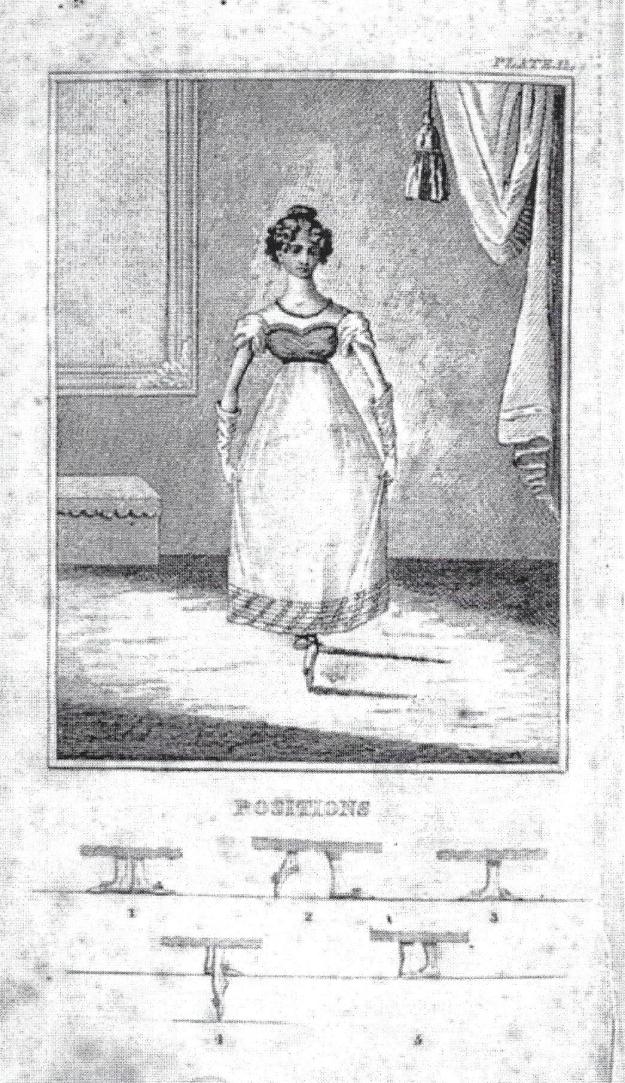
A first clue to these demands appears in the second plate, showing a young lady ready to dance. The positions of the feet at the bottom of the page are recognisably derived from ballet, and require a full ninety-degree turnout.

Strathy Plate Lady

Strathy. Elements of the Art of Dancing (1822), plate II.

Strathy does indeed describe these positions (which had been established in the mid-17th century) and emphasises the importance of proper turnout of the legs. He goes on to describe several training exercises, from bends and rises to various grand battements and petit battements while holding on to a support for balance. Many of these still form part of the barre work in a ballet class today.

Strathy’s steps include assemblés, jetés, glissades, sissonnes, temps levés, chassés and changements. Some of these relate closely to their modern ballet equivalents while others differ in certain respects. One important difference is the omission of the jump from assemblés and jetés. These are performed with a sink and rise, which provides a similar effect but makes them more elegant and provides a contrast with the other jumped steps. Some steps seem to have been taken from the stage, for example the pas de Zéphyre (which I will explore further in a later post).

Strathy’s little treatise is a good place to start for dancers willing, and with the skill, to add more demanding steps to their quadrilles. It is also a great introduction to early 19th-century dance for those with some background in ballet.

Reconstructing Isaac’s Rigadoon

After several sessions, I have finally learnt the whole of Isaac’s Rigadoon and I am beginning to feel comfortable enough with the choreography to work on shaping it as if for performance.

Isaac focusses on the changing rhythms and shifting dynamics of the Rigadoon’s steps. The footwork is not complicated, there are no quasi-theatrical steps but they are difficult to perform clearly and accurately, particularly at speed. The dance does need to be quite fast to make its proper effect. Isaac repeats steps and even short sequences, but he never exactly replicates sequences elsewhere in the choreography. I have found The Rigadoon quite hard to learn and I am still struggling to find the best way to perform the basic steps. How far should these travel? How much spring should there be in the jettés that come at the end of so many of them? I have performed many of the notated theatrical dances, which need amplitude and force even in basic steps. The Rigadoon requires neither, although it certainly demands swift and lively dancing.

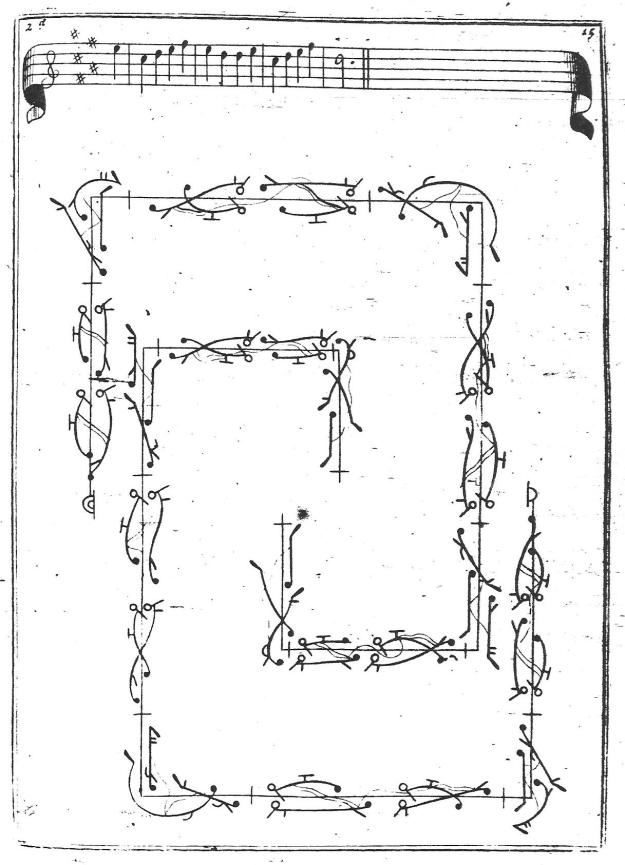
The famous figure with glissades, that according to Kellom Tomlinson ‘forms a perfect Square’ (The Art of Dancing, p. 56), is very hard to get right.

Isaac Rigadoon 2

Isaac, The Rigadoon (1706), plate 2/15.

Each bar has two glissades and so has two mouvements and two steps with glissé. These need fast reactions in feet and ankles and downward pressure, without being heavy. The notation of the pas de bourées used to turn the corners is interesting. Each is different and three of them apparently require the first demi-coupé to move on an outward diagonal. I haven’t got this right yet, but it must surely serve to align the partners within the dancing space as well as with each other. The perfect square is formed by the paths of both dancers, who should end where they began but facing each other up and down the room instead of across it. I would love to work on this figure with a partner.

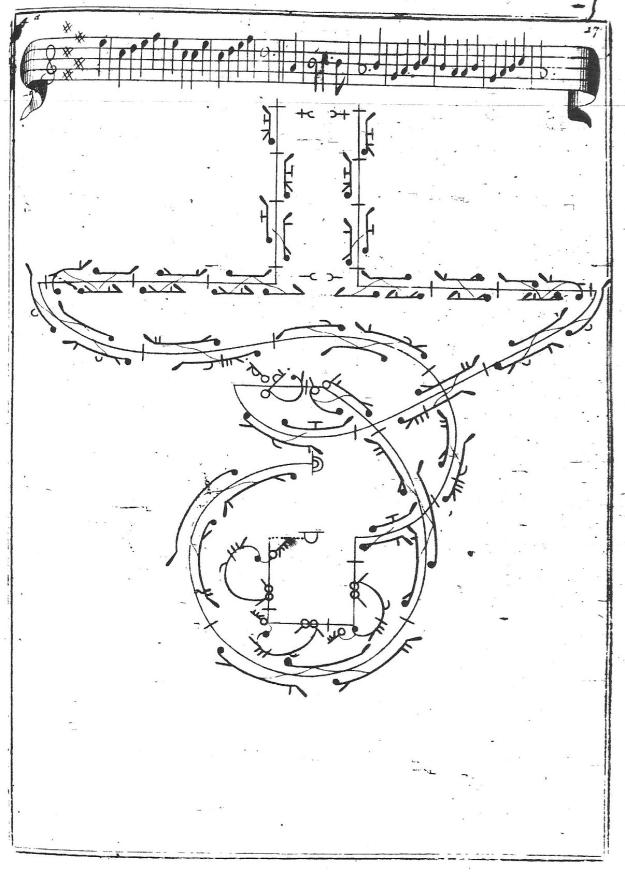
It is hard to get a proper sense of the figures in a duet when working on it alone. This is particularly true of the asymmetric figure in The Rigadoon, in which the man performs three quarter-turn sprung pirouettes as the woman dances around him with pas de bourées and he then moves around her with a coupé, a contretems with a bound and a pas de bourée as she does a coupé to first position, a half-turn pirouette and a coupé.

Isaac Rigadoon 4

Isaac, The Rigadoon (1706), plate 4/17

It is such a shame that I am unlikely to get to work on this dance with a partner. I would love to sort out exactly what happens in this section and how it should be performed.

I can’t really analyse the whole dance within a single blog post, so I will just look at those of Isaac’s choreographic effects that I really enjoy (from the point of view of the lady, as this is the side I have been working on). One is his use of the coupé to first position, in the second B section and the third A section. It brings the dancer to a dynamic stop after a lively sequence of pas de bourées. In both cases it is followed by a pirouette. The two B sections in the third AABB repeat reveal Isaac’s love of rhythm as well as his wit. The first B sequence comes at the top of the page, just below the music, in the plate illustrated above. There is a little game with the mouvement in demi-coupés, coupé and pas de bourée. Then in the second B (on the next plate of the dance, not shown here) there is a contrast between sliding steps and springs in two consecutive pas de bourée. I love the way Isaac has the couple bound towards one another before turning to face the back in order to travel away from the presence. Even though I can’t try this out with a partner, it always makes me smile.

The point is, of course, that Isaac’s Rigadoon isn’t simply a difficult dance exercise. It is a challenging choreography that is rewarding to learn and wonderful fun to perform. The same is true of the other dances by him that I have performed, including The Richmond, The Saltarella, The Pastorall and even The Union.


What’s in a name: Gallini’s forty-four cotillons

Somebody recently mentioned one of Gallini’s cotillons to me, with particular reference to its name. I thought it might be interesting to take a look at his dance titles to see if any patterns emerge. Meaningful analysis is difficult without access to a comprehensive list of cotillon titles, French as well as English, throughout the period when this contredanse was popular. However, a little while ago I compiled a list of the titles of the earliest English cotillons which might help.

All but one of Gallini’s titles are French. The exception is La Graziosetta which is, presumably, Italian. The same is true for all the other early cotillons published in London, although Gherardi occasionally adds English versions, for example La Poison d’Avril or the April Fool.  Thomas Hurst who was insistent that his dances were ‘New English Cotillons’ nevertheless gave his titles first in French and then in English, as Le Moulinet. The Windmill and La Belle Angloise. The British Beauty.

There are a fair number of titles which include place names, perhaps hinting at the fashionable pastimes to be enjoyed there. Gallini has Les Amusements de Spa and Le Bois de Boulogne, among others. Gherardi is more inclined to London and its environs, for example Les Folies d’Ormond Street and Les Plaisirs de Tooting.

There are plenty of titles which are commonplaces, such as Gallini’s La Belle Paisanne and Les Quatre Saisons (Siret also has a cotillon entitled Les Quatre Saisons). It would be interesting to know how many of the cotillons that share a title also use the same music and, conversely, how many use the same music but have different titles. A few cotillons have titles that are the same as those of much earlier contredanses, for example Le Pistolet and La Pantomime (both in collections by music publishers). Are there any links between the dances or their music?

There are allusions to royalty, as in Gallini’s Le Prince de Galles and La Royale. There are also acknowledgements of other dancing masters. Gallini has Les Plaisirs de Carel, but his Le Rondeau de Fischer may refer to the composer and oboist Johann Christian Fischer who spent some time in London. Carel also features in the 1768 cotillon collection by the music publishers Thompson (La Carel and La Nouvelle Carel). Villeneuve includes the cotillon La Dubois in his collection.

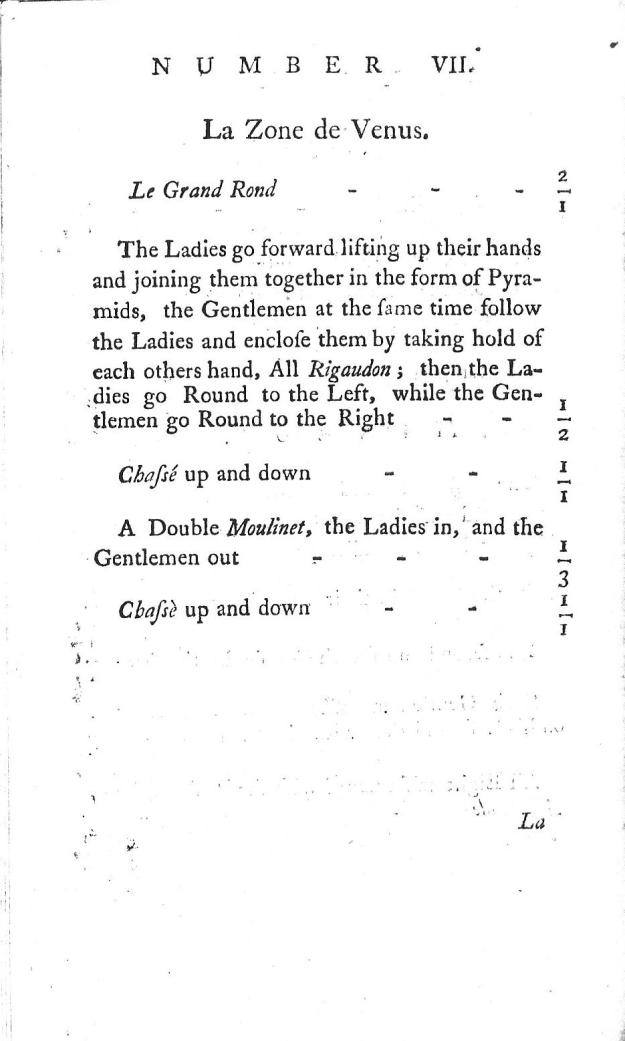
There are, of course, many allusions to love, in keeping with the galanterie inseparable from the cotillon. Gallini has L’Amour Fidelle and L’Amour du Village as well as, less obviously, Les Plaisirs Enchantés and La Pouvoir de la Beauté. The cotillon mentioned to me was La Zone de Venus. The Figure goes as follows:

Gallini Zone of Venus 1

Gallini’s Instructions for La Zone de Venus

Is it intended to represent homage to Venus and to love? In the 18th century the ‘Zone’ of Venus was identified as her girdle or ‘Cestus’, which was decorated to encourage desire. There is a painting by Sir Joshua Reynolds entitled ‘Cupid untying the Zone of Venus’, which shows him undoing the ribbon around her waist. It seems that the ‘Cestus’ became an object of interest (if indeed it was not invented) during the early 1700s. So, was Gallini’s title innocently referring to youthful love or was it intended to be risqué?

The Fundamental Step of the Cotillon

In his Le Repertoire des Bals of 1762 de La Cuisse set down the steps to be used in cotillons, although he did not explain how to perform them. One of these steps is:

‘Le Pas de Gavote ou Demi-Contretems … un Pas naturel; C’es le Pas fondamental de la Contredanse; C’est enfin avec ce Pas que se font les Ronds, les Moulinets, les Courses, et prèsque toutes les figures des Contredanses. Chacun de ces Pas vaut une demie-mesure de Musique.’

So, the demi-contretems was much used in France when dancing cotillons. As the name, as well as de La Cuisse’s explanation, implies, there were two demi-contretems to each bar of music.

Gallini made no mention of the demi-contretems among the steps in his A New Collection of Forty-four Cotillons. Perhaps this was a deliberate omission, for he writes ‘it is intended here to explain only those [steps] which are used in the following cotillons’. Gherardi included ‘Demi contre-tems d’un Pied et de l’autre’ within his list of ‘The Names of the French Country Dance Steps’ in his Fourteen Cotillons or French Dances published around 1767, repeated in his subsequent collections. Contrary to what I said in my post Dancing the Cotillon: Gherardi’s Steps, the dancing master did list some individual steps among the sequences. However, he did not explain how this, or any other, step should be performed. Hurst says nothing about steps and Siret also remains silent. Villeneuve’s list of steps does not include the demi-contretems.

The demi-contretems is a step for travelling forwards in a variety of figures, as recommended by de La Cuisse. This is how it is recorded in the 1705 dance for four Le Cotillon. This is also how it has been used in those modern reconstructions of cotillons which I have danced. I don’t know why it was ignored by some of the dancing masters publishing in London – unless the cotillons in their collections hold the answer.

In the dance manuals of the early 18th century, the first mention by name of the demi-contretems seems to be in Pierre Rameau’s Abbrégé de la nouvelle méthode published around 1725. He includes notated versions of the step, with its name, in his table ‘Suitte des contretems’ (p.65) but he does not describe it. In Rameau’s Le Maître a danser it is not mentioned by name, but its manner of performance may be taken from the description of the contretems de gavotte (translation by John Essex, The Dancing-Master, p. 97):

‘To make one with the right Foot, the Body must be on the Left in the fourth Position, the Heel of the right behind up; then sink upon the Left, and rise upon it with a Spring; but at the same Time the right Leg, which was ready to go, moves forwards in the fourth Position and on the Toes, both Legs well extended; …’

Instead of making the second step, to perform a contretems de gavotte, the dancer should transfer his or her weight onto the right foot to repeat the demi-contretems on the left.

The instruction ‘rise upon it with a Spring’ (Rameau writes ‘se relever en sautant dessus’) has resulted in two different modes of execution by dancers today. One is simply a hop followed by a step (usually onto a flat foot). The other begins with a small spring onto the ball of the foot, much like a rélevé in classical ballet, followed by step onto the ball of the foot and a quick sink into plié. The latter is more difficult and travels less, but gives a pleasing vivacity and crispness to both the step and the figures in which it is used. The demi-contretems can also be performed with a pas rond, in which the working leg traces a small half circle in the air as it passes from back to front. This little embellishment suits the rococo elegance of the cotillon very well.

The Waltz, 1802

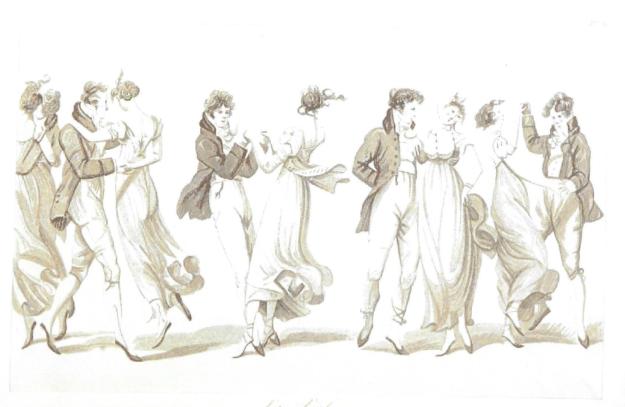
A little while ago, I encountered an early illustration of the waltz that was new to me. It may be well known to experts in the dancing of the 1800s, but I hadn’t seen it before. Nor could I find it in any of the general accounts of this dance I was able to access. It is an acquatint from Journal of a Party of Pleasure to Paris in the Month of August 1802, published in London the same year.

Waltz 1802

‘La Valse’ from Journal of a Party of Pleasure to Paris (1802).

It accompanies what is said to be the first known description of the waltz.

‘At night we went to Tivoli, … Every kind of diversion was going forward; … in the midst of the whole, dancing, on a very large floored space. But the dance was of so curious a nature that I must describe it. It is called a Valse; and it was there danced by about two hundred couple, to a tune extremely slow, each couple turning each other round and round, till they have completed the circle of the whole platform, in the manner of the sketch here presented. But this can only give a faint idea of it; the attitudes of the women are tasteful and sportive, to say no more of them; but of the men I can say nothing, they were so dirty and vulgar they only excited disgust. This dance, though very amusing to the lookers on, and doubtless to the performers, will, I think, never become the fashion in England.’

The Journal is anonymous, but the author has been identified as Sir John Dean Paul (1775-1852) an English neo-classical artist. The Tivoli gardens in Paris were named after those of the Villa d’Este near Rome and were fashionable as an amusement park from the 1790s to the 1840s. 1802 was the year of the Treaty of Amiens, which briefly halted the wars between France and Great Britain and allowed the English to visit Paris.

Waltz music dates back to the 1750s, but the dance seems to have emerged into polite society around 1800. I have elsewhere mentioned the similarity of the basic waltz step to the pas de menuet. Another possible influence on the waltz was the couple allemande, fashionable in the 1770s and 1780s. The hold of the fourth couple in the illustration resembles one of the figures depicted in Dubois’s Principes d’Allemande (undated, but perhaps published in the 1770s). The hold of the third couple appears in a later source, 16 Divisions of Waltzing by the English dancing master G.M.S. Chivers, published around 1822. The first of the four couples use a hold that might also relate to the couple allemande, although it does not exactly correspond to any of those depicted in the handful of treatises that explain this dance. The second couple look more like they are swinging one another around in a modern country dance manner. I haven’t come across anything that resembles it.

None of the couples look like they are dancing slowly. Was the music ‘extremely slow’ so that they could dance in double time? In this early version, the waltz looks as if it might indeed have been as shocking as onlookers claimed.

‘Of the Close beating before …’ Tomlinson, The Art of Dancing (1735)

Kellom Tomlinson devotes chapter XXX of Book 1 of The Art of Dancing to one particular pas composé, ‘the Close beating before and falling behind in the third Position, upright Spring changing to the same before, and Coupee to a Measure’. The ‘Close beating before and falling behind’ appears in Feuillet’s Choregraphie in the ‘Table des Pas de Sissonne’ (p. 81) – in modern ballet terminology the step is an assemblé battu. The ‘upright Spring changing to the same before’ does not appear in Choregraphie – it is the equivalent of the modern changement. The coupé is, of course, one of the fundamental steps of la belle danse. As Tomlinson says, all three elements must be performed within a single bar of music. He provides notation for the pas composé in his Plate I.

Tomlinson Art of Dancing Plate I (detail)

Tomlinson, The Art of Dancing (1735), Plate I (detail).

Tomlinson also refers to two dances where this pas composé is used. Both can be identified as choreographies by Guillaume-Louis Pecour from the 1704 Recueil de dances, the first published collection of his entrées de ballet. One is the Entrée pour deux hommes ‘Dancée par Mr. Piffetau et Mr. Cherrier au Ballet de l’Europe galante’, for which the music is a loure – the ‘Air pour les espagnols’ from the Entrée ‘L’Espagne’. The other is the Entrée Espagnolle pour un homme et une femme ‘Dancée par Mr. Balon et Mlle. Subligny au Ballet de l’Europe galante’, for which the music is the ‘Air. Rondeau’ also from ‘L’Espagne’ – the music is in triple time but is not identifiable with a particular dance type. Is it simply coincidence that both are ‘Spanish’ dances?

Tomlinson adds that this pas composé is usually followed by a coupé avec ouverture de jambe, to allow it to be repeated on the other foot. In the Entrée pour deux hommes, it is followed by a coupé avec ouverture de jambe ornamented with an additional ‘tour de jambe’ (Feuillet’s term for a pas rond with no transfer of weight). In the Entrée Espagnolle pour un homme et une femme, the coupé avec ouverture de jambe incorporates a beat. In neither dance is Tomlinson’s pas composé then repeated.

Is this pas composé widely used? Does it appear in dances without ‘Spanish’ connotations? I looked through the three published collections of theatre dances, together with Feuillet’s 1700 Recueil of his own choreographies (which are not described as theatrical, but have close links to the genre of stage dances). The step does not appear at all in Feuillet’s 1700 collection, although some of the men’s dances include what is obviously a related sequence over two bars of music. Using modern terminology, this is an assemblé battu followed by a changement in the first bar and either a pas de bourée or a coupé in the second. This and other variants occur in a number of stage choreographies. Here I will look only at occurrences of the step as described by Tomlinson.

In Pecour’s Recueil de dances of 1704, apart from Tomlinson’s two examples, the step appears in the following dances.

Passacaille pour une femme, music from Gatti’s Scylla (1701). The onstage characters are Plaisirs. (plate 31)

Sarabande à deux, a male-female duet to music from Campra’s Tancrède (1702). The onstage characters are Plaisirs. (plate 131)

Loure pour deux hommes, music from Gatti’s Scylla (1701). The onstage characters are Candiots. In the loure, each bar contains two distinct pas composés – this occurs as the second. (plate 175)

Chaconne de Phaeton pour un homme, music from Lully’s Phaeton (1683, latest revival before this collection of dances 1702). This solo was not danced at the Paris Opéra, so we do not know which (if any) character was danced. (plate 186)

L’Aimable Vainqueur, a solo for a man to music from Campra’s Hésione (1700). This solo was not danced at the Paris Opéra and the character danced (if any) is unknown. (plate 209)

Sarabande pour un homme, music otherwise unknown and not danced at the Paris Opéra. (plate 215)

Folies d’Espagne pour un homme, to the well-known tune. (plate 224)

In all the dances, the pas composé is followed by a coupée avec ouverture de jambe, with a variety of ornaments. In six cases, it comes towards the end of the choreography although in three of these a variant version appears earlier in the dance.

In Pecour’s Nouveau Recueil de Dance de Bal (c1713), the step appears in one dance only – the Passacaille pour une femme to music from Lully’s Armide (1686, latest revival before this collection 1703. The 1713 revival must have come after the collection was prepared for publication). This solo is stated to have been ‘dancée par Mlle. Subligny en Angleterre’. In the opera the character is a demon disguised as an Amante Fortunée. The choreography apparently belongs to the period 1701-1702, when Mlle Subligny danced in London, where this dance may have been performed simply as a virtuosic belle danse solo. The pas composé appears twice (plates 84, 86). The second time the following bar has three jettés backwards (the first a jetté battu), since the pas composé itself initiates the dancer’s final retreat as she ends her solo.

Pecour Passacaille Armide 86

Pecour, Nouveau Recueil de Dance de Bal [c1713], ‘Passacaille pour une femme’, final plate.

Tomlinson’s version of this pas composé is not used in L’Abbé’s A New Collection of Dances (c1725), although it appears in variant versions in several of the choreographies.

Does all of this tell us anything about how baroque dance vocabulary was used? It seems that Tomlinson’s ‘Close beating before and falling behind in the third Position, upright Spring changing to the same before, and Coupee to a Measure’ is a step used in theatre dance, but it has few ‘Spanish’ connotations. In its basic form it seems to have been most popular in the early 1700s, according to the evidence provided by the musical sources as well as the notated dances. By the 1710s, it was more often used in variant forms. Perhaps it provides evidence of changing choreographic tastes, unless it simply indicates differences in style between individual dancing masters.