Tag Archives: Baroque Dance

Dancing the cotillon: Gherardi’s steps

In all three of his cotillon collections, Gherardi provides the same list of steps needed for the dances.

‘The Names of the French Country Dance Steps

Balancé pas de Rigodon.

Deux chassés, assemblé, pas de Rigodon.

Deux glissades, assemblé, pas de Rigodon.

Contre-tems en avant, contre-tems en arrière, contre-tems en tournant.

Chassé en tournant.

Demi contre-tems d’un Pied et de l’autre.

Brizé, a trois pas d’un Pied et de l’autre.

Chassé a trois pas d’un Pied et de l’autre.

And the Steps necessary for the Country Dance in Allemande.’

It is obvious that Gherardi is setting down not individual steps but sequences of steps, enchainements, for use within the changes and the figures of his cotillons.

He does not explain how each particular step is to be performed. However, in his ‘Observations and Advice’ at the beginning of his first collection, Gherardi says:

‘Every Lady & Gentleman desirous of dancing the Cotillons with some degree of Excellence, … should have the assistance of a Master to perfect them in the following very few Steps; easy in the Execution, and without which, it is impossible to perform these fashionable & entertaining Dances with Precision.’

In his second collection, Gherardi proposes that gentlemen and ladies take out subscriptions for his Cotillon Academy, where they can learn the steps ‘from the Assistance of an experienced Master’. Was he assuming that they will know the basic belle danse steps, but will need help with his enchainements?

Most of the steps are recognisable from the dance manuals of the early 18th century, and several are those described by Gallini. However, the ‘Brizé, a trois pas’ and the ‘Chassé, a trois pas’ are not so familiar and will need a bit of investigation, as do ‘the Steps necessary for the Country Dance in Allemande’.

I can see I will need to devote some more posts to cotillon steps.

Louis XIV, Premier Danseur Noble

Louis XIV is the only dancer, among the many nobles and professionals who appeared in the ballets de cour, to repeatedly attract the attention of scholars. His rank and the extent of his repertoire make any appraisal of his dancing career a challenge. The King performed some 68 roles in 24 ballets de cour, together with at least one role in a comédie-ballet, from 1651 to 1669, a period of nearly twenty years.

I list all these roles below. I will limit myself to just a few observations about them. There is more work to be done on Louis XIV premier danseur, but as much (if not more) research is needed on his dancing contemporaries if we are to reach a proper understanding of his involvement in the ballet de cour.

The King took some roles more than once. He danced the role of le Soleil (the Sun) three times:  le Soleil levant, Ballet de la Nuit (1653); le Soleil, Ballet d’Hercule Amoureux (1662); le Soleil, Ballet de Flore (1669). Despite the frequent identification of the Sun with Apollo, Louis XIV danced the latter role only once, in Les Nopces de Pélée et de Thétis (1654). He appeared as a Maure in three ballets, as Printemps (Spring) in three and as a Berger (Shepherd) in three. These few roles give us an idea of his range as a dancer.

Between 1651 and 1666, Louis also danced seven female roles:

1651 Ballet des Festes de Bacchus (Bacchante; Muse)

1654 Les Nopces de Pélée et de Thétis (Furie; Dryade)

1661 Ballet des Saisons (Cérès)

1663 Les Noces de Village (Fille de Village)

1666 Ballet des Muses (Nymphe)

His first such appearance was at the age of thirteen and the last took place when Louis was twenty-eight.

Louis XIV began to dance in public when he was thirteen and ceased when he was thirty-one.  Over the period of his dancing career, he not only danced alongside his own courtiers but he also appeared with the leading professional dancers of the time.

Louis XIV’s dancing roles in ballets de cour and other entertainments:

1651 Ballet de Cassandre 

(III: Chevalier Suivant de Cassandre. XI:  Tricotet Poitevin)

1651 Ballet des Festes de Bacchus

(IV: Filou. VIII: Devin. XVIII: Bacchante. XXII: Homme de Glace. XXVII: Titan. XXX: Muse)

[an entrée with Louis XIV as a Coquette was suppressed]

1653 Ballet de la Nuit

(Part 1. I: Heure. Part 2. II: Jeu. Part 3. VI: Ardent. XI. Curieux.  Part 4. II: Furieux. X: Le Soleil Levant)

1654 Ballet des Proverbes

(Part 1. IV: ‘Tout ce qui reluit n’est pas or’. X: Maure. Part 2. II: Attaquant. XI: Espagnol)

1654 Les Nopces de Pélée et de Thétis

(I: Apollo. IV: Furie. VI: Dryade. VIII: Academiste de Chiron habillé en Indien. IX: Courtisan. [X]: La Guerre)

Louis XIV as La Guerre in Les Nopces de Pélée et de Thétis (1654). Workshop of Henry de Gissey.

Louis XIV as La Guerre in Les Nopces de Pélée et de Thétis (1654). Workshop of Henry de Gissey.

1654 Ballet du Temps

(Part 1. II: Moment. XII: Siecle d’Or. Part 2. VI: Printemps. XI: Feu)

1655 Ballet des Plaisirs

(Part 1. I: Jeune Berger. XII: Egyptien. Part 2. I: Desbauché. XI: Genie de la Danse)

1655 Ballet des Bienvenus

(Part 2. II: Partie de la Renommée)

1656 Ballet de Psyché

(Part 1. II: Printemps. XII: Esprit Folet. Part 2. XII: Pluton)

1656 Ballet de la Galanterie du Temps

II, X: Galant

1657 Ballet de l’Amour Malade

(I: Divertissement.  X: Parent des Mariez)

1658 Ballet de l’Alcidiane

(Part 1. I: La Haine. Part 2. I: Eole. VI: Demon. Part 3:  VII. Maure)

1659 Ballet de la Raillerie

(I: Ris. V: Le Bonheur. XII: Gentilhomme Français)

1661 Ballet Royal de l’Impatience

(Part 1. I: Grand Amoureux. Part 2. IV: Jupiter. Part 3. III: Chevalier de l’ancienne Chevalerie)

1661 Ballet des Saisons

(IV: Cérès. VIII: Printemps)

1662 Ballet d’Hercule Amoureux

(I: Maison de France. VIII: Pluton. IX: Mars. XVII: Le Soleil)

1663 Ballet des Arts

(I: Berger)

1663 Les Noces de Village

(VIII: Fille de Village)

[He apparently did not dance, as announced, as a Bohémien in entrée XIII.]

1664 Ballet des Amours Déguisés

(VII: Regnaut)

1665 Ballet de la Naissance de Vénus

(Part 2. VI: Alexandre)

[1665 La Réception

(X: Paysan)]

1666 Ballet des Muses

(IV: Berger. VI: Espagnol. VIII: Cyrus. XII: Nymphe. XIV: Maure)

1668 Le Carnaval

(I: Plaisir. VI: Masque Serieux)

1669 Ballet de Flore (2)

(I: Soleil. XV: Européen)

Louis XIV did not appear in the Ballet des Plaisirs Troublés (1657), Ballet de Xerxes (1660), Le Triomphe de Bacchus (1666).

He danced as an Egyptien in the III entrée of the comédie-ballet Le Mariage Forcé (1664). He probably did not dance the roles in the first and last entrées (Intermède 1. I: Neptune. Intermède 6. V: Apollon) intended for him in the comédie-ballet Les Amants Magnifiques (1670).

Dancing the cotillon: Gallini’s steps

I have looked at the changes and discussed the figures of the cotillon. I now turn to the steps of this contredanse française. Among the dancing masters in London who published cotillons when the craze for these dances began, only Gallini, Gherardi and Villeneuve say anything about steps. The figures and the steps are so closely intertwined that both Gallini and Gherardi describe them together.

Gallini’s steps are all recognisably from the long-established vocabulary of la belle danse, the ‘French Dancing’ that developed at the court of Louis XIV in the late 17th century and subsequently spread throughout Europe. They were at once over-familiar and unfamiliar. Gallini introduces them by saying:

‘A description of all the Steps and Figures in Dancing, might, by the Reader, be thought tedious, therefore it is intended here to explain only those which are used in the following cotillons’’

He begins with the Assemblé, which is used ‘at the end of several Steps’.

‘the Assemblé Forward is performed by Sinking and Advancing the hinder foot in a circular manner, Springing and Falling on both feet in any Position that shall be proper for the following Step.’

The use of a circular motion hints at the decorations that could be added within the cotillon.

Le Balancé:

‘is done by Sinking, then Rising as you Step forward or sideways with one foot, the other must follow Straight to the first Position, and in the same manner Step back again, beginning with the contrary foot.’

Le Chassé ‘is performed in various ways’:

‘To do this Sideways you must place yourself in the Second Position; if you go to the Right, it is performed by Sinking, then in Rising Spring on both feet and place the Left foot behind where the Right was, at the same time the Right foot Advancing to the Second Position.’

Gallini explains ‘if you Chassé cross, add one Step in the fifth Position and an Assemblé’ and the same is done for the chassé forward. This step was moving towards the 19th-century basic quadrille step.

Le Contretemps:

‘To perform this Forward you must advance your Right foot, sink on both feet, but spring and fall on the Right, then walk two Steps Straight.’

He goes on ‘to this you may add an assemblè’, taking it towards a pas de gavotte.

He describes only half-turn pirouettes:

‘[La Pirouette] is performed to the Right, by bringing your Right foot in the fifth Position behind, then  Rising on your Toes, and turning half Round to the same Position, do the same again to bring you Round; this may be done to the Left, by Reversing the Feet.’

Finally, Gallini gets to Le Rigaudon, one of the characteristic steps of the cotillon.

‘To perform this in the first Position, you must Sink, then Spring, and Fall on the Right foot, bring your left to the first Position, move your Right and return it to the same Position, the knees being straight, Sink, then Spring on both feet and Fall on your Toes in the first Position.’

He adds ‘This may be done by Reversing the Feet’. He also, helpfully, explains how to do the rigaudon from the third position, allowing the dancer to move forwards or backwards.

‘When the Rigaudon is performed in the third Position, with the Right foot foremost, you must Sink, then Spring, and Fall on the Right foot; advance your Left to the same Position, then advance the Right to the third Position, the Knees being straight, Sink, then Spring on both feet and Fall on your Toes with the Left foot foremost in the same Position.’

The one step Gallini completely ignores is the demi-contretemps, the basic step of the cotillon already being used as early as Le Cotillon, the dance for four published in 1705.

His step descriptions seem to be his own, which he presumably developed in the course of his teaching rather than simply copying them from earlier dance manuals. They don’t seem to provide quite enough detail to perform all these steps properly – assuming that the steps were indeed the same as those notated and described in the early 1700s. Do Gallini’s instructions provide hints on the changing style and technique of ballroom dancing in the mid-18th century?

Madame. The first ballerina?

Modern histories of ballet usually name Mlle de la Fontaine as the first ballerina, citing her appearance in Lully’s Le Triomphe de l’Amour of 1681 as marking the advent of the female professional dancer. In fact, the history of the ballerina starts some years before then.

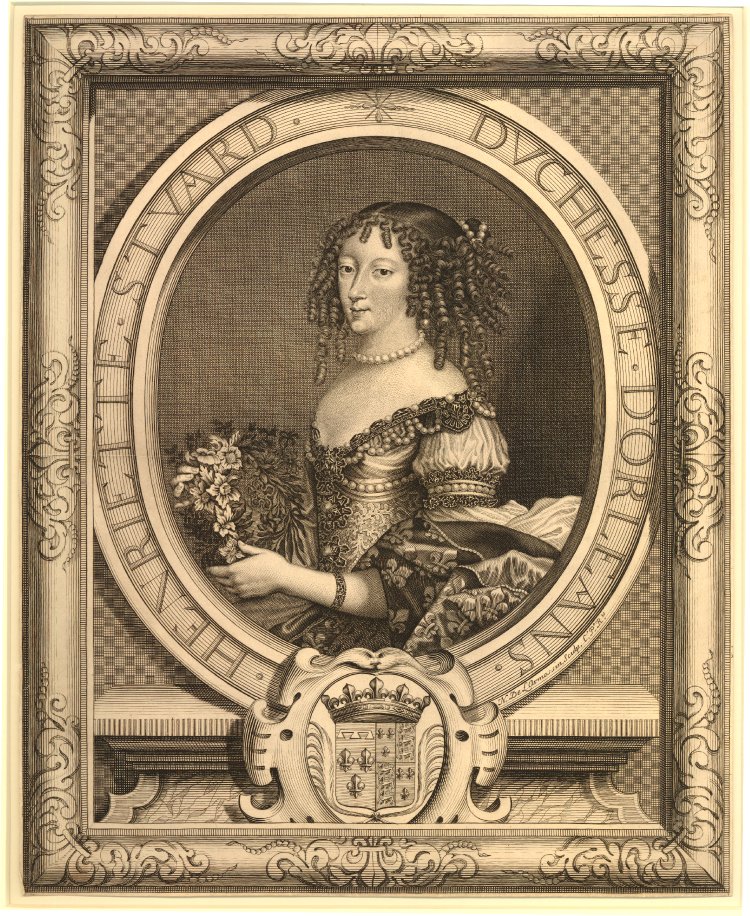
Another contender for the title of the first ballerina, although she was most definitely not a professional dancer, is Madame – Henriette-Anne, Princesse d’Angleterre, duchesse d’Orleans. She was the sister of Charles II, king of England, and married Monsieur, the brother of Louis XIV, in 1661. Her first appearance in a ballet de cour was in April 1654, at the age of nine, when she danced in the first entrée of Les Nopces de Pélée et de Thétis as Erato, at the head of the other Muses.

Madame’s brief ascendancy as the leading female noble dancer at the French court began in 1661, just a few months after her marriage, when she danced the role of Diane in the second entrée of the Ballet des Saisons accompanied by a corps de ballet of court ladies. The verses written to celebrate her appearance, published in the ballet’s libretto, began:

‘Diane dans les bois, Diane dans les cieux,

Diane enfin brille en tous lieux,

Elle est de l’univers la seconde lumière,

Elle enchante les coeurs, elle ébloüit les yeux.’

If they are careful to describe her as ‘la seconde lumière’ to her brother-in-law the Sun King, the lines still suggest the idea of her as a ballerina, the leading dancer of the company.

In 1663, Madame appeared in the Ballet des Arts, dancing alongside Louis XIV as a Bergère (Shepherdess) to his Berger. In the final entrée she danced as Pallas Athene with a group of Amazons personified by court ladies. In 1665, she danced as Venus in the first entrée to the Ballet de la Naissance de Vénus, given in her own apartments. According to the libretto, she made her appearance on a throne of mother-of-pearl surrounded by twelve Nereides (danced by court ladies) ‘qui l’admirent, la reverent, & dansent avec elle’. In the sixth and final entrée Louis XIV appeared as Alexander the Great with Madame as his mistress Roxane. The following year, 1666, Madame reached her apogee as the court’s ballerina when she danced in the Ballet des Muses. Her first appearance was alongside Louis XIV, again as a Bergère and Berger, in the fourth entrée. She and the King led troupes of female and male dancing Spaniards in the sixth entrée and in the eleventh entrée she led a group of Pierides (daughters of Pierus) against the Muses. This entrée took the form of a contest, with ‘ces deux troupes aspirant avec mesme ardeur à triompher de celle qui luy est opposée’. The Ballet des Muses ended with an Entrée des Maures, in which Louis XIV and Madame again danced together as a Maure and a ‘Mauresque’.

Madame’s career as a ballerina ended with the Ballet des Muses. She had been prevented from appearing in earlier ballets by pregnancy and she was unable to participate in the Ballet de Flore, created for her in 1669, because she was again expecting a child. Just fifteen months later, in 1670, Madame unexpectedly died at the age of twenty-six. The Ballet de Flore was probably the last time that Louis XIV danced in public. Would he have danced again, and would the ballet de cour have survived for longer if Madame, the court’s ballerina, had not died so tragically early?

Madame, Duchesse d'Orleans.Nicholas de Larmessin after Pierre Mignard? c1661-1670. © Trustees of the British Museum

Madame, Duchesse d’Orleans. Nicholas de Larmessin after Pierre Mignard? c1661-1670. © Trustees of the British Museum

Dances for four: Le Cotillon (1705)

The first dance for four to be published in the new system of dance notation was Le Cotillon, which appeared in Feuillet’s IIIIe Recueil de dances de bal pour l’année 1706. In his first such collection, for 1703, Feuillet promised that they would appear towards the beginning of November each year to allow time to learn the dances before the winter season of balls began. This little collection had just three dances, two danses à deux and a danse à quatre:

La Bavière, a menuet and forlane, choreography by Guillaume-Louis Pecour.

La Fanatique, a sort of rigaudon to a ‘marche des Fanatiques’ by Lully, choreography by Feuillet.

Le Cotillon, a branle (in fact a gavotte) by an unknown choreographer.

In his Avertissement to his latest annual collection, Feuillet wrote:

‘Le Cotillon, quoi que Danse ancienne, est aujourdhui si a la mode a la Cour, que j’ay cru ne pouvoir me dispenser de la joindre à ce petit Recüeil, c’est une maniere de branle a quatre que toutes sortes de personnes peuvent danser sans même avoir jamais appris.’

[The Cotillon, although an old dance, is so fashionable at court, that I thought I had to include it in this little collection, it is a sort of branle for four that anyone can dance without having learnt it beforehand]

He reminded his readers that he would continue to publish his collections of ball dances each November for the forthcoming year. He also announced the publication of his Recueil de contredances at the beginning of 1706 – ‘les Contredanses d’Angleterre … aussi fort à la mode’.

Le Cotillon is an earlier form of the contredanses françaises – cotillons – that would become a dance craze in the 1760s in both France and England. The musical structure for the dance is AABABA x 6 (A = B = 4). There are a series of Changes, to each AA, between which the same Figure is danced, to the BABA music. The terminology ‘Change’ and ‘Figure’ is that used when the cotillon, a dance for four couples facing inwards around a square, reached London in the mid-1760s.

The 8-bar changes in Le Cotillon are as follows:

Forward and back (in couples)

Siding (in couples)

Taking right hands and left hands (in couples)

Taking both hands (in couples)

Right hand star (all four dancers)

Left hand star (all four dancers)

Circle left and right (all four dancers)

These are recognisably related to English country dance conventions.

The 16-bar figure is much simpler than those to be found in the later cotillons. One man and his opposite lady perform a sequence of steps taking right hands and then their partners do the same.

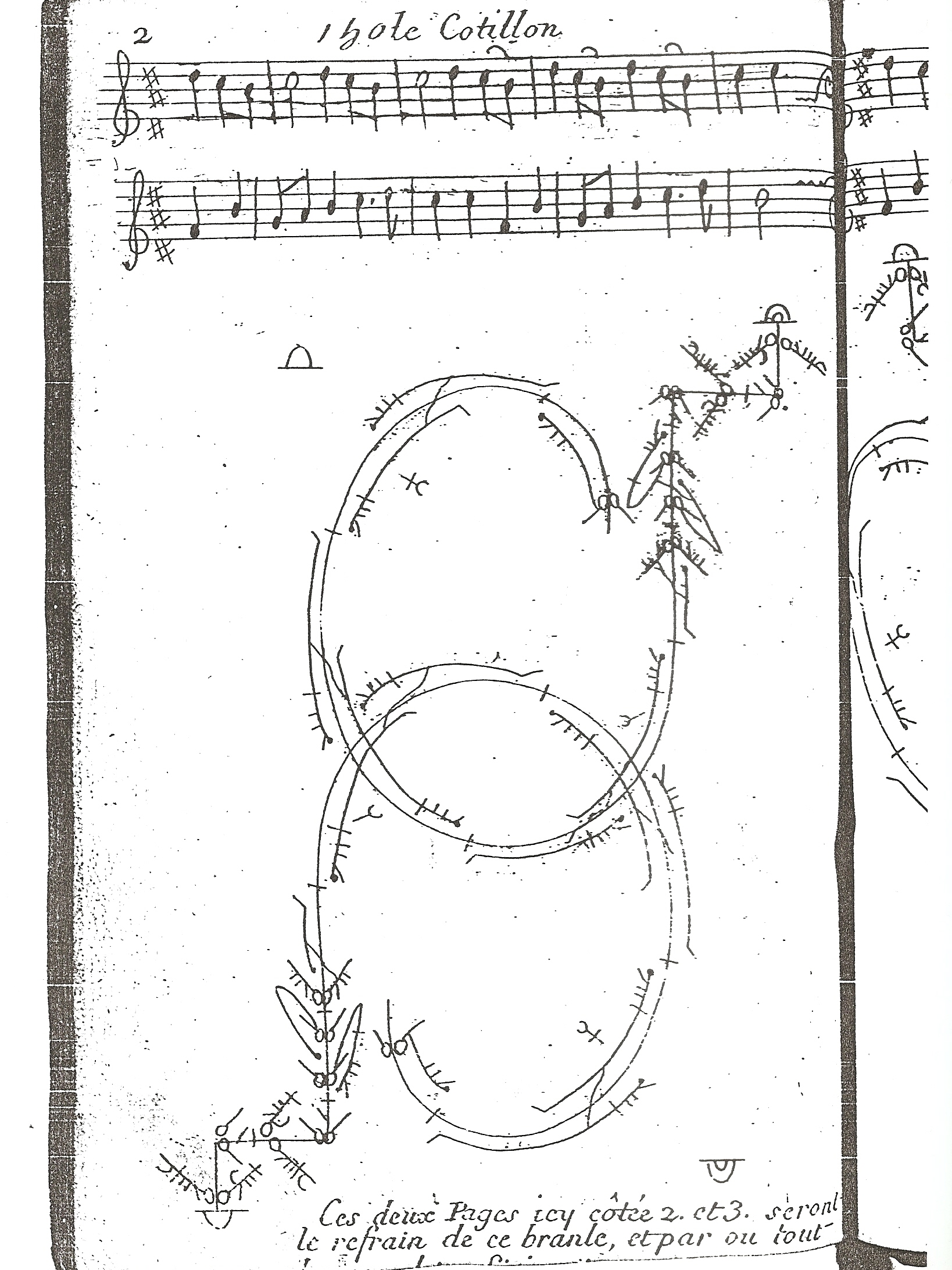
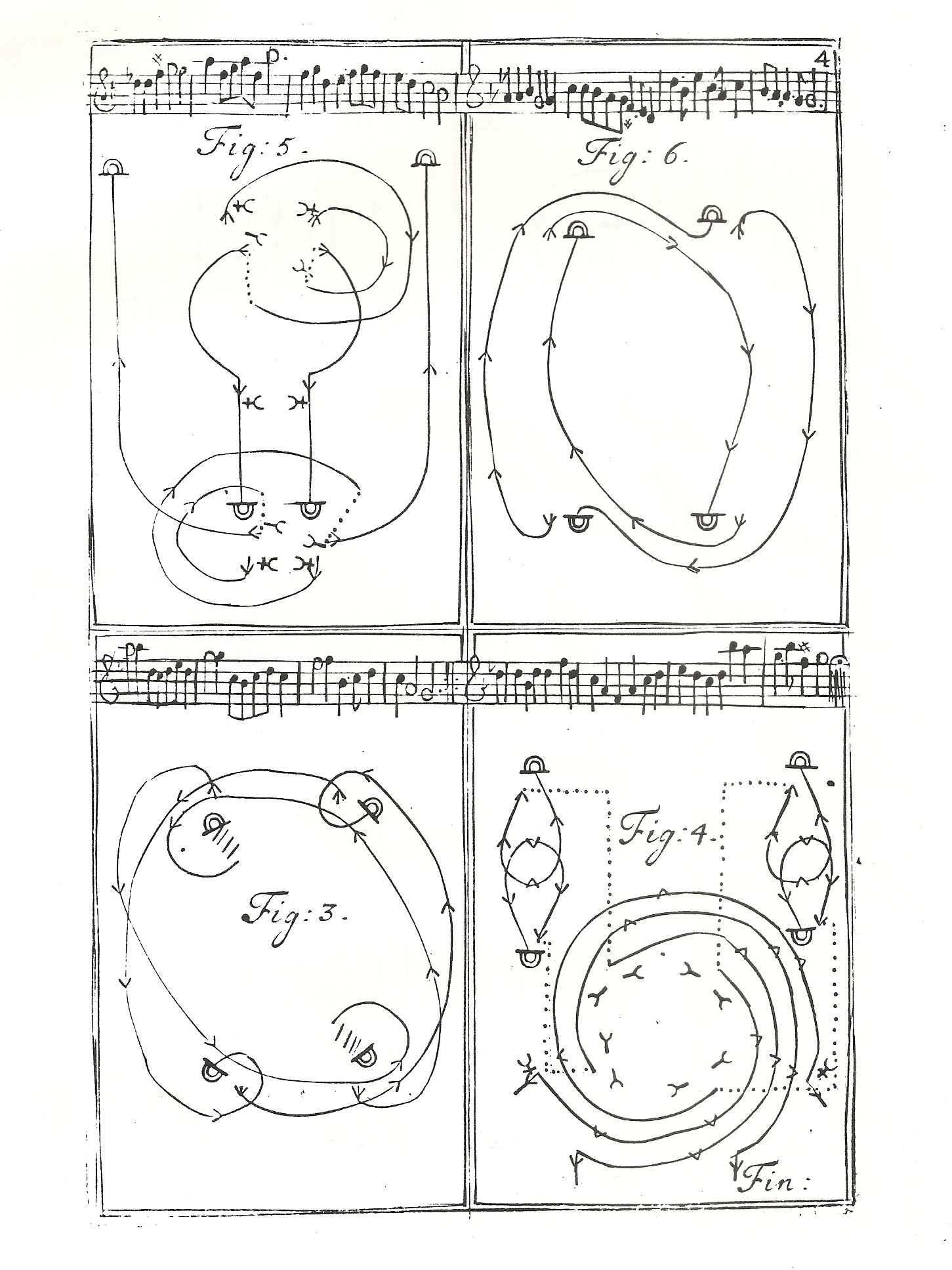
Feuillet notates all the steps in Le Cotillon. These, too, anticipate the vocabulary of the later cotillons. Dancers use pas de gavotte (contretemps to first position, jump and step) when moving forwards and backwards and demi-contretemps when moving in a circle. Sequences usually end with an assemblé. The figure uses a sequence beginning with a jump on two feet with a quarter-turn and then back, pas de rigaudon and a jump on two feet, a step and then a series of demi-contretemps ending with an assemblé.

The steps are easy and the sequences are straightforward and predictable. As Feuillet promised, dancers could perform Le Cotillon with no prior practice.

Le Cotillon (1705). First plate. Opening Change.

Le Cotillon (1705). First plate. Opening Change.

Le Cotillon (1705). Second plate. First half of Figure.

Le Cotillon (1705). Second plate. First half of Figure.


Mr Holt’s Minuet and Jigg in Performance

There are at least three versions of Mr Holt’s Minuet and Jigg on YouTube. In my opinion, this is the best of them.

The dancers are well costumed and they dance nicely. However, we have two men and two ladies, rather than the four ladies specified by the original notation. One of the videos I was able to find has four ladies, but this version has much better dancing.

The figures are accurately performed and the steps are neat, although the performance is perhaps rather too contained and even a bit stiff. Is that how they thought it should be danced? It is very difficult to find a happy medium between our conflicting ideas of 18th-century politeness and extravagance. Although there is some interaction within each couple, each pair less often acknowledges the other – which underplays the social dimension of this choreography. The second figure of the Minuet looks to me, on paper at least, to refer to the S-reversed of the ballroom minuet, a possibility that these dancers do not acknowledge. Other figures are danced prettily, particularly the circle in the second part of the Minuet where the dancers use to good effect the shoulder shading called for in the pas de menuet to the left.

The steps used in the Jigg don’t always quite work. Mr Holt calls for only a few steps in specific figures, leaving the others to the dancers’ choice. Those chosen, or rather the sequences of steps, don’t always seem choreographically quite right to me. I’m not sure why. I do like the concluding figure and the way the dancers open out into a half-circle to face their audience. This must have been charming at the time, when the dance was performed by four young ladies.

I wonder if this performance does represent the style and technique of 18th-century social dancing. There is simply no way we can tell. It is nicely danced, and those wishing to perform Mr Holt’s Minuet and Jigg can learn much from it, but I would prefer a little more freedom and liveliness – within the bounds of politeness, of course.


Mr. Holt and his Minuet and Jigg for four ladies

The first and only dance for four to appear in an English source was Mr Holt’s Minuet and Jigg. Who was Mr Holt and why did he create this choreography?

This dance for four was published in London in 1711, in Edmund Pemberton’s An Essay for the Further Improvement of Dancing. The collection of ‘Figure Dances’ was entirely for female performers, although Pemberton never mentions this fact. The title page says nothing. The Preface focuses almost exclusively on the significance and value of the new system of dance notation used to record the choreographies. Even the dedication to Thomas Caverley, noted as a teacher of young ladies, avoids any reference to female dancers.

Mr Holt was obviously deemed worthy of a place among ‘the most Eminent Masters’ (according to the title page) whose dances were published in Pemberton’s collection. There were several Holts, dancing masters and musicians, working in London during the early 1700s. Which of them created this Minuet and Jigg? Among the subscribers to the publication (who had paid in advance for copies in order to finance the printing) are Walter Holt and William Holt. The choreographer must have been one of them, but which one?

Various dancing masters named Holt subscribed to dance treatises and collections of dances in the early eighteenth century. In 1706, Walter Holt ‘Senior’ and Walter Holt ‘Junior’, together with Richard Holt, subscribed to John Weaver’s Orchesography (his translation of Feuillet’s Choregraphie) and A Collection of Ball-Dances Perform’d at Court (his notations of choreographies by Mr Isaac). In 1721, Walter Holt and William Holt subscribed to Weaver’s Anatomical and Mechanical Lectures upon Dancing (which were delivered at ‘Mr Holt’s Dancing-Room, at the Academy in Chancery-Lane’ according to the Daily Post for 31 January 1721). In the early 1720s, too, Walter Holt, William Holt and ‘Mr. Holt Junior’ subscribed to Anthony L’Abbé’s A New Collection of Dances.  I suggest that Walter Holt ‘Senior’ was the ‘Musician’ who died in 1706 (his will survives in the National Archives at Kew) and that Walter Holt ‘Junior’ was his son, another ‘Musician’, probably born in 1676 who died in 1738 (his will is also in the National Archives). Richard and William Holt are likely to be the brothers of Walter Holt ‘Junior’, born in 1678 and 1691 respectively. William, who died in 1723 (his will is in the National Archives), was the choreographer of a ballroom duet Le Rigadon Renouvele published around 1720. ‘Mr. Holt Junior’ may well be another Walter, the son of Walter Holt ‘Junior’, born in 1701.

The only real candidate for choreographer of the Minuet and Jigg is Walter Holt ‘Junior’ (1676-1738). He is surely the ‘Mr. Holt’ listed among the dancing masters named by John Weaver in his 1712 An Essay towards an History of Dancing as ‘happy Teachers of that Natural and Unaffected Manner, which has been brought to so high a Perfection by Isaack and Caverley’. He was a contemporary of Weaver and must have been very well-established as a dancing master, unlike his much younger brother William. When he died in 1738, Walter Holt was described as ‘Mr. Holt, sen. a very wealthy and famous Dancing-Master’ (Weekly Miscellany, 15 September 1738).

What of the Minuet and Jigg itself? I will not analyse the choreography in detail, for there are others who are far more expert in this genre than I. The minuet has 48 bars and the jigg 32 bars, so the dance is quite long. The four ladies begin as two couples facing one another (two of the dancers have their backs to the audience). They face towards each other, in the manner of a country dance, for much of the choreography. The minuet section draws on the familiar figures of the ballroom minuet, including the S-reversed, taking right hands and taking left hands. It also uses figures from country dances, for example the square hey and the dos-à-dos. Only one step is specified in the notation – the pas de sissonne used in the jigg. Pemberton gives no advice about steps, but his reference to John Essex’s For the Further Improvement of Dancing (a translation of Feuillet’s 1706 Recueil de contredances), published in 1710, implies that he expects readers to look at that treatise for advice. The ladies complete the dance by opening into a semi-circle to face their audience.

Mr Holt's Minuet and Jigg, first plate.

Mr Holt’s Minuet and Jigg. First plate.


Mr Holt's Minuet and Jigg.  Last plate.

Mr Holt’s Minuet and Jigg. Last plate.


This choreography for four is simultaneously a means of teaching the genteel style and technique of both ballroom and country dances expected in English polite society and a contrivance for displaying the skills that could be learnt from the best dancing masters. It was probably created for performance by his female scholars, before an audience, at Walter Holt’s Academy.

Dancing the cotillon: Gherardi’s figures, from his Third Book of Cotillons

In the introduction to his A Third Book of French Country Dances or Cotillons, Gherardi complained:

‘The reason of the little Improvement (generally speaking) hitherto made in the Cotillons, has been and is, doubtless, owing to the obscure and unintelligible method of explaining the Figure; for, to this Day, Masters have generally adopted Terms made use of for the English Country Dances; which, inadequate as they must appear to be in pointing out the Figure, leave the Dancer totally in the dark with respect to what he ought to do himself, or cause his Partner to perform.’

Gherardi’s answer to this problem was to repeat what he had done in his second book, ‘I think it not improper to explain them, both by Representation and Words’. So, he again used diagrams to make the figures as clear as possible. He chose to both explain and illustrate nine figures, including: simple chassé across; chassé dessus et dessous; chassé double (for which he gave two diagrams). He also showed some more complex figures, for which I will give only his diagrams:

Gherardi, A Third Book of French Country Dances or Cotillons. London, [1770], p. viii

Gherardi, A Third Book of French Country Dances or Cotillons. London, [1770], p. viii

Gherardi, A Third Book of French Country Dances or Cotillons. London, [1770], p. ix.

Gherardi, A Third Book of French Country Dances or Cotillons. London, [1770], p. ix.

Gherardi, A Third Book of French Country Dances or Cotillons. London, [1770], p. xiii.

Gherardi, A Third Book of French Country Dances or Cotillons. London, [1770], p. xiii.

Gherardi, A Third Book of French Country Dances or Cotillons. London, [1770], p. xiv.

Gherardi, A Third Book of French Country Dances or Cotillons. London, [1770], p. xiv.

Gherardi, A Third Book of French Country Dances or Cotillons. London, [1770], p. xv.

Gherardi, A Third Book of French Country Dances or Cotillons. London, [1770], p. xv.

Gherardi, A Third Book of French Country Dances or Cotillons. London, [1770], p. xvi.

Gherardi, A Third Book of French Country Dances or Cotillons. London, [1770], p. xvi.

Did he need to use all this ingenuity to keep his cotillons interesting and, above all, novel and thus fashionable?

After his explanations and illustrations, Gherardi was careful to add:

‘I recommend to the Lovers of the French Country Dances, or Cotillons, a careful and frequent consideration of these Figures, & also of those in my last Book, … in order to fix them strongly in their Memory.’

He ended his introduction by reminding his readers that ‘Mr. Gherardi’s Academy is begun for the Winter’. Gherardi’s books were not so much self-help manuals as advertisements.


The ballets of Louis XIV: a list

Here is a list of the ballets performed at the court of Louis XIV between 1648 and 1669.

1648       Ballet du Dérèglement des passions

1651       Ballet de Cassandre

1651       Ballet des festes de Bacchus

1653       Ballet de la nuit

1654       Ballet des proverbes

1654       Les Nopces de Pélée et de Thétis

1654       Ballet du Temps

1655       Ballet des Plaisirs

1655       Ballet des Bienvenus

1656       Ballet de Psyché

1656       Ballet de la Galanterie du Temps

1657       Ballet de l’Amour malade

1657       Ballet des plaisirs troublés

1658       Ballet de l’Alcidiane

1659       Ballet de la raillerie

1660       Ballet de Xerxes

1661       Ballet royal de l’impatience

1661       Ballet des saisons

1662       Ballet d’Hercule amoureux

1663       Ballet des arts

1663       Les Noces de village

1664       Ballet des amours déguisés

1665       Ballet de la naissance de Vénus

1666       Le Triomphe de Bacchus

1666       Ballet des muses

1668       Le Carnaval

1669       Ballet de Flore

Not all of these were ballets de cour. Some were smaller-scale and more intimate mascarades. There were other ballets over this period, notably the comédies-ballets of Lully and Molière, which mostly involved professional dancers. The ballets de cour were danced, first and foremost, by the king and his courtiers. Why were these ballets performed? What were they about? Who danced in them? How much did they influence later dance works, not only in France but throughout Europe? I can see that I will have to do some research into recent writing on the subject if I am to find out.

Nicolas de Larmessin. Louis XIV. 1661. © Trustees of the British Museum

Nicolas de Larmessin. Louis XIV. 1661. © Trustees of the British Museum

My interest is also in how they affected dancing on the London stage. Most of these ballets de cour were performed while England was suffering a civil war and then living under a puritan commonwealth government. The English tradition of the masque was interrupted by these calamitous events and never fully revived following the restoration of Charles II in 1660. However, French dancing was to be profoundly influential in London after 1660, both at court and in the playhouses. Before I can pursue that topic, I need to look more closely at the French ballets de cour and their performers.

The Morning Star: Monsieur and the ballet de cour

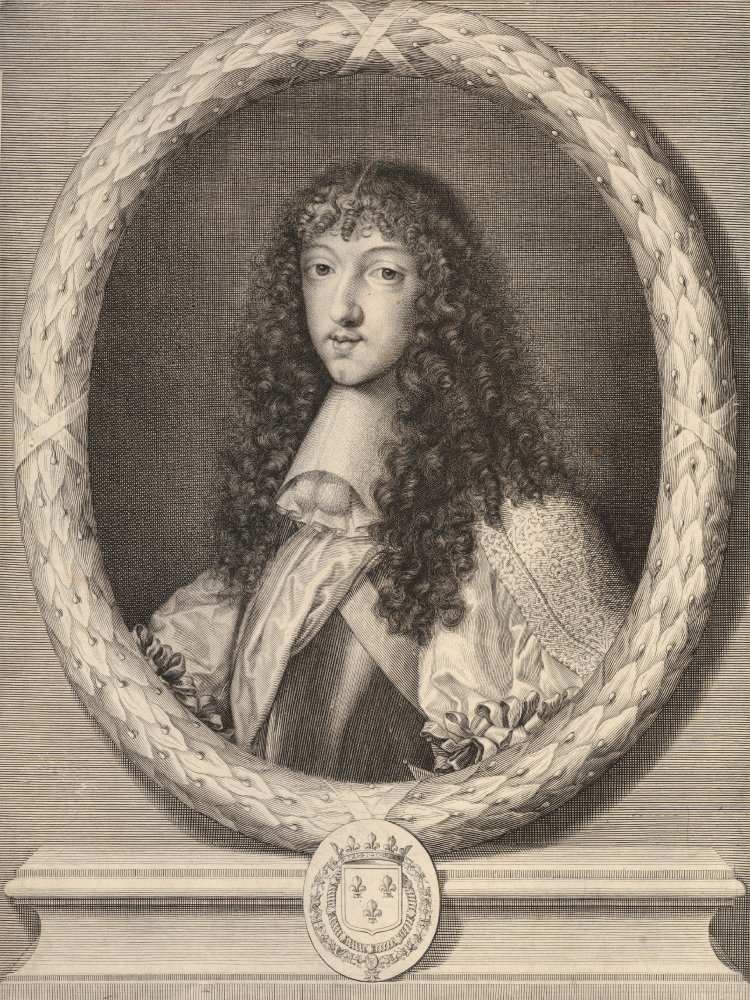
Much has been made of the dancing skills of Louis XIV, who performed in so many of the ballets given at his court between 1651 and 1669, but what of his brother Philippe duc d’Orleans known simply by the honorific title ‘Monsieur’? In the ballet, as in life, he was not allowed to overshadow the Sun King. Monsieur made his first appearance as a dancer in the Ballet de Cassandre, in which Louis XIV also made his debut. While the thirteen-year-old Louis took two dancing roles, Philippe (aged eleven) danced only as a Page de Cassandre. Later that same year he danced as a Fille (Young Girl) in the Ballet des Festes de Bacchus. At this time (and for many years to come) female roles were almost invariably danced by boys and men. Louis XIV himself danced female roles on several occasions, the last being in the 1666 Ballet des Muses when he was in his late twenties.

Monsieur’s notable roles included L’Estoille du Point du Jour (The Morning Star) in Le Ballet de la Nuit in 1653, in which he heralded the appearance of the King as Le Soleil Levant (the role that made Louis, definitively, the Sun King). In 1656, when he was sixteen, Philippe appeared in the Ballet de Psyché as Talestris, Reine des Amazones (Talestris, Queen of the Amazons) with four male courtiers as his fellow female warriors. The customary verses written to celebrate his performance and printed in the ballet’s libretto declared ‘like a true and perfect Amazon, you combine beauty and courage’. After 1656, Monsieur’s appearances in ballets de cour became less frequent, although he did dance in several of these increasingly extravagant productions during the early 1660s.

Following their marriage in 1661, Philippe’s wife Henriette d’Angleterre (sister of Charles II, King of England and known as ‘Madame’) began to take a leading role in court entertainment. She appeared alongside her brother-in-law Louis XIV in a number of ballets. In 1666, Monsieur again took the role of L’Estoille du Point du Jour – this time reflecting the glory of Madame, who appeared as Venus. Below is a list of Monsieur’s dancing roles (spellings generally follow those in the original libretti). At the moment, I do not know why he did not appear in so many of the ballets in which his brother Louis took leading roles as a dancer.

Philippe d’Orleans. Print by François de Poilly I, after Jean Nocret. c 1660. © Trustees of the British Museum

Philippe d’Orleans. Print by François de Poilly I, after Jean Nocret. c 1660. © Trustees of the British Museum

Monsieur’s Dancing Roles:

1651       Ballet de Cassandre (Page de Cassandre)

1651       Ballet des festes de Bacchus (Fille)

1653       Ballet de la Nuit (Galant; L’Estoille du Point du Jour)

1654       Les Nopces de Pélée et de Thétis (Pescheur de Corail; Un Amour)

1654       Ballet du Temps (L’Esté)

1655       Ballet des Plaisirs (Paren des Mariez; Courtisan)

1656       Ballet de Psyché (Talestris, Reine des Amazones; L’Hymen)

1661       Ballet des Saisons (Vendangeur)

1662       Ballet d’Hercule Amoureux (L’Hymen)

1664       Ballet des Amours Déguisés (Amour déguisé en Dieu Marin)

1665       Ballet de la Naissance de Vénus (L’Estoille du Point du Jour)