Category Archives: Steps & Figures

Pas Battus in L’Abbé’s Stage Duets for a Man and a Woman

My investigation of the choreographies for men in the three published collections of stage dances has shown that Anthony L’Abbé made much greater use of pas battus than Guillaume-Louis Pecour. The three collections have, between them, 31 duets for a man and a woman (around 40% of the total), but I am going to look only at the male-female duets in L’Abbé’s New Collection of Dances (c1725). I won’t attempt a full analysis of each, I’ll simply focus on specific pas battus in each choreography. L’Abbé’s four dances are the ‘Chacone of Galathee performd’ by Mr La Garde and Mrs Santlow’ (plates 22-30), the ‘Saraband of Issee performd’ by Mr Düpré & Mrs Bullock’ (plates 31-36), which is followed by a ‘Jigg’ performed by them (plates 37-39), and the ‘Türkish Dance performd’ by Mr Desnoyer & Mrs Younger’ (plates 84-96). All of the performers were leading dancers in London’s theatres. One of the dances, the ‘Jigg’, has little in the way of pas battus of the sort I am exploring, so I will not include it in this post.

The ‘Chacone of Galathee’ is to music from Lully’s Acis et Galatée of 1686, which was regularly revived after its first performances. It is possible that L’Abbé performed in it at the Paris Opéra. His choreography for Delagarde and Mrs Santlow probably dates to the period 1708-1712, when the two could have danced together, and the duet was evidently meant to be a virtuoso showpiece. The chacone has five 8-bar variations and is played through twice, so the dance has 80 bars of music. It begins with a coupé preparation and a single pirouette en dedans, which sets the tone for what is to follow. The dancers perform in mirror symmetry and do the same steps (on opposite feet) for much of the duet. However, in bar 38 (plate 25), Mrs Santlow begins a pas composé with a jetté emboîté, which is followed by a pas, a pas battu derrière into plié and a demi entre-chat. Delagarde does the same, except that he begins with a demie cabriole or jetté battu, beating his legs together in the air. I wrote about the jetté emboîté in my post Stage Dances for Women and the Demie Cabriole back in April 2019 and concluded that (despite the notation – which may owe as much to social convention as to stage practice) women may well have performed the step as a demie cabriole. I should add that Le Roussau’s notation for this dance has a number of (usually minor) errors.

The differences become more obvious, and more interesting, with the repeat of the music. In bar 43 (plate 26), both dancers perform a full-turn pirouette en dehors on both feet. This is the preparation for their next step – Mrs Santlow performs a tour en l’air with a changement, while Delagarde does an entre-chat droit à 6 without a tour.

Chacone of Galathee 1725 26 (2)

The couple then dance the same steps as each other until bar 72 (plate 29), when Mrs Santlow simply does a changement while Delagarde performs another entre-chat droit à 6.
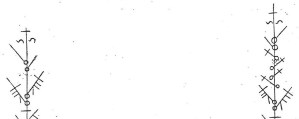
Chacone of Galathee 1725 29 (2)

They have exactly the same steps, in mirror symmetry, until the end of the choreography. It is obvious that the notation is wrong in one or other (or both) of these places, but how? Is Mrs Santlow’s tour en l’air in bar 44 a mistake, or should Delagarde have had one too? Should the repetition of the changement and the entre-chat in bar 72 have tours as well? Can we really be sure that Mrs Santlow, shown in other dances to have had a virtuoso technique, could not have performed an entre-chat droit à 6?

The ‘Sarabande of Issee’ is to music from Destouches’s opera Issé, first performed in 1697 and given its first revival in 1708. Dupré is, of course, London’s Louis Dupré. Ann Bullock, a pupil of Delagarde, began her career (as Miss Russell) at the Lincoln’s Inn Fields Theatre in 1714. Their duet probably dates to around 1715. It begins with a preparatory ouverture de jambe, followed by a pas battu (notated as a spring but possibly performed with a relevé sauté) in which each dancer’s inside leg beats front, back, front around their supporting leg. Throughout the dance, except for the steps I will be singling out, Mrs Bullock dances the same vocabulary as Dupré.

In bars 11 and 19 (plate 32), she and Dupré do something different.
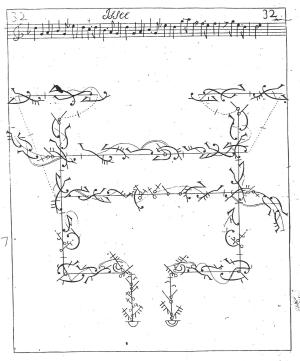
Sarabande of Issee 1725 32

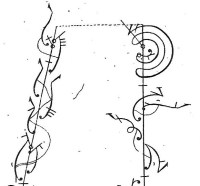
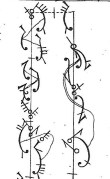
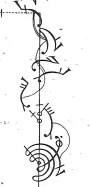
At the bottom of the page, Dupré performs an entre-chat droit à 6 while Mrs Bullock does a changement. In the middle of the page (the tracts running left to right), he does an entre-chat à 5 followed by two demi-contretemps, but she does only a contretemps battu before the two demi-contretemps. In bar 42 (plate 34), Dupré does another entre-chat droit à 6 to Mrs Bullock’s changement. They do the same for a third, and final, time in bar 60 (plate 36). The preceding pas composé for Dupré joins two entre-chats à 5 with an assemblé battu, while Mrs Bullock has a coupé to point, a coupé avec ouverture de jambe and a pas emboîté. The last of these is odd, as the notation for bar 37 (plate 34) shows her matching Dupré with an assemblé battu which has a half-turn in the air. Here is the whole of the final plate for this saraband. You can see the sequence culminating in the entre-chat droit à 6 / changement in the tracts running bottom to top nearest the centre of the page.
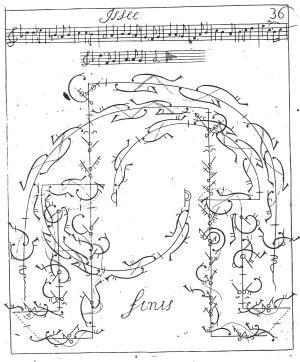
Sarabande of Issee 1725 36

Surely Mrs Bullock was capable of performing an entre-chat droit à 6, given her other technical feats in this dance. Does the notation really tell us the steps she did, or were some deliberately simplified for the purposes of publishing the notation?

In the ‘Türkish Dance’ I want to draw attention to three steps in the duet. This choreography uses music from the Entrée ‘La Turquie’ in Campra’s L’Europe galante of 1697. L’Abbé’s dance must date to 1721 or 1722, when George Desnoyer made his first visit to London and apparently enjoyed a dance partnership with the dancer-actress Elizabeth Younger. In bars 17-18 (plate 94, I have numbered the bars from the beginning of the last piece of music in this duet), Desnoyer and Mrs Younger each perform a cabriole one after the other. They repeat this feat in bars 37-38 (plate 96) and, as they move away from each other a few steps later, they do another cabriole in bar 44. The notated cabrioles appear just above the centre of the page and then to right and left as the tract begins to straighten.

Turkish Dance 1725 96

What is going on here? Does the nature of these steps permit a woman to do a cabriole? Did Le Roussau fail to edit out the cabrioles (which are indicated by a single additional short stroke at right-angles to the step) from his notation? Or, were women routinely performing pas cabriolés all along?

My last post on this topic will look at the ‘Passagalia of Venüs & Adonis’ created by L’Abbé for Hester Santlow, a solo which further calls into question the supposed limitations on the technique of female professional dancers.
Entre-Chats in Male Solos and Duets

My last post on the topic of pas battus in stage dances for men and women (back in November 2019) looked at Feuillet’s ‘Table des Entre-Chats’ in Choregraphie. Here, I will investigate the entre-chats notated in the male solos and duets within Pecour’s collections of 1704 and c1713, as well as L’Abbé’s of c1725. Once again, there are some interesting differences between their use in the three collections and by the two choreographers.

In Pecour’s 1704 collection, four of the thirteen choreographies for men have no entre-chats – the ‘Sarabande pour un homme non dancée a l’Opera’ (plates 210-215), the ‘Folies d’Espagne pour un homme’ (plates 221-224, this is also a sarabande), the ‘Sarabande pour deux hommes’ (Piffetot and Cherrier, plates 154-157) and the ‘Entrée pour deux hommes’ (Piffetot and Cherrier, plates 164-168). The absence of this step from the sarabandes may reflect a convention particular to that dance type, but loures present a more complex picture.

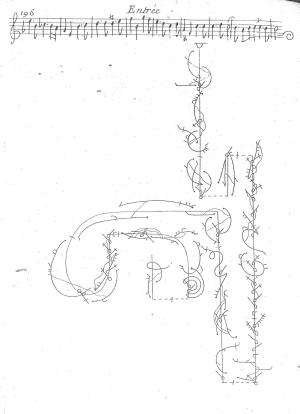
In the 1704 collection, Pecour’s preference seems to be for the entre-chat à 3 which is used in seven of the dances. There are four in the ‘Canary pour deux hommes’ (Piffetot and Cherrier, plates 158-163). The entre-chat à 5 is used in four of the dances, although none has more than two. The entre-chat à 6 is used in six of the dances, but never more than once. Pecour’s ‘Entrée d’Appolon’ which was also ‘non dancée à l’Opera’ has no entre-chat à 6, but there are entre-chats à 5, entre-chats à 4 and entre-chats à 3. Pecour joins one entre-chat à 4 with an entre-chat à 5 to form a new pas composé (bar 12, plate 196, the sequence can be seen on the right-hand side).

Entree Appolon 1704 196

Pecour’s use of entre-chats in his c1713 collection is different. Only one of the seven choreographies for men has no entre-chats – the ‘Entrée de deux homme’ (Marcel and Gaudrau, plates 91-94, to the ‘Entrée des divinitez infernales’ from Lully’s Persée). Of the other six, only one does not have an entre-chat à 6 – the ‘Entrée seul pour un homme’ (danced by ‘Klin’, plates 102-103) – although it does have what seems to be an entre-chat à 5 with a full turn in the air (bar 32, plate 103). The ‘Entrée seul pour un homme’ (plates 107-108, to a loure from Campra’s Les Fêtes vénitiennes) has three entre-chats droit à 6. Two are danced together (bars 15-16, plate 107), while the third comes within a sequence of jumped steps (bar 38, plate 108).

Anthony L’Abbé, in his collection of c1725, is far more lavish in his use of the entre-chat within his six dances for men. He likes to combine the entre-chat with a tour en l’air, as in the ‘Loure or Faune’ (danced by himself and Claude Balon, plates 1-6) which has both an entre-chat à 6 and an entre-chat à 5 with a tour (bar 7, plate 1; bar 22, plate 4) and the ‘Spanish Entrée’ (George Desnoyer, plates 72-75) which has two consecutive entre-chats à 5  (bar 11, plate 73) as well as an entre-chat à 6  (bar 24, plate 75) each with a tour.

The most demanding dance in L’Abbé’s collection is the ‘Chacone of Amadis’ (plates 57-64), danced by London’s Louis Dupré, well-known for its three entre-chats droit à 6 to be performed within a single bar of music (bar 10, plate 57).  L’Abbé also gives Dupré an more extended sequence based on the entre-chat à 5 which is worth closer analysis (bars 41-44, plate 60).

Chacone of Amadis L'Abbe 1725 60

I admit that I am not sure whether these steps are entre-chats à 5 as Feuillet understood them (the ‘Chacone of Amadis’ probably dates to 1717 or 1718, nearly twenty years after the publication of Choregraphie). They can plausibly be seen as variants on that step, but the notation suggests that they were similar to the modern brisé volé. The first of these entre-chats (bar 41) takes one beat and ends with the left leg extended forward in the air – the position is held for two beats. The second (bar 42) is the same, but without an extension of the free right leg (the foot comes to third position behind). The third (bar 43) begins with a repeat of these two steps, each with the same timing but no pauses, and ends with an assemblé battu. The sequence ends with an entre-chat droit à 6 (bar 44) also completed on the first beat and followed by a two-beat pause. The four bars show not only speed and dexterity but also formidable control. The use of dynamic pauses is a feature of baroque choreographies all too often overlooked.

In my next post, I will look at a couple of L’Abbé’s stage duets for a man and a woman in which the pas battus are definitely notated differently – but were they necessarily performed that way?

Jumping or Rising? Regency Quadrille Steps

I have been trying to get my feet around the steps and sequences used in regency quadrilles and finding it a bit of a struggle. I think there are two main reasons for this. One is that the ‘grammar’ of the sequences, the way in which the steps are put together, contradicts what I am used to in modern ballet’s petit allegro. The other is that the individual steps, which seem very similar to those of petit allegro, in fact need a different style and technique which I am still trying to work out.

I started to learn this material (in which I claim no expertise) for a project devised by a young teacher of historical dance with whom I have been lucky enough to work over several years. The source texts we are using are Strathy’s treatise of 1822 and the 1817 American translation of Gourdoux-Daux’s manual.

These provide descriptions of the temps levé, chassé, jeté, assemblé, échappé, glissade, sissonne, changement and grand coupé, which feature in the various quadrille figures and balances we have been exploring.

Looking through the two treatises, I was surprised to see that both use the word ‘rise’ where I expected to see ‘spring’ or ‘jump’. Gourdoux-Daux’s translator does use the word ‘jump’ occasionally and Strathy says ‘spring’ once, but the descriptions suggest that neither word really represents what they intended their dancers to do. When describing the landing from a step which I would assume (from my experience with ballet) leaves the floor, Strathy uses the word ‘fall’ while ‘V.G.’ says ‘alight’. I won’t go through all of the steps I have listed, but here are their descriptions of the changement, which I think illustrate the point I am grappling with.

Strathy says:

‘Of the step named Changement de Jambe.

Place the body as directed for the deportment, the feet in the fifth position; balance the body equally on both legs, bend low by folding the knees outward, rise without jerking, and make the feet pass by the first position, the one to the place of the other, the knees extended, and the points or toes turned down, so as the feet may be in a line with the legs, the points near the floor, where they will fall by the weight of the body: place the heels gently, the feet in the fifth position; keep the knees straight.’

While Gourdoux-Daux says:

‘On the motion called Change of Foot, in the third position.

To perform this step, place yourself in the third position, firm on the hips and knees, with the toes properly turned out. Bend down equally upon both knees and insteps, (without raising the heels from the floor) rise up gradually, just high enough to enable you to bend the instep so as to cause the toes to be in a perpendicular line with the leg, as much as possible. Cross your feet as in the first position, viz. the heels close together, and alighting on the floor on the toes, bring the heels gradually down in the third position and straighten up your knees.’

Both descriptions suggest a jump that isn’t quite a jump, since the dancer rises only high enough to fully point the feet. The motive force for the step seems to come from the feet as much as the plié, making it closer to the modern rélevé than a jump. So, in regency dancing, are jumps closer to the demi-jeté or perhaps the ‘relever en sautant dessus’ of the contretemps in baroque dance?

Another word that turns up regularly in these treatises is ‘slide’, used in the description of the assemblé (for the initial movement of the working foot) as well as in the glissade (which is obviously linked to the baroque step with its pas glissés). A sliding step does not, of course, leave the floor.

For another project, I have been re-reading a study of balls and assemblies 1660-1840 where I came across a short discussion of changes to the dancing floors around the regency period. The evidence was somewhat contradictory. Apparently sprung floors were being introduced at much the same time as floors became highly polished – the one facilitating springing steps while the other encouraged sliding steps. Did they indeed affect the dancing style and technique of the time – perhaps further research is needed?

So, to return to my original problem, was regency dancing full of small jumps similar to those taught in a modern ballet class? Or was it based on jumps that weren’t quite jumps, making it lively and bouncy but with the emphasis on controlled vivacity rather than aerial feats?


Feuillet and the Entrechat

Earlier this year, I wrote a series of posts on pas battus in stage dances for men and women. My starting point was the oft-repeated but questionable statement that Marie Anne Camargo was the first woman to perform an entrechat-quatre on stage (see my post ‘La Camargo and the Entrecht-Quatre’) and my original focus was the use of jumped pas battus in the notated dances of earlier female professional dancers. I also looked at the use of such pas pattus in the stage dances for men, with some interesting results in terms of the choreographic preferences of individual dancing masters. My last such post was a while ago, so here is a reminder of what I have written so far in chronological order of their publication:

‘Stage Dances for Women and Feuillet’s Pas Battus

Pas de Sissonne Battu in Stage Dances for Women’

‘Stage Dances for Women and the Demie Cabriole

‘When is a Changement not a Changement?’

Pas de Sissone Battu in Stage Dances for Men’

Demies Cabrioles in Male Solos and Duets’

Demie Cabriole en Tournant un Tour en Saut de Basque – a Step Solely for a Man?’

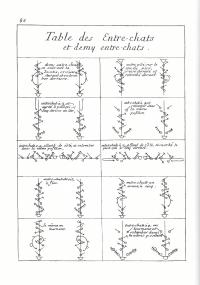
I have a few more topics to explore before I leave this complex area and I’ll pick up the thread with Feuillet’s ‘Table des Entre-Chats’ (Choregraphie, p. 86).

Choregraphie Entrechats

Feuillet notates five different entre-chats (I’ll use his spelling here to differentiate them from the modern steps) together with some variants. Only some of them correspond directly with the entrechats to be found in modern ballet technique.

The Demi Entre-Chat is similar to a modern brisé. Feuillet shows the step both to the front and the back.

Choregraphie Demi Entre-Chat

The Entre-Chat à 3 is much the same as its modern equivalent, although the notation does not show the legs beating together in the air (Feuillet could have used a cabriole sign, but its omission suggests that this wasn’t a feature of the earlier step). He adds a step by the free foot after the jump.

Choregraphie Entre-Chat a 3

The Entre-Chat à 4 begins and ends in second position, as an échappé battu would today. Feuillet also shows it travelling sideways and with a tour en l’air.

Choregraphie Entre-Chat a 4

The Entre-Chat à 5 seems to have no modern equivalent. It begins with a spring and the back leg moving forward to initiate the beat, which closes front and back before finishing front giving it the feel of an entrechat-six. Feuillet also shows it with a half turn in the air.

Choregraphie Entre-Chat a 5

The Entre-Chat Droit à 6 is the same as the modern step.

Choregraphie Entre-Chat a 6

Feuillet seems to be presenting a selection of entre-chats, and it is not clear how these might relate to the range of such steps in use at the time he was compiling his treatise. The term ‘droit’ seems to refer to a vertical jump from two feet to two feet while the use of the term ‘en avant’, as well the specific reference to beginning and ending in the second position, suggest that there may have been other versions of these entre-chats. All surely belong to the stage and not to the ballroom, so I will turn next to the notated theatre dances for men to see what additional information they might provide.

La Camargo and the Entrechat-Quatre

Popular histories of ballet often tell us that Marie Anne Camargo was the first female dancer to perform the entrechat-quatre. Where does the story come from? Is it true?

I have been looking at pas battus in the notated stage dances for women in a series of other posts. These choreographies record them regularly performing assemblés battus as well as demi entre-chats and even demie cabrioles. There are hints, if no clear evidence in the notations, that female professional dancers performed entrechats-quatre long before Mlle Camargo made her debut at the Paris Opéra.

The story was examined by the publisher, bookseller and dance historian Cyril Beaumont in his Three French Dancers of the 18th Century: Camargo, Sallé and Guimard, published in 1954. He identified the originator of the story as Louis de Cahusac, citing his ‘La Danse et les Ballets’. I thought at first that Beaumont meant Cahusac’s La Danse ancienne et moderne of 1754, but I didn’t find it in the modern edition I have of that text and I couldn’t track down another work by Cahusac with the title Beaumont cites. Cahusac contributed many articles on dance topics to the famous Encyclopédie edited by Diderot and d’Alembert and published in the mid-18th century. Volume 5 of this great work has an entry for ‘Entrechat’, written by Cahusac, which includes the following paragraph:

‘J’ai vû naître les entrechats des danseuses; mademoiselle Salley ne l’a jamais fait sur le théatre; mademoiselle Camargo le faisoit d’une maniere fort brillante à quatre; mademoiselle Lany est la premiere danseuse en France qui l’ait passé au théatre à six.’

This could form the basis of another whole blog post on the topic of female batterie, but is it the source of the story of La Camargo and her ‘first’ entrechat-quatre? Note that Cahusac does not actually say she was the first, although this may perhaps be inferred from his words.

La Camargo’s virtuoso technique was certainly immediately recognised. Her debut at the Paris Opéra on 5 May 1726, was reviewed thus in the Mercure de France:

‘ … la Dlle Camargo, Danseuse de l’Opera de Bruxelles, qui n’avoit jamais paru ici, dansa les Caracteres de la Danse, avec toute la vivacité & l’intelligence qu’on peut attendre d’une jeune personne de quinze à seize ans. Elle est Eleve de l’illustre Mlle Prevost, qui la presenta au Public. Les Cabrioles & les Entrechats ne lui coûtent rien; & quoiqu’elle ait encore bien des perfections à acquerir pour approcher de son inimitable Maîtresse, le Public la regarde comme une des plus brillantes Danseuses qu’on sçauroit voir, surtout pour la justesse de l’oreille, la legereté & la force.’

There is no suggestion here that cabrioles and entrechats were new to female dancers, Camargo’s ease and brilliance of execution are noted but her vocabulary excites no comment.

In 1733, in Le Temple du Goût, Voltaire included the lines:

Legere & forte en sa souplesse,

La vive Camargo sautoit,

A ces sons brillans d’allegresse,

Et de Rebel et de Mouret.

Voltaire placed Camargo between Marie sallé ‘D’un pas guidé par la justesse’ and the actress Adrienne Lecouvreur ‘avec cette grace divine’. A footnote to the lines declares ‘Mademoiselle Camargo, la première qui ait dansé comme un homme’ without further elaboration. It seems to refer to the ‘attack’ in her dancing and not to her actual steps, contrasting her with the performers either side in the verses.

Marie Anne Camargo retired from the Paris Opéra twice, first in 1734 or 1735 (both dates are given in different sources and I haven’t yet found a contemporary reference) only to return in 1740 and then retire, finally, in 1751.

When she died in 1770, obituaries recalled Camargo at the height of her powers. Les Spectacles de Paris pour l’année 1771 included a biography of her with an appraisal of her dancing:

‘ … exécuta-t-elle tous les genres possibles de la dame noble, les menuets, les passe-pieds d’une manière bien supérieure à Mlle Prévost, et elle y conserva ce je ne sais quoi de piquant qu’elle avoit pris de sa maîtresse, ainsi que dans les entrées de pures grâces. Les gavottes, les rigaudons, les tambourins, les loures, tout ce qu’on appelle les grands airs étoit rendus dans leurs caractères, par la variété des pas qui y étoient propres, car elle les avoit tous dans la jambe et si elle n’a pas fait usage de la gargouillade, c’est qu’elle la croyait peu convenable aux femmes. Elle y substitua le pas de Basque dont elle seule et Dumoulin ont fait usage. Jamais personne qu’elle n’a fait ces beaux pas de menuet sur le bord des lampes, d’un côté du théâtre à l’autre, d’abord de gauche à droite et ensuite en revenant de droite à gauche.’

This text was transcribed by Émile Campardon in his L’Académie Royale de Musique au xviiie siècle, published in Paris, 1884 (pp. 88-89). It provides a more nuanced view of La Camargo’s dancing than is usually given, although allowance must be made for the developments in style and technique  since her retirement which may well have influenced the writer.

As late as 1804, in the last edition of his works, Jean-Georges Noverre wrote of having seen Camargo dance:

‘J’ai vu danser la Dlle. Camargo. C’est à tort que quelques auteurs lui ont prêté des graces. La nature lui avoit refusé tout ce qu’il faut pour en avoit; elle n’étoit ni jolie ni grande ni bienfaite; mai sa danse étoit vive, légère et pleine de gaieté et de brillant. Les jettés battus, la royale, l’entrechat coupé sans frottement, tous ces tems aujourd’hui rayés du catalogue de la danse et qui avoient un éclat séduisant, la Dlle. Camargo les exécutoit avec une extrême facilité, elle ne dansoit que des airs vifs, et ce n’est pas sur ces mouvemens rapides que l’on peut déployer de la grace: mais l’aisance, la prestesse et la gaieté la remplacoient; …’

The steps he mentions are those we today associate with the male dancers of the period, but Noverre talks only of her facility, thereby suggesting that they were routinely performed by women.

The various accounts of La Camargo’s dancing need more detailed analysis, as they surely provide us with important information about the style and technique open to some (if not all) female professional dancers of her time. The story of the entrechat-quatre masks a far more compelling picture of the dancer Marie Anne Camargo, whose brilliance of technique convinced audiences that she danced with the virtuosity of a man.

Camargo Wallace Collection

Nicolas Lancret, Mlle Camargo Dancing, 1730

Demie Cabriole en Tournant un Tour en Saut de Basque – a Step Solely for a Man?

My previous post, about the jetté emboîté – pas simple and the demie cabriole or jetté battu – pas simple, indicated that male dancing was not necessarily always about the more difficult steps. However, there is one virtuosic step that is almost always found in dances for men but (with one exception) never in dances for women – the demie cabriole en tournant un tour en saut de basque. Here is Feuillet’s notation for it in Choregraphie (p. 85):

Cabrioles Feuillet 2 (3)

It is a bit easier to list those male dances in the three collections I am concerned with which do not include this step.

In the 1704 Pecour Recüeil: ‘Sarabande pour un homme’; ‘Folies d’Espagne pour un homme’; ‘Sarabande pour un homme’ (music Colasse, Enée et Lavinie); ‘Sarabande pour deux hommes’. (3 of the 8 solos and 1 of the 5 duets)

In the Pecour Nouveau recüeil of c1713: ‘Entrée seul pour un homme’ (music Cavalli, Xerxes); ‘Entrée seul pour un homme’ (music Stuck, Méléagre); ‘Entrée seul pour un homme’ (music Campra, Les Fêtes vénitiennes); ‘Entrée de deux hommes’ (Blondy and Marcel, music Campra, Les Fêtes vénitiennes). (all 3 solos and 1 of the 4 duets)

L’Abbé’s New Collection of c1725: ‘Pastoral by a Gentleman’; ‘Spanish Entrée’ (Desnoyer, music Lully, Le Bourgeois gentilhomme). (2 of the 4 solos and neither of the 2 duets)

All of the dances from the 1704 Recüeil are sarabands (including the ‘Folies d’Espagne’). In Pecour’s collection of c1713, one of the dances is actually an entrée grave while another is a loure. In L’Abbé’s collection, both are loures. Is a pattern emerging? Are sarabands and loures less likely to include such virtuosic steps?

None of L’Abbé’s choreographies have more than one demie cabriole en tournant un tour en saut de basque. Two of Pecour’s include as many as three – the solo ‘Entrée d’Appolon’ and the ‘Entrée pour deux hommes’ danced by Piffetau and Cherrier to music from Campra’s L’Europe galante. The latter is a loure, disrupting the possible pattern I mentioned earlier.

In the majority of instances, the demie cabriole en tournant un tour en saut de basque is preceded by a contretemps. It also usually has a three-quarter turn in the air, often clockwise and often starting facing stage left and finishing facing stage front. In three of the solos and seven of the duets it is the final step of the dance.

The demie cabriole en tournant un tour en saut de basque is notated in only one of the stage dances for a woman, the ‘Passagalia of Venüs & Adonis’ created by Anthony L’Abbé for Hester Santlow (plate 52, bar 129):

Passagalia of Venus & Adonis 52 (2)

As you can see, the step is preceded by a contretemps. I will return to this solo in another post.

Demie Cabrioles in Male Solos and Duets

Given the frequent use of the jetté emboîté followed by a pas simple (which I abbreviate as jetté-pas simple) in the women’s dances, I expected to find many examples of this step with a demie cabriole (also called a jetté battu) instead of a jetté in the choreographies for men. In fact, where it appears in Pecour’s dances he prefers the less virtuosic version.  L’Abbé, on the other hand, does make good use of it.

In the 1704 collection of Pecour’s stage dances, the demie cabriole with a step appears only in the ‘Chacone pour un homme’ (bar 14, plate 177) and the ‘Entrée d’Appolon’ (bar 9, plate 195). In the former it is preceded by a contretemps and followed by a jetté-chassé. In the latter, the demie cabriole takes a variant form with the working foot coming into emboîté derrière and then stepping forward – making it a different step, to which Pecour adds a half-turn:

Entree Pecour 1704 195 (2)

Both dances include the jetté-pas simple version, and this also appears in four of the other six male solos as well as three of the five duets.

In the Nouveau Recüeil published around 1713, Pecour makes no use of the demie cabriole and includes the jetté-pas simple version only in the ‘Entrée seul pour un homme’ and the ‘Entrée de deux homme’ performed by Marcel and Gaudrau. Does the absence of the demie cabriole from this step, throughout the collection, reflect a deliberate choreographic choice by Pecour?

L’Abbé, by contrast, seems to have thought the demie cabriole version of this step indispensable for he includes it in all four of the solos and both of the duets in his New Collection. We get a hint of his choreographic preferences (or perhaps a glimpse of baroque choreographic conventions) because the step is very often preceded by a contretemps. L’Abbé generally follows it with a variety of more or less complex pas composés. Here are a couple of examples. First, from the ‘Chacone of Amadis’ danced by Dupré (bar 21, plate 58):

Chacone of Amadis L'abbe 1725 58 (2)

Second, from the ‘Entrée’ (an entrée grave) danced by Desnoyer (bar 13, plate 78):

Entree L'Abbe 1725 78 (2)

In the only male dance in which L’Abbé uses the jetté-pas simple, Desnoyer’s ‘Entrée’, he puts two of them together and then adds the demie cabriole version (bar 35, plate 82):

Entree L'Abbe 1725 82 (2)

In the ‘Pastoral performed by a Gentleman’, L’Abbé includes a variant on the demie cabriole version of the step in the hornpipe section of the dance. He follows the practice in this English dance type of beginning a step in one bar and finishing it in the next and does so twice, each time substituting a jetté for the pas simple (bar 33, plate 68,  immediately below and bar 54, plate 71, further below):

Pastoral L'Abbe 1725 68 (2)

Pastoral L'Abbe 1725 71 (2)

In each case the context for the step is quite different. I find it hard to believe that the ‘Gentleman’ who performed this very difficult dance was an amateur. Who could he possibly have been?

I have, of course, entirely ignored the demie cabriole en tournant un tour en saut de basque, which is essentially the demi cabriole – pas simple with a turn in the air and is very often used in the male dances. I will turn to that in my next post.

Pas de Sissonne Battu in Stage Dances for Men

The pas de sissonne battu occurs in many, but certainly not all, of the male solos and duets in the 1704, c1713 and c1725 collections of stage dances I am investigating.

The collection of ‘Entrées de Ballet’ by Pecour published in 1704 has 8 male solos and 5 male duets. Of these, two solos and two duets do not include the pas de sissonne battu. In the other dances, some conventions surrounding the step begin to emerge.  The assemblé battu is often followed by a changement rather than the sissonne (a vertical spring from two feet to one, from which the pas de sissonne presumably derives its name). The assemblé battu occasionally incorporates a turn in the air. In the two examples in this collection, it is a half-turn. Although the step is preceded by a variety of pas composés, it is most often followed by a coupé simple and a coupé (sometimes a coupé battu) avec ouverture de jambe. Does this reveal one of Pecour’s favoured choreographic motifs?

Here is an example from a solo, the ‘Sarabande pour un homme non dancée a l’Opera’, bar 46 (plate 215).

Sarabande Pecour 1704 215 (2)

And another from a duet, ‘Entrée pour deux hommes’ a loure danced by ‘Mr. Piffetau et Mr. Cherrier’, bar 11 (plate 165).

Entree Pecour 1704 165 (2)

Another example in this collection may not really be a pas de sissonne battu at all, for the plié is shown on the first beat and there is no following changement or sissonne – ‘Loure pour deux hommes’ danced by Blondy and Philbois, bar 18 (plate 173).

Loure Pecour 1704 173 (2)

In this collection, the pas de bourée en presence also appears a number of times after the pas de sissonne battu.

There are quite a lot of mistakes in the notations within this collection. Is the following, from the ‘Sarabande pour un homme’ bar 35 (Plate 227), an assemblé with an additional beat or simply a pas élevé battu?

Sarabande Pecour 1704 227 (2)

Pecour’s second collection of theatrical choreographies, published around 1713, has three male solos and four male duets. Only one solo and one duet include the pas de sissonne battu. There is no way of telling whether this might point to changing choreographic choices by Pecour or is purely by chance. What is interesting is that the immediate choreographic context for the step is the same in both dances. Here is the step in Pecour’s ‘Entrée seul pour un homme’, bar 32 (plate 106).

Entree Pecour 1713 106 (2)

And here it is in Pecour’s ‘Entrée de cithe dancée par Mrs. Blondy et Marcel’, bar 12 (plate 100).

Entree de Cithe Pecour 1713 100 (2)

In both, the pas de sissonne concludes with a changement. It is immediately preceded by a chassé battu and immediately followed by a pas de bourée en presence.

Could a study of the use of such phrases help us to understand more about the choreographic style of individual dancing masters?

There are hints of individual choreographic style in L’Abbé’s use of the pas de sissonne battu and his contexts for the step. There are four male solos and two male duets in his New Collection of Dances published in the mid-1720s. One of the solos and one of the duets do not contain the step. Among the others, when the assemblé battu is followed by a changement, Le Roussau often uses a variant notation method, for example in L’Abbé’s ‘Spanish Entry Performed by Mr Desnoyer’, bar 20 (plate 74).

Spanish Entry L'Abbe 1725 74 (2)

L’Abbé seems to enjoy placing this step within a phrase of more demanding pas battus, for example entrechats. Although he may simply be exploiting the virtuosity of his male dancers. As in the ‘Chacone of Amadis Perform’d by Mr Dupré’, bar 43 (plate 60).

Chacone of Amadis L'Abbe 1725 60 (2)

Or in the ‘Spanish Entry Performed by Mr Desnoyer’, bar 29 (plate 75).

However, L’Abbé also uses Pecour’s device of a coupé followed by a coupé avec ouverture de jambe from time to time, always after the pas de sissonne battu and sometimes with an extra embellishment such as a rond de jambe (see the ‘Entrée performd’ by Mr Desnoyer’, bars 30-31, plate 81). Apart from the addition of a turn to the assemblé battu and the regular substitution of a changement for the sissonne, L’Abbé does not embellish the pas de sissonne battu itself.

In all these collections the assemblé battu is notated just as it appears in the women’s dances. Of course, the men may have added their own ornamentations in performance, just as the women may have done.

Stage Dances and Their Performers

I have started to look at the vocabulary of pas battus in solos and duets created for female professional dancers, concentrating on the choreographies in Pecour’s Recüeil of 1704 and his Nouveau recüeil of around 1713 as well as the L’Abbé New Collection of about 1725. I began my investigation with some statistics on the dances in these. I’m now about to turn to pas battus in the solos and duets for male dancers in these same sources. There are more dances for men than for women, although the difference between the two is not enormous: there are 11 male duets to 7 female duets; and 15 male solos to 14 female solos. However, there are some differences in the head titles (the details on the first page of each notated dance) which give me pause for thought as I try to make comparisons between the step vocabulary in the female and male repertoires.

In Pecour’s 1704 Recüeil, four of the six female solos name the dancers and are linked to stage performance either in the operas from which their music is taken or elsewhere (for example Mlle Subligny’s gigue danced ‘en Angleterre’, i.e. in one of London’s theatres). The single female duet in this collection names the dancers and is linked to performance at the Paris Opéra. With the male solos, the picture is rather different. None of the eight choreographies has a named dancer and six of them declare that they were ‘non dancée a l’Opera’. What does this phrase mean? Were the dances created for productions at the Paris Opéra and then not used? Were they intended for either public or private performance at another venue? Can one make a fair comparison between solos attributed to leading female professional dancers performed on stage at the Paris Opéra and those by unnamed male dancers not given there? Interestingly, all five of the male duets name the leading professionals who performed them and are linked to specific operas.

Pecour’s Nouveau recüeil of around 1713 has three male solos, but only one has a named performer. The other two are titled ‘Entrée seul pour un homme’ with no reference to the operas from which their music comes. As in the earlier collection, the four duets all name dancers at the Paris Opéra and refer to performances in operas given there. One of the six female solos does not name the dancer and is also ‘non dancée a L’opéra’. One of Mlle Guyot’s solos has no reference to the opera from which it takes its music.  As with the men, all five of the female duets name their dancers and the opera in which they were performed.

I don’t know why there should be this difference in the head titles for male and female dances in these two collections. Did the leading men routinely choreograph or even improvise their own solos (so these couldn’t readily be notated) but need Pecour to create their duets? Or were Pecour’s male solo choreographies intended for Paris Opéra students or amateur dancers rather than these professionals?

In London, the situation (so far as stage dancing was concerned) was very different. The title page of L’Abbé’s New Collection claims that all the choreographies ‘have been performed both in Druy-Lane [sic] and Lincoln’s Inn-Fields, by the best Dancers’ – all these dancers are then named. All but one of the four male solos are attributed to leading male dancers in London and it is possible to link the ‘Gentleman’ who danced the fourth to a specific performance. The two duets similarly have named performers. The two female solos and the duet also have named dancers. None of the dances in this collection can be securely linked to individual performances on the London stage, but there is no reason to doubt the assertion on the title page.

There is one other issue, when it comes to comparing like for like with stage dances intended for men or women, and that is the dance types performed by them. Quite some time ago, I did an analysis of these as they occur across all the sources for male and female solos as well as male-only and female-only duets. I have never published it, so it could be a topic for another post. The vocabulary which is currently the focus of my interest may also be affected by the dance types as well as the performers, but the corpus of material I am investigating is so small that I will leave this issue to one side as I pursue my investigation of pas battus.


When is a Changement not a Changement?

Among the many steps notated by Feuillet in Choregraphie one looks in vain for one named ‘changement’ or indeed for notation of a step that is recognisable as one. This basic step is described thus in a modern dictionary of classical ballet:

‘Changements are springing steps in the fifth position, the dancer changing feet in the air and alighting in the fifth position with the opposite foot in front.’

When I wrote my PhD thesis back in the 1990s, I compiled a ‘Glossary of Terms for Early Eighteenth-Century Dance’ which, in shortened form, became Appendix II. I combed through all of the principal sources for the dance vocabulary and technique of the period, but I did not find any sign of the changement.

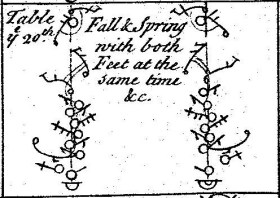
I obviously did not do my research thoroughly enough, for in his The Art of Dancing of 1735 Kellom Tomlinson wrote of the changement in the context of two different pas composés, although he did not use that term. In chapter XXIX, he calls it a ‘Spring with both feet at the same Time’ and describes a pas tombé ending with:

‘half the Weight [on the left foot] in the fourth Position behind the right Foot, with the Knees bent … from whence the Spring is immediately made with both Feet, … changing the right Foot backwards and the left forwards’ (p. 87)

I have omitted the references to the timing of the step. Tomlinson provides notation of the pas composé ‘Fall, Spring with both Feet at the same Time, and Coupee to a Measure’ which actually shows the ‘Spring with both Feet’ starting and finishing in the 3rd position.

Tomlinson Plate I (2)

Tomlinson, The Art of Dancing (London, 1735), plate I (detail)

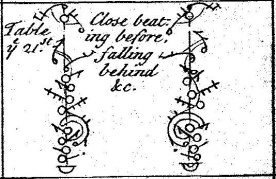
In chapter XXX, Tomlinson calls it an ‘upright Spring’, referring to it as part of ‘the Close beating before and falling behind in the third Position, upright Spring changing to the same before, and Coupee to a Measure’. He again provides notation of the pas composé.

Tomlinson Plate I (3)

Tomlinson, The Art of Dancing (London, 1735), plate I (detail)

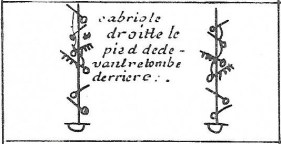
A fresh look at Feuillet’s step tables reveals another piece of information I overlooked. In his ‘Table des Cabrioles’, Feuillet notates a ‘cabriole droitte le pied devant retombe derriere’.

Cabrioles Feuillet 2 (2)

Feuillet, Choregraphie (Paris, 1701), pl. 85

This is, of course, a changement with the addition of a beat of the legs in the air.

My interest is not so much in the changement as in its use in notated dances in relation to jumps incorporating pas battus – in particular entrechats. Did female professional dancers of the early 1700s really only ever do changements while their male counterparts did entrechats-quatre and entrechats-six? Do the notated dances perhaps suggest otherwise?