Category Archives: Stage Dancing

Feuillet’s Sarabands

Six of the surviving notated sarabands are by Raoul Auger Feuillet. All are solo dances. He included two in his 1700 collection of his own choreographies, both to the ‘Spanish’ saraband in the Ballet des Nations from Le Bourgeois gentilhomme. I’ll look at those later, alongside Feuillet’s versions of the Folie d’Espagne. The other four sarabands are from a manuscript collection possibly compiled between 1710 and 1720. Three are solos for a woman and the fourth is a solo for a man.

As I said in my last post, I’ve been working on one of the sarabands for a woman – the Sarabande de Polixène. I’ve been wondering how the three female solos relate to one another, given that they are all by the same choreographer. I’ve long been interested in the very different choreographies created for male dancers (the complexities of most of these suggest that they were created for male professionals). These four sarabands provide an opportunity for some analysis. Unfortunately, I only have recorded music for the Sarabande de Polixène which makes reconstruction of the other solos difficult. I feel that such reconstruction is always the best basis for any analysis. I’ll just have to see what the notations themselves can tell me.

None of these solos is long. The Sarabande de Mr. Feüillet for a woman, whose music remains unidentified, has 40 bars. The Sarabande de Mr. Feüillet to music from act 1 scene 5 of Gatti’s opera Scylla (1701) has only 36 bars – I’ll refer to this dance as the Sarabande de Scylla. The Sarabande de Mr. Feuillet for a man, also with unidentified music, has 48 bars. The Sarabande de Polixène is the longest, with 64 bars of music taken from act 3 scene 5 of Colasse’s opera Polixène et Pirrhus (1706). All the music for these dances has a basic AABB structure with a B section longer than the A section. However, the Sarabande de Scylla has an AABBB’ structure in which both A and B have 8 bars and B’ has 4.

I find it useful to do some basic analysis to start with, looking at how many steps in a choreography incorporate jumps or beats or turns. Sometimes such ornamentations can point to a dance for the stage rather than the ballroom. In all three of the female solos around one-third of the steps include one or more jumped elements. The inclusion of beats runs from only 3% of steps in the Sarabande de Scylla to 11% in the Sarabande de Polixène. Both the female solo Sarabande de Mr. Feüillet and the Sarabande de Scylla add turns to around 45% of their steps, but the Sarabande de Polixène does this with only 22%. Does this suggest that the last is more presentational than the other two? Well, it might depend on where the dancer most often faces at the end of individual steps. The number of basic, unornamented steps ranges from 35% in the female Sarabande de Mr. Feüillet to 50% in the Sarabande de Scylla. Are there any conclusions that can safely be drawn from this?

The male solo saraband both overlaps with and radically departs from the step vocabulary of the other three dances, so I will devote a separate post to it. I will also look at the pas composés shared by these four solos, by which I mean those steps formed from two or more basic steps with or without further ornamentation.

In the meantime, here is some notation from one of the female solos. Note the pirouette on both feet with a full turn towards the end of this section.
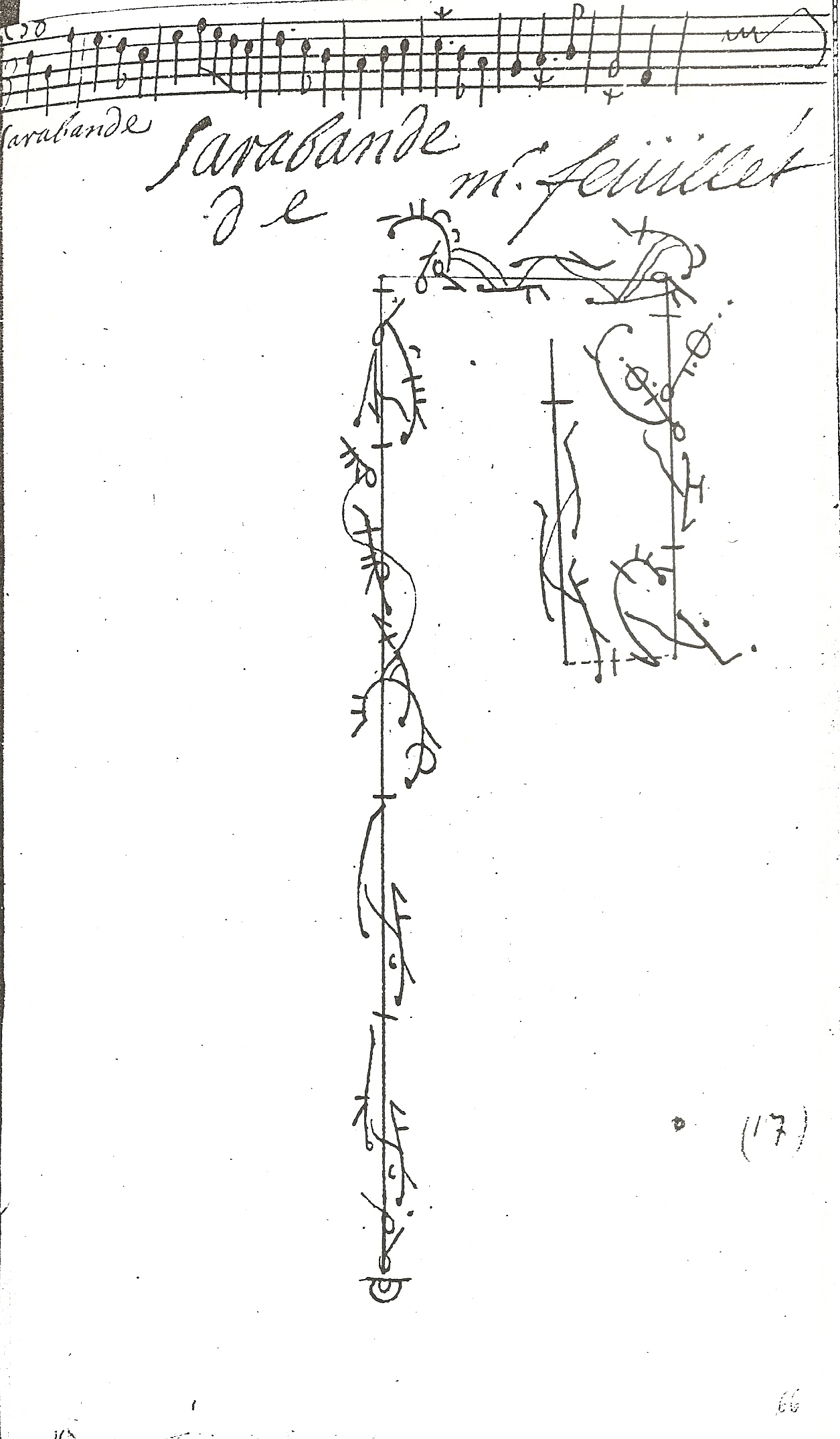
Sarabande de Mr. Feüillet (undated). First plate
Sarabande de Mr. Feüillet (undated). First plate
The Saraband

I’ve recently been working on Feuillet’s solo Sarabande for a woman to music from Colasse’s 1706 opera Polyxène et Pirrhus. This choreography survives in a single manuscript source and must date to period 1706 to 1710. The music is very different from the better-known saraband in the Entrée for Spain within the Ballet des Nations that ends Lully and Molière’s Le Bourgeois gentilhomme. It seems that, in the early 18th century, there were two distinct types of saraband – one being French, as in the Sarabande de Polyxène, and the other Spanish, the best known examplar being the Folie d’Espagne.

A remark on the radio, describing  the saraband as ‘slow and stately’ prompted me to take a closer look at this dance type. I admit to being very tired of hearing the expression ‘slow and stately’ in relation to the very varied ballroom and theatre dances of the late 17th and 18th centuries, but it is difficult to know how to counter it.

There are at least 27 surviving choreographies labelled as sarabands, to which can be added four Folie d’Espagne notations (not included in the following statistics). The dance was popular both in the ballroom and on the stage. Ten of the notated sarabands are identifiable as ballroom dances. Nine of these include the saraband alongside other dance types in mini-dance suites. Five choreographies can be linked directly either to the Paris Opéra or the London stage. Six more dances are male solos and there are five female solos. All of these may have been intended either for the stage or as exhibition dances. Four of the solos (two male and two female) are to the saraband in Le Bourgeois gentilhomme, marking them out as ‘Spanish’.

There is, of course, much more to the saraband as a dance. Do the choreographies themselves differentiate between ‘French’ and ‘Spanish’ sarabands, or do these distinctions lie hidden within style and technique rather than on view in the step vocabulary and choreographic motifs? I will try to address these issues in later posts.

In the meantime, here is a description of a dancer performing a saraband from Father François Pomey’s Le Dictionnaire royal augmentée published in Lyon in 1671. The translation of the French original comes from a 1986 article by the researcher Patricia Ranum.

‘At first he danced with a totally charming grace, with a serious and circumspect air, with an equal and slow rhythm, and with such a noble, beautiful, free and easy carriage that he had all the majesty of a king, and inspired as much respect as he gave pleasure.

Then, standing taller and more assertively, and raising his arms to half-height and keeping them partly extended, he performed the most beautiful steps ever invented for the dance.

Sometimes he would glide imperceptibly, with no apparent movement of his feet and legs, and seemed to slide rather than step. Sometimes, with the most beautiful timing in the world, he would remain suspended, immobile, and half leaning to the side with one foot in the air; and then, compensating for the rhythmic unit that had just gone by, with another more precipitous unit he would almost fly, so rapid was his motion.

Sometimes he would advance with little skips, sometimes he would drop back with long steps that, although carefully planned, seemed to be done spontaneously, so well had he cloaked his art in skilful nonchalance.

Sometimes, for the pleasure of everyone present, he would turn to the right, and sometimes he would turn to the left; and when he reached the very middle of the empty floor, he would pirouette so quickly that the eye could not follow.

Now and then he would let a whole rhythmic unit go by, moving no more than a statue and then, setting off like an arrow, he would be at the other end of the room before anyone had time to realise that he had departed.

But all this was nothing compared to what was observed when this gallant began to express the emotions of his soul through the motions of his body, and reveal them in his face, his eyes, his steps and all his actions.

There is more, but isn’t this more than enough to refute the idea of the saraband (or, indeed, any baroque dance) as ‘slow and stately’? The expressive possibilities outlined in this passage can readily be seen in the surviving notated sarabands.

Aimable Vainqueur on the London stage

The most famous ballroom duet of the 18th century was undoubtedly Aimable Vainqueur. Pecour’s choreography was first performed before Louis XIV at Marly early in 1701 and published in notation later that same year.

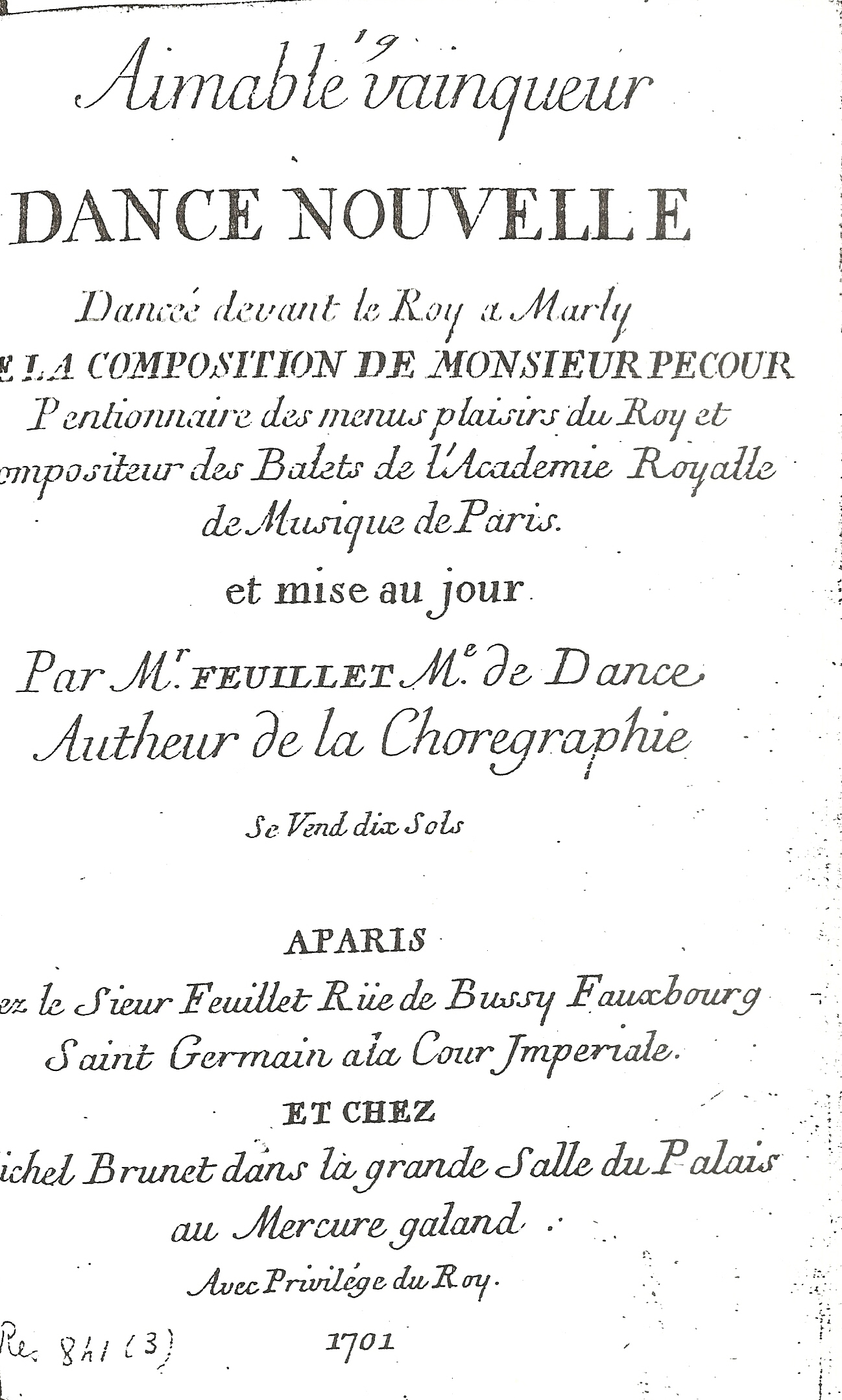
Pecour. Aimable Vainqueur (Paris, 1701), Title page

Pecour. Aimable Vainqueur (Paris, 1701), Title page

By the time the dance appeared in Magny’s Principes de Choregraphie in 1765 it had been printed at least ten times. It also features in four manuscript collections of choreographies. Did all these copies drive the duet’s popularity, or did they simply reflect it?

Pecour took his music from Campra’s opera Hésione, given its premiere at the Paris Opéra in December 1700. Hésione proved popular, enjoying three revivals by 1743. Pecour was obviously quick to capitalise on its success. I will say more about the duet’s original performances in another post. Aimable Vainqueur attracted attention beyond the French court. A new notation by the dancing master Richard Shirley was published in London in 1715. The dance was mentioned by Taubert in his Rechtschaffener Tantzmeister published in Leipzig 1717. John Weaver included it, under the title The Louvre in response to its dance type – a loure, in the second edition of Orchesography (his translation of Feuillet’s treatise Choregraphie) which appeared in the early 1720s.

I haven’t pursued the performance history of Aimable vainqueur at the French court and in Paris, but it was first performed on the London stage on 14 May 1726 at the Lincoln’s Inn Fields Theatre by Dupré and Mrs Wall. He was not ‘le grand’ Dupré, as is often claimed, but he was probably French and may have been from the same family. The dance was almost always titled The Louvre in advertisements for its stage performances, perhaps following Weaver. It wasn’t given again until 5 April 1731, when Francis Sallé performed it at Lincoln’s Inn Fields with his sister Marie. Thereafter it quickly became a staple of the benefit performances of London’s leading dancers.

The dancer responsible for the popularity of Aimable Vainqueur on the London stage was probably Leach Glover, French-trained and a leading dancer at the Covent Garden Theatre. Glover performed The Louvre at his annual benefit performances from 1731 (when he partnered Marie Sallé) to 1741 (when he danced it with the Italian ballerina Barbara Campanini, known as ‘La Barberina’). Other leading dancers to perform Aimable Vainqueur regularly at benefit performances included Michael Lally, who pursued a very successful career in London’s theatres, and later Augustin Noverre, brother of the famous ballet master Jean-Georges Noverre. The last recorded performance of The Louvre on the London stage was on 23 April 1777 at Drury Lane, when the Miss Stageldoirs danced it with a Minuet and an Allemande. The bills are silent on whether one of the girls danced in ‘boy’s clothes’ although, given their repertoire together, this is quite likely.

What choreography did these dancers actually perform? I cannot give a definitive answer, but as well as the dance recorded in notation in 1701 there are some interesting possibilities. I will consider these in a later post.

A Year of Dance: 1725

1725 was quite a busy year, both culturally and politically.

In Britain, one noteworthy event was George I’s foundation of the Order of the Bath. However, the hanging of the notorious thief-taker Jonathan Wild at Tyburn on 24 May 1725 probably attracted greater interest. In Europe, there were several events of undoubted political significance. Tsar Peter the Great died on 8 February and was succeeded by his second wife – Catherine I was the first woman to rule Russia. The Emperor Charles VI and King Philip V of Spain signed the Treaty of Vienna on 30 April, which included a guarantee of the Pragmatic Sanction allowing the Emperor to be succeeded by a daughter, despite the prevailing Salic law. In France, the fifteen year old Louis XV married the Polish Princess Marie Leszczyńska. She was seven years older than the King.

At the Paris Opéra, Les Eléments an opéra-ballet by Delalande and Destouches was given its first public performance on 29 May 1725. The work had initially been performed in 1721 as a court ballet, with Louis XV among the dancers. Its popularity on the public stage was to be long-lived. In London there were two notably diverse premieres within a week. Handel’s latest opera Rodelinda was performed at the King’s Theatre on 13 February. On 20 February, Drury Lane’s new pantomime Apollo and Daphne opened. It was described in the bills as a ‘Dramatick Entertainment of Dancing’ and it did indeed have a great deal of serious dancing in its main plot.

1725 was an unusually busy year for dance publishing. In London, L’Abbé’s new dance for the year was Prince Frederick, in honour of George I’s eldest grandson. L’Abbé’s A New Collection of Dances, notations for 13 choreographies performed in London’s theatres, may have appeared this year (it has no publication date). The undated 18th edition of The Dancing-Master has also been assigned to 1725, although some modern sources prefer 1728. The dancing master Siris published his own ‘dance for the year’ The Diana, in honour of the Duchess of Marlborough’s much-loved grand-daughter Lady Diana Spencer.

Siris. The Diana. First plate

Siris. The Diana. First plate

In Paris, the most important dance publication of 1725 was undoubtedly Pierre Rameau’s treatise Le Maître a danser. This work explains how to perform the steps recorded by Feuillet a quarter of a century earlier. Rameau’s revision of the Beauchamp-Feuillet system of notation, put forward in his Abbrégé de la Nouvelle Méthode, probably appeared in late 1725. He followed Feuillet by including a collection of twelve dances by Pecour as part two of the treatise, all in his revised notation. These dances, described as the most beautiful and best liked of Pecour’s many choreographies, were apparently still popular in the ballroom. They were given a new lease of life by their appearance in subsequent reissues of Rameau’s Abbrégé.

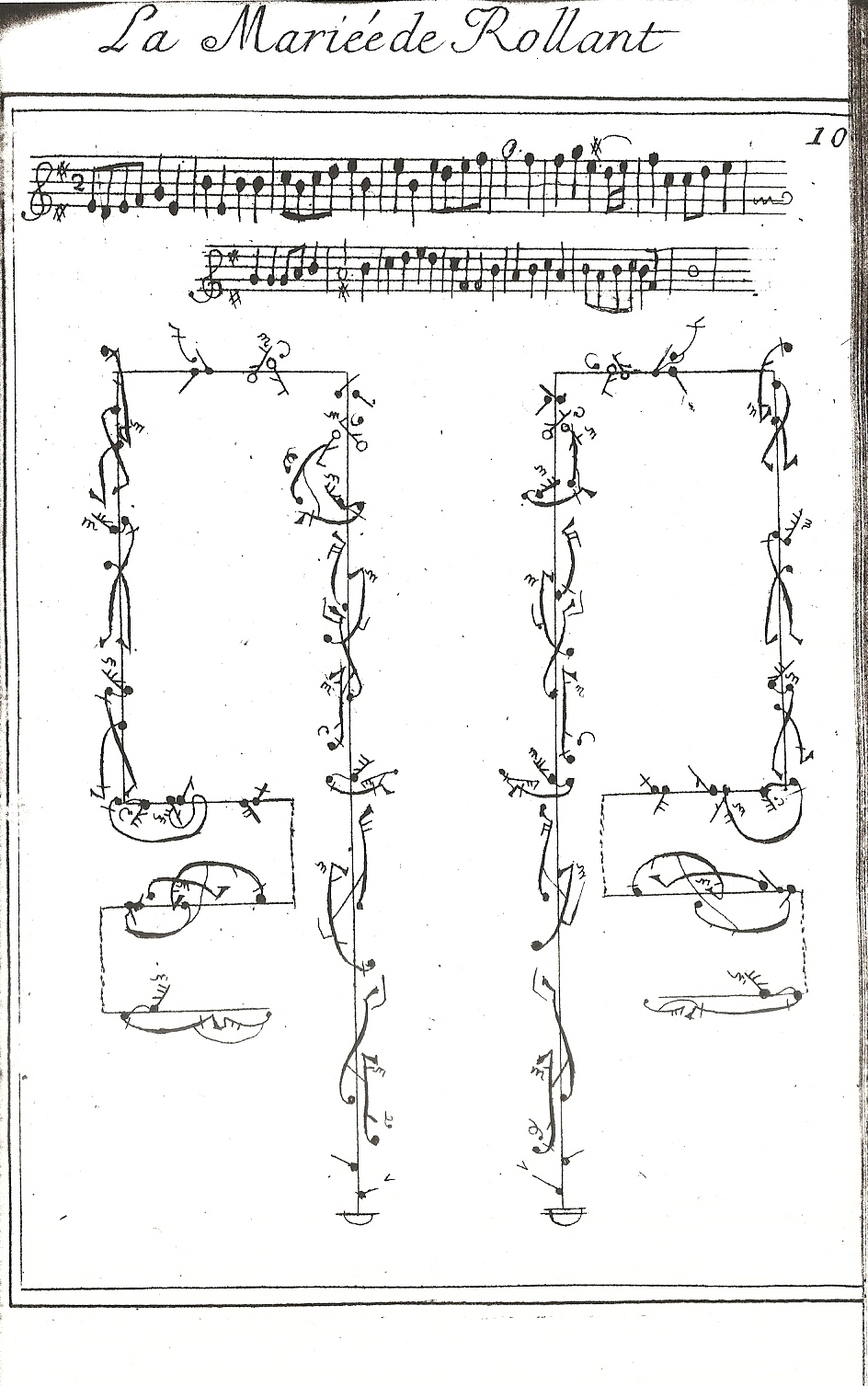
Pecour. La Mariée, notated by Rameau. First plate

Pecour. La Mariée, notated by Rameau. First plate

The regular annual collections of dances issued first by Feuillet and then by Dezais continued with the XXIII Recüeil de dances pour l’Année 1725. Dezais also published his Premier Livre de Contre-Dances, which I have written about in other posts. The title Premier Livre … suggests that he was intending to pursue a new series devoted to notations of contredanses. No more collections of either danses à deux or contredanses appeared after 1725. The abrupt cessation suggests that Dezais died before he could prepare or publish further collections. 1725 marks the end of the publication of notated dances in France, until the contredanses known as cotillons began to appear in a simplified form of notation in the early 1760s.

La Mariée on the London stage

La Mariée, a ballroom dance for a man and a woman, was one of the dances Pierre Rameau described as the most beautiful choreographies created by Guillaume-Louis Pecour. Rameau included his own notation of the dance in his Abbregé de la nouvelle methode,dans l’art d’ecrire ou de traçer toutes sortes de danse de ville, published in Paris probably in 1725. The duet already had a long history by then, for it was first published in 1700 in Feuillet’s Recueil de dances composées par M. Pecour, one of the collections that accompanied Choregraphie.

Guillaume-Louis Pecour. Recueil de dances (Paris, 1700), plate 12, opening of La Mariée

Guillaume-Louis Pecour. Recueil de dances (Paris, 1700), plate 12, opening of La Mariée

The dance historian Rebecca Harris-Warrick showed, in an essay published in 1989, that La Mariée was almost certainly originally a stage dance created for a revival of Lully’s opera Roland in 1690. She suggested that the dance entered the French ballroom repertoire during the 1690s. It may have been danced in mascarade entertainments during the 1700 carnival season at the French court. It may well have continued to be danced on the stage of the Paris Opéra in later revivals of Roland, by such stars as Ballon and Mlle Subligny (1705) and David Dumoulin and Mlle Prévost (1709). It was mentioned in many dance treatises and republished in notation many times between 1700 and 1765. After that it apparently faded from view.

Pecour’s popular duet had probably reached London by 1698, when the music was published in John Walsh’s compilation Theater Musick, being a Collection of the Newest Ayers for the Violin. Harris-Warrick speculates that it may have been danced at William III’s birth night ball that year. If so, one of the performers could have been Anthony L’Abbé who had already danced before the King in May 1698. On 1 June 1703, L’Abbé was billed at Lincoln’s Inn Fields in The Wedding Dance. This was described in advertisements as ‘compos’d by Monsieur L’Abbé, and perform’d by him, Mrs Elford, and others’. The piece seems to have been a divertissement, which may or may not have incorporated Pecour’s La Mariée.

In later years, ‘Wedding’ dances reappeared every so often among the entr’acte entertainments in London’s theatres. There was a Wedding Dance ‘by Prince and others’ at Drury Lane on 20 July 1713 and a Grand Comic Wedding Dance, created by Moreau, at Lincoln’s Inn Fields on 14 January 1717. Moreau’s Wedding Dance was performed by three men and three women together with the Sallé children, Francis and Marie. I am inclined to think that La Mariée was performed as part of Moreau’s divertissement, possibly by the Sallés. On 15 May 1718, a dance titled Marie was given at Drury Lane by Cook and Miss Schoolding. Apart from the ongoing dance rivalry between the theatres, which caused much copying of repertoire, Cook had danced in Moreau’s piece and Miss Schoolding was Mrs Moreau’s younger sister.

Thereafter The Marie (as it was often billed) was regularly given as an entr’acte dance. The Sallés performed it, as adult dancers, several times during the 1725-26 and 1726-27 seasons. The duet was later taken up by Leach Glover, one of the leading dancers in John Rich’s company, who gave it regularly at his benefit performances during the 1730s. Pecour’s famous ball dance apparently made its last London stage appearance, after a gap of many years, on 24 April 1759 at Covent Garden. It was performed ‘By Desire’ by Lalauze and Miss Toogood at his benefit. Did they really dance the choreography as created some seventy years earlier?

A Year of Dance: 1715

The most significant event of 1715 was the death of Louis XIV on 1 September. He was succeeded by his five year old great-grandson, who became Louis XV. Philippe, duc d’Orléans, the son of Louis XIV’s brother (who had died in 1701) became Regent to the child-king. The new reign would usher in significant cultural as well as political changes.

In Britain, George I was briefly threatened by a Jacobite rising that sought to put the Catholic James Francis Edward Stuart, son of James II, on the throne. The rebellion began in September and was over before Christmas. With the succession assured, at least for the time being, the new Hanoverian dynasty began to settle into English court life.

In Paris, Dezais published the XIII Recüeil de danses pour l’année 1715. This contained only two duets – La Transilvanie by Claude Ballon and Le Menuet d’Espagne by Dezais himself. Another collection, notated and published by Gaudrau, was entitled Danses nouvelles presentées au Roy. Gaudrau had begun to publish dances by Guillaume-Louis Pecour a couple of years earlier, with a Nouveau recüeil de dance de bal et celle de ballet. The Danses nouvelles were two ballroom duets by Pecour, La Venitienne and Le Branle allemand. The former was to a piece of music from Mouret’s Les Fêtes de Thalie.

Pecour. Danses nouvelles (Paris, [1715?]), title page.

Pecour. Danses nouvelles (Paris, [1715?]), title page.

Dezais’s collection was probably published early in the year (perhaps even towards the end of the previous year). Gaudrau’s is undated, but has been ascribed to 1715. The collection must have appeared after the death of Louis XIV, for it is dedicated to his successor. Pecour wrote:

J’ay l’honneur de presenter a Votre Majesté les deux premieres dances que j’ay composées depuis son règne, je souhaitte avec ardeur les voir un jour éxécuter par Votre Majesté, …

Pecour was in his early sixties and had worked for the French court for more than forty years. It seems that he was hoping for further employment.

In London, at least nine dance publications appeared during 1715 as dancing masters vied for the patronage of the new royal family. The first to appear was Siris’s The Princess Anna, advertised towards the end of January. No copy of this dance is known to survive. A new edition of For the Further Improvement of Dancing, John Essex’s translation of Feuillet’s 1706 Recüeil de contredances, probably dates to 1715. Essex dedicated it to ‘Her Royal Highness the Princess of Wales’ and the only known copy may well have been the one presented to her. It included some new country dances and ‘a new French Dance, which I presume to call the Princess’s Passpied’. This duet may have been created with an eye to the Princess’s birthday on 1 March.

The dancing master Richard Shirley published his own notated versions of Ballon’s La Silvie (which had appeared in Paris in 1712) and Pecour’s Aimable vainqueur (first published 1701) in mid-March. He, too, may have had an eye on the birthday celebrations for the Princess of Wales.

George I’s birthday on 28 May was marked by the appearance of a duet honouring his eldest granddaughter Princess Anne, aged five. There were two competing editions of L’Abbé’s The Princess Royale. One was notated by Edmund Pemberton, who was to record and publish L’Abbé’s ballroom duets for many years. The other was by the music publisher John Walsh, who seems to have pirated Pemberton’s version.

L’Abbé. The Princess Royale (London, [1715]), title page.

L’Abbé. The Princess Royale (London, [1715]), title page.

Walsh also published Mr Isaac’s new ballroom dance The Friendship, which may have appeared early in the year. The Morris, Mr Isaac’s ‘new Dance for the year 1716’, was published towards the end of 1715 not by Walsh but by Pemberton.

The ninth of the dance publications was from an up-and-coming dancing master, Kellom Tomlinson. He produced his first published duet The Passepied Round O during the year. It may simply have been fortuitous that it appeared in 1715, but Tomlinson was soon to prove himself adept at attracting patronage.

One other dance may belong to 1715, although it was not published for several more years. L’Abbé’s stage dance Canaries ‘perform’d by Mr La Garde and Mr Dupré’ appeared in his A New Collection of Dances around 1725. Charles Delagarde and Louis Dupré were both among the dancers at Lincoln’s Inn Fields during the 1714-1715 season. This was the only time they are known to have danced together. The duet signals the new emphasis on dancing in London’s theatres, as well as the virtuosity of the male professional dancers working in them.

A Year of Dance: 1714

A while ago, I had the idea of looking at significant dance events year by year, placing them within a wider context and slowly developing a more detailed chronology than most dance histories can provide. 1714 seems as good a place to start as any. The year was notable for the death of Queen Anne, on 1 August, and the accession to the British throne of her protestant cousin the Elector of Hanover as King George I.

At the English court the social calendar revolved around royal birthdays, the accession and coronation days of the current monarch, New Year’s Day and Twelfth Night. All were occasions for dancing. Queen Anne’s birthday on 6 February had been the occasion of festivities throughout her reign. 1714 was no exception, with music, a ball and a ‘splendid entertainment’ at Windsor in the presence of the Queen herself. Her dancing master Mr Isaac created a new dance in her honour, The Godolphin named for Lady Harriot Godolphin the grand-daughter of the Duke and Duchess of Marlborough and (at the age of fifteen) a lady of the bedchamber to the Queen. The dance was published in notation on 11 February 1714.

Mr Isaac. The Godolphin (London, 1714). Title page.

Mr Isaac. The Godolphin (London, 1714). Title page.

The status of another dance, published on 4 March 1714, is uncertain. The only surviving copy of The Siciliana by Siris has no title page but, like Isaac’s choreography, it was published by John Walsh and may have been intended to capitalise on the Queen’s birthday celebrations.

George I arrived in England before the end of September 1714, with his son the new Prince of Wales. His daughter-in-law Princess Caroline arrived in London, with her three daughters, in October. The coronation took place in late October 2014. There are no records of any balls at court or the publication of any dances until the following year, when the usual festivities were resumed.

One other event of note was the re-opening of the Lincoln’s Inn Fields Theatre, renewing theatrical competition in London. This led very quickly to a great deal more dancing in the playhouses.  It seems that there was dancing at the first performance at Lincoln’s Inn Fields and there were at least six dancers (two women and four men) in the company. They appeared regularly throughout the season.

In London, dances were often published singly in notation whether or not they had a royal connection. In Paris, small collections of dances were published ‘pour l’année’ in time for the balls held during the carnival season (between Twelfth Night and the beginning of Lent). The XIIe Recueil de danses pour l’année 1714, published by Jacques Dezais, contained three duets – La Gavotte de Seaux and a Rigaudon by Claude Ballon and Dezais’s La Chamberi.

The Château de Sceaux was the venue for an experiment in dancing. At one of the duchesse du Maine’s ‘Grands Nuits’ of entertainments during 1714, Mlle Prévost and M. Ballon (leading dancers at the Paris Opéra) gave a scene from Corneille’s tragedy Les Horaces as a ‘danse caracterisée’. They performed with such intensity that they reduced themselves, as well as their audience, to tears. This event calls into question the idea that French stage dancing was fundamentally inexpressive. By 1714, Louis XIV’s long reign was drawing to a close and changing times were signalled at the Paris Opéra by the production of its first lyric comedy, Mouret’s Les Fêtes de Thalie.

Were all these events quite separate? Surely not, although the influences that flowed between them have yet to be explored.

Solos for Girls

Among the 18th-century dances surviving in notation are fourteen solos for unnamed female dancers. Who were these solos created for? What sort of choreographies are they?

Four of these dances are probably for young girls. Mr Isaac’s Chacone and his Minuet, published in 1711 in Pemberton’s An Essay for the Further Improvement of Dancing, are usually seen as one dance (following Pemberton’s title page) but may have been originally created independently. The anonymous La Cybelline, to music by Charles Fairbank, dates to 1719. Thomas Caverley’s Slow Minuet for a Girl, which shares its title page design with La Cybelline, has been dated to 1729. However, it may have been choreographed before 1720 since there is another version of the dance by Kellom Tomlinson. This was probably written down between 1708 and 1714 when Tomlinson was apprenticed to Caverley.

Two solos are from Feuillet’s 1700 Recueil de dances, a collection of his own choreographies. No dancers are named. The Sarabande pour femme, to music by Lully for Le Bourgeois gentilhomme, and the Folie d’espagne pour femme are among the easiest of the dances in Feuillet’s collection.

Two of the solos are from the 1704 Recueil de dances, a collection ‘des meillieures Entrées de Ballet de Mr. Pecour’. There is the Sarabande pour une femme, to the same music as Feuillet’s Sarabande pour femme, and the Chacone pour une femme, to music from Lully’s opera Phaéton. Of the six female solos in this collection, only these two have unnamed performers.

One solo is from the Nouveau recueil de dance de bal et celle de ballet, choreographies by Pecour published around 1713. The Gigue pour une femme seule non dancée a Lopera, to music from Alcide by Louis Lully and Marin Marais, is the only one of the female solos in this collection that has an unnamed performer. All the others were performed by leading dancers at the Paris Opéra.

Turning again to the English choreographies, L’Abbé’s solo Passacaille to music from Lully’s opera Armide followed Isaac’s Chacone and Minuet in Pemberton’s Essay of 1711. It is derived from the duet he had created for the professional dancers Mrs Elford and Mrs Santlow around 1706 (which was not published until about 1725).

L’Abbé’s Passacaille from Pemberton’s Essay (1711), plate 1.

L’Abbé’s Passacaille from Pemberton’s Essay (1711), plate 1.

The remaining three solos are all entitled Sarabande and are ascribed to Feuillet. They appear in a manuscript which has been dated to the first decades of the 18th century. The music for one of these dances has not yet been identified, but the other two are from Gatti’s opera Scylla and Colasse’s Polyxène et Pyrrhus respectively. The great majority of dances in this source (24 out of 28) are solos and most are by Feuillet.

The status of each of these solos for girls is difficult to determine. They may have been theatrical dances for the stage or display dances for the ballroom. They may have been created for amateurs, apprentice dancers or young professionals. Closer investigation of the choreographies, their music and the sources within which they appear might shed further light on them.


La Brone and La Blonde on the London Stage

A dance entitled La Brone and La Blonde was danced by ‘Vallois, Mlle Vallois, &c’ at the end of act one of Nicholas Rowe’s tragedy Jane Shore in a booth at London’s Bartholomew Fair on 23 August 1733. The venue was not quite as down-market as it seems. The proprietors of the booth were regular members of the Drury Lane Theatre company and many of the players were drawn from there and the Covent Garden Theatre. William Jovan de Vallois had made his London debut at the Lincoln’s Inn Fields Theatre on 13 April 1732, billed as ‘lately arrived from the Opera at Paris, the first Time of his dancing in England, a Scholar to M. Marcelle’. These credentials link him to one of the leading dancers and dancing masters in Paris. I have yet to discover whether Monsieur de Vallois pursued his earlier career at the Paris Opéra itself or at the Opéra-Comique (the successor to the theatres in the Paris fairs).

La Brone and La Blonde seems to have been danced in London only that once. The ‘&c’ suggests that there were more than two dancers, but there is no way of guessing how many. Could the dance have had any connection with the choreographies recorded and published by Dezais in his Premier Livre de Contre-Dances in 1725? There is a concordance for the tune for La Blonde, in Contre-Danses et Branles qui se danse aux bals de l’opera published in Paris around the same time. This suggests that Dezais might have been drawing on (or perhaps aiming his collection at) dancing in the public balls given at the Paris Opéra. This same music had also been used for The Siciliana by Siris, a ballroom duet published in London in 1714. Both La Blonde and La Brunne are in 6/8 and their music is titled ‘Gigue’, although La Brunne has an upbeat which identifies it as a Canarie. Both choreographies are for four and in the Dezais collection La Blonde is immediately followed by La Brunne and then repeated after it to conclude the dance.

The choreographies recorded by Dezais go a bit beyond straightforward contredanses. He notates steps for two sections within La Blonde. The little enchainement performed by each of the two couples, balonné, coupé battu starting with the right foot and then the left while taking right and then left hands, is familiar from a number of ballroom duets. Its earliest recorded use (if not its origin) is in the 1702 L’Allemande by Guillaume-Louis Pecour, ballet master at the Paris Opéra. This choreography was danced by Claude Ballon and Marie-Thérèse de Subligny in the ballet Fragments de Mr. De Lully the same year as the dance appeared. La Brunne has a right and left allemande turn which might also echo the same source, although no steps are notated (L’Allemande has two balonnés, a pas de bourée and an assemblé for each turn, which would fit).

If there is a link between the London dance La Brone and La Blonde and Dezais’s little suite of contredanses, it is perhaps more likely to lie within the music than the choreography. Yet, the use of motifs from L’Allemande (if that is indeed what is happening) suggests other possibilities. Did the dance performed at Bartholomew Fair in 1733 also derive some of its choreography from L’Allemande, perhaps via the contredanses published by Dezais?

Here is a nice performance of Dezais’s La Blonde and La Brunne. The dancers choose to do pas de bourées for their allemande turns. This is, after all, a contredanse.

Dancing on the London Stage

Dancing in London’s theatres during the 18th century is a topic that has not attracted dance historians. There are very few reliable accounts and no extended study has so far been published. My work in this area began when I did my PhD on the English dancer-actress Hester Santlow, whose dancing career began in 1706 and ended when she retired from the stage in 1733. I found myself trying to reconstruct the context within which she danced, as well as her dancing repertoire. My thesis was entitled ‘Art and Nature Join’d: Hester Santlow and the Development of Dancing on the London Stage, 1700-1737’. Since then, I have extended my interest to dancing on the London stage from 1660 to 1760. Central to this period are, of course, the notated theatrical dances published in the early 18th century to which I referred in my earlier post Stage Dancing.

The paradox of any research into dancing on the London stage is that the dances, with the exception of the handful of notated choreographies, have entirely disappeared. There are also very few portraits of dancers or depictions of dancing before the late 18th century. Any research is therefore very challenging. This is probably why the period has attracted little or no interest from dance researchers. There is also the bias towards dancing in Paris, which is widely seen as the sole centre of serious dancing at this time.

Yet, this was a particularly exciting period for London audiences, who were avid followers of dancers and their repertoire. ‘French Dancing’ reached London from Paris not long after the Restoration in 1660. French stars came to the English capital, where they could make good money in the commercial theatres. Claude Ballon made a brief visit in 1699 and his favourite dancing partner, the ballerina Marie-Thérèse de Subligny, came in 1702. There were also home-grown dance celebrities who could equal them in the style and technique of serious dancing, notably Hester Santlow. The British developed their own dances and genres of dancing. Among the former was the hornpipe, acknowledged as an ‘English’ dance. Among the latter was the first modern ballet, created by John Weaver, a theorist as well as a dancer and a dancing master. The Loves of Mars and Venus, performed at the Drury Lane Theatre in 1717, was the first dance work with recognisable characters and a story in which the entire narrative was conveyed through dance and gesture alone, with no sung or spoken words. This was a significant development in the art of dancing and must surely have influenced the French ballerina Marie Sallé, who also came to dance, and experiment with dancing, in London.

Dancing was popular in London’s theatres throughout the 18th century. Dances were regularly performed between the acts of plays (entr’acte dances). There was a great deal of dancing (serious as well as comic) in the pantomimes that became popular from the 1720s and there were dance divertissements in plays and musical works. The entr’acte dances were many and various, from speciality comic dances drawing on indigenous dance forms to complex and virtuosic serious dances deploying the style and technique of French professional dancing.

I will try to reveal some of this wealth of innovative dance entertainment in future posts.

John Ellys. Hester Santlow as Harlequine. c.1725

John Ellys. Hester Santlow as Harlequine. c.1725