Category Archives: Stage Dancing

La Brone and La Blonde on the London Stage

A dance entitled La Brone and La Blonde was danced by ‘Vallois, Mlle Vallois, &c’ at the end of act one of Nicholas Rowe’s tragedy Jane Shore in a booth at London’s Bartholomew Fair on 23 August 1733. The venue was not quite as down-market as it seems. The proprietors of the booth were regular members of the Drury Lane Theatre company and many of the players were drawn from there and the Covent Garden Theatre. William Jovan de Vallois had made his London debut at the Lincoln’s Inn Fields Theatre on 13 April 1732, billed as ‘lately arrived from the Opera at Paris, the first Time of his dancing in England, a Scholar to M. Marcelle’. These credentials link him to one of the leading dancers and dancing masters in Paris. I have yet to discover whether Monsieur de Vallois pursued his earlier career at the Paris Opéra itself or at the Opéra-Comique (the successor to the theatres in the Paris fairs).

La Brone and La Blonde seems to have been danced in London only that once. The ‘&c’ suggests that there were more than two dancers, but there is no way of guessing how many. Could the dance have had any connection with the choreographies recorded and published by Dezais in his Premier Livre de Contre-Dances in 1725? There is a concordance for the tune for La Blonde, in Contre-Danses et Branles qui se danse aux bals de l’opera published in Paris around the same time. This suggests that Dezais might have been drawing on (or perhaps aiming his collection at) dancing in the public balls given at the Paris Opéra. This same music had also been used for The Siciliana by Siris, a ballroom duet published in London in 1714. Both La Blonde and La Brunne are in 6/8 and their music is titled ‘Gigue’, although La Brunne has an upbeat which identifies it as a Canarie. Both choreographies are for four and in the Dezais collection La Blonde is immediately followed by La Brunne and then repeated after it to conclude the dance.

The choreographies recorded by Dezais go a bit beyond straightforward contredanses. He notates steps for two sections within La Blonde. The little enchainement performed by each of the two couples, balonné, coupé battu starting with the right foot and then the left while taking right and then left hands, is familiar from a number of ballroom duets. Its earliest recorded use (if not its origin) is in the 1702 L’Allemande by Guillaume-Louis Pecour, ballet master at the Paris Opéra. This choreography was danced by Claude Ballon and Marie-Thérèse de Subligny in the ballet Fragments de Mr. De Lully the same year as the dance appeared. La Brunne has a right and left allemande turn which might also echo the same source, although no steps are notated (L’Allemande has two balonnés, a pas de bourée and an assemblé for each turn, which would fit).

If there is a link between the London dance La Brone and La Blonde and Dezais’s little suite of contredanses, it is perhaps more likely to lie within the music than the choreography. Yet, the use of motifs from L’Allemande (if that is indeed what is happening) suggests other possibilities. Did the dance performed at Bartholomew Fair in 1733 also derive some of its choreography from L’Allemande, perhaps via the contredanses published by Dezais?

Here is a nice performance of Dezais’s La Blonde and La Brunne. The dancers choose to do pas de bourées for their allemande turns. This is, after all, a contredanse.

Dancing on the London Stage

Dancing in London’s theatres during the 18th century is a topic that has not attracted dance historians. There are very few reliable accounts and no extended study has so far been published. My work in this area began when I did my PhD on the English dancer-actress Hester Santlow, whose dancing career began in 1706 and ended when she retired from the stage in 1733. I found myself trying to reconstruct the context within which she danced, as well as her dancing repertoire. My thesis was entitled ‘Art and Nature Join’d: Hester Santlow and the Development of Dancing on the London Stage, 1700-1737’. Since then, I have extended my interest to dancing on the London stage from 1660 to 1760. Central to this period are, of course, the notated theatrical dances published in the early 18th century to which I referred in my earlier post Stage Dancing.

The paradox of any research into dancing on the London stage is that the dances, with the exception of the handful of notated choreographies, have entirely disappeared. There are also very few portraits of dancers or depictions of dancing before the late 18th century. Any research is therefore very challenging. This is probably why the period has attracted little or no interest from dance researchers. There is also the bias towards dancing in Paris, which is widely seen as the sole centre of serious dancing at this time.

Yet, this was a particularly exciting period for London audiences, who were avid followers of dancers and their repertoire. ‘French Dancing’ reached London from Paris not long after the Restoration in 1660. French stars came to the English capital, where they could make good money in the commercial theatres. Claude Ballon made a brief visit in 1699 and his favourite dancing partner, the ballerina Marie-Thérèse de Subligny, came in 1702. There were also home-grown dance celebrities who could equal them in the style and technique of serious dancing, notably Hester Santlow. The British developed their own dances and genres of dancing. Among the former was the hornpipe, acknowledged as an ‘English’ dance. Among the latter was the first modern ballet, created by John Weaver, a theorist as well as a dancer and a dancing master. The Loves of Mars and Venus, performed at the Drury Lane Theatre in 1717, was the first dance work with recognisable characters and a story in which the entire narrative was conveyed through dance and gesture alone, with no sung or spoken words. This was a significant development in the art of dancing and must surely have influenced the French ballerina Marie Sallé, who also came to dance, and experiment with dancing, in London.

Dancing was popular in London’s theatres throughout the 18th century. Dances were regularly performed between the acts of plays (entr’acte dances). There was a great deal of dancing (serious as well as comic) in the pantomimes that became popular from the 1720s and there were dance divertissements in plays and musical works. The entr’acte dances were many and various, from speciality comic dances drawing on indigenous dance forms to complex and virtuosic serious dances deploying the style and technique of French professional dancing.

I will try to reveal some of this wealth of innovative dance entertainment in future posts.

John Ellys. Hester Santlow as Harlequine. c.1725

John Ellys. Hester Santlow as Harlequine. c.1725

Stage Dancing

An idea that has been often repeated in baroque dance circles over many years is that professional dancing on the stage was the same as the amateur dancing seen in ballrooms. Certainly the two genres share the same basic vocabulary of steps and figures and some of the surviving notated theatrical dances appear (on the page) to be simpler and easier than some of the more complex ballroom choreographies. There was undoubtedly some overlap in technique, if not in style, but I do not subscribe to the view that there was little difference between the two.

In the final chapter of his An Essay towards an History of Dancing of 1712, John Weaver made an apt distinction, with reference to one particular genre of stage dancing:

Serious Dancing, differs from the Common-Dancing usually taught in Schools, as History Painting differs from Limning. For as the Common-Dancing has a peculiar Softness, which would hardly be perceiveable on the Stage; so Stage-Dancing would have a rough and ridiculous Air in a Room, when on the Stage it would appear soft, tender and delightful.’

Weaver, as both a professional dancer and a teacher of amateurs, was familiar with the differences of scale and force between the two techniques. He concedes that ‘the Steps of both are generally the same’ but he adds ‘yet they differ in performance’ and goes on to list a number of steps ‘peculiarly adapted’ to stage dancing, specifying ‘almost all Steps from the Ground’ as meant for theatrical practitioners.

The difference between the two genres is underlined by the surviving notations, even though they cannot show the way in which steps were performed. Among the published dances, three collections are designated on their title pages as either ‘Entrées de Ballet’ or ‘Stage Dances’:

Guillaume-Louis Pecour. Recueil de dances (Paris, 1704)

Guillaume-Louis Pecour. Nouveau recueil de dance de bal et celle de ballet (Paris, [c1713])

Anthony L’Abbé. A New Collection of Dances [London, c1725]

Most of the dances in these collections have named performers – leading dancers either at the Paris Opéra or in the London theatres – and many of them make significant technical demands. Of particular interest are the male solos and duets, which demand a virtuoso level of technique. All of these choreographies carry within them the seeds of what will later become classical ballet. Yet, they are not merely the precursors of a later superior form of dance. They represent an already fully developed, refined and sophisticated art of dancing.

I will explore this repertoire, as well as other aspects of stage dancing in London and in Paris, in future posts.

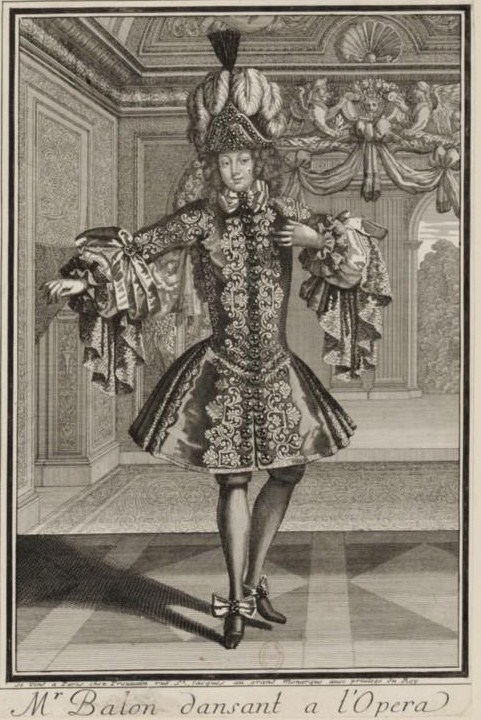
Claude Ballon, one of the most famous danseurs nobles of the early 18th century.

Claude Ballon, one of the most famous danseurs nobles of the early 18th century.