Category Archives: Stage Dancing

WHY A ‘DRAMATIC ENTERTAINMENT OF DANCING’?

As a dancer and a dancing master, John Weaver had deep concerns about the status of dancing. In An Essay Towards an History of Dancing, published in 1712, he tried to address these. His ‘Prefatory Introduction’ set out Weaver’s underlying aim:

‘an undeserved Contempt has been cast unwarily on this Art, as Low and Mechanick; I have here endeavour’d to set it in its true Light; and to shew, that it is an Art both Noble and Useful; and not unworthy the Encouragement of all Lovers of Elegance and Decorum; …’

His strategy for establishing dancing as an ‘Art’ was to link not only its past but also its current practice to classical antiquity.

In the final chapter of his Essay, entitled ‘Of the Modern Dancing’, Weaver laid the foundations for what he would call a ‘Dramatic Entertainment of Dancing’. He wanted the London stage to present dancing that was something more than the ‘Motion, Figure and Measure’ seen in the technically accomplished French dancers who were so successful there. Weaver’s ambition was to present dancing that could rival drama. Appealing to classical antiquity, he wrote:

‘Stage-Dancing was at first design’d for Imitation; to explain Things conceiv’d in the Mind, by the Gestures and Motions of the Body, and plainly and intelligibly representing Actions, Manners and Passions; so that the Spectator might perfectly understand the Performer by these his Motions, tho’ he say not a Word.

Weaver’s concept of the mute art of dancing was one in which the body provided a means of expression as powerful as the spoken word. He wished to imitate (and improve upon) ‘that surprising Performance of the Pantomimes’ he had written about in his Essay Towards an History of Dancing.

There had, of course, been ballets well before Weaver’s The Loves of Mars and Venus. The English masque of the early 1600s and the French ballet de cour, which reached its apogee in the mid-17th century, gave a central place to dancing. However, both were dependant on spoken and sung words to express emotions as well as unfold the story. The same was true of French opera, from the tragedies en musique of Lully to the opéra-ballets of Campra and others. The English semi-opera, which became popular in the 1690s thanks to Purcell’s music, used dance simply as part of divertissements alongside the drama. In none of these works did dance stand alone.

Weaver must have been familiar with the semi-operas and obviously knew a great deal about French dancing, even if his experience of French opera was limited. The underlying reason for his dissatisfaction must surely have been that all the dancing he saw was merely decorative. It embellished the arts of music and drama, but fell short of being an art itself. Weaver’s appeal to the ‘Pantomimes of the Ancient Greeks and Romans’ who (in his Preface to the published scenario for The Loves of Mars and Venus) he characterised as ‘Dancers that represented a Story or Fable in Motion or Measure; Imitators of all things, as the Name of Pantomime imports’ offered a way forward.

He had an example closer to hand in the commedia dell’arte, whose exponents were once again finding their way into London’s theatres in the early 1700s. In his Essay, Weaver wrote of ‘that surprising Performance of the Pantomimes, the Ruins of which remain still in Italy; but sunk and degenerated into Pleasantry, and merry conceited Representations of Harlequin, Scaramouch, …’ describing the players as ‘these modern Mimes inimitable’. He could not help admiring their expressive abilities, depending on actions not words. He admired (grudgingly) the French dancing of his own time, too. In ‘Of the Modern Dancing’ he set down its virtues as well as what he saw as its vices.

John Weaver worked in theatres where drama and dance were juxtaposed and intertwined at almost every performance. He was that rarest of combinations, a scholar as well as a dancer. His ambitions for dancing, and the means by which he chose to pursue them, sprang out of both his theoretical reading and his practical experience. Weaver’s bold experiment of 1717 was enough of a success for him to follow it with another ‘Dramatic Entertainment of Dancing’, Orpheus and Eurydice in 1718. This failed and he did not return to the genre until 1733, when he created The Judgment of Paris in which he abandoned his early ideals by introducing songs.

My focus in these posts is his first great venture with his new genre, The Loves of Mars and Venus, the very first modern ballet.

A VERY IMPORTANT DANCE ANNIVERSARY

Next year marks the 300th anniversary of John Weaver’s The Loves of Mars and Venus. His ‘dramatic entertainment of dancing’ was first performed at the Drury Lane Theatre on 2 March 1717.

Loves Title Page Detail

John Weaver, The Loves of Mars and Venus, detail from title page

Why is this often overlooked dance work so important? It is the first modern ballet – the first theatrical work to tell a story and represent its characters solely through dance, mime and music. Unlike all the ballets that had come before it, including the much celebrated French ballets de cour and English masques, there were no spoken or sung words. The Loves of Mars and Venus was a dance work, nothing more and nothing less.

Weaver’s ballet tells the story of the love affair between the goddess Venus and Mars, the god of War, and the revenge enacted on them by her husband Vulcan. It draws on classical mythology, but contemporary passions abound. Despite Weaver’s appeal to the revered performances of the ‘mimes and pantomimes’ of classical antiquity, who he wished to emulate, his ballet was a thoroughly modern work in tune with the sophisticated comedies of his own time.

The Loves of Mars and Venus has six short scenes. Mars appears with his soldiers and performs a war dance. Venus is shown surrounded by the Graces and displays her allure in a sensual passacaille, but when Vulcan arrives she quarrels with him in a ‘dance of the pantomimic kind’. Vulcan retires to his smithy to devise revenge with the help of his workmen the Cyclops. Mars and Venus meet and, with their followers, perform dances expressive of love and desire. Vulcan completes his plan of revenge against the lovers. In the final scene, Vulcan and the Cyclops catch Mars and Venus together and expose them to the derision of the other gods, until Neptune intervenes and harmony is restored in a final ‘Grand Dance’. The entire ballet took, perhaps, about 40 minutes.

John Weaver was a dancer as well as a choreographer. He is also one of the very few dance practitioners who have written about their art. He was Vulcan. Venus was Hester Santlow, also an actress and a dancer of consummate skill and expressiveness. Mars was Louis Dupré, a virtuoso dancer who was probably French (although not Louis ‘le grand’ Dupré, with whom he is still often confused). Weaver’s bold experiment had the best dancers on the London stage.

This first modern ballet was a remarkable work and enjoyed success in its own time. It was subsequently far more influential than many realise. It may well have been seen by the young dancer Marie Sallé, who would herself later experiment with narrative and expressive dancing. Sallé, of course, influenced Jean-Georges Noverre when he came to create his ballets d’action. They led to the story ballets of the romantic period and onwards to today’s narrative dance works.

Has Weaver’s The Loves of Mars and Venus been consigned to history or can it be recovered? I will explore this innovative ballet further in later posts.

A Year of Dance: 1660

For England, the most significant event by far of 1660 was the Restoration of Charles II. At the beginning of the year there was no indication that the monarchy might return, but following the arrival of General George Monck in London during February 1660 thinking began to change. On 25 April Parliament voted to restore the monarchy. On 8 May Charles was declared King. On 25 May he landed at Dover to be welcomed by Monck and on 29 May (his thirtieth birthday) he entered London to popular rejoicing. The King soon began to rebuild his household and to revive court life. The theatres had started to reopen, albeit quietly, in anticipation of the King’s arrival and only a few months after his return Charles II granted two courtiers – Sir Thomas Killigrew and Sir William Davenant – permission to form theatre companies for public performances. In October 1660 a united company of players, under the direction of both men, played briefly at the Cockpit playhouse in Drury Lane (an indoor theatre dating back to the Jacobean period). By November the two companies were playing separately, establishing a duopoly that would survive well into the 18th century. Killigrew’s King’s Company was in the converted Gibbons’s Tennis Court in Vere Street, while Davenant’s Duke’s Company apparently began playing at the Salisbury Court playhouse, which also dated back before 1642.

Another noteworthy, but very private, development was the beginning of Samuel Pepys’s diary on 1 January 1660. Thanks to his testimony, far more is known about the plays and other entertainments given in London’s playhouses during the first decade after the Restoration than would otherwise have been the case. Pepys’s entries on his theatre-going quite often make references to the dancing he saw.

So far as theatrical dancing is concerned, the only indication we have for 1660 is an undated performance of Le Ballet de la Paix before the French ambassador. We do not know when, or even if, the performance actually took place, since the ambassador concerned was accredited to the Protectorate and left London in June 1660. If it did happen, who were the dancers? We don’t know. There must surely have been dancing in London’s playhouses too, but there is no known evidence to prove this.

In France, the year was marked by the marriage of Louis XIV to the Spanish Infanta Maria Theresa on 9 June 1660 (New Style). This event was celebrated with Lully’s Ballet de Xerxes, six entrées added to a performance of Cavalli’s opera Xerxes. The whole entertainment was given at the Louvre on 22 November 1660 (New Style). The dancers were all men and all professionals, including Lully himself and Pierre Beauchamps. Neither Louis XIV nor his new Queen took part. Another event of note at the French court was the death of the King’s uncle Gaston duc d’Orléans on 2 February 1660 (New Style). His title was assumed a few months later by Louis XIV’s brother Philippe, also known simply as Monsieur.

‘Of the Close beating before …’ Tomlinson, The Art of Dancing (1735)

Kellom Tomlinson devotes chapter XXX of Book 1 of The Art of Dancing to one particular pas composé, ‘the Close beating before and falling behind in the third Position, upright Spring changing to the same before, and Coupee to a Measure’. The ‘Close beating before and falling behind’ appears in Feuillet’s Choregraphie in the ‘Table des Pas de Sissonne’ (p. 81) – in modern ballet terminology the step is an assemblé battu. The ‘upright Spring changing to the same before’ does not appear in Choregraphie – it is the equivalent of the modern changement. The coupé is, of course, one of the fundamental steps of la belle danse. As Tomlinson says, all three elements must be performed within a single bar of music. He provides notation for the pas composé in his Plate I.

Tomlinson Art of Dancing Plate I (detail)

Tomlinson, The Art of Dancing (1735), Plate I (detail).

Tomlinson also refers to two dances where this pas composé is used. Both can be identified as choreographies by Guillaume-Louis Pecour from the 1704 Recueil de dances, the first published collection of his entrées de ballet. One is the Entrée pour deux hommes ‘Dancée par Mr. Piffetau et Mr. Cherrier au Ballet de l’Europe galante’, for which the music is a loure – the ‘Air pour les espagnols’ from the Entrée ‘L’Espagne’. The other is the Entrée Espagnolle pour un homme et une femme ‘Dancée par Mr. Balon et Mlle. Subligny au Ballet de l’Europe galante’, for which the music is the ‘Air. Rondeau’ also from ‘L’Espagne’ – the music is in triple time but is not identifiable with a particular dance type. Is it simply coincidence that both are ‘Spanish’ dances?

Tomlinson adds that this pas composé is usually followed by a coupé avec ouverture de jambe, to allow it to be repeated on the other foot. In the Entrée pour deux hommes, it is followed by a coupé avec ouverture de jambe ornamented with an additional ‘tour de jambe’ (Feuillet’s term for a pas rond with no transfer of weight). In the Entrée Espagnolle pour un homme et une femme, the coupé avec ouverture de jambe incorporates a beat. In neither dance is Tomlinson’s pas composé then repeated.

Is this pas composé widely used? Does it appear in dances without ‘Spanish’ connotations? I looked through the three published collections of theatre dances, together with Feuillet’s 1700 Recueil of his own choreographies (which are not described as theatrical, but have close links to the genre of stage dances). The step does not appear at all in Feuillet’s 1700 collection, although some of the men’s dances include what is obviously a related sequence over two bars of music. Using modern terminology, this is an assemblé battu followed by a changement in the first bar and either a pas de bourée or a coupé in the second. This and other variants occur in a number of stage choreographies. Here I will look only at occurrences of the step as described by Tomlinson.

In Pecour’s Recueil de dances of 1704, apart from Tomlinson’s two examples, the step appears in the following dances.

Passacaille pour une femme, music from Gatti’s Scylla (1701). The onstage characters are Plaisirs. (plate 31)

Sarabande à deux, a male-female duet to music from Campra’s Tancrède (1702). The onstage characters are Plaisirs. (plate 131)

Loure pour deux hommes, music from Gatti’s Scylla (1701). The onstage characters are Candiots. In the loure, each bar contains two distinct pas composés – this occurs as the second. (plate 175)

Chaconne de Phaeton pour un homme, music from Lully’s Phaeton (1683, latest revival before this collection of dances 1702). This solo was not danced at the Paris Opéra, so we do not know which (if any) character was danced. (plate 186)

L’Aimable Vainqueur, a solo for a man to music from Campra’s Hésione (1700). This solo was not danced at the Paris Opéra and the character danced (if any) is unknown. (plate 209)

Sarabande pour un homme, music otherwise unknown and not danced at the Paris Opéra. (plate 215)

Folies d’Espagne pour un homme, to the well-known tune. (plate 224)

In all the dances, the pas composé is followed by a coupée avec ouverture de jambe, with a variety of ornaments. In six cases, it comes towards the end of the choreography although in three of these a variant version appears earlier in the dance.

In Pecour’s Nouveau Recueil de Dance de Bal (c1713), the step appears in one dance only – the Passacaille pour une femme to music from Lully’s Armide (1686, latest revival before this collection 1703. The 1713 revival must have come after the collection was prepared for publication). This solo is stated to have been ‘dancée par Mlle. Subligny en Angleterre’. In the opera the character is a demon disguised as an Amante Fortunée. The choreography apparently belongs to the period 1701-1702, when Mlle Subligny danced in London, where this dance may have been performed simply as a virtuosic belle danse solo. The pas composé appears twice (plates 84, 86). The second time the following bar has three jettés backwards (the first a jetté battu), since the pas composé itself initiates the dancer’s final retreat as she ends her solo.

Pecour Passacaille Armide 86

Pecour, Nouveau Recueil de Dance de Bal [c1713], ‘Passacaille pour une femme’, final plate.

Tomlinson’s version of this pas composé is not used in L’Abbé’s A New Collection of Dances (c1725), although it appears in variant versions in several of the choreographies.

Does all of this tell us anything about how baroque dance vocabulary was used? It seems that Tomlinson’s ‘Close beating before and falling behind in the third Position, upright Spring changing to the same before, and Coupee to a Measure’ is a step used in theatre dance, but it has few ‘Spanish’ connotations. In its basic form it seems to have been most popular in the early 1700s, according to the evidence provided by the musical sources as well as the notated dances. By the 1710s, it was more often used in variant forms. Perhaps it provides evidence of changing choreographic tastes, unless it simply indicates differences in style between individual dancing masters.

‘Spanish’ dancing and the dance treatises

Spanish dancing features very little in the early 18th-century dance treatises. Feuillet makes no reference to Spanish styles and techniques of dancing in Choregraphie, except for a section ‘De la batterie des Castagnettes’ towards the end of the manual. He provides notation for the arm movements as well as castanet beats to accompany steps danced to the Folie d’Espagne melody. His little 16-bar choreography does not correspond to any of the four Folie d’Espagne dances that survive in notation. In particular, it does not have the 8-bar repeat structure found in those but is through-composed. Feuillet says nothing about castanets being Spanish, but his choice of the Folie d’Espagne music for his example suggests the link. In his translation Orchesography, John Weaver omits Feuillet’s section on castanets altogether.

In his Neue und Curieuse Theatrialische Tantz-Schul of 1716, Lambranzi includes a plate showing a solo male dancer performing to the Folie d’Espagne tune. He says only:

‘In this dance pas de courante, pas graves, ballonnés, pas de sissonne and pas de chaconne must be employed, together with such other pas as the dancer may select.’

There is nothing inherently Spanish about the steps listed (except that the chaconne has a Spanish origin) and the dancer is not shown holding castanets. So is the dance ‘Spanish’ at all, apart from its music?

Lambranzi Folie 1-3

Lambranzi, Neue und Curieuse Theatrialische Tantz-Schul (1716), Part 1, plate 3

In his 1717 treatise Rechtschaffener Tantz-Meister, Taubert includes notation for five Folie d’Espagne variations for a solo woman. These were presumably taken directly from Feuillet’s choreography in his 1700 Recueil de dances. Taubert includes it as an example of ‘high theatrical’ dance. He says nothing about it being Spanish, but he probably assumed that the title of the music would speak for itself.

Pierre Rameau makes no mention of Spanish steps or dances in either of the treatises he published in 1725, Le Maître a danser and Abbrégé de la nouvelle méthode. This is possibly because his focus was solely on ballroom dancing. At that period, ‘Spanish’ dances were almost all intended for the stage.

By contrast, in The Art of Dancing Kellom Tomlinson refers several times to ‘Spanish’ dances, all of them stage choreographies. In his explanation of ‘the Close beating before and falling behind in the third Position, upright Spring changing to the same before, and Coupee to a Measure’ he cites Pecour’s ‘Spanish Entree for two Men’ and ‘Entree Espagnole for a Man and a Woman’ as dances within which this pas composé was used. Was there anything particularly ‘Spanish’ about this combination, or were the two dances merely ones with which Tomlinson was familiar as sources for a step sequence he liked? I will come back to this sequence in a later post.

In his 1762 A Treatise on the Art of Dancing, Giovanni-Andrea Gallini comments:

‘In Spain, they have a dance, called, Les Folies d’Espagne, which is performed either by one or by two, with castanets. There is a dress peculiarly adapted to it, which has a very pleasing effect, as well as the dance itself.’

His remarks are picturesque but, apart from the linking of castanets with ‘Spanish’ dancing and the tantalising reference to the dress ‘peculiarly adapted to it’, they are not particularly informative.

Far more helpful is Gennaro Magri in his Trattato Teorico-Prattico di Ballo published in Naples in 1779. Magri discusses ‘Spanish’ positions alongside the long-established true and false positions (which feature in Feuillet’s Choregraphie). They correspond to the five true positions, except that the feet are in parallel and not turned out. Magri also points out that both false and Spanish positions occur in pas tortillés, which are recorded in early 18th-century treatises and notations. This suggest another possible line of enquiry.

So, there are some pointers to the style and technique of ‘Spanish’ dancing in the 18th century. I should make it clear that my interest here is in ‘Spanish’ dancing as it might have been performed on the London stage in the early 1700s, where it was most likely filtered through ‘French’ dancing.


The Perils of Terminology

I usually write about ‘French Dancing’, the style and technique developed at the court of Louis XIV during the mid-17th century which was adopted at courts and on stages throughout Europe. The term ‘French Dancing’ was quite often used in London during the 18th century, both on stage and in society. Nowadays, the preferred term is ‘la belle danse’ (which dates to the mid-1600s), which has the merit of focussing on the dancing without explicit reference to its original national or social context.

I occasionally write about ‘Country Dancing’ over a period from the 1650s to the 1820s. This term seems straightforward to me. Country dances are social dances, performed in the ballroom by a number of couples together, usually ranged in a line to form what is called a longways set. There are other formations, and the number of couples may vary, but such choreographies are still recognisable as country dances. The form endures from John Playford’s The English Dancing Master of 1651 through to Thomas Wilson’s treatises of the early 19th century, and beyond. Country dances were also included in stage plays or, apparently, as entr’acte dances in London’s theatres. The term ‘contredanse’ refers to French country dances, most of which are in square formation. In both cases, ‘country dance’ or ‘contredanse’ refers to the dancing and the dances first and foremost.

My problems start when I turn to dancing that falls into neither of these categories. Among the most popular entr’acte dances on the London stage were Scotch and Irish Jigs, most of which were assuredly not French-style gigues. There were ‘Peasant’ dances, very few of which are likely to have resembled the belle danse notated ‘paysan’ choreographies. ‘Clown’ dances featured an unsophisticated rustic, who was unlikely to emulate even the easy-going refinement of English country dancing. Such dances are usually defined as ‘folk’ or ‘traditional’. Both terms are loaded with ideas about ‘national identity’, ‘social status’ and ‘community’ which derive from the preoccupations of researchers in the late 19th and early 20th centuries. I am reluctant to use them because they implicitly impose theories about dance history for which there is little or no evidence. They are more concerned with the social and even the political context than with the dancing they purport to define.

What the Jigs, Peasant, Clown and other such dances have in common is that they are part of a purely oral transmission process. Unlike belle danse choreographies and even country dances, they were never written down and their step vocabulary was not recorded or codified to be taught by dancing masters. They were simply learned by one dancer from another. It is possible to glimpse this process through the calendar of performances on the London stage between 1660 and 1800. There are a number of dances, usually solos, which are danced season after season by the same performer. When the performer changes the new dancer will frequently have close links with the old one. Such dances are also quite often associated with a particular country or region. Perhaps I should use the terms ‘speciality’ or ‘regional’ for such dances? Either would serve to differentiate them from the international style of la belle danse.

I guess that I’ll have to develop my terminological thinking along with my research.


Dancing ‘Spaniards’

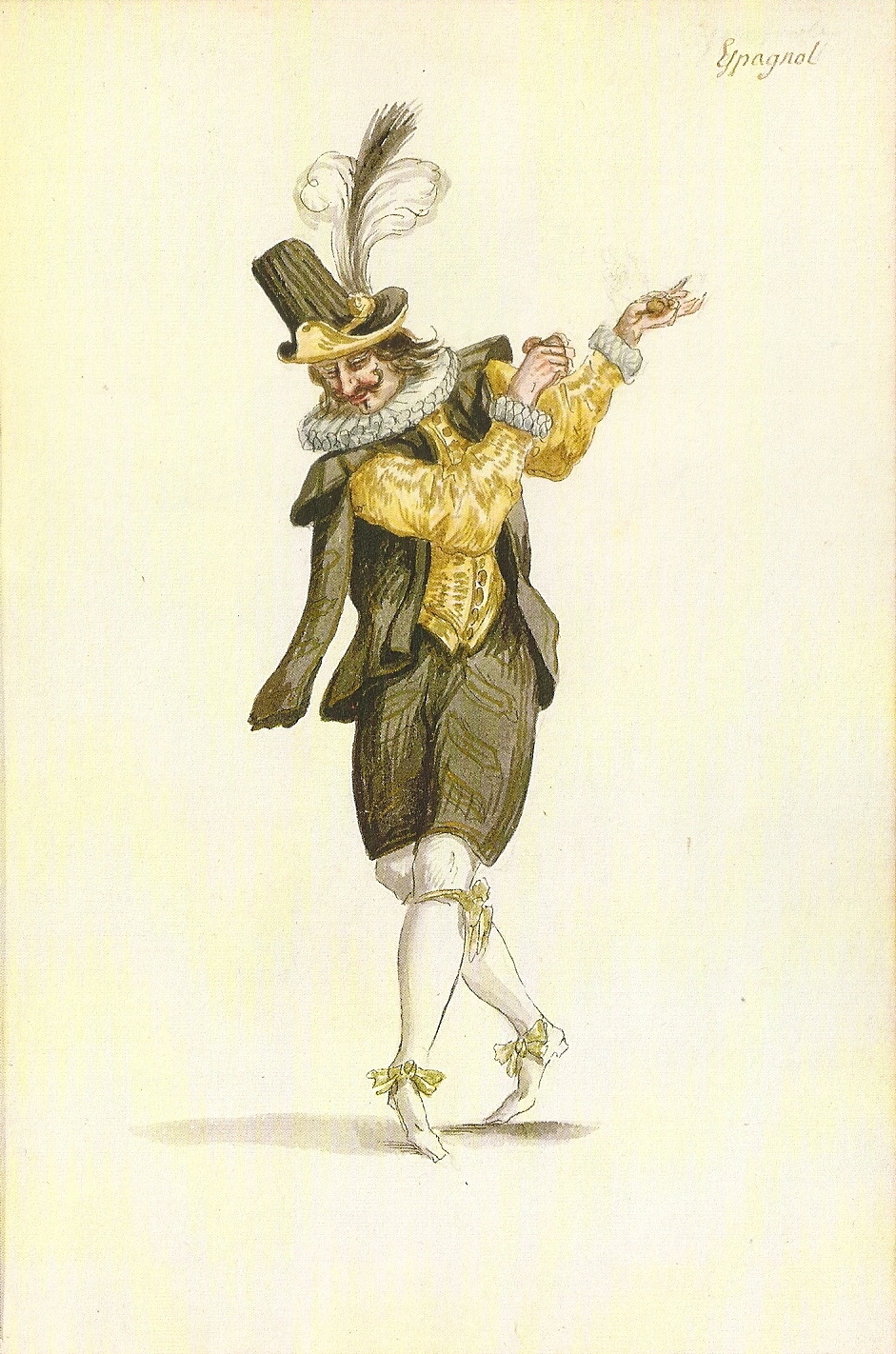
There were dancing ‘Spaniards’ on stage long before ‘Spanish’ dances were recorded in notation. They appeared in English masques as well as in the French ballets de cour. Charles II is unlikely to have remembered the ‘grave Spanish lover’ in the second antimasque to William Davenant’s Triumphs of the Prince d’Amour, given in 1635 when he was only five years old. During his exile, Charles spent several periods in France. The last of these ran from 1651 to 1654, and the King might well have seen the Ballet des Proverbes when it was performed at the Louvre on 17 February 1654. Its final entrée of ‘Espagnols’ and ‘Espagnolles’ included the young Louis XIV and Pierre Beauchamp among the dancers (the ‘Espagnolles’ were all danced by men).

Dancing Spaniard from designs for Le Ballet de la Nuit, 1653

Dancing Spaniard from designs for Le Ballet de la Nuit, 1653

It is a matter for conjecture as to how such performances might have influenced the entertainments offered by the London theatres. Charles II and his court were certainly committed patrons of the theatres, after they legally reopened with the patents granted to Davenant and Killigrew in 1660. I was interested to come across dancing Spaniards in Dryden’s The Indian Emperor, first given at the Bridges Street Theatre in 1665 and published in 1667. The dance comes in act 4 scene 3 of the play and the stage direction reads ‘two Spaniards arise and Dance a Saraband with Castanieta’s’. The dance follows a song, ‘Ah fading joy, how quickly thou art past?’ sung by ‘many Indian Women’ who are captives of the Spanish (the play deals with the Spanish conquistadors).  The use of castanets suggests a dynamic dance, so perhaps it was meant to contrast with the song. It calls to mind the final entrée in the 1659 Ballet de la Raillerie in which an ‘Espagnolle’ appears ‘dansant avec Castagnettes’. However, Dryden’s inspiration was probably closer to hand. Davenant’s The Cruelty of the Spaniards in Peru, performed and published in London in 1658, also includes a ‘Saraband’ danced by two Spaniards ‘with Castanietos’. The play was revived in 1661 and Dryden must surely have known it.

Was the music for the dance in The Indian Emperor Spanish or French, or did it draw on a more local tune? A country dance called The Spaniard had appeared in The English Dancing-Master when it was published in 1651 and was still included in the third edition of 1665. The music for Davenant’s The Cruelty of the Spaniards in Peru was by Matthew Locke.

Undoubtedly more influential in later years, although we lack direct musical evidence, was Lully’s score for Le Bourgeois gentilhomme, which included the Ballet des Nations with its Spanish, Italian and French entrées as well as the celebrated ‘Turkish’ ceremony. The comédie-ballet was given before Louis XIV at Chambord on 14 October 1670 and repeated later the same year for the public at the theatre in the Palais Royal in central Paris. It was revived in 1689, 1691 and as late as 1716. At the first court performance, the English actor Jo Haines was much applauded when he danced between the acts. Le Bourgeois gentilhomme was translated and adapted for London audiences by Edward Ravenscroft as The Citizen Turn’d Gentleman, given at the Dorset Garden Theatre in July 1672. Although it included Jo Haines as the French tutor and singing master, Ravenscroft’s version omitted the Ballet des Nations. The lasting influence of Lully’s dance music in France is clearly shown by the eight notated dances that use it. Did it also affect dancing on the London stage?

Campra’s opéra-ballet L’Europe galante, first performed at the Paris Opéra on 24 October 1697, was even more influential. Its four entrées were set in France, Spain, Italy and Turkey – the same as the four nations featured in Le Bourgeois gentilhomme. L’Europe galante was revived in 1706, 1715, 1724, 1725, 1736 and 1747, providing clear evidence of its lasting popularity. There are nine notated dances to its music. The significance of L’Europe galante to French dance culture is obvious. Its importance to dancing in London is more difficult to determine, although Anthony L’Abbé later used music from the Turkish entrée for a popular stage duet.

There was also a ‘Ballet des Nations’ in Europe’s Revels for the Peace, performed at the English court on 4 November 1697 to celebrate both the Peace of Ryswick which had ended the Nine Years’ War and King William III’s birthday.  This work, with music by John Eccles, has dances by Spanish, Dutch, French and English men and women. The music for these dances was not included in the surviving manuscript score, but some of the tunes were published in Thomas Bray’s Country Dances in 1699. Unfortunately, the ‘Spanish’ dance was not among them. Europe’s Revels for the Peace was revived at the Queen’s theatre in 1706, so perhaps its music and dances did influence ‘national’ dances given on the London stage later in the 18th century.

So, there are some clues to the nature of performances by dancing ‘Spaniards’ during the late 17th and early 18th centuries. Do the surviving dance treatises tell us anything about their dance style and technique?


‘Jouissons les plaisirs’

My work in baroque dance has always had a strong practical element. I find it easier to understand and write about the dances I have reconstructed. Much of my earlier work was based around dances I actually performed. Performance opportunities are few and far between nowadays, for a variety of reasons, but I try to continue reconstructing notated choreographies as part of my research.

I’ve recently been working on a loure, a duet to the air ‘Jouissons les plaisirs’. The music is identified on the notated ‘Entrée pour un homme et une femme Dancée par Mr Balon et Mlle Subligny au Ballet des Fragments de Mr de Lully’ in the Recüeil de dances contenant un tres grand nombres, des meillieures Entrees de Ballet de Mr. Pecour published in Paris in 1704. The work of reconstruction has had its difficulties – I have a recording of the music which is beguiling but otherwise not great and I have nobody to partner me, which all too easily leads to misinterpretation of the notation. Yet, I have found this little dance to be utterly charming. It is so prettily evocative of the early 18th century that it has been a delight to learn. I would love to see it in a good performance.

I like to know about the original contexts for the notated dances I reconstruct. In this case the air seems to have been written for the 1670 comédie-ballet Les Amants Magnifiques – the ballet in which Louis XIV apparently did not after all make his final performances as a dancer. The notated choreography, and its music, are instead associated with the Ballet des Fragmens de M. Lully first given at the Paris Opéra in 1702. This ballet brought together pieces of Lully’s music from the ballets de cour and comédies-ballets of the late 17th century into several entrées arranged by Campra. Its popularity was such that it was revived in 1708, 1711, 1717 and 1722. In Les Amants Magnifiques ‘Jouissons les plaisirs’ was a vocal duet by shepherdesses, in the Ballet des Fragmens it was entitled ‘[Air] des Jeux Pithiens’ and formed part of the first entrée, a ‘Fête marine’, as a vocal duet by female sailors accompanied by the dance. I can’t quite relate either the song or the dance to the later context, but I’m probably missing something.

I have been looking at ‘Spanish’ loures, but this dance surely falls into the ‘pastoral’ category. It is short, with only 54 bars, and the music is a rondeau (ABACA, A has 9 bars, B has 12 and C has 16 bars). The music has the time signature 3, in common with the famous ballroom duet Aimable vainqueur. It is quite unlike the ‘Spanish’ loures in 6/4. Although it is a stage dance, there are no difficult steps in this little entrée. Many of the pas composées incorporate quarter, half or (occasionally) full turns and nearly half include small jumps, so the sequences are flowing and lively. There are coupés avec ouverture de jambe which provide a pleasing suspension of movement and several other steps with a similar feel of extension. I like to draw on ballet’s ronds de jambes, even demi grand ronds de jambe, to give a greater sense of amplitude. The little jumps woven throughout add energy and make the pas de bourée and other ‘walking’ steps feel light and playful rather than languid. I haven’t yet mastered the musicality of this choreography, but I’m sure that if and when I do it will add to the pleasure of dancing it.

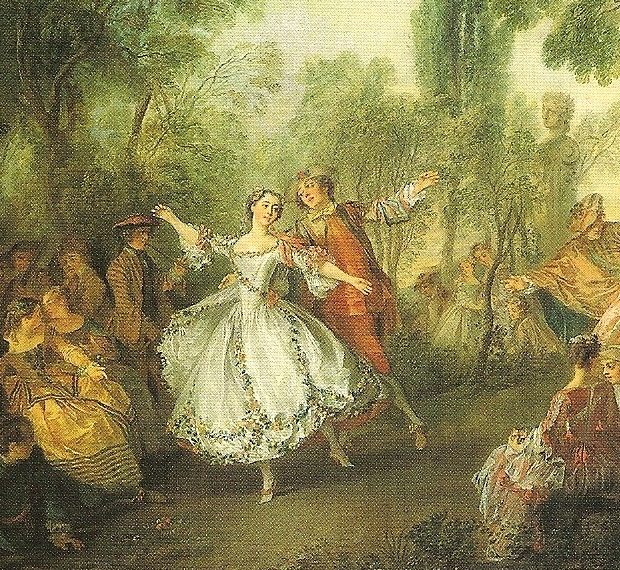
Perhaps the most important aspect of the dance is its figures, not so much the movement of the dancers within their stage space as the continually changing spatial relationships between them. They turn towards and then away from each other, face or turn their backs on one another, approach and retreat as they dance. On the page, the floor patterns look completely conventional, even banal, but they are transformed by the way the dancers turn on their own axis and move around each other. Without a partner it is difficult to be sure, but my guess is that the figures are quite tight and the couple stay close to one another much of the time, particularly when they circle and cross. There are many opportunities for interaction, through glances, turns of the head and épaulement as they move through their shared space. Even without a partner, the choreography conjures up the graceful flirtation of a fête galante. It brings to mind the paintings of Watteau, Lancret and Pater. It would be so easy to perform as a tiny drama of pastoral love and pleasure.

Lancret’s painting of Mlle Camargo and her partner is some thirty years later than the dance to ‘Jouissons les plaisirs’, but it gives a good idea of the style and affect of such a duet.

Nicolas Lancret, La Camargo Dancing (c1730)

Nicolas Lancret, La Camargo Dancing (c1730)

‘Spanish’ dances

In an earlier post, I looked at the ‘French’ saraband. I thought I’d turn to the ‘Spanish’ saraband, but I quickly got caught up in a confusing web of ‘Spanish’ dances.

There are four notated dances that can be defined as ‘Spanish’ sarabands, because of their music. Two are solos for a man, one by Favier (in an undated manuscript) and the other by Feuillet (in his 1700 Recueil de dances). The other two are solos for a woman, from Feuillet’s 1700 collection and Pecour’s 1704 Recueil de dances. All four choreographies use the ‘Ier Air des Espagnols’ from the Entrée ‘L’Espagne’ in the Ballet des Nations at the end of Le Bourgeois gentilhomme. I’ll come back to these dances later.

There are four surviving choreographies to the Folie d’Espagne music.  This is, of course, also a saraband. Two of these dances are very closely related: Feuillet’s solo Folie d’Espagne pour femme published in 1700 was lightly adapted to become a duet, recorded in a manuscript collection where it is attributed to Pecour. There is also one solo for a man by Feuillet, surviving only in manuscript, and another by Pecour in his 1704 Recueil de dances. I will return to these four choreographies too. On the London stage, the Folie d’Espagne was advertised under that title only once – at Lincoln’s Inn Fields on 29 May 1718 when it was performed ‘by a Little Girl that never danced on the Stage’.

Feuillet’s Sarabande Espagnole, a solo for a man in his 1700 collection, is actually a loure or gigue lente, another dance type that often has ‘Spanish’ connotations. There seem to be both ‘French’ and ‘Spanish’ loures, for some of the choreographies using this dance type have a pastoral or amorous context, at least so far as their music is concerned. The most famous ‘French’ loure is Pecour’s Aimable Vainqueur.

Another eight notated dances are designated ‘Spanish’ either in their titles or through their music. Five are loures, three of which are male solos. Two are by Feuillet, an Entreé DEspagnol surviving in manuscript and a Sarabande Espagnole pour homme in his 1700 collection. The third solo is the Spanish Entry in L’Abbé’s A New Collection of Dances dating to the mid-1720s. Pecour has an Entrée Espagnolle pour une femme and an Entrée pour deux hommes in his 1704 Recueil de dances. Both use the same piece of music from the Entrée for Spain in Campra’s L’Europe galante of 1697, as does Feuillet’s Entreé DEspagnol. The other two male solos use another tune from the Entrée L’Espagne in the Ballet des Nations.

Spanish dances were quite popular on the London stage. There were male and female solos, as well as duets, trios and a variety of dances for larger groups. It is virtually impossible to know what these choreographies were like, although the links of so many of the dancers to France and their training in ‘French’ dancing suggest that many were sarabands or loures or perhaps the Folie d’Espagne itself. Most of the advertisements for a ‘louvre’ probably refer to Aimable Vainqueur. However, there are a few billings for male and female solos, which may well be ‘Spanish’ loures. Among the last of the dancers to be advertised in a solo ‘louvre’ was La Barberina in the 1740-1741 and 1741-1742 seasons.

There is also the question of what made a dance ‘Spanish’ (apart from its music). I’ll come back to this.

The Saraband on the London Stage

The first saraband to be advertised as an entr’acte dance on the London stage was danced, together with a ‘Jig’, by the actress Elizabeth Younger at Drury Lane on 3 May 1714. Her appearance was described as ‘being the first time of her dancing alone on the stage’ – she was just fourteen but already had several years of acting experience. The last advertisement to mention a saraband was for a performance at Covent Garden on 13 February 1742. The dancer was the Italian virtuoso Barbara Campanini, ‘La Barbarina’. Little evidence survives to tell us what these dances were like. Both dancers were trained in French dancing, la belle danse. Miss Younger was really an actress who danced, although the surviving choreography for the Türkish Dance duet by Anthony L’Abbé shows that her technique was quite considerable. Perhaps her solo saraband was comparable to Feuillet’s Sarabande de Polixène. Although she was only twenty-one, La Barbarina was a first-rate ballerina fresh from success at the Paris Opéra where her technique had dazzled audiences.  I wonder whether her saraband was more like those created by Feuillet and Pecour for male soloists?

The first saraband duet was advertised for a performance at Lincoln’s Inn Fields Theatre on 5 May 1724. The dancers were Dupré and Mrs Wall. He was then one of the leading male dancers in the company, while Mrs Wall seems to have been a promising newcomer (she disappeared from the bills within just a few years).  She danced another saraband later the same season with Leach Glover, also a leading dancer at Lincoln’s Inn Fields. Both Dupré and Glover were accomplished exponents of la belle danse. Glover went on to perform sarabands with Mrs Laguerre and then Miss La Tour, both leading dancers in John Rich’s company, into the early 1730s. A clue to the nature of all these duets may lie in the Saraband’ of Issee, created by Anthony L’Abbé in the mid-1710s for Dupré and Mrs Bullock and published in his A New Collection of Dances around 1725. The duet is one of three choreographies to the same piece of music, taken from Destouches 1697 opera Issé. The other two dances are both by Pecour. L’Abbé’s dance is technically the most demanding of them. Mrs Bullock, as well as Dupré, was expected to perform beaten steps, turns and ornamentations normal for male technique (although she did not do the entrechats-six notated for Dupré, substituting plain changements instead).

The Saraband’ of Issee was a showpiece, which later dancers advertised in sarabands may or may not have been able to emulate. There is also a quite different saraband danced on the London stage and published in notation. L’Abbé’s The Prince of Wales’s Saraband was created for the birthday of Queen Caroline and performed at Drury Lane on 22 March 1731 by William Essex and Hester Booth. This ballroom duet has no spectacular steps. It makes its effects through subtle ornamentation, including modulations to the timing of individual pas composés although, like the stage choreographies, it recalls the contrast between fast and slow, dynamic and languid described by Pomey in 1671. Such an unadorned choreography requires true elegance and the utmost refinement of technique from its dancers. Hester Booth (née Santlow) was famous for her ‘address’ (which may loosely be translated as comportment). Her partner William Essex (son of the dancing master John Essex who had translated Rameau’s Le Maître a danser) must have been her equal. Was the notated choreography what they actually danced at Drury Lane? Evidence from other notated dances suggests that they may well have included some difficult unrecorded ornamentations.

Did the saraband really disappear from the London stage after 1742?

Anthony L’Abbé. Saraband’ of Issee [c1725], first plate.

Anthony L’Abbé. Saraband’ of Issee [c1725], first plate.

Anthony L’Abbé. The Prince of Wales’s Saraband [1731], first plate.

Anthony L’Abbé. The Prince of Wales’s Saraband [1731], first plate.