Category Archives: Stage Dancing

WERE THERE LIFTS IN EARLY 18TH-CENTURY BALLET?

Is there any evidence that male dancers lifted their partners in stage duets in the early 18th century? The short answer is very little. I know of only one report that says, incontrovertibly, that it happened. The Grub Street Journal for 8 January 1736 included a letter in which the writer complained about a duet by Michael Poitier and Catherine Roland.

‘Every one who has seen her dance knows, that at the end of the dance she is lifted by Poitier, that she may cut the higher, and represent to the whole house as immodest a sight as the most abandoned women in Drury-lane can shew. Her whole behaviour is of a stamp with this; for during the whole dance, her only endeavour is to shew above her knees as often as she can.’

The dance may well have been within the ‘Grand New Ballet Le Badinage de Provence’ first given at Drury Lane on 22 October 1735 and repeated numerous times that season. This letter, by ‘Cato’, needs careful analysis to disentangle the various issues the writer is addressing. However, there is no doubt that Poitier lifted Mlle Roland.

The surviving theatre dance duets, many for a man and a woman (although there are quite a few for two men as well as two women), definitely do not include any lifts. The two dancers perform alongside one another and rarely even touch hands. The lack of any references to, or notation for, lifts (assuming that Beauchamp-Feuillet notation could indeed record such moves) suggests that they did not form part of the vocabulary of serious dance.

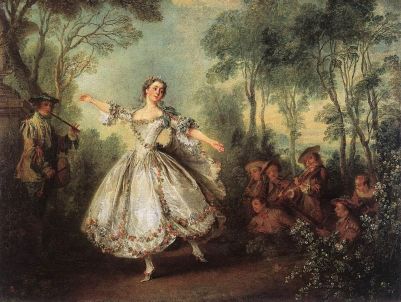
I did wonder whether the nature of the costumes worn at the time might clinch any argument against the use of lifts, but I am not sure. I believe that women’s bodices were less rigidly boned and their skirts shorter than those acceptable in polite society long before La Camargo is said to have shortened her skirts (for skirt lengths, see my post ‘Long Skirts or Short?’ The various versions of Lancret’s portrait of Mlle Camargo also suggest light boning in her bodice). So far as the feasibility of lifts in such attire is concerned, I am inclined to draw a parallel between dancers’ stage costumes in the early 1700s and those in modern ballroom dancing. For the latter, men wear formal suits with jackets that fit tightly and have tails, while the women have long full skirts to their dresses (as well as heeled shoes). As everyone who watches Strictly Come Dancing knows, there are lifts aplenty in ballroom dancing!

Returning to the 18th century, the problem is that we have a very tiny snapshot of what was actually danced on stage. There is no information from the professionals themselves (beyond the relatively few theatrical choreographies created by a handful of leading ballet masters). Pierre Rameau’s promised treatise on theatrical dancing does not survive, if it was ever written and published – although I doubt that it would have mentioned lifts, whether or not they existed, as he probably would have meant it for members of the audience rather than professional dancers.

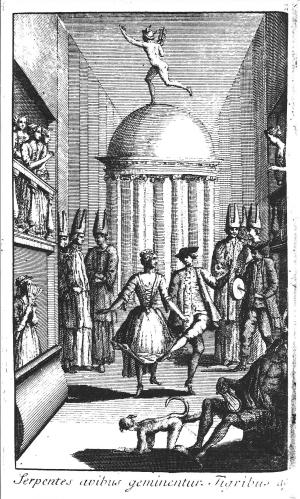
The passage quoted above seems to indicate that lifts were not a normal part of the serious style. It is unlikely that modern ballet’s supported adagio existed, if only because the technique of early 18th-century ballet has only the beginnings of the movements that would develop into the developés and grands ronds de jambe that are integral to ballet’s adage. So, there is little likelihood that stage duets included lifts associated with these slower movements. The report of Poitier and Mlle Roland apparently describes a lift to allow her to perform more brilliant batterie, so were lifts used elsewhere for this purpose? They certainly exist in modern ballet, although (so far as I know) their history for this purpose is yet to be traced. Back in the 18th century did such lifts belong to the comic genre, about which we know much less? The one pictorial source we have from this period, Lambranzi’s Neue und curieuse theatrialische Tantz-Schul of 1716, provides no evidence.

So, in answer to the question in my title, I think that there were lifts in early 18th-century ballet but only in certain genres and in particular contexts. If Poitier and Mlle Roland were the first to introduce them to the London stage, they were unlikely to have been the last – whatever the strictures of ‘Cato’.

FOLLOWERS OF MARS

According to the cast list in Weaver’s scenario for The Loves of Mars and Venus, Mars had four ‘Followers’ danced by Mr Prince, Mr Boval, Mr Wade and Mr Birkhead. They were the first characters to appear in the afterpiece, coming onstage at the end of the overture to perform a Pyrrhic Dance before the arrival of Mars himself. If Weaver’s description of the action in scene four is to be taken literally, they represented the strength and vigour of warriors. The four dancers who took the roles of the Followers are not listed alphabetically, so perhaps the order of their names reflects their status within the company (if it is not simply random). Weaver does not distinguish between them, as he does with the Attendants on Venus.

The first name is that of Mr Prince. It is difficult to disentangle the various dancers named Prince who worked in London’s theatres in the years before and after 1700. The dancer in The Loves of Mars and Venus has been identified as the Joseph Prince who in 1678 married Judith Channell (daughter of Luke Channell, a leading dancing master of the late 17th century). This seems unlikely, as Joseph Prince would have been around 60 years old in 1717, rather older than the other dancers in the ballet. Was he the ‘famous Dancing-Master’ named Prince who died in 1718? This man may have been the Mr Prince who is recorded as dancing in London’s theatres from the mid-1690s and who danced alongside John Weaver in the 1701-1702 season. Was he the Prince commended by the Spectator for his choreography in 1712?

‘In all the dances he invents, you see he keeps close to the characters he represents. He does not hope to please by making his performers move in a manner in which no one else ever did, but by motions proper to the characters he represents.’

Mr Prince’s repertoire seems to have been mainly comic, but there are so few records of him dancing that it is impossible to be sure.

Second on the list of Followers is Mr Boval. He was a relative newcomer to the London stage, for he is first recorded as dancing at the Lincoln’s Inn Fields Theatre in 1714-1715. Like several of the other dancers engaged by John Rich following the reopening of that theatre, Boval may have been French. His repertoire in his first season included Harlequin and Two Punches (probably as a Punch) and a Grand Spanish Entry. After he moved to Drury Lane, for the 1715-1716 season, Boval appeared in the pastoral divertissement from the masque Myrtillo as well as performing an unspecified ‘New Dance’ with Prince and Birkhead. The records for Boval’s repertoire are scant but they suggest that he was a versatile dancer in both the serious and the comic styles.

Mr Wade’s first known billing was at Drury Lane during the 1711-1712 season (other records name him as John Wade). His early repertoire included the Dutch Skipper and the French Peasant, suggesting that he was mainly a comic dancer. In Weaver’s ‘Dramatick Entertainment of Dancing in Grotesque Characters’ The Shipwreck; or, Perseus and Andromeda, given at Drury Lane on 2 April 1717, Wade was billed as the Monster Crocodile (which presumably tried to devour Andromeda/Colombine, played by Mrs Bicknell, until Perseus / Harlequin, played by Weaver, intervened). Does the casting indicate that his skills extended to broad comedy?

The last of the four Followers of Mars is Matthew Birkhead. He was first recorded at Drury Lane during the 1707-1708 season, although his career may well have begun earlier. Birkhead was both an actor and a dancer. As a supporting, rather than a leading, player he was not always mentioned in the bills, so it is difficult to get a full picture of his repertoire. Among the dances he is known to have performed are the Miller and His Wife, Four Scaramouches, a Country Man and Woman, the Boor Left in the Lurch and a Wedding Dance (with Prince among others). Birkhead’s skills evidently ran in the direction of broad comedy.

Prince, Boval and Birkhead danced together several times, if not regularly, during the 1715-1716 season, so perhaps there were similarities in their dancing styles and techniques. All four of the Followers of Mars seem to have been versatile performers, with Mr Prince the most senior among them. Boval, Wade and Birkhead were all definitely supporting dancers. Such evidence as there is suggests that, although they probably could portray the strength and vigour wanted by Weaver, their dancing could not (and was not intended to) challenge the sophisticated virtuosity of Louis Dupré as Mars.

There are no known portraits of any of these men. For The Loves of Mars and Venus were they costumed in a style reminiscent of the conventions of the French ballet de cour and opera?

mars

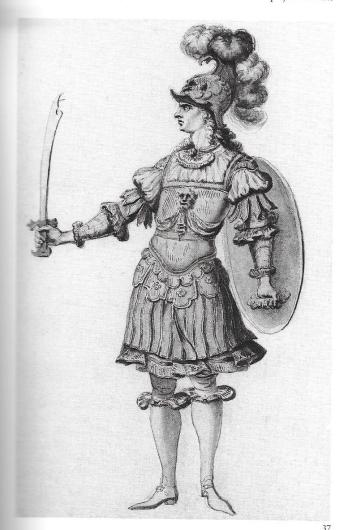
A late 17th-century costume design for a ‘Combattant’. Did the Followers of Mars wear something like this?

Or did they merely add a breastplate, shield and sword to less military attire. A plate in Lambranzi’s Neue und Curieuse Theatralische Tantz-Schul provides an idea (if you ignore the hats).


Lambranzi 1-50 detail

Gregorio Lambranzi, Neue und Curieuse Theatralische Tantz-Schul, Part 1, Plate 50 (detail)

I will consider the dances of the Followers of Mars in a later post.


LONG SKIRTS OR SHORT – WHAT DID FEMALE PROFESSIONAL DANCERS ACTUALLY WEAR?

I recently posted a short piece on The Weaver Dance Company website about the skirt lengths of female professional dancers. Here, I would like to look more closely at this topic which has concerned me for as many years as I have practised baroque dance.

The story still told regularly in popular histories of dancing is that Marie-Anne de Camargo, the great French ballerina of the mid-18th century, was the first to shorten her skirts in order to show off her brilliant footwork. The famous portrait of her by Nicolas Lancret, painted in 1730, supports this idea by showing her with a mid-calf length skirt.

Lancret Camargo Wallace

Yet, in her entry for Mlle Camargo within the International Encyclopedia of Dance, Régine Astier (a specialist in the period) says bluntly that ‘there is no evidence to support the legend’.

What do we know about skirt lengths among ballerinas in ballet’s early years?

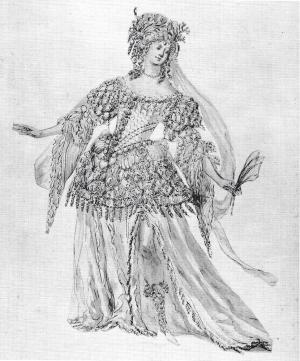
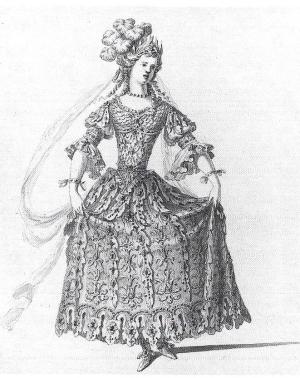
If we look back to the late 17th century, we find that female characters danced by male courtiers did wear shorter skirts than their female counterparts. These two designs come from the 1654 French court ballet Les Noces de Pélée et de Thétis. On the left is a Dame de la cour de Pélée performed by a male dancer and on the right the muse Erato performed by a female dancer.


We also find indications that female professional dancers showed more of their legs than was possible in an elaborate floor-length gown. Marquise-Thérèse de Gorla, known as Mlle Du Parc, was a member of Molière’s troupe and a dancer as well as an actress. She attracted attention when she performed ‘certain remarkable cabrioles – for one could see her legs and part of her thighs through the slit in her skirt’. There are several references to female professional dancers of this period performing jumps and cabrioles. Was Mlle Du Parc’s costume something like this design for a Divinité marine from the 1665 Ballet de la Naissance de Vénus?

Marine Deity (female dancer)

The long underskirt seems to be a lightweight material, which would be less inhibiting than the heavily decorated skirts so often seen in late 17th-century designs.

Towards the end of the 17th century, there are depictions of women holding up their skirts to dance. While this would seem to confirm the floor-length skirt it also suggests that women commanded a dance technique for which the feet needed to be unimpeded and visible. This costume for a Nayade comes from the ballet Le Triomphe de l’Amour of 1681 – according to Jérôme de la Gorce in Berain, Dessinateur du Roi Soleil it may well be for the professional production staged a few months after the ballet was given at court.

Nayade (female dancer)

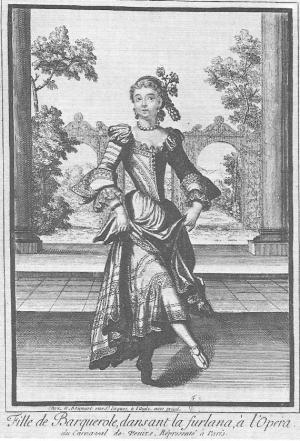
The following illustration, linked to Campra’s 1699 opéra-ballet Le Carnaval de Venise, also shows a female professional dancer in a lightweight skirt.

Fille de Barquerolle


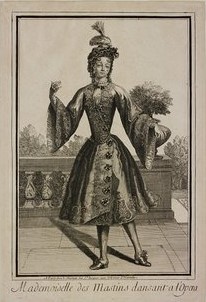
This late 17th-century engraved portrait of Mlle Desmatins ‘dansant à l’opéra’ is notable for its knee-length skirt – In The Pre-Romantic Ballet, Marian Hannah Winter suggests that she may have been dancing en travesti.

Desmatins Mlle

Her costume seems to belong to same period as the familiar depiction of Marie-Thérèse de Subligny in an elaborate, and seemingly unyielding, gown.

Subligny

Mlle Subligny is one of the earliest ballerinas for whom we have surviving dances. The solo Passacaille d’Armide, created for her by Guillaume-Louis Pecour and danced when she visited London in the winter of 1701-02, has an elaborately ornamented vocabulary with many small jumps, beats and turns. As I have said elsewhere, why create such virtuosic choreography if none of the steps can be seen (assuming that the ballerina could indeed perform them in such a dress)?

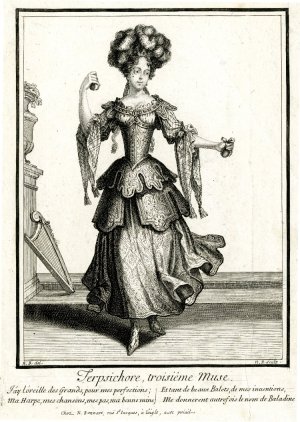
I believe that this image of Terpsichore from the end of the 17th century gives us a much better idea of the costumes that Mlle Subligny and other ballerinas would actually have worn.

Terpsichore


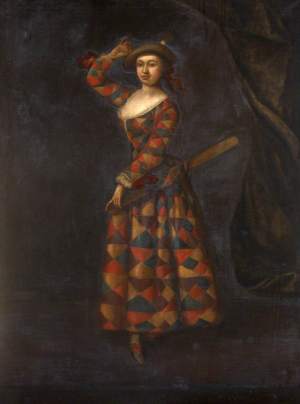
Once we reach the 18th century and the London stage there is further evidence for shorter skirts, although this comes from much the same period as Lancret’s portrait of La Camargo. The portrait of Hester Santlow as Harlequine, in a floor-length costume, is well known. However, in a little-known (and not very good) copy she is known to have owned herself, she has a skirt which is noticeably shorter.

Ellys, John, c.1701-1757; Mrs Hester Booth (1681-1773)

The dates of these Harlequine portraits are not entirely certain, but both are likely to have been painted by the early 1720s.

One of Mrs Santlow’s dancing roles was Diana in ‘The Masque of the Deities’ which concluded the smash-hit pantomime Harlequin Doctor Faustus, given at Drury Lane in 1723. There is no image of her as Diana, but the description of the character in a scenario of the pantomime published at the time may well reflect what she wore.

‘She is pictur’d of a middle Stature, her Hair loose, a Bow in her Hand, and a Quiver of Arrows hanging at her Shoulders; a Deer-Skin fasten’d to her Breast, a Gown of Purple, tuck’d up to her Knees with Jewels; her Legs adorn’d with Buskins up to the Calf, her Dress, tho’ careless, handsome; her Behaviour free and easy, tho’ modest and decent.’

Like Mlle Subligny, Mrs Santlow’s surviving dances reveal a virtuoso technique with a vocabulary that is full of small jumps, beats and turns – impossible to see, or execute, in a heavy floor-length dress.

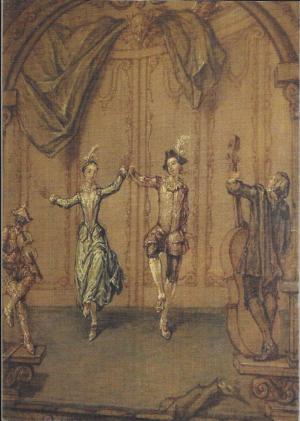
Marcellus Laroon’s charming depiction of a couple dancing, apparently on a stage, shows the girl in a soft mid-calf length skirt.

Laroon Couple Dancing

It may date to the 1720s.

Better known is the 1731 satirical print showing Mrs Laguerre and Francis Nivelon dancing in the Lincoln’s Inn Fields pantomime Perseus and Andromeda. It was given an equally satirical review in the Grub-Street Journal for 25 February 1731. The writer pays some attention to Mrs Laguerre’s skirts, complaining that ‘the woman’s petticoats, in that ever memorable dance, which should have been at least some inches above the knee, are here no higher than the calf of the leg’.

Perseus and Andromeda Satire

What should we make of the way in which Mrs Laguerre’s skirts are tucked up at the front? Further research and analysis are needed but, taken together with Mrs Santlow’s depiction as Harlequine and description as Diana, it further suggests that female professional dancers in London were routinely wearing skirts as short as or even shorter than Mlle Camargo’s by at least the 1720s.

I haven’t ventured into the topic of female fashions in the years around 1700, which would also shed light on costume for stage dancing, but it begins to seem that Lancret’s painting of La Camargo records a well-established convention for the length of a ballerina’s skirt rather than a revolution in costuming.

CONSTANT ATTENDANTS ON VENUS

Weaver’s scenario for The Loves of Mars and Venus lists the 3 Graces as ‘Constant Attendants on Venus’. Aglaia was danced by Mrs Bicknell, Thalia by Mrs Younger and Euphrosyne by Mrs Willis. The ‘Hour’, whom I have elsewhere identified as one of the Horae or Seasons and probably Flora, has no performer named, but it may be possible to discover who among the women in the Drury Lane company for the 1716-1717 season might have danced the role.

The three Graces were, collectively, goddesses of beauty, but each also had an individual personality. Aglaia was associated with splendour and glory, Thalia with prosperity and festivity and Euphrosyne with joy and mirth. Weaver must have been well aware of these characteristics since he gave them their own names in his cast list. Did this affect his casting of these roles, or was that based purely on practical considerations?

Aglaia (splendour, glory) was performed by the actress-dancer Margaret Bicknell. Born Margaret Younger in Edinburgh in 1681, she was first recorded at Drury Lane as a dancer in 1702 with her first known billing as an actress in 1703. By 1709, she had evidently become a favourite of Sir Richard Steele. Following her first appearance in the title-role of Wycherley’s The Country Wife on 14 April 1709, he wrote in the Tatler that she made ‘a very pretty Figure’ and had ‘a certain Grace in her rusticity’. In the Spectator, a while later, he wrote of her performances:

‘One who has the Advantage of such an agreeable Girlish Person as Mrs. Bicknell, joined with her Capacity of Imitation, could in proper Gesture and Motion represent all the decent Characters of female Life’.

He was obviously captivated by her powers of mimicry, a useful skill in the context of John Weaver’s ambitions for the art of dancing. As an actress, Mrs Bicknell appeared almost exclusively in comedy, taking supporting as well as leading roles. As a dancer, she had a relatively narrow repertoire which centred on comic duets and did not (so far as we can tell) include any of the important serious dance types like the passacaille or the saraband.

Thalia (prosperity, festivity) was danced by Mrs Bicknell’s sister Elizabeth Younger, born in 1699. She had made her first stage appearances as a child actress, joining the adult company at Drury Lane for the 1712-1713 season. Miss Younger made her first solo appearance as a dancer at that theatre on 3 May 1714, dancing a saraband and a jig. As both an actress and a dancer, she had a wider repertoire than Mrs Bicknell and must have been trained in ‘French Dancing’ (which her sister possibly was not). A few years later, Anthony L’Abbé created a Turkish Dance duet for her and the young virtuoso George Desnoyer which was published in notation in the mid-1720s. It shows that she had a good belle danse technique.

According to Weaver’s scenario, Euphrosyne (joy, mirth) was danced by ‘Mrs. Willis’ but the performer was surely her daughter Miss Willis (as stated in the advertisements for The Loves of Mars and Venus). Mary Willis, probably born in the 1690s, was an actress who occasionally danced. She was a supporting player, too far down the company’s ranks to get individual billing in advertisements regularly, so we have almost no evidence about her dance repertoire. However, it seems unlikely that she had much grounding in ‘French Dancing’.

The most plausible if not the only candidate for the role of the ‘Hour’ (probably Flora) is the singer-dancer-actress Miss Lindar. So far, I haven’t been able to discover exactly who she was and where she was from. She may have begun her career at Drury Lane around 1715, although she was not mentioned in the bills until 14 May 1717 when she gave a new prologue to John Fletcher’s comedy Rule a Wife and Have a Wife. The following season, on 30 October 1717, the advertisements declared that the dancing would include ‘A Chacone, a Minuet and a Jigg by Miss Lindar, being the first time of her Dancing on any Stage’.  As with many other performers of the time, this was simply an advertising ploy and need not be taken as the literal truth. The listing indicates that she had been trained in ‘French Dancing’ and she was later billed as the scholar of Mr Shirley, a London dancing master who may well have known John Weaver. It seems likely that in 1717 Miss Lindar (like Elizabeth Younger a few years earlier) was making the transition from a child to an adult performer. She was possibly in her mid-teens.

Sadly, we have no known portraits of Margaret Bicknell, Elizabeth Younger, Mary Willis or Miss Lindar. Here is an image of three female dancers in a pas de trois from a few years later, suggesting how the three Graces may have appeared in Weaver’s ballet.

Lancret Salle Detail 1

Nicolas Lancret, Portrait of Marie Sallé (1732), detail

Weaver’s three Graces were competent and experienced stage dancers whose skills did not reach anywhere near the heights of Hester Santlow as Venus. As actresses, however, they must surely all have been able to portray characters even without words (as Steele’s description of Margaret Bicknell shows). Miss Lindar, as the Hour, had less experience but the advantage of training in ‘French Dancing’. Perhaps she was less in evidence as a character in the ballet (as Weaver’s scenario hints), but she must have been able to participate fully in the dances by these ‘Attendants on Venus’ in scenes 2 and 4.

I will look at what the dances by the three Graces and the Hour might have been like in a later post.


THE SUPPORTING CAST

John Weaver’s ‘Dramatick Entertainment of Dancing’ The Loves of Mars and Venus had a cast of 26 characters, according to the published scenario. In addition to Mars, Venus and Vulcan there was a supporting cast.

‘the 3 Graces, constant Attendants on Venus

‘four Followers of Mars

‘Four Cyclops. … Workmen to Vulcan

‘Three more Cyclops

Gallus, Attendant on Mars

‘One of the Hours attending on Venus

Cupid

Jupiter, Juno, Apollo, Diana, Neptune, Thetis, Gods and Godesses’

Although Gallus accompanies Mars in scenes 1 and 6 and Cupid appears with Venus in scenes 2, 4 and 6, neither seem to have been dancing roles. Gallus is simply a walk-on part, while Cupid is a mime role and must have been played by a child actor. It is likely that there is some doubling of roles, with 3 of the Followers of Mars and (probably) the 3 Graces also dancing the 3 gods and 3 goddesses who descend towards the end of scene 6. The ballet would thus have had 17 supporting dancers and actors in addition to the three principals – it was not a large-scale work but neither was it a negligible one.

I thought I would take a closer look at the supporting roles in The Loves of Mars and Venus, not only the characters but also the dancers who portrayed them. I intended to cover them all in a single blog post, but once I started my research I discovered rather more than I had anticipated. So, I will devote one post each to the ‘Attendants on Venus’, the ‘Followers of Mars’ and the ‘Cyclops’.


LOUIS DUPRÉ – MARS

What of Louis Dupré, who was a newcomer to the London stage? How did he portray Mars?

Dupré is still too often identified with ‘le grand’ Dupré of the Paris Opéra. Some years ago, I published an article that disproved this idea on the simple grounds that the two men were performing on opposite side of the English Channel simultaneously.

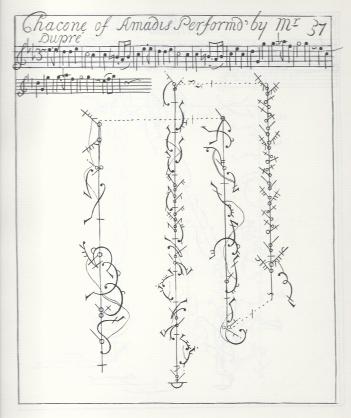
A dancer named Dupré is first advertised on 22 December 1714 at the Lincoln’s Inn Fields Theatre and appeared there regularly during the 1714-1715 season. He then moved to Drury Lane, where he danced for the next two seasons, appearing in The Loves of Mars and Venus during that period. Dupré’s skills are often solely identified with the serious style, but from soon after his arrival in London he regularly performed a Harlequin dance. There is even a notated Harlequin choreography dedicated to him, which claims to include some of his characteristic steps and moves. The dancing skills that Dupré was able to bring to the character of Mars are amply demonstrated by the ‘Chacone of Amadis’ created for him by Anthony L’Abbé, probably around the time of The Loves of Mars and Venus. This solo contains a panoply of early 18th-century male virtuosity, from entrechats-six to multiple pirouettes and tours en l’air.

chacone-of-amadis-1

L’Abbé, ‘Chacone of Amadis’, A New Collection of Dances, [c1725], first plate

Dupré returned to Lincoln’s Inn Fields for the 1717-1718 season and continued to dance with John Rich’s company until he died in 1734 or 1735.

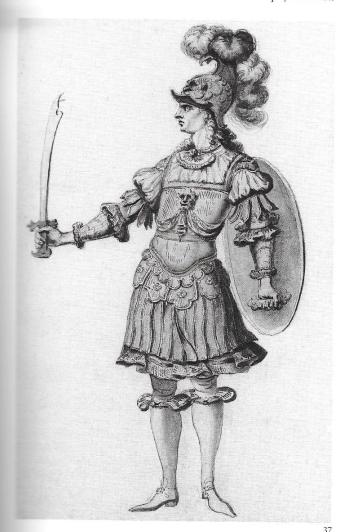
There is no known portrait of London’s Louis Dupré. This design reflects contemporary ideas about the appearance of a classical warrior.

mars

A late 17th-century costume design for a ‘Combattant’. 

Although the London Dupré was obviously more than just a serious dancer of the type that Weaver criticised for lack of expression in his Essay towards an History of Dancing, Mars is given fewer explicitly formal gestures than either Vulcan or Venus. Weaver describes the character thus in his scenario for the ballet:

mars-in-words

Weaver, The Loves of Mars and Venus (1717), p. xv

In scene 1, Mars dances an ‘Entry’, probably intended to show his power through a display of virtuosity, and a ‘Pyrrhic’ mimicking hand-to-hand combat with his Followers. In scene 4, he woos Venus in mime but his gestures (as well as those of the other dancers who take part in this scene) ‘are so obvious, relating only to Gallantry, and Love; that they need no Explanation’. Mars is asked to show ‘Gallantry, Respect; Ardent Love; and Adoration’ before Venus, a sequence that creates a crescendo of feeling. In scene 6, after being caught in the net with the goddess, Mars shows ‘Audacity; Vexation; Restlessness; and a kind of unwilling Resignation’. Weaver describes ‘Resignation’ as ‘To hold out both the Hands joyn’d together’ adding that it is ‘a natural Expression of Submission and Resignation’. Were ‘Audacity’ and ‘Vexation’ perhaps modified versions of ‘Threats’ and ‘Impatience’?

The way in which Weaver depicts Mars is reflective of the God of War as a man of action rather than one of thought or feeling. This may have had more to do with Weaver’s concept of his ballet and its characters than with Dupré’s supposed limitations when it came to gesture.

HESTER SANTLOW – VENUS

In the 1716-1717 season, Hester Santlow was Drury Lane’s leading dancer and one of the company’s leading actresses. Who was she and how might she have danced Venus?

Hester Santlow’s date and place of birth and, indeed, her origins remain unknown. Her name seems to be French in derivation (St Loe) and her family were, apparently, not connected with the theatre. What evidence there is suggests that she was born in 1693 or 1694 (see my 2007 book The Incomparable Hester Santlow). She made her stage debut as a dancer in 1706, adding acting to her professional skills in 1709 when she appeared as Miss Prue in Congreve’s comedy Love for Love. Thereafter, she pursued a double career as both a dancer and an actress. Her acting roles show her as a light comedienne – her most popular roles included Harriet in Etherege’s The Man of Mode and Miranda in Mrs Centlivre’s The Busy Body. She was much admired in breeches roles such as Hellena in Aphra Behn’s The Rover. In tragedy, she was best suited to such roles as Ophelia in Hamlet and Cordelia in Nahum Tate’s version of King Lear, both of which she played for many years.

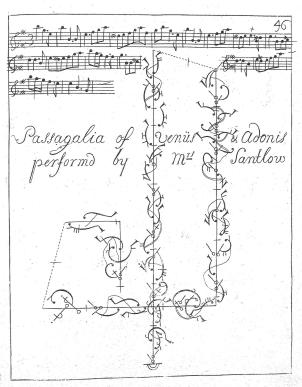
As a dancer, Hester Santlow had no peer on the London stage. She was trained by the Frenchman René Cherrier and had dances created for her Anthony L’Abbé, royal dancing master and a leading choreographer. L’Abbé’s solo ‘Passagalia of Venüs & Adonis’ (to music from the opera by Desmarets), published in notation in the mid-1720s, remains a testimony to her virtuoso technique and her expressive powers.

passagalia-1

L’Abbé, ‘Passagalia of Venüs & Adonis’, A New Collection of Dances, [c1725], first plate

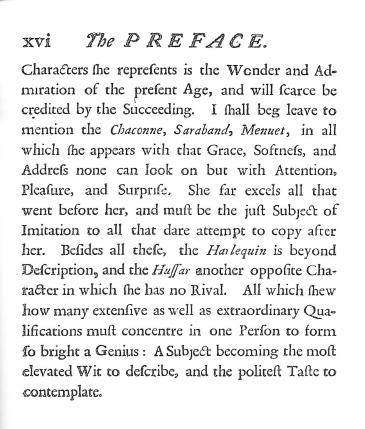
Her impact is well described by the dancing master John Essex in his Preface to The Dancing Master (his translation of Rameau’s Le Maître a danser).

essex-santlow-1

essex-santlow-2


Hester Santlow married her fellow actor and Drury Lane manager Barton Booth in 1719. Her career ended in 1733, following the death of her husband. During her final season on the London stage, she created the role of Helen of Troy in Weaver’s last ballet The Judgment of Paris.

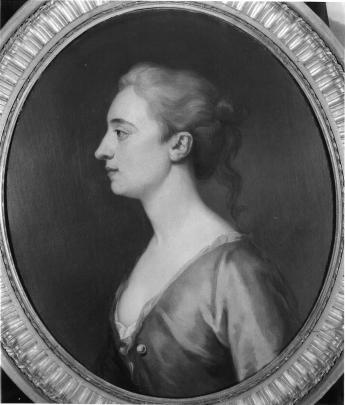
In Hester Santlow, Weaver had a Venus ‘Goddess of Love and Beauty’ who could both dance and act. Unsurprisingly, she has the greatest range of gestures in the ballet after Weaver himself as Vulcan. He used her dancing skills and her expressive abilities to the full. He also took every chance to show off her beauty. Another contemporary described Mrs Santlow as ‘a beautiful Woman, lovely in her Countenance, delicate in her form’. She is one of the very few dancers of the 18th century for whom we have several portraits.

vanderbank-santlow

John Vanderbank, Hester Santlow, c1720

Venus is first shown ‘in her Dressing-Room at her Toilet’ surrounded by the Graces with Cupid and the Hour (probably Flora). She ‘rises and dances a Passacaile’ first solo and then with the other women. The choreography could have shared features with L’Abbé’s ‘Passagalia’. The ‘Dance … of the Pantomimic kind’ with Vulcan which follows is worth its own post. Weaver entrusted a significant number of gestures to Venus, although she has a far narrower range of ‘Passions’ which have less powerful physical expressions. She is, however, allowed to improvise ‘Coquetry. … seen in affected Airs, given herself throughout the whole Dance’. In scene 4, with Mars, Mrs Santlow’s gestures are again improvisatory – ‘reciprocal Love’ and ‘wishing Looks’. Were these expressions stock-in-trade for Mrs Santlow the actress, or were they new to her?

In the final scene, Venus has to express ‘Shame’, ‘Confusion’ and ‘Grief’. Weaver provides gestures for the first and last of these, leaving her to find her own way of showing ‘Confusion’. How and with whom did Venus dance in the closing ‘Grand Dance’? Were there echoes of her ‘Pantomimic’ dance with Vulcan in scene 2 and of her gestures and dancing with Mars in scene 4? If there were, with her breadth of dance repertoire and her acting skills, Hester Santlow could surely have encompassed them all.

JOHN WEAVER – VULCAN

Who was John Weaver? How did he create the role of Vulcan in his ballet The Loves of Mars and Venus?

John Weaver was born in 1673 in Shrewsbury, the son of a dancing master. By the mid-1690s, he was himself a dancing master in the same town, but by the end of that decade he was probably in London working in the theatre as a professional dancer. His earliest known billing is at the Drury Lane Theatre on 6 July 1700, when he appeared in ‘a new Entry’ with two other dancers. Few advertisements for theatrical performances survive from this period, so it is very difficult to chart individual performers’ careers, but the bill suggests that Weaver was an established member of the Drury Lane company. The handful of advertisements that mention Weaver in the first years of the 18th century indicate that his forte was comic dancing, although as a dancing master he would surely have had a thorough knowledge of the serious or ‘French’ style and technique of dancing for both the ballroom and the stage. He returned to Shrewsbury to teach dancing in late 1707 or early 1708.

Weaver returned to Drury Lane for the 1716-1717 season to create and dance in The Loves of Mars and Venus. We do not know whether he danced in his own early pantomimes, The Shipwreck and Harlequin Turn’d Judge, but his later repertoire of entr’acte dances included English Clown, Lads and Lasses, Irish Trot and Sailor and His Lass. None suggest the sophisticated refinements of the serious style of dancing. Weaver went on dancing at Drury Lane until the end of the 1728-1729 season, when he was 55 years old. His last visit to London came in 1733, when he created his final work for the stage The Judgment of Paris, after which he returned to Shrewsbury and his dancing school for good.

There is no known portrait of John Weaver.

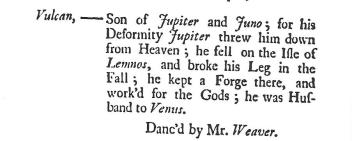
In the scenario for The Loves of Mars and Venus, Weaver provides a pen-portrait of Vulcan drawn from classical authors.

vulcan-in-words

John Weaver, The Loves of Mars and Venus (1717), p. xv

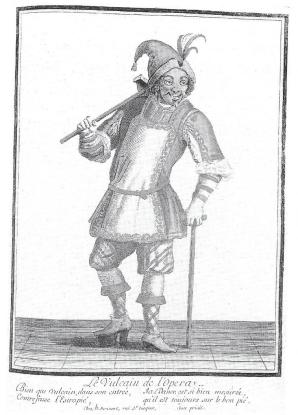
The description suggests that he portrayed Vulcan as lame in his ballet, following contemporary depictions of the god.

vulcan

A late 17th-century depiction of a stage Vulcan.

Weaver continues to draw Vulcan’s character throughout The Loves of Mars and Venus. The god first enters part way through scene 2 to a ‘wild rough air’. When he joins with Venus in the ‘Dance being altogether of the Pantomimic kind’, Vulcan’s passions are powerful – jealousy, anger, anguish are among them – and strongly expressed. Anger has ‘The left Hand struck suddenly with the right; and sometimes against the Breast’. His accustomed habitat is ‘Vulcan’s Shop, to which scene 3 opens showing the Cyclops as they work to ‘a rough Consort of Musick … adapted to the particular Sounds’ hammering and filing arms and armour for the gods. This provides the soundscape for the Entry danced by Vulcan and his workmen.

A different side of Vulcan appears when the shop is shown again, with the god ‘leaning in a thoughtful Posture on his Anvil’. Weaver is not explicit about his mood when he dances alone as the Cyclops complete the net that will enable his revenge on his wife and her lover. Did he maintain Vulcan’s lameness as he danced? Did he express pleasure, as Weaver’s gesture ‘Pleas’d at some Contrivance’ indicates, or something darker?

Vulcan must have dominated the final scene of The Loves of Mars and Venus. His control of the action reaches its highest point in the ‘insulting Performance’ he and the Cyclops give before the imprisoned Mars and Venus. Even after the arrival of the other gods, Vulcan remains the most active figure on stage as Weaver performs ‘Triumphing’, described as ‘To shake the Hand open, rais’d above our Head, is an exulting expression of Triumph’. How did Weaver show Vulcan’s responses as Neptune tries to persuade Vulcan ‘at length’ to forgive Mars and Venus? Vulcan must have taken part in the ‘grand Dance’ which concludes the ballet. Was this dance in the serious style or was it closer to a country dance in its steps and figures?

Vulcan’s dances post questions of genre, style and technique which are not easy to answer. All of them must have been ‘comic’ but what did this mean in practice? I will try to return to the subject of comic dancing in a later post.

THE DRAMATICK ENTERTAINMENT OF DANCING IN ACTION

The only surviving evidence for The Loves of Mars and Venus is the scenario written by John Weaver to accompany the first performances of the ballet. There were probably several reasons for its publication. Weaver writes in his Preface ‘I know it will be expected that I should give the Reader some Account of the Nature of this kind of Entertainment in Dancing, which I have here attempted to revive from the Ancients in Imitation of their Pantomimes’, thereby presenting himself as a scholar as well as a dancing master. The detail within the scenario suggests that he was rather more concerned that the audience might not understand the story, and the gestures used by the dancers, without some help. He acknowledges that ‘I have not been able to get all my Dancers equal to the Design’, admitting that ‘I have in this Entertainment too much inclin’d to the Modern Dancing’. So, what does the scenario tell us about Weaver’s dance drama?

The ballet unfolds in six scenes, for each of which Weaver describes the action – dance, gesture and even music – quite closely. The first scene is devoted to Mars and is preceded by a ‘Martial Overture’.

mars

A late 17th-century costume design for a ‘Combattant’. Did Weaver’s Mars look something like this?

The four ‘Followers of Mars’ enter to perform a ‘Pyrrhic Dance’ which Weaver explains as an exercise in training for combat. After a ‘Warlike Prelude’, Mars joins them. He dances a solo ‘Entry’ and then performs the Pyrrhic Dance with them.

The second scene provides a complete contrast, as Venus is discovered ‘at her Toilet’ surrounded by Cupid, the Graces and ‘one of the Hours’ (this character is probably one of the ‘Horae’ or Seasons, most likely Flora).

venus

A mid-17th century costume design for Venus (danced by a man). Nothing in her dress declares that she is a goddess.

She is introduced by a ‘Simphony of Flutes’ and rises to dance a passacaille, in which she is joined by the Graces and the Hour. They have just finished their dance when a ‘Wild Rough Air’ heralds the arrival of Vulcan. Everyone except Venus hastily departs. There follows what Weaver describes as a ‘Dance being altogether of the Pantomimic kind’ – a mute quarrel between Venus and Vulcan, for which Weaver specifies in great detail their gestures. This duet surely reaches to the heart of Weaver’s ambition to recreate the ‘surprizing’ performances of the mimes and pantomimes of classical antiquity.

The third scene belongs to Vulcan and his workmen the Cyclops.

vulcan

A late 17th-century depiction of a stage Vulcan. Did Weaver make his god lame?

It begins with a set piece probably familiar from other works on the London stage. Vulcan ‘strikes at the Scene’ and it opens to show the Cyclops, blacksmiths like Vulcan himself, at work to a ‘Rough Consort of Musick’. Four Cyclops dance an ‘Entry’, joined by Vulcan. The ‘Entry’ is, of course, very different from the one performed by Mars in the first scene. The pantomime, as Vulcan plans his revenge on his wife and her lover, differs from that between Venus and Vulcan in scene two.

As well as setting the plot in motion, these three scenes introduce, successively, the principal characters in the drama, through contrasting music, dance and gestures.

Scene four brings Mars and Venus together for the first time. Weaver explains that ‘This Performance is alternate, as representing Love and War’, adding ‘As to the Gestures made use of in this Scene; they are so obvious, relating only to Gallantry, and Love, that they need no Explanation’. Mars and Venus meet and embrace, and Mars woos the goddess in mime. The two deities and their respective Followers then dance another ‘Entry’ which, Weaver says, portrays ‘Strength and Softness, reciprocally, and alternately’. The dance, and the scene, end ‘with every Man carrying off his Woman’.

In scene five, the Cyclops are again shown at work and Vulcan dances a solo showing his pleasure as his plan moves to fruition. The final scene of the ballet begins with a ‘soft Symphony of Flutes’, to which the scene opens showing Mars and Venus sitting together. Their ‘pleas’d Tenderness which supposes past Embraces’ is rudely interrupted as Vulcan and the Cyclops enter and catch the two in a net and then give an ‘insulting Performance’. After that, ‘Jupiter, Apollo, Neptune, Juno, Diana, and Thetis’ arrive to witness the humiliation of Mars and Venus. Finally, Neptune persuades Vulcan to forgive the lovers and release them. Much of this scene was played in gestures, again described by Weaver. The ballet concludes as ‘Mars, with the rest of the Gods, and Goddesses, dance a Grand Dance’. This choreography was, presumably, for nine. Weaver’s wording suggests that Mars danced alone, with the other gods and goddesses in couples. Although it is surely likely that Mars, Venus and Vulcan came together for a trio at some point.

The action of The Loves of Mars and Venus was a mixture of old and new. The dancing of Mars and Venus seems to have used the current French stage style and technique and the final ‘Grand Dance’ followed a well-established convention. Vulcan and the Cyclops probably danced in a comic style commonly seen in the entr’actes in London’s theatres. However, Weaver went well beyond accepted ideas in his use of dance to establish the individuality of his characters. His use of gesture and, apparently, its combination with conventional dance steps was completely new and was, for the first time, the means through which a story was told. Weaver was boldly experimental and innovative, despite his use of a great deal of ‘Modern Dancing’ and the justification of his work through an appeal to classical antiquity.

I will say more about the dances and Weaver’s gestures in future posts on The Loves of Mars and Venus.

THE LOVES OF MARS AND VENUS IN CONTEXT

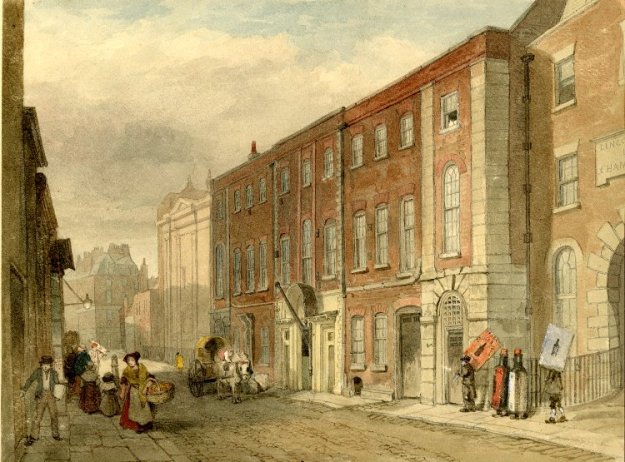
The theatre world of 18th-century London was very different from ours today. There were only two theatres allowed by law to perform plays, an arrangement that went back to the Restoration of Charles II in 1660. By 1717, one of these playhouses was Drury Lane (on the same site as the present theatre, but much smaller) while the other was Lincoln’s Inn Fields (demolished in 1848, but on a site now occupied by the Royal College of Surgeons of England). There was also the King’s Theatre in the Haymarket (on the site now occupied by Her Majesty’s Theatre) which presented only Italian opera. The most capacious of the three (at least when it was full to bursting) was Lincoln’s Inn Fields, which could hold some 1400 people. Drury Lane and the King’s Theatre could seat around 800 – 1000 patrons.

Drury Lane and Lincoln’s Inn Fields were both wholly commercial ventures and thus dependant on paying audiences for their survival. They were, of necessity, rivals. Dancing was a key element in their struggle to fill their auditoriums each night. Most dancing, at both houses, took place in the entr’actes, i.e. between the acts of the plays which were the main part of the bills. John Rich, manager of Lincoln’s Inn Fields, was well aware of the popularity of dancing and made it an important feature as soon as he took over the theatre in 1714.

lincolns-inn-fields

John Wykeham Archer, Building formerly Lincoln’s Inn Fields Theatre, 1847. © British Museum

At Drury Lane, the actor-managers Colley Cibber, Robert Wilks and Barton Booth, together with their fellow manager Sir Richard Steele, favoured drama – not least because they had the best actors in London. Despite their serious intent, they were forced to try and emulate Rich as his success drew away their audiences.

old-drury-lane-1794

View of the Drury Lane Theatre (Bridges Street front by Robert Adam), c1794? © British Museum

This was the world within which John Weaver’s The Loves of Mars and Venus was first produced.

Theatre seasons ran from September or October to June or July the following year. So, The Loves of Mars and Venus received its first performance some way through Drury Lane’s 1716-1717 season. During that season, the playhouse offered some nine afterpieces (short farces or other entertainments performed after the main comedy or tragedy), but only The Loves of Mars and Venus and The Shipwreck; or, Perseus and Andromeda, a ‘New Dramatick Entertainment of Dancing in Grotesque Characters’ also by Weaver, were danced. In their first season the former received seven performances before the end of March 1717, while the latter had three in April.

More than twenty years later, in his Apology, Colley Cibber explained how and why Weaver’s experimental ballet was allowed to go ahead. He began with the disparity between the two companies, and Lincoln’s Inn Fields’s need ‘to exhibit some new-fangled Foppery’ if it was to compete with Drury Lane’s higher reputation.

‘Dancing therefore was, now, the only Weight in the opposite Scale, and as the New Theatre [Lincoln’s Inn Fields] sometimes found their Account in it, it could not be safe for us, wholly to neglect it. To give even Dancing therefore some Improvement, and to make it something more than Motion without Meaning, the Fable of Mars and Venus, was form’d into a connected Presentation of Dances in Character, wherein the Passions were so happily express’d, and the whole Story so intelligibly told, by a mute Narration of Gesture only, that even thinking Spectators allow’d it both a pleasing, and a rational Entertainment; tho’, at the same time, from our Distrust of its Reception, we durst not venture to decorate it, with any extraordinary Expence of Scenes, or Habits; but upon the Success of this Attempt, it was rightly concluded, that if a visible Expence in both, were added to something of the same Nature, it could not fail of drawing the Town proportionably after it.’

Colley Cibber obviously had no great respect for dancing, but he had to admit that Weaver’s The Loves of Mars and Venus was not only completely new, it was also a proper drama and a success.

The Loves of Mars and Venus was given another sixteen performances in 1717-1718, seven performances in 1718-1719 and eight more in 1719-1720. It then disappeared from the repertoire until 1723-1724, when it was performed five times before it was dropped completely. Its success in all the seasons when it was performed suggests that there may have been other reasons why it did not survive beyond the mid-1720s.

However, there were later dance pieces titled Mars and Venus and at least one of these may have been a revival of Weaver’s ballet. This was given at Drury Lane on 2 May 1739 at a benefit for the dancer Essex. He was, very probably, William Essex the son of John Essex who translated Rameau’s Le Maître a danser for publication in London in 1728. William Essex danced Vulcan, with Desnoyer as Mars and Mrs Walter as Venus. All three had worked with John Weaver. Essex had danced in Drury Lane’s 1728 pantomime Perseus and Andromeda. With the Rape of Colombine: or, The Flying Lovers, for which Roger had created the serious scenes while Weaver had undertaken the comic action. Even though Essex had danced in Roger’s scenes, he must have worked alongside Weaver. Desnoyer had created the role of Paris in Weaver’s last dance drama The Judgment of Paris, given at Drury Lane in 1733. Mrs Walter had also danced in The Judgment of Paris, as the goddess Juno.

There were, therefore, many opportunities for Weaver’s The Loves of Mars and Venus to influence other, later dance works even beyond its last certain performances in the 1723-1724 season.