Category Archives: Ballroom Dancing

Prince Frederick

Prince Frederick, ‘A New Dance’ by Anthony L’Abbé, was notated and published in 1725 by Edmund Pemberton.

Prince Frederick Title Page

L’Abbé, Prince Frederick (1725), Title Page

The title indicates that the dance was dedicated to the eldest son of the Prince and Princess of Wales (who would soon become King George II and Queen Caroline). The publication of the dance was advertised in the Evening Post for 9-11 March 1725. The date links it to Caroline’s birthday on 1 March, although the bare description of it as ‘A New Dance’ suggests that it was not performed at court. I have not been able to find any record of a court ball in honour of the Princess’s birthday that year.

Prince Frederick was still in Hanover, where he had remained as the representative of the electoral family when his parents travelled to England in 1714 following the accession of his grandfather (Elector of Hanover) to the British throne as George I. In 1725, Frederick turned 18 and thus officially came of age. This event was celebrated in Hanover, where the festivities included a ball at which Frederick opened the dancing with the Countess Amalie von Platen (who may have been the daughter of George I). Perhaps L’Abbé intended his ballroom dance to honour Frederick’s majority and be a compliment to the prince’s mother. If so, it was unlikely to have found favour in London – both of the prince’s parents disliked him.

L’Abbé’s Prince Frederick is described on the notation as a ‘Slow Minuet’. The music has been identified as a song The Beauteous Cloe. The single-sheet version is undated (although ascribed a date of 1715 or 1720 in some sources). It also appears in A Choice Collection of English Songs Set to Musick by Mr Handel, published by John Walsh around 1730. It has been further identified as a reworking of Teofane’s aria ‘S’io dir potessi’ in act 2 of Handel’s 1723 opera Ottone. If, as has been suggested, Handel himself transformed the aria into the song, he must have been happy to do so soon after the first performances of Ottone on the London stage. Did he perhaps revise the music for the ball dance first? Handel was employed by George I at the same period as L’Abbé was dancing master to the King’s grand-daughters. The two must have known one another, and Handel – like L’Abbé – may have wished to honour Prince Frederick, who would in due course become Prince of Wales and might one day be king.

The description ‘Slow Minuet’ on the notation cannot be taken too literally, but it accords more with the slow sad aria of Ottone than the lively light-hearted song The Beauteous Cloe. I am currently working on L’Abbé’s Prince Frederick so I will return to the choreography and its interpretation in a later post.

Reconstructing Isaac’s Rigadoon

After several sessions, I have finally learnt the whole of Isaac’s Rigadoon and I am beginning to feel comfortable enough with the choreography to work on shaping it as if for performance.

Isaac focusses on the changing rhythms and shifting dynamics of the Rigadoon’s steps. The footwork is not complicated, there are no quasi-theatrical steps but they are difficult to perform clearly and accurately, particularly at speed. The dance does need to be quite fast to make its proper effect. Isaac repeats steps and even short sequences, but he never exactly replicates sequences elsewhere in the choreography. I have found The Rigadoon quite hard to learn and I am still struggling to find the best way to perform the basic steps. How far should these travel? How much spring should there be in the jettés that come at the end of so many of them? I have performed many of the notated theatrical dances, which need amplitude and force even in basic steps. The Rigadoon requires neither, although it certainly demands swift and lively dancing.

The famous figure with glissades, that according to Kellom Tomlinson ‘forms a perfect Square’ (The Art of Dancing, p. 56), is very hard to get right.

Isaac Rigadoon 2

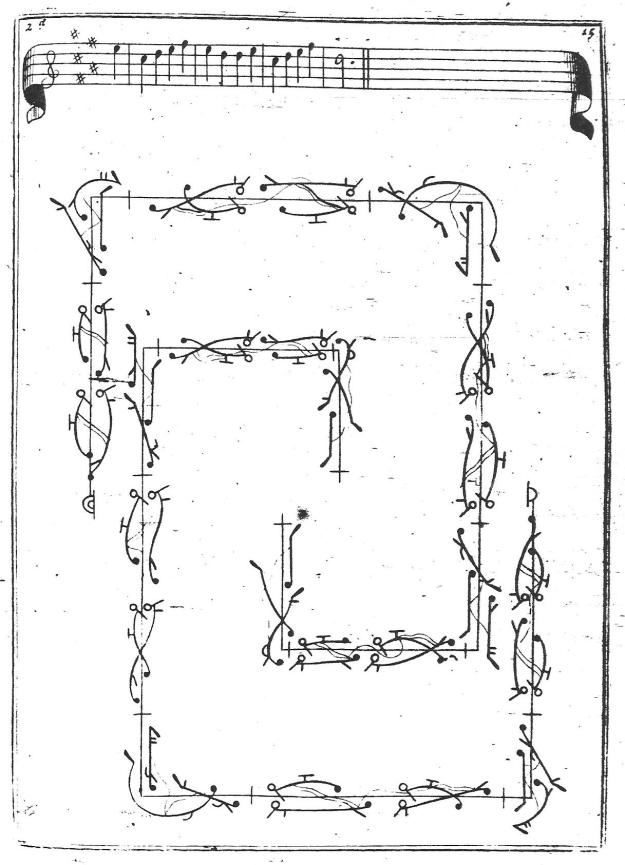
Isaac, The Rigadoon (1706), plate 2/15.

Each bar has two glissades and so has two mouvements and two steps with glissé. These need fast reactions in feet and ankles and downward pressure, without being heavy. The notation of the pas de bourées used to turn the corners is interesting. Each is different and three of them apparently require the first demi-coupé to move on an outward diagonal. I haven’t got this right yet, but it must surely serve to align the partners within the dancing space as well as with each other. The perfect square is formed by the paths of both dancers, who should end where they began but facing each other up and down the room instead of across it. I would love to work on this figure with a partner.

It is hard to get a proper sense of the figures in a duet when working on it alone. This is particularly true of the asymmetric figure in The Rigadoon, in which the man performs three quarter-turn sprung pirouettes as the woman dances around him with pas de bourées and he then moves around her with a coupé, a contretems with a bound and a pas de bourée as she does a coupé to first position, a half-turn pirouette and a coupé.

Isaac Rigadoon 4

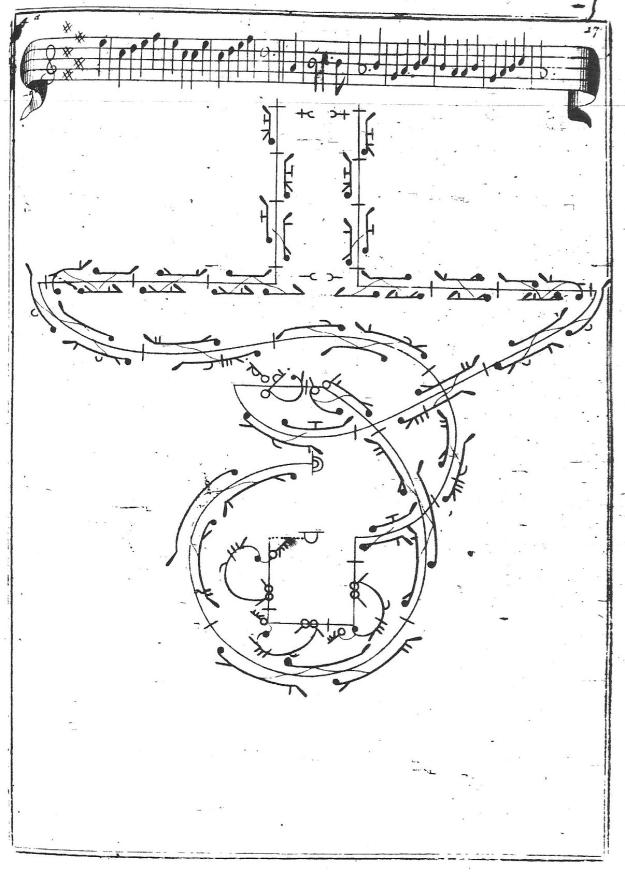
Isaac, The Rigadoon (1706), plate 4/17

It is such a shame that I am unlikely to get to work on this dance with a partner. I would love to sort out exactly what happens in this section and how it should be performed.

I can’t really analyse the whole dance within a single blog post, so I will just look at those of Isaac’s choreographic effects that I really enjoy (from the point of view of the lady, as this is the side I have been working on). One is his use of the coupé to first position, in the second B section and the third A section. It brings the dancer to a dynamic stop after a lively sequence of pas de bourées. In both cases it is followed by a pirouette. The two B sections in the third AABB repeat reveal Isaac’s love of rhythm as well as his wit. The first B sequence comes at the top of the page, just below the music, in the plate illustrated above. There is a little game with the mouvement in demi-coupés, coupé and pas de bourée. Then in the second B (on the next plate of the dance, not shown here) there is a contrast between sliding steps and springs in two consecutive pas de bourée. I love the way Isaac has the couple bound towards one another before turning to face the back in order to travel away from the presence. Even though I can’t try this out with a partner, it always makes me smile.

The point is, of course, that Isaac’s Rigadoon isn’t simply a difficult dance exercise. It is a challenging choreography that is rewarding to learn and wonderful fun to perform. The same is true of the other dances by him that I have performed, including The Richmond, The Saltarella, The Pastorall and even The Union.


The Waltz, 1802

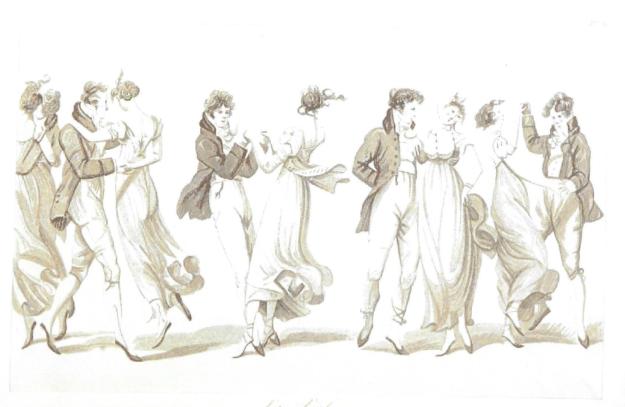
A little while ago, I encountered an early illustration of the waltz that was new to me. It may be well known to experts in the dancing of the 1800s, but I hadn’t seen it before. Nor could I find it in any of the general accounts of this dance I was able to access. It is an acquatint from Journal of a Party of Pleasure to Paris in the Month of August 1802, published in London the same year.

Waltz 1802

‘La Valse’ from Journal of a Party of Pleasure to Paris (1802).

It accompanies what is said to be the first known description of the waltz.

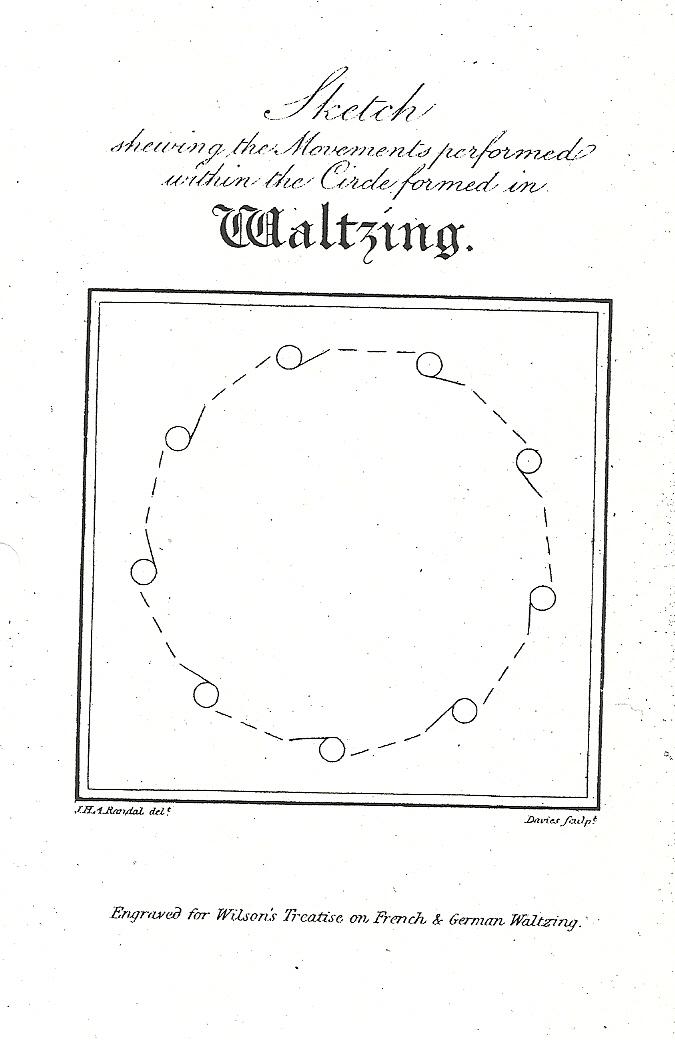
‘At night we went to Tivoli, … Every kind of diversion was going forward; … in the midst of the whole, dancing, on a very large floored space. But the dance was of so curious a nature that I must describe it. It is called a Valse; and it was there danced by about two hundred couple, to a tune extremely slow, each couple turning each other round and round, till they have completed the circle of the whole platform, in the manner of the sketch here presented. But this can only give a faint idea of it; the attitudes of the women are tasteful and sportive, to say no more of them; but of the men I can say nothing, they were so dirty and vulgar they only excited disgust. This dance, though very amusing to the lookers on, and doubtless to the performers, will, I think, never become the fashion in England.’

The Journal is anonymous, but the author has been identified as Sir John Dean Paul (1775-1852) an English neo-classical artist. The Tivoli gardens in Paris were named after those of the Villa d’Este near Rome and were fashionable as an amusement park from the 1790s to the 1840s. 1802 was the year of the Treaty of Amiens, which briefly halted the wars between France and Great Britain and allowed the English to visit Paris.

Waltz music dates back to the 1750s, but the dance seems to have emerged into polite society around 1800. I have elsewhere mentioned the similarity of the basic waltz step to the pas de menuet. Another possible influence on the waltz was the couple allemande, fashionable in the 1770s and 1780s. The hold of the fourth couple in the illustration resembles one of the figures depicted in Dubois’s Principes d’Allemande (undated, but perhaps published in the 1770s). The hold of the third couple appears in a later source, 16 Divisions of Waltzing by the English dancing master G.M.S. Chivers, published around 1822. The first of the four couples use a hold that might also relate to the couple allemande, although it does not exactly correspond to any of those depicted in the handful of treatises that explain this dance. The second couple look more like they are swinging one another around in a modern country dance manner. I haven’t come across anything that resembles it.

None of the couples look like they are dancing slowly. Was the music ‘extremely slow’ so that they could dance in double time? In this early version, the waltz looks as if it might indeed have been as shocking as onlookers claimed.

Isaac’s Rigadoon: the choreography

Isaac’s Rigadoon is one of 31 notated dances which either are or include a rigaudon (three more dances are labelled as rigaudons but are in fact gavottes). Among these 14 were published in London, of which 8 (Including Isaac’s Rigadoon) are rigaudons throughout. As I said in my previous post on this dance, it was first published in 1706 but may have been created some years earlier. Isaac choreographed a second rigaudon, The Rigadoon Royal, in 1711.

What made Isaac’s Rigadoon so admired and, apparently, so popular? Music theorists of the time characterised the rigaudon as ‘rustic’ and suggested that it was a fast dance. I have a delightful recording (made for rehearsal purposes some years ago) which is both and really brings the duet to life. The dance, in duple time, is quite long. The musical structure is the conventional AABB (A has 4 bars and B has 6) played through four times, so there are 80 bars of dancing. The choreography is lively. More than half of the steps incorporate small jumps, which are notated as such. There are no demi-jettés and only a few steps with a terminating demi-coupé to give a sense of suspension rather than a lilt. The step vocabulary is relatively limited, but Isaac’s use of variants on basic steps and his combinations of these demand swift reactions and rhythmic clarity. This can only be achieved through good underlying technique, particularly placement (or aplomb) and control over the mouvements that provide vertical articulation between and within the steps. The music needs some rustic heaviness (though not too much) but the steps need a feeling of upward spring. If the Rigadoon is as fast as I think it should be, it is not an easy dance and needs much practice to get it right. It must have been an agreeable challenge to able amateur dancers.

John Weaver identified four steps in Isaac’s Rigadoon that were rarely, if ever, found in other dances. All occur on the first plate of the notation, the first AABB section of the dance. Was Weaver (if not Mr Isaac himself) deliberately appealing not only to the contemporary love of novelty but also to a desire for ‘English Dancing’?

Weaver Step Suplement detail

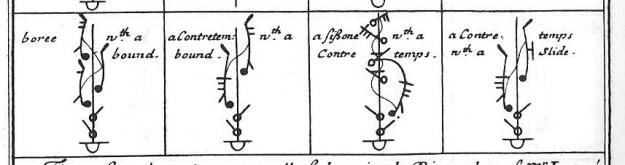
Feuillet transl. Weaver. Orchesography (1706), ‘A Suplement of Steps’, detail.

Isaac Rigadoon 1 detail

Mr Isaac. The Rigadoon (1706), first plate, detail.

Weaver’s reference to ‘the so frequent use of them’ in the Rigadoon is a little puzzling. The ‘boree wth. a bound’ does appear throughout the dance. Feuillet gives notations for a large number of variants on the pas de bourée but none has either a final demi-jetté or jetté, even though Rameau refers to the former in Le Maître a danser. Weaver makes no reference to Isaac’s variant pas de bourée which has a pas glissé as the final step. The ‘contretem wth. a bound’ is used only four times by the man in the Rigadoon (the lady has three). There is nothing similar in Feuillet’s ‘Table des Contre-temps’. Although Rameau refers to a ‘contre-tems à deux mouvemens’ he actually means a contretemps balonné. My impression, from working through quite a number of notated choreographies over the years, is that the ‘contretem wth. a bound’ is quite widely used elsewhere, but I need to check this out. The ‘sissonne wth. a Contre temps’ occurs only at the very beginning of the Rigadoon. All the other sissonnes in the dance are the conventional version, as notated by Feuillet at the beginning of his ‘Table des Pas de Sissonne’ and described by Rameau. Isaac’s ‘contretems wth. a slide’ occurs only once, in the first B section near the beginning of the dance’. It is not recorded by either Feuillet or Rameau.

The contradiction between Weaver’s statement about ‘the so frequent use’ of these steps and the actual inclusion of them in his notation of Isaac’s Rigadoon raises questions. Could Weaver’s notation be inaccurate in some places? Did he perhaps use Feuillet’s standard notation instead of recording Isaac’s variant steps? Or was the dance as notated made more conventional to accommodate a greater range of amateur dance skills?

I meant this post to be a discussion of the difficulties, and the pleasures, to be encountered while learning Isaac’s Rigadoon, but I am still only about half-way through the choreography. A proper appraisal will have to wait for a little while longer.


The minuet versus the waltz

An early dance friend recently suggested to me that the 19th-century waltz is more difficult than the 18th-century minuet and invited me to discuss the idea. So, here goes.

I have danced many minuets over the years and I am well acquainted with the challenges of the ballroom minuet, as described by Pierre Rameau in Le Maître a danser (1725) and Kellom Tomlinson in The Art of Dancing (1735). I am nowhere near as practised in the early waltz. My friend did not specify any particular version, so I will look at Thomas Wilson’s A Description of the Correct Method of Waltzing (1816).

The minuet was the duet that opened 18th-century formal balls. It was danced one couple at a time before the scrutiny of all the other guests. It was, in effect, an exhibition ballroom dance. This did not mean that it was slow and stately, 18th-century minuets were lively and quite fast dances. It had specific steps and figures (floor patterns) that had to be performed in a set order. It also allowed for some improvisation, mainly through the use of ‘grace steps’ in place of the conventional vocabulary. Controlled and elegant deportment was essential, not least to enable the partners to manage and display their elaborate attire, including the gentleman’s hat.

What was difficult about the minuet? Apart from the pressure of performance, both the steps and the figures were exacting. Minuet music is in  3 / 4 but the basic pas de menuet takes two bars of music, so four steps have to be fitted into six musical beats. There are two main timings, and both could be used within a ballroom minuet. The contretemps du menuet, the other basic step, had another different timing over six beats. All the steps of the minuet require a great deal of practice if they are to be performed with ease and elegance. There are five figures: the opening figure; the Z-figure; taking right hands; taking left hands; taking both hands, which is the closing figure of the dance. The Z-figure is the principal figure of the minuet. It can repeated at will and is often, but not always, reprised just before the final figure. Some idea of the steps and figures of the minuet is given by Kellom Tomlinson’s notation of the dance.

Kellom Tomlinson. The Art of Dancing (1735), Plate U

Kellom Tomlinson. The Art of Dancing (1735), Plate U

At balls, the minuet was addressed to the two highest ranking members of the audience, referred to as ‘the presence’. The dancers had to begin and end facing them and the figures had to be oriented in relation to them. The accurate performance of the figures, as well as their placing and orientation within the dancing space, needs a great deal of practice.

Musically the minuet was challenging. The couple could begin their dance at any point in the music (taking care to start on an odd-numbered bar), so their dance figures would inevitably cross the musical structure and phrasing at several points. Tomlinson tries to suggest such musical challenges in his notation of the minuet. This, too, needs much practice to master.

What about the waltz? How difficult was it? The waltz was always danced with a number of couples on the floor at any one time. It was a social dance and not meant as a display piece. Wilson distinguished between the French waltz and the German waltz. The French waltz began with the ‘Slow Waltz’, changed to the ‘Sauteuse Waltz’ and ended with the ‘Jetté, or Quick Sauteuse Waltz’. As the titles suggest, the dance got progressively faster. Each of these little waltzes had its own steps. In the slow waltz, these were a half-turn pirouette and a pas de bourée, over two bars of 3 / 4 music. The rhythmic pattern is reminiscent of the simplest timing of the basic pas de menuet. I can’t help feeling there was a link between them. The sauteuse waltz replaces the pirouette with a jetté-step combination and makes the first step of the pas de bourée a jetté. The jetté or quick sauteuse waltz had just one step,  a jetté-hop combination, performed first on one foot and then on the other. Wilson’s explanations are not entirely clear and I am radically condensing them. It is obvious, though, that these steps need practice if they are to be well performed.

The German waltz was Wilson’s undoubted favourite.

‘The Construction of the Movements is truly elegant; and, when they are well performed, afford subject of much pleasing Amusement and Delight.’

This version of the waltz had two quite different, and slightly more complicated, steps than those in the French waltz. In all Wilson’s versions of the waltz, the dancers needed good deportment but – just as their dress was freer than in the 18th century – a degree of informality was acceptable.

There are no figures in the waltz, which simply follows a circular track around the dancing space with the partners turning as they go. The dance is not directed at those who may be watching. It simply tries to make best use of the available dancing space.
Thomas Wilson. A Description of the Correct Method of Waltzing (1816), plate

Thomas Wilson. A Description of the Correct Method of Waltzing (1816), plate

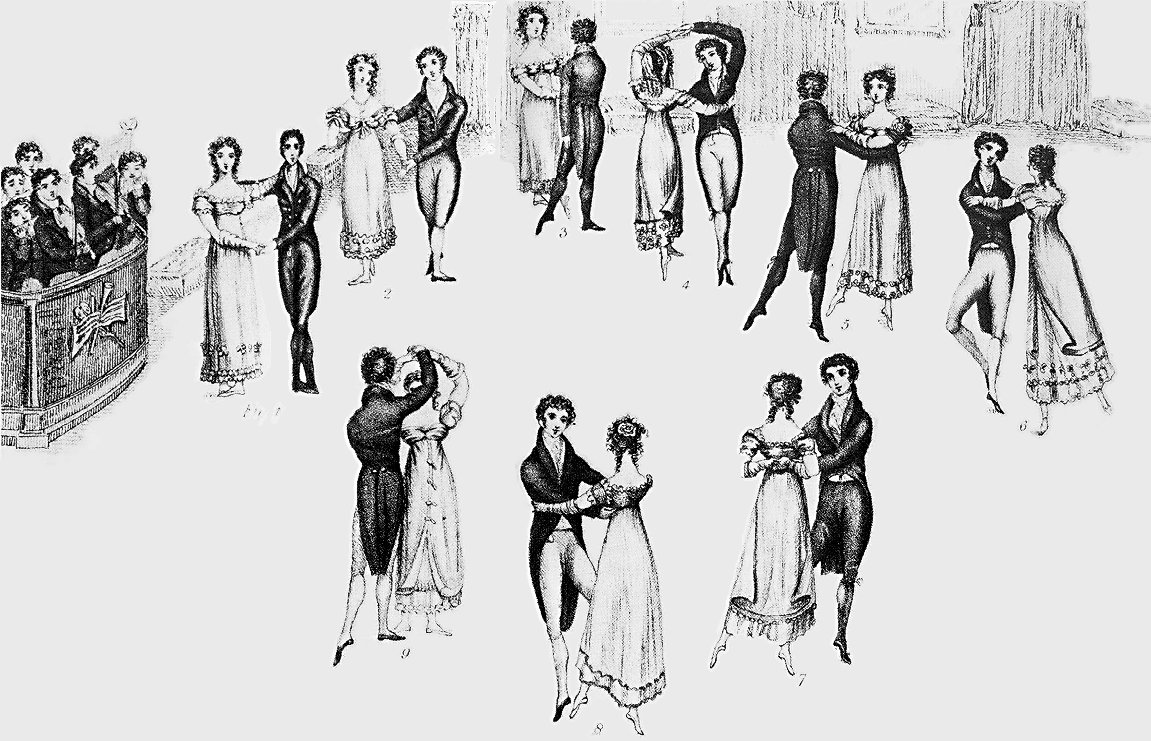
One of the most complicated aspects of the early 19th-century waltz is the varieties of what would today be called ‘hold’. Wilson’s pretty frontispiece shows several of these.

Thomas Wilson. A Description of the Correct Method of Waltzing (1816), frontispiece

Thomas Wilson. A Description of the Correct Method of Waltzing (1816), frontispiece

The partners had to change hold as they dance. I suggest that this would have taken quite a bit of practice, certainly rather more than the basic steps. This is one area where the waltz is definitely more difficult than the minuet, in which the partners merely take hands from time to time.

Musically the waltz does not pose challenges. The dancers could start anywhere (although, like the minuet, on an odd bar) and they didn’t need to worry about musical structure or phrasing since the waltz is repetitious. However, they did need to worry about being in time with each other and fitting their steps and turns around each other. Again, this would have taken practice, just as it does with the modern waltz. There was also the speed of the dance, at least with the sauteuse and jetté or quick sauteuse waltzes, which made neat footwork a challenge. Giddiness with all the turning was perhaps seen as a pleasure rather than a difficulty.

So, which dance do I think was the most difficult? It has to be the minuet, for its status as an exhibition dance, the complexity of its steps and figures and the challenges of its musicality. The waltz has its fair share of challenges, but a simple early 19th-century waltz can be learned and enjoyed quite quickly. There is no such thing as a simple ballroom minuet.

Isaac’s Rigadoon

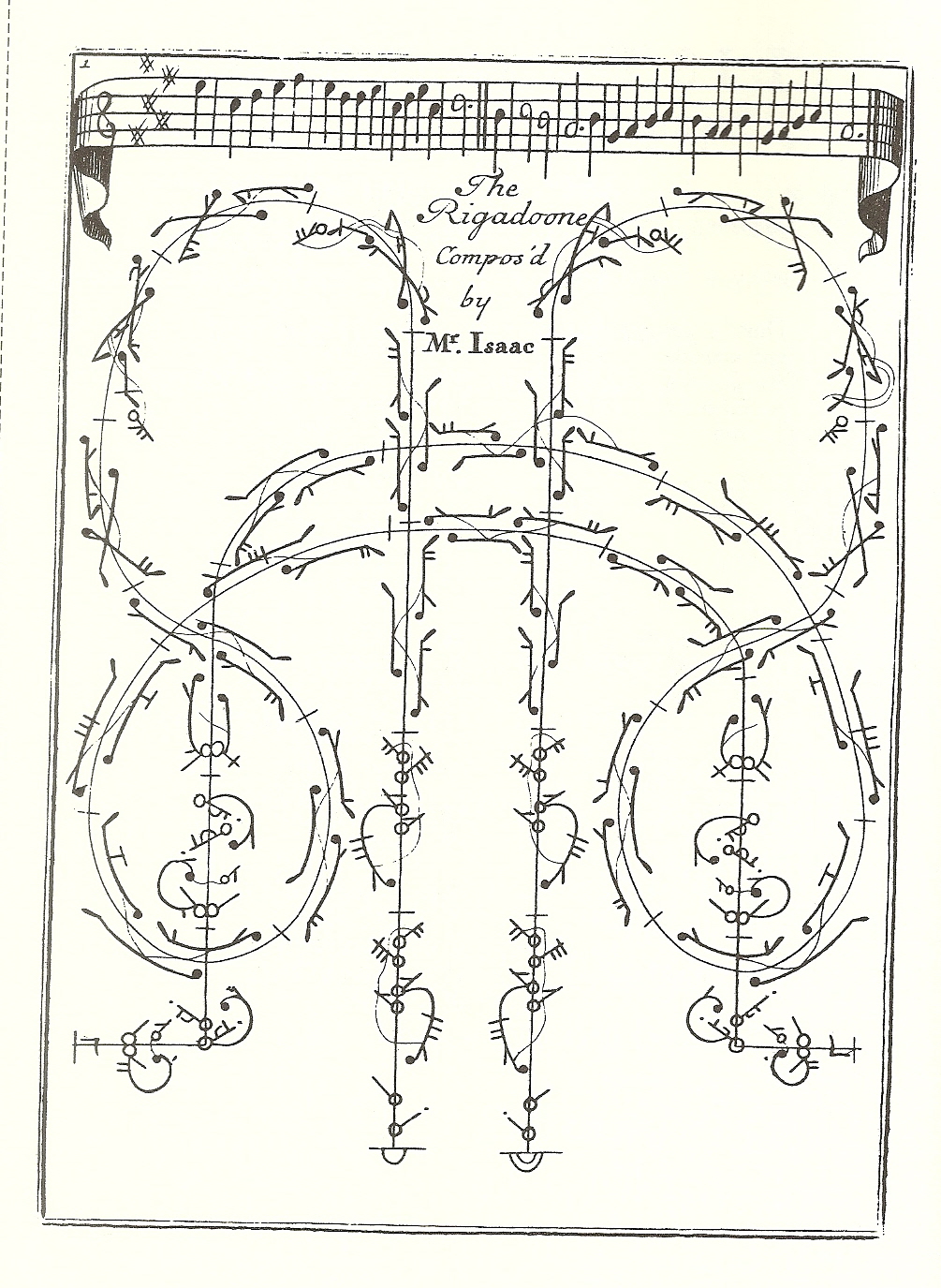
I am currently learning another of the most famous ballroom dances of the 18th century, Mr Isaac’s The Rigadoon. I first worked on this lively duet some years ago, but I never performed it and I’ve had to start on it afresh. The Rigadoon, like much of the rest of the ‘English’ baroque dance repertoire, rarely (if ever) features in workshops in the UK. Perhaps this is because these dances are choreographically idiosyncratic – and difficult. This is a pity, since they have much to offer in helping us to understand the dancing of the period and they are sheer pleasure to dance.

Mr Isaac. The Rigadoon (1706), first plate

Mr Isaac. The Rigadoon (1706), first plate

The duet is, of course, a rigaudon. The music has been attributed to James Paisible, the French recorder player who made his career in London, but this is by no means certain. Mr Isaac’s The Rigadoon has been dated as early as 1695. It was first published in 1706 in A Collection of Ball-Dances perform’d at Court, notations by John Weaver of six of Isaac’s choreographies. That same year, the dance also appeared in a different version notated by the dancing master Siris and published in his The Art of Dancing alongside Pecour’s ball dance La Bretagne. Siris’s The Art of Dancing was a rival to Weaver’s translation of Feuillet’s Choregraphie.

Weaver evidently passed his notations (or rather, the plates on which they were engraved) to the music publisher John Walsh, who reissued The Rigadoon along with other dances by Isaac around 1708 and again about 1712. Walsh published a second edition of Weaver’s Orchesography around 1722. In a late response to Siris, Weaver added notations of The Rigadoon, The Louvre (Pecour’s ball dance Aimable Vainqueur) and The Bretagne. Orchesography was reissued, with its dances, around 1730. Within thirty years of its first appearance in print, Isaac’s The Rigadoon had gone through at least six editions.

Weaver drew particular attention to Isaac’s dance in Orchesography, by including four steps from it in a ‘Suplement of Steps’ at the end of his step tables.

Raoul Auger Feuillet transl. John Weaver, Orchesography (1706), ‘A Suplement of Steps’

Raoul Auger Feuillet transl. John Weaver, Orchesography (1706), ‘A Suplement of Steps’

The steps, and Weaver’s comment on how graceful and unusual they are, provide a glimpse of English choreographic taste as exemplified by The Rigadoon.

Isaac’s The Rigadoon seems to have been continued to be taught and given in the ballroom for many years. In his 1729 poem The Art of Dancing, Soame Jenyns (referring to the invention of dance notation) wrote:

‘Hence with her Sister-Arts shall Dancing claim

An equal Right to Universal Fame,

And Isaac’s Rigadoon shall last as long

As Raphael’s Painting, or as Virgil’s song.’

A few years later, in 1735, Kellom Tomlinson referred to The Rigadoon several times in his manual The Art of Dancing. In describing ‘the Slip’, i.e. the glissade, Tomlinson wrote:

‘ … twice slipping behind, is in the Rigadoon of the late Mr. Isaac, where, in the Beginning of the Tune, the second Time of playing over, it forms a perfect Square, which is no small Addition to the Beauty of the said Dance; …’

Tomlinson mentions a number of notated dances in The Art of Dancing. Are these the choreographies he taught to his own pupils, including Isaac’s The Rigadoon?

Twelve years later, in his Essay on the Advantage of a Polite Education published in 1747, Stephen Philpot also referred to Isaac’s The Rigadoon since he featured the dance in his own teaching practice. The ball dance may well have survived into the 1750s. On 19 March 1752 at the Covent Garden Theatre, Cooke and Miss Hilliard gave ‘A Ball Dance call’d the Rigadoon concluding with a Minuet’. The performance was a benefit for Cooke.  On 12 May 1753 at Drury Lane, Mr and Miss Shawcross danced ‘The Rigadoon and Minuet’ for his shared benefit. If these performances were indeed Isaac’s The Rigadoon, then the dance must have continued to be taught in dancing schools for more than fifty years.

I will take a closer look at the choreography of The Rigadoon in a later post.


A Year of Dance: 1716

In both England and France relatively little of importance happened politically during 1716. The Jacobite uprising which had begun in 1715 suffered its final failure when James Edward Stuart, the Old Pretender, fled Scotland for France in February 1716. That same month, some of the Jacobite leaders were executed in London. In France, the duc d’Orléans continued to act as regent for his great-nephew Louis XV.

The Paris Opéra offered no significant new works this year, although there was a revival of Le Bourgeois gentilhomme, the first since 1691. However, the duc d’Orléans invited a troupe of commedia dell’arte players to Paris for the first time since the suppression of the Comédie-Italienne in 1697. There had been Italian comedies and comedians in the Paris fair theatres in the intervening years, but the Nouveau Théâtre Italien took up residence at the theatre in the Palais-Royal thereby showing royal approval. They gave their first performance there on 18 May (New Style) and played regularly for the rest of 1716.

Was it simply a coincidence that London audiences saw the beginnings of pantomime that same year? The new genre was introduced not at Lincoln’s Inn Fields, where the manager John Rich was to become a noted Harlequin, but at Drury Lane where Sir Richard Steele engaged two forains (fair performers) to provide entr’acte entertainments. Sorin and Baxter gave an afterpiece The Whimsical Death of Harlequin at Drury Lane on 4 April 1716. They were described as ‘lately arriv’d from Paris, who have variety of Entertainments of that Kind, and make but a short Stay in England’. London’s playhouses had advertised any number of commedia dell’arte characters and scenes among their entr’acte entertainments over the years, but the billing of The Whimsical Death of Harlequin as an afterpiece was surely intended to signal something new.

Another coincidence was the publication in Nuremberg of Gregorio Lambranzi’s Neue und Curieuse Theatrialische Tantz-Schul, a collection of 101 engraved illustrations of dances. It provides virtually the only visual record we have of the dances that were performed on stages throughout Europe. This plate shows Harlequin and Scaramouch in what must have been an ‘Italian Night Scene’, popular as an entr’acte piece on the London stage from the early 1700s and one of the precursors of the pantomime.

Lambranzi, Neue und Curieuse Theatrialische Tantz-Schul (1716), Part 1, Plate 29

Lambranzi, Neue und Curieuse Theatrialische Tantz-Schul (1716), Part 1, Plate 29

The dances that appeared in notation during 1716 could not have been more different. In Paris, Dezais published a XIIIIe Recüeil de danses pour l’année 1716. This had two choreographies by Claude Ballon, La Gavotte du Roy a quatre and the duet La Bouree Nouvelle, together with Le Cotillon des Fêtes de Thalie by Dezais himself. In the Avertissement at the beginning of the collection Dezais declared that La Gavotte du Roy had been created for the six-year-old Louis XV. The brevity and simplicity of La Bouree Nouvelle suggests that it, too, might have been created for the child King. The cotillon is an early example of the contredanse for eight that would become a dance craze in the 1760s.

In London, Edmund Pemberton published Anthony L’Abbé’s The Princess Anna ‘a new Dance for his Majesty’s BirthDay 1716’, dedicated to the King’s eldest granddaughter the young Princess Royal. As in the previous year, the birthday dance was quickly pirated by the music publisher John Walsh, who also tried to undercut Pemberton. The dancing master was having none of it and attacked Walsh in the Evening Post for 14 June 1716.

‘Whereas the judicious Mr. Walsh has condescended to sell Mr. Isaac’s dances for 1s. 6d. each, the usual price being 5s. It is to be hop’d his tender conscience will cause him to refund the overplus of every 5s. he has receiv’d for 8 or 10 years past, but as it appears his design is equally level’d against me his friend, he having pirated upon me the last birth day dance, compos’d by Mr. Labee. The main reason he gives for it, is, he loves to be doing, and by the same rule, a highwayman may exclaim against the heinous sin of idleness, and plead that for following his vocation: as I have attain’d to a mastery in my art, ‘tis but reasonable I should reap some advantage by it; the masters are impos’d upon by his impression, it being faulty in several places, particularly in the footing. The original is sold against Mercer’s street, Long-Acre, by me the author, E. Pemberton.’

Pemberton had worked for Walsh as a notator of Isaac’s dances, and was clearly acquainted with his wiles.  Walsh gave up without a fight. Presumably Pemberton’s patrons (who extended ultimately to the King) were too powerful for him.

The publication of Kellom Tomlinson’s second ball dance The Shepherdess, a forlana, could have been little more than a sideshow to the publicly expressed rivalry over the printing of the birthday dances created by the royal dancing master. Similarly the appearance of the 16th edition of The Dancing-Master (printed by W. Pearson and sold by John Young) and even Nathaniel Kynaston’s Twenty Four New Country Dances for the year 1716 (printed for Walsh and his partner Hare) were simply part of the normal round of music and dance publishing.

Country Dancing Further Improved

The publication history of For the Further Improvement of Dancing, John Essex’s translation of Feuillet’s 1706 Recueil de contredances, is not entirely straightforward and raises some interesting questions.

For the Further Improvement of Dancing is dated 1710 on its title page. The earliest advertisement I know is in the Tatler for 23-25 March 1710. A third edition was advertised in the Spectator (the successor publication to the Tatler) for 5 March 1712. I have not yet come across an advertisement for a second edition. Indeed, there is no explicit evidence for the successive editions in any of the surviving copies of this collection. The first edition was sold by the music publishers Walsh, Randall, Hare and Cullen, together with the author. According to the Spectator advertisement, the third edition was ‘to be had nowhere but at the Author’s House in Rood-lane, Fenchurch Street’. How should this be interpreted? Had Essex simply taken over the remaining copies printed in 1710 to sell himself as a ‘third’ edition? Or had he fallen out with the music publisher John Walsh, as others were to do later?

There is just one copy of For the Further Improvement of Dancing which is indisputably a new edition, or, to be more precise, a reissue of the original edition in a different format with additional dances. Essex’s translation had originally been printed in the small, duodecimo format. This reissue is a much larger folio. It uses the original plates (For the Further Improvement of Dancing is printed throughout from engraved copper or pewter plates), but these are placed four to a page.

John Essex, For the Further Improvement of Dancing [1715?], plates 1 - 4

John Essex, For the Further Improvement of Dancing [1715?], plates 1 – 4

The newly added dances are readily identified by their larger format. There is one ballroom duet, The Princess’s Passpied, which shows the new layout:

John Essex, The Princess's Passpied, [1715?], first plate

John Essex, The Princess’s Passpied, [1715?], first plate

There are five new country dances, also in the new layout:

Liberty & Property

The Lottery

Mr La Gard’s Royall Swede

The Careless Husband

The Little Whigg

I will return to the titles of these in a subsequent post.

The volume is dedicated to the ‘Princess of Wales’, dating it to after the Hanoverian accession on 1 August 1714. The Princess is Caroline, wife of George Augustus the son of King George I. Essex praises her ‘Patronage and Encouragement’ of the art of dancing and offers her the dances he has added to his original treatise. I suggest that The Princess’s Passpied was intended for performance by Caroline’s eldest daughter Anne, the Princess Royal aged around seven, who would be the dedicatee of several more notated ballroom dances. The sole surviving copy of this folio edition of For the Further Improvement of Dancing, now in the British Library, may well be a presentation copy made especially for Caroline, Princess of Wales.

It is interesting to note that this unique copy, which has been dated to 1715, has an imprint claiming that it was to be sold by Walsh, Hare and ‘the Author’.  By this time, John Essex was presumably well-known as a dancing master. He was certainly careful to ensure that the title page specified that he ‘taught all the Ball Dances of the English and French Court’, probably meaning those that had been published in Beauchamp-Feuillet notation. The inclusion of The Princess’s Passpied would have underlined his expertise. Was he trying to recommend himself as dancing master to the new royal family?

The Saraband on the London Stage

The first saraband to be advertised as an entr’acte dance on the London stage was danced, together with a ‘Jig’, by the actress Elizabeth Younger at Drury Lane on 3 May 1714. Her appearance was described as ‘being the first time of her dancing alone on the stage’ – she was just fourteen but already had several years of acting experience. The last advertisement to mention a saraband was for a performance at Covent Garden on 13 February 1742. The dancer was the Italian virtuoso Barbara Campanini, ‘La Barbarina’. Little evidence survives to tell us what these dances were like. Both dancers were trained in French dancing, la belle danse. Miss Younger was really an actress who danced, although the surviving choreography for the Türkish Dance duet by Anthony L’Abbé shows that her technique was quite considerable. Perhaps her solo saraband was comparable to Feuillet’s Sarabande de Polixène. Although she was only twenty-one, La Barbarina was a first-rate ballerina fresh from success at the Paris Opéra where her technique had dazzled audiences.  I wonder whether her saraband was more like those created by Feuillet and Pecour for male soloists?

The first saraband duet was advertised for a performance at Lincoln’s Inn Fields Theatre on 5 May 1724. The dancers were Dupré and Mrs Wall. He was then one of the leading male dancers in the company, while Mrs Wall seems to have been a promising newcomer (she disappeared from the bills within just a few years).  She danced another saraband later the same season with Leach Glover, also a leading dancer at Lincoln’s Inn Fields. Both Dupré and Glover were accomplished exponents of la belle danse. Glover went on to perform sarabands with Mrs Laguerre and then Miss La Tour, both leading dancers in John Rich’s company, into the early 1730s. A clue to the nature of all these duets may lie in the Saraband’ of Issee, created by Anthony L’Abbé in the mid-1710s for Dupré and Mrs Bullock and published in his A New Collection of Dances around 1725. The duet is one of three choreographies to the same piece of music, taken from Destouches 1697 opera Issé. The other two dances are both by Pecour. L’Abbé’s dance is technically the most demanding of them. Mrs Bullock, as well as Dupré, was expected to perform beaten steps, turns and ornamentations normal for male technique (although she did not do the entrechats-six notated for Dupré, substituting plain changements instead).

The Saraband’ of Issee was a showpiece, which later dancers advertised in sarabands may or may not have been able to emulate. There is also a quite different saraband danced on the London stage and published in notation. L’Abbé’s The Prince of Wales’s Saraband was created for the birthday of Queen Caroline and performed at Drury Lane on 22 March 1731 by William Essex and Hester Booth. This ballroom duet has no spectacular steps. It makes its effects through subtle ornamentation, including modulations to the timing of individual pas composés although, like the stage choreographies, it recalls the contrast between fast and slow, dynamic and languid described by Pomey in 1671. Such an unadorned choreography requires true elegance and the utmost refinement of technique from its dancers. Hester Booth (née Santlow) was famous for her ‘address’ (which may loosely be translated as comportment). Her partner William Essex (son of the dancing master John Essex who had translated Rameau’s Le Maître a danser) must have been her equal. Was the notated choreography what they actually danced at Drury Lane? Evidence from other notated dances suggests that they may well have included some difficult unrecorded ornamentations.

Did the saraband really disappear from the London stage after 1742?

Anthony L’Abbé. Saraband’ of Issee [c1725], first plate.

Anthony L’Abbé. Saraband’ of Issee [c1725], first plate.

Anthony L’Abbé. The Prince of Wales’s Saraband [1731], first plate.

Anthony L’Abbé. The Prince of Wales’s Saraband [1731], first plate.


The Saraband

I’ve recently been working on Feuillet’s solo Sarabande for a woman to music from Colasse’s 1706 opera Polyxène et Pirrhus. This choreography survives in a single manuscript source and must date to period 1706 to 1710. The music is very different from the better-known saraband in the Entrée for Spain within the Ballet des Nations that ends Lully and Molière’s Le Bourgeois gentilhomme. It seems that, in the early 18th century, there were two distinct types of saraband – one being French, as in the Sarabande de Polyxène, and the other Spanish, the best known examplar being the Folie d’Espagne.

A remark on the radio, describing  the saraband as ‘slow and stately’ prompted me to take a closer look at this dance type. I admit to being very tired of hearing the expression ‘slow and stately’ in relation to the very varied ballroom and theatre dances of the late 17th and 18th centuries, but it is difficult to know how to counter it.

There are at least 27 surviving choreographies labelled as sarabands, to which can be added four Folie d’Espagne notations (not included in the following statistics). The dance was popular both in the ballroom and on the stage. Ten of the notated sarabands are identifiable as ballroom dances. Nine of these include the saraband alongside other dance types in mini-dance suites. Five choreographies can be linked directly either to the Paris Opéra or the London stage. Six more dances are male solos and there are five female solos. All of these may have been intended either for the stage or as exhibition dances. Four of the solos (two male and two female) are to the saraband in Le Bourgeois gentilhomme, marking them out as ‘Spanish’.

There is, of course, much more to the saraband as a dance. Do the choreographies themselves differentiate between ‘French’ and ‘Spanish’ sarabands, or do these distinctions lie hidden within style and technique rather than on view in the step vocabulary and choreographic motifs? I will try to address these issues in later posts.

In the meantime, here is a description of a dancer performing a saraband from Father François Pomey’s Le Dictionnaire royal augmentée published in Lyon in 1671. The translation of the French original comes from a 1986 article by the researcher Patricia Ranum.

‘At first he danced with a totally charming grace, with a serious and circumspect air, with an equal and slow rhythm, and with such a noble, beautiful, free and easy carriage that he had all the majesty of a king, and inspired as much respect as he gave pleasure.

Then, standing taller and more assertively, and raising his arms to half-height and keeping them partly extended, he performed the most beautiful steps ever invented for the dance.

Sometimes he would glide imperceptibly, with no apparent movement of his feet and legs, and seemed to slide rather than step. Sometimes, with the most beautiful timing in the world, he would remain suspended, immobile, and half leaning to the side with one foot in the air; and then, compensating for the rhythmic unit that had just gone by, with another more precipitous unit he would almost fly, so rapid was his motion.

Sometimes he would advance with little skips, sometimes he would drop back with long steps that, although carefully planned, seemed to be done spontaneously, so well had he cloaked his art in skilful nonchalance.

Sometimes, for the pleasure of everyone present, he would turn to the right, and sometimes he would turn to the left; and when he reached the very middle of the empty floor, he would pirouette so quickly that the eye could not follow.

Now and then he would let a whole rhythmic unit go by, moving no more than a statue and then, setting off like an arrow, he would be at the other end of the room before anyone had time to realise that he had departed.

But all this was nothing compared to what was observed when this gallant began to express the emotions of his soul through the motions of his body, and reveal them in his face, his eyes, his steps and all his actions.

There is more, but isn’t this more than enough to refute the idea of the saraband (or, indeed, any baroque dance) as ‘slow and stately’? The expressive possibilities outlined in this passage can readily be seen in the surviving notated sarabands.