Author Archives: moiragoff

A Year of Dance: 1714

A while ago, I had the idea of looking at significant dance events year by year, placing them within a wider context and slowly developing a more detailed chronology than most dance histories can provide. 1714 seems as good a place to start as any. The year was notable for the death of Queen Anne, on 1 August, and the accession to the British throne of her protestant cousin the Elector of Hanover as King George I.

At the English court the social calendar revolved around royal birthdays, the accession and coronation days of the current monarch, New Year’s Day and Twelfth Night. All were occasions for dancing. Queen Anne’s birthday on 6 February had been the occasion of festivities throughout her reign. 1714 was no exception, with music, a ball and a ‘splendid entertainment’ at Windsor in the presence of the Queen herself. Her dancing master Mr Isaac created a new dance in her honour, The Godolphin named for Lady Harriot Godolphin the grand-daughter of the Duke and Duchess of Marlborough and (at the age of fifteen) a lady of the bedchamber to the Queen. The dance was published in notation on 11 February 1714.

Mr Isaac. The Godolphin (London, 1714). Title page.

Mr Isaac. The Godolphin (London, 1714). Title page.

The status of another dance, published on 4 March 1714, is uncertain. The only surviving copy of The Siciliana by Siris has no title page but, like Isaac’s choreography, it was published by John Walsh and may have been intended to capitalise on the Queen’s birthday celebrations.

George I arrived in England before the end of September 1714, with his son the new Prince of Wales. His daughter-in-law Princess Caroline arrived in London, with her three daughters, in October. The coronation took place in late October 2014. There are no records of any balls at court or the publication of any dances until the following year, when the usual festivities were resumed.

One other event of note was the re-opening of the Lincoln’s Inn Fields Theatre, renewing theatrical competition in London. This led very quickly to a great deal more dancing in the playhouses.  It seems that there was dancing at the first performance at Lincoln’s Inn Fields and there were at least six dancers (two women and four men) in the company. They appeared regularly throughout the season.

In London, dances were often published singly in notation whether or not they had a royal connection. In Paris, small collections of dances were published ‘pour l’année’ in time for the balls held during the carnival season (between Twelfth Night and the beginning of Lent). The XIIe Recueil de danses pour l’année 1714, published by Jacques Dezais, contained three duets – La Gavotte de Seaux and a Rigaudon by Claude Ballon and Dezais’s La Chamberi.

The Château de Sceaux was the venue for an experiment in dancing. At one of the duchesse du Maine’s ‘Grands Nuits’ of entertainments during 1714, Mlle Prévost and M. Ballon (leading dancers at the Paris Opéra) gave a scene from Corneille’s tragedy Les Horaces as a ‘danse caracterisée’. They performed with such intensity that they reduced themselves, as well as their audience, to tears. This event calls into question the idea that French stage dancing was fundamentally inexpressive. By 1714, Louis XIV’s long reign was drawing to a close and changing times were signalled at the Paris Opéra by the production of its first lyric comedy, Mouret’s Les Fêtes de Thalie.

Were all these events quite separate? Surely not, although the influences that flowed between them have yet to be explored.

Solos for Girls

Among the 18th-century dances surviving in notation are fourteen solos for unnamed female dancers. Who were these solos created for? What sort of choreographies are they?

Four of these dances are probably for young girls. Mr Isaac’s Chacone and his Minuet, published in 1711 in Pemberton’s An Essay for the Further Improvement of Dancing, are usually seen as one dance (following Pemberton’s title page) but may have been originally created independently. The anonymous La Cybelline, to music by Charles Fairbank, dates to 1719. Thomas Caverley’s Slow Minuet for a Girl, which shares its title page design with La Cybelline, has been dated to 1729. However, it may have been choreographed before 1720 since there is another version of the dance by Kellom Tomlinson. This was probably written down between 1708 and 1714 when Tomlinson was apprenticed to Caverley.

Two solos are from Feuillet’s 1700 Recueil de dances, a collection of his own choreographies. No dancers are named. The Sarabande pour femme, to music by Lully for Le Bourgeois gentilhomme, and the Folie d’espagne pour femme are among the easiest of the dances in Feuillet’s collection.

Two of the solos are from the 1704 Recueil de dances, a collection ‘des meillieures Entrées de Ballet de Mr. Pecour’. There is the Sarabande pour une femme, to the same music as Feuillet’s Sarabande pour femme, and the Chacone pour une femme, to music from Lully’s opera Phaéton. Of the six female solos in this collection, only these two have unnamed performers.

One solo is from the Nouveau recueil de dance de bal et celle de ballet, choreographies by Pecour published around 1713. The Gigue pour une femme seule non dancée a Lopera, to music from Alcide by Louis Lully and Marin Marais, is the only one of the female solos in this collection that has an unnamed performer. All the others were performed by leading dancers at the Paris Opéra.

Turning again to the English choreographies, L’Abbé’s solo Passacaille to music from Lully’s opera Armide followed Isaac’s Chacone and Minuet in Pemberton’s Essay of 1711. It is derived from the duet he had created for the professional dancers Mrs Elford and Mrs Santlow around 1706 (which was not published until about 1725).

L’Abbé’s Passacaille from Pemberton’s Essay (1711), plate 1.

L’Abbé’s Passacaille from Pemberton’s Essay (1711), plate 1.

The remaining three solos are all entitled Sarabande and are ascribed to Feuillet. They appear in a manuscript which has been dated to the first decades of the 18th century. The music for one of these dances has not yet been identified, but the other two are from Gatti’s opera Scylla and Colasse’s Polyxène et Pyrrhus respectively. The great majority of dances in this source (24 out of 28) are solos and most are by Feuillet.

The status of each of these solos for girls is difficult to determine. They may have been theatrical dances for the stage or display dances for the ballroom. They may have been created for amateurs, apprentice dancers or young professionals. Closer investigation of the choreographies, their music and the sources within which they appear might shed further light on them.


Dancers in Ballets de Cour, 1648-1669

Between 1648 and 1669 the dancers in ballets de cour were predominantly male. More than 300 male dancers appeared during this period. Around 90 of them, not quite one-third, were professionals. About 100 men, mostly courtiers, appeared in only one or two of the ballets. Of those who appeared in a significant number of ballets, i.e. at least half of the productions, around two-thirds were professional dancers. These men were the core performers in the ballets de cour. They ensured that the performances were the spectacular events they were meant to be.

Among the most important of the professional dancers were:

Louis de Mollier (c1615-1688). He took 48 roles in 18 ballets and was the most prominent dancer up to 1660.

Pierre Beauchamps (1631-1705). He took an astounding 93 roles in 23 ballets. His significance for the development of ballet cannot be overestimated, not least because of his dominant position as a performer over the whole period.

François Hilaire d’Olivet. He took 46 roles in 18 ballets and like Beauchamps was active throughout the period.

These men were also leaders of the profession of dancing masters. D’Olivet was a founder member of the Académie Royale de Danse, established in 1661. Beauchamps became Director of the Académie in 1680.

Two other men were, if anything, even more important to the ballet de cour and dancing:

Louis XIV, the monarch around whom these entertainments were created, was the subject of an earlier post. His regular appearances alongside professional dancers, as well as the range and extent of his repertoire, suggest that reports of his dancing skills were not simply hyperbole.

Jean-Baptiste Lully (1632-1687), composer and dancer. He took 45 dancing roles in 11 ballets. He made his dancing debut in 1653 in the Ballet de la Nuit. He began to compose music for the ballets de cour in 1655. His involvement as a dancer diminished as his role as a musician and composer expanded.

Ballets de cour did include female dancers. Around 120 noblewomen and female professionals appeared in 15 out of the 26 ballets performed over the period. Six of these ballets involved only professional female dancers. The number of female professionals is uncertain, because they are difficult to identify from the sources, but there seem to have been about 15 of them. Of the other nine ballets, five were closely associated with Louis XIV’s sister-in-law, the English Princess Henriette-Anne, known as Madame, also the subject of an earlier post.

However, so many male dancers and the irregular appearance of female dancers meant that female roles were often danced by men. This is a topic I will return to.

Dancing the cotillon: the allemande step

In his A Second Book of Cotillons or French Dances (1768), Gherardi lists the steps and then adds ‘And the steps necessary for the Country Dance in Allemande’. He says nothing more. Similarly, he says nothing about the steps in his collection Twelve New Allemandes, probably published in 1769, despite claiming to include ‘Instructions and Advice respecting the Allemandes’. Instead, he tantalisingly refers to ‘Boiteuse’, ‘Troteuse’ and ‘Sauteuse’ allemandes. His omissions were probably deliberate. On the title page of his Twelve New Allemandes, Gherardi made clear that the collection was aimed at the scholars of his Academy, who would of course be taught the necessary steps for a fee.

I don’t really know my way around the dance collections and treatises of the later 18th century, so it took me a while to track down descriptions of the allemande steps even with the help of modern studies of this dance. I couldn’t find them in La Cuisse’s Le Repertoire des bals, although he explains the steps suitable for cotillons in volume one (1762) and in the ‘Avertisement’ to volume three (1765) he talks about the growing popularity of the allemande and the necessity of learning the steps that go with it.

Guillaume, in his Almanach dansant ou positions et attitudes de l’allemande, published in 1770 and dealing with the duet, describes two different steps for use in the dance and explains how he teaches the step.

‘Le vrai Pas pour l’Allemande ordinaire ou de deux quatre, se fait par une espece de Pas de bourée-jetté, & marque trois tems.

Je leur fais faire un petit jetté à la quatrieme position sur le pied droit, le gauche marque le deuxieme tems en se rapprochant du droit à la troisieme, & le droit se détache en avant entre la troisieme & quatrieme. Les genoux pliés pour recommencer le jetté sur la jambe gauche. Ce Pas se fait de la même maniere de côté & en arriere; & pour lui donner plus d’agrément, on peut faire une petite ouverture de jambes en faisant le jetté, la pointe bien en dehors & le cou du pied tendu.’

Guillaume continues:

‘L’autre Pas, … en trois huit, se fait en posant la pointe du pied droit & sautant dessus, ce qui forme deux tems, ensuite la même chose du pied gauche, soit en avant soit en arriere: ce qu’on appelle balancers dans les Danses Allemandes, n’est autre chose qu’un Pas en avant, & un autre en arriere sans quitter sa place, ou un de côté à droite, & un autre à gauche.’

The only other description of an allemande step I was able to locate comes from the 1776 Supplement to the famous French Encyclopédie, in the entry for ‘Contredanse’.

‘Cette danse [the allemande] n’admet qu’une seule espece de pas boiteuse, formé par un plié & deux pas marchés.’

Was this the step to which Gherardi was referring with his allemande ‘Boiteuse’?

Dancing the cotillon: Villeneuve’s steps

Like Gherardi, Villeneuve simply provides a list of the steps to be used for the dances in his A Collection of Cotillons.

The Balance

The Pirouette

The Rigadoon Step

The Double Chasse forwards and backwards

Contretems forwards, backwards, and in turning

The Glissades to the Right and Left

The Sissoons forwards and backwards

Four of Villeneuve’s steps are among those described by Gallini: the balance; the pirouette; the rigaudon; and the contretems. Gherardi includes glissades within his step sequences. Villeneuve’s double chasse is presumably Gherardi’s chassé double included among the figures in his Second Book of Cotillons. By ‘Sissoons’, Villeneuve must mean pas de sissonne. These are not mentioned by either Gallini or Gherardi.

Between them, Gallini, Gherardi and Villeneuve suggest around a dozen steps to be used in cotillons. All are familiar from the early 18th-century treatises that set out the style, technique and step vocabulary of ‘French’ dancing or la belle danse. However, it was for the dancing masters (and perhaps the dancers as well) to decide how and when to use these steps in individual cotillons.

Mlle de Verpré, the first female professional dancer?

If Madame was the source of the ballerina’s refined and sophisticated style, the latter may owe her virtuosity of technique to Mlle Verpré. She, too, has a claim to be the first ballerina. She may have been the daughter of the Verpré who danced in court ballets from 1648 to 1661, and was one of several girls from professional dance backgrounds who appeared in these entertainments. These first female professional dancers have been written about in recent years by a handful of dance historians.

Mlle Verpré first came to notice in the Ballet d’Alcidiane of 1658. In the very last entrée of the ballet she danced a chaconne as a Princess Maure with the King and seven other male dancers. The libretto sets the scene:

‘Une Princesse de Mauretanie que le hazard a fait aborder en l’isle inaccessible avec sa suite, tesmoigne par une Chacone, dont les Maures ont esté les premiers inventeurs, la part qu’elle prend à la satisfaction des deux Amans [Alcidiane and Polexandre]; & conclud tout le Ballet par cette dance si agreable; …’

Mlle Verpré unquestionably took a starring role in this ballet.

The following year she appeared in the closing entrée of the Ballet de la Raillerie as ‘L’Espagnolle. … dansant avec Castagnettes, accompagnée de huict Guitarres’. She was the sole female Spaniard among the pairs of French, Italian, Turkish and Indian ‘Gentilhommes’. Louis XIV danced as one of the French gentlemen. The nine danced a chaconne together.  In the Ballet de l’Impatience of 1661, she appeared in the first entrée with eleven men, including the King. Louis XIV performed as ‘un Grand amoureux’ and she may have been his ‘Maistresse’. She returned to the stage for the third entrée of part 3 as ‘la Dame’ with the King and seven other men as ‘Chevaliers de l’ancienne Chevalerie’ all of whom were rivals for her favour. Two other female professional dancers, Mlles Girault and de la Faveur, appeared in the final entrée of this ballet.

The ballerina in the 1661 Ballet des Saisons was Madame, but Mlle de Verpré appeared in the seventh entrée dancing a saraband with seven men (nobles as well as professionals). The ‘de’ added to her name, usually an indication of nobility, suggests that her dancing skill had been rewarded with higher status. 1662 perhaps marked the high point of her career, when she appeared in the Ballet d’Hercule Amoureux as part of the celebrations for the King’s marriage. Both the King and the Queen danced in this ballet. In the sixteenth entrée Mlle de Verpré danced alone as Aurora, heralding the appearance of Louis XIV as le Soleil in the following entrée.

Mlle de Verpré did not appear in the Ballet des Arts of 1663, in which Madame took pride of place. The advent of Madame as the court’s ballerina seems to have pushed the professional dancer to one side. Even in the Ballet des Amours Déguisés of 1664, in which Madame did not appear (but the King did), Mlle de Verpré danced only in the second entrée as ‘La Gouvernante’ albeit alongside the duc de Saint-Aignan as ‘Le Gouverneur d’Egypte’ with a supporting group of eight men (four of whom danced as women). She made her final appearance in 1665 in the Ballet de la Naissance de Vénus, dancing only in the second entrée of part 2 as Daphne, alongside the marquis de Beringuen as Apollo. Thereafter she disappears from dance history.

In his verse gazette La Muze Historique, Jean Loret mentions Mlle de Verpré and her performances in ballets de cour several times. He repeatedly refers to her ‘caprioles’. Of her appearance as an ‘Espagnolle’ in the Ballet de la Raillerie, Loret wrote of the gentlemen of various nations and their female companion:

‘Accompagnez d’une Espagnole,

Qui sçait frizer la capriole,

De la mesme sort et façon

Que feroit un joly Garçon,

…’

By ‘frizer la capriole’ did Loret mean that she could execute a cabriole, a jump with a beat in the air? In any case, Mlle de Verpré evidently had a professional level of technique and the skill to keep up with (if not challenge) the young men she danced alongside.

There is no known portrait of Mlle de Verpré.


La Brone and La Blonde on the London Stage

A dance entitled La Brone and La Blonde was danced by ‘Vallois, Mlle Vallois, &c’ at the end of act one of Nicholas Rowe’s tragedy Jane Shore in a booth at London’s Bartholomew Fair on 23 August 1733. The venue was not quite as down-market as it seems. The proprietors of the booth were regular members of the Drury Lane Theatre company and many of the players were drawn from there and the Covent Garden Theatre. William Jovan de Vallois had made his London debut at the Lincoln’s Inn Fields Theatre on 13 April 1732, billed as ‘lately arrived from the Opera at Paris, the first Time of his dancing in England, a Scholar to M. Marcelle’. These credentials link him to one of the leading dancers and dancing masters in Paris. I have yet to discover whether Monsieur de Vallois pursued his earlier career at the Paris Opéra itself or at the Opéra-Comique (the successor to the theatres in the Paris fairs).

La Brone and La Blonde seems to have been danced in London only that once. The ‘&c’ suggests that there were more than two dancers, but there is no way of guessing how many. Could the dance have had any connection with the choreographies recorded and published by Dezais in his Premier Livre de Contre-Dances in 1725? There is a concordance for the tune for La Blonde, in Contre-Danses et Branles qui se danse aux bals de l’opera published in Paris around the same time. This suggests that Dezais might have been drawing on (or perhaps aiming his collection at) dancing in the public balls given at the Paris Opéra. This same music had also been used for The Siciliana by Siris, a ballroom duet published in London in 1714. Both La Blonde and La Brunne are in 6/8 and their music is titled ‘Gigue’, although La Brunne has an upbeat which identifies it as a Canarie. Both choreographies are for four and in the Dezais collection La Blonde is immediately followed by La Brunne and then repeated after it to conclude the dance.

The choreographies recorded by Dezais go a bit beyond straightforward contredanses. He notates steps for two sections within La Blonde. The little enchainement performed by each of the two couples, balonné, coupé battu starting with the right foot and then the left while taking right and then left hands, is familiar from a number of ballroom duets. Its earliest recorded use (if not its origin) is in the 1702 L’Allemande by Guillaume-Louis Pecour, ballet master at the Paris Opéra. This choreography was danced by Claude Ballon and Marie-Thérèse de Subligny in the ballet Fragments de Mr. De Lully the same year as the dance appeared. La Brunne has a right and left allemande turn which might also echo the same source, although no steps are notated (L’Allemande has two balonnés, a pas de bourée and an assemblé for each turn, which would fit).

If there is a link between the London dance La Brone and La Blonde and Dezais’s little suite of contredanses, it is perhaps more likely to lie within the music than the choreography. Yet, the use of motifs from L’Allemande (if that is indeed what is happening) suggests other possibilities. Did the dance performed at Bartholomew Fair in 1733 also derive some of its choreography from L’Allemande, perhaps via the contredanses published by Dezais?

Here is a nice performance of Dezais’s La Blonde and La Brunne. The dancers choose to do pas de bourées for their allemande turns. This is, after all, a contredanse.

Dezais, Premier Livre de Contre-Dances: a closer look

I have been curious about the choreography for La Blonde and La Brunne for a long time, because a dance with much the same name was performed on the London stage in the early 1730s. Before I pursue that dance, I want to take a closer look at the Premier Livre de Contre-Dances published by Dezais in 1725. Unfortunately, the collection seems to have been unknown to the dance historians and musicologists who have done such valuable work on the dance notations surviving from the 18th century. So far as I can tell, nothing has been published on it and few concordances for the tunes have so far been identified.

The collection helps to fill a gap in the history of the cotillon, between Le Cotillon des Fêtes de Thalie published by Dezais in 1716 and the 1762 Le Repertoire des Bals by De la Cuisse. There must have been many cotillons danced between those two dates, but the interruption in the publication of notated dances means that they were never recorded in print.

Among the dances in the Premier Livre, the following have the ‘Change’ and ‘Figure’ structure familiar from the later cotillons (although the first two are for four and not eight dancers):

Cotillon Hongrois

L’Inconstante

L’Infante

Cotillon de Surenne

L’Esprit Follet

All are recorded in a way that shows their structure explicitly, i.e. the ‘Figure’ is notated in full the first time round and the successive repeats are merely noted after each ‘Change’. I haven’t gone so far as to analyse the choreographies for these dances, but such work would undoubtedly shed light on the early development of the cotillon.

The other dances in the collection – La Blonde, La Brunne, L’Ecossoise and La Carignan – are also worth closer investigation. L’Ecossoise is for six, four men and two women (although Dezais says in his Avertissement ‘qu’a la place de 4.  hōmes et 2. fēmes que l’on peut mettre quatre femmes et 2. hommes’.  How unusual are those line-ups among the surviving dances? La Carignan is one of several minuets ‘à quatre’, choreographies worth considering as a group.

There is much to learn from the Dezais Premier Livre de Contre-Dances.

Dancing on the London Stage

Dancing in London’s theatres during the 18th century is a topic that has not attracted dance historians. There are very few reliable accounts and no extended study has so far been published. My work in this area began when I did my PhD on the English dancer-actress Hester Santlow, whose dancing career began in 1706 and ended when she retired from the stage in 1733. I found myself trying to reconstruct the context within which she danced, as well as her dancing repertoire. My thesis was entitled ‘Art and Nature Join’d: Hester Santlow and the Development of Dancing on the London Stage, 1700-1737’. Since then, I have extended my interest to dancing on the London stage from 1660 to 1760. Central to this period are, of course, the notated theatrical dances published in the early 18th century to which I referred in my earlier post Stage Dancing.

The paradox of any research into dancing on the London stage is that the dances, with the exception of the handful of notated choreographies, have entirely disappeared. There are also very few portraits of dancers or depictions of dancing before the late 18th century. Any research is therefore very challenging. This is probably why the period has attracted little or no interest from dance researchers. There is also the bias towards dancing in Paris, which is widely seen as the sole centre of serious dancing at this time.

Yet, this was a particularly exciting period for London audiences, who were avid followers of dancers and their repertoire. ‘French Dancing’ reached London from Paris not long after the Restoration in 1660. French stars came to the English capital, where they could make good money in the commercial theatres. Claude Ballon made a brief visit in 1699 and his favourite dancing partner, the ballerina Marie-Thérèse de Subligny, came in 1702. There were also home-grown dance celebrities who could equal them in the style and technique of serious dancing, notably Hester Santlow. The British developed their own dances and genres of dancing. Among the former was the hornpipe, acknowledged as an ‘English’ dance. Among the latter was the first modern ballet, created by John Weaver, a theorist as well as a dancer and a dancing master. The Loves of Mars and Venus, performed at the Drury Lane Theatre in 1717, was the first dance work with recognisable characters and a story in which the entire narrative was conveyed through dance and gesture alone, with no sung or spoken words. This was a significant development in the art of dancing and must surely have influenced the French ballerina Marie Sallé, who also came to dance, and experiment with dancing, in London.

Dancing was popular in London’s theatres throughout the 18th century. Dances were regularly performed between the acts of plays (entr’acte dances). There was a great deal of dancing (serious as well as comic) in the pantomimes that became popular from the 1720s and there were dance divertissements in plays and musical works. The entr’acte dances were many and various, from speciality comic dances drawing on indigenous dance forms to complex and virtuosic serious dances deploying the style and technique of French professional dancing.

I will try to reveal some of this wealth of innovative dance entertainment in future posts.

John Ellys. Hester Santlow as Harlequine. c.1725

John Ellys. Hester Santlow as Harlequine. c.1725

Stage Dancing

An idea that has been often repeated in baroque dance circles over many years is that professional dancing on the stage was the same as the amateur dancing seen in ballrooms. Certainly the two genres share the same basic vocabulary of steps and figures and some of the surviving notated theatrical dances appear (on the page) to be simpler and easier than some of the more complex ballroom choreographies. There was undoubtedly some overlap in technique, if not in style, but I do not subscribe to the view that there was little difference between the two.

In the final chapter of his An Essay towards an History of Dancing of 1712, John Weaver made an apt distinction, with reference to one particular genre of stage dancing:

Serious Dancing, differs from the Common-Dancing usually taught in Schools, as History Painting differs from Limning. For as the Common-Dancing has a peculiar Softness, which would hardly be perceiveable on the Stage; so Stage-Dancing would have a rough and ridiculous Air in a Room, when on the Stage it would appear soft, tender and delightful.’

Weaver, as both a professional dancer and a teacher of amateurs, was familiar with the differences of scale and force between the two techniques. He concedes that ‘the Steps of both are generally the same’ but he adds ‘yet they differ in performance’ and goes on to list a number of steps ‘peculiarly adapted’ to stage dancing, specifying ‘almost all Steps from the Ground’ as meant for theatrical practitioners.

The difference between the two genres is underlined by the surviving notations, even though they cannot show the way in which steps were performed. Among the published dances, three collections are designated on their title pages as either ‘Entrées de Ballet’ or ‘Stage Dances’:

Guillaume-Louis Pecour. Recueil de dances (Paris, 1704)

Guillaume-Louis Pecour. Nouveau recueil de dance de bal et celle de ballet (Paris, [c1713])

Anthony L’Abbé. A New Collection of Dances [London, c1725]

Most of the dances in these collections have named performers – leading dancers either at the Paris Opéra or in the London theatres – and many of them make significant technical demands. Of particular interest are the male solos and duets, which demand a virtuoso level of technique. All of these choreographies carry within them the seeds of what will later become classical ballet. Yet, they are not merely the precursors of a later superior form of dance. They represent an already fully developed, refined and sophisticated art of dancing.

I will explore this repertoire, as well as other aspects of stage dancing in London and in Paris, in future posts.

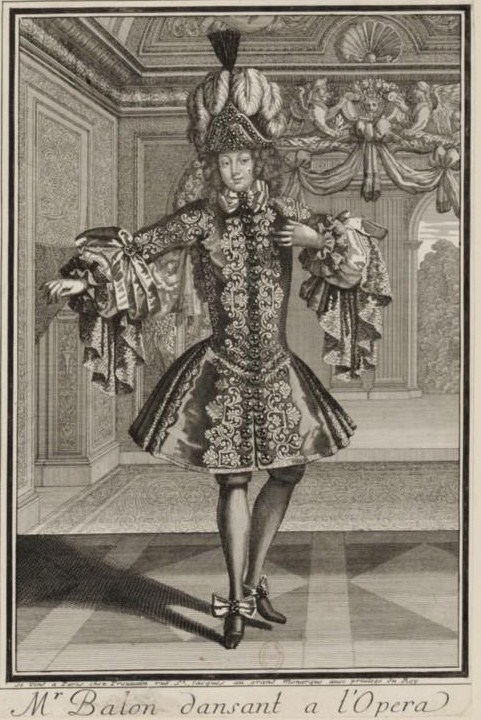
Claude Ballon, one of the most famous danseurs nobles of the early 18th century.

Claude Ballon, one of the most famous danseurs nobles of the early 18th century.