Tag Archives: Marie Sallé

Season of 1725-1726: Dancers at Lincoln’s Inn Fields

The figures I initially gave for the dancers at the Lincoln’s Inn Fields Theatre during the 1725-1726 season were not right either. There were, in fact, 16 dancers (9 men and 7 women) who danced regularly in the entr’actes during the main season. Of the others, Glover danced only on 14 April 1726. He had been a member of the dance ‘company within the company’ since 1723-1724 but was absent from Lincoln’s Inn Fields this season, apart from this one performance. ‘Pollett’s Son’, who made a single appearance on 25 April 1726 may have been a child dancer – there were other dancers named Pollett in London’s theatres around this time, although their careers need further research. Burny made only one appearance before the end of the main season, but he (together with Morgan and Smith) danced during the theatre’s summer season. I will look at the summer season and its dancers separately.

The following entr’acte dancers were at Lincoln’s Inn Fields in 1725-1726:

Nivelon

Lally

Dupré

Newhouse

Pelling

Dupré Jr

Sallé

Le Sac

Lanyon

Mrs Laguerre

Mrs Wall

Mrs Bullock

Mrs Ogden

Mlle Sallé

Miss La Tour

Mrs Anderson

At least one name in this list is likely to be familiar to those interested in the 18th-century dance.

Among the dancers at Lincoln’s Inn Fields the one most often billed in 1725-1726 was Nivelon, who danced in the entr’actes some 50 times. He was followed by Sallé (46 billings). None of the other men appeared nearly so often – next was Lally (31 billings), Le Sac (22), Dupré (17), Newhouse (15), Pelling (9), Dupré Jr (7) and Lanyon (4). Among the women, Mlle Sallé was the most in demand with 38 entr’acte billings. Mrs Wall danced some 34 times, followed by Mrs Bullock (32), Mrs Laguerre and Miss La Tour (22 performances each), Mrs Ogden (15) and Mrs Anderson (10). Mrs Ogden and Mrs Anderson also danced during the summer season.

As at Drury Lane, each dancer’s repertoire provides clues to his or her status. Nivelon and Sallé were first among the men. Nivelon performed 6 solos, 4 duets and 1 trio, while Sallé danced 1 solo, 6 duets, 1 trio and 2 group dances. Dupré had 2 duets and 6 group dances (he was also billed as a choreographer). Newhouse also performed 2 duets but appeared in only 1 group dance. Le Sac gave 1 solo and also performed 4 duets. Pelling, Dupré Jr and Lanyon were all supporting dancers, appearing only in group choreographies. Among the women, Mrs Wall had the most extensive repertoire, with 3 solos, 7 duets and 6 group dances. Mlle Sallé danced 1 solo (Les Caractères de la Danse), 5 duets and 1 trio. Mrs Laguerre performed in 6 duets and 1 group dance, while Mrs Anderson gave 1 solo and 2 duets and performed in 4 group dances. Miss La Tour danced 1 solo and 4 duets and Mrs Ogden was billed in 2 duets and 2 group dances. None of the women can be described simply as supporting dancers.

All the men, except for Le Sac, danced in the pantomime afterpieces which were performed on nearly as many evenings as entr’acte dancing. As at Drury Lane, the roles performed by these dancers reveal more about their place within the ‘dance company’. They also tell us a little about the specialities of individual dancers. Four pantomimes were given at Lincoln’s Inn Fields during the main season – Jupiter and Europa, The Necromancer, Harlequin a Sorcerer and Apollo and Daphne. The first two are anonymous, but may have been devised by the theatre’s manager John Rich who was himself a Harlequin and took that role in these afterpieces. The second two have libretti by the writer Lewis Theobald. Nivelon’s role was Punch, while Lally was Mezzetin, Pelling was Pierrot and Newhouse was Scaramouch (Lanyon also appeared as Scaramouch). Nivelon’s status was shown by Apollo and Daphne; or, The Burgomaster Tricked (to give the pantomime its full title), in which he was the Burgomaster and thus central to the comic plot. Lally (Edward Lally, who may or may not have been the brother of Michael Lally at Drury Lane that season) and Dupré both took prominent dancing roles in the pantomimes. Dupré also performed as a dancing Harlequin (Rich did not dance).

Mlle Sallé danced both Daphne and Flora, ‘An Inconstant’, in Apollo and Daphne, the only pantomime in which she appeared. Mrs Wall was Europa in Jupiter and Europa and took prominent roles in three more pantomimes. Mrs Bullock and Mrs Anderson also had significant dancing roles. Mrs Laguerre, Mrs Ogden and Miss La Tour did not appear in pantomimes at all. Mrs Laguerre had been one of the leading dancers at Lincoln’s Inn Fields and would be so again, but she seems to have been absent from late November 1725 to mid-March 1726. She was also an actress (the only one among Lincoln’s Inn Fields’s female dancers in 1725-1726) and played 11 acting roles during the months she was present.

So, what of the ‘dance company’ at Lincoln’s Inn Fields in 1725-1726? Le Sac and Miss La Tour made their debuts together and danced a series of duets. They were advertised as ‘Scholars of Mr. Dupre’ and were presumably just emerging from his tutelage. Were they members of the ‘dance company’ or more like apprentices? Francis and Marie Sallé were returning to dance in London for the first time since the 1718-1719 season, so they may have been seen as ‘guest artists’. Nivelon must have been the leading male dancer, and perhaps the company’s dancing master. (Although the meaning and even the existence of that position needs investigation and discussion). Lally and Dupré may have been more-or-less equal, followed by Newhouse and Pelling, then Dupré and Lanyon.

The relative status of the women is more difficult to unravel. Their benefits perhaps provide additional clues (although Rich at Lincoln’s Inn Fields seems to have been less hierarchical about these than the management at Drury Lane), along with their dancing partners. Mrs Laguerre was probably the leading local female dancer, her benefit (shared with her husband, the singer-actor John Laguerre) was on 14 April 1726. She was most often partnered by Nivelon. Mrs Wall shared her benefit with Newhouse, on 30 April, her main partner was Lally although she also danced with Dupré (who may have been one of her teachers). Mrs Bullock shared her 2 May benefit with her brother-in-law, the actor William Bullock. She danced her only duet with Nivelon, but in the group dances she seems to have been partnered by Sallé and Dupré most often. Mrs Anderson’s benefit (also shared) came on 9 May and Mrs Ogden had no benefit at all. They were evidently the lowest ranking of the female dancers in the company.

There are accounts surviving for Lincoln’s Inn Fields for the seasons 1724-1725 and 1726-1727 which provide more information about the relative status of the dancers, based on their pay scales. The 1724-1725 accounts have been analysed in some detail – I provide a reference to the article below – and I looked at those for 1726-1727 myself some years ago (although my notes are not extensive). They tell us that Nivelon earned by far the most among the dancers – much more than even the two Sallés (at least in 1726-1727) – and that Dupré was the next highest paid of the male dancers, followed by Lally. The highest paid of the women were Mrs Laguerre and Mrs Bullock. Apart from Nivelon, none of the dancers received anything like as much as the principal singers in Rich’s company.

The only one of the dancers at Lincoln’s Inn Fields in 1725-1726 for whom we have a portrait is Marie Sallé. Here she is, as a dancer and off-stage.

Reference

Judith Milhous, ‘The Finances of an Eighteenth-Century London Theatre: the Lincoln’s Inn Fields Company under John Rich in 1724-1725’ in Berta Joncus and Jeremy Barlow (editors), “The Stage’s Glory” John Rich, 1692-1761 (Newark, 2011), pp. 61-69.
The First Ballet at Covent Garden

In a recent TV dance programme, the presenter told us that the first ballet was given at Covent Garden in 1734. I assume that she meant the first ballet to be given at that theatre and not the first ballet to be given in London, which had been John Weaver’s The Loves of Mars and Venus performed at the Drury Lane Theatre in 1717. She did not name the work, but the date indicates that she was referring to Pygmalion, first given at Covent Garden on 14 January 1734. Was this really the first ballet to be performed at John Rich’s new playhouse, the first such building on the site of what we now know as the Royal Opera House?

What was a ballet in early 18th-century London? The definition I work with is a stage work in which the narrative is told through dance, mime and music only, with no words. This describes John Weaver’s intention, although he called his stage works dramatic entertainments of dancing not ballets. For the purposes of this post, I will draw on that definition while concentrating on dancing at the Covent Garden Theatre from its opening on 7 December 1732 to the first performance of Pygmalion on 14 January 1734.

I’ll begin by looking more closely at Pygmalion. It is now attributed to the ballerina Marie Sallé, who took the role of the Statue Galatea. Her creations for the London stage were much applauded in Paris, where she was known as a dancer at the Académie Royale de Musique (the Paris Opéra). A description of Pygmalion was published in the Mercure de France for April 1734, in the form of a letter from London dated 15 March – by which date the ballet had been performed at least fourteen times, demonstrating its success with London audiences. The dance historian Cyril Beaumont published a translation of the letter in his Three French Dancers of the 18th Century in 1934. The ballet itself is described thus:

‘Pygmalion enters his studio accompanied by his sculptors, who execute a characteristic dance, mallet and chisel in hand. Pygmalion bids them throw open the back of the studio which, like the forepart, is adorned with statues. One in the middle stands out above all the others and attracts the admiration of everyone. Pygmalion examines it, considers it, and sighs. He puts his hands on the feet, then on the body; he examines all the contours, likewise the arms, which he adorns with precious bracelets. He places a rich necklace around the neck and kisses the hands of his beloved statue. At last he becomes enraptured with it; he displays signs of unrest and falls into a reverie, then prays to Venus and beseeches her to endow the marble with life.

Venus heeds his prayer; three rays of light appear, and, to the surprise of Pygmalion and his followers, the statue, to suitable music, gradually emerges from its insensibility; she expresses astonishment at her new existence and at all the objects which surround her.

Pygmalion, amazed and transported, holds out his hand for her to step from her position; she tests the ground, as it were, and gradually steps into the most elegant poses that a sculptor could desire. Pygmalion dances in front of her as if to teach her to dance. She repeats after him the simplest as well as the most difficult and complicated steps; he endeavours to inspire her with the love which he feels, and succeeds.’

Pygmalion was always given as an entr’acte entertainment, never as an afterpiece, and (apart from calling it ‘new’ at its first performances) the advertisements drew no particular attention to it. It is never called a ‘ballet’.

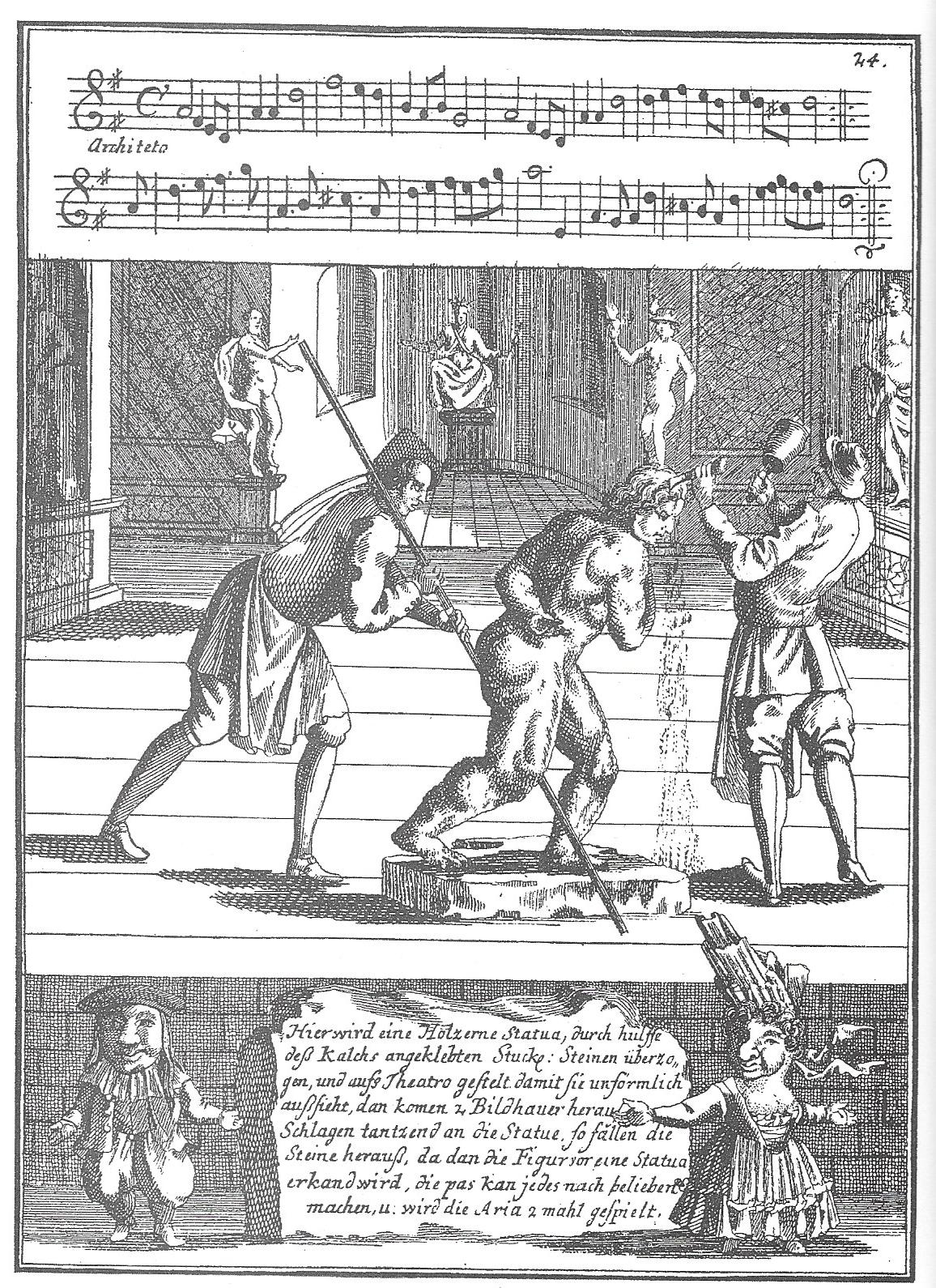
The account of the action suggests that it began with a group dance by the Sculptors, followed by an extended mime sequence for Pygmalion. There was a little bit of scenic business (as Venus ‘heeds his prayer’) and then a mime sequence by the Statue, Galatea, followed by solos and a duet for her and her creator. The whole piece is essentially a single scene. It draws on a number of antecedents, one of which is indicated by Gregorio Lambranzi in his Neue unde Curieuse Theatrialische Tantz-Schul of 1716 in a plate showing sculptors at work (part 2, plate 24).

Lambranzi Part 2 Plate 24

The dancers at Covent Garden were Malter and Mlle Sallé, who performed as Pygmalion and Galatea, together with Dupré, Pelling, Duke, Le Sac, Newhouse and Delagarde, all regular members of Rich’s company.

What earlier entertainments at the new theatre might be classed as ballets? There are three contenders: The Sleeping Dutchman and his Frow given 27 March 1733; The Amorous Clown; or, The Courtizan given 3 May 1733; The Cobler; or, The Merry Wife Constant given 4 May 1733. All were performed by a principal couple with a group of supporting dancers and their titles suggest a narrative with action conveyed through dance and mime. All three pieces were created for benefit performances and only The Sleeping Dutchman and his Frow was given more than once.

The Cobler; or, The Merry Wife Constant can also be associated with a dance recorded by Lambranzi, who shows a Cobbler ‘with the tools of his trade, the use of which he expresses in mime’ before he is joined by his wife and the two dance together (part 2, plates 29, 30).

This entr’acte dance has a cast list which pairs the characters with commedia dell’arte characters (the Cobler is Punch, but the ‘Merry Wife’ has no counterpart), an idea used in some of Rich’s pantomime afterpieces. This suggests expressive action drawn from the commedia dell’arte, which by this period was common on the London stage. The Cobler; or, The Merry Wife Constant was probably created by Newhouse, who danced the Cobbler, for his own benefit.

The other two pieces involved Francis Nivelon, who was Rich’s leading dancer and probably the dancing master at Covent Garden. He shared a background in French fair theatre with Marie Sallé. The Sleeping Dutchman and his Frow was created for Nivelon’s own benefit and he and Mrs Laguerre took the title roles. She was Rich’s leading English female dancer, with skills that allowed her to take over some of Marie Sallé’s pantomime roles notably Daphne and Flora in Apollo and Daphne. Mrs Laguerre was also an actress, albeit a minor one. They were supported by Newhouse, Pelling, Le Sac, Delagarde, Miss La Tour, Mrs Pelling, Mrs Ogden and Miss Baston. The men would all appear in Pygmalion the following season.

The Amorous Clown; or, the Courtizan has the strongest claim to be considered a ballet. It was given right at the end of the performance, following the afterpiece, suggesting that it was a more substantial piece. It was created for the benefit of Dupré and Mrs Pelling, probably by Nivelon for the cast list had ‘Clowns by Nivelon and Pelling; Wives by Miss Latour and Mrs Ogden; Courtizan – Mrs Pelling’. In this context a ‘Clown’ was an unsophisticated Countryman or Rustic. The title suggests that the piece centred on Nivelon and Mrs Pelling and contained mime sequences as well as dances.  Mrs Pelling, like Mrs Laguerre, had skills that extended to serious dance and allowed her, too, to take over some of Marie Sallé’s pantomime roles.

These dance pieces have been overlooked by dance historians because they had very limited stage lives and were never noticed in the newspapers or elsewhere (it is worth recalling that Pygmalion received little attention in the British newspapers). Unlike Pygmalion, we have no accounts of their action. All three are comic rather than serious (although one or more of them may well have included some serious dancing). They make no use of the classical mythology used as a yardstick for the importance of dance works by so many 20th-century dance writers. Despite all that, I suggest that Pygmalion was not the first ballet given at the new Covent Garden playhouse – that honour should arguably go to The Amorous Clown; or, the Courtizan. Marie Sallé’s ballet was created within, and as a result of, the rich and varied repertoire of dancing (which included many such small ballets, serious as well as comic) in London’s theatres during the early 1700s.


Dancing on the London Stage

Dancing in London’s theatres during the 18th century is a topic that has not attracted dance historians. There are very few reliable accounts and no extended study has so far been published. My work in this area began when I did my PhD on the English dancer-actress Hester Santlow, whose dancing career began in 1706 and ended when she retired from the stage in 1733. I found myself trying to reconstruct the context within which she danced, as well as her dancing repertoire. My thesis was entitled ‘Art and Nature Join’d: Hester Santlow and the Development of Dancing on the London Stage, 1700-1737’. Since then, I have extended my interest to dancing on the London stage from 1660 to 1760. Central to this period are, of course, the notated theatrical dances published in the early 18th century to which I referred in my earlier post Stage Dancing.

The paradox of any research into dancing on the London stage is that the dances, with the exception of the handful of notated choreographies, have entirely disappeared. There are also very few portraits of dancers or depictions of dancing before the late 18th century. Any research is therefore very challenging. This is probably why the period has attracted little or no interest from dance researchers. There is also the bias towards dancing in Paris, which is widely seen as the sole centre of serious dancing at this time.

Yet, this was a particularly exciting period for London audiences, who were avid followers of dancers and their repertoire. ‘French Dancing’ reached London from Paris not long after the Restoration in 1660. French stars came to the English capital, where they could make good money in the commercial theatres. Claude Ballon made a brief visit in 1699 and his favourite dancing partner, the ballerina Marie-Thérèse de Subligny, came in 1702. There were also home-grown dance celebrities who could equal them in the style and technique of serious dancing, notably Hester Santlow. The British developed their own dances and genres of dancing. Among the former was the hornpipe, acknowledged as an ‘English’ dance. Among the latter was the first modern ballet, created by John Weaver, a theorist as well as a dancer and a dancing master. The Loves of Mars and Venus, performed at the Drury Lane Theatre in 1717, was the first dance work with recognisable characters and a story in which the entire narrative was conveyed through dance and gesture alone, with no sung or spoken words. This was a significant development in the art of dancing and must surely have influenced the French ballerina Marie Sallé, who also came to dance, and experiment with dancing, in London.

Dancing was popular in London’s theatres throughout the 18th century. Dances were regularly performed between the acts of plays (entr’acte dances). There was a great deal of dancing (serious as well as comic) in the pantomimes that became popular from the 1720s and there were dance divertissements in plays and musical works. The entr’acte dances were many and various, from speciality comic dances drawing on indigenous dance forms to complex and virtuosic serious dances deploying the style and technique of French professional dancing.

I will try to reveal some of this wealth of innovative dance entertainment in future posts.

John Ellys. Hester Santlow as Harlequine. c.1725

John Ellys. Hester Santlow as Harlequine. c.1725