Tag Archives: John Weaver

A VERY IMPORTANT DANCE ANNIVERSARY

Next year marks the 300th anniversary of John Weaver’s The Loves of Mars and Venus. His ‘dramatic entertainment of dancing’ was first performed at the Drury Lane Theatre on 2 March 1717.

Loves Title Page Detail

John Weaver, The Loves of Mars and Venus, detail from title page

Why is this often overlooked dance work so important? It is the first modern ballet – the first theatrical work to tell a story and represent its characters solely through dance, mime and music. Unlike all the ballets that had come before it, including the much celebrated French ballets de cour and English masques, there were no spoken or sung words. The Loves of Mars and Venus was a dance work, nothing more and nothing less.

Weaver’s ballet tells the story of the love affair between the goddess Venus and Mars, the god of War, and the revenge enacted on them by her husband Vulcan. It draws on classical mythology, but contemporary passions abound. Despite Weaver’s appeal to the revered performances of the ‘mimes and pantomimes’ of classical antiquity, who he wished to emulate, his ballet was a thoroughly modern work in tune with the sophisticated comedies of his own time.

The Loves of Mars and Venus has six short scenes. Mars appears with his soldiers and performs a war dance. Venus is shown surrounded by the Graces and displays her allure in a sensual passacaille, but when Vulcan arrives she quarrels with him in a ‘dance of the pantomimic kind’. Vulcan retires to his smithy to devise revenge with the help of his workmen the Cyclops. Mars and Venus meet and, with their followers, perform dances expressive of love and desire. Vulcan completes his plan of revenge against the lovers. In the final scene, Vulcan and the Cyclops catch Mars and Venus together and expose them to the derision of the other gods, until Neptune intervenes and harmony is restored in a final ‘Grand Dance’. The entire ballet took, perhaps, about 40 minutes.

John Weaver was a dancer as well as a choreographer. He is also one of the very few dance practitioners who have written about their art. He was Vulcan. Venus was Hester Santlow, also an actress and a dancer of consummate skill and expressiveness. Mars was Louis Dupré, a virtuoso dancer who was probably French (although not Louis ‘le grand’ Dupré, with whom he is still often confused). Weaver’s bold experiment had the best dancers on the London stage.

This first modern ballet was a remarkable work and enjoyed success in its own time. It was subsequently far more influential than many realise. It may well have been seen by the young dancer Marie Sallé, who would herself later experiment with narrative and expressive dancing. Sallé, of course, influenced Jean-Georges Noverre when he came to create his ballets d’action. They led to the story ballets of the romantic period and onwards to today’s narrative dance works.

Has Weaver’s The Loves of Mars and Venus been consigned to history or can it be recovered? I will explore this innovative ballet further in later posts.
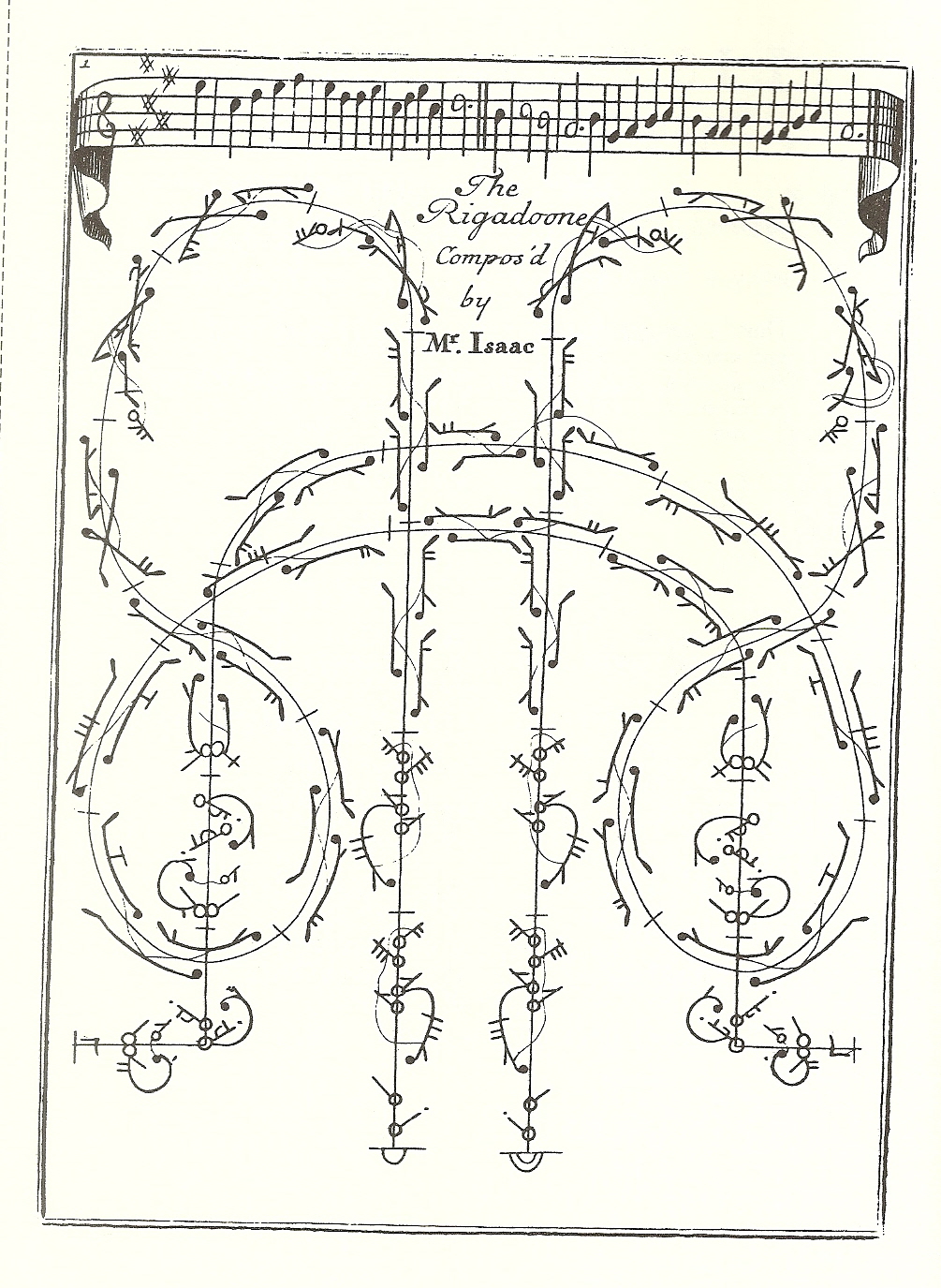
Isaac’s Rigadoon

I am currently learning another of the most famous ballroom dances of the 18th century, Mr Isaac’s The Rigadoon. I first worked on this lively duet some years ago, but I never performed it and I’ve had to start on it afresh. The Rigadoon, like much of the rest of the ‘English’ baroque dance repertoire, rarely (if ever) features in workshops in the UK. Perhaps this is because these dances are choreographically idiosyncratic – and difficult. This is a pity, since they have much to offer in helping us to understand the dancing of the period and they are sheer pleasure to dance.

Mr Isaac. The Rigadoon (1706), first plate

Mr Isaac. The Rigadoon (1706), first plate

The duet is, of course, a rigaudon. The music has been attributed to James Paisible, the French recorder player who made his career in London, but this is by no means certain. Mr Isaac’s The Rigadoon has been dated as early as 1695. It was first published in 1706 in A Collection of Ball-Dances perform’d at Court, notations by John Weaver of six of Isaac’s choreographies. That same year, the dance also appeared in a different version notated by the dancing master Siris and published in his The Art of Dancing alongside Pecour’s ball dance La Bretagne. Siris’s The Art of Dancing was a rival to Weaver’s translation of Feuillet’s Choregraphie.

Weaver evidently passed his notations (or rather, the plates on which they were engraved) to the music publisher John Walsh, who reissued The Rigadoon along with other dances by Isaac around 1708 and again about 1712. Walsh published a second edition of Weaver’s Orchesography around 1722. In a late response to Siris, Weaver added notations of The Rigadoon, The Louvre (Pecour’s ball dance Aimable Vainqueur) and The Bretagne. Orchesography was reissued, with its dances, around 1730. Within thirty years of its first appearance in print, Isaac’s The Rigadoon had gone through at least six editions.

Weaver drew particular attention to Isaac’s dance in Orchesography, by including four steps from it in a ‘Suplement of Steps’ at the end of his step tables.

Raoul Auger Feuillet transl. John Weaver, Orchesography (1706), ‘A Suplement of Steps’

Raoul Auger Feuillet transl. John Weaver, Orchesography (1706), ‘A Suplement of Steps’

The steps, and Weaver’s comment on how graceful and unusual they are, provide a glimpse of English choreographic taste as exemplified by The Rigadoon.

Isaac’s The Rigadoon seems to have been continued to be taught and given in the ballroom for many years. In his 1729 poem The Art of Dancing, Soame Jenyns (referring to the invention of dance notation) wrote:

‘Hence with her Sister-Arts shall Dancing claim

An equal Right to Universal Fame,

And Isaac’s Rigadoon shall last as long

As Raphael’s Painting, or as Virgil’s song.’

A few years later, in 1735, Kellom Tomlinson referred to The Rigadoon several times in his manual The Art of Dancing. In describing ‘the Slip’, i.e. the glissade, Tomlinson wrote:

‘ … twice slipping behind, is in the Rigadoon of the late Mr. Isaac, where, in the Beginning of the Tune, the second Time of playing over, it forms a perfect Square, which is no small Addition to the Beauty of the said Dance; …’

Tomlinson mentions a number of notated dances in The Art of Dancing. Are these the choreographies he taught to his own pupils, including Isaac’s The Rigadoon?

Twelve years later, in his Essay on the Advantage of a Polite Education published in 1747, Stephen Philpot also referred to Isaac’s The Rigadoon since he featured the dance in his own teaching practice. The ball dance may well have survived into the 1750s. On 19 March 1752 at the Covent Garden Theatre, Cooke and Miss Hilliard gave ‘A Ball Dance call’d the Rigadoon concluding with a Minuet’. The performance was a benefit for Cooke.  On 12 May 1753 at Drury Lane, Mr and Miss Shawcross danced ‘The Rigadoon and Minuet’ for his shared benefit. If these performances were indeed Isaac’s The Rigadoon, then the dance must have continued to be taught in dancing schools for more than fifty years.

I will take a closer look at the choreography of The Rigadoon in a later post.


Dancing on the London Stage

Dancing in London’s theatres during the 18th century is a topic that has not attracted dance historians. There are very few reliable accounts and no extended study has so far been published. My work in this area began when I did my PhD on the English dancer-actress Hester Santlow, whose dancing career began in 1706 and ended when she retired from the stage in 1733. I found myself trying to reconstruct the context within which she danced, as well as her dancing repertoire. My thesis was entitled ‘Art and Nature Join’d: Hester Santlow and the Development of Dancing on the London Stage, 1700-1737’. Since then, I have extended my interest to dancing on the London stage from 1660 to 1760. Central to this period are, of course, the notated theatrical dances published in the early 18th century to which I referred in my earlier post Stage Dancing.

The paradox of any research into dancing on the London stage is that the dances, with the exception of the handful of notated choreographies, have entirely disappeared. There are also very few portraits of dancers or depictions of dancing before the late 18th century. Any research is therefore very challenging. This is probably why the period has attracted little or no interest from dance researchers. There is also the bias towards dancing in Paris, which is widely seen as the sole centre of serious dancing at this time.

Yet, this was a particularly exciting period for London audiences, who were avid followers of dancers and their repertoire. ‘French Dancing’ reached London from Paris not long after the Restoration in 1660. French stars came to the English capital, where they could make good money in the commercial theatres. Claude Ballon made a brief visit in 1699 and his favourite dancing partner, the ballerina Marie-Thérèse de Subligny, came in 1702. There were also home-grown dance celebrities who could equal them in the style and technique of serious dancing, notably Hester Santlow. The British developed their own dances and genres of dancing. Among the former was the hornpipe, acknowledged as an ‘English’ dance. Among the latter was the first modern ballet, created by John Weaver, a theorist as well as a dancer and a dancing master. The Loves of Mars and Venus, performed at the Drury Lane Theatre in 1717, was the first dance work with recognisable characters and a story in which the entire narrative was conveyed through dance and gesture alone, with no sung or spoken words. This was a significant development in the art of dancing and must surely have influenced the French ballerina Marie Sallé, who also came to dance, and experiment with dancing, in London.

Dancing was popular in London’s theatres throughout the 18th century. Dances were regularly performed between the acts of plays (entr’acte dances). There was a great deal of dancing (serious as well as comic) in the pantomimes that became popular from the 1720s and there were dance divertissements in plays and musical works. The entr’acte dances were many and various, from speciality comic dances drawing on indigenous dance forms to complex and virtuosic serious dances deploying the style and technique of French professional dancing.

I will try to reveal some of this wealth of innovative dance entertainment in future posts.

John Ellys. Hester Santlow as Harlequine. c.1725

John Ellys. Hester Santlow as Harlequine. c.1725