Category Archives: Dancers & Dancing Masters

Monsieur Gherardi and the Couple Allemande

Looking back over my various Dance in History posts, I can see that I have written next to nothing about the couple allemande which became popular in the ballroom (and on the stage) in the late 1760s. This is probably because I have had very few opportunities either to learn or dance it, although quite some time ago I did bring together a folder of research notes about this duet. I am currently involved in some research which is concerned with ballroom dancing in the late 1700s and early 1800s and my attention was caught by what Monsieur Gherardi had to say in his Twelve new allemandes and twelve new minuets, published in London in 1770. This is actually a collection of pieces of dance music, to which Gherardi prefixes some quite lengthy remarks on the couple allemande, which I here transcribe in full.

“To the Lovers of the Allemande Dances.

The satisfaction, which every one expressed, who saw the Allemande Dances two Years ago, gave me room to hope a diversion, so much in fashion throughout the major part of Europe, would, at last, take place in the public, and private Balls of this kingdom also: I had the greater reason for this agreable supposition, on account of the repeated and continual encomiums they met with from almost – and, indeed, I might say, entirely – all whom I then had the honour of instructing.

Consequences however have deceived me; I am in hopes therefore it will not be unacceptable if I endeavour to point out the cause of this disappointment; especially as my principal motive is to remove those Impediments which obstruct the enjoyment of one of the most elegant and innocent amusements of the polite world.

As a Professor of dancing, I could impute it to several circumstances, of which I have had ocular experience during the course of my Instructions; the principal of which is, a fundamental error in the generality of Masters, which, perhaps, operating with the too common negligence in Pupils of attending even to the best directions, has chiefly contributed to the disparagement both of the Art in question, and of its Instructor likewise.

As I address myself to the lovers of the Allemande Dances, I do not apprehend the censure of obtruding the following Reflections and Advice; my earnest and only desire being, to furnish them with the most certain and effectual methods, of arriving at a masterly execution in this elegant diversion: a Point which, when obtained, cannot fail of adding to their pleasure, and of removing, or, at least diminishing, their fatigue.

The Allemande comprehends a number of minutiæ, in which, all, who pretend to any knowledge of it, should be instructed, which must necessarily concur to its perfection.

In the first Place; the Gentleman and his Partner must never close their hands, or fingers: they must, on the contrary, keep them almost disengaged, so as to turn easily within each other: & above all, take care not to loose their hold during the passes unless the necessity of the case requires it.

They must also be match’d as much as possible in point of height; by which means the passes will be render’d more facile, and consequently less fatiguing; or if there must be a difference in their size, the Man’s being a little taller than his Partner will occasion no material inconvenience, provided he shews his Judgment (which if he is adroit he may) by making use of his advantage, in point of height, in favouring the steps of the Lady, who may not be so skilfull as himself.

In order to dance the Allemande well, a nice knowledge of the different steps is also necessary: it has but few for such as make it only the amusement of the Evening; but for those who aspire after excellence, there are a sufficient number to be employed at quitting and joining hands, & also during the momentary interval of separation; which are properly the critical times for displaying the address and ingenuity of the Artist.

But what astonishes me is, that in a Country where the National dance is so extreamly lively and animated, a kind of Allemande, which being much more so, seems better suited to the taste and genius of the People, should have been wholly omitted: the kind I am speaking of, is called Boiteuse; it is in great esteem at Strasburgh, where they dance it to perfection: the Air of it is brisk and sudden, and has its particular steps and passes: to dwell upon its beauties would be unnecessary; they may be discovered by looking over the Airs themselves, for which purpose I have inserted several of them in my collection.

There are still two other kinds of Allemandes called Troteuse and Sauteuse, or the Trotting and Leaping kinds; but as each of these includes several subdivisions also, I shall defer any consideration of them to another opportunity.

Notwithstanding several Masters of this Metropolis (in order to distinguish their Scholars) have endeavour’d to mix the natural steps of the Hornpipe, with those of the Allemande, and which they have effected in the Contre dances Francioises [sic], or Cotillons, I will venture, without design of prejudicing their reputation or their interest, to warn such as desire really to distinguish themselves, from following this method; it being entirely repugnant to the true Allemande; in which nothing but an uniformity in the Steps, and an easy performance of the Passes, can procure perfection or applause: in fact, is it not ridiculous to see a Dance between two Persons, executed in one way by the Gentleman, and in another by the Lady? and which must very frequently be the unavoidable Consequence in the present Case.

It is upon long experience that all my remarks are founded. In Germany, where I resided at the Margrave of Baireith’s, in quality of Ballet-Master, principal Dancer, and dancing master to the Court, and to the reigning Dutchess of Wirtemburg, the Margrave’s Daughter, I never observed, either among the Saxons, Suabians, or Strasburghers, other than a perfect correspondence between the steps of the Gentleman and his fair Partner; and if these People, the first in the World for Allemande Dances, did not put a proper Value upon this correspondence, may we not suppose their Masters would be directed to furnish them with the requisite varieties; for which Task they are certainly as capable as those of this Nation!

The following are therefore the directions I would recommend to be observ’d in the Allemande. The Gentleman must, in the first place, take care not to make his Allemande too long, and 2dly. to avoid every pass which being in the least difficult to him, must be so likewise to the Lady; and the passes to be rejected, are such as, where the body being half bent, the Man turns three or four times round, under his own and the Lady’s Arms; a Position which, besides the indelicacy of it, subjects her to the almost inevitable necessity of spoiling her cloathes by the Powder and Pomatum in his Hair; not to mention the consequent disagreable discomposure of that material part of the dress of the Gentleman; giving his Head the same elegant appearance as if he had just popped it out of a Sack.

We must therefore endeavour to conform to the present prevailing taste amongst those who Pique themselves on dancing the Allemande well; which is, to make but few passes, and even those very easy too: such as we call Mirroirs, or Regards, are, for their great facility, extreamly in use, and, on that account, very proper for the Ladies.

In a tour which I made last Year to Paris, I was present at an Assembly, and saw a tall Gentleman dance the Allemande with a Lady only ten years of age, for at least a quarter of an Hour, without once passing under her Arms; every figure was in Mirroir, the execution was elegant and pleased me infinitely! I must likewise observe the advantage there is of previously practising every dance at home, under the inspection of a Master; by this means each party, being more thoroughly acquainted with the necessary passes, is more certain and easy in the execution of what they so well know; and every thing becomes , of course, greatly more agreable.

To evince what I assert, we need only reflect on the Allemandes of the Stage Dancers, who acquire the Judgment, and Agility, they display, in the execution of their art, by nothing so much as by the mere dint of frequent repetitions of the same Dance; and as a proof still more convincing, it will not be improper to instance the astonishing approbation and success which the Allemande has met with during the space of two Years it has been danced in London at the Public Theatres; and are still, and deservedly, seen with new delight.

I recommend to the Admirers and Learners of the Allemandes, to weigh the few foregoing Observations, and if they find the Theory (as I flatter myself they will) founded on Reason and Judgment, to avail themselves of it in the Practice: for in what-ever situation of Life a Person may be, if he attempts a Science, and does not study it with assiduity and precision, so as to attain to some degree of perfection, he certainly throws a damp on Emulation in others; and thereby injures that very Science, which as a Student therein, it should be his warmest Endeavour to advance.

Persuaded of this truth from the earliest part of Life; I have, for many Years past, devoted my whole time and study to the Profession in which I am engaged, with a view of rendering myself, in my little Province, useful to, and deserving the countenance and approbation of, the Public in general; but more particularly of those who have already honoured, or do at present honour me, with their commands, and presence at my Academy, held twice a Week at my own House.”

Who was Gherardi? He provides some information about his career in his remarks, describing himself as ‘Ballet-Master, principal Dancer, and dancing master’ to the Margrave of Bayreuth and his daughter the Duchess of Württemburg, although he does not tell us when or how long he worked for them. His patrons were evidently Frederick, Margrave of Brandenburg-Bayreuth (1711-1763) and Elisabeth Fredericke Sophie of Brandenburg-Bayreuth (1732-1780) who married Charles Eugene, Duke of Württemburg in 1748. Her mother was Princess Wilhelmine of Prussia, sister of Frederick the Great.

On the title pages of his various collections, Gherardi also describes himself as ‘One of the Principal Dancers of ye Opera at Paris’ and ‘Ballet Master and principal Dancer of the Opera in London’. The Biographical Dictionary of Actors describes Gherardi as dancing and then becoming ballet master at London’s opera house, the King’s Theatre, between 1760 and 1765. The same source suggests that he was the son of Jean-Baptiste Gherardi (b.1696) of the Comédie Italienne in Paris and the grandson of Evariste Gherardi (1663-1700), who had been Harlequin and the author of numerous comedies for the famous commedia dell’arte troupe based in Paris until its expulsion by Louis XIV in 1697. Gherardi himself seems to have been a Harlequin, as well as a dancer, at the Paris Opéra between 1740 and 1746 and subsequently to have danced at various other European theatres. In her book The Pre-Romantic Ballet, Marian Hannah Winter records that Gherardi’s father had sent him for training to Louis ‘le grand’ Dupré before entering the Paris Opéra (although she does not cite her source). Gherardi was still teaching in London in 1774, for the Public Advertiser for 3 March 1774 carried a notice for his ball at Carlisle House, Soho Square – he was presumably still at Rathbone Place in Soho, as shown in his earlier publications. He is certainly worth further research to document more fully his career in Paris and Europe as well as in London.

Gherardi’s remarks on the couple allemande are of particular interest because they go beyond the information to be found in the various contemporary French treatises on this dance. He mentions that the allemande has a number of steps, associated particularly with the ‘Boiteuse’ allemande as danced in Strasbourg. He refers to ‘Troteuse’ and ‘Sauteuse’ allemandes not mentioned in the French treatises. In his Almanach dansant ou positions et attitudes de l’allemande of 1770, Guillaume says ‘Il y a plusieurs sortes de Pas qui servent à danser l’allemande’ but does not describe them, restricting his explanation to the steps ‘plus usités & analogues à cette danse’. I can’t help wondering whether both Gherardi and Guillaume might be thinking of some of the steps included within Clement’s Passepied et Allemande à Quatre published in notation in 1771. Do any German sources survive to tell us more about the couple allemande?

Here is an English illustration of the allemande in full flow:

References:

Philip Highfill Jr at al. Biographical dictionary of actors, actresses, musicians, dancers, managers & other stage personnel in London, 1660-1800. 16 vols. (Carbondale, 1973-1993)

Marian Hannah Winter. The pre-romantic ballet (London, 1974)

Mr Isaac’s Six Dances

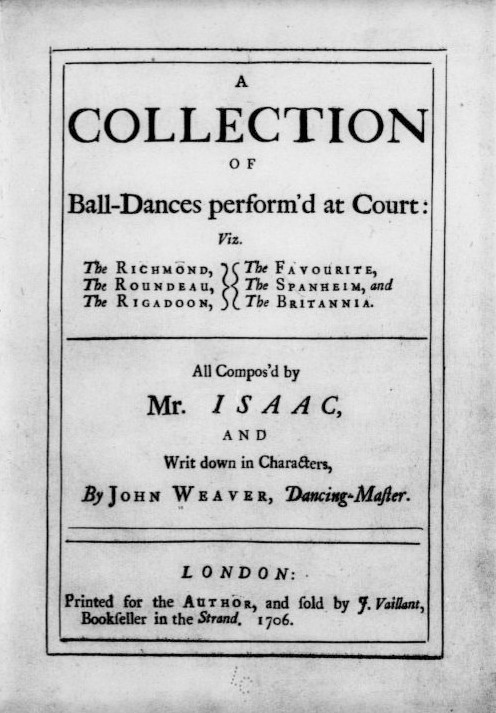
A Collection of Ball-Dances perform’d at Court; … All Compos’d by Mr. Isaac and Writ Down in Characters, by John Weaver was published in London in 1706. There is evidence to suggest that at least one individual dance had already appeared, but it was certainly the earliest collection of dances to be published in London in Beauchamp-Feuillet notation. It was intended to accompany Orchesography, Weaver’s translation of Feuillet’s Choregraphie, which appeared the same year. This is made clear by the advertisement in the Daily Courant for 25 June 1706, which calls it the ‘Second Part’ of Orchesography.

It was also the first collection of English choreographies and close analysis suggests that these had a character quite distinct from the French ball dances being published in notation in Paris around the same time. We have no portrait of Weaver, but there is this print of Mr Isaac, engraved by George White after a portrait by Louis Goupy which seems not to survive.

The Collection of Ball-Dances was ‘printed for the Author’, presumably Weaver who had produced the notations and who had signed the work’s dedication to the Duke of Richmond. It was published by subscription – 47 names appear in the List of Subscribers, all of whom were men and most (if not all) were dancing masters. Both Isaac and his brother-in-law Anthony L’Abbé subscribed and the list is otherwise almost identical to that for Orchesography (see my recent post Subscription Lists and London’s Dancing Masters: John Weaver for more information).

So far as we know, the Collection survives in only two copies now in the USA, at the Library of Congress and Harvard University Library respectively. There is a possible third copy at the British Library, bound with other notated dances, which I hope to be able to discuss in a separate post in due course.

The order of the dances on the title page reflects their order in the volume.

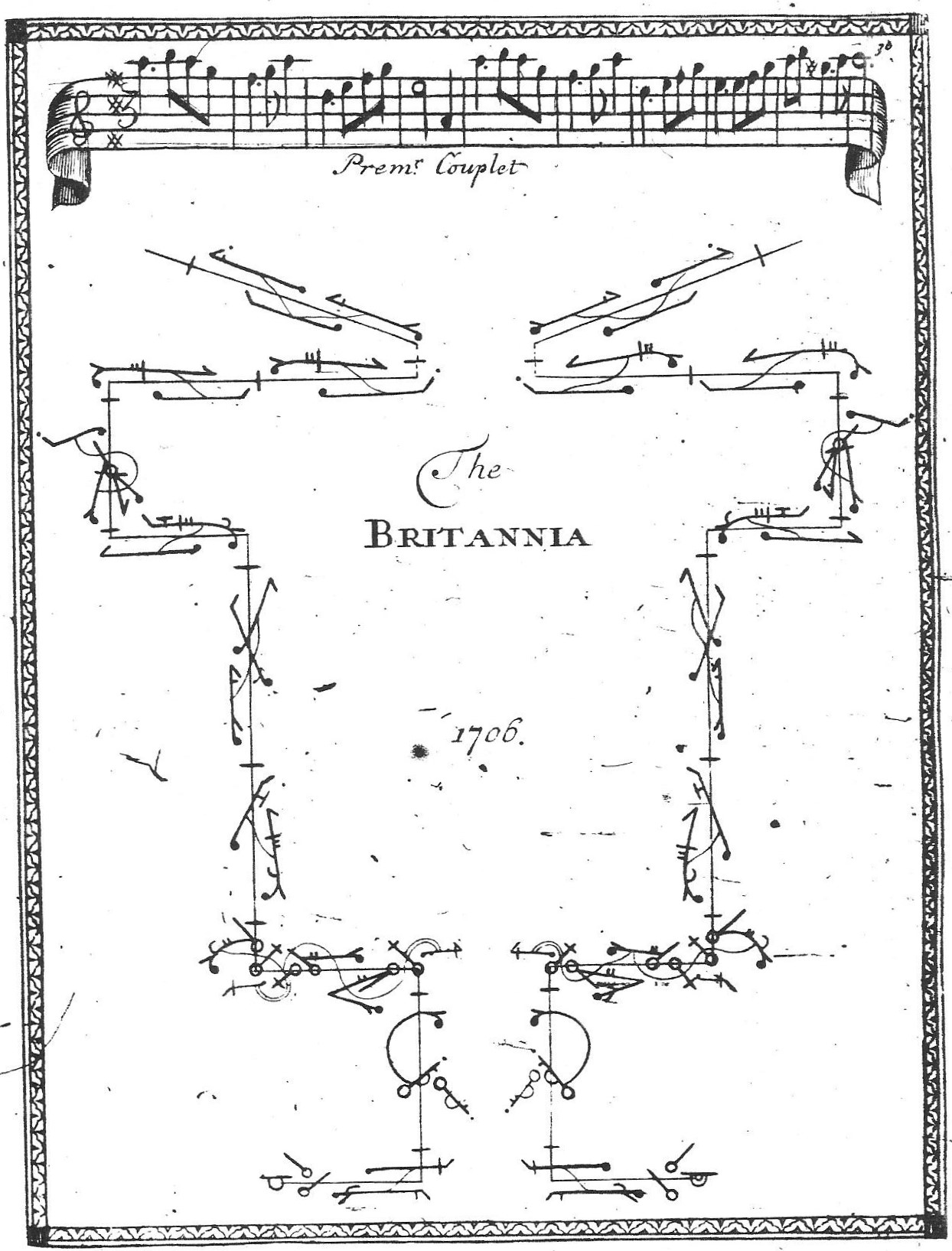
This order is confirmed by pagination in the top right-hand corner of each plate, although three of the dances – The Rondeau, The Favourite and The Spanheim – have additional individual paginations in the top left-hand corner of each of their pages. The Britannia is engraved in a different style from the rest of the choreographies, not only does it have a decorative border on its first plate but the notated steps have different profiles. These details raise questions about the compilation of the collection, which may have been brought together after some of the dances had been notated for separate publication. I hope to be able to discuss some of these possibilities when I look at the individual dances in later posts.

The dedicatee of A Collection of Ball-Dances perform’d at Court was Charles Lennox, 1st Duke of Richmond (1672-1723), the son of Charles II and his mistress Louise de Kérouaille, Duchess of Portsmouth. In his dedication to the Duke, John Weaver writes ‘from your Grace it was that I receiv’d the first encouragement in the Subscription towards this Undertaking, and all, or most of the following Dances, have been Honour’d with your Grace’s Performance’. This portrait by Sir Godfrey Kneller depicts the duke around the time the Collection was published.

Weaver suggests that Richmond had provided some financial support for the publication of the Collection, although his name does not appear in the list of subscribers. Was there another unpublished list of the royal and aristocratic contributors to the costs of publication?

There is also the question of which dances the duke had in fact performed. Weaver’s uncertainty (he writes ‘all, or most’) is perplexing. We know that Isaac was the creator of all six choreographies and he would surely have been able to provide Weaver with accurate information about their performers (Isaac and Weaver were close collaborators over some years). So, did the duke perform only some of the choreographies when they were first given at court, perhaps dancing others at private gatherings to which Isaac was not privy? Whichever ones he did dance, who did he partner?

According to evidence presented by the American dance historian Carol Marsh, in her 1985 thesis ‘French Court Dance in England’, the six dances in this collection may range in date of composition from 1690 to 1706. She draws on the publication date of the music for each dance to indicate when the corresponding choreographies might have been created (the resulting chronology does not relate to the order of the dances in the volume). Isaac’s ball dances thus belong to the court culture of William III and Mary II as well as the early years of Queen Anne. There was more dancing at court in the 1690s than many historians realise, which might also have implications for our understanding of dancing on the London stage during that decade.

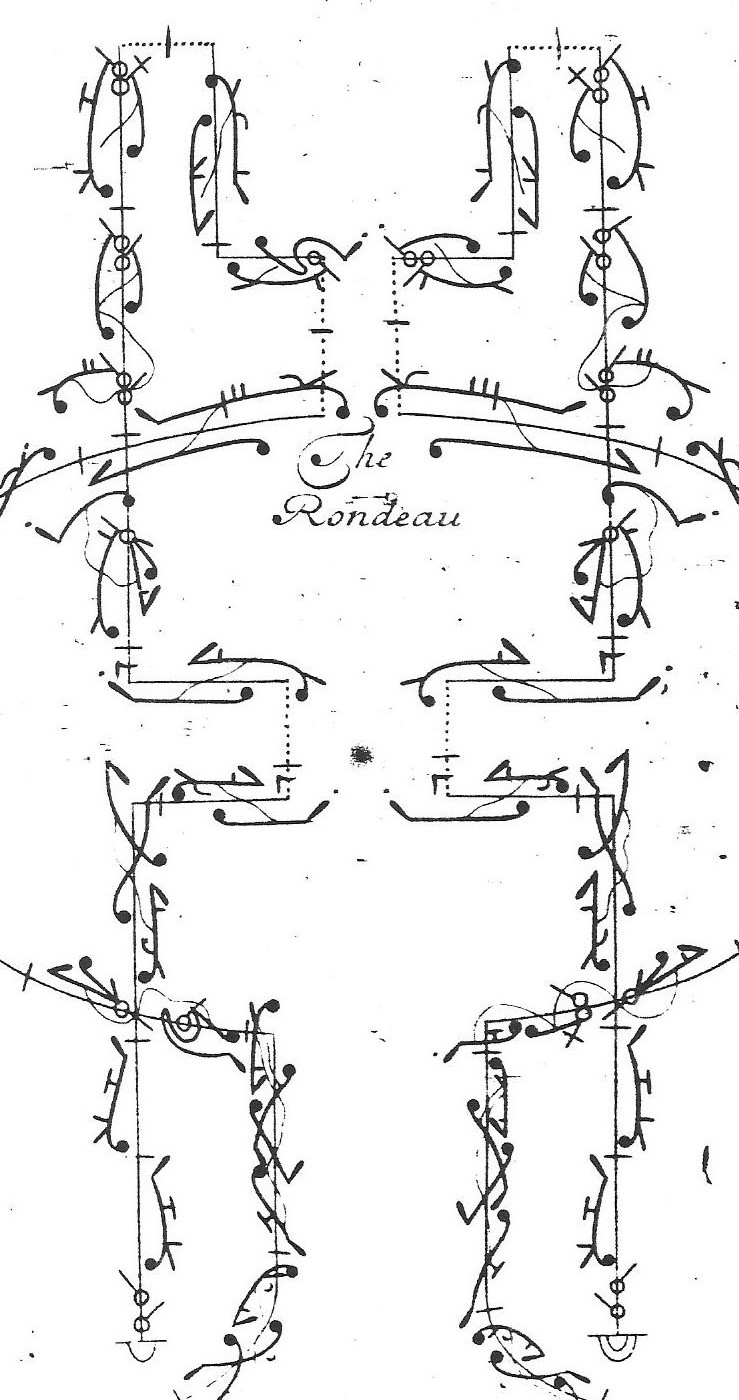
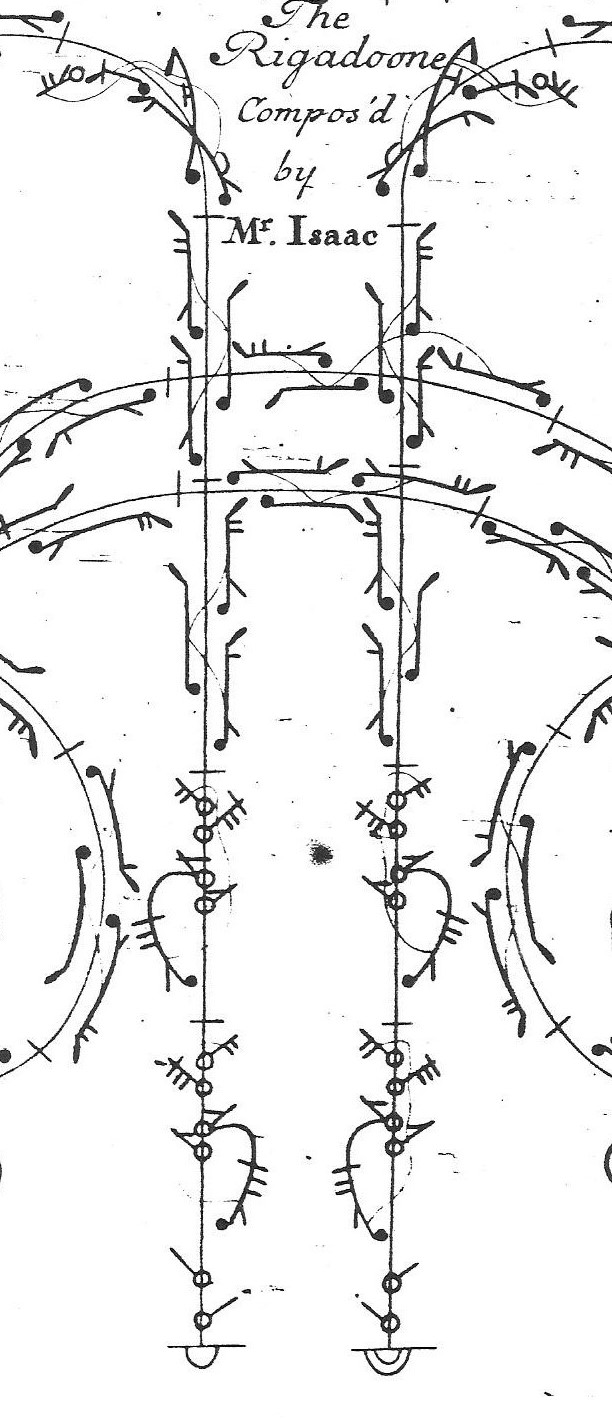
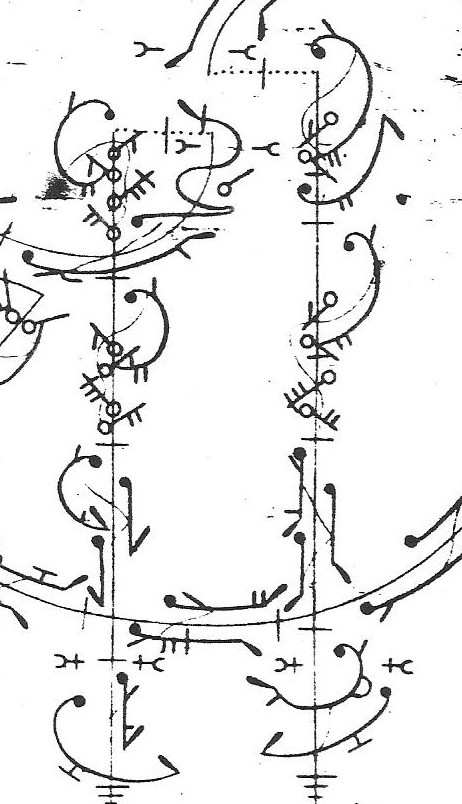
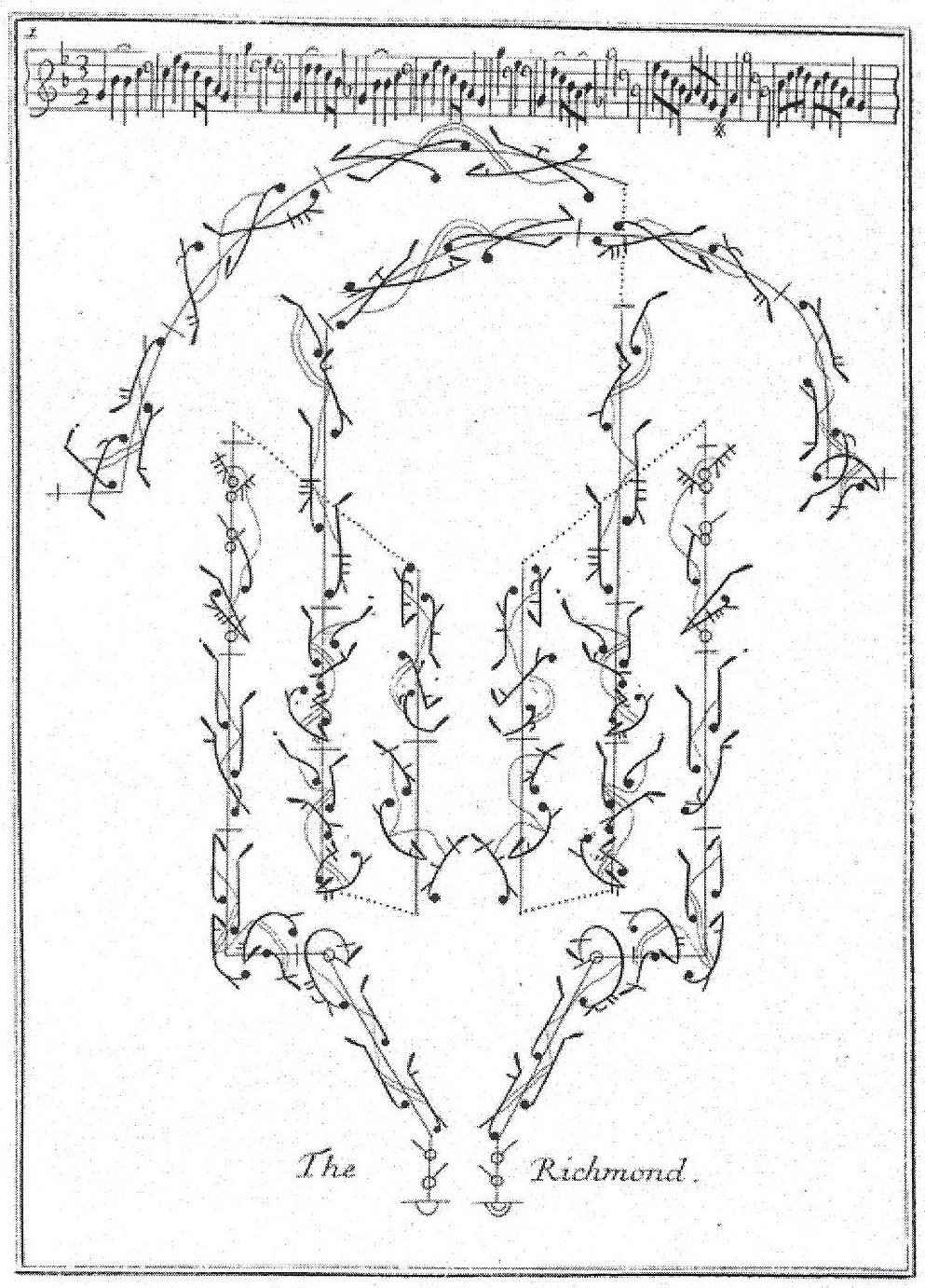
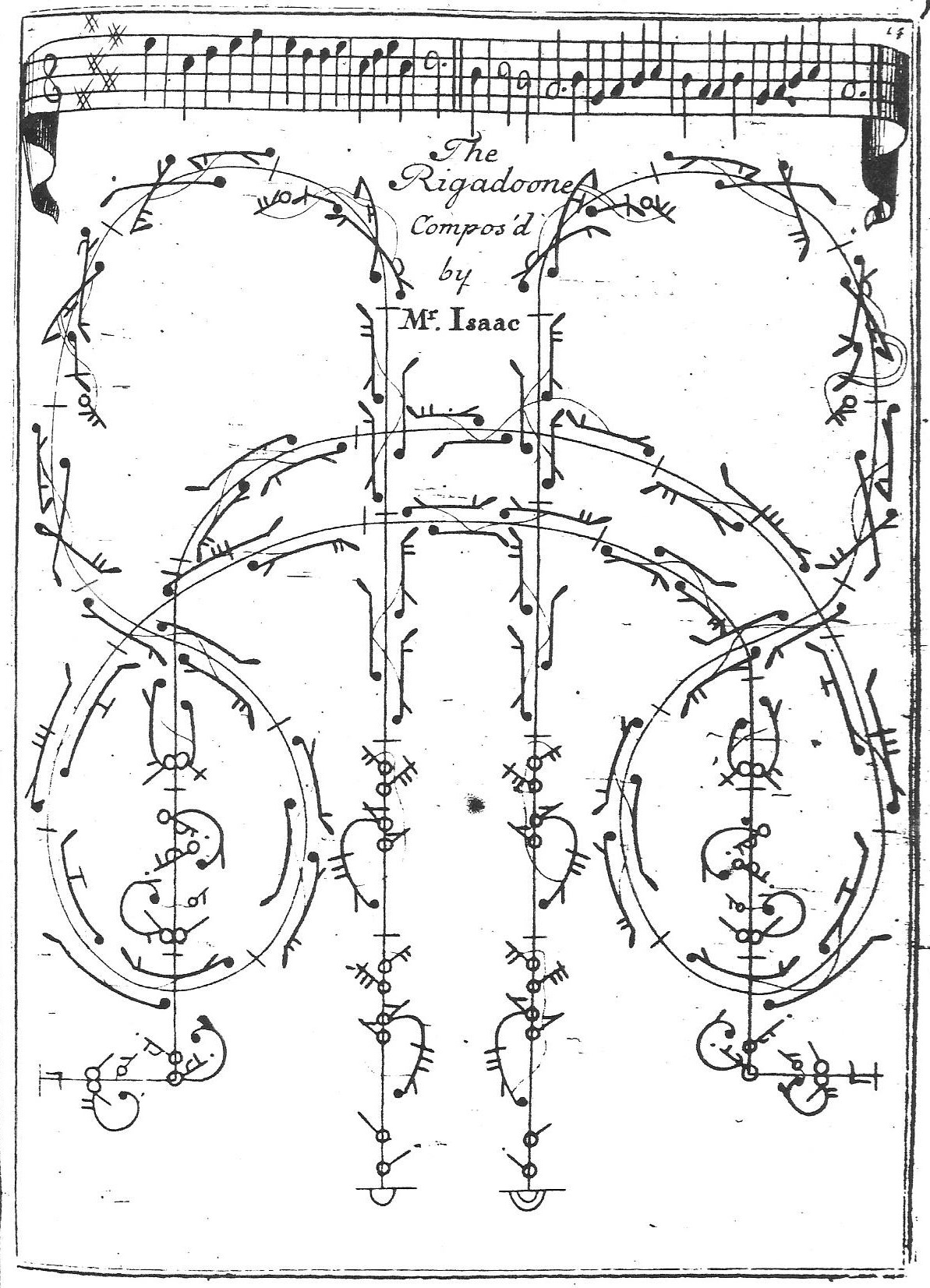
Isaac’s six dances have other features which are important for our understanding of ballroom dancing of the period. Here is a summary of basic information about each of the notated choreographies, in the order in which they appear in the Collection, together with an image of the first plate of notation.

The Richmond: 1695 or before. The music was published in The Self-Instructor (London, 1695). The dance is a hornpipe in 3/2, with the musical structure AABBCCDDEEFF’ (A=B=C=D=E=4 F= 8, F’=4 as a petit reprise), and has 52 bars of music.

The Rondeau: c1693. The music was published that year in the 7th edition of Apollo’s Banquet. The dance uses music in a slow 3 and duple time, with a concluding minuet. As the title suggests, the musical structure of the first part is AABACAA (A=B=C=8. A is the slow 3, B and C are in duple time). The musical structure of the minuet is also AABACAA (A=B=C=8, written in 3, i.e. 3/4 rather than 6/4). There are 112 bars of music in all.

The Rigadoon: c1695-1698. An alternative version of the music for Isaac’s choreography was published in Theatre Musick I in 1698 (there is no concordance for Weaver’s version). The dance is a rigaudon and was acknowledged as Isaac’s most famous choreography. The musical structure is AABB (A=4 B=6), played four times to provide 80 bars of music for the dance.

The Favorite: c1690 or earlier. The music was published in the 6th edition of Apollo’s Banquet in 1690, although it can also be found in the Deusiesme recueil des dances et contre-dances (Amsterdam, 1688). It is a chaconne followed by a bourrée. The chaconne has three variations (4+4 bars, 4+4 bars, 8+8 bars) and is played through twice. The bourrée is AABBB’ (A=B=8, B’=4 and is a petit reprise). In all the dance has 100 bars of music.

The Spanheim: may date between 1701 and 1705. The music was published in the Second Book of the Lady’s Banquet in 1706 and there was a country dance to the tune published in 1705. This dance is a gigue, with the musical structure AABBCCDD (A=4 B=6 C=4 D=6), which is repeated to give 80 bars of music.

The Britannia: this was the dance created for Queen Anne’s birthday on 6 February 1706. Although the music was published in 1706 by John Walsh and Joseph Hare together with other ‘new Minuets, Rigadoons, and French Dances, danced at Balls and publick Entertainments’, no copy of this is known to survive. This is another multi-partite choreography, beginning with a section in triple time, followed by a bourrée and then a minuet. The triple-time opening section has the musical structure AA (A=10). The bourrée is also AA (A=14), while the minuet has a rondeau structure AABACAA (A=B=C=8). The whole dance has 104 bars of music.

The music for The Britannia, along with that of many of the dances published after 1706, has been attributed to James Paisible, who may also have provided music for some of the earlier choreographies.

Over the years, I have performed The Richmond and The Favorite and I have worked on The Rondeau and The Rigadoon. I have never danced either The Spanheim or The Britannia, although I am looking forward to learning both of them in due course (albeit on my own, which makes analysis of these duets tricky).

There are another fifteen notated duets by Mr. Isaac, some of which can also be dated to the period between 1690 and 1706, although all were ostensibly first published after 1706. These begin with The Union of 1707 (another choreography I have danced) and end with The Morris of 1716 (a dance I hope to work on at a later date).

All of Isaac’s dances are challenging and even perplexing – as the above short descriptions of the six choreographies in the 1706 Collection suggest. They are very different in style (and even in technique) to the contemporary duets created by Guillaume-Louis Pecour. Were they the product of Isaac’s personal approach to choreography, or do they reflect the idiosyncrasies of English court dance in the French style? Isaac was part French and may well have trained in Paris (he certainly danced in some of the ballets given at the court of Louis XIV), which adds to the questions surrounding his dances. I will try to discuss each of these six dances in separate posts as and when I have done sufficient work on them. I have written on Isaac and some of his dances before and I give a list of these earlier posts below, for those who might be interested.

Earlier Posts

Isaac’s Rigadoon

Isaac’s Rigadoon: the Choreography

Reconstructing Isaac’s Rigadoon

Mr Isaac’s ‘The Favorite A Chaconne Danc’d by Her Majesty’

Further Reading

Carol Marsh, ‘French Court Dance in England, 1706-1740: a Study of the Sources’ (unpublished PhD thesis, City University of New York, 1985)

Meredith Ellis Little and Carol G. Marsh, La Danse Noble: An Inventory of Dances and Sources (Williamstown, 1992)

Jennifer Thorp, ‘Mr. Isaac, Dancing Master’, Dance Research, 24.2 (Winter, 2006), 117-137

Moira Goff ‘The testament and last will of Jerome Francis Gahory’, Early Music, 38.4 (November 2010), 537-542

Subscription Lists and London’s Dancing Masters: Kellom Tomlinson

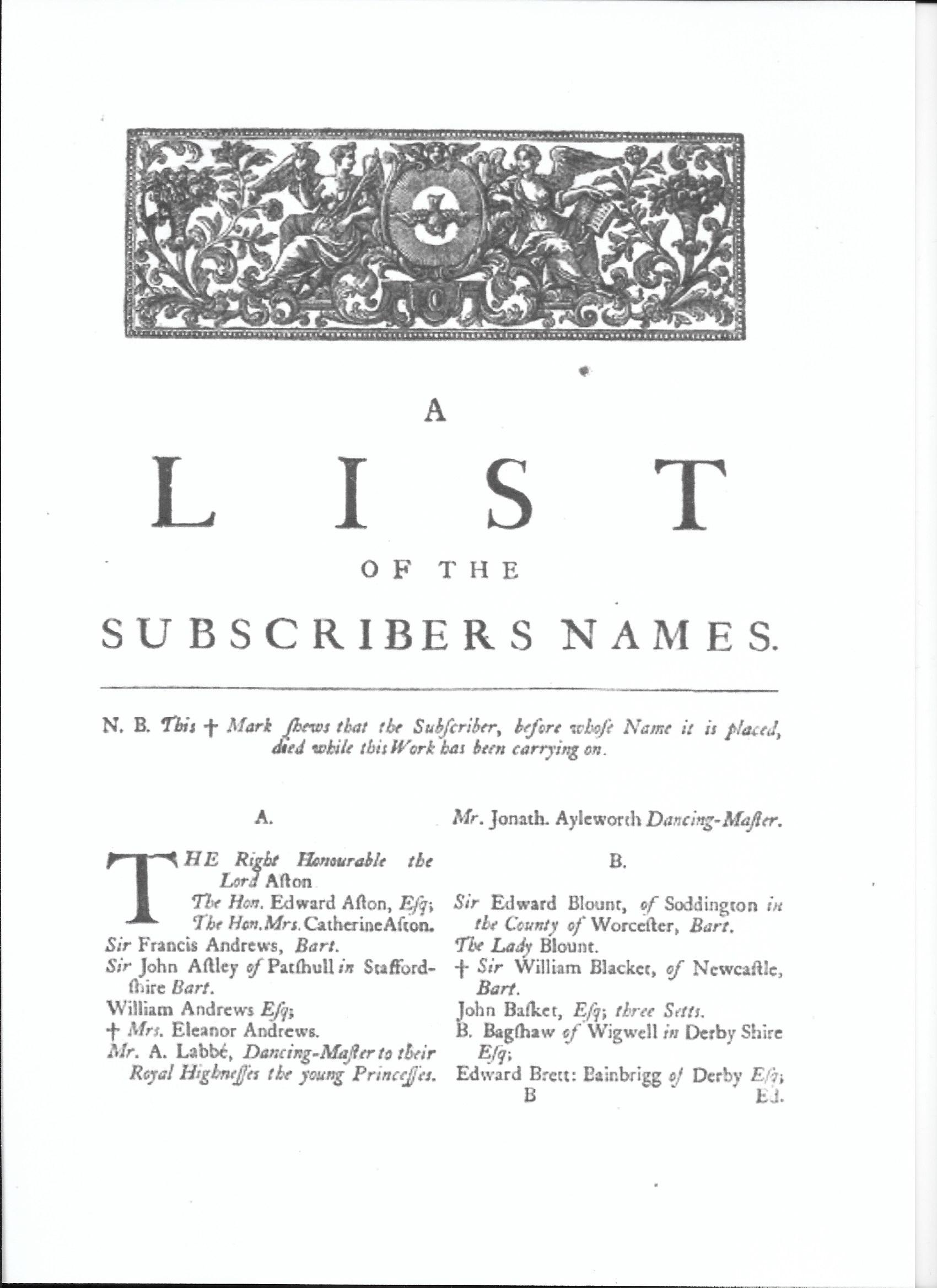
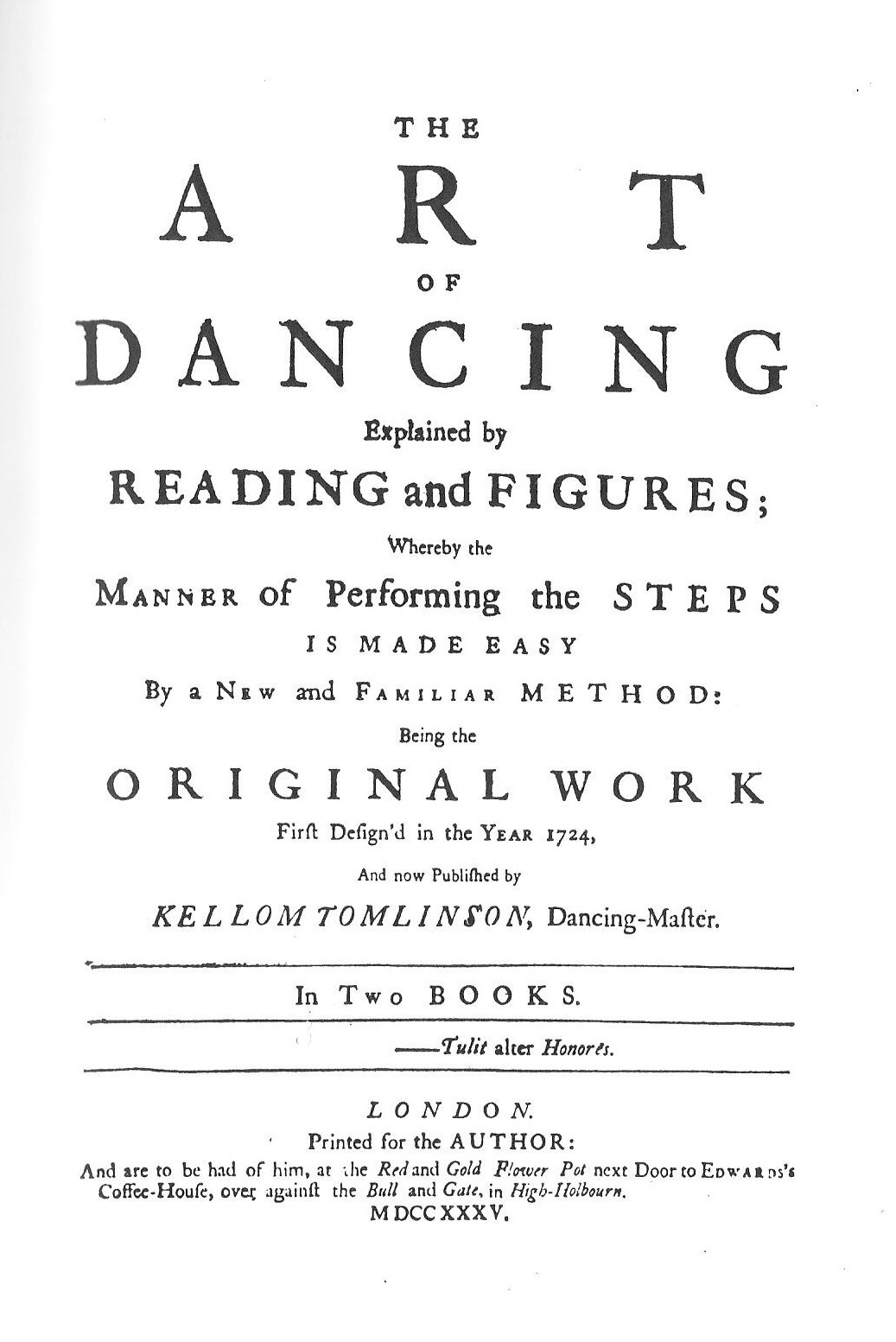
In some ways, the List of Subscribers to Kellom Tomlinson’s 1735 manual The Art of Dancing is the opposite to that for Anthony L’Abbé’s A New Collection of Dances. The publications are, of course, quite different from one another. Tomlinson’s manual of dancing is aimed at dancing masters and his, as well as their, pupils. L’Abbé’s collection of notated stage dances was surely intended for the far more specialised audience reflected by his subscribers, most of whom were professional dancers and dancing masters.

Kellom Tomlinson attracted 169 subscribers to L’Abbé’s 68, a third of whom were women (as I have pointed out, there were no female subscribers to L’Abbé’s collection). Tomlinson’s list ranges through dancing masters, nearly half of whom were (or had been) professional dancers on the London stage, as well as engravers, printers and booksellers, alongside members of the gentry and aristocracy. The gentry were predominant, accounting for around two-thirds of all the subscribers. Does this suggest the breadth of Tomlinson’s clientèle, or simply his ability to market his treatise (with or without actual teaching) to a significant number of pupils and their families? Here is the ‘List of the Subscribers Names’.
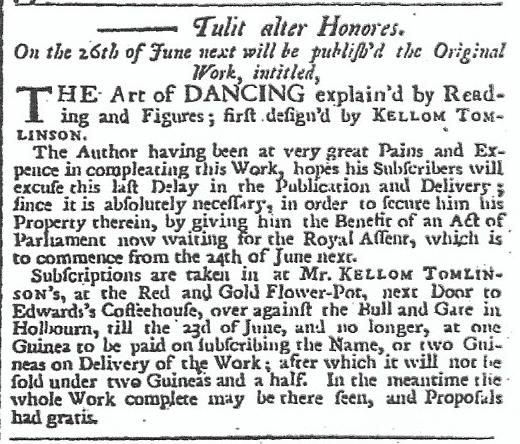
The publication history of The Art of Dancing is far from straightforward and despite a number of accounts of it (see the reading list below) still calls for fresh, detailed research. I looked at the rivalry between Tomlinson and John Essex, over the latter’s translation of Pierre Rameau’s Le Maître à danser, in my post The Dancing Master’s Art Explained: Pierre Rameau, John Essex and Kellom Tomlinson. Closer reading of Tomlinson’s advertisements suggests a number of issues I did not pursue there. In the context of this post, it is worth saying again that Tomlinson had first advertised for subscribers to The Art of Dancing in 1726, but publication of his treatise was deferred until 1735. Over that period of delay, twenty of his subscribers died, including Thomas Howard, 8th Duke of Norfolk (1683-1732) and the dancing master, notator and publisher Edmund Pemberton (d. 1733). In this post, I will not go through the List of Subscribers in detail but I will look at some of the identifiable groups as well as some of the individuals within it. Tomlinson dedicated most of his engraved illustrations to individual pupils and I will also look at one or two of these.

Within the context of subscribers to works by dancing masters, one group of particular interest is that comprised of other teachers of dancing. Twenty-two men in the list have the epithet ‘Dancing-Master’. Ten of them can readily be identified as professional dancers. L’Abbé is there, as is John Essex, P. Siris and John Weaver – all of whom had themselves published treatises, as well as notated dances and collections of dances. Thomas Caverley was a subscriber, too – hardly surprising since the treatise focusses on ballroom dancing and Tomlinson had been his pupil. Among those dancing masters still appearing professionally on the stage, Leach Glover stands out as one of the leading dancers at Covent Garden who would shortly succeed Anthony L’Abbé as royal dancing master. It is interesting that the other subscribers include John Rich, described as ‘Master of the Theatres Royal in Lincoln’s-Inn-Fields, and Covent-Garden’.

The female subscribers to The Art of Dancing include Mrs Booth, ‘the celebrated Dancer’. She had recently retired from the stage when the treatise was finally published, but may well have set down her name while she was still London’s leading female professional dancer. The list also has Mrs Bullock, ‘Dancer, at the Theatre in Goodman’s Fields’. Ann Bullock (née Russell) had begun her career around 1714 and by 1735 was in her final years on the stage. Like Mrs Booth, she had been among the dancers represented in L’Abbé’s choreographies in A New Collection of Dances in the mid-1720s.

Turning away from dancers and teachers of dancing, Tomlinson’s list includes five engravers. Two of them – George Bickham Junior and John Clark, are recorded as engravers who had worked on the plates added to The Art of Dancing. There were, in addition, two booksellers and a printer – Messieurs Knapton and Henry Lintot (who subscribed for three copies) were the booksellers and James Mechel was the printer. Were they involved in printing and selling Tomlinson’s manual? His title page says only ‘Printed for the Author’ and that it could be ‘had of him’ at his home address.

The feature that most clearly sets Tomlinson’s List of Subscribers apart from its predecessors is the number of individuals who may reasonably be assumed to have engaged him as a dancing master to teach them or their children. They make up around 80% of the whole list and many of them are identified with particular places, mostly in England. Tomlinson may well have taught the aristocracy in their London houses, but other evidence suggests that he travelled to their country seats and taught in the surrounding areas too.

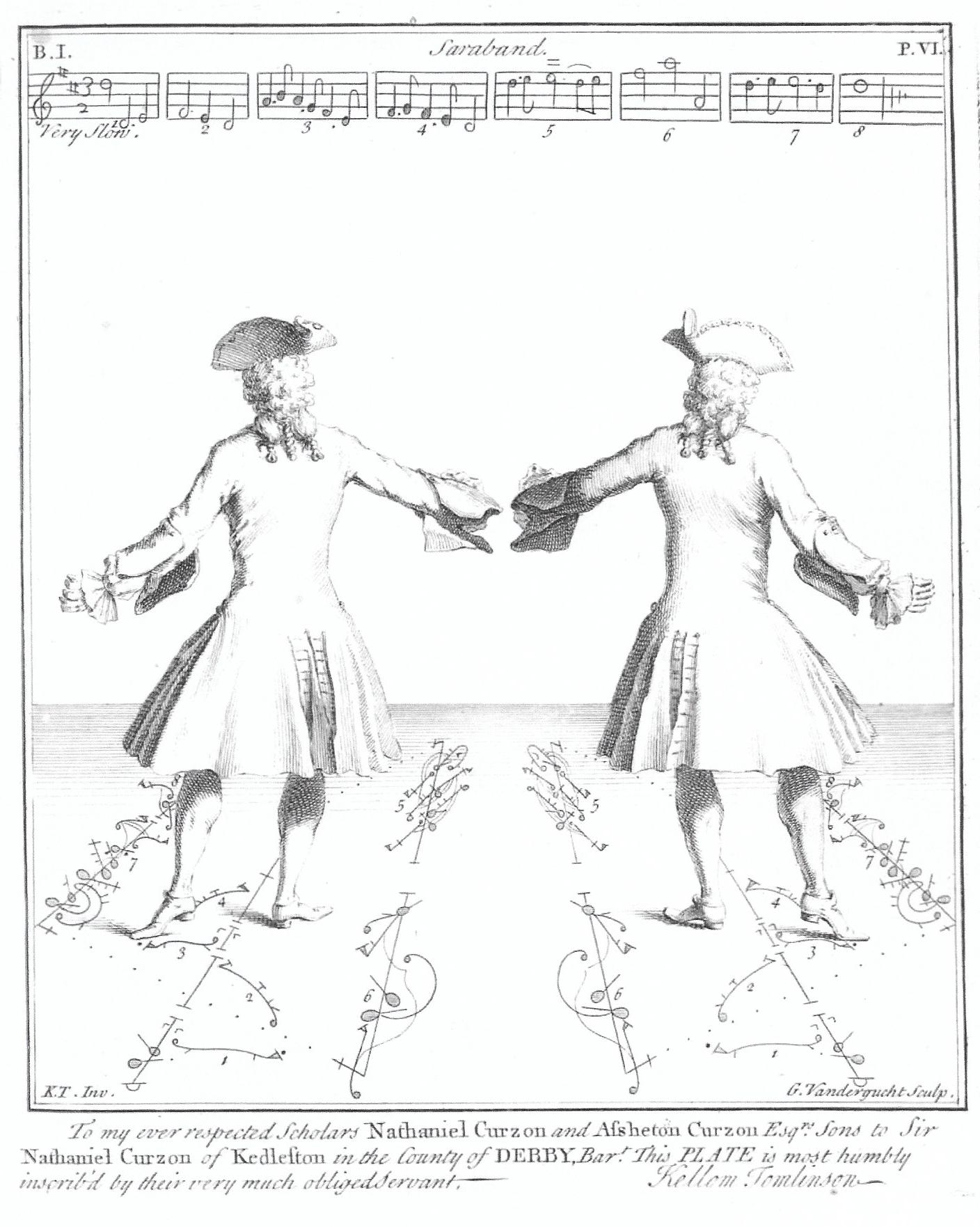
Among his subscribers is ‘The Lady Curzon of Kedleston in Derbyshire’ and plate six in book one is dedicated to ‘my ever respected Scholars Nathaniel Curzon and Assheton Curzon Esqrs. Sons to Sir Nathaniel Curzon of Kedleston’.

Lady Curzon was Mary (née Assheton), wife of Sir Nathaniel 4th Baronet Curzon and the mother of the two boys. This portrait of her with them, by Andrea Soldi and painted around 1738 to 1740 a few years after the publication of The Art of Dancing, hangs at Kedleston.

Tomlinson’s plate was not intended to portray the two boys themselves, who in 1735 were only nine and six years old. As he declared in his Preface to The Art of Dancing:

‘The Figures in each Plate are designed only to show the Postures proper in Dancing, but not to bear the least Resemblance to any Person to whom the Plate is inscribed.’

Did Tomlinson use dancers as models for these images (which he ‘invented’ himself) and, if so, who might they have been?

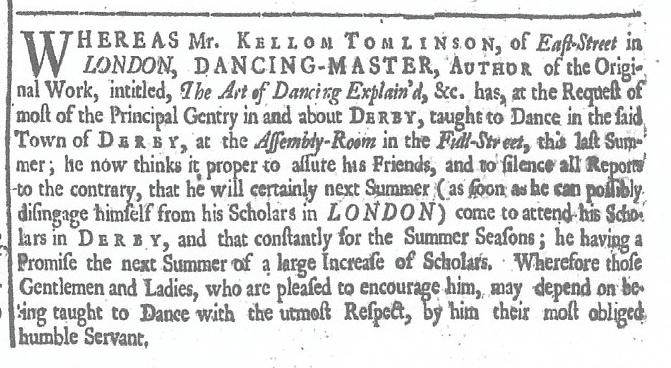
A chance discovery, made a few years ago in the course of another line of research, provides additional evidence of Tomlinson’s assiduous use of advertising to further his career as a dancing master. An advertisement in the Derby Mercury for 12 December 1734, shows that he had been teaching ‘in and about’ Derby (and so in the vicinity of Kedleston).

He must also have been teaching the young Nathaniel and Assheton Curzon at Kedleston in the summer of 1734. Was that when he secured a subscription from Lady Curzon of Kedleston, or had his teaching and her patronage begun earlier in London? It is surely significant that another ten of the subscribers to The Art of Dancing describe themselves as being ‘in and about’ Derby. Tomlinson evidently established an ongoing professional relationship with the area, for he was still advertising in the Derby Mercury as late as 1756 (Tomlinson died in 1761). This advertisement is dated 11 June 1756:

Kellom Tomlinson has been the subject of research, as the reading list below shows, but I can’t help thinking that there is far more work that can be done on him, The Art of Dancing and his various circles of patrons and pupils.

Reading list:

Carol G. Marsh, ‘French Court Dance in England, 1706-1740: A Study of the Sources’ (unpublished PhD thesis, City University of New York, 1985), see pp. 11-121, 150-155.

A Work Book by Kellom Tomlinson, ed. Jennifer Shennan (Stuyvesant, NY, 1992)

Jennifer Thorp, ‘“Borrowed Grandeur and Affected Grace”: Perceptions of the Dancing-Master in Early Eighteenth-Century England’, Music in Art, XXXVI, no. 1-2 (Spring-Fall 2011), 9-27 (see pp. 18, 20-21)

Jennifer Thorp, ‘Picturing a Gentleman Dancing Master: A Lost Portrait of Kellom Tomlinson’, Dance Research, 30.1 (Summer 2012), 70-79 (see pp. 74-76)

Subscription Lists and London’s Dancing Masters: Anthony L’Abbé

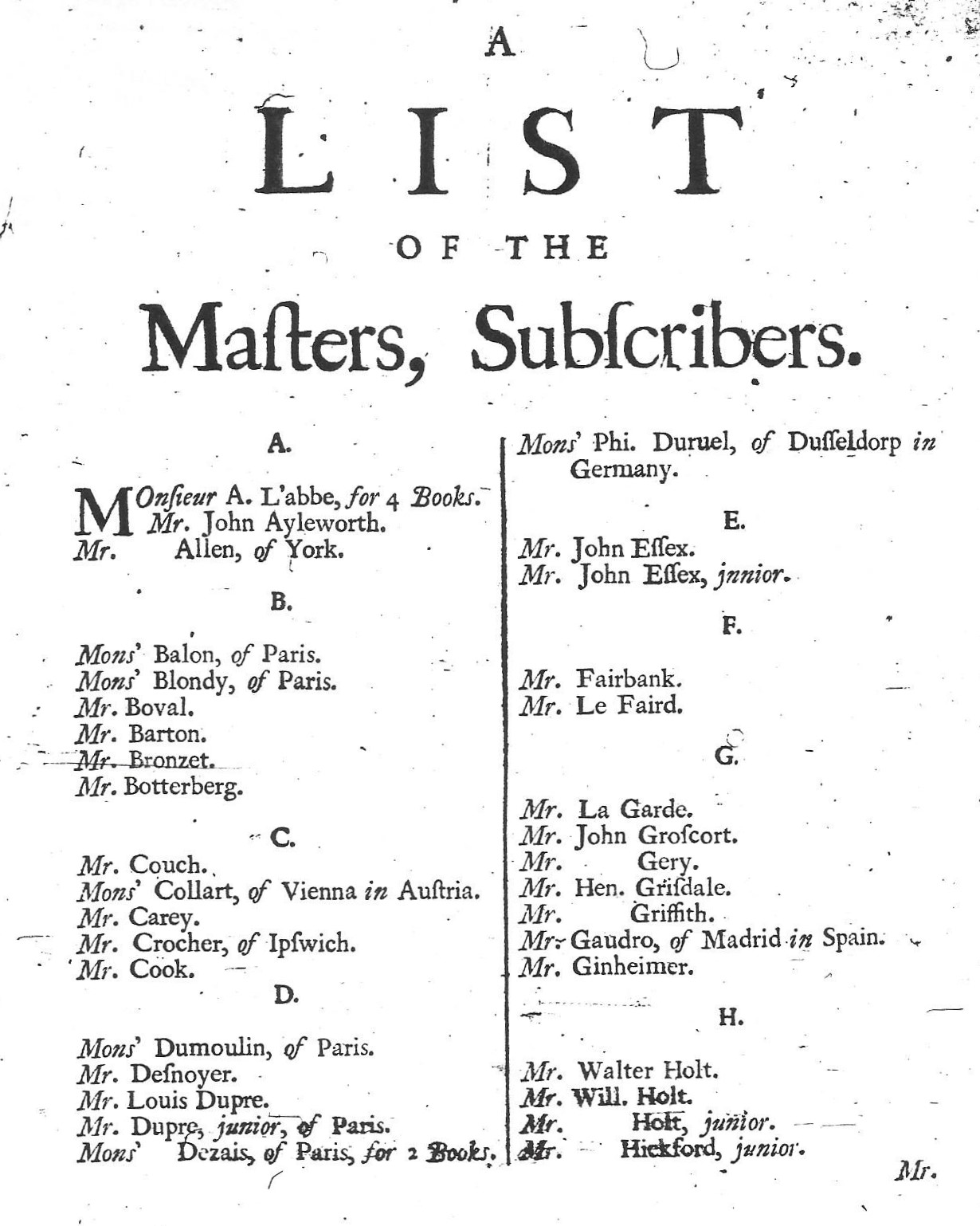
Around 1725, Le Roussau published A New Collection of Dances – thirteen choreographies ‘That have been performed both in Druy-Lane [sic] and Lincoln’s Inn Fields, by the best Dancers’ created by Anthony L’Abbé and notated by Le Roussau himself. The dancers were named on the title page as Ballon, L’Abbé, Delagarde, Dupré and Desnoyer with Mrs Elford, Mrs Santlow, Mrs Bullock and Mrs Younger. All were leading dancers in London’s theatres. The collection provides a series of snapshots of stage dancing in London between 1698 and 1722. It also gives us an insight into the world of professional dancers and dancing masters, through the ‘List of the Masters, Subscribers’ which precedes the notated dances. They are the individuals who made publication possible by paying in advance for the printed copies.

The list of subscribers is on two preliminary pages and has 68 names.

All five of the male dancers represented among the notated choreographies subscribed, but not one of the women – there are no female subscribers to this collection. Given the popularity with audiences of the professional female dancers named on the title page, that absence is worth further investigation. Was it to do with their status within the dance worlds of Britain, France and Europe? Was it that they didn’t teach (or weren’t known as teachers, even if they did)? Were they excluded from learning and using Beauchamp-Feuillet notation? I can’t readily answer any of those questions, but this subscription list reveals the need for a great deal more research and much discussion about the 18th-century dance world.

Of the 68 male subscribers, 48 were British and apparently based in London, six were from English provincial towns and cities, seven were French and five were based elsewhere in Europe. L’Abbé himself subscribed for four copies, while Dezais (Feuillet’s successor as the publisher of notated dances in Paris) took two – the same as Edward Lally (who may have been the seasoned dancing master Edmund Lally, rather than the young Edward Lally – probably his son – just beginning to make a name for himself on the London stage), and John Shaw who was one of London’s leading professional dancers. Shaw died young in December 1725, providing an end date for the publication of L’Abbé’s Collection. It is interesting that, although he had been trained by the French dancer René Cherrier and assuredly had a mastery of French dance style and technique, Shaw was not one of the Collection’s male dancers. They were all French, by ancestry if not nationality. Even more interesting is the fact that all the female dancers were British.

The list of subscribers includes ‘Mr. Edw. Pemberton’, probably Edmund Pemberton, the notator and publisher of L’Abbé’s ballroom dances many of which were created for the Hanoverian court to which L’Abbé was dancing master. L’Abbé’s list overlaps with that of Pemberton’s 1711 An Essay for the Further Improvement of Dancing (which includes a solo version of L’Abbé’s passacaille to music from Lully’s opera Armide). Pemberton’s dedicatee Thomas Caverley did not subscribe to L’Abbé’s theatrical choreographies, perhaps because – although he was a champion of dance notation – he was dedicated to the teaching of amateurs and ballroom dancing. Among the other English dancing masters who were L’Abbé’s subscribers were Couch, Essex, Fairbank, Groscourt, Gery, two members of the Holt family, Shirley and John Weaver. All supported both Pemberton’s and L’Abbé’s collections.

A handful of London’s other male professional dancers also subscribed – Boval, Newhouse, John Thurmond and John Topham, who were to be seen dancing varied repertoires at Drury Lane and Lincoln’s Inn Fields. We don’t know how much it cost to purchase L’Abbé’s A New Collection of Dances by subscription, but Le Roussau’s title page advertised copies at 25 shillings (around £145 today). Was this within the means of such dancers, some of who were definitely below the top ranks? Was their interest in the notations chiefly to aid teaching, or might they have drawn upon these when creating new choreographies for their own use?
John Weaver had been the first London dancing master to publish by subscription, with Orchesography (his translation of Feuillet’s Choregraphie) in 1706. Among the subscribers to L’Abbé’s Collection several had subscribed to one or more of the three works published in that way by Weaver (the others were A Collection of Ball-Dances by Mr Isaac, also in 1706, and Anatomical and Mechanical Lectures upon Dancing in 1721). A few – Essex, Walter Holt and Pemberton – subscribed to all five of the treatises published by subscription between 1706 and 1735. The last to appear was Kellom Tomlinson’s The Art of Dancing, which he must have been planning if not writing close to the time when L’Abbé’s Collection was published, to which he subscribed.

Apart from a few continental dancers working in London’s theatres, there were no European subscribers to any of the dance treatises published in London – except for L’Abbé’s Collection, which had seven subscribers from Paris and five from elsewhere in Europe. Among the Parisians, I have already mentioned Dezais. His name is the only one that would be unfamiliar to non-specialists with an interest in dancing during the 18th century. Claude Ballon and Michel Blondy were close contemporaries of L’Abbé, as well as being leading dancers at the Paris Opéra from the 1690s and distinguished teachers of dancing. Ballon’s ballroom dances were published by Dezais. Dumoulin may well be David Dumoulin, the most celebrated of the four brothers who all pursued dancing careers at the Paris Opéra. He was noted for his mastery of the serious style. Like François Marcel, he was from a younger generation of dancers. He made his Opéra debut in 1705 followed by Marcel in 1708. Marcel was also making a reputation as a teacher. It is very unlikely that ‘Mr. Dupre, junior, of Paris’ was Louis ‘le grand’ Dupré, in fact he may have been related to London’s Louis Dupré the dancer in four of L’Abbé’s choreographies in the Collection.

The ’Mons. Pecour’ listed must have been Guillaume-Louis Pecour, ballet master at the Paris Opéra. His dancing career reached back to the early 1670s. L’Abbé’s A New Collection of Dances emulates the Nouveau Recüeil de Dance de Bal at Celle de Ballet notated and published by Gaudrau around 1713. Gaudrau’s collection of Pecour’s ballroom and stage choreographies has nine ballroom dances and thirty theatrical dances, to Le Roussau’s thirteen stage dances by L’Abbé. Gaudrau, ‘Mr. Gaudro, of Madrid in Spain’ is among L’Abbé’s subscribers. There is also ‘Mons’ Phi. Duruel, of Dusseldorp in Germany’ – John-Philippe Du Ruel had danced in London between 1703, when he was billed as ‘from the opera at Paris’ and described as a ‘Scholar’ of Pecour, and 1707, the year he danced at court for Queen Anne’s birthday celebrations. It seems likely that he was the dancing master based in Dusseldorf by the mid-1720s.

The subscription list to A New Collection of Dances surely represents L’Abbé’s own circle of dancers and dancing masters – those he knew and who knew him and his work. There were the men L’Abbé must have danced alongside at the Paris Opéra, as well as those he had worked with both onstage and off over the twenty years and more that he had been in London. What about the English provincial dancing masters and those in Europe? Did they know L’Abbé or did he know them, by reputation at least? Were they invited to subscribe and by whom? Did some of those who were more closely associated with L’Abbé act as intermediaries in this process? As you can see, I have rather more questions than answers about this particular list of subscribers.

Money for Entrechats: Valuing the Virtuosic Male Dancer – Delagarde and Dupré

The second male duet in L’Abbé’s New Collection of Dances is the ‘Canaries performd’ by Mr La Garde & Mr Düpré’. Here is the first plate of the notation.

The dance probably dates to the 1714-1715 London theatre season, the only period when the two dancers were in the same company and are known to have danced together. This duet was performed during a period of peace with France following a long and debilitating war, as the War of the Spanish Succession had finally ended in the spring of 1713 with the Treaty of Utrecht. More significant, in 1714 Queen Anne died and was succeeded by the Elector of Hanover as George I. The new King arrived in England on 18 September and was crowned on 20 October 1714. One outcome of the change of dynasty was the renewal of theatre rivalries, when the King allowed John Rich to open a playhouse in Lincoln’s Inn Fields and provide fresh competition for Drury Lane. Rich very quickly revealed his entrepreneurial flair and a predilection for singing and dancing alongside the usual fare of comedies and tragedies. ‘Entertainments’ were a feature of his opening bill on 18 December 1714, and several dancers were billed by name for the performance on 22 December. Like Thomas Betterton (with whom he otherwise had little in common), Rich was interested in French opera and French dancers. Over his years as a playhouse manager he would engage a series of French dancers as a draw for audiences.

Charles Delagarde was born in 1687 or 1688 and first appears in a bill for the Queen’s Theatre on 12 December 1705, performing in a Grand Dance led by Anthony L’Abbé. This was probably not his first performance on the London stage. John Essex tells us:

‘Mr. L’Abbe bred up Mr D’ la Garde, who maintained the genteel Part of Dancing upon the Stage many years after his Master, and with great Honour supported the Character the World had long before entertained of Mr. L’Abbe

Mr. D’ la Garde was happy enough in his Comic Performances, but more graceful and pleasing in the Serious.’

His career is hard to trace in detail, but Delagarde spent some years at the Queen’s Theatre as a dancer and dancing master for the opera there. The bill for Lincoln’s Inn Fields on 1 January 1715 offered dancing ‘By de la Garde, who has not appear’d these six years’, which was not true as he had appeared at Drury Lane as recently as 2 May 1712. His repertoire in his first season with the new company ranged from a Spanish Entry to a Dutch Skipper. Delagarde remained at Lincoln’s Inn Fields until 1718-19, after which he retired from the stage. His value to the company and appeal to audiences is shown by the receipts at his benefit performance on 2 April 1715. His was the sixth performer’s benefit of the season and the first given to a dancer and pulled in £119. 8s. (equivalent to around £13000 today).

Louis Dupré’s origins and background are still to be discovered, although it has long been known that he was not ‘le grand’ Dupré who enjoyed an exceptionally long and successful career at the Paris Opéra. Dupré was apparently first engaged by Rich, for the 1714-1715 season marks the beginning of his career in London. Essex does not mention him, but he seems to have been a versatile dancer with a repertoire that ranged from a solo Harlequin dance to the exceptional technical demands of the solo ‘Chacone of Amadis’ which also appears in L’Abbé’s New Collection of Dances. He danced at Lincoln’s Inn Fields for most of his career, and died around 1735. Dupré’s benefit on 7 April (the eighth performer’s and second dancer’s benefit) brought in £121.5s (equivalent to around £13500 today) making it just a little more successful than Delagarde’s. Sadly, there are no known portraits of either Dupré or Delagarde.

It is worth trying to put these benefit earnings into a wider context. For both Delagarde and Dupré, these are the highest benefit receipts recorded for them (although there are a number of their benefit performances for which we do not have such figures). From this period, we only have accounts for Rich’s Lincoln’s Inn Fields Theatre – there is nothing comparable for Drury Lane, so we cannot compare the dancers at the two theatres. At Lincoln’s Inn Fields, the highest benefit earnings in 1714-1715 were for the actor Theophilus Keene, whose receipts amounted to £170.1s (around £18000 today) while the actress Frances Maria Knight gained £141.1s (around £15500) and the singer Richard Leveridge received £133.14s (around £14800). It is worth looking more closely at the benefit earnings of dancers around this time – I hope to do this in a later post. Ballon’s 500 guineas were for a five-week engagement (although we do not know how often he performed) and these benefit figures of some fifteen years later provide another perspective on his earnings.

Returning to the ‘Canaries’ duet, this is a dance in 6/8 similar to a gigue but faster. As a fast dance, it was quite popular as a showcase for male dancers. Three ‘canary’ male duets were published in notation. The other two were Feuillet’s ‘Canary à deux’ for two unnamed men to music from an unknown source, published in 1700, and Pecour’s ‘Canary pour deux hommes’ for Piffetot and ‘Chevrier’ (probably the dancer René Cherrier) to music from Desmarest’s opera Didon, published in 1704. L’Abbé’s choreography has 48 bars of music, taken from act five scene three of Lully’s 1677 opera Isis, and a musical structure AABBAABB (A=4 B=8).

The duet opens conventionally with the two men side by side upstage, standing in third position ready to step forward on the outside foot. As with the ‘Loure or Faune’ the choreography uses mirror symmetry throughout. The speed of the dance allows for less ornamentation, but even so around 40% of the steps have turns, some 30% incorporate beats and about 10% have other embellishments like pas glissés or ronds de jambe. Unlike the earlier dance, the ‘Canaries’ has some repetition of steps or phrases, particularly at the beginning and near the end. There are the usual virtuosic steps, such as assemblé battu en tournant, with a full turn in the air and an entrechat-six, and pirouettes, one of which has a full turn with beats while the other has one-and-a-half turns without embellishment. Other steps are featured, for example the pas tortillé or ‘waving step’ in which the dancer uses toe and heel swivels to move from turned-out to parallel positions and back again. Parallel positions of the feet were described as ‘Spanish’ so their inclusion here is perhaps a nod to the earlier history of the canaries. There are several cabrioles, including a soubresaut (a vertical jump in fifth position) with a cabriole followed immediately by an assemblé battu. Here is the third plate of the duet, with pas tortillés as well as the assemblé battu en tournant with its additions. These virtuoso steps are interspersed with plain pas de bourée and a demi-contretemps.

The dance ends with a demie cabriole en tournant un tour en saut de basque – a jump with a turn, a beat in the air and a final step forward. The men end on the same side as they began the dance.

We do not know when or where this choreography was performed, although there was a performance at Lincoln’s Inn Fields which seems particularly appropriate. On 10 March 1715, the King ‘honour’d that House [Lincoln’s Inn Fields] with his presence the first Time since they open’d’. Delagarde and Dupré were both billed to appear. Could they have performed the ‘Canaries’ for Britain’s new monarch?

The ‘Loure or Faune’ and ‘Canaries’ duets in L’Abbé’s New Collection of Dances highlight the virtuosity attained by male professional dancers in the years around 1700. They provide an insight into their power, speed and dexterity and show the intricacy of the ornamentations they were expected to master. The male repertoire of the early 1700s, which has so far been little studied by dance historians, makes demands that go well beyond the technique expected of professional female dancers at the time (at least that is what the notated dances suggest). The vocabulary of steps depends on male strength, of course, but much of the embellishment is located in the lower leg and male legs were clearly visible (as the portraits of Ballon demonstrate). Alongside the sheer physical display of such dancing, ‘Frenchness’ was obviously a key component of its appeal. France led Europe in dancing, whether in the ballroom or on stage, as the notated dances testify, and French ballet and opéra-ballet were widely influential, even in London where French opera never found favour. Despite the late 20th-century focus on the leading female dancers at the Paris Opéra and elsewhere, the men were the real stars at this period.

Does the difference in the monetary values set on the individual male dancers discussed in these two posts reveal something other than the initial shock of the new and its waning with the passage of time? L’Abbé obviously benefitted from being the first leading French dancer of his generation to visit London. He went on to a successful career there and became a widely admired and respected royal dancing master. Ballon made a far greater and longer-lasting impact in one short visit. He seems to have had something extra, which justified the extravagance lavished upon him. He undoubtedly had the style and technique to amaze audiences, but he surely had more – a glamour and sheer physical allure that bewitched those who saw him and persuaded those who hadn’t that no price was too high for the privilege.

This post was originally the second section of a conference paper, given several years ago but never published, which I have revised.

Reading List:

Moira Goff, ‘John Rich, French Dancing, and English Pantomimes’ in Berta Joncus and Jeremy Barlow (eds) “The Stage’s Glory” John Rich, 1692-1761 (Newark: University of Delaware Press, 2011), 85-98.

Moira Goff, The Incomparable Hester Santlow (Aldershot: Ashgate, 2007).

Moira Goff, ‘The “London” Dupré’, Historical Dance, 3.6 (1999), 23-6.

Anthony L’Abbé, A New Collection of Dances. Originally published by F. Le Roussau London c.1725 (London, 1991).

F. Le Roussau, Chacoon for a Harlequin (London: Le Roussau, [1729?]).

Pierre Rameau, trans. John Essex, The Dancing-Master (London, 1728), The Preface.

Money for Entrechats: Valuing the Virtuosic Male Dancer – L’Abbé and Ballon

Anthony L’Abbé’s A New Collection of Dances Containing a Great Number of the Best Ball and Stage Dances, published around 1725, was dedicated to George I. It brought together in Beauchamp-Feuillet notation thirteen choreographies, almost all of which were described as having been performed by London’s leading professional dancers. At the time of publication, L’Abbé was dancing master to the King’s granddaughters. He had been a dancer as well as a choreographer, working both at the Paris Opéra (where he began his career) and in London’s theatres. The first dance in the New Collection was a ‘Loure or Faune performd’ before his Majesty King William ye 3d bÿ Monsr Balon and Mr L’abbé’. The details in the head-title suggest that the dance had been performed in 1699, the year that Claude Ballon (a leading male dancer at the Paris Opéra) had come to London for the first and last time. Ballon had apparently been able to command a fabulously high fee for his London appearances. The writer and collector Narcissus Luttrell recorded that ‘Monsieur Ballon, the famous French dancing master, … having leave to come hither for 5 weeks, is allowed by the playhouse 400 guineas for that time, besides which the Lord Cholmley has sent him a present of 100 more’. Ballon was obviously exceptionally highly valued as a performer (500 guineas is the equivalent of around £60,000 now), but what was the playhouse management and the audience paying to see? The all-male duets and male solos in L’Abbé’s New Collection of Dances (six choreographies in all) provide evidence of the spectacular virtuosity of leading male dancers in the early eighteenth century, which was obviously part of their appeal. Here I will look at the skills and rewards of Ballon and L’Abbé. In a second post, I will look at Delagarde and Dupré who were dancing in London’s theatres a few years later and fared somewhat differently.

The ‘Loure or Faune’ was performed against a complex background of international and cultural politics, extending from Anglo-French diplomacy surrounding the succession to the Spanish crown to rivalries between London’s theatre companies. Anthony L’Abbé first came to dance in London in May 1698 at the invitation of Thomas Betterton, the leading actor of the recently formed company at Lincoln’s Inn Fields Theatre which was in fierce competition with the rival company at Drury Lane. Only one of L’Abbé’s London performances was recorded, in the Post Boy for 14-17 May 1698:

‘On Friday night last [13 May] there was fine Dancing at Kensington, where his Majesty was present,  as also his Excellency the French Ambassador: The Frenchman, who is lately come over and Dances now at the Play-house, was sent for to dance there, and performed his part very dexterously.’

‘Kensington’ was, of course, Kensington Palace, where the performance took place before King William III and the Comte de Tallard, who had been sent to London by Louis XIV for negotiations to agree a successor to the Spanish King Carlos II whose death without issue was expected imminently. Both England and France were war-weary following the conclusion of the Nine Years War with the Treaty of Ryswick in September 1697. The visits of both L’Abbé and Ballon occurred during the few years of peace when French cultural leadership in Europe could be readily acknowledged and enjoyed, before hostilities between the two countries resumed in May 1702 with the War of the Spanish Succession.

Anthony L’Abbé was born in 1666 or 1667 and made his debut at the Paris Opéra in 1688. It is difficult to trace his repertoire there over the next ten years, in the absence of complete cast lists for many productions, but he is recorded as dancing in Lully’s Cadmus et Hérmione in 1690 and in Lully and Molière’s Le Bourgeois gentilhomme in 1691. He undoubtedly danced in several other productions as well during that period, and his appearance at Kensington Palace was in a divertissement entitled Le Palais des Plaisirs which was essentially a pastiche of scenes from Lully’s operas. According to an analysis of a rare surviving copy of the livret, the entertainment included scenes from Lully’s Le Carnaval Mascarade (1675), Armide (1686) and Roland (1685) with a cast of both English and French singers and dancers. L’Abbé pleased spectators in two dances from Le Carnaval Mascarade, first as a Spaniard in an Italian Night Scene alongside characters from the commedia dell’arte and then (in the final scene of the entertainment) as the leader of six Matassins. These roles suggest that L’Abbé’s technical virtuosity was to the fore. The dancing master John Essex (who may well have seen L’Abbé on the London stage at this time) later wrote that ‘His Talent chiefly lay in the grave Movement, and he excelled all that ever appeared on the English Stage in that Character’, again alluding to L’Abbé’s virtuosity. There is no way of knowing what L’Abbé danced at Lincoln’s Inn Fields in 1698, but according to the theatre’s prompter John Downes his first London engagement placed him among the ‘exorbitantly expensive’ foreign performers engaged by Betterton. L’Abbé continued to work in London as a dancer and a choreographer, and then a dancing master, for another forty years.

Claude Ballon arrived in London in April 1699. His date of birth has been variously given as 1671 and 1676 and he made his debut at the Paris Opéra in 1690 in Cadmus et Hérmione. Like L’Abbé, his early repertoire is difficult to trace. He also danced in Le Bourgeois gentilhomme in 1691, and in 1697 he appeared in Destouches’s opera Issé as a Faune and Campra’s extremely successful opéra-ballet L’Europe galante as a Spaniard and as a Moor. Ballon seems to have arrived around Easter and was advertised in the Post-Man of 4-6 April 1699 for a performance on 10 April:

‘On Easter Monday, at the New Theatre in Little Lincoln’s Inn Fields, will be an entertainment of Dancing, performed by Monsieur Balon newly arrived from Paris.’

Ballon’s monetary rewards come into sharper focus in relation to an advertisement in the Post Boy of 13-15 April 1699, which announced the forthcoming appearance at Drury Lane of ‘Signior Clementine’ a castrato of such ‘extraordinary Desert in Singing’ that he was to be given a yearly salary of £500.

Ballon’s success is attested by a later source, the anonymous A Comparison Between the Two Stages published in 1702:

‘… with Balon; the Town ran mad to see him, and the prizes were rais’d to an extravagant degree to bear the extravagant rate they allow’d him.’

Unfortunately, apart from the ‘Loure or Faune’ we have no idea what he danced. Nor have the date and occasion of his appearance with L’Abbé before William III been identified. The performance was presumably also at Kensington Palace and must have taken place either before or after the King’s visit to Newmarket for the racing from 11 to 19 April. Ballon was later described by the dancing master John Weaver, who may have seen him in London, as the best of the ‘French Dancers, who have been seen with so much Applause, and follow’d with so great an Infatuation’ although he offered ‘nothing more than a graceful Motion, with strong and nimble Risings, and the casting of his Body into several (perhaps) agreeable Postures’. Weaver found Ballon’s dancing technically impressive but lacking in expression and meaning. Ballon never returned to London after his 1699 visit. He pursued his career at the Paris Opéra and later became dancing master to the young Louis XV and, in turn, that monarch’s family.

The ‘Loure or Faune’ danced by Ballon and L’Abbé is a loure or gigue lente in 6/4 time. Its music is the ‘Entrée des cyclopes’ from act two scene six of Lully’s 1686 pastorale héroïque Acis et Galatée. Here is the first plate of the notation.

The dance has only 36 bars of music, lasting for little more than a minute, but there are two complex and demanding steps to each bar which make it a showpiece despite its brevity. The loure, taken at a slow tempo, was a favoured dance type for male duets and was often used for male solos. Music treatises of the period characterise the loure as slow or grave, and also as strong and noble, making it particularly suitable for choreographies danced by men.

Ballon and L’Abbé begin conventionally, side by side upstage facing the King (I will use the stage terms, although the two men probably danced in a space similar to a ballroom, with the King as the ‘presence’). Each dancer stands on his inside foot, with the outside foot free to begin the first step. This mirror symmetry is maintained throughout the dance. In the first bar they perform two balonnés, springing steps which bring them downstage towards William III. The choreography is highly ornamented throughout: around 75% of the bars have steps which incorporate turns; more than 50% of bars have steps with beats (which vary in nature and complexity); more than 33% have another form of decoration, for example an added slide or a rond de jambe. There are only six bars with steps which have no beats, turns or other embellishments to enrich the vocabulary.

There are several technically very difficult and spectacular steps in this duet. In bar 7, when the two dancers have completed their opening passage downstage (another convention in choreographies of the period) and are side by side in front of the King, they perform an entrechat-six with a simultaneous full turn in the air. In Bar 22, when the men are centre stage, they perform a contretemps followed by an assemblé battu en tournant. The latter begins with a powerful swing of the working leg which provides the impetus for a full turn in the air and initiates the beaten element of the step, another entrechat-six. The final section of the dance begins (in bar 32) with a triple pirouette over 2 bars of music, with the two men (who turn in mirror image directions away from one another) again downstage in front of the King. This adagio turn, which requires powerful control, would have been taken with the working leg open in a second position and is more demanding in performance than the modern pirouette (which has the working leg bent at the knee and the foot in front of the upper calf or knee of the supporting leg). The triple pirouette in the ‘Loure or Faune’ is extended by another quarter-turn and completed with a sliding and beaten jetté which adds yet another quarter turn. The duet ends with the conventional retreat upstage, but unconventionally the men end facing one another, each standing on his upstage leg with the other leg in front of him, perhaps in a low attitude. Equally unconventionally, they have changed sides.

Acis et Galatée had been revived at the Paris Opéra as recently as 1695 and it is possible that both Ballon and L’Abbé had danced in the production, although not necessarily together. It is unlikely that L’Abbé’s choreography was performed then, for the dances would have been created by the maître de ballet at the Opéra Guillaume-Louis Pecour. There are few depictions of dancers at this period, although Ballon is represented in a number of engravings – one of which is below – there seems to be no image of L’Abbé dancing.

If the surviving portraits of Ballon represent the style of costumes worn by him and L’Abbé for their ‘Loure or Faune’ the effect must have been stunning in performance, heightening the power and refinement of their steps, displaying the grandeur as well as the sophistication of the French ballet and evoking the glamour of the court of Louis XIV as well as the Paris Opéra.

This post was originally part of a conference paper, given several years ago but never published, which I have revised.

Reading List

Julie Andrijeski, ‘A Survey of the Loure through Definitions, Music, and Choreographies’ (Unpublished doctoral thesis, Case Western Reserve University, 2006).

A Comparison Between the Two Stages (London, 1702).

John Downes, Roscius Anglicanus, ed. Judith Milhous and Robert D. Hume (London, 1987).

Kenneth H. D. Haley, ‘International Affairs’ in Robert P. Maccubbin and Martha Hamilton-Phillips (eds), The Age of William III and Mary II: Power, Politics, and Patronage  1688-1702 (Williamsburg, 1989).

Anthony L’Abbé, A New Collection of Dances. Originally published by F. Le Roussau London c.1725 (London, 1991).

Narcissus Luttrell, A Brief Historical Relation of State Affairs from September, 1678 to April 1714. 6 vols. (Oxford, 1857), Vol. 4.

Claude and François Parfaict, Dictionnaire des théâtres de Paris. 7 vols. (Paris, 1767), Vols. 1, 2.

Pierre Rameau, trans. John Essex, The Dancing-Master (London, 1728).

Jennifer Thorp, ‘Monsieur L’Abbé and Le Palais des Plaisirs: a New Source for a London Spectacle’ in Society of Dance History Scholars [Conference July 9-11, 2010 held at the University of Surrey, Guildford] (SDHS, 2010).

John Weaver, An Essay Towards an History of Dancing (London, 1712).

Subscription Lists and London’s Dancing Masters: John Weaver

One way to finance printing and publication in the 18th century was through subscriptions. Authors would solicit advance payment for their books from a circle of clients and supporters, enabling these to be printed. The subscribers would receive their copies soon after printing and there would be additional copies available for purchase by non-subscribers, often at a higher price. A list of those who had subscribed was printed for inclusion in the volume and can provide valuable information about the intended audience for the work. Several dancing masters of the period availed themselves of this funding method and I thought it would be interesting to take a look at their subscription lists.

I will start with John Weaver. His translation of Feuillet’s Choregraphie (entitled Orchesography) as well as A Collection of Ball-Dances by Mr Isaac, which he had notated, were published by subscription in 1706. Some years later, in 1721, Weaver’s Anatomical and Mechanical Lectures upon Dancing was similarly published. Who were Weaver’s subscribers and were they different for each of the three publications?

Orchesography had 39 subscribers, all of whom also subscribed to A Collection of Ball-Dances, which had a total of 47 names on its subscription list. Anatomical and Mechanical Lectures upon Dancing had only 31 names, of which only nine had subscribed to Weaver’s earlier works. The first name on all three lists is that of Monsieur L’Abbé, by virtue of his place in the alphabet, although by 1721 he was also the royal dancing master – a post which placed him at the head of his profession in Great Britain. L’Abbé was one of ten men listed with the title ‘Monsieur’ in the 1706 lists, identifying them as French. He is the only one so identified in the 1721 list. The majority of the men named as subscribers in the three lists (there were no women) were identified simply by their names, but there were a handful in all of the lists who were further identified by the place where they lived and worked. I will look at each of these groups in turn.

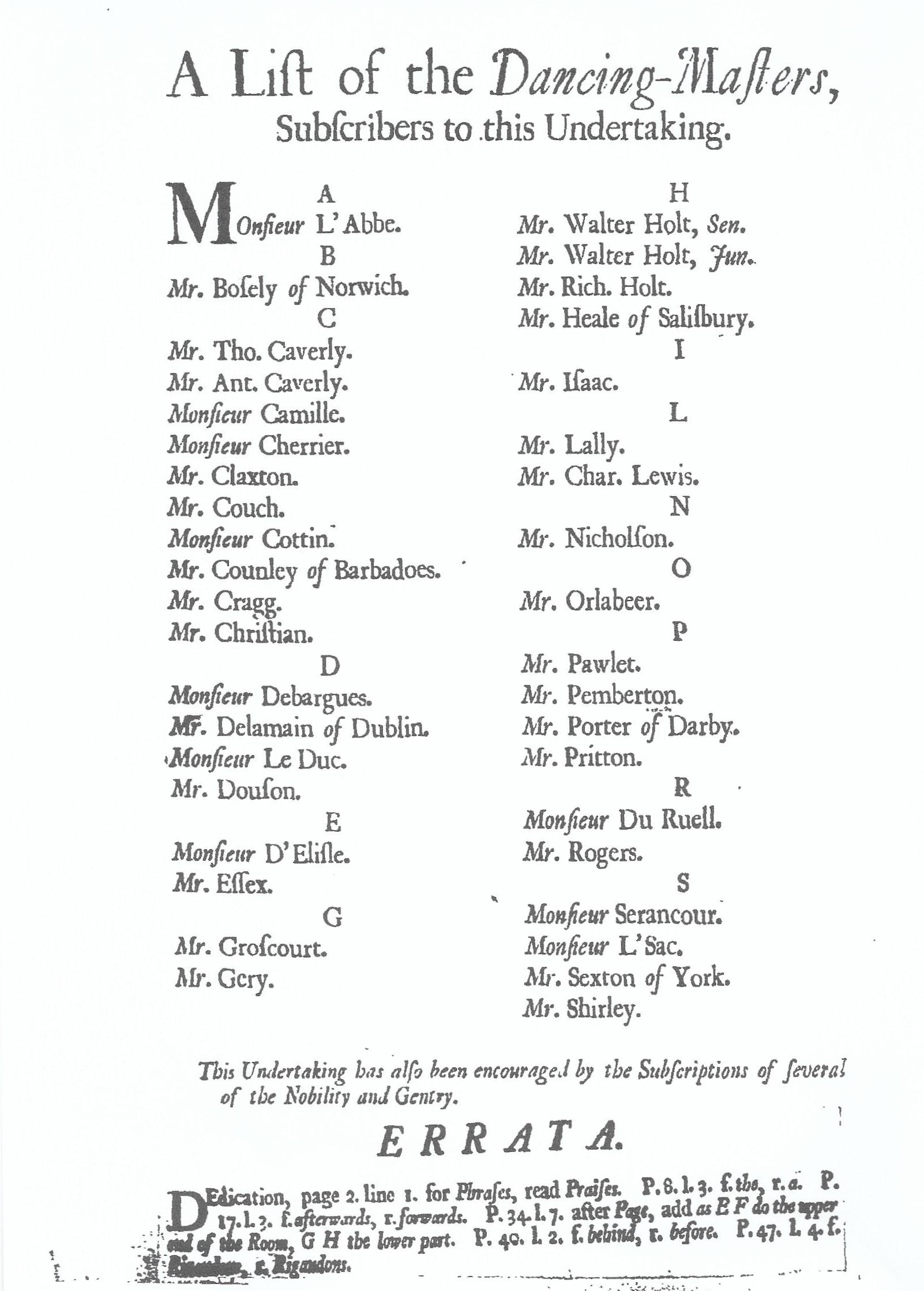
I will start with Orchesography and A Collection of Ball-Dances. Here are their lists of subscribers, to left and right respectively.

Among the Frenchmen, Cherrier, Debargues (usually called Desbarques) and Du Ruell were all stage dancers appearing regularly in London’s theatres during the early 1700s. Together with L’Abbé, Weaver singles out all three for praise in his Preface to Orchesography. The other ‘French’ names raise a series of questions. The first dancer we know called Camille to appear on the London stage was a ‘Young Mr. Camille’ at the Queen’s Theatre in 1712. The epithet suggests that he could, possibly, have been the son of an earlier dancer named Camille for whom we have no record of appearances in London. The dancer Cottin was billed at Drury Lane between 1700 and 1705, but there is no suggestion in the advertisements that he was ‘Monsieur’ Cottin. Monsieur Le Duc and Monsieur D’Elisle bear the same names as French dancers who had performed in the court masque Calisto in 1675. Did they stay in London to dance and to teach or are these other men? The Biographical Dictionary of Actors (full reference below) wrongly conflates Monsieur Le Sac with Queen Anne’s dancing master Mr Isaac. Le Sac was billed on the London stage in 1699-1700 and 1709-1710 and there was a musician of the same name working at Drury Lane during that period. Were the dancer and the musician one and the same? Finally, there is Monsieur Serancour, declared by the Biographical Dictionary of Actors to be the Davencourt who performed in a Grand Dance alongside L’Abbé and others at the Queen’s Theatre in December 1705. A quick look at the original advertisements in the Daily Courant reveals these to be the source of the confusion – ‘Davencourt’ in the first bill becomes ‘Serancour’ in subsequent ones.

The provincial dancing masters listed as subscribers in the two 1706 lists are not quite the same. They are scattered geographically in a way that suggests that Weaver’s appeal for subscribers was mainly concentrated on London. Norwich, Salisbury, Derby and York are represented in both lists, with the addition of Coventry in A Collection of Ball-Dances. Mr Delamain ‘of Dublin’ is joined there by Mr Smith in the Collection of Ball-Dances, while Mr Counly ‘Of Barbadoes’ in Orchesography becomes simply Mr Counly in the Collection. Without further research, we cannot tell why these differences appear, although they may well be simple omissions during typesetting.

This leaves us with the subscribers we are invited to assume are London dancers and dancing masters. Several names are well known from other contexts. There is Thomas Caverley, one of London’s leading teachers of ‘common Dancing’ (as Weaver calls it in the last chapter of his 1712 An Essay towards an History of Dancing) and one of Weaver’s close associates. Antony Caverley, who follows him in the lists, may have been Thomas’s son – unless he was his brother. ‘Mr. Essex’ is, of course, John Essex, who would go on to translate Feuillet’s 1706 Recüeil de contredances in 1710 as For the Furthur Improvement of Dancing. Weaver and Essex seem to have been friends. The Holts, represented in these lists by Walter ‘Senior’, Walter ‘Junior’ and Richard, belonged to a dynasty of dancing masters. I tried to disentangle them in an earlier blog post – Mr Holt and His Minuet and Jigg for Four Ladies. They seem to have been teachers of common dancing with no links to the stage. ‘Mr. Lally’ was perhaps the founder of a family of stage dancers. He was surely Edmund Lally (c1677-1760) whose son Edward was later to enjoy a short but promising stage career. I am not sure about the relationship between Edmund and the far more famous Michael Lally, they may have been father and son or uncle and nephew.

There are some other familiar names that I have passed over. John Groscourt (d. 1742) would be the dedicatee of John Essex’s translation of Pierre Rameau’s The Dancing-Master (1728), while ‘Mr. Gery’ (or Geary) was accorded a place in the preliminary pages to Weaver’s 1712 Essay, alongside Groscourt, Couch, Holt, Firbank and Lewis, as ‘happy Teachers of that Natural and Unaffected Manner which has been brought to so high a Perfection by Isaack and Caverly’. All, except for ‘Firbank’ (the musician and dancer Charles Fairbank), subscribed to both Orchesography and A Collection of Ball-Dances. Sharp-eyed readers will also have noticed an overlap between Weaver’s subscribers and the contributors to Edmund Pemberton’s An Essay for the Further Improvement of Dancing published in 1711. I will have more to say about that work in another post.

What about Weaver’s Anatomical and Mechanical Lectures upon Dancing, published some fifteen years later? Here is the list of subscribers, spread over a spacious two pages.

This list has only nine names in common with the earlier ones – Caverley, Couch, Essex (John), Holt (Walter), Lally (Edmund), Orlabeer, Pemberton (Edmund) and Shirley. The forenames come from the List of Subscribers and distinguish between members of the same family. William Essex, William Holt. Edward Lally and James Pemberton were all the sons of earlier subscribers. There are again a handful of provincial dancing masters, none of whom had subscribed earlier and, so far as I can tell, about eight men who were professional dancers in London’s theatres. They include William Essex (John’s son) and ‘Mr. Shaw’ who must surely be the much-admired English dancer John Shaw (d. 1725). Like the 1706 works, the majority of subscribers seem to have been dancing masters rather than dancers.

These subscription lists add to our knowledge of Britain’s (especially London’s) dancing masters, but they also call into question some aspects of our understanding of that world. Weaver’s criticisms of French dancers are well known, yet several were happy to subscribe to his English translation of a work they would surely have known in its French original. The appearance of several families of dancing masters should perhaps be no surprise, although their individual subscriptions suggest they had separate dancing schools. As I put this post together, I was struck by the amount of research still needed to uncover this network of dancers and dancing masters based in London and elsewhere. John Weaver’s Lists of Subscribers are certainly one place to start.

References:

Philip H. HIghfill Jr, Kalman A. Burnim and Edward A. Langhans, A Biographical Dictionary of Actors, Actresses, Musicians, Dancers, … in London, 1660-1800. 16 Volumes. (Carbondale, 1973-1993)

Mr Isaac’s ‘The Favorite A Chaconne Danc’d by her Majesty’

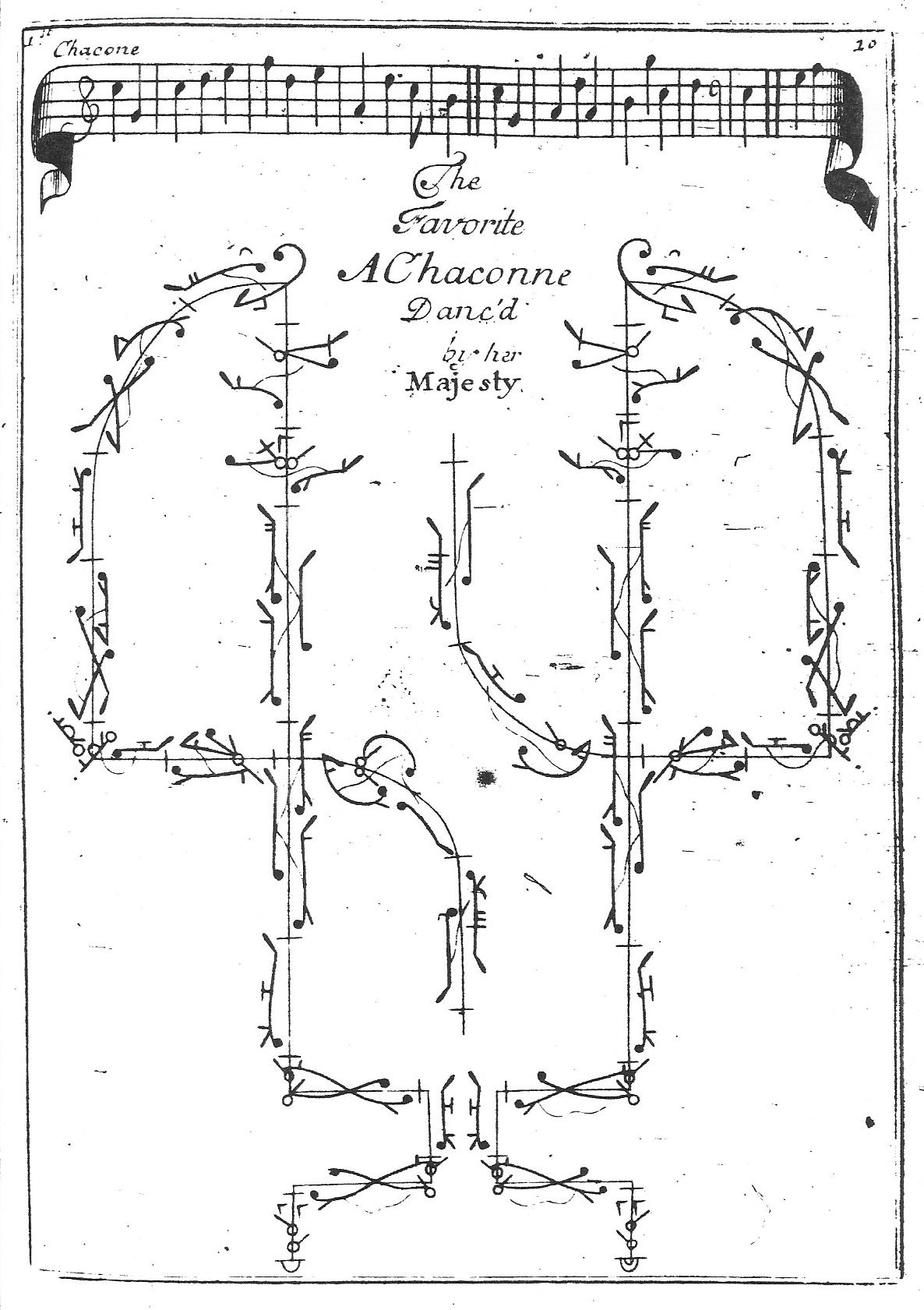
I have been learning Mr Isaac’s The Favorite, described on its first plate as ‘A Chaconne Danc’d by her Majesty’. This duet was one of the six notated choreographies included in A Collection of Ball-Dances perform’d at Court published in 1706 by John Weaver and perhaps intended to accompany Orchesography, Weaver’s translation of Feuillet’s Choregraphie. ‘Her Majesty’ was, of course, Queen Anne, although by the time of the dance’s appearance in notation poor health had forced her to give up dancing. Mr Isaac has an idiosyncratic choreographic style and his ballroom duets shed important light on court culture under the late Stuart monarchs, so I thought it would be worth looking more closely at this dance.

The Favorite is actually in two parts, for it is a chaconne followed by a bourée. The music was first published in Amsterdam in 1688 and it appeared as ‘the new French Dance’ in 1690 in the sixth edition of Apollo’s Banquet. When it was reissued by John Walsh around 1712, the title page named the composer as ‘Mr. Paisible’. The chaconne has three variations, which are then repeated, giving 64 bars in all. The bourée has the structure AAAABB and a petite reprise of four bars to give 36 bars. At 80 bars, the dance seems long for a ballroom choreography intended for performance at court but Isaac’s other dances in A Collection of Ball-Dances are mostly the same or even longer (the exception is The Richmond at only 52 bars).

This dance probably dates to the years around 1690, when the music was first published. Princess Anne (as she then was) hosted a ball for William III’s birthday in November 1688, while her sister Queen Mary II gave a dance for the Princess’s own birthday in February 1691. Both were occasions when Anne (then between pregnancies) might have performed before the assembled court a duet specially created by her dancing master.

Can this notated choreography tell us anything about Isaac’s approach to choreographing these dances of display or Princess Anne’s dancing skills? The notation shows that Isaac used a basic vocabulary of steps throughout the two parts of the dance, although he sometimes combined them in ways that required particular skill from his dancers. For example, the first plate includes two balancés. The first ends in first position on beat two, with a pause on beat three, while the second has a battu on the second beat with an extension of the working leg in the air on beat three (as a preparation for the pas tombé and jetté in the next bar). It is a point for debate whether the Princess would have balanced on the ball of each foot in turn or performed these balancés on a flat foot. The fifth plate, with notation for the bourée, includes several bars which have two coupés travelling sideways. Much practice is needed to execute these fast-moving steps clearly and correctly.

Isaac ornaments only one of Princess Anne’s steps, the coupé avec ouverture de jambe in bar 22 of the chaconne, which has a pas battu around the ankle before the working leg opens towards the fourth position. There are five bars within the chaconne in which the man’s steps have either a pas battu or a rond de jambe. Such explicit ornamentation of the man’s steps, but not the woman’s, occurs in other notated dances by Isaac.

The chaconne has some 17% of steps with small jumps within them, whereas the bourée has around 44%. The steps most often used throughout the two parts of The Favorite are the pas de bourée, with its final jetté, the contretemps and (in the bourée section) the pas de sissonne. Isaac also repeats sequences in both the chaconne and the bourée.

The figures in The Favorite hint that this dance is not simply an abstract display. One of Isaac’s repeated motifs has the dancers coming together and then parting (or vice-versa) across the dancing space. They first do this at the very beginning, with a coupé sideways and a tems de courante forwards, before travelling towards the presence according to convention. The following figure has the dancers travelling sideways away from the presence – the only extended sequence of sideways movement in the dance – which allowed them to face the spectators who would have surrounded them as they moved. These figures can clearly be seen in the first plate, even if you don’t read Beauchamp-Feuillet notation.

They begin the third variation of the chaconne back-to-back, with the woman (Princess Anne) facing the presence – her previous step (a contretemps forwards) can be seen just beneath the word ‘Majesty’ on the notation above. Both perform a coupé battu with a plié on the beat. This has the effect of a bow or curtsey towards those watching at each end of the room, before the dancers turn to face one another and come together. They then turn to their right for a more extended sequence in which they travel apart before turning to come together again.

Apart from the occasional mistakes in the notation, the practice of crowding several figures onto a single page can make it difficult to read. The Favorite has five plates of notation, with plates three and five being the busiest (with 32 bars and 28 bars of music and dance respectively). The second half of the chaconne (notated in full on plate three) begins with a double version of the approach and retreat motif. The dancers first turn towards each other and then away before continuing to travel apart and then return, moving on shallow diagonals. Isaac repeats this theme of retreat and approach twice more with another variation, as he places the dancers side-by-side to face the presence. The chaconne ends with the couple turning to face one another across the dancing space. They have been in mirror symmetry (dancing on opposite feet) for most of it, but the woman does a tems de courante and the man a coupé to begin the bourée in axial symmetry.

I don’t want to go into too much detail, so I will skip to the second plate of the bourée which contains three-quarters of its notated steps.

After two circular figures, the dancers can be seen facing one another up and down the dancing space – the man is nearest the presence with his back to it, while the woman faces him. There must be some distance between them as they have two travelling steps to come together (Beauchamp-Feuillet notation does not show figures with spatial accuracy). They dance in a circle, taking right hands, and then travel away from each other and back again in another instance of the retreat and return motif. Isaac’s repeated use of two coupés in a bar (mentioned earlier) can be seen to either side of the page, about two-thirds from the bottom, then to either side of the centre and finally about a third from the bottom of the page – just before the dancers begin their final sequence of steps to the petite reprise which take them to the back of the dancing space before they turn to face the presence with a coupé soutenu, which presumably precedes their final bow (not included on the notation).

I have enjoyed working on Isaac’s The Favorite. It isn’t a difficult dance technically but it certainly isn’t easy either. It would be rewarding to be able to work on it with a partner and a musician or two, to explore the interpretative possibilities of both music and dance and see how the choreography might work in performance. The steps and figures in these five plates of notation suggest that Isaac’s choreography had wit as well as elegance and liveliness.

The Dancing Master’s Art Explained: Pierre Rameau, John Essex and Kellom Tomlinson

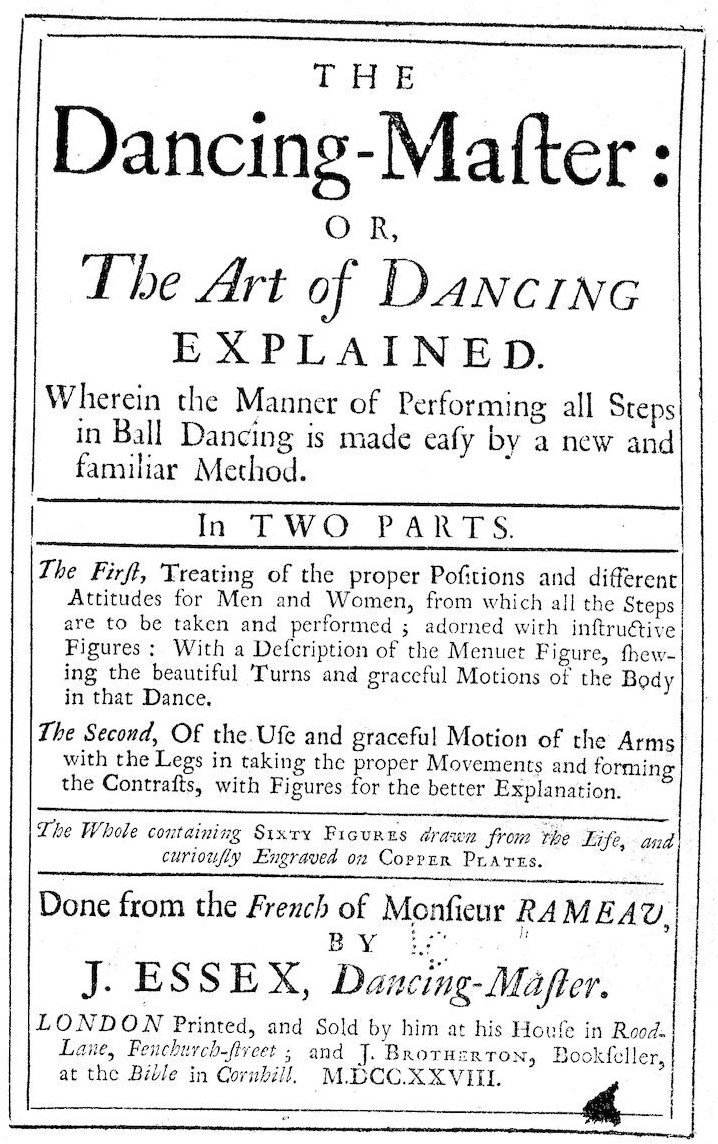
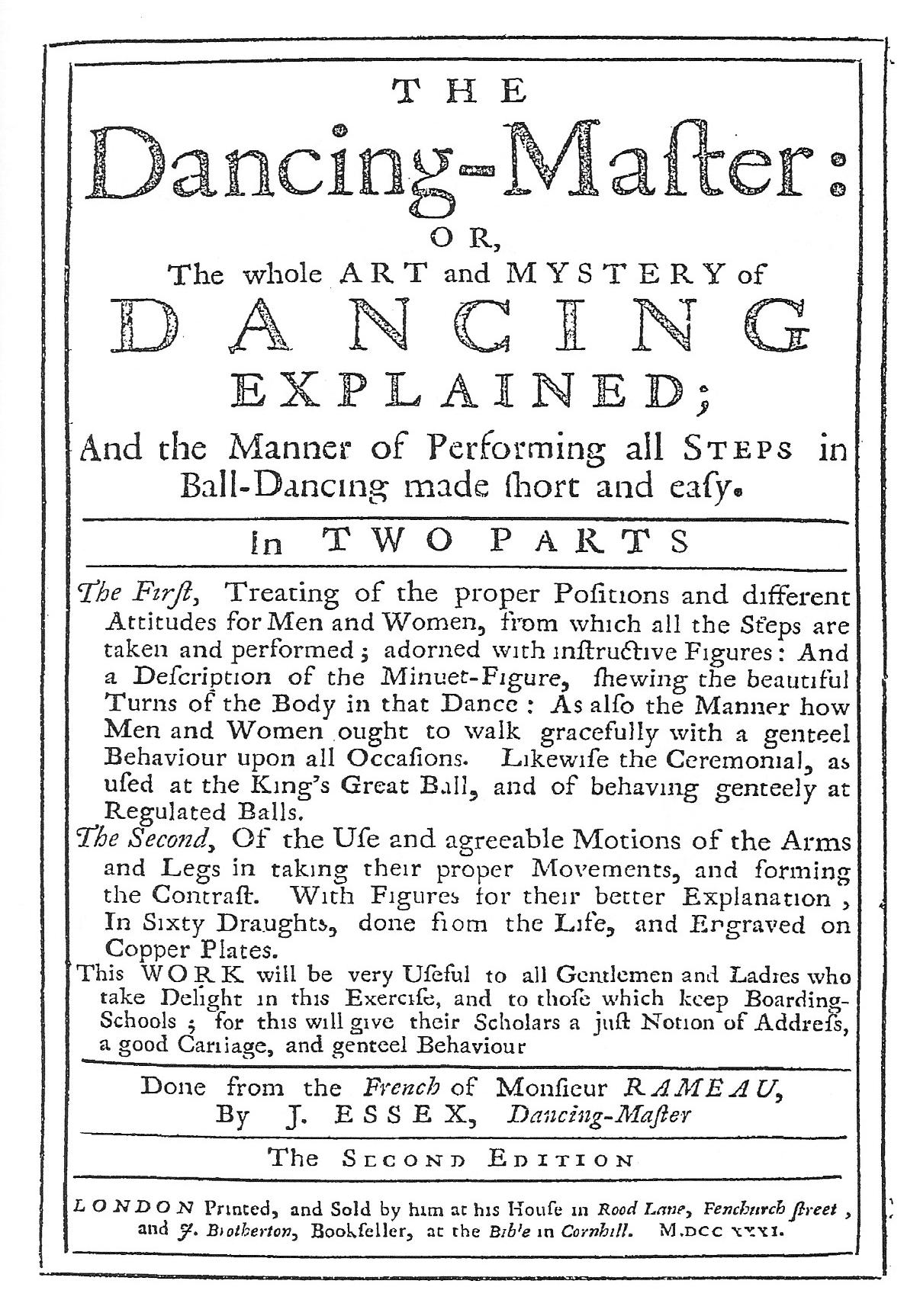
In 1725, Pierre Rameau’s Le Maître à danser was published in Paris. Just three years later, a translation by John Essex entitled The Dancing-Master; or, the Art of Dancing Explained appeared in London. It was heralded by an advertisement in Mist’s Weekly Journal for 13 January 1728, which stated that the treatise would be published ‘Next Week’ and promised that it would be ‘illustrated with 60 Figures drawn from the Life’ (Rameau’s title page had promised that his treatise was ‘Enrichi de Figures en Taille-douce’ without saying how many). The price was to be one guinea (equivalent to around £120 today).

Just over a year earlier, the issues of the Evening Post for 13-15 and 20-22 October 1726 had carried advertisements soliciting subscriptions for another English dance manual, Kellom Tomlinson’s The Art of Dancing. Tomlinson promised ‘many Copper Plates’ for the illustration of his treatise indicating how important such images were. There was another advertisement in the London Journal for 3 December 1726, in which Tomlinson promised that The Art of Dancing was ‘now partly finished’ and would be published once he had sufficient subscribers to cover his costs. As we know, Tomlinson’s work would not appear until 1735 but his 1726 advertisements may have acted as a spur to Essex to produce his translation of Rameau’s treatise.

If John Essex had intended to compete with Kellom Tomlinson, it seems that he succeeded. In his Preface to The Art of Dancing, Tomlinson gave his reaction to reading about the imminent publication of The Dancing-Master in Mist’s Weekly Journal:

‘This gave me no small Surprize, having never before heard of either any such Book, or Author. Had it been my Fortune to have known, either before, or after I undertook to write on this Art, that such a Book was extant, my Curiosity would certainly have led me to have consulted it; and had I approved it, ‘tis highly probable, I should have given the World a translation of it, with some additional Observations of my own.’

Tomlinson’s claim to be ignorant of the existence of Rameau’s Le Maître à danser needs some investigation, given the tight-knit community of London’s leading dancing masters and the importance of French treatises and notated dances to their work (evidenced in Tomlinson’s surviving notebook). His immediate response was to defend his own treatise, which he did with an advertisement in Mist’s Weekly Journal for 27 January 1728.

Thereafter, Kellom Tomlinson remained quiet until he was able to return to advertising the forthcoming publication of The Art of Dancing, beginning in the London Evening Post for 20-22 December 1733. He may have spent the intervening period enhancing his treatise with additional plates to accompany his text, so that he could challenge Essex directly.

In the meantime, successive advertisements suggest that Essex’s The Dancing-Master may not have sold well. There were notices in the Country Journal or the Craftsman for 22 November and 27 December 1729, both saying ‘This Day is Published’ although The Dancing-Master had first appeared nearly two years earlier. Then, the Grub Street Journal for 23 December 1730 announced the publication of the ‘Second Edition’ of the treatise (which is dated 1731 on its title page). However, this was not a new edition at all but a reissue of unsold copies of the first edition, with a fresh title page and an additional leaf with approbations from Pecour (who was recommending Rameau’s original treatise) and Anthony L’Abbé. This edition was advertised successively in the Country Journal or the Craftsman on 1 January and 5 May 1733.

The changes to the title page wording (with an extended sub-title and a recommendation to likely purchasers) were doubtless for marketing purposes.

Later that year, the Grub Street Journal for 8 November 1733 advertised a ‘Second Edition with Additions’. This notice reproduces the wording of Essex’s title page, but it is worth paying close attention to the final paragraph.

Essex’s concern about the quality of his plates may have been prompted by his discovery that Kellom Tomlinson was finally ready to publish The Art of Dancing with its ‘many Copper Plates’ as announced in the London Evening Post for 20-22 December 1733.

I will have to leave a discussion of the plates in both The Dancing-Master and The Art of Dancing for another post.

Essex followed up his November 1733 advertisement with another in the Country Journal or the Craftsman on 5 January 1734, saying ‘This Day is Published’ but otherwise word-for-word as in the Grub Street Journal. Tomlinson’s next notice, in the London Evening Post for 18-20 April 1734, advised his subscribers that publication would be deferred to the following January ‘by Reason of the Advance of the Season, and the Emptiness of the Town’. He was hinting that many, if not most, of those who had subscribed to his treatise were the ‘Quality’ who left London for their country estates over the summer and early autumn. Essex seems to have fallen silent, at least I have not discovered further advertisements by him in the mid-1730s. The next notice was Tomlinson’s, in the London Evening Post for 8-10 May 1735, announcing the publication of The Art of Dancing on 26 June.

The additional delay was to allow the Engraving Copyright Act to become law. It had been championed by William Hogarth among others to protect the rights of artists whose original works were the subject of engravings. Tomlinson had himself drawn the images which were engraved by several leading printmakers for his treatise. The Art of Dancing cost two guineas to subscribers and two and a half guineas to others (equivalent to £250 and nearly £300 today).

Kellom Tomlinson’s The Art of Dancing might have been more original and more handsomely produced than The Dancing-Master, as well as being supported by the nobility and gentry, but it did not sell well either. An advertisement in the London Daily Post for 11 December 1736 includes it among ‘Books sold cheap’ by William Warner. According to a notice in the London Evening Post for 5-7 November 1741, Tomlinson was himself selling copies for £1.11s.6d – rather less than the two and a half guineas he was originally charging – although an advertisement in the Country Journal or the Craftsman for 2 January 1742 quotes his original price. In the same newspaper for 31 December 1743, Tomlinson told intending purchasers that ‘there now remain but a small Number unsold of the Work’. The London Evening Post for 9-11 October 1746 advertised a ‘Second Edition’ as published that day, although surviving copies are dated 1744. The pagination of the two editions suggests that the second was in fact a reissue. Here are their respective title pages.

The last advertisement for the ‘Second Edition’ of Essex’s The Dancing-Master appeared in the Daily Advertiser for 12 January 1744 and there are surviving copies with this date on their title pages. John Essex was buried at St Dionis Backchurch in London on 6 February 1744.

I have come across two later advertisements for Tomlinson’s The Art of Dancing. One is in the London Evening Post 30 January – 1 February 1752, offering the ‘Second Edition’ which is ‘colour’d, in a most beautiful Manner, and bound’ for five guineas (equivalent to more than £600 today). The other, in the Whitehall Evening Post or London Intelligencer for 9 November 1758, has Tomlinson offering ‘The Original Art of Dancing’ for three guineas. The Whitehall Evening Post or London Intelligencer for 18-20 June 1761 reported ‘Tuesday died, of a Paralytick Disorder, in Theobald’s Court, East Street, Red-Lion-Square, Mr. Kenelm Tomlinson, Dancing-Master, in the 74th Year of his Age’.

The publication history of these two early 18th-century dance manuals illuminates the commercial and social as well as the artistic context within which London’s dancing masters worked. They were intended for a monied if not an elite clientele. Both The Dancing-Master and The Art of Dancing are worth detailed research which goes well beyond a concern with the steps, style and technique that are their subject matter.

References

Both of these treatises were studied in detail by the American dance historian Carol G. Marsh in her PhD thesis ‘French Court Dance in England, 1706-1740: a Study of the Sources’ (City University of New York, 1985). In this post, I have drawn on and tried to add to her work.

The Regency Minuet

A few weeks ago, I had the chance to take part in a display of dancing for a heritage open day. We were doing regency dances, but the display began with a couple minuet. One of the other dancers asked if it was a regency minuet and I had to admit that it was not, but the question got me thinking about what a regency minuet might have been like.

Were minuets still being danced in the regency period? George, Prince of Wales was sworn in as Prince Regent for his father George III on 6 February 1811, and he succeeded him as king on 29 January 1820. A quick survey of newspaper references to the minuet during the first and last years of the regency reveals that it was still being taught, and performed at balls, throughout that period. I didn’t have time to do a thorough search, but I quickly came across advertisements by dancing masters who continued to include the minuet among the dances they offered. The Morning Post for 23 January 1810 has one by Thomas Wilson, who lists minuets alongside cotillions, hornpipes and country dances. The Morning Herald for 6 April 1818 has another by Mr Cunningham, who was offering ‘Quadrilles, Waltzes, Spanish Dances, Minuets, &c. Taught in the most fashionable style’. The following year, in the Morning Post for 12 November 1819, Mr Levien in his turn offered quadrilles, waltzes, minuets and country dances, ‘or any other department of Fashionable Dancing’. The minuet seems to have been far from dead, at least so far as dancing masters were concerned.

The reports and advertisements for balls show that the minuet was still the opening dance, performed by a suitably high-ranking couple. The ball on Lord Mayor’s Day, reported in the Morning Chronicle for 11 November 1811, was ‘opened in a Minuet by the Duke del Infantado, the Spanish Ambassador, and Lady Georgiana Cecil’. However, one indication of the changes that were happening appears in the report of the Lord Mayor’s Easter Monday ball in the Morning Chronicle for 15 April 1819. The Earl of Morton and Miss Atkins danced the Menuet de la Cour, and the writer declared that ‘Nothing could be more elegant and graceful’. The report did not reveal whether the ball opened with this dance but it did explain that ‘It was originally intended that the minuet should conclude with the usual Gavot as danced at the Opera House, but that part of the performance was omitted, as being inconsistent with the dignity of his Lordship’s character as Lord High Commissioner to the Grand Assembly of the Church of Scotland’. The ‘Gavot’ was, of course, the Gavotte de Vestris. Other changes involving the minuet are also evident from the newspapers, although I will not pursue these here.

The Menuet de la Cour dated back to the late 1770s and seems to have been introduced to London in 1781, when Gaëtan Vestris and his wife Anne Heinel danced it in the ballet-pantomime Ninette à la Cour. This duet (with and without the Gavotte de Vestris) would become a staple of benefit performances in London’s theatres. The original choreography would undergo many transformations in the course of an exceptionally long afterlife. The version published in notation by Malpied around 1780 shows clearly that, although the Menuet de la Cour included some of the minuet’s long-established figures, its steps went well beyond those prescribed by Pierre Rameau and Kellom Tomlinson in the earlier 1700s. This may have made it a suitable basis for the development of this exacting exhibition dance in the decades around 1800. Here is the opening figure of the dance, following the reverences (also notated by Malpied), in which there is not a single conventional pas de menuet.

One question hovering in the background of the regency minuet is to do with dress. The minuet had begun its long career in the late 17th century and had seen many changes of silhouette during the course of the 18th century, particularly for women. This illustration, which dates to the mid-1700s, shows one of them.

How was this most formal and, apparently, inhibited of dances adjusted to the free-flowing female dress of the regency and for dancers who were at the same time experiencing the very different movement style of the early waltz? This print, published in 1813, shows Princess Charlotte (the Prince Regent’s daughter) dancing a minuet with William Cavendish, 6th Duke of Devonshire. I can’t help thinking that the style and technique of the minuet, as well as its figures and its steps, were forced to change alongside the revolutions in dress and dancing.

There was one obvious attempt to bring the old duet up to date. The Sunday Monitor for 20 April 1817 has an advertisement by Thomas Wilson for a ‘Waltz and Quadrille Ball’ which ‘will be opened … by Mr. Wilson and a Young Lady, one of his Pupils, with the Waltz Minuet, composed by Mr. Wilson’.  I know that the basic waltz step suggested by Wilson in his 1816 treatise A Description of the Correct Method of Waltzing bears an interesting relationship to the minuet step. I am hoping that there is somebody out there who knows (or can find out) how the ‘Waltz Minuet’ was performed. I would be happy to attend a workshop!