Category Archives: Country Dancing

The Cotillon Ball

As I explained in earlier posts, the cotillon may have been introduced to London in the mid-1760s by Giovanni-Andrea Gallini. His ‘collection of cotillons or French dances’ was probably first published in 1765. By 1768, the cotillon had become the first-ever dance craze. Newspaper advertisements during that year show that these contredanses françaises were central to the balls and assemblies organised by some of the biggest names in London entertainments for the beau monde.

The St James’s Chronicle for 16-18 February 1768 included a poem satirising this ultra-fashionable dance.
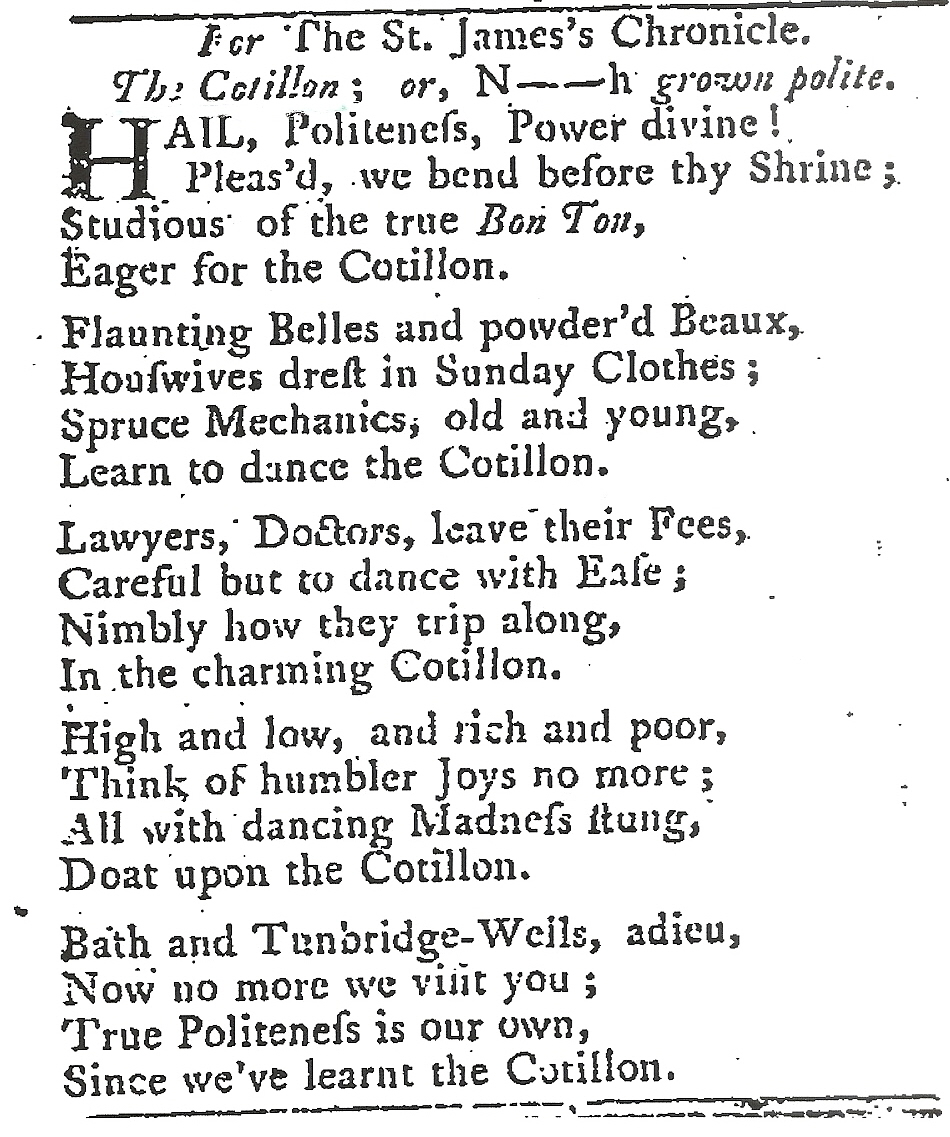
St James’s Chronicle or the British Evening Post, 16-18 February 1768, from ‘Poets Corner’.

St James’s Chronicle or the British Evening Post, 16-18 February 1768, from ‘Poets Corner’.

This was one of many such jibes – a sure indication of the dance’s overwhelming popularity.

The first to advertise a cotillon event that year was Teresa Cornelys at Carlisle House in Soho Square, famous for its masquerades and other lavish entertainments. The Gazetteer and New Daily Advertiser for 8 March 1768 reported:

‘On account of the Royal Family, Nobility, and Gentry, now universally dancing the Cotillons, which are very elegant French country dances lately introduced into the gay and fashionable world, at all their assemblies, a very polite and brilliant company is expected to-morrow at the Annual Assembly in Soho-square … in order to be spectators of, or parties in, these celebrated dances.’

Some weeks later, in the Gazetteer and New Daily Advertiser for 26 April 1768, Gallini advertised cotillons at his own event:

‘By Desire, Mr. Gallini’s Ball (by subscription) will be at Haberdashers Hall, Maiden lane (for one night only) on Wednesday the 11th of May, where the new Cotillons Allemande will be performed.’

Tickets were half a guinea each (around 52 pence, equivalent to at least £55 today). Gallini had already held at least one ball that year. Although the advertisements for his ball on 23 March 1768, like those for previous years, made no specific mention of the cotillon, Gallini did promise ‘great Variety’ of dances. He may, of course, have been including cotillons in his balls even before the publication of his collection but only felt the need to advertise them when faced with competition.

Over the next few years, the cotillon ball remained very popular. I will pursue this phenomenon a little further in a later post.
Going to the Ball

I occasionally get all dressed up and go to an historical dance ball. Most such events are Regency period, but some acknowledge the earlier Georgians in costumes as well as country dances. All, understandably, emphasise enjoyment rather than authenticity so far as the dancing goes (although, sometimes, the reverse seems to be true for the costumes). 18th-century balls were formal and elaborate affairs. I can’t help wondering whether it would be possible to get closer to them than our modern historical balls generally do.

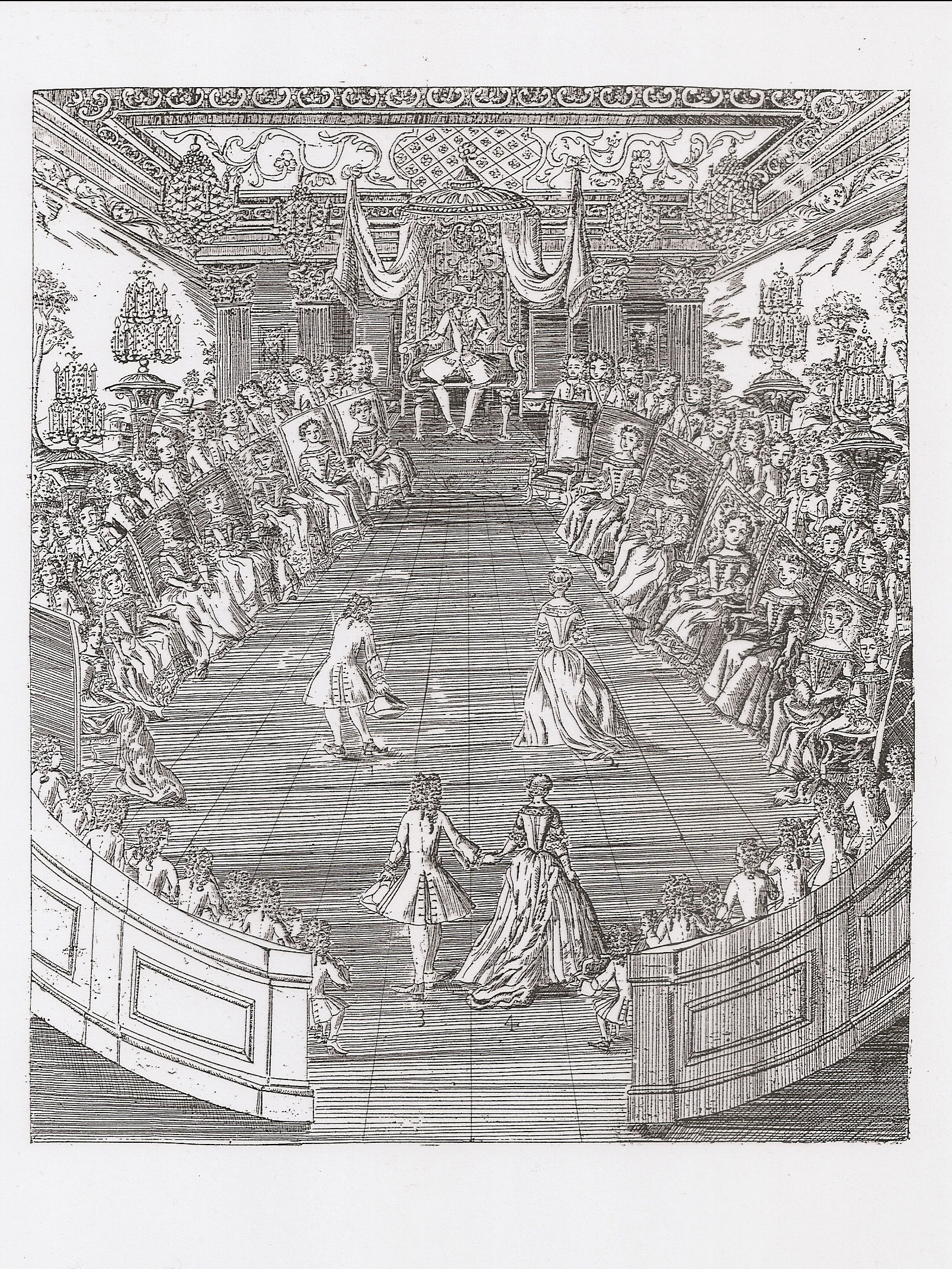
What was an 18th-century ball like? The most detailed and often-quoted description comes from Pierre Rameau’s treatise Le Maître a danser, published in Paris in 1725 and translated into English by John Essex just a few years later. Rameau describes a ball at the court of Louis XIV ‘to which … all private Balls ought to be conformable’. At the French court, everything was ordered by rank. The ball began with branles and gavottes, line dances, led by the King and highest ranking lady. These were followed by minuets, performed one couple at a time in order of precedence. Rameau says nothing about the other danses à deux, specially choreographed duets that use the steps explained in his treatise, or about contredanses. He seems to be writing about the most important and formal court balls, where most of those present were spectators.

A ball at the court of Louis XIV. Pierre Rameau. Le Maître à danser (Paris, 1725).

A ball at the court of Louis XIV. Pierre Rameau. Le Maître à danser (Paris, 1725).

Masquerade balls, with their elaborately disguised participants, were extremely popular. These followed the same basic programme as the formal balls, with the addition of danses à deux and contredanses. The most lavish masked balls also included danced divertissements, often involving professional dancers. Today, that would be a great way to show off some of the surviving choreographies – if there were enough enterprising and talented people to perform them.

John Essex translated Pierre Rameau’s account of royal and ‘regulated’ balls without significant change, suggesting that the form and order of dancing was much the same in England. Balls were held to celebrate royal birthdays, as well as on Twelfth Night and many other occasions. What evidence there is about the dancing at court comes mainly from newspaper reports. According to the Weekly Journal or British Gazetteer for 4 June 1720, the formal ball held to celebrate George I’s birthday that year ‘began about Eight, and the Musick and Dancing (by order) ceas’d at Twelve’, when the King and other members of the royal family departed.

There are few references to what was danced, although the Daily Advertiser for 3 March 1731 provides a glimpse of the ball held to celebrate Queen Caroline’s birthday.

‘On Monday Night His Royal Highness the Prince of Wales, and the Princess Royal, open’d the Ball at Court with a Minuet, and afterwards danced set Dances, with several of the Quality, till between 4 and 5 o’Clock next Morning.’

The ‘set Dances’ were presumably country dances. Dancing into the small hours became customary once the younger members of the royal family began to participate in court balls.

One place to attend ‘regulated’ balls was Bath. John Wood’s A Description of Bath (1765) summarises proceedings at the ‘Publick Balls’ held in the city on Tuesday and Friday evenings.

‘The Balls begin at six o’Clock, and end at Eleven; … the Ball is commonly Opened with a Minuet Danced by two Persons of the Highest Distinction …

The Minuet being over, the Lady returns to her Seat, and the Bathonian King brings the Gentleman a New Partner, with whom he Dances a second Minuet, and then both retire: A second Gentleman doing as the first had done, and so on; every Gentleman Dancing with two Ladies till the Minuets are all over, which commonly happens in about two Hours Time, and then the Country Dances begin …’

The country dances went on for about an hour, after which there was a break for refreshments (Wood refers to ‘Tea’) and then the country dances resumed until the ball closed with appropriate ceremony. The ‘Bathonian King’ was, for many years, Beau Nash.

So, an authentic Georgian ball should begin with about two hours of minuets, danced couple by couple, before it can turn to country dances. Such a programme is unlikely to prove popular with modern would-be historical dancers. Yet, it would surely be possible to begin with two or three couple minuets, together with some minuets for four (which became part of the opening sequence of minuets at the less exalted balls). The rest of the evening could then be given over to country dances – hopefully played at speeds that allow for steps of the period rather than simply walking through the figures. Of course, to be true to the 18th century, one would have to be able to heed Lord Chesterfield’s advice to ‘dance a minuet very well’.

Later in the 18th century, cotillon balls became the rage. I will take a look at them later.


Dancing the cotillon: the allemande step

In his A Second Book of Cotillons or French Dances (1768), Gherardi lists the steps and then adds ‘And the steps necessary for the Country Dance in Allemande’. He says nothing more. Similarly, he says nothing about the steps in his collection Twelve New Allemandes, probably published in 1769, despite claiming to include ‘Instructions and Advice respecting the Allemandes’. Instead, he tantalisingly refers to ‘Boiteuse’, ‘Troteuse’ and ‘Sauteuse’ allemandes. His omissions were probably deliberate. On the title page of his Twelve New Allemandes, Gherardi made clear that the collection was aimed at the scholars of his Academy, who would of course be taught the necessary steps for a fee.

I don’t really know my way around the dance collections and treatises of the later 18th century, so it took me a while to track down descriptions of the allemande steps even with the help of modern studies of this dance. I couldn’t find them in La Cuisse’s Le Repertoire des bals, although he explains the steps suitable for cotillons in volume one (1762) and in the ‘Avertisement’ to volume three (1765) he talks about the growing popularity of the allemande and the necessity of learning the steps that go with it.

Guillaume, in his Almanach dansant ou positions et attitudes de l’allemande, published in 1770 and dealing with the duet, describes two different steps for use in the dance and explains how he teaches the step.

‘Le vrai Pas pour l’Allemande ordinaire ou de deux quatre, se fait par une espece de Pas de bourée-jetté, & marque trois tems.

Je leur fais faire un petit jetté à la quatrieme position sur le pied droit, le gauche marque le deuxieme tems en se rapprochant du droit à la troisieme, & le droit se détache en avant entre la troisieme & quatrieme. Les genoux pliés pour recommencer le jetté sur la jambe gauche. Ce Pas se fait de la même maniere de côté & en arriere; & pour lui donner plus d’agrément, on peut faire une petite ouverture de jambes en faisant le jetté, la pointe bien en dehors & le cou du pied tendu.’

Guillaume continues:

‘L’autre Pas, … en trois huit, se fait en posant la pointe du pied droit & sautant dessus, ce qui forme deux tems, ensuite la même chose du pied gauche, soit en avant soit en arriere: ce qu’on appelle balancers dans les Danses Allemandes, n’est autre chose qu’un Pas en avant, & un autre en arriere sans quitter sa place, ou un de côté à droite, & un autre à gauche.’

The only other description of an allemande step I was able to locate comes from the 1776 Supplement to the famous French Encyclopédie, in the entry for ‘Contredanse’.

‘Cette danse [the allemande] n’admet qu’une seule espece de pas boiteuse, formé par un plié & deux pas marchés.’

Was this the step to which Gherardi was referring with his allemande ‘Boiteuse’?

Dancing the cotillon: Villeneuve’s steps

Like Gherardi, Villeneuve simply provides a list of the steps to be used for the dances in his A Collection of Cotillons.

The Balance

The Pirouette

The Rigadoon Step

The Double Chasse forwards and backwards

Contretems forwards, backwards, and in turning

The Glissades to the Right and Left

The Sissoons forwards and backwards

Four of Villeneuve’s steps are among those described by Gallini: the balance; the pirouette; the rigaudon; and the contretems. Gherardi includes glissades within his step sequences. Villeneuve’s double chasse is presumably Gherardi’s chassé double included among the figures in his Second Book of Cotillons. By ‘Sissoons’, Villeneuve must mean pas de sissonne. These are not mentioned by either Gallini or Gherardi.

Between them, Gallini, Gherardi and Villeneuve suggest around a dozen steps to be used in cotillons. All are familiar from the early 18th-century treatises that set out the style, technique and step vocabulary of ‘French’ dancing or la belle danse. However, it was for the dancing masters (and perhaps the dancers as well) to decide how and when to use these steps in individual cotillons.

La Brone and La Blonde on the London Stage

A dance entitled La Brone and La Blonde was danced by ‘Vallois, Mlle Vallois, &c’ at the end of act one of Nicholas Rowe’s tragedy Jane Shore in a booth at London’s Bartholomew Fair on 23 August 1733. The venue was not quite as down-market as it seems. The proprietors of the booth were regular members of the Drury Lane Theatre company and many of the players were drawn from there and the Covent Garden Theatre. William Jovan de Vallois had made his London debut at the Lincoln’s Inn Fields Theatre on 13 April 1732, billed as ‘lately arrived from the Opera at Paris, the first Time of his dancing in England, a Scholar to M. Marcelle’. These credentials link him to one of the leading dancers and dancing masters in Paris. I have yet to discover whether Monsieur de Vallois pursued his earlier career at the Paris Opéra itself or at the Opéra-Comique (the successor to the theatres in the Paris fairs).

La Brone and La Blonde seems to have been danced in London only that once. The ‘&c’ suggests that there were more than two dancers, but there is no way of guessing how many. Could the dance have had any connection with the choreographies recorded and published by Dezais in his Premier Livre de Contre-Dances in 1725? There is a concordance for the tune for La Blonde, in Contre-Danses et Branles qui se danse aux bals de l’opera published in Paris around the same time. This suggests that Dezais might have been drawing on (or perhaps aiming his collection at) dancing in the public balls given at the Paris Opéra. This same music had also been used for The Siciliana by Siris, a ballroom duet published in London in 1714. Both La Blonde and La Brunne are in 6/8 and their music is titled ‘Gigue’, although La Brunne has an upbeat which identifies it as a Canarie. Both choreographies are for four and in the Dezais collection La Blonde is immediately followed by La Brunne and then repeated after it to conclude the dance.

The choreographies recorded by Dezais go a bit beyond straightforward contredanses. He notates steps for two sections within La Blonde. The little enchainement performed by each of the two couples, balonné, coupé battu starting with the right foot and then the left while taking right and then left hands, is familiar from a number of ballroom duets. Its earliest recorded use (if not its origin) is in the 1702 L’Allemande by Guillaume-Louis Pecour, ballet master at the Paris Opéra. This choreography was danced by Claude Ballon and Marie-Thérèse de Subligny in the ballet Fragments de Mr. De Lully the same year as the dance appeared. La Brunne has a right and left allemande turn which might also echo the same source, although no steps are notated (L’Allemande has two balonnés, a pas de bourée and an assemblé for each turn, which would fit).

If there is a link between the London dance La Brone and La Blonde and Dezais’s little suite of contredanses, it is perhaps more likely to lie within the music than the choreography. Yet, the use of motifs from L’Allemande (if that is indeed what is happening) suggests other possibilities. Did the dance performed at Bartholomew Fair in 1733 also derive some of its choreography from L’Allemande, perhaps via the contredanses published by Dezais?

Here is a nice performance of Dezais’s La Blonde and La Brunne. The dancers choose to do pas de bourées for their allemande turns. This is, after all, a contredanse.

Dezais, Premier Livre de Contre-Dances: a closer look

I have been curious about the choreography for La Blonde and La Brunne for a long time, because a dance with much the same name was performed on the London stage in the early 1730s. Before I pursue that dance, I want to take a closer look at the Premier Livre de Contre-Dances published by Dezais in 1725. Unfortunately, the collection seems to have been unknown to the dance historians and musicologists who have done such valuable work on the dance notations surviving from the 18th century. So far as I can tell, nothing has been published on it and few concordances for the tunes have so far been identified.

The collection helps to fill a gap in the history of the cotillon, between Le Cotillon des Fêtes de Thalie published by Dezais in 1716 and the 1762 Le Repertoire des Bals by De la Cuisse. There must have been many cotillons danced between those two dates, but the interruption in the publication of notated dances means that they were never recorded in print.

Among the dances in the Premier Livre, the following have the ‘Change’ and ‘Figure’ structure familiar from the later cotillons (although the first two are for four and not eight dancers):

Cotillon Hongrois

L’Inconstante

L’Infante

Cotillon de Surenne

L’Esprit Follet

All are recorded in a way that shows their structure explicitly, i.e. the ‘Figure’ is notated in full the first time round and the successive repeats are merely noted after each ‘Change’. I haven’t gone so far as to analyse the choreographies for these dances, but such work would undoubtedly shed light on the early development of the cotillon.

The other dances in the collection – La Blonde, La Brunne, L’Ecossoise and La Carignan – are also worth closer investigation. L’Ecossoise is for six, four men and two women (although Dezais says in his Avertissement ‘qu’a la place de 4.  hōmes et 2. fēmes que l’on peut mettre quatre femmes et 2. hommes’.  How unusual are those line-ups among the surviving dances? La Carignan is one of several minuets ‘à quatre’, choreographies worth considering as a group.

There is much to learn from the Dezais Premier Livre de Contre-Dances.

Dances for four: Dezais, Premier Livre de Contre-Dances (1725)

Since my first blog post on dances for four, I have acquired a copy of the Premier Livre de Contre-Dances by Jacques Dezais, published in Paris in 1725. This collection contains the following dances:

Cotillon Hongrois à quatre

L’Inconstante à quatre

L’Infante à 8

Cotillon de Surenne à 8

La Blonde à quatre

La Brunne à quatres

L’Esprit Follet à 4 [in fact à 8]

L’Ecossoise à six

La Carignan menuet à quatre

So, there are five dances for four in this collection.

Dezais uses the simplified form of notation developed by Feuillet for contredanses, notating just a few steps in each dance. The pas de rigaudon appears in nearly every dance and several dances include half-turn pirouettes, balancé, pas de bourée and assemblé. Dezais obviously classified these choreographies as contredanses. He describes them as such on the title page and, as well as using the simplified notation, he refers readers to Feuillet’s 1706 Recueil de contredances for the ‘principes’ needed to read and perform each dance. Indeed, he goes further by offering to notate and publish any ‘contre-dances des Provces. [Provinces]’ he may receive. According to Dezais, then, these are definitely contredanses, for the ballroom. Nevertheless, I will take a closer look at some of them in future posts within other contexts.

There is one other interesting aspect to this collection. The Premier Livre de Contre-Dances was engraved by Mlle Louise Roussel. When cotillons began to be published in large numbers in Paris in the 1760s, one name prominent on their title pages was Mlle Castagnery. Both she and Mlle Roussel are worth further investigation.


Dancing the cotillon: Gherardi’s steps

In all three of his cotillon collections, Gherardi provides the same list of steps needed for the dances.

‘The Names of the French Country Dance Steps

Balancé pas de Rigodon.

Deux chassés, assemblé, pas de Rigodon.

Deux glissades, assemblé, pas de Rigodon.

Contre-tems en avant, contre-tems en arrière, contre-tems en tournant.

Chassé en tournant.

Demi contre-tems d’un Pied et de l’autre.

Brizé, a trois pas d’un Pied et de l’autre.

Chassé a trois pas d’un Pied et de l’autre.

And the Steps necessary for the Country Dance in Allemande.’

It is obvious that Gherardi is setting down not individual steps but sequences of steps, enchainements, for use within the changes and the figures of his cotillons.

He does not explain how each particular step is to be performed. However, in his ‘Observations and Advice’ at the beginning of his first collection, Gherardi says:

‘Every Lady & Gentleman desirous of dancing the Cotillons with some degree of Excellence, … should have the assistance of a Master to perfect them in the following very few Steps; easy in the Execution, and without which, it is impossible to perform these fashionable & entertaining Dances with Precision.’

In his second collection, Gherardi proposes that gentlemen and ladies take out subscriptions for his Cotillon Academy, where they can learn the steps ‘from the Assistance of an experienced Master’. Was he assuming that they will know the basic belle danse steps, but will need help with his enchainements?

Most of the steps are recognisable from the dance manuals of the early 18th century, and several are those described by Gallini. However, the ‘Brizé, a trois pas’ and the ‘Chassé, a trois pas’ are not so familiar and will need a bit of investigation, as do ‘the Steps necessary for the Country Dance in Allemande’.

I can see I will need to devote some more posts to cotillon steps.

Dancing the cotillon: Gallini’s steps

I have looked at the changes and discussed the figures of the cotillon. I now turn to the steps of this contredanse française. Among the dancing masters in London who published cotillons when the craze for these dances began, only Gallini, Gherardi and Villeneuve say anything about steps. The figures and the steps are so closely intertwined that both Gallini and Gherardi describe them together.

Gallini’s steps are all recognisably from the long-established vocabulary of la belle danse, the ‘French Dancing’ that developed at the court of Louis XIV in the late 17th century and subsequently spread throughout Europe. They were at once over-familiar and unfamiliar. Gallini introduces them by saying:

‘A description of all the Steps and Figures in Dancing, might, by the Reader, be thought tedious, therefore it is intended here to explain only those which are used in the following cotillons’’

He begins with the Assemblé, which is used ‘at the end of several Steps’.

‘the Assemblé Forward is performed by Sinking and Advancing the hinder foot in a circular manner, Springing and Falling on both feet in any Position that shall be proper for the following Step.’

The use of a circular motion hints at the decorations that could be added within the cotillon.

Le Balancé:

‘is done by Sinking, then Rising as you Step forward or sideways with one foot, the other must follow Straight to the first Position, and in the same manner Step back again, beginning with the contrary foot.’

Le Chassé ‘is performed in various ways’:

‘To do this Sideways you must place yourself in the Second Position; if you go to the Right, it is performed by Sinking, then in Rising Spring on both feet and place the Left foot behind where the Right was, at the same time the Right foot Advancing to the Second Position.’

Gallini explains ‘if you Chassé cross, add one Step in the fifth Position and an Assemblé’ and the same is done for the chassé forward. This step was moving towards the 19th-century basic quadrille step.

Le Contretemps:

‘To perform this Forward you must advance your Right foot, sink on both feet, but spring and fall on the Right, then walk two Steps Straight.’

He goes on ‘to this you may add an assemblè’, taking it towards a pas de gavotte.

He describes only half-turn pirouettes:

‘[La Pirouette] is performed to the Right, by bringing your Right foot in the fifth Position behind, then  Rising on your Toes, and turning half Round to the same Position, do the same again to bring you Round; this may be done to the Left, by Reversing the Feet.’

Finally, Gallini gets to Le Rigaudon, one of the characteristic steps of the cotillon.

‘To perform this in the first Position, you must Sink, then Spring, and Fall on the Right foot, bring your left to the first Position, move your Right and return it to the same Position, the knees being straight, Sink, then Spring on both feet and Fall on your Toes in the first Position.’

He adds ‘This may be done by Reversing the Feet’. He also, helpfully, explains how to do the rigaudon from the third position, allowing the dancer to move forwards or backwards.

‘When the Rigaudon is performed in the third Position, with the Right foot foremost, you must Sink, then Spring, and Fall on the Right foot; advance your Left to the same Position, then advance the Right to the third Position, the Knees being straight, Sink, then Spring on both feet and Fall on your Toes with the Left foot foremost in the same Position.’

The one step Gallini completely ignores is the demi-contretemps, the basic step of the cotillon already being used as early as Le Cotillon, the dance for four published in 1705.

His step descriptions seem to be his own, which he presumably developed in the course of his teaching rather than simply copying them from earlier dance manuals. They don’t seem to provide quite enough detail to perform all these steps properly – assuming that the steps were indeed the same as those notated and described in the early 1700s. Do Gallini’s instructions provide hints on the changing style and technique of ballroom dancing in the mid-18th century?

Dances for four: Le Cotillon (1705)

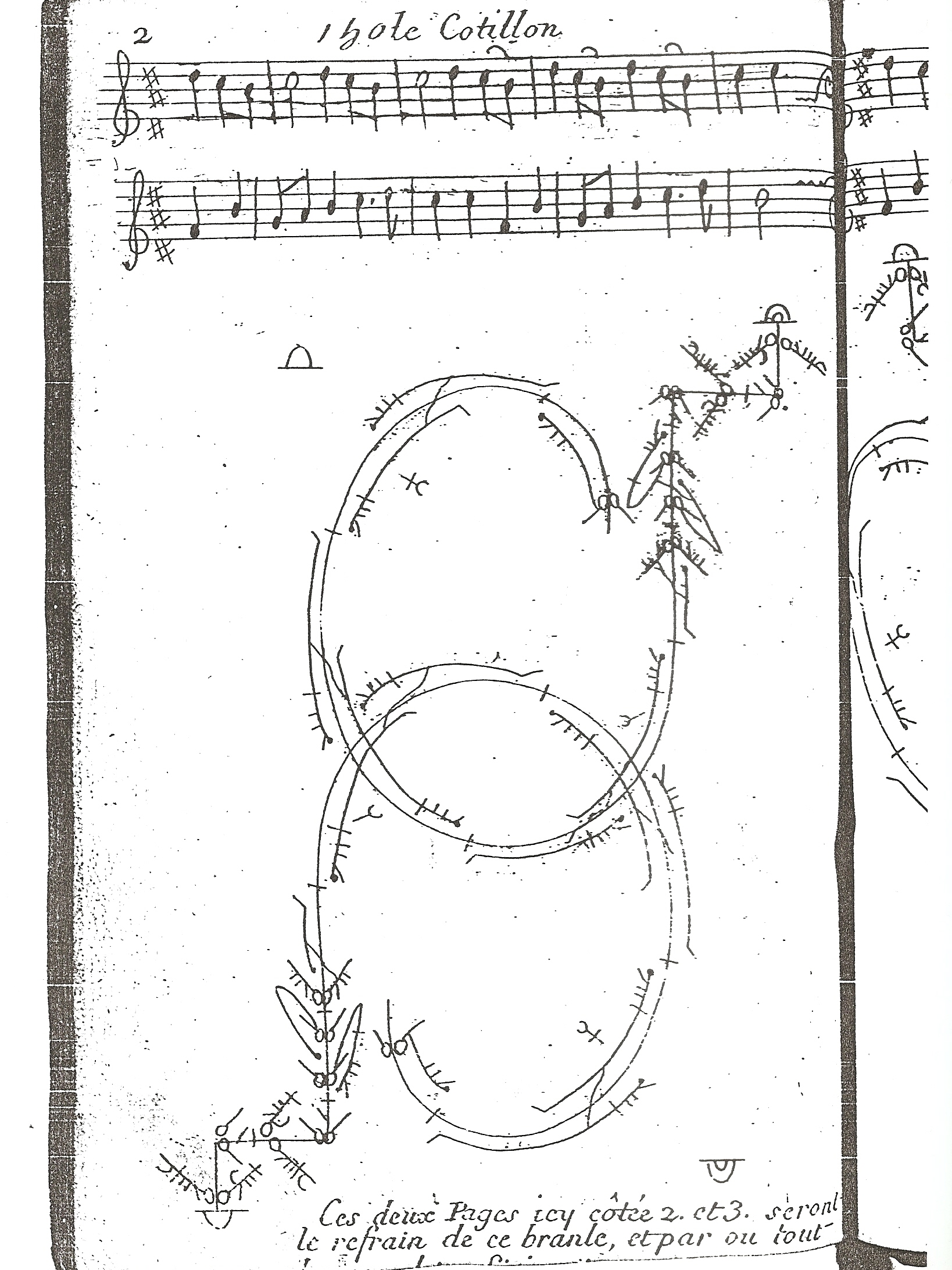
The first dance for four to be published in the new system of dance notation was Le Cotillon, which appeared in Feuillet’s IIIIe Recueil de dances de bal pour l’année 1706. In his first such collection, for 1703, Feuillet promised that they would appear towards the beginning of November each year to allow time to learn the dances before the winter season of balls began. This little collection had just three dances, two danses à deux and a danse à quatre:

La Bavière, a menuet and forlane, choreography by Guillaume-Louis Pecour.

La Fanatique, a sort of rigaudon to a ‘marche des Fanatiques’ by Lully, choreography by Feuillet.

Le Cotillon, a branle (in fact a gavotte) by an unknown choreographer.

In his Avertissement to his latest annual collection, Feuillet wrote:

‘Le Cotillon, quoi que Danse ancienne, est aujourdhui si a la mode a la Cour, que j’ay cru ne pouvoir me dispenser de la joindre à ce petit Recüeil, c’est une maniere de branle a quatre que toutes sortes de personnes peuvent danser sans même avoir jamais appris.’

[The Cotillon, although an old dance, is so fashionable at court, that I thought I had to include it in this little collection, it is a sort of branle for four that anyone can dance without having learnt it beforehand]

He reminded his readers that he would continue to publish his collections of ball dances each November for the forthcoming year. He also announced the publication of his Recueil de contredances at the beginning of 1706 – ‘les Contredanses d’Angleterre … aussi fort à la mode’.

Le Cotillon is an earlier form of the contredanses françaises – cotillons – that would become a dance craze in the 1760s in both France and England. The musical structure for the dance is AABABA x 6 (A = B = 4). There are a series of Changes, to each AA, between which the same Figure is danced, to the BABA music. The terminology ‘Change’ and ‘Figure’ is that used when the cotillon, a dance for four couples facing inwards around a square, reached London in the mid-1760s.

The 8-bar changes in Le Cotillon are as follows:

Forward and back (in couples)

Siding (in couples)

Taking right hands and left hands (in couples)

Taking both hands (in couples)

Right hand star (all four dancers)

Left hand star (all four dancers)

Circle left and right (all four dancers)

These are recognisably related to English country dance conventions.

The 16-bar figure is much simpler than those to be found in the later cotillons. One man and his opposite lady perform a sequence of steps taking right hands and then their partners do the same.

Feuillet notates all the steps in Le Cotillon. These, too, anticipate the vocabulary of the later cotillons. Dancers use pas de gavotte (contretemps to first position, jump and step) when moving forwards and backwards and demi-contretemps when moving in a circle. Sequences usually end with an assemblé. The figure uses a sequence beginning with a jump on two feet with a quarter-turn and then back, pas de rigaudon and a jump on two feet, a step and then a series of demi-contretemps ending with an assemblé.

The steps are easy and the sequences are straightforward and predictable. As Feuillet promised, dancers could perform Le Cotillon with no prior practice.

Le Cotillon (1705). First plate. Opening Change.

Le Cotillon (1705). First plate. Opening Change.

Le Cotillon (1705). Second plate. First half of Figure.

Le Cotillon (1705). Second plate. First half of Figure.