Category Archives: The Minuet

How Should I Perform the Pas de Menuet?

As I continue to work on baroque notated choreographies, I constantly wonder how I should perform their steps. I learned the basic baroque dance technique a long time ago and I have worked on various approaches to it over the years, with different teachers. More recently, I have had to work mostly on my own, without access to the latest thinking and practice on what the treatises and the notations actually mean, so I have many questions.

I have been learning a couple of ballroom dances that include minuets and one question in particular arose. How should the basic pas de menuet travelling forwards be performed, should it be danced smoothly or have staccato elements? It begins with a demi-coupé (essentially a plié followed by a step forward and a rise as the weight is transferred) and continues with a fleuret (another demi-coupé followed by two steps on the balls of the feet) How should the demi-coupés be performed? Should the pliés be soft and controlled or should there be a quick and somewhat sharp bend of the knees and ankles? How should the transition at the end of this pas composé be managed? Is there a sharp lowering from the demi-pointe into a plié or does the final step end on a flat foot in preparation for the bend that begins the demi-coupé? I am not going to explore the timing of this step, because I looked at this in some detail in The Pas de Menuet and Its Timing a few years ago.

When I find myself in doubt about an aspect of baroque dance technique, I generally go back to the early treatises – Pierre Rameau’s Le Maître à danser (Paris, 1725), with its translation by John Essex The Dancing-Master (London, 1728), and Kellom Tomlinson’s The Art of Dancing (London, 1735). Here is what Rameau (as translated by Essex) has to say about the pas de menuet ‘of only two Movements’:

‘Having then the left Foot foremost, you rest the Body on it, bringing the right Foot up to the Left, in the first Position, and from thence sink without letting the right Foot rest on the Ground, and move the right Foot into the fourth Position, rising at the same Time on the Toes, and extending both Legs close together, as represented by the fourth Figure of the half Coupees, called the Equilibrium or Balance; and afterwards set the right Heel down to the Ground, that the Body may be the more steady, and sink at the same Time on the right, without resting on the Left, which move forwards the same as the right Foot, into the fourth Position, and rise upon it: Then make two Walks on the Toes of both Feet, observing to set down the Heel of the Left, that you may begin your Menuet Step again  with more Firmness.’

The Dancing-Master, Chapter XX1, pp. 44-45.

By ‘Toes’, Essex means the ball of the foot, translating Rameau’s ‘la pointe du pied’ – in both cases the meaning is made clear by the engravings that accompany the description of the demi-coupé. Here is the fourth and final one:

It is interesting that in modern ballroom dancing ‘toe’ also means the ball of the foot.

Tomlinson explains the method of performing the pas de menuet and its timing together (I have omitted some of the text relating to the timing as it is given in my earlier post):

‘The Weight of the Body being upon the left foot in the first position the right, which is at liberty, begins the Minuet Step, by making the Half Coupee or first of the four Steps belonging to the Minuet, in a Movement or Sink and Stepping of the right Foot forwards, the gentle or easy Rising of which, either upon the Toe or the Heel, marks what is called Time to the first Note of the three in the first of the two Measures, … the second Note is the coming down of the Heel to the Floor, if the Rise was made upon the Toe, but if upon the Heel or the flat Foot, in the tight Holding of the Knees before the Sink is made that prepares for the Fleuret or Bouree following, in which is counted the third and last Note of the Measure aforesaid; …

              The Sink or Beginning of the Movement, that prepares for the Fleuret or second Part of the Minuet Step, … being made, there only remains to rise from the Sink aforesaid in the stepping forwards of the left Foot to the first Note of the second Measure, and first of the Fleuret or three last Steps that compose the Minuet Step; …’

The Art of Dancing. Book the Second, Chap. I, pp. 105-106.

By ‘Heel’ Tomlinson means the flat foot, allowing for those dancers who do not wish to attempt a balance on the ball of the foot.

Neither passage directly answers my questions, although Tomlinson refers to ‘gentle or easy Rising’ in the demi-coupé. In the chapter preceding that on the minuet step, ‘Of the Manner of making half Coupees’, Rameau tells his reader ‘good Dancing very much depends on this first Step, since the knowing how to sink and rise well makes the fine Dancer.’ (The Dancing-Master, Chapter XX, p. 42). I would need to look further and more closely at what both Rameau and Tomlinson say about other steps before reaching firm conclusions about how to perform the basic pas de menuet.

Before I conclude this post, there are a couple of interesting issues I would like to touch on concerning the pas de menuet à trois mouvements. Rameau describes this version as follows:

‘This Menuet Step hath three Movements, and one March on the Toes; viz. the first is a half Coupee of the right Foot, and one of the left; a March on the Toes of the right Foot, and the Legs extended: At the End of this Step you set the right Heel softly down to bend its Knee, which by this Movement raises the left Leg, which moving forwards makes a Tack or Bound, which is the third Movement of this Menuet Step, and its fourth Step.’

The Dancing-Master, Chapter XXI, p. 43.

Rameau adds ‘But as this Step is not agreeable to every one, because it requires a very strong instep; for this Reason it is not so much used, but a more easy Method introduced’ (The Dancing-Master, Chapter XXI, p. 44) and he goes on to describe the basic pas de menuet. Tomlinson, writing around the same time (although The Art of Dancing was published ten years later) calls that basic minuet step ‘One and a Fleuret’ or the ‘New Minuet Step, … that is now danced in all polite Assemblies’ (The Art of Dancing. Book the Second. Chap. I, p. 104). Here are Tomlinson’s notations of his various minuet steps, from Plate O in The Art of Dancing:

I will leave aside the additional complexities introduced when minuet steps are performed sideways to the right and the left (which can be seen in the above illustration). Nor will I consider how the pas de menuet is shown in the notated stage minuets – although the solo ‘Menuet performd’ by Mrs Santlow’ in L’Abbé’s A New Collection of Dances begins with a sequence of pas de menuet à trois mouvements.

There are several other posts about the minuet on Dance in History. The most relevant to my topic here is probably Thomas Caverley’s Slow Minuet.

What were Entr’acte Dances on the London Stage Like?

During the 18th century, entr’acte dances (dances given between the acts of plays) were an integral part of many performances in London’s theatres. The following advertisement, from the London Daily Post and General Advertiser for 25 March 1736, shows how these dances fitted into the evening’s entertainment:

This performance was for the benefit of one of Covent Garden’s leading dancers, Leach Glover.

As this bill shows, entr’acte dances could be quite varied. Nivelon’s Clown was a country bumpkin, possibly related to the ‘Peasant’ depicted by Lambranzi in his Neue und Curieuse Theatrialisches Tantz-Schul in 1716. I have used this image several times before but here it is again.

I continue to puzzle about the differences between ‘Clowns’ and ‘Peasants’ on the London stage, as well as the distinctions between those of different nationalities – in the 1720s both John Weaver and Francis Nivelon danced an English Clown, while Nivelon was also billed in a French Clown dance.

The Minuet and Louvre performed by Glover and Miss Rogers were ballroom dances (the Louvre was, of course, Pecour’s famous Aimable Vainqueur), although we don’t know whether the basic choreographies as set down in surviving notations were embellished for the stage.

This engraving from Kellom Tomlinson’s The Art of Dancing (1735) shows a moment from the ballroom minuet (the viewpoint is from the lower end of the room, looking towards the ‘Presence’). It raises questions about the performance of ballroom dances on stage, even though they shared with stage dances the concept of a ‘Presence’ as an important focus for their dancing.

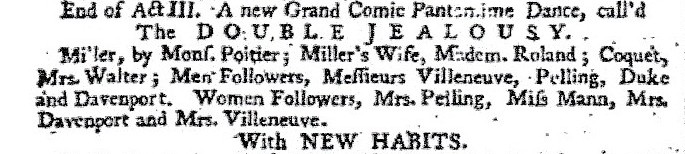
The Grand Ballet was different again, with several performers led by Lalauze and Mlle D’Hervigni, and was probably in the form of a divertissement with several dances one after the other. These more extended pieces could also be small ballets, for example the ‘new grand Comic Pantomime Dance’ The Double Jealousy given at Mlle Roland’s benefit at Drury Lane on 1 April 1736, as this detail from the advertisement in the London Daily Post and General Advertiser for that date shows (the mainpiece was King Henry the Fourth. With the Humours of Sir John Falstaff):

The Double Jealousy hints, through its title and its characters, at comic and expressive action, but what were the other dances – in particular the solos and duets – like?

Most entr’acte dances must have been short: solos and duets may have lasted between one and two minutes (for the early 18th century their duration can be compared with that of the dances surviving in notation); divertissements (the ‘Grand Dances’) and even small ballets seem likely to have lasted ten minutes at the most. So, we get the idea that during an evening in one of London’s theatres there were several short dances that contrasted with the action of the play they accompanied and presented a variety of characters and dance styles. They were also intended to showcase the leading professional dancers in the companies and could be, in themselves, a draw for audiences.

A little while ago, I was at a very different sort of event – a modern ballroom and Latin competition, with a Gala evening at which two couples of professional dancers performed. As they appeared alternately, dancing their way through the five standard ballroom dances and the five Latin ones, I was reminded of the entr’acte dances on the London stage and began to wonder what (if anything at all) they might have in common. These 21st-century dances had no context. They were simply intended to display the skills of the dancers and entertain the audience (many of whom were dancers themselves), so how might they tell us anything about the 18th-century entr’acte dances I have been describing?

First, was the length of the modern dances. They were short, at just a few minutes each, so the dancers had to make an immediate impact. Second, was their presentation without a specific background – they were danced to an audience seated around the ballroom floor with little decoration and no scenery. It is difficult to be sure what happened with 18th-century entr’acte dances, but it seems unlikely that they were provided with their own scenery (although, like the modern dances, they were presented in costume) and they were probably danced mainly on the forestage in the midst of their audience.

I was struck with the way in which the 21st-century dancers played with the conventions of the dances they performed, elaborating and subverting these by turns. The modern dances – waltz, tango, Viennese Waltz, foxtrot and quickstep for the ballroom and cha-cha, samba, rumba, paso doble and jive for the Latin – have different and well-defined characters as choreographies. Although it is usually only in the Latin dances that couples hint at drama, in the Gala performances both the ballroom and Latin couples did so. They also intensified the characters of the individual dances and one couple even incorporated props into their dancing. I couldn’t help feeling that early 18th-century dancers must have used similar techniques in the sarabands, chaconnes, passacailles, gigues, canaries, loures, bourrées, rigaudons, minuets and other dance types (divided between serious and comic) that they would have performed on the London stage three centuries ago. They, too, were trying to command the attention of their audience and display to the full their skills and individuality.

Contextualizing Mr Isaac’s Minuets

I thought it would be interesting, and perhaps informative, to try to place Mr Isaac’s minuets within the context of other minuet choreographies of approximately the same period. It isn’t easy to date the French notated dances, other than by their dates of publication, but given that some use music that appeared earlier they, too, may have been created a few years before their first appearance in print. I have taken my investigation as far as 1709, the year that Isaac’s The Royal Portuguez was published. Apart from the minuet in Favier’s Le Mariage de la Grosse Cathos of 1688, which I include here, there are six other minuets to be explored. Some are minuets only, while others are minuet sections within multi-partite dances.

La Bourée d’Achille was first published in Feuillet’s Recueil de dances composées par Mr. Pecour in Paris in 1700, one of the first two collections of dances to appear in notation. The minuet is the central section of the dance, with 48 bars of music in 3/4 time (2xAABB A=4 B=8), preceded and followed by a bourrée. The music is from Achille et Polixène, the opera begun by Lully and completed after his death by Colasse. It was first performed in 1687 and then not revived until 1712. So, the duet must antedate 1700 and could belong to the mid to late 1690s.

The Menuet à Deux was published by Feuillet in Recueil de dances contenant un tres grand nombres, de meillieures entrées de ballet de Mr. Pecour which appeared in Paris in 1704. This was the first collection of dances closely linked to the Paris Opéra (Feuillet had published a collection of his own ‘theatrical’ choreographies in 1700, but these seem not to have been associated with dancers on the professional stage). It was danced by Dumoulin l’aîné and Mlle Victoire in Campra’s Fragments de Mr de Lully in 1702 and the choreography obviously belongs to that date. As its title suggests, this is a minuet throughout which has 48 bars in 3/4 time (AABB A=8 B=16)

The Entrée pour un homme et une femme was also choreographed by Pecour and included in the 1704 Recueil de dances. The music is from Destouches’s opera Omphale, first given at the Paris Opéra in 1701 and then at court in 1702 (after which it was not revived until 1721). The notation declares that this duet was performed by Ballon and Mlle Subligny. It was, of course, a minuet for the stage rather than the ballroom with 68 bars of music in 3/4 time (a rondeau, ABACA A=16 B=8 C=12)

La Bavière, choreographed by Pecour, appeared in the IIIIe Recueil de dances de bal pour l’année 1706 published in Paris the previous year. This is a minuet followed by a forlana, to music from La Barre’s La Vénitienne first given at the Paris Opéra in 1705, so this ballroom dance must surely have been created with speedy publication in mind. The minuet has 32 bars of music in 3/4 time (AABB A=B=8)

The Brawl of Audenarde, by Siris, was published individually in London as his ‘new Dance for the year 1709’ and was obviously intended to celebrate the Duke of Marlborough’s victory at the Battle of Oudenarde as part of the War of the Spanish Succession in 1708. The title page says ‘The Tune by Mr. G.’, John Ernest Galliard, and the music was published separately the same year. This dance is a courante followed by a minuet and then a gigue, so it has structural affinities with some of Mr Isaac’s choreographies. The minuet has 32 bars of music in 3/4 time (ABAB A=B=8).

Le Menuet d’Alcide, another choreography by Pecour, was also published in 1709 but in Paris within the VIIe Recüeil de dances pour l’année 1709. Its music is from the opera Alcide by Louis Lully and Marin Marais, first performed at the Paris Opéra in 1693 and revived in 1705 (according to Francine Lancelot’s catalogue La Belle Dance (entry FL/1709.1/02) the music was also used in Ariane et Bacchus by Marais in 1696). This is another minuet throughout with 54 bars of music in 6/4 (3xAABB’ A=4 B=6 B’=4). It is possible, but perhaps unlikely, that Pecour’s choreography dates to the mid to late 1690s.

Leaving aside issues of dating, do any of these minuets have steps or figures in common with those by Mr Isaac that I explored in my earlier post?

Favier’s minuet ‘Entrée des 2. Garçons et des 2. filles de la Nopce’ in Le Mariage de la Grosse Cathos is analysed in detail by Rebecca Harris-Warrick and Carol Marsh in their 1994 book Musical Theatre at the Court of Louis XIV (see particularly pages 144-148). This choreography uses pas de menuet and contretemps du menuet, plus a single coupé and assemblé combination. The pas de menuet and contretemps du menuet differ from later versions, both in their component steps and their timing (see Harris-Warrick and Marsh, pp. 109, 111). There is no reference to any of the later conventional figures of the ballroom minuet. This ‘Entrée’ is a stage choreography performed within a work which uses music, songs and dances to portray an event – the marriage of ‘Fat Kate’. It is, perhaps, more surprising that it uses a standard and restricted vocabulary of steps than that it ignores the usual figures of the minuet, if these had indeed been established by 1688.

The French ballroom dances published in the early 1700s all reflect the menuet ordinaire as known from Rameau’s Le Maître à danser of 1725. The minuets in La Bourée d’Achille and La Bavière, as well as Le Menuet d’Alcide, all predominantly use the pas de menuet with some contretemps du menuet and occasional grace steps. In La Bourée d’Achille the pas de menuet à trois mouvements is favoured, while in Le Menuet d’Alcide preference is given to the pas de menuet à deux mouvements. The figures of these two minuets (particularly the latter) recognisably relate to the conventional figures of the ballroom minuet, but the minuet section in La Bavière is too short to do other than allude to the opening figure before moving on to another short figure which simply gets the dancers to their places to begin the following forlana.

Of the two minuets for the stage, the Menuet à Deux danced by Dumoulin l’aîné and Mlle Victoire is the most conventional. Of the twenty-four pas composés in this dance (which are written as if in 6/4), ten are pas de menuet à deux mouvements and eight are contretemps du menuet. Pecour begins the dance with a coupé sideways as the couple face each other, followed by a pas tombé and a jetté. The first B section of the music begins with the couple facing one another on a right line for a pas balancé forwards and backwards, incorporating a beat and an ouverture de jambe, before moving sideways away from each other with a fleuret and a pas balonné. They then repeat this sequence. Despite his choice of steps, Pecour seems not to reflect any of the ballroom minuet’s figures within his choreography – although this dance has quite a strong inward focus between the two dancers which is interesting in the context of a stage performance. Here is the first plate.

The Entrée pour un homme et une femme, danced by Ballon and Mlle Subligny in Omphale, has a far more varied vocabulary of steps with only four pas de menuet à deux mouvements and two contretemps du menuet. Otherwise Pecour uses pas composés based on a wider range of basic steps, some of which play with conventional steps from the minuet, for example the demi-contretemps followed by a pas tombé and a jetté, while others come together into sequences which echo those he uses in other dance types, like the coupé à deux mouvements followed by a coupé sans poser as the couple move sideways away from each other. There are no clear references to the conventional figures of the minuet, although the final retreat does have a contretemps du menuet as the pair move backwards upstage. Here is the final plate of this duet.

It is worth noting that this dance is far more outwardly focussed than Pecour’s Menuet à Deux. It is less easy to identify as a minuet from its choreography, but I suspect that a subtle relationship with the conventions of the ballroom minuet might emerge in the course of detailed reconstruction of the duet.

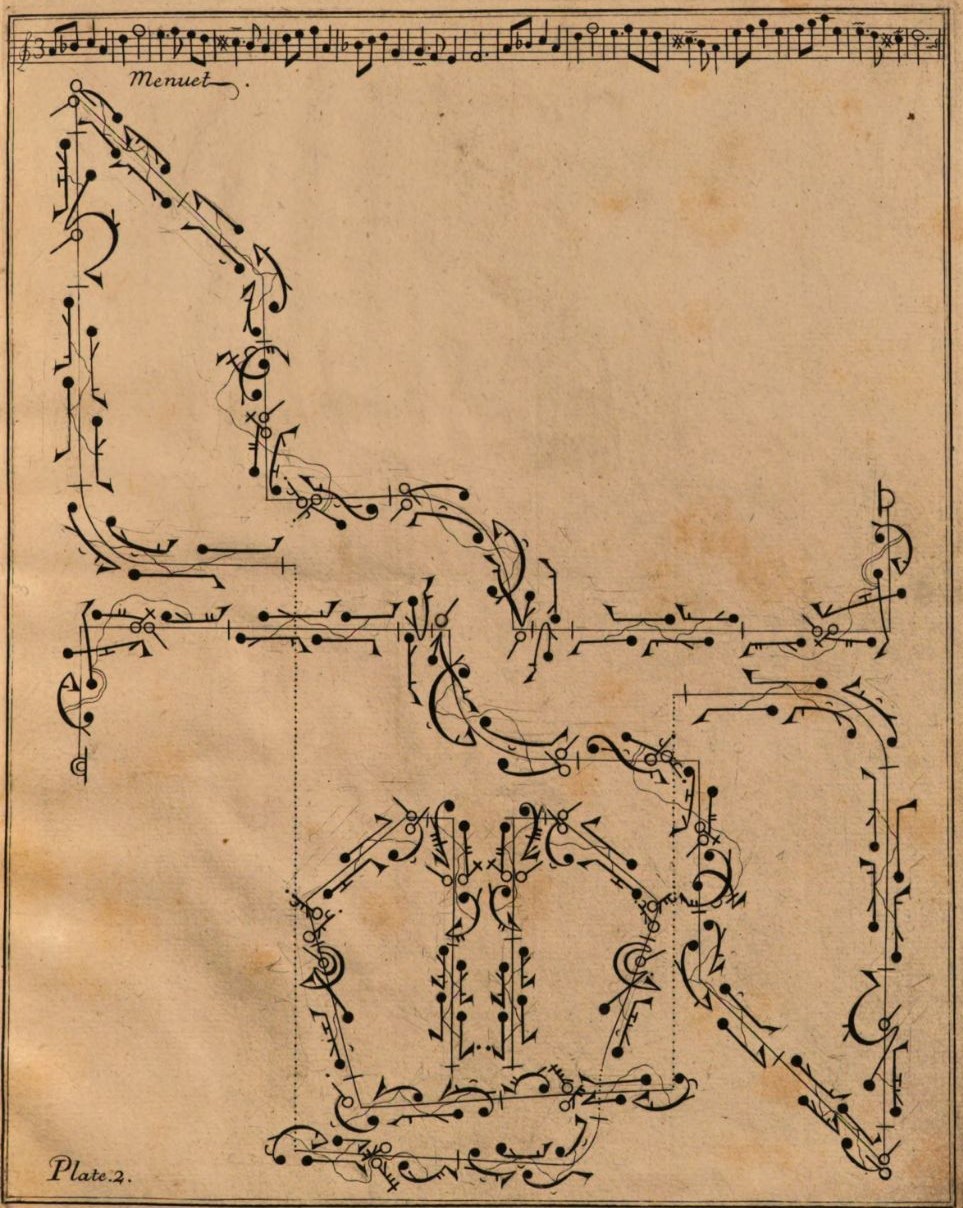
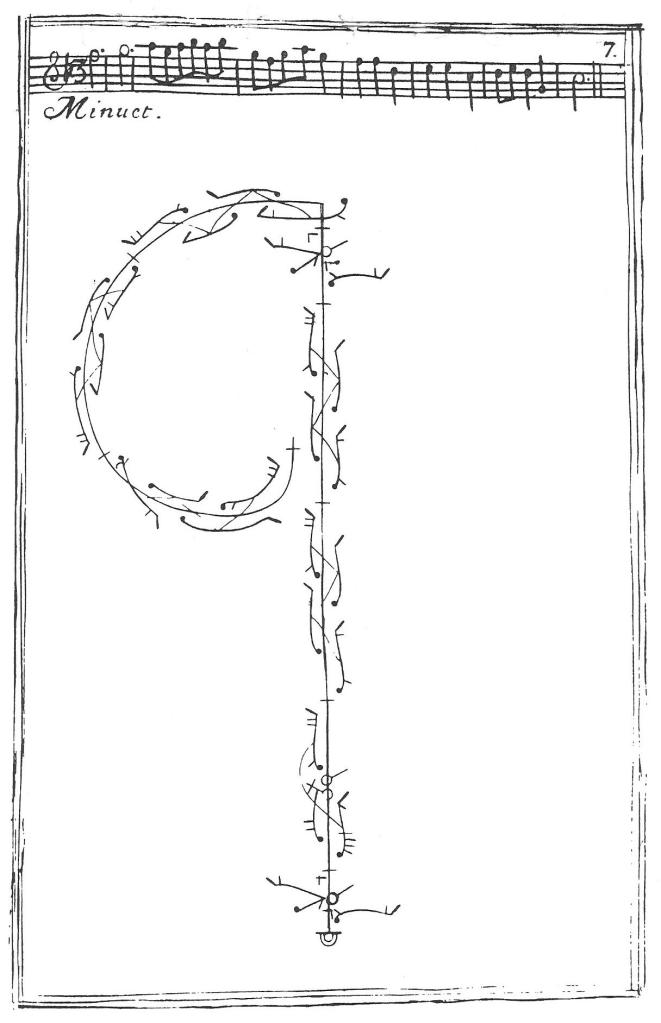
The last of the minuets seems to relate most closely to those by Mr Isaac, perhaps because Siris was working in London as well, or maybe because he was trying to emulate some aspects of Isaac’s choreographic style. Here is plate two of The Brawl of Audenarde with the whole of the minuet section.

The notation and engraving styles are strikingly different from those of the French notations and resemble those of Isaac’s dances (the printer John Walsh produced both Isaac’s and Siris’s dances). The dancers have just completed the courante, the opening section of the duet, and are facing each other offset across the dancing space. They begin by moving onto the same diametrical line with a variant of the pas de bourrée in which the last step is a pas glissé, recognisable from Isaac’s minuet for The Britannia, to which Siris adds a final plié. This is joined to a hop and a jetté, the final elements of the contretemps du menuet, to make a new hybrid pas composé emulating the sort of steps created by Isaac. Siris makes copious use of the pas de menuet à deux mouvements – there are seven in all within this 16-bar minuet (although the music is notated in 3/4, the dance steps are written in 6/4) and four are given small variations. There is a grace step, the pas de courante, which appears once in its usual guise of a tems de courante followed by a demi-jetté battu and then in an ornamented version (performed by the woman as well as the man) which has a double beat. The latter comes close to the end of the minuet section, by which time the couple are in mirror symmetry and so dancing on opposite feet. Like La Bavière, the minuet section of The Brawl of Audenarde is too short to include even allusions to the figures of the ballroom minuet. It ends with the man and woman side by side facing the presence, but improper, ready to begin the gigue with which the duet ends.

On the evidence of this small selection of early notated minuets, six French and one English (or, at least, published in London), Mr Isaac’s choreography was very idiosyncratic. The nearest to him in style is Siris. Should we read anything into the fact that, in his own translation of Feuillet’s Choregraphie entitled The Art of Dancing, Demonstrated by Characters and Figures and published in London in 1706, Siris claimed that he had been taught the notation by its inventor Pierre Beauchamp in the late 1680s? As we now know, Mr Isaac had begun his career in Paris by the early 1670s and was undoubtedly acquainted with Beauchamp. Did he and Siris enjoy similar early training in belle danse, contributing to the similarities between their approaches to choreography?

Mr Isaac’s Minuets

Four of Mr Isaac’s duets published in notation include minuets:

The Rondeau and The Britannia from A collection of ball-dances perform’d at court published in 1706. The Rondeau may date to 1693, while The Britannia was danced in celebration of Queen Anne’s birthday in 1706.

The Marlborough, apparently not published until 1710 although it was a ‘new dance’ in 1705 when it was performed to celebrate Queen Anne’s birthday.

The Royal Portuguez, a ‘New Dance made for her Majesty’s BirthDay’ in 1709 and published the same year. The title may refer to Maria Anna of Austria, who was escorted to Portugal in an English navy vessel for her marriage to João V of Portugal in 1708. She arrived at Spithead from Holland on 24 September 1708 in the Royal Anne.

I am reconstructing these minuets from their notations and all are springing surprises. Here, I will look at them in order of their dates of composition.

The Rondeau

In this duet, the musical structure of the concluding minuet reflects that of the preceding triple and duple time sections. It, too, is a rondeau, running AABACAA (A=B=C=8) and so has 56 bars in 3/4 time. The dance notation is also barred in triple time.

Only about a third of the steps in this minuet are recognisable as belonging to the vocabulary reserved for the dance type. There are some conventional pas de menuet and contretemps du menuet (notated as if in 6/4, but with a bar line part way through the step). There are also some ‘Grace’ steps, or variants of these. I will return to Isaac’s steps more generally towards the end of this post.

It is generally accepted that the partners in a ballroom minuet both begin their steps on the right foot and maintain this throughout the dance. In The Rondeau, as in his other minuets, Isaac ignores this convention at will. The minuet begins with the couple facing one another across the dancing space, before they turn to dance two pas de menuet upstage side-by-side and then turn to face one another again with a pas balancé. They only turn to face the presence as they change to mirror symmetry (the first of two such sequences) and perform two jettés backwards. This change gives the woman a contretemps du menuet on the left foot, shown in this first plate of the minuet.

The first floor patterns on the next plate could be interpreted as a variation of the ‘Z’  figure, as the couple face one another and move apart sideways, before returning on the same line and then passing right shoulders – all of which is done on an orientation which has been moved through forty-five degrees so it is sideways on to the presence. At the end of the dance, shown in the plate below, the figure resembles the taking of both hands (although no hand holds are included in the notation) before a final retreat with the man moving backwards and the woman forwards in more conventional minuet steps.

The Marlborough

In this dance, ostensibly created just a year before The Britannia, it is not easy to see the triple-time section as a minuet. The musical structure is difficult to analyse. It seems to be AABACBAC (A=4 B=8 C=4), but (as a non-musician) I am happy to be corrected on this. There are, in any case, 40 bars of music. The minuet follows a march, to which the choreography returns for a final reprise.

The dancers begin facing one another on a right line, the man backing the presence, and they travel backwards away from one another with steps that can perhaps be interpreted as a variation on the pas de menuet. None of the subsequent figures seem to make any reference to the conventional figures of the minuet and few of the steps clearly seem to be variants of minuet steps, although several resemble those in Isaac’s other couple minuets. In the final figures, before the return to the march, both travel sideways upstage with contretemps and pas de bourrée before facing each other on a diametrical line for pas de sissonne and coupé variants. They end facing each other ready to begin the last duple-time section. Here are the opening and conclusion of the minuet in The Marlborough.

The Britannia

Like The Rondeau, Isaac’s The Britannia has the musical structure AABACAA (A=B=C=8) although in this case neither of the preceding sections – in triple time followed by a bourrée in duple time – are musical rondeaus. Although the music is written in 3/4, the dance notation is actually barred in 6/4. There are 56 bars of triple time music. About a third of the steps can be recognised as pas de menuet and contretemps du menuet, although in The Britannia these are mostly in variant form.

The minuet section begins with the couple facing one another across the dancing space and then moving diagonally, the man downstage and the woman upstage, to end facing one another on a right line with the man backing the presence. In much of The Britannia, the partners are on the same foot, but there are two sequences in mirror symmetry. One comes on plate 10, following a short sequence with faint echoes of the ‘Z’ figure, while the other is in the closing bars immediately after the couple have taken both hands. Here is the final sequence, which differs from a conventional minuet in that both the man and the woman are travelling forwards towards upstage.

The Royal Portuguez

This is the latest of Isaac’s ballroom dances to include a minuet, although it comes only three years after The Britannia (Isaac would continue to create ballroom dances until at least 1714). It follows a loure, which resembles one of the ‘Spanish’ loures to be found in the French repertoire of notated dances (rather than Pecour’s Aimable Vainqueur or Isaac’s The Pastoral, both of which could be described as ‘French’). The loure is, perhaps, meant to honour the new Queen of Portugal, for whom the dance is named. The minuet has a musical structure AABB (A=8 B=12) which is rather different from the other three couple minuets, and the dance notation calls for ‘Brisk Minuet time’. Both the music and the dance notation are barred in triple-time and there are 40 bars altogether.

If its steps are unconventional, the figures of the minuet in The Royal Portuguez at least refer to some of the expected figures of the minuet. It begins with the couple side-by-side facing the presence for a passage on a right line downstage (with steps that might be construed as variants on the pas de menuet, although the dancers are in mirror symmetry). They briefly face each other before turning back to the presence and then travel sideways away from each other on a shallow diagonal. Apart from this opening sequence and another to end the dance, the couple dance on the same foot throughout. A couple of the figures hint at the ‘Z’ figure, although the dancers pass by left shoulders. The final figure begins with the couple facing one another on a diametrical line before travelling on a circular path anti-clockwise. They take hands as they perform a variant on the pas de sissonne to face one another on a right line, before a very short passage upstage to finish. Like The Marlborough, there is little to underline that this is a minuet. Here are the opening and closing plates of the minuet section of The Royal Portuguez.

Mr Isaac’s ‘Minuet’ Steps

Mr Isaac does use recognisable pas de menuet – these have three movements ending with a demi-coupé – although only The Rondeau and The Britannia include them. The contretemps du menuet appears in the same two dances. There are occasional ‘Grace’ steps, a pas balancé in The Rondeau, a pas de courante in The Britannia and paired pas de bourrée in The Rondeau and The Marlborough. Isaac seems to have liked pas composé beginning with a jumping step and ending with a pas de bourrée, which provided him with a range of variations on the pas de menuet à deux mouvements. His most often used versions were:

  • Two jettés and a pas de bourrée, which appears in The Rondeau, The Marlborough, The Britannia and The Royal Portuguez;
  • A coupé followed by a pas de bourrée, which is used in The Rondeau, The Britannia and The Royal Portuguez.

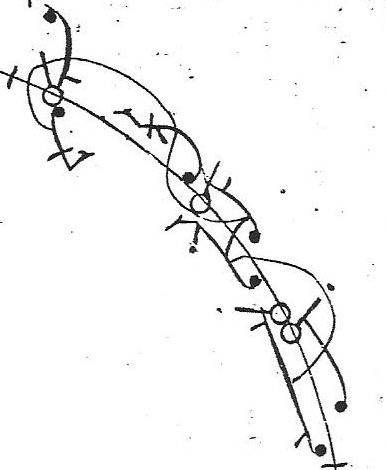
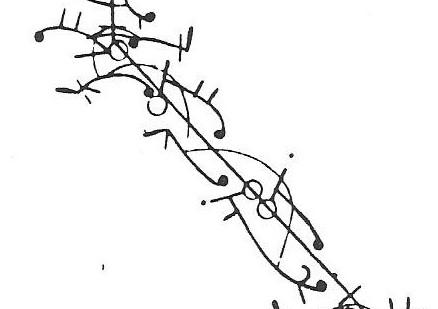
Isaac also makes quite frequent use of the jetté-chassé as an element within a pas composé. Most of these are specific to the dance in which they appear, although a coupé followed by two jettés-chassé is used in both The Royal Portuguez and The Marlborough. The jettés-chassé themselves differ, in relation to the extension (or not) of the working leg), as shown in these versions from plate 8 of The Britannia (on the left) and plate 14 of The Royal Portuguez (on the right).

It is particularly interesting that the minuet sections of three of these dances – The Rondeau, The Britannia and The Marlborough – each have several steps that appear to be unique to them.

My work on Mr Isaac’s couple minuets has called into question much of what I thought I knew about this dance. These earlier minuets range far from the conventional steps and figures set out by Rameau in Le Maître à danser and Tomlinson in The art of dancing some decades later. What does this mean for our understanding of the minuet or, indeed, other dance types among the ballroom duets.

The Regency Minuet

A few weeks ago, I had the chance to take part in a display of dancing for a heritage open day. We were doing regency dances, but the display began with a couple minuet. One of the other dancers asked if it was a regency minuet and I had to admit that it was not, but the question got me thinking about what a regency minuet might have been like.

Were minuets still being danced in the regency period? George, Prince of Wales was sworn in as Prince Regent for his father George III on 6 February 1811, and he succeeded him as king on 29 January 1820. A quick survey of newspaper references to the minuet during the first and last years of the regency reveals that it was still being taught, and performed at balls, throughout that period. I didn’t have time to do a thorough search, but I quickly came across advertisements by dancing masters who continued to include the minuet among the dances they offered. The Morning Post for 23 January 1810 has one by Thomas Wilson, who lists minuets alongside cotillions, hornpipes and country dances. The Morning Herald for 6 April 1818 has another by Mr Cunningham, who was offering ‘Quadrilles, Waltzes, Spanish Dances, Minuets, &c. Taught in the most fashionable style’. The following year, in the Morning Post for 12 November 1819, Mr Levien in his turn offered quadrilles, waltzes, minuets and country dances, ‘or any other department of Fashionable Dancing’. The minuet seems to have been far from dead, at least so far as dancing masters were concerned.

The reports and advertisements for balls show that the minuet was still the opening dance, performed by a suitably high-ranking couple. The ball on Lord Mayor’s Day, reported in the Morning Chronicle for 11 November 1811, was ‘opened in a Minuet by the Duke del Infantado, the Spanish Ambassador, and Lady Georgiana Cecil’. However, one indication of the changes that were happening appears in the report of the Lord Mayor’s Easter Monday ball in the Morning Chronicle for 15 April 1819. The Earl of Morton and Miss Atkins danced the Menuet de la Cour, and the writer declared that ‘Nothing could be more elegant and graceful’. The report did not reveal whether the ball opened with this dance but it did explain that ‘It was originally intended that the minuet should conclude with the usual Gavot as danced at the Opera House, but that part of the performance was omitted, as being inconsistent with the dignity of his Lordship’s character as Lord High Commissioner to the Grand Assembly of the Church of Scotland’. The ‘Gavot’ was, of course, the Gavotte de Vestris. Other changes involving the minuet are also evident from the newspapers, although I will not pursue these here.

The Menuet de la Cour dated back to the late 1770s and seems to have been introduced to London in 1781, when Gaëtan Vestris and his wife Anne Heinel danced it in the ballet-pantomime Ninette à la Cour. This duet (with and without the Gavotte de Vestris) would become a staple of benefit performances in London’s theatres. The original choreography would undergo many transformations in the course of an exceptionally long afterlife. The version published in notation by Malpied around 1780 shows clearly that, although the Menuet de la Cour included some of the minuet’s long-established figures, its steps went well beyond those prescribed by Pierre Rameau and Kellom Tomlinson in the earlier 1700s. This may have made it a suitable basis for the development of this exacting exhibition dance in the decades around 1800. Here is the opening figure of the dance, following the reverences (also notated by Malpied), in which there is not a single conventional pas de menuet.

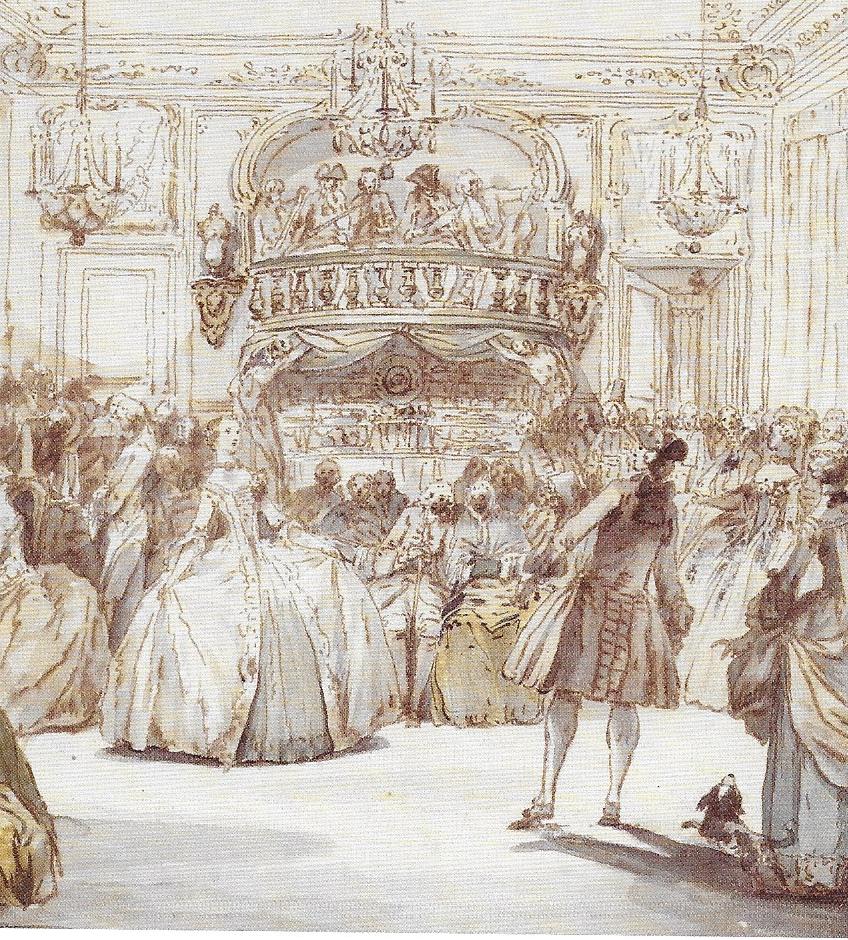
One question hovering in the background of the regency minuet is to do with dress. The minuet had begun its long career in the late 17th century and had seen many changes of silhouette during the course of the 18th century, particularly for women. This illustration, which dates to the mid-1700s, shows one of them.

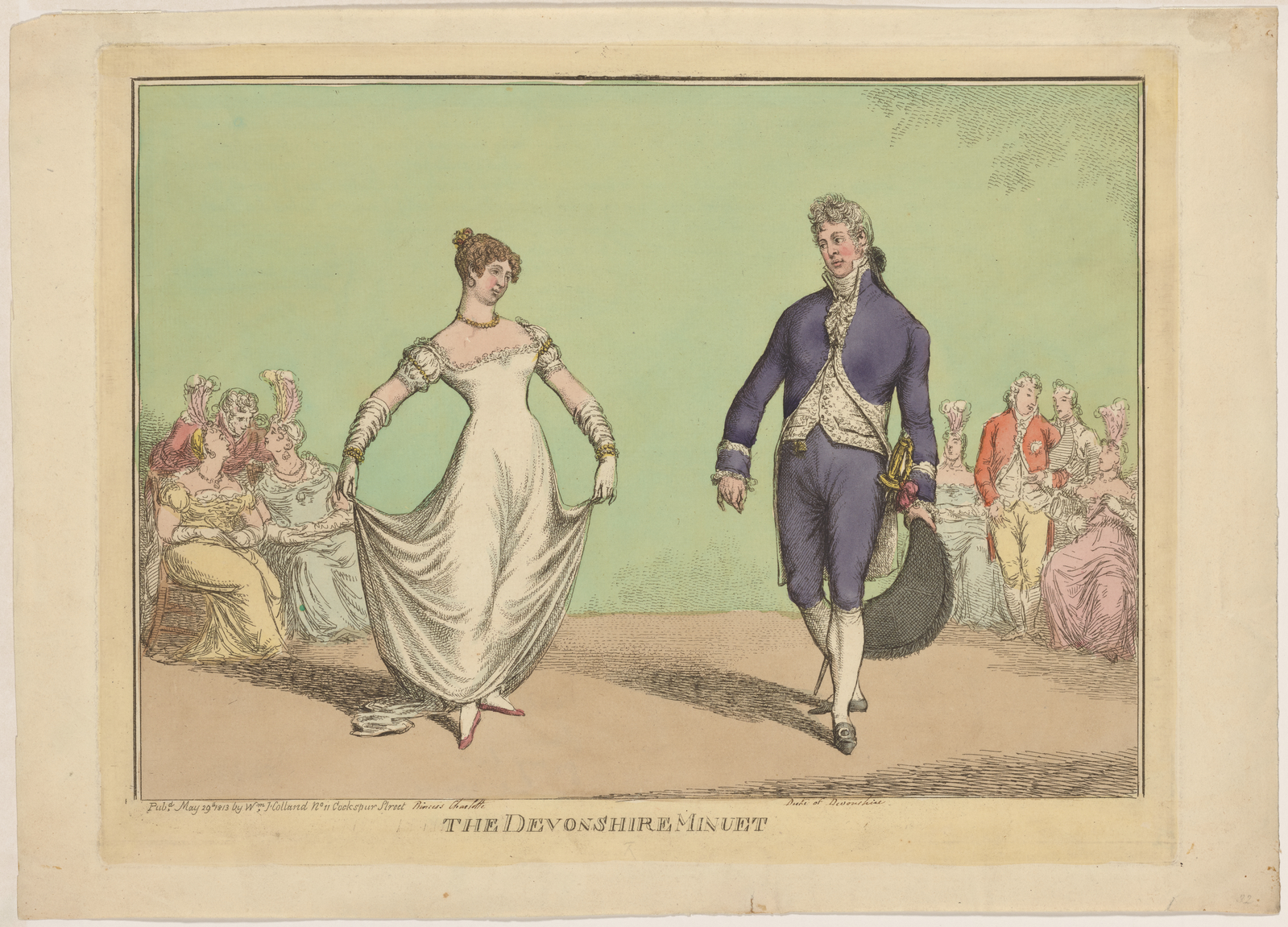
How was this most formal and, apparently, inhibited of dances adjusted to the free-flowing female dress of the regency and for dancers who were at the same time experiencing the very different movement style of the early waltz? This print, published in 1813, shows Princess Charlotte (the Prince Regent’s daughter) dancing a minuet with William Cavendish, 6th Duke of Devonshire. I can’t help thinking that the style and technique of the minuet, as well as its figures and its steps, were forced to change alongside the revolutions in dress and dancing.

There was one obvious attempt to bring the old duet up to date. The Sunday Monitor for 20 April 1817 has an advertisement by Thomas Wilson for a ‘Waltz and Quadrille Ball’ which ‘will be opened … by Mr. Wilson and a Young Lady, one of his Pupils, with the Waltz Minuet, composed by Mr. Wilson’.  I know that the basic waltz step suggested by Wilson in his 1816 treatise A Description of the Correct Method of Waltzing bears an interesting relationship to the minuet step. I am hoping that there is somebody out there who knows (or can find out) how the ‘Waltz Minuet’ was performed. I would be happy to attend a workshop!

Thomas Caverley’s Slow Minuet

I have recently been working on Thomas Caverley’s Slow Minuet and I thought I would look more closely at the two different versions of this solo that survive in notation. One was published by Edmund Pemberton, who gives it the subtitle ‘A New Dance for a Girl’, while the other survives in a manuscript version by Kellom Tomlinson. They differ enough from one another to be thought of as two dances rather than two versions of the same dance. There is another solo minuet for a female dancer, Mr Isaac’s Minuet, which was published by Pemberton in 1711 and is clearly linked to both versions of the Slow Minuet. I will mention this third dance from time to time.

The Sources

Mr. Caverley’s Slow Minuet ‘A New Dance for a Girl’ was among the series of notated ball dances published by Edmund Pemberton between 1715 and 1733. The notation is undated and has been ascribed to 1729, a date I accepted when I wrote about Pemberton in 1993 (references to the sources I have used are given at the end of the post). However, fresh examination of the dance notation suggests that it was probably notated and engraved much earlier. The title page (with its mention of ‘Mr. Firbank’ as the composer of the tune) was also used for the anonymous solo La Cybelline – another ‘New Dance for a Girl’ – but has clearly been altered for Caverley’s dance. La Cybelline was published in 1719, so the Slow Minuet might have appeared around the same time. However, there is another piece of evidence which might place the work of engraving the dance a few years earlier. The dance notation is densely laid out, mainly because Pemberton would have wanted to save on the cost of paper for printing by fitting it into four pages. The engraving is somewhat rough and ready, reminiscent of the first dances that Pemberton published independently after he stopped working for the music publisher John Walsh in 1715. Could the Slow Minuet have been the first dance notation that Pemberton produced himself and then re-issued with a new title page at a later date? Both Caverley and Isaac were keen proponents of the new art of dance notation, so Caverley could have favoured Pemberton with a dance just as Isaac had done a few years earlier. Here is the title page alongside the first plate of Pemberton’s version of Caverley’s Slow Minuet.

The manuscript version of the solo, titled ‘The Slow Minnitt: by Mr: Caverley:’ was transcribed by Kellom Tomlinson into his WorkBook, along with other notes and dances. The WorkBook was discovered in New Zealand and published in facsimile in 1992, edited by the dancer and dance historian Jennifer Shennan. Tomlinson was apprenticed to Thomas Caverley between 1707 and 1714 and would go on to publish several of his own dances in notation between 1715 and 1720. His version of the Slow Minuet is undated but probably belongs to the period of his apprenticeship – the WorkBook contains material which can be dated from 1708 to 1721. Tomlinson’s notation is actually more assured than Pemberton’s (he had fewer restrictions as to paper and gives a separate page to each section of the dance). His notational style differs from Pemberton’s (a topic to which I will return). Some of the differences between the two versions are discussed and analysed by Jennifer Shennan in her introduction to the facsimile. Here are the first two pages of Tomlinson’s notation.

The other dance I have mentioned is the Minuet by Mr Isaac, published in notation within Edmund Pemberton’s An Essay for the Further Improvement of Dancing in 1711. It follows Isaac’s Chacone and, in his Preface, Pemberton says that Isaac had ‘oblig’d’ him with ‘a single Dance’ suggesting that the two were meant to be performed together as one choreography. The same collection has Pecour’s solo forlana for a woman (titled a ‘Jigg’) and a solo version of Anthony L’Abbé’s ‘Passacaille’ originally choreographed as a duet for two professional female dancers to music from Lully’s opera Armide. Pemberton’s 1711 collection was published by John Walsh. Here are the first two plates of Isaac’s Minuet.

It is worth adding that Thomas Caverley and Mr Isaac were near contemporaries. Isaac (whose real name was Francis Thorpe, as I discovered some years ago when I was researching Jerome Francis Gahory) was perhaps born around 1650 and was buried early in 1721. Thomas Caverley’s birth date has been given variously as 1641, 1648 or 1651, although he may have been born as late as 1658 or 1659. He lived much longer than Isaac for he died in 1745. Isaac, of course, was a royal dancing master – described by John Essex in the ‘English’ Preface to his translation of Rameau, The Dancing-Master (1728), as ‘the prime Master in England for forty Years together’. Essex wrote of Caverley as ‘the first Master in teaching young Ladies to dance’, a reputation which explains the publication of his Slow Minuet.

The Dances

The two versions of Caverley’s Slow Minuet each use different music. In Pemberton’s version the tune is attributed to the dancing master Charles Fairbank, whereas Tomlinson’s music is anonymous. The solos are different lengths too. Pemberton’s music has the time signature 3 and four AABB repeats (A=B=8). The dance notation has 6 beats to the bar, so each pas composé takes two musical bars in accordance with the usual convention for minuets. Tomlinson also writes his music with a time signature of 3 but his has five AABB repeats (A=B=8). His notation has three beats to each dance bar, although he writes some steps over two bars with liaison lines to make clear that they are single pas composés. Pemberton’s Slow Minuet has 128 bars of music, while Tomlinson’s has 160.

An analysis of both notations reveals that, although these closely related choreographies are minuets, much of their vocabulary consists in demi-coupés, coupés and pas de bourée. The pas de menuet and contretemps du menuet are used mainly in the third repeat of the AA and again in the fourth AA. Tomlinson uses these steps additionally in his fifth and final AA and final B section.

Both choreographies begin with a sequence of two demi-coupés forwards and two backwards, followed by a coupépas de bourée sequence repeated six times. This fills the first AA and, it seems, sets out Caverley’s intention of teaching the minuet not through the conventional step vocabulary of that dance but through its building blocks. He uses these to introduce the girl to the rhythmic variety possible within the steps of this formal dance, among other ideas, as well as to provide a technical foundation. This approach is evidenced elsewhere in both versions of the Slow Minuet. In the third plate of Pemberton’s notation the pas de menuet à trois mouvements with a demi-jeté on the final step is introduced, and in the fourth plate there are pas de menuet à deux mouvements which begin on both the right and the left foot. In his third AA, Tomlinson uses the pas de menuet à deux mouvements, but in his fourth and fifth AA sections he turns to the pas de menuet used by Isaac in his Minuet (in The Art of Dancing, Tomlinson calls this the ‘English Minuet Step’). This is, essentially, a fleuret followed by a jeté and can be seen in the plates from Isaac’s Minuet shown above. This hints at a link between the choreographies and, perhaps, the teaching of both Isaac and Caverley.

Another such hint is provided by a pas composé used in Pemberton’s version of the Slow Minuet. This takes two bars of music and all the steps are linked together by liaison lines. I find such compound steps difficult to break down into their component parts, but this one may be analysed as a variant on the pas de bourée, incorporating an emboîté and ending with a pas plié, followed by two coupés avec ouverture de jambe. A slightly different version of the step is found in Isaac’s Minuet, with jetés-chassés instead of the coupés. Here are the two steps in notation for comparison. First Pemberton’s, from his fourth plate – without being able to examine an original notation it is not possible to be certain, but the initial emboîté shows the foot position on the balls of the feet.

Next Isaac’s, from his third plate – the dots showing the emboîté on the balls of the feet are clear.

Both Pemberton and Tomlinson use a variety of figures, which are quite often not the same or at least are notated differently. The opening figures are actually the same in both versions, although Pemberton notates all the sideways steps around the right line of the dancer’s direction of travel towards the presence, while Tomlinson shows the sideways travel explicitly. In the figures for the third AA, Pemberton notates the dancer travelling a semi-circular path anti-clockwise followed by another clockwise, whereas Tomlinson takes his dancer clockwise in a quarter-circle followed by a tighter three-quarter circle in the same direction and then traces the same figure anti-clockwise. Both dances have figures that reflect some of those in Isaac’s Minuet, notably zig-zags on the diagonal and repeated tight circles. Although some of the figures contain echoes of those in the ballroom couple minuet, parallels are not obvious in either notation.

Both versions of the Slow Minuet are constructed around a series of variations. Some of these are 8 bars long and are danced twice, starting with the right foot and then the left, to match the repeated musical sections. There are also 4 bar sequences, which might or might not be repeated within a musical section. Two of Tomlinson’s plates are missing a couple of bars of dance notation, but the structure of the section and its predecessor (as well as Pemberton’s version) suggest what the missing steps might be. The second BB section (plate 4) appears to be without its final two dance bars.

One suggestion is that the coupédemi-coupé steps that follow the two demi-coupés should take two bars of music each (rather than one bar as notated). I suggest instead that they do take one bar each and that they should be repeated after the last two demi-coupés on the plate, which gives two identical sequences to match the musical repeat.

The other omission comes in the last B of the third BB section (plate 6).

This is more difficult to guess, but I suggest that two contretemps should be added, one sideways to the left after the fourth step (another contretemps) and the other sideways to the right at the end of the sequence. This would then run as a repeated 4-bar sequence of contretempscoupépas de bouréecontretemps.

The different notational styles of Pemberton and Tomlinson are almost worth a post of their own and are evident from the very beginning of the two dances with the opening demi-coupés. Pemberton’s version is on the left and Tomlinson’s on the right.

Or, do these represent different steps? Tomlinson’s demi-coupé finishes on the first beat, followed by a two-beat rest, while Pemberton apparently gives the dancer two beats to bring the free foot into first position – making this a version of a coupé sans poser rather than a demi-coupé. Later on the same plate, Pemberton notates demi-coupés more conventionally, suggesting that the opening steps are not demi-coupés.

Conclusion

I have discussed these two notations in some detail because I believe that such close reading can help us get a better idea of how these notated dances were actually performed. Caverley’s Slow Minuet is one of very few choreographies that survive in more than one version and there is far more to say than I have set down here. I think that the dance was integral to his teaching of young ladies and that it was intended as a display piece for performance at formal balls held by the dancing master at his premises and elsewhere. It makes formidable demands on the young dancer’s mastery of aplomb – not merely her placement but also her address. She has to be secure in balancing on one foot and moving rhythmically (and sometimes quite slowly) from one foot to another. She also has to maintain her erect and easy carriage as she moves through her steps and figures. There are continuous rhythmic challenges as well as demands on her memory as she dances a series of variations no two of which are the same.

If I were called upon to devise a syllabus for teaching the minuet, I would begin with Thomas Caverley’s Slow Minuet. If aspirant historical dancers can perform this exacting solo (in either version) successfully, the ballroom minuet would surely hold no terrors for them.

This image from Kellom Tomlinson’s The Art of Dancing is well known. Does it suggest that he continued to adapt and teach a Slow Minuet to his young female pupils?

References

Thomas Caverley. Mr. Caverley’s Slow Minuet. A New Dance for a Girl. The Tune Composed by Mr. Firbank. Writt by Mr. Pemberton. [London, c1720?]

For the 1729 dating see Little and Marsh, La Danse Noble, [c1729]-Mnt

An Essay for the Further Improvement of Dancing; Being a Collection of Figure Dances, of Several Numbers, Compos’d by the Most Eminent Masters; Describ’d in Characters … by E. Pemberton (London, 1711)

Kellom Tomlinson. A WorkBook by Kellom Tomlinson. Commonplace Book of an Eighteenth-Century English Dancing-Master, a Facsimile Edition, edited by Jennifer Shennan. (Stuyvesant, NY, 1992)

Moira Goff, ‘Edmund Pemberton, Dancing-Master and Publisher’, Dance Research, 11.1 (Spring 1993), 52-81.

Moira Goff, ‘The Testament and Last Will of Jerome Francis Gahory’, Early Music, 38.4 (November 2010), 537-542.

Meredith Ellis Little, Carol G. Marsh. La Danse Noble. An Inventory of Dances and Sources. (New York, 1992)

The ‘Z’ Figure of the Minuet: Taubert and Tomlinson

I am not going to undertake a lengthy and exhaustive investigation of the ‘Z’ figure of the minuet. My aim is simply to discover the origins of the version I originally learned. Here, I will look at two sources in particular, and glance at some others.

The earliest notated source for a minuet comes from Jean Favier’s notation for Le Mariage de la Grosse Cathos of 1688. This minuet is for four dancers and was performed within an entertainment given by professional dancers at the court of Louis XIV. It thus falls outside my present topic. Details can, of course, be found in Musical Theatre at the Court of Louis XIV: Le Mariage de la Grosse Cathos by Rebecca Harris-Warrick and Carol G. Marsh, a study published in 1994 which includes a facsimile reprint of the manuscript.

The treatise by I.H.P. ‘Maître de danse, oder Tantz-Meister’, published in Glueckstadt and Leipzig in 1705, contains the ‘Menuet d’Anjou’ a ballroom duet for a couple. This is a choreographed dance rather than a conventional ballroom minuet, so it too falls outside my topic. The dance and its notation, together with a translation of the treatise can be found in Barocktanz / La Danse Baroque / Baroque Dance, edited by Stephanie Schroedter, Marie-Thérèse Mourey and Giles Bennett and published in 2008.

The next treatise to deal with the ballroom minuet, and apparently the earliest to look at the basic form of this dance, is Gottfried Taubert’s Rechtschaffener Tantzmeister published in Leipzig in 1717. This valuable treatise is now available in an English translation by Tilden Russell published in 2012. Taubert turns to the minuet in chapter 30 of his second book. After a lengthy discussion of the various minuet steps, he discusses the ‘principal figure of the minuet’ in chapter 33. He gives a short history of the ‘Z’ figure and identifies three versions currently in use – a reversed ‘S’, a ‘2’ and the ‘Z’. For the reversed ‘S’, Taubert prescribes sideways pas de menuet for the first semi-circle and forward pas de menuet for the second. For the ‘2’ he suggests various combinations of sideways and forwards pas de menuet, but he also says:

‘Some use only side steps throughout, in this way: three or four to the left, bringing them down to the beginning of the straight line, along which they turn and make one or two side steps to the right, thus using no forward steps in the principal figure, which I find displeasing. Also it should be remembered that nowadays many do not make the turn to the left [at the straight line], but instead, after having passed by the woman with side steps, always keeping her before their eyes, they dance backward, and then sideways to the right.’ (p. 640 original text, p. 529 translation)

So, we have another backwards step – although Taubert’s sequence is not the same as Rameau’s.

For the ‘Z’ version of the figure, Taubert says ‘Two side steps to the left are made along the upper horizontal line, two or three forward steps along the long middle line, and another one or two side steps to the right along the lower horizontal line’ (p. 640, p. 529. Taubert is describing the figure as danced by the man). He adds ‘Recently it was reliably reported to me that two royal personages were seen dancing this figure with nothing but side steps from right to left, circling round each other at the same time; but I would never lightly advise anyone to try this’. Taubert also notates the ballroom minuet – the ‘Z’ figure looks like this (p. 658, p. 541):

As you can see, there are two pas de menuet à trois mouvements to the left, two more forward and two pas de menuet à deux mouvements to the right having turned around the left shoulder. The half turn is divided into two quarter-turns performed over the final demi-jeté of the fourth pas de menuet and first demi-coupé of the fifth.

In Le Maître a danser, some eight years later, Rameau explained that Guillaume-Louis Pecour had been responsible for changing the original reversed ‘S’ to a ‘Z’ figure (chapter 22, p. 84).

In his Trattato del Ballo Nobile published in Naples in 1728, Giambatista Dufort has a second section devoted to the minuet and looks at the ‘Z’ figure in chapter 5. Essentially, he prescribes two pas de menuet to the left, two more to cross and then two to the right. He does not mention any backwards steps.

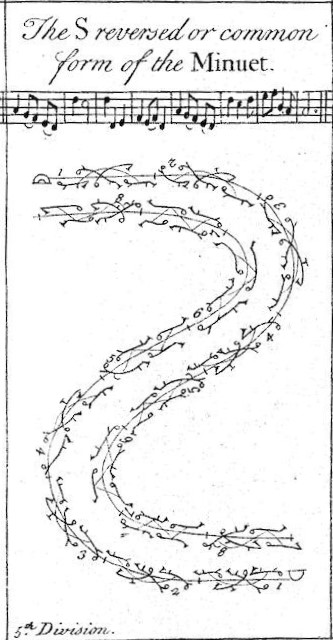
Kellom Tomlinson published The Art of Dancing in London in 1735 (although he claimed to have completed the work in 1724, before Rameau published Le Maître a danser). He provides a detailed account of the steps and figures of the minuet in book two, reaching the ‘Figure of S reversed’ in chapter 7. Tomlinson uses eight pas de menuet for the figure. He begins with four pas de menuet à trois mouvements sideways – two to the left and two on the diagonal to meet in the middle – followed by four pas de menuet (‘one and a fleuret’) forwards to complete the ‘S reversed’. He adds that the last of the eight pas de menuet may be made sideways. Like Taubert, Tomlinson includes a notation for his ballroom minuet with two ‘S reversed’ figures in which he varies the last step.

Tomlinson also includes several engravings showing couples dancing the minuet. In this one they are about to begin the ‘S reversed’ figure.

Not only does the ‘Z’ figure include a pas de menuet backwards, in more than one treatise, but the type of step as well as the number used varies according to the different dancing masters who wrote about it in the early 1700s. I wish I had known this when I was learning the dance. The version I learned most closely resembles Taubert’s notation, although I do not remember him ever being cited as the source. I am not going to take this particular line of enquiry any further, at least for the time being, but I think there is ample material for some practical research by those who would like to get a little closer to how the minuet might have been danced at balls and assemblies in the 18th century.

The ‘Z’ Figure of the Minuet: Pierre Rameau

I recently saw a demonstration of the ‘Z’ figure of the minuet that gave me pause for thought. Citing Pierre Rameau and the diagram in Le Maître a danser, the figure was danced with two pas de menuet sideways to the left, two forwards on the diagonal and one backwards to the right. So far as I can remember, I have never been taught the ‘Z’ figure in this way, but instead of rushing to the conclusion that the interpretation must be wrong, I decided to do some research. A quick look on YouTube revealed very few videos of the ballroom minuet, let alone Rameau’s version of this dance. Of the two videos I found, the couple in one danced the final section of the ‘Z’ figure with two pas de menuet sideways to the right (turning around the right shoulder for the necessary quarter-turn), while the other couple did indeed do a single pas de menuet backwards. It was interesting that the latter video was far more recent than the former, so was I looking at a fresh interpretation of Rameau’s instructions?

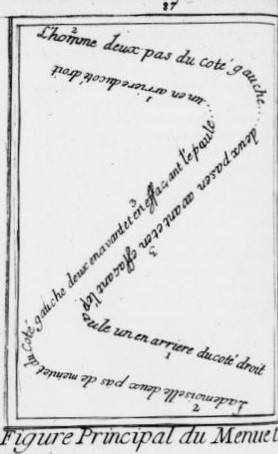
Rameau deals with the figures of the ballroom minuet in his chapter XXII, ‘Du Menuet, & de la maniere de le danser régulierement’. Here is Rameau’s illustration of the ‘Z’ figure – ‘Figure Principal du Menuet’ – from this chapter.

As you can see, it says that both dancers perform two pas de menuet sideways to the left, two more forwards to pass one another by the right shoulder ‘en effaçant l’épaule’ and one backwards to the right (‘un en arriere du coté droit’).

When we turn to Rameau’s text, his written instructions are less clear.

Although he includes the numbers 1, 2 and 3 on his diagram, Rameau refers only to 2 and 3 in his text. In fact, he says nothing at all about the final step of the ‘Z’ figure. Is it possible that a part of Rameau’s instructions was omitted when the book was printed? So far as I am aware, there has been no detailed bibliographical study of this text that might address such issues.

I turned to John Essex’s 1728 translation of Rameau’s treatise, The Dancing-Master, to see whether he might have made good the omission in the original. Essex reproduces Rameau’s diagram, titling it ‘The fourth & Principal Figure of the Menuet’ and he too shows ‘two menuet Steps to ye left’ followed by ‘two forward, shading the shoulder’, but he has ‘two backwards to the right’.

Essex has made a change to Rameau’s illustration, but he merely translates the associated text without alteration.

Although Rameau’s treatise was published in 1725, was he perhaps reflecting an earlier French convention for the performance of the ‘Z’ figure? Was Essex merely making a faithful translation, or was he referring to a convention still current in English performances of the minuet?

Why was I taught a ‘Z’ figure with two pas de menuet sideways to the left, two forwards on the diagonal and two sideways to the right? Does the answer lie in other dance manuals of the early 18th century rather than in an idiosyncratic approach to dance reconstruction? I will turn to the other sources for the ‘Z’ figure in a new post.

Minuets Mocked

Among the many minuets danced in London’s theatres in the course of the 18th century, two have titles that single them out from the majority. A Mock Minuet was performed at Covent Garden on 12 April 1733 and lasted into the following season. A Grotesque Minuet was given a single performance at the same theatre on 20 April 1758. What might their titles tell us about these particular entr’acte dances, or about minuets performed on the London stage more generally?

According to the advertisement in the Daily Journal on 12 April 1733, the performance at Covent Garden included a ‘Mock Minuet by Nivelon and Mrs Laguerre, introduced by Pelling, Mrs Pelling, Newhouse, Miss La Tour, De la Garde, Mrs Ogden, Lesac, Miss Baston’ to be given at the end of act 4 of Thomas Otway’s tragedy Venice Preserv’d.

Mock Minuet Daily Journal 12 Apr 1733 (2)

The entr’acte dance was given another six performances before the end of the season, with several different mainpieces although all the performances were benefits (including one for Mrs Laguerre and her husband, the actor-singer John Laguerre). On 7 May, and for all subsequent performances, the number of supporting couples was reduced from four to three. The Mock Minuet was revived for another eight performances in 1733-1734 at the Little Theatre in the Haymarket. Nivelon again led the dancers, with Miss Robinson as his partner, but there were only two supporting couples. Such variations in the number of dancers and even changes of venue were not unusual for dances given on the London stage, although in this case Nivelon revived the dance at the Haymarket following his departure from the Covent Garden company.

Why was the dance titled a ‘Mock Minuet’? The answer lies beyond the dance repertoire in London’s theatres, for it must surely relate to an extremely successful play. Henry Fielding’s The Mock Doctor; or, The Dumb Lady Cur’d, an adaptation of Molière’s Le medecin malgré lui, was first given at Drury Lane on 23 June 1732. It had been such a hit that not only was it revived the following season but it secured a place in the repertory into the 19th century. At Drury Lane it was given several times early in the 1732-1733 season and then revived again in January 1733. The Mock Doctor was performed for the first time at the Goodman’s Fields Theatre and the Little Theatre in the Haymarket on 13 and 14 February 1733 respectively, underlining its popularity with audiences.

All this was followed by several other plays that tried to capitalise on Fielding’s success. The anonymous The Mock Officer; or, The Captain’s Lady was given at Drury Lane on 28 March 1733, followed by Chetwood’s The Mock Mason ‘a Ballad Opera of one Act’ given a single performance at Goodman’s Fields on 13 April 1733 (for Chetwood’s benefit). Covent Garden joined in with The Mock Lawyer, ‘a Farcical Ballad Opera’ by Edward Phillips, on 27 April 1733 and finally there was the anonymous The Mock Countess at Drury Lane on 30 May 1733. Most of these copy-cat productions responded to the format of Fielding’s play which, with its several songs, resembled a small-scale ballad opera. The Mock Minuet was given in the middle of all this opportunistic rivalry – which surely explains its title.

The choreographer of the Mock Minuet was very likely Francis Nivelon, with whom the dance moved from Covent Garden to the Haymarket. Can all this information tell us anything about the entr’acte dance itself? Nivelon had been a member of John Rich’s company since the 1723-1724 season and may well have created many, if not all, of the choreographies he had performed at Lincoln’s Inn Fields in both entr’acte dances and afterpieces. Among the entr’acte dances he performed in 1732-1733 were two first given around the same time as the Mock Minuet – the Sleeping Dutchman and his Frow on 27 March 1733 and The Amorous Clowns; or, the Courtezan on 3 May 1733.

The advertisement for the Sleeping Dutchman and his Frow in the Daily Journal for 16 May 1733 follows the same pattern as that for the Mock Minuet (I couldn’t locate the advertisement for 27 March).

Mock Doctor Daily Journal 16 May 1733 (2)

Nivelon subsequently took this same dance to Drury Lane and the advertisement for the performance there on 10 October 1734 makes it clear that Nivelon is the Sleeping Dutchman with Mrs Laguerre as his wife. There were many ‘Dutch’ duets performed on the London stage at this period, so Nivelon seems to be giving a new twist to an old theme and perhaps also using some familiar music.

The Amorous Clowns; or, the Courtezan was actually advertised with its own cast list in the Daily Journal for 3 May 1733.

Mock Doctor Daily Journal 3 May 1733 (2)

Nivelon had made a speciality of Clowns (in this context meaning ‘Boors’ or ‘Rustics’) and so was presumably drawing on his own dances and perhaps their music too. He may have collaborated with Pelling on this entr’acte dance, for it turns up at Drury Lane in 1735-1736 with Pelling as the lead Clown. It seems likely that both of these dances – and the Mock Minuet – incorporated comic action alongside dances.

Could the Mock Minuet have drawn on The Mock Doctor? Nivelon may well have used music from some of the latter’s songs but did he draw on one or other of Fielding’s two intertwining plots? The major strand concerns Gregory, his wife Dorcas and her revenge when he beats her – Gregory is the ‘Mock Doctor’ of the play’s title. The other follows Charlotte and Leander, who cannot marry because her father intends her for another. Charlotte is the ‘Dumb Lady’ of the play’s sub-title, who is treated by the ‘Mock Doctor’. If Nivelon did refer explicitly to Fielding’s farce (and the Mock Minuet was one of Covent Garden’s responses to Drury Lane’s success with The Mock Doctor), the scenes with Dorcas and Gregory probably provided the sort of comic action he had already created so often.

Another Mock Minuet was given single performances in each of the 1752-1753 and 1753-1754 performances. In both cases it was danced by ‘Maranesi and Sga Bugiani’, each time for Maranesi’s benefit. This was a duet and may well owe something to the Italian grottesco dance tradition. It is also worth noting that another Mock Minuet held the stage from the 1770-1771 season until the end of the century. This dance was associated with James Townley’s farce High Life Below Stairs, in which two servants impersonate their master and mistress to dance an ‘awkward and conceited’ minuet. The dance became such a hit with audiences that it was regularly billed as a feature of the performance when the afterpiece was given.

The Grotesque Minuet is less of a conundrum. On the London stage the term ‘Grotesque’ is not often used for dances and in advertisements signifies performance by characters from the commedia dell’arte – as John Weaver made clear in his The History of the Mimes and Pantomimes (1728) – ‘By Grotesque Dancing, I mean only such Characters as are quite out of Nature; as Harlequin, Scaramouch, Pierot, &c.’ (p. 56). Weaver did muddy the waters by adding ‘tho’ in the natural Sense of the Word, Grotesque among Masters of our Profession, takes in all comic Dancing whatever’. When it comes to dancing on the London stage, one can never be quite sure about anything.

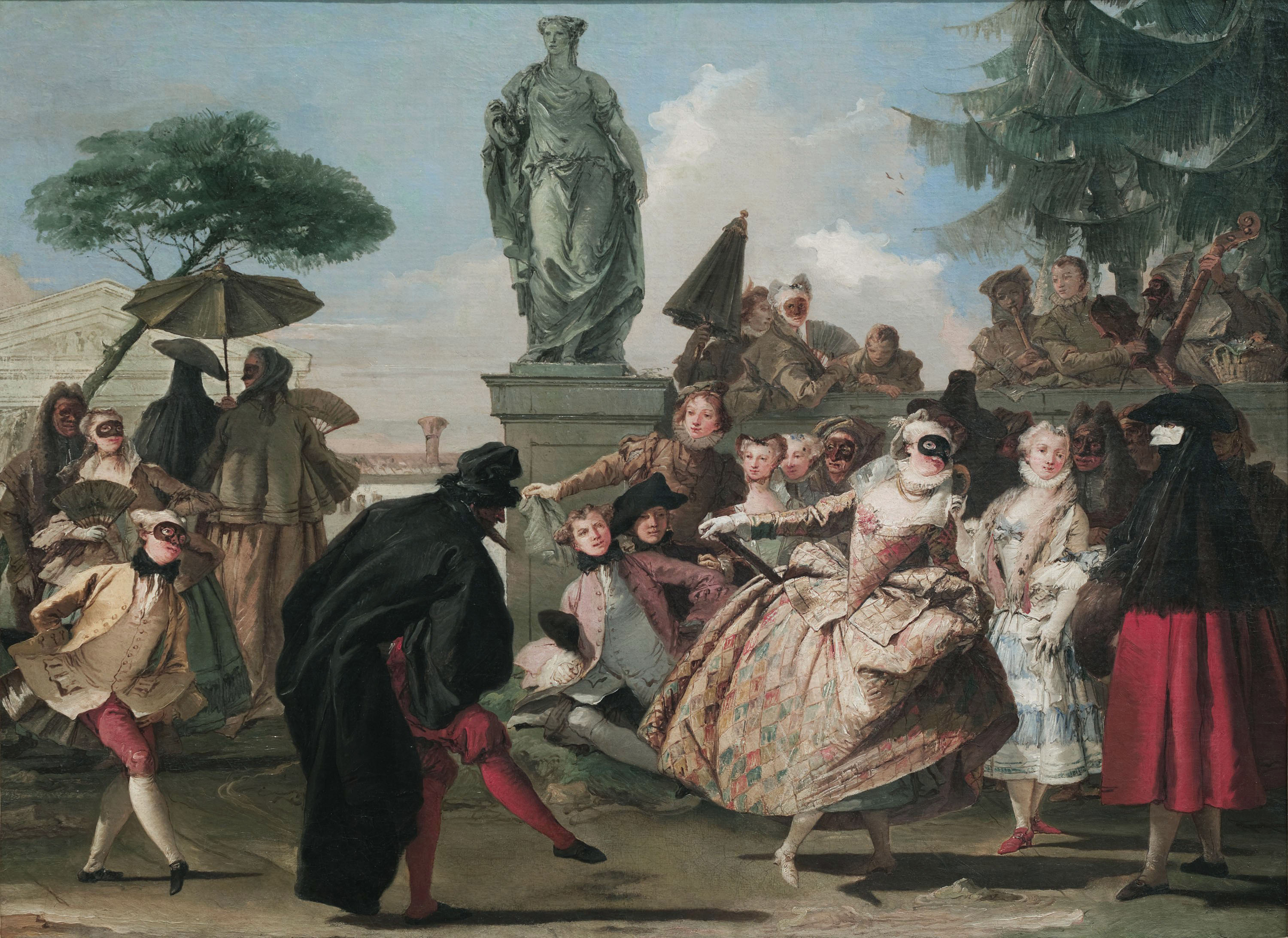
The single performance of the Grotesque Minuet was given by Leppie and Miss Hillyard for her benefit. Unfortunately, I can’t find any evidence to suggest which commedia characters they may have represented, if indeed they did. Perhaps their duet looked a little like this dance depicted by Giandomenico Tiepolo in 1756?

Gian Domenico Tiepolo Grotesque Minuet 1756


Minuets on the London Stage

Those of you who are familiar with the minuet probably know it best as the pre-eminent ballroom duet of the 18th century. Some will have encountered it within the figure dances in Edmund Pemberton’s An Essay for the Further Improvement of Dancing, published in 1711, while others may have learnt one or other of the notated minuets. How many of you have discovered that the minuet, in various guises, was regularly performed in London’s theatres throughout the 1700s? I thought it would be interesting to take a look at some of these stage minuets.

Some time ago, I compiled a list of entr’acte performances of minuets on the London stage between 1700 and 1760. Extensive as it is, the list certainly has omissions, since the surviving advertisements do not always provide full details of the dances performed each evening. The earliest mention is a solo Minuet, performed with a Chacone and a Jigg by the dancer Miss Lindar at Drury Lane on 30 October 1717. This is very unlikely to have been the first solo minuet given in London’s theatres. The ‘Menuet performd’ by Mrs Santlow’, published in notation within Anthony L’Abbé’s A New Collection of Dances in the mid-1720s, may well date to between 1708 and 1712 – although there is no advertisement to confirm this. I have danced this choreography many times and I love the intricacy of its steps, its subtly allusive figures and its unusual use of the stage space. Here is the final plate of the dance, which I think shows all of those characteristics.

Menuet Solo 1725 21

Hester Santlow is not billed in a solo minuet until 25 March 1731, when she danced a Chacone and a Minuet in the entr’actes at Drury Lane, but the dance must surely have been part of her repertoire long before then. There is no way of telling whether she continued to perform L’Abbé’s solo, or had new minuet choreographies created for her (or crafted her own dances) over the years.

Another solo minuet which has escaped record in The London Stage is Kellom Tomlinson’s ‘Minevit’ created for Mrs Schoolding to dance in The Island Princess at the Lincoln’s Inn Fields Theatre in 1716. In comparison to Mrs Santlow’s ‘Menuet’, this is a miniature (32 bars of music and 16 minuet steps to 120 bars and 60 minuet steps), but Tomlinson adds complexity with successive half-turns in several steps (which are all variants on the contretemps du menuet).

MInevit Tomlinson 1

Later solo minuets in the period I am looking at apparently include a ‘Minuet in Boy’s Cloaths’, danced by Mlle Grognet at Lincolns Inn Felds on 18 April 1734. I am uncertain about this one, as Mlle Grognet was billed as dancing a minuet in ‘Men’s Clothes’ with other female dancers several times that season. I suggest that they were dancing a version of the ballroom minuet.

Solo minuets were rarely advertised and the last examples before 1760 were performances by young actresses. At Drury Lane Miss Pritchard ‘Danc’d a Minuit for the King’ in a Masquerade Dance inserted into Mrs Centlivre’s The Wonder on 8 November 1756. The performance had been commanded by George II. Was this choreography closer to Thomas Caverley’s Slow Minuet … for a Girl than to Mrs Santlow’s sophisticated ‘Menuet’? If it was, in fact, a solo minuet.

The minuet was usually performed as a duet in London’s theatres, although the earliest advertisement dates only to 14 April 1726 at Lincoln’s Inn Fields, when Glover and Mrs Laguerre did the honours. As with the majority of bills on which the Minuet appears, the performance was a benefit (in this case for the actor-singer John Laguerre and his wife Mrs Laguerre). The next advertisement for a Minuet was not until 3 May 1731, when Glover danced at his own benefit with Mlle Sallé. Thereafter, the minuet became a fixture in the bills for benefit performances. It was given by a galaxy of star dancers (as well as those of lesser rank) – Desnoyer and Mrs Booth (Hester Santlow before her marriage in 1719), Desnoyer and Mlle Sallé in 1735 (performed at each other’s benefits), Desnoyer and Signorina Barberini in 1741 and 1742. If Glover began the idea, Desnoyer seems to have established the minuet as an entr’acte dance of choice for benefits. Anne Auretti would do the same from 1748 into the early 1750s.

What were these minuets like? Were they essentially the ballroom minuet, designed as demonstrations of perfect – and perfectly restrained – style and technique, albeit scaled-up for the stage? Or were they heightened forms of the dance, with virtuoso steps and figures and perhaps few, or no, minuet steps? I will return to this question in a later post.

One issue I will explore here is the question of costume. When George Desnoyer and Marie Sallé danced a Minuet together at Drury Lane on 17 March 1735 (for his benefit) and he then performed a Minuet with Mrs Walter for another benefit on 22 March, they were described as dancing ‘in modern Habits’. They were not so described when Desnoyer danced a Minuet with Marie Sallé at Covent Garden on 24 April 1735 (for her benefit). The phrase ‘in modern Habits’ had not been used in advertisements before then and was only occasionally used later – most often, but not always, when Desnoyer was dancing – and only for minuets. The last such usage seems to have been for his benefit on 13 March 1738, when he again danced a Minuet with Mrs Walter.

What did ‘in modern Habits’ mean? When I first encountered it, I assumed that it meant that the dancers were wearing fashionable dress, rather than more archaic court costume (the ‘grand Habit’ of formal court wear). Returning to it now and looking more closely at its use in advertisements, I wonder if I had that the wrong way round. What illustrations there are of couples dancing the minuet in a ballroom setting (I know of none in a theatre) all show them in what looks like fashionable dress. The range of dancers who performed minuets in London’s theatres suggest that this was the case on stage too. So, did ‘in modern Habits’ suggest that Desnoyer and his partners wore the latest form of court dress, with him in an elaborate but fashionable suit and her in a court mantua with a hooped skirt rather than the stiff-bodied gown that was already beginning to disappear in England? I really need a costume expert to answer this!

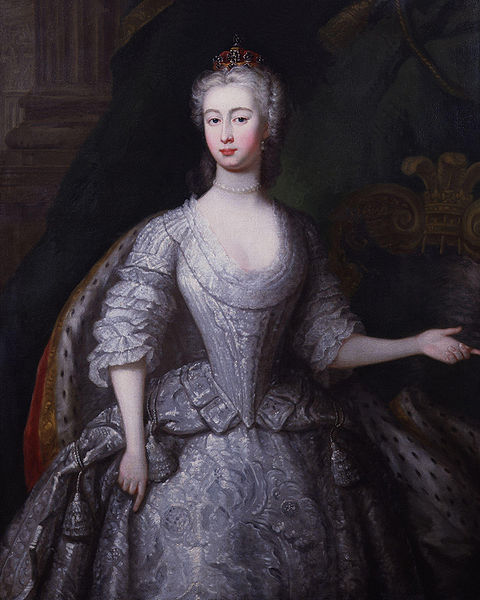
Here is Augusta, Princess of Wales, in a stiff-bodied gown. The portrait, by Charles Philips, was painted at the time of her marriage in 1736.

Augusta Princess of Wales 1736

I have been unable to find a depiction of a court mantua of that period, but here is a portrait of Lady Betty Germain (also by Charles Philips) in a very elaborate mantua painted in 1731.

(c) National Trust, Knole; Supplied by The Public Catalogue Foundation

In both cases the skirt is far smaller than the dimensions it would attain in the 1740s. Desnoyer was, of course, part of court circles as dancing master to Frederick, Prince of Wales and some of his siblings, as well as (from 1736) Princess Augusta.

A minuet was quite often added to another ball dance at benefit performances. I have written in other posts about Aimable Vainqueur (the ‘Louvre’) and La Mariée on the London stage. Both were quite often performed with a Minuet, as were L’Abbé’s Prince of Wales’s Saraband, The Britain or Britannia (most likely Pecour’s La Bretagne) and even Isaac’s The Union, as well as a variety of named and unnamed ball dances that have not survived in notation. There were also minuets for three and for four, a Grotesque Minuet and a Mock Minuet. I hope to return to some, if not all, of these in later posts.