
Twenty-Six dances surviving in Beauchamp-Feuillet notation were created for performance in London’s theatres between 1699 and 1731. The best-known are probably the thirteen choreographies in Anthony L’Abbé’s A New Collection of Dances, created for leading dancers at Drury Lane and Lincoln’s Inn Fields among others and published around 1725. Less often considered for their London links are Pecour’s solos for Mlle Subligny ‘dancée en Angleterre’: the ‘Gigue pour une femme’ in Feuillet’s 1704 Recüeil de Dances and the ‘Passacaille pour une femme … delopera darmide’ in Gaudrau’s Nouveau Recüeil of c1713. There are also several duets by Mr Isaac, ostensibly for the ballroom but danced on the London stage – The Saltarella (1708), The Friendship (1715) and The Morris (1716) – as well as Kellom Tomlinson’s The Submission (1717) and L’Abbé’s The Prince of Wales’s Saraband (1731). In addition, there are the six dances created by Tomlinson for performance at Lincoln’s Inn Fields between 1716 and 1721 which survive only in his manuscript workbook. I do not include those dances, for example Isaac’s The Union or Pecour’s Aimable Vainqueur (known in London as The Louvre), which were created for the ballroom but later danced on the London stage.
The question underlying these notations is the nature of the relationship between the page and the stage. Specifically, what might they reveal about the stage space available to dancers in London’s theatres and how it was used?
The Page
In Choregraphie, published in Paris in 1700, Feuillet explains that the page represents the ‘Stage or Dancing-Room’ (I will use John Weaver’s translation of 1706, Orchesography, for quotations). The top of the page is the ‘upper end’ of the room, in the theatre the audience or downstage, so the bottom of the page is upstage and the right and left sides are stage right and stage left. Feuillet moves on to the ‘Presence of the Body’, the directions in which the dancer faces, identifying these with the four sides of the page. He then turns to the ‘Tract’ which he describes as the ‘Line on which the Dances are described’. These tracts are delineated as a ‘Right Line’, a ‘Diametrical Line’, a ‘Circular Line’ and an ‘Oblique Line’. All of them correspond to paths that can be used to traverse the stage. [See Orchesography, pp. 3, 4] Feuillet sums up his description of the Tract thus, and provides a diagram:
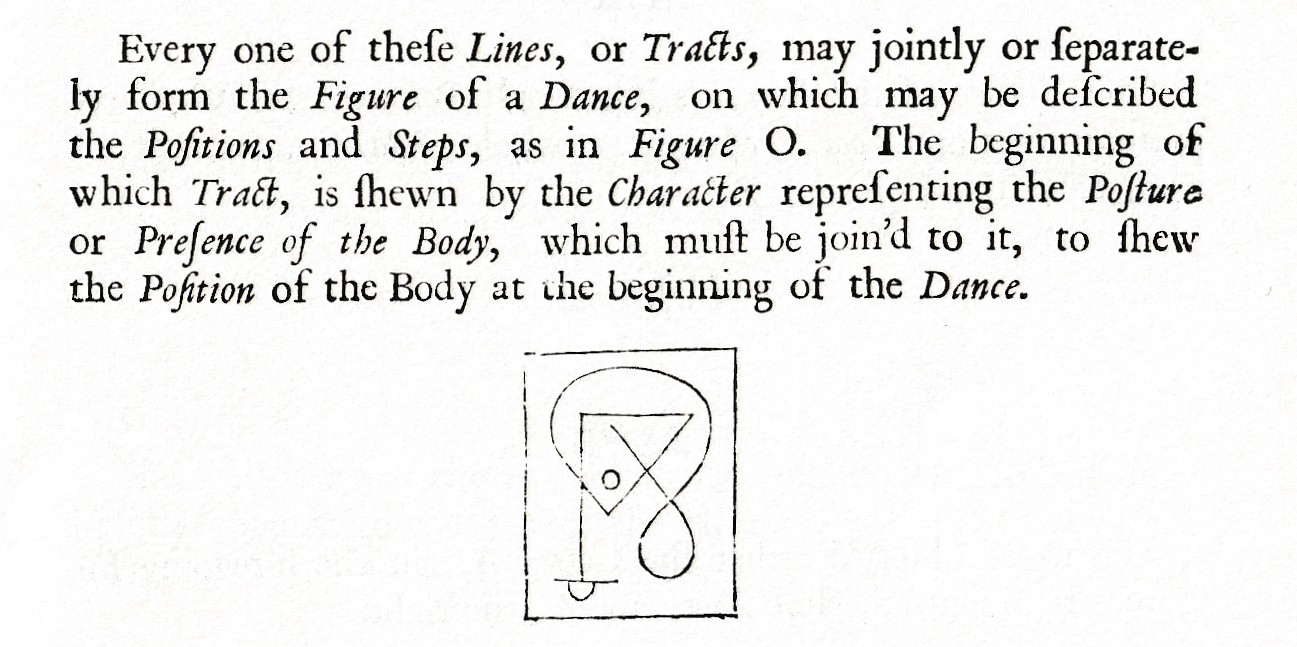
[Orchesography, p. 5]
Each page of the notations I have referred to may be understood as recording the steps and figures of the dancer or dancers performing on stage. However, it is not that simple. Feuillet himself complicates the relationship when, towards the end of his treatise, he turns to ‘Some Rules to be observ’d in the Figures of Dances’ and explains:
‘I have already shewn, that the Tract serves for two Ends, viz. first, on which to describe the Steps and Positions; and secondly, for the Direction of the Figure of the Dance.’
[Orchesography, p. 53]
As he concludes his text, Feuillet adds:
‘Altho’ the Tract serves generally for the explaining the Figure of the Dance, yet it often happens that many Steps are to be perform’d in the same Place, and then (as I have shewn before) the Tract is to have regard only to the Steps. This Tract is only a borrow’d Tract, and which may be drawn any way, as shall be most convenient.’
[Orchesography, p. 58]
Referring to the steps written along the Tract and how they should be performed, Feuillet ends his treatise with the words ‘… you are not to conclude anything from the Length or Shortness of the Steps’.
[Orchesography, p. 59]
Feuillet warns us that the figures on the page do not necessarily show accurately those performed in the dancing space and that the steps as notated do not necessarily reflect the stage space needed to perform them. Those of us who have reconstructed the notated dances for performance are well aware of this, but can the notations tell us more about the space for dancing on London’s stages?
The Stage
During the period covered by these notations there were three theatres in London where the dances may have been performed – Drury Lane, Lincoln’s Inn Fields and the new Queen’s (later King’s) Theatre (for the principal sources of information about them, see the end of the post). Some of these dances were first performed at court, in various spaces, which may have influenced aspects of the choreographies, but I will not consider these other venues here. The Drury Lane Theatre had been built in 1674 and there were alterations to its stage and auditorium in the 1690s. The Lincoln’s Inn Fields Theatre dated back to the 1660s, when it had been converted from a tennis court, it was closed for some years between the early 1680s and mid-1690s and was then used again between 1695 and 1705. Lincoln’s Inn Fields was apparently all but rebuilt (following the design of Drury Lane) in the years immediately before it reopened in 1714. The Queen’s Theatre was built by Vanbrugh and opened in 1705 as a playhouse. It was more suited to music than drama and quickly became London’s Italian opera house. The Covent Garden Theatre was later, opening in 1732, and so falls outside my topic here. A more detailed discussion of the stages in London’s theatres appears in my earlier post ‘How Many Dancers Can You Fit on an Early 18th-Century London Stage?’.
These theatres shared the same main features. They each had an auditorium with a pit, a little below stage level, one or two tiers of boxes surrounding the pit and two or more levels of galleries above the boxes. Drury Lane (and by implication Lincoln’s Inn Fields) had a fan-shaped auditorium which gave most seats a good view of the stage. The Royal Box was generally in the centre of the boxes, directly opposite the stage to provide the best view of the perspective scenery. These stages had three main areas: the forestage, which projected into the auditorium in front of the proscenium arch and was the widest area; the scenic stage, where the wings forming the moveable scenery and their grooves were placed, terminating in a backdrop; and the vista stage for the display of deep perspective scenes which was not generally used by performers. There were doors on either side of the stage, immediately downstage of the proscenium arch, providing entrances for actors (and perhaps dancers) onto the forestage. The forestage and scenic stage had traps for the appearance or disappearance of characters.
Both the auditorium and the stage were lit by candles, with candelabra suspended over the forestage and sconces behind the wings, as well as footlights – the forestage was the most brightly lit area – and they remained illuminated throughout the performance. Drury Lane is known to have had a raked stage, so presumably Lincoln’s Inn Fields did too. At many performances (notably benefits) members of the audience sat on the stage, limiting the dancing space and complicating the focus of the dancers. It is difficult to be sure, as precise calculations are impossible, but it seems that dancers were in general required to perform within an area about 30 feet square at its maximum.
The Page and the Stage
So, what does all this information mean when it comes to reconstructing such dances as Pecour’s ‘Gigue’ for Mlle Subligny, probably performed around 1702 at the earlier Lincoln’s Inn Fields Theatre? Here are the first two plates:
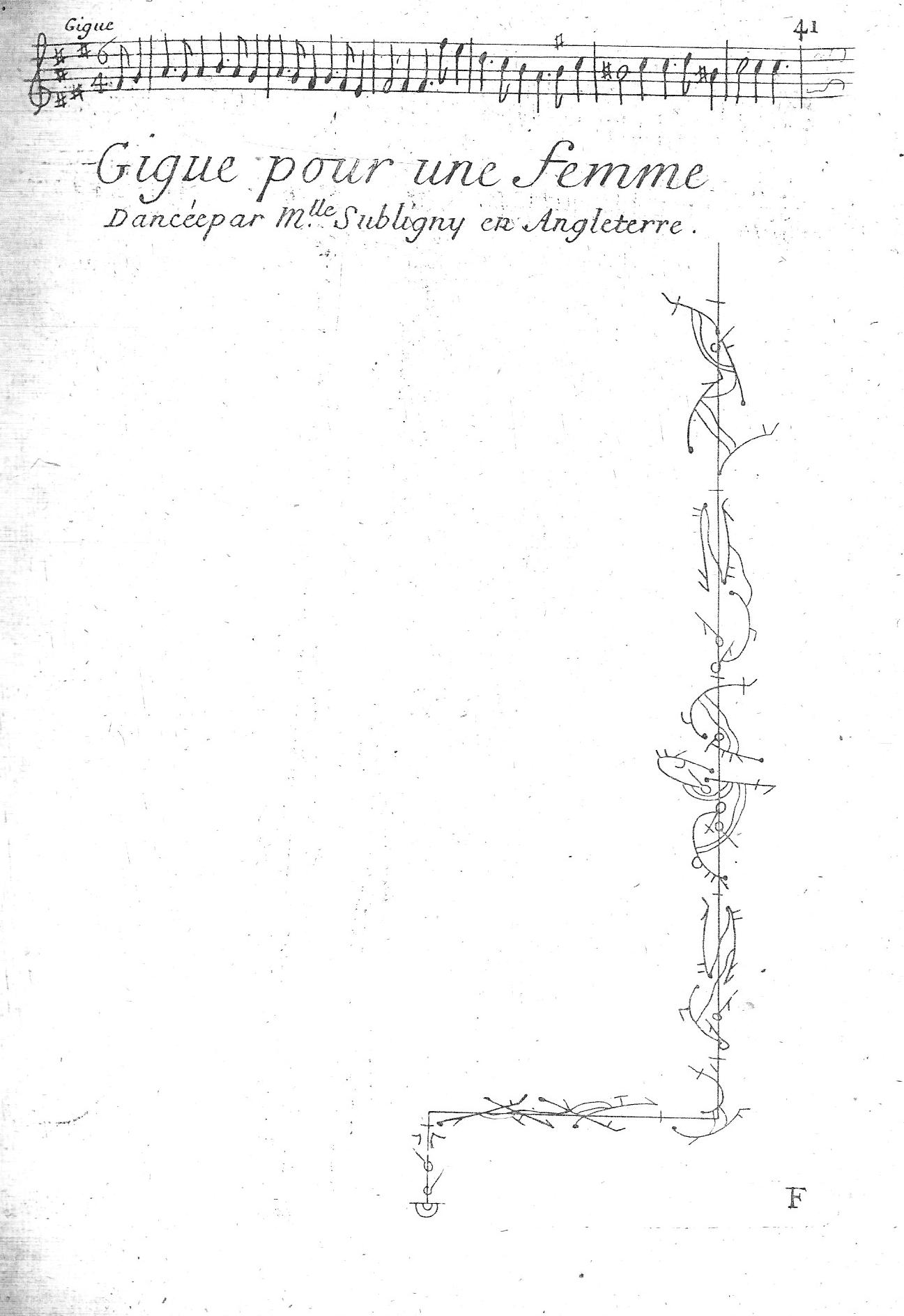
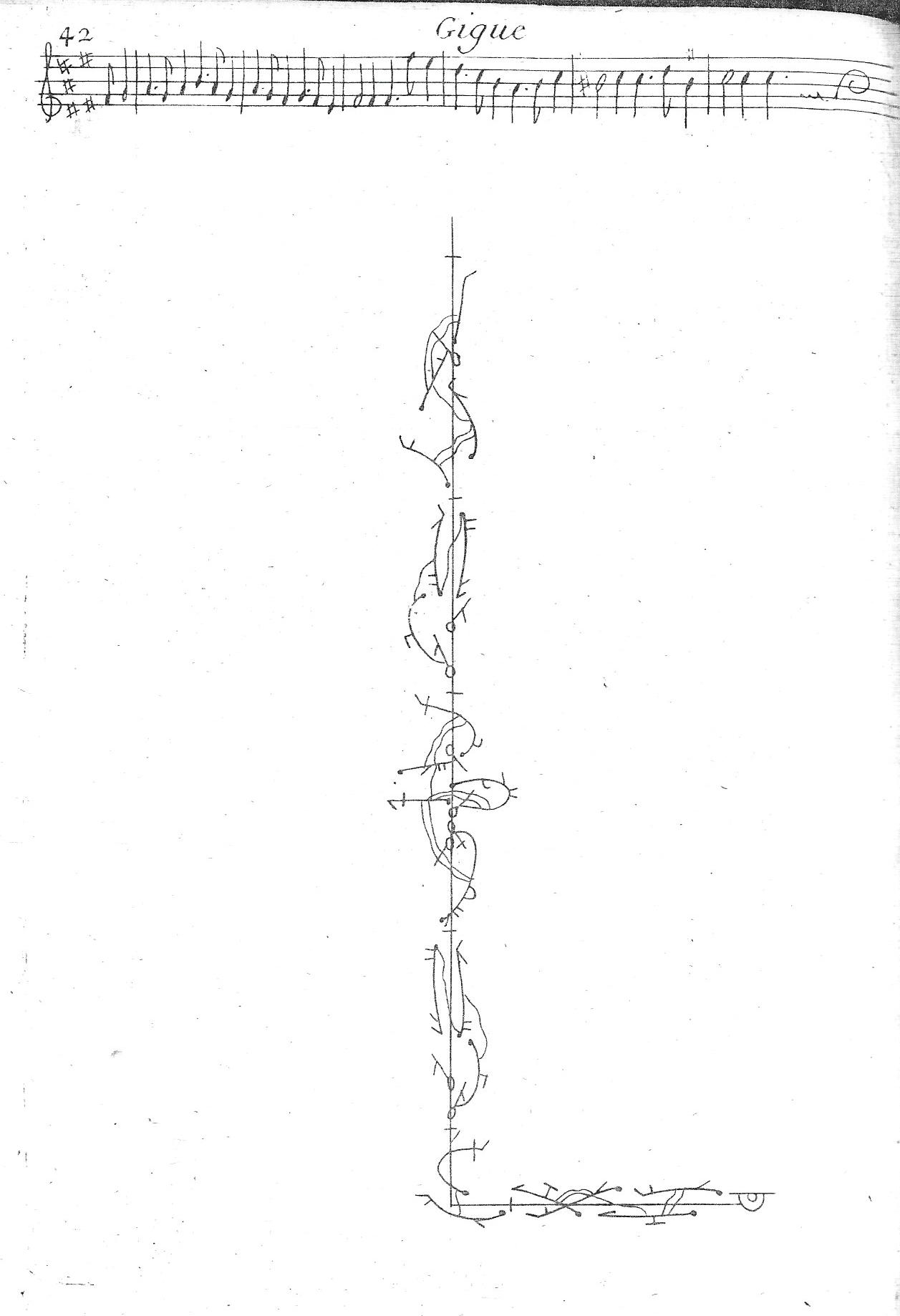
It is interesting that in the opening sections of the dance, the first two A sections, she dances to right and then left but does not travel forwards very far. Only the coupé and coupé avec ouverture de jambe bring her slightly closer to her audience. Assuming that she begins upstage centre, she ends just a little closer to her audience after a display of technique with balances on one foot, jumps, tombés and turns. Mlle Subligny’s main focus is towards the audience in front of her, and she maintains this throughout the opening sections of her solo.
How much did Pecour know about the stage on which she would be dancing? Did he create the ‘Gigue’ in the context of the Paris Opéra stage in the Palais Royal and keep to the conventions for traversing that space? It seems unlikely that he would have been familiar with the Lincoln’s Inn Fields stage, but how different was it from Paris? Did the use of stage space by dancers differ in these two theatres? Of course, in Paris Mlle Subligny would have been dancing as a soloist among other dancers in an opera, whereas in London she was probably performing alone in the entr’actes.
L’Abbé would have been familiar with the Drury Lane stage, where Hester Santlow probably first performed the solo ‘Menuet’ he created for her around 1708. The first plate shows a very different use of stage space:
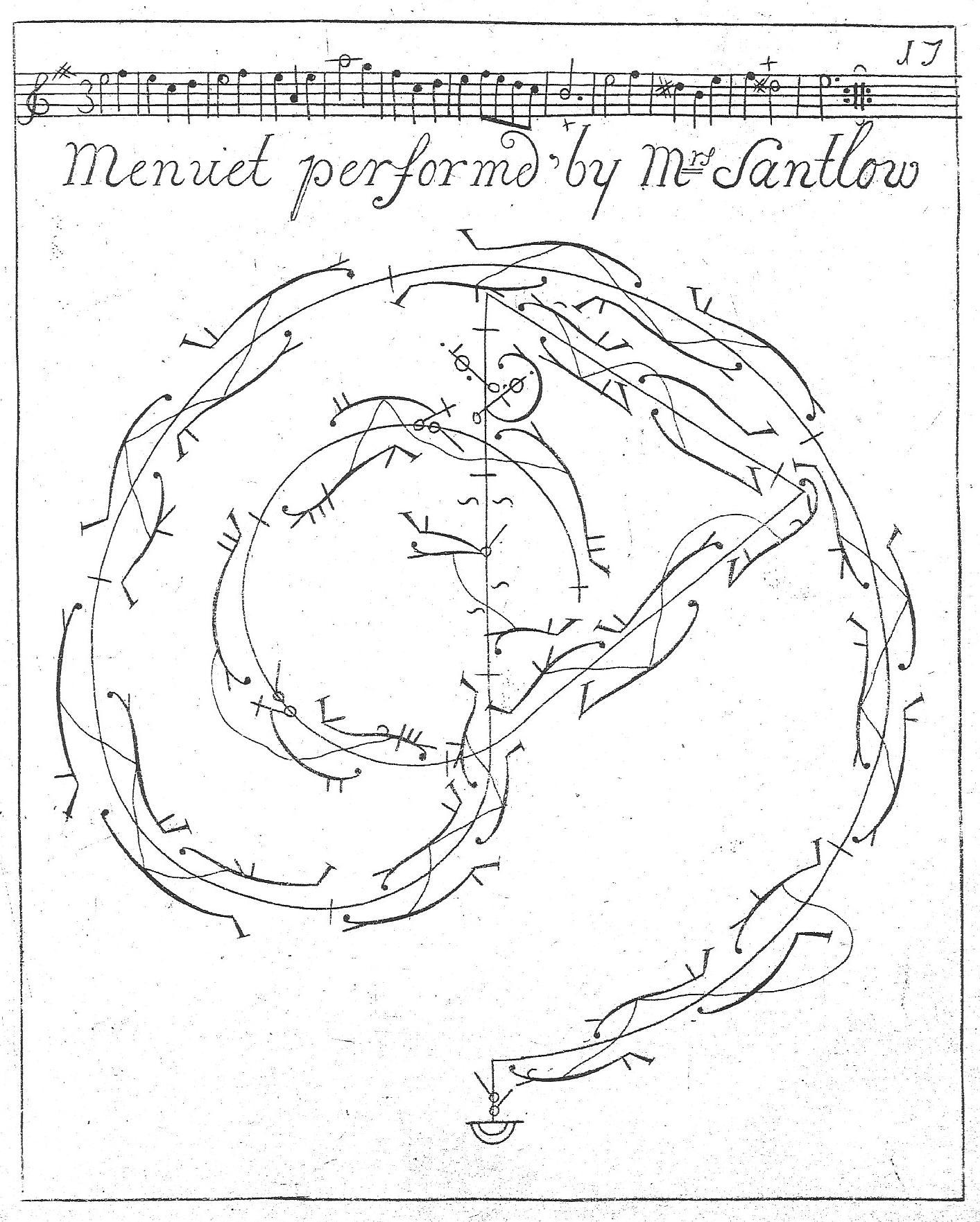
This sequence, the first two A sections of the choreography, suggests that L’Abbé and Mrs Santlow exploited the layout of the stage through the ‘Tracts’ and ‘Presence of the Body’ described by Feuillet. She begins with a circular figure, probably traversing the forestage and greeting a surrounding audience with a series of pas de menuet à trois mouvements before reaching stage centre to address the royal box with pas balancés and a full turn on both feet. In my earlier work on Mrs Santlow, I have guessed that she performed this dance at a benefit.
With these two examples alone, we can begin to see some of the challenges as we try to interpret the figures of the notated stage dances. The opening of Mlle Subligny’s solo seems to invite the audience to concentrate on her steps, while Mrs Santlow’s first figure emphasises her relationship with her audience. What might analysis of the rest of these solos suggest about their use of the stage?
Further reading:
Edward A. Langhans, ‘The Theatres’ in The London Theatre World, 1660-1800, ed. Robert D. Hume (Carbondale, 1980), 35-65
Richard Leacroft, The Development of the English Playhouse. Revised ed. (London, 1988)
Paul Sawyer, The New Theatre in Lincoln’s Inn Fields (London, 1979)
Survey of London. Volume XXXV. The Theatre Royal Drury Lane and the Royal Opera House Covent Garden (London, 1970)
Related Blog Posts:
How Many Dancers Can You Fit on an Early 18th-Century London Stage?
Scenery for dancing on the Early 18th-Century London Stage

