Yearly Archives: 2018

A DANCE FROM THE LAST BALL AT MARLY: LA ROYALLE

In his Nouveau Recüeil de dance de bal et celle de ballet, a collection of dances by Guillaume-Louis Pecour, Gaudrau included nine ball dances. In his Preface, Gaudrau declared that they had been performed at the last ball given at Louis XIV’s favourite retreat Marly. The Nouveau Recüeil received permission to be printed in October 1712 and is generally agreed to have appeared in 1713.

The last ball at Marly must have taken place in the early months of 1711. Such entertainments were not given regularly there and the death of Louis XIV’s son Monseigneur, in April 1711, would have severely curtailed all court amusements for the rest of that year and beyond. In February 1712, the King suffered the double blow of the deaths of Monseigneur’s eldest son, then the Dauphin, and his Dauphine. These sad losses brought an end to all festivities for some time. Gaudrau would have been vividly aware of all of these unhappy events as he prepared the Nouveau Recüeil for publication, although there is no reference to them either in his preface or Pecour’s dedication of the collection to Louis XIV.

The Dauphine, Marie-Adélaïde de Savoie, had been a great favourite of the King from her first arrival at the French court in 1696. She revitalized the court with her high spirits and became well-known for her love of dancing.
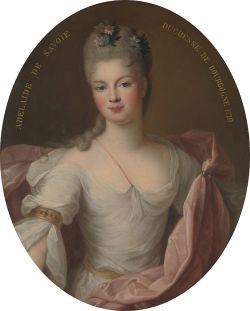
Marie-Adelaide de Savoie

Pierre Gobert, Marie-Adélaïde de Savoie, Duchesse de Bourgogne, 1710

Were the nine ball dances (with which the collection begins) intended as a tribute to her? Several ball dances published in notation in the early 1700s were either named in her honour or dedicated to her. Among them is La Royalle, the very first choreography in the Nouveau Recüeil. Around 1725, when the dancing master Pierre Rameau included the dance in his Abbrégé de la nouvelle méthode dans l’art d’écrire ou de traçer toutes sortes de danses de ville, he revealed that La Royalle had been created for Marie-Adélaïde. We may guess that she had actually danced it at that last ball given at Marly in 1711.

There may be another tribute enfolded within this choreography. The music for La Royalle, a saraband followed by a bourrée, is taken from Colasse’s Ballet des Saisons. Both pieces were originally by Jean-Baptiste Lully. The saraband comes from the 1665 Ballet de la Naissance de Vénus. This ballet de cour had first been performed in the apartments of Henriette d’Angleterre, known simply as Madame, the first wife of Louis’s brother Philippe. She had not only appeared in the ballet’s title role but had also danced in its final entrée as Roxane to Louis’s Alexander the Great. She and the King had enjoyed a notable dance partnership. Some years earlier, in 1661, Madame had appeared as Diana in Lully’s Ballet des Saisons. She had died, unexpectedly and aged only twenty-six, in 1671.

Henrietta Anne

Sir Peter Lely, Henriette Anne, Duchesse d’Orléans, 1662

Surely La Royalle was intended to honour both Madame and Marie-Adélaïde, who was her granddaughter and like Henriette Anne was greatly beloved for her beauty and charm.

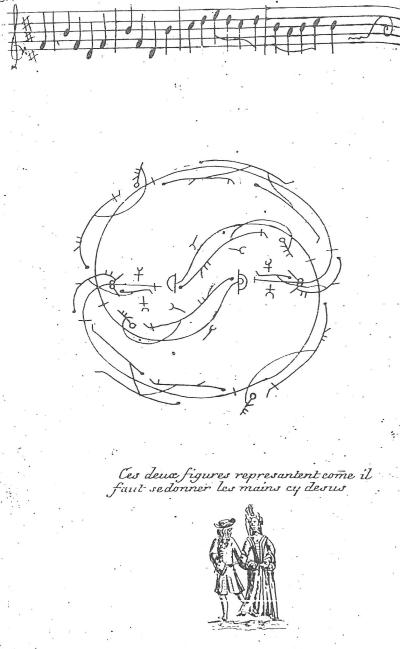
La Royalle 1

Guillaume-Louis Pecour, La Royalle (Paris, c1713), first plate

We still have much to learn about the subtle allusions that lie within the elegant and sophisticated ball dances created for the court of Louis XIV and that of his successor Louis XV, Marie-Adélaïde’s son.


Famous French Ballroom Dances

Among the many ballroom dances published in Beauchamp-Feuillet notation in the early 1700s, eight choreographies have a claim to be famous. All were published in notation and recorded in manuscript collections numerous times. Almost all of them survived well beyond the first decades of the 18th century. All are by Guillaume-Louis Pecour and all were originally notated and published by Raoul Auger Feuillet. Whether or not these dances continued to be performed in the ballroom, they were known to dancing masters who went on teaching them long after the style and technique they exemplified had gone out of fashion.

These are the dances, with their first date of publication:

La Bourée d’Achille (1700)

La Bourgogne (1700)

La Forlana (1700)

La Mariée (1700)

Le Passepied (1700)

Aimable Vainqueur (1701)

L’Allemande (1702)

La Bretagne (1704)

Most were long-lived, but were they really that famous?

Two of these dances, Aimable Vainqueur and La Mariée, enjoyed extended lives on the London stage and I have looked at them in earlier posts. Five of the dances (including La Mariée) come from Feuillet’s very first collection of Pecour’s ballroom dances, published in 1700 alongside his treatise Choregraphie which explains the new notation system. That treatise and its associated collections of dances were reissued in 1709 and again in 1713. Significantly, these dances (together with the other three) were all included in Pierre Rameau’s Abbrégé de la nouvelle méthode dans l’art de d’ecrire ou de traçer toutes sortes de danses de ville, first published in Paris around 1725 and intended to introduce his revised version of Beauchamp-Feuillet notation. Rameau’s Abbrégé was reissued around 1728 and again around 1732. The dances must have become more widely known through the successive reissues of both works.

Two of the dances, La Bourée d’Achille and La Bourgogne, may have had more limited afterlives than the others. Neither featured in later printed treatises and were recorded only in what are thought to be early manuscript collections of notated choreographies. Although La Bourgogne does appear in I.H.P. Maître de Danse oder Tantz-Meister published in Leipzig in 1705, indicating that it quickly became known outside France. It is interesting to note that both of the choreographies have become familiar to modern practitioners of baroque dance, as they are often taught to beginners.

Le Passepied and La Bretagne were published as late as 1760 in Madrid, within Pablo Minguet’s El Noble Arte de Danzar a la Francesa. Le Passepied had also been included in I. H. P. Maître de Danse oder Tantz-Meister, while La Bretagne appeared in the translations of Choregraphie issued in London by Siris and Weaver between 1706 and 1730. L’Allemande, which I have also mentioned in an earlier post, appeared as late as 1765 in Magny’s Principes de Choregraphie, alongside more recent dances. Magny provided it with new music, perhaps to bring it more up-to-date. The choreography with the longest life of all was La Forlana, published around 1780 in Paris in a new notation by Malpied.

These dances probably owed their fame and longevity to a variety of factors, including their music, their original performers, their associations with particular people or places and perhaps the desire of individual dancing masters to find favour in court circles. They underline Europe’s (including Britain’s) widespread and enduring fascination with French court culture and not least its expression through dancing. I hope to be able to say more about them, particularly within an English context, in future posts.


A Year of Dance: 1698

On 4 January 1698, Whitehall Palace was destroyed by fire. Few of the buildings were left standing, apart from Inigo Jones’s Banqueting House (the only part of the palace to survive today). The disaster was less of a blow than it might have been, for most of the furnishings and movable objects were saved. The sprawling palace was not much loved by King William III, who preferred the more salubrious surroundings of Kensington Palace or Hampton Court. Plans to rebuild Whitehall Palace over the next few years came to nothing.

The visit of the Russian Czar, Peter the Great, between 11 January and 21 April, brought a different sort of chaos as the monarch was oblivious to the niceties of English court life. Abroad, Georg Ludwig succeeded his father as Elector of Hanover on 23 January 1698. His right of succession to the British throne was yet to be enshrined in law.

London’s theatres came under attack with the publication, in March 1698, of Jeremy Collier’s A Short View of the Immorality and Profaneness of the English Stage. The effects of his diatribe were insidious and long-lasting. However, dance was (it seems) beyond Collier’s reach. The newspapers announced the arrival of Anthony L’Abbé who was ‘lately come over and Dances at the Play-house’. L’Abbé had swapped the Paris Opéra for London’s Lincoln’s Inn Fields Theatre. He also danced before William III at Kensington Palace on 13 May 1698. His appearances marked the beginning of a long association with both the court and the theatre in England. November 1698 saw the first performance of John Dennis’s Rinaldo and Armida with music by John Eccles. Given at Lincoln’s Inn Fields, the piece was not a success although Eccles’s music was appreciated.

In 1698, Louis XIV turned sixty. He had been King of France for more than fifty-five years. This was the year that he signed the Treaty of the Hague (also called the First Partition Treaty) with William III in a vain attempt to settle the succession to the Spanish throne following the long-expected death of King Carlos II. Louis’s own son, the Grand Dauphin, had a claim through his mother who had been a Spanish Infanta. Louis set this aside, for the moment.

There was little of note at the Paris Opéra in 1698. Desmarets’s ballet Les Fêtes galantes, despite its title, bore no relation to Campra’s L’Europe galante, the great success of the previous year. Its complicated plot about the Queen of Naples and three princes all in love with her probably contributed to its failure.

MEDEA AND JASON ON THE LONDON STAGE

Jean-Georges Noverre’s ballet Medea et Jason, first performed in 1763 in Stuttgart, reached the London stage in 1781 in a version by Gaëtan Vestris (who had danced Jason in Noverre’s original production). This ballet d’action falls well outside my usual areas of research, but my interest was stirred when I came across a playbill for a production which has been overlooked by most writers on Noverre and his work.

On 29 April 1790, the Royal Circus announced a programme which included ‘a Grand Spectacle, called Medea and Jason’. Despite the inclusion of another ‘Splendid Entertainment, called The Triumph of Liberty, or, the Destruction of the Bastille’, Medea and Jason is obviously meant to be the main draw. The playbill provides full details of the ‘Spectacle’ and I have tried to reproduce a flavour of the typography.

MEDEA AND JASON.

With the Overture and original Music composed by GLUCK.

THIS BEAUTIFUL SPECTACLE

Represents the remarkable PARTING between MEDEA and JASON,

When JASON quits that Sorceress, on his Marriage with CREUSA,

DAUGHTER OF CREON, KING of CORINTH;

The SORCERY by which MEDEA’S FURIES prepared

THE CABINET OF WILDFIRE, and the POISON’D NOSEGAY,

By which CREUSA is kill’d, and the Palace FIRED,

The dreadful STORM and LOUD THUNDER, that accompany the

SHOWER of FIRE,

Through which MEDEA rides in a triumphant Car, with her two Children;

Her barbarous Murder of the Infants, in the Presence of, and just before

The DEATH of JASON, amidst a DANCE of FLAMING FURIES,

JASON by MR. PALMER,

Creon, Signor ROSSI; Creusa, Signora SALA; and Medea, Mademoiselle De La CROIX.

The SCENES designed and executed by Mr. CAPON.’

Modern commentators have focussed on Medea and Jason’s expressive pantomime, which is seen as Noverre’s greatest innovation and a significant development for balletic art. However, Noverre’s scenario (as published in Paris in 1780, to accompany performances given under his direction) also describes a great deal of dramatic action. The production by Vestris at the King’s Theatre in 1781, which introduced the work to London, certainly included all the latter.

The Royal Circus (later to become the Surrey Theatre) had first opened in 1782 as a venue for equestrian shows as well as entertainments which offered singing and dancing within spectacular productions. It is hardly surprising that it was attracted by Medea and Jason’s melodramatic plot and scenic extravagances, both of which were likely to appeal to audiences far removed from the elite patrons at the King’s Theatre. The Royal Circus was probably more respectful of the ballet than the Theatre Royal, Haymarket, where a burlesque version of Medea and Jason was given between 1781 and 1785, billed as by ‘Signior Novestris’ (George Colman the elder) with ‘Music by Signior Gluck. With New Scenes, Dresses and Decorations. Machinist and Painter – Signor Rookereschi. Tailor – Signior Walkerino’.

It is tempting to describe Medea and Jason as tailor-made for the Royal Circus, except for the dancing. ‘Mr. Palmer’ was Jason. He may have been the fourteen-year-old son of a previous stage manager at the Royal Circus. Mlle De La Croix, as Medea, seems to have been a young newcomer to the London stage. In 1790, she appeared in the corps de ballet of the Italian Opera as well as at the Royal Circus. At the King’s Theatre, Gaëtan Vestris had appeared with Adelaide Simonet in the title roles – both were leading dancers in the serious style. The Royal Circus playbill makes no claims for the dancing, Medea and Jason is described as a ‘Beautiful Spectacle’ and not as a tragic ballet d’action.

The following illustration, so often reproduced alongside discussions of Medea and Jason, was intended as a satire on the ballet and perhaps gives a flavour of the alternative versions to be seen at the Royal Circus and the Theatre Royal, Haymarket.

Medea and Jason 1781

Francesco Bortolozzi after Nathaniel Dance. Jason et Medée. Ballet tragique. Acquatint (London, 1781)


The Menuet à Quatre: Figures

In my last post about the four French notated menuets à quatre, I promised to look at the figures. How do these differ between the choreographies? Where are they the same? How do they relate to the ballroom menuet à deux? These are just some of the questions to be asked.

An obvious first question is – how do each of these minuets for four begin? Presumably they all open with a révérence, although none of the notations show this. Perhaps the révérence took the same form as in the minuet for a couple, who honour the presence and then each other. In the case of the menuet à quatre, the first honour would therefore be to the facing couple. Or were the honours reversed, as they are in the later quadrille, so the first révérence is to your own partner and the second to your opposite? In any case, all four dances begin with the two couples facing each other.

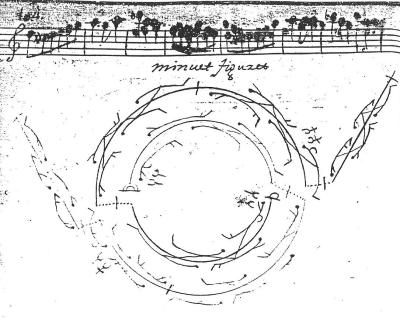
Only two of the dances begin in the same way. The very first plates of the 1706 Menuet à Quatre and the 1751 Menuet aquatre figuret show the dancers performing two pas de menuet forwards and two backwards. In his Menuet à Quatre of c1713, Pecour has his couples moving sideways to the left, moving forwards to cross (right shoulders) on a diagonal and curling round to face one another again. His figure is an obvious allusion to the ‘Z’ figure of the ballroom minuet. Although the ‘Z’ figure is also referenced in the other choreographies, Pecour’s version in this dance is the most straightforward. Dezais begins La Carignan with a contredanse figure, in which each dancer casts out and then changes places with their partner.

How do these dances end? In both his Menuet à Quatre of c1713 and his Menuet aquatre figuret, Pecour has his dancers moving forwards and then backwards to end in a final révérence. In the earlier dance, they balancé forwards and back, do two pas de menuet backwards and their final coupé soutenue (which is on opposite feet) brings them together. His later choreography is simpler. The dancers do two pas de menuet forwards, one backwards and also move towards one another on the final coupé soutenue. The 1706 Menuet à Quatre has the dancers, in couples, taking inside hands and crossing (left shoulders) on a diagonal before sweeping around to return to place for the final révérence. The figure alludes to the minuet’s ‘Z’ figure but seems closer to a contredanse figure. Dezais draws on the final figure of the ballroom minuet, with his couples each taking both hands to end La Carignan, although they do so for only one pas de menuet before letting go with their outside hands for one pas de menuet forwards and one backwards before the final step into the révérence.

Taking right hands, taking left hands and taking both hands all feature in these dances for four, but transmuted into their contredanse counterparts. The 1706 Menuet à Quatre has a right hand and a left hand moulinet as well as a rond with all the dancers holding hands. Pecour’s c1713 Menuet à Quatre adds variations when taking right and left hands, for the ladies have to wait for the opposite man to cross the set to take right hands  and the men then have to wait for their partners to do the same before taking left hands. The plate for the rond shows the dancers only taking inside hands with their opposite, although each couple ends in their original place. Apart from briefly taking both hands in the final figure, Dezais’s dancers do only a right hand moulinet. He dispenses entirely with any equivalent of taking left hands.

In his Menuet aquatre figuret, Pecour runs through all the various permutations on taking hands, but this dance is a cotillon so perhaps they should be seen as changes and not as minuet figures at all. Working in couples, his dancers take right hands then left hands. After a repeat of the figure, they take both hands to move first clockwise and then anti-clockwise. The notation then has another circling figure, with a notation for taking hands that I have not seen before and cannot readily interpret.

Pecour Minuet aquatre figuret 34 detail

Pecour, Menuet aquatre figuret (notated 1751), plate 34 (detail).

Are the couples holding hands behind their backs or could this be an allemande hold? The notation for the latter is quite different in Pecour’s L’Allemande of 1702, the dance in which the hold was first recorded.

Pecour Allemande 2

Pecour, L’Allemande (1702), plate 2

Pecour then brings the four dancers together for a right hand and left hand moulinet. They all hold hands in a circle to dance clockwise and then anti-clockwise. As a final flourish, he makes them all face outwards for a rond clockwise and then anti-clockwise. This last change must have needed a bit of practice.

None of the choreographers of these minuets for four entirely loses sight of the ballroom minuet for a couple, but all have more than half an eye on contredanse figures. On the evidence of these notations, the menuet à quatre retained the challenge of the pas de menuet, but put it in a context that relinquished the ordeal of scrutiny by the assembled company in favour of the relaxed pleasure of dancing with them.

The Menuet à Quatre: Steps

What can we learn from a more detailed scrutiny of the four menuets à quatre surviving in notation? The first question to ask is do they bear any relation to the ballroom minuet? I’ll begin my answer with the steps.

The anonymous Menuet à Quatre of 1706 uses pas de menuet à deux mouvements throughout most of the dance. These travel forwards in all but one of the figures, in which the step moves sideways to the left. Although, in three figures, the final pas de menuet ends with two steps backwards. The dance concludes with coupé soutenue en arrière into a révérence. after the music ends.

Pecour’s Menuet à Quatre of around 1713 uses both the pas de menuet à deux mouvements and the pas de menuet à trois mouvements. The latter are used only when travelling sideways to the left. Pecour occasionally adds ornaments – a battu after the first step of the pas de menuet in one case and a three-quarter turn on the third step in another. His final figure begins with pas balancé forwards and backwards and ends with a pas de bourrée and coupé soutenue into the final révérence.

In La Carignan in 1725, Dezais uses both pas de menuet à deux mouvements and pas de menuet à trois mouvements. The latter are used only when travelling sideways to the left. He adds pas balancés to several figures, forward and back (ornamented with a battu) and side to side. His final step uses a coupé plus coupé soutenue for the man and coupé plus pas de bourrée for the woman, taking both dancers into a révérence.

The Menuet aquatre figuret, attributed to Pecour when it was written down in 1751, uses pas de menuet à deux mouvements throughout (even when travelling to the left – as does the 1706 Menuet à Quatre). It ends with coupé and coupé soutenue for the man and pas de bourrée with coupé soutenue for the woman, into the closing révérence.

All these dances follow the conventions of the ballroom minuet, at least so far as the steps are concerned. They do, of course, use a narrower range of steps than the latter. Perhaps this should be expected in dances where the figures, or at least the ever-changing spatial relationships between the dancers, are more complex than in the danse à deux. What about the figures in these dances for four? I’ll make that the subject of my next post.

A Year of Dance: 1697

The Treaty of Ryswick, signed on 20 September 1697, ended the Nine Years’ War in which Louis XIV had faced a ‘Grand Alliance’ of European powers including Great Britain. As part of the terms of the treaty, the French King finally recognised William III as King of England (although he continued to shelter William’s predecessor James II). Just a few months after the treaty, on 6 December 1697 (N.S.), Louis’s eldest grandson the duc de Bourgogne married the twelve-year-old Marie Adelaïde de Savoie, to ensure the French Catholic succession. In England, the protestant succession was undermined by the two miscarriages suffered by the heir to the throne Princess Anne in March and December 1697.

In London, both the treaty and William III’s birthday were celebrated at court on 4 November 1697 by a performance of Europe’s Revels for the Peace, a musical work with a libretto by Peter Motteux and a score by John Eccles. The fierce rivalry between the Lincoln’s Inn Fields company led by Thomas Betterton and the Drury Lane company managed by Christopher Rich continued. Betterton’s company included the French fair dancer Joseph Sorin, who was billed in a short-lived piece called The Novelty, given at Lincoln’s Inn Fields in June 1697. Sorin presumably made other appearances, but records of performances are too few to confirm this.

There were a number of successful operas in Paris. Desmarets’s Vénus et Adonis was given on 28 July 1697 (N.S.). Campra’s L’Europe galante, which would enjoy widespread success, was given on 24 October 1697 (N.S.) with Blondy, Balon and Mlles Subligny and Dufort among the dancers. Balon and Mlle Subligny were also prominent among the dancers in Destouches’s pastoral opera Issé given at court on 17 December 1697 (N.S.). Dance music from all of these operas would make its way onto the London stage in later years.

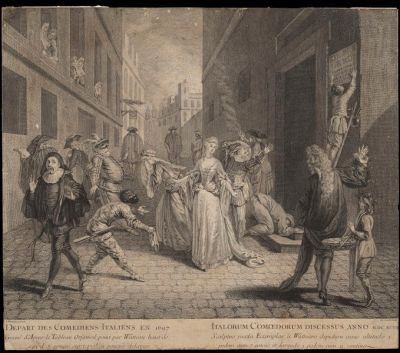
More newsworthy, perhaps, than anything happening at the Paris Opéra was the suppression of the Comédie-Italienne on 14 May 1697. There had been an Italian commedia dell’arte troupe in Paris since the 1640s and they had enjoyed conspicuous royal favour for much of that time. The conventional explanation for the turn-about, apart from Louis XIV’s increasing piety, was the performance of a new play that satirised the King’s morganatic wife Mme de Maintenon. Modern commentators have suggested other reasons, including the machinations of their rivals at the Comédie-Française and even the King’s indebtedness to the Italian troupe. Whatever the cause, there would be no Comédie-Italienne in Paris for nearly 20 years. The out-of-work players were forced to find entertainment elsewhere.

Watteau Departure of the Comedians

Louis Jacob after Antoine Watteau, Depart des Comédiens Italiens en 1697, 18th century

Enjoying the Minuet ‘à Quatre’

About three years ago, I wrote some posts about dances for four. With the earlier ones, I speculated that they were more enjoyable than the danses à deux because they were less technically demanding. This very obviously applied to the minuets ‘à quatre’ of which five survive in notation.

Le Menuet à Quatre. Anonymous, 1706.

Minuet & Jigg. Mr Holt, 1711

Menuet à Quatre. Pecour, c1713

Minuet aquatre figuret. Pecour, [1700-1725? Manuscript collection compiled 1751]

La Carignan, Menuet à Quatre. Dezais, 1725

I discussed Mr Holt’s Minuet & Jigg back in 2015, so this time round I will look just at the four French choreographies.

Unlike the English dance, the French ones are all simply minuets using the pas de menuet pretty well throughout. Before I analyse each of them in more detail, here are some facts and figures for comparison.

The anonymous Menuet à Quatre appears in Feuillet’s Vme Recueil de danses de bal pour l’année 1707 published in 1706. It is the last of the three dances in that collection, the other two being danses à deux. The source of the music has not been identified, although it does appear in a set of ‘Suites de danses … qui se joüent ordinairement à tous les bals chez le Roy’ dated to the first decade of the 18th century. In his Avertissement for the collection, Feuillet says that the minuet is ‘si en vogue qu’il ne se fait aucune assemblée où il ne soit dansé’, adding that he has ‘pris le 1er air qui m’a tombé sous la main car tous les menuets y sont également bons’. The choreography has the musical structure AABBAAB (A=B=4) and is short, with only 28 bars in 6/4.

Pecour’s Menuet à Quatre appears in the Nouveau recüeil de dance de bal et celle de ballet published by Gaudrau around 1713. This collection brings together 9 ballroom dances and 30 theatre choreographies, with the Menuet à Quatre as the last but one of the ballroom dances. The musical source has not been identified. The choreography has the musical structure ABACABACA (A=B=C=8) giving a rondeau form and 36 bars in 6/4 (the music is written in 3). Again, this dance is short. In his Preface to the collection, Gaudrau tells us that Pecour’s choreography was danced at the last ball at Marly (Louis XIV’s country retreat, where the King could relax away from the rigorous etiquette of Versailles).

Dezais includes La Carignan, Menuet à Quatre in his Premier livre de contredances published in 1725. Little or no research has been done on this collection (which does not feature either in the Little & March 1992 catalogue La Danse Noble or Lancelot’s La Belle Dance of 1996) so I cannot tell whether there is a concordance for the music. This choreography uses a musical structure 3 x AABB (A=B=4). At 48 bars of 6/4 music it is a little longer than its predecessors.

The Minuet aquatre figuret by Pecour is recorded in the manuscript compiled by the dancing master Felix Kinski in Oporto in 1751. It appears among other French ballroom choreographies, presumably brought together (and taught) by Kinski. This minuet for four is very different from the others. The choreography’s music, for which no source has been identified, has the structure 7 x AABB + AA (A=8 B=16) with 120 bars in 6/4 (the music is written in 3). The dance has a ‘Change’ and ‘Figure’ structure very much like a cotillon. As I mentioned in posts back in 2014, the form of the cotillon goes back at least as far as 1705 and Feuillet’s ballroom dance for four entitled Le Cotillon. Such dances seem to have been popular around 1715-1725, so perhaps Pecour’s choreography belongs to that period.

What do these facts and figures tell us? The evidence confirms a couple of things. One is that menuets à quatre were danced at French royal balls and were popular lower down the social scale. Another is that, like the menuet à deux, they could be danced to any minuet music (though, perhaps, the A, B and, sometimes, C strains needed to be the right length).

I will address other questions in later posts, for example how the menuets à quatre relate to the menuet à deux as recorded by Pierre Rameau in his 1725 treatise Le Maître a danser and how they relate to each other.

Anon Menuet a Quatre 1

Anonymous. Le Menuet à Quatre (Paris, 1706), First plate.

The Rise and Fall of the Grand Dance on the London Stage

A couple of months ago, I took a first look at the Grand Ballet, Grand Dance and Serious Dance, wondering what these generic titles might mean when came to the actual dancing. Before I try to investigate them in more detail, I thought it would be interesting to see if there was a changing pattern to their appearance in entr’acte entertainments in London’s theatres during the first few decades of the 18th century.

Over the first 20 years, the Grand Dance and the Serious Dance were billed infrequently. The Serious Dance was usually a duet and so not a ‘Grand’ dance at all. The same is true for the 1720s, although from the 1726-1727 season the Grand Ballet was also billed very occasionally. During the early 1730s, the Grand Dance and Grand Ballet rarely appeared in advertisements, but from 1734-1735 this changed. There was a steady increase in billings, culminating in 1739-1740 with over 70 mentions of a Grand Ballet, Grand Dance or group Serious Dance among the entr’acte dances given at Drury Lane and Covent Garden. Thereafter there was a steady decline, although some seasons (1742-1743 and 1744-1745) went against the trend. From the late 1740s until the 1759-1760 season very few ‘Grand’ or ‘Serious’ dances were mentioned in the bills.

I have been focussing my research on the period up to 1760, so I have not really explored the last few decades of the 18th century. However, it is worth noting that according to the Index to the London Stage the Grand Ballet more or less disappears during the 1760s but returns in the 1770s and 1780s before disappearing again. The Grand Dance is advertised from time to time during the 1760s, is billed more often in the 1770s and becomes a feature in the 1780s and 1790s. The Serious Dance (in what forms I don’t know) continues into the early 1770s before disappearing altogether. I am tempted to suggest that these changes were driven by developments in stage dancing elsewhere, particularly in Paris, where ballets were being given independently of opera and drama. Such dance works were brought to London by the many continental dancers and choreographers hired, not least by the King’s Theatre in the Haymarket (London’s opera house). Further research is certainly needed before we can be sure what was happening.

For the earlier period, the drivers of the increase in ‘Grand’ dances seem to have been in part the visiting foreign dancers, many of whom were extremely popular with audiences. The commercial rivalry between the two principal theatres, which waxed and waned, also affected their dance repertoire. In a later post, I will take a look at the seasons around 1740 to see if these shed any light on the phenomenon of the Grand Dance.


The Origins of the Pas de Zephyr: One Dancer or More?

In my last post about the pas de Zephyr, I suggested that there were four contenders for the professional male dancer who may have originated the step or the enchainement from which the social dance step took its name – André Deshayes, Louis Duport, Charles-Louis Didelot and Monsieur Albert. As I also said, there are a number of issues to consider as I try to answer the question of who was responsible, if the pas de Zephyr can indeed be traced to a single dancer.

There are at least six descriptions of the step in social dance manuals. Three of these are English – Payne (1818), Strathy (1822) and Mason (1827). Two are French – Gourdoux-Daux (1823) and Albert (1834). One is Italian – Costa (1831). It is interesting that there are a number of English treatises, although it seems likely that the earliest description of the pas de Zephyr is in fact French. It could have appeared in either the first treatise by Gourdoux Daux, Principes et notions élémentaires sur l’art de la danse published in 1804, or its second edition published in 1811, neither of which I have yet been able to consult. However, might the inclusion of the step in English treatises suggest that the dancer (whoever he was) also appeared as Zephyr on the London stage?

All the treatises are, of course, for amateurs and dancing in the ballroom. Apart from the fact that the stage version of the pas de Zephyr would have had to be simplified for performance by amateur dancers, there is also the question of appropriate style. Strathy devotes much space to the variations appropriate for what he calls ‘Balancer, or to Set to your Partner’ (for which his recommended steps include the pas de Zephyr). Before he does so, he emphasises the importance of a ‘gliding smoothness of execution’, however difficult the steps. Strathy also refers to ‘that easy, dignified and engaging manner, which never fails to distinguish a polite person’ and ‘the importance of a genteel and prepossessing deportment of the person’. In the early 19th-century ballroom, style was as important as technique and the latter should never undermine the former.

So, there are at least three issues to consider in identifying the dancer responsible for inspiring the addition of the pas de Zephyr to those steps deemed suitable for the ballroom. The first is the period during which each dancer appeared as Zephyr, which must allow time for the stage step to be seen, admired, transformed and adopted in the ballroom before it was recorded in treatises. The second is whether the dancer appeared in both London and Paris. The third is the dancer’s performance style and how it interacted with their virtuosity (all four dancers were highly technically accomplished).

At this point, I think it is possible to discount Didelot, at least as a performer. Although he spent much of his earlier career in London, he appeared relatively little in Paris. He was the eldest of the four dancers by some years, and so is perhaps less likely to have influenced dancing masters around 1800. In any case, his style (that of a demi-caractère dancer) would not have recommended itself to teachers of social dancing. On the other hand, he did create Zéphire et Flore – the most famous of the Zephyr ballets – which may have been a work within which the pas de Zephyr drew particular attention.

Monsieur Albert almost certainly appeared too late to be the originator of the pas de Zephyr, since he was only engaged at the Paris Opéra from 1808 and did not dance in London until the 1820s. His style was undoubtedly worth emulating, so perhaps he contributed to the continued popularity of the pas de Zephyr in the ballroom.

It seems to me that the two dancers most likely to have caught the imagination of audiences with their versions of the pas de Zephyr are André Deshayes and Louis Duport. Both were closely identified with the role of Zephyr and both appeared in London as well as Paris. Deshayes spent more time in London, whereas Duport was more famous in Paris. Deshayes was as famed for his style as his virtuosity, which made him a model for aspirant ballroom dancers. Duport allowed his legendary skill to run away with him on many occasions, which must have made his tours de force hard to forget. So, could they each have contributed towards the adoption of this step in their different ways? The watercolour in which both dancers have been separately identified underlines the difficulty of choosing between them.

Zephyr Deshayes or Duport

Scene from Gardel’s Le Retour de Zéphire? Undated watercolour by an anonymous artist.

If I have to choose, I would settle on Deshayes – for his style as much as for his fame as Zephyr. However, perhaps what really mattered were the various Zephyr ballets, irrespective of who danced the title role. The vocabulary deployed by all four men, and indeed other dancers who played Zephyr, probably made use of a similar range of steps intended to make the danseur noble appear to fly. Who would not want to feel as if they were as elegantly airborne when dancing as one of the ballet’s great stars, even within the confines of the ballroom?