
I have recently been learning The Prim Rose by Monsieur Marcel, simply because I have never danced it, and it has turned out to be more interesting and enjoyable than I expected. It raises several questions about the notation and publication of dances in the early 18th century which seem to be worth airing, even though at this point I can’t really answer them.
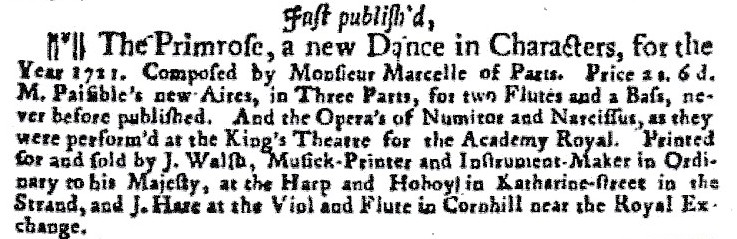
The notation for Marcel’s The Prim Rose survives in a single copy, without its title page, in Oxford’s Bodleian Library. An advertisement in the Post Boy for 17-20 December 1720 announces its publication, alongside a variety of music, by John Walsh and Joseph Hare:
Marcel’s dance was published again, by Dezais in Paris within the XXII Recüeil de Dances pour l’Année 1724, with the title Rigaudon Nouveau. Curiously this collection includes La Primeroze, a very different choreography by Pecour to a gigue from the recent ballet Les Festes Grecques et Romaines (the source for Marcel’s music remains unidentified). It is worth noting that two other dances published in notation in London between the appearance of the English and French notations of Marcel’s duet have similar titles, although they share neither its music nor choreography: William Holt’s Le Rigadon Renouvele is dated to around 1722, while Anthony L’Abbé’s The New Rigadon was published in 1723. The three dances may simply reflect a fashion for the rigaudon around this time, although I ought also to mention that the most admired English choreography using this dance type – Isaac’s The Rigadoone (which appeared in 1706) – was republished in notation in London in 1722.
I don’t know how or why Marcel’s ballroom duet was first published in London. He was still dancing at the Paris Opéra and must also have been teaching regularly in Paris (he had been elected to the Académie Royale de Danse in 1719). There is no record that Marcel ever visited London, although he and his teaching would become well known and much admired there. Only two other choreographies by him were published in notation, the Menuet Dauphin and the Menuet de la Reine, which were included in Magny’s Principes de Chorégraphie in 1765. Marcel was particularly renowned for his teaching of the minuet.
The music for The Prim Rose has the time signature 2 and structure AABB (A=4 B=6 making 80 bars of dance in all). Its step vocabulary is basic, although some steps (including the coupé and the pas de bourrée) do appear in a number of variants. For its figures, in addition to right lines with the dancers travelling up and down the dancing space and some circular lines, Marcel makes use of oblique (diagonal) lines. These add interest and (to my mind) help the dancers to keep track of where they are in the choreography.
Here is the first plate of The Prim Rose (the date has been added in manuscript):
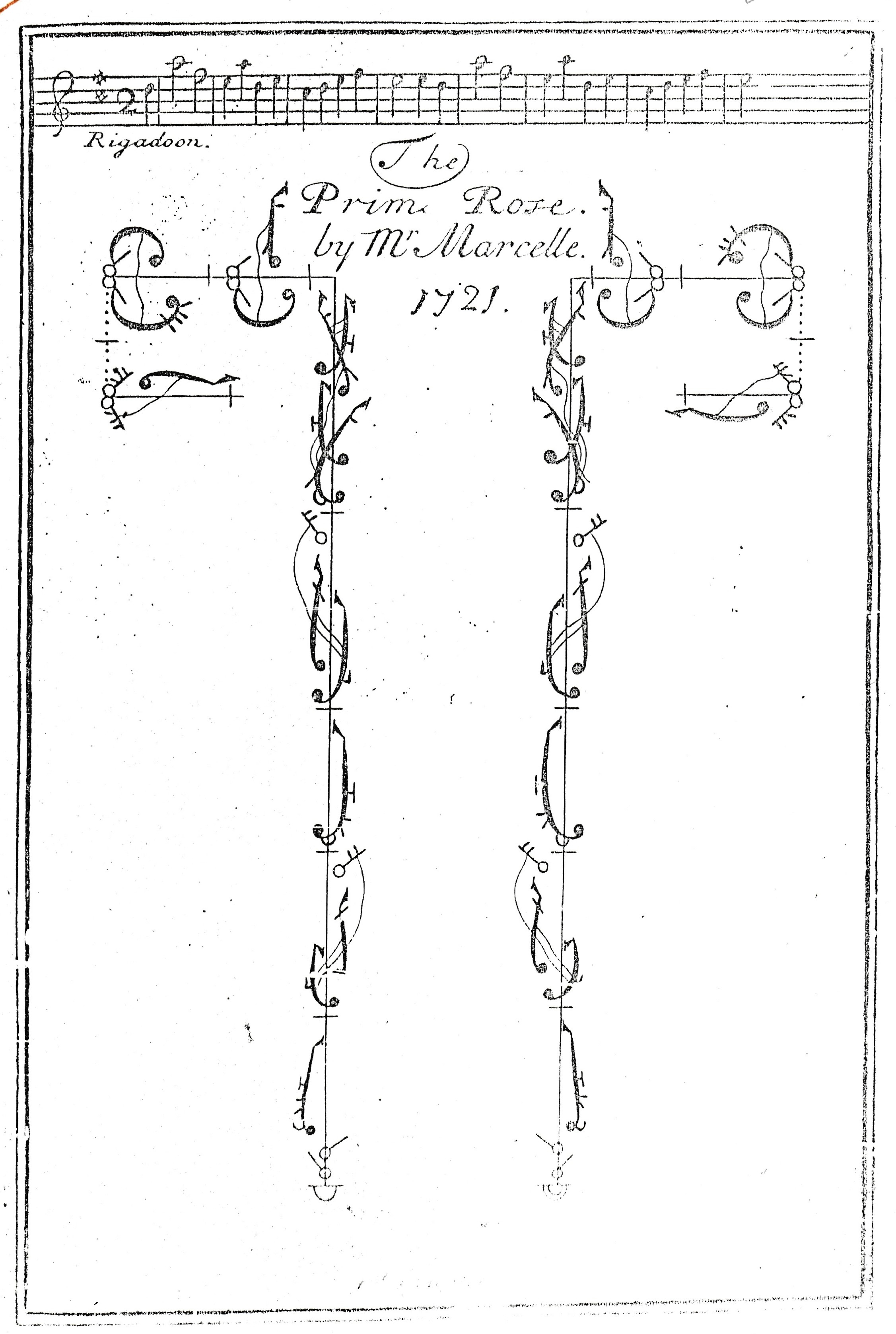
The dancers begin facing the Presence according to convention but immediately turn to face each other for their first step. They don’t really face the Presence again until bar 48 and then only for the duration of a single pas assemblé. They do face each other up and down the dancing space for a number of figures, but the one nearest the Presence has their back turned and is directly opposite their partner who cannot readily be seen from the front. They only face the Presence together at the end of the dance, for the last two steps of the penultimate B section and then the final B in which they both dance backwards to end the choreography with a pas assemblé.
Another feature of this choreography are sequences in which one dancer moves backwards and the other forwards. Here is the first of these:
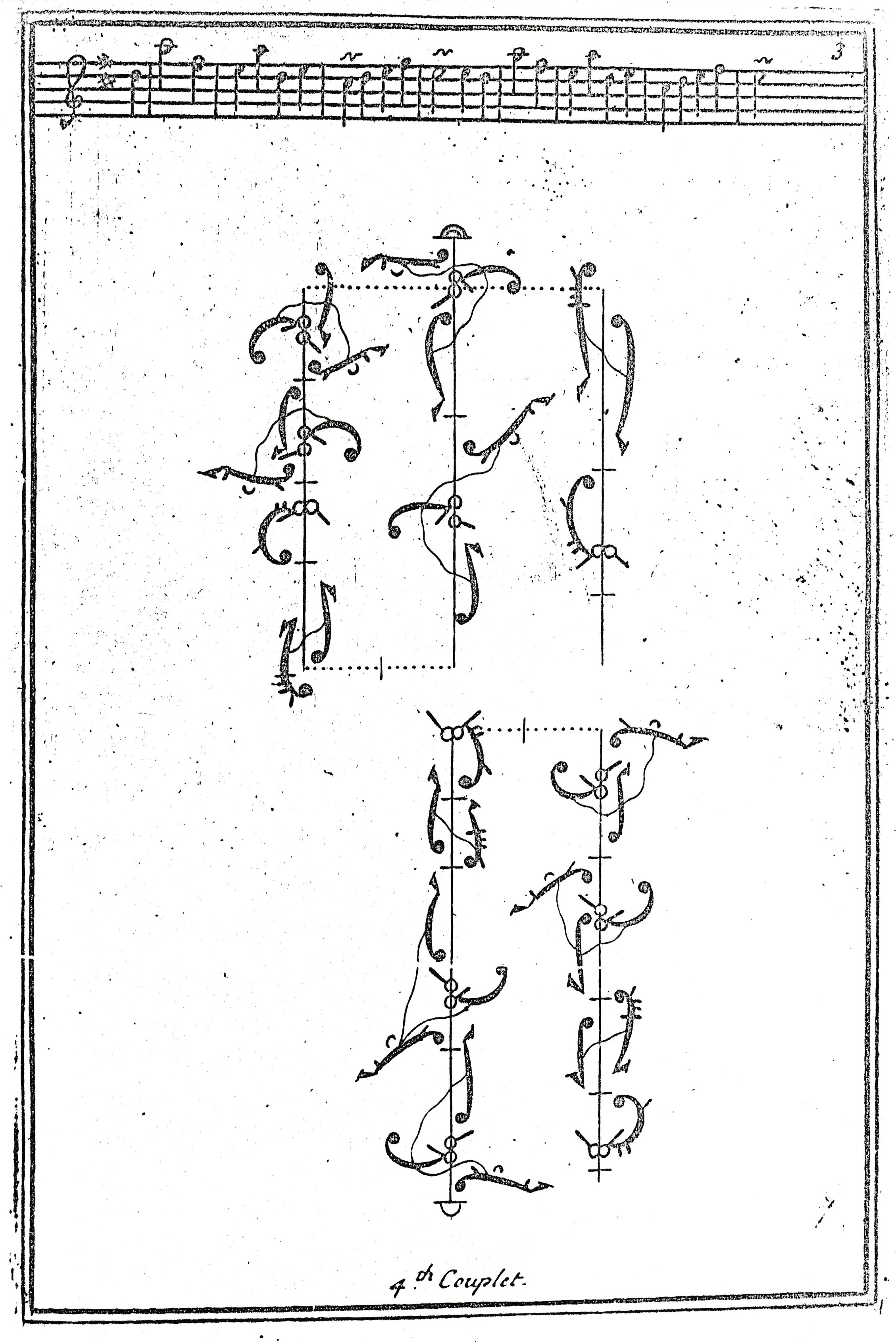
This the second AA, in which the dancers perform a variant on the pas de bourrée towards each other and then the woman travels backwards with a variant pas de bourrée, a contretemps and a pas assemblé as the man travels forwards with the same steps. They then change roles, repeating their steps with the man dancing backwards as the woman comes forwards. This figure can really only be seen from the sides of the dancing space. The concluding B of the following BB section has the two dancers on a diagonal ready to perform an oblique line. They travel towards each other for three bars and then the man continues to advance while the woman retreats. This figure is visible to the Presence as well as from the sides of the dancing space.
The last of these oblique lines is danced to the fourth and final AA section. This time, the woman stands still for the first A, while the man advances towards her. On the second A she dances towards him as he retreats. This diagonal is opposite to the one previously described. Here is the notation for the final plate of the dance, from which you can see not only the oblique line but also an idiosyncracy of this particular notation.
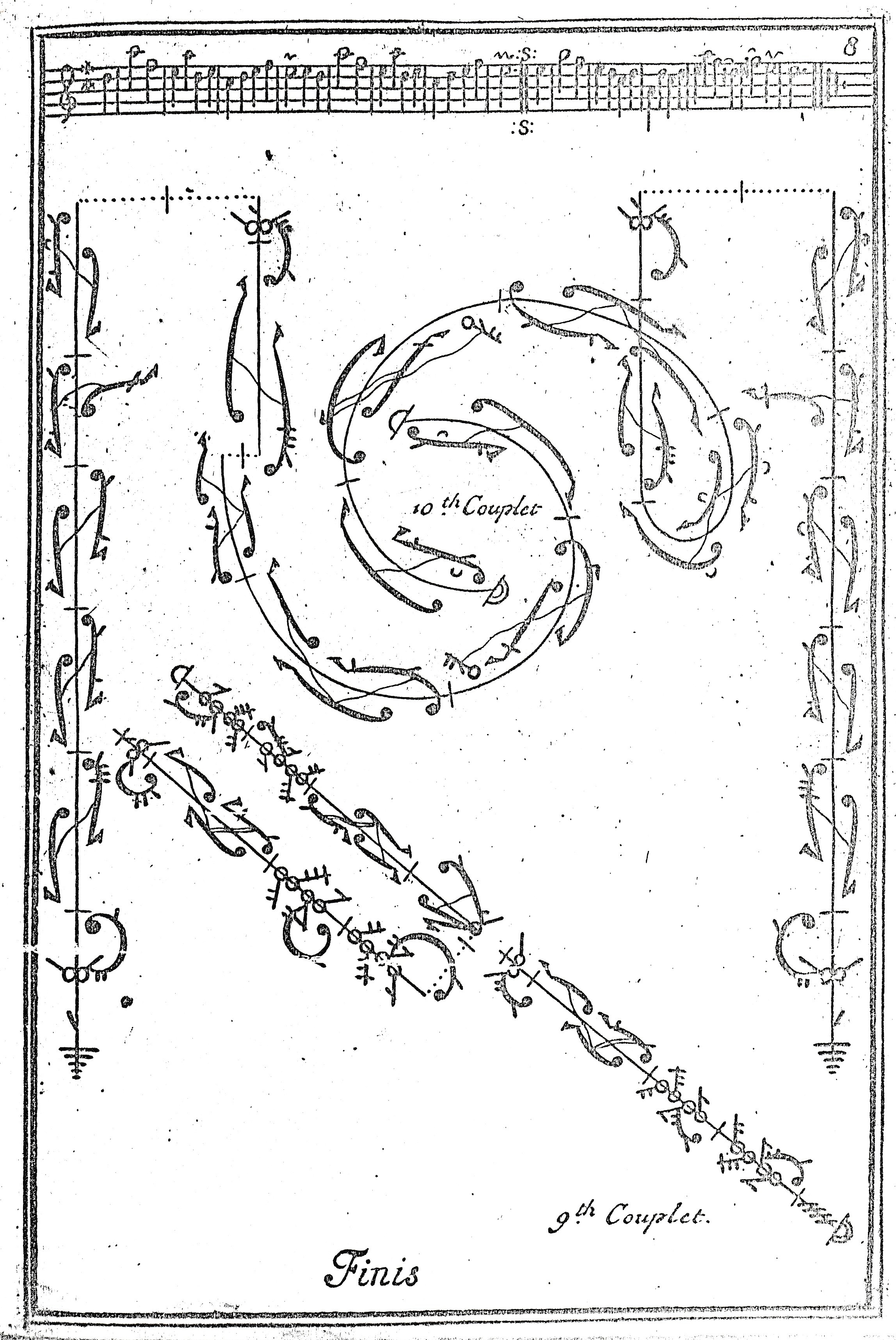
The plate shows the two final couplets of the dance notated separately but on the same page. The same pattern occurs on plate 2, where the layout is less immediately obvious.
The later notation by Dezais is laid out quite differently. Here is the first plate of Marcel’s Rigaudon Nouveau:
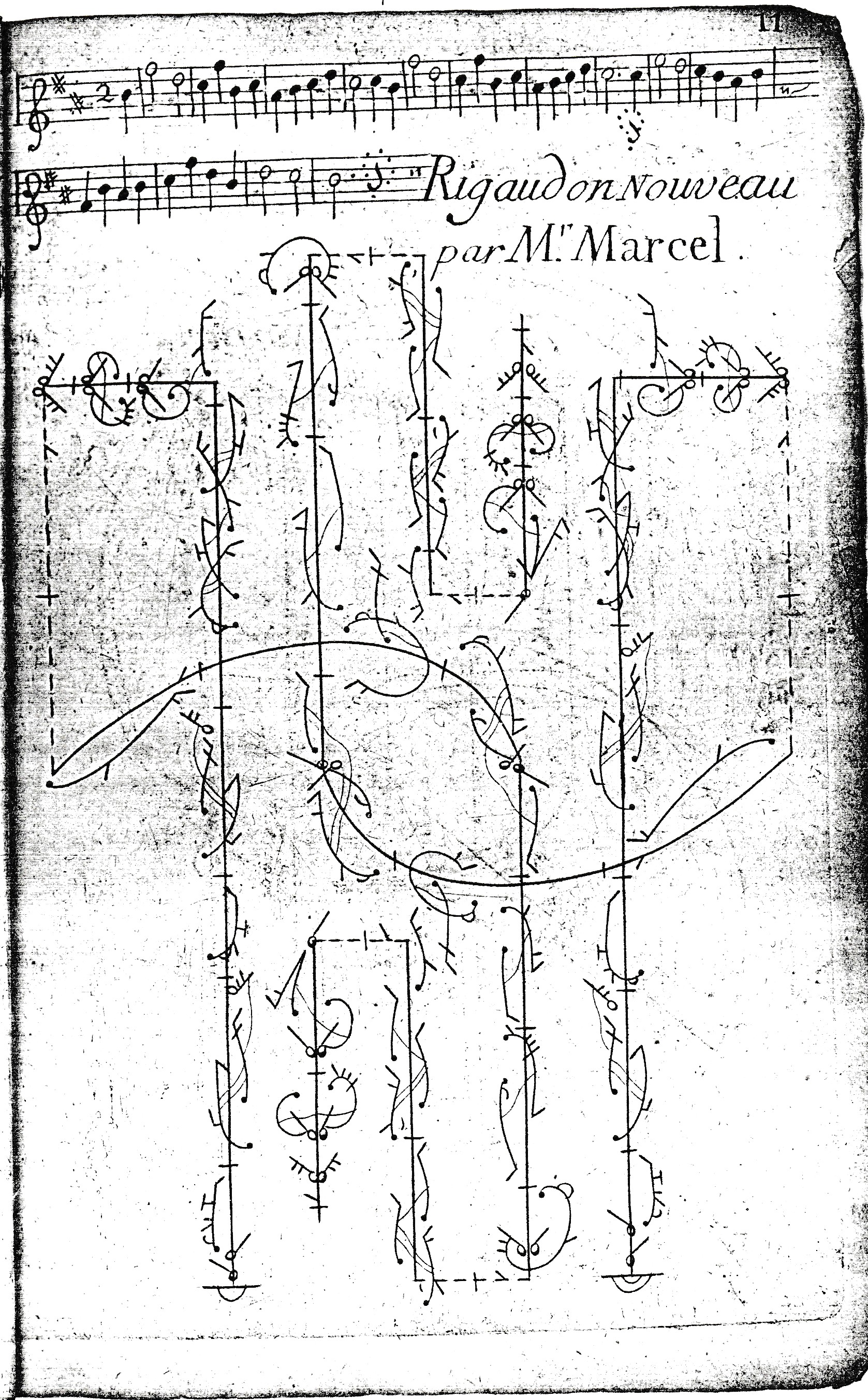
Walsh’s notator brought together the eight-bar AA sections onto single pages, but separated the six-bar B sections – ostensibly calling for ten pages of printed notation. These were reduced to eight by printing the first and last of the BB sections on one plate each, as can be seen in the image of plate 8 above. Dezais was far more economical. His notation fits onto just four plates, each of which has an entire AABB section (the plates are numbered 11-14 within the collection of four dances, of which it is the last). Although the styles of notation and engraving differ, the steps are the same except in a handful of cases. The figures in the two versions are the same.
There is one figure in this dance that I find puzzling. It occurs in the second B of the third AABB section and is the same in both notations (plate 7 of the English notation and plate 13 of the French). The woman performs a balonné followed by a coupé battu on an oblique line, ostensibly coming right shoulder to right shoulder with the man. However, he remains still for these two bars and only joins her when she repeats the steps on her other foot and the opposite oblique line, so that they come left shoulder to left shoulder. Here is the sequence in the London notation (the two-bar rest for the man, who is on the left side of the plate, can be seen just before his balonné):
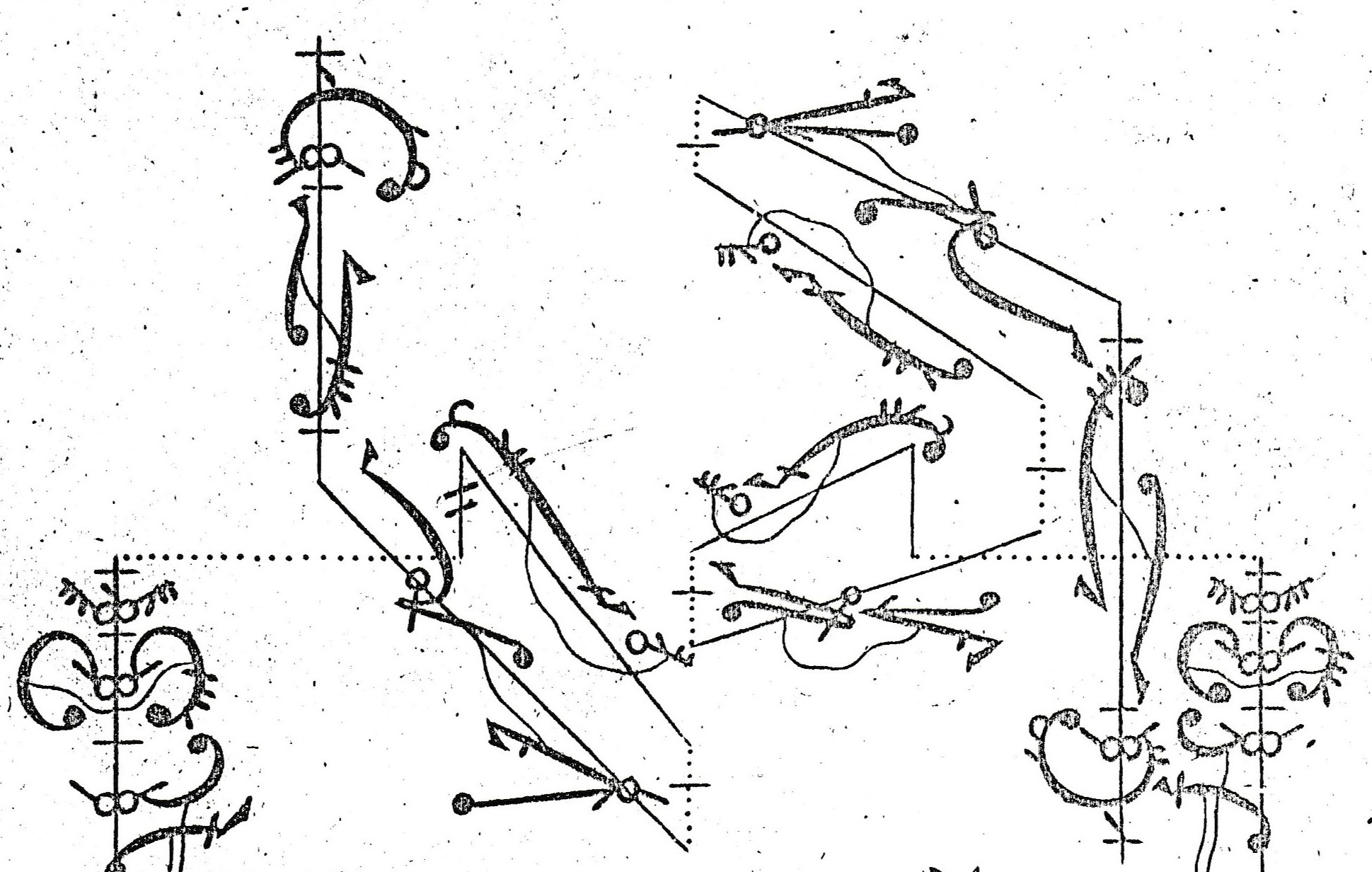
The whole sequence with its two diagonals occurs in a number of earlier notated dances and apparently originated in Pecour’s L’Allemande of 1702. Marcel’s variation on the original sequence gives it a lop-sided quality and it is not easy to understand what he intended by doing this. I did wonder whether there was a mistake in the notation (either here or elsewhere), but both versions are the same.
The Prim Rose is easy to learn and enjoyable to dance and seems to me to be a good choreography to teach to those who are new to baroque dance. It helps to provide a grounding in the basic steps and develops understanding of a range of figures and the variety of ways in which they might fit into the dancing space. It also curbs a tendency (to which I myself still fall prey) to interpret these ballroom dances solely in relation to the Presence, allowing us instead to see them as dances performed in the round. I hope that it will, in time, become better known as an example of Marcel’s teaching skills, which were acknowledged as exceptional and extended well beyond the minuet.
Further reading:
Régine Astier, ‘François Marcel and the Art of Teaching Dance in the Eighteenth Century’, Dance Research, 2.2 (Summer 1984), 11-23.
 Dance in History