Catherine of Braganza: A Dancing Queen

Catherine of Braganza (1638-1705) is generally known as the Portuguese princess who married Charles II in 1662 and failed to provide him with an heir. As his Queen, she had much to endure – not only the King’s repeated and flagrant infidelities but also the spiteful politics of the English court. Much less well known is her love of dancing and her role in the promotion of dancing both at court and on the London stage.

Catherine of Braganza Huysmans 2

Attributed to Jacob Huysmans. Queen Catherine of Braganza, 1660-1670

She is first recorded as attending a ball at court on 31 December 1662, just a few months after her arrival and marriage. Samuel Pepys records the entrance of ‘the King and Queen, the Duke and Duchesse [of York], and all the great ones’. On this occasion, the Queen seems not to have danced, for Charles II ‘takes out the Duchess of Yorke, and the Duke the Duchesse of Buckingham, the Duke of Monmouth my Lady Castlemayne, and so other lords other ladies; and they danced the Bransle’. Pepys also mentioned that ‘when the King dances, all the ladies in the room, and the Queen herself, stands up’. Catherine of Braganza had a sheltered upbringing so she may not have been familiar with the courante, the formal couple dance repeated several times after the bransles, and she was unlikely to have encountered the English country dances which followed.

Charles II had appointed a royal dancing master, the Frenchman Jerome Francis Gahory, around Christmas 1660. In July 1663, Gahory was sworn as a groom of the Queen’s Privy Chamber. He must have begun teaching the Queen some months earlier, for John Evelyn records a ball at court on 5 February 1663 at which both the King and the Queen danced. On 11 May 1663, the French visitor Balthasar de Monconys wrote of the Queen’s ‘petit bal en privé’ at which ‘L’on commença le bal par un branle comme en France, & ensuite l’on dança des courantes & d’autres danses; le Duc d’York commença avec la Reyne’ adding ‘Quand elle ou le Roy dansoient, toutes les Dames demeuroient debout’. Catherine of Braganza had obviously learnt both the steps and the etiquette of the court ball quickly. Sadly, we have no record of the lessons she must have had (presumably from Gahory) to acquire this new skill.

The first ball to celebrate Queen Catherine’s birthday that we know of took place at Whitehall Palace on 15 November 1666. I have discussed the account by Pepys in another post, ‘The Restoration Court Ball’. There were certainly further birthday balls for the Queen in 1671, 1672, 1673, 1675, 1676, 1677, 1681 and 1684, enough to establish such events within the annual court calendar well into the 18th century. Such accounts as survive of Catherine of Braganza’s birthday balls tend to be brief, particularly those by John Evelyn who usually fails to mention whether or not the Queen danced herself. However, Evelyn’s account of the last ball on 15 November 1684 (when the Queen would have been forty-six) tells us that ‘all the young ladys and gallants daunced in the greate hall’ suggesting that she looked on rather than dancing. He adds that ‘The Court had not been seen so brave and rich in apparell since his Majesty’s Restauration’, presumably the King was there alongside her.
The Queen was also responsible for some more elaborate entertainments with dancing. The ‘Queens’ Ballett’ was given at Whitehall Palace in the mid-1660s but seems to have left no records of its performance. It may have been the event described by Pepys on 2 February 1665, at which Lady Castlemaine and the Duke and Duchess of Monmouth among others (he does not mention the Queen) ‘did dance admirably and most gloriously’. The ‘Queen’s Masque’ given at Whitehall, probably on 20 and 21 February 1671, did leave some evidence. One would-be member of the audience wrote:

‘The Queen is preparing a ball to bee danced in the greate Hall by herself and the Dutchesse of Buckingham, Richmond, Monmouth, Mrs Berkely, and Madame Kerwell the French maid of honor. There are no men of quality but the Duke of Monmouth, all the rest are gentlemen.’

The event did not disappoint, for the writer affirmed that the performers in this grand ballet ‘danced very finely, and shifted their clothes three times’. There is evidence that the music included pieces from the ‘Ballet des Nations’ in Lully and Molière’s Le Bourgeois gentilhomme, which had been performed at the French court just a few months earlier. The ‘Queen’s Masque’ came a year before the first adaptation of the comédie-ballet reached the London stage in the form of Edward Ravenscroft’s The Citizen Turn’d Gentleman, given at the Dorset Garden Theatre in early 1672. Her lavish entertainment could not compare in scale and ambition with the court masque Calisto, given by young members of the royal family and the court before the King and Queen on 22 February 1675. Calisto, with its English and French professional dancers performing alongside the royal and noble amateurs, undoubtedly affected dancing on the London stage. The Queen’s earlier ballets must surely have influenced dancing at court as well as in the theatre.

Catherine of Braganza is well worth further study as both a dancer and a patron of dancing.

Comus, Dance and Gesture

On 4 March 1738, Comus was performed at Drury Lane. The advertisements declared that the piece was ‘Never Acted before. Alter’d from Milton’s Masque perform’d (upwards of a Hundred Years since) at Ludlow-Castle and now adapted to the Stage’. The production was lavish, as the advertisement for the third performance on 7 March (a benefit) indicates, ‘To prevent any Interruption in the Musick, Dancing, Machinery or other Parts of the Performance, Side Boxes only will be form’d on the Stage, for the Accommodation of the Ladies’. Comus, an adaptation from Milton by the poet John Dalton with music by Thomas Arne, quickly became a staple of the London stage.

Although the advertisement for the first performance lists only four dancers, there were very likely more. When Comus was revived on 28 November 1738, there were two principal dancers (George Desnoyer and Marie Chateauneuf) supported by six men and six women.

The text published to accompany the first performances includes three dances, all in act three. These are performed as part of Comus’s attempt to seduce ‘the Lady’. There is a ‘slow Dance … expressive of the Passion of Love’ by naiads, then a ‘Dance Tambourin’ by fauns and dryads and finally a song by Euphrosyne which, according to the score, was interrupted by several instrumental passages with varying time signatures. Euphrosyne calls for the dancers to represent different moods:

‘Now cold and denying,

Now kind and complying,

Disdaining, complaining,

Consenting, repenting,

Indifference now feigning.’

They seem to have responded as the music changed. It is tempting to draw a parallel with Les Caractères de la Dance (sometimes titled Les Caractères de l’Amour). It is worth noting that Mlle Chateauneuf had danced this choreography during her first visit to London during the 1734-1735 season and would revive it during the season following the first performances of Comus, in 1738-1739.

Could the final sequence of dances in Comus have made use of gesture? In particular, might any of the gestures described by John Weaver more than twenty years earlier, for his The Loves of Mars and Venus, fit the passions called for by Euphrosyne?

The ‘cold and denying’ lover might have used Weaver’s ‘Distaste. The left Hand thrust forth with the Palm turn’d backward; the left Shoulder rais’d, and the Head bearing towards the Right’. When she turns ‘kind and complying’ perhaps this was merely ‘Coquetry … seen in affected Airs’. Could ‘disdaining’ have been Weaver’s ‘Contempt … express’d by scornful Smiles; forbidding Looks; tossing of the head; filliping of the Fingers’? While ‘complaining’ might have been expressed by ‘Upbraiding. The Arms thrown forwards; the Palm of the Hands turn’d outwards; the Fingers open, and the Elbows turn’d inward to the Breast’. Weaver has no gestures for ‘Consenting, repenting’ but perhaps ‘Reconciliation’, with its shaking of hands or an embrace, might convey the former, while ‘Shame. The covering the Face with the Hand’ could represent the latter. While ‘Indifference’ suggests Weaver’s ‘Neglect’ with its ‘scornful turning the Neck; the flirting outward the back of the right Hand, with a turn of the wrist’, ‘feigning’ calls for additional movements which contradict the gesture’s overall effect. As this is, after all, a dance, the gestures would need to accompany steps either simultaneously or sequentially.

Could Weaver’s use of dance and gesture to convey ‘Actions, Manners, and Passions’ have been a regular feature of danced entertainments on the London stage, and not an isolated phenomenon (as it is so often described by modern researchers)? There are hints here and there that such expressive dancing was seen in London’s theatres, both before and after John Weaver’s dramatic entertainments of dancing. The 1738 production of Comus is only one such example.

This later depiction of Comus comes from A Collection of the Dresses of Different Nations, published in four volumes in London between 1757 and 1772. Comus can be found at the end of volume 2.

Comus Costume NYPL

La Camargo and the Entrechat-Quatre

Popular histories of ballet often tell us that Marie Anne Camargo was the first female dancer to perform the entrechat-quatre. Where does the story come from? Is it true?

I have been looking at pas battus in the notated stage dances for women in a series of other posts. These choreographies record them regularly performing assemblés battus as well as demi entre-chats and even demie cabrioles. There are hints, if no clear evidence in the notations, that female professional dancers performed entrechats-quatre long before Mlle Camargo made her debut at the Paris Opéra.

The story was examined by the publisher, bookseller and dance historian Cyril Beaumont in his Three French Dancers of the 18th Century: Camargo, Sallé and Guimard, published in 1954. He identified the originator of the story as Louis de Cahusac, citing his ‘La Danse et les Ballets’. I thought at first that Beaumont meant Cahusac’s La Danse ancienne et moderne of 1754, but I didn’t find it in the modern edition I have of that text and I couldn’t track down another work by Cahusac with the title Beaumont cites. Cahusac contributed many articles on dance topics to the famous Encyclopédie edited by Diderot and d’Alembert and published in the mid-18th century. Volume 5 of this great work has an entry for ‘Entrechat’, written by Cahusac, which includes the following paragraph:

‘J’ai vû naître les entrechats des danseuses; mademoiselle Salley ne l’a jamais fait sur le théatre; mademoiselle Camargo le faisoit d’une maniere fort brillante à quatre; mademoiselle Lany est la premiere danseuse en France qui l’ait passé au théatre à six.’

This could form the basis of another whole blog post on the topic of female batterie, but is it the source of the story of La Camargo and her ‘first’ entrechat-quatre? Note that Cahusac does not actually say she was the first, although this may perhaps be inferred from his words.

La Camargo’s virtuoso technique was certainly immediately recognised. Her debut at the Paris Opéra on 5 May 1726, was reviewed thus in the Mercure de France:

‘ … la Dlle Camargo, Danseuse de l’Opera de Bruxelles, qui n’avoit jamais paru ici, dansa les Caracteres de la Danse, avec toute la vivacité & l’intelligence qu’on peut attendre d’une jeune personne de quinze à seize ans. Elle est Eleve de l’illustre Mlle Prevost, qui la presenta au Public. Les Cabrioles & les Entrechats ne lui coûtent rien; & quoiqu’elle ait encore bien des perfections à acquerir pour approcher de son inimitable Maîtresse, le Public la regarde comme une des plus brillantes Danseuses qu’on sçauroit voir, surtout pour la justesse de l’oreille, la legereté & la force.’

There is no suggestion here that cabrioles and entrechats were new to female dancers, Camargo’s ease and brilliance of execution are noted but her vocabulary excites no comment.

In 1733, in Le Temple du Goût, Voltaire included the lines:

Legere & forte en sa souplesse,

La vive Camargo sautoit,

A ces sons brillans d’allegresse,

Et de Rebel et de Mouret.

Voltaire placed Camargo between Marie sallé ‘D’un pas guidé par la justesse’ and the actress Adrienne Lecouvreur ‘avec cette grace divine’. A footnote to the lines declares ‘Mademoiselle Camargo, la première qui ait dansé comme un homme’ without further elaboration. It seems to refer to the ‘attack’ in her dancing and not to her actual steps, contrasting her with the performers either side in the verses.

Marie Anne Camargo retired from the Paris Opéra twice, first in 1734 or 1735 (both dates are given in different sources and I haven’t yet found a contemporary reference) only to return in 1740 and then retire, finally, in 1751.

When she died in 1770, obituaries recalled Camargo at the height of her powers. Les Spectacles de Paris pour l’année 1771 included a biography of her with an appraisal of her dancing:

‘ … exécuta-t-elle tous les genres possibles de la dame noble, les menuets, les passe-pieds d’une manière bien supérieure à Mlle Prévost, et elle y conserva ce je ne sais quoi de piquant qu’elle avoit pris de sa maîtresse, ainsi que dans les entrées de pures grâces. Les gavottes, les rigaudons, les tambourins, les loures, tout ce qu’on appelle les grands airs étoit rendus dans leurs caractères, par la variété des pas qui y étoient propres, car elle les avoit tous dans la jambe et si elle n’a pas fait usage de la gargouillade, c’est qu’elle la croyait peu convenable aux femmes. Elle y substitua le pas de Basque dont elle seule et Dumoulin ont fait usage. Jamais personne qu’elle n’a fait ces beaux pas de menuet sur le bord des lampes, d’un côté du théâtre à l’autre, d’abord de gauche à droite et ensuite en revenant de droite à gauche.’

This text was transcribed by Émile Campardon in his L’Académie Royale de Musique au xviiie siècle, published in Paris, 1884 (pp. 88-89). It provides a more nuanced view of La Camargo’s dancing than is usually given, although allowance must be made for the developments in style and technique  since her retirement which may well have influenced the writer.

As late as 1804, in the last edition of his works, Jean-Georges Noverre wrote of having seen Camargo dance:

‘J’ai vu danser la Dlle. Camargo. C’est à tort que quelques auteurs lui ont prêté des graces. La nature lui avoit refusé tout ce qu’il faut pour en avoit; elle n’étoit ni jolie ni grande ni bienfaite; mai sa danse étoit vive, légère et pleine de gaieté et de brillant. Les jettés battus, la royale, l’entrechat coupé sans frottement, tous ces tems aujourd’hui rayés du catalogue de la danse et qui avoient un éclat séduisant, la Dlle. Camargo les exécutoit avec une extrême facilité, elle ne dansoit que des airs vifs, et ce n’est pas sur ces mouvemens rapides que l’on peut déployer de la grace: mais l’aisance, la prestesse et la gaieté la remplacoient; …’

The steps he mentions are those we today associate with the male dancers of the period, but Noverre talks only of her facility, thereby suggesting that they were routinely performed by women.

The various accounts of La Camargo’s dancing need more detailed analysis, as they surely provide us with important information about the style and technique open to some (if not all) female professional dancers of her time. The story of the entrechat-quatre masks a far more compelling picture of the dancer Marie Anne Camargo, whose brilliance of technique convinced audiences that she danced with the virtuosity of a man.

Camargo Wallace Collection

Nicolas Lancret, Mlle Camargo Dancing, 1730

Demie Cabriole en Tournant un Tour en Saut de Basque – a Step Solely for a Man?

My previous post, about the jetté emboîté – pas simple and the demie cabriole or jetté battu – pas simple, indicated that male dancing was not necessarily always about the more difficult steps. However, there is one virtuosic step that is almost always found in dances for men but (with one exception) never in dances for women – the demie cabriole en tournant un tour en saut de basque. Here is Feuillet’s notation for it in Choregraphie (p. 85):

Cabrioles Feuillet 2 (3)

It is a bit easier to list those male dances in the three collections I am concerned with which do not include this step.

In the 1704 Pecour Recüeil: ‘Sarabande pour un homme’; ‘Folies d’Espagne pour un homme’; ‘Sarabande pour un homme’ (music Colasse, Enée et Lavinie); ‘Sarabande pour deux hommes’. (3 of the 8 solos and 1 of the 5 duets)

In the Pecour Nouveau recüeil of c1713: ‘Entrée seul pour un homme’ (music Cavalli, Xerxes); ‘Entrée seul pour un homme’ (music Stuck, Méléagre); ‘Entrée seul pour un homme’ (music Campra, Les Fêtes vénitiennes); ‘Entrée de deux hommes’ (Blondy and Marcel, music Campra, Les Fêtes vénitiennes). (all 3 solos and 1 of the 4 duets)

L’Abbé’s New Collection of c1725: ‘Pastoral by a Gentleman’; ‘Spanish Entrée’ (Desnoyer, music Lully, Le Bourgeois gentilhomme). (2 of the 4 solos and neither of the 2 duets)

All of the dances from the 1704 Recüeil are sarabands (including the ‘Folies d’Espagne’). In Pecour’s collection of c1713, one of the dances is actually an entrée grave while another is a loure. In L’Abbé’s collection, both are loures. Is a pattern emerging? Are sarabands and loures less likely to include such virtuosic steps?

None of L’Abbé’s choreographies have more than one demie cabriole en tournant un tour en saut de basque. Two of Pecour’s include as many as three – the solo ‘Entrée d’Appolon’ and the ‘Entrée pour deux hommes’ danced by Piffetau and Cherrier to music from Campra’s L’Europe galante. The latter is a loure, disrupting the possible pattern I mentioned earlier.

In the majority of instances, the demie cabriole en tournant un tour en saut de basque is preceded by a contretemps. It also usually has a three-quarter turn in the air, often clockwise and often starting facing stage left and finishing facing stage front. In three of the solos and seven of the duets it is the final step of the dance.

The demie cabriole en tournant un tour en saut de basque is notated in only one of the stage dances for a woman, the ‘Passagalia of Venüs & Adonis’ created by Anthony L’Abbé for Hester Santlow (plate 52, bar 129):

Passagalia of Venus & Adonis 52 (2)

As you can see, the step is preceded by a contretemps. I will return to this solo in another post.

Demie Cabrioles in Male Solos and Duets

Given the frequent use of the jetté emboîté followed by a pas simple (which I abbreviate as jetté-pas simple) in the women’s dances, I expected to find many examples of this step with a demie cabriole (also called a jetté battu) instead of a jetté in the choreographies for men. In fact, where it appears in Pecour’s dances he prefers the less virtuosic version.  L’Abbé, on the other hand, does make good use of it.

In the 1704 collection of Pecour’s stage dances, the demie cabriole with a step appears only in the ‘Chacone pour un homme’ (bar 14, plate 177) and the ‘Entrée d’Appolon’ (bar 9, plate 195). In the former it is preceded by a contretemps and followed by a jetté-chassé. In the latter, the demie cabriole takes a variant form with the working foot coming into emboîté derrière and then stepping forward – making it a different step, to which Pecour adds a half-turn:

Entree Pecour 1704 195 (2)

Both dances include the jetté-pas simple version, and this also appears in four of the other six male solos as well as three of the five duets.

In the Nouveau Recüeil published around 1713, Pecour makes no use of the demie cabriole and includes the jetté-pas simple version only in the ‘Entrée seul pour un homme’ and the ‘Entrée de deux homme’ performed by Marcel and Gaudrau. Does the absence of the demie cabriole from this step, throughout the collection, reflect a deliberate choreographic choice by Pecour?

L’Abbé, by contrast, seems to have thought the demie cabriole version of this step indispensable for he includes it in all four of the solos and both of the duets in his New Collection. We get a hint of his choreographic preferences (or perhaps a glimpse of baroque choreographic conventions) because the step is very often preceded by a contretemps. L’Abbé generally follows it with a variety of more or less complex pas composés. Here are a couple of examples. First, from the ‘Chacone of Amadis’ danced by Dupré (bar 21, plate 58):

Chacone of Amadis L'abbe 1725 58 (2)

Second, from the ‘Entrée’ (an entrée grave) danced by Desnoyer (bar 13, plate 78):

Entree L'Abbe 1725 78 (2)

In the only male dance in which L’Abbé uses the jetté-pas simple, Desnoyer’s ‘Entrée’, he puts two of them together and then adds the demie cabriole version (bar 35, plate 82):

Entree L'Abbe 1725 82 (2)

In the ‘Pastoral performed by a Gentleman’, L’Abbé includes a variant on the demie cabriole version of the step in the hornpipe section of the dance. He follows the practice in this English dance type of beginning a step in one bar and finishing it in the next and does so twice, each time substituting a jetté for the pas simple (bar 33, plate 68,  immediately below and bar 54, plate 71, further below):

Pastoral L'Abbe 1725 68 (2)

Pastoral L'Abbe 1725 71 (2)

In each case the context for the step is quite different. I find it hard to believe that the ‘Gentleman’ who performed this very difficult dance was an amateur. Who could he possibly have been?

I have, of course, entirely ignored the demie cabriole en tournant un tour en saut de basque, which is essentially the demi cabriole – pas simple with a turn in the air and is very often used in the male dances. I will turn to that in my next post.

Dances on the London Stage: Castiglione’s A Cortegiano

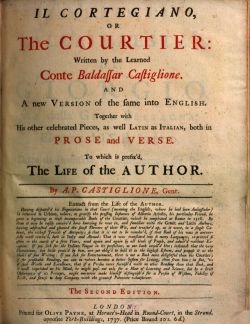
In the course of my research into dancing on the London stage, I recently came across ‘A new Comic Dance called A Cortegiano by Castiglione’ performed at the Little Theatre in the Haymarket on 29 December 1735, at the end of act 5 of Dryden’s The Spanish Fryar. The dance’s title is a very obvious reference to Il Cortegiano by the dancer’s namesake Baldassare Castiglione, originally published in Venice in 1528.

Who was the dancer Castiglione and why would he create a dance whose title refers to an early 16th century courtesy book?

Castiglione (we have no record of his first name) danced in London between 1734 and 1736. I have not been able to discover anything about his earlier or later career. According to The London Stage, his first appearance in London was on 28 October 1734 at Drury Lane. His last performance was very likely on 29 May 1736 at the Little Theatre in the Haymarket, when he appeared as Pierrot in Henry Fielding’s Tumble Down Dick; or, Phaeton in the Suds. The afterpiece was described in advertisements as ‘The Practice of a Dramatick Entertainment of Walking, in Serious and Absurd Characters’, which sounds like a satirical reference to John Weaver and his ‘Dramatick Entertainments of Dancing’ of the 1710s to 1730s.

The dancer Castiglione may have been Italian in origin, but he probably came to London from France. At his benefit performance on 28 March 1735, the mainpiece was Arlequin Balouard given by a company of French comedians including ‘Francisque’ (Francisque Moylin) as Arlequin, while the entr’acte dances were Les Warriors, Les Transfigurations, The Prisoner, a Comical Pantomime Dance, Pierot and Pieraite, a Wooden Shoe Dance and a Pantomime after the Venetian Manner ‘All by Castiglione’. The first three seem to have been performed only this once on the London stage. The titles of the last four of his dances call to mind the French forain repertoire that had been popular in London’s theatres for more than twenty years.

With A Cortegiano, Castiglione was not only showing off his knowledge of his heritage but also capitalising on the English passion for Italian culture.  Il Cortegiano had been published in an English translation as recently as 1724 and a parallel English – Italian edition had appeared in 1727. The latter was accorded a second edition in 1737.

Cortegiano 1737 title page

For a dancer, Castiglione must have been unusually well read!

Pas de Sissonne Battu in Stage Dances for Men

The pas de sissonne battu occurs in many, but certainly not all, of the male solos and duets in the 1704, c1713 and c1725 collections of stage dances I am investigating.

The collection of ‘Entrées de Ballet’ by Pecour published in 1704 has 8 male solos and 5 male duets. Of these, two solos and two duets do not include the pas de sissonne battu. In the other dances, some conventions surrounding the step begin to emerge.  The assemblé battu is often followed by a changement rather than the sissonne (a vertical spring from two feet to one, from which the pas de sissonne presumably derives its name). The assemblé battu occasionally incorporates a turn in the air. In the two examples in this collection, it is a half-turn. Although the step is preceded by a variety of pas composés, it is most often followed by a coupé simple and a coupé (sometimes a coupé battu) avec ouverture de jambe. Does this reveal one of Pecour’s favoured choreographic motifs?

Here is an example from a solo, the ‘Sarabande pour un homme non dancée a l’Opera’, bar 46 (plate 215).

Sarabande Pecour 1704 215 (2)

And another from a duet, ‘Entrée pour deux hommes’ a loure danced by ‘Mr. Piffetau et Mr. Cherrier’, bar 11 (plate 165).

Entree Pecour 1704 165 (2)

Another example in this collection may not really be a pas de sissonne battu at all, for the plié is shown on the first beat and there is no following changement or sissonne – ‘Loure pour deux hommes’ danced by Blondy and Philbois, bar 18 (plate 173).

Loure Pecour 1704 173 (2)

In this collection, the pas de bourée en presence also appears a number of times after the pas de sissonne battu.

There are quite a lot of mistakes in the notations within this collection. Is the following, from the ‘Sarabande pour un homme’ bar 35 (Plate 227), an assemblé with an additional beat or simply a pas élevé battu?

Sarabande Pecour 1704 227 (2)

Pecour’s second collection of theatrical choreographies, published around 1713, has three male solos and four male duets. Only one solo and one duet include the pas de sissonne battu. There is no way of telling whether this might point to changing choreographic choices by Pecour or is purely by chance. What is interesting is that the immediate choreographic context for the step is the same in both dances. Here is the step in Pecour’s ‘Entrée seul pour un homme’, bar 32 (plate 106).

Entree Pecour 1713 106 (2)

And here it is in Pecour’s ‘Entrée de cithe dancée par Mrs. Blondy et Marcel’, bar 12 (plate 100).

Entree de Cithe Pecour 1713 100 (2)

In both, the pas de sissonne concludes with a changement. It is immediately preceded by a chassé battu and immediately followed by a pas de bourée en presence.

Could a study of the use of such phrases help us to understand more about the choreographic style of individual dancing masters?

There are hints of individual choreographic style in L’Abbé’s use of the pas de sissonne battu and his contexts for the step. There are four male solos and two male duets in his New Collection of Dances published in the mid-1720s. One of the solos and one of the duets do not contain the step. Among the others, when the assemblé battu is followed by a changement, Le Roussau often uses a variant notation method, for example in L’Abbé’s ‘Spanish Entry Performed by Mr Desnoyer’, bar 20 (plate 74).

Spanish Entry L'Abbe 1725 74 (2)

L’Abbé seems to enjoy placing this step within a phrase of more demanding pas battus, for example entrechats. Although he may simply be exploiting the virtuosity of his male dancers. As in the ‘Chacone of Amadis Perform’d by Mr Dupré’, bar 43 (plate 60).

Chacone of Amadis L'Abbe 1725 60 (2)

Or in the ‘Spanish Entry Performed by Mr Desnoyer’, bar 29 (plate 75).

However, L’Abbé also uses Pecour’s device of a coupé followed by a coupé avec ouverture de jambe from time to time, always after the pas de sissonne battu and sometimes with an extra embellishment such as a rond de jambe (see the ‘Entrée performd’ by Mr Desnoyer’, bars 30-31, plate 81). Apart from the addition of a turn to the assemblé battu and the regular substitution of a changement for the sissonne, L’Abbé does not embellish the pas de sissonne battu itself.

In all these collections the assemblé battu is notated just as it appears in the women’s dances. Of course, the men may have added their own ornamentations in performance, just as the women may have done.

Stage Dances and Their Performers

I have started to look at the vocabulary of pas battus in solos and duets created for female professional dancers, concentrating on the choreographies in Pecour’s Recüeil of 1704 and his Nouveau recüeil of around 1713 as well as the L’Abbé New Collection of about 1725. I began my investigation with some statistics on the dances in these. I’m now about to turn to pas battus in the solos and duets for male dancers in these same sources. There are more dances for men than for women, although the difference between the two is not enormous: there are 11 male duets to 7 female duets; and 15 male solos to 14 female solos. However, there are some differences in the head titles (the details on the first page of each notated dance) which give me pause for thought as I try to make comparisons between the step vocabulary in the female and male repertoires.

In Pecour’s 1704 Recüeil, four of the six female solos name the dancers and are linked to stage performance either in the operas from which their music is taken or elsewhere (for example Mlle Subligny’s gigue danced ‘en Angleterre’, i.e. in one of London’s theatres). The single female duet in this collection names the dancers and is linked to performance at the Paris Opéra. With the male solos, the picture is rather different. None of the eight choreographies has a named dancer and six of them declare that they were ‘non dancée a l’Opera’. What does this phrase mean? Were the dances created for productions at the Paris Opéra and then not used? Were they intended for either public or private performance at another venue? Can one make a fair comparison between solos attributed to leading female professional dancers performed on stage at the Paris Opéra and those by unnamed male dancers not given there? Interestingly, all five of the male duets name the leading professionals who performed them and are linked to specific operas.

Pecour’s Nouveau recüeil of around 1713 has three male solos, but only one has a named performer. The other two are titled ‘Entrée seul pour un homme’ with no reference to the operas from which their music comes. As in the earlier collection, the four duets all name dancers at the Paris Opéra and refer to performances in operas given there. One of the six female solos does not name the dancer and is also ‘non dancée a L’opéra’. One of Mlle Guyot’s solos has no reference to the opera from which it takes its music.  As with the men, all five of the female duets name their dancers and the opera in which they were performed.

I don’t know why there should be this difference in the head titles for male and female dances in these two collections. Did the leading men routinely choreograph or even improvise their own solos (so these couldn’t readily be notated) but need Pecour to create their duets? Or were Pecour’s male solo choreographies intended for Paris Opéra students or amateur dancers rather than these professionals?

In London, the situation (so far as stage dancing was concerned) was very different. The title page of L’Abbé’s New Collection claims that all the choreographies ‘have been performed both in Druy-Lane [sic] and Lincoln’s Inn-Fields, by the best Dancers’ – all these dancers are then named. All but one of the four male solos are attributed to leading male dancers in London and it is possible to link the ‘Gentleman’ who danced the fourth to a specific performance. The two duets similarly have named performers. The two female solos and the duet also have named dancers. None of the dances in this collection can be securely linked to individual performances on the London stage, but there is no reason to doubt the assertion on the title page.

There is one other issue, when it comes to comparing like for like with stage dances intended for men or women, and that is the dance types performed by them. Quite some time ago, I did an analysis of these as they occur across all the sources for male and female solos as well as male-only and female-only duets. I have never published it, so it could be a topic for another post. The vocabulary which is currently the focus of my interest may also be affected by the dance types as well as the performers, but the corpus of material I am investigating is so small that I will leave this issue to one side as I pursue my investigation of pas battus.


When is a Changement not a Changement?

Among the many steps notated by Feuillet in Choregraphie one looks in vain for one named ‘changement’ or indeed for notation of a step that is recognisable as one. This basic step is described thus in a modern dictionary of classical ballet:

‘Changements are springing steps in the fifth position, the dancer changing feet in the air and alighting in the fifth position with the opposite foot in front.’

When I wrote my PhD thesis back in the 1990s, I compiled a ‘Glossary of Terms for Early Eighteenth-Century Dance’ which, in shortened form, became Appendix II. I combed through all of the principal sources for the dance vocabulary and technique of the period, but I did not find any sign of the changement.

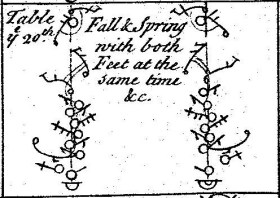
I obviously did not do my research thoroughly enough, for in his The Art of Dancing of 1735 Kellom Tomlinson wrote of the changement in the context of two different pas composés, although he did not use that term. In chapter XXIX, he calls it a ‘Spring with both feet at the same Time’ and describes a pas tombé ending with:

‘half the Weight [on the left foot] in the fourth Position behind the right Foot, with the Knees bent … from whence the Spring is immediately made with both Feet, … changing the right Foot backwards and the left forwards’ (p. 87)

I have omitted the references to the timing of the step. Tomlinson provides notation of the pas composé ‘Fall, Spring with both Feet at the same Time, and Coupee to a Measure’ which actually shows the ‘Spring with both Feet’ starting and finishing in the 3rd position.

Tomlinson Plate I (2)

Tomlinson, The Art of Dancing (London, 1735), plate I (detail)

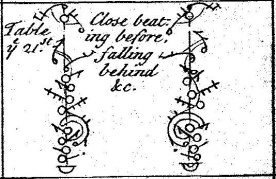
In chapter XXX, Tomlinson calls it an ‘upright Spring’, referring to it as part of ‘the Close beating before and falling behind in the third Position, upright Spring changing to the same before, and Coupee to a Measure’. He again provides notation of the pas composé.

Tomlinson Plate I (3)

Tomlinson, The Art of Dancing (London, 1735), plate I (detail)

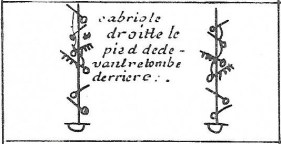
A fresh look at Feuillet’s step tables reveals another piece of information I overlooked. In his ‘Table des Cabrioles’, Feuillet notates a ‘cabriole droitte le pied devant retombe derriere’.

Cabrioles Feuillet 2 (2)

Feuillet, Choregraphie (Paris, 1701), pl. 85

This is, of course, a changement with the addition of a beat of the legs in the air.

My interest is not so much in the changement as in its use in notated dances in relation to jumps incorporating pas battus – in particular entrechats. Did female professional dancers of the early 1700s really only ever do changements while their male counterparts did entrechats-quatre and entrechats-six? Do the notated dances perhaps suggest otherwise?

Stage Dances for Women and the Demie Cabriole

There is another pas composé which appears in many of the stage dances for women, although Feuillet does not include it specifically in his step tables. This is how it is notated in the ‘Entrée pour une femme Dancée par Mlle Victoire au Ballet du Carnaval de Venise’, a forlane included in the 1704 collection of Pecour’s ‘Entrées de Ballet’ (plate 7):

Forlana 7 (2)

The first element of the step is the same as Feuillet’s jetté ‘en avant et le second emböetté derriere’ (Choregraphie, pl. 72).

Choregraphie Jettes 72 (2)

This particular jetté is the basis for Feuillet’s ‘demie cabriole en avant’, which he also calls a ‘jetté battu’ (Choregraphie, pl.84).

Cabrioles Feuillet 1 (2)

In the women’s dances, it is notated as a jetté, without the third line that denotes the cabriole movement, the beating together of the legs in the air.

The demie cabriole is one of the few theatrical steps to get a mention in Pierre Rameau’s Le Maître a danser of 1725, in his chapter XXXVI ‘Des Jettez, ou demies Cabrioles’ (the translation is by John Essex, from The Dancing-Master of 1728, p. 96)

‘They  [jettés] are yet made after another Manner which requires more Strength in the Spring, Quickness in the Rise, and Extension of the Legs, striking them one against the other, falling on the contrary Foot to that sunk upon, and then change their Names and are called half Capers: But as these are Steps for the Stage, and in this Treatise I undertook to teach the Manner of making Steps used in Ball Dancing, I shall not trouble my Reader with these latter, which are only for those whose Form is exquisitely nice, and who make Dancing their Business.’

We might assume that Rameau (as well as his translator) refers to male professional dancers, but he does not specifically say so.

So, where does this jetté ‘emböetté’ appear in the solos and duets for women within the three collections I am looking at? The other solo dance in the Pecour collection of 1704 which includes it is Mlle Subligny’s ‘Gigue pour une femme’, to music from Gatti’s Scylla, first in bar 22 (plate 43, shown below) and again in bar 34 (plate 44).

Gigue Angleterre 43 (2)

She starts with the right foot the first time and the left foot when the step reappears. Both times it is preceded by a pas de bourée emboîté and followed by a coupé battu. The step is embedded within a repeated 12-bar sequence of steps danced to the first and second repeats of the B section of the music.

It also occurs in the one duet in the 1704 collection, the forlane danced by Mlle Victoire and Mlle Dangeville in the Ballet des Fragments de Lully (bar 17, plate 53).

Forlana duet 53 (2)

Here, it is preceded by an assemblé / pas simple combination and followed by a coupé battu.

The jetté emboîté occurs in three of the women’s solos in Pecour’s Nouveau recüeil of around 1713. The first is the ‘Gigue pour une femme seul’ from Campra’s Tancrède (bar 18, plate 75), danced by Mlle Guyot.

Gigue Tancrede 75 (2)

Here, it follows a contretemps backwards and is followed by a coupé battu.

In the ‘Passacaille pour une femme’ danced by Mlle Subligny to music from Lully’s Armide it appears twice. First in bar 62 (plate 82, shown below left), where it is preceded by a pas de bourée and followed by a coupé battu, then in bar 74 (plate 83, shown below right), where it follows a pas de bourée emboîté. This second time, the concluding pas simple becomes a pas plié and the dance bar ends with a coupé avec rond de jambe.

Passacaille Armide 82 (2) Passacaille Armide 83 (2)


This proto-cabriole turns up in both the canary duets for women in this collection. In the ‘Canarÿe’ it occurs twice, first in bar 10 (plate 43, see below top), where it is preceded by a pas de bourée emboîté and followed by a coupé battu. The second time, in bar 38 (plate 45, see below bottom), it begins the final musical section after the assemblé / pas simple which finishes a pas de rigaudon and is followed by a coupé battu.

Canarye Guyot Prevost 43 (3)

Canarye Guyot Prevost 45 (2)

In the ‘Entrée de deux Bacchante’, like the ‘Canarÿe’ danced by Mlle Guyot and Mlle Prévost, it also begins the final musical section (bar 26, plate 63) and is preceded by a pas de bourée and followed by a coupé battu.

Bacchante Guyot Prevost 63 (2)

In his New Collection of around 1725, L’Abbé’s ‘Passagalia of Venüs & Adonis’ provides Mrs Santlow with several variants on the basic jetté emboîté which I will discuss in another post. In the ‘Passacaille of Armide’ danced by Mrs Elford and Mrs Santlow, this proto-cabriole comes in bar 100 (plate 13), immediately preceding the assemblé battu which closes the musical variation. It is preceded by a pas composé comprised of a coupé to first position, a pas plié and a jetté. And, as you see, there are three of these variant jettés emboîtés in the bar rather than the more usual two.

Passacaille Armide Duet 13 (3)

Like the pas de sissonne battu, this jetté emboîté is a commonplace in stage dances for women. Should we make anything of the fact that in the majority of the dances by Pecour it is followed by coupé battu? If nothing else, it seems to point to one of his favoured choreographic devices.

Why have I dealt with this topic at such length? Am I the only one who has danced all these choreographies to wonder whether the jetté emboîté should really be a demie cabriole? The female professional dancers for whom these dances were created undoubtedly had the strength and the technical skill to perform cabrioles, which would have been clearly seen under the shorter skirts we know they wore. Did the notations follow a convention related to the one that routinely depicts leading ballerinas in floor-length skirts? I believe they did.