Category Archives: Dancers & Dancing Masters

Mr Holt’s Minuet and Jigg in Performance

There are at least three versions of Mr Holt’s Minuet and Jigg on YouTube. In my opinion, this is the best of them.

The dancers are well costumed and they dance nicely. However, we have two men and two ladies, rather than the four ladies specified by the original notation. One of the videos I was able to find has four ladies, but this version has much better dancing.

The figures are accurately performed and the steps are neat, although the performance is perhaps rather too contained and even a bit stiff. Is that how they thought it should be danced? It is very difficult to find a happy medium between our conflicting ideas of 18th-century politeness and extravagance. Although there is some interaction within each couple, each pair less often acknowledges the other – which underplays the social dimension of this choreography. The second figure of the Minuet looks to me, on paper at least, to refer to the S-reversed of the ballroom minuet, a possibility that these dancers do not acknowledge. Other figures are danced prettily, particularly the circle in the second part of the Minuet where the dancers use to good effect the shoulder shading called for in the pas de menuet to the left.

The steps used in the Jigg don’t always quite work. Mr Holt calls for only a few steps in specific figures, leaving the others to the dancers’ choice. Those chosen, or rather the sequences of steps, don’t always seem choreographically quite right to me. I’m not sure why. I do like the concluding figure and the way the dancers open out into a half-circle to face their audience. This must have been charming at the time, when the dance was performed by four young ladies.

I wonder if this performance does represent the style and technique of 18th-century social dancing. There is simply no way we can tell. It is nicely danced, and those wishing to perform Mr Holt’s Minuet and Jigg can learn much from it, but I would prefer a little more freedom and liveliness – within the bounds of politeness, of course.


Mr. Holt and his Minuet and Jigg for four ladies

The first and only dance for four to appear in an English source was Mr Holt’s Minuet and Jigg. Who was Mr Holt and why did he create this choreography?

This dance for four was published in London in 1711, in Edmund Pemberton’s An Essay for the Further Improvement of Dancing. The collection of ‘Figure Dances’ was entirely for female performers, although Pemberton never mentions this fact. The title page says nothing. The Preface focuses almost exclusively on the significance and value of the new system of dance notation used to record the choreographies. Even the dedication to Thomas Caverley, noted as a teacher of young ladies, avoids any reference to female dancers.

Mr Holt was obviously deemed worthy of a place among ‘the most Eminent Masters’ (according to the title page) whose dances were published in Pemberton’s collection. There were several Holts, dancing masters and musicians, working in London during the early 1700s. Which of them created this Minuet and Jigg? Among the subscribers to the publication (who had paid in advance for copies in order to finance the printing) are Walter Holt and William Holt. The choreographer must have been one of them, but which one?

Various dancing masters named Holt subscribed to dance treatises and collections of dances in the early eighteenth century. In 1706, Walter Holt ‘Senior’ and Walter Holt ‘Junior’, together with Richard Holt, subscribed to John Weaver’s Orchesography (his translation of Feuillet’s Choregraphie) and A Collection of Ball-Dances Perform’d at Court (his notations of choreographies by Mr Isaac). In 1721, Walter Holt and William Holt subscribed to Weaver’s Anatomical and Mechanical Lectures upon Dancing (which were delivered at ‘Mr Holt’s Dancing-Room, at the Academy in Chancery-Lane’ according to the Daily Post for 31 January 1721). In the early 1720s, too, Walter Holt, William Holt and ‘Mr. Holt Junior’ subscribed to Anthony L’Abbé’s A New Collection of Dances.  I suggest that Walter Holt ‘Senior’ was the ‘Musician’ who died in 1706 (his will survives in the National Archives at Kew) and that Walter Holt ‘Junior’ was his son, another ‘Musician’, probably born in 1676 who died in 1738 (his will is also in the National Archives). Richard and William Holt are likely to be the brothers of Walter Holt ‘Junior’, born in 1678 and 1691 respectively. William, who died in 1723 (his will is in the National Archives), was the choreographer of a ballroom duet Le Rigadon Renouvele published around 1720. ‘Mr. Holt Junior’ may well be another Walter, the son of Walter Holt ‘Junior’, born in 1701.

The only real candidate for choreographer of the Minuet and Jigg is Walter Holt ‘Junior’ (1676-1738). He is surely the ‘Mr. Holt’ listed among the dancing masters named by John Weaver in his 1712 An Essay towards an History of Dancing as ‘happy Teachers of that Natural and Unaffected Manner, which has been brought to so high a Perfection by Isaack and Caverley’. He was a contemporary of Weaver and must have been very well-established as a dancing master, unlike his much younger brother William. When he died in 1738, Walter Holt was described as ‘Mr. Holt, sen. a very wealthy and famous Dancing-Master’ (Weekly Miscellany, 15 September 1738).

What of the Minuet and Jigg itself? I will not analyse the choreography in detail, for there are others who are far more expert in this genre than I. The minuet has 48 bars and the jigg 32 bars, so the dance is quite long. The four ladies begin as two couples facing one another (two of the dancers have their backs to the audience). They face towards each other, in the manner of a country dance, for much of the choreography. The minuet section draws on the familiar figures of the ballroom minuet, including the S-reversed, taking right hands and taking left hands. It also uses figures from country dances, for example the square hey and the dos-à-dos. Only one step is specified in the notation – the pas de sissonne used in the jigg. Pemberton gives no advice about steps, but his reference to John Essex’s For the Further Improvement of Dancing (a translation of Feuillet’s 1706 Recueil de contredances), published in 1710, implies that he expects readers to look at that treatise for advice. The ladies complete the dance by opening into a semi-circle to face their audience.
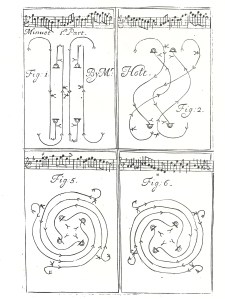
Mr Holt's Minuet and Jigg, first plate.

Mr Holt’s Minuet and Jigg. First plate.
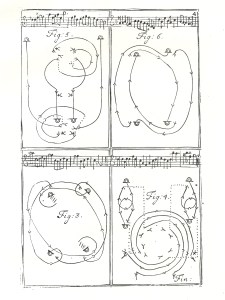
 

Mr Holt's Minuet and Jigg.  Last plate.

Mr Holt’s Minuet and Jigg. Last plate.


This choreography for four is simultaneously a means of teaching the genteel style and technique of both ballroom and country dances expected in English polite society and a contrivance for displaying the skills that could be learnt from the best dancing masters. It was probably created for performance by his female scholars, before an audience, at Walter Holt’s Academy.

Teaching the cotillon

In the early 1760s, before the appearance of Gallini’s ‘collection of cotillons or French dances’, dancing masters principally taught minuets and country dances. At that period Nicholas Hart regularly placed notices in the Public Advertiser. On 2 January 1762, he announced he was available to teach ‘Grown Persons to dance a Minuet and Country Dances, in the genteelest Manner, and with Privacy and Expedition’. He promised to impart the necessary skills speedily – ‘Country Dances … from three Hours to six Days’ and ‘A Minuet may be attained in two or three Weeks’. He did not specify how many lessons would be needed, and he was coy about his fees. ‘The Expense of learning Address [bows, curtsies and other basics of etiquette] is One Pound Six; (in the Minuet Address is included)’, other charges ‘may be seen at large in the printed Proposals’. Hart expected his dancing school to be open for business for many hours each day. ‘Continual Attendance is given for private Instructions from Ten to Ten, And on Wednesday and Friday Evenings the Long-Room is open for general Practising, from Seven to Ten’.

Dancing masters, like polite society, were subject to changes in fashion. The Gazetteer and New Daily Advertiser for 6 April 1768 declared ‘Mr.Welch, dancing-master, the partner of Mr. Hart, is returned from France, where we may expect the cotilons, &c. in perfection’. In another advertisement on 2 May 1768, Welch observed that ‘the cotillons, &c. [are] an essential requisite in this nation’. On 14 June 1768, the dancing master Mr Patence advertised in the Gazetteer and New Daily Advertiser. He, too, taught ‘grown ladies or gentlemen’ a repertoire of minuets and country dances ‘in the most polite and expeditious manner’. Country dances could be learned in six hours and the minuet in twelve lessons. He also taught ‘all the rigadoon steps, and figures, for the cotillon dances’. He was equally reticent about his fees, saying only ‘For further particulars enquire’.

There was obviously a numerous regular clientele, of both adults and children, who needed or wished to learn the dances performed at assemblies and balls. If one was to succeed in Georgian society, one had to be able to dance. By the late 1760s the cotillon was the dance of choice.

[After John Collet. Grown gentlemen taught to dance. 1767. © Trustees of the British Museum]

[After John Collet. Grown gentlemen taught to dance. 1767. © Trustees of the British Museum]

[After John Collet. Grown ladies taught to dance. c1768. © Trustees of the British Museum]

[After John Collet. Grown ladies taught to dance. c1768. © Trustees of the British Museum]

Mr. Siret, A Set of Cotillons, c1770

A Set of Cotillons, or French Dances by Mr Siret is undated, but has been ascribed to around 1770. This places it among the collections published soon after the cotillon first became popular in London. The title page declares that Siret’s cotillons are ‘properly explain’d and illustrated, by Corographical Lines, drawn on a plan entirely new & far superior to those which have been before Published’, adding that both the tunes and the figures are by him.

Unlike the other treatises that appeared in London around this time, which all have verbal descriptions, Siret records his dances in a form of notation like that used in France for the publication of contredanses. He was probably French – he is very likely the Siret recorded as a musician in Paris around 1780 who had earlier published music in London. He may have been a relation of the French organist and composer Nicolas Siret (1663-1754).

Siret explains the notation he uses. He gives the same symbols to the ladies and the gentlemen, except that the ladies are shown in white and the gentlemen in black, with partners sharing identical shapes. He makes a mistake when he says ‘every Gentleman has his partner on his left hand’.  In his diagram of the couples standing in a square, Siret does show the ladies on the right according to convention.

He lists seven changes, plus the grand rond ‘all eight hands round and back again’. These, he says, are ‘the most fashionable’. Each dance has an ‘Explanation of the Plan’, which is a verbal description of the figures, and a ‘Plan of the Figures’, which notates them. The ‘Explanation’ names some steps, for which Siret provides no descriptions. His six cotillons all have French titles.

Siret obviously intended to make his mark among the dancing masters competing for attention, and dance students, in late 18th-century London. All these cotillon collections raise the question of dancing masters and their lessons, my next topic.

Henry Kingsbury. A Cotilion. [Detail, right hand side]. 1788. © Trustees of the British Museum

Henry Kingsbury. A Cotilion. [Detail, right hand side]. 1788. © Trustees of the British Museum

George Villeneuve Junior, A Collection of Cotillons, 1769

The 1769 Collection of Cotillons by George Villeneuve ‘Junior’ advertises its ‘plain and easy Directions’ on the title page. He lists seven steps and nine changes. His twelve cotillons all have French titles.

The epithet ‘Junior’ presumably distinguished George Villeneuve from his father. It is likely that he was the son of the Mr Villeneuve (also George) who danced at Drury Lane and then Covent Garden between 1734 and 1756. The elder Villeneuve married another dancer, Elizabeth Oates, at Lincoln’s Inn Chapel on 8 September 1735. George Junior was apparently born on 7 November 1738. Unusually for dancing masters at this period, his family tree can be traced a little further. George Villeneuve Junior married Susannah Smart on 20 May 1769 at St Mary in Marylebone Road, shortly before his book was first advertised. The couple had at least four children between 1770 and 1778.

There are no records to suggest that George Villeneuve Junior ever worked as a dancer on the London stage. He presumably taught ballroom dancing to amateurs, perhaps working with or in succession to his father. He may also have been a musician, as many dancing masters were, although the title page to the collection says nothing about the composer of the music. The collection was obviously designed to capitalise on the dance’s popularity and probably to draw attention to Villeneuve as a dancing master.

Henry Kingsbury. A Cotilion. [Detail, centre right]. 1788. © Trustees of the British Museum

Henry Kingsbury. A Cotilion. [Detail, centre right]. 1788. © Trustees of the British Museum

Thomas Hurst, The Cotillons Made Plain and Easy, 1769

On the titlepage of his 1769 collection, The Cotillons Made Plain and Easy, Thomas Hurst describes himself as ‘Of  the Theatre Royal in Drury Lane, Late Pupil and Assistant to Mr. Grimaldi Ballet-Master’. Giuseppe Grimaldi (d.1788) worked at Drury Lane from 1758 to 1785 and was the father of the famous clown Joseph Grimaldi. Hurst seems to have worked at Drury Lane from 1755, when he was a child dancer, until at least 1782.

Given his background, Hurst’s remarks in his preface are surprising. He refers to the many books already published on the cotillon, complaining that they ‘cannot be of service to any but great proficients’ and declaring that he will avoid the terminology and steps of theatre dancing. He offers no French tunes, preferring instead English, Irish and Scotch airs for his cotillons. Hurst dedicates his book ‘to the Dancing-Masters of these Kingdoms’. Perhaps he was just setting up as a teacher of social dancing.

Hurst provides a diagram of the ‘Dancing-Room’ which shows clearly the placing and numbering of the four couples. He briefly explains how to perform a cotillon – the bows, the alternation of changes and the figure, and the changes themselves. He lists fourteen changes, explaining that he has added ‘several new ones, to those now in use’. He says nothing about steps. Thomas Hurst’s sixteen cotillons all have French titles, which he translates into English.

Henry Kingsbury. A Cotilion. [Detail, centre left]. 1788. © Trustees of the British Museum

Henry Kingsbury. A Cotilion. [Detail, centre left]. 1788. © Trustees of the British Museum

Giovanni Battista Gherardi’s Three Books of Cotillons, 1768-1770

Three collections of ‘Cotillons or French Dances’ were compiled by Giovanni Battista Gherardi and published in the late 1760s. Notices in the Public Advertiser for 9 March 1768 and 2 March 1769, together with the date 1770 on Gherardi’s dedication in the third volume, suggest that they appeared over two to three years. Gherardi himself dates the first volume to1767 and the second to 1768, a discrepancy which is worth further research although this is not the place for it. If he did not initially conceive them as a set, Gherardi obviously developed this idea as he went on, for each of the three volumes provides additional information about the cotillon.

Fourteen Cotillons or French Dances, of 1767 or 1768, lists nine changes and nine step sequences. The fourteen cotillons all have French titles, perhaps suggesting a Parisian origin for the choreographies. The book also has music for four allemandes, indicating the parallel growth in popularity of the allemande country dances (like cotillons, performed in a square formation by four couples) as well as the couple allemande.

The Second Book of Cotillons or French Dances, of 1768 or 1769, includes an additional explanation of twelve ‘Figures the most in Vogue’. It lists the same nine sequences of steps as the first volume, referring also to ‘the steps necessary for the Country Dance in Allemande’ although Gherardi does not list or explain these. This book has twelve cotillons, three of which are also titled ‘Allemande’. At the end of his introductory text, Gherardi proposes ‘to the Nobility and Gentry, admirers of these fashionable performances, a Subscription for a Cotillon Academy’. He intends to teach not only cotillons ‘of his own composing’ but also all other fashionable dances, including Allemandes. The beau monde would be protected from interlopers ‘as the Subscription shall be wholly confin’d to Ladies & Gentlemen of Rank, Fashion, & Fortune’.

In his A Third Book of French Country Dances or Cotillons, Gherardi explains ‘several Figures not much used’. There are nine of these. The nine step sequences are the same as before, but the nine changes differ from those in the first book. Does this suggest an evolution of the cotillon, or merely alternatives in use in London’s ballrooms? Gherardi provides twelve more cotillons, all with French names. He also advertises his ‘Academy … for the Winter’ to begin in the following January. He must have had to work hard to maintain his position as one of London’s leading dancing masters.

I will return to Gherardi’s explanations and descriptions later.

Henry Kingsbury. A Cotilion. [Detail, left hand side]. 1788. © Trustees of the British Museum

Henry Kingsbury. A Cotilion. [Detail, left hand side]. 1788. © Trustees of the British Museum

Cotillons in print

Apart from Gallini’s New Collection, the 1760s saw the appearance of a number of small books offering instruction in the cotillon along with several choreographies for enthusiasts to dance. Giovanni Battista Gherardi ‘some Time since principal Dancer at the Opera in Paris’ led the way with ‘A Collection of the most favourite Cotillons now in vogue in Paris’, announced for imminent publication in the Public Advertiser for 9 March 1768. This was presumably the Fourteen Cotillons or French Dances published by Welcker. Gherardi followed this up with A Second Book of Cotillons or French Dances, which appeared a year later, and then A Third Book in 1770. The Second Book was advertised as costing 2 shillings (10 pence, around £20 in today’s money although an exact equivalent value is hard to calculate).

Thomas Hurst’s The Cotillons, Made Plain and Easy was published in April 1769. It, too, cost 2 shillings. A Collection of Cotillons by George Villeneuve Junior came out in May 1769, at the slightly cheaper price of one shilling and sixpence (around 8 pence, say £15 today). There was also Mr Siret’s A Set of Cotillons or French Dances, perhaps published a year later in 1770.

All these books offered advice on dancing the changes, figures and steps in cotillons. For the dances, Gherardi, Hurst and Villeneuve followed the English practice of describing country dances in words. Siret adopted the French convention of a simplified form of notation. Between them, these manuals provide a detailed introduction to the cotillon when it first became fashionable.

I will look at each cotillon manual in more detail in later posts.

The Ballets de Cour of Louis XIV

Among the most significant works for the creation of modern ballet were the ballets de cour of Louis XIV. Louis succeeded to the throne of France in 1643, before he had reached the age of five. Between 1648 and 1669, some 26 ballets de cour were performed. Louis XIV made his dancing debut at the age of twelve in 1651, in the Ballet de Cassandre. His last performance may have been in 1670, in the comédie-ballet Les Amants magnifiques, when he was 31 (his appearance in this work is uncertain). He danced in many ballets de cour, alongside his family and his courtiers. These high-ranking amateurs were trained and supported by skilled professional dancers, who must have created the choreographic content of these hybrid works.

Nicolas de Larmessin. Louis XIV. 1661. © Trustees of the British Museum

Nicolas de Larmessin. Louis XIV. 1661. © Trustees of the British Museum

The ballets de cour ultimately gave way to the comèdies-ballets created by the actor and dramatist Molière and the court composer and dancer Lully. These works, performed between 1661 and 1671 (the most important date to 1669 – 1671), had a largely professional cast. They were succeeded from 1672 by Lully’s operas, which included much dancing and were performed in Paris on the public stage by professionals. I will return to the dancers and dancing in these.

Louis XIV’s ballets de cour have been studied in some detail, although little attention has been paid to the development of the style and technique, and the conventions, of the dancing we now call ballet. Apart from the King himself, one of the most important dancers in the court ballets was a professional – Pierre Beauchamps, his dancing master, who performed several roles in nearly every ballet de cour. Louis XIV and Beauchamps, between them, established the danseur noble – the leading male dancer in ballets ever since.

Beauchamps was credited with technical innovations, including the codification of the five positions of the feet still used in ballet today (Pierre Rameau, Le Maître a danser. Paris, 1725, p. 9). This was only possible once turn-out of the legs and feet had become the norm. Beauchamps must surely have developed this and other ideas in the course of his work in the ballets de cour.

The ballets de cour also saw the emergence of the ballerina – the leading female dancer in ballets – and laid the foundation of a repertoire of stories and characters that have not entirely been relinquished by theatre dance even today. I will also return to these themes.

The Cotillon arrives in London

Giovanni-Andrea Gallini’s Critical observations on the art of dancing, with its ‘collection of cotillons or French dances’ was probably first published in 1765. This was the year before he retired from the London stage as a dancer and director of dances at the King’s Theatre in the Haymarket (London’s opera house). Gallini was also a dancing master, teaching pupils from high society. 1765 seems to have been the year of his first subscription ball, given at the ‘Great Assembly Room, King Street, St James’s’ – later advertisements would make clear that this was Almack’s, the famous club which also opened that year. Gallini’s subscription balls would become an annual event in London’s social calendar.

Cotillons are frequently referred to as ‘French country dances’ in English sources. They have been identified with the contredanses françaises that began publication in Paris in the early 1760s. Did Gallini introduce the cotillon to London? He had trained in Paris and, although he had worked continuously in London since the late 1750s, he may well have returned there from time to time. He must surely have maintained his dance contacts in France, since they would have been useful for his work at the King’s Theatre.

There are several brief accounts of Gallini’s career in London, although none of them pay attention to his work as a dancing master. I will return to him, but my immediate concern is the success of the cotillon in London’s ballrooms.