Category Archives: Dance Treatises & Notations

A Year of Dance: 1714

A while ago, I had the idea of looking at significant dance events year by year, placing them within a wider context and slowly developing a more detailed chronology than most dance histories can provide. 1714 seems as good a place to start as any. The year was notable for the death of Queen Anne, on 1 August, and the accession to the British throne of her protestant cousin the Elector of Hanover as King George I.

At the English court the social calendar revolved around royal birthdays, the accession and coronation days of the current monarch, New Year’s Day and Twelfth Night. All were occasions for dancing. Queen Anne’s birthday on 6 February had been the occasion of festivities throughout her reign. 1714 was no exception, with music, a ball and a ‘splendid entertainment’ at Windsor in the presence of the Queen herself. Her dancing master Mr Isaac created a new dance in her honour, The Godolphin named for Lady Harriot Godolphin the grand-daughter of the Duke and Duchess of Marlborough and (at the age of fifteen) a lady of the bedchamber to the Queen. The dance was published in notation on 11 February 1714.

Mr Isaac. The Godolphin (London, 1714). Title page.

Mr Isaac. The Godolphin (London, 1714). Title page.

The status of another dance, published on 4 March 1714, is uncertain. The only surviving copy of The Siciliana by Siris has no title page but, like Isaac’s choreography, it was published by John Walsh and may have been intended to capitalise on the Queen’s birthday celebrations.

George I arrived in England before the end of September 1714, with his son the new Prince of Wales. His daughter-in-law Princess Caroline arrived in London, with her three daughters, in October. The coronation took place in late October 2014. There are no records of any balls at court or the publication of any dances until the following year, when the usual festivities were resumed.

One other event of note was the re-opening of the Lincoln’s Inn Fields Theatre, renewing theatrical competition in London. This led very quickly to a great deal more dancing in the playhouses.  It seems that there was dancing at the first performance at Lincoln’s Inn Fields and there were at least six dancers (two women and four men) in the company. They appeared regularly throughout the season.

In London, dances were often published singly in notation whether or not they had a royal connection. In Paris, small collections of dances were published ‘pour l’année’ in time for the balls held during the carnival season (between Twelfth Night and the beginning of Lent). The XIIe Recueil de danses pour l’année 1714, published by Jacques Dezais, contained three duets – La Gavotte de Seaux and a Rigaudon by Claude Ballon and Dezais’s La Chamberi.

The Château de Sceaux was the venue for an experiment in dancing. At one of the duchesse du Maine’s ‘Grands Nuits’ of entertainments during 1714, Mlle Prévost and M. Ballon (leading dancers at the Paris Opéra) gave a scene from Corneille’s tragedy Les Horaces as a ‘danse caracterisée’. They performed with such intensity that they reduced themselves, as well as their audience, to tears. This event calls into question the idea that French stage dancing was fundamentally inexpressive. By 1714, Louis XIV’s long reign was drawing to a close and changing times were signalled at the Paris Opéra by the production of its first lyric comedy, Mouret’s Les Fêtes de Thalie.

Were all these events quite separate? Surely not, although the influences that flowed between them have yet to be explored.

Solos for Girls

Among the 18th-century dances surviving in notation are fourteen solos for unnamed female dancers. Who were these solos created for? What sort of choreographies are they?

Four of these dances are probably for young girls. Mr Isaac’s Chacone and his Minuet, published in 1711 in Pemberton’s An Essay for the Further Improvement of Dancing, are usually seen as one dance (following Pemberton’s title page) but may have been originally created independently. The anonymous La Cybelline, to music by Charles Fairbank, dates to 1719. Thomas Caverley’s Slow Minuet for a Girl, which shares its title page design with La Cybelline, has been dated to 1729. However, it may have been choreographed before 1720 since there is another version of the dance by Kellom Tomlinson. This was probably written down between 1708 and 1714 when Tomlinson was apprenticed to Caverley.

Two solos are from Feuillet’s 1700 Recueil de dances, a collection of his own choreographies. No dancers are named. The Sarabande pour femme, to music by Lully for Le Bourgeois gentilhomme, and the Folie d’espagne pour femme are among the easiest of the dances in Feuillet’s collection.

Two of the solos are from the 1704 Recueil de dances, a collection ‘des meillieures Entrées de Ballet de Mr. Pecour’. There is the Sarabande pour une femme, to the same music as Feuillet’s Sarabande pour femme, and the Chacone pour une femme, to music from Lully’s opera Phaéton. Of the six female solos in this collection, only these two have unnamed performers.

One solo is from the Nouveau recueil de dance de bal et celle de ballet, choreographies by Pecour published around 1713. The Gigue pour une femme seule non dancée a Lopera, to music from Alcide by Louis Lully and Marin Marais, is the only one of the female solos in this collection that has an unnamed performer. All the others were performed by leading dancers at the Paris Opéra.

Turning again to the English choreographies, L’Abbé’s solo Passacaille to music from Lully’s opera Armide followed Isaac’s Chacone and Minuet in Pemberton’s Essay of 1711. It is derived from the duet he had created for the professional dancers Mrs Elford and Mrs Santlow around 1706 (which was not published until about 1725).

L’Abbé’s Passacaille from Pemberton’s Essay (1711), plate 1.

L’Abbé’s Passacaille from Pemberton’s Essay (1711), plate 1.

The remaining three solos are all entitled Sarabande and are ascribed to Feuillet. They appear in a manuscript which has been dated to the first decades of the 18th century. The music for one of these dances has not yet been identified, but the other two are from Gatti’s opera Scylla and Colasse’s Polyxène et Pyrrhus respectively. The great majority of dances in this source (24 out of 28) are solos and most are by Feuillet.

The status of each of these solos for girls is difficult to determine. They may have been theatrical dances for the stage or display dances for the ballroom. They may have been created for amateurs, apprentice dancers or young professionals. Closer investigation of the choreographies, their music and the sources within which they appear might shed further light on them.


Stage Dancing

An idea that has been often repeated in baroque dance circles over many years is that professional dancing on the stage was the same as the amateur dancing seen in ballrooms. Certainly the two genres share the same basic vocabulary of steps and figures and some of the surviving notated theatrical dances appear (on the page) to be simpler and easier than some of the more complex ballroom choreographies. There was undoubtedly some overlap in technique, if not in style, but I do not subscribe to the view that there was little difference between the two.

In the final chapter of his An Essay towards an History of Dancing of 1712, John Weaver made an apt distinction, with reference to one particular genre of stage dancing:

Serious Dancing, differs from the Common-Dancing usually taught in Schools, as History Painting differs from Limning. For as the Common-Dancing has a peculiar Softness, which would hardly be perceiveable on the Stage; so Stage-Dancing would have a rough and ridiculous Air in a Room, when on the Stage it would appear soft, tender and delightful.’

Weaver, as both a professional dancer and a teacher of amateurs, was familiar with the differences of scale and force between the two techniques. He concedes that ‘the Steps of both are generally the same’ but he adds ‘yet they differ in performance’ and goes on to list a number of steps ‘peculiarly adapted’ to stage dancing, specifying ‘almost all Steps from the Ground’ as meant for theatrical practitioners.

The difference between the two genres is underlined by the surviving notations, even though they cannot show the way in which steps were performed. Among the published dances, three collections are designated on their title pages as either ‘Entrées de Ballet’ or ‘Stage Dances’:

Guillaume-Louis Pecour. Recueil de dances (Paris, 1704)

Guillaume-Louis Pecour. Nouveau recueil de dance de bal et celle de ballet (Paris, [c1713])

Anthony L’Abbé. A New Collection of Dances [London, c1725]

Most of the dances in these collections have named performers – leading dancers either at the Paris Opéra or in the London theatres – and many of them make significant technical demands. Of particular interest are the male solos and duets, which demand a virtuoso level of technique. All of these choreographies carry within them the seeds of what will later become classical ballet. Yet, they are not merely the precursors of a later superior form of dance. They represent an already fully developed, refined and sophisticated art of dancing.

I will explore this repertoire, as well as other aspects of stage dancing in London and in Paris, in future posts.

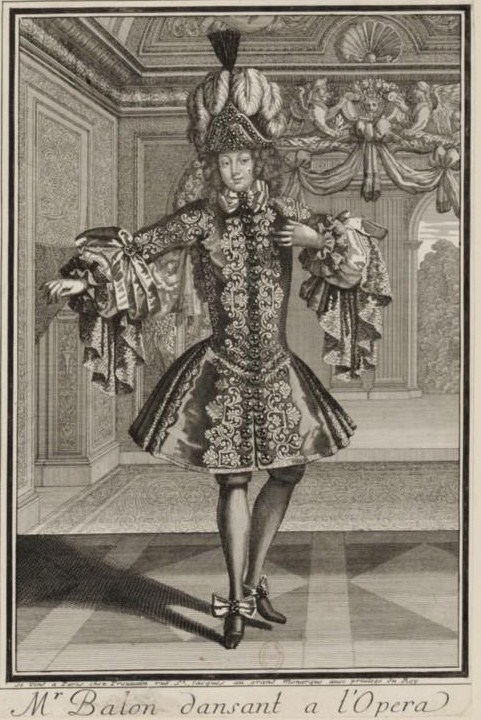
Claude Ballon, one of the most famous danseurs nobles of the early 18th century.

Claude Ballon, one of the most famous danseurs nobles of the early 18th century.

Mr. Siret, A Set of Cotillons, c1770

A Set of Cotillons, or French Dances by Mr Siret is undated, but has been ascribed to around 1770. This places it among the collections published soon after the cotillon first became popular in London. The title page declares that Siret’s cotillons are ‘properly explain’d and illustrated, by Corographical Lines, drawn on a plan entirely new & far superior to those which have been before Published’, adding that both the tunes and the figures are by him.

Unlike the other treatises that appeared in London around this time, which all have verbal descriptions, Siret records his dances in a form of notation like that used in France for the publication of contredanses. He was probably French – he is very likely the Siret recorded as a musician in Paris around 1780 who had earlier published music in London. He may have been a relation of the French organist and composer Nicolas Siret (1663-1754).

Siret explains the notation he uses. He gives the same symbols to the ladies and the gentlemen, except that the ladies are shown in white and the gentlemen in black, with partners sharing identical shapes. He makes a mistake when he says ‘every Gentleman has his partner on his left hand’.  In his diagram of the couples standing in a square, Siret does show the ladies on the right according to convention.

He lists seven changes, plus the grand rond ‘all eight hands round and back again’. These, he says, are ‘the most fashionable’. Each dance has an ‘Explanation of the Plan’, which is a verbal description of the figures, and a ‘Plan of the Figures’, which notates them. The ‘Explanation’ names some steps, for which Siret provides no descriptions. His six cotillons all have French titles.

Siret obviously intended to make his mark among the dancing masters competing for attention, and dance students, in late 18th-century London. All these cotillon collections raise the question of dancing masters and their lessons, my next topic.

Henry Kingsbury. A Cotilion. [Detail, right hand side]. 1788. © Trustees of the British Museum

Henry Kingsbury. A Cotilion. [Detail, right hand side]. 1788. © Trustees of the British Museum

George Villeneuve Junior, A Collection of Cotillons, 1769

The 1769 Collection of Cotillons by George Villeneuve ‘Junior’ advertises its ‘plain and easy Directions’ on the title page. He lists seven steps and nine changes. His twelve cotillons all have French titles.

The epithet ‘Junior’ presumably distinguished George Villeneuve from his father. It is likely that he was the son of the Mr Villeneuve (also George) who danced at Drury Lane and then Covent Garden between 1734 and 1756. The elder Villeneuve married another dancer, Elizabeth Oates, at Lincoln’s Inn Chapel on 8 September 1735. George Junior was apparently born on 7 November 1738. Unusually for dancing masters at this period, his family tree can be traced a little further. George Villeneuve Junior married Susannah Smart on 20 May 1769 at St Mary in Marylebone Road, shortly before his book was first advertised. The couple had at least four children between 1770 and 1778.

There are no records to suggest that George Villeneuve Junior ever worked as a dancer on the London stage. He presumably taught ballroom dancing to amateurs, perhaps working with or in succession to his father. He may also have been a musician, as many dancing masters were, although the title page to the collection says nothing about the composer of the music. The collection was obviously designed to capitalise on the dance’s popularity and probably to draw attention to Villeneuve as a dancing master.

Henry Kingsbury. A Cotilion. [Detail, centre right]. 1788. © Trustees of the British Museum

Henry Kingsbury. A Cotilion. [Detail, centre right]. 1788. © Trustees of the British Museum

Thomas Hurst, The Cotillons Made Plain and Easy, 1769

On the titlepage of his 1769 collection, The Cotillons Made Plain and Easy, Thomas Hurst describes himself as ‘Of  the Theatre Royal in Drury Lane, Late Pupil and Assistant to Mr. Grimaldi Ballet-Master’. Giuseppe Grimaldi (d.1788) worked at Drury Lane from 1758 to 1785 and was the father of the famous clown Joseph Grimaldi. Hurst seems to have worked at Drury Lane from 1755, when he was a child dancer, until at least 1782.

Given his background, Hurst’s remarks in his preface are surprising. He refers to the many books already published on the cotillon, complaining that they ‘cannot be of service to any but great proficients’ and declaring that he will avoid the terminology and steps of theatre dancing. He offers no French tunes, preferring instead English, Irish and Scotch airs for his cotillons. Hurst dedicates his book ‘to the Dancing-Masters of these Kingdoms’. Perhaps he was just setting up as a teacher of social dancing.

Hurst provides a diagram of the ‘Dancing-Room’ which shows clearly the placing and numbering of the four couples. He briefly explains how to perform a cotillon – the bows, the alternation of changes and the figure, and the changes themselves. He lists fourteen changes, explaining that he has added ‘several new ones, to those now in use’. He says nothing about steps. Thomas Hurst’s sixteen cotillons all have French titles, which he translates into English.

Henry Kingsbury. A Cotilion. [Detail, centre left]. 1788. © Trustees of the British Museum

Henry Kingsbury. A Cotilion. [Detail, centre left]. 1788. © Trustees of the British Museum

Giovanni Battista Gherardi’s Three Books of Cotillons, 1768-1770

Three collections of ‘Cotillons or French Dances’ were compiled by Giovanni Battista Gherardi and published in the late 1760s. Notices in the Public Advertiser for 9 March 1768 and 2 March 1769, together with the date 1770 on Gherardi’s dedication in the third volume, suggest that they appeared over two to three years. Gherardi himself dates the first volume to1767 and the second to 1768, a discrepancy which is worth further research although this is not the place for it. If he did not initially conceive them as a set, Gherardi obviously developed this idea as he went on, for each of the three volumes provides additional information about the cotillon.

Fourteen Cotillons or French Dances, of 1767 or 1768, lists nine changes and nine step sequences. The fourteen cotillons all have French titles, perhaps suggesting a Parisian origin for the choreographies. The book also has music for four allemandes, indicating the parallel growth in popularity of the allemande country dances (like cotillons, performed in a square formation by four couples) as well as the couple allemande.

The Second Book of Cotillons or French Dances, of 1768 or 1769, includes an additional explanation of twelve ‘Figures the most in Vogue’. It lists the same nine sequences of steps as the first volume, referring also to ‘the steps necessary for the Country Dance in Allemande’ although Gherardi does not list or explain these. This book has twelve cotillons, three of which are also titled ‘Allemande’. At the end of his introductory text, Gherardi proposes ‘to the Nobility and Gentry, admirers of these fashionable performances, a Subscription for a Cotillon Academy’. He intends to teach not only cotillons ‘of his own composing’ but also all other fashionable dances, including Allemandes. The beau monde would be protected from interlopers ‘as the Subscription shall be wholly confin’d to Ladies & Gentlemen of Rank, Fashion, & Fortune’.

In his A Third Book of French Country Dances or Cotillons, Gherardi explains ‘several Figures not much used’. There are nine of these. The nine step sequences are the same as before, but the nine changes differ from those in the first book. Does this suggest an evolution of the cotillon, or merely alternatives in use in London’s ballrooms? Gherardi provides twelve more cotillons, all with French names. He also advertises his ‘Academy … for the Winter’ to begin in the following January. He must have had to work hard to maintain his position as one of London’s leading dancing masters.

I will return to Gherardi’s explanations and descriptions later.

Henry Kingsbury. A Cotilion. [Detail, left hand side]. 1788. © Trustees of the British Museum

Henry Kingsbury. A Cotilion. [Detail, left hand side]. 1788. © Trustees of the British Museum

Cotillons in print

Apart from Gallini’s New Collection, the 1760s saw the appearance of a number of small books offering instruction in the cotillon along with several choreographies for enthusiasts to dance. Giovanni Battista Gherardi ‘some Time since principal Dancer at the Opera in Paris’ led the way with ‘A Collection of the most favourite Cotillons now in vogue in Paris’, announced for imminent publication in the Public Advertiser for 9 March 1768. This was presumably the Fourteen Cotillons or French Dances published by Welcker. Gherardi followed this up with A Second Book of Cotillons or French Dances, which appeared a year later, and then A Third Book in 1770. The Second Book was advertised as costing 2 shillings (10 pence, around £20 in today’s money although an exact equivalent value is hard to calculate).

Thomas Hurst’s The Cotillons, Made Plain and Easy was published in April 1769. It, too, cost 2 shillings. A Collection of Cotillons by George Villeneuve Junior came out in May 1769, at the slightly cheaper price of one shilling and sixpence (around 8 pence, say £15 today). There was also Mr Siret’s A Set of Cotillons or French Dances, perhaps published a year later in 1770.

All these books offered advice on dancing the changes, figures and steps in cotillons. For the dances, Gherardi, Hurst and Villeneuve followed the English practice of describing country dances in words. Siret adopted the French convention of a simplified form of notation. Between them, these manuals provide a detailed introduction to the cotillon when it first became fashionable.

I will look at each cotillon manual in more detail in later posts.