Author Archives: moiragoff

Country Dancing Improved

A little while ago, I attended a ball where one of the country dances was The Busie Body. When I was told that it was by John Essex, I thought I ought to explore further.

In 1710, Essex translated Feuillet’s 1706 Recueil de contredances as For the Further Improvement of Dancing. What he translated was Feuillet’s introductory treatise on the simplified notation system used to record country dances. Instead of merely reproducing Feuillet’s collection of 32 country dances, Essex selected 10 from various sources. Three come from Feuillet’s 1706 Recueil: Pantomime; Gasconne; and The Female Saylor (La Matelotte in Feuillet). Two more dances are also French: Micareme and The Diligent, both from Feuillet’s VIme. Recüeil de danses et de contredanses pour l’Année 1708. The other five dances were, as Essex tells us in his Preface, ‘my own composing’. These are the dances titled Trip to the Jubilee, The Great Turk, The Busie Body, The Tatler and The Tost.

If the French were acknowledged as the masters of ballroom and stage dancing, la belle danse, the English claimed primacy in country dancing. Essex was happy to wave the flag in his Preface to For the Further Improvement of Dancing.

John Essex, Preface, For the Further Improvement of Dancing (1710), first page

John Essex, Preface, For the Further Improvement of Dancing (1710), first page

In this post, my interest lies in the titles of Essex’s own country dances and their links with stage and society in London.

Trip to the Jubilee must refer to Farquhar’s play The Constant Couple; or, The Trip to the Jubilee, first performed (so far as we know) at the Drury Lane Theatre on 28 November 1699. Farquhar’s play was one of the most popular of the early 18th century and was performed regularly until the 1790s. The ‘Jubilee’ was the Pope’s Jubilee year to be celebrated in Rome in 1700 – a trip to this event was a running joke throughout The Constant Couple. The dance and its music were first published in 1701 in the 11th edition of The Dancing-Master, described ‘as ‘tis Danced at the Play-House’. So it seems that Essex actually created this country dance for Farquhar’s play. He is certainly recorded as a professional dancer at Drury Lane in the first years of the 18th century.

The Great Turk uses music from the Turkish Entrée in Campra’s 1697 opéra-ballet L’Europe galante. Anthony L’Abbé made use of the same piece for his Türkish Dance in the early 1720s. Essex’s use of the music suggests that it was already familiar in London some years earlier. It is worth noting the danced entr’acte ‘Entertainment after the Turkish Manner’ given at Drury Lane on 2 February 1710. Did this perhaps also use Campra’s music?

The title of The Busie Body is taken from Mrs Centlivre’s play of the same name, first given at Drury Lane on 12 May 1709. This was another successful comedy played regularly in London’s theatres until the end of the century.  The published play has ‘A Dance’ towards the end, in accordance with the convention of a country dance performed by a play’s characters as the plot concludes. Could Essex’s dance have been performed in the original production of The Busie Body, even though he makes no mention of this?

The Tatler, obviously, refers to the famous periodical launched by Sir Richard Steele in 1709 and published three times a week until 1711. It dealt in news, gossip and the manners of the day and was frequently reprinted in collected editions throughout the 1700s.

The title The Tost was corrected to The Toast when Essex reissued For the Further Improvement of Dancing around 1715. (I will talk about this reissue in a later post). Essex may well have had in mind the ‘Toast’ as explained by Steele in the Tatler for 4 June 1709. She is:

‘… the Lady we mention in our Liquors, … call’d a Toast. … The Manner of her Inauguration is much like that of the Choice of a Doge in Venice: it is perform’d by Balloting; and when she is so chosen, she reigns indisputably for that Year; but must be elected anew to prolong her Empire a Moment beyond it.’

Was this dance implicitly dedicated to a well-known ‘Toast’ of the Kit-Cat Club (of which Steele was a member and to which he was referring)? Or was it meant as a compliment to the Duchess of Bolton, to whom Essex dedicated his collection? She was Henrietta née Crofts (c1682-1730), the illegitimate daughter of James, Duke of Monmouth. She married the second Duke of Bolton in 1697.

With his dances in For the Further Improvement of Dancing Essex is surely trying to appeal to a fashionable, London-based élite – the beau monde – members of which he hoped to attract as pupils.
‘Jouissons les plaisirs’

My work in baroque dance has always had a strong practical element. I find it easier to understand and write about the dances I have reconstructed. Much of my earlier work was based around dances I actually performed. Performance opportunities are few and far between nowadays, for a variety of reasons, but I try to continue reconstructing notated choreographies as part of my research.

I’ve recently been working on a loure, a duet to the air ‘Jouissons les plaisirs’. The music is identified on the notated ‘Entrée pour un homme et une femme Dancée par Mr Balon et Mlle Subligny au Ballet des Fragments de Mr de Lully’ in the Recüeil de dances contenant un tres grand nombres, des meillieures Entrees de Ballet de Mr. Pecour published in Paris in 1704. The work of reconstruction has had its difficulties – I have a recording of the music which is beguiling but otherwise not great and I have nobody to partner me, which all too easily leads to misinterpretation of the notation. Yet, I have found this little dance to be utterly charming. It is so prettily evocative of the early 18th century that it has been a delight to learn. I would love to see it in a good performance.

I like to know about the original contexts for the notated dances I reconstruct. In this case the air seems to have been written for the 1670 comédie-ballet Les Amants Magnifiques – the ballet in which Louis XIV apparently did not after all make his final performances as a dancer. The notated choreography, and its music, are instead associated with the Ballet des Fragmens de M. Lully first given at the Paris Opéra in 1702. This ballet brought together pieces of Lully’s music from the ballets de cour and comédies-ballets of the late 17th century into several entrées arranged by Campra. Its popularity was such that it was revived in 1708, 1711, 1717 and 1722. In Les Amants Magnifiques ‘Jouissons les plaisirs’ was a vocal duet by shepherdesses, in the Ballet des Fragmens it was entitled ‘[Air] des Jeux Pithiens’ and formed part of the first entrée, a ‘Fête marine’, as a vocal duet by female sailors accompanied by the dance. I can’t quite relate either the song or the dance to the later context, but I’m probably missing something.

I have been looking at ‘Spanish’ loures, but this dance surely falls into the ‘pastoral’ category. It is short, with only 54 bars, and the music is a rondeau (ABACA, A has 9 bars, B has 12 and C has 16 bars). The music has the time signature 3, in common with the famous ballroom duet Aimable vainqueur. It is quite unlike the ‘Spanish’ loures in 6/4. Although it is a stage dance, there are no difficult steps in this little entrée. Many of the pas composées incorporate quarter, half or (occasionally) full turns and nearly half include small jumps, so the sequences are flowing and lively. There are coupés avec ouverture de jambe which provide a pleasing suspension of movement and several other steps with a similar feel of extension. I like to draw on ballet’s ronds de jambes, even demi grand ronds de jambe, to give a greater sense of amplitude. The little jumps woven throughout add energy and make the pas de bourée and other ‘walking’ steps feel light and playful rather than languid. I haven’t yet mastered the musicality of this choreography, but I’m sure that if and when I do it will add to the pleasure of dancing it.

Perhaps the most important aspect of the dance is its figures, not so much the movement of the dancers within their stage space as the continually changing spatial relationships between them. They turn towards and then away from each other, face or turn their backs on one another, approach and retreat as they dance. On the page, the floor patterns look completely conventional, even banal, but they are transformed by the way the dancers turn on their own axis and move around each other. Without a partner it is difficult to be sure, but my guess is that the figures are quite tight and the couple stay close to one another much of the time, particularly when they circle and cross. There are many opportunities for interaction, through glances, turns of the head and épaulement as they move through their shared space. Even without a partner, the choreography conjures up the graceful flirtation of a fête galante. It brings to mind the paintings of Watteau, Lancret and Pater. It would be so easy to perform as a tiny drama of pastoral love and pleasure.

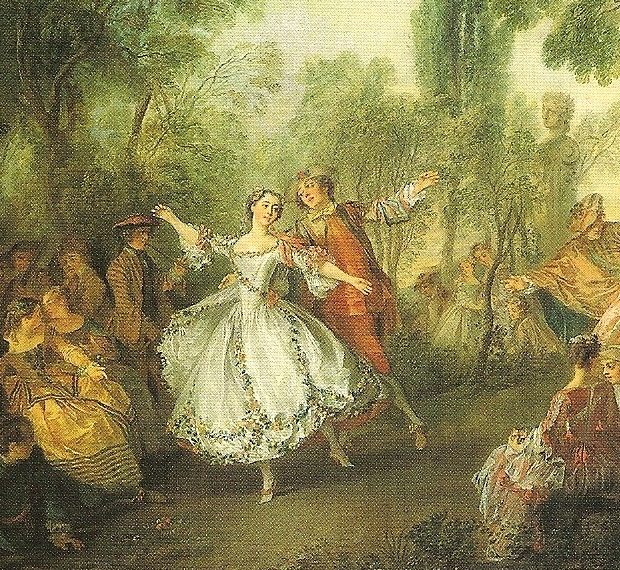
Lancret’s painting of Mlle Camargo and her partner is some thirty years later than the dance to ‘Jouissons les plaisirs’, but it gives a good idea of the style and affect of such a duet.

Nicolas Lancret, La Camargo Dancing (c1730)

Nicolas Lancret, La Camargo Dancing (c1730)

‘Spanish’ dances

In an earlier post, I looked at the ‘French’ saraband. I thought I’d turn to the ‘Spanish’ saraband, but I quickly got caught up in a confusing web of ‘Spanish’ dances.

There are four notated dances that can be defined as ‘Spanish’ sarabands, because of their music. Two are solos for a man, one by Favier (in an undated manuscript) and the other by Feuillet (in his 1700 Recueil de dances). The other two are solos for a woman, from Feuillet’s 1700 collection and Pecour’s 1704 Recueil de dances. All four choreographies use the ‘Ier Air des Espagnols’ from the Entrée ‘L’Espagne’ in the Ballet des Nations at the end of Le Bourgeois gentilhomme. I’ll come back to these dances later.

There are four surviving choreographies to the Folie d’Espagne music.  This is, of course, also a saraband. Two of these dances are very closely related: Feuillet’s solo Folie d’Espagne pour femme published in 1700 was lightly adapted to become a duet, recorded in a manuscript collection where it is attributed to Pecour. There is also one solo for a man by Feuillet, surviving only in manuscript, and another by Pecour in his 1704 Recueil de dances. I will return to these four choreographies too. On the London stage, the Folie d’Espagne was advertised under that title only once – at Lincoln’s Inn Fields on 29 May 1718 when it was performed ‘by a Little Girl that never danced on the Stage’.

Feuillet’s Sarabande Espagnole, a solo for a man in his 1700 collection, is actually a loure or gigue lente, another dance type that often has ‘Spanish’ connotations. There seem to be both ‘French’ and ‘Spanish’ loures, for some of the choreographies using this dance type have a pastoral or amorous context, at least so far as their music is concerned. The most famous ‘French’ loure is Pecour’s Aimable Vainqueur.

Another eight notated dances are designated ‘Spanish’ either in their titles or through their music. Five are loures, three of which are male solos. Two are by Feuillet, an Entreé DEspagnol surviving in manuscript and a Sarabande Espagnole pour homme in his 1700 collection. The third solo is the Spanish Entry in L’Abbé’s A New Collection of Dances dating to the mid-1720s. Pecour has an Entrée Espagnolle pour une femme and an Entrée pour deux hommes in his 1704 Recueil de dances. Both use the same piece of music from the Entrée for Spain in Campra’s L’Europe galante of 1697, as does Feuillet’s Entreé DEspagnol. The other two male solos use another tune from the Entrée L’Espagne in the Ballet des Nations.

Spanish dances were quite popular on the London stage. There were male and female solos, as well as duets, trios and a variety of dances for larger groups. It is virtually impossible to know what these choreographies were like, although the links of so many of the dancers to France and their training in ‘French’ dancing suggest that many were sarabands or loures or perhaps the Folie d’Espagne itself. Most of the advertisements for a ‘louvre’ probably refer to Aimable Vainqueur. However, there are a few billings for male and female solos, which may well be ‘Spanish’ loures. Among the last of the dancers to be advertised in a solo ‘louvre’ was La Barberina in the 1740-1741 and 1741-1742 seasons.

There is also the question of what made a dance ‘Spanish’ (apart from its music). I’ll come back to this.

The Saraband on the London Stage

The first saraband to be advertised as an entr’acte dance on the London stage was danced, together with a ‘Jig’, by the actress Elizabeth Younger at Drury Lane on 3 May 1714. Her appearance was described as ‘being the first time of her dancing alone on the stage’ – she was just fourteen but already had several years of acting experience. The last advertisement to mention a saraband was for a performance at Covent Garden on 13 February 1742. The dancer was the Italian virtuoso Barbara Campanini, ‘La Barbarina’. Little evidence survives to tell us what these dances were like. Both dancers were trained in French dancing, la belle danse. Miss Younger was really an actress who danced, although the surviving choreography for the Türkish Dance duet by Anthony L’Abbé shows that her technique was quite considerable. Perhaps her solo saraband was comparable to Feuillet’s Sarabande de Polixène. Although she was only twenty-one, La Barbarina was a first-rate ballerina fresh from success at the Paris Opéra where her technique had dazzled audiences.  I wonder whether her saraband was more like those created by Feuillet and Pecour for male soloists?

The first saraband duet was advertised for a performance at Lincoln’s Inn Fields Theatre on 5 May 1724. The dancers were Dupré and Mrs Wall. He was then one of the leading male dancers in the company, while Mrs Wall seems to have been a promising newcomer (she disappeared from the bills within just a few years).  She danced another saraband later the same season with Leach Glover, also a leading dancer at Lincoln’s Inn Fields. Both Dupré and Glover were accomplished exponents of la belle danse. Glover went on to perform sarabands with Mrs Laguerre and then Miss La Tour, both leading dancers in John Rich’s company, into the early 1730s. A clue to the nature of all these duets may lie in the Saraband’ of Issee, created by Anthony L’Abbé in the mid-1710s for Dupré and Mrs Bullock and published in his A New Collection of Dances around 1725. The duet is one of three choreographies to the same piece of music, taken from Destouches 1697 opera Issé. The other two dances are both by Pecour. L’Abbé’s dance is technically the most demanding of them. Mrs Bullock, as well as Dupré, was expected to perform beaten steps, turns and ornamentations normal for male technique (although she did not do the entrechats-six notated for Dupré, substituting plain changements instead).

The Saraband’ of Issee was a showpiece, which later dancers advertised in sarabands may or may not have been able to emulate. There is also a quite different saraband danced on the London stage and published in notation. L’Abbé’s The Prince of Wales’s Saraband was created for the birthday of Queen Caroline and performed at Drury Lane on 22 March 1731 by William Essex and Hester Booth. This ballroom duet has no spectacular steps. It makes its effects through subtle ornamentation, including modulations to the timing of individual pas composés although, like the stage choreographies, it recalls the contrast between fast and slow, dynamic and languid described by Pomey in 1671. Such an unadorned choreography requires true elegance and the utmost refinement of technique from its dancers. Hester Booth (née Santlow) was famous for her ‘address’ (which may loosely be translated as comportment). Her partner William Essex (son of the dancing master John Essex who had translated Rameau’s Le Maître a danser) must have been her equal. Was the notated choreography what they actually danced at Drury Lane? Evidence from other notated dances suggests that they may well have included some difficult unrecorded ornamentations.

Did the saraband really disappear from the London stage after 1742?

Anthony L’Abbé. Saraband’ of Issee [c1725], first plate.

Anthony L’Abbé. Saraband’ of Issee [c1725], first plate.

Anthony L’Abbé. The Prince of Wales’s Saraband [1731], first plate.

Anthony L’Abbé. The Prince of Wales’s Saraband [1731], first plate.


Feuillet’s Sarabands

Six of the surviving notated sarabands are by Raoul Auger Feuillet. All are solo dances. He included two in his 1700 collection of his own choreographies, both to the ‘Spanish’ saraband in the Ballet des Nations from Le Bourgeois gentilhomme. I’ll look at those later, alongside Feuillet’s versions of the Folie d’Espagne. The other four sarabands are from a manuscript collection possibly compiled between 1710 and 1720. Three are solos for a woman and the fourth is a solo for a man.

As I said in my last post, I’ve been working on one of the sarabands for a woman – the Sarabande de Polixène. I’ve been wondering how the three female solos relate to one another, given that they are all by the same choreographer. I’ve long been interested in the very different choreographies created for male dancers (the complexities of most of these suggest that they were created for male professionals). These four sarabands provide an opportunity for some analysis. Unfortunately, I only have recorded music for the Sarabande de Polixène which makes reconstruction of the other solos difficult. I feel that such reconstruction is always the best basis for any analysis. I’ll just have to see what the notations themselves can tell me.

None of these solos is long. The Sarabande de Mr. Feüillet for a woman, whose music remains unidentified, has 40 bars. The Sarabande de Mr. Feüillet to music from act 1 scene 5 of Gatti’s opera Scylla (1701) has only 36 bars – I’ll refer to this dance as the Sarabande de Scylla. The Sarabande de Mr. Feuillet for a man, also with unidentified music, has 48 bars. The Sarabande de Polixène is the longest, with 64 bars of music taken from act 3 scene 5 of Colasse’s opera Polixène et Pirrhus (1706). All the music for these dances has a basic AABB structure with a B section longer than the A section. However, the Sarabande de Scylla has an AABBB’ structure in which both A and B have 8 bars and B’ has 4.

I find it useful to do some basic analysis to start with, looking at how many steps in a choreography incorporate jumps or beats or turns. Sometimes such ornamentations can point to a dance for the stage rather than the ballroom. In all three of the female solos around one-third of the steps include one or more jumped elements. The inclusion of beats runs from only 3% of steps in the Sarabande de Scylla to 11% in the Sarabande de Polixène. Both the female solo Sarabande de Mr. Feüillet and the Sarabande de Scylla add turns to around 45% of their steps, but the Sarabande de Polixène does this with only 22%. Does this suggest that the last is more presentational than the other two? Well, it might depend on where the dancer most often faces at the end of individual steps. The number of basic, unornamented steps ranges from 35% in the female Sarabande de Mr. Feüillet to 50% in the Sarabande de Scylla. Are there any conclusions that can safely be drawn from this?

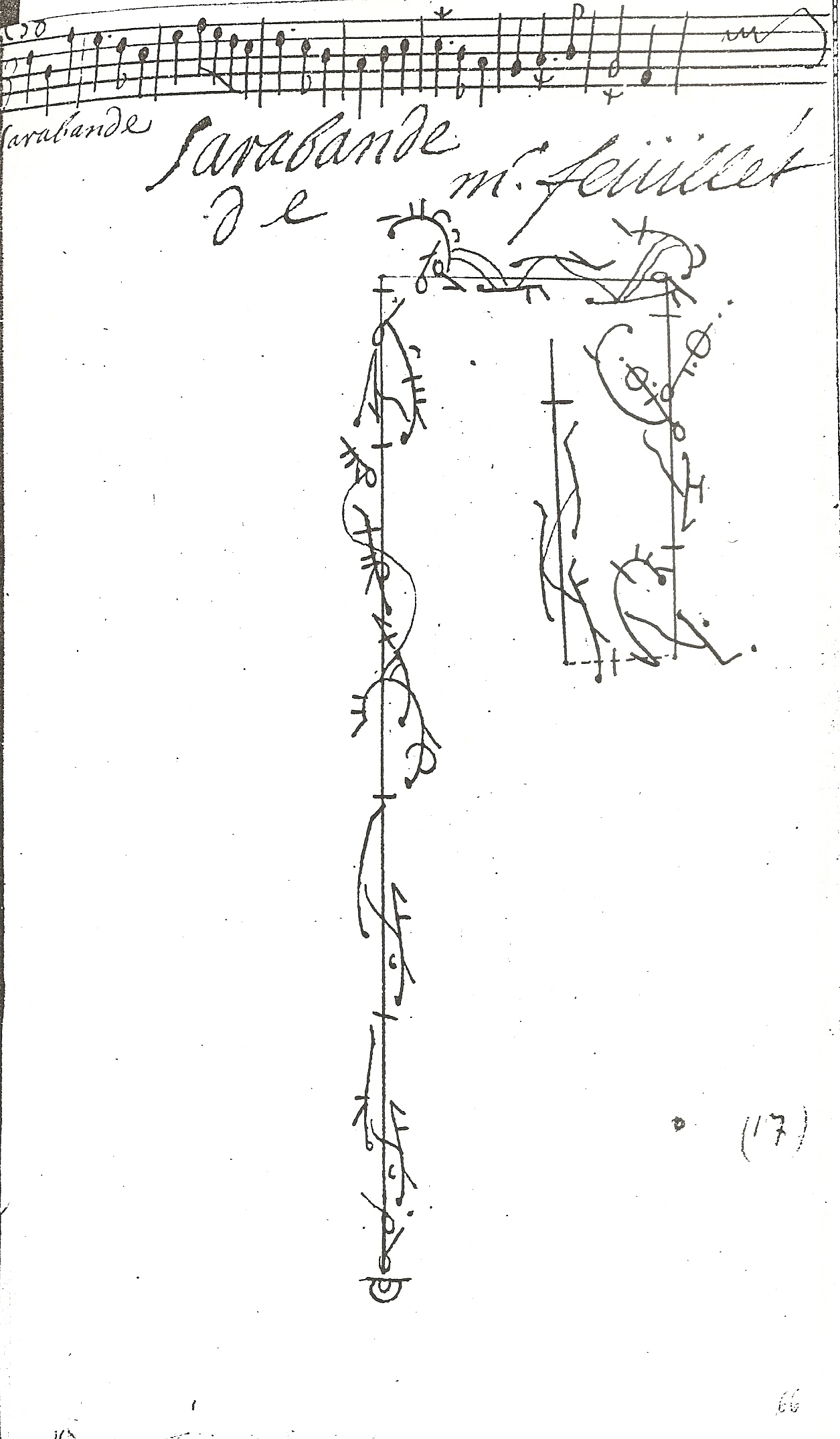
The male solo saraband both overlaps with and radically departs from the step vocabulary of the other three dances, so I will devote a separate post to it. I will also look at the pas composés shared by these four solos, by which I mean those steps formed from two or more basic steps with or without further ornamentation.

In the meantime, here is some notation from one of the female solos. Note the pirouette on both feet with a full turn towards the end of this section.

Sarabande de Mr. Feüillet (undated). First plate

Sarabande de Mr. Feüillet (undated). First plate

The Saraband

I’ve recently been working on Feuillet’s solo Sarabande for a woman to music from Colasse’s 1706 opera Polyxène et Pirrhus. This choreography survives in a single manuscript source and must date to period 1706 to 1710. The music is very different from the better-known saraband in the Entrée for Spain within the Ballet des Nations that ends Lully and Molière’s Le Bourgeois gentilhomme. It seems that, in the early 18th century, there were two distinct types of saraband – one being French, as in the Sarabande de Polyxène, and the other Spanish, the best known examplar being the Folie d’Espagne.

A remark on the radio, describing  the saraband as ‘slow and stately’ prompted me to take a closer look at this dance type. I admit to being very tired of hearing the expression ‘slow and stately’ in relation to the very varied ballroom and theatre dances of the late 17th and 18th centuries, but it is difficult to know how to counter it.

There are at least 27 surviving choreographies labelled as sarabands, to which can be added four Folie d’Espagne notations (not included in the following statistics). The dance was popular both in the ballroom and on the stage. Ten of the notated sarabands are identifiable as ballroom dances. Nine of these include the saraband alongside other dance types in mini-dance suites. Five choreographies can be linked directly either to the Paris Opéra or the London stage. Six more dances are male solos and there are five female solos. All of these may have been intended either for the stage or as exhibition dances. Four of the solos (two male and two female) are to the saraband in Le Bourgeois gentilhomme, marking them out as ‘Spanish’.

There is, of course, much more to the saraband as a dance. Do the choreographies themselves differentiate between ‘French’ and ‘Spanish’ sarabands, or do these distinctions lie hidden within style and technique rather than on view in the step vocabulary and choreographic motifs? I will try to address these issues in later posts.

In the meantime, here is a description of a dancer performing a saraband from Father François Pomey’s Le Dictionnaire royal augmentée published in Lyon in 1671. The translation of the French original comes from a 1986 article by the researcher Patricia Ranum.

‘At first he danced with a totally charming grace, with a serious and circumspect air, with an equal and slow rhythm, and with such a noble, beautiful, free and easy carriage that he had all the majesty of a king, and inspired as much respect as he gave pleasure.

Then, standing taller and more assertively, and raising his arms to half-height and keeping them partly extended, he performed the most beautiful steps ever invented for the dance.

Sometimes he would glide imperceptibly, with no apparent movement of his feet and legs, and seemed to slide rather than step. Sometimes, with the most beautiful timing in the world, he would remain suspended, immobile, and half leaning to the side with one foot in the air; and then, compensating for the rhythmic unit that had just gone by, with another more precipitous unit he would almost fly, so rapid was his motion.

Sometimes he would advance with little skips, sometimes he would drop back with long steps that, although carefully planned, seemed to be done spontaneously, so well had he cloaked his art in skilful nonchalance.

Sometimes, for the pleasure of everyone present, he would turn to the right, and sometimes he would turn to the left; and when he reached the very middle of the empty floor, he would pirouette so quickly that the eye could not follow.

Now and then he would let a whole rhythmic unit go by, moving no more than a statue and then, setting off like an arrow, he would be at the other end of the room before anyone had time to realise that he had departed.

But all this was nothing compared to what was observed when this gallant began to express the emotions of his soul through the motions of his body, and reveal them in his face, his eyes, his steps and all his actions.

There is more, but isn’t this more than enough to refute the idea of the saraband (or, indeed, any baroque dance) as ‘slow and stately’? The expressive possibilities outlined in this passage can readily be seen in the surviving notated sarabands.

Does Authenticity Matter?

Two performances I’ve seen recently brought the topic of authenticity back into my mind. Both were minuets that reminded me of ‘baroque dance’ I’d seen a good few years ago which owed very little to the surviving 18th-century dance manuals and notations.

In an earlier post, I voiced my uncertainty, and my scepticism, about ‘authenticity’ in historic dance. Yet, these performances reminded me that authenticity does sometimes matter. One took place in a gallery with a wonderful collection of 18th-century fine and decorative arts. The other was in a historic house dating originally from the mid-1700s. Both called for performances that were true to their surroundings in terms of style and technique.  Expert knowledge of the treasures on show, as well as accessibility, is important to galleries and historic houses open to the public. Why should the occasional dance performances in such venues be exempt from the same values?

One reason is, of course, the status of dancing – seen as merely a frivolous pastime rather than a socially and culturally significant art form.  Another is the widespread ignorance of the dancing of the 18th century. It is all too often seen as simple yet full of affectation – very far from the classically inspired beauties of the surviving choreographies. Yet another is the fixation on costume, at the expense of the dancing – even though deportment, so important to the correct wearing of period costume, was of fundamental importance in the 18th century. I should say here, that I believe that costuming does matter. After all, whatever the period, the dancing of the past was crafted around the prevailing style of dress – as indeed are modern dance genres.

The steps described in 18th-century manuals, as well as the choreographies preserved in notation bear witness to a refined and sophisticated style and technique in the ballroom as well as in the theatre. None of the modern attempts at ‘baroque dance’ routines I have seen come close to the originals for variety, energy or elegance. The dances of the 1700s reflect the complexities of the other arts of the period – from music to garden design. All share the same aesthetic space.

Unfortunately, baroque dance is difficult. It takes a great deal of time and much hard work to master. An effortless performance of the minuet is the result of years of practice of the steps and figures described in the original sources. I am uncertain whether any of the dancers in the performances I saw really understood that such work either could or should be done. I don’t want to enter into a critique of either of the ‘minuets’ on show, but I can’t help feeling sad that such a beautiful dance and such a wonderful dance form should still be so little known and so often poorly represented. The visitors to those and other wonderful places that preserve the material evidence of 18th-century life surely deserve better.


Le Menuet d’Espagne

I have been meaning to return to the minuet for a while, and I would like to open my discussions with a choreographed version of this most revered of ballroom dances. Le Menuet d’Espagne by Dezais was published in his XIII Recueil de danses pour l’année 1715 alongside Balon’s La Transilvanie (discussed in an earlier post). The collection appeared early in the year, aimed at the carnival season which took place several months before the death of Louis XIV on 1 September.

Le Menuet d’Espagne is one of a number of choreographed minuets published in notation during the 18th century. There are about 20 in all and a dozen or so of them date to the early 1700s. Among all these dances are several minuets for four, figured minuets for larger groups of dancers, solo minuets (mostly intended for the stage) and minuets within dance suites that display a number of different dance types in a single choreography. I will return to each of these in due course.

The music for Le Menuet d’Espagne is a rondeau with the structure ABACA (A has sixteen bars, B and C each have eight bars), but the source of the tune has not so far been identified. The choreography is almost a ballroom minuet in miniature. The steps are limited to pas de menuet à deux mouvements, pas de menuet à trois mouvements and contretemps du menuet, with just a couple of agréments or grace steps. The figures are essentially those of the ballroom minuet. The minuet’s opening figure has been simplified. The Z figure has been freely adapted – the sideways steps at the beginning and end are there, together with the crossing of the dancers, but the order of these elements, the paths of the dancers and the spatial relationships between them are quite different. The taking of right hands, then left hands and the closing figure, in which the dancers take both hands, are all clearly recognisable. The whole dance has just 64 bars of music, rather shorter than was expected for a ballroom minuet.

Why is this very French choreography titled Le Menuet d’Espagne? Could it have been a compliment to King Philip V of Spain, grandson of Louis XIV, who had married his second wife Elisabeth Farnese on 24 December 1714? Their proxy marriage on 16 September 1714 would have allowed Dezais plenty of time to create a new ballroom dance honouring the couple. What better duet to choose than a minuet,  performed at royal and other formal balls before (and sometimes by) the highest ranking guests?

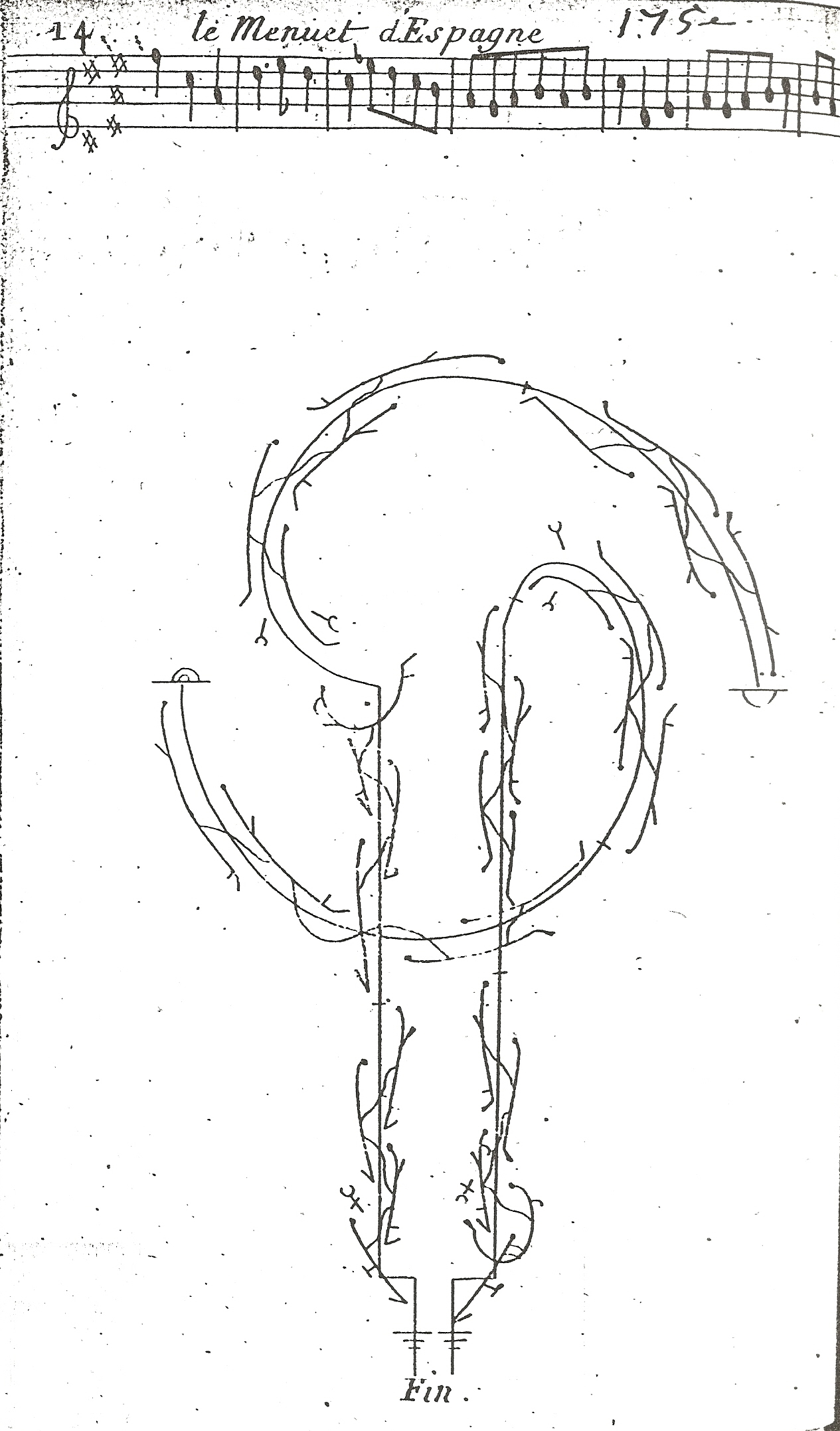
I would like to have included a video of this charming duet, but the version I had in mind is not so far available on YouTube. Here is the close of the dance in notation, showing the couple taking both hands as they retreat from the presence.

Dezais. Le Menuet d’Espagne (Paris, 1715), final plate

Dezais. Le Menuet d’Espagne (Paris, 1715), final plate

Aimable Vainqueur on the London stage

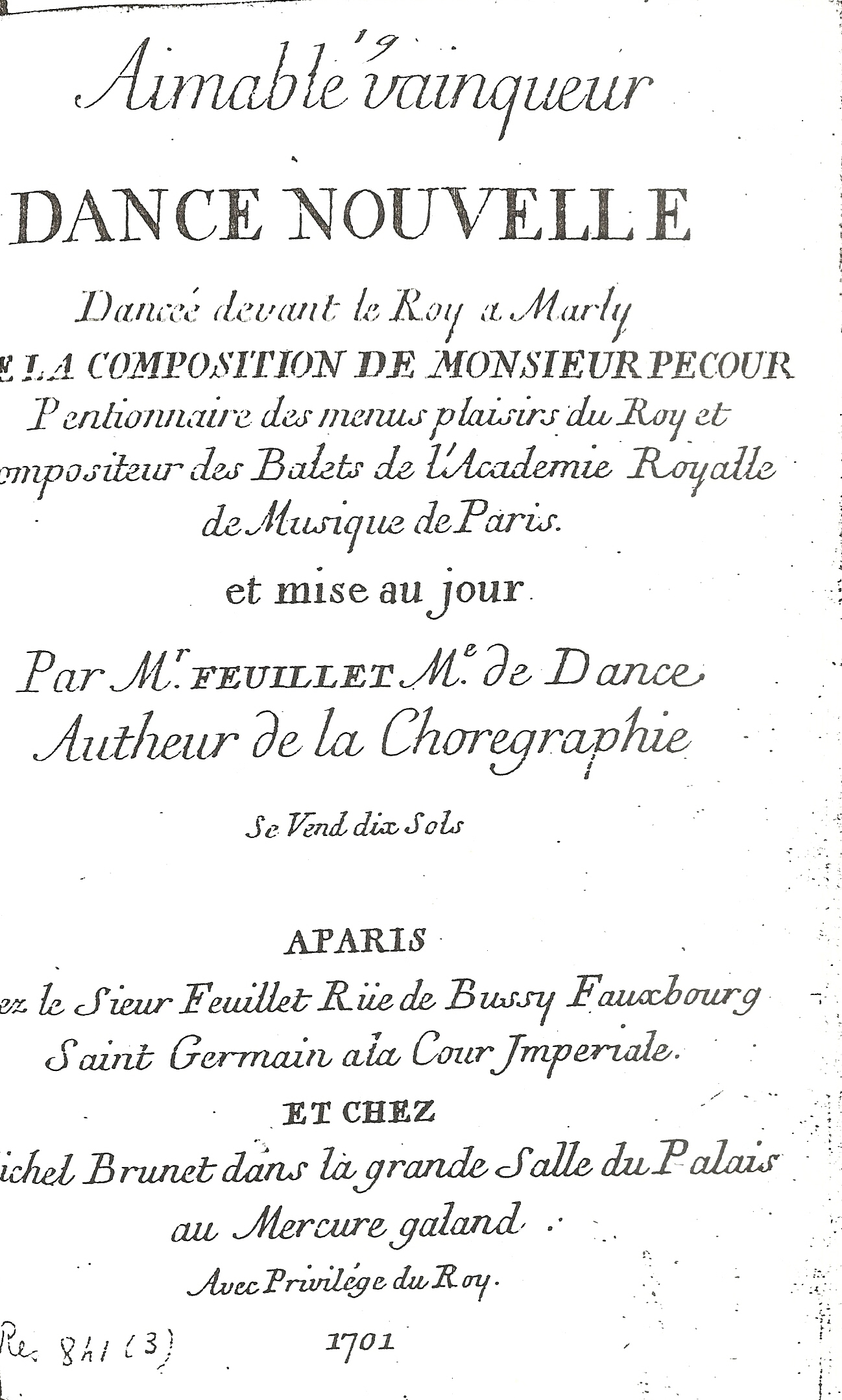
The most famous ballroom duet of the 18th century was undoubtedly Aimable Vainqueur. Pecour’s choreography was first performed before Louis XIV at Marly early in 1701 and published in notation later that same year.

Pecour. Aimable Vainqueur (Paris, 1701), Title page

Pecour. Aimable Vainqueur (Paris, 1701), Title page

By the time the dance appeared in Magny’s Principes de Choregraphie in 1765 it had been printed at least ten times. It also features in four manuscript collections of choreographies. Did all these copies drive the duet’s popularity, or did they simply reflect it?

Pecour took his music from Campra’s opera Hésione, given its premiere at the Paris Opéra in December 1700. Hésione proved popular, enjoying three revivals by 1743. Pecour was obviously quick to capitalise on its success. I will say more about the duet’s original performances in another post. Aimable Vainqueur attracted attention beyond the French court. A new notation by the dancing master Richard Shirley was published in London in 1715. The dance was mentioned by Taubert in his Rechtschaffener Tantzmeister published in Leipzig 1717. John Weaver included it, under the title The Louvre in response to its dance type – a loure, in the second edition of Orchesography (his translation of Feuillet’s treatise Choregraphie) which appeared in the early 1720s.

I haven’t pursued the performance history of Aimable vainqueur at the French court and in Paris, but it was first performed on the London stage on 14 May 1726 at the Lincoln’s Inn Fields Theatre by Dupré and Mrs Wall. He was not ‘le grand’ Dupré, as is often claimed, but he was probably French and may have been from the same family. The dance was almost always titled The Louvre in advertisements for its stage performances, perhaps following Weaver. It wasn’t given again until 5 April 1731, when Francis Sallé performed it at Lincoln’s Inn Fields with his sister Marie. Thereafter it quickly became a staple of the benefit performances of London’s leading dancers.

The dancer responsible for the popularity of Aimable Vainqueur on the London stage was probably Leach Glover, French-trained and a leading dancer at the Covent Garden Theatre. Glover performed The Louvre at his annual benefit performances from 1731 (when he partnered Marie Sallé) to 1741 (when he danced it with the Italian ballerina Barbara Campanini, known as ‘La Barberina’). Other leading dancers to perform Aimable Vainqueur regularly at benefit performances included Michael Lally, who pursued a very successful career in London’s theatres, and later Augustin Noverre, brother of the famous ballet master Jean-Georges Noverre. The last recorded performance of The Louvre on the London stage was on 23 April 1777 at Drury Lane, when the Miss Stageldoirs danced it with a Minuet and an Allemande. The bills are silent on whether one of the girls danced in ‘boy’s clothes’ although, given their repertoire together, this is quite likely.

What choreography did these dancers actually perform? I cannot give a definitive answer, but as well as the dance recorded in notation in 1701 there are some interesting possibilities. I will consider these in a later post.

Reconstructing Ballroom Dances: La Mariée

I am currently reconstructing La Mariée, one of the most famous ballroom dances of the early 18th century. I have performed many notated ballroom dances over the years, but this is my first encounter with Pecour’s much-loved duet. So far, it has been a bit of a struggle! In my own defence, one hour a week with no dancing partner is not the easiest way to learn such a long and complex choreography.

When I began on La Mariée, I had been working on a couple of English solos ‘for a Girl’. Turning to Pecour’s dance I felt like I was grappling with a completely different language – which, of course, I was. The only recording of the music I could find initially was too fast to use while I was learning the steps. I subsequently found another much slower version, but it only had the music once through instead of twice as required by the choreography. Such problems, of tempo and repeat structure, are all too common with commercial recordings of baroque dance music. Still, at least I have the music. There are far too many dances for which there is no recorded music at all.

After several weeks, I am finally getting to grips with this dance. I’ve pretty well committed to memory the steps and figures and my body is beginning to learn these too. Now, I’m ready to make decisions about how I want to perform the steps and sequences. Since I began to take baroque dance seriously, I have worked with many different teachers – all of whom have their own approaches to dance style and technique. I have drawn something from each of them. The various ways in which steps might be performed provide a wide range of interpretations for individual choreographies. Even in a single dance, I might perform particular step differently when it occurs within new context, although I do try to find a unified style.

My version of La Mariée will be shaped by the fast recording. At my last session working on the dance, I found myself considering how I should perform the pas de sissonne that punctuate the choreography. Should I follow the teacher who took the first assemblée to a small fourth position with the working leg on the following saut in a low attitude? Or should I go back to my earlier lessons (and, apparently, the notation) with an assemblée into fifth position and the raised foot on the saut close to the supporting ankle? I obviously need to go back to Rameau’s Le Maître a danser to see what he says. At the moment, I’m inclining to the more compact approach with an emphasis on the upward motion of the springs.

Whatever I decide to do with the individual steps, I want to create a lively and dynamically varied performing version of a teasing and witty choreography.