Tag Archives: Mrs Elford

BAROQUE DANCE IN PERFORMANCE

One of the many challenges facing dance historians who (like me) specialise in ‘baroque dance’, and in particular stage dancing, is the rarity of opportunities to see performances of the notated choreographies. The most difficult of the surviving stage dances are rarely, if ever taught at historical dance workshops or courses here in the UK. I confess that I have been unable to find videos of performances of most of them online.

I have long been interested in Anthony L’Abbé’s A New Collection of Dances, thirteen choreographies created by him for professional dancers on the London stage notated and published around 1725 by F. Le Roussau. I have in my time performed four of them – the ‘Passacaille of Armide’, ‘Mrs Santlow’s Minuet’, the ‘Passagalia of Venüs & Adonis’ and the ‘Türkish Dance’ – and worked on another three – the ‘Chacone of Galathee’, the ‘Saraband of Issee’ and the following ‘Jigg’. However, until recently I had only seen four of them performed. When the chance arose to see three of the duets being taught in Paris as part of the Pecour Academy summer course 2025, I jumped at it. I am extremely grateful to Guillaume Jablonka and his fellow teachers Hubert Hazebroucq and Irène Feste for making an exception and allowing me to attend part of the course simply to watch and to learn. I have to say that it was a marvellous and truly rewarding experience.

The three choreographies were the ‘Loure or Faune’ danced by L’Abbé himself with his great compatriot Claude Ballon, the ‘Canaries’ performed by Charles Delagarde and Louis Dupré (the ‘London’ Dupré I wrote about a little while ago) and the ‘Passacaille of Armide’ danced by Mrs Elford and the very young Mrs Santlow.

Hubert Hazebroucq taught the ‘Loure or Faune’, Guillaume Jablonka the ‘Canaries’ and Irène Feste the ‘Passacaille of Armide’. The ‘Passacaille of Armide’ was one of the first baroque stage dances I worked on and inspired me to pursue the research which culminated in my book The Incomparable Hester Santlow. All three duets, particularly those for the men, are technically challenging and require teachers and dancers with an advanced level of training.  The Pecour Academy was attended by dancers who were well up to the task.

The three teachers, all professional dancers, differ in their dancing styles and approaches to teaching, but all recognisably belong to a shared French tradition of historical dance research and reconstruction based on the concept of ‘la belle dance’. Their individuality as well as their shared heritage was apparent in their warm-up sessions and their teaching of the notated dances. I was able to observe their work during the last three days of the course and the focus and energy in all three classes was inspiring. The teaching and dancing I watched has raised many questions about my own knowledge and understanding of baroque dance, at one end of the spectrum in relation to the performance of individual steps and at the other about the interpretation of the dances in L’Abbé’s New Collection.

An abiding issue for all who study the dancing of the decades around 1700 (when Feuillet first published Choregraphie and the associated collections of notated dances) is what the notations leave out when it comes to technique as well as style. Some questions are answered (although not definitively) by the descriptions of steps in Pierre Rameau’s Le Maître a danser of 1725. For others there are no answers, at least in print. I was aware that French interpretations of Rameau differ from those in the UK and this course reminded me of details I had forgotten. It also revealed new thinking about steps that I was unaware of. I hope to be able to pursue some of these in individual posts for Dance in History.

Two other issues came up that require me to undertake far more research and do a great deal more thinking. One is about the way in which L’Abbé’s dances use space, which relates to the stages for which he created these choreographies in London (not in Paris, with the possible exception of the ‘Loure or Faune’ even though this was undoubtedly performed at London’s Kensington Palace). This issue is difficult to address in any course which has several couples of dancers learning dances in the same space, who necessarily have nothing like the area for which L’Abbé created each choreography and who are also engaging with the most difficult steps in the baroque vocabulary. There are also the relationships, expressive as well as spatial, between the two dancers and between them and their audience (which these students were certainly very aware of). The placing of that audience in relation to the dancers is also a factor to be investigated – I suspect that this differed in Paris and London. I hope to be able to explore all of these aspects more fully in due course. The second issue that arose is the characters personified by the dancers, which may or may not derive from the music used by L’Abbé. The three teachers understandably thought of these choreographies in the context of the works given at the Paris Opéra from which L’Abbé took his music. I (equally understandably, I hope) have tended to think of them in performance on the London stage, where they would have been removed from their original operatic context (which may well have been unknown to their London audiences). I think these two views, which can surely be reconciled despite their differences, provide a rich environment for the development of a range of interpretations.

I have focussed here on L’Abbé’s three choreographies, but each day included workshops on other dances and aspects of baroque dance. Notable among these was Christine Bayle’s masterclass on Pecour’s La Nouvelle Forlane, in which she shared her great skill, experience and knowledge with a group of of dancers who were eager and extremely well prepared to benefit from it. That was a special moment, too. The whole course concluded with a public presentation of the dances that had been taught over the week. It was described as showing ‘Work in Progress’, but what marvellous Work – and fantastic Progress – it shared. I salute the teachers and their students for a wonderful achievement.

The 2025 Pecour Academy was a while ago now, but I am still thinking about it as I pursue my research into L’Abbé’s stage dances. I repeat my grateful thanks to Guillaume, Hubert and Irène for sharing their work with me.

Lady Dancing Masters in 18th-Century England

I recently watched another dance history video in the very informative series compiled and published by Carlos Blanco, which draws inspiration from the rich resources of the Biblioteca Nacional de España. In this video (which can be found on YouTube) four historical dance experts consider the question ‘Is there Sexism or Misogyny in Dance Treatises?’ Inevitably, the topic of female dancing masters arose, in the context of the discussion focussing on the USA and Great Britain, and it proved difficult to identify or name any – indicating a gap in published research. In the course of my own work, which is mostly limited to England and particularly London, I have come across several women who taught dancing – lady dancing masters. My list is very far from exhaustive (and at least one name is questionable), but I thought it might be of interest to write a post about them and perhaps reveal or encourage further research. There has been some work which includes this topic and I have included a list for further reading at the end.

The first of these women is the questionable one. Peggy Fryer was billed as acting and dancing at the Little Theatre in the Haymarket on 28 January 1723. The advertisements declared that she was aged seventy-one and had ‘taught three Queens to dance’. She had previously appeared at the Lincoln’s Inn Fields Theatre on 11 January 1720, ‘it being the first time of her Appearing on any stage since the Reign of King Charles II’, and she was then said to be eighty-five years old. Without a great deal more research, it is difficult to discern whether there was any truth at all in these conflicting announcements. If Peggy Fryer had indeed ‘taught three Queens to dance’, who might they have been? My thoughts turned to Charles II’s Queen, Catherine of Braganza, and his two nieces Mary (later Queen Mary II) and Anne (later Queen Anne), although there are other candidates. Would someone like Peggy Fryer have been called in to teach any of them, when there was a royal dancing master – Jerome Gahory – to do so?

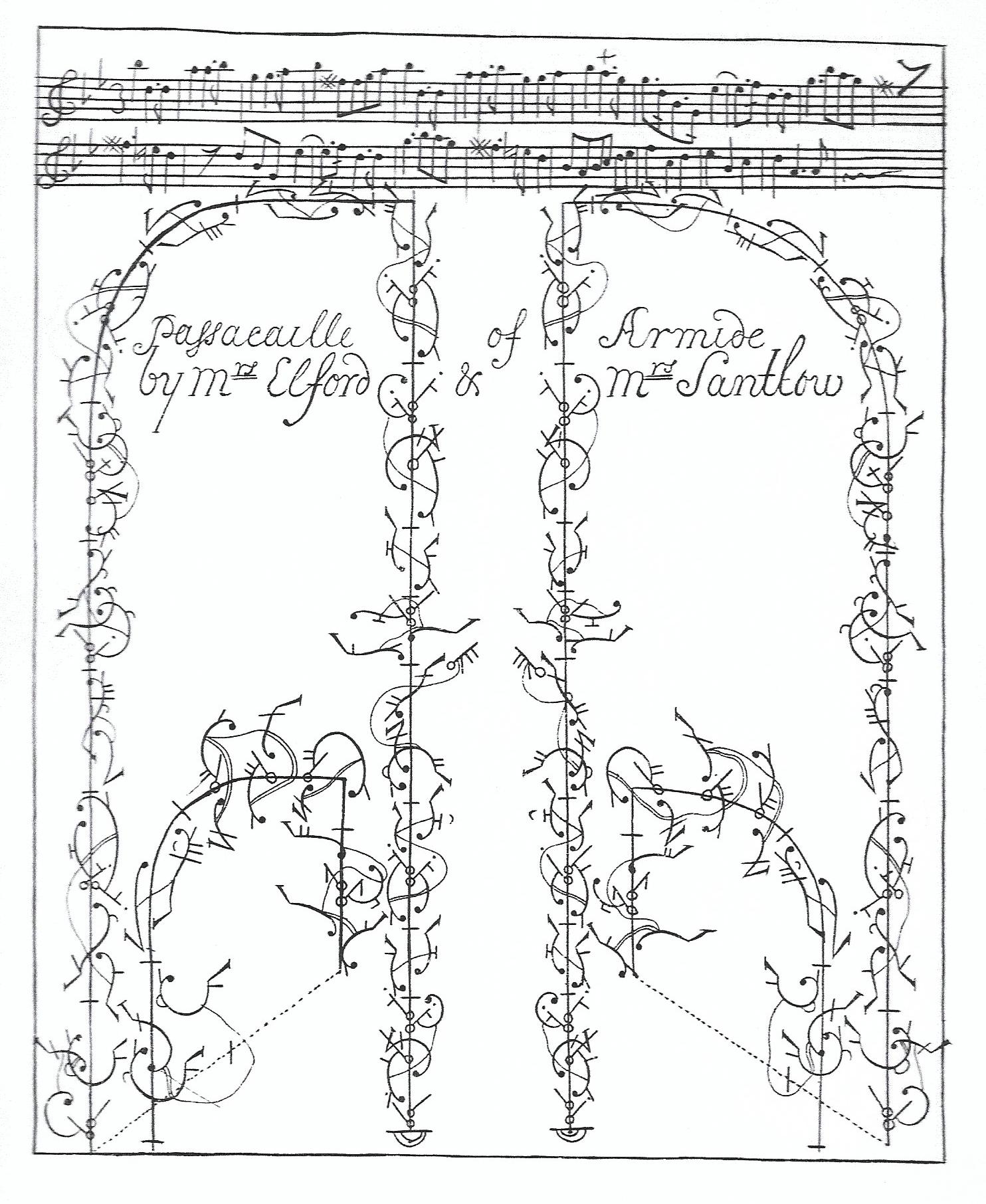
With the second of these lady dancing masters we are on much surer ground. Mrs Elford emerges into view on 5 July 1700 at Lincoln’s Inn Fields, where she is billed as dancing a ‘new Entry, never performed but once’, She was obviously already established as a leading dancer and would later be billed alongside Anthony L’Abbé as his regular dancing partner. The collection of L’Abbé’s stage dances published in the mid-1720s includes a duet to the passacaille from Lully’s opera Armide danced by Ann Elford and Hester Santlow. The earliest evidence for Mrs Elford as a teacher dates to 12 September 1705, when dancing ’By a little Girl, Mrs Elford’s scholar’ was advertised at Lincoln’s Inn Fields. Mrs Elford’s career as a stage dancer seems to have ended in 1706, by which time she was probably already teaching regularly. The first record of her work beyond the world of the London stage dates to 1711, when she was teaching Mary Bankes of the Bankes family of Kingston Lacey. Mrs Elford’s later activities are less easy to trace, although she is recorded as teaching the daughters of the second Duke of Montagu between 1720 and 1729.

The next woman to be recorded as teaching dance in England was one of the most notable dancers to appear on the 18th-century London stage. Marie Sallé first danced in London as a child, during the 1716-1717 season at Lincoln’s Inn Fields. She returned to dance there as a young woman in 1725-1726 and made her last London appearances at the Covent Garden Theatre during the 1734-1735 season. For Mlle Sallé’s benefit at Lincoln’s Inn Fields on 6 April 1727 the bill included a ‘Pastoral by Miss Rogers, a Child of Nine Years of Age, Scholar to Mlle Sallé’. Elizabeth Rogers would later enjoy a career as a singer and actress, as well as a dancer. When she was billed again at Lincoln’s Inn Fields on 5 April 1731, dancing a Saraband and Tambourin, she was advertised as ‘Scholar to Salle’. Marie Sallé’s brother Francis remained in London when she returned to France and made his career there. It is not surprising that he took over some of his sister’s teaching. However, a continuing link between Marie Sallé and Elizabeth Rogers is suggested by the latter’s appearance as a Bacchante in Bacchus and Ariadne (a ballet attributed to Mlle Sallé) when it was given within The Necromancer at Covent Garden on 26 February 1734. Marie Sallé is the first of my lady dancing masters for whom there is a portrait. In fact there are several, this is a print of the painting by Nicolas Lancret.

My third lady dancing master appeared on the London stage much later in the 18th century. Marie-Louise Hilligsberg began her career at the Paris Opéra in the early 1780s, making her first visit to London during the 1787-1788 season to appear at the King’s Theatre. She returned to Paris for a little over a year, but when she failed to get the promotion she expected at the Opéra she returned to London in 1789. Mme Hilligsberg continued to dance in London, mostly at the King’s Theatre but also elsewhere, until she retired from the stage in 1803. She was well-known for her travesti roles as well as her more conventional ones. Here are portraits of her in both guises: a print showing her in the ballet Le Jaloux Puni and a painting by Hoppner.

In 1796, she appeared in the ballet Little Peggy’s Love at the King’s Theatre (perhaps in the title role) for which the ‘Pantomime and Principal Steps’ were created by Didelot. Some years later, in 1799, this ballet was performed by several young aristocrats at a private party thrown by Lord and Lady Shaftesbury. As newspaper reports make clear, this amateur performance was mounted by Mme Hilligsberg, who also coached the child dancers in their roles. There are more details in my 2017 post A Favourite Ballet. Mme Hilligsberg is also known to have given dancing lessons to Lady Harriet Montagu and she may well have had other pupils during her years in England. She retired from the stage in 1803 and died in France the following year.

I have to return to the early 1700s for my next lady dancing master, who bridges a divide between professional dancers who became teachers and those who pursued the teaching of dance without having a stage career. Ann Roland was the sister of the well-known dancer Catherine Roland. She made her London debut at Drury Lane on 18 November 1735, described as ‘lately arrived from Paris’ and dancing alongside her sister. She continued to dance in London until 1743, mainly at the Covent Garden Theatre, and then moved to Dublin for the 1743-1744 season where she acted and apparently sang as well as dancing. Her extensive repertoire ranged from a Tambourine solo, through duets including The Louvre and the minuet, to leading dancing roles in a number of popular pantomimes. Around 1745 she married the Irish violinist Francis Fleming, with whom she had three daughters. Ann Fleming’s subsequent career as a lady dancing master is not easy to trace, but she is said to have begun teaching with her husband in and around Bath in the late 1740s. According to an advertisement in the Salisbury and Winchester Journal for 25 September 1752, announcing Mr Fleming’s return from Paris ‘where he has completed himself in the Art of Dancing’ he and his wife were then teaching at a boarding school in Bath as well as giving private lessons to young ladies and gentlemen. There is no known portrait of Ann Roland Fleming, who died in 1759.

Francis Fleming may have begun to involve his eldest daughter Ann Teresa in teaching soon after the death of her mother (when she would have been thirteen or fourteen years old). She was certainly his assistant by 1768, as the Bath Chronicle for 3 November 1768 reported that ‘Mr. and Miss Fleming, … have been in Paris this summer’ learning the ‘true Step of the Cotilions with the additional Graces of the Minuets’ and that they would both be teaching at another boarding school in Bath, as well as giving private lessons to ladies and gentlemen. Ann Teresa Fleming took over her father’s dancing academy when he died in 1778 and quickly became the most famous teacher of dancing in Bath, where she continued to work until her retirement in 1805. Her balls for her scholars, held several times each year at both the Upper and Lower Assembly Rooms, were often reported in detail in the Bath Chronicle. Her importance is perhaps best shown by the fact that she is one of very few dancing masters, male or female, for whom we have a portrait (now in the collections of the Victoria & Albert Museum), which has been linked to the studio of Sir Joshua Reynolds:

Miss Fleming died in 1823 and was accorded a quite lengthy obituary in the Bath Chronicle for 18 February 1823.

For nearly twenty years, Ann Teresa Fleming ran her school with her younger sister Kitty. When she retired she was succeeded by Miss Le Mercier, who had become her assistant in the mid-1790s and would continue the school – as another lady dancing master – until around 1811. Another assistant to Miss Fleming had been Elizabeth Rundall, who in 1796 married the actor Robert Elliston and around the same time set up her own school in Bath in partnership with Kitty Fleming. Mrs Elliston’s school was notably successful. Like Ann Teresa Fleming, she held regular balls for her pupils in Bath’s Upper Assembly Rooms – the Bath Chronicle for 10 December 1803 reports that the Duchess of Devonshire was to attend ‘Mrs Elliston’s Ball’. Elizabeth Elliston left Bath for London in 1812 (her husband was by then a leading actor in the company at Drury Lane) and her sister Miss D. C. Rundell took over her Bath school.

The ladies I have mentioned in this post were undoubtedly just a few of the many lady dancing masters who taught in England from the seventeenth to the early nineteenth century. Some worked with their dancing master husbands and were seldom mentioned as teachers in their own right. Others were well-known and admired for their dancing and teaching skills. Further research will surely uncover many more lady dancing masters within surviving historical records.

Further Reading:

Quotations from advertisements for stage performances are taken from the appropriate volumes of The London Stage, 1660-1800.

For Peg Fryer see: the entry ‘Fryer, Margaret, later Mrs Vandervelt, c.1635-1747, actress, dancer’ in Philip H. Highfill Jr et al. A Biographical Dictionary of Actors. 16 vols. (Carbondale, 1973-1993), Vol. 5.

For Ann Elford see: Jennifer Thorp, ‘Mrs Elford: stage dancer and teacher in London, 1700-1730’, in Ballroom, Stage and Village Green: Contexts for Early Dance, ed. Barbara Segal and William Tuck (Early Dance Circle, 2015), 53-60.

For Marie Sallé as a teacher, in Paris as well as in London, see: Sarah McCleave, ‘Marie Sallé, a Wise Professional Woman of Influence’, in Women’s Work: Making Dance in Europe before 1800, ed. Lynn Matluck Brooks (Madison, Wis., 2007), 160-182 (pp. 168-171)

For Marie-Louise Hilligsberg, see: the entry in A Biographical Dictionary of Actors, Vol. 7; Ivor Guest, The Ballet of the Enlightenment (London, 1996);  Katrina Faulds, ‘Opera Dances’, chapter 6 in A Passion for Opera: The Duchess and the Georgian Stage (Kettering, 2019), 91-99 (pp. 95-96).

For Ann Roland Fleming, see: the entry for Ann Roland in A Biographical Dictionary of Actors, Vol. 13, as well as the sources listed below for her daughter and successors.

For Ann Teresa Fleming, Miss Le Mercier and Elizabeth Elliston, together with other lady dancing masters in Bath, see: Trevor Fawcett, ‘Dance and Teachers of Dance in Eighteenth-Century Bath’, Bath History, 2 (1988), 27-48; Mathew Spring, ‘The Fleming family’s dance academy at Bath 1750-1800’, in Ballroom, Stage and Village Green: Contexts for Early Dance, ed. Barbara Segal and William Tuck (Early Dance Circle, 2015), 47-52.

Stage Dances for Women and the Demie Cabriole

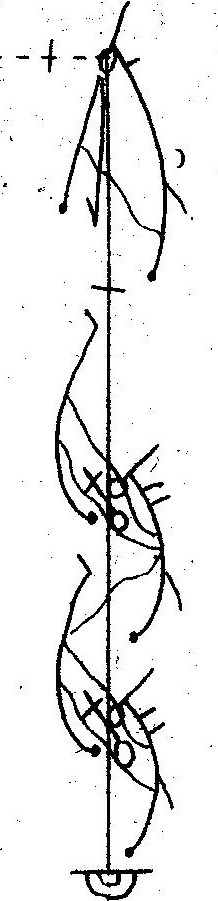
There is another pas composé which appears in many of the stage dances for women, although Feuillet does not include it specifically in his step tables. This is how it is notated in the ‘Entrée pour une femme Dancée par Mlle Victoire au Ballet du Carnaval de Venise’, a forlane included in the 1704 collection of Pecour’s ‘Entrées de Ballet’ (plate 7):

Forlana 7 (2)

The first element of the step is the same as Feuillet’s jetté ‘en avant et le second emböetté derriere’ (Choregraphie, pl. 72).

Choregraphie Jettes 72 (2)

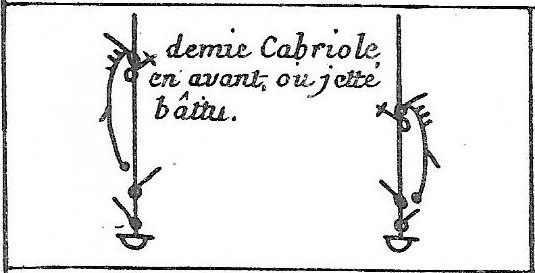
This particular jetté is the basis for Feuillet’s ‘demie cabriole en avant’, which he also calls a ‘jetté battu’ (Choregraphie, pl.84).

Cabrioles Feuillet 1 (2)

In the women’s dances, it is notated as a jetté, without the third line that denotes the cabriole movement, the beating together of the legs in the air.

The demie cabriole is one of the few theatrical steps to get a mention in Pierre Rameau’s Le Maître a danser of 1725, in his chapter XXXVI ‘Des Jettez, ou demies Cabrioles’ (the translation is by John Essex, from The Dancing-Master of 1728, p. 96)

‘They  [jettés] are yet made after another Manner which requires more Strength in the Spring, Quickness in the Rise, and Extension of the Legs, striking them one against the other, falling on the contrary Foot to that sunk upon, and then change their Names and are called half Capers: But as these are Steps for the Stage, and in this Treatise I undertook to teach the Manner of making Steps used in Ball Dancing, I shall not trouble my Reader with these latter, which are only for those whose Form is exquisitely nice, and who make Dancing their Business.’

We might assume that Rameau (as well as his translator) refers to male professional dancers, but he does not specifically say so.

So, where does this jetté ‘emböetté’ appear in the solos and duets for women within the three collections I am looking at? The other solo dance in the Pecour collection of 1704 which includes it is Mlle Subligny’s ‘Gigue pour une femme’, to music from Gatti’s Scylla, first in bar 22 (plate 43, shown below) and again in bar 34 (plate 44).

Gigue Angleterre 43 (2)

She starts with the right foot the first time and the left foot when the step reappears. Both times it is preceded by a pas de bourée emboîté and followed by a coupé battu. The step is embedded within a repeated 12-bar sequence of steps danced to the first and second repeats of the B section of the music.

It also occurs in the one duet in the 1704 collection, the forlane danced by Mlle Victoire and Mlle Dangeville in the Ballet des Fragments de Lully (bar 17, plate 53).

Forlana duet 53 (2)

Here, it is preceded by an assemblé / pas simple combination and followed by a coupé battu.

The jetté emboîté occurs in three of the women’s solos in Pecour’s Nouveau recüeil of around 1713. The first is the ‘Gigue pour une femme seul’ from Campra’s Tancrède (bar 18, plate 75), danced by Mlle Guyot.

Gigue Tancrede 75 (2)

Here, it follows a contretemps backwards and is followed by a coupé battu.

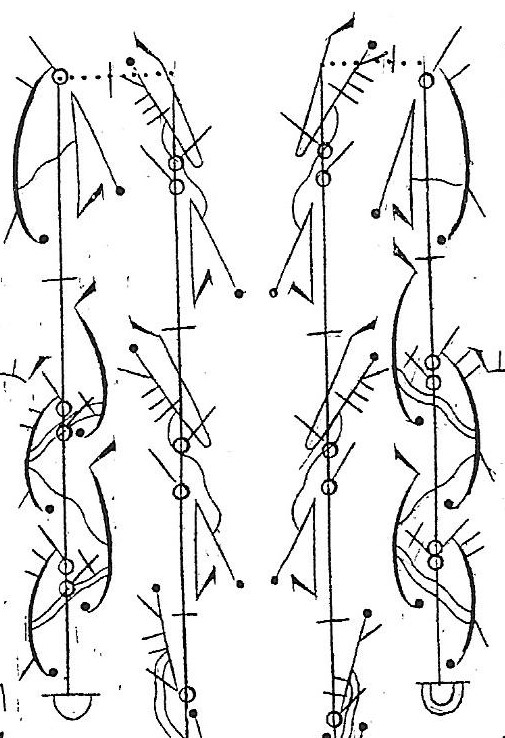
In the ‘Passacaille pour une femme’ danced by Mlle Subligny to music from Lully’s Armide it appears twice. First in bar 62 (plate 82, shown below left), where it is preceded by a pas de bourée and followed by a coupé battu, then in bar 74 (plate 83, shown below right), where it follows a pas de bourée emboîté. This second time, the concluding pas simple becomes a pas plié and the dance bar ends with a coupé avec rond de jambe.

Passacaille Armide 82 (2) Passacaille Armide 83 (2)


This proto-cabriole turns up in both the canary duets for women in this collection. In the ‘Canarÿe’ it occurs twice, first in bar 10 (plate 43, see below top), where it is preceded by a pas de bourée emboîté and followed by a coupé battu. The second time, in bar 38 (plate 45, see below bottom), it begins the final musical section after the assemblé / pas simple which finishes a pas de rigaudon and is followed by a coupé battu.

Canarye Guyot Prevost 43 (3)

Canarye Guyot Prevost 45 (2)

In the ‘Entrée de deux Bacchante’, like the ‘Canarÿe’ danced by Mlle Guyot and Mlle Prévost, it also begins the final musical section (bar 26, plate 63) and is preceded by a pas de bourée and followed by a coupé battu.

Bacchante Guyot Prevost 63 (2)

In his New Collection of around 1725, L’Abbé’s ‘Passagalia of Venüs & Adonis’ provides Mrs Santlow with several variants on the basic jetté emboîté which I will discuss in another post. In the ‘Passacaille of Armide’ danced by Mrs Elford and Mrs Santlow, this proto-cabriole comes in bar 100 (plate 13), immediately preceding the assemblé battu which closes the musical variation. It is preceded by a pas composé comprised of a coupé to first position, a pas plié and a jetté. And, as you see, there are three of these variant jettés emboîtés in the bar rather than the more usual two.

Passacaille Armide Duet 13 (3)

Like the pas de sissonne battu, this jetté emboîté is a commonplace in stage dances for women. Should we make anything of the fact that in the majority of the dances by Pecour it is followed by coupé battu? If nothing else, it seems to point to one of his favoured choreographic devices.

Why have I dealt with this topic at such length? Am I the only one who has danced all these choreographies to wonder whether the jetté emboîté should really be a demie cabriole? The female professional dancers for whom these dances were created undoubtedly had the strength and the technical skill to perform cabrioles, which would have been clearly seen under the shorter skirts we know they wore. Did the notations follow a convention related to the one that routinely depicts leading ballerinas in floor-length skirts? I believe they did.


Pas de Sissonne Battu in Stage Dances for Women

The pas de sissonne battu, shown in Feuillet’s ‘Table des Pas de Sissonne’ turns up in several of the notated stage solos and duets for women. I am not going to attempt any detailed analysis in this post, I will simply point out where the step occurs.

It can be found in two of the choreographies in the 1704 collection of Pecour’s ‘Entrées de Ballet’: the ‘Passacaille pour une femme’ performed by Mlle Subligny in Gatti’s Scylla; and the ‘Entrée Espagnolle pour une femme’ danced by her in Campra’s L’Europe galante.

It is notated twice in the passacaille, first in bar 96 (plate 28), when it is not (strictly speaking) a pas de sissonne since the assemblé battu is followed by a changement, and the dance bar concludes with a coupé simple.

Passacaille Scylla 28 (2)

It is danced again in bar 152 (plate 31). In both cases, the step is preceded by a coupé soutenue and followed by a coupé battu avec ouverture de jambe.

In the ‘Entrée Espagnolle’ it comes in the penultimate bar of the dance, bar 29 (plate 40) – the loure is notated with two pas composés to each bar of the music. The pas de sissonne is preceded by a contretemps and has an ouverture de jambe on the concluding spring. The assemblé battu is performed with a half turn in the air.

Entree Espagnolle 40 (2)

In Pecour’s Nouveau recüeil of around 1713, the pas de sissonne battu turns up in four of the female solos and just one of the duets. The ‘Gigue pour une femme’ danced to music from Louis Lully’s and Marais’s Alcide is a highly embellished choreography. The unnamed danseuse has a wealth of steps incorporating pas battus, although only one is a pas de sissonne battu. It comes early in the dance, bar 11 (plate 69) and concludes with a changement. It is preceded by two unusual pas composés incorporating tortillé movements (only one is shown here) and followed by a pas de bourée.

Gigue Alcide 69 (2)

I have often wondered whether the anonymous female soloist was, in fact, Mlle Guyot who is the female star in this collection.

Mlle Guyot is named as the performer of the ‘Gigue pour une femme’ from Campra’s Tancrède. This lively little number has a pas de sissonne battu in bar 32 (plate 76), although again it has a concluding changement rather than a spring onto one foot. It is followed by a coupé simple and a coupé avec ouverture de jambe, recalling the sequence in the passacaille from Scylla.

Gigue Tancrede 76 (2)

The ‘Entrée pour une femme seul’, a gavotte from Lully’s Atys, also danced by Mlle Guyot, has a pas de sissonne battu in bar 22 (plate 78). It, too, has a changement instead of a spring and is followed by a pas de bourée battu.

Gavotte Atys 78 (2)

The choreographic masterpiece in this collection, so far as the dances for women are concerned, is the ‘Passacaille pour une femme dancée par Mlle. Subligny en Angleterre’, presumably during her visit to London in the winter of 1701-1702. The music is from Lully’s opera Armide.

Mlle Subligny performs two assemblés battus during the solo. The first comes in bar 101 (plate 84) as a new variation begins in the music. It is followed by a changement and a coupé simple.

Passacaille Armide 84 (2)

The second is in bar 147 (plate 86), as the solo draws to its conclusion, and is the step just before she begins her final retreat. Again, it is followed by a changement and a coupé simple.

Passacaille Armide 86 (2)

The collection of c1713 is notable for the five duets performed by Mlle Guyot and Mlle Prévost. These characterful choreographies are full of pas sautés, although only the ‘Canarÿe dancée … au triomphe de l’amour’ includes a pas de sissonne battu (bar 8, plate 43). This example has a half-turn in the air and is preceded by a contretemps and followed by a pas de bourée.

Canarye Guyot Prevost 43 (2)

In L’Abbé’s New Collection of Dances, published around 1725, neither of Mrs Santlow’s solos include a pas de sissonne battu. However, the ‘Passagalia of Venüs & Adonis’ is an astounding choreography, so far as our ideas of the conventions of female dance technique are concerned. I have performed it numerous times and written about in several different contexts. I hope to return to it later.

L’Abbé’s ‘Passacaille of Armide’ danced by Mrs Elford and Mrs Santlow has one assemblé battu in bar 101 (plate 13). It draws attention to itself not only because it marks the transition to a new musical variation but also because it is followed by two beats in which the dancers come to a dynamic stop – a moment of stillness in which energy continues to flow through their bodies as they wait to resume their dance.

Passacaille Armide Duet 13 (2)

I suggest that, given the number of examples in these collections, the assemblé battu, within the pas de sissonne battu (which is often in a variant concluding with a changement) or alone, was a step integral to the vocabulary of early 18th-century professional female dancers. If they regularly performed this step, what other jumped pas battus might they have performed? There are some hints in the notated female solos and duets and also in the male-female duets as well as the dances for men.

Dances on the London Stage: Blouzabella

On 8 June 1703, the entr’acte entertainments at Lincoln’s Inn Fields included a duet by Prince and Mrs Elford entitled Blouzabella. The dance must have been at least moderately successful, because it was repeated on 11 June by (according to The London Stage) L’Abbé and Mrs Elford. Blouzabella was revived at Lincoln’s Inn Fields in 1703-1704, 1704-1705 and, for the last time, in 1711-1712 when it was given at Drury Lane. At each of these revivals it was danced by Prince, initially with Mrs Clark and finally with Mrs Bicknell.

The title of the dance suggests that it was a comic number. Blowzabella is the vulgar, ostentatious and shameless wife of the hero of Thomas Durfey’s The Famous History of the Rise and Fall of Massaniello, inspired by the Italian fisherman who in 1647 led a revolt against the rulers of Naples. Durfey’s play was first given at Drury Lane in May 1699. According to The London Stage, Massaniello was short-lived, although both it and the entr’acte dance it inspired may have enjoyed more performances than are recorded there.

There are some puzzles about this duet and its performers. We know all too little about Mrs Elford and her repertoire, except that the sparse surviving evidence suggests that she was an accomplished exponent of belle danse. She is generally advertised in serious dances and her one recorded choreography is a passacaille danced as a duet with the young Hester Santlow, probably in 1706 the year Mrs Elford left the stage. She seems an unlikely performer of a duet that draws on the antics of a low comedy character.

Mrs Elford regularly danced with Anthony L’Abbé, but the suggestion in The London Stage that they danced Blouzabella together is very likely to be wrong. The original advertisement for the performance says:

‘Also an Entertainment of several Dances by Monsieur Labbe, Mrs Elford, and others; particularly the Wedding Dance, and Blouzabella. The Medley Dance by Mr Prince and his Daughter. …’

The wording ‘and others’, together with Prince’s appearance on this bill as well as the one for 8 June, suggests that it was he and not L’Abbé who danced Blouzabella with Mrs Elford. As for Prince’s later partners, we know next to nothing about Mrs Clark and Mrs Bicknell was well-known as a comic actress as well as a dancer, although her range did not usually extend to low comedy.

Prince’s appearance in probably all of the known performances raises the possibility that he was the choreographer of Blouzabella. Who was Mr Prince? Was he the Joseph Prince who married Judith, the daughter of the dancing master Luke Channell, in 1678 and was in his mid-forties in the early 1700s? Or was he perhaps a son of Joseph Prince, who might then have been in his early twenties?

Any research into dances on the London stage must be undertaken with caution. Even well into the 18th century we cannot be entirely sure who danced these choreographies, where, when or with whom. Nor can we always be sure what sort of dances they were. Durfey’s Massaniello has several dance numbers, some of which were serious, so was Blouzabella not as comic a dance as its title might suggest?