Tag Archives: Marie Sallé

Who Was Francis Sallé?

Most people who have an interest in the history of dancing will have heard of the 18th-century French ballerina Marie Sallé. How many will know of Francis Sallé, her brother, who is mentioned only in passing in the various accounts of her career? I use the English form of his first name because, unlike Marie, he chose to pursue a career on the London stage.

Francis and Marie Sallé made their debuts together on the London stage, at the Lincoln’s Inn Fields Theatre on 18 October 1716. They were billed as ‘two Children, Scholars of M Ballon, lately arriv’d from the Opera at Paris’, with the warning to prospective audiences that ‘Their Stay will be short in England’. The ‘Opera’ was, of course, Paris’s Opéra-Comique rather than the Académie Royale de Musique, despite the link with Claude Ballon. Francis is generally said to have been born in 1705 and Marie in 1707, so they were eleven and nine years old when they first came to London. At their first performance, they danced the Harlequins in Two Punchanellos, Two Harlequins and a Dame Ragonde. They proved so popular that their stay was extended. In the bills from 5 to 10 December, Rich encouraged interest in their performances with successive announcements from the children ‘stay but Nine Days longer’  down to ‘the last Time but one of their Dancing during their Stay in England’. Their last performance was, ostensibly, their shared benefit on 11 December 1716, which according to the advertisement in the Daily Courant for that day, included

‘… several Entertainments of Dancing, both Serious and Comic, by the Children and others. A new Comic Dance, call’d The Drunken Man, to be perform’d by the Children. The last New Comic Dance, compos’d by Mons. Moreau, and to be perform’d by him, Mr. Kellom’s Schollar, Mr. Cook, Mrs. Schoolding, Mrs. Cross, Miss Smith, and the Children. Likewise a Scene in the French Andromache burlesqued, to be acted by the Children: Orestes to be perform’d by Mons. Salle, and Hermione by Mademoiselle Salle his Sister.’

On 18 December 1716, the bills announced ‘In Consideration of the Diversion the French Children have given the Town, Mr. Rich has engag’d their Stay in England for some time longer. The two children danced at Lincoln’s Inn Fields until 10 June 1717, with one performance at the King’s Theatre on 5 June, giving more than 100 performances in all. They were allowed a second benefit on 11 May 1717, when they gave a ‘French Scene’ with their father and danced with Moreau and Mrs Schoolding.

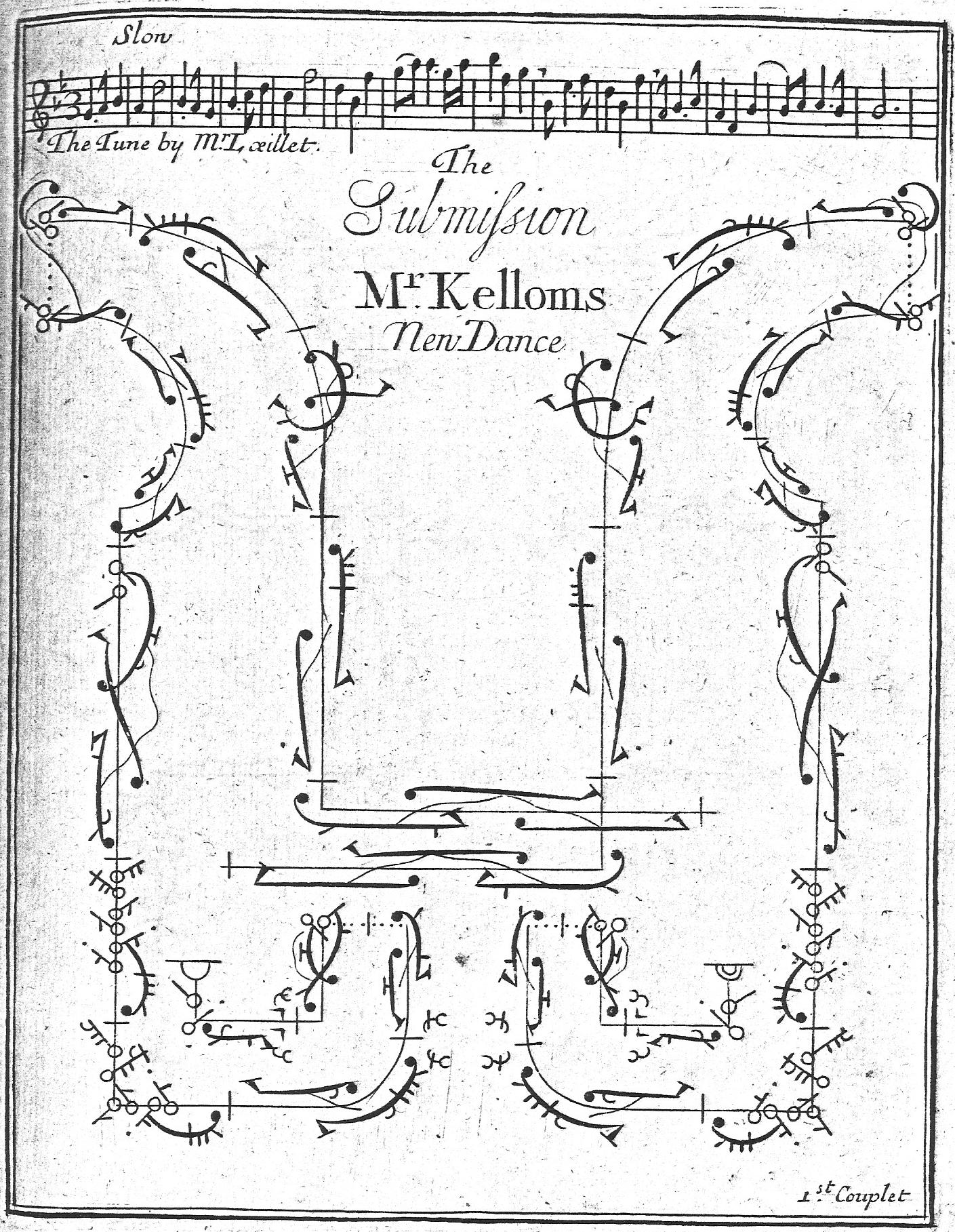
During the 1716-1717 season, the two children performed around a dozen entr’acte dances both serious and comic. Their repertoire included a ball dance by Kellom Tomlinson, The Submission first given on 21 February 1717 and published in notation the same year. The dance opens with a slow triple-time section, followed by a minuet and then a rigadon. Here is the first plate.
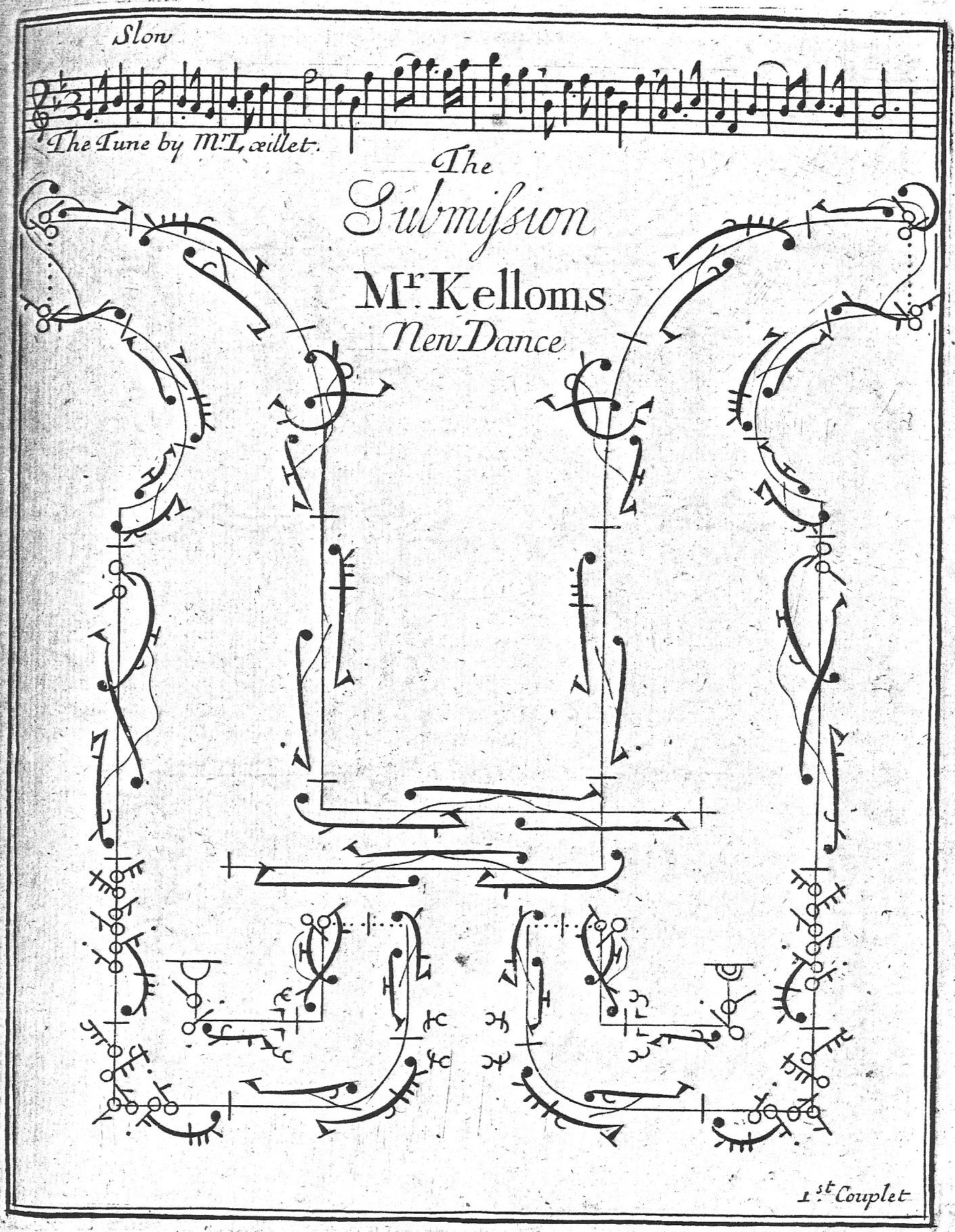
This is the only dance created for either Francis or Marie Sallé that survives in notation.

The two young dancers returned to London for the 1718-1719 season, this time appearing first at Lincoln’s Inn Fields and then at the King’s Theatre with the troupe of their uncle Francisque Moylin. At Lincoln’s Inn Fields, they were mentioned only once in the bills, on the 19 December 1718 (their benefit performance), when they were advertised as ‘M and Mlle Salle, the two Children, who dance in the Company of the French Comedians’. They were billed only three times when Moylin’s company moved to the King’s Theatre. However, the Lincoln’s Inn Fields bill suggests that they may have danced at most, if not all, of the 40 performances that the French Comedians gave at the two theatres between 7 November 1718 and 19 March 1719. The bills say nothing at all about their repertoire.

Francis and Marie Sallé did not return to London again until the 1725-1726 season, when they again danced for John Rich at Lincoln’s Inn Fields. By this time, Francis was twenty years old and Marie eighteen and they immediately became the company’s leading dancers. They performed the title roles in that season’s new pantomime, Apollo and Daphne; or, The Burgomaster Trick’d, Rich’s answer to Drury Lane’s Apollo and Daphne; or, Harlequin’s Metamorphoses of the previous season. At Drury Lane, the title roles had been taken by John Thurmond Jr (the pantomime’s creator) and Hester Booth and Rich followed suit with two dancers at Lincoln’s Inn Fields. The two Sallés also appeared as Zephyrus and Flora in the pantomime’s concluding divertissement. Apollo and Daphne; or, The Burgomaster Trick’d, first performed on 14 January 1726, was given 45 performances before the end of the season. Francis Sallé was billed for 106 performances during 1725-1726. As well as dancing four entr’acte  duets with Marie, he apparently gave a solo French Sailor (in addition to the French Sailor and His Wife with his sister) and danced Two Pierrots with Francis Nivelon as well as Two Harlequins with Louis Dupré. He also partnered Mrs Bullock in a Grand Dance with other dancers in the company. Francis and Marie Sallé shared a benefit on 18 April 1726, the last time they would do so. Their careers were already beginning to diverge.

Both Sallés returned to Lincoln’s Inn fields for the 1726-1727 season. They were first billed together, without comment, on 19 September 1726 dancing Shepherd and Shepherdess and French Sailors. Francis had already appeared a few days earlier, dancing First Fury in The Necromancer (a role he had initially performed the previous season). He and Marie repeated their roles in Apollo and Daphne and danced together in the entr’actes, although Francis was also billed (without Marie) alongside other dancers in the company for performances of The Prophetess as well as a new masque Pan and Syrinx, first given on 24 October 1726. Later in the season, on 30 May 1727, he was billed as Mezzetin Man (with the actress-dancer Elizabeth Younger as Mezzetin Woman) in The Necromancer as well as First Fury. By contrast, Marie’s only billing without her brother was on 27 April 1727, when she performed a new Ball Dance with Leach Glover at his benefit.

The main reason for the Sallés engagement at Lincoln’s Inn Fields in 1726-1727 was undoubtedly their appearance in the new pantomime, The Rape of Proserpine, introduced on 13 February 1727 and performed 32 times before the end of the season. This was a pantomime that Rich had long wished to produce. In the libretto for Harlequin a Sorcerer, first given at Lincoln’s Inn Fields on 21 February 1725, he had written of ‘The Expectation which has been rais’d in the Town of seeing a Dramatick Entertainment, call’d The Rape of Proserpine‘ explaining that ‘being disappointed of some very necessary Persons from abroad, on whom we depended, we have deferr’d the same for some time longer’. The ‘very necessary Persons’ must have been Francis and Marie Sallé, for all the other principal performers in The Rape of Proserpine appeared in Harlequin a Sorcerer. When Rich was able to engage the two Sallés for the 1725-1726 season, his focus had evidently turned immediately to the need to outdo Drury Lane’s Apollo and Daphne and he had deferred his pet project for another year.

In The Rape of Proserpine, the roles of Ceres, Pluto, Proserpine and Mercury were all performed by singers, although Marie and Francis danced in the serious part of the pantomime. She was the first of five female Sylvans, while he was the first of four Gods of the Woods and the first of five Demons. The most spectacular dancing was probably reserved for the ballet which ended the pantomime, described thus in the libretto, ‘Enter several Dancers, who represent the four Elements, and celebrate the Marriage of Pluto and Proserpine, by a Grand Ballet.’ Earth was danced by Louis Dupré, with Mrs Pelling as his Female. Air was Leach Glover, with Mrs Laguerre, and Fire was Poitier with Mrs Bullock. The ballet must have culminated with the appearance of Francis Sallé as Water, accompanied by his sister. The bills suggest that the men may have danced virtuoso solos as well as duets with their ‘Females’. The Rape of Proserpine drew on Lully’s 1680 opera Proserpine and the ballet of the elements may have had a French source too, although this has yet to be identified.

This season, Marie received her own benefit on 6 April 1727 at which she apparently did not dance, for the advertisement announced only a Pastoral by her scholar the nine-year-old Miss Rogers and Two Pierrots by Francis Nivelon and Francis Sallé. Her brother’s benefit was a week later, on 14 April, at which the mainpiece was The Prophetess (in which he may well have danced) and the dancing comprised a solo Harlequin by Miss Violante, his scholar, a solo version of Les Caractères de la Dance by Marie and a Fury Dance with Francis as First Fury (presumably taken from The Necromancer). It is worth noting that Marie’s benefit was more profitable than that of Francis and had higher attendance than his. Marie Sallé had already emerged as the more celebrated dancer and was probably the more ambitious too. During 1726-1727, Francis Sallé gave 97 performances and had evidently decided that his future lay with Rich’s company. The surviving Lincoln’s Inn Fields accounts for that season record a payment of 10 guineas on 9 June 1727 to ‘Mr Salle upon signing articles and in pt of next year’s contract’.

Marie Sallé would not return to London and Lincoln’s Inn Fields until the 1730-1731 season. Francis became one of Rich’s group of dancers, although he probably returned to dance in France regularly. His first London season without his sister, 1727-1728, may not have met his expectations. On 29 January 1728, the first performance of The Beggar’s Opera was given at Lincoln’s Inn Fields, and the production dominated the theatre’s repertoire until the end of the season. None of the bills for The Beggar’s Opera mention dancing, but the libretto does refer to dances and it is possible that at least one of them – the ‘Dance of Prisoners in Chains’ was performed by male dancers in the company. Otherwise, Francis Sallé was billed only four times in the entr’actes, although his appearances in The Necromancer, Apollo and Daphne and The Rape of Proserpine (with Mrs Laguerre in Marie Sallé’s roles in the two latter pantomimes) came to a total of 46 performances. His benefit, on 22 April 1728, was shared with Michael Poitier and he did not dance himself. Sallé’s last billing before that was on 25 March 1728 and he may have been absent for the rest of the season.

Although The Beggar’s Opera was given frequently in 1728-1729, there was more room for other repertoire in the course of the season. Francis Sallé danced from 21 October 1728 to 22 May 1729 and was billed in three entr’acte duets, two entr’acte group dances and five afterpieces (three of which were pantomimes). He was advertised in 67 performances altogether and allowed a solo benefit on 8 April 1729, when he danced the Mad Soldier in The Humours of Bedlam (a comic ballet always given with the play The Pilgrim) as well as two entr’acte duets with Mrs Laguerre – Highlander and Mistress and French Sailor. By this time he had established a dance partnership with Mrs Laguerre, their new duet Highlander and Mistress was repeated nine times before the end of the season and continued to be popular thereafter.

In 1729-1730, Sallé was billed for 117 performances. This season was dominated by another new pantomime, Perseus and Andromeda; or, The Cheats of Harlequin (or, The Flying Lovers), Rich’s response to Drury Lane’s Perseus and Andromeda: With the Rape of Colombine; or, The Flying Lovers by Roger and Weaver given the previous season. The Lincoln’s Inn Fields Perseus and Andromeda was performed 60 times before the end of 1729-1730. Francis Sallé was an Infernal in the serious part of the pantomime, for which Rich had drawn on Lully’s 1682 opera Persée, and it is tempting to speculate whether he and his fellow dancers (Poitier, Dupré, Pelling, Newhouse and Lanyon – Papillion, billed first, was actually a singer and probably did not dance) performed to the ‘Entrée des Divinités Infernales’ from the opera. A duet created by Guillaume-Louis Pecour to this music for Marcel and Gaudrau, performed at the Paris Opéra, was published in notation around 1713 and shows the demands that could be placed on male dancers at the period. Sallé’s early tuition by Claude Ballon (which could have continued beyond his childhood) indicates that he might well have been capable of similar virtuosity. Here is the first plate:
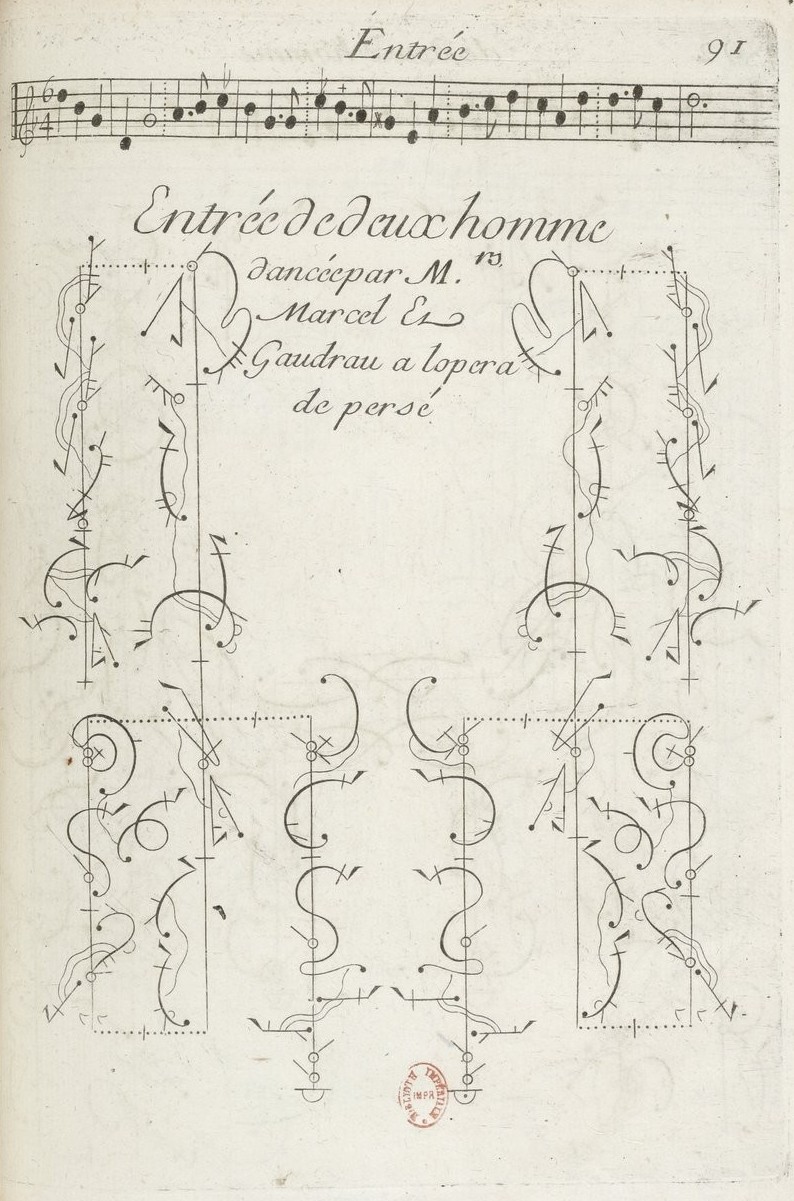
Sallé also danced in a smaller scale afterpiece in 1729-1730, The Dutch and Scotch Contention first given on 29 October 1729. This was probably taken from a ballet performed at the Opéra-Comique in Paris, in which Sallé had appeared ‘en Ecossois’ alongside Roger and Nivelon. I looked at this piece in some detail in my post Highland Dances on the London Stage, back in February 2021. Sallé’s duet Highlander and Mistress with Mrs Laguerre formed part of the action in the London ballet.

Marie Sallé returned to Lincoln’s Inn Fields for the 1730-1731 season, first appearing on 23 November 1730 and dancing until 4 June 1731. Francis made his first appearance some two months before the arrival of his sister, on 21 September 1730, and his last just a few days later, on 7 June 1731. His benefit was on 5 April 1731, in which he danced The Loyal and Generous Free-Mason with Dupré, Pelling and Newhouse – described in the advertisements as ‘all Brothers’- as well as the duets Les Caractères de la Dance and the Louvre and Bretagne with Marie. The last two were ballroom dances by Guillaume-Louis Pecour, among the most famous choreographies of the day and regularly given at benefit performances in London’s theatres. Sallé’s benefit brought in a little over £129. His sister’s benefit, held on 25 March 1731 and commanded by the King (who attended with the Queen, Prince William and the ‘three eldest princesses’), brought in more than £194. She and Francis performed Les Caractères de la Dance together, while Francis also contributed a Scottish Dance duet with Mrs Laguerre (perhaps the popular Highlander and Mistress introduced in 1729).

During 1730-1731, Francis danced with his sister at only 16 of his 50 appearances in the entr’actes and at only 22 of his 65 afterpiece performances. He danced with Marie in Apollo and Daphne and The Rape of Proserpine, but his most popular entr’acte dance was again Highlander and Mistress with Mrs Laguerre. While their respective benefits underlined Marie Sallé’s celebrity status, Francis demonstrated his independence from his sister and his importance as a dancer on the London stage.

The 1731-1732 season was marked by the absence of Marie Sallé. Francis danced at Lincoln’s Inn Fields from 4 October 1731 to 2 June 1732, giving 111 performances in all. His benefit on 12 April 1732 brought in a little over £80 and he was allowed a second benefit on 24 May 1732 which achieved receipts of just over £93. The receipts and the two benefits (an unusual arrangement) need analysis which I won’t undertake here, although there is no question that Francis Sallé was working hard for John Rich who certainly appreciated his contribution to the company. This season, his principal partner was Mrs Laguerre, with whom he performed several entra’cte dances including French Sailor and Wife (presumably the duet Francis had often performed with his sister), Highlander and Mistress and a new duet The Baulk which promised to be popular beyond 1731-1732. He again took leading dancing roles (partnering Mrs Laguerre) in Apollo and Daphne, The Rape of Proserpine and The Dutch and Scotch Contention. For his final performance of the season, Sallé danced as an Infernal in Perseus and Andromeda.

Just ten days after his last performance, the Daily Post for 12 June 1732 announced that:

 ‘On Friday last died at his Lodgings at Newington Green, after a tedious Indisposition, Mons. Salle, a celebrated Dancer belonging to Lincoln’s Inn Fields Playhouse.’

Francis Sallé was buried at St. John Hackney on 14 June 1732. He was little more than twenty-seven years old. According to Dacier in Une Danseuse de l’Opéra sous Louis XV (pp. 293-4), Marie Sallé was grief-stricken by her brother’s death and a portrait of Francis was found among her possessions after her own death.

Francis and Marie Sallé pursued separate careers alongside their performances together in London. She was far more successful, yet his career deserves much more attention than it has received. He was, for a time, the leading male dancer in John Rich’s company at Lincoln’s Inn Fields and – had he lived longer – would undoubtedly have gone on to star at the first Covent Garden Theatre, opened by Rich in December 1732 just a few months after Sallé’s untimely death.

Notes:

There seems to be no documentary proof of the birth dates of either Francis or Marie Sallé. In his biography, Une Danseuse de l’Opéra sous Louis XV: Mlle Sallé (1707-1756), Émile Dacier gives her birth year as 1707 (p. 4 n. 2). In their Mémoires pour servir à l’histoire des spectacles de la foire, 2 vols. (Paris, 1743) the Parfaicts declare that Francis was two years older than Marie (vol. 1, p. 207). Together, these sources presumably provide what evidence there is for his birth year.

For The Rape of Proserpine, Perseus and Andromeda and French dancing see: Moira Goff, ‘John Rich, French Dancing, and English Pantomimes’, “The Stage’s Glory” John Rich, 1692-1761, ed. Berta Joncus and Jeremy Barlow (Newark, NJ, 2011), 85-98.

There are numerous volumes of accounts for the Lincoln’s Inn Fields and Covent Garden theatres during the 18th century in the manuscript collections at the British Library. The entry for Francis Sallé quoted above comes from Egerton ms. 2266, f. 171r.

For dancing in The Beggar’s Opera, see Jeremy Barlow and Moira Goff, ‘Dancing in Early productions of The Beggar’s Opera’, Dance Research, 33.2 (2015), 143-158 (pp. 148-149 for the ‘Dance of Prisoners in Chains’).

Other Dance in History posts relating to the London career of Francis Sallé include:

Aimable Vainqueur on the London Stage

La Bretagne in London

Highland Dances on the London Stage

The Humours of Bedlam

The Necromancer at 300

Season of 1725-1726 (11 posts on various aspects of the dancing at Drury Lane and Lincoln’s Inn Fields this season)

Tambourins on the London Stage

The Tambourin (or Tambourine it was it was often called in advertisements) was apparently introduced to the London stage by Marie Sallé, who performed a solo with this title at Lincoln’s Inn Fields on 4 January 1731. It quickly became popular. Mlle Sallé danced it at least nine times before the end of the season, including at her own benefit on 25 March when it was titled a ‘New French Tambourin’. A solo Tambourin was also danced at Lincoln’s Inn Fields a couple of times by Miss Rogers ‘Scholar to Salle’ (Marie Sallé’s brother Francis), while at Drury Lane Miss Robinson danced a solo Tambourin several times (including at her own benefit on 14 April 1731 when she also performed ‘Les Characteres de la Dance’).

In 1730-1731, Marie Sallé was returning to dance in London after some years performing at the Paris Opéra, where she had made her official debut on 14 September 1727. She had appeared in a number of operas during her time in Paris, so it is possible that she was drawing on one of her dancing roles there. It is interesting to note that she appeared in Alcione by Marais, premièred in 1706 and cited as the first French opera to include a tambourin.  However the dance forms part of the ‘Feste Marine’ in the third act, whereas Mlle Sallé danced in acts one and four. Marais’s music was also closely associated with Matelots both in the opera and when it was appropriated for choreographies recorded in Beauchamp-Feuillet notation, so it is perhaps unlikely that it was used for Marie Sallé’s London Tambourin.

Mlle Sallé returned to dance in London in the 1733-1734 and 1734-1735 seasons, after which she never returned. She seems to have danced her Tambourin again only on 18 and 26 December 1734. By that time the dance had become a regular feature of the entr’actes. At Covent Garden it continued to be danced as a solo by Miss Rogers, as well as a duet by her and Leach Glover. At Drury Lane a solo ‘Tambourine’ was danced by Mlle Grognet, while Miss Robinson gave her solo ‘Tambourine’ at the Little Theatre in the Haymarket (where she performed with others who had taken part in the actors’ rebellion at Drury Lane at the end of the 1732-1733 season) and Miss Wherrit danced yet another solo ‘Tambourine’ at the Goodman’s Fields Theatre.  The Tambourin or Tambourine remained popular as both a solo and a duet into the 1740s.

The Tambourine was exceptionally popular during the 1739-1740 and 1740-1741 seasons, when it was performed frequently at Drury Lane by a visitor ‘lately arriv’d from Paris’ Mlle Chateauneuf. We do not know what music she used for her solo (which was sometimes advertised as by ‘Mlle Chateauneuf &c.’ as if it were a group dance). In 1740-1741, she had rivals at Covent Garden in the form of Desnoyer and Signora Barberini who danced a ‘new Tambourine’ together on 14 February 1741 which they repeated at numerous performances during the rest of the season. The music for their dance may have been related to the ‘Tambourine Sigra Barbarina’ published in the second of the set of eight volumes popularly known as Hasse’s Comic Tunes which appeared between 1741 and 1758. This particular volume was issued in four parts between September 1742 and October 1743, which includes a period when Desnoyer and Signora Barberini were still performing their duet. Here is her Tambourine (p. 67):

During the 1742-1743 season, the dancer Philip Cooke performed a Tambourine at Covent Garden and his music was also included in the same volume (p. 52). Here is the beginning (the music seems to continue onto the next page):

These two pieces (as well as a number of other tambourins in the same volume) are worth further research for the insights they might provide into music for dancing on the London stage at this period.

There is another entr’acte dance which might have links to yet another Parisian tambourin. Le Badinage de Provence was first performed at Dury Lane on 22 October 1735 by Michael Poitier and Catherine Roland with a supporting group of twelve dancers (six men and six women). It proved very popular, with at least seventeen performances before the end of the season and it would continue to be revived until 1739-1740. In its last season it was advertised, this time at Covent Garden, on 15 October 1739 as a ‘Tambourine Dance call’d La Badinage de Provence’. The title, and the later advertisement, raise the possibility that the music for the dance (which may well have been choreographed by Poitier) was one or both of the tambourins in the first Entrée ‘Le Turc Généreux’ of Jean-Philippe Rameau’s Les Indes galantes. This ‘ballet héroïque’, an opéra-ballet, was first performed at the Paris Opéra on 23 August 1735 and was still in the repertoire there when Le Badinage de Provence was first given at Drury Lane. The tambourins are played in the final scene of the Entrée, which has ‘Provençaux et Provençales’ onstage (presumably the ‘Matelots’ seen earlier) and a ‘Danse de Matelots’.  As the entries in Grove Music Online and the International Encyclopedia of Dance acknowledge, the tambourin was widely thought to be of Provençal origin. Poitier seems to have moved regularly between Paris and London and would undoubtedly have encountered Rameau’s opera.

The popularity of Tambourine dances waned in the 1750s. They were performed a handful of times each season at most and not given at all in several seasons. The dance enjoyed a significant revival in the mid-1760s, with the ‘new Tambourine Dance’ by Simon Slingsby and Miss Baker at Drury Lane on 29 September 1764. This duet was apparently a response to Le Tambourine danced by Fischar and others at the King’s Theatre during the 1763-1764 season, for the latter was repeated in response to Slingsby and Miss Baker’s dance throughout 1764-1765. Other sources suggest that these were very different dances to the earlier Tambourines. I hope to write about them, and about Slingsby, at a later date.

References:

For a listing of Marie Sallé’s dancing roles see: Émile Dacier. Une Danseuse de l’Opéra sous Louis XV: Mlle Sallé (1707-1756) (Paris, 1909), pp. 323-335.

For the text of scene VI of the first Entrée of Rameau’s opera, see: Louis Fuzelier, Les Indes galantes ([Paris], 1735), pp. 24-26.

Rebecca Harris-Warrick, ‘Tambourin’, International Encyclopedia of Dance. 6 Vols, (New York, 1998), vol. 6.

Hasse’s Comic Tunes to the Opera and Theatre Dances. [Volume II]. The Celebrated Comic Tunes to the Opera Dances, as Perform’d at the King’s Theatre in the Hay Market. To which is added, Several of the Most Celebrated Dances Perform’d at Both Theatres (London, 1742-1743).

Meredith Ellis Little, ‘Tambourin (i)’, Grove Music Online (2001, accessed 7/10/2024).

Lady Dancing Masters in 18th-Century England

I recently watched another dance history video in the very informative series compiled and published by Carlos Blanco, which draws inspiration from the rich resources of the Biblioteca Nacional de España. In this video (which can be found on YouTube) four historical dance experts consider the question ‘Is there Sexism or Misogyny in Dance Treatises?’ Inevitably, the topic of female dancing masters arose, in the context of the discussion focussing on the USA and Great Britain, and it proved difficult to identify or name any – indicating a gap in published research. In the course of my own work, which is mostly limited to England and particularly London, I have come across several women who taught dancing – lady dancing masters. My list is very far from exhaustive (and at least one name is questionable), but I thought it might be of interest to write a post about them and perhaps reveal or encourage further research. There has been some work which includes this topic and I have included a list for further reading at the end.

The first of these women is the questionable one. Peggy Fryer was billed as acting and dancing at the Little Theatre in the Haymarket on 28 January 1723. The advertisements declared that she was aged seventy-one and had ‘taught three Queens to dance’. She had previously appeared at the Lincoln’s Inn Fields Theatre on 11 January 1720, ‘it being the first time of her Appearing on any stage since the Reign of King Charles II’, and she was then said to be eighty-five years old. Without a great deal more research, it is difficult to discern whether there was any truth at all in these conflicting announcements. If Peggy Fryer had indeed ‘taught three Queens to dance’, who might they have been? My thoughts turned to Charles II’s Queen, Catherine of Braganza, and his two nieces Mary (later Queen Mary II) and Anne (later Queen Anne), although there are other candidates. Would someone like Peggy Fryer have been called in to teach any of them, when there was a royal dancing master – Jerome Gahory – to do so?

With the second of these lady dancing masters we are on much surer ground. Mrs Elford emerges into view on 5 July 1700 at Lincoln’s Inn Fields, where she is billed as dancing a ‘new Entry, never performed but once’, She was obviously already established as a leading dancer and would later be billed alongside Anthony L’Abbé as his regular dancing partner. The collection of L’Abbé’s stage dances published in the mid-1720s includes a duet to the passacaille from Lully’s opera Armide danced by Ann Elford and Hester Santlow. The earliest evidence for Mrs Elford as a teacher dates to 12 September 1705, when dancing ’By a little Girl, Mrs Elford’s scholar’ was advertised at Lincoln’s Inn Fields. Mrs Elford’s career as a stage dancer seems to have ended in 1706, by which time she was probably already teaching regularly. The first record of her work beyond the world of the London stage dates to 1711, when she was teaching Mary Bankes of the Bankes family of Kingston Lacey. Mrs Elford’s later activities are less easy to trace, although she is recorded as teaching the daughters of the second Duke of Montagu between 1720 and 1729.

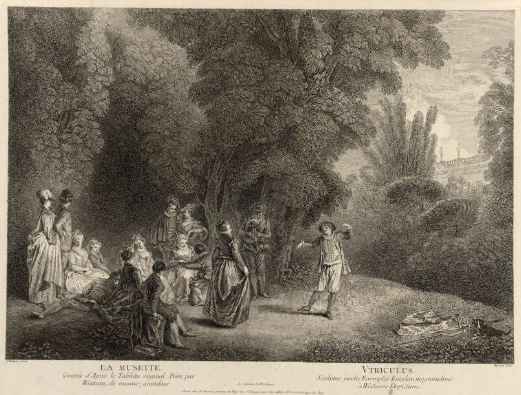
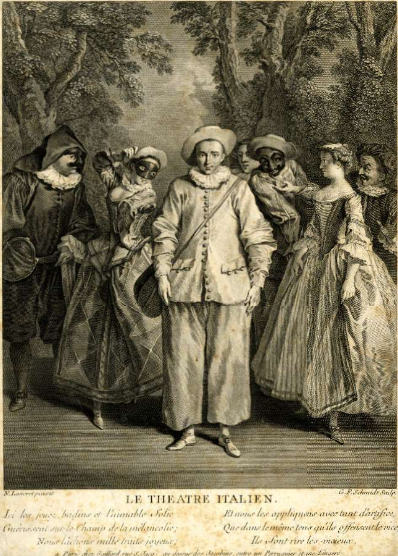
The next woman to be recorded as teaching dance in England was one of the most notable dancers to appear on the 18th-century London stage. Marie Sallé first danced in London as a child, during the 1716-1717 season at Lincoln’s Inn Fields. She returned to dance there as a young woman in 1725-1726 and made her last London appearances at the Covent Garden Theatre during the 1734-1735 season. For Mlle Sallé’s benefit at Lincoln’s Inn Fields on 6 April 1727 the bill included a ‘Pastoral by Miss Rogers, a Child of Nine Years of Age, Scholar to Mlle Sallé’. Elizabeth Rogers would later enjoy a career as a singer and actress, as well as a dancer. When she was billed again at Lincoln’s Inn Fields on 5 April 1731, dancing a Saraband and Tambourin, she was advertised as ‘Scholar to Salle’. Marie Sallé’s brother Francis remained in London when she returned to France and made his career there. It is not surprising that he took over some of his sister’s teaching. However, a continuing link between Marie Sallé and Elizabeth Rogers is suggested by the latter’s appearance as a Bacchante in Bacchus and Ariadne (a ballet attributed to Mlle Sallé) when it was given within The Necromancer at Covent Garden on 26 February 1734. Marie Sallé is the first of my lady dancing masters for whom there is a portrait. In fact there are several, this is a print of the painting by Nicolas Lancret.

My third lady dancing master appeared on the London stage much later in the 18th century. Marie-Louise Hilligsberg began her career at the Paris Opéra in the early 1780s, making her first visit to London during the 1787-1788 season to appear at the King’s Theatre. She returned to Paris for a little over a year, but when she failed to get the promotion she expected at the Opéra she returned to London in 1789. Mme Hilligsberg continued to dance in London, mostly at the King’s Theatre but also elsewhere, until she retired from the stage in 1803. She was well-known for her travesti roles as well as her more conventional ones. Here are portraits of her in both guises: a print showing her in the ballet Le Jaloux Puni and a painting by Hoppner.

In 1796, she appeared in the ballet Little Peggy’s Love at the King’s Theatre (perhaps in the title role) for which the ‘Pantomime and Principal Steps’ were created by Didelot. Some years later, in 1799, this ballet was performed by several young aristocrats at a private party thrown by Lord and Lady Shaftesbury. As newspaper reports make clear, this amateur performance was mounted by Mme Hilligsberg, who also coached the child dancers in their roles. There are more details in my 2017 post A Favourite Ballet. Mme Hilligsberg is also known to have given dancing lessons to Lady Harriet Montagu and she may well have had other pupils during her years in England. She retired from the stage in 1803 and died in France the following year.

I have to return to the early 1700s for my next lady dancing master, who bridges a divide between professional dancers who became teachers and those who pursued the teaching of dance without having a stage career. Ann Roland was the sister of the well-known dancer Catherine Roland. She made her London debut at Drury Lane on 18 November 1735, described as ‘lately arrived from Paris’ and dancing alongside her sister. She continued to dance in London until 1743, mainly at the Covent Garden Theatre, and then moved to Dublin for the 1743-1744 season where she acted and apparently sang as well as dancing. Her extensive repertoire ranged from a Tambourine solo, through duets including The Louvre and the minuet, to leading dancing roles in a number of popular pantomimes. Around 1745 she married the Irish violinist Francis Fleming, with whom she had three daughters. Ann Fleming’s subsequent career as a lady dancing master is not easy to trace, but she is said to have begun teaching with her husband in and around Bath in the late 1740s. According to an advertisement in the Salisbury and Winchester Journal for 25 September 1752, announcing Mr Fleming’s return from Paris ‘where he has completed himself in the Art of Dancing’ he and his wife were then teaching at a boarding school in Bath as well as giving private lessons to young ladies and gentlemen. There is no known portrait of Ann Roland Fleming, who died in 1759.

Francis Fleming may have begun to involve his eldest daughter Ann Teresa in teaching soon after the death of her mother (when she would have been thirteen or fourteen years old). She was certainly his assistant by 1768, as the Bath Chronicle for 3 November 1768 reported that ‘Mr. and Miss Fleming, … have been in Paris this summer’ learning the ‘true Step of the Cotilions with the additional Graces of the Minuets’ and that they would both be teaching at another boarding school in Bath, as well as giving private lessons to ladies and gentlemen. Ann Teresa Fleming took over her father’s dancing academy when he died in 1778 and quickly became the most famous teacher of dancing in Bath, where she continued to work until her retirement in 1805. Her balls for her scholars, held several times each year at both the Upper and Lower Assembly Rooms, were often reported in detail in the Bath Chronicle. Her importance is perhaps best shown by the fact that she is one of very few dancing masters, male or female, for whom we have a portrait (now in the collections of the Victoria & Albert Museum), which has been linked to the studio of Sir Joshua Reynolds:

Miss Fleming died in 1823 and was accorded a quite lengthy obituary in the Bath Chronicle for 18 February 1823.

For nearly twenty years, Ann Teresa Fleming ran her school with her younger sister Kitty. When she retired she was succeeded by Miss Le Mercier, who had become her assistant in the mid-1790s and would continue the school – as another lady dancing master – until around 1811. Another assistant to Miss Fleming had been Elizabeth Rundall, who in 1796 married the actor Robert Elliston and around the same time set up her own school in Bath in partnership with Kitty Fleming. Mrs Elliston’s school was notably successful. Like Ann Teresa Fleming, she held regular balls for her pupils in Bath’s Upper Assembly Rooms – the Bath Chronicle for 10 December 1803 reports that the Duchess of Devonshire was to attend ‘Mrs Elliston’s Ball’. Elizabeth Elliston left Bath for London in 1812 (her husband was by then a leading actor in the company at Drury Lane) and her sister Miss D. C. Rundell took over her Bath school.

The ladies I have mentioned in this post were undoubtedly just a few of the many lady dancing masters who taught in England from the seventeenth to the early nineteenth century. Some worked with their dancing master husbands and were seldom mentioned as teachers in their own right. Others were well-known and admired for their dancing and teaching skills. Further research will surely uncover many more lady dancing masters within surviving historical records.

Further Reading:

Quotations from advertisements for stage performances are taken from the appropriate volumes of The London Stage, 1660-1800.

For Peg Fryer see: the entry ‘Fryer, Margaret, later Mrs Vandervelt, c.1635-1747, actress, dancer’ in Philip H. Highfill Jr et al. A Biographical Dictionary of Actors. 16 vols. (Carbondale, 1973-1993), Vol. 5.

For Ann Elford see: Jennifer Thorp, ‘Mrs Elford: stage dancer and teacher in London, 1700-1730’, in Ballroom, Stage and Village Green: Contexts for Early Dance, ed. Barbara Segal and William Tuck (Early Dance Circle, 2015), 53-60.

For Marie Sallé as a teacher, in Paris as well as in London, see: Sarah McCleave, ‘Marie Sallé, a Wise Professional Woman of Influence’, in Women’s Work: Making Dance in Europe before 1800, ed. Lynn Matluck Brooks (Madison, Wis., 2007), 160-182 (pp. 168-171)

For Marie-Louise Hilligsberg, see: the entry in A Biographical Dictionary of Actors, Vol. 7; Ivor Guest, The Ballet of the Enlightenment (London, 1996);  Katrina Faulds, ‘Opera Dances’, chapter 6 in A Passion for Opera: The Duchess and the Georgian Stage (Kettering, 2019), 91-99 (pp. 95-96).

For Ann Roland Fleming, see: the entry for Ann Roland in A Biographical Dictionary of Actors, Vol. 13, as well as the sources listed below for her daughter and successors.

For Ann Teresa Fleming, Miss Le Mercier and Elizabeth Elliston, together with other lady dancing masters in Bath, see: Trevor Fawcett, ‘Dance and Teachers of Dance in Eighteenth-Century Bath’, Bath History, 2 (1988), 27-48; Mathew Spring, ‘The Fleming family’s dance academy at Bath 1750-1800’, in Ballroom, Stage and Village Green: Contexts for Early Dance, ed. Barbara Segal and William Tuck (Early Dance Circle, 2015), 47-52.

Season of Dancing: 1716-1717

One of the London stage seasons I have wanted to look at more closely is 1716-1717. It was the season that saw the first performances of John Weaver’s ‘Dramatick Entertainment of Dancing’ The Loves of Mars and Venus. I am not going to explore 1716-1717 in as much detail as I did 1725-1726, although I will pick up some of the topics I mention here in later posts.

1716-1717 was the third season to follow the reopening of the Lincoln’s Inn Fields Theatre in 1714, which ended Drury Lane’s monopoly over drama and associated entertainments. I have mentioned elsewhere that John Rich at Lincoln’s Inn Fields turned to dancing to counter Drury Lane’s far more experienced acting company. His success forced Drury Lane to take other genres, including dancing, more seriously so it could respond in kind. In 1715-1716, the forain performers Joseph Sorin and Richard Baxter had appeared at Drury Lane and presented a variety of entr’acte dances and two afterpieces which drew on the commedia dell’arte. I will return to the afterpieces, The Whimsical Death of Harlequin and La Guingette, on another occasion, but it may have been their success which prompted Drury Lane’s managers to look out for other similar entertainments and to engage the dancer and choreographer John Weaver for the next season.

During 1716-1717, Drury Lane offered 204 performances between September and the following August – including a summer season with 19 performances, which ran from 24 June to 23 August 1717. At Lincoln’s Inn Fields, there were 185 performances between October 1716 and July 1717 with no separate summer season. There was also the King’s Theatre, which offered a season of Italian opera between December 1716 and June 1717 with a total of six operas and 32 performances. At King’s, dancers were advertised at just three performances although they must have appeared more often.

The figures for performances with entr’acte dances are very different at the two main theatres. At Drury Lane there were 93 (including the summer season, 45% of the total), while at Lincoln’s Inn Fields there were 154 (83% of the total). Drury Lane had 10 performances with danced afterpieces and Lincoln’s Inn Fields had 12. However, Lincoln’s Inn Fields was evidently working hard to catch up, because their afterpieces were given in April and May – after Drury Lane’s in March and April.

As for the dancers, Drury Lane had 5 men and 3 women who danced regularly in the entr’actes, although the three women were also actresses. These dancers were:  Dupré, Boval, Dupré Jr, Prince and Birkhead; Mrs Santlow, Mrs Bicknell and Miss Younger. John Weaver and Wade danced only in afterpieces. Dupré and Mrs Santlow were the company’s leading dancers. At Lincoln’s Inn Fields there were 7 men and 3 women as regular entr’acte dancers: Thurmond Jr, Moreau, Cook, Newhouse, Delagarde, Shaw and ‘Kellum’s Scholar’ (perhaps the dancer John Topham); Mrs Schoolding, Miss Smith, Mrs Bullock. Rich’s leading dancers were Anthony Moreau and Mrs Schoolding (although Miss Smith was most often billed among the women). There were also the Sallé children, Francis and Marie, who were a special attraction. At both playhouses there were other dancers who were only billed a few times during the season, although they may have performed more often. At the King’s Theatre, the dancers were Glover, billed as ‘De Mirail’s Scholar’ and Mlle Cerail. The Sallé childen made what was apparently a single appearance there on 5 June 1717, alongside Handel’s opera Rinaldo.

Francis and Marie Sallé were making their first appearance in London. At their first performance at Lincoln’s Inn Fields on 18 October 1716, they were billed as ‘two Children, Scholars of M Ballon, lately arriv’d from the Opera at Paris’ with the additional notice that ‘Their Stay will be short in England’. They were undoubtedly the star dancers of the 1716-1717 season at Lincoln’s Inn Fields.  Rich even resorted to a ‘count down’ trick to increase audiences, with an announcement on 5 December 1716 that they ‘stay but nine days longer’, while 10 December was ‘the last time but one of their Dancing on the Stage during their Stay in England’. If this was true, he must have negotiated an extension to their contract for they reappeared not only on 11 December but on 15 December (their ‘last appearance’) and again, without comment, on 20 December. They then danced regularly until 10 June 1717.

Unsurprisingly, there were far more entr’acte dances advertised at Lincoln’s Inn Fields than at Drury Lane. Rich’s dancers gave 27 (6 group dances, 18 duets and 3 solos), while those at Drury Lane gave only 10 (5 group dances, 1 trio, 1 duet and 3 solos). Two of the Drury Lane dances – a solo Mimic Song and Country Dance and the group Countryman and Women – were only given during the summer season. The overlap in entr’acte dances between the two theatres was among the commedia dell’arte numbers. On 18 October, Drury Lane advertised Dame Ragundy and her Family, in the Characters of a Harlequin Man and Woman, Two Fools, a Punch and Dame Ragundy. According to the dancers billed for the performance, the Harlequin Man and Woman were probably Dupré and Mrs Santlow. At Lincoln’s Inn Fields that same evening there was Two Punchanellos, Two Harlequins and a Dame Ragonde, ‘the Harlequins to be perform’d by the Two Children’. Both dances were revivals from the previous season, probably with some changes. Drury Lane was trying to capitalise on its success with Sorin and Baxter in 1715-1716 as well as answer the Lincoln’s Inn Fields forays into commedia dell’arte.

On 22 October 1716, Drury Lane billed a Mimic Night Scene, after the Italian Manner, between a Harlequin, Scaramouch and Dame Ragonde, ‘being the same that was perform’d with great Applause, by the Sieurs Alard, 14 years ago’. The theatre’s revival of a piece from its own past (if that is what it was) was a success, for this Night Scene was given some 19 times during the season. The response from Lincoln’s Inn Fields was a Night Scene by the Sallé children, given three performances between 5 and 7 November. There had been some tit-for-tat billing of Night Scenes between the two theatres in 1715-1716, but Rich may now have felt he had other fish to fry when it came to dancing ‘after the Italian Manner’.

His focus was, of course, on the Sallé children, who together performed in a dozen entr’acte dances during 1716-1717. They gave nine duets and took part in three group dances. I have already mentioned the Dame Ragonde dance in which they performed as Harlequins and I will come to the other group dances shortly. Their London repertoire as child dancers in the late 1710s is worth closer analysis and I hope to return to it in another post.  Here, I will only mention the ‘Scene in the French Andromache burlesqued’ in which Francis danced Orestes with Marie as Hermione – the play was presumably Racine’s Andromaque and the children may have been drawing on their repertoire at the Paris fairs. This was repeated at least five times during the season. They also performed a new duet, The Submission, by the London dancing master Kellom Tomlinson who was then starting out on his career. This was first given on 21 February 1717 and repeated another three times that month. The Submission is the only dance performed by Marie Sallé to survive in notation, for it was published by Tomlinson that same year. Here is the first plate.

The leading dancer and perhaps the dancing master at Lincoln’s Inn Fields, Anthony Moreau, was credited with five dances in the bills and may well have been responsible for more. His most popular choreography by far was the Grand Comic Dance first performed with The Prophetess on 15 November 1716. It was advertised as the Grand Comic Wedding Dance alongside The Emperor of the Moon on 28 December but reverted to its original title when it was given on 8 April 1717. It received 21 performances in all in the course of 1716-1717 and the Sallé children were among its dancers.

Drury Lane revived two of its popular pastoral dances from the previous season – Lads and Lasses on 18 October and Myrtillo on 13 December – although neither of them were given more than a few performances, perhaps because there was no response from Lincoln’s Inn Fields. Lads and Lasses is one of those dances for which it is impossible to discover exactly who danced it at most, if not all, of its performances. Myrtillo may have deployed the same six dancers as in the previous season (Dupré, Boval, Dupré Jr, Mrs Santlow, Mrs Bicknell, Miss Younger – who were all named as entr’acte dancers at its first performance in 1716-1717). Lads and Lasses would last into the late 1720s. Myrtillo became a regular feature of the entr’acte dance repertoire at Lincoln’s Inn Fields as well as Drury Lane and lasted into the mid-1730s.

Both companies gave mainpieces with dancing this season. At Drury Lane these were Macbeth and The Tempest, while at Lincoln’s Inn Fields The Island Princess, Macbeth and The Prophetess as well as The Emperor of the Moon were performed. However, the most important productions, so far as future developments are concerned, were the afterpieces at both theatres. With these, the sequence of first performances is of interest as it shows clearly the progress of the rivalry between Drury Lane and Lincoln’s Inn Fields.

Drury Lane, 2 March 1717, The Loves of Mars and Venus by John Weaver

Drury Lane, 2 April 1717, The Shipwreck; or, Perseus and Andromeda by John Weaver

Lincoln’s Inn Fields, 22 April 1717, The Cheats; or, The Tavern Bilkers

Lincoln’s Inn Fields, 29 April 1717, The Jealous Doctor

Lincoln’s Inn Fields, 20 May 1717, Harlequin Executed

These were all new productions and it is evident that Rich at Lincoln’s Inn Fields was responding to Weaver at Drury Lane. I have written about The Loves of Mars and Venus elsewhere and I will take another closer look at this ballet in due course. Rich would produce a direct response to it in 1717-1718 and there would be several Lincoln’s Inn Fields afterpieces which used the phrase ‘Loves of’ in their titles. This season, though, there was only an entr’acte dance, The Loves of Harlequin and Colombine, performed by Francis and Marie Sallé on 23 April 1717. Might this suggest that the two children had been taken to Drury Lane to see Dupré and Mrs Santlow as Mars and Venus, so they could mimic them?

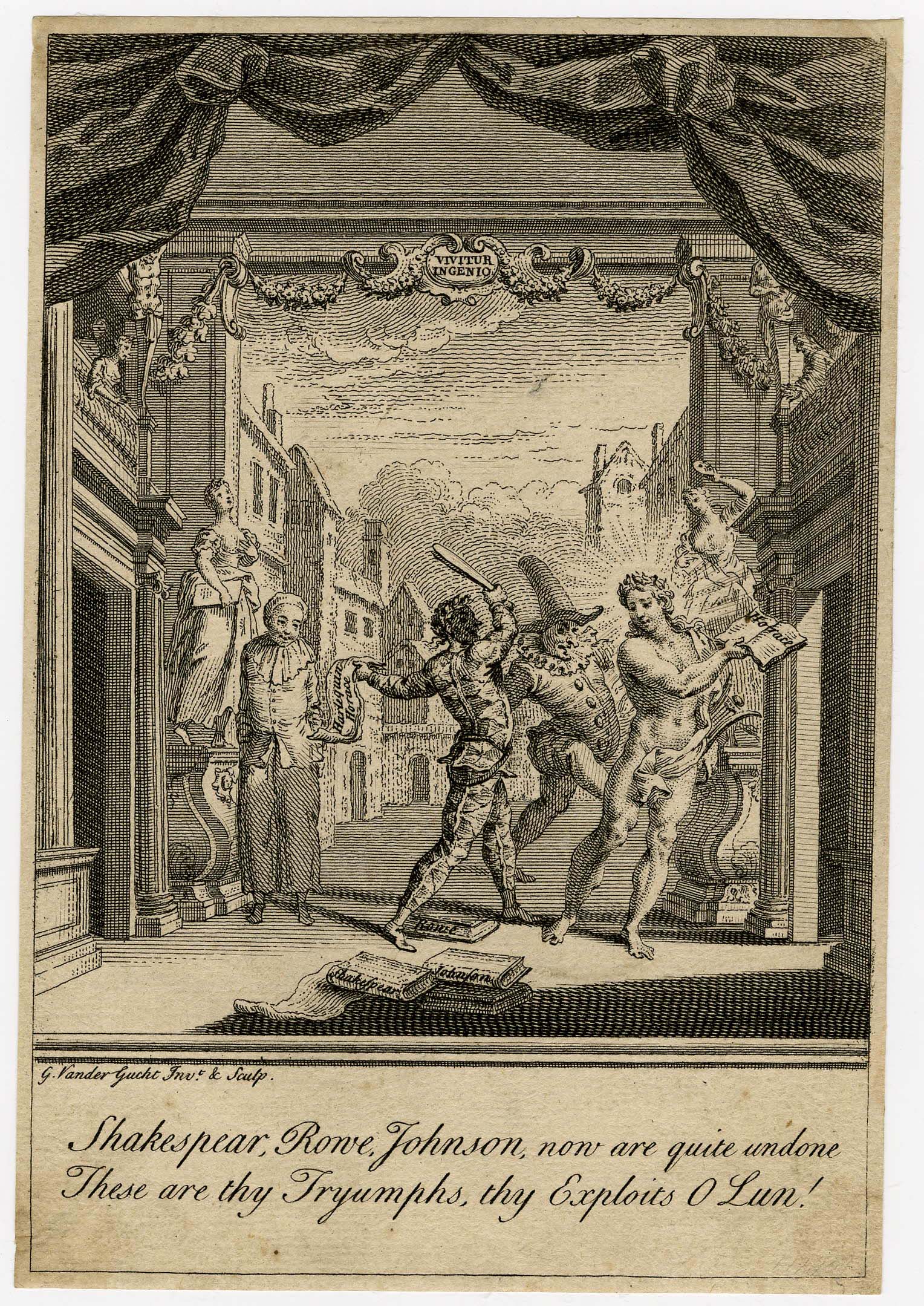
The Cheats; or, The Tavern Bilkers was, of course, a direct hit at Weaver by Rich – who obviously knew of Weaver’s claim to have created a piece entitled The Tavern Bilkers some fifteen years earlier, described by Weaver some years later as ‘The first Entertainment that appeared on the English Stage, where the Representation and Story was carried on by Dancing, Action and Motion only’ (The History of the Mimes and Pantomimes, published 1728, see page 45). The Jealous Doctor was based on a new, short-lived play given at Drury Lane on 16 January 1717, Three Hours after Marriage by John Gay, Alexander Pope and John Arbuthnot. Harlequin Executed had begun as a Lincoln’s Inn Fields entr’acte dance, entitled Italian Mimic Scene between a Scaramouch, Harlequin, Country Farmer, His Wife and Others on 26 December 1716 before being renamed as Harlequin Executed; or, The Farmer Disappointed on 29 December. After some seven performances as an entr’acte dance, it became an afterpiece on 10 May 1717 and would last in the Lincoln’s Inn Fields repertoire until 1721-1722. Although there is no mention of him in Harlequin Executed until 1717-1718, ‘Lun’ (John Rich himself) took the role of Harlequin in both The Cheats and The Jealous Doctor – directly challenging Weaver as Vulcan in The Loves of Mars and Venus and Perseus (Harlequin) in The Shipwreck. All of these afterpieces were, of course, laying the foundations for the new genre of English pantomime that would emerge over the next few years. This satirical print depicts how unsettling that would be for serious drama on the London stage. ‘Lun’ as Harlequin takes centre stage.

A Year of Dance: 1726

Following my recent detailed analysis of the 1725-1726 theatrical season on the London stage, I thought I should return to my A Year of Dance series and add 1726. (I wrote about 1725 quite some time ago). Politically, this seems to have been a quieter year than 1725.

In France in June, Louis XV appointed his old tutor André-Hercule de Fleury as his chief minister. Fleury was created a cardinal in September 1726. The previous spring, the poet and writer Voltaire had arrived in England for two years of exile from France following a second period of imprisonment in the Bastille. He quickly learned English, honing his language skills by regular visits to London’s theatres. During his stay he was to meet Alexander Pope, John Gay and Jonathan Swift, among others.

In England, 1726 was marked by the death of the architect and dramatist Sir John Vanbrugh on 26 March, followed by that of the scourge of London’s theatres Jeremy Collier on 26 April, whose A Short View of the Immorality and Profaneness of the English Stage published in 1698 had attacked Vanbrugh among other leading playwrights. Towards the end of the year, George I’s former wife Sophia Dorothea of Celle died. Their marriage had been dissolved following her adultery in 1694 and she had been imprisoned in her native Celle for more than twenty years. 1726 also saw the publication of Swift’s Gulliver’s Travels (‘Lilliputians’ would in due course become a popular feature on the London stage), as well as the ‘rabbit’ hoax by Mary Toft which fascinated and bamboozled many over the autumn.

In the wider context for these posts, the most significant theatrical event of 1726 in London was the new pantomime at Lincoln’s Inn Fields, Apollo and Daphne given on 14 January, which brought Francis and Marie Sallé back to the London stage after an absence of several years and reintroduced them to audiences as adult dancers. It answered Drury Lane’s 1725 Apollo and Daphne pantomime, which was revised and revived in reply. This small painting by the Italian artist Michele Rocca probably dates to the early 18th century.

There was also Italian opera at the King’s Theatre, with two new operas by Handel – Scipione on 12 March and Alessandro on 5 May. The Italian soprano Faustina Bordoni made her debut as Rossane in Alessandro, with Francesca Cuzzoni as Lisaura and Senesino in the title role.

In Paris, Destouches’s opéra-ballet Les Stratagèmes de l’Amour (composed to celebrate the marriage of Louis XV and Marie Leszczyńska the previous year) was given at the Paris Opéra on 28 March. The dancers included Françoise Prévost and David Dumoulin – she led the Troyennes in the first divertissement in Entrée I, while he led the Matelots in the second divertissement, and they danced together as Esclaves (with sixteen other dancers) in Entrée III. Rebel’s tragédie en musique Pyrame et Thisbé had its first performance on 17 October. David Dumoulin and Mlle Prévost also danced in this production, leading the Egyptiens (with Blondy) in act two and the Bergers and Bergères in act three.

No dances were published in notation this year. The last of the Paris collections had appeared in 1725, while in England the series of new dances ‘For the Year’ by Anthony L’Abbé had already ceased to be annual. It would resume in 1727 and continue, with occasional gaps, until 1733.

Season of 1725-1726: Afterpieces with Dancing at Lincoln’s Inn Fields

There were seven afterpieces with dancing at Lincoln’s Inn Fields in 1725-1726. One was a masque, while the rest were the pantomimes listed below.

Jupiter and Europa

The Necromancer

Harlequin a Sorcerer

Apollo and Daphne

The Cheats; or, The Tavern Bilkers

The Jealous Doctor

Only Apollo and Daphne was new. The list shows clearly how important pantomimes were to John Rich and his theatre company.

The masque was St. Ceciliae; or, The Union of the Three Sister Arts, which had first been performed in 1723-1724 and was briefly revived in 1724-1725 and 1725-1726. When it was given on 22 November 1725 (St. Cecilia’s day) it was advertised with ‘Proper Dances’ performed by three couples.

Jupiter and Europa; or, The Intrigues of Harlequin was given on 21 October 1725 with ‘Lun’ (John Rich) as Jupiter (Harlequin) and Mrs Wall as Europa and performed eight times in all during the season. The pantomime had first been performed in 1722-1723, when it had been billed as a ‘new Dramatic Entertainment of Dancing in Burlesque Characters’.  It lasted in the repertoire in its original form until 1727-1728 and was then revived in 1735-1736 within a new pantomime, The Royal Chace; or, Merlin’s Cave: With Jupiter and Europa. Like many of the pantomimes of this period, it is worth a post of its own. The abduction of Europa by Jupiter in the form of a bull was a favourite theme of artists of the period. This French painting by Pierre Gobert dates to the 1710s.

The Necromancer; or, Harlequin Doctor Faustus was given on 3 November 1725 with Lun as Faustus. This pantomime had been John Rich’s answer to John Thurmond Junior’s Harlequin Doctor Faustus in 1723-1724. It proved to be far more popular than its rival and would be regularly revived into the 1740s. The serious parts of Rich’s pantomimes used singers, rather than dancers as at Drury Lane, so Rich’s practice was to publish libretti for the ‘Vocal Parts’ with brief references to the action of the comic characters. The competition between the two Faustus pantomimes and the craze for these afterpieces which ensued meant that there were two scenarios printed for the Lincoln’s Inn Fields version. These provide details of the comic plot. The bills highlight the commedia dell’arte characters who appear in the final scene, performed by the company’s leading dancers – Harlequin Man and Woman, Pierrot Man and Woman, Mezzetin Man and Woman and Scaramouch Man and Woman. The Necromancer also featured Francis Nivelon as Punch.  This particular pantomime has attracted much scholarly attention, including analyses of the surviving music, and I will look at it more closely in a separate post. One drawing survives which is generally agreed to show the singer Richard Leveridge as an Infernal Spirit with John Rich as Faustus in scene one.

Harlequin a Sorcerer: With the Loves of Pluto and Proserpine, given at Lincoln’s Inn Fields on 21 January 1725, was Rich’s next new pantomime after The Necromancer. It received nearly 30 performances in its first season and was revived on 13 November 1725 for another ten. In 1725-1726, it was overshadowed by the popularity of that season’s new pantomime Apollo and Daphne. Rich, as Lun, took the title role in Harlequin a Sorcerer, while Pluto and Proserpine were played by singers. The pantomime’s subtitle refers to the pantomime that Rich had wanted to produce (and would indeed put on the following season). The libretto that was published to accompany performances records a few details of the scenic tricks and transformations in the piece, which I will also look at separately. Harlequin a Sorcerer lasted until the early 1730s and was revived at Covent Garden in the 1750s.

The 1725-1726 season’s new pantomime, Apollo and Daphne; or, The Burgomaster Tricked, was first given on 14 January 1726 with Francis and Marie Sallé in the title roles and Francis Nivelon as the Burgomaster. It had 45 performances before the end of the season and would be regularly revived into the 1750s, making it one of Rich’s most popular pantomime afterpieces. Apollo and Daphne was unusual among the Lincoln’s Inn Fields pantomimes for using dancers to play the principal characters in the serious plot – Rich was, of course, replying to Thurmond Junior and Mrs Booth at Drury Lane. Only the words for the ‘Vocal Parts’ were published, with little beyond the descriptions of the various scenes to hint at the dance and mime performed by the Sallés. There is no mention of the comic scenes with the Burgomaster or the various commedia dell’arte characters. Rich went one better than Drury Lane with his concluding entertainment to Apollo and Daphne, in which Francis and Marie Sallé reappeared as Zephyrus and Flora. Recent research suggests that this was taken from Aubert’s opera La Reine des Péris given at the Paris Opéra in 1725. Again, I will have to devote a separate post to this pantomime. The Triumph of Flora, like Zephyrus and Flora, was a favourite theme for artists. This version by Poussin is much earlier, although the artist was still greatly admired in the 18th century.

The last two pantomimes in repertoire at Lincoln’s Inn Fields in 1725-1726 were given during the summer season. The Cheats; or, The Tavern Bilkers was revived on 1 July 1726 for the first of five performances. Over the years casts were rarely listed for this pantomime, and this summer’s advertisements were no exception. The Cheats had begun life in 1716-1717 and was undoubtedly intended by Rich as a hit at John Weaver, whose danced afterpieces were popular at Drury Lane that season (Weaver’s first piece for the stage had been titled The Tavern Bilkers). On the occasions when the characters in The Cheats were named in the bills they were revealed as drawn from the commedia dell’arte – the piece was billed as an ‘Italian Night Scene’ at its first performance. The Cheats was revived into the early 1730s.

The Jealous Doctor; or, The Intriguing Dame, given on 19 July 1726 and then for another three performances, also dated back to 1716-1717. It had replied to the play by John Gay, Alexander Pope and John Arbuthnot Three Hours after Marriage given at Drury Lane that same season. The play lasted for only a few performances, but the pantomime was revived around half-a-dozen times each season until 1725-1726. Its relegation to the 1726 summer season marked the end of its stage life.

I am going to round up this lengthy exploration of dancing on the London stage during the 1725-1726 season in my next post by considering what all these details might tell us about dancing at the two patent theatres and stage dancing in London more generally.

Season of 1725-1726: Solo Entr’acte Dances at Lincoln’s Inn Fields

The following solo entr’acte dances were given at Lincoln’s Inn Fields in 1725-1726:

Scotch Dance

Wooden Shoe Dance

Passacaille

Les Caractères de la Dance

French Sailor

French Clown

Chacone

Louvre

Flag Dance

Dutch Boor

Saraband

Spanish Dance

Dame Gigogne

As I mentioned in my last post about the entr’acte solos at Drury Lane, this season the Passacaille and the Spanish Dance were also performed there.

I recently wrote a post about Scotch Dances on the London stage and I began by mentioning those performed during the 1725-1726 season. Mrs Bullock performed a solo Scots Dance at Lincoln’s Inn Fields on 4 October 1725 and repeated it at least ten times that season. Thanks to her and Newhouse (who performed a Scottish Dance with Mrs Ogden at least five times this season), Scotch Dances had become a regular feature in the entr’actes by the mid-1720s. Although we still don’t know much about them and where they might have come from.

On 13 October 1725, Nivelon performed a Wooden Shoe Dance and repeated what was surely the same dance ‘in the Character of a Clown’ (meaning a rustic or peasant) on 25 October. The solo was billed simply as a Wooden Shoe Dance for the rest of the season and he performed it at least eleven times. There had been occasional Wooden Shoe Dances as early as 1709-1710, but it was Nivelon who established them in the entr’acte repertoire. He sometimes danced a Wooden Shoe duet with Mrs Laguerre (although not in 1725-1726), but his solo was far more popular.

Only one of the many solos and other dances given in the entr’actes at London’s theatres over the course of the 18th century is widely known among those with an interest in dance history. At Lincoln’s Inn Fields on 27 November 1725, Marie Sallé performed ‘Les Caractères de la Dance, in which are express’d all the different Movements in Dancing’. The description refers to Rebel’s score, which runs through the courante, minuet, bourée, chaconne, saraband, gigue, rigaudon, passepied, gavotte, loure and musette in some eight minutes or so. This dance (which was also occasionally performed as a duet) has been much discussed and often recreated. Its history on the London stage is worth a post of its own, so I won’t say much here. Mlle Sallé gave it three times during the 1725-1726 season. It was revived by her once in 1726-1727 and then several times as Les Caractères de l’Amour (which I assume was essentially the same) in 1733-1734, her penultimate season on the London stage. The solo obviously proved popular, because it was performed by several of London’s leading female dancers into the early 1750s.

A solo French Sailor was apparently danced at Lincoln’s Inn Fields by Francis Sallé on 3 January 1726. I have been wondering whether this really was a solo, since every other performance of the French Sailor this season was a duet by both Sallés. There is no other reference to Francis giving a solo Sailor’s Dance, with the exception of his appearance in a Sailor’s Hornpipe in 1729-1730. The advertisement refers to ‘Mons Salle’s French Sailor’, which may simply be meant to draw attention to the fact that he had created the duet that he danced with his sister. Of course, he may simply have adapted that duet into a solo to be performed alongside the solo French Peasant by Nivelon and Mrs Bullock’s solo Scotch Dance on the same bill.

On 31 March 1726, Nivelon danced a solo French Clown. Although he was occasionally so billed, he was more often advertised in a Clown solo (he appeared at least once as a Dutch Clown). Nivelon’s repertoire, in particular his appearance in pantomime afterpieces, needs careful analysis, but it is possible that the main difference between these three solos was their costumes rather than their choreographies. The term ‘Clown’ can have rustic connotations, but perhaps Nivelon’s solo was related to the ‘Buffoon’ depicted by Lambranzi, who describes his performance thus (the translation is from New and Curious School of Theatrical Dancing translated by Derra de Moroda, edited by Cyril Beaumont and first published in 1928, p. 25):

‘This buffoon does various foolish but curious pas, with distorted but comic jumps, which he varies as much as possible and endeavours to make still more humorous, until the air has been played three times.’

Lambranzi shows the Buffoon performing a suitably distorted pas.

In 1725-1726, four different female dancers performed a solo Chacone in the entr’actes at Lincoln’s Inn Fields. The first was Mrs Bullock on 31 March 1726, followed on 9 May by Mrs Anderson, on 11 May by Miss Latour and on 14 May by Mrs Wall. All were benefit performances (Miss Latour was dancing at her own benefit). Mrs Anderson went on to perform her solo Chacone another eight times during the theatre’s summer season. Without their music, it is difficult to know what these solos might have been like. Were they related to Pecour’s ‘Chacone pour une femme’ danced to music from Lully’s Phaëton and published in notation in 1704? Mrs Bullock’s Chacone was part of her repertoire from 1714-1715 to 1734-1735 and undoubtedly changed over the years. What little evidence we have of her technical abilities (in the form of L’Abbé’s ‘Saraband of Issee’ and ‘Jigg’ created for her and Dupré) suggests that she could be a virtuoso dancer. Was her solo Chacone popular because it was a tour de force?

Leach Glover made his first appearance of the season on 14 April 1726, a benefit for Mrs Laguerre and her husband, when he danced a solo Louvre. Most advertisements for the Louvre referred to the duet Aimable Vainqueur, a favourite for benefit performances, but solo billings point to quite different dances. They are never billed explicitly as such, but at least some of them may have been ‘Spanish’ dances using loures either from Lully’s Le Bourgeois gentilhomme or Campra’s L’Europe galante. There was a recent precedent for such a solo in L’Abbé’s ‘Spanish Entrée’ created for the young George Desnoyer in 1721 or 1722 and published in notation around 1725.

This solo was to Lully’s music and provides a glimpse of the male dance virtuosity to be seen in London’s theatres at this period. This first plate includes cabrioles and a pirouette with pas battus (in modern terminology petits battements). Later in the solo there are several entre-chats à six, some of which are incorporated into tours en l’air.

At his benefit on 15 April 1726, Nivelon included his solo Flag Dance – a piece that he seems to have had a near monopoly on. He apparently introduced it to the London stage at Lincoln’s Inn Fields in 1723-1724 and was last billed performing it in 1730-1731. This is another piece which might have a link to Lambranzi, who has a dance by a ‘Switzer’ with a ‘standard’.

Nivelon’s dance may also have been related to the ‘Flourishing of the Colours’ performed by Signora Violante at the King’s Theatre in 1719-1720.

Nivelon was very busy in the entr’actes during 1725-1726, for on 15 April he also added a Dutch Boor to his repertoire. As I have mentioned in earlier posts, ‘Dutch’ dances were very popular on the London stage, although – apart from the Dutch Skipper – solo dances were far less often performed than duets. By London audiences, a ‘Dutch Boor’ was probably seen as a Dutch peasant or country bumpkin. Nivelon was rarely seen in ‘Dutch’ dances and this seems to be the only time he performed such a solo on its own.

Mrs Wall danced a solo ‘new Saraband compos’d by Dupre’ at the benefit she shared with Newhouse on 30 April 1726. It is possible that she had been taught by Dupré, although this was not mentioned in the bills. I wrote about the Saraband on the London Stage back in 2015, so I won’t say more here – except to suggest that this solo was a ‘French’ rather than a ‘Spanish’ Saraband.

There was a solo Spanish Dance at Lincoln’s Inn Fields this season, given by Lesac on 11 May 1726 – his benefit shared with Miss Latour, both of them billed earlier in the season as scholars of Dupré. Could this also have been a loure?

The last of the solos danced at Lincoln’s Inn Fields in 1725-1726 was a ‘new Comic Dance called Dame Gigogne’ performed by Mrs Anderson on 5 July 1726. This seems to be the only mention of this character in the entr’actes at London’s theatres. Dame Ragonde, however, turns up several times, notably in the mid-1710s, usually alongside various commedia dell’arte characters and sometimes with her ‘Family’. Dame Gigogne and Dame Ragonde are all but interchangeable and can be traced back in dance and music contexts to the late 17th century, notably to the cast of Le Mariage de la Grosse Cathos given at Louis XIV’s court in 1688. For a short discussion of both characters and their history see Musical Theatre at the Court of Louis XIV by Rebecca Harris-Warrick and Carol G. Marsh (1994), particularly pages 41-43. This image of Dame Ragonde may hint at Mrs Anderson’s appearance in her solo.

She is shown as a lady of uncertain age in a distinctly old-fashioned dress.

I will turn my attention to dancing in the pantomime afterpieces at both playhouses next, although one or two other topics may intervene over the next few weeks.

Season of 1725-1726: Other Entr’acte Duets at Lincoln’s Inn Fields

The other duets given at Lincoln’s Inn Fields this season were:

French Peasant

Passacaille

French Sailor and his Wife

Shepherd and Shepherdess

Spanish Entry

Le Marrie

Two Pierrots

Running Footman’s Dance

Fingalian Dance

Burgomaster and his Frow

Tollet’s Ground

Chacone

Venetian Dance

Swedish Dance

Spinning Wheel Dance

The last two duets were performed only during the summer season.

It is immediately apparent that Lincoln’s Inn Fields offered a wider range of entr’acte choreographies than Drury Lane in 1725-1726. This was related to the dancers employed there this season, as well as John Rich’s habitual use of dance as a weapon in his rivalry with the other patent theatre.

The French Peasant danced by Nivelon and Mrs Laguerre on 29 September 1725 was one of the perennially popular dances on the London stage. So far as I can tell, a French Peasant duet was first advertised at Drury Lane on 15 June 1704, when the dancers were Mr and Mrs Du Ruel. It would continue in the entr’acte repertoire until the early 1740s. Several Peasant or ‘Paysan’ dances were recorded in notation in the early 1700s, including this choreography by Guillaume-Louis Pecour published in the Nouveau recüeil de dance de bal et celle de ballet around 1713.

These dances may provide hints towards the French Peasant dances on the London stage.

The Passacaille was seldom advertised as a duet in London’s theatres and the two performances given at Lincoln’s Inn Fields on 13 October and 9 November 1725 by Lally and Mrs Wall seem to be the last to be billed before the 1770s. The only notated passacaille duet for a man and a woman, choreographed by Guillaume-Louis Pecour for Ballon and Mlle Subligny, was published in 1704 and thus does not necessarily provide an exemplar for a dance of the mid-1720s. I wrote about both solo and duet passacailles in my post The Passacaille back in 2017.

As I mentioned in an earlier post, ‘Sailor’ dances on the London stage go back to the 17th century and were a frequent feature in 18th-century entr’acte entertainments. A French Sailor duet was performed at Lincoln’s Inn Fields in the mid-1710s, but the French Sailor and his Wife performed there on 25 October 1725 by Francis and Marie Sallé seems to mark a new chapter in the stage life of the dance. I can certainly devote a post to the sailor dances in London’s theatres, so I won’t pursue the topic further here. It is just worth mentioning that a Matelot duet was introduced to the entr’actes at Drury Lane in 1726-1727, raising a question about the difference between it and the French Sailor dances.

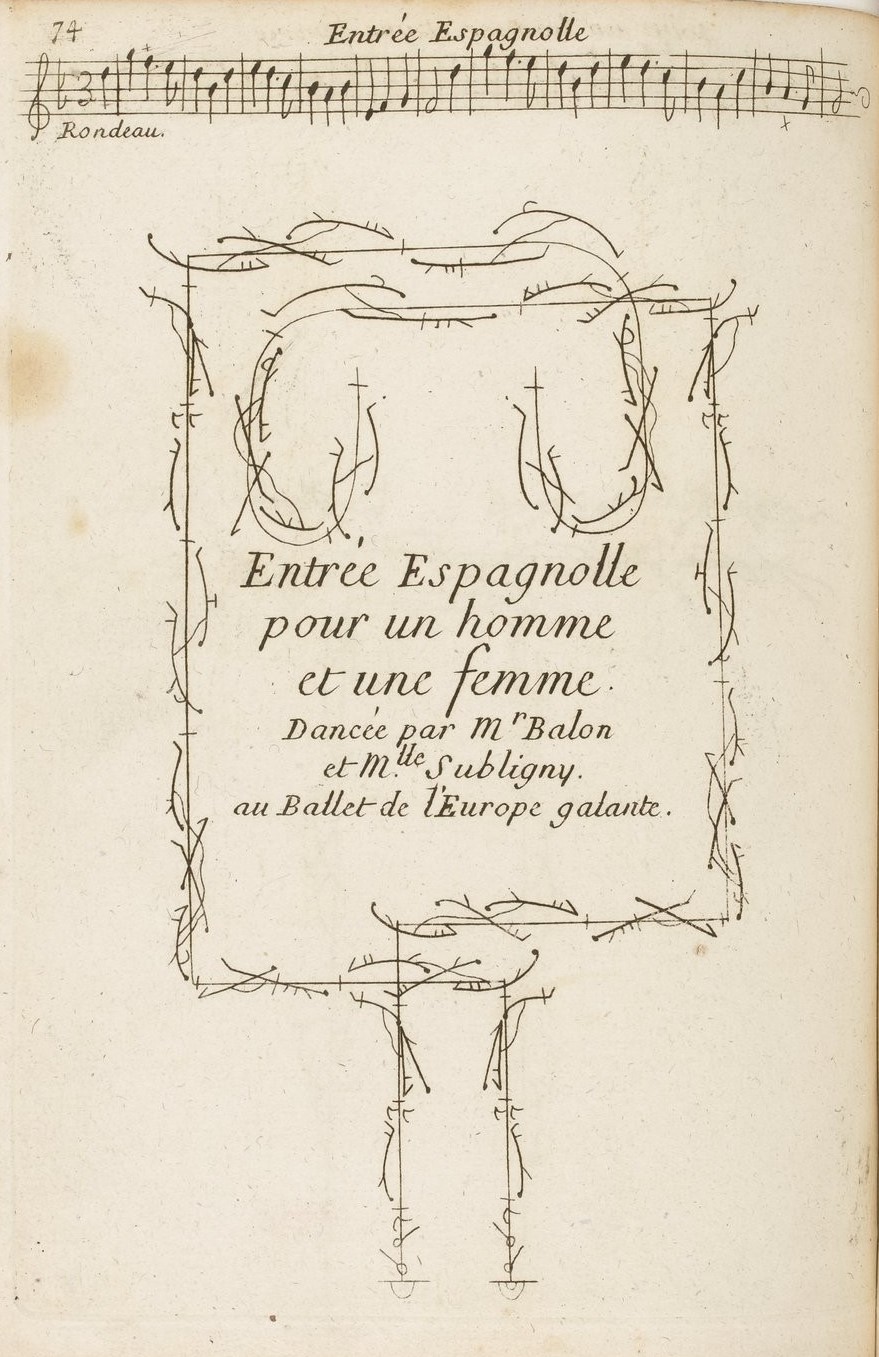
I discussed Shepherd and Shepherdess dances in an earlier post, Season of 1725-1726: Entr’acte Dances at Drury Lane and Lincoln’s Inn Fields, so I will move straight on to the Spanish Entry given as a duet by Lesac and Miss La Tour on 2 November 1725. I have written about ‘Spanish’ dances before – in posts entitled ‘Spanish’ Dances, Dancing ‘Spaniards’ and ‘Spanish’ Dancing and the Dance Treatises – but I haven’t taken an extended look at such dances on the London stage. I am not going to attempt that here, although it is certainly another topic worth exploring. There were Spanish Dances and Spanish Entries advertised in the entr’actes at London’s theatres from the first decade of the 18th century, which probably drew on similar choreographies from the Restoration period. The Spanish Entry had been advertised as a duet at Lincoln’s Inn Fields and had stayed in the repertoire for a few seasons. It had then disappeared, only to reappear in the mid-1720s with the duet danced by Lesac and Miss La Tour. The use of the word ‘Entry’ for this dance suggests (to me at least) that it was less likely to have been a version of the Folies d’Espagne than one of the other dance types made popular in the French comédies-ballets and opéra-ballets given in Paris. Here is the first plate from Pecour’s well-known ‘Entrée Espagnolle’ for Ballon and Mlle Subligny, which provides one example that may have been influential (it was transcribed by Kellom Tomlinson in his ‘WorkBook’ compiled during the first two decades of the 18th century).

Le Marrie’ danced by Francis and Marie Sallé at Lincoln’s Inn Fields on 16 December 1725 must surely have been Pecour’s ball dance La Mariée, first published by Feuillet in his 1700 Recüeil de dances composées par Mr. Pecour. As I wrote in another post back in 2015, La Mariée on the London Stage, research by the American dance historian Rebecca Harris-Warrick has shown that this duet probably began as a stage dance in Paris and reached the London stage shortly after 1698. The Marie performed at Lincoln’s Inn Fields in 1717-1718 could have been La Mariée resurfacing in the entr’actes, although its performance by the Sallés seems to have given the duet a new lease of life with regular revivals at benefit performances. Here is the first plate from the 1700 collection.

Two Pierrots was also danced by the Sallés at Lincoln’s Inn Fields on 16 December 1725. They seem to have introduced the male-female duet to London – previously there had been a few Pierrot solos and an all-male duet by Francis and Louis Nivelon in 1723-1724. The Sallés were answered at Drury Lane by Roger and Mrs Brett in La Pierette later that season. I should probably have counted Two Pierrots and La Pierette among the entr’acte dances shared between the two theatres, although the titles suggest that two might have been quite different thematically if not choreographically. Pierrot dances would last into the 1750s and beyond.

The Running Footman, danced by Nivelon and Mrs Laguerre on 10 March 1726, had been introduced to the London stage by them in 1723-1724. It was probably created by Nivelon and I looked at the duet in some detail in my post Dances on the London Stage: The Running Footman back in September.

The Fingalian Dance performed by Newhouse and Mrs Ogden on 11 April 1726 had first been danced by them in 1724-1725. They would continue to perform it regularly each season until 1733-1734. This entr’acte duet had apparently begun life as ‘A new Irish Dance in Fingalian Habits by Newhouse, Pelling, and Mrs Ogden’ at Lincoln’s Inn Fields in 1723-1724 but the trio format did not survive the season. Newhouse and Mrs Ogden were also billed more than a dozen times during 1724-1725 in an Irish Dance. I think that was probably the Fingalian Dance, which I am guessing was choreographed by Newhouse. There are a number of ‘Irish’ tunes in the various editions of Playford’s The Dancing Master, all considerably earlier than the duet by Newhouse and Mrs Ogden. They may hint at the music for the Fingalian Dance, although the dance itself seems to have been characterised by its costumes as much as the ‘Irishness’ of its music. Fingal is a county in Ireland in the Dublin region – the reference to ‘Fingalian Habits’ suggests costumes that are at least recognisably Irish. So far, I have not managed to find any clues as to what these ‘Habits’ may have been like. Fingalian Dances would survive in the London stage entr’acte repertoire until the 1770s.

The Burgomaster and his Frow, another entr’acte dance performed by Newhouse and Mrs Ogden on 20 April 1726, was one of the many ‘Dutch’ dances given in the entr’actes at London’s theatres. The duet seems to have been variously titled – as Dutch Boor in 1723-1724 and 1724-1725 and as Dutch Burgomaster and Wife in 1724-1725 – but it seems to have been distinct from the Dutch Skipper, which Newhouse was never billed as dancing. There is, of course, music for a ‘Dance for the Dutch man and his Wife’ in Thomas Bray’s 1699 collection Country Dances. This tune was used in Europe’s Revels for the Peace, the masque created to celebrate the peace of Ryswick that ended the Nine Years’ War in 1697.

Tollett’s Ground, danced by Newhouse and Mrs Laguerre on 30 April 1726 and revived during the Lincoln’s Inn Fields summer season by him and Mrs Ogden, took its title from its music. The piece is generally attributed to the Irish musician Thomas Tollett, who worked in London’s theatres during the 1690s and may have died in 1696. It appeared in several music collections around 1700 and was first billed at Drury Lane in 1701-1702, when it was performed by John Essex and Mrs Lucas. During the 1710s it was given several times by Margaret Bicknell and her sister Elizabeth Younger. The Tollett’s Ground duet survived into the early 1730s and was usually performed at benefits or during the summer season.

I mentioned the Chacone in my post The Most Popular Entr’acte Dances on the London Stage, 1700-1760 a couple of months ago. In 1725-1726, a Chacone duet was danced at Lincoln’s Inn Fields by Dupré and Mrs Wall on 30 April and then 23 May 1726, followed by Lally and Mrs Wall on 30 May. Some of the chaconnes given in London’s theatres were associated with Harlequin, but others (including this one) were evidently serious dances. We do have a local notated example of a chaconne for the stage which was published around this time and might shed light on some of those given in the entr’actes. Anthony L’Abbé choreographed the ‘Chacone of Galathee’ for Delagarde and Mrs Santlow (from 1719 Mrs Booth) perhaps around 1712, although it seems to have been notated some ten years later – around the time it was published by Le Roussau in A New Collection of Dances. As this plate reveals, it was a showpiece of virtuosity for these two dancers (I strongly suspect that Delagarde’s entre-chat à six should also have a tour-en-l’air, and I certainly think that Mrs Santlow was capable of adding an entre-chat à six to her tour).

The Chacone duets danced by Dupré and Lally with Mrs Wall in 1725-1726 may have been similar.

The Venetian Dance was given just once this season, on 9 May 1726 by Burny and Mrs Anderson ‘both Scholars to Essex’. At present, I can’t be sure whether ‘Essex’ is William Essex, who had made his debut at Drury Lane the previous season, or his father John, who had left the stage to pursue his career as a dancing master more than twenty years earlier. John Essex is perhaps the more likely candidate. It is tempting to assume that a Venetian Dance must be performed to a forlana, but a contemporary source suggests a quite different piece of music – the allemande used by Pecour for his duet of that title, published in Paris in 1702. I have puzzled over this musical choice, apparently made for a ‘Venetian Dance by Mr Shaw and Mrs Booth’ which was performed (but not mentioned in the bills) in 1724-1725. I can see that I should return to Venetian Dances in another post.

Dances associated with particular nations were decidedly popular at Lincoln’s Inn Fields this season. Another was the Swedish Dal Carl given by Pelling and Mrs Ogden on 17 June 1726 (the opening performance of the summer season). A ‘new Swedish Dance’ had entered the entr’acte repertoire at Lincoln’s Inn Fields in 1714-1715, when it was performed by Delagarde and Miss Russell (later Mrs Bullock and a leading dancer at that theatre). Thereafter the Swedish Dale Karl, as it was usually known, was performed most seasons into the 1730s. It may well have continued to use the music recorded in The Ladys Banquet 3d Book, a collection first published around 1720, although the earliest surviving edition has been dated around 1732. The ‘new Play House’ mentioned on the score is probably Lincoln’s Inn Fields, which opened in 1714. There are no solo Swedish Dances billed in London’s theatres, so is the ‘Sweedish Woman’s Dance’ actually part of the duet?

The last of the dances I listed at the beginning of this post was also performed only during the Lincoln’s Inn Fields summer season. Newhouse and Mrs Ogden performed the Spinning Wheel Dance on 21 June 1726. The duet had first been given in 1723-1724 at the same theatre and the bills indicate that it only ever received a handful of performances. I would characterise it as one of the novelty dances that turn up in the entr’actes from time to time, particularly during summer seasons.

My next post on the season of 1725-1726 will be concerned with the entr’acte solos given at Drury Lane and Lincoln’s Inn Fields.

Season of 1725-1726: Group Entr’acte Dances at Drury Lane and Lincoln’s Inn Fields

Myrtillo was performed at Drury Lane on 25 September 1725 and then at Lincoln’s Inn Fields on 4 October. At Drury Lane the dancers for this particular group entr’acte dance were never specifically billed, so we cannot be sure how many dancers there were and who performed Myrtillo. At Lincoln’s Inn Fields, the bill for 2 April 1726 named Dupré, Lally, Pelling, Mrs Laguerre, Mrs Wall and Mrs Bullock, who probably formed three couples according to the order in which their names appear, i.e. Dupré and Mrs Laguerre, Lally and Mrs Wall, Pelling and Mrs Bullock – reflecting the dance partnerships during this season.

In the absence of pictorial material directly related to dancing on the London stage at this period, it is worth looking at some of the conventions around the depiction of dancers in a pastoral setting. This is obviously a quite separate area of research and one that I will not try to undertake here. However, this print after Watteau dating to the late 1720s perhaps evokes some of the visual expectations that audiences might have brought to the theatre, as well as some possible influences on the theatre managers and their designers.

The choreography had begun as a ‘Grand Dance’ within the ‘Pastoral Interlude’ Myrtillo, an afterpiece with a libretto by Colley Cibber and music by Johann Christoph Pepusch first given at Drury Lane on 5 November 1715. The afterpiece did not last long, but its ‘Grand Dance’ was first billed separately in the entr’actes on 31 May 1716 when the dancers were Dupré, Boval, Dupré Jr (not the same dancer as at Lincoln’s Inn Fields ten years later), Mrs Santlow (who became Mrs Booth), Mrs Bicknell and Miss Younger. The entr’acte dance Myrtillo was revived at Drury Lane regularly thereafter, and billed at Lincoln’s Inn Fields for the first time on 17 October 1721. It would continue in repertoire at Lincoln’s Inn Fields until the 1729-1730 season and at Drury Lane until 1734-1735.

Myrtillo was usually danced by three couples, although some advertisements suggest that there could be as many as five or as few as two (I haven’t yet checked whether or not the transcriptions in The London Stage are accurate for these latter). It is one of the very few entr’acte dances from this period for which we can be sure of the music, since Pepusch’s original score survives in the collections of London’s Royal Academy of Music. It includes a single dance at the end of the entertainment, which has five sections – a rigaudon, a gavotte, a musette, another rigaudon and a passepied (the pieces are not titled, but their musical characteristics suggest these dance types). I discussed Myrtillo in my book The Incomparable Hester Santlow, so I will not analyse it further here except to suggest that it may have been first choreographed by Louis Dupré and he may well have mounted it at Lincoln’s Inn Fields later.

A key part of any choreography is surely the costuming, which delineates characters as well as helping to shape the steps performed by individual dancers. A surviving costume bill from the Drury Lane Theatre tells us that, in the afterpiece Myrtillo, Mrs Santlow wore a white lustring dress decorated with rose coloured satin ribbon and trimmed with white ribbon roses, while Mrs Bicknell wore only a ‘Paysanes Dress’. The bill also mentions binding for Mrs Santlow’s stays and the whalebone of her petticoat – she evidently wore a hooped skirt. It survives, along with many others, in the collections of the Folger Shakespeare Library, and provides helpful insights not only into what dancers wore on the London stage, but also the hierarchies of the characters they portrayed.

The other group dances at Drury Lane in 1725-1726 were La Follett and Le Badinage Champetre, both choreographed by Roger, and a Turkish Dance (also titled Grand Turkish Dance). Roger may well have been drawing on his earlier career with various companies of French commedia dell’arte players (possibly including that led by Francisque Moylin, uncle to Francis and Marie Sallé). In 1725-1726, he was appearing with one of London’s own theatre companies for the first time and apparently made his Drury Lane debut with La Follett on 23 September 1725. He wasn’t explicitly billed until 28 September, when he was named as the dance’s choreographer and described as the ‘French Pierot’. La Follett itself was billed as a dance ‘in Comic Characters’ and danced by Roger, Thurmond Jr, Boval, Lally, Mrs Brett and Miss Tenoe. The ‘Comic Characters’ were probably drawn from the commedia dell’arte, but I am not going to pursue the meaning of the dance’s title here. It was given eleven performances in 1725-1726 and then disappeared from the repertoire.

The title of Le Badinage Champetre is surely self-explanatory. It was performed by five couples, with (as was usual) the men billed first followed by the women – Roger, Boval, Lally, Duplessis, Haughton, Mrs Booth, Mrs Tenoe, Mrs Brett, Mrs Walter, Miss Lindar. I suggest that this was a divertissement rather than a single dance, with Roger and Mrs Booth as the leading couple and the last two men and last two women as supporting dancers to the others. Le Badinage Champetre proved popular and was danced regularly into the 1730s.

The Turkish Dance given at Drury Lane on 31 March 1726 was performed by five men – Thurmond Jr, Roger, Boval, Lally and Duplessis (the transcription in The London Stage omits Boval, although he appears in the Daily Courant advertisement on that day). Thurmond Jr had probably danced in L’Abbe’s ‘Turkish Dance’ duet in 1723-1724, so could this new choreography (which I suspect may have been by him) have used music from Campra’s L’Europe galante? Or did it perhaps draw on Lully’s music for the Turkish Ceremony in Le Bourgeois gentilhomme, which had been presented at the Little Theatre in the Haymarket a few seasons earlier?

This image from part two of Lambranzi’s 1716 Neue und curieuse theatrialische Tantz-Schul shows four Turks dancing together. Can it tell us anything about either the costuming or the choreography of the Turkish Dance given at Drury Lane in 1726?

At Lincoln’s Inn Fields, in addition to Myrtillo the following group entr’acte dances were performed:

Grand Dance

Shepherds and Shepherdesses

The Rivals (a trio)

Grand Dance of Two Punches, Two Scaramouches, and Three Harlequins

Grand Spanish Dance

Grand Chacone

The Grand Dance was first given on 21 March 1726 with three couples – Dupré and Mrs Wall, Sallé and Mrs Bullock, Lally and Mrs Anderson – listed so in the bills. It was advertised as being performed at the end of the afterpiece, a ‘Pastoral Entertainment of Vocal and Instrumental Musick’ entitled The Fickle Fair One. Was it actually an entr’acte dance, or was it performed in the piece’s closing scene?

Shepherds and Shepherdesses was given on 18 April 1726 and danced by Dupré, Sallé, Lally, Pelling, Mrs Bullock, Mrs Wall, Mrs Anderson. Such dances were particularly popular during the 1720s and 1730s, although this one seems not to have outlasted the 1725-1726 season. The uneven number of men and women seems to point to a divertissement structure incorporating solos and duets.

The Rivals was a trio danced by Francis Sallé, Francis Nivelon and Marie Sallé ‘in the Characters of Harlequin, Punch and Harlequin Woman’. The Sallés must have been the Harlequins, with Nivelon as Punch. The dance was presented only once, on 18 April 1726 for the benefit of Francis and Marie Sallé. It presumably included commedia dell’arte-style pantomime alongside dancing and may have been a short scene. There were always a number of dances each season that were performed only as benefit pieces and this seems to have been one of them.

This print is taken from a well-known painting by Nicolas Lancret of the mid-1720s. It shows Harlequin and Harlequine, with Pierrot rather than Punch (although Lancret did depict Punch in other paintings). Could it give us a flavour of the commedia dell’arte-style dances on the London stage, in particular The Rivals with its three French dancers?

I am reproducing prints in this post because this was how such paintings became known in London at this period.

The Grand Dance of Two Punches, Two Scaramouches, and Three Harlequins was first billed on 19 April 1726 for Lally’s benefit. The dancers were not named until 30 April, when the dance was repeated at the benefit of Newhouse and Mrs Wall. Dupré and Sallé were two Harlequins, with Mrs Wall as Harlequin Woman making up the third, the Punches were Newhouse and Pelling and the Scaramouches Lanyon and Dupré Jr. This Grand Dance was repeated at two more benefits before the end of the season. Dances by commedia dell’arte characters had been popular since the first decade of the 18th century and it would be interesting to chart the changes in that popularity as well as the variety of choreographies offered. Over time, they were wholly absorbed into the pantomime afterpieces and all but disappeared from the entr’actes.

Both the Grand Spanish Dance and the Grand Chacone were added to the Lincoln’s Inn Fields entr’acte dance repertoire at Dupré’s benefit on 21 April 1726. It is possible that both dances were either arranged or choreographed by him. ‘Spanish’ dances were regularly given in the entr’actes, although this Grand Spanish Dance – performed by Dupré, Pelling, Newhouse, Lanyon, Dupré Jr, Mrs Bullock, Mrs Wall, Mrs Ogden and Mrs Anderson – was danced only once. The billing of five men and four women suggests that Dupré may have danced as a soloist with four supporting couples.

The Grand Chacone was danced by four men and four women – Dupré, Lally, Pelling, Dupré Jr, Mrs Bullock, Mrs Wall, Mrs Ogden and Mrs Anderson. Like the Grand Spanish Dance, this choreography was performed only once. Chacones were performed regularly in the entr’actes at London’s theatres from the first decade of the 18th century to the 1730s. Many were solos associated with individual dancers. This Grand Chacone may provide some hints on those danced at the Paris Opéra, although we can only guess at the choreographies performed there or in London. Was the music for both this dance and the Grand Spanish Dance from French operas?

Despite the lack of documentation on the actual dancing, these group dances are interesting for what they tell us about choreographic themes popular in London and with the choreographers working there, as well as the deployment of dancers in the ‘company within the company’ at each of London’s theatres. In my next post, I will take a look at the duets given at Drury Lane and Lincoln’s Inn Fields.

Season of 1725-1726: Entr’acte Dances at Drury Lane and Lincoln’s Inn Fields

In my first post about dancing on the London stage during the 1725-1726 season, I provided some statistics for the number of entr’acte dances performed in the theatres. At Drury Lane there were 28 dances in all – 4 group dances, 1 trio, 13 duets and 10 solos. At Lincoln’s Inn Fields there were 43 entr’acte dances – 7 group dances, 2 trios, 22 duets and 12 solos. I should qualify this set of figures immediately by noting that 5 dances – 1 trio, 3 duets and 1 solo – were given only during the Lincoln’s Inn Fields summer season. Nevertheless, the disparity between the two theatres is interesting since Drury Lane had 91 performances with entr’acte dancing billed, whereas (excluding its summer season) Lincoln’s Inn Fields had 81.

As with the dancers, the figures are not quite accurate, although it is probably next to impossible to be sure exactly what dances were performed. At Drury Lane, Roger danced a solo Peasant, a solo Drunken Peasant and a solo French Peasant. Were these all different choreographies? Were all (or perhaps two) of them the same dance, but performed differently according to the various characters depicted? At Lincoln’s Inn Fields, Nivelon gave both a solo Wooden Shoe Dance and a solo Wooden Shoe Dance in the Character of a Clown. Were these actually the same choreography? There were also two Shepherd and Shepherdess duets given at Lincoln’s Inn Fields during the course of the season, one by Francis and Marie Sallé and the other, titled Shepherd and Shepherdess representing Acis and Galatea, by Le Sac and Miss La Tour. I think that these had different music and different choreographies (which may, however, have been related in terms of steps, figures and even choreographic motifs). The duet by Le Sac and Miss La Tour may have used music by Handel, whose Acis and Galatea had first been performed some years previously, although it would not reach the London stage (in a revised version) until 1731. The duet was performed at their joint benefit on 11 May 1726, when Miss La Tour also played a ‘Set of Mr Hendel’s Lessons’ on the harpsichord as an entr’acte entertainment. It seems likely that the Sallés danced to music from a French opera. I also made a mistake when I included the new Dance of Slaves advertised on 25 October 1725 among the entr’acte dances. When I took another look, I concluded that it was probably danced within Oroonoko which was the mainpiece that evening.

There is an overlap in the dance titles advertised at the two theatres, suggesting a common source for some dances and perhaps shared music, if not similar choreographies. Here are those titles.

Myrtillo, a group dance

Polonese, a duet

Dutch Skipper, a duet

Pastoral, a duet

Saraband, a duet

Minuet, a duet

Peasants, a duet

Spanish Entry / Spanish Dance, a solo

I will use these dances as the starting point to look more closely at the repertoire of entr’acte dances given at Drury Lane and Lincoln’s Inn Fields in 1725-1726. I will deal with each of the dance types – group (including trios), duet and solo – in separate posts. Curiously, there is quite a lot we can discover (and that I can say) about them, even though we cannot reach the actual choreographies.