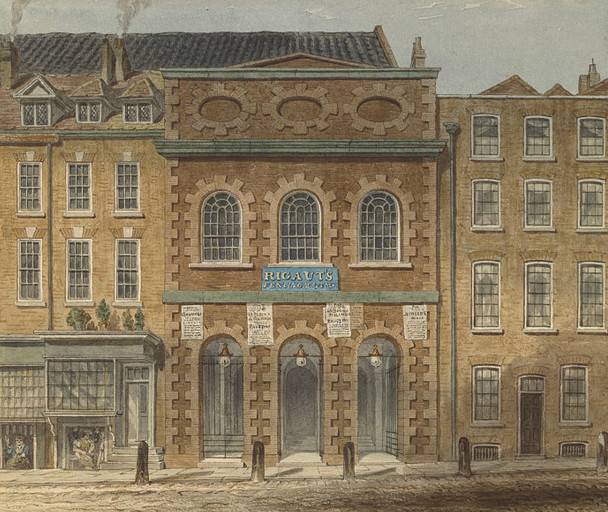
Tag Archives: Lincoln's Inn Fields Theatre

Who Was Francis Sallé?

Most people who have an interest in the history of dancing will have heard of the 18th-century French ballerina Marie Sallé. How many will know of Francis Sallé, her brother, who is mentioned only in passing in the various accounts of her career? I use the English form of his first name because, unlike Marie, he chose to pursue a career on the London stage.

Francis and Marie Sallé made their debuts together on the London stage, at the Lincoln’s Inn Fields Theatre on 18 October 1716. They were billed as ‘two Children, Scholars of M Ballon, lately arriv’d from the Opera at Paris’, with the warning to prospective audiences that ‘Their Stay will be short in England’. The ‘Opera’ was, of course, Paris’s Opéra-Comique rather than the Académie Royale de Musique, despite the link with Claude Ballon. Francis is generally said to have been born in 1705 and Marie in 1707, so they were eleven and nine years old when they first came to London. At their first performance, they danced the Harlequins in Two Punchanellos, Two Harlequins and a Dame Ragonde. They proved so popular that their stay was extended. In the bills from 5 to 10 December, Rich encouraged interest in their performances with successive announcements from the children ‘stay but Nine Days longer’  down to ‘the last Time but one of their Dancing during their Stay in England’. Their last performance was, ostensibly, their shared benefit on 11 December 1716, which according to the advertisement in the Daily Courant for that day, included

‘… several Entertainments of Dancing, both Serious and Comic, by the Children and others. A new Comic Dance, call’d The Drunken Man, to be perform’d by the Children. The last New Comic Dance, compos’d by Mons. Moreau, and to be perform’d by him, Mr. Kellom’s Schollar, Mr. Cook, Mrs. Schoolding, Mrs. Cross, Miss Smith, and the Children. Likewise a Scene in the French Andromache burlesqued, to be acted by the Children: Orestes to be perform’d by Mons. Salle, and Hermione by Mademoiselle Salle his Sister.’

On 18 December 1716, the bills announced ‘In Consideration of the Diversion the French Children have given the Town, Mr. Rich has engag’d their Stay in England for some time longer. The two children danced at Lincoln’s Inn Fields until 10 June 1717, with one performance at the King’s Theatre on 5 June, giving more than 100 performances in all. They were allowed a second benefit on 11 May 1717, when they gave a ‘French Scene’ with their father and danced with Moreau and Mrs Schoolding.

During the 1716-1717 season, the two children performed around a dozen entr’acte dances both serious and comic. Their repertoire included a ball dance by Kellom Tomlinson, The Submission first given on 21 February 1717 and published in notation the same year. The dance opens with a slow triple-time section, followed by a minuet and then a rigadon. Here is the first plate.
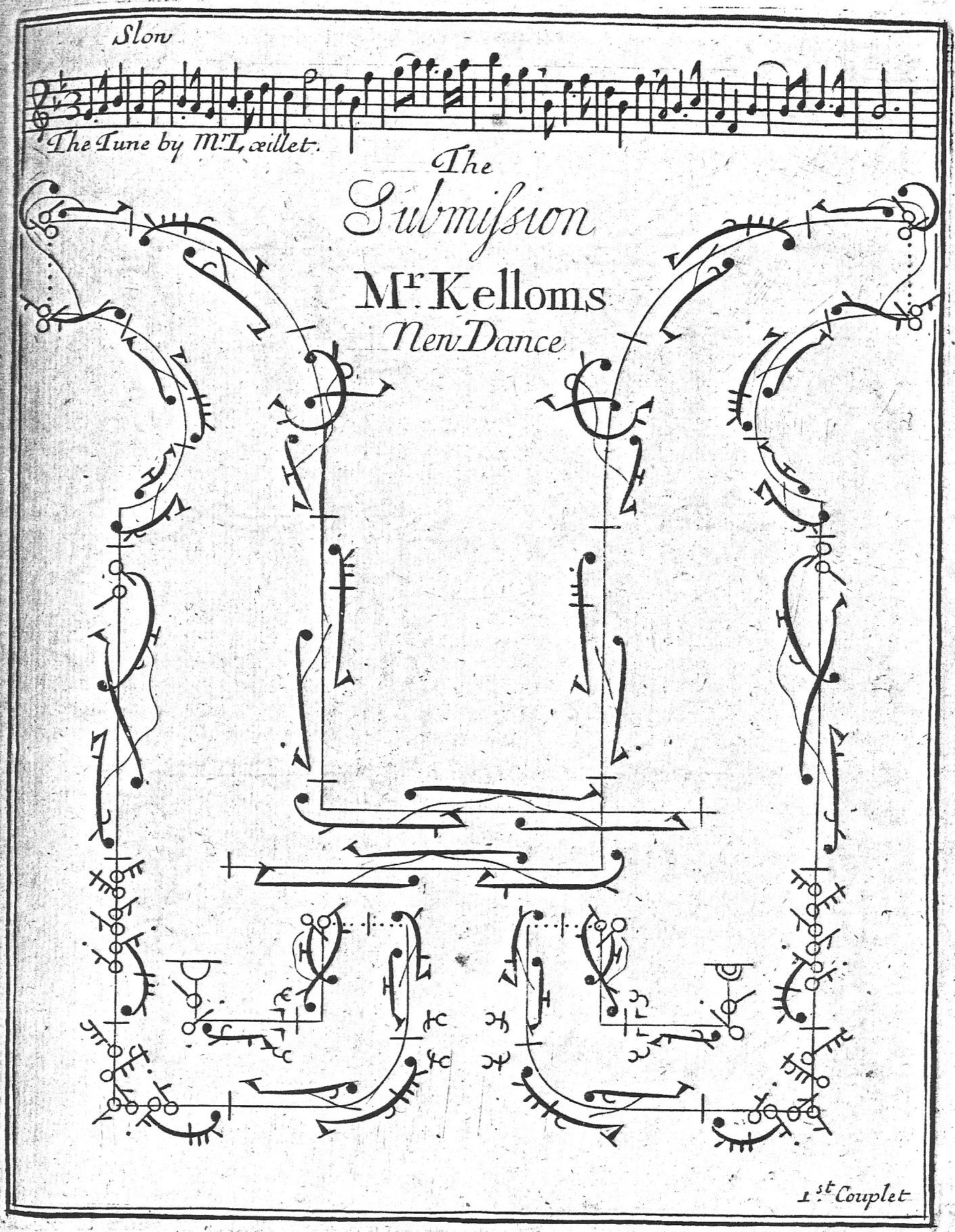
This is the only dance created for either Francis or Marie Sallé that survives in notation.

The two young dancers returned to London for the 1718-1719 season, this time appearing first at Lincoln’s Inn Fields and then at the King’s Theatre with the troupe of their uncle Francisque Moylin. At Lincoln’s Inn Fields, they were mentioned only once in the bills, on the 19 December 1718 (their benefit performance), when they were advertised as ‘M and Mlle Salle, the two Children, who dance in the Company of the French Comedians’. They were billed only three times when Moylin’s company moved to the King’s Theatre. However, the Lincoln’s Inn Fields bill suggests that they may have danced at most, if not all, of the 40 performances that the French Comedians gave at the two theatres between 7 November 1718 and 19 March 1719. The bills say nothing at all about their repertoire.

Francis and Marie Sallé did not return to London again until the 1725-1726 season, when they again danced for John Rich at Lincoln’s Inn Fields. By this time, Francis was twenty years old and Marie eighteen and they immediately became the company’s leading dancers. They performed the title roles in that season’s new pantomime, Apollo and Daphne; or, The Burgomaster Trick’d, Rich’s answer to Drury Lane’s Apollo and Daphne; or, Harlequin’s Metamorphoses of the previous season. At Drury Lane, the title roles had been taken by John Thurmond Jr (the pantomime’s creator) and Hester Booth and Rich followed suit with two dancers at Lincoln’s Inn Fields. The two Sallés also appeared as Zephyrus and Flora in the pantomime’s concluding divertissement. Apollo and Daphne; or, The Burgomaster Trick’d, first performed on 14 January 1726, was given 45 performances before the end of the season. Francis Sallé was billed for 106 performances during 1725-1726. As well as dancing four entr’acte  duets with Marie, he apparently gave a solo French Sailor (in addition to the French Sailor and His Wife with his sister) and danced Two Pierrots with Francis Nivelon as well as Two Harlequins with Louis Dupré. He also partnered Mrs Bullock in a Grand Dance with other dancers in the company. Francis and Marie Sallé shared a benefit on 18 April 1726, the last time they would do so. Their careers were already beginning to diverge.

Both Sallés returned to Lincoln’s Inn fields for the 1726-1727 season. They were first billed together, without comment, on 19 September 1726 dancing Shepherd and Shepherdess and French Sailors. Francis had already appeared a few days earlier, dancing First Fury in The Necromancer (a role he had initially performed the previous season). He and Marie repeated their roles in Apollo and Daphne and danced together in the entr’actes, although Francis was also billed (without Marie) alongside other dancers in the company for performances of The Prophetess as well as a new masque Pan and Syrinx, first given on 24 October 1726. Later in the season, on 30 May 1727, he was billed as Mezzetin Man (with the actress-dancer Elizabeth Younger as Mezzetin Woman) in The Necromancer as well as First Fury. By contrast, Marie’s only billing without her brother was on 27 April 1727, when she performed a new Ball Dance with Leach Glover at his benefit.

The main reason for the Sallés engagement at Lincoln’s Inn Fields in 1726-1727 was undoubtedly their appearance in the new pantomime, The Rape of Proserpine, introduced on 13 February 1727 and performed 32 times before the end of the season. This was a pantomime that Rich had long wished to produce. In the libretto for Harlequin a Sorcerer, first given at Lincoln’s Inn Fields on 21 February 1725, he had written of ‘The Expectation which has been rais’d in the Town of seeing a Dramatick Entertainment, call’d The Rape of Proserpine‘ explaining that ‘being disappointed of some very necessary Persons from abroad, on whom we depended, we have deferr’d the same for some time longer’. The ‘very necessary Persons’ must have been Francis and Marie Sallé, for all the other principal performers in The Rape of Proserpine appeared in Harlequin a Sorcerer. When Rich was able to engage the two Sallés for the 1725-1726 season, his focus had evidently turned immediately to the need to outdo Drury Lane’s Apollo and Daphne and he had deferred his pet project for another year.

In The Rape of Proserpine, the roles of Ceres, Pluto, Proserpine and Mercury were all performed by singers, although Marie and Francis danced in the serious part of the pantomime. She was the first of five female Sylvans, while he was the first of four Gods of the Woods and the first of five Demons. The most spectacular dancing was probably reserved for the ballet which ended the pantomime, described thus in the libretto, ‘Enter several Dancers, who represent the four Elements, and celebrate the Marriage of Pluto and Proserpine, by a Grand Ballet.’ Earth was danced by Louis Dupré, with Mrs Pelling as his Female. Air was Leach Glover, with Mrs Laguerre, and Fire was Poitier with Mrs Bullock. The ballet must have culminated with the appearance of Francis Sallé as Water, accompanied by his sister. The bills suggest that the men may have danced virtuoso solos as well as duets with their ‘Females’. The Rape of Proserpine drew on Lully’s 1680 opera Proserpine and the ballet of the elements may have had a French source too, although this has yet to be identified.

This season, Marie received her own benefit on 6 April 1727 at which she apparently did not dance, for the advertisement announced only a Pastoral by her scholar the nine-year-old Miss Rogers and Two Pierrots by Francis Nivelon and Francis Sallé. Her brother’s benefit was a week later, on 14 April, at which the mainpiece was The Prophetess (in which he may well have danced) and the dancing comprised a solo Harlequin by Miss Violante, his scholar, a solo version of Les Caractères de la Dance by Marie and a Fury Dance with Francis as First Fury (presumably taken from The Necromancer). It is worth noting that Marie’s benefit was more profitable than that of Francis and had higher attendance than his. Marie Sallé had already emerged as the more celebrated dancer and was probably the more ambitious too. During 1726-1727, Francis Sallé gave 97 performances and had evidently decided that his future lay with Rich’s company. The surviving Lincoln’s Inn Fields accounts for that season record a payment of 10 guineas on 9 June 1727 to ‘Mr Salle upon signing articles and in pt of next year’s contract’.

Marie Sallé would not return to London and Lincoln’s Inn Fields until the 1730-1731 season. Francis became one of Rich’s group of dancers, although he probably returned to dance in France regularly. His first London season without his sister, 1727-1728, may not have met his expectations. On 29 January 1728, the first performance of The Beggar’s Opera was given at Lincoln’s Inn Fields, and the production dominated the theatre’s repertoire until the end of the season. None of the bills for The Beggar’s Opera mention dancing, but the libretto does refer to dances and it is possible that at least one of them – the ‘Dance of Prisoners in Chains’ was performed by male dancers in the company. Otherwise, Francis Sallé was billed only four times in the entr’actes, although his appearances in The Necromancer, Apollo and Daphne and The Rape of Proserpine (with Mrs Laguerre in Marie Sallé’s roles in the two latter pantomimes) came to a total of 46 performances. His benefit, on 22 April 1728, was shared with Michael Poitier and he did not dance himself. Sallé’s last billing before that was on 25 March 1728 and he may have been absent for the rest of the season.

Although The Beggar’s Opera was given frequently in 1728-1729, there was more room for other repertoire in the course of the season. Francis Sallé danced from 21 October 1728 to 22 May 1729 and was billed in three entr’acte duets, two entr’acte group dances and five afterpieces (three of which were pantomimes). He was advertised in 67 performances altogether and allowed a solo benefit on 8 April 1729, when he danced the Mad Soldier in The Humours of Bedlam (a comic ballet always given with the play The Pilgrim) as well as two entr’acte duets with Mrs Laguerre – Highlander and Mistress and French Sailor. By this time he had established a dance partnership with Mrs Laguerre, their new duet Highlander and Mistress was repeated nine times before the end of the season and continued to be popular thereafter.

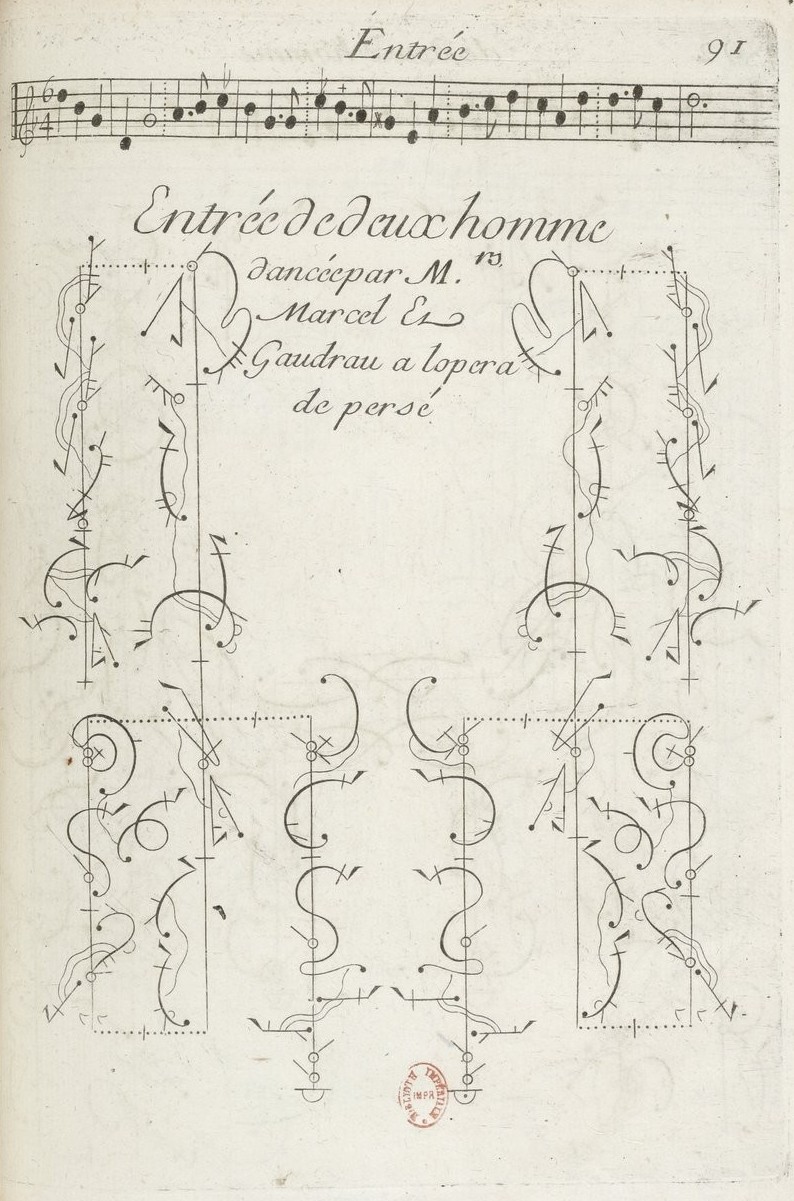
In 1729-1730, Sallé was billed for 117 performances. This season was dominated by another new pantomime, Perseus and Andromeda; or, The Cheats of Harlequin (or, The Flying Lovers), Rich’s response to Drury Lane’s Perseus and Andromeda: With the Rape of Colombine; or, The Flying Lovers by Roger and Weaver given the previous season. The Lincoln’s Inn Fields Perseus and Andromeda was performed 60 times before the end of 1729-1730. Francis Sallé was an Infernal in the serious part of the pantomime, for which Rich had drawn on Lully’s 1682 opera Persée, and it is tempting to speculate whether he and his fellow dancers (Poitier, Dupré, Pelling, Newhouse and Lanyon – Papillion, billed first, was actually a singer and probably did not dance) performed to the ‘Entrée des Divinités Infernales’ from the opera. A duet created by Guillaume-Louis Pecour to this music for Marcel and Gaudrau, performed at the Paris Opéra, was published in notation around 1713 and shows the demands that could be placed on male dancers at the period. Sallé’s early tuition by Claude Ballon (which could have continued beyond his childhood) indicates that he might well have been capable of similar virtuosity. Here is the first plate:
Sallé also danced in a smaller scale afterpiece in 1729-1730, The Dutch and Scotch Contention first given on 29 October 1729. This was probably taken from a ballet performed at the Opéra-Comique in Paris, in which Sallé had appeared ‘en Ecossois’ alongside Roger and Nivelon. I looked at this piece in some detail in my post Highland Dances on the London Stage, back in February 2021. Sallé’s duet Highlander and Mistress with Mrs Laguerre formed part of the action in the London ballet.

Marie Sallé returned to Lincoln’s Inn Fields for the 1730-1731 season, first appearing on 23 November 1730 and dancing until 4 June 1731. Francis made his first appearance some two months before the arrival of his sister, on 21 September 1730, and his last just a few days later, on 7 June 1731. His benefit was on 5 April 1731, in which he danced The Loyal and Generous Free-Mason with Dupré, Pelling and Newhouse – described in the advertisements as ‘all Brothers’- as well as the duets Les Caractères de la Dance and the Louvre and Bretagne with Marie. The last two were ballroom dances by Guillaume-Louis Pecour, among the most famous choreographies of the day and regularly given at benefit performances in London’s theatres. Sallé’s benefit brought in a little over £129. His sister’s benefit, held on 25 March 1731 and commanded by the King (who attended with the Queen, Prince William and the ‘three eldest princesses’), brought in more than £194. She and Francis performed Les Caractères de la Dance together, while Francis also contributed a Scottish Dance duet with Mrs Laguerre (perhaps the popular Highlander and Mistress introduced in 1729).

During 1730-1731, Francis danced with his sister at only 16 of his 50 appearances in the entr’actes and at only 22 of his 65 afterpiece performances. He danced with Marie in Apollo and Daphne and The Rape of Proserpine, but his most popular entr’acte dance was again Highlander and Mistress with Mrs Laguerre. While their respective benefits underlined Marie Sallé’s celebrity status, Francis demonstrated his independence from his sister and his importance as a dancer on the London stage.

The 1731-1732 season was marked by the absence of Marie Sallé. Francis danced at Lincoln’s Inn Fields from 4 October 1731 to 2 June 1732, giving 111 performances in all. His benefit on 12 April 1732 brought in a little over £80 and he was allowed a second benefit on 24 May 1732 which achieved receipts of just over £93. The receipts and the two benefits (an unusual arrangement) need analysis which I won’t undertake here, although there is no question that Francis Sallé was working hard for John Rich who certainly appreciated his contribution to the company. This season, his principal partner was Mrs Laguerre, with whom he performed several entra’cte dances including French Sailor and Wife (presumably the duet Francis had often performed with his sister), Highlander and Mistress and a new duet The Baulk which promised to be popular beyond 1731-1732. He again took leading dancing roles (partnering Mrs Laguerre) in Apollo and Daphne, The Rape of Proserpine and The Dutch and Scotch Contention. For his final performance of the season, Sallé danced as an Infernal in Perseus and Andromeda.

Just ten days after his last performance, the Daily Post for 12 June 1732 announced that:

 ‘On Friday last died at his Lodgings at Newington Green, after a tedious Indisposition, Mons. Salle, a celebrated Dancer belonging to Lincoln’s Inn Fields Playhouse.’

Francis Sallé was buried at St. John Hackney on 14 June 1732. He was little more than twenty-seven years old. According to Dacier in Une Danseuse de l’Opéra sous Louis XV (pp. 293-4), Marie Sallé was grief-stricken by her brother’s death and a portrait of Francis was found among her possessions after her own death.

Francis and Marie Sallé pursued separate careers alongside their performances together in London. She was far more successful, yet his career deserves much more attention than it has received. He was, for a time, the leading male dancer in John Rich’s company at Lincoln’s Inn Fields and – had he lived longer – would undoubtedly have gone on to star at the first Covent Garden Theatre, opened by Rich in December 1732 just a few months after Sallé’s untimely death.

Notes:

There seems to be no documentary proof of the birth dates of either Francis or Marie Sallé. In his biography, Une Danseuse de l’Opéra sous Louis XV: Mlle Sallé (1707-1756), Émile Dacier gives her birth year as 1707 (p. 4 n. 2). In their Mémoires pour servir à l’histoire des spectacles de la foire, 2 vols. (Paris, 1743) the Parfaicts declare that Francis was two years older than Marie (vol. 1, p. 207). Together, these sources presumably provide what evidence there is for his birth year.

For The Rape of Proserpine, Perseus and Andromeda and French dancing see: Moira Goff, ‘John Rich, French Dancing, and English Pantomimes’, “The Stage’s Glory” John Rich, 1692-1761, ed. Berta Joncus and Jeremy Barlow (Newark, NJ, 2011), 85-98.

There are numerous volumes of accounts for the Lincoln’s Inn Fields and Covent Garden theatres during the 18th century in the manuscript collections at the British Library. The entry for Francis Sallé quoted above comes from Egerton ms. 2266, f. 171r.

For dancing in The Beggar’s Opera, see Jeremy Barlow and Moira Goff, ‘Dancing in Early productions of The Beggar’s Opera’, Dance Research, 33.2 (2015), 143-158 (pp. 148-149 for the ‘Dance of Prisoners in Chains’).

Other Dance in History posts relating to the London career of Francis Sallé include:

Aimable Vainqueur on the London Stage

La Bretagne in London

Highland Dances on the London Stage

The Humours of Bedlam

The Necromancer at 300

Season of 1725-1726 (11 posts on various aspects of the dancing at Drury Lane and Lincoln’s Inn Fields this season)

The Necromancer at 300

At the Lincoln’s Inn Fields Theatre, the manager John Rich had been watching Drury Lane’s developing repertoire of pantomimes and he was quick to respond to the success of Harlequin Dotor Faustus. On 20 November 1723, the afterpiece at Lincoln’s Inn Fields was ‘A New Dramatick Entertainment in Grotesque Characters’ entitled The Necromancer; or, Harlequin Doctor Faustus. Here is the advertisement from the Daily Courant that same day.

Rich himself, under his stage name ‘Lun’, took the title role. The new pantomime was given 51 performances before the end of the season and then played every season until 1744-1745. It was briefly revived in 1751-1752 and 1752-1753 before it finally disappeared from the repertoire.

The Necromancer was far more successful than Thurmond Junor’s Harlequin Doctor Faustus. It is thus interesting to note that in 1766-1767 Henry Woodward (who had been trained in the role of Harlequin by John Rich) produced a new pantomime at the Covent Garden Theatre titling it simply Harlequin Doctor Faustus. The advertisements declared that it drew on The Necromancer for some of its scenes, but it seems to have had little or nothing to do with Thurmond Junior’s original.

Rich’s pantomimes made much use of singing and The Necromancer had two scenes which exploited the talents of the singers in his company. The opening scene echoed that of Harlequin Doctor Faustus, as the Doctor is persuaded to sign away his soul, but Rich had a Good Spirit, a Bad Spirit and (instead of Mephostophilus) an Infernal Spirit, all of whom made their entreaties in song. A drawing now in the British Museum shows Faustus together with the Infernal Spirit in this scene.

There is a dance of five Furies in this same scene (which may have been a nod to French opera, which was a strong influence on Rich and his pantomime productions). The Infernal Spirit finally induces Faustus to take his fatal step by conjuring the appearance of Helen of Troy, who does not dance but sings. Rich’s creative response to his rival’s scenario can be seen from the very beginning of The Necromancer. The second episode of singing begins the final scene of the pantomime, when Faustus himself conjures Hero and Leander, who celebrate in song their eternal bliss in the Elysian Fields until Charon arrives and declares (again in song) his intention to ferry them to Hell.

The Lincoln’s Inn Fields pantomime was far more focussed than its rival at Drury Lane. It had only eight scenes, three of which were purely transitional – as characters entered and left the stage linking the scenes before and after with the minimum of action, a device that Thurmond Junior did not really use. The whole action of The Necromancer was published in An Exact Description of the Two Fam’d Entertainments of Harlequin Doctor Faustus … and The Necromancer of 1724. The first performances of the pantomime were accompanied by The Vocal Parts of an Entertainment, call’d The Necromancer : or, Harlequin Doctor Faustus which must have appeared before the end of 1723. There was also a series of editions of A Dramatick Entertainment call’d The Necromancer: or, Harlequin Doctor Faustus which gave only the sung texts. Without An Exact Description, we would know little about the comic action in The Necromancer.

There was dancing in five of the eight scenes. In scene 5, two men enter as Faustus is enjoying a meal with two Country Girls. He tells the men’s fortunes, which they reject and then try to make off without paying him. As they leave, Faustus ‘brings ‘em back on their Hands, making ‘em in that Posture dance a Minuet round the Room’.

In the following scene the dancing was probably more conventional, for the location moves to a Mill where the Miller’s Wife dances a solo before she is joined by the Miller for a duet. Their choreography may have owed something to the various Miller’s dances which had been given in the entr’actes at London’s theatres since the early 1700s. The scene carried on with one of the pantomime’s more daring scenic tricks, as Faustus tries to elude the Miller and make off with his wife, finally fixing the Miller to one of the sails of his own Mill and setting them turning.

Rich’s masterstroke was the finale of The Necromancer, which may have been developed in response to little more than a hint in Thurmond Junior’s Harlequin Doctor Faustus. In the latter, Mephostophilus ‘flies down upon a Dragon’ in the first scene, but Rich reserved the appearance of his monster to the end of his pantomime. As soon as Hero, Leander and Charon have vanished:

‘The Doctor waves his Wand, and the Scene changes to a Wood; a monstrous Dragon appears, and descends about half way down the Stage, and from each Claw drops a Daemon, representing divers grotesque Figures, viz. Harlequin, Punch, Scaramouch, and Mezzetin. Four Female Spirits rise in Character to each Figure, and join in an Antick Dance;’

This was probably the most substantial sequence of dancing in the pantomime, performed by the company’s leading dancers with Dupré and Mrs Rogier as the Harlequins, Nivelon Junior and Mrs Cross as the Pierrots (Punch is not listed among these dancing Spirits in the advertisements although he did appear in the pantomime, played by Nivelon Senior i.e. Francis Nivelon), Glover and Mrs Wall as the Mezzetins and Lanyon and Mrs Bullock as Scaramouches. Dupré was, of course, a dancing Harlequin and his performance in this last scene must have been very different from John Rich’s in the title role. The dance historian Richard Semmens has suggested that this ‘Antick Dance’ was performed to a chacone, a piece which is included among music for The Necromancer published some years later. The scene then moves inexorably to its tragic conclusion.

‘as they are performing, a Clock strikes; the Doctor is seiz’d by Spirits, and thrown into the Dragon’s Mouth, which opens and shuts several times, ‘till he has swallow’d the Doctor down, belching out Flames of Fire, and roaring in a horrible Manner. The Dragon rises slowly; the four Daemons that drop from his Claws, take hold of ‘em again, and rise with it; the Spirits vanish;’

Rich did not bother with a masque to point the moral of his tale. The Necromancer ends with a sung chorus:

Now triumph Hell, and Fiends be gay,

The Sorc’rer is become our Prey.

In contrast to Harlequin Doctor Faustus, evil apparently triumphs at the end of The Necromancer.

It has been suggested that Rich was preparing The Necromancer as a new pantomime for Lincoln’s Inn Fields well before Drury Lane mounted Harlequin Doctor Faustus, but the coincidence seems unlikely and does not fit with his later practice. Could he instead have been developing another theme and then quickly repurposed its tricks and transformations to outdo Drury Lane with its own story?

References:

Richard Semmens, Studies in the English Pantomime, 1712-1733 (Hillsdale, NY, 2016), chapter 3.

Olive Baldwin and Thelma Wilson, ‘“Heathen Gods and Heroes”: Singers and John Rich’s Pantomimes at Lincoln’s Inn Fields’, “The Stage’s Glory” John Rich, 1692-1761, ed. Berta Joncus and Jeremy Barlow (Newark, NJ, 2011), 157-168.

How Many Dancers Can You Fit on an Early 18th-Century London Stage?

Watching several excerpts from baroque operas performed in period style recently, I was struck by how crowded the stage was – particularly when there were also dancers. I couldn’t help wondering how this might relate to dancing in London’s theatres during the 1700s and what this might tell us about the view seen from the audience. These operas were not performed in an 18th-century theatre, although the stage and its scenery emulated its much earlier predecessors. The main differences (so far as London is concerned) were that there was no forestage (the area in front of the proscenium arch which projected into the auditorium) and the stage was not raked. I have been told that the overall space for the dancers to perform, with some variation between individual productions, was 24 feet across the front of the stage, narrowing to around 15 feet upstage and with a depth of some 10 to 12 feet. How does this compare with London’s Drury Lane, Lincoln’s Inn Fields and Covent Garden Theatres in the early decades of the 18th century?

Stages in London’s Theatres

By 1714, London had three theatres with either a patent or a license which allowed them to present a variety of entertainments to the public. Drury Lane, built in 1674, and Lincoln’s Inn Fields, reopened in 1714 after the rebuilding of an earlier theatre, offered plays and related genres with a variety of entr’acte entertainments. The King’s Theatre, known as the Queen’s Theatre when it opened in 1705, was to all intents and purposes London’s opera house offering the newly-fashionable Italian opera. Covent Garden, like the King’s Theatre an entirely new playhouse, opened in 1732 and took over the repertoire previously given at Lincoln’s Inn Fields, although it also offered Italian opera from time to time. Drury Lane, Lincoln’s Inn Fields and Covent Garden all included entr’acte dances and danced afterpieces on their bills.

The three theatres used for drama accommodated their audiences on several levels. The pit was in front of and a little below the stage, the front boxes faced the stage on a level with it and the side boxes ran along the sides of the auditorium from the stage in two or more tiers at stage level and above. Some of the side boxes were within the stage area. Above the front boxes rose one or two galleries. There were no separate numbered seats and no fixed capacity at any of the theatres. On special occasions, for example performer benefits, seating could be altered by railing part of the pit into boxes and at many performances members of the audience might sit on the stage itself. Drury Lane could hold around 1000 spectators, while at Lincoln’s Inn Fields and Covent Garden there could be as many as 1400. The auditoriums were fan-shaped, rather than the horse-shoe shape more familiar to us now, and provided good sightlines from most parts of the house. The whole of each theatre was illuminated by candles, with footlights at the front of the stage, and both the auditorium and stage remained fully lit throughout the performance.

The stage itself had three distinct parts. The forestage was in front of the proscenium arch and was wider than it was deep. It was well in front of the scenery and the most brightly lit of the stage areas. The scenic stage was immediately behind the proscenium arch.  It was deeper than the forestage and narrowed progressively towards the upstage area. It was enclosed by the wings and shutters which formed the scenery, and was also the area where machines were used for special effects like flying or transformations. It contained traps for surprise appearances and disappearances. Beyond the scenic stage was the vista stage used for deep perspective scenes, an area not used for acting or dancing.  Dance historians are divided on whether dancers were able to perform within the scenic stage, because of the traps and the placing of the grooves which held the scenes and shutters. There is some evidence that the first set of shutters was normally placed some nine feet upstage of the proscenium arch, which could have allowed dancers to use the area in front of them.

This plan of the Covent Garden Theatre of 1732, published in Paris some forty years later, shows the layout of the stage and points to the area most likely to have been used by dancers.

The incomplete data from the three theatres does not readily translate into precise measurements. In The Development of the English Playhouse, Richard Leacroft provides detailed drawings for conjectural reconstructions of Drury Lane and Covent Garden, but he does not try to do the same for Lincoln’s Inn Fields. His drawings are difficult to interpret in any detail by those of us who are non-specialists in architecture. Using Leacroft together with an essay by Edward A. Langhans and a pamphlet by Paul Sawyer it is possible to provide some indicative figures (references for all these sources are given at the end of this post). At Drury Lane the forestage was some 30 feet wide and 20 feet deep, while at Covent Garden it was 30 feet wide but only 12 feet deep. The scenic stage at Drury Lane was 25 feet wide and 30 feet deep. At Covent Garden it was 30 feet wide and 30 feet deep. There are no certain figures for Lincoln’s Inn Fields, but the forestage may have been some 25 feet wide and its depth has been estimated at only 12 to 15 feet. However, a visitor who saw the playhouse more than a dozen years after it had fallen out of use for performances said that it ‘stretched itself to nearly the center of the house greatly to the dimunation of the Pit’, suggesting that it was in fact deeper than the forestage at its contemporary Drury Lane.

It is hard to assess how far the dancers moved upstage as they were performing, as this will have depended on the scenery and props for individual productions as well as the amount of upstage lighting. With this fresh review of the evidence, I think that dancers might have had a maximum space of some 30 feet by 30 feet (across and up the stage) at each of the playhouses.

Dancers on London’s Stages

How many dancers did London’s theatres have on stage at any one time in mainpieces, afterpieces and the entr’actes? I can’t answer this question definitively. For now, I will concentrate on the 1720s when, for some reason, advertisements were more detailed and specific than they were in the surrounding decades.

There were a handful of mainpieces with dancing that were given in many seasons. They were, essentially, dramatic operas. One from the Drury Lane repertoire was The Tempest and another, given at Lincoln’s Inn Fields, was The Island Princess. I hope to take a closer look at each of them in due course, but for now here is an estimate of the maximum number of dancers they each put on stage at any one time – so far as I can tell from their published texts and the bills published in the newspapers and elsewhere.

The 1674 production of The Tempest (when Shakespeare’s play became a dramatic opera with alterations by Dryden, Davenant and Thomas Shadwell) called for as many as 12 Tritons for the dancing in the concluding masque of Neptune and Amphitrite. The Tritons seem to have disappeared from the cast as the masque changed in the early years of the 18th century, but none of the bills are clear as to which and how many dancing characters replaced them. The Drury Lane performance on 15 May 1734 announced a ‘Grand Dance of Spirits’ but provided no further information.

The Island Princess was first given as a dramatic opera in 1699, with swains and shepherdesses dancing in act 2 (we don’t know how many there were) and a concluding masque of the ‘Four Seasons or Love in Every Age’. The text published at the time of the 1699 performances lists at least 12 dancing characters for the masque, which ends as ‘Cupid with the four ages and four seasons, mingle in a dance’ while a chorus is sung. The stage directions are not clear about the dancers in this final choreography, but there must have been at least nine and perhaps as many as fifteen. When The Island Princess was revived at Lincoln’s Inn Fields on 24 October 1729, the bill announced dancing ‘Incident to the Play’ by some 14 dancers (nine men and five women). There seems to be no way of telling how many of them performed in the masque’s concluding dance.

The Grand Dances and Grand Ballets are the most likely of the many entr’acte dances given in London’s theatres to have deployed larger numbers of dancers. Eight to ten dancers seem to have been quite usual in the 1720s and early 1730s, but there were sometimes more (particularly at Lincoln’s Inn Fields). On 6 May 1728 a ‘new Grand Dance’ was given at Lincoln’s Inn Fields by Glover with five men and five women at his benefit. On 19 April 1729 at the same theatre there was a ‘new Grand Ballet (English, French, Dutch Characters) composed by Moreau’ with six couples including Moreau and his wife. On 14 November 1724, Drury Lane had advertised a ‘new Grand Dance’ with six men and three women, a pattern that was repeated with another ‘new Grand Dance’ on 14 April 1729. Of course, there is no way of knowing if all the dancers in these choreographies actually appeared on stage together – these Grand Dances and Grand Ballets may have been divertissements rather than single dances – but it would have enhanced the spectacle if they did.

Then, there are the afterpieces. Weaver’s The Loves of Mars and Venus, first given in 1717 ad revived as late as 1724, ends with a Grand Dance by ‘Mars, with the rest of the Gods, and Goddesses’, so there were nine or perhaps ten dancers, if Cupid also joined in. I am assuming, perhaps wrongly, that the Cyclops have already left the stage. The Lincoln’s Inn Fields Apollo and Daphne; or, the Burgomaster Tricked, first given on 14 January 1726, included the triumph of Cupid with a ‘Grand Entry’ centred on Zephyrus and Flora. According to advertisements, this must have had eight dancers, with Spanish, Polish and French couples alongside Zephyrus and Flora. Drury Lane’s Cephalus and Procris, first given on 28 October 1730, culminated in a masque for Neptune and Amphitrite (which must surely have drawn on that for The Tempest) which ended with a ‘Grand Dance’. It is impossible to be sure how many dancers appeared together but there must have been between eight and fifteen.

The deployment of dancers in mainpieces and afterpieces may have taken them further into the scenic stage than would have been the case for entr’acte dances, in which the performers may well have kept to the forestage. Apart from space for the dancers to perform steps and figures, there is also the question of what the audience could see. How might a stage crowded with dancers have influenced choreographies created for them? The forestage allowed dancers to be seen from three sides as well as from above, while the rake would have helped to make dancers upstage more visible to the audience seated in the pit and boxes. We need to think beyond what we know from the notated dances, to the theatres and stages where these were performed, if we are to understand the dancing in 18th-century London theatres.

Reading List

Edward A. Langhans, ‘The Theatres’ in The London Theatre World, 1660-1800, ed. Robert D. Hume (Carbondale, 1980), 35-65

Richard Leacroft, The Development of the English Playhouse (London, 1988)

Paul Sawyer, The New Theatre in Lincoln’s Inn Fields (London, 1979)

Richard Southern, Changeable Scenery: its Origin and Development in the British Theatre (London, 1952)

Dancing in London’s Theatres, the 1725-1726 season

Since October 2020, I have written more than 15,600 words in a total of twelve posts devoted to dancing in London’s theatres during the season of 1725-1726. This survey covered the capital’s four theatres, who gave nearly 460 performances between them. No dancing was advertised at the King’s Theatre, while both Drury Lane and Lincoln’s Inn Fields billed entr’acte dancing at about half of their performances. Drury Lane offered afterpieces with dancing about 25% of the time and Lincoln’s Inn Fields did the same at nearly 45% of its performances. There was little overlap between entr’acte dancing and afterpieces – bills at Drury Lane and Lincoln’s Inn Fields generally included either one or the other, but rarely both – so at least 70% of that season’s bills (other than at the King’s Theatre) must have had some sort of dancing. That amounts to more than 330 performances.

So much dancing called for a group of specialist dancers at London’s two theatres royal. Drury Lane had thirteen dancers (seven men and six women), while Lincoln’s Inn Fields had sixteen (nine men and seven women). Among the women, several were also actresses (Drury Lane’s leading dancer, Hester Booth, was also one of the company’s leading actresses). At both playhouses, these dancers formed a company within the theatre company which brought together performers with different backgrounds as well as of various ages and experience. Several seem to have had quite extensive training in the French serious style (several more did not) and some had skills in speciality dance techniques. All the dancers, in both companies, seem to have been expected to dance in a range of styles and genres. Far more research is needed into the careers and repertoires of both leading and supporting dancers at this period to help us to understand how dancers were recruited and deployed. Such knowledge is closely linked to any attempt to analyse the repertory of dances at the two theatres.

This season, as in many others during the late 17th and 18th centuries, there were a number of French dancers on the London stage. Some, like Marie Sallé at Lincoln’s Inn Fields, were ‘guest artists’ while others, like her brother Francis and Monsieur Roger at Drury Lane, became members of the theatre’s dance company. Attention has been focussed on visitors from the Paris Opéra, but dancers from the Opéra Comique and the Paris fairs (the forains) were equally if not more influential. ‘French’ dance on the London stage is another topic that awaits detailed research and analysis.

As explained in my earlier pieces, 28 entr’acte dances were given at Drury Lane and 43 at Lincoln’s Inn Fields. The majority of these were duets. There seem to have been around eight choreographies which (on the evidence of their titles) were performed at both playhouses. The lack of music as well as other sources makes it difficult to distinguish between dances with the same, similar or otherwise related titles. A study over a longer period than a single season might help us to resolve some of these queries, as well as providing insights into the entr’acte dance repertoire at each of the two patent theatres.

Even this one season of 1725-1726 gives us some clues about the popularity of individual dances. For example, many of the duets given at Lincoln’s Inn Fields were, or would become, staples of the repertoire with stage lives extending over many seasons. The same was true at Drury Lane, although to a lesser extent. It is difficult to assign many of these dances to a single, specific genre, although the editors of The London Stage made an attempt at a list of categories (Introduction to Part Two, pp. cxxxiii – cxxxv) and so did I in chapter three of my PhD thesis ‘Art and Nature Join’d: Hester Santlow and the Development of Dancing on the London Stage, 1700-1737’ (2000). I won’t set out details of these categorisations here, although I make some use of them in what follows.

At Drury Lane and Lincoln’s Inn Fields in 1725-1726, the most popular dances fall into the ‘National’ genre – French, Dutch, Irish and Spanish foremost among them. Many of these dances overlap with the ‘Character’ genre, dances performed by particular character types of which the most popular were Peasants. The ‘National’ dances were followed quite closely by choregraphies titled according to their dance type – Passacaille, Chacone, Saraband, Minuet, and so on. There were, relatively speaking, few dances linked to commedia dell’arte characters, who were being steadily absorbed into the pantomime afterpieces, and not as many ‘Pastoral’ dances as might be expected although the longevity of group dances like Myrtillo and Le Badinage Champetre (which was new in 1725-1726) suggest that over time the hierarchy of popular dances might look different. There is also the question of the number of performances enjoyed by each entr’acte dance, which might change the pecking order. One factor, which needs detailed research, is the influence of the dancers themselves (more specifically the dancer-choreographers) over their own and their theatre’s repertoire. And, there were the theatre managers who had the final say on each evening’s bill. John Rich at Lincoln’s Inn Fields is known to have favoured dance, while at Drury Lane Colley Cibber, Robert Wilks and Barton Booth thought it detracted from the serious drama.

All but one of the afterpieces with dancing given at the two theatres royal this season were pantomimes, still a new and emerging genre. These brought together comic and serious dancing, by commedia dell’arte characters and figures from classical mythology, in productions that made full use of scenes, machines, tricks and transformations to entertain and amaze audiences. In 1725-1726, Drury Lane revived three pantomimes that had been successful in earlier seasons, notably Harlequin Doctor Faustus, while Lincoln’s Inn Fields revived five (including The Necromancer) and put on one new production. Drury Lane used dancers for the serious plots in its pantomimes, while Lincoln’s Inn Fields preferred singers. The Lincoln’s Inn Fields Apollo and Daphne was an exception to this rule, since it responded to the Drury Lane pantomime of the same name by casting Francis and Marie Sallé in the title roles. Both versions of Apollo and Daphne seem to have had affinities with John Weaver’s earlier dramatic entertainments of dancing – a link that remains largely unexplored, although the lack of detailed evidence about these pantomimes makes this difficult.

How much time was devoted to dancing each evening? Entr’acte dances must have varied in length, but one or two minutes is a reasonable average for solos and duets while group dances might take five or six minutes (or longer in those cases where there was a narrative thread to the choreography). So, the entr’acte dances might take up ten to fifteen minutes in an evening, more or less. Pantomimes are thought to have lasted around 40 minutes altogether, with varying amounts of comic and serious dancing depending on the production. Around fifteen to twenty minutes of actual dancing might be a reasonable guess. This is another area that needs research and analysis.

The 1725-1726 season fell within a pivotal period for dancing on the London stage. Pantomimes had just begun their long reign, dancers from France were bringing new choreographies that would be influential as the dancing in London’s theatres changed. Throughout the 18th century dancing was an integral and far from negligible part of most performances in London’s principal theatres, yet, in the absence of surviving choreographies and even their music, it remains intangible and unintelligible to all but those dance historians specialising in the period. I hope that this will change as more research is done.

I have still to look at the dancing at the Little Theatre in the Haymarket, which I will do in a separate piece by way of an epilogue to this lengthy investigation.

Season of 1725-1726: Afterpieces with Dancing at Lincoln’s Inn Fields

There were seven afterpieces with dancing at Lincoln’s Inn Fields in 1725-1726. One was a masque, while the rest were the pantomimes listed below.

Jupiter and Europa

The Necromancer

Harlequin a Sorcerer

Apollo and Daphne

The Cheats; or, The Tavern Bilkers

The Jealous Doctor

Only Apollo and Daphne was new. The list shows clearly how important pantomimes were to John Rich and his theatre company.

The masque was St. Ceciliae; or, The Union of the Three Sister Arts, which had first been performed in 1723-1724 and was briefly revived in 1724-1725 and 1725-1726. When it was given on 22 November 1725 (St. Cecilia’s day) it was advertised with ‘Proper Dances’ performed by three couples.

Jupiter and Europa; or, The Intrigues of Harlequin was given on 21 October 1725 with ‘Lun’ (John Rich) as Jupiter (Harlequin) and Mrs Wall as Europa and performed eight times in all during the season. The pantomime had first been performed in 1722-1723, when it had been billed as a ‘new Dramatic Entertainment of Dancing in Burlesque Characters’.  It lasted in the repertoire in its original form until 1727-1728 and was then revived in 1735-1736 within a new pantomime, The Royal Chace; or, Merlin’s Cave: With Jupiter and Europa. Like many of the pantomimes of this period, it is worth a post of its own. The abduction of Europa by Jupiter in the form of a bull was a favourite theme of artists of the period. This French painting by Pierre Gobert dates to the 1710s.

The Necromancer; or, Harlequin Doctor Faustus was given on 3 November 1725 with Lun as Faustus. This pantomime had been John Rich’s answer to John Thurmond Junior’s Harlequin Doctor Faustus in 1723-1724. It proved to be far more popular than its rival and would be regularly revived into the 1740s. The serious parts of Rich’s pantomimes used singers, rather than dancers as at Drury Lane, so Rich’s practice was to publish libretti for the ‘Vocal Parts’ with brief references to the action of the comic characters. The competition between the two Faustus pantomimes and the craze for these afterpieces which ensued meant that there were two scenarios printed for the Lincoln’s Inn Fields version. These provide details of the comic plot. The bills highlight the commedia dell’arte characters who appear in the final scene, performed by the company’s leading dancers – Harlequin Man and Woman, Pierrot Man and Woman, Mezzetin Man and Woman and Scaramouch Man and Woman. The Necromancer also featured Francis Nivelon as Punch.  This particular pantomime has attracted much scholarly attention, including analyses of the surviving music, and I will look at it more closely in a separate post. One drawing survives which is generally agreed to show the singer Richard Leveridge as an Infernal Spirit with John Rich as Faustus in scene one.

Harlequin a Sorcerer: With the Loves of Pluto and Proserpine, given at Lincoln’s Inn Fields on 21 January 1725, was Rich’s next new pantomime after The Necromancer. It received nearly 30 performances in its first season and was revived on 13 November 1725 for another ten. In 1725-1726, it was overshadowed by the popularity of that season’s new pantomime Apollo and Daphne. Rich, as Lun, took the title role in Harlequin a Sorcerer, while Pluto and Proserpine were played by singers. The pantomime’s subtitle refers to the pantomime that Rich had wanted to produce (and would indeed put on the following season). The libretto that was published to accompany performances records a few details of the scenic tricks and transformations in the piece, which I will also look at separately. Harlequin a Sorcerer lasted until the early 1730s and was revived at Covent Garden in the 1750s.

The 1725-1726 season’s new pantomime, Apollo and Daphne; or, The Burgomaster Tricked, was first given on 14 January 1726 with Francis and Marie Sallé in the title roles and Francis Nivelon as the Burgomaster. It had 45 performances before the end of the season and would be regularly revived into the 1750s, making it one of Rich’s most popular pantomime afterpieces. Apollo and Daphne was unusual among the Lincoln’s Inn Fields pantomimes for using dancers to play the principal characters in the serious plot – Rich was, of course, replying to Thurmond Junior and Mrs Booth at Drury Lane. Only the words for the ‘Vocal Parts’ were published, with little beyond the descriptions of the various scenes to hint at the dance and mime performed by the Sallés. There is no mention of the comic scenes with the Burgomaster or the various commedia dell’arte characters. Rich went one better than Drury Lane with his concluding entertainment to Apollo and Daphne, in which Francis and Marie Sallé reappeared as Zephyrus and Flora. Recent research suggests that this was taken from Aubert’s opera La Reine des Péris given at the Paris Opéra in 1725. Again, I will have to devote a separate post to this pantomime. The Triumph of Flora, like Zephyrus and Flora, was a favourite theme for artists. This version by Poussin is much earlier, although the artist was still greatly admired in the 18th century.

The last two pantomimes in repertoire at Lincoln’s Inn Fields in 1725-1726 were given during the summer season. The Cheats; or, The Tavern Bilkers was revived on 1 July 1726 for the first of five performances. Over the years casts were rarely listed for this pantomime, and this summer’s advertisements were no exception. The Cheats had begun life in 1716-1717 and was undoubtedly intended by Rich as a hit at John Weaver, whose danced afterpieces were popular at Drury Lane that season (Weaver’s first piece for the stage had been titled The Tavern Bilkers). On the occasions when the characters in The Cheats were named in the bills they were revealed as drawn from the commedia dell’arte – the piece was billed as an ‘Italian Night Scene’ at its first performance. The Cheats was revived into the early 1730s.

The Jealous Doctor; or, The Intriguing Dame, given on 19 July 1726 and then for another three performances, also dated back to 1716-1717. It had replied to the play by John Gay, Alexander Pope and John Arbuthnot Three Hours after Marriage given at Drury Lane that same season. The play lasted for only a few performances, but the pantomime was revived around half-a-dozen times each season until 1725-1726. Its relegation to the 1726 summer season marked the end of its stage life.

I am going to round up this lengthy exploration of dancing on the London stage during the 1725-1726 season in my next post by considering what all these details might tell us about dancing at the two patent theatres and stage dancing in London more generally.

Season of 1725-1726: Other Entr’acte Duets at Lincoln’s Inn Fields

The other duets given at Lincoln’s Inn Fields this season were:

French Peasant

Passacaille

French Sailor and his Wife

Shepherd and Shepherdess

Spanish Entry

Le Marrie

Two Pierrots

Running Footman’s Dance

Fingalian Dance

Burgomaster and his Frow

Tollet’s Ground

Chacone

Venetian Dance

Swedish Dance

Spinning Wheel Dance

The last two duets were performed only during the summer season.

It is immediately apparent that Lincoln’s Inn Fields offered a wider range of entr’acte choreographies than Drury Lane in 1725-1726. This was related to the dancers employed there this season, as well as John Rich’s habitual use of dance as a weapon in his rivalry with the other patent theatre.

The French Peasant danced by Nivelon and Mrs Laguerre on 29 September 1725 was one of the perennially popular dances on the London stage. So far as I can tell, a French Peasant duet was first advertised at Drury Lane on 15 June 1704, when the dancers were Mr and Mrs Du Ruel. It would continue in the entr’acte repertoire until the early 1740s. Several Peasant or ‘Paysan’ dances were recorded in notation in the early 1700s, including this choreography by Guillaume-Louis Pecour published in the Nouveau recüeil de dance de bal et celle de ballet around 1713.

These dances may provide hints towards the French Peasant dances on the London stage.

The Passacaille was seldom advertised as a duet in London’s theatres and the two performances given at Lincoln’s Inn Fields on 13 October and 9 November 1725 by Lally and Mrs Wall seem to be the last to be billed before the 1770s. The only notated passacaille duet for a man and a woman, choreographed by Guillaume-Louis Pecour for Ballon and Mlle Subligny, was published in 1704 and thus does not necessarily provide an exemplar for a dance of the mid-1720s. I wrote about both solo and duet passacailles in my post The Passacaille back in 2017.

As I mentioned in an earlier post, ‘Sailor’ dances on the London stage go back to the 17th century and were a frequent feature in 18th-century entr’acte entertainments. A French Sailor duet was performed at Lincoln’s Inn Fields in the mid-1710s, but the French Sailor and his Wife performed there on 25 October 1725 by Francis and Marie Sallé seems to mark a new chapter in the stage life of the dance. I can certainly devote a post to the sailor dances in London’s theatres, so I won’t pursue the topic further here. It is just worth mentioning that a Matelot duet was introduced to the entr’actes at Drury Lane in 1726-1727, raising a question about the difference between it and the French Sailor dances.

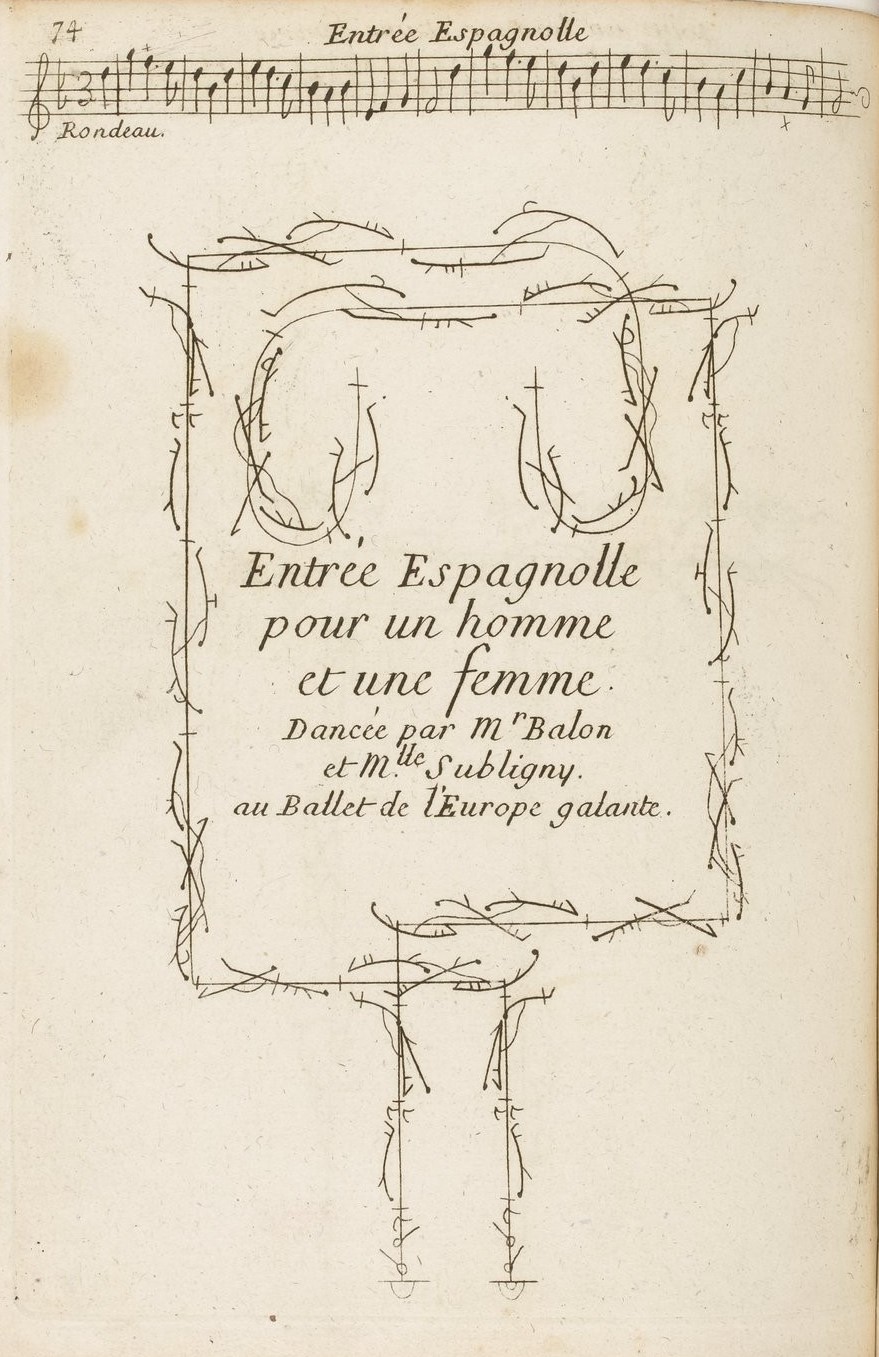
I discussed Shepherd and Shepherdess dances in an earlier post, Season of 1725-1726: Entr’acte Dances at Drury Lane and Lincoln’s Inn Fields, so I will move straight on to the Spanish Entry given as a duet by Lesac and Miss La Tour on 2 November 1725. I have written about ‘Spanish’ dances before – in posts entitled ‘Spanish’ Dances, Dancing ‘Spaniards’ and ‘Spanish’ Dancing and the Dance Treatises – but I haven’t taken an extended look at such dances on the London stage. I am not going to attempt that here, although it is certainly another topic worth exploring. There were Spanish Dances and Spanish Entries advertised in the entr’actes at London’s theatres from the first decade of the 18th century, which probably drew on similar choreographies from the Restoration period. The Spanish Entry had been advertised as a duet at Lincoln’s Inn Fields and had stayed in the repertoire for a few seasons. It had then disappeared, only to reappear in the mid-1720s with the duet danced by Lesac and Miss La Tour. The use of the word ‘Entry’ for this dance suggests (to me at least) that it was less likely to have been a version of the Folies d’Espagne than one of the other dance types made popular in the French comédies-ballets and opéra-ballets given in Paris. Here is the first plate from Pecour’s well-known ‘Entrée Espagnolle’ for Ballon and Mlle Subligny, which provides one example that may have been influential (it was transcribed by Kellom Tomlinson in his ‘WorkBook’ compiled during the first two decades of the 18th century).

Le Marrie’ danced by Francis and Marie Sallé at Lincoln’s Inn Fields on 16 December 1725 must surely have been Pecour’s ball dance La Mariée, first published by Feuillet in his 1700 Recüeil de dances composées par Mr. Pecour. As I wrote in another post back in 2015, La Mariée on the London Stage, research by the American dance historian Rebecca Harris-Warrick has shown that this duet probably began as a stage dance in Paris and reached the London stage shortly after 1698. The Marie performed at Lincoln’s Inn Fields in 1717-1718 could have been La Mariée resurfacing in the entr’actes, although its performance by the Sallés seems to have given the duet a new lease of life with regular revivals at benefit performances. Here is the first plate from the 1700 collection.

Two Pierrots was also danced by the Sallés at Lincoln’s Inn Fields on 16 December 1725. They seem to have introduced the male-female duet to London – previously there had been a few Pierrot solos and an all-male duet by Francis and Louis Nivelon in 1723-1724. The Sallés were answered at Drury Lane by Roger and Mrs Brett in La Pierette later that season. I should probably have counted Two Pierrots and La Pierette among the entr’acte dances shared between the two theatres, although the titles suggest that two might have been quite different thematically if not choreographically. Pierrot dances would last into the 1750s and beyond.

The Running Footman, danced by Nivelon and Mrs Laguerre on 10 March 1726, had been introduced to the London stage by them in 1723-1724. It was probably created by Nivelon and I looked at the duet in some detail in my post Dances on the London Stage: The Running Footman back in September.

The Fingalian Dance performed by Newhouse and Mrs Ogden on 11 April 1726 had first been danced by them in 1724-1725. They would continue to perform it regularly each season until 1733-1734. This entr’acte duet had apparently begun life as ‘A new Irish Dance in Fingalian Habits by Newhouse, Pelling, and Mrs Ogden’ at Lincoln’s Inn Fields in 1723-1724 but the trio format did not survive the season. Newhouse and Mrs Ogden were also billed more than a dozen times during 1724-1725 in an Irish Dance. I think that was probably the Fingalian Dance, which I am guessing was choreographed by Newhouse. There are a number of ‘Irish’ tunes in the various editions of Playford’s The Dancing Master, all considerably earlier than the duet by Newhouse and Mrs Ogden. They may hint at the music for the Fingalian Dance, although the dance itself seems to have been characterised by its costumes as much as the ‘Irishness’ of its music. Fingal is a county in Ireland in the Dublin region – the reference to ‘Fingalian Habits’ suggests costumes that are at least recognisably Irish. So far, I have not managed to find any clues as to what these ‘Habits’ may have been like. Fingalian Dances would survive in the London stage entr’acte repertoire until the 1770s.

The Burgomaster and his Frow, another entr’acte dance performed by Newhouse and Mrs Ogden on 20 April 1726, was one of the many ‘Dutch’ dances given in the entr’actes at London’s theatres. The duet seems to have been variously titled – as Dutch Boor in 1723-1724 and 1724-1725 and as Dutch Burgomaster and Wife in 1724-1725 – but it seems to have been distinct from the Dutch Skipper, which Newhouse was never billed as dancing. There is, of course, music for a ‘Dance for the Dutch man and his Wife’ in Thomas Bray’s 1699 collection Country Dances. This tune was used in Europe’s Revels for the Peace, the masque created to celebrate the peace of Ryswick that ended the Nine Years’ War in 1697.

Tollett’s Ground, danced by Newhouse and Mrs Laguerre on 30 April 1726 and revived during the Lincoln’s Inn Fields summer season by him and Mrs Ogden, took its title from its music. The piece is generally attributed to the Irish musician Thomas Tollett, who worked in London’s theatres during the 1690s and may have died in 1696. It appeared in several music collections around 1700 and was first billed at Drury Lane in 1701-1702, when it was performed by John Essex and Mrs Lucas. During the 1710s it was given several times by Margaret Bicknell and her sister Elizabeth Younger. The Tollett’s Ground duet survived into the early 1730s and was usually performed at benefits or during the summer season.

I mentioned the Chacone in my post The Most Popular Entr’acte Dances on the London Stage, 1700-1760 a couple of months ago. In 1725-1726, a Chacone duet was danced at Lincoln’s Inn Fields by Dupré and Mrs Wall on 30 April and then 23 May 1726, followed by Lally and Mrs Wall on 30 May. Some of the chaconnes given in London’s theatres were associated with Harlequin, but others (including this one) were evidently serious dances. We do have a local notated example of a chaconne for the stage which was published around this time and might shed light on some of those given in the entr’actes. Anthony L’Abbé choreographed the ‘Chacone of Galathee’ for Delagarde and Mrs Santlow (from 1719 Mrs Booth) perhaps around 1712, although it seems to have been notated some ten years later – around the time it was published by Le Roussau in A New Collection of Dances. As this plate reveals, it was a showpiece of virtuosity for these two dancers (I strongly suspect that Delagarde’s entre-chat à six should also have a tour-en-l’air, and I certainly think that Mrs Santlow was capable of adding an entre-chat à six to her tour).

The Chacone duets danced by Dupré and Lally with Mrs Wall in 1725-1726 may have been similar.

The Venetian Dance was given just once this season, on 9 May 1726 by Burny and Mrs Anderson ‘both Scholars to Essex’. At present, I can’t be sure whether ‘Essex’ is William Essex, who had made his debut at Drury Lane the previous season, or his father John, who had left the stage to pursue his career as a dancing master more than twenty years earlier. John Essex is perhaps the more likely candidate. It is tempting to assume that a Venetian Dance must be performed to a forlana, but a contemporary source suggests a quite different piece of music – the allemande used by Pecour for his duet of that title, published in Paris in 1702. I have puzzled over this musical choice, apparently made for a ‘Venetian Dance by Mr Shaw and Mrs Booth’ which was performed (but not mentioned in the bills) in 1724-1725. I can see that I should return to Venetian Dances in another post.

Dances associated with particular nations were decidedly popular at Lincoln’s Inn Fields this season. Another was the Swedish Dal Carl given by Pelling and Mrs Ogden on 17 June 1726 (the opening performance of the summer season). A ‘new Swedish Dance’ had entered the entr’acte repertoire at Lincoln’s Inn Fields in 1714-1715, when it was performed by Delagarde and Miss Russell (later Mrs Bullock and a leading dancer at that theatre). Thereafter the Swedish Dale Karl, as it was usually known, was performed most seasons into the 1730s. It may well have continued to use the music recorded in The Ladys Banquet 3d Book, a collection first published around 1720, although the earliest surviving edition has been dated around 1732. The ‘new Play House’ mentioned on the score is probably Lincoln’s Inn Fields, which opened in 1714. There are no solo Swedish Dances billed in London’s theatres, so is the ‘Sweedish Woman’s Dance’ actually part of the duet?

The last of the dances I listed at the beginning of this post was also performed only during the Lincoln’s Inn Fields summer season. Newhouse and Mrs Ogden performed the Spinning Wheel Dance on 21 June 1726. The duet had first been given in 1723-1724 at the same theatre and the bills indicate that it only ever received a handful of performances. I would characterise it as one of the novelty dances that turn up in the entr’actes from time to time, particularly during summer seasons.

My next post on the season of 1725-1726 will be concerned with the entr’acte solos given at Drury Lane and Lincoln’s Inn Fields.

Season of 1725-1726: Shared Entr’acte Duets at Drury Lane and Lincoln’s Inn Fields

In the entr’actes, duets were far more popular than group or solo dances during 1725-1726. At Drury Lane 13 were given, while at Lincoln’s Inn Fields there were 22. The following duet titles were advertised at both theatres:

Polonese

Dutch Skipper

Pastoral

Saraband

Minuet

Peasants

I will begin with these shared dance titles and go on to the other duets at each of the theatres in later posts.

The Polonese was performed at Lincoln’s Inn Fields on 1 October 1725 by Lally and Mrs Wall and then at Drury Lane on 25 November 1725 by Rainton and Miss Robinson. This duet had been advertised for the first time at Drury Lane in 1724-1725, where Rainton and Miss Robinson danced it on 18 March 1725 followed by Lally and Mrs Wall on 20 April. This duet would last for several seasons. The title must surely mean ‘Polonaise’ – perhaps prompted by the forthcoming marriage of the French King Louis XV to the Polish Princess Maria Leszcynska on 5 September 1725 (N.S.).

The Dutch Skipper was given on 21 April 1726 by Thurmond Junior and Miss Tenoe, for the shared benefit of Rainton. At Lincoln’s Inn Fields it was performed by Pelling and Mrs Ogden on 24 June. Although ‘Dutch’ dances can be traced back to the 17th century in London, the earliest known billing of the Dutch Skipper was 7 June 1704, when Philippe Du Ruel danced it with his wife at Drury Lane. The duet quickly entered the repertoire and, following the opening of the Lincoln’s Inn Fields Theatre in 1714, was regularly performed in the entr’actes at both playhouses. It was usually a duet for a man and a woman, but was sometimes danced by two men or even two women. It was also occasionally danced as a solo – in 1725-1726 it was so performed at Drury Lane by Sandham (or perhaps his son). Music for the Dutch Skipper, sometimes called ‘Du Ruel’s Dutch Skipper’ survives in several sources, none of them earlier than the second decade of the 18th century. This version comes from the Lady’s Banquet, 3d Book, published around 1732 (although an earlier edition, which does not survive, was dated 1720):

Lambranzi depicts a Dutch sailor and his wife in part 2 of his Neue und curieuse theatrialisches Tantz-Schul, who might provide a clue to the costuming of the Dutch Skipper dances on the London stage.

Although the solo Dutch Skipper was usually performed by speciality dancers, the duet was often given by those who also performed a belle danse repertoire suggesting that it was not simply a comic-grotesque number.

A Pastoral duet was danced at Lincoln’s Inn Fields on 29 September 1725 by Lally and Mrs Wall and on 5 January 1726 by Le Sac and Miss La Tour, who performed it several times before the end of the season. During the Lincoln’s Inn Fields summer season, the Pastoral was taken up by Burny and Mrs Anderson. At Drury Lane, a Pastoral duet was first given by Boval and Mrs Brett on 3 May 1726 and then taken up at later performances by Michael Lally and Mrs Walter. Were all these duets the same or different choreographies, or were they perhaps variations around a shared choreographic theme? The first Pastoral to be advertised on the London stage was a solo by Miss Schoolding at Lincoln’s Inn Fields in 1717-1718, while the duet was first given in a version danced by Delagarde’s two sons in 1718-1719. It is possible that, at Lincoln’s Inn Fields at least, the choreography for the 1725-1726 duets derived from the Pastoral performed by Glover and Mrs Wall in 1723-1724. Glover was also the lead dancer in a group Pastoral Dance given at Lincoln’s Inn Fields in 1726-1727, so he may have been the choreographer of both versions. Without music, it is difficult to have much idea of what these dances were like – although we could, perhaps, look to Myrtillo for clues.

The Saraband and Minuet are well-known as dance types and at Drury Lane and Lincoln’s Inn Fields both were performed at benefit performances as duets. In 1725-1726 at Lincoln’s Inn Fields, Glover and Mrs Laguerre danced a ‘Saraband and Minuet’ together for the benefit she shared with her husband the actor-singer John Laguerre on 14 April 1726. At Drury Lane, Boval and Mrs Brett danced the same combination at her shared benefit on 6 May 1726. As a duet, the Saraband seems to have reached the entr’actes only in 1723-1724, although it had been danced as a solo from at least 1713-1714. Similarly, the solo entra’cte Minuet dates back to at least the first decade of the 18th century. It made its first entr’acte appearance as a duet with Glover and Mrs Laguerre in 1725-1726 – also the first time that a Saraband and Minuet were billed together. The Minuet was also given with other ‘Ball Dances’, although it was rarely performed in the entr’actes other than for benefits. I give more information about both dances in my earlier posts about the Saraband and the Minuet on the London stage.

The other duet performed at both playhouses was Peasants, which might perhaps be classified as the opposite to the Pastoral duet. ‘Peasant’ dances were very popular and I included them in my post The Most Popular Entr’acte Dances on the London Stage, 1700-1760. One of the issues in 1725-1726, as in other seasons, is whether the dances variously billed as French Peasants and Peasants are actually the same dance. At Lincoln’s Inn Fields, a Peasants duet was given by Nivelon and Mrs Bullock on 19 October 1725 when he had danced a French Peasant with Mrs Laguerre on 29 September. At Drury Lane, Sandham’s children danced Peasants on 25 May 1726 (there was no entra’cte French Peasants duet there that season). Peasants duets apparently entered the entr’acte repertoire a decade later than French Peasants, in the 1710s. The first such duet to be advertised was danced by Shaw and Mrs Younger at Drury Lane in 1718-1719. Again, without music it is difficult to know what such dances might have been like, although I suspect that they were similar in many respects to the French Peasant dances, for which both music and choreography may be found in French sources.

In my next post I will look at the other duets given at Drury Lane.

Season of 1725-1726: Entr’acte Dances at Drury Lane and Lincoln’s Inn Fields

In my first post about dancing on the London stage during the 1725-1726 season, I provided some statistics for the number of entr’acte dances performed in the theatres. At Drury Lane there were 28 dances in all – 4 group dances, 1 trio, 13 duets and 10 solos. At Lincoln’s Inn Fields there were 43 entr’acte dances – 7 group dances, 2 trios, 22 duets and 12 solos. I should qualify this set of figures immediately by noting that 5 dances – 1 trio, 3 duets and 1 solo – were given only during the Lincoln’s Inn Fields summer season. Nevertheless, the disparity between the two theatres is interesting since Drury Lane had 91 performances with entr’acte dancing billed, whereas (excluding its summer season) Lincoln’s Inn Fields had 81.

As with the dancers, the figures are not quite accurate, although it is probably next to impossible to be sure exactly what dances were performed. At Drury Lane, Roger danced a solo Peasant, a solo Drunken Peasant and a solo French Peasant. Were these all different choreographies? Were all (or perhaps two) of them the same dance, but performed differently according to the various characters depicted? At Lincoln’s Inn Fields, Nivelon gave both a solo Wooden Shoe Dance and a solo Wooden Shoe Dance in the Character of a Clown. Were these actually the same choreography? There were also two Shepherd and Shepherdess duets given at Lincoln’s Inn Fields during the course of the season, one by Francis and Marie Sallé and the other, titled Shepherd and Shepherdess representing Acis and Galatea, by Le Sac and Miss La Tour. I think that these had different music and different choreographies (which may, however, have been related in terms of steps, figures and even choreographic motifs). The duet by Le Sac and Miss La Tour may have used music by Handel, whose Acis and Galatea had first been performed some years previously, although it would not reach the London stage (in a revised version) until 1731. The duet was performed at their joint benefit on 11 May 1726, when Miss La Tour also played a ‘Set of Mr Hendel’s Lessons’ on the harpsichord as an entr’acte entertainment. It seems likely that the Sallés danced to music from a French opera. I also made a mistake when I included the new Dance of Slaves advertised on 25 October 1725 among the entr’acte dances. When I took another look, I concluded that it was probably danced within Oroonoko which was the mainpiece that evening.

There is an overlap in the dance titles advertised at the two theatres, suggesting a common source for some dances and perhaps shared music, if not similar choreographies. Here are those titles.

Myrtillo, a group dance

Polonese, a duet

Dutch Skipper, a duet

Pastoral, a duet

Saraband, a duet

Minuet, a duet

Peasants, a duet

Spanish Entry / Spanish Dance, a solo

I will use these dances as the starting point to look more closely at the repertoire of entr’acte dances given at Drury Lane and Lincoln’s Inn Fields in 1725-1726. I will deal with each of the dance types – group (including trios), duet and solo – in separate posts. Curiously, there is quite a lot we can discover (and that I can say) about them, even though we cannot reach the actual choreographies.

Season of 1725-1726: Dancers at Lincoln’s Inn Fields

The figures I initially gave for the dancers at the Lincoln’s Inn Fields Theatre during the 1725-1726 season were not right either. There were, in fact, 16 dancers (9 men and 7 women) who danced regularly in the entr’actes during the main season. Of the others, Glover danced only on 14 April 1726. He had been a member of the dance ‘company within the company’ since 1723-1724 but was absent from Lincoln’s Inn Fields this season, apart from this one performance. ‘Pollett’s Son’, who made a single appearance on 25 April 1726 may have been a child dancer – there were other dancers named Pollett in London’s theatres around this time, although their careers need further research. Burny made only one appearance before the end of the main season, but he (together with Morgan and Smith) danced during the theatre’s summer season. I will look at the summer season and its dancers separately.

The following entr’acte dancers were at Lincoln’s Inn Fields in 1725-1726:

Nivelon

Lally

Dupré

Newhouse

Pelling

Dupré Jr

Sallé

Le Sac

Lanyon

Mrs Laguerre

Mrs Wall

Mrs Bullock

Mrs Ogden

Mlle Sallé

Miss La Tour

Mrs Anderson

At least one name in this list is likely to be familiar to those interested in the 18th-century dance.

Among the dancers at Lincoln’s Inn Fields the one most often billed in 1725-1726 was Nivelon, who danced in the entr’actes some 50 times. He was followed by Sallé (46 billings). None of the other men appeared nearly so often – next was Lally (31 billings), Le Sac (22), Dupré (17), Newhouse (15), Pelling (9), Dupré Jr (7) and Lanyon (4). Among the women, Mlle Sallé was the most in demand with 38 entr’acte billings. Mrs Wall danced some 34 times, followed by Mrs Bullock (32), Mrs Laguerre and Miss La Tour (22 performances each), Mrs Ogden (15) and Mrs Anderson (10). Mrs Ogden and Mrs Anderson also danced during the summer season.

As at Drury Lane, each dancer’s repertoire provides clues to his or her status. Nivelon and Sallé were first among the men. Nivelon performed 6 solos, 4 duets and 1 trio, while Sallé danced 1 solo, 6 duets, 1 trio and 2 group dances. Dupré had 2 duets and 6 group dances (he was also billed as a choreographer). Newhouse also performed 2 duets but appeared in only 1 group dance. Le Sac gave 1 solo and also performed 4 duets. Pelling, Dupré Jr and Lanyon were all supporting dancers, appearing only in group choreographies. Among the women, Mrs Wall had the most extensive repertoire, with 3 solos, 7 duets and 6 group dances. Mlle Sallé danced 1 solo (Les Caractères de la Danse), 5 duets and 1 trio. Mrs Laguerre performed in 6 duets and 1 group dance, while Mrs Anderson gave 1 solo and 2 duets and performed in 4 group dances. Miss La Tour danced 1 solo and 4 duets and Mrs Ogden was billed in 2 duets and 2 group dances. None of the women can be described simply as supporting dancers.

All the men, except for Le Sac, danced in the pantomime afterpieces which were performed on nearly as many evenings as entr’acte dancing. As at Drury Lane, the roles performed by these dancers reveal more about their place within the ‘dance company’. They also tell us a little about the specialities of individual dancers. Four pantomimes were given at Lincoln’s Inn Fields during the main season – Jupiter and Europa, The Necromancer, Harlequin a Sorcerer and Apollo and Daphne. The first two are anonymous, but may have been devised by the theatre’s manager John Rich who was himself a Harlequin and took that role in these afterpieces. The second two have libretti by the writer Lewis Theobald. Nivelon’s role was Punch, while Lally was Mezzetin, Pelling was Pierrot and Newhouse was Scaramouch (Lanyon also appeared as Scaramouch). Nivelon’s status was shown by Apollo and Daphne; or, The Burgomaster Tricked (to give the pantomime its full title), in which he was the Burgomaster and thus central to the comic plot. Lally (Edward Lally, who may or may not have been the brother of Michael Lally at Drury Lane that season) and Dupré both took prominent dancing roles in the pantomimes. Dupré also performed as a dancing Harlequin (Rich did not dance).

Mlle Sallé danced both Daphne and Flora, ‘An Inconstant’, in Apollo and Daphne, the only pantomime in which she appeared. Mrs Wall was Europa in Jupiter and Europa and took prominent roles in three more pantomimes. Mrs Bullock and Mrs Anderson also had significant dancing roles. Mrs Laguerre, Mrs Ogden and Miss La Tour did not appear in pantomimes at all. Mrs Laguerre had been one of the leading dancers at Lincoln’s Inn Fields and would be so again, but she seems to have been absent from late November 1725 to mid-March 1726. She was also an actress (the only one among Lincoln’s Inn Fields’s female dancers in 1725-1726) and played 11 acting roles during the months she was present.

So, what of the ‘dance company’ at Lincoln’s Inn Fields in 1725-1726? Le Sac and Miss La Tour made their debuts together and danced a series of duets. They were advertised as ‘Scholars of Mr. Dupre’ and were presumably just emerging from his tutelage. Were they members of the ‘dance company’ or more like apprentices? Francis and Marie Sallé were returning to dance in London for the first time since the 1718-1719 season, so they may have been seen as ‘guest artists’. Nivelon must have been the leading male dancer, and perhaps the company’s dancing master. (Although the meaning and even the existence of that position needs investigation and discussion). Lally and Dupré may have been more-or-less equal, followed by Newhouse and Pelling, then Dupré and Lanyon.

The relative status of the women is more difficult to unravel. Their benefits perhaps provide additional clues (although Rich at Lincoln’s Inn Fields seems to have been less hierarchical about these than the management at Drury Lane), along with their dancing partners. Mrs Laguerre was probably the leading local female dancer, her benefit (shared with her husband, the singer-actor John Laguerre) was on 14 April 1726. She was most often partnered by Nivelon. Mrs Wall shared her benefit with Newhouse, on 30 April, her main partner was Lally although she also danced with Dupré (who may have been one of her teachers). Mrs Bullock shared her 2 May benefit with her brother-in-law, the actor William Bullock. She danced her only duet with Nivelon, but in the group dances she seems to have been partnered by Sallé and Dupré most often. Mrs Anderson’s benefit (also shared) came on 9 May and Mrs Ogden had no benefit at all. They were evidently the lowest ranking of the female dancers in the company.

There are accounts surviving for Lincoln’s Inn Fields for the seasons 1724-1725 and 1726-1727 which provide more information about the relative status of the dancers, based on their pay scales. The 1724-1725 accounts have been analysed in some detail – I provide a reference to the article below – and I looked at those for 1726-1727 myself some years ago (although my notes are not extensive). They tell us that Nivelon earned by far the most among the dancers – much more than even the two Sallés (at least in 1726-1727) – and that Dupré was the next highest paid of the male dancers, followed by Lally. The highest paid of the women were Mrs Laguerre and Mrs Bullock. Apart from Nivelon, none of the dancers received anything like as much as the principal singers in Rich’s company.

The only one of the dancers at Lincoln’s Inn Fields in 1725-1726 for whom we have a portrait is Marie Sallé. Here she is, as a dancer and off-stage.

Reference

Judith Milhous, ‘The Finances of an Eighteenth-Century London Theatre: the Lincoln’s Inn Fields Company under John Rich in 1724-1725’ in Berta Joncus and Jeremy Barlow (editors), “The Stage’s Glory” John Rich, 1692-1761 (Newark, 2011), pp. 61-69.

A Season of Dancing: 1725-1726

I have written quite a number of posts on individual dances or groups of dances performed on the London stage during the 18th century. I thought it would be interesting to look in detail at just one season, to get a more rounded view of dancing in London’s theatres. I have chosen, not quite at random, 1725-1726. London’s theatre seasons ran from September to the following June and during the earlier 1700s there were often summer seasons at one or more of the playhouses that extended into July or August. The information I will set out is mostly taken from the calendar of performances provided by The London Stage, 1660-1800.

In 1725-1726, London had four theatres offering stage performances. Chief among them were the Theatres Royal in Drury Lane and Lincoln’s Inn Fields. Only they were allowed to present serious drama, under the patents granted by King Charles II following his restoration in 1660. Drury Lane is shown on the left and Lincoln’s Inn Fields on the right, both depictions are later than the period I am looking at.

Although there is an illustration of the Drury Lane auditorium, following the changes made for David Garrick by Robert Adam later in the 18th century, there is no such image for Lincoln’s Inn Fields. The Little Theatre in the Haymarket presented a variety of entertainments even though it was, to all intents and purposes, unlicensed. The King’s Theatre, also in the Haymarket and almost opposite the Little Theatre, was London’s opera house. The Little Theatre is on the left and the King’s Theatre is on the right. Again, both images are later.

The following images show the auditoriums of both theatres. The Little Theatre is on the left (this image is much later) and the King’s Theatre on the right (this image is dated 1724 and shows a masquerade in progress).

It is interesting to note that the present Drury Lane Theatre occupies the same site as its much smaller predecessor, while today’s Theatre Royal Haymarket is right next to the site of the Little Theatre. Her Majesty’s Theatre is where the King’s Theatre once stood. The Lincoln’s Inn Fields Theatre has entirely disappeared – it was finally demolished to make way for the Royal College of Surgeons of England in the early 19th century – but its successor is the Royal Opera House, on the same site as the new Covent Garden Theatre built for the Lincoln’s Inn Fields company in 1732.

The 1725-1726 season opened at Drury Lane on 4 September 1725 and closed at the King’s Theatre on 7 June 1726. There was also a summer season at Lincoln’s Inn Fields which ran from 17 June to 23 August 1726. Apart from two isolated performances in December 1725 and February 1726, the Haymarket Theatre hosted a company of French players from 24 March to 7 May 1726. In total, there were 186 performances at Drury Lane, 193 at Lincoln’s Inn Fields (including the 16 performances of the summer season), 53 at the King’s Theatre and 25 at the Haymarket Theatre.

At this period much of the dancing was given in the entr’actes and in the newly popular pantomime afterpieces. A little straightforward statistical analysis provides an indication of the amount of dancing at the various theatres. At Drury Lane, 91 performances (around 49%) included entr’acte dancing and 44 (about 24%) included afterpieces with dancing. At Lincoln’s Inn Fields there were 97 performances with entr’acte dances (around 50%, although every performance during the summer season had dancing) and 85 (around 44%) included afterpieces with dancing. At both houses far less music was advertised explicitly in the entr’actes, but there would have been a great deal of music associated with the performance in general as well as in the plays and afterpieces – this was taken for granted and not mentioned in the bills. About 13% of performances at Drury Lane and 26% at Lincoln’s Inn Fields had entr’acte music advertised. No dancing of any sort was advertised at the King’s Theatre this season. At the Haymarket, the repertoire of commedia dell’arte pieces was quite different from the fare at the other theatres. The distinction between mainpieces and afterpieces, with or without dancing, is not meaningful. Nevertheless, 16 performances (64%) were advertised with entr’acte dancing. Such analyses for individual seasons can be revealing – the patterns that might emerge over longer periods are yet to be investigated.

How many dancers did Drury Lane, Lincoln’s Inn Fields and the Haymarket Theatre employ? The short answer is, we don’t really know. It is possible to chart those dancers who performed regularly in the entr’actes, as well as those who appeared in the pantomime afterpieces, but without the company’s accounts (which rarely survive) it is difficult to be sure of their status.  The leading dancers in the afterpieces were usually those who appeared most frequently in the entr’actes and may have formed ‘a company within the company’. However, some of these professional dancers (usually the women) were also actors. The afterpieces also employed minor players within the company as supporting dancers. In 1725-1726, 19 dancers (12 men and 7 women) were billed in the entr’actes at Drury Lane. At Lincoln’s Inn Fields, there were 21 entr’acte dancers (14 men and 7 women). At the Haymarket Theatre, 11 dancers (7 men and 4 women) were billed in the entr’actes during the short season given by the French comedians. I will come back to all of these dancers in a later post.

Then, there is the repertoire performed in the entr’actes by these dancers. How many and what sort of dances were performed each season in London’s theatres? This is another question which cannot be answered definitively. Dances with similar titles may or may not be the same (a clue sometimes lies in their performers). Dances with the same title but billed as solos or duets may be the same dance (if the billing is obviously inaccurate), or related versions of a dance, or different dances altogether (again a clue might be in the performers). Very occasionally, a dance with a common title might be attributed to a particular dancer, pointing to a specific choreography – although we do not know how much such choreographies made use of conventional elements. With these caveats in mind, I have interpreted the titles of the dances billed in the entr’actes, dividing them into solos, duets, trios and group dances.

At Drury Lane, 28 dances were billed in the entr’actes: 10 solos, 13 duets, one trio and 4 group dances. Only one dance, the Dutch Skipper, was billed as both a duet and a solo. Lincoln’s Inn Fields advertised 43 entr’acte dances: 12 solos, 22 duets, two trios and 7 group dances. At the Little Theatre in the Haymarket there were only 13 entr’acte dances: 2 solos, 3 duets, one trio and 7 group dances. There was, of course, an overlap in titles (and perhaps choreographies, too) between the three theatres. I will return to these dances in a later post.

In 1725-1726, the most significant dancing beyond the entr’actes came in the pantomime afterpieces. There were three pantomimes in repertoire at Drury Lane: The Escapes of Harlequin, Harlequin Doctor Faustus and Apollo and Daphne. All were by John Thurmond Jr and none were new. At Lincoln’s Inn Fields, seven afterpieces included dancing – one of these, St. Ceciliae; or The Union of the Three Sister Arts, was a masque and not a pantomime. The Lincoln’s Inn Fields pantomimes were Jupiter and Europa, The Necromancer, Harlequin a Sorcerer, Apollo and Daphne, The Cheats; or, The Tavern Bilkers and The Jealous Doctor. Only Lewis Theobald’s Apollo and Daphne was new. I will return to all these pantomimes in a later post.

There is one final element in this survey of dancing in London’s theatres in 1725-1726. Some 50 to 60 mainpiece plays, or more, were given each season at the two patent theatres. A small number of these included a significant amount of dancing (enough to be mentioned in the bills with the dancers listed) and were performed season after season over many decades. At Drury Lane, Macbeth (Shakespeare’s play, but with significant revisions and additions by Sir William Davenant) and The Tempest (an adaptation of Shakespeare’s play by Davenant, Dryden and Thomas Shadwell) were part of the repertoire. At Lincoln’s Inn Fields, Macbeth (but not The Tempest), The Prophetess, The Island Princess and The Emperor of the Moon were given. In 1725-1726 there was also The Pilgrim, with the group dance The Humours of Bedlam (which I have written about elsewhere). The Capricious Lovers by Gabriel Odingsells was given with ‘proper Dances’ (that is dances within the play) but it did not last beyond three performances. I will continue to look at these mainpieces with dancing in separate blog posts.

As you can see from this brief analysis, dancing formed a significant part of the entertainments given each evening in London’s theatres but it is not straightforward to chart what was danced, when and by whom. It is safe to say, however, that although much of that dancing was very different to what we see today, it influenced many aspects of the enormous range of dance styles we have in the twenty-first century.