Tag Archives: John Rich

Who Was Francis Sallé?

Most people who have an interest in the history of dancing will have heard of the 18th-century French ballerina Marie Sallé. How many will know of Francis Sallé, her brother, who is mentioned only in passing in the various accounts of her career? I use the English form of his first name because, unlike Marie, he chose to pursue a career on the London stage.

Francis and Marie Sallé made their debuts together on the London stage, at the Lincoln’s Inn Fields Theatre on 18 October 1716. They were billed as ‘two Children, Scholars of M Ballon, lately arriv’d from the Opera at Paris’, with the warning to prospective audiences that ‘Their Stay will be short in England’. The ‘Opera’ was, of course, Paris’s Opéra-Comique rather than the Académie Royale de Musique, despite the link with Claude Ballon. Francis is generally said to have been born in 1705 and Marie in 1707, so they were eleven and nine years old when they first came to London. At their first performance, they danced the Harlequins in Two Punchanellos, Two Harlequins and a Dame Ragonde. They proved so popular that their stay was extended. In the bills from 5 to 10 December, Rich encouraged interest in their performances with successive announcements from the children ‘stay but Nine Days longer’  down to ‘the last Time but one of their Dancing during their Stay in England’. Their last performance was, ostensibly, their shared benefit on 11 December 1716, which according to the advertisement in the Daily Courant for that day, included

‘… several Entertainments of Dancing, both Serious and Comic, by the Children and others. A new Comic Dance, call’d The Drunken Man, to be perform’d by the Children. The last New Comic Dance, compos’d by Mons. Moreau, and to be perform’d by him, Mr. Kellom’s Schollar, Mr. Cook, Mrs. Schoolding, Mrs. Cross, Miss Smith, and the Children. Likewise a Scene in the French Andromache burlesqued, to be acted by the Children: Orestes to be perform’d by Mons. Salle, and Hermione by Mademoiselle Salle his Sister.’

On 18 December 1716, the bills announced ‘In Consideration of the Diversion the French Children have given the Town, Mr. Rich has engag’d their Stay in England for some time longer. The two children danced at Lincoln’s Inn Fields until 10 June 1717, with one performance at the King’s Theatre on 5 June, giving more than 100 performances in all. They were allowed a second benefit on 11 May 1717, when they gave a ‘French Scene’ with their father and danced with Moreau and Mrs Schoolding.

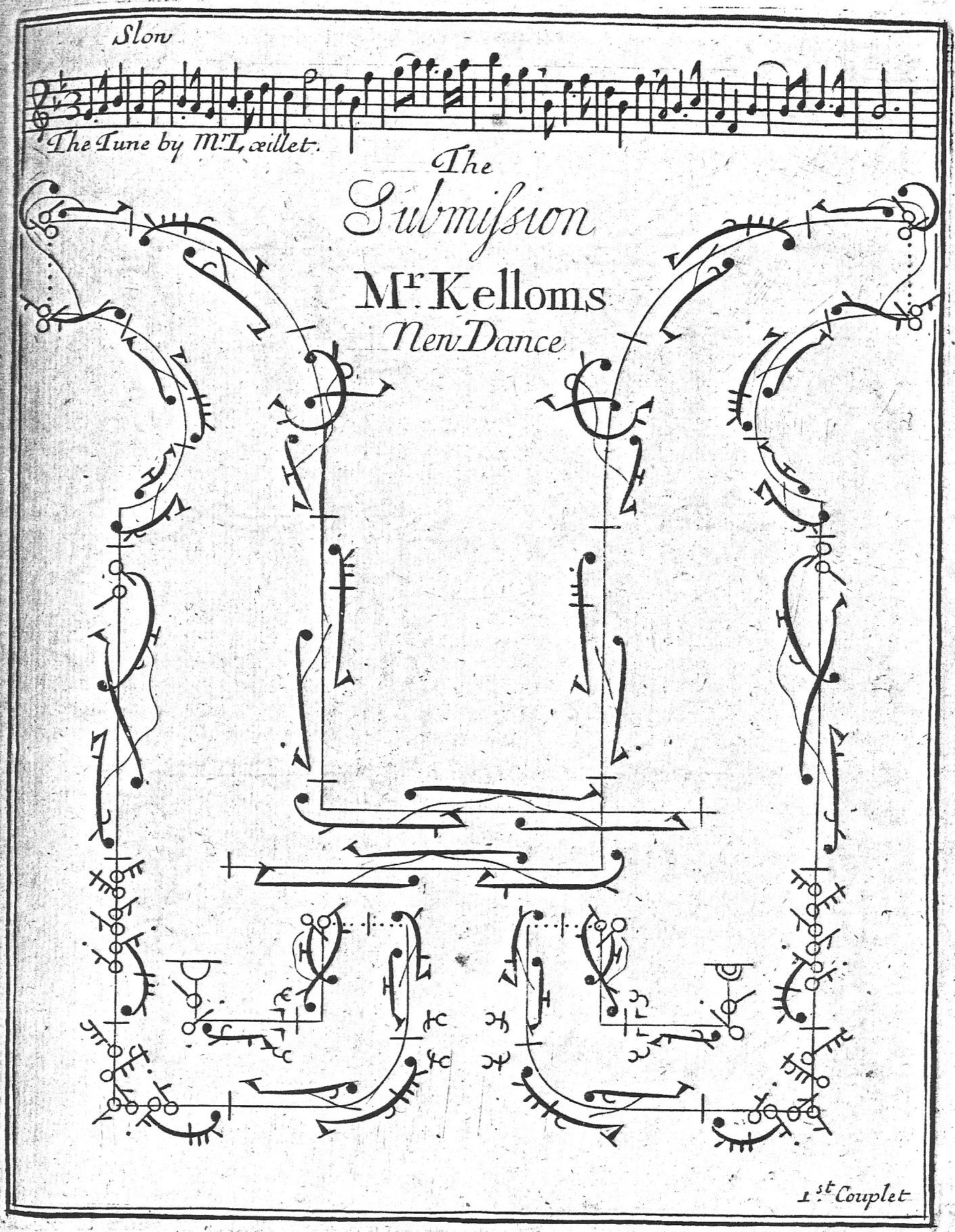
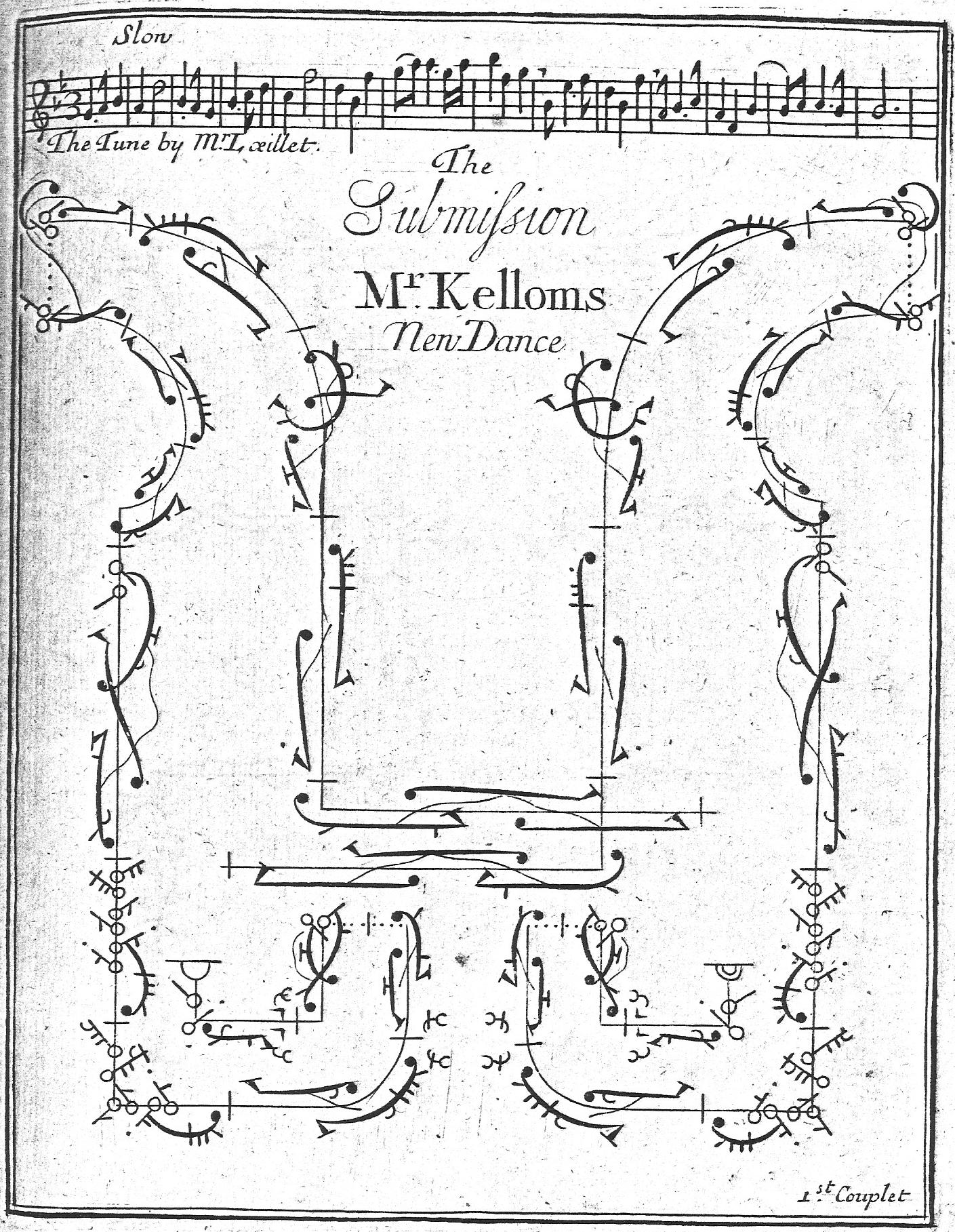
During the 1716-1717 season, the two children performed around a dozen entr’acte dances both serious and comic. Their repertoire included a ball dance by Kellom Tomlinson, The Submission first given on 21 February 1717 and published in notation the same year. The dance opens with a slow triple-time section, followed by a minuet and then a rigadon. Here is the first plate.

This is the only dance created for either Francis or Marie Sallé that survives in notation.

The two young dancers returned to London for the 1718-1719 season, this time appearing first at Lincoln’s Inn Fields and then at the King’s Theatre with the troupe of their uncle Francisque Moylin. At Lincoln’s Inn Fields, they were mentioned only once in the bills, on the 19 December 1718 (their benefit performance), when they were advertised as ‘M and Mlle Salle, the two Children, who dance in the Company of the French Comedians’. They were billed only three times when Moylin’s company moved to the King’s Theatre. However, the Lincoln’s Inn Fields bill suggests that they may have danced at most, if not all, of the 40 performances that the French Comedians gave at the two theatres between 7 November 1718 and 19 March 1719. The bills say nothing at all about their repertoire.

Francis and Marie Sallé did not return to London again until the 1725-1726 season, when they again danced for John Rich at Lincoln’s Inn Fields. By this time, Francis was twenty years old and Marie eighteen and they immediately became the company’s leading dancers. They performed the title roles in that season’s new pantomime, Apollo and Daphne; or, The Burgomaster Trick’d, Rich’s answer to Drury Lane’s Apollo and Daphne; or, Harlequin’s Metamorphoses of the previous season. At Drury Lane, the title roles had been taken by John Thurmond Jr (the pantomime’s creator) and Hester Booth and Rich followed suit with two dancers at Lincoln’s Inn Fields. The two Sallés also appeared as Zephyrus and Flora in the pantomime’s concluding divertissement. Apollo and Daphne; or, The Burgomaster Trick’d, first performed on 14 January 1726, was given 45 performances before the end of the season. Francis Sallé was billed for 106 performances during 1725-1726. As well as dancing four entr’acte  duets with Marie, he apparently gave a solo French Sailor (in addition to the French Sailor and His Wife with his sister) and danced Two Pierrots with Francis Nivelon as well as Two Harlequins with Louis Dupré. He also partnered Mrs Bullock in a Grand Dance with other dancers in the company. Francis and Marie Sallé shared a benefit on 18 April 1726, the last time they would do so. Their careers were already beginning to diverge.

Both Sallés returned to Lincoln’s Inn fields for the 1726-1727 season. They were first billed together, without comment, on 19 September 1726 dancing Shepherd and Shepherdess and French Sailors. Francis had already appeared a few days earlier, dancing First Fury in The Necromancer (a role he had initially performed the previous season). He and Marie repeated their roles in Apollo and Daphne and danced together in the entr’actes, although Francis was also billed (without Marie) alongside other dancers in the company for performances of The Prophetess as well as a new masque Pan and Syrinx, first given on 24 October 1726. Later in the season, on 30 May 1727, he was billed as Mezzetin Man (with the actress-dancer Elizabeth Younger as Mezzetin Woman) in The Necromancer as well as First Fury. By contrast, Marie’s only billing without her brother was on 27 April 1727, when she performed a new Ball Dance with Leach Glover at his benefit.

The main reason for the Sallés engagement at Lincoln’s Inn Fields in 1726-1727 was undoubtedly their appearance in the new pantomime, The Rape of Proserpine, introduced on 13 February 1727 and performed 32 times before the end of the season. This was a pantomime that Rich had long wished to produce. In the libretto for Harlequin a Sorcerer, first given at Lincoln’s Inn Fields on 21 February 1725, he had written of ‘The Expectation which has been rais’d in the Town of seeing a Dramatick Entertainment, call’d The Rape of Proserpine‘ explaining that ‘being disappointed of some very necessary Persons from abroad, on whom we depended, we have deferr’d the same for some time longer’. The ‘very necessary Persons’ must have been Francis and Marie Sallé, for all the other principal performers in The Rape of Proserpine appeared in Harlequin a Sorcerer. When Rich was able to engage the two Sallés for the 1725-1726 season, his focus had evidently turned immediately to the need to outdo Drury Lane’s Apollo and Daphne and he had deferred his pet project for another year.

In The Rape of Proserpine, the roles of Ceres, Pluto, Proserpine and Mercury were all performed by singers, although Marie and Francis danced in the serious part of the pantomime. She was the first of five female Sylvans, while he was the first of four Gods of the Woods and the first of five Demons. The most spectacular dancing was probably reserved for the ballet which ended the pantomime, described thus in the libretto, ‘Enter several Dancers, who represent the four Elements, and celebrate the Marriage of Pluto and Proserpine, by a Grand Ballet.’ Earth was danced by Louis Dupré, with Mrs Pelling as his Female. Air was Leach Glover, with Mrs Laguerre, and Fire was Poitier with Mrs Bullock. The ballet must have culminated with the appearance of Francis Sallé as Water, accompanied by his sister. The bills suggest that the men may have danced virtuoso solos as well as duets with their ‘Females’. The Rape of Proserpine drew on Lully’s 1680 opera Proserpine and the ballet of the elements may have had a French source too, although this has yet to be identified.

This season, Marie received her own benefit on 6 April 1727 at which she apparently did not dance, for the advertisement announced only a Pastoral by her scholar the nine-year-old Miss Rogers and Two Pierrots by Francis Nivelon and Francis Sallé. Her brother’s benefit was a week later, on 14 April, at which the mainpiece was The Prophetess (in which he may well have danced) and the dancing comprised a solo Harlequin by Miss Violante, his scholar, a solo version of Les Caractères de la Dance by Marie and a Fury Dance with Francis as First Fury (presumably taken from The Necromancer). It is worth noting that Marie’s benefit was more profitable than that of Francis and had higher attendance than his. Marie Sallé had already emerged as the more celebrated dancer and was probably the more ambitious too. During 1726-1727, Francis Sallé gave 97 performances and had evidently decided that his future lay with Rich’s company. The surviving Lincoln’s Inn Fields accounts for that season record a payment of 10 guineas on 9 June 1727 to ‘Mr Salle upon signing articles and in pt of next year’s contract’.

Marie Sallé would not return to London and Lincoln’s Inn Fields until the 1730-1731 season. Francis became one of Rich’s group of dancers, although he probably returned to dance in France regularly. His first London season without his sister, 1727-1728, may not have met his expectations. On 29 January 1728, the first performance of The Beggar’s Opera was given at Lincoln’s Inn Fields, and the production dominated the theatre’s repertoire until the end of the season. None of the bills for The Beggar’s Opera mention dancing, but the libretto does refer to dances and it is possible that at least one of them – the ‘Dance of Prisoners in Chains’ was performed by male dancers in the company. Otherwise, Francis Sallé was billed only four times in the entr’actes, although his appearances in The Necromancer, Apollo and Daphne and The Rape of Proserpine (with Mrs Laguerre in Marie Sallé’s roles in the two latter pantomimes) came to a total of 46 performances. His benefit, on 22 April 1728, was shared with Michael Poitier and he did not dance himself. Sallé’s last billing before that was on 25 March 1728 and he may have been absent for the rest of the season.

Although The Beggar’s Opera was given frequently in 1728-1729, there was more room for other repertoire in the course of the season. Francis Sallé danced from 21 October 1728 to 22 May 1729 and was billed in three entr’acte duets, two entr’acte group dances and five afterpieces (three of which were pantomimes). He was advertised in 67 performances altogether and allowed a solo benefit on 8 April 1729, when he danced the Mad Soldier in The Humours of Bedlam (a comic ballet always given with the play The Pilgrim) as well as two entr’acte duets with Mrs Laguerre – Highlander and Mistress and French Sailor. By this time he had established a dance partnership with Mrs Laguerre, their new duet Highlander and Mistress was repeated nine times before the end of the season and continued to be popular thereafter.

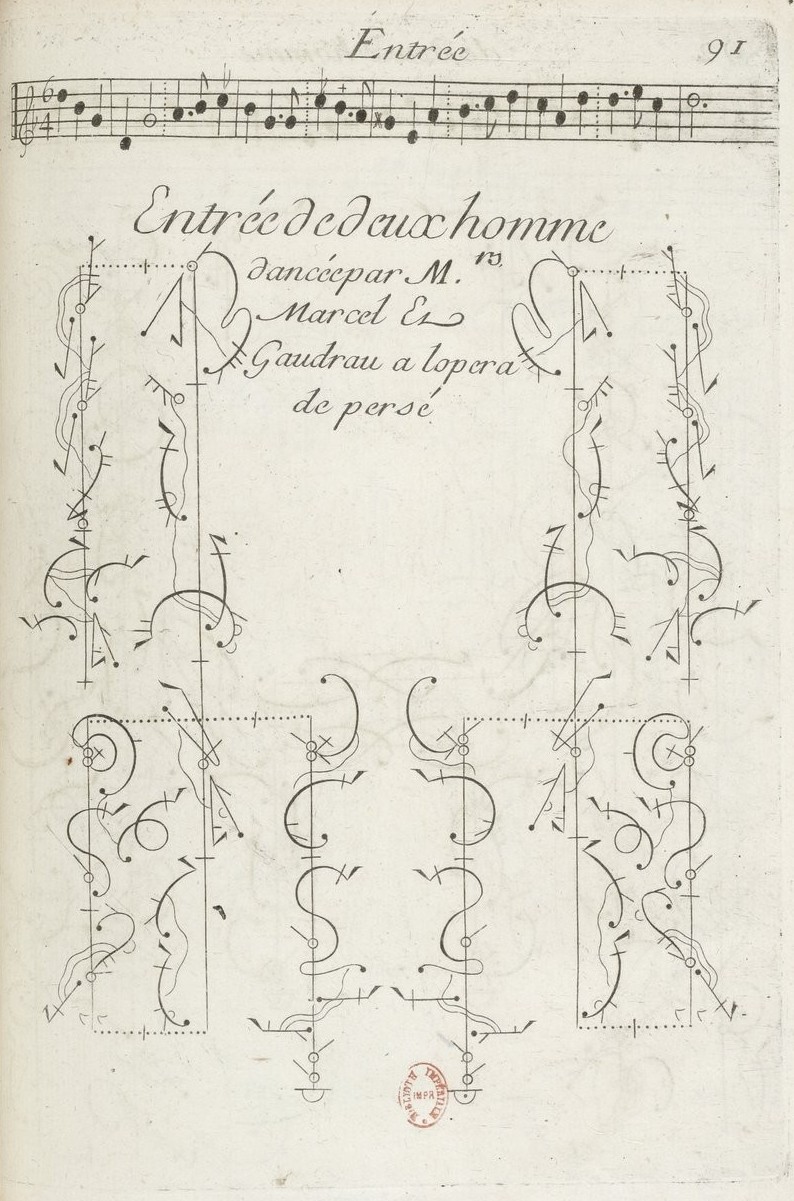
In 1729-1730, Sallé was billed for 117 performances. This season was dominated by another new pantomime, Perseus and Andromeda; or, The Cheats of Harlequin (or, The Flying Lovers), Rich’s response to Drury Lane’s Perseus and Andromeda: With the Rape of Colombine; or, The Flying Lovers by Roger and Weaver given the previous season. The Lincoln’s Inn Fields Perseus and Andromeda was performed 60 times before the end of 1729-1730. Francis Sallé was an Infernal in the serious part of the pantomime, for which Rich had drawn on Lully’s 1682 opera Persée, and it is tempting to speculate whether he and his fellow dancers (Poitier, Dupré, Pelling, Newhouse and Lanyon – Papillion, billed first, was actually a singer and probably did not dance) performed to the ‘Entrée des Divinités Infernales’ from the opera. A duet created by Guillaume-Louis Pecour to this music for Marcel and Gaudrau, performed at the Paris Opéra, was published in notation around 1713 and shows the demands that could be placed on male dancers at the period. Sallé’s early tuition by Claude Ballon (which could have continued beyond his childhood) indicates that he might well have been capable of similar virtuosity. Here is the first plate:

Sallé also danced in a smaller scale afterpiece in 1729-1730, The Dutch and Scotch Contention first given on 29 October 1729. This was probably taken from a ballet performed at the Opéra-Comique in Paris, in which Sallé had appeared ‘en Ecossois’ alongside Roger and Nivelon. I looked at this piece in some detail in my post Highland Dances on the London Stage, back in February 2021. Sallé’s duet Highlander and Mistress with Mrs Laguerre formed part of the action in the London ballet.

Marie Sallé returned to Lincoln’s Inn Fields for the 1730-1731 season, first appearing on 23 November 1730 and dancing until 4 June 1731. Francis made his first appearance some two months before the arrival of his sister, on 21 September 1730, and his last just a few days later, on 7 June 1731. His benefit was on 5 April 1731, in which he danced The Loyal and Generous Free-Mason with Dupré, Pelling and Newhouse – described in the advertisements as ‘all Brothers’- as well as the duets Les Caractères de la Dance and the Louvre and Bretagne with Marie. The last two were ballroom dances by Guillaume-Louis Pecour, among the most famous choreographies of the day and regularly given at benefit performances in London’s theatres. Sallé’s benefit brought in a little over £129. His sister’s benefit, held on 25 March 1731 and commanded by the King (who attended with the Queen, Prince William and the ‘three eldest princesses’), brought in more than £194. She and Francis performed Les Caractères de la Dance together, while Francis also contributed a Scottish Dance duet with Mrs Laguerre (perhaps the popular Highlander and Mistress introduced in 1729).

During 1730-1731, Francis danced with his sister at only 16 of his 50 appearances in the entr’actes and at only 22 of his 65 afterpiece performances. He danced with Marie in Apollo and Daphne and The Rape of Proserpine, but his most popular entr’acte dance was again Highlander and Mistress with Mrs Laguerre. While their respective benefits underlined Marie Sallé’s celebrity status, Francis demonstrated his independence from his sister and his importance as a dancer on the London stage.

The 1731-1732 season was marked by the absence of Marie Sallé. Francis danced at Lincoln’s Inn Fields from 4 October 1731 to 2 June 1732, giving 111 performances in all. His benefit on 12 April 1732 brought in a little over £80 and he was allowed a second benefit on 24 May 1732 which achieved receipts of just over £93. The receipts and the two benefits (an unusual arrangement) need analysis which I won’t undertake here, although there is no question that Francis Sallé was working hard for John Rich who certainly appreciated his contribution to the company. This season, his principal partner was Mrs Laguerre, with whom he performed several entra’cte dances including French Sailor and Wife (presumably the duet Francis had often performed with his sister), Highlander and Mistress and a new duet The Baulk which promised to be popular beyond 1731-1732. He again took leading dancing roles (partnering Mrs Laguerre) in Apollo and Daphne, The Rape of Proserpine and The Dutch and Scotch Contention. For his final performance of the season, Sallé danced as an Infernal in Perseus and Andromeda.

Just ten days after his last performance, the Daily Post for 12 June 1732 announced that:

 ‘On Friday last died at his Lodgings at Newington Green, after a tedious Indisposition, Mons. Salle, a celebrated Dancer belonging to Lincoln’s Inn Fields Playhouse.’

Francis Sallé was buried at St. John Hackney on 14 June 1732. He was little more than twenty-seven years old. According to Dacier in Une Danseuse de l’Opéra sous Louis XV (pp. 293-4), Marie Sallé was grief-stricken by her brother’s death and a portrait of Francis was found among her possessions after her own death.

Francis and Marie Sallé pursued separate careers alongside their performances together in London. She was far more successful, yet his career deserves much more attention than it has received. He was, for a time, the leading male dancer in John Rich’s company at Lincoln’s Inn Fields and – had he lived longer – would undoubtedly have gone on to star at the first Covent Garden Theatre, opened by Rich in December 1732 just a few months after Sallé’s untimely death.

Notes:

There seems to be no documentary proof of the birth dates of either Francis or Marie Sallé. In his biography, Une Danseuse de l’Opéra sous Louis XV: Mlle Sallé (1707-1756), Émile Dacier gives her birth year as 1707 (p. 4 n. 2). In their Mémoires pour servir à l’histoire des spectacles de la foire, 2 vols. (Paris, 1743) the Parfaicts declare that Francis was two years older than Marie (vol. 1, p. 207). Together, these sources presumably provide what evidence there is for his birth year.

For The Rape of Proserpine, Perseus and Andromeda and French dancing see: Moira Goff, ‘John Rich, French Dancing, and English Pantomimes’, “The Stage’s Glory” John Rich, 1692-1761, ed. Berta Joncus and Jeremy Barlow (Newark, NJ, 2011), 85-98.

There are numerous volumes of accounts for the Lincoln’s Inn Fields and Covent Garden theatres during the 18th century in the manuscript collections at the British Library. The entry for Francis Sallé quoted above comes from Egerton ms. 2266, f. 171r.

For dancing in The Beggar’s Opera, see Jeremy Barlow and Moira Goff, ‘Dancing in Early productions of The Beggar’s Opera’, Dance Research, 33.2 (2015), 143-158 (pp. 148-149 for the ‘Dance of Prisoners in Chains’).

Other Dance in History posts relating to the London career of Francis Sallé include:

Aimable Vainqueur on the London Stage

La Bretagne in London

Highland Dances on the London Stage

The Humours of Bedlam

The Necromancer at 300

Season of 1725-1726 (11 posts on various aspects of the dancing at Drury Lane and Lincoln’s Inn Fields this season)

Another French Dancer in London: The Other Louis Dupré

Way back in 1999, I wrote an article which I hoped would settle once and for all the question of the identity of the dancer who first performed the role of Mars in John Weaver’s 1717 ballet The Loves of Mars and Venus. As he continues to be wrongly identified with the French dancer known as Louis ‘le grand’ Dupré, I thought I ought to include London’s Louis Dupré in my series about French male dancers in England, even though there is no certain evidence that he was French.

My 1999 article provides a detailed comparison of the dates on which the two Louis Duprés were dancing in London and Paris respectively, showing that they were indeed different dancers pursuing quite separate careers on each side of the Channel. I also included a brief summary of ‘le grand’ Dupré’s career – he still awaits a properly detailed biography – so in this post I will look only at the ‘London’ Dupré.

The other Louis Dupré was first billed in London at Lincoln’s Inn Fields on 22 December 1714, as one of six dancers performing in the entr’actes. All of them may well have appeared on that theatre’s opening night on 18 December and then again on 20 and 21 December, when ‘Entertainments’ and ‘Singing and Dancing’ were advertised with no other details. John Rich had engaged six men and two women as dancers for his first season at Lincoln’s Inn Fields, because he saw dancing as an important draw for audiences while his new acting company gained the experience to challenge the established players at the rival Drury Lane Theatre. Dupré was undoubtedly Rich’s leading male dancer that season. He was billed for 71 performances in a repertoire that included a French Sailor duet with Mrs Schoolding, a Harlequin and Two Punches trio (with Moreau and Boval – Dupré was probably Harlequin) and a Grand Spanish Entry (with Moreau, Boval and the dancer Mrs Bullock). He was allowed a benefit performance on 7 April 1715, the second dancer’s benefit after Charles Delagarde who may have been the company’s dancing master.

This may have been the season that Dupré danced a ‘Canaries’ with Charles Delagarde and the ‘Saraband of Issee’ and ‘Jigg’ with Ann Bullock. Both dances were choreographed by Anthony L’Abbé and published in notation within A New Collection of Dances in the mid-1720s. Dupré could have come to L’Abbé’s notice through Delagarde, whose career on the London stage had begun in 1705 and who had subsequently worked with L’Abbé. If all these men were indeed French (Charles Delagarde’s origins are also uncertain) and had professional links – perhaps through their dance training, their association is easy to understand.

Charles Delagarde ‘who has not appeared these six years’ was billed at Lincoln’s Inn Fields from 1 January 1715 and 1714-1715 is the season in which he and Dupré were most likely to have danced together. L’Abbé’s ‘Canaries’ is to music from Lully’s 1677 opera Isis and is, as its title indicates, the dance type called a canary. The music is in 6/8 and has 48 bars in all. Here is the first plate.

Although it has its share of cabrioles and pas battus, as well as a passage with pas tortillés, on the page it is not a particularly demanding choreography for male dancers.

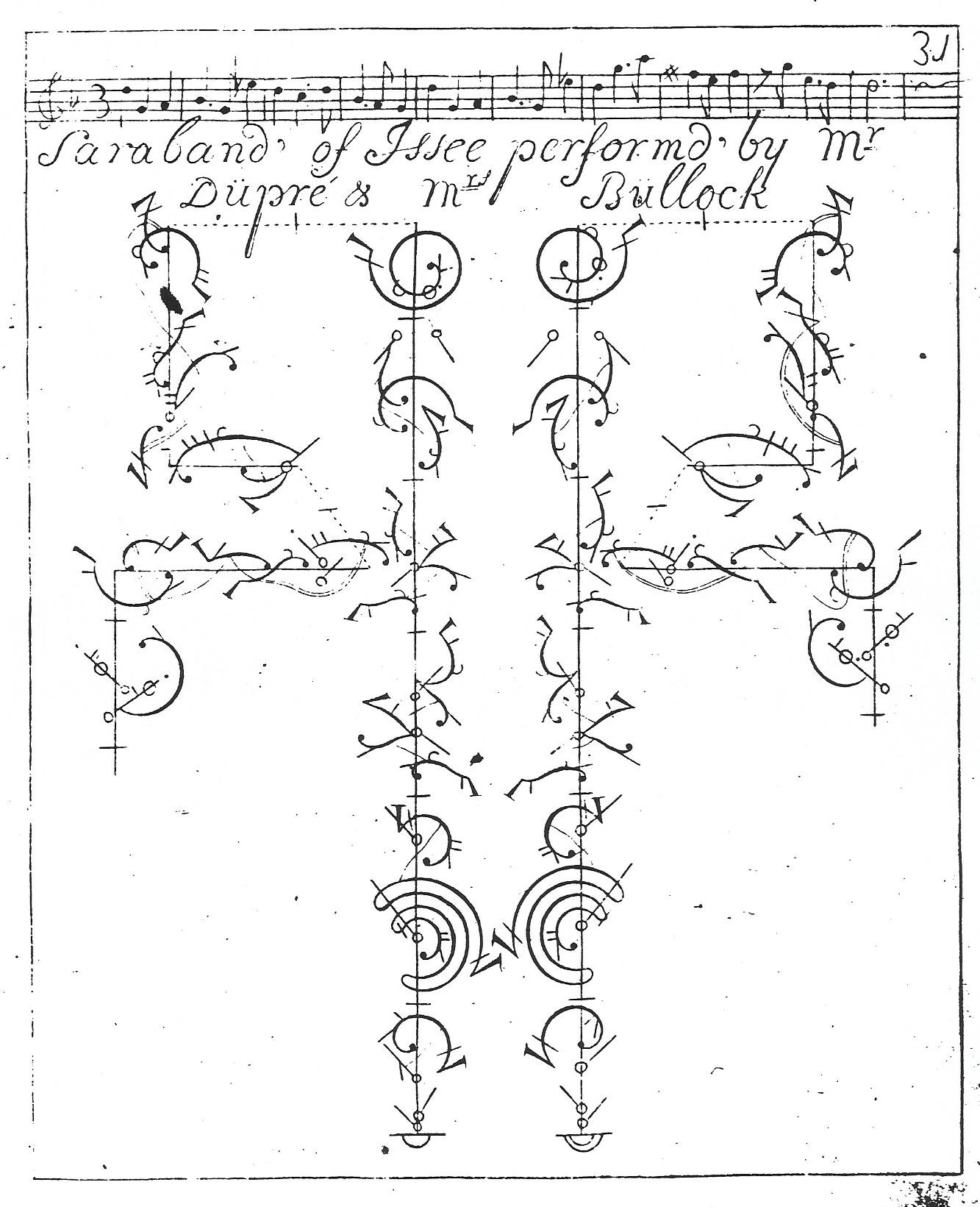
This was also the most likely season for Dupré to have danced with Mrs Bullock, a pupil of Delagarde who (as Miss Russell) began her dancing career in 1714-1715. L’Abbé’s ‘Saraband of Issee’, to music from Destouches’s 1697 opera Issé has Mrs Bullock matching Dupré with pas battus and pirouettes, although he gives her changements instead of Dupré’s entrechats-six. This dance has the time signature 3 and 64 bars of music. This is the first plate.

The ‘Jigg’ they danced together, either immediately following the ‘Saraband’ or quite separately, is to music from La Coste’s 1707 opera Bradamante and is in 6/4 with 48 bars of music. On the page, it has a straightforward vocabulary of steps.

I have glanced at these dances in earlier posts on Dance in History, but all are worth more detailed analysis.

Dupré moved to Drury Lane for the 1715-1716 season, his second on the London stage, perhaps because of the financial uncertainty surrounding John Rich and Lincoln’s Inn Fields. At Drury Lane, he immediately became the leading male dancer and partner to the dancer-actress Hester Santlow. They performed Spanish Entry and Harlequin duets together, as well as appearing as the lead couple in the popular entr’acte group dance Myrtillo. In 1716-1717, Dupré appeared with Hester Santlow and John Weaver in the latter’s The Loves of Mars and Venus. However, he seems not to have been happy at the Drury Lane Theatre, for he returned to Lincoln’s Inn Fields for the 1717-1718 season and would work for John Rich for the rest of his career.

Louis Dupré did not make his first appearance of the 1717-1718 season at Lincoln’s Inn Fields until 25 October 1717, when he was billed with ‘Mlle Gautier, from the opera at Paris, being the first time of her appearing upon the English Stage’. On 22 November, he took one of the title roles in a ‘New Dramatic Entertainment of dancing in Grotesque Characters’ entitled Mars and Venus; or, The Mouse Trap. He was Mars, with Mrs Schoolding as Venus and John Rich (under his stage name of Lun) as Vulcan. The afterpiece points to the possibility of past disagreements between Dupré and the Drury Lane management as well as Rich’s rivalry with John Weaver, and Dupré must surely have contributed his inside knowledge of Weaver’s ballet to the new entertainment.

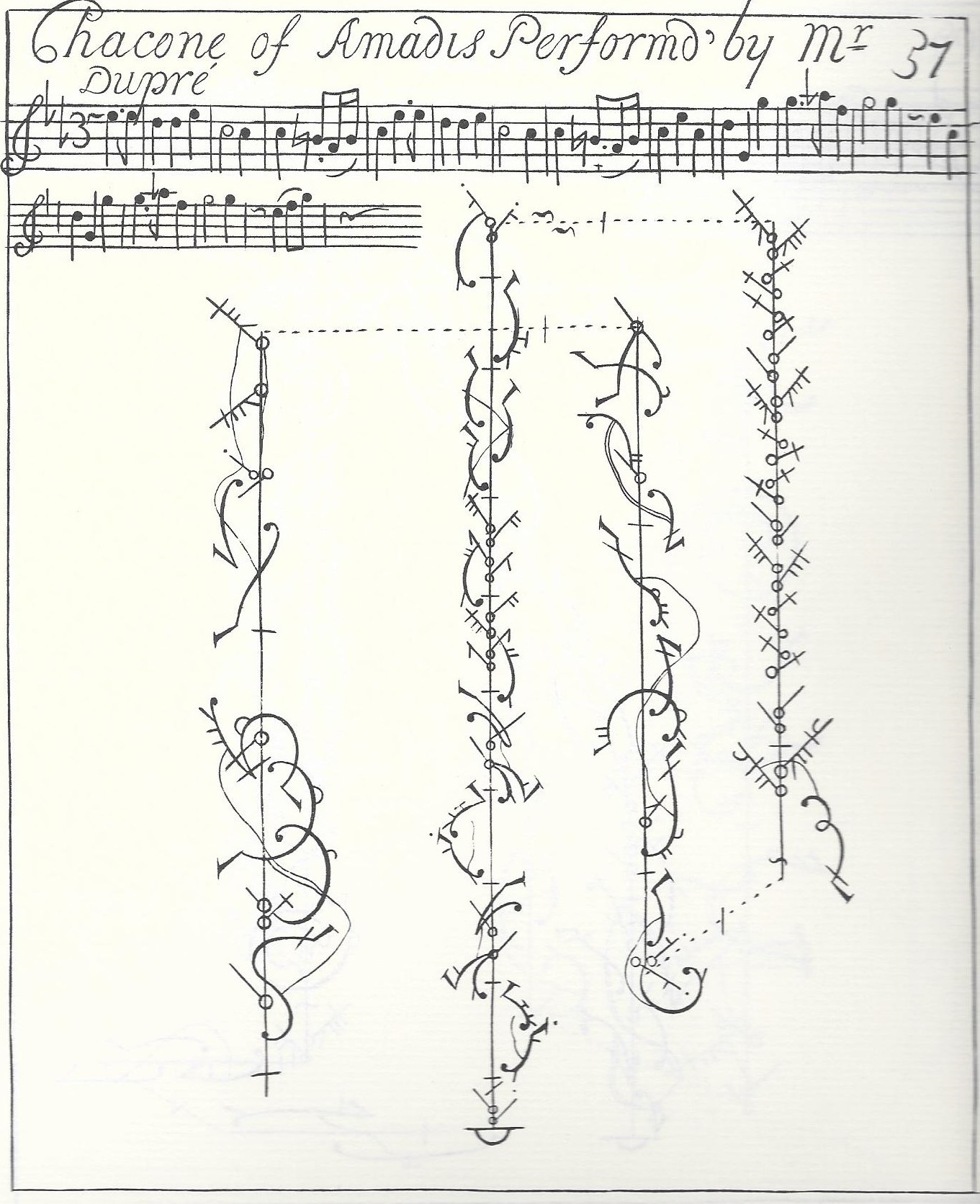
On 3 January 1718, another new afterpiece was advertised. The Professor of Folly was a ‘new Dramatick Entertainment of Vocal and Instrumental Musick after the Italian Manner, in Grotesque Characters’ for which Dupré had composed ‘all the Dances’ for himself and nine others (five men and four women), although it lasted for just a few performances. Then, on 24 January, Dupré appeared in the title role of Amadis; or, The Loves of Harlequin and Colombine with Mlle Gautier as Oriana and Lun (John Rich) with Mrs Schoolding as Harlequin and Colombine. This afterpiece was described as a ‘new Dramatick Opera in Dancing in Serious and Grotesque Characters’, although there were no singing roles. No scenario was published, but the characters in the serious part of the pantomime suggest a link with Lully’s 1684 opera Amadis and this is reinforced by Anthony L’Abbé’s solo for Dupré of around the same date to the chaconne from the opera. Here is the first plate of the notation from L’Abbé’s A New Collection of Dances.

I have elsewhere suggested that this solo was performed within the pantomime. It is certainly one of the most demanding of the male solos recorded in notation, and also seems to be one of the least known and least reconstructed by modern practitioners of baroque dance. It has 92 bars of music and its technical challenges include three entrechats-six in a single bar of music (1st plate) , a pirouette with two-and-a-half turns in a single bar (3rd plate) and a pirouette with four turns over three bars of music (6th and final plate). Again, I have looked briefly at this solo in earlier Dance in History posts, but it calls for both technical analysis and detailed comparison with other notated male solos.

During the late 1720s, Dupré danced in all of Rich’s most important pantomimes. In 1724-1725 he was billed as the first of three Furies in Harlequin a Sorcerer: With the Loves of Pluto and Proserpine (21 January 1725). In Apollo and Daphne; or, The Burgomaster Trick’d (14 January 1726) he danced as a Spaniard in the pantomime’s concluding divertissement, initially with Mrs Bullock as a Spanish Woman and later partnered by a succession of the company’s leading female dancers. This afterpiece marked the return to London of Francis and Marie Sallé, now young adults, who danced the title roles. These evidently required the expressive mime in which they excelled (a skill which Dupré may have lacked). In The Rape of Proserpine; or, The Birth and Adventures of Harlequin (13 February 1727), Dupré was one of three Gods of the Woods, one of five Demons and, in the final divertissement, the element Earth (with Mrs Pelling as his partner ‘Female’). This was another pantomime in which Francis and Marie Sallé were the leading dancers (although the title role and other roles in the serious part were performed by singers). In The Rape of Proserpine, Dupré was no longer billed first among the male supporting dancers. The last pantomime in which he danced was Perseus and Andromeda; or, The Cheats of Harlequin (or, The Flying Lovers) (2 January 1730). He was one of seven Infernals, but again he had lost his primacy among the men. However, in all these pantomimes Dupré danced serious roles which may well have required virtuosity, and he kept them until the end of his career.

His repertoire of entr’acte dances was also predominantly serious. As in the first years of his career in London, it included several ‘Spanish’ dances, either duets or for a group, as well as Chaconnes, which were mostly duets. He was never billed solo as Harlequin, although the trios and duets which he performed may well have had solo passages. Dupré’s last new entr’acte dance, first performed on 14 January 1734 at Covent Garden, was Pigmalion. This was Marie Sallé’s ballet, with Malter in the title role and Sallé herself as the statue Galatea. Dupré was billed as the first of six supporting male dancers, described in a review in the Mercure de France for April 1734 as Sculptors who performed a ‘danse caracterisée, le Maillet et le Ciseau à la main’. It seems that, at the end of his career when he must have been in his forties, Dupré was still capable of virtuosic dancing.

Dupré’s last recorded performance was at Covent Garden on 22 May 1734. That season, he had been billed for 34 performances in the entr’actes (the only dance named in the advertisements which featured him was Pigmalion) and 55 performances in three pantomimes (The Necromancer, Apollo and Daphne, and Perseus and Andromeda). If he was the ‘Lewis Dupre from the parish of St Anne Westminster’ who was buried at St James Paddington on 5 August 1734, then it seems he died suddenly. There was apparently no mention of his death in the newspapers, but he did not return to the stage in 1734-1735. The Dupré billed at Covent Garden that season danced a different repertoire and was probably the ‘Dupré Junior’ of earlier seasons. Louis Dupré’s death in 1734 or 1735 is confirmed by the acceptance of the ‘Widow Dupré’s tickets’ at Covent Garden on 2 December 1735. She continued to receive such benefit performances until at least 1740, underlining both Rich’s generosity to his players and Dupré’s value to him as a dancer in his company over nearly twenty years.

Louis Dupré’s career reveals both the opportunities and the difficulties faced by male professional dancers in London’s theatres during the early 18th century. His technical skills were exploited by John Rich, who needed dancers to draw audiences following the opening of Lincoln’s Inn Fields in December 1714. Dupré also faced competition from other dancers – like Francis Nivelon, who had exceptional abilities as a comic dancer, and Francis Sallé, who was probably no less virtuosic and of a younger generation. Both overtook Dupré in the ranks of dancers at Lincoln’s Inn Fields and then Covent Garden (and both will feature in my series on French male dancers working in London). Sadly, like most dancers, male and female, performing in London during the early 1700s, we have no portrait of the other Louis Dupré.

Further Reading:

Moira Goff, ‘The “London” Dupré’, Historical Dance, 3.6 (1999), 23-26

Linda Tomko, ‘Harlequin Choreographies: Repetition, Difference, and Representation’ in “The Stage’s Glory” John Rich, 1692-1761, ed. Berta Joncus and Jeremy Barlow (Newark, 2011), 99-137.

Season of Dancing: 1714-1715

It is quite some time since I have explored dancing in one of the seasons on the London stage, and quite a while since I have been able to publish a post on Dance in History as I have been busy with other research and writing. Nearly three years ago, I posted Season of Dancing: 1716-1717 to try to place in context the first performances of John Weaver’s The Loves of Mars and Venus. I have been thinking about Weaver and his work over the past year and more, so I thought I would look back a little further to see what was happening on the London stage in the preceding seasons and what light that might shed on Weaver’s ground-breaking ballet. The starting point of 1714-1715 is, of course, determined by the opening of the Lincoln’s Inn Fields Theatre that season and the return to theatrical competition for the first time since 1710-1711. In the past, I have also considered the wider context in my Year of Dance posts for 1714 to 1717.

Drury Lane opened for the 1714-1715 season on 21 September 1714 and the company gave 217 performances (including during its summer season) by the time it closed on 23 August 1715. The King’s Theatre opened on 23 October 1714 but, as London’s opera house, gave far fewer performances – only 42 by the time it closed on 27 August 1715. Lincoln’s Inn Fields reopened on 18 December 1714, following the decision of the new King George I to allow John Rich the use of his patent after some years of silence. By 31 August 1715 Rich’s new company had given 130 performances, a sign of its weakness against the senior established company at Drury Lane.

All three companies included dancing among their entertainments. The statistics for these offerings are interesting. Drury Lane offered entr’acte dancing in a little over 20% of its performances. At the King’s Theatre around 19% of its performances were advertised with dancing. Lincoln’s Inn Fields included entr’acte dancing in 96% of its performances, a startling statistic that proves the importance that Rich attached to dance from the very beginning of his career as the manager of one of London’s patent theatres.

The immediate change wrought by the reopening of Lincoln’s Inn Fields and the return to competition is highlighted by a few statistics from the 1713-1714 season, when the only theatres allowed to mount performances were Drury Lane and the then Queen’s Theatre. Drury Lane advertised 196 performances but included entr’acte dancing only during the benefit and summer seasons for around 11 % of the total. The Queen’s Theatre advertised dancing at only one of its 31 performances that season, with no mention of the dancers. However, the opera house’s practice of minimal advertising (because its performances were offered on subscription) make it very difficult to know how much dancing was actually offered there each season throughout much of the eighteenth century.

Returning to 1714-1715, Drury Lane billed a total of thirteen dancers (eight men and five women) in entr’acte dances, although only five of them – three men (Wade, Prince and Birkhead) and two women (Mrs Santlow and Mrs Bicknell) – gave more than a handful of performances. The advertisements suggest that Mrs Santlow and Mrs Bicknell were the chief draw when it came to entr’acte dancing. None of the men were named in advertisements before the early months of 1715, when Rich’s dance strategy had become obvious. Both Hester Santlow and Margaret Bicknell were well established as dancer-actresses with the company. John Wade and Joseph (or John) Prince were both specialist dancers, while Matthew Birkhead was an actor, singer and dancer.

Lincoln’s Inn Fields advertised eighteen dancers (fourteen men and four women) in the entr’actes during the season, but – as at Drury Lane – only ten of them were billed for more than a handful of performances. Ann Russell and Mrs Schoolding appeared throughout the season and both apparently made their London stage debuts following Rich’s opening of the theatre. Miss Russell was a dancer and would remain one throughout her career, without making the usual transition to a dancer-actress. She married Hildebrand Bullock, a member of the well-known acting family, on 3 May 1715 and would thereafter be billed as Mrs Bullock. Mrs Schoolding seems to have begun an acting career at Lincoln’s Inn Fields, alongside her appearances as a dancer. Letitia Cross was not billed until 5 July 1715 but gave at least ten performances before the end of the season. She had already enjoyed a long career as an actress, a singer and a dancer. Three of the men – Anthony Moreau, Louis Dupré and William Boval – made their London stage debuts this season. Newhouse may have appeared elsewhere in earlier seasons, but his appearance at Lincoln’s Inn Fields on 8 February 1715 is the first record of him dancing at one of the patent theatres. Charles Delagarde was well established as a dancer and dancing master. John Thurmond Junior had appeared in London in earlier seasons, as had Sandham. All the men were specialist dancers.

The dancers who appeared regularly in the entr’actes could be said to form a ‘company within the company’ at each playhouse, even though several of them (the women in particular) acted as well as danced. Both acting companies mounted plays that included significant amounts of dancing in 1714-1715, but no casts were listed by either theatre in advertisements so it is impossible to be sure of the involvement of the dancers alongside the actors and actresses who danced only occasionally.

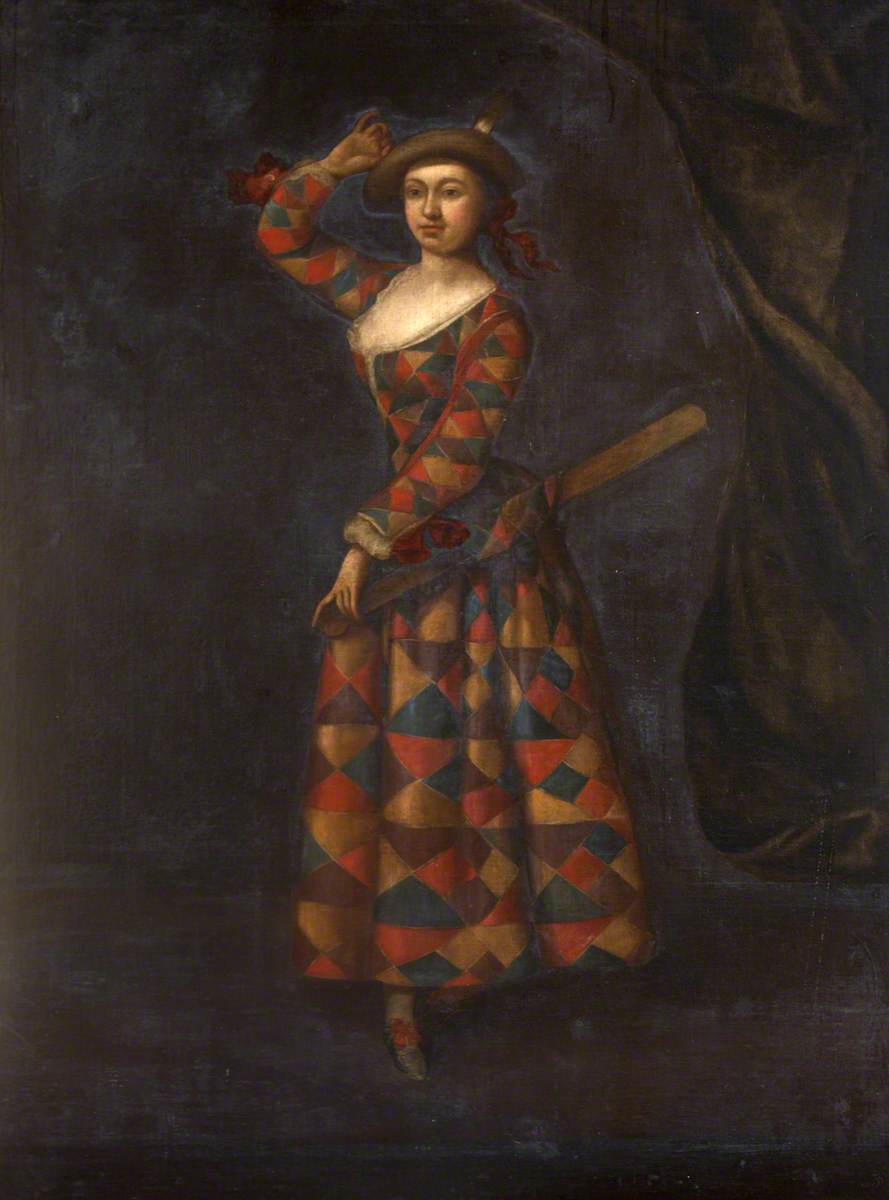
As for the entr’acte dances, Drury Lane offered nine, while Lincoln’s Inn Fields advertised seventeen. Drury Lane rarely mentioned specific dances in its advertisements, so it is impossible to know whether the repertoire was more extensive or which dances were the most popular.  It seems likely that Mrs Santlow’s solo Harlequin was among the latter. She was billed in it twice during 1714-1715 and the dance had been popular since she first performed it, perhaps as early as 1706. This is the less familiar version of her portrait as Harlequine, the one she owned herself which shows her skirt at the length she probably wore for performance.

It was one of only two dances advertised by Drury Lane before the opening of Lincoln’s Inn Fields, after which the theatre did not bill dance titles again until the benefit season began. The theatre’s managers were initially slow to grasp the value of dancing to attract audiences in the new atmosphere of rivalry. Other dances that may have been more popular than the bills suggest were the duets Dutch Skipper and French Peasant, the first given by Wade and Mrs Bicknell and the second by Wade and Mrs Santlow. Both had become part of the entr’acte repertoire not long after 1700 and would remain popular into the 1740s.

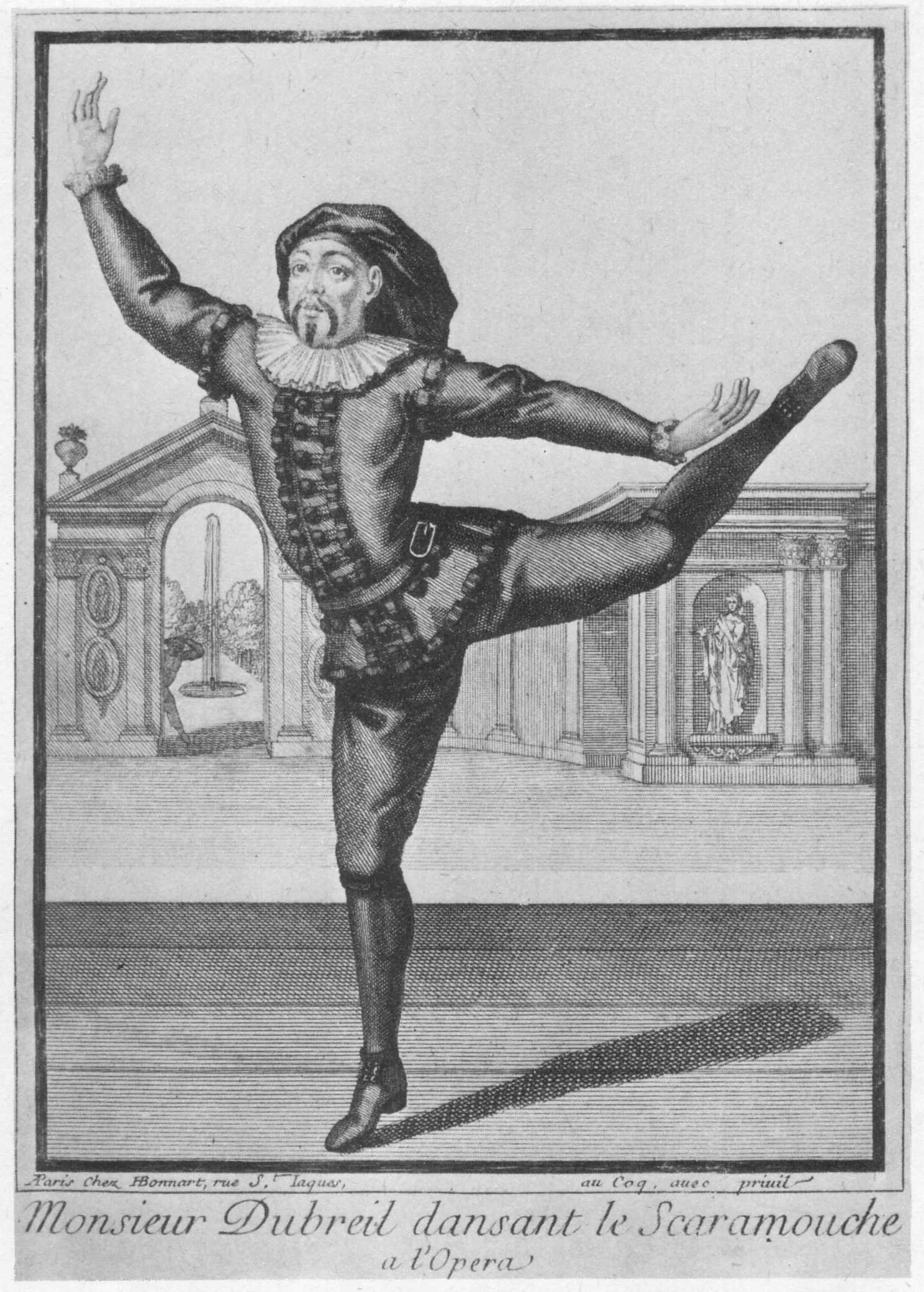
At Lincoln’s Inn Fields, the Dutch Skipper – first given on 6 January 1715 by Delagarde and Miss Russell – was far and away the most popular entr’acte dance, advertised twenty times by the end of the season. It was followed by a solo Scaramouch, performed on 5 February 1715 ‘by a Gentleman for his Diversion’ who gave it seven times during the season. John Thurmond Junior also danced a solo Scaramouch from 16 May 1715, when he was billed as ‘lately arrived from Ireland’. Scaramouch was already a familiar dancing character in London. John Thurmond Junior had been billed dancing the role ‘as it was performed by the famous Monsieur du Brill from the Opera at Brussels’ back in 1711. This print shows Pierre Dubreuil as Scaramouch about that time and suggests the acrobatic skills that Thurmond Junior may have emulated.

There were six entr’acte dances involving Scaramouch this season, with Lincoln’s Inn Fields leading the way and Drury Lane trying to catch up. At Lincoln’s Inn Fields, there was also an Italian Night Scene between Harlequin, Scaramouch and Punch (31 March 1715) and Scaramouches (18 April 1715, apparently a group dance although no dancers were named). Drury Lane replied with a Scaramouch and Harlequin (31 May 1715), a Tub Dance between a Cooper, his Wife, his Man, Scaramouch and Harlequin (2 June 1715) and Four Scaramouches (also 2 June 1715). In these dances, Harlequin would have been performed by one of the male dancers in the company. The four Scaramouches were probably danced by Prince, Wade, Sandham and Newhouse, who were listed in the bill (they also shared between them the male roles in the Tub Dance).

Delagarde and Miss Russell have a good claim to be the leading dancers at Lincoln’s Inn Fields this season, not only because of the number of their appearances (he was billed 65 times and she on 82 occasions) but also for their repertoire. As well as the Dutch Skipper, they performed a Spanish Entry, a Swedish Dance, a Venetian Dance and, most notably, The Friendship a new dance by Mr Isaac (who had been Queen Anne’s dancing master) which was also published in notation. The last of these may have been given before George I when he made his only visit of the season to Lincoln’s Inn Fields, on 10 March 1715 (he had visited Drury Lane on 5 January 1715). The new King was not proficient in English so limited his attendance at plays, preferring the Italian opera at the King’s Theatre. No serious dances were advertised at Drury Lane this season, whereas at Lincoln’s Inn Fields the Spanish Entry, an Entry and Mrs Bullock’s solo Chacone, given later in the season, can probably be assigned to the genre.

The 1714-1715 season should probably be seen as one of transition, at least so far as the dancing was concerned, as Drury Lane adjusted to the return of theatrical competition after enjoying several years of monopoly and Lincoln’s Inn Fields tried to gauge how it would deal with the dramatic superiority of its rival. Both theatres had to assess the impact of a new monarch and a new royal family on London’s theatrical life. In the following season of 1715-1716, they began to develop responses that would have a lasting effect on the entertainments of dancing to be seen on the London stage.

The Necromancer at 300

At the Lincoln’s Inn Fields Theatre, the manager John Rich had been watching Drury Lane’s developing repertoire of pantomimes and he was quick to respond to the success of Harlequin Dotor Faustus. On 20 November 1723, the afterpiece at Lincoln’s Inn Fields was ‘A New Dramatick Entertainment in Grotesque Characters’ entitled The Necromancer; or, Harlequin Doctor Faustus. Here is the advertisement from the Daily Courant that same day.

Rich himself, under his stage name ‘Lun’, took the title role. The new pantomime was given 51 performances before the end of the season and then played every season until 1744-1745. It was briefly revived in 1751-1752 and 1752-1753 before it finally disappeared from the repertoire.

The Necromancer was far more successful than Thurmond Junor’s Harlequin Doctor Faustus. It is thus interesting to note that in 1766-1767 Henry Woodward (who had been trained in the role of Harlequin by John Rich) produced a new pantomime at the Covent Garden Theatre titling it simply Harlequin Doctor Faustus. The advertisements declared that it drew on The Necromancer for some of its scenes, but it seems to have had little or nothing to do with Thurmond Junior’s original.

Rich’s pantomimes made much use of singing and The Necromancer had two scenes which exploited the talents of the singers in his company. The opening scene echoed that of Harlequin Doctor Faustus, as the Doctor is persuaded to sign away his soul, but Rich had a Good Spirit, a Bad Spirit and (instead of Mephostophilus) an Infernal Spirit, all of whom made their entreaties in song. A drawing now in the British Museum shows Faustus together with the Infernal Spirit in this scene.

There is a dance of five Furies in this same scene (which may have been a nod to French opera, which was a strong influence on Rich and his pantomime productions). The Infernal Spirit finally induces Faustus to take his fatal step by conjuring the appearance of Helen of Troy, who does not dance but sings. Rich’s creative response to his rival’s scenario can be seen from the very beginning of The Necromancer. The second episode of singing begins the final scene of the pantomime, when Faustus himself conjures Hero and Leander, who celebrate in song their eternal bliss in the Elysian Fields until Charon arrives and declares (again in song) his intention to ferry them to Hell.

The Lincoln’s Inn Fields pantomime was far more focussed than its rival at Drury Lane. It had only eight scenes, three of which were purely transitional – as characters entered and left the stage linking the scenes before and after with the minimum of action, a device that Thurmond Junior did not really use. The whole action of The Necromancer was published in An Exact Description of the Two Fam’d Entertainments of Harlequin Doctor Faustus … and The Necromancer of 1724. The first performances of the pantomime were accompanied by The Vocal Parts of an Entertainment, call’d The Necromancer : or, Harlequin Doctor Faustus which must have appeared before the end of 1723. There was also a series of editions of A Dramatick Entertainment call’d The Necromancer: or, Harlequin Doctor Faustus which gave only the sung texts. Without An Exact Description, we would know little about the comic action in The Necromancer.

There was dancing in five of the eight scenes. In scene 5, two men enter as Faustus is enjoying a meal with two Country Girls. He tells the men’s fortunes, which they reject and then try to make off without paying him. As they leave, Faustus ‘brings ‘em back on their Hands, making ‘em in that Posture dance a Minuet round the Room’.

In the following scene the dancing was probably more conventional, for the location moves to a Mill where the Miller’s Wife dances a solo before she is joined by the Miller for a duet. Their choreography may have owed something to the various Miller’s dances which had been given in the entr’actes at London’s theatres since the early 1700s. The scene carried on with one of the pantomime’s more daring scenic tricks, as Faustus tries to elude the Miller and make off with his wife, finally fixing the Miller to one of the sails of his own Mill and setting them turning.

Rich’s masterstroke was the finale of The Necromancer, which may have been developed in response to little more than a hint in Thurmond Junior’s Harlequin Doctor Faustus. In the latter, Mephostophilus ‘flies down upon a Dragon’ in the first scene, but Rich reserved the appearance of his monster to the end of his pantomime. As soon as Hero, Leander and Charon have vanished:

‘The Doctor waves his Wand, and the Scene changes to a Wood; a monstrous Dragon appears, and descends about half way down the Stage, and from each Claw drops a Daemon, representing divers grotesque Figures, viz. Harlequin, Punch, Scaramouch, and Mezzetin. Four Female Spirits rise in Character to each Figure, and join in an Antick Dance;’

This was probably the most substantial sequence of dancing in the pantomime, performed by the company’s leading dancers with Dupré and Mrs Rogier as the Harlequins, Nivelon Junior and Mrs Cross as the Pierrots (Punch is not listed among these dancing Spirits in the advertisements although he did appear in the pantomime, played by Nivelon Senior i.e. Francis Nivelon), Glover and Mrs Wall as the Mezzetins and Lanyon and Mrs Bullock as Scaramouches. Dupré was, of course, a dancing Harlequin and his performance in this last scene must have been very different from John Rich’s in the title role. The dance historian Richard Semmens has suggested that this ‘Antick Dance’ was performed to a chacone, a piece which is included among music for The Necromancer published some years later. The scene then moves inexorably to its tragic conclusion.

‘as they are performing, a Clock strikes; the Doctor is seiz’d by Spirits, and thrown into the Dragon’s Mouth, which opens and shuts several times, ‘till he has swallow’d the Doctor down, belching out Flames of Fire, and roaring in a horrible Manner. The Dragon rises slowly; the four Daemons that drop from his Claws, take hold of ‘em again, and rise with it; the Spirits vanish;’

Rich did not bother with a masque to point the moral of his tale. The Necromancer ends with a sung chorus:

Now triumph Hell, and Fiends be gay,

The Sorc’rer is become our Prey.

In contrast to Harlequin Doctor Faustus, evil apparently triumphs at the end of The Necromancer.

It has been suggested that Rich was preparing The Necromancer as a new pantomime for Lincoln’s Inn Fields well before Drury Lane mounted Harlequin Doctor Faustus, but the coincidence seems unlikely and does not fit with his later practice. Could he instead have been developing another theme and then quickly repurposed its tricks and transformations to outdo Drury Lane with its own story?

References:

Richard Semmens, Studies in the English Pantomime, 1712-1733 (Hillsdale, NY, 2016), chapter 3.

Olive Baldwin and Thelma Wilson, ‘“Heathen Gods and Heroes”: Singers and John Rich’s Pantomimes at Lincoln’s Inn Fields’, “The Stage’s Glory” John Rich, 1692-1761, ed. Berta Joncus and Jeremy Barlow (Newark, NJ, 2011), 157-168.

Season of Dancing: 1716-1717

One of the London stage seasons I have wanted to look at more closely is 1716-1717. It was the season that saw the first performances of John Weaver’s ‘Dramatick Entertainment of Dancing’ The Loves of Mars and Venus. I am not going to explore 1716-1717 in as much detail as I did 1725-1726, although I will pick up some of the topics I mention here in later posts.

1716-1717 was the third season to follow the reopening of the Lincoln’s Inn Fields Theatre in 1714, which ended Drury Lane’s monopoly over drama and associated entertainments. I have mentioned elsewhere that John Rich at Lincoln’s Inn Fields turned to dancing to counter Drury Lane’s far more experienced acting company. His success forced Drury Lane to take other genres, including dancing, more seriously so it could respond in kind. In 1715-1716, the forain performers Joseph Sorin and Richard Baxter had appeared at Drury Lane and presented a variety of entr’acte dances and two afterpieces which drew on the commedia dell’arte. I will return to the afterpieces, The Whimsical Death of Harlequin and La Guingette, on another occasion, but it may have been their success which prompted Drury Lane’s managers to look out for other similar entertainments and to engage the dancer and choreographer John Weaver for the next season.

During 1716-1717, Drury Lane offered 204 performances between September and the following August – including a summer season with 19 performances, which ran from 24 June to 23 August 1717. At Lincoln’s Inn Fields, there were 185 performances between October 1716 and July 1717 with no separate summer season. There was also the King’s Theatre, which offered a season of Italian opera between December 1716 and June 1717 with a total of six operas and 32 performances. At King’s, dancers were advertised at just three performances although they must have appeared more often.

The figures for performances with entr’acte dances are very different at the two main theatres. At Drury Lane there were 93 (including the summer season, 45% of the total), while at Lincoln’s Inn Fields there were 154 (83% of the total). Drury Lane had 10 performances with danced afterpieces and Lincoln’s Inn Fields had 12. However, Lincoln’s Inn Fields was evidently working hard to catch up, because their afterpieces were given in April and May – after Drury Lane’s in March and April.

As for the dancers, Drury Lane had 5 men and 3 women who danced regularly in the entr’actes, although the three women were also actresses. These dancers were:  Dupré, Boval, Dupré Jr, Prince and Birkhead; Mrs Santlow, Mrs Bicknell and Miss Younger. John Weaver and Wade danced only in afterpieces. Dupré and Mrs Santlow were the company’s leading dancers. At Lincoln’s Inn Fields there were 7 men and 3 women as regular entr’acte dancers: Thurmond Jr, Moreau, Cook, Newhouse, Delagarde, Shaw and ‘Kellum’s Scholar’ (perhaps the dancer John Topham); Mrs Schoolding, Miss Smith, Mrs Bullock. Rich’s leading dancers were Anthony Moreau and Mrs Schoolding (although Miss Smith was most often billed among the women). There were also the Sallé children, Francis and Marie, who were a special attraction. At both playhouses there were other dancers who were only billed a few times during the season, although they may have performed more often. At the King’s Theatre, the dancers were Glover, billed as ‘De Mirail’s Scholar’ and Mlle Cerail. The Sallé childen made what was apparently a single appearance there on 5 June 1717, alongside Handel’s opera Rinaldo.

Francis and Marie Sallé were making their first appearance in London. At their first performance at Lincoln’s Inn Fields on 18 October 1716, they were billed as ‘two Children, Scholars of M Ballon, lately arriv’d from the Opera at Paris’ with the additional notice that ‘Their Stay will be short in England’. They were undoubtedly the star dancers of the 1716-1717 season at Lincoln’s Inn Fields.  Rich even resorted to a ‘count down’ trick to increase audiences, with an announcement on 5 December 1716 that they ‘stay but nine days longer’, while 10 December was ‘the last time but one of their Dancing on the Stage during their Stay in England’. If this was true, he must have negotiated an extension to their contract for they reappeared not only on 11 December but on 15 December (their ‘last appearance’) and again, without comment, on 20 December. They then danced regularly until 10 June 1717.

Unsurprisingly, there were far more entr’acte dances advertised at Lincoln’s Inn Fields than at Drury Lane. Rich’s dancers gave 27 (6 group dances, 18 duets and 3 solos), while those at Drury Lane gave only 10 (5 group dances, 1 trio, 1 duet and 3 solos). Two of the Drury Lane dances – a solo Mimic Song and Country Dance and the group Countryman and Women – were only given during the summer season. The overlap in entr’acte dances between the two theatres was among the commedia dell’arte numbers. On 18 October, Drury Lane advertised Dame Ragundy and her Family, in the Characters of a Harlequin Man and Woman, Two Fools, a Punch and Dame Ragundy. According to the dancers billed for the performance, the Harlequin Man and Woman were probably Dupré and Mrs Santlow. At Lincoln’s Inn Fields that same evening there was Two Punchanellos, Two Harlequins and a Dame Ragonde, ‘the Harlequins to be perform’d by the Two Children’. Both dances were revivals from the previous season, probably with some changes. Drury Lane was trying to capitalise on its success with Sorin and Baxter in 1715-1716 as well as answer the Lincoln’s Inn Fields forays into commedia dell’arte.

On 22 October 1716, Drury Lane billed a Mimic Night Scene, after the Italian Manner, between a Harlequin, Scaramouch and Dame Ragonde, ‘being the same that was perform’d with great Applause, by the Sieurs Alard, 14 years ago’. The theatre’s revival of a piece from its own past (if that is what it was) was a success, for this Night Scene was given some 19 times during the season. The response from Lincoln’s Inn Fields was a Night Scene by the Sallé children, given three performances between 5 and 7 November. There had been some tit-for-tat billing of Night Scenes between the two theatres in 1715-1716, but Rich may now have felt he had other fish to fry when it came to dancing ‘after the Italian Manner’.

His focus was, of course, on the Sallé children, who together performed in a dozen entr’acte dances during 1716-1717. They gave nine duets and took part in three group dances. I have already mentioned the Dame Ragonde dance in which they performed as Harlequins and I will come to the other group dances shortly. Their London repertoire as child dancers in the late 1710s is worth closer analysis and I hope to return to it in another post.  Here, I will only mention the ‘Scene in the French Andromache burlesqued’ in which Francis danced Orestes with Marie as Hermione – the play was presumably Racine’s Andromaque and the children may have been drawing on their repertoire at the Paris fairs. This was repeated at least five times during the season. They also performed a new duet, The Submission, by the London dancing master Kellom Tomlinson who was then starting out on his career. This was first given on 21 February 1717 and repeated another three times that month. The Submission is the only dance performed by Marie Sallé to survive in notation, for it was published by Tomlinson that same year. Here is the first plate.

The leading dancer and perhaps the dancing master at Lincoln’s Inn Fields, Anthony Moreau, was credited with five dances in the bills and may well have been responsible for more. His most popular choreography by far was the Grand Comic Dance first performed with The Prophetess on 15 November 1716. It was advertised as the Grand Comic Wedding Dance alongside The Emperor of the Moon on 28 December but reverted to its original title when it was given on 8 April 1717. It received 21 performances in all in the course of 1716-1717 and the Sallé children were among its dancers.

Drury Lane revived two of its popular pastoral dances from the previous season – Lads and Lasses on 18 October and Myrtillo on 13 December – although neither of them were given more than a few performances, perhaps because there was no response from Lincoln’s Inn Fields. Lads and Lasses is one of those dances for which it is impossible to discover exactly who danced it at most, if not all, of its performances. Myrtillo may have deployed the same six dancers as in the previous season (Dupré, Boval, Dupré Jr, Mrs Santlow, Mrs Bicknell, Miss Younger – who were all named as entr’acte dancers at its first performance in 1716-1717). Lads and Lasses would last into the late 1720s. Myrtillo became a regular feature of the entr’acte dance repertoire at Lincoln’s Inn Fields as well as Drury Lane and lasted into the mid-1730s.

Both companies gave mainpieces with dancing this season. At Drury Lane these were Macbeth and The Tempest, while at Lincoln’s Inn Fields The Island Princess, Macbeth and The Prophetess as well as The Emperor of the Moon were performed. However, the most important productions, so far as future developments are concerned, were the afterpieces at both theatres. With these, the sequence of first performances is of interest as it shows clearly the progress of the rivalry between Drury Lane and Lincoln’s Inn Fields.

Drury Lane, 2 March 1717, The Loves of Mars and Venus by John Weaver

Drury Lane, 2 April 1717, The Shipwreck; or, Perseus and Andromeda by John Weaver

Lincoln’s Inn Fields, 22 April 1717, The Cheats; or, The Tavern Bilkers

Lincoln’s Inn Fields, 29 April 1717, The Jealous Doctor

Lincoln’s Inn Fields, 20 May 1717, Harlequin Executed

These were all new productions and it is evident that Rich at Lincoln’s Inn Fields was responding to Weaver at Drury Lane. I have written about The Loves of Mars and Venus elsewhere and I will take another closer look at this ballet in due course. Rich would produce a direct response to it in 1717-1718 and there would be several Lincoln’s Inn Fields afterpieces which used the phrase ‘Loves of’ in their titles. This season, though, there was only an entr’acte dance, The Loves of Harlequin and Colombine, performed by Francis and Marie Sallé on 23 April 1717. Might this suggest that the two children had been taken to Drury Lane to see Dupré and Mrs Santlow as Mars and Venus, so they could mimic them?

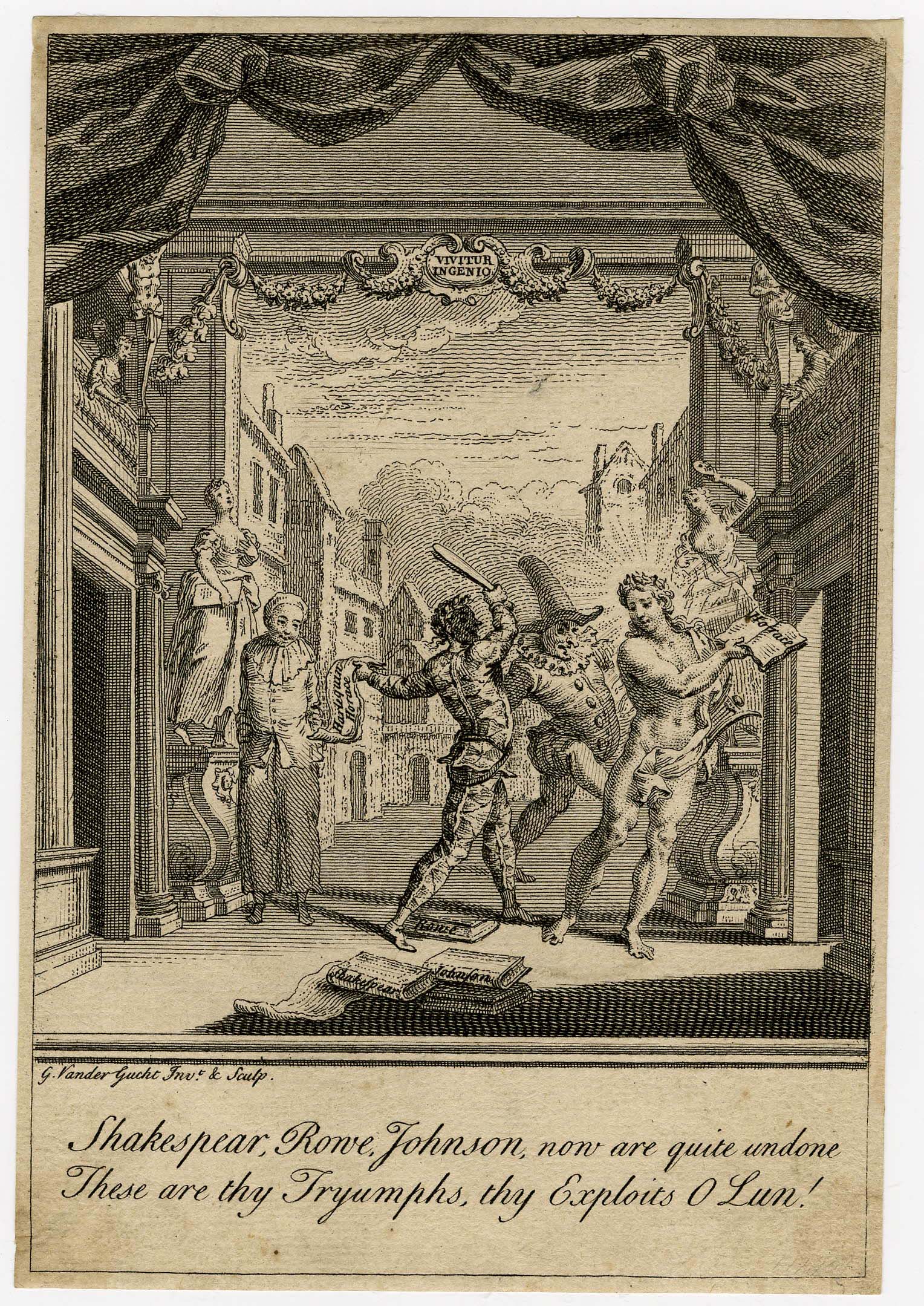
The Cheats; or, The Tavern Bilkers was, of course, a direct hit at Weaver by Rich – who obviously knew of Weaver’s claim to have created a piece entitled The Tavern Bilkers some fifteen years earlier, described by Weaver some years later as ‘The first Entertainment that appeared on the English Stage, where the Representation and Story was carried on by Dancing, Action and Motion only’ (The History of the Mimes and Pantomimes, published 1728, see page 45). The Jealous Doctor was based on a new, short-lived play given at Drury Lane on 16 January 1717, Three Hours after Marriage by John Gay, Alexander Pope and John Arbuthnot. Harlequin Executed had begun as a Lincoln’s Inn Fields entr’acte dance, entitled Italian Mimic Scene between a Scaramouch, Harlequin, Country Farmer, His Wife and Others on 26 December 1716 before being renamed as Harlequin Executed; or, The Farmer Disappointed on 29 December. After some seven performances as an entr’acte dance, it became an afterpiece on 10 May 1717 and would last in the Lincoln’s Inn Fields repertoire until 1721-1722. Although there is no mention of him in Harlequin Executed until 1717-1718, ‘Lun’ (John Rich himself) took the role of Harlequin in both The Cheats and The Jealous Doctor – directly challenging Weaver as Vulcan in The Loves of Mars and Venus and Perseus (Harlequin) in The Shipwreck. All of these afterpieces were, of course, laying the foundations for the new genre of English pantomime that would emerge over the next few years. This satirical print depicts how unsettling that would be for serious drama on the London stage. ‘Lun’ as Harlequin takes centre stage.

Season of 1725-1726: Afterpieces with Dancing at Lincoln’s Inn Fields

There were seven afterpieces with dancing at Lincoln’s Inn Fields in 1725-1726. One was a masque, while the rest were the pantomimes listed below.

Jupiter and Europa

The Necromancer

Harlequin a Sorcerer

Apollo and Daphne

The Cheats; or, The Tavern Bilkers

The Jealous Doctor

Only Apollo and Daphne was new. The list shows clearly how important pantomimes were to John Rich and his theatre company.

The masque was St. Ceciliae; or, The Union of the Three Sister Arts, which had first been performed in 1723-1724 and was briefly revived in 1724-1725 and 1725-1726. When it was given on 22 November 1725 (St. Cecilia’s day) it was advertised with ‘Proper Dances’ performed by three couples.

Jupiter and Europa; or, The Intrigues of Harlequin was given on 21 October 1725 with ‘Lun’ (John Rich) as Jupiter (Harlequin) and Mrs Wall as Europa and performed eight times in all during the season. The pantomime had first been performed in 1722-1723, when it had been billed as a ‘new Dramatic Entertainment of Dancing in Burlesque Characters’.  It lasted in the repertoire in its original form until 1727-1728 and was then revived in 1735-1736 within a new pantomime, The Royal Chace; or, Merlin’s Cave: With Jupiter and Europa. Like many of the pantomimes of this period, it is worth a post of its own. The abduction of Europa by Jupiter in the form of a bull was a favourite theme of artists of the period. This French painting by Pierre Gobert dates to the 1710s.

The Necromancer; or, Harlequin Doctor Faustus was given on 3 November 1725 with Lun as Faustus. This pantomime had been John Rich’s answer to John Thurmond Junior’s Harlequin Doctor Faustus in 1723-1724. It proved to be far more popular than its rival and would be regularly revived into the 1740s. The serious parts of Rich’s pantomimes used singers, rather than dancers as at Drury Lane, so Rich’s practice was to publish libretti for the ‘Vocal Parts’ with brief references to the action of the comic characters. The competition between the two Faustus pantomimes and the craze for these afterpieces which ensued meant that there were two scenarios printed for the Lincoln’s Inn Fields version. These provide details of the comic plot. The bills highlight the commedia dell’arte characters who appear in the final scene, performed by the company’s leading dancers – Harlequin Man and Woman, Pierrot Man and Woman, Mezzetin Man and Woman and Scaramouch Man and Woman. The Necromancer also featured Francis Nivelon as Punch.  This particular pantomime has attracted much scholarly attention, including analyses of the surviving music, and I will look at it more closely in a separate post. One drawing survives which is generally agreed to show the singer Richard Leveridge as an Infernal Spirit with John Rich as Faustus in scene one.

Harlequin a Sorcerer: With the Loves of Pluto and Proserpine, given at Lincoln’s Inn Fields on 21 January 1725, was Rich’s next new pantomime after The Necromancer. It received nearly 30 performances in its first season and was revived on 13 November 1725 for another ten. In 1725-1726, it was overshadowed by the popularity of that season’s new pantomime Apollo and Daphne. Rich, as Lun, took the title role in Harlequin a Sorcerer, while Pluto and Proserpine were played by singers. The pantomime’s subtitle refers to the pantomime that Rich had wanted to produce (and would indeed put on the following season). The libretto that was published to accompany performances records a few details of the scenic tricks and transformations in the piece, which I will also look at separately. Harlequin a Sorcerer lasted until the early 1730s and was revived at Covent Garden in the 1750s.

The 1725-1726 season’s new pantomime, Apollo and Daphne; or, The Burgomaster Tricked, was first given on 14 January 1726 with Francis and Marie Sallé in the title roles and Francis Nivelon as the Burgomaster. It had 45 performances before the end of the season and would be regularly revived into the 1750s, making it one of Rich’s most popular pantomime afterpieces. Apollo and Daphne was unusual among the Lincoln’s Inn Fields pantomimes for using dancers to play the principal characters in the serious plot – Rich was, of course, replying to Thurmond Junior and Mrs Booth at Drury Lane. Only the words for the ‘Vocal Parts’ were published, with little beyond the descriptions of the various scenes to hint at the dance and mime performed by the Sallés. There is no mention of the comic scenes with the Burgomaster or the various commedia dell’arte characters. Rich went one better than Drury Lane with his concluding entertainment to Apollo and Daphne, in which Francis and Marie Sallé reappeared as Zephyrus and Flora. Recent research suggests that this was taken from Aubert’s opera La Reine des Péris given at the Paris Opéra in 1725. Again, I will have to devote a separate post to this pantomime. The Triumph of Flora, like Zephyrus and Flora, was a favourite theme for artists. This version by Poussin is much earlier, although the artist was still greatly admired in the 18th century.

The last two pantomimes in repertoire at Lincoln’s Inn Fields in 1725-1726 were given during the summer season. The Cheats; or, The Tavern Bilkers was revived on 1 July 1726 for the first of five performances. Over the years casts were rarely listed for this pantomime, and this summer’s advertisements were no exception. The Cheats had begun life in 1716-1717 and was undoubtedly intended by Rich as a hit at John Weaver, whose danced afterpieces were popular at Drury Lane that season (Weaver’s first piece for the stage had been titled The Tavern Bilkers). On the occasions when the characters in The Cheats were named in the bills they were revealed as drawn from the commedia dell’arte – the piece was billed as an ‘Italian Night Scene’ at its first performance. The Cheats was revived into the early 1730s.

The Jealous Doctor; or, The Intriguing Dame, given on 19 July 1726 and then for another three performances, also dated back to 1716-1717. It had replied to the play by John Gay, Alexander Pope and John Arbuthnot Three Hours after Marriage given at Drury Lane that same season. The play lasted for only a few performances, but the pantomime was revived around half-a-dozen times each season until 1725-1726. Its relegation to the 1726 summer season marked the end of its stage life.

I am going to round up this lengthy exploration of dancing on the London stage during the 1725-1726 season in my next post by considering what all these details might tell us about dancing at the two patent theatres and stage dancing in London more generally.

Season of 1725-1726: Dancers at Lincoln’s Inn Fields

The figures I initially gave for the dancers at the Lincoln’s Inn Fields Theatre during the 1725-1726 season were not right either. There were, in fact, 16 dancers (9 men and 7 women) who danced regularly in the entr’actes during the main season. Of the others, Glover danced only on 14 April 1726. He had been a member of the dance ‘company within the company’ since 1723-1724 but was absent from Lincoln’s Inn Fields this season, apart from this one performance. ‘Pollett’s Son’, who made a single appearance on 25 April 1726 may have been a child dancer – there were other dancers named Pollett in London’s theatres around this time, although their careers need further research. Burny made only one appearance before the end of the main season, but he (together with Morgan and Smith) danced during the theatre’s summer season. I will look at the summer season and its dancers separately.

The following entr’acte dancers were at Lincoln’s Inn Fields in 1725-1726:

Nivelon

Lally

Dupré

Newhouse

Pelling

Dupré Jr

Sallé

Le Sac

Lanyon

Mrs Laguerre

Mrs Wall

Mrs Bullock

Mrs Ogden

Mlle Sallé

Miss La Tour

Mrs Anderson

At least one name in this list is likely to be familiar to those interested in the 18th-century dance.

Among the dancers at Lincoln’s Inn Fields the one most often billed in 1725-1726 was Nivelon, who danced in the entr’actes some 50 times. He was followed by Sallé (46 billings). None of the other men appeared nearly so often – next was Lally (31 billings), Le Sac (22), Dupré (17), Newhouse (15), Pelling (9), Dupré Jr (7) and Lanyon (4). Among the women, Mlle Sallé was the most in demand with 38 entr’acte billings. Mrs Wall danced some 34 times, followed by Mrs Bullock (32), Mrs Laguerre and Miss La Tour (22 performances each), Mrs Ogden (15) and Mrs Anderson (10). Mrs Ogden and Mrs Anderson also danced during the summer season.

As at Drury Lane, each dancer’s repertoire provides clues to his or her status. Nivelon and Sallé were first among the men. Nivelon performed 6 solos, 4 duets and 1 trio, while Sallé danced 1 solo, 6 duets, 1 trio and 2 group dances. Dupré had 2 duets and 6 group dances (he was also billed as a choreographer). Newhouse also performed 2 duets but appeared in only 1 group dance. Le Sac gave 1 solo and also performed 4 duets. Pelling, Dupré Jr and Lanyon were all supporting dancers, appearing only in group choreographies. Among the women, Mrs Wall had the most extensive repertoire, with 3 solos, 7 duets and 6 group dances. Mlle Sallé danced 1 solo (Les Caractères de la Danse), 5 duets and 1 trio. Mrs Laguerre performed in 6 duets and 1 group dance, while Mrs Anderson gave 1 solo and 2 duets and performed in 4 group dances. Miss La Tour danced 1 solo and 4 duets and Mrs Ogden was billed in 2 duets and 2 group dances. None of the women can be described simply as supporting dancers.

All the men, except for Le Sac, danced in the pantomime afterpieces which were performed on nearly as many evenings as entr’acte dancing. As at Drury Lane, the roles performed by these dancers reveal more about their place within the ‘dance company’. They also tell us a little about the specialities of individual dancers. Four pantomimes were given at Lincoln’s Inn Fields during the main season – Jupiter and Europa, The Necromancer, Harlequin a Sorcerer and Apollo and Daphne. The first two are anonymous, but may have been devised by the theatre’s manager John Rich who was himself a Harlequin and took that role in these afterpieces. The second two have libretti by the writer Lewis Theobald. Nivelon’s role was Punch, while Lally was Mezzetin, Pelling was Pierrot and Newhouse was Scaramouch (Lanyon also appeared as Scaramouch). Nivelon’s status was shown by Apollo and Daphne; or, The Burgomaster Tricked (to give the pantomime its full title), in which he was the Burgomaster and thus central to the comic plot. Lally (Edward Lally, who may or may not have been the brother of Michael Lally at Drury Lane that season) and Dupré both took prominent dancing roles in the pantomimes. Dupré also performed as a dancing Harlequin (Rich did not dance).

Mlle Sallé danced both Daphne and Flora, ‘An Inconstant’, in Apollo and Daphne, the only pantomime in which she appeared. Mrs Wall was Europa in Jupiter and Europa and took prominent roles in three more pantomimes. Mrs Bullock and Mrs Anderson also had significant dancing roles. Mrs Laguerre, Mrs Ogden and Miss La Tour did not appear in pantomimes at all. Mrs Laguerre had been one of the leading dancers at Lincoln’s Inn Fields and would be so again, but she seems to have been absent from late November 1725 to mid-March 1726. She was also an actress (the only one among Lincoln’s Inn Fields’s female dancers in 1725-1726) and played 11 acting roles during the months she was present.

So, what of the ‘dance company’ at Lincoln’s Inn Fields in 1725-1726? Le Sac and Miss La Tour made their debuts together and danced a series of duets. They were advertised as ‘Scholars of Mr. Dupre’ and were presumably just emerging from his tutelage. Were they members of the ‘dance company’ or more like apprentices? Francis and Marie Sallé were returning to dance in London for the first time since the 1718-1719 season, so they may have been seen as ‘guest artists’. Nivelon must have been the leading male dancer, and perhaps the company’s dancing master. (Although the meaning and even the existence of that position needs investigation and discussion). Lally and Dupré may have been more-or-less equal, followed by Newhouse and Pelling, then Dupré and Lanyon.

The relative status of the women is more difficult to unravel. Their benefits perhaps provide additional clues (although Rich at Lincoln’s Inn Fields seems to have been less hierarchical about these than the management at Drury Lane), along with their dancing partners. Mrs Laguerre was probably the leading local female dancer, her benefit (shared with her husband, the singer-actor John Laguerre) was on 14 April 1726. She was most often partnered by Nivelon. Mrs Wall shared her benefit with Newhouse, on 30 April, her main partner was Lally although she also danced with Dupré (who may have been one of her teachers). Mrs Bullock shared her 2 May benefit with her brother-in-law, the actor William Bullock. She danced her only duet with Nivelon, but in the group dances she seems to have been partnered by Sallé and Dupré most often. Mrs Anderson’s benefit (also shared) came on 9 May and Mrs Ogden had no benefit at all. They were evidently the lowest ranking of the female dancers in the company.

There are accounts surviving for Lincoln’s Inn Fields for the seasons 1724-1725 and 1726-1727 which provide more information about the relative status of the dancers, based on their pay scales. The 1724-1725 accounts have been analysed in some detail – I provide a reference to the article below – and I looked at those for 1726-1727 myself some years ago (although my notes are not extensive). They tell us that Nivelon earned by far the most among the dancers – much more than even the two Sallés (at least in 1726-1727) – and that Dupré was the next highest paid of the male dancers, followed by Lally. The highest paid of the women were Mrs Laguerre and Mrs Bullock. Apart from Nivelon, none of the dancers received anything like as much as the principal singers in Rich’s company.

The only one of the dancers at Lincoln’s Inn Fields in 1725-1726 for whom we have a portrait is Marie Sallé. Here she is, as a dancer and off-stage.

Reference

Judith Milhous, ‘The Finances of an Eighteenth-Century London Theatre: the Lincoln’s Inn Fields Company under John Rich in 1724-1725’ in Berta Joncus and Jeremy Barlow (editors), “The Stage’s Glory” John Rich, 1692-1761 (Newark, 2011), pp. 61-69.

Harlequin, Scaramouch and The Emperor of the Moon

Another play with dancing that held the London stage for several decades was Aphra Behn’s The Emperor of the Moon. It was probably first performed in March 1687 at the Dorset Garden Theatre and was published the same year. Behn’s principal source was Fatouville’s Arlequin empereur dans la lune, itself first performed by the Italian comedians in Paris on 5 March 1684. I am not going to attempt an analysis of the relationship between the two plays. My interest, as ever, is dancing and – in this case – the roles of Harlequin and Scaramouch, as performed on the London stage.

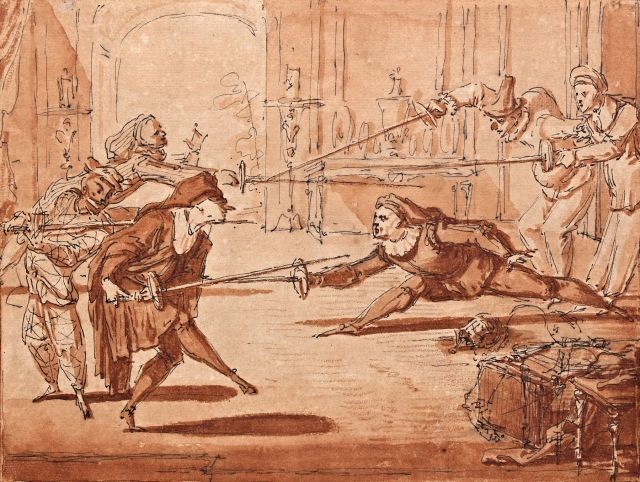
According to the printed play, Harlequin was first performed by ‘Mr Jevon’ and Scaramouch by ‘Mr Leigh’. Thomas Jevon and Anthony Leigh were both comedians with the company. Jevon had begun as a dancing master and regularly added dancing to his stage performances, while Leigh was known for ad-libbing and his wide variety of roles. Both must have been able to give a good account of commedia dell’arte-style action, for Behn’s play includes several lazzi for the two, including a fight which ends in a dance in act 1 scene 3.

‘They go to fight ridiculously, and ever as Scaramouch passes, Harlequin leaps aside, and skips so nimbly about, he cannot touch him for his life; which after a while endeavouring in vain, [Scaramouch] lays down his sword’.

Admitting defeat as a swordsman, ‘Scaramouch pulls out a flute doux, and falls to playing. Harlequin throws down his [sword], and falls a-dancing. After the dance, they shake hands’. Both are, of course, speaking (as well as miming) characters.

Scaramouch is described in the stage directions as ‘dressed in black, with a short black cloak, a ruff, and a little hat’, his customary costume, suggesting that Harlequin also wore his traditional parti-coloured suit with a mask. Aphra Behn is thought to have seen Fatouville’s piece in Paris in 1684, but it is not clear where Jevon and Leigh learnt their action since there had been no Italian comedians in London since the late 1670s.

The Emperor of the Moon revolves around the usual pairs of young lovers, who employ Harlequin and Scaramouch to trick Doctor Baliardo into allowing them to wed. The Doctor is obsessed with the world in the Moon and the final scene of the play has an elaborate masque in which the two young men descend to earth as the ‘Emperor of the Moon’ and the ‘Prince of Thunderland’ and marry their sweethearts. The action of the play includes three ‘antic’ dances, the last of which comes in this finale and is probably performed by the attendants of the ‘Emperor’ and ‘Prince’. According to the cast list they are ‘persons that represent the court cards’.

Revivals of The Emperor of the Moon up to 1700 are difficult to chart. The play was given in 1687-1688 and 1691-1692 and perhaps also in 1699-1700, although its later popularity suggests that it was performed far more often. The first known performance after 1700 was on 18 September 1702 at Drury Lane, with another famous comedian, William Pinkethman, as Harlequin. He experimented by trying to play the role without a mask, but – as Colley Cibber recorded in his Apology of 1740, ‘Penkethman could not take to himself the Shame of the Character without being concealed – he was no more Harlequin – his Humour was quite disconcerted!’. The Drury Lane performance on 20 December 1704 advertised ‘All the original Dances which were perform’d, particularly the Card Dance’. In 1709-1710, a Night Scene with commedia dell’arte characters was advertised alongside The Emperor of the Moon but may perhaps have been performed within the play.

When the Lincoln’s Inn Fields Theatre was allowed to open in 1714, it gave The Emperor of the Moon in competition with Drury Lane, finally taking over the play altogether from 1717-1718. Behn’s play was given at Lincoln’s Inn Fields nearly every season until 1731-1732, usually with William Bullock Sr as Scaramouch and James Spiller as Harlequin. Both were established comedians and Spiller also occasionally danced in the entr’actes. When the company moved to its new Covent Garden Theatre, The Emperor of the Moon went too.

The Emperor of the Moon was given a well-advertised revival at the Goodman’s Fields Theatre on 15 October 1735, with William Pinkethman Junior as Harlequin and James Rosco as Scaramouch. Pinkethman was following in his father’s footsteps, while Rosco was a leading actor in the company with a very varied repertoire. The bills announced that the play would be given with ‘the original Songs’ and ‘New Dances, adapted to the opera, particularly A Dance of Court Cards’. According to the advertised cast list, actors and not dancers performed this dance, while the company’s dancers gave ‘other dances’. The Emperor of the Moon was performed more than a dozen times at Goodman’s Fields in 1735-1736, but was not subsequently revived there.

The last revival of Behn’s play was during the 1748-1749 season, when David Garrick at Drury Lane vied for audiences with John Rich at Covent Garden. Both theatres advertised it as ‘forthcoming’ a few days before Christmas and both performed The Emperor of the Moon on 26 December 1748. At Drury Lane it was given as an afterpiece, with Henry Woodward as Harlequin and Richard Yates as Scaramouch. Both were comic actors and Woodward (trained by John Rich) would become London’s leading Harlequin. Garrick’s production included dancers, but did Rich’s? At Covent Garden, The Emperor of the Moon was the mainpiece, with a pantomime The Royal Chace (which did have dancing) as an afterpiece. There was no mention of dancing in the play, but the entr’acte dances included a solo Scaramouch and a Grand Masquerade Dance – or were they both given in The Emperor of the Moon?

Aphra Behn used commedia dell’arte at a period when it was still quite new to English actors and The Emperor of the Moon established a place in the repertoire some years before Joseph Sorin and other French forains came to perform in London. The tradition begun by Thomas Jevon may well have influenced some of London’s dancing Harlequins, while Pinkethman’s and Spiller’s performances may have contributed to the rise of ‘Lun’ (John Rich’s ‘Harlequin’ identity). The dances in The Emperor of the Moon didn’t make their way into the entr’actes, but the antics of Harlequin and Scaramouch must surely have played a part in the development of the English pantomime.

Claude Gillot’s various depictions of scenes from the Italian comedies given in Paris provide a flavour of performances there – here are Arlequin and Scaramouch fighting in Arlequin empereur dans la lune. What were the English like?

Gillot Arlequin Scaramouch combat

THE LOVES OF MARS AND VENUS IN CONTEXT

The theatre world of 18th-century London was very different from ours today. There were only two theatres allowed by law to perform plays, an arrangement that went back to the Restoration of Charles II in 1660. By 1717, one of these playhouses was Drury Lane (on the same site as the present theatre, but much smaller) while the other was Lincoln’s Inn Fields (demolished in 1848, but on a site now occupied by the Royal College of Surgeons of England). There was also the King’s Theatre in the Haymarket (on the site now occupied by Her Majesty’s Theatre) which presented only Italian opera. The most capacious of the three (at least when it was full to bursting) was Lincoln’s Inn Fields, which could hold some 1400 people. Drury Lane and the King’s Theatre could seat around 800 – 1000 patrons.

Drury Lane and Lincoln’s Inn Fields were both wholly commercial ventures and thus dependant on paying audiences for their survival. They were, of necessity, rivals. Dancing was a key element in their struggle to fill their auditoriums each night. Most dancing, at both houses, took place in the entr’actes, i.e. between the acts of the plays which were the main part of the bills. John Rich, manager of Lincoln’s Inn Fields, was well aware of the popularity of dancing and made it an important feature as soon as he took over the theatre in 1714.

lincolns-inn-fields

John Wykeham Archer, Building formerly Lincoln’s Inn Fields Theatre, 1847. © British Museum

At Drury Lane, the actor-managers Colley Cibber, Robert Wilks and Barton Booth, together with their fellow manager Sir Richard Steele, favoured drama – not least because they had the best actors in London. Despite their serious intent, they were forced to try and emulate Rich as his success drew away their audiences.

old-drury-lane-1794

View of the Drury Lane Theatre (Bridges Street front by Robert Adam), c1794? © British Museum

This was the world within which John Weaver’s The Loves of Mars and Venus was first produced.

Theatre seasons ran from September or October to June or July the following year. So, The Loves of Mars and Venus received its first performance some way through Drury Lane’s 1716-1717 season. During that season, the playhouse offered some nine afterpieces (short farces or other entertainments performed after the main comedy or tragedy), but only The Loves of Mars and Venus and The Shipwreck; or, Perseus and Andromeda, a ‘New Dramatick Entertainment of Dancing in Grotesque Characters’ also by Weaver, were danced. In their first season the former received seven performances before the end of March 1717, while the latter had three in April.

More than twenty years later, in his Apology, Colley Cibber explained how and why Weaver’s experimental ballet was allowed to go ahead. He began with the disparity between the two companies, and Lincoln’s Inn Fields’s need ‘to exhibit some new-fangled Foppery’ if it was to compete with Drury Lane’s higher reputation.

‘Dancing therefore was, now, the only Weight in the opposite Scale, and as the New Theatre [Lincoln’s Inn Fields] sometimes found their Account in it, it could not be safe for us, wholly to neglect it. To give even Dancing therefore some Improvement, and to make it something more than Motion without Meaning, the Fable of Mars and Venus, was form’d into a connected Presentation of Dances in Character, wherein the Passions were so happily express’d, and the whole Story so intelligibly told, by a mute Narration of Gesture only, that even thinking Spectators allow’d it both a pleasing, and a rational Entertainment; tho’, at the same time, from our Distrust of its Reception, we durst not venture to decorate it, with any extraordinary Expence of Scenes, or Habits; but upon the Success of this Attempt, it was rightly concluded, that if a visible Expence in both, were added to something of the same Nature, it could not fail of drawing the Town proportionably after it.’

Colley Cibber obviously had no great respect for dancing, but he had to admit that Weaver’s The Loves of Mars and Venus was not only completely new, it was also a proper drama and a success.

The Loves of Mars and Venus was given another sixteen performances in 1717-1718, seven performances in 1718-1719 and eight more in 1719-1720. It then disappeared from the repertoire until 1723-1724, when it was performed five times before it was dropped completely. Its success in all the seasons when it was performed suggests that there may have been other reasons why it did not survive beyond the mid-1720s.

However, there were later dance pieces titled Mars and Venus and at least one of these may have been a revival of Weaver’s ballet. This was given at Drury Lane on 2 May 1739 at a benefit for the dancer Essex. He was, very probably, William Essex the son of John Essex who translated Rameau’s Le Maître a danser for publication in London in 1728. William Essex danced Vulcan, with Desnoyer as Mars and Mrs Walter as Venus. All three had worked with John Weaver. Essex had danced in Drury Lane’s 1728 pantomime Perseus and Andromeda. With the Rape of Colombine: or, The Flying Lovers, for which Roger had created the serious scenes while Weaver had undertaken the comic action. Even though Essex had danced in Roger’s scenes, he must have worked alongside Weaver. Desnoyer had created the role of Paris in Weaver’s last dance drama The Judgment of Paris, given at Drury Lane in 1733. Mrs Walter had also danced in The Judgment of Paris, as the goddess Juno.

There were, therefore, many opportunities for Weaver’s The Loves of Mars and Venus to influence other, later dance works even beyond its last certain performances in the 1723-1724 season.

A Year of Dance: 1717

1717 was a busy year on the London stage, at least so far as dancing was concerned. With hindsight, the most significant event was the performance at the Drury Lane Theatre on 2 March 1717 of John Weaver’s ‘New Dramatick Entertainment of Dancing after the Manner of the Antient Pantomimes’ The Loves of Mars and Venus – now widely recognised as the first modern ballet. Weaver followed it up on 2 April with a ‘New Dramatick Entertainment of Dancing in Grotesque Characters’, The Shipwreck; or, Perseus and Andromeda. Together, the two afterpieces were surely intended to show the full range of the expressive dancing that Weaver was eager to promote. On 5 December 1717, Weaver’s Harlequin Turn’d Judge was given at Drury Lane. It was later advertised as an ‘Entertainment of Dancing in Grotesque Characters’ but was, to all intents and purposes, a pantomime (a genre new to London’s theatres). Both The Loves of Mars and Venus and Harlequin Turn’d Judge were successful enough to survive into the 1720s.

The popularity of Weaver’s danced afterpieces attracted several responses from John Rich at Lincoln’s Inn Fields. Rich began with The Cheats; or, The Tavern Bilkers on 22 April 1717. The alternative title apparently refers to a much earlier piece by Weaver, which the dancing master claimed was performed at Drury Lane in 1702. Although, as Weaver’s The Tavern Bilkers was never revived, how did Rich know about it? A few months later, Rich turned his attention to Weaver’s new ballet with Mars and Venus; or, The Mouse Trap, given at Lincoln’s Inn Fields on 22 November 1717. He then produced Colombine; or, Harlequin Turn’d Judge on 11 December. Neither of Rich’s ripostes were anything like as successful as the originals. However, The Jealous Doctor; or, The Intriguing Dame, a pantomime given at Lincoln’s Inn Fields on 29 April 1717 continued to be popular until the mid-1720s.

All these afterpieces had casts of dancers, and Rich did not neglect entr’acte dancing. His star dancers in 1717 were the ‘two Children, Scholars of M Ballon, lately arriv’d from the Opera at Paris’. Francis and Marie Sallé had made their London debut at Lincoln’s Inn Fields on 18 October 1716. Rich billed them frequently, in a varied repertoire of serious and comic dances, between then and their last performance on 20 June 1717. Was their ‘New Comic Scene’ entitled The Loves of Harlequin and Colombine, given on 23 April 1717, intended as another hit at The Loves of Mars and Venus? They also performed ‘The Submission, a new Dance, compos’d by Kellom’ on 21 February 1717 demonstrating their versatility.

Kellom Tomlinson’s The Submission was one of the only two notated dances to be published in London this year. The other was L’Abbé’s The Royal George, according to newspaper advertisements published ‘for the Princess’s Birth Day’ in March 1717 although the title page says only a ‘A New Dance … for the Year 1717’. The title must thus honour the Prince of Wales her husband. Fortunately, the dance appeared several months before the serious quarrel between the King and his son the following November, which would divide the royal family for the next few years. The other noteworthy cultural event of 1717 was the first performance on 17 July of Handel’s Water Music for George I as he travelled by barge along the River Thames.

In Paris, the annual dance publication was the XV Recüeil de danses pour l’année 1717 published by Dezais. It contained three short ballroom duets, La Clermont and La de Bergue by Claude Ballon and La Ribeyra by Dezais himself. The last of them was dedicated ‘A Madame l’Ambassatrice de Portugal’, providing an insight into the naming of such choreographies. At the Paris Opéra, besides the usual revivals of works by Lully, André Campra was represented not only by revivals of his Fragments de M. Lully and Tancrède but also by a new opera Camille, Reine des Volsques given on 9 November 1717 (N.S.).

The most important dance publication of the year, at least for many 21st-century dance historians, was Gottfried Taubert’s monumental treatise Rechtschaffener Tantzmeister which appeared in Leipzig and provided a German view of French dancing. It shows not only how influential la belle danse was around Europe but also how this French style and technique could be moulded to suit other national tastes and ideas.