Tag Archives: Hester Santlow

BAROQUE DANCE IN PERFORMANCE

One of the many challenges facing dance historians who (like me) specialise in ‘baroque dance’, and in particular stage dancing, is the rarity of opportunities to see performances of the notated choreographies. The most difficult of the surviving stage dances are rarely, if ever taught at historical dance workshops or courses here in the UK. I confess that I have been unable to find videos of performances of most of them online.

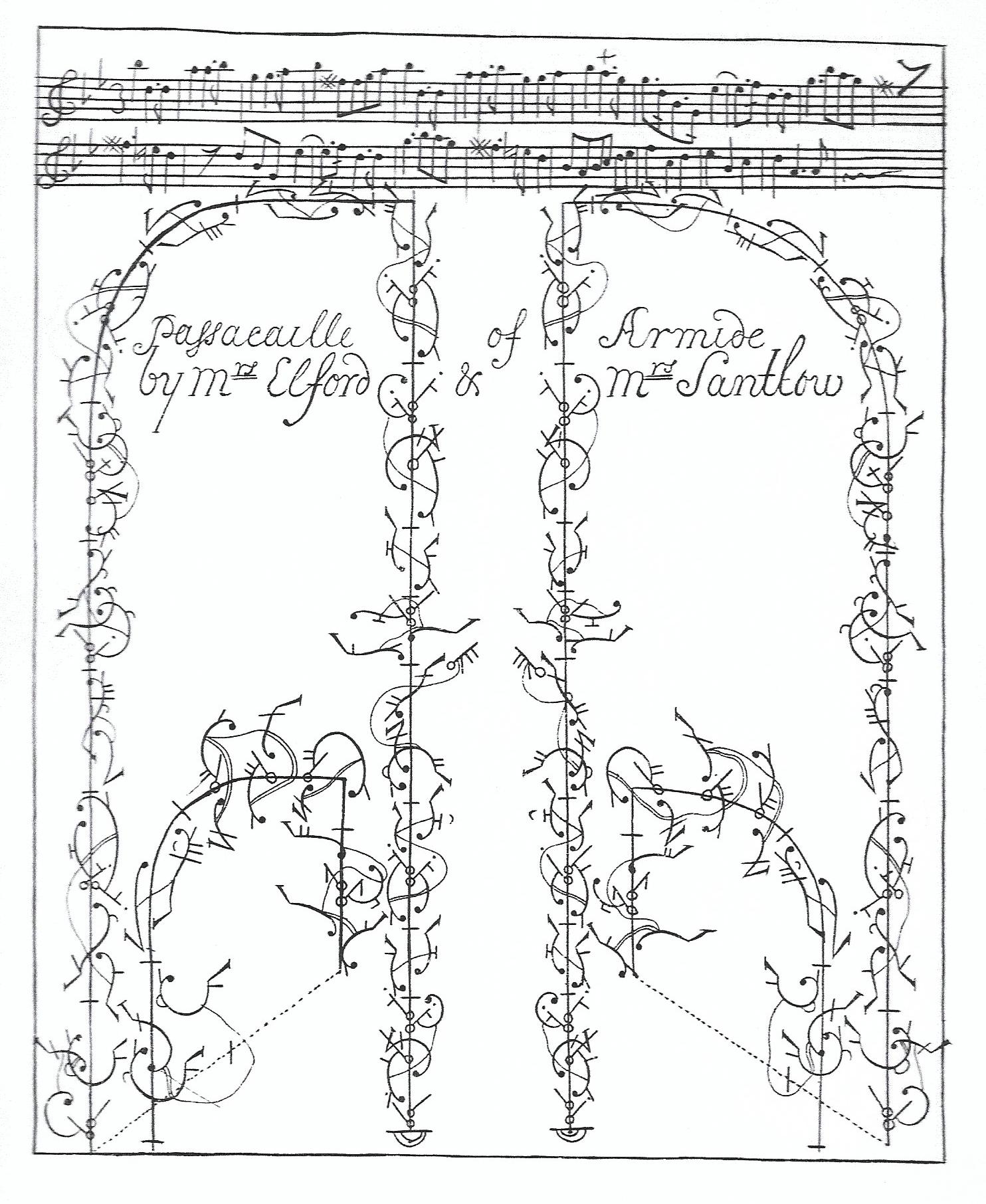
I have long been interested in Anthony L’Abbé’s A New Collection of Dances, thirteen choreographies created by him for professional dancers on the London stage notated and published around 1725 by F. Le Roussau. I have in my time performed four of them – the ‘Passacaille of Armide’, ‘Mrs Santlow’s Minuet’, the ‘Passagalia of Venüs & Adonis’ and the ‘Türkish Dance’ – and worked on another three – the ‘Chacone of Galathee’, the ‘Saraband of Issee’ and the following ‘Jigg’. However, until recently I had only seen four of them performed. When the chance arose to see three of the duets being taught in Paris as part of the Pecour Academy summer course 2025, I jumped at it. I am extremely grateful to Guillaume Jablonka and his fellow teachers Hubert Hazebroucq and Irène Feste for making an exception and allowing me to attend part of the course simply to watch and to learn. I have to say that it was a marvellous and truly rewarding experience.

The three choreographies were the ‘Loure or Faune’ danced by L’Abbé himself with his great compatriot Claude Ballon, the ‘Canaries’ performed by Charles Delagarde and Louis Dupré (the ‘London’ Dupré I wrote about a little while ago) and the ‘Passacaille of Armide’ danced by Mrs Elford and the very young Mrs Santlow.

Hubert Hazebroucq taught the ‘Loure or Faune’, Guillaume Jablonka the ‘Canaries’ and Irène Feste the ‘Passacaille of Armide’. The ‘Passacaille of Armide’ was one of the first baroque stage dances I worked on and inspired me to pursue the research which culminated in my book The Incomparable Hester Santlow. All three duets, particularly those for the men, are technically challenging and require teachers and dancers with an advanced level of training.  The Pecour Academy was attended by dancers who were well up to the task.

The three teachers, all professional dancers, differ in their dancing styles and approaches to teaching, but all recognisably belong to a shared French tradition of historical dance research and reconstruction based on the concept of ‘la belle dance’. Their individuality as well as their shared heritage was apparent in their warm-up sessions and their teaching of the notated dances. I was able to observe their work during the last three days of the course and the focus and energy in all three classes was inspiring. The teaching and dancing I watched has raised many questions about my own knowledge and understanding of baroque dance, at one end of the spectrum in relation to the performance of individual steps and at the other about the interpretation of the dances in L’Abbé’s New Collection.

An abiding issue for all who study the dancing of the decades around 1700 (when Feuillet first published Choregraphie and the associated collections of notated dances) is what the notations leave out when it comes to technique as well as style. Some questions are answered (although not definitively) by the descriptions of steps in Pierre Rameau’s Le Maître a danser of 1725. For others there are no answers, at least in print. I was aware that French interpretations of Rameau differ from those in the UK and this course reminded me of details I had forgotten. It also revealed new thinking about steps that I was unaware of. I hope to be able to pursue some of these in individual posts for Dance in History.

Two other issues came up that require me to undertake far more research and do a great deal more thinking. One is about the way in which L’Abbé’s dances use space, which relates to the stages for which he created these choreographies in London (not in Paris, with the possible exception of the ‘Loure or Faune’ even though this was undoubtedly performed at London’s Kensington Palace). This issue is difficult to address in any course which has several couples of dancers learning dances in the same space, who necessarily have nothing like the area for which L’Abbé created each choreography and who are also engaging with the most difficult steps in the baroque vocabulary. There are also the relationships, expressive as well as spatial, between the two dancers and between them and their audience (which these students were certainly very aware of). The placing of that audience in relation to the dancers is also a factor to be investigated – I suspect that this differed in Paris and London. I hope to be able to explore all of these aspects more fully in due course. The second issue that arose is the characters personified by the dancers, which may or may not derive from the music used by L’Abbé. The three teachers understandably thought of these choreographies in the context of the works given at the Paris Opéra from which L’Abbé took his music. I (equally understandably, I hope) have tended to think of them in performance on the London stage, where they would have been removed from their original operatic context (which may well have been unknown to their London audiences). I think these two views, which can surely be reconciled despite their differences, provide a rich environment for the development of a range of interpretations.

I have focussed here on L’Abbé’s three choreographies, but each day included workshops on other dances and aspects of baroque dance. Notable among these was Christine Bayle’s masterclass on Pecour’s La Nouvelle Forlane, in which she shared her great skill, experience and knowledge with a group of of dancers who were eager and extremely well prepared to benefit from it. That was a special moment, too. The whole course concluded with a public presentation of the dances that had been taught over the week. It was described as showing ‘Work in Progress’, but what marvellous Work – and fantastic Progress – it shared. I salute the teachers and their students for a wonderful achievement.

The 2025 Pecour Academy was a while ago now, but I am still thinking about it as I pursue my research into L’Abbé’s stage dances. I repeat my grateful thanks to Guillaume, Hubert and Irène for sharing their work with me.

Monsieur Roger, Who Plays the Pierrot

‘There have been companies of Pantomimes raised in England; and some of those comedians have acted even at Paris dumb scenes which everybody understood. Tho’ Roger did not open his mouth, yet it was easy to understand what he meant.’

This quotation from Jean-Baptiste Dubos’s Réflexions critiques sur la poesie et sur la peinture, as translated by Thomas Nugent in 1748, is well-known. Roger himself is hardly known at all, yet his career is of great interest not only as part of the history of the English pantomime but also for what it tells us about theatrical exchange between Paris and London in the early 18th century.

Roger was probably the ‘Person, who plays Pierot at Paris, is just arrived from thence, and will perform this night’ advertised to appear at the Lincoln’s Inn Fields Theatre on 29 January 1719. He was joining Francisque Moylin’s company, which had been playing there since mid-November 1718 and would stay until 5 February before moving on to perform at the King’s Theatre until 21 March 1719. He presumably took the title role in the French three-act farce Pierot maître valet, et l’opera de campagne, ou la critique de l’opera. Roger was given a benefit on 5 February 1719, commanded by the Prince of Wales, at which he performed an acrobatic stunt (apparently as Octave in a one-act farce titled Grapignant; or, the French Lawyer) and ‘the Scene of the Monkey, which has never been performed in England before’. His mimetic and acrobatic skills had probably been acquired through his training and experience as a performer at the Paris fairs.

Roger returned to London in the spring of 1720, playing in De Grimbergue’s company at the King’s Theatre (which alternated its performances with those of an Italian opera company). He returned, again with De Grimbergue, for a season at the newly opened Little Theatre in the Haymarket between December 1720 and April 1721, after which he did not return to London until 1725. The Biographical Dictionary of Actors states that he was appointed as ballet master at the Opéra-Comique in Paris by its manager, the English Harlequin Richard Baxter, but gives no source for this assertion. It also repeats the suggestion by Ifan Kyrle Fletcher, in Famed for Dance, that Roger may have been an Englishman. Fletcher likewise offers no evidence for this and may simply have been misinterpreting the passage from Dubos referring to Roger. Further research is needed to see what can be discovered about Roger in French records, although I cannot pursue this here.

A new troupe of ‘Italian Comedians’ was billed at the Little Theatre in the Haymarket between 17 December 1724 and 13 May 1725. ‘Roger, the Pierrot’ was first advertised on 22 January 1725, as the creator of ‘un ballet nouveau’ given as part of a performance which included Molière’s Le Medecin malgré lui and Gherardi’s Les Filles errantes. Later in the season, he was billed as the creator of a ‘Nouveau ballet comique’ as well as a performer in a ‘Variety of new Dances’ and gave Pierrot and Country Dance solos. His benefit was on 18 March 1725 and included ‘Pierrot Grand Vizier, with the Turkish Ceremony of the Bourgeois Gentilhomme’ and ‘a new Sonata on the Violin of Mr. Roger’s composing, by himself’.

Although companies of ‘Italian Comedians’ would return to play in London during the 1725-1726 and 1726-1727 seasons, Roger did not appear with them for he had joined the company at the Drury Lane Theatre, where he was first advertised on 28 September 1725. The bill published in the Daily Courant on that date recorded his latest new dance.

La Follett (as it was first called) had already been advertised at Drury Lane on 23 September 1725, with no mention of the performers. Roger must surely have danced it then, and if it marked his first appearance with the company it is interesting that no mention was made of this.

In his first season at Drury Lane, Roger was billed in three solos, a duet, three group dances and three pantomimes. The solos were variations on the ubiquitous Peasant dance – a Peasant (28 October 1725), a Drunken Peasant (3 November 1725) and a French Peasant (13 May 1726). He was billed in a Drunken Peasant again in 1728-1729, but he seems not to have repeated the first two dances in later seasons. The duet, usually advertised as La Pieraite and created by Roger himself, was first given on 21 March 1726 and immediately became a staple of the entr’acte dance repertoire. It was performed every season until 1730-1731 by Roger, first with Mrs Brett and then with Mrs De Lorme, and was presumably a ‘Pierrot’ dance. This season also marked the first performances of Roger’s group dance Le Badinage Champetre, billed on 19 November 1725, in which there were five couples led by Roger and Mrs Booth. This dance was also popular and remained in the entr’acte repertoire until 1729-1730.

Drury Lane had lost its leading male dancer, the multi-talented John Shaw, who was absent from late in the 1724-1725 season and died in December 1725. Shaw had been the company’s Harlequin and had created that role in John Thurmond Junior’s The Escapes of Harlequin (first given 10 January 1722) and the overwhelmingly successful Harlequin Doctor Faustus (first given 26 November 1723). Drury Lane’s managers understandably wished to keep both pantomimes in the theatre’s repertoire, not least to counter the rivalry of John Rich at Lincoln’s Inn Fields, and seem to have given Roger the opportunity to try out the role of Harlequin in both pantomimes. The experiment (if that is what it was) was unsuccessful. The Escapes of Harlequin was not revived again and Roger instead took over the role of Pierrot in Harlequin Doctor Faustus, which he played regularly until 1730-1731.

In his first season at Drury Lane, Roger also took over the role of Pierrot in Thurmond Junior’s Apollo and Daphne; or, Harlequin’s Metamorphoses (first given under the title Apollo and Daphne; or, Harlequin Mercury in 1724-1725). He continued to dance in the pantomime until 1727-1728. Apollo and Daphne made a final appearance as a ‘Scene’ within a ‘New Entertainment’ The Comical Distresses of Pierrot which was given a single performance at Drury Lane on 10 December 1729. Roger played Pierrot, suggesting that the piece may have been created by him.

Roger danced at Drury Lane for six seasons, until his untimely death in 1731, and built a successful career there as both a choreographer and a dancer within the company. After his first season, he seems to have mainly appeared in pantomime afterpieces. He worked with John Thurmond Junior again in 1726-1727, as Pierot in The Miser; or, Wagner and Abericock, which was revised and re-titled Harlequin’s Triumph later that season. He then went on to create a number of pantomimes himself. Harlequin Happy and Poor Pierrot Married, first given on 11 March 1728, brought him and John Weaver together on stage for the first time. Weaver, who had not appeared in London since 1721, played Colombine’s Father, while Roger took his accustomed role of Pierrot. The pantomime lasted until 1729-1730 (with cast changes) and was revived for a single performance at Drury Lane on 4 December 1736.

Far more important was Perseus and Andromeda: With the Rape of Colombine; or, the Flying Lovers first given at Drury Lane on 15 November 1728 and successful enough to persuade John Rich to mount a rival production at Lincoln’s Inn Fields on 2 January 1730. The Drury Lane version was ‘In five different Interludes, viz. Three Serious, and two Comic’ and the scenario published to accompany performances stated that the serious part was by Roger and the comic part by John Weaver. Both Roger and Weaver appeared in the comic part, Roger as Pierrot (Doctor’s Man) and Weaver as Clown (Squire’s Man). From 15 March 1729, the comic part was changed to ‘the Devil upon Two Sticks’ and the new edition of the scenario (again published to accompany performances) made clear that this was by Roger.  Here are the title pages of the two editions.

Weaver had no role in the new comic plot and may have already decided to leave London by the end of the season. He had a shared benefit on 25 April 1729, at which he danced a Clown solo and Roger reprised his solo Drunken Peasant (perhaps an indication that there were no hard feelings between the two men over the change to the comic part of Perseus and Andromeda). Weaver’s last billing was on 2 May 1729 and he would not return to work in London until 1733. It is worth noting that in the serious part of Perseus and Andromeda Roger followed Thurmond Junior’s Apollo and Daphne in giving the title roles to two dancers.

The next of Roger’s afterpieces was wholly serious. Diana and Acteon was given on 23 April 1730 for Roger’s benefit, with Mrs Booth and Michael Lally in the title roles (they had also danced the title roles in Perseus and Andromeda). The afterpiece was not revived until 1733-1734, when it had two performances the first of which was as part of a benefit for Mr and Mrs Vallois. She was Roger’s widow and she repeated her role as one of the Followers of Diana, with Mrs Bullock as Diana and Vallois as Acteon.

Roger’s last afterpiece for Drury Lane was by far his most successful and the theatre’s most popular production for many years. Cephalus and Procris: With the Mistakes received its first performance on 28 October 1730. Like Perseus and Andromeda, the comic part was quickly changed – the ‘Dramatic Masque’ (as it was described in the bills) was advertised on 4 December 1730 with ‘a new Pantomime Interlude’ as Cephalus and Procris: With Harlequin Grand Volgi. This pantomime had seventy-four performances in its first season and continued to be played until 1734-1735. Roger was Pierrot, a role that went to Theophilus Cibber after his death. Cephalus and Procris broke new ground for Drury Lane by copying John Rich’s practice of giving pantomime title roles to singers. It may also have influenced John Weaver when he returned to Drury Lane in 1733 to mount his last ‘Dramatick Entertainment in Dancing and Singing’ The Judgment of Paris.

Without further research, I cannot tell whether Roger returned to Paris regularly each summer to perform at the Opéra-Comique and the fairs when Drury Lane was closed. He did play at the Opéra-Comique in July and August 1729, for the Mercure de France mentions him performing in two ballets given as divertissements within La Princesse de la Chine. The first was a ballet on the subject of ‘l’Amour et la Jalousie’ on 7 July 1729 and the writer was obviously convulsed by Roger’s performance.

‘Le Sieur Roger, qui a composé les pas du Balet, & dont la seule figure est capable de faire éclater de rire le plus grand stoïcien’

The piece Love and Jealousy given at Drury Lane on 18 October 1729, with no information other than its title in the bills, may well have been by Roger. The Opéra-Comique ballet was also the source for The Dutch and Scotch Contention; or, Love and Jealousy given at Lincoln’s Inn Fields on 22 October 1729. For more information about this afterpiece, which may have been by Francis Nivelon, see my post Highland Dances on the London Stage (21 February 2021) which transcribes in full the report in the Mercure de France for July 1729.

The other ‘nouveau Balet Pantomime’ was La Noce Angloise for which the Mercure de France for August 1729 provided a detailed description. This ballet included a singing ‘Sorcière’ with singing ‘camarades’, not long before Roger’s creation of Cephalus and Procris. The report does not name the ballet’s creator but does mention Roger.

‘La figure du Sr. Roger, en Paysan, a été trouvée très originale, & a fait autant de plaisir qu’il en a déja fait en Matelot Hollandais [in the Ballet de l’Amour et de la Jalousie]’

Although his performing career centred on Pierrot (about whom there is much more to say, particularly regarding this character’s appearances on the London stage), Roger did portray other comic characters.

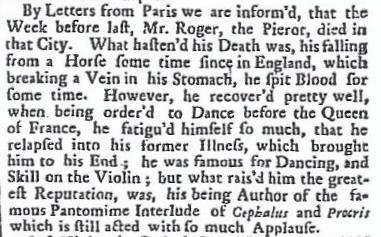
Tragically, Roger’s career was cut short by his sudden death in 1731 in Paris, reported in the Daily Advertiser for 11 November 1731.

I have been aware of Roger since the early days of my research into the life and career of Hester Santlow (later Hester Booth), who danced with and for him during his time at Drury Lane. My work on this short post has highlighted in new ways his significance for the development of stage dancing in early 18th-century London – there is much more to be uncovered about the dances and pantomimes he created at Drury Lane in the late 1720s. Roger was not the only French dancer to pursue a career in London’s theatres and I hope to look at some of the others in future posts.

References:

Jean-Baptiste Dubos, Réflexions critiques sur la poesie et sur la peinture. 4e. éd. 3 vols. (Paris, 1740). Roger is mentioned in volume III, pp. 288-289. I have not been able to check whether he was also mentioned in the previous edition of 1733.

Jean-Baptiste Dubos, translated by Thomas Nugent, Critical reflections on poetry, painting and music. 3 vols. (London, 1748). Roger is mentioned in volume III, p. 219.

Ifan Kyrle Fletcher, ‘Ballet in England, 1660-1740’ in Ifan Kyrle Fletcher, Selma Jeanne Cohen and Roger Lonsdale, Famed for Dance (New York, 1960), 5-20 Roger is mentioned on p. 17.

Philip H. Highfill Jr, Kalman A. Burnim and Edward A. Langhans, A Biographical Dictionary of Actors, Actresses, Musicians, Dancers … in London, 1660-1800. 16 vols. (Carbondale, 1973-1993). The entry for Roger is in volume 13.

Mercure de France, juillet 1729, p. 1661

Mercure de France, août 1729, p. 1846

Season of Dancing: 1714-1715

It is quite some time since I have explored dancing in one of the seasons on the London stage, and quite a while since I have been able to publish a post on Dance in History as I have been busy with other research and writing. Nearly three years ago, I posted Season of Dancing: 1716-1717 to try to place in context the first performances of John Weaver’s The Loves of Mars and Venus. I have been thinking about Weaver and his work over the past year and more, so I thought I would look back a little further to see what was happening on the London stage in the preceding seasons and what light that might shed on Weaver’s ground-breaking ballet. The starting point of 1714-1715 is, of course, determined by the opening of the Lincoln’s Inn Fields Theatre that season and the return to theatrical competition for the first time since 1710-1711. In the past, I have also considered the wider context in my Year of Dance posts for 1714 to 1717.

Drury Lane opened for the 1714-1715 season on 21 September 1714 and the company gave 217 performances (including during its summer season) by the time it closed on 23 August 1715. The King’s Theatre opened on 23 October 1714 but, as London’s opera house, gave far fewer performances – only 42 by the time it closed on 27 August 1715. Lincoln’s Inn Fields reopened on 18 December 1714, following the decision of the new King George I to allow John Rich the use of his patent after some years of silence. By 31 August 1715 Rich’s new company had given 130 performances, a sign of its weakness against the senior established company at Drury Lane.

All three companies included dancing among their entertainments. The statistics for these offerings are interesting. Drury Lane offered entr’acte dancing in a little over 20% of its performances. At the King’s Theatre around 19% of its performances were advertised with dancing. Lincoln’s Inn Fields included entr’acte dancing in 96% of its performances, a startling statistic that proves the importance that Rich attached to dance from the very beginning of his career as the manager of one of London’s patent theatres.

The immediate change wrought by the reopening of Lincoln’s Inn Fields and the return to competition is highlighted by a few statistics from the 1713-1714 season, when the only theatres allowed to mount performances were Drury Lane and the then Queen’s Theatre. Drury Lane advertised 196 performances but included entr’acte dancing only during the benefit and summer seasons for around 11 % of the total. The Queen’s Theatre advertised dancing at only one of its 31 performances that season, with no mention of the dancers. However, the opera house’s practice of minimal advertising (because its performances were offered on subscription) make it very difficult to know how much dancing was actually offered there each season throughout much of the eighteenth century.

Returning to 1714-1715, Drury Lane billed a total of thirteen dancers (eight men and five women) in entr’acte dances, although only five of them – three men (Wade, Prince and Birkhead) and two women (Mrs Santlow and Mrs Bicknell) – gave more than a handful of performances. The advertisements suggest that Mrs Santlow and Mrs Bicknell were the chief draw when it came to entr’acte dancing. None of the men were named in advertisements before the early months of 1715, when Rich’s dance strategy had become obvious. Both Hester Santlow and Margaret Bicknell were well established as dancer-actresses with the company. John Wade and Joseph (or John) Prince were both specialist dancers, while Matthew Birkhead was an actor, singer and dancer.

Lincoln’s Inn Fields advertised eighteen dancers (fourteen men and four women) in the entr’actes during the season, but – as at Drury Lane – only ten of them were billed for more than a handful of performances. Ann Russell and Mrs Schoolding appeared throughout the season and both apparently made their London stage debuts following Rich’s opening of the theatre. Miss Russell was a dancer and would remain one throughout her career, without making the usual transition to a dancer-actress. She married Hildebrand Bullock, a member of the well-known acting family, on 3 May 1715 and would thereafter be billed as Mrs Bullock. Mrs Schoolding seems to have begun an acting career at Lincoln’s Inn Fields, alongside her appearances as a dancer. Letitia Cross was not billed until 5 July 1715 but gave at least ten performances before the end of the season. She had already enjoyed a long career as an actress, a singer and a dancer. Three of the men – Anthony Moreau, Louis Dupré and William Boval – made their London stage debuts this season. Newhouse may have appeared elsewhere in earlier seasons, but his appearance at Lincoln’s Inn Fields on 8 February 1715 is the first record of him dancing at one of the patent theatres. Charles Delagarde was well established as a dancer and dancing master. John Thurmond Junior had appeared in London in earlier seasons, as had Sandham. All the men were specialist dancers.

The dancers who appeared regularly in the entr’actes could be said to form a ‘company within the company’ at each playhouse, even though several of them (the women in particular) acted as well as danced. Both acting companies mounted plays that included significant amounts of dancing in 1714-1715, but no casts were listed by either theatre in advertisements so it is impossible to be sure of the involvement of the dancers alongside the actors and actresses who danced only occasionally.

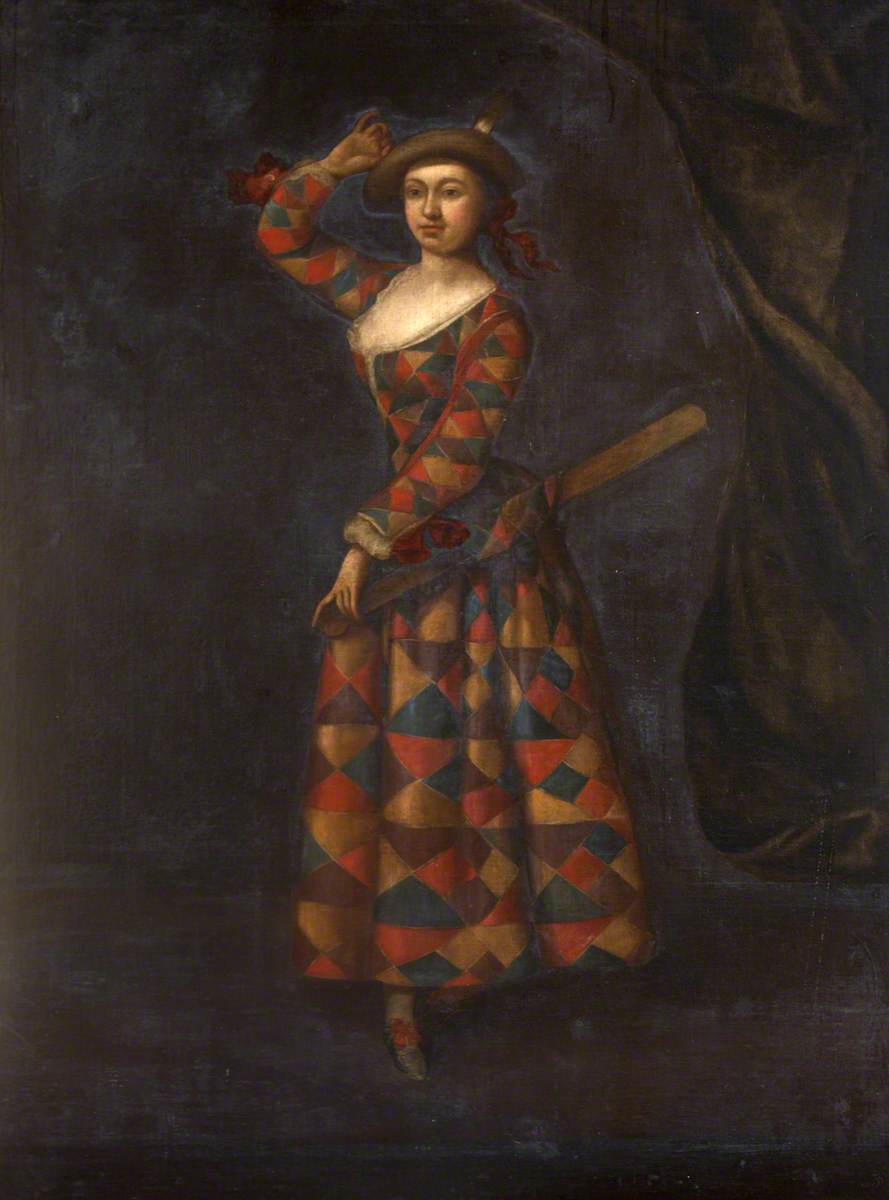
As for the entr’acte dances, Drury Lane offered nine, while Lincoln’s Inn Fields advertised seventeen. Drury Lane rarely mentioned specific dances in its advertisements, so it is impossible to know whether the repertoire was more extensive or which dances were the most popular.  It seems likely that Mrs Santlow’s solo Harlequin was among the latter. She was billed in it twice during 1714-1715 and the dance had been popular since she first performed it, perhaps as early as 1706. This is the less familiar version of her portrait as Harlequine, the one she owned herself which shows her skirt at the length she probably wore for performance.

It was one of only two dances advertised by Drury Lane before the opening of Lincoln’s Inn Fields, after which the theatre did not bill dance titles again until the benefit season began. The theatre’s managers were initially slow to grasp the value of dancing to attract audiences in the new atmosphere of rivalry. Other dances that may have been more popular than the bills suggest were the duets Dutch Skipper and French Peasant, the first given by Wade and Mrs Bicknell and the second by Wade and Mrs Santlow. Both had become part of the entr’acte repertoire not long after 1700 and would remain popular into the 1740s.

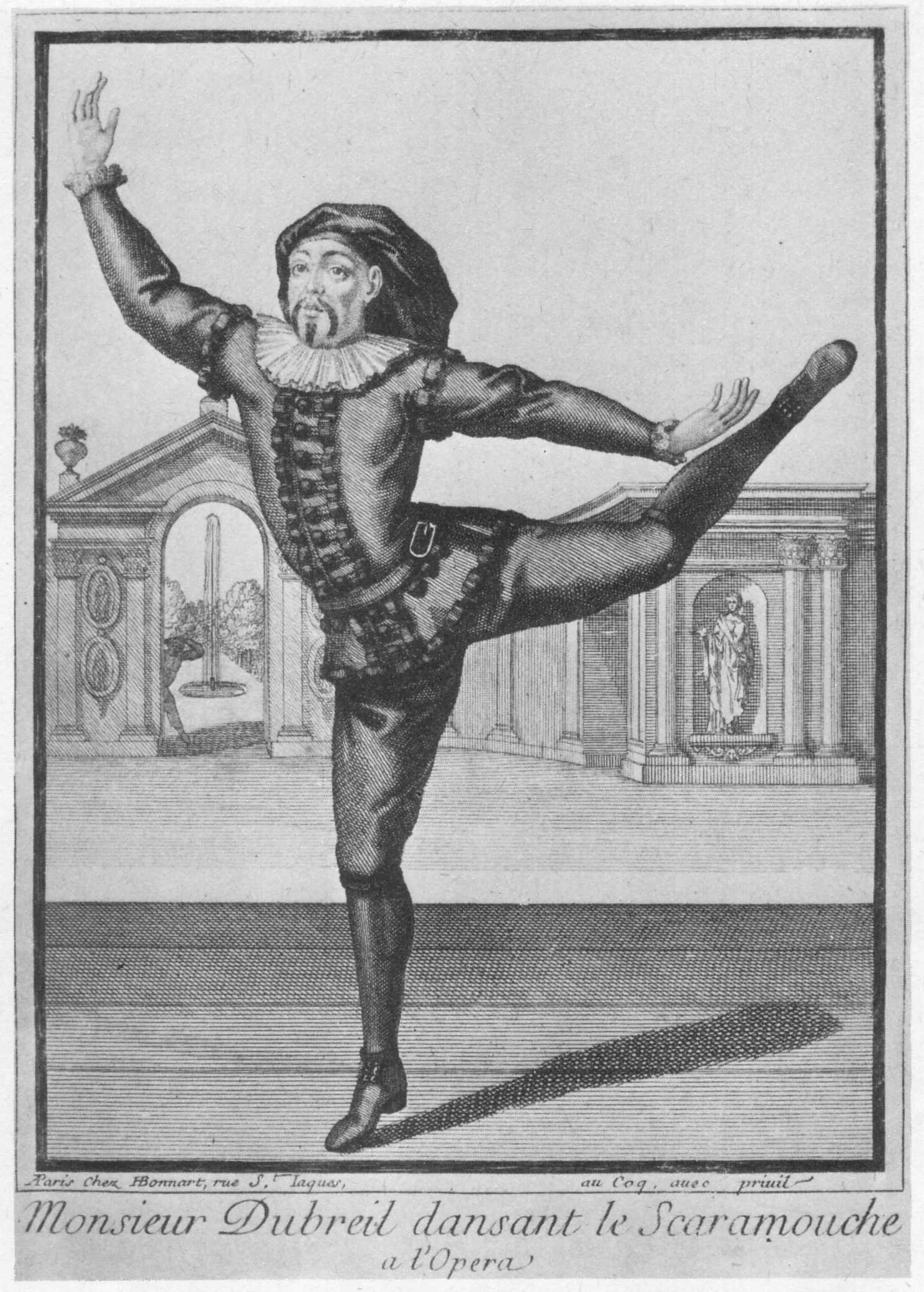
At Lincoln’s Inn Fields, the Dutch Skipper – first given on 6 January 1715 by Delagarde and Miss Russell – was far and away the most popular entr’acte dance, advertised twenty times by the end of the season. It was followed by a solo Scaramouch, performed on 5 February 1715 ‘by a Gentleman for his Diversion’ who gave it seven times during the season. John Thurmond Junior also danced a solo Scaramouch from 16 May 1715, when he was billed as ‘lately arrived from Ireland’. Scaramouch was already a familiar dancing character in London. John Thurmond Junior had been billed dancing the role ‘as it was performed by the famous Monsieur du Brill from the Opera at Brussels’ back in 1711. This print shows Pierre Dubreuil as Scaramouch about that time and suggests the acrobatic skills that Thurmond Junior may have emulated.

There were six entr’acte dances involving Scaramouch this season, with Lincoln’s Inn Fields leading the way and Drury Lane trying to catch up. At Lincoln’s Inn Fields, there was also an Italian Night Scene between Harlequin, Scaramouch and Punch (31 March 1715) and Scaramouches (18 April 1715, apparently a group dance although no dancers were named). Drury Lane replied with a Scaramouch and Harlequin (31 May 1715), a Tub Dance between a Cooper, his Wife, his Man, Scaramouch and Harlequin (2 June 1715) and Four Scaramouches (also 2 June 1715). In these dances, Harlequin would have been performed by one of the male dancers in the company. The four Scaramouches were probably danced by Prince, Wade, Sandham and Newhouse, who were listed in the bill (they also shared between them the male roles in the Tub Dance).

Delagarde and Miss Russell have a good claim to be the leading dancers at Lincoln’s Inn Fields this season, not only because of the number of their appearances (he was billed 65 times and she on 82 occasions) but also for their repertoire. As well as the Dutch Skipper, they performed a Spanish Entry, a Swedish Dance, a Venetian Dance and, most notably, The Friendship a new dance by Mr Isaac (who had been Queen Anne’s dancing master) which was also published in notation. The last of these may have been given before George I when he made his only visit of the season to Lincoln’s Inn Fields, on 10 March 1715 (he had visited Drury Lane on 5 January 1715). The new King was not proficient in English so limited his attendance at plays, preferring the Italian opera at the King’s Theatre. No serious dances were advertised at Drury Lane this season, whereas at Lincoln’s Inn Fields the Spanish Entry, an Entry and Mrs Bullock’s solo Chacone, given later in the season, can probably be assigned to the genre.

The 1714-1715 season should probably be seen as one of transition, at least so far as the dancing was concerned, as Drury Lane adjusted to the return of theatrical competition after enjoying several years of monopoly and Lincoln’s Inn Fields tried to gauge how it would deal with the dramatic superiority of its rival. Both theatres had to assess the impact of a new monarch and a new royal family on London’s theatrical life. In the following season of 1715-1716, they began to develop responses that would have a lasting effect on the entertainments of dancing to be seen on the London stage.

Anthony L’Abbé. The Prince of Wales’s Saraband

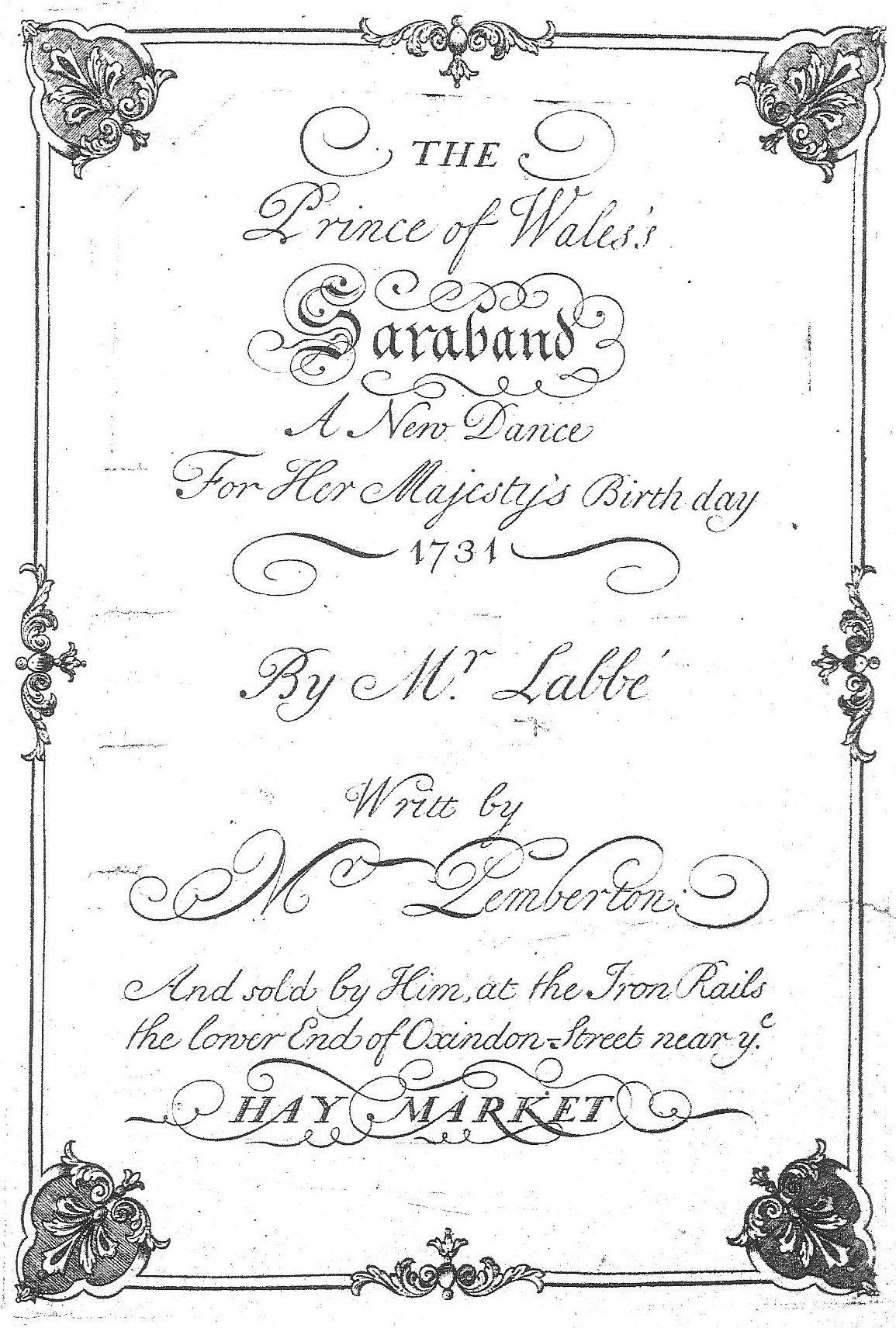
The notation for Anthony L’Abbé’s ballroom dance The Prince of Wales’s Saraband is one of the exhibits in Crown to Couture at Kensington Palace (the exhibition closes on 29 October 2023). It is shown out of context and with next to no explanation of its meaning so, although I have written about the dance elsewhere, I thought it would be worth a post in Dance in History to provide some information about this beguiling duet.

The Prince of Wales’s Saraband was one of a series of dances created by Anthony L’Abbé and published in Beauchamp-Feuillet notation by Edmund Pemberton following L’Abbé’s appointment by George I as royal dancing master around 1715. The title page makes clear that this was one of the dances choreographed by L’Abbé to celebrate the birthday of Queen Caroline, wife of King George II and mother of the Prince.

Her birthday was on 1 March and it had been celebrated at court since at least 1717, when L’Abbé’s ballroom dance The Royal George was created and published for that purpose. In that case, the title page of the dance makes no reference to the then Princess of Wales but the advertisements for the notation make it clear that the dance was in her honour.

By 1731, Caroline had been Queen for fewer than four years and L’Abbé had not published a dance since the Queen Caroline which honoured her birthday in 1728. In 1731, there was a birth night ball for the Queen and the report in the Daily Advertiser for 3 March 1731 gives us some details.

There is no mention of L’Abbé’s dance, although Frederick Prince of Wales ‘open’d the Ball’ by dancing a minuet with his sister Anne the Princess Royal. The reference to the illumination of the houses of all three of the actor-managers of the Theatre Royal, Drury Lane, is interesting, for The Prince of Wales’s Saraband was performed in the entr’actes at that theatre on 22 March 1731 by William Essex and Hester Booth. That first public performance was obviously also intended to honour the Queen.

The dance seems to have been admired, for it was revived at the Haymarket Theatre on 21 August 1734 and again at Drury Lane on 17 May 1735, each time performed by Davenport and Miss Brett. It was revived again at Covent Garden on 25 April and 13 May 1737, by Dupré (probably the dancer James Dupré) and Miss Norman.

Prince Frederick had remained in Hanover following the accession of his grandfather as George I in 1714. He came to England only in 1728, eighteen months after the accession of his parents to the British throne. By this time, the prince was twenty-one and he joined a family which included four sisters and a brother whom he scarcely knew. This portrait by Philippe Mercier shows Prince Frederick in the mid-1730s.

Prince Frederick’s relationship with his parents, particularly his mother Queen Caroline, became steadily more difficult after his arrival in England. In 1731, the year The Prince of Wales’s Saraband was created, this problem lay in the future.

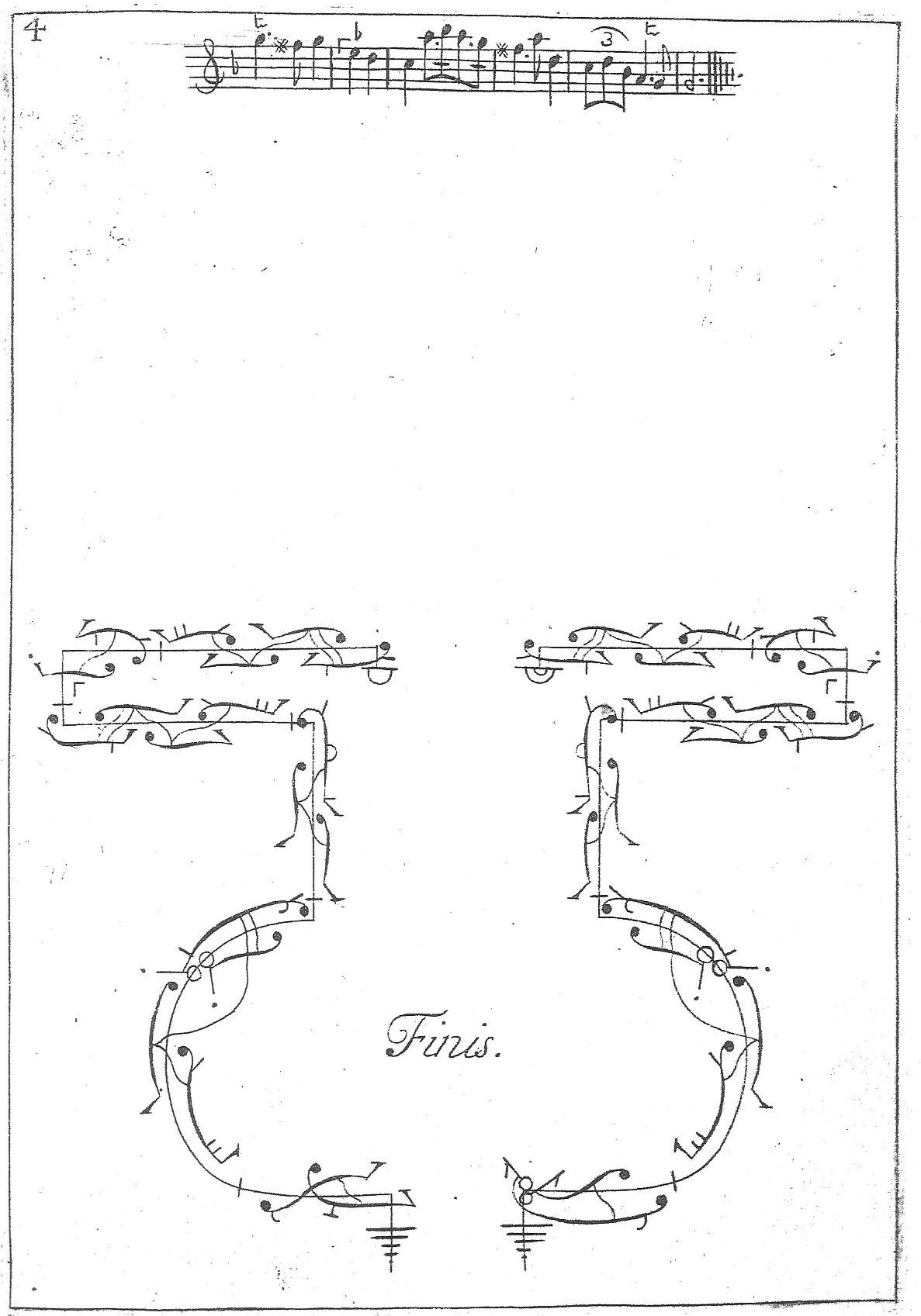
The Prince of Wales’s Saraband, as notated, is ostensibly an undemanding ballroom dance of 48 bars of music with the familiar AABB musical structure (A=10 B=14). The choreography is divided between four plates of notation (which by this time was Pemberton’s regular practice and probably reflects the expense of paper for printing). Plate 1 records the two A sections (20 bars of dance and music) and plate 2 the first B section. Plate 3 has bars 1 – 8 of the second B section and the dance ends on plate 4 with its final 6 bars. This division of the last section of the dance between two plates is dictated by the circular figures traced, which need to be shown separately so that they do not overlap, but also respects the musical phrasing. The layout on each plate may also reflect Pemberton’s aesthetic preferences – his notations for Isaac and L’Abbé include some of the most beautiful examples of this highly specialised genre of engraving.

Closer analysis of the notation reveals that this duet has some complexities and that it demands immaculate style and technique if it is to make an impact. Reconstructing the dance raises a number of questions about those aspects that are not notated – in particular arm movements and the use of the head. In all of these notated ballroom dances, the attention of the two performers seems to be divided between the presence (the guest of honour), each other and the surrounding audience. How much do we really know about the conventions that governed the performance of such dances, either at court or on stage, which should inform our dance reconstructions?

The Prince of Wales’s Saraband opens with a figure based around a temps de courante à deux, in which a temps is followed by a temps de courante, first on the inside foot and then on the outside foot. The notation indicates that the dancers turn their bodies towards the pointing foot on each temps, turning back towards the presence on each temps de courante. Did this mean that they turned their heads the same way or did they look steadfastly forward?

In the remaining bars of the first A section, they turn alternately towards one another and the presence but there are also opportunities to take in the surrounding audience.

The end of the dance, the steps and figures of the its last six bars on the final plate, has the dancers face the presence side-by-side for three bars travelling sideways away from each other and back again. They then turn to perform a pas de bourrée directly upstage, followed by a variant on the pas de bourrée vîte curving away from each other and coming face to face briefly before a coupé into their final réverence.

I can’t help wondering if this sequence was created, in part, to allow the dancers to acknowledge the audience that surrounded them before they made their final honours. The performance of The Prince of Wales’s Saraband at Drury Lane was part of a benefit for Mrs Booth, when some of the audience may have sat around the dancers on the stage (almost as they would have done in the ballroom) as well as in the auditorium. There is no evidence that Queen Caroline herself attended, but the royal box at this period would have been directly opposite the stage in the centre of the first tier just above the pit, providing the dancers with a specific focus.

The step vocabulary of this dance is dominated by the pas de bourrée, with and without a final jetté, extending to the pas de bourrée vîte. There are also a number of variants of the coupé, including the coupé sans poser and the coupé avec ouverture de jambe. It is interesting that, throughout, L’Abbé uses the jetté and not the demi-jetté in pas composés. These add energy and prevent the dance from becoming languid. He also likes to pair steps, although where he repeats these pairings he often introduces an element of variation the second time.

One sequence, on the second plate within the final bars of the B section, is noteworthy and quite challenging to perform.

L’Abbé introduces an element of suspension, in the opening coupé sans poser with a one-beat pause (which comes at the end of the preceding musical phrase), before a pas composé which demands unhurried speed – a pas plié, changement and coupé soutenu to fourth position with a quarter-turn. There is then a coupé avec ouverture de jambe (also with a one-beat pause) before the pas composé is repeated. This sequence ends with another coupé avec ouverture de jambe and a pause, before the B section is completed with two pas balancés.

The Prince of Wales’s Saraband was first performed on stage by Mrs Booth (née Hester Santlow), with whom L’Abbé had worked over many years and for whom he had created several notable choreographies. Could this ostensibly simple, yet demanding, ballroom duet have been created with and for her, intended specifically for performance at her benefit?

Further Reading:

Moira Goff, ‘Edmund Pemberton, Dancing Master and Publisher’, Dance Research, 11.1 (Spring 1993), 52-81

Moira Goff, The Incomparable Mrs Booth (London, 2007), pp. 138-139.

Season of 1725-1726: Afterpieces with Dancing at Drury Lane

There were three afterpieces with dancing at Drury Lane during the 1725-1726 season. All were pantomimes.

The Escapes of Harlequin

Harlequin Doctor Faustus

Apollo and Daphne

All had been created by John Thurmond Junior and none were new this season. The second two are worth posts of their own and I will write these in due course.

The Escapes of Harlequin was given on 19 October 1725. The cast listed in the bills consisted entirely of commedia dell’arte characters – Roger and Mrs Booth were Harlequins, Thurmond and Boval together with Mrs Brett and Miss Lindar were Punches, Bridgwater and Mrs Willis (both actors rather than dancers) were the Doctor and his Wife, while Rainton danced Pierrot and Miss Tenoe Columbine. The pantomime had first been given, at Drury Lane, on 10 January 1722 and had been moderately successful in subsequent seasons, although it was performed only twice in 1725-1726 and would be revived only once more, in 1727-1728. No scenario was published and no music is known to survive (the composer is never mentioned in the bills). The afterpiece is ascribed to John Thurmond Junior by John Weaver, who included it in his ‘List of the Modern Entertainments that have been Exhibited on the English Stage; Either in Imitation of the Ancient Pantomimes, or after the Manner of the Modern Italians’ within his The History of the Mimes and Pantomimes published in 1728. Weaver’s lengthy title provides a summary of the influences that lay behind the new pantomimes. The Escapes of Harlequin was initially described in the bills as ‘A new Dramatick Entertainment of Dancing in Grotesque Characters’ linking it to the ‘Modern Italians’.

The pairs of characters suggest a series of duets, while the separate characters of Pierrot and Columbine perhaps hint at a plot which involves them, although it is impossible to guess at the action of the afterpiece. Thurmond Junior may have drawn on one or more of the plays (many of which were commedia dell’arte pieces) performed by a company of French comedians at the Little Theatre in the Haymarket during 1720-1721. I did wonder whether he might have been using existing entr’acte dances, but the evidence points another way – a Harlequin duet later performed in the entr’actes which might have originated in The Escapes of Harlequin. We know little, if anything about the dancing in Thurmond Jr’s pantomime but, since it had a cast of characters entirely from the commedia dell’arte performed by leading dancers at Drury Lane, might this drawing by Claude Gillot evoke its style?

Harlequin Doctor Faustus, given on 9 November 1725, was the pantomime that had started a craze for the genre when it was first performed at Drury Lane on 26 November 1723. John Rich had swiftly responded at Lincoln’s Inn Fields with the even more successful pantomime The Necromancer; or, Harlequin Doctor Faustus (which I will discuss in my next post) and both productions were integral to the repertoires of the two theatres for many seasons. At least three scenarios were published for Harlequin Doctor Faustus, which differ in some details, so we have a good idea of its action. Little if any of the music survives. The pantomime is, of course, based on the legend of Doctor Faustus and his pact with the Devil, told through the distorting lens of the commedia dell’arte. Thurmond Junior is identified as the author of the piece on the title pages of the scenarios. At the first performances, he played Mephistophilus with John Shaw as Faustus. In 1725-1726, no cast was listed until 3 June 1726 when Roger was Harlequin / Faustus and either Rainton or Haughton (both young dancers) performed Mephistophilus.

An important feature of this particular pantomime was the ‘grand Masque of the Heathen Deities’ with which it ended. This was an extended divertissement of serious dancing, in complete contrast to the grotesque commedia dell’arte characters who appeared in the main part of the afterpiece. The transition from pantomime to divertissement is described in the scenario, Harlequin Doctor Faustus: with the Masque of the Deities (1724). Time and Death enter the Doctor’s study and sing, in turn, to warn Faustus his time is up.

‘When the Songs are ended, it Thunders and Lightens; two Fiends enter and seize the Doctor, and are sinking with him headlong thro’ Flames, other Devils run in and tear him piece-meal, some fly away with the Limbs, and others sink. Time and Death go out.

The Music changes, and the Scene draws, and discovers a Poetical Heaven with the Gods and Goddesses rang’d in order on both sides the Stage, who express their joy for the Enchanter’s Death, (who was supposed to have power over the Sun, the Moon, and the Seasons of the Year.)’

The ‘Gods and Goddesses’ are the dancers in the masque. The excerpt above from the printed text shows how elaborate the staging was, with its tricks, transformations and sophisticated scenery. Sadly, there is no visual record at all of Harlequin Doctor Faustus but the ‘assembly of the gods’ was a favourite topic for ceiling paintings, including this one by William Kent which dates to around 1720.

The last of Thurmond Junior’s pantomimes to be given in 1725-1726 was his most recent, Apollo and Daphne; or, Harlequin’s Metamorphoses on 11 February 1726. Thurmond Junior and Mrs Booth danced the title roles, with Theophilus Cibber as Harlequin. It had first been given as Apollo and Daphne; or, Harlequin Mercury at Drury Lane on 20 February 1725 with the same leading dancers. John Rich had had to wait nearly a year before he could reply from Lincoln’s Inn Fields with Apollo and Daphne; or, The Burgomaster Tricked, in which the title roles were danced by Francis and Marie Sallé with Francis Nivelon as the Burgomaster. Two scenarios were published for the Drury Lane pantomime, which tell us that it began and ended with episodes from Apollo’s fruitless pursuit of Daphne, separated by a complete comic plot in four scenes, and had a concluding pastoral divertissement. In 1724-1725, Thurmond Junior and Mrs Booth were a Sylvan and a Nymph, while in 1725-1726 the divertissement had become ‘a Rural Masque: Les Bois d’Amourette’ with Mrs Booth again as a Nymph and both Thurmond Junior and Roger as two Rival Swains.

It is worth noting that, for its first performance in 1724-1725, Apollo and Daphne is billed as ‘A New Dramatick Entertainment of Dancing’, linking it to John Weaver’s ballets of a few years before. In 1725-1726, Thurmond Junior had obviously revised his pantomime in answer to Rich’s version and it received more than 25 performances that season (more than in 1724-1725), although it would remain in the Drury Lane repertoire only until 1727-1728. The music for Thurmond Junior’s Apollo and Daphne was by Richard Jones and Henry Carey, but no score survives. We have little idea of the visual effect of the production, although the scenarios record some of the scenic and special effects in both the serious and the comic parts of the pantomime. Apollo’s pursuit of Daphne and her transformation into a laurel tree when he catches her, were favoured topics for artists of the period and both moments were depicted in the pantomime. This version, by Giambatista Tiepolo, is nearly thirty years later, but it shows Daphne beginning her transformation beside her father the river god Peneus as Apollo catches up with her too late.

In my next post, I will turn to the Lincoln’s Inn Fields afterpieces with dancing.

Season of 1725-1726: Solo Entr’acte Dances at Drury Lane

The following solo entr’acte dances were given at Drury Lane during 1725-1726:

Passacaille

Harlequin

Peasant

Drunken Peasant

Punch

Scaramouch

Dutch Skipper

Pastoral

Spanish Entry

French Peasant

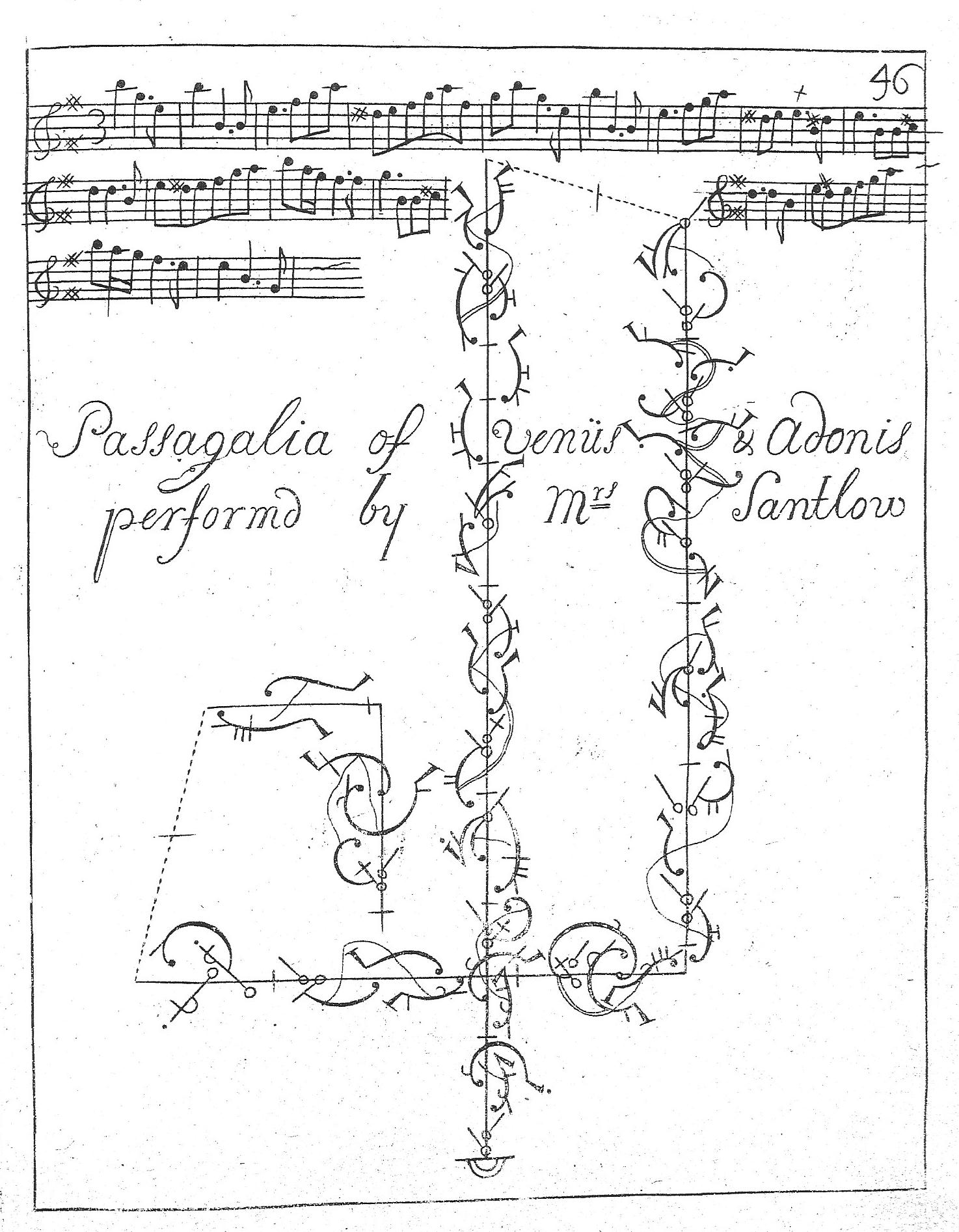
A solo Passacaille was performed by Miss Robinson at Drury Lane on 2 October 1725. She had first been advertised in the dance the previous season and she repeated it four times in 1725-1726. Mrs Booth also danced a solo Passacaille on 15 April 1726. This was one of the solos shared between the two playhouses, for Mrs Bullock performed another solo Passacaille at Lincoln’s Inn Fields on 2 May 1726. In London’s theatres, the solo passacaille was firmly linked to female dancers. The first surviving advertisement is for a performance by Mrs Elford in 1705-1706 (although Mlle Subligny is known to have danced Pecour’s Passacaille d’Armide in London during the 1701-1702 season), while the latest is for a ‘New Dance call’d Le Passecalle de Zaid’ performed by Mlle Auretti in 1753-1754. There is one notation which can shed light on the style and technique of London’s leading female dancers in such solos – Anthony L’Abbé’s ‘Passagalia of Venüs & Adonis’ created for Mrs Booth (then Mrs Santlow) around 1717 and published in the mid-1720s. I have written elsewhere about this astounding solo and here is the first plate.

It is interesting that all the solo passacailles published in notation are also for women.

Solo Harlequin dances were popular throughout the first three decades of the 18th century and enjoyed occasional revivals into the mid-1750s. In 1725-1726, Mrs Booth was billed in a Harlequin entr’acte dance on 14 October 1725. She had been famous for this solo since very early in her career and would continue to dance it into the early 1730s. I wrote at some length about the dance in The Incomparable Hester Santlow and I am sure that this portrait is intended to represent her in this solo, although – as I have said many times before – there is strong evidence that she wore an ankle-length skirt in performance.

The other solo Harlequin given at Drury Lane this season was danced by Rainton several times in April and May 1726.

On 25 October 1725, Roger danced a solo Peasant, followed by a Drunken Peasant on 3 November and a French Peasant on 13 May 1726. Peasant dances were popular for many years, although they were generally only billed a few times each season. Drunken Peasant dances would become extremely popular in the 1730s, while French Peasant solos were regularly revived into the early 1740s. It is impossible to be certain how these dances might have related to one another, although they may well have had overlapping step vocabularies and choreographic motifs. The Drunken Peasant may have relied more heavily on pantomime, while the French Peasant may have used a recognisably ‘French’ tune. Of course, the advertisements may have been inaccurate and the difference between Peasant and French Peasant dances may simply have been an inconsistency of billing.

Lambranzi includes a Drunken Peasant and a Drunken Peasant with his Wife in Part One of his Neue und curieuse theatrialische Tantz-Schul of 1716, describing the solo thus:

‘When the curtain is raised this drunken peasant is seen. As the air begins he tries to get up, but falls down several times. At last he staggers to his feet and waves his hand to the tankard of beer, which does not want to come to him. Reeling, he snatches it up, drinks from it thrice, puts it on the ground again and finishes the strain by staggering backwards and forwards, walking and jumping. At the end he claps on his hat, picks up the tankard and exits tottering from side to side.’ (Gregorio Lambranzi, translated by Derra de Moroda and edited by Cyril Beaumont, New and Curious School of Theatrical Dancing. Reprint (London, 2002), p. 20)

He also provides this image:

The description may well relate to performances of the Drunken Peasant in London’s theatres. However, during the 1720s there were also regular performances of an entr’acte Drunken Man solo by the comic actor John Harper at Drury Lane. Although he was predominantly an actor, Harper also danced from time to time. So, one question is – was the Drunken Peasant influenced by the Drunken Man or vice versa?

There was only one performance of a Punch dance at Drury Lane this season, a solo by Sandham’s son given on 27 January 1726. Although there had been Punch dances on the London stage since at least the first decade of the 18th century, these would not really become popular until the 1730s. During the 1710s and 1720s, Punch was usually seen dancing in company with Harlequin and from the 1720s he also featured in pantomime afterpieces. I hope to explore the London stage history of Punch dances in a later post.

Scaramouch made regular entr’acte appearances from the very early 1700s through to the 1760s. Like Punch, he featured in pantomimes and is also worth a post of his own. His depictions by Lambranzi, who refers to his ‘beautiful pas de Scaramouch’ and his ‘long steps combined with cabrioles and pirouettes’, are well known. Here are two of them.

In 1725-1726, Sandham’s son danced a ‘new Scaramouch’ on 15 April 1726, repeating it on 23 April and 18 May. All were benefit performances – the last was shared between the two Sandham children and the dancer Mrs Walter.

I wrote about the solo Dutch Skipper when I looked at the shared entr’acte duets at Drury Lane and Lincoln’s Inn Fields, so I will not say any more here. I also discussed the Pastoral duets in that post. There were very few solos with the title Pastoral advertised in London’s theatres and all but one were performed by female dancers. The exception was the Pastoral danced by ‘Vallois, lately arrived from the Opera at Paris, the first Time of his dancing in England; a Scholar to M Marcelle’ at Lincoln’s Inn Fields on 13 April 1732 – both his dance and Vallois himself are worth further research.

I discussed the Spanish Entry duets in my post Season of 1725-1726: Other Entr’acte Duets at Lincoln’s Inn Fields but the solo Spanish Dances and Spanish Entries are worth additional consideration. These certainly go back to the late 17th century in London, and most (if not all) have a French origin. Music for a ‘Spanish Entry’ danced by Anthony L’Abbé and published in 1698 in The Second Book of the Dancing Master comes from Campra’s L’Europe galante. René Cherrier’s solo Spanish Dance given at Drury Lane in 1704-1705 may well also have used French music. Both solos probably drew on choreographies danced at the Paris Opéra, where both men spent part of their careers. In 1725-1726, a solo Spanish Entry was danced by Miss Robinson at Drury Lane on 9 May 1726. She seems to have made the dance a regular part of her repertoire, for she continued to perform it until 1728-1729. The whole question of Spanish Dances in London’s theatres is complicated by occasional advertisements for the Folies d’Espagne (although these are rare), solo Louvres (the Louvre duet was almost always Aimable Vainqueur) and Sarabands (many of which were certainly French, although – given the identification of the Saraband with the Spanish in English plays of the period – some must surely have indeed been Spanish). I looked briefly at ‘Spanish’ Dances and Dancing ‘Spaniards’ in earlier posts, but the topic is certainly worth more detailed investigation at a future date.

In my next post, I will look at the solos performed at Lincoln’s Inn Fields in 1725-1726. The topic of dancing in London’s theatres during the 1725-1726 season is turning into a marathon and I still have danced afterpieces and mainpiece plays with dancing to explore!

Season of 1725-1726: Other Entr’acte Duets at Lincoln’s Inn Fields

The other duets given at Lincoln’s Inn Fields this season were:

French Peasant

Passacaille

French Sailor and his Wife

Shepherd and Shepherdess

Spanish Entry

Le Marrie

Two Pierrots

Running Footman’s Dance

Fingalian Dance

Burgomaster and his Frow

Tollet’s Ground

Chacone

Venetian Dance

Swedish Dance

Spinning Wheel Dance

The last two duets were performed only during the summer season.

It is immediately apparent that Lincoln’s Inn Fields offered a wider range of entr’acte choreographies than Drury Lane in 1725-1726. This was related to the dancers employed there this season, as well as John Rich’s habitual use of dance as a weapon in his rivalry with the other patent theatre.

The French Peasant danced by Nivelon and Mrs Laguerre on 29 September 1725 was one of the perennially popular dances on the London stage. So far as I can tell, a French Peasant duet was first advertised at Drury Lane on 15 June 1704, when the dancers were Mr and Mrs Du Ruel. It would continue in the entr’acte repertoire until the early 1740s. Several Peasant or ‘Paysan’ dances were recorded in notation in the early 1700s, including this choreography by Guillaume-Louis Pecour published in the Nouveau recüeil de dance de bal et celle de ballet around 1713.

These dances may provide hints towards the French Peasant dances on the London stage.

The Passacaille was seldom advertised as a duet in London’s theatres and the two performances given at Lincoln’s Inn Fields on 13 October and 9 November 1725 by Lally and Mrs Wall seem to be the last to be billed before the 1770s. The only notated passacaille duet for a man and a woman, choreographed by Guillaume-Louis Pecour for Ballon and Mlle Subligny, was published in 1704 and thus does not necessarily provide an exemplar for a dance of the mid-1720s. I wrote about both solo and duet passacailles in my post The Passacaille back in 2017.

As I mentioned in an earlier post, ‘Sailor’ dances on the London stage go back to the 17th century and were a frequent feature in 18th-century entr’acte entertainments. A French Sailor duet was performed at Lincoln’s Inn Fields in the mid-1710s, but the French Sailor and his Wife performed there on 25 October 1725 by Francis and Marie Sallé seems to mark a new chapter in the stage life of the dance. I can certainly devote a post to the sailor dances in London’s theatres, so I won’t pursue the topic further here. It is just worth mentioning that a Matelot duet was introduced to the entr’actes at Drury Lane in 1726-1727, raising a question about the difference between it and the French Sailor dances.

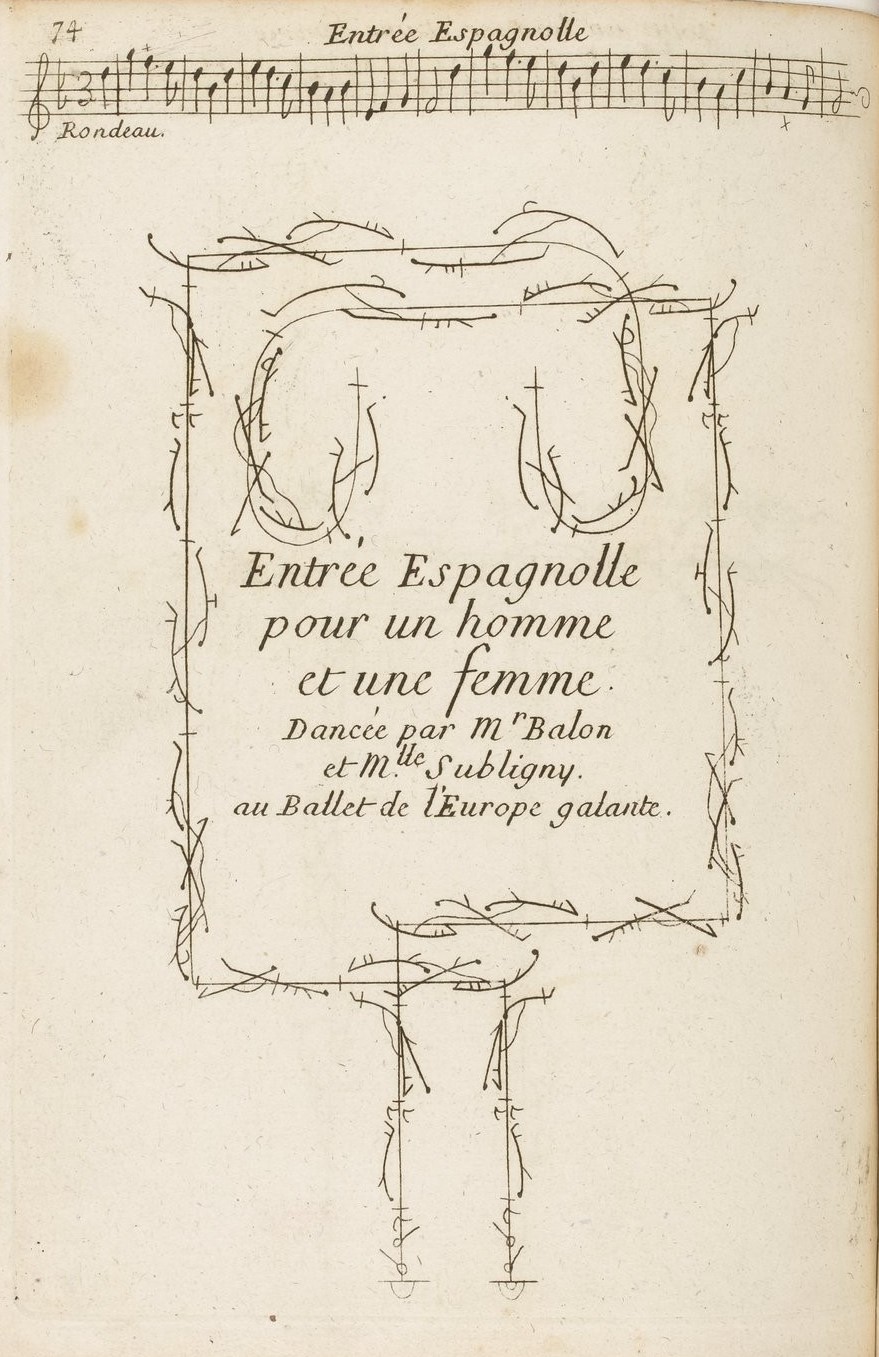
I discussed Shepherd and Shepherdess dances in an earlier post, Season of 1725-1726: Entr’acte Dances at Drury Lane and Lincoln’s Inn Fields, so I will move straight on to the Spanish Entry given as a duet by Lesac and Miss La Tour on 2 November 1725. I have written about ‘Spanish’ dances before – in posts entitled ‘Spanish’ Dances, Dancing ‘Spaniards’ and ‘Spanish’ Dancing and the Dance Treatises – but I haven’t taken an extended look at such dances on the London stage. I am not going to attempt that here, although it is certainly another topic worth exploring. There were Spanish Dances and Spanish Entries advertised in the entr’actes at London’s theatres from the first decade of the 18th century, which probably drew on similar choreographies from the Restoration period. The Spanish Entry had been advertised as a duet at Lincoln’s Inn Fields and had stayed in the repertoire for a few seasons. It had then disappeared, only to reappear in the mid-1720s with the duet danced by Lesac and Miss La Tour. The use of the word ‘Entry’ for this dance suggests (to me at least) that it was less likely to have been a version of the Folies d’Espagne than one of the other dance types made popular in the French comédies-ballets and opéra-ballets given in Paris. Here is the first plate from Pecour’s well-known ‘Entrée Espagnolle’ for Ballon and Mlle Subligny, which provides one example that may have been influential (it was transcribed by Kellom Tomlinson in his ‘WorkBook’ compiled during the first two decades of the 18th century).

Le Marrie’ danced by Francis and Marie Sallé at Lincoln’s Inn Fields on 16 December 1725 must surely have been Pecour’s ball dance La Mariée, first published by Feuillet in his 1700 Recüeil de dances composées par Mr. Pecour. As I wrote in another post back in 2015, La Mariée on the London Stage, research by the American dance historian Rebecca Harris-Warrick has shown that this duet probably began as a stage dance in Paris and reached the London stage shortly after 1698. The Marie performed at Lincoln’s Inn Fields in 1717-1718 could have been La Mariée resurfacing in the entr’actes, although its performance by the Sallés seems to have given the duet a new lease of life with regular revivals at benefit performances. Here is the first plate from the 1700 collection.

Two Pierrots was also danced by the Sallés at Lincoln’s Inn Fields on 16 December 1725. They seem to have introduced the male-female duet to London – previously there had been a few Pierrot solos and an all-male duet by Francis and Louis Nivelon in 1723-1724. The Sallés were answered at Drury Lane by Roger and Mrs Brett in La Pierette later that season. I should probably have counted Two Pierrots and La Pierette among the entr’acte dances shared between the two theatres, although the titles suggest that two might have been quite different thematically if not choreographically. Pierrot dances would last into the 1750s and beyond.

The Running Footman, danced by Nivelon and Mrs Laguerre on 10 March 1726, had been introduced to the London stage by them in 1723-1724. It was probably created by Nivelon and I looked at the duet in some detail in my post Dances on the London Stage: The Running Footman back in September.

The Fingalian Dance performed by Newhouse and Mrs Ogden on 11 April 1726 had first been danced by them in 1724-1725. They would continue to perform it regularly each season until 1733-1734. This entr’acte duet had apparently begun life as ‘A new Irish Dance in Fingalian Habits by Newhouse, Pelling, and Mrs Ogden’ at Lincoln’s Inn Fields in 1723-1724 but the trio format did not survive the season. Newhouse and Mrs Ogden were also billed more than a dozen times during 1724-1725 in an Irish Dance. I think that was probably the Fingalian Dance, which I am guessing was choreographed by Newhouse. There are a number of ‘Irish’ tunes in the various editions of Playford’s The Dancing Master, all considerably earlier than the duet by Newhouse and Mrs Ogden. They may hint at the music for the Fingalian Dance, although the dance itself seems to have been characterised by its costumes as much as the ‘Irishness’ of its music. Fingal is a county in Ireland in the Dublin region – the reference to ‘Fingalian Habits’ suggests costumes that are at least recognisably Irish. So far, I have not managed to find any clues as to what these ‘Habits’ may have been like. Fingalian Dances would survive in the London stage entr’acte repertoire until the 1770s.

The Burgomaster and his Frow, another entr’acte dance performed by Newhouse and Mrs Ogden on 20 April 1726, was one of the many ‘Dutch’ dances given in the entr’actes at London’s theatres. The duet seems to have been variously titled – as Dutch Boor in 1723-1724 and 1724-1725 and as Dutch Burgomaster and Wife in 1724-1725 – but it seems to have been distinct from the Dutch Skipper, which Newhouse was never billed as dancing. There is, of course, music for a ‘Dance for the Dutch man and his Wife’ in Thomas Bray’s 1699 collection Country Dances. This tune was used in Europe’s Revels for the Peace, the masque created to celebrate the peace of Ryswick that ended the Nine Years’ War in 1697.

Tollett’s Ground, danced by Newhouse and Mrs Laguerre on 30 April 1726 and revived during the Lincoln’s Inn Fields summer season by him and Mrs Ogden, took its title from its music. The piece is generally attributed to the Irish musician Thomas Tollett, who worked in London’s theatres during the 1690s and may have died in 1696. It appeared in several music collections around 1700 and was first billed at Drury Lane in 1701-1702, when it was performed by John Essex and Mrs Lucas. During the 1710s it was given several times by Margaret Bicknell and her sister Elizabeth Younger. The Tollett’s Ground duet survived into the early 1730s and was usually performed at benefits or during the summer season.

I mentioned the Chacone in my post The Most Popular Entr’acte Dances on the London Stage, 1700-1760 a couple of months ago. In 1725-1726, a Chacone duet was danced at Lincoln’s Inn Fields by Dupré and Mrs Wall on 30 April and then 23 May 1726, followed by Lally and Mrs Wall on 30 May. Some of the chaconnes given in London’s theatres were associated with Harlequin, but others (including this one) were evidently serious dances. We do have a local notated example of a chaconne for the stage which was published around this time and might shed light on some of those given in the entr’actes. Anthony L’Abbé choreographed the ‘Chacone of Galathee’ for Delagarde and Mrs Santlow (from 1719 Mrs Booth) perhaps around 1712, although it seems to have been notated some ten years later – around the time it was published by Le Roussau in A New Collection of Dances. As this plate reveals, it was a showpiece of virtuosity for these two dancers (I strongly suspect that Delagarde’s entre-chat à six should also have a tour-en-l’air, and I certainly think that Mrs Santlow was capable of adding an entre-chat à six to her tour).

The Chacone duets danced by Dupré and Lally with Mrs Wall in 1725-1726 may have been similar.

The Venetian Dance was given just once this season, on 9 May 1726 by Burny and Mrs Anderson ‘both Scholars to Essex’. At present, I can’t be sure whether ‘Essex’ is William Essex, who had made his debut at Drury Lane the previous season, or his father John, who had left the stage to pursue his career as a dancing master more than twenty years earlier. John Essex is perhaps the more likely candidate. It is tempting to assume that a Venetian Dance must be performed to a forlana, but a contemporary source suggests a quite different piece of music – the allemande used by Pecour for his duet of that title, published in Paris in 1702. I have puzzled over this musical choice, apparently made for a ‘Venetian Dance by Mr Shaw and Mrs Booth’ which was performed (but not mentioned in the bills) in 1724-1725. I can see that I should return to Venetian Dances in another post.

Dances associated with particular nations were decidedly popular at Lincoln’s Inn Fields this season. Another was the Swedish Dal Carl given by Pelling and Mrs Ogden on 17 June 1726 (the opening performance of the summer season). A ‘new Swedish Dance’ had entered the entr’acte repertoire at Lincoln’s Inn Fields in 1714-1715, when it was performed by Delagarde and Miss Russell (later Mrs Bullock and a leading dancer at that theatre). Thereafter the Swedish Dale Karl, as it was usually known, was performed most seasons into the 1730s. It may well have continued to use the music recorded in The Ladys Banquet 3d Book, a collection first published around 1720, although the earliest surviving edition has been dated around 1732. The ‘new Play House’ mentioned on the score is probably Lincoln’s Inn Fields, which opened in 1714. There are no solo Swedish Dances billed in London’s theatres, so is the ‘Sweedish Woman’s Dance’ actually part of the duet?

The last of the dances I listed at the beginning of this post was also performed only during the Lincoln’s Inn Fields summer season. Newhouse and Mrs Ogden performed the Spinning Wheel Dance on 21 June 1726. The duet had first been given in 1723-1724 at the same theatre and the bills indicate that it only ever received a handful of performances. I would characterise it as one of the novelty dances that turn up in the entr’actes from time to time, particularly during summer seasons.

My next post on the season of 1725-1726 will be concerned with the entr’acte solos given at Drury Lane and Lincoln’s Inn Fields.

Season of 1725-1726: Other Entr’acte Duets at Drury Lane

The other entr’acte duets given at Drury Lane this season were the following:

Hussars

Muzette

Pierette

Whitson Holiday

Country Dance

Wooden Shoe Dance

Serious Dance

As their titles suggest, they provided a variety of danced entertainment.

Hussars was danced by Thurmond Jr and Mrs Booth on 2 October 1725 and repeated several times during the season. The duet had originally been performed by John Shaw and Mrs Booth in 1719-1720 and she would go on to dance it with William Essex as well as John Thurmond Jr. It is easy to suggest that it was created by Shaw, but it is certainly possible that it originated with Mrs Booth. I discussed the duet and its costuming in The Incomparable Hester Santlow, including its music which (according to a contemporary source) was the forlana from La Sérénade vénitienne, added by Campra to the Ballet des Fragmens de Lully in 1703. This music suggests that Hussars may have been seen as a dance in masquerade.

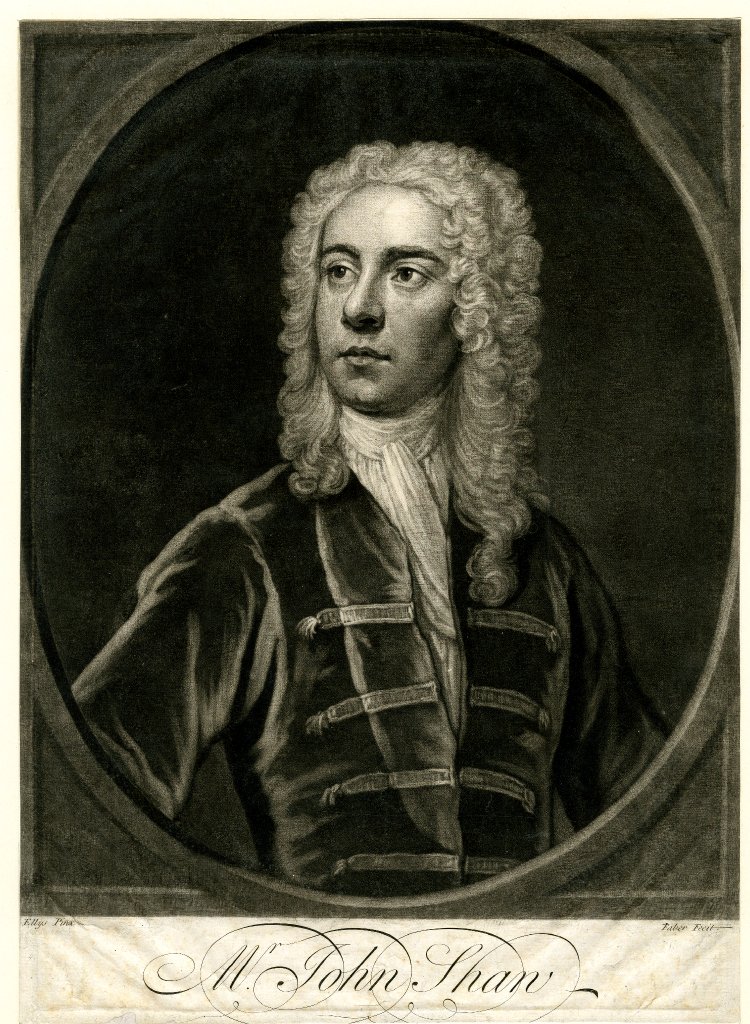
John Shaw (who sadly died on 8 December 1725) had been one of London’s leading male dancers. He is one of the very few dancers of this period for whom we have a portrait, although only an engraving of the painting by John Ellys now survives.

The Muzette seems to have been introduced to the London stage by Rainton and Miss Robinson in 1724-1725, so their performances of the duet in 1725-1726 were a revival of the dance. As with Hussars, it was Miss Robinson who would go on to perform the Muzette with a series of partners, including William Essex and in 1729-1730 ‘Master Lally’ (probably Samuel Lally, a younger member of the Lally family). Muzette dances continued to be performed into the early 1740s, although it is likely that there were a number of different choreographies. I am reluctant to link this dance to the choreographies that were published in notation, the majority of which were created for the ballroom, although it certainly belongs to the genre of French-inspired pastoral dances that were popular in London’s theatres.

La Peirette or Pierette, given by Roger and Mrs Brett at Drury Lane on 21 March 1726 almost certainly has links to the French comedians who specialized in commedia dell’arte (the French influences on this Italian dramatic form are important to performances in London). This Pierrot or Pierette duet was almost certainly created by Roger – he had been described as the ‘French Pierrot’ in earlier bills – who continued to dance it with Mrs Brett and then other partners in subsequent seasons. Although the duet continued in the entr’acte repertoire after Roger’s death in 1731, it may or may not have drawn on his original choreography.

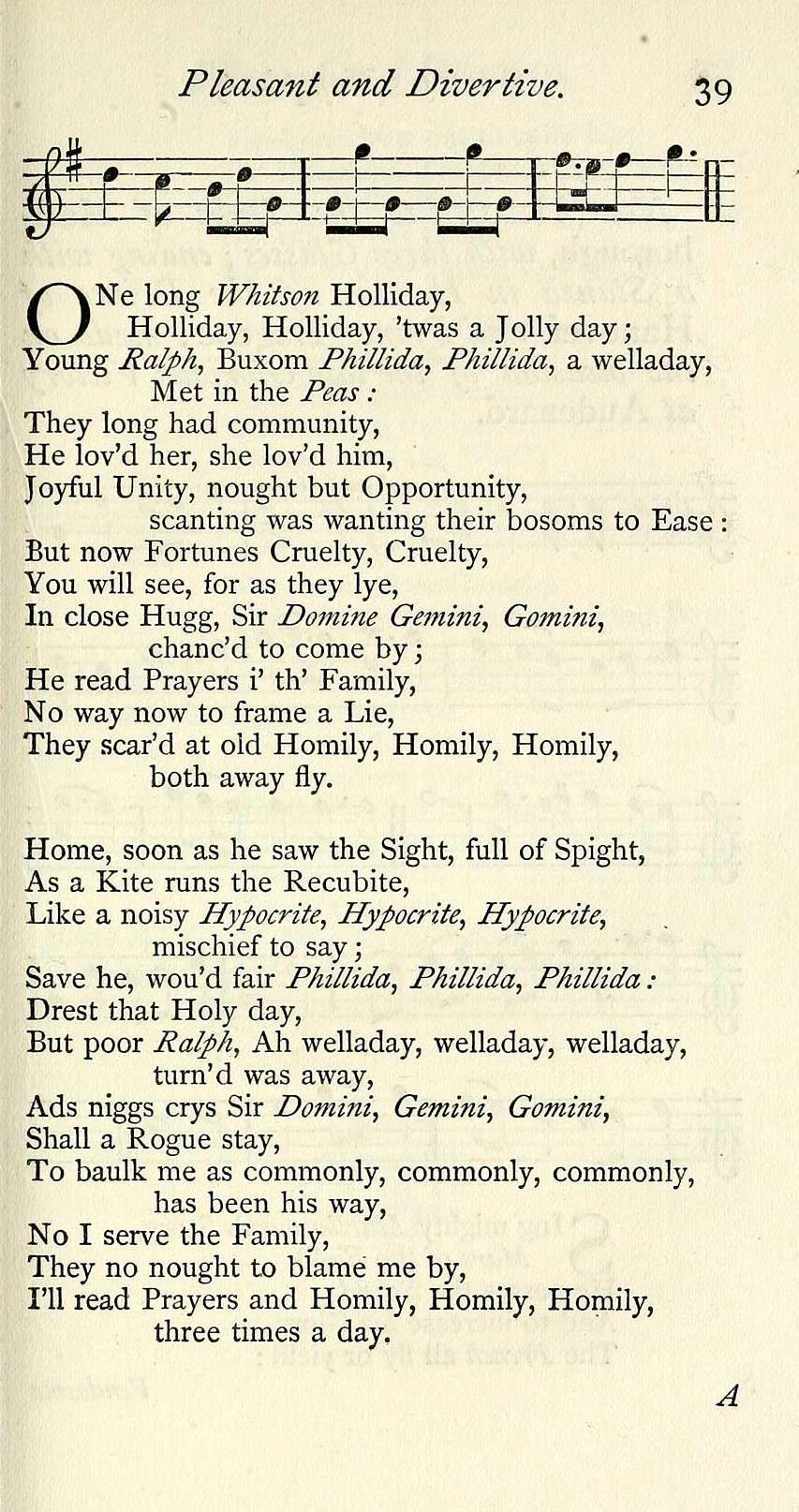
Whitson Holiday, danced at Drury Lane on 18 April 1726 by Boval and Miss Tenoe, was first performed at Drury Lane on 29 May 1721 by Boval and Mrs Younger. It was evidently by Boval, who danced it with a series of female partners until 1729-1730. The duet was created for a benefit performance and continued to be danced at benefits a few times each season throughout its stage life. The music may have come from Songs Compleat, Pleasant and Divertive, the new edition of Thomas Durfey’s Wit and Mirth; or, Pills to Purge Melancholy published in 1719 and then reissued under the original title 1719-1720. The collection includes the song tune ‘The Parson among the Pease’, which begins with the line ‘One long Whitson Holliday’.

The use of country dances towards the end of plays is quite well-known, but both solo and duet Country Dances were occasionally billed in the entr’actes – as at Drury Lane on 21 April 1726, when Rainton and Miss Robinson were billed together in a Country Dance at his shared benefit. I suspect that these dances should really be billed as Countryman and Countrywoman (as some were). None of the dances with these titles were performed regularly.

The Wooden Shoe Dance was far more popular as a solo than as a duet, and in the latter form was performed this season only at Drury Lane by Sandham’s children. I will take a closer look at these dances when I consider the entr’acte solos performed at the two patent theatres during 1725-1726.

The title Serious Dance was used regularly in the bills from the mid-1710s onwards. Advertisements rarely mentioned Serious Dances and Comic Dances together, although dancing ‘Serious and Comic’ was quite often billed thus. I don’t know why this should be, although the latter wording indicates that the two were seen as quite different. I haven’t yet written a post on comic dancing, although I have addressed Serious Dancing (back in 2017) and The Grand Ballet, Grand Dance and Serious Dance on the London Stage (in early 2018). The only Serious Dance billed in 1725-1726 was a duet by Michael Lally and Mrs Walter at Drury Lane on 18 May 1726, a benefit for Mrs Walter shared with Sandham’s children. It occurs to me that the title may have been used for another dance performed by them this season. Was it perhaps the Pastoral they gave at other performances in 1725-1726?

My next post will be about the other duets performed at Lincoln’s Inn Fields in 1725-1726.

Season of 1725-1726: Dancers at Drury Lane

In my first post devoted to the 1725-1726 season on the London stage, I gave the number of dancers billed in the entr’actes at the Drury Lane Theatre as 19 (12 men and 7 women). Further research has shown that these numbers were not correct and also revealed some of the problems with the information in both The London Stage, 1660-1800 and the Biographical Dictionary of Actors, which were my principal sources. (I provide full references for these at the end of this post).

For the total number of dancers who appeared in the entr’actes, I first read through the calendar of performances for the season noting down the names as they appeared. When I went back to check the number of entr’acte appearances by each of those dancers, I discovered that some of them were billed only once. The Topham advertised only on 25 September 1725 is identified by the Biographical Dictionary as John Topham, although he may equally well have been his brother H. Topham. In any case, his single performance shows that he was not a regular member of the Drury Lane company in 1725-1726. The ‘Cheshire Boy’ was billed only on 6 January 1726 and his performance record over the seasons suggest that he was an occasional ‘guest artist’ and not a member of the Drury Lane company in this or other seasons. Sandham, who was billed for a single entr’acte appearance on 5 May 1726, may or may not have been the father of the two Sandham children who performed on a number of occasions (the billing may instead have referred to ‘Master Sandham’, his son, but I am not sure). The London Stage also records Nivelon as dancing a Drunken Peasant on 3 November 1725, but the advertisement in the Daily Courant for that day clearly records the performer as Monsieur Roger.

There was also the puzzle of two dancers, one named Rainton and the other Young Rainton. The Biographical Dictionary records them as two different individuals. However, a comparison of their respective dance repertoires in 1725-1726 as well as checks on the original newspaper advertisements show that they were one and the same.

So far as I can tell, the following dancers appeared at Drury Lane throughout the 1725-1726 season, in both the entr’actes and the pantomime afterpieces:

Rainton

Thurmond Jr

Roger

Lally

Boval

Duplessis

Haughton

Miss Tenoe

Miss Robinson

Mrs Booth

Mrs Walter

Mrs Brett

Miss Lindar

 Thus, there were 13 entr’acte dancers (7 men and 6 women), together with two children – Sandham’s son and daughter – making 15 in all. The adults formed a ‘company within the company’, although that concept is not entirely straightforward. Among the women four also took acting roles (one additionally sang), while the men were all first and foremost dancers.

It is possible to characterise the members of this ‘company’ more precisely, through the number of their appearances and their repertoire. Among the men, Rainton appeared most often (52 entr’acte billings) followed by Boval (49), Thurmond Jr (41), Roger (38), Lally (33), Duplessis (22) and Haughton (20). Among the women, Miss Robinson was the busiest (61 entr’acte billings), followed by Miss Tenoe (47), Mrs Brett (45), Mrs Booth (35), Mrs Walter (24) and Miss Lindar (13). Sandham’s son and daughter made 8 and 6 entr’acte appearances respectively.

The individual repertoires performed by these dancers provide a different perspective. Among the men, Roger and Boval performed the most choreographies – Roger appeared in 3 solos, 1 duet and 3 group dances, while Boval danced 4 duets and 3 group dances. Duplessis and Haughton had the narrowest repertoires with 1 trio and 2 group dances each. Miss Robinson had the most extensive entr’acte repertoire of the women, with 3 solos and 4 duets, while (at the other extreme) Miss Lindar appeared in only 1 group dance. These figures point to dancers at different stages of their careers as well as of varying status within the dance ‘company’. It is worth pointing out that Mrs Booth was also one of Drury Lane’s leading actresses and played 21 principal acting roles during 1725-1726. Miss Tenoe also did a lot of acting, taking 15 supporting roles during the season.

Every one of the 13 entr’acte dances also took roles in Drury Lane’s popular pantomime afterpieces. It is with these productions that the status of individual dancers emerges. All three of Drury Lane’s 1725-1726 pantomimes – The Escapes of Harlequin, Harlequin Doctor Faustus and Apollo and Daphne – had been created by John Thurmond Jr. The title roles in Apollo and Daphne were danced by him and Mrs Booth. Roger was Harlequin in both The Escapes of Harlequin and Harlequin Doctor Faustus, appearing in Apollo and Daphne as both Pierrot and, in the pantomime’s concluding ballet, a Rival Swain. Two of that season’s popular group dances, La Folete and Le Badinage Champetre, were created by Roger. It is possible that both he and Thurmond Jr acted as dancing masters to the Drury Lane company.

Rainton and Miss Robinson enjoyed a dance partnership this season and seem to have been the young, up-and-coming stars. Lally, Boval, Duplessis and Haughton, like Miss Tenoe, Mrs Walter, Mrs Brett and Miss Lindar, were essentially supporting dancers in both the entr’actes and afterpieces. The two Sandham children were really a popular speciality act, although their repertoire drew on the same dances as adult performers.

Apart from the frustration of not really knowing what any of the dances performed on the London stage at this period were like, there is also the disappointment of having no portraits of all but a very few of the dancers. Even leading dancers could rarely afford the services of a portrait painter. Among the dancers at Drury Lane in 1725-1726 we have portraits of only one – Hester Booth, the company’s star ballerina and leading actress. Here she is in the familiar Harlequin portrait and portrayed in more classical guise.

In my next post, I will look more closely at the dancers who appeared in the entr’actes and afterpieces at Lincoln’s Inn Fields in 1725-1726.

References

For those who might be interested, the full references for The London Stage (the volume that I used for this post) and the Biographical Dictionary of Actors are as follows:

The London Stage, 1660-1800. Part 2: 1700-1729, ed. Emmett L. Avery (Carbondale, Ill., 1960)

A Biographical Dictionary of Actors, Actresses, Musicians, Dancers, Managers & Other Stage Personnel, 1660-1800, ed. Philip H. Highfill Jr, Kalman A. Burnim and Edward A. Langhans. 16 vols (Carbondale, Ill., 1973-1993)

The ’Passagalia of Venüs & Adonis’ and Professional Female Dancing

The ‘Passagalia of Venüs & Adonis’ was choreographed by Anthony L’Abbé for Drury Lane’s (and London’s) leading dancer Hester Santlow. It was published in notation around 1725 in his A New Collection of Dances. It is the female counterpart to the ‘Chacone of Amadis’ for Louis Dupré who, like Mrs Santlow, has four dances in the collection. We do not know where or when she performed this solo, although I have wondered whether the ‘Passagalia’ might have been created for performance before George I at the Hampton Court Theatre. During September and October 1718, the Drury Lane Company (including Hester Santlow) gave seven performances there, some of which included ‘Entertainments of Dancing’ which were later repeated at their own theatre. Mrs Santlow was a favourite performer of the King and it would surely be appropriate for the royal dancing master to create a new choreography for her to dance before him.

I have myself performed the ‘Passagalia of Venüs & Adonis’ many times and I have also written about it. Returning to this dance after quite a while, partly for the purpose of writing this post, it still amazes me. It isn’t the longest of the surviving notated dances – that honour goes to Pecour’s ‘Passacaille pour une femme’ created for Mlle Subligny to music from Gatti’s Scylla and published in 1704 (with 219 bars of music it is 10 bars longer than L’Abbé’s ‘Passagalia’). Nor is it the best known – it cannot compete with Pecour’s ‘Passacaille pour une femme … de lopera darmide’ again created for Mlle Subligny and published around 1713 in the Nouveau recüeil de dance de bal et celle de ballet. The latter is regularly performed by specialists in baroque dance and has attracted analysis by a number of scholars.

Here, I am concerned only with the pas battus in L’Abbé’s solo, which is to music from Desmarest’s 1697 opera Vénus et Adonis. Unusually for a passacaille, this has a central 80-bar section in duple time framed by tripe-time sections of 64 and 65 bars respectively. The music provides the basis for a choreography that is richly expressive, but my focus is simply on what the notation might tell us about the technique of a leading female professional dancer at this period.

In a post of almost exactly a year ago, I looked at the jetté ‘emböetté’ and asked whether it might usually have been performed by women on stage as a demie cabriole. This step turns up several times in the ‘Passagalia’. It features in the very first variation of the dance (bar 4, plate 46) in a variant form at the beginning of a pas composé and is used, again as the first element of a pas composé, within a short passage in which Mrs Santlow travels rapidly downstage (bars 34-35, plate 48). The density of the notation makes the second of these difficult to show, but here is the first.

Passagalia of Venus & Adonis 46 (2)

Another instance on plate 48 (bar 40) presents a puzzle, for at some point the notation was amended. In the British Library copy, it looks like this.

Passagalia of Venus & Adonis 48 (2)

In the Bodleian Library copy, it looks like this.

Passagalia of Venus & Adonis 48 Bodley (3)

In the second version, Mrs Santlow takes off from both feet and a pas battu is clearly notated. There are several small differences between the notations in these two copies. It is difficult to be certain, but these differences suggest that the Bodleian copy is a later issue than that in the British Library.

The jetté-step sequence also turns up in the duple-time section, within a repeated sequence in which the pas composé it begins alternates with another (coupépas plié). This is repeated three times and here is the second occurrence (bars 92-93, plate 51).

Passagalia of Venus & Adonis 51 (2)

It is also inserted into pas composés which alternate with chassés as Mrs Santlow retreats upstage (bars 122-125, plate 52). In this case, each pas composé is different – bars 122-123 are shown first, followed by bars 124-125.

Passagalia of Venus & Adonis 52 (3)

Passagalia of Venus & Adonis 52 (4)

In the final triple-time section, L’Abbé plays with a similar idea (in this section, the music has the feel of duple-time). Here are the concluding bars of the sequence (bars 187-188, plate 55).

Passagalia of Venus & Adonis 55 (2)

He uses the jetté-step again as the dance draws to a conclusion (bars 206-207, plate 56).

Passagalia of Venus & Adonis 56 (2)

These are the last steps in which Mrs Santlow advances, before she makes her final retreat to end the solo.

There is no question that Hester Santlow could have performed any, or all, of these steps as demies cabrioles. There are just two more steps that I wish to draw attention to within this complex and surprising choreography. One is the demi entre-chat within the first triple-time section, which begins a pas composé which continues with a coupé to plié and a coupé battu avec ouverture de jambe (bar 50, plate 49).

Passagalia of Venus & Adonis 49 (2)

The other is that quintessentially male step the demie cabriole en tournant un tour en saut de basque within the duple-time section (bar 129, plate 52).

Passagalia of Venus & Adonis 52 (5)

Mrs Santlow does only a half-turn in the air (Feuillet notated it with a three-quarter turn followed by a quarter-turn on the concluding step), but she does perform a pas cabriolé.

The ‘Passagalia of Venüs & Adonis’ is an exceptionally demanding solo – because of its length, the complexity of its steps (there are no exactly repeated variations), its changes in time signature and its expressivity. For me, it signals very clearly that the leading female professional dancers of the early 18th century were fully the equals of their male partners when it came to pas battus.