Tag Archives: Guillaume-Louis Pecour

A Year of Dance: 1715

The most significant event of 1715 was the death of Louis XIV on 1 September. He was succeeded by his five year old great-grandson, who became Louis XV. Philippe, duc d’Orléans, the son of Louis XIV’s brother (who had died in 1701) became Regent to the child-king. The new reign would usher in significant cultural as well as political changes.

In Britain, George I was briefly threatened by a Jacobite rising that sought to put the Catholic James Francis Edward Stuart, son of James II, on the throne. The rebellion began in September and was over before Christmas. With the succession assured, at least for the time being, the new Hanoverian dynasty began to settle into English court life.

In Paris, Dezais published the XIII Recüeil de danses pour l’année 1715. This contained only two duets – La Transilvanie by Claude Ballon and Le Menuet d’Espagne by Dezais himself. Another collection, notated and published by Gaudrau, was entitled Danses nouvelles presentées au Roy. Gaudrau had begun to publish dances by Guillaume-Louis Pecour a couple of years earlier, with a Nouveau recüeil de dance de bal et celle de ballet. The Danses nouvelles were two ballroom duets by Pecour, La Venitienne and Le Branle allemand. The former was to a piece of music from Mouret’s Les Fêtes de Thalie.

Pecour. Danses nouvelles (Paris, [1715?]), title page.

Pecour. Danses nouvelles (Paris, [1715?]), title page.

Dezais’s collection was probably published early in the year (perhaps even towards the end of the previous year). Gaudrau’s is undated, but has been ascribed to 1715. The collection must have appeared after the death of Louis XIV, for it is dedicated to his successor. Pecour wrote:

J’ay l’honneur de presenter a Votre Majesté les deux premieres dances que j’ay composées depuis son règne, je souhaitte avec ardeur les voir un jour éxécuter par Votre Majesté, …

Pecour was in his early sixties and had worked for the French court for more than forty years. It seems that he was hoping for further employment.

In London, at least nine dance publications appeared during 1715 as dancing masters vied for the patronage of the new royal family. The first to appear was Siris’s The Princess Anna, advertised towards the end of January. No copy of this dance is known to survive. A new edition of For the Further Improvement of Dancing, John Essex’s translation of Feuillet’s 1706 Recüeil de contredances, probably dates to 1715. Essex dedicated it to ‘Her Royal Highness the Princess of Wales’ and the only known copy may well have been the one presented to her. It included some new country dances and ‘a new French Dance, which I presume to call the Princess’s Passpied’. This duet may have been created with an eye to the Princess’s birthday on 1 March.

The dancing master Richard Shirley published his own notated versions of Ballon’s La Silvie (which had appeared in Paris in 1712) and Pecour’s Aimable vainqueur (first published 1701) in mid-March. He, too, may have had an eye on the birthday celebrations for the Princess of Wales.

George I’s birthday on 28 May was marked by the appearance of a duet honouring his eldest granddaughter Princess Anne, aged five. There were two competing editions of L’Abbé’s The Princess Royale. One was notated by Edmund Pemberton, who was to record and publish L’Abbé’s ballroom duets for many years. The other was by the music publisher John Walsh, who seems to have pirated Pemberton’s version.

L’Abbé. The Princess Royale (London, [1715]), title page.

L’Abbé. The Princess Royale (London, [1715]), title page.

Walsh also published Mr Isaac’s new ballroom dance The Friendship, which may have appeared early in the year. The Morris, Mr Isaac’s ‘new Dance for the year 1716’, was published towards the end of 1715 not by Walsh but by Pemberton.

The ninth of the dance publications was from an up-and-coming dancing master, Kellom Tomlinson. He produced his first published duet The Passepied Round O during the year. It may simply have been fortuitous that it appeared in 1715, but Tomlinson was soon to prove himself adept at attracting patronage.

One other dance may belong to 1715, although it was not published for several more years. L’Abbé’s stage dance Canaries ‘perform’d by Mr La Garde and Mr Dupré’ appeared in his A New Collection of Dances around 1725. Charles Delagarde and Louis Dupré were both among the dancers at Lincoln’s Inn Fields during the 1714-1715 season. This was the only time they are known to have danced together. The duet signals the new emphasis on dancing in London’s theatres, as well as the virtuosity of the male professional dancers working in them.

Solos for Girls

Among the 18th-century dances surviving in notation are fourteen solos for unnamed female dancers. Who were these solos created for? What sort of choreographies are they?

Four of these dances are probably for young girls. Mr Isaac’s Chacone and his Minuet, published in 1711 in Pemberton’s An Essay for the Further Improvement of Dancing, are usually seen as one dance (following Pemberton’s title page) but may have been originally created independently. The anonymous La Cybelline, to music by Charles Fairbank, dates to 1719. Thomas Caverley’s Slow Minuet for a Girl, which shares its title page design with La Cybelline, has been dated to 1729. However, it may have been choreographed before 1720 since there is another version of the dance by Kellom Tomlinson. This was probably written down between 1708 and 1714 when Tomlinson was apprenticed to Caverley.

Two solos are from Feuillet’s 1700 Recueil de dances, a collection of his own choreographies. No dancers are named. The Sarabande pour femme, to music by Lully for Le Bourgeois gentilhomme, and the Folie d’espagne pour femme are among the easiest of the dances in Feuillet’s collection.

Two of the solos are from the 1704 Recueil de dances, a collection ‘des meillieures Entrées de Ballet de Mr. Pecour’. There is the Sarabande pour une femme, to the same music as Feuillet’s Sarabande pour femme, and the Chacone pour une femme, to music from Lully’s opera Phaéton. Of the six female solos in this collection, only these two have unnamed performers.

One solo is from the Nouveau recueil de dance de bal et celle de ballet, choreographies by Pecour published around 1713. The Gigue pour une femme seule non dancée a Lopera, to music from Alcide by Louis Lully and Marin Marais, is the only one of the female solos in this collection that has an unnamed performer. All the others were performed by leading dancers at the Paris Opéra.

Turning again to the English choreographies, L’Abbé’s solo Passacaille to music from Lully’s opera Armide followed Isaac’s Chacone and Minuet in Pemberton’s Essay of 1711. It is derived from the duet he had created for the professional dancers Mrs Elford and Mrs Santlow around 1706 (which was not published until about 1725).

L’Abbé’s Passacaille from Pemberton’s Essay (1711), plate 1.

L’Abbé’s Passacaille from Pemberton’s Essay (1711), plate 1.

The remaining three solos are all entitled Sarabande and are ascribed to Feuillet. They appear in a manuscript which has been dated to the first decades of the 18th century. The music for one of these dances has not yet been identified, but the other two are from Gatti’s opera Scylla and Colasse’s Polyxène et Pyrrhus respectively. The great majority of dances in this source (24 out of 28) are solos and most are by Feuillet.

The status of each of these solos for girls is difficult to determine. They may have been theatrical dances for the stage or display dances for the ballroom. They may have been created for amateurs, apprentice dancers or young professionals. Closer investigation of the choreographies, their music and the sources within which they appear might shed further light on them.


Stage Dancing

An idea that has been often repeated in baroque dance circles over many years is that professional dancing on the stage was the same as the amateur dancing seen in ballrooms. Certainly the two genres share the same basic vocabulary of steps and figures and some of the surviving notated theatrical dances appear (on the page) to be simpler and easier than some of the more complex ballroom choreographies. There was undoubtedly some overlap in technique, if not in style, but I do not subscribe to the view that there was little difference between the two.

In the final chapter of his An Essay towards an History of Dancing of 1712, John Weaver made an apt distinction, with reference to one particular genre of stage dancing:

Serious Dancing, differs from the Common-Dancing usually taught in Schools, as History Painting differs from Limning. For as the Common-Dancing has a peculiar Softness, which would hardly be perceiveable on the Stage; so Stage-Dancing would have a rough and ridiculous Air in a Room, when on the Stage it would appear soft, tender and delightful.’

Weaver, as both a professional dancer and a teacher of amateurs, was familiar with the differences of scale and force between the two techniques. He concedes that ‘the Steps of both are generally the same’ but he adds ‘yet they differ in performance’ and goes on to list a number of steps ‘peculiarly adapted’ to stage dancing, specifying ‘almost all Steps from the Ground’ as meant for theatrical practitioners.

The difference between the two genres is underlined by the surviving notations, even though they cannot show the way in which steps were performed. Among the published dances, three collections are designated on their title pages as either ‘Entrées de Ballet’ or ‘Stage Dances’:

Guillaume-Louis Pecour. Recueil de dances (Paris, 1704)

Guillaume-Louis Pecour. Nouveau recueil de dance de bal et celle de ballet (Paris, [c1713])

Anthony L’Abbé. A New Collection of Dances [London, c1725]

Most of the dances in these collections have named performers – leading dancers either at the Paris Opéra or in the London theatres – and many of them make significant technical demands. Of particular interest are the male solos and duets, which demand a virtuoso level of technique. All of these choreographies carry within them the seeds of what will later become classical ballet. Yet, they are not merely the precursors of a later superior form of dance. They represent an already fully developed, refined and sophisticated art of dancing.

I will explore this repertoire, as well as other aspects of stage dancing in London and in Paris, in future posts.

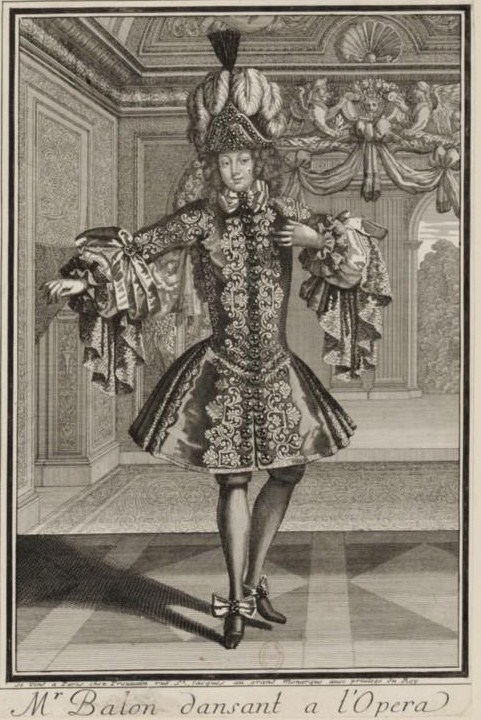
Claude Ballon, one of the most famous danseurs nobles of the early 18th century.

Claude Ballon, one of the most famous danseurs nobles of the early 18th century.