Tag Archives: Baroque Dance

Reasons to be Bored by Early Dance.  VI: Cultural Snobbery

Dancers in the UK early dance world are, it goes without saying, very cultured people. There are, in fact, two sources of true culture in historical dancing. One is the definitively high culture of classical music. The other is the indisputably low culture of folk music and dancing. Isn’t there a chasm between the two? Aren’t they mutually opposed cultural worlds? I’ll explore a bit further.

There are those in UK early dance, a sizeable minority I would say, who are devoted to proper music. They avoid any horrible modern styles of dancing because of the awful music. ‘Pop’ or ‘Rock’ – who needs those? Never mind all the latest styles (which I’ll leave others younger and more enlightened than I am to enumerate). I confess myself puzzled by the ‘high culture’ group. I am trying to think of any major classical composers whose music is actually used in early dance. In the world of baroque dance, we are talking about music by the likes of Lully, Campra, or other equally obscure and third-rate composers. Bach never wrote actual dance music. Although Handel was foolish enough to compose ballet music from time to time, who ever listens to it?

Much of the music for early dance was written by the dancing masters themselves, so does it qualify as folk music? The fons et origo of folk dance music is, of course, John Playford’s The English Dancing Master of 1651. These tunes are well known to derive from classical antiquity, when folk really were folk and totally traditional in their tastes. With such a pedigree, who would want to be listening to modern, vulgar popular music? This is the well-founded opinion of the folk music and dancing people who form the majority in UK early dance.

So far as I can tell, with music for folk dancing (or as the early dance world has it, country dancing), the instruments are really important. Now here we reach a small problem. Nowadays, music for folk dancing demands an accordion – but this instrument cannot be claimed as truly historical even so recently as the mid-19th century.  What to do? The answer is to play all the tunes on a scratchy fiddle, as slowly as possible. Cultural authenticity at a stroke!

It is the fiddle (or violin, if we wish to appeal to the other wing of UK early dance) that unites the ‘high’ classical and ‘low’ folk cultural aficionados. This could return us our very first reason to be bored by early dance – the music – but in my next post I will not go backwards, I will move on.

Contextualizing Mr Isaac’s Minuets

I thought it would be interesting, and perhaps informative, to try to place Mr Isaac’s minuets within the context of other minuet choreographies of approximately the same period. It isn’t easy to date the French notated dances, other than by their dates of publication, but given that some use music that appeared earlier they, too, may have been created a few years before their first appearance in print. I have taken my investigation as far as 1709, the year that Isaac’s The Royal Portuguez was published. Apart from the minuet in Favier’s Le Mariage de la Grosse Cathos of 1688, which I include here, there are six other minuets to be explored. Some are minuets only, while others are minuet sections within multi-partite dances.

La Bourée d’Achille was first published in Feuillet’s Recueil de dances composées par Mr. Pecour in Paris in 1700, one of the first two collections of dances to appear in notation. The minuet is the central section of the dance, with 48 bars of music in 3/4 time (2xAABB A=4 B=8), preceded and followed by a bourrée. The music is from Achille et Polixène, the opera begun by Lully and completed after his death by Colasse. It was first performed in 1687 and then not revived until 1712. So, the duet must antedate 1700 and could belong to the mid to late 1690s.

The Menuet à Deux was published by Feuillet in Recueil de dances contenant un tres grand nombres, de meillieures entrées de ballet de Mr. Pecour which appeared in Paris in 1704. This was the first collection of dances closely linked to the Paris Opéra (Feuillet had published a collection of his own ‘theatrical’ choreographies in 1700, but these seem not to have been associated with dancers on the professional stage). It was danced by Dumoulin l’aîné and Mlle Victoire in Campra’s Fragments de Mr de Lully in 1702 and the choreography obviously belongs to that date. As its title suggests, this is a minuet throughout which has 48 bars in 3/4 time (AABB A=8 B=16)

The Entrée pour un homme et une femme was also choreographed by Pecour and included in the 1704 Recueil de dances. The music is from Destouches’s opera Omphale, first given at the Paris Opéra in 1701 and then at court in 1702 (after which it was not revived until 1721). The notation declares that this duet was performed by Ballon and Mlle Subligny. It was, of course, a minuet for the stage rather than the ballroom with 68 bars of music in 3/4 time (a rondeau, ABACA A=16 B=8 C=12)

La Bavière, choreographed by Pecour, appeared in the IIIIe Recueil de dances de bal pour l’année 1706 published in Paris the previous year. This is a minuet followed by a forlana, to music from La Barre’s La Vénitienne first given at the Paris Opéra in 1705, so this ballroom dance must surely have been created with speedy publication in mind. The minuet has 32 bars of music in 3/4 time (AABB A=B=8)

The Brawl of Audenarde, by Siris, was published individually in London as his ‘new Dance for the year 1709’ and was obviously intended to celebrate the Duke of Marlborough’s victory at the Battle of Oudenarde as part of the War of the Spanish Succession in 1708. The title page says ‘The Tune by Mr. G.’, John Ernest Galliard, and the music was published separately the same year. This dance is a courante followed by a minuet and then a gigue, so it has structural affinities with some of Mr Isaac’s choreographies. The minuet has 32 bars of music in 3/4 time (ABAB A=B=8).

Le Menuet d’Alcide, another choreography by Pecour, was also published in 1709 but in Paris within the VIIe Recüeil de dances pour l’année 1709. Its music is from the opera Alcide by Louis Lully and Marin Marais, first performed at the Paris Opéra in 1693 and revived in 1705 (according to Francine Lancelot’s catalogue La Belle Dance (entry FL/1709.1/02) the music was also used in Ariane et Bacchus by Marais in 1696). This is another minuet throughout with 54 bars of music in 6/4 (3xAABB’ A=4 B=6 B’=4). It is possible, but perhaps unlikely, that Pecour’s choreography dates to the mid to late 1690s.

Leaving aside issues of dating, do any of these minuets have steps or figures in common with those by Mr Isaac that I explored in my earlier post?

Favier’s minuet ‘Entrée des 2. Garçons et des 2. filles de la Nopce’ in Le Mariage de la Grosse Cathos is analysed in detail by Rebecca Harris-Warrick and Carol Marsh in their 1994 book Musical Theatre at the Court of Louis XIV (see particularly pages 144-148). This choreography uses pas de menuet and contretemps du menuet, plus a single coupé and assemblé combination. The pas de menuet and contretemps du menuet differ from later versions, both in their component steps and their timing (see Harris-Warrick and Marsh, pp. 109, 111). There is no reference to any of the later conventional figures of the ballroom minuet. This ‘Entrée’ is a stage choreography performed within a work which uses music, songs and dances to portray an event – the marriage of ‘Fat Kate’. It is, perhaps, more surprising that it uses a standard and restricted vocabulary of steps than that it ignores the usual figures of the minuet, if these had indeed been established by 1688.

The French ballroom dances published in the early 1700s all reflect the menuet ordinaire as known from Rameau’s Le Maître à danser of 1725. The minuets in La Bourée d’Achille and La Bavière, as well as Le Menuet d’Alcide, all predominantly use the pas de menuet with some contretemps du menuet and occasional grace steps. In La Bourée d’Achille the pas de menuet à trois mouvements is favoured, while in Le Menuet d’Alcide preference is given to the pas de menuet à deux mouvements. The figures of these two minuets (particularly the latter) recognisably relate to the conventional figures of the ballroom minuet, but the minuet section in La Bavière is too short to do other than allude to the opening figure before moving on to another short figure which simply gets the dancers to their places to begin the following forlana.

Of the two minuets for the stage, the Menuet à Deux danced by Dumoulin l’aîné and Mlle Victoire is the most conventional. Of the twenty-four pas composés in this dance (which are written as if in 6/4), ten are pas de menuet à deux mouvements and eight are contretemps du menuet. Pecour begins the dance with a coupé sideways as the couple face each other, followed by a pas tombé and a jetté. The first B section of the music begins with the couple facing one another on a right line for a pas balancé forwards and backwards, incorporating a beat and an ouverture de jambe, before moving sideways away from each other with a fleuret and a pas balonné. They then repeat this sequence. Despite his choice of steps, Pecour seems not to reflect any of the ballroom minuet’s figures within his choreography – although this dance has quite a strong inward focus between the two dancers which is interesting in the context of a stage performance. Here is the first plate.

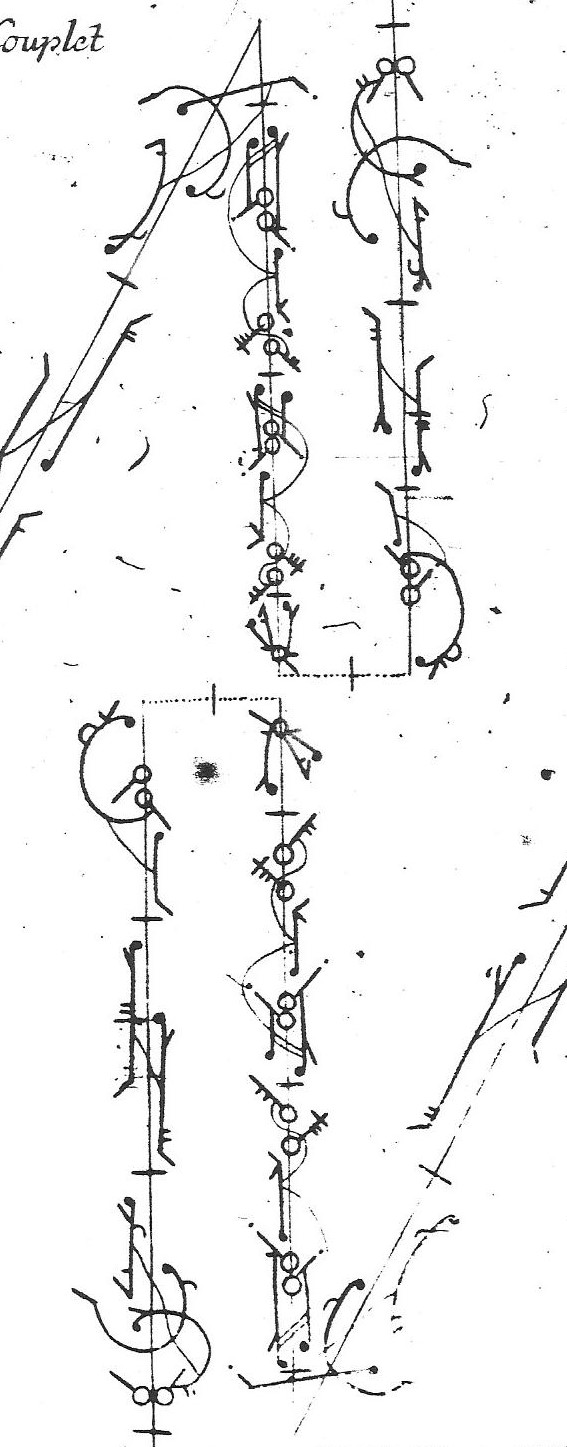
The Entrée pour un homme et une femme, danced by Ballon and Mlle Subligny in Omphale, has a far more varied vocabulary of steps with only four pas de menuet à deux mouvements and two contretemps du menuet. Otherwise Pecour uses pas composés based on a wider range of basic steps, some of which play with conventional steps from the minuet, for example the demi-contretemps followed by a pas tombé and a jetté, while others come together into sequences which echo those he uses in other dance types, like the coupé à deux mouvements followed by a coupé sans poser as the couple move sideways away from each other. There are no clear references to the conventional figures of the minuet, although the final retreat does have a contretemps du menuet as the pair move backwards upstage. Here is the final plate of this duet.

It is worth noting that this dance is far more outwardly focussed than Pecour’s Menuet à Deux. It is less easy to identify as a minuet from its choreography, but I suspect that a subtle relationship with the conventions of the ballroom minuet might emerge in the course of detailed reconstruction of the duet.

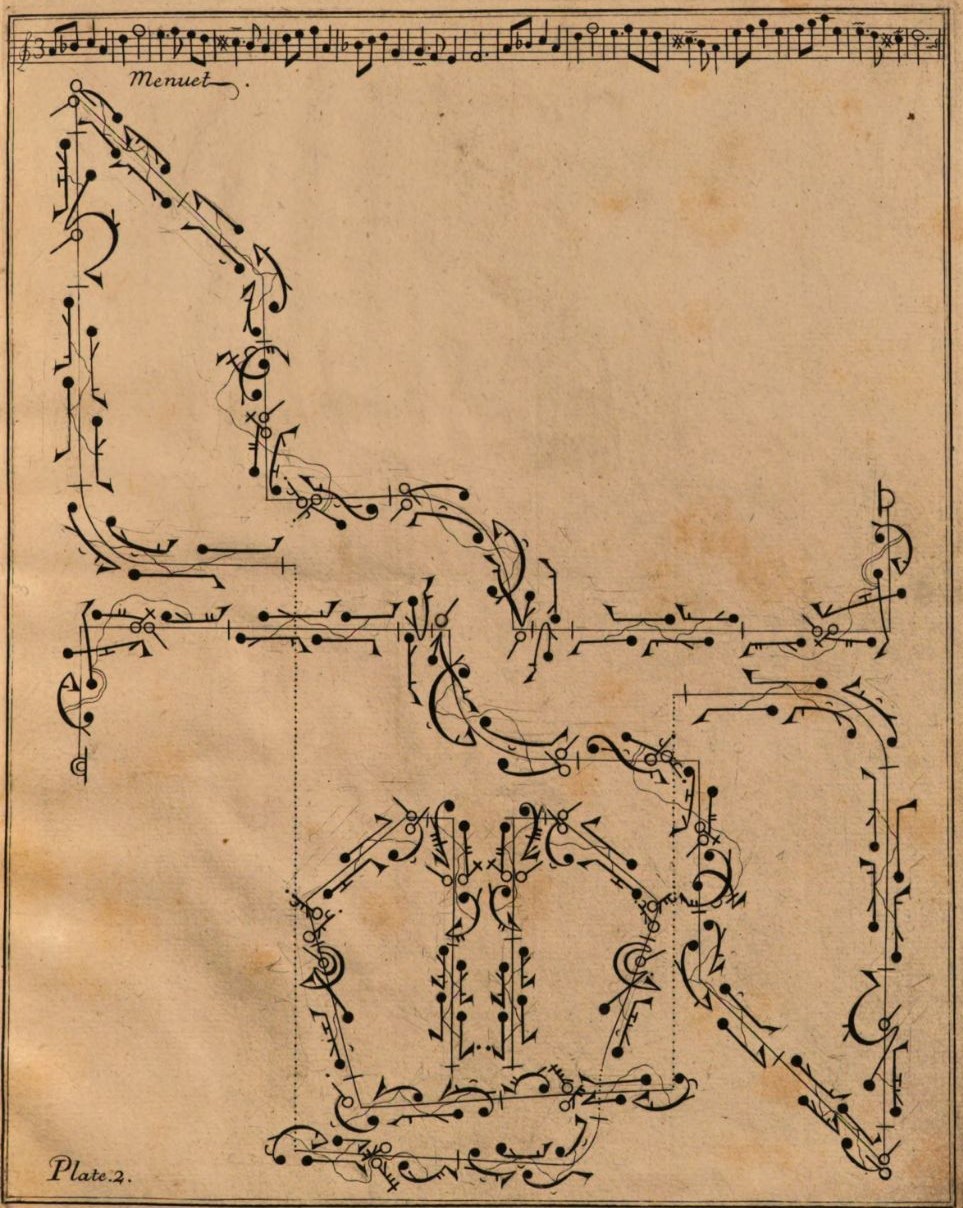
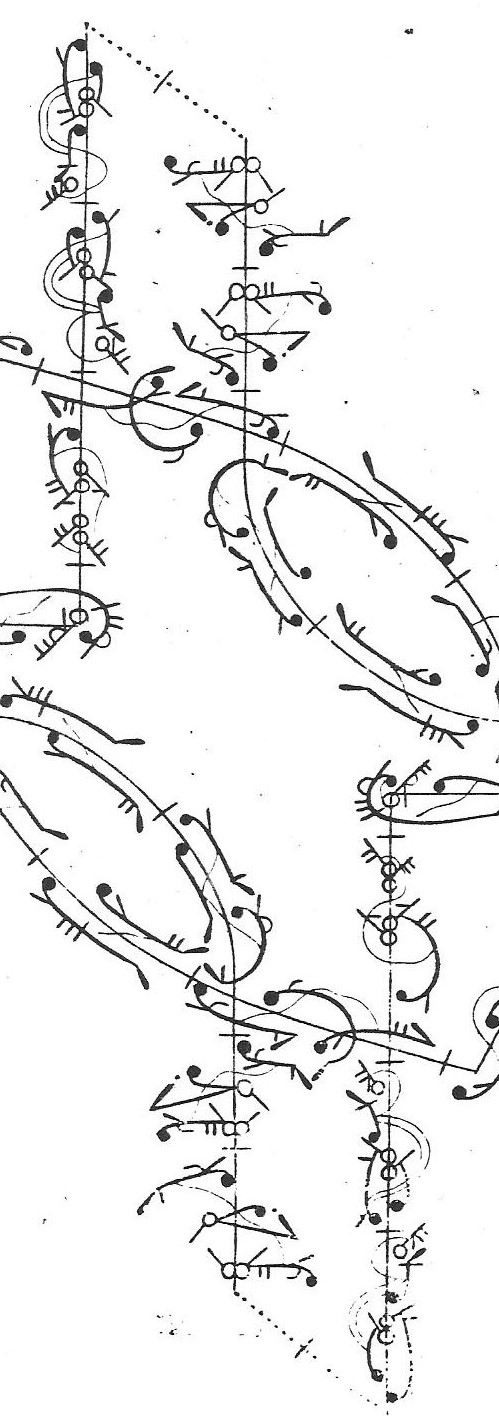
The last of the minuets seems to relate most closely to those by Mr Isaac, perhaps because Siris was working in London as well, or maybe because he was trying to emulate some aspects of Isaac’s choreographic style. Here is plate two of The Brawl of Audenarde with the whole of the minuet section.

The notation and engraving styles are strikingly different from those of the French notations and resemble those of Isaac’s dances (the printer John Walsh produced both Isaac’s and Siris’s dances). The dancers have just completed the courante, the opening section of the duet, and are facing each other offset across the dancing space. They begin by moving onto the same diametrical line with a variant of the pas de bourrée in which the last step is a pas glissé, recognisable from Isaac’s minuet for The Britannia, to which Siris adds a final plié. This is joined to a hop and a jetté, the final elements of the contretemps du menuet, to make a new hybrid pas composé emulating the sort of steps created by Isaac. Siris makes copious use of the pas de menuet à deux mouvements – there are seven in all within this 16-bar minuet (although the music is notated in 3/4, the dance steps are written in 6/4) and four are given small variations. There is a grace step, the pas de courante, which appears once in its usual guise of a tems de courante followed by a demi-jetté battu and then in an ornamented version (performed by the woman as well as the man) which has a double beat. The latter comes close to the end of the minuet section, by which time the couple are in mirror symmetry and so dancing on opposite feet. Like La Bavière, the minuet section of The Brawl of Audenarde is too short to include even allusions to the figures of the ballroom minuet. It ends with the man and woman side by side facing the presence, but improper, ready to begin the gigue with which the duet ends.

On the evidence of this small selection of early notated minuets, six French and one English (or, at least, published in London), Mr Isaac’s choreography was very idiosyncratic. The nearest to him in style is Siris. Should we read anything into the fact that, in his own translation of Feuillet’s Choregraphie entitled The Art of Dancing, Demonstrated by Characters and Figures and published in London in 1706, Siris claimed that he had been taught the notation by its inventor Pierre Beauchamp in the late 1680s? As we now know, Mr Isaac had begun his career in Paris by the early 1670s and was undoubtedly acquainted with Beauchamp. Did he and Siris enjoy similar early training in belle danse, contributing to the similarities between their approaches to choreography?

Mr Isaac’s Minuets

Four of Mr Isaac’s duets published in notation include minuets:

The Rondeau and The Britannia from A collection of ball-dances perform’d at court published in 1706. The Rondeau may date to 1693, while The Britannia was danced in celebration of Queen Anne’s birthday in 1706.

The Marlborough, apparently not published until 1710 although it was a ‘new dance’ in 1705 when it was performed to celebrate Queen Anne’s birthday.

The Royal Portuguez, a ‘New Dance made for her Majesty’s BirthDay’ in 1709 and published the same year. The title may refer to Maria Anna of Austria, who was escorted to Portugal in an English navy vessel for her marriage to João V of Portugal in 1708. She arrived at Spithead from Holland on 24 September 1708 in the Royal Anne.

I am reconstructing these minuets from their notations and all are springing surprises. Here, I will look at them in order of their dates of composition.

The Rondeau

In this duet, the musical structure of the concluding minuet reflects that of the preceding triple and duple time sections. It, too, is a rondeau, running AABACAA (A=B=C=8) and so has 56 bars in 3/4 time. The dance notation is also barred in triple time.

Only about a third of the steps in this minuet are recognisable as belonging to the vocabulary reserved for the dance type. There are some conventional pas de menuet and contretemps du menuet (notated as if in 6/4, but with a bar line part way through the step). There are also some ‘Grace’ steps, or variants of these. I will return to Isaac’s steps more generally towards the end of this post.

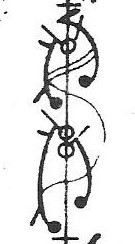
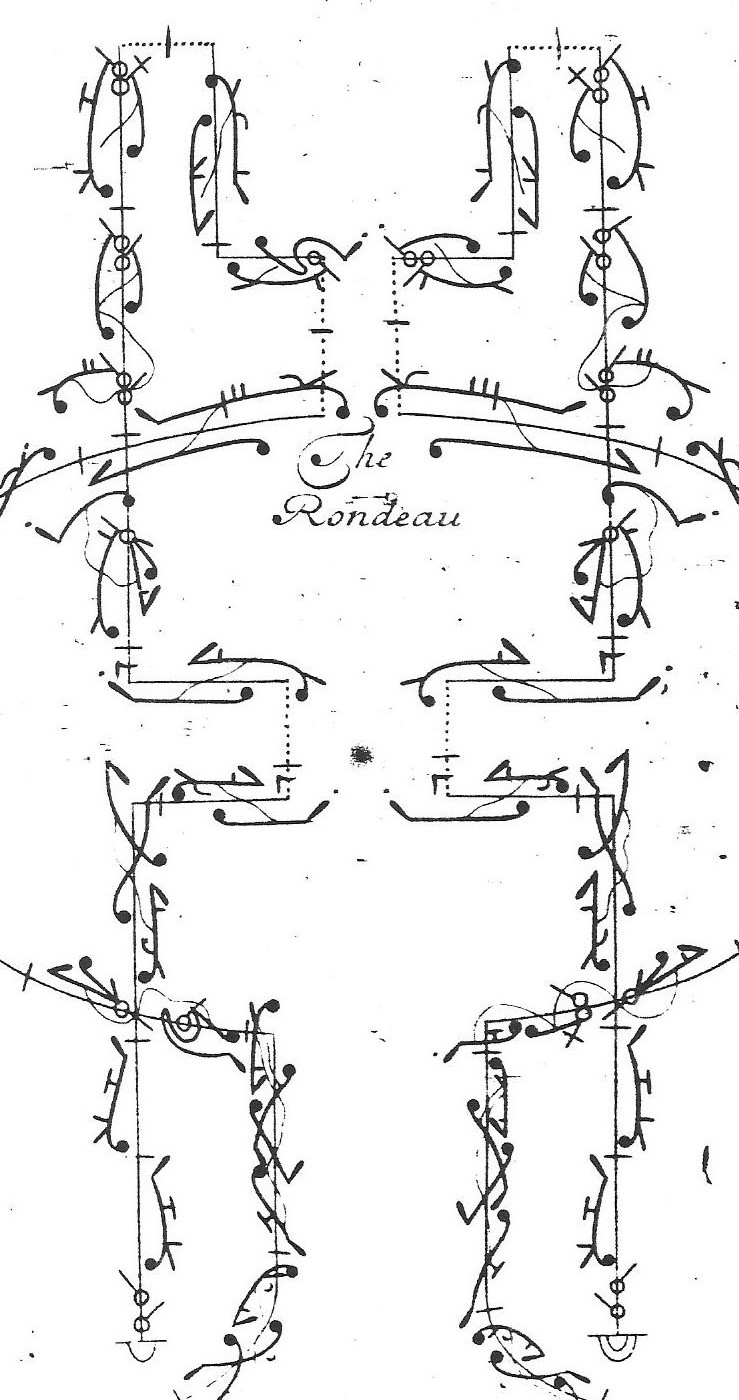
It is generally accepted that the partners in a ballroom minuet both begin their steps on the right foot and maintain this throughout the dance. In The Rondeau, as in his other minuets, Isaac ignores this convention at will. The minuet begins with the couple facing one another across the dancing space, before they turn to dance two pas de menuet upstage side-by-side and then turn to face one another again with a pas balancé. They only turn to face the presence as they change to mirror symmetry (the first of two such sequences) and perform two jettés backwards. This change gives the woman a contretemps du menuet on the left foot, shown in this first plate of the minuet.

The first floor patterns on the next plate could be interpreted as a variation of the ‘Z’  figure, as the couple face one another and move apart sideways, before returning on the same line and then passing right shoulders – all of which is done on an orientation which has been moved through forty-five degrees so it is sideways on to the presence. At the end of the dance, shown in the plate below, the figure resembles the taking of both hands (although no hand holds are included in the notation) before a final retreat with the man moving backwards and the woman forwards in more conventional minuet steps.

The Marlborough

In this dance, ostensibly created just a year before The Britannia, it is not easy to see the triple-time section as a minuet. The musical structure is difficult to analyse. It seems to be AABACBAC (A=4 B=8 C=4), but (as a non-musician) I am happy to be corrected on this. There are, in any case, 40 bars of music. The minuet follows a march, to which the choreography returns for a final reprise.

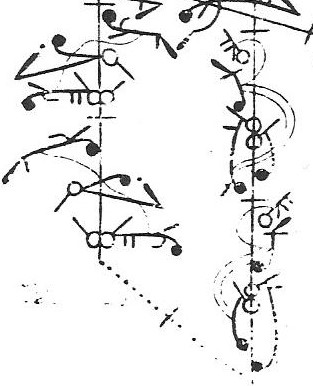
The dancers begin facing one another on a right line, the man backing the presence, and they travel backwards away from one another with steps that can perhaps be interpreted as a variation on the pas de menuet. None of the subsequent figures seem to make any reference to the conventional figures of the minuet and few of the steps clearly seem to be variants of minuet steps, although several resemble those in Isaac’s other couple minuets. In the final figures, before the return to the march, both travel sideways upstage with contretemps and pas de bourrée before facing each other on a diametrical line for pas de sissonne and coupé variants. They end facing each other ready to begin the last duple-time section. Here are the opening and conclusion of the minuet in The Marlborough.

The Britannia

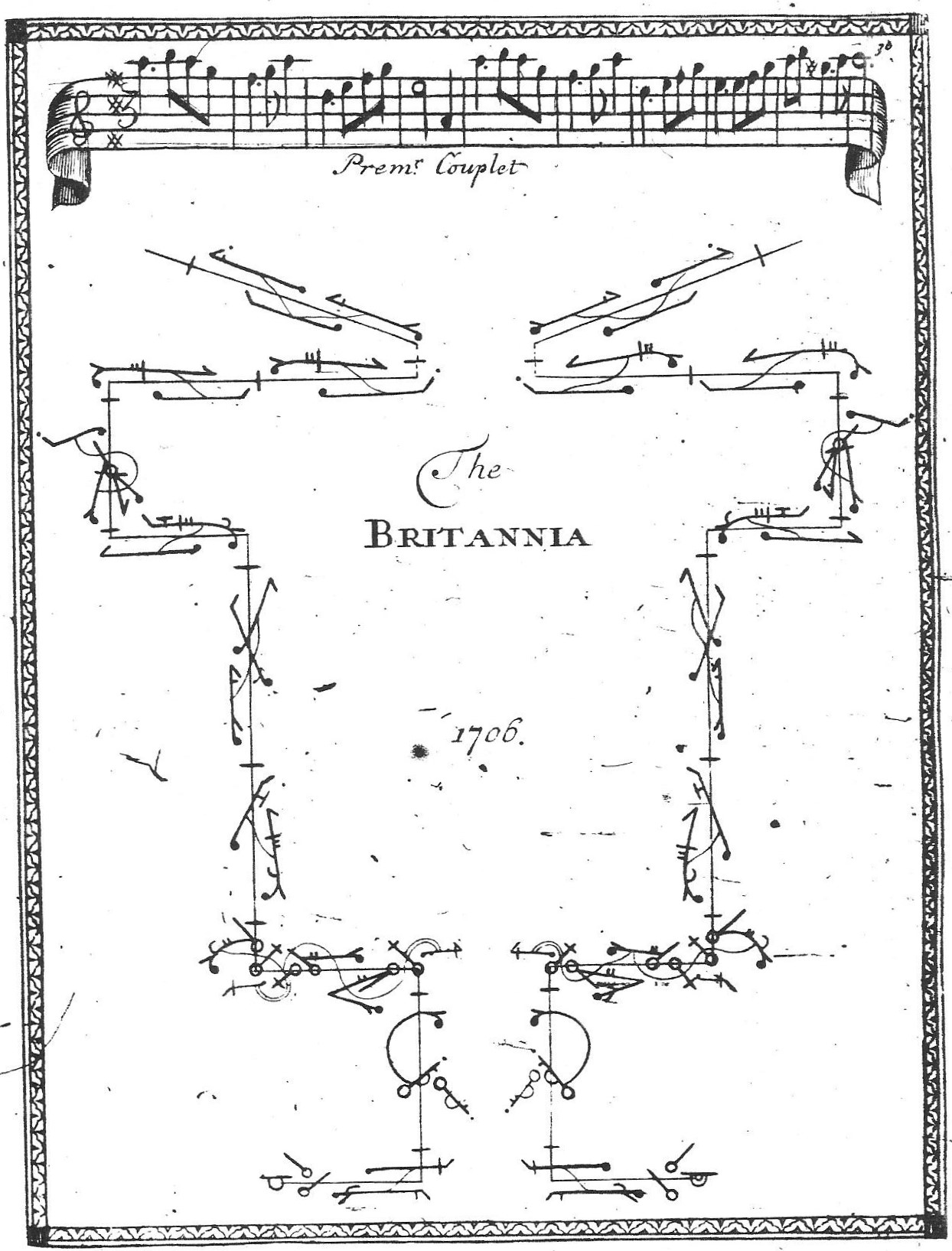
Like The Rondeau, Isaac’s The Britannia has the musical structure AABACAA (A=B=C=8) although in this case neither of the preceding sections – in triple time followed by a bourrée in duple time – are musical rondeaus. Although the music is written in 3/4, the dance notation is actually barred in 6/4. There are 56 bars of triple time music. About a third of the steps can be recognised as pas de menuet and contretemps du menuet, although in The Britannia these are mostly in variant form.

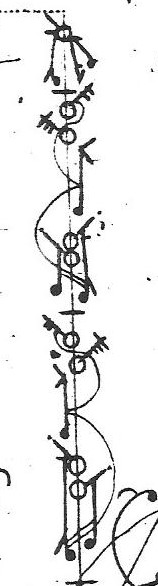
The minuet section begins with the couple facing one another across the dancing space and then moving diagonally, the man downstage and the woman upstage, to end facing one another on a right line with the man backing the presence. In much of The Britannia, the partners are on the same foot, but there are two sequences in mirror symmetry. One comes on plate 10, following a short sequence with faint echoes of the ‘Z’ figure, while the other is in the closing bars immediately after the couple have taken both hands. Here is the final sequence, which differs from a conventional minuet in that both the man and the woman are travelling forwards towards upstage.

The Royal Portuguez

This is the latest of Isaac’s ballroom dances to include a minuet, although it comes only three years after The Britannia (Isaac would continue to create ballroom dances until at least 1714). It follows a loure, which resembles one of the ‘Spanish’ loures to be found in the French repertoire of notated dances (rather than Pecour’s Aimable Vainqueur or Isaac’s The Pastoral, both of which could be described as ‘French’). The loure is, perhaps, meant to honour the new Queen of Portugal, for whom the dance is named. The minuet has a musical structure AABB (A=8 B=12) which is rather different from the other three couple minuets, and the dance notation calls for ‘Brisk Minuet time’. Both the music and the dance notation are barred in triple-time and there are 40 bars altogether.

If its steps are unconventional, the figures of the minuet in The Royal Portuguez at least refer to some of the expected figures of the minuet. It begins with the couple side-by-side facing the presence for a passage on a right line downstage (with steps that might be construed as variants on the pas de menuet, although the dancers are in mirror symmetry). They briefly face each other before turning back to the presence and then travel sideways away from each other on a shallow diagonal. Apart from this opening sequence and another to end the dance, the couple dance on the same foot throughout. A couple of the figures hint at the ‘Z’ figure, although the dancers pass by left shoulders. The final figure begins with the couple facing one another on a diametrical line before travelling on a circular path anti-clockwise. They take hands as they perform a variant on the pas de sissonne to face one another on a right line, before a very short passage upstage to finish. Like The Marlborough, there is little to underline that this is a minuet. Here are the opening and closing plates of the minuet section of The Royal Portuguez.

Mr Isaac’s ‘Minuet’ Steps

Mr Isaac does use recognisable pas de menuet – these have three movements ending with a demi-coupé – although only The Rondeau and The Britannia include them. The contretemps du menuet appears in the same two dances. There are occasional ‘Grace’ steps, a pas balancé in The Rondeau, a pas de courante in The Britannia and paired pas de bourrée in The Rondeau and The Marlborough. Isaac seems to have liked pas composé beginning with a jumping step and ending with a pas de bourrée, which provided him with a range of variations on the pas de menuet à deux mouvements. His most often used versions were:

  • Two jettés and a pas de bourrée, which appears in The Rondeau, The Marlborough, The Britannia and The Royal Portuguez;
  • A coupé followed by a pas de bourrée, which is used in The Rondeau, The Britannia and The Royal Portuguez.

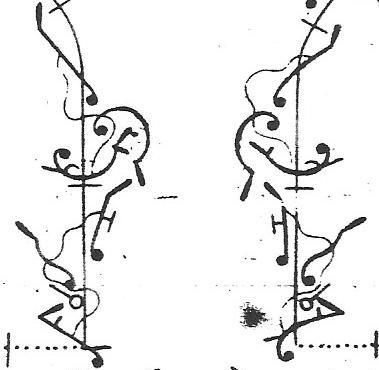
Isaac also makes quite frequent use of the jetté-chassé as an element within a pas composé. Most of these are specific to the dance in which they appear, although a coupé followed by two jettés-chassé is used in both The Royal Portuguez and The Marlborough. The jettés-chassé themselves differ, in relation to the extension (or not) of the working leg), as shown in these versions from plate 8 of The Britannia (on the left) and plate 14 of The Royal Portuguez (on the right).

It is particularly interesting that the minuet sections of three of these dances – The Rondeau, The Britannia and The Marlborough – each have several steps that appear to be unique to them.

My work on Mr Isaac’s couple minuets has called into question much of what I thought I knew about this dance. These earlier minuets range far from the conventional steps and figures set out by Rameau in Le Maître à danser and Tomlinson in The art of dancing some decades later. What does this mean for our understanding of the minuet or, indeed, other dance types among the ballroom duets.

English Court Balls, 1685 – 1702

Back in 2019, I wrote a couple of posts about dancing at the English court – The Restoration Court Ball and Catherine of Braganza: a Dancing Queen. Recent research has taken me back to the topic of court balls and I thought I would pursue birthday balls in particular up to the accession of Queen Anne. Charles II’s queen undoubtedly helped to establish the convention of balls to celebrate royal birthdays following the Restoration in 1660. As I said in my post about her, the first ball that we know of celebrating Catherine of Braganza’s birthday was held on 15 November 1666, some four years after her arrival and marriage. Several others are known from subsequent years.

By contrast, there is evidence for only one ball in honour of Charles II’s birthday, held on 29 May 1675. There may be several reasons for this (not least that the King’s restoration coincided with his birthday) but the lack of such celebrations is still worth further research.

Charles II died on 6 February 1685 and was succeeded by his brother James, Duke of York. James II was crowned on 23 April 1685 and the Hall Theatre at Whitehall Palace was apparently first prepared for a ball the following October. The new King’s birthday was on 14 October, while that of his Queen Mary of Modena was on 5 October.

Preparations for a ball in the Hall Theatre are recorded in October 1686, but there are no indications of similar work the following year. By October 1688, Britain was in crisis – William of Orange landed at Torbay on 5 November and on 23 December James II sailed to exile in France.

Researchers seem to have paid little attention to court balls during the reign of William III and Mary II, although surviving evidence indicates that such entertainments continued. The couple were reported to have danced at a ‘greate Ball’ held at the court of Charles II on 15 November 1677, not long after their marriage on 4 November. Despite his evident seriousness, William of Orange is reported to have been a good dancer.

Following their joint acceptance of the throne on 13 February 1689 and their coronation on 11 April that year, it was several months before court entertainments settled into a pattern. There was a ball to celebrate William III’s birthday on 4 November 1689, the first of what would become a series. There seems to have been no parallel entertainment for Mary II’s birthday on 30 April the following year, or indeed in later years, although the Queen apparently hosted a ball for her sister Princess Anne’s birthday on 6 February 1691. William III’s birthday was accompanied by a ball at Whitehall Palace in November 1691, November 1693 and November 1694. There may well have been a ball in November 1692 as well but direct evidence that would confirm this does not survive.

The death of Queen Mary II on 28 December 1694 brought court entertainments to a halt. In November 1695 there was no ball for the birthday of the widowed King. In November 1696, William III’s sister-in-law Princess Anne – who had taken on her late sister’s role of court ‘hostess’ – gave a ball for the King’s birthday and there were further such balls in 1697, 1698 and 1699.

Princess Anne’s birthday was celebrated by a ball at Kensington House on 6 February 1698, although this seems to have been an isolated occasion. I have recently been investigating some of the choreographies by Mr Isaac, dancing master to Princess Anne, and it is possible that those that can plausibly be dated to the 1690s include some that were originally performed at the birthday balls for William III.

It is worth reiterating that the birthday balls that were a feature of Queen Anne’s reign and continued throughout the ensuing Georgian era had their beginning in the 1660s, perhaps under the auspices of the royal dancing master Jerome Gahory (Mr Isaac’s uncle). William III himself tacitly acknowledged the importance of French dancing at his court, continuing the precedent set by Charles II, when Le Palais des Plaisirs was given at Kensington House in 1698 and again when the French dancers Claude Ballon and Anthony L’Abbé danced there before him in 1699. L’Abbé was Isaac’s brother-in-law and would continue the line of royal dancing masters when he was appointed to that post by George I around 1715.

Further research among a range of primary sources is needed on this topic. For this post, I have mainly relied on the following secondary sources:

John van der Kiste. William and Mary (Stroud, 2008)

Anne Somerset. Queen Anne: the politics of passion (London, 2012)

Eleanore Boswell. The Restoration court stage, 1660-1702 (London, 1966). Reprint of the 1932 ed.

A register of English theatrical documents 1660-1737, compiled and ed. Judith Milhous and Robert D. Hume. 2 vols. (Carbondale and Edwardsville, 1991)

See also:

Moira Goff. ‘The testament and last will of Jerome Francis Gahory’, Early Music, 38.4 (November 2010), pp. 537-542

Jennifer Thorp. ‘Monsieur L’Abbé and Le Palais des Plaisirs: a new source for a London spectacle’, Proceedings of the SDHS Conference 2010, pp. 335-343.

Mr. Isaac’s Choreography: The Six Dances – Motifs and Steps

In my previous post, I looked at the opening and closing sections in each of Mr Isaac’s six dances published in 1706. Here, I turn my attention to some of his choreographic motifs and his versions of some of the basic steps of baroque dance.

Choreographic Motifs: The Right Line

As I work on each of these six dances (a project which is still in progress), I am taking note of one of Isaac’s choreographic motifs in particular. In all of the six dances, except for The Rigadoon, there is at least one sequence danced on a right line. In Orchesography, Weaver describes a ‘Right Line’ as ‘that which extends itself in Length, from one end of the Room to the other’ and illustrates it as running from the presence to the far end of the room in the centre of the dancing space. He is, of course, simply translating what Feuillet says (and illustrates) as his ‘ligne droite’. The feature which makes Isaac’s motif surprising is that the couple face one another and dance along this ‘Right Line’, so one of them has their back to the presence and screens the other from view. (I am assuming, perhaps wrongly, that the presence is on the same level as the dancers and not above them).

The Richmond

The Richmond has one sequence on a right line, roughly half way through the choreography, which begins on plate 3 and finishes on plate 4.

Plate 3
Plate 4 (sequences at top and bottom)

With the woman backing the presence, they approach one another and then retreat.  Each then travels to the right for another sequence in which they move towards one another again on a right line, although they are now offset so both dancers can be seen from the front. The sequence of steps is complex, in keeping with this English hornpipe.

The Rondeau

The Rondeau also has a single sequence on a right line, this time around halfway through the minuet section with which the dance ends.

Plate 6 (the sequence begins on the central vertical line)

The man has his back to the presence. The pair approach one another and then retreat to begin a circular line (on the next plate) which will bring them face to face again, this time on a diametrical line.

The Favorite

The Favorite has two sequences on a right line. The first occurs in the chaconne with the lady backing the presence (plate 2). The second is in the first part of the bourrée with the man backing the presence (plate 5)

Plate 2
Plate 5

This was the dance that drew my attention to the motif, simply because in the chaconne the woman performs a coupé battu to the presence before she turns her back to face her partner (at the top of the detail from plate 2) and this includes a plié on the pas battu which makes it seem like a courtesy. (The man does the same step facing upstage). This figure is followed by another on a diametrical line. The second of these motifs, in the bourrée, has the man with his back to the presence and brings the two dancers together to take right hands for a circular figure.

The Spanheim

The Spanheim also has two figures on a right line. The first comes about a quarter of the way through the dance and the second just over half-way, within the full repeat of the music.

Plate 1
Plate 3

The first of these figures takes only three bars, while the second lasts for five bars. The first time, the woman has her back to the presence and the second time she faces it. The notation for the second right line shows the dancers as slightly offset, although their preceding steps and figure indicate that they are indeed face to face.

The Britannia

The last of the six dances, The Britannia, has three sequences on a right line. The first comes within the first half of the bourrée, with the woman backing the presence, and has the couple approaching one another, turning their backs and turning to face each other again.

Plate 4

The second and third right line figures are within the early sections of the minuet. Both are fleeting and the dancers face the sides of the dancing space (or even the presence and end of the room) as much as each other. In the second, the man is closest to the presence and in the third it is the woman.

Plate 7
Plate 8

There is even the hint of yet another figure on a right line, in the form of a single step just a little further on in the minuet, with the man closest to the presence.

Plate 9

Isaac reveals some preferences in his choice of steps for these right line figures. He uses paired jettés-chassés in The Richmond, The Rondeau and The Britannia, and he also turns to pas de bourrée incorporating an emboîté and a plié. Similarly, he likes to use a coupé with an emboîté and an ouverture de jambe leading to a pas sauté – either a jetté, a jetté-chassé or a sissonne (the vertical jump from two feet to one that completes the pas de sissonne).

Isaac’s Steps

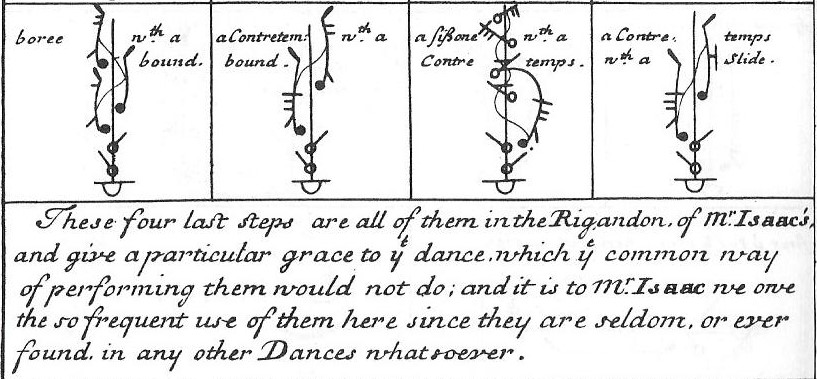
For Orchesography, Weaver evidently used the 1701 second edition of Feuillet’s Choregraphie with its ‘Supplement de pas’ (Feuillet had neglected to include the pas de menuet and contretemps du menuet, alongside a variety of other steps in the notation tables of his first edition). Weaver’s ‘Suplement’ is limited to minuet steps, including some of the ‘grace’ steps, but he also includes four pas composés which he attributes to Mr. Isaac.

Weaver’s claim that these steps are ‘seldom, or ever found in any other Dances whatsoever’ needs to be explored in detail. They aren’t in Feuillet’s step tables but it would be worth checking where and when they occur in dances other than those by Isaac.

Looking through the six dances, some other individual steps stand out. Here are some examples.

The Richmond

Plate 3 (an extension with variation of the jetté-chassé).

Plate 5 (the first pas simple continues that of the preceding pas composé, note the additional ornamentation on the right, the man’s side).

The Rondeau

Plate 1 (this can be described as a coupé battu with an added temps and is a step used in other dances. It comes from the opening triple time section).

Plate 3 (a jetté followed by a coupé soutenue, but perhaps also related to Isaac’s fondness for the sort of variations shown in Weaver’s examples of his steps. This is from the second duple time section).

The Favorite

Plate 3 (two pas de bourrée with variations, from the chaconne).

The notation suggests subtle adjustments to the step as the foot moves, as well as directional changes in relation to the partner – assuming that it represents Weaver’s notation rather than the engraver’s interpretation of it.

Plate 5 (a coupé simple emboîté paired with a variant on the coupé avec ouverture de jambe, from the bourrée).

The Rigadoon

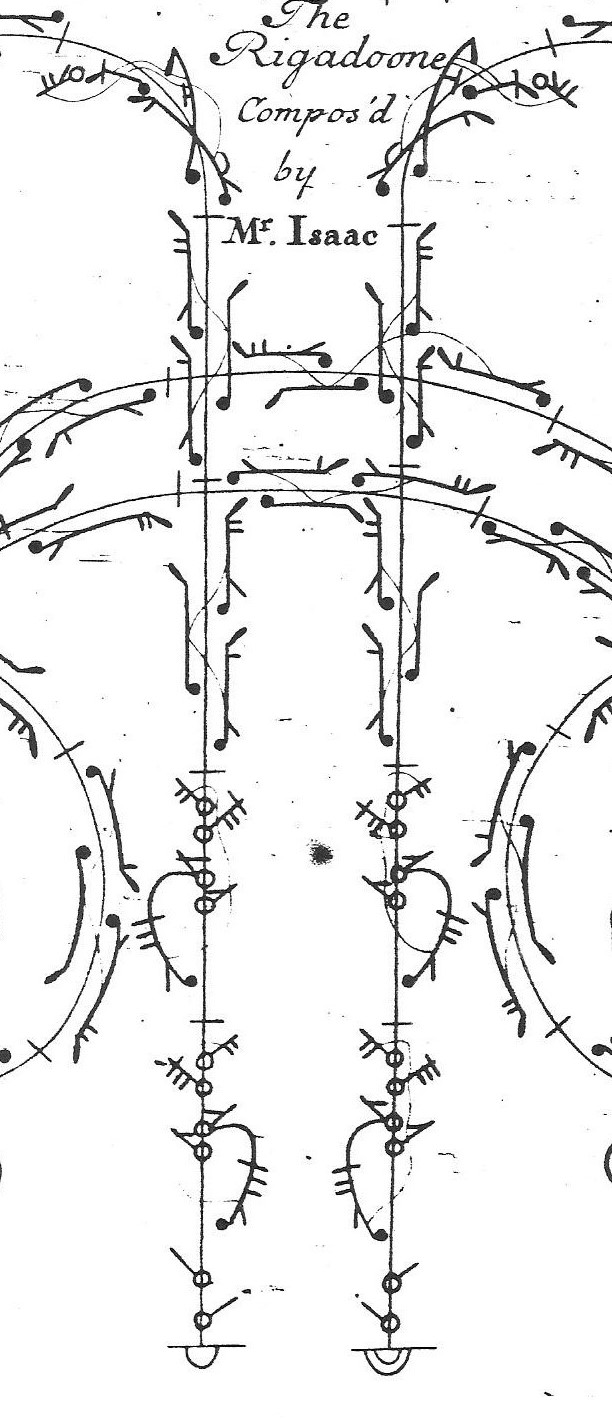
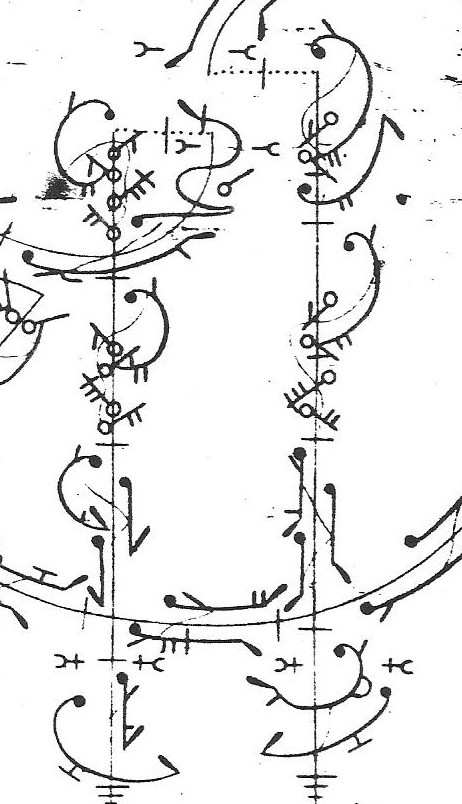
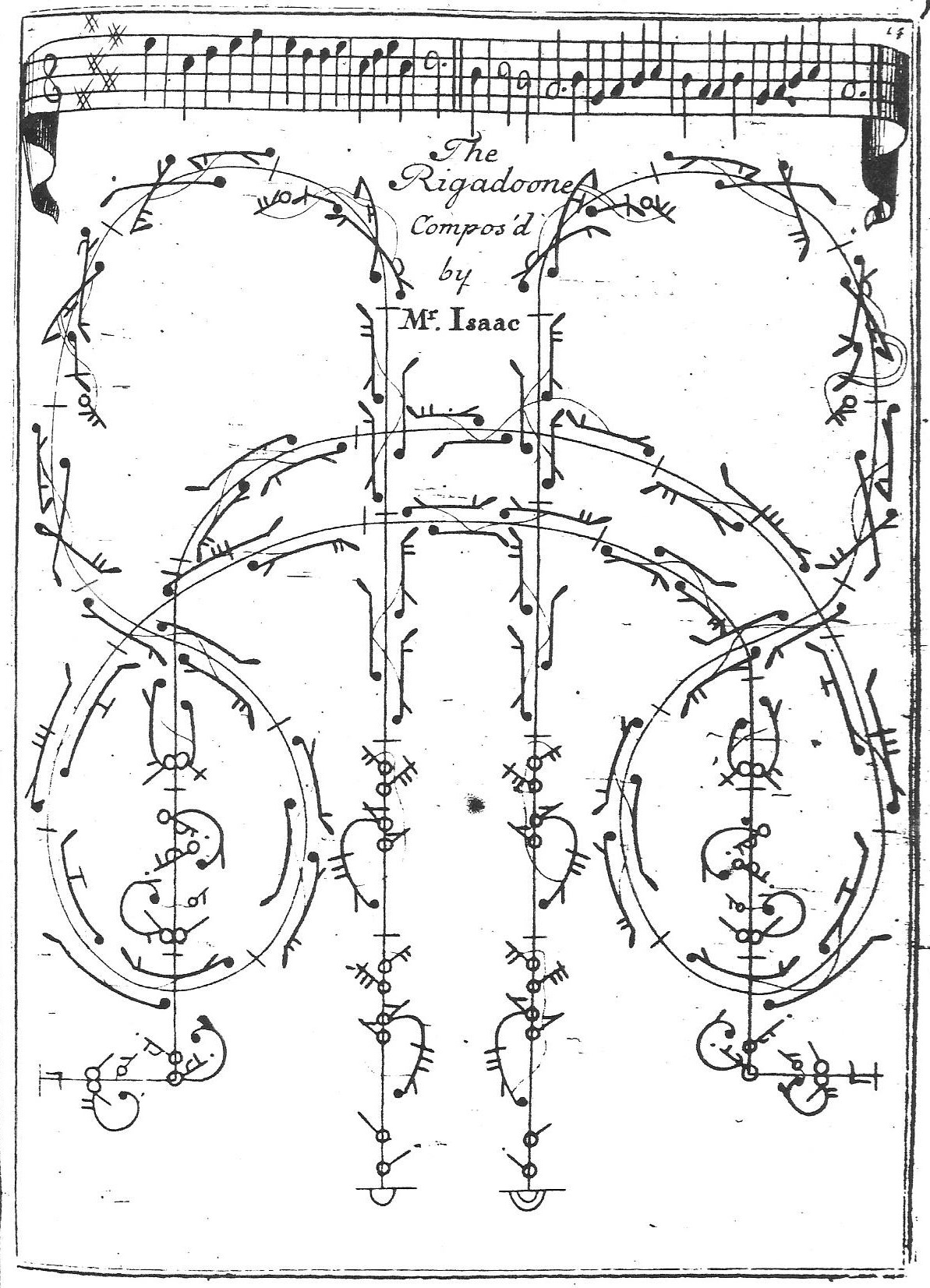
In The Rigadoon it is the sequences of steps that are unusual, rather than the individual pas composés. The most famous sequence is that of plate 2, with its glissades and pas de bourrée tracing a square or rectangular figure.

The glissades (paired coupés soutenues travelling sideways) are a feature of the step vocabulary of The Rigadoon and can be found in other dances as well, notably The Favorite.

There is also the rhythmic challenge posed by a sequence on plate 4. Three successive steps, each of which has a different number and placing of demi-coupés.

The couple travel sideways towards each other and are, at this point in the figure, quite close to the presence.

The Spanheim

Plate 3 (the two steps on the left can each be described as a pas de bourrée with a beat as well as the concluding jetté – here an assemblé – with added changes of direction).

The Britannia

Plate 1 (two jettés-chassés followed by a jetté, from the opening triple time section).

Plate 2 (a hop ornamented with a rond de jambe followed by a demi-coupé. The next step is two demi-coupés in succession. These are from the triple time section).

Plate 4 (two pas de bourrée with emboîté, ending in a plié leading to a sissonne, from the bourrée).

I hope to look at Isaac’s minuets in The Rondeau and The Britannia separately as both use a vocabulary of steps which go beyond the usual variations on and around the pas de menuet, contretemps du menuet and grace steps.

In all these steps, we can see Isaac not only constructing new pas composés from otherwise familiar elements, combining these in new ways, but also ornamenting these compound steps spatially as well as dynamically. It takes time and practice to master Isaac’s steps and sequences, which are an integral part of his idiosyncratic approach to the choreography of ballroom danses à deux.

Mr Isaac’s Choreography: The Six Dances – Opening and Closing Figures

Apart from a solo Chacone and Minuet for a girl (perhaps two separate solos), Mr Isaac’s choreography survives in twenty-one ballroom duets published between 1706 and 1716. Of these, eleven were said to have been ‘Perform’d at Court’ (another, The Northumberland, may also have been danced at court), while another seven were advertised as ‘Made for Her Majesty’s Birth Day’. Two were called a ‘new Dance for the Year’ – they were danced on stage and may have been originally intended for that purpose.

In her 1985 thesis (p. 229), French Court Dance in England: A Study of the Sources, Carol Marsh identified nine country dances that used music from Isaac’s ballroom dances (some used only one section from the music for a multi-partite dance). There appears to be no suggestion that these were created by Mr Isaac himself, although most were published close in date to his ballroom duets. There is also Isaac’s Maggot, in the ninth edition of The Dancing-Master published in 1695, which might be by him. I don’t intend to pursue any of these here or in future posts, although they may well be worth further research by those well-versed in country dances and their history.

In this post, I will look at two of the choreographic conventions demonstrated, or disregarded, in the six of Isaac’s dances published together in 1706. I will investigate some of his more idiosyncratic figures and steps in my next post. Behind this line of enquiry lies the issue of the notation, what it can (and can’t) notate, notational errors and (with Isaac’s other dances) the different approaches of individual notators and engravers. John Weaver was the notator of the six Isaac dances (which were published the same year as Orchesography, Weaver’s translation of Feuillet’s Choregraphie), but at least two engravers prepared the plates from which they were printed. I will touch on these issues in my analyses, although work on the styles and practices of engravers, and notators, really needs to be done through close examination of the originals.

Early in my involvement in baroque dance, I encountered what were identified as choreographic conventions within the genre. There were two in particular: dances opened with a passage travelling downstage towards the audience, or for ballroom dances – the presence; they ended with another passage travelling upstage so that the dancers returned to their starting point. These conventions provide a useful starting point for a brief analysis of Isaac’s six dances.

Here are the opening and closing figures for each of the six dances.

The Richmond:

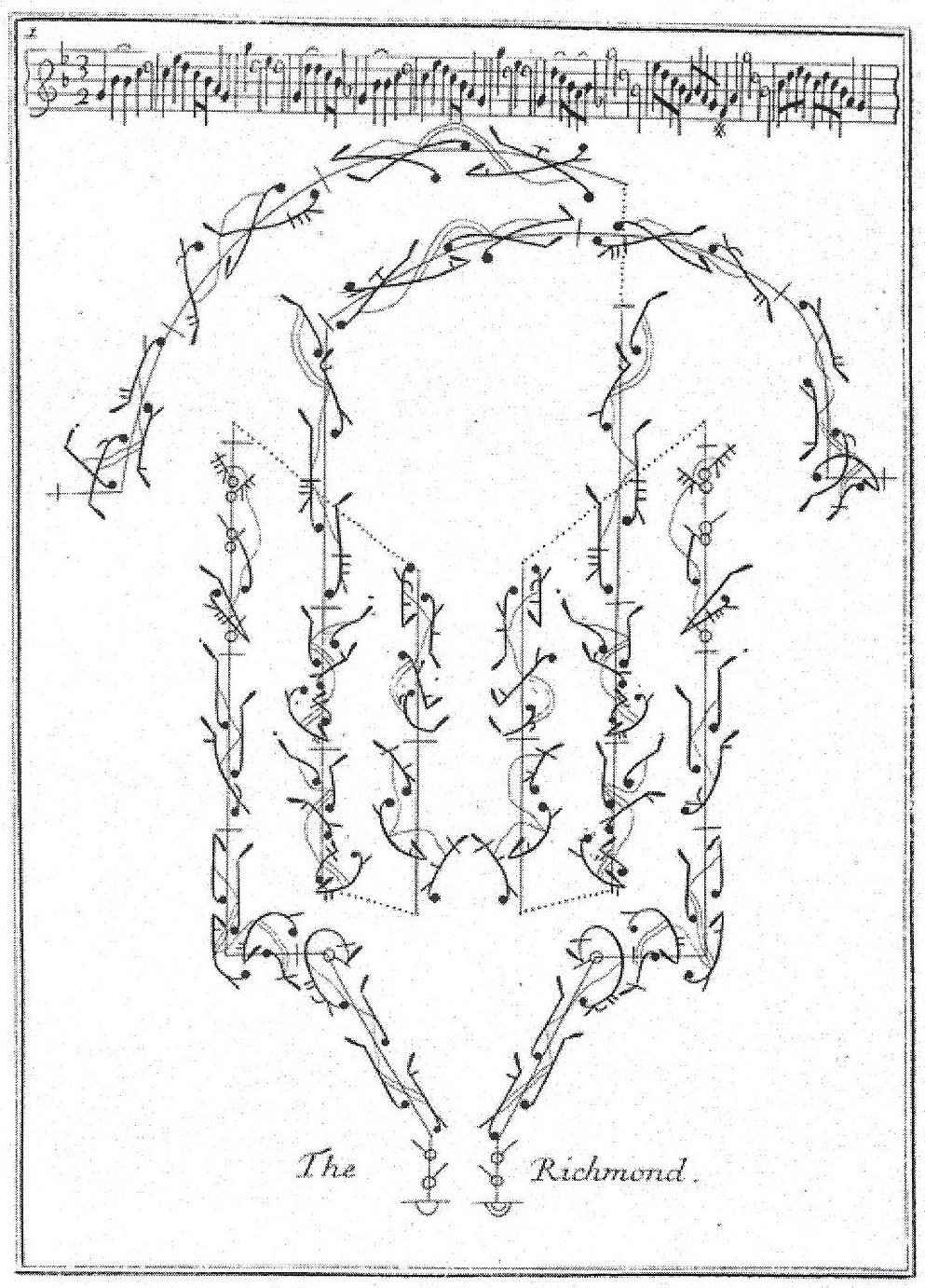
In the opening A section of the music for The Richmond (4 bars), the two dancers move downstage on a diagonal but quickly turn to face each other. They move sideways for one step, then turn to face the presence for two steps. Isaac divides the focus of the dancers between each other and the presence. They are closer together than appears on the notation.

The closing sequence (the final 4 bars, a petite reprise to the last section of the music) has the couple (who are improper) take inside hands as the man moves upstage and lady downstage. They then turn and repeat their pas composé taking other hands. On the next, penultimate, step they let go hands and change sides for their final step in which the man dances backwards and the lady dances forwards. She makes a half turn on the coupé soutenu into fourth position, with which they both finish.

The Rondeau:

Apart from one step, in bar 3, in which the couple face each other for a brief acknowledgement, the convention of facing and travelling downstage towards the presence is observed throughout the first 8-bar musical section. The two coupés sans poser sideways (in bars 4 and 5) would have travelled less than the notation suggests.

The Rondeau ends with a minuet and the closing figure uses the convention of the man travelling backwards, while his lady travels forwards – as if they had taken both hands, although no hand holds are shown on the notation. His final coupé soutenu ends in fourth position, while hers ends in first position implying that they immediately perform an honour.

The Rigadoon:

Isaac gives The Rigadoon, his most famous dance, an entirely conventional opening sequence, with the two dancers travelling downstage side-by-side towards the presence throughout the first A section (before turning their backs as they begin the second A).

The closing sequence is actually a repeat, with variations, of the steps from the opening of The Rigadoon. The man moves backwards as the woman dances forwards and she turns to face the presence only on her final step – both ending with a coupé soutenu into fourth position.

The Favorite:

Apart from their initial steps in The Favorite, which include coupés sideways towards and away from each other, the couple travel directly downstage side-by-side towards the presence, making this a conventional opening.

The Favorite is another dance for which the music ends with a petite reprise. In these final four bars, the two dancers face each other or upstage, travelling upstage on a diagonal before ending with a quarter-turn (not indicated on the notation) into a coupé soutenu into fourth position.

The Spanheim:

In The Spanheim the dancers face one another on their first step and travel sideways downstage on the next, before turning to face the presence to continue travelling downstage with their next two steps to complete the first A section of the music.

The final musical section of The Spanheim has six bars. For the first three the couple travel upstage together, turning to face the presence at the end of their second step. The floor pattern for the last three bars is more complex, using diagonals and a curving track before they make a quarter turn to face the presence at the very end. The man does a coupé soutenu into fourth position and the woman into first, so this dance also seems to end with an immediate honour.

The Britannia:

The A section in The Britannia is longer than usual, with 10 bars, and begins unconventionally with the dancers facing one another for the first 5 bars, before turning to face the presence for a sequence which travels sideways moving away, towards and away from each other.

The Britannia ends with a minuet, like The Rondeau, and Isaac also uses a variation on the taking of both hands (in this dance the notation indicates that the couple do take hands). Their final retreat is shorter (three bars of music – equivalent to one and a half minuet steps) and ends with coupés soutenus into fourth and first respectively, so presumably straight into an honour.

Although each of these dances keep to the general conventions in their opening and closing passages, Isaac is inventive in his variations of these. In all but The Rigadoon, his dancers acknowledge each other in some way. In The Richmond, The Spanheim and The Britannia their opening steps and figures are directed to each other and they only turn to the presence some way into the opening section. I am wondering whether these differences, subtle as they may seem, point to different contexts for their performance or perhaps to Isaac interpretating a theme within his music or the dance’s title. As I work on these choreographies, I question how formal were the balls at which they were performed. Were some of them danced at private or semi-private events before a small royal and aristocratic group, rather than at royal balls given before a wider audience?

The variations in the closing steps are interesting. In Le Maître à danser, published some twenty and more years later than the creation of Isaac’s six dances, Rameau specifies that at the ‘grand Bal du Roy’ and ‘Bals reglez’ honours must be made at both the beginning and end of each couple dance (pages 54, 56-57). These honours are rarely notated in the surviving dances and Weaver’s notations for Isaac seem to hint at differences in practice, signalled by the finishing position of the woman. Do these, too, point to a less formal context for the performance of some of the dances?

Mr Isaac’s Six Dances

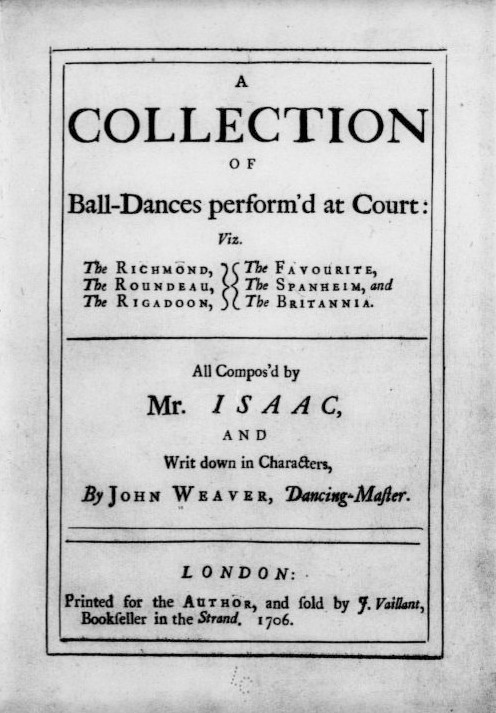
A Collection of Ball-Dances perform’d at Court; … All Compos’d by Mr. Isaac and Writ Down in Characters, by John Weaver was published in London in 1706. There is evidence to suggest that at least one individual dance had already appeared, but it was certainly the earliest collection of dances to be published in London in Beauchamp-Feuillet notation. It was intended to accompany Orchesography, Weaver’s translation of Feuillet’s Choregraphie, which appeared the same year. This is made clear by the advertisement in the Daily Courant for 25 June 1706, which calls it the ‘Second Part’ of Orchesography.

It was also the first collection of English choreographies and close analysis suggests that these had a character quite distinct from the French ball dances being published in notation in Paris around the same time. We have no portrait of Weaver, but there is this print of Mr Isaac, engraved by George White after a portrait by Louis Goupy which seems not to survive.

The Collection of Ball-Dances was ‘printed for the Author’, presumably Weaver who had produced the notations and who had signed the work’s dedication to the Duke of Richmond. It was published by subscription – 47 names appear in the List of Subscribers, all of whom were men and most (if not all) were dancing masters. Both Isaac and his brother-in-law Anthony L’Abbé subscribed and the list is otherwise almost identical to that for Orchesography (see my recent post Subscription Lists and London’s Dancing Masters: John Weaver for more information).

So far as we know, the Collection survives in only two copies now in the USA, at the Library of Congress and Harvard University Library respectively. There is a possible third copy at the British Library, bound with other notated dances, which I hope to be able to discuss in a separate post in due course.

The order of the dances on the title page reflects their order in the volume.

This order is confirmed by pagination in the top right-hand corner of each plate, although three of the dances – The Rondeau, The Favourite and The Spanheim – have additional individual paginations in the top left-hand corner of each of their pages. The Britannia is engraved in a different style from the rest of the choreographies, not only does it have a decorative border on its first plate but the notated steps have different profiles. These details raise questions about the compilation of the collection, which may have been brought together after some of the dances had been notated for separate publication. I hope to be able to discuss some of these possibilities when I look at the individual dances in later posts.

The dedicatee of A Collection of Ball-Dances perform’d at Court was Charles Lennox, 1st Duke of Richmond (1672-1723), the son of Charles II and his mistress Louise de Kérouaille, Duchess of Portsmouth. In his dedication to the Duke, John Weaver writes ‘from your Grace it was that I receiv’d the first encouragement in the Subscription towards this Undertaking, and all, or most of the following Dances, have been Honour’d with your Grace’s Performance’. This portrait by Sir Godfrey Kneller depicts the duke around the time the Collection was published.

Weaver suggests that Richmond had provided some financial support for the publication of the Collection, although his name does not appear in the list of subscribers. Was there another unpublished list of the royal and aristocratic contributors to the costs of publication?

There is also the question of which dances the duke had in fact performed. Weaver’s uncertainty (he writes ‘all, or most’) is perplexing. We know that Isaac was the creator of all six choreographies and he would surely have been able to provide Weaver with accurate information about their performers (Isaac and Weaver were close collaborators over some years). So, did the duke perform only some of the choreographies when they were first given at court, perhaps dancing others at private gatherings to which Isaac was not privy? Whichever ones he did dance, who did he partner?

According to evidence presented by the American dance historian Carol Marsh, in her 1985 thesis ‘French Court Dance in England’, the six dances in this collection may range in date of composition from 1690 to 1706. She draws on the publication date of the music for each dance to indicate when the corresponding choreographies might have been created (the resulting chronology does not relate to the order of the dances in the volume). Isaac’s ball dances thus belong to the court culture of William III and Mary II as well as the early years of Queen Anne. There was more dancing at court in the 1690s than many historians realise, which might also have implications for our understanding of dancing on the London stage during that decade.

Isaac’s six dances have other features which are important for our understanding of ballroom dancing of the period. Here is a summary of basic information about each of the notated choreographies, in the order in which they appear in the Collection, together with an image of the first plate of notation.

The Richmond: 1695 or before. The music was published in The Self-Instructor (London, 1695). The dance is a hornpipe in 3/2, with the musical structure AABBCCDDEEFF’ (A=B=C=D=E=4 F= 8, F’=4 as a petit reprise), and has 52 bars of music.

The Rondeau: c1693. The music was published that year in the 7th edition of Apollo’s Banquet. The dance uses music in a slow 3 and duple time, with a concluding minuet. As the title suggests, the musical structure of the first part is AABACAA (A=B=C=8. A is the slow 3, B and C are in duple time). The musical structure of the minuet is also AABACAA (A=B=C=8, written in 3, i.e. 3/4 rather than 6/4). There are 112 bars of music in all.

The Rigadoon: c1695-1698. An alternative version of the music for Isaac’s choreography was published in Theatre Musick I in 1698 (there is no concordance for Weaver’s version). The dance is a rigaudon and was acknowledged as Isaac’s most famous choreography. The musical structure is AABB (A=4 B=6), played four times to provide 80 bars of music for the dance.

The Favorite: c1690 or earlier. The music was published in the 6th edition of Apollo’s Banquet in 1690, although it can also be found in the Deusiesme recueil des dances et contre-dances (Amsterdam, 1688). It is a chaconne followed by a bourrée. The chaconne has three variations (4+4 bars, 4+4 bars, 8+8 bars) and is played through twice. The bourrée is AABBB’ (A=B=8, B’=4 and is a petit reprise). In all the dance has 100 bars of music.

The Spanheim: may date between 1701 and 1705. The music was published in the Second Book of the Lady’s Banquet in 1706 and there was a country dance to the tune published in 1705. This dance is a gigue, with the musical structure AABBCCDD (A=4 B=6 C=4 D=6), which is repeated to give 80 bars of music.

The Britannia: this was the dance created for Queen Anne’s birthday on 6 February 1706. Although the music was published in 1706 by John Walsh and Joseph Hare together with other ‘new Minuets, Rigadoons, and French Dances, danced at Balls and publick Entertainments’, no copy of this is known to survive. This is another multi-partite choreography, beginning with a section in triple time, followed by a bourrée and then a minuet. The triple-time opening section has the musical structure AA (A=10). The bourrée is also AA (A=14), while the minuet has a rondeau structure AABACAA (A=B=C=8). The whole dance has 104 bars of music.

The music for The Britannia, along with that of many of the dances published after 1706, has been attributed to James Paisible, who may also have provided music for some of the earlier choreographies.

Over the years, I have performed The Richmond and The Favorite and I have worked on The Rondeau and The Rigadoon. I have never danced either The Spanheim or The Britannia, although I am looking forward to learning both of them in due course (albeit on my own, which makes analysis of these duets tricky).

There are another fifteen notated duets by Mr. Isaac, some of which can also be dated to the period between 1690 and 1706, although all were ostensibly first published after 1706. These begin with The Union of 1707 (another choreography I have danced) and end with The Morris of 1716 (a dance I hope to work on at a later date).

All of Isaac’s dances are challenging and even perplexing – as the above short descriptions of the six choreographies in the 1706 Collection suggest. They are very different in style (and even in technique) to the contemporary duets created by Guillaume-Louis Pecour. Were they the product of Isaac’s personal approach to choreography, or do they reflect the idiosyncrasies of English court dance in the French style? Isaac was part French and may well have trained in Paris (he certainly danced in some of the ballets given at the court of Louis XIV), which adds to the questions surrounding his dances. I will try to discuss each of these six dances in separate posts as and when I have done sufficient work on them. I have written on Isaac and some of his dances before and I give a list of these earlier posts below, for those who might be interested.

Earlier Posts

Isaac’s Rigadoon

Isaac’s Rigadoon: the Choreography

Reconstructing Isaac’s Rigadoon

Mr Isaac’s ‘The Favorite A Chaconne Danc’d by Her Majesty’

Further Reading

Carol Marsh, ‘French Court Dance in England, 1706-1740: a Study of the Sources’ (unpublished PhD thesis, City University of New York, 1985)

Meredith Ellis Little and Carol G. Marsh, La Danse Noble: An Inventory of Dances and Sources (Williamstown, 1992)

Jennifer Thorp, ‘Mr. Isaac, Dancing Master’, Dance Research, 24.2 (Winter, 2006), 117-137

Moira Goff ‘The testament and last will of Jerome Francis Gahory’, Early Music, 38.4 (November 2010), 537-542

Subscription Lists and London’s Dancing Masters: Kellom Tomlinson

In some ways, the List of Subscribers to Kellom Tomlinson’s 1735 manual The Art of Dancing is the opposite to that for Anthony L’Abbé’s A New Collection of Dances. The publications are, of course, quite different from one another. Tomlinson’s manual of dancing is aimed at dancing masters and his, as well as their, pupils. L’Abbé’s collection of notated stage dances was surely intended for the far more specialised audience reflected by his subscribers, most of whom were professional dancers and dancing masters.

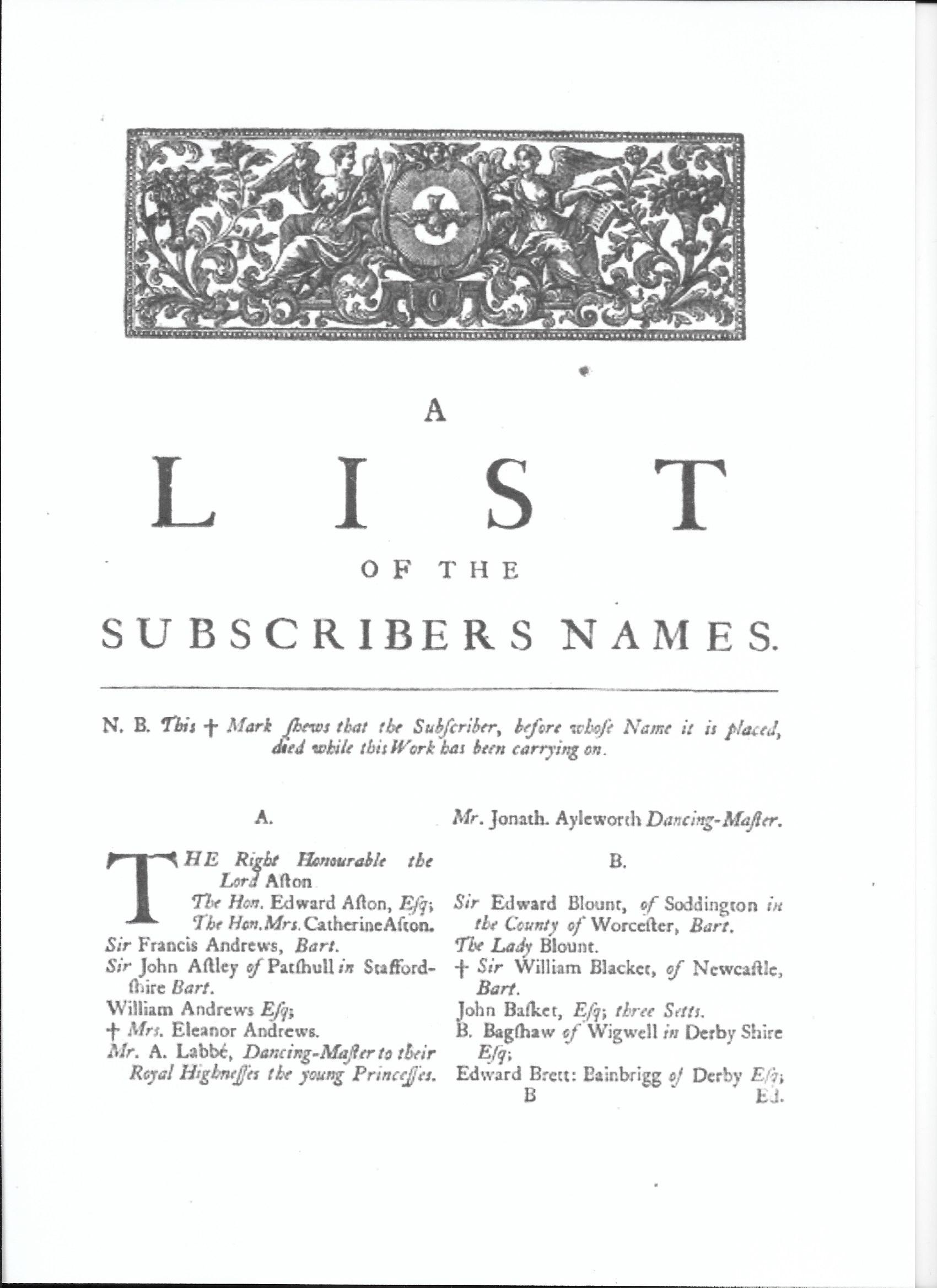
Kellom Tomlinson attracted 169 subscribers to L’Abbé’s 68, a third of whom were women (as I have pointed out, there were no female subscribers to L’Abbé’s collection). Tomlinson’s list ranges through dancing masters, nearly half of whom were (or had been) professional dancers on the London stage, as well as engravers, printers and booksellers, alongside members of the gentry and aristocracy. The gentry were predominant, accounting for around two-thirds of all the subscribers. Does this suggest the breadth of Tomlinson’s clientèle, or simply his ability to market his treatise (with or without actual teaching) to a significant number of pupils and their families? Here is the ‘List of the Subscribers Names’.

The publication history of The Art of Dancing is far from straightforward and despite a number of accounts of it (see the reading list below) still calls for fresh, detailed research. I looked at the rivalry between Tomlinson and John Essex, over the latter’s translation of Pierre Rameau’s Le Maître à danser, in my post The Dancing Master’s Art Explained: Pierre Rameau, John Essex and Kellom Tomlinson. Closer reading of Tomlinson’s advertisements suggests a number of issues I did not pursue there. In the context of this post, it is worth saying again that Tomlinson had first advertised for subscribers to The Art of Dancing in 1726, but publication of his treatise was deferred until 1735. Over that period of delay, twenty of his subscribers died, including Thomas Howard, 8th Duke of Norfolk (1683-1732) and the dancing master, notator and publisher Edmund Pemberton (d. 1733). In this post, I will not go through the List of Subscribers in detail but I will look at some of the identifiable groups as well as some of the individuals within it. Tomlinson dedicated most of his engraved illustrations to individual pupils and I will also look at one or two of these.

Within the context of subscribers to works by dancing masters, one group of particular interest is that comprised of other teachers of dancing. Twenty-two men in the list have the epithet ‘Dancing-Master’. Ten of them can readily be identified as professional dancers. L’Abbé is there, as is John Essex, P. Siris and John Weaver – all of whom had themselves published treatises, as well as notated dances and collections of dances. Thomas Caverley was a subscriber, too – hardly surprising since the treatise focusses on ballroom dancing and Tomlinson had been his pupil. Among those dancing masters still appearing professionally on the stage, Leach Glover stands out as one of the leading dancers at Covent Garden who would shortly succeed Anthony L’Abbé as royal dancing master. It is interesting that the other subscribers include John Rich, described as ‘Master of the Theatres Royal in Lincoln’s-Inn-Fields, and Covent-Garden’.

The female subscribers to The Art of Dancing include Mrs Booth, ‘the celebrated Dancer’. She had recently retired from the stage when the treatise was finally published, but may well have set down her name while she was still London’s leading female professional dancer. The list also has Mrs Bullock, ‘Dancer, at the Theatre in Goodman’s Fields’. Ann Bullock (née Russell) had begun her career around 1714 and by 1735 was in her final years on the stage. Like Mrs Booth, she had been among the dancers represented in L’Abbé’s choreographies in A New Collection of Dances in the mid-1720s.

Turning away from dancers and teachers of dancing, Tomlinson’s list includes five engravers. Two of them – George Bickham Junior and John Clark, are recorded as engravers who had worked on the plates added to The Art of Dancing. There were, in addition, two booksellers and a printer – Messieurs Knapton and Henry Lintot (who subscribed for three copies) were the booksellers and James Mechel was the printer. Were they involved in printing and selling Tomlinson’s manual? His title page says only ‘Printed for the Author’ and that it could be ‘had of him’ at his home address.

The feature that most clearly sets Tomlinson’s List of Subscribers apart from its predecessors is the number of individuals who may reasonably be assumed to have engaged him as a dancing master to teach them or their children. They make up around 80% of the whole list and many of them are identified with particular places, mostly in England. Tomlinson may well have taught the aristocracy in their London houses, but other evidence suggests that he travelled to their country seats and taught in the surrounding areas too.

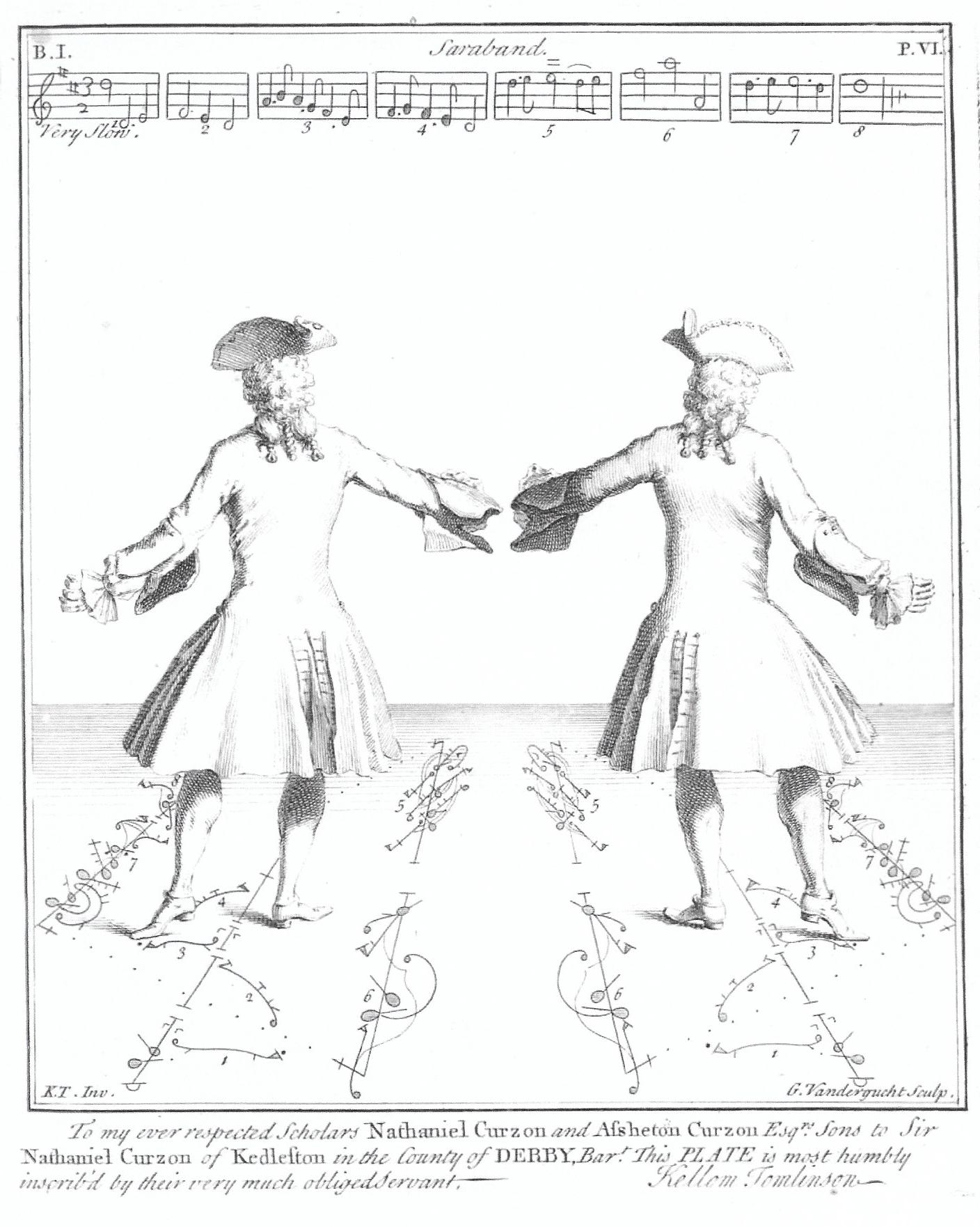
Among his subscribers is ‘The Lady Curzon of Kedleston in Derbyshire’ and plate six in book one is dedicated to ‘my ever respected Scholars Nathaniel Curzon and Assheton Curzon Esqrs. Sons to Sir Nathaniel Curzon of Kedleston’.

Lady Curzon was Mary (née Assheton), wife of Sir Nathaniel 4th Baronet Curzon and the mother of the two boys. This portrait of her with them, by Andrea Soldi and painted around 1738 to 1740 a few years after the publication of The Art of Dancing, hangs at Kedleston.

Tomlinson’s plate was not intended to portray the two boys themselves, who in 1735 were only nine and six years old. As he declared in his Preface to The Art of Dancing:

‘The Figures in each Plate are designed only to show the Postures proper in Dancing, but not to bear the least Resemblance to any Person to whom the Plate is inscribed.’

Did Tomlinson use dancers as models for these images (which he ‘invented’ himself) and, if so, who might they have been?

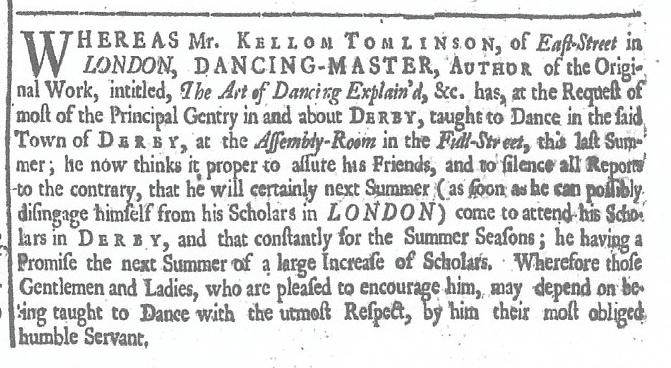
A chance discovery, made a few years ago in the course of another line of research, provides additional evidence of Tomlinson’s assiduous use of advertising to further his career as a dancing master. An advertisement in the Derby Mercury for 12 December 1734, shows that he had been teaching ‘in and about’ Derby (and so in the vicinity of Kedleston).

He must also have been teaching the young Nathaniel and Assheton Curzon at Kedleston in the summer of 1734. Was that when he secured a subscription from Lady Curzon of Kedleston, or had his teaching and her patronage begun earlier in London? It is surely significant that another ten of the subscribers to The Art of Dancing describe themselves as being ‘in and about’ Derby. Tomlinson evidently established an ongoing professional relationship with the area, for he was still advertising in the Derby Mercury as late as 1756 (Tomlinson died in 1761). This advertisement is dated 11 June 1756:

Kellom Tomlinson has been the subject of research, as the reading list below shows, but I can’t help thinking that there is far more work that can be done on him, The Art of Dancing and his various circles of patrons and pupils.

Reading list:

Carol G. Marsh, ‘French Court Dance in England, 1706-1740: A Study of the Sources’ (unpublished PhD thesis, City University of New York, 1985), see pp. 11-121, 150-155.

A Work Book by Kellom Tomlinson, ed. Jennifer Shennan (Stuyvesant, NY, 1992)

Jennifer Thorp, ‘“Borrowed Grandeur and Affected Grace”: Perceptions of the Dancing-Master in Early Eighteenth-Century England’, Music in Art, XXXVI, no. 1-2 (Spring-Fall 2011), 9-27 (see pp. 18, 20-21)

Jennifer Thorp, ‘Picturing a Gentleman Dancing Master: A Lost Portrait of Kellom Tomlinson’, Dance Research, 30.1 (Summer 2012), 70-79 (see pp. 74-76)

Subscription Lists and London’s Dancing Masters: Anthony L’Abbé

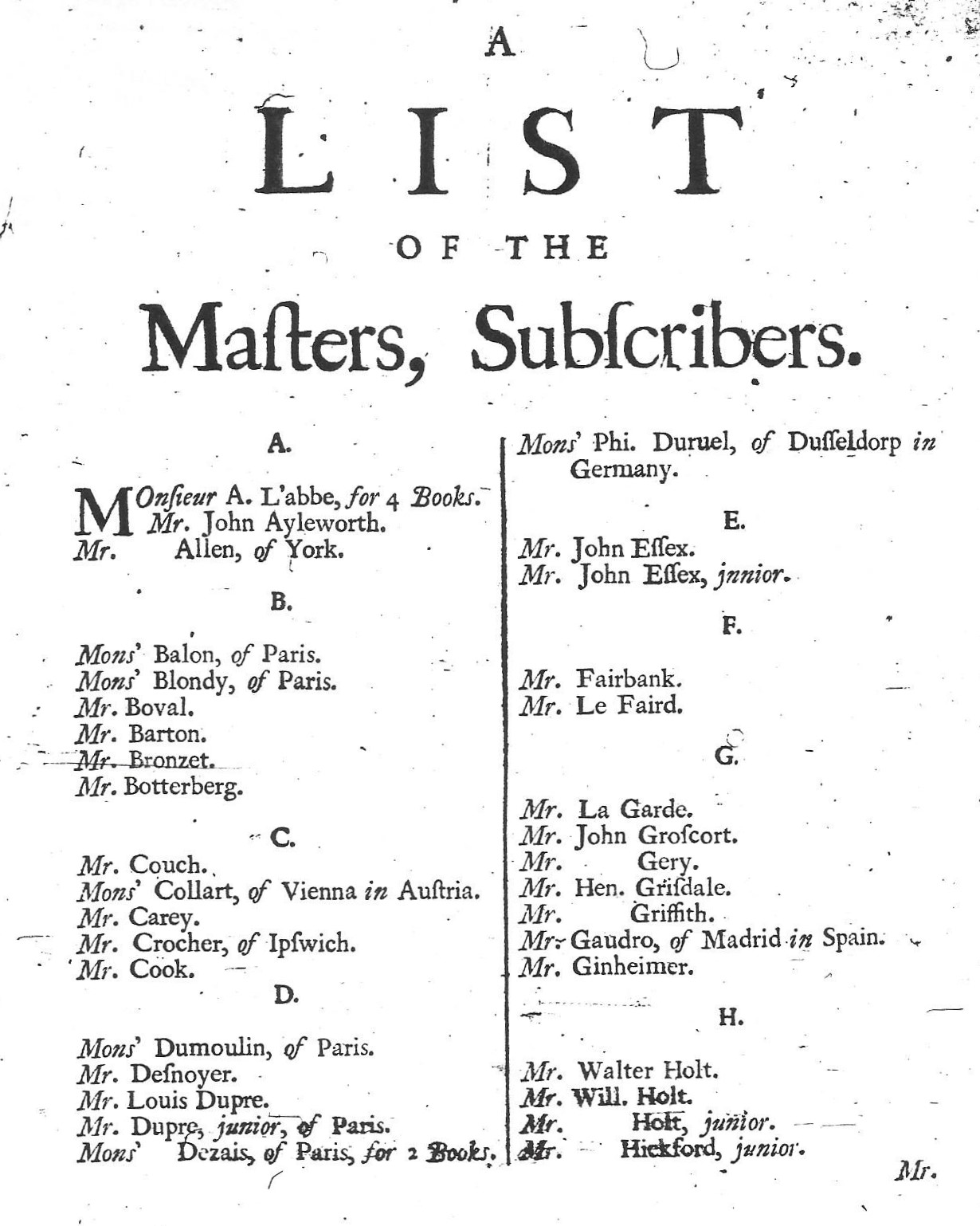
Around 1725, Le Roussau published A New Collection of Dances – thirteen choreographies ‘That have been performed both in Druy-Lane [sic] and Lincoln’s Inn Fields, by the best Dancers’ created by Anthony L’Abbé and notated by Le Roussau himself. The dancers were named on the title page as Ballon, L’Abbé, Delagarde, Dupré and Desnoyer with Mrs Elford, Mrs Santlow, Mrs Bullock and Mrs Younger. All were leading dancers in London’s theatres. The collection provides a series of snapshots of stage dancing in London between 1698 and 1722. It also gives us an insight into the world of professional dancers and dancing masters, through the ‘List of the Masters, Subscribers’ which precedes the notated dances. They are the individuals who made publication possible by paying in advance for the printed copies.

The list of subscribers is on two preliminary pages and has 68 names.

All five of the male dancers represented among the notated choreographies subscribed, but not one of the women – there are no female subscribers to this collection. Given the popularity with audiences of the professional female dancers named on the title page, that absence is worth further investigation. Was it to do with their status within the dance worlds of Britain, France and Europe? Was it that they didn’t teach (or weren’t known as teachers, even if they did)? Were they excluded from learning and using Beauchamp-Feuillet notation? I can’t readily answer any of those questions, but this subscription list reveals the need for a great deal more research and much discussion about the 18th-century dance world.

Of the 68 male subscribers, 48 were British and apparently based in London, six were from English provincial towns and cities, seven were French and five were based elsewhere in Europe. L’Abbé himself subscribed for four copies, while Dezais (Feuillet’s successor as the publisher of notated dances in Paris) took two – the same as Edward Lally (who may have been the seasoned dancing master Edmund Lally, rather than the young Edward Lally – probably his son – just beginning to make a name for himself on the London stage), and John Shaw who was one of London’s leading professional dancers. Shaw died young in December 1725, providing an end date for the publication of L’Abbé’s Collection. It is interesting that, although he had been trained by the French dancer René Cherrier and assuredly had a mastery of French dance style and technique, Shaw was not one of the Collection’s male dancers. They were all French, by ancestry if not nationality. Even more interesting is the fact that all the female dancers were British.

The list of subscribers includes ‘Mr. Edw. Pemberton’, probably Edmund Pemberton, the notator and publisher of L’Abbé’s ballroom dances many of which were created for the Hanoverian court to which L’Abbé was dancing master. L’Abbé’s list overlaps with that of Pemberton’s 1711 An Essay for the Further Improvement of Dancing (which includes a solo version of L’Abbé’s passacaille to music from Lully’s opera Armide). Pemberton’s dedicatee Thomas Caverley did not subscribe to L’Abbé’s theatrical choreographies, perhaps because – although he was a champion of dance notation – he was dedicated to the teaching of amateurs and ballroom dancing. Among the other English dancing masters who were L’Abbé’s subscribers were Couch, Essex, Fairbank, Groscourt, Gery, two members of the Holt family, Shirley and John Weaver. All supported both Pemberton’s and L’Abbé’s collections.

A handful of London’s other male professional dancers also subscribed – Boval, Newhouse, John Thurmond and John Topham, who were to be seen dancing varied repertoires at Drury Lane and Lincoln’s Inn Fields. We don’t know how much it cost to purchase L’Abbé’s A New Collection of Dances by subscription, but Le Roussau’s title page advertised copies at 25 shillings (around £145 today). Was this within the means of such dancers, some of who were definitely below the top ranks? Was their interest in the notations chiefly to aid teaching, or might they have drawn upon these when creating new choreographies for their own use?

John Weaver had been the first London dancing master to publish by subscription, with Orchesography (his translation of Feuillet’s Choregraphie) in 1706. Among the subscribers to L’Abbé’s Collection several had subscribed to one or more of the three works published in that way by Weaver (the others were A Collection of Ball-Dances by Mr Isaac, also in 1706, and Anatomical and Mechanical Lectures upon Dancing in 1721). A few – Essex, Walter Holt and Pemberton – subscribed to all five of the treatises published by subscription between 1706 and 1735. The last to appear was Kellom Tomlinson’s The Art of Dancing, which he must have been planning if not writing close to the time when L’Abbé’s Collection was published, to which he subscribed.

Apart from a few continental dancers working in London’s theatres, there were no European subscribers to any of the dance treatises published in London – except for L’Abbé’s Collection, which had seven subscribers from Paris and five from elsewhere in Europe. Among the Parisians, I have already mentioned Dezais. His name is the only one that would be unfamiliar to non-specialists with an interest in dancing during the 18th century. Claude Ballon and Michel Blondy were close contemporaries of L’Abbé, as well as being leading dancers at the Paris Opéra from the 1690s and distinguished teachers of dancing. Ballon’s ballroom dances were published by Dezais. Dumoulin may well be David Dumoulin, the most celebrated of the four brothers who all pursued dancing careers at the Paris Opéra. He was noted for his mastery of the serious style. Like François Marcel, he was from a younger generation of dancers. He made his Opéra debut in 1705 followed by Marcel in 1708. Marcel was also making a reputation as a teacher. It is very unlikely that ‘Mr. Dupre, junior, of Paris’ was Louis ‘le grand’ Dupré, in fact he may have been related to London’s Louis Dupré the dancer in four of L’Abbé’s choreographies in the Collection.

The ’Mons. Pecour’ listed must have been Guillaume-Louis Pecour, ballet master at the Paris Opéra. His dancing career reached back to the early 1670s. L’Abbé’s A New Collection of Dances emulates the Nouveau Recüeil de Dance de Bal at Celle de Ballet notated and published by Gaudrau around 1713. Gaudrau’s collection of Pecour’s ballroom and stage choreographies has nine ballroom dances and thirty theatrical dances, to Le Roussau’s thirteen stage dances by L’Abbé. Gaudrau, ‘Mr. Gaudro, of Madrid in Spain’ is among L’Abbé’s subscribers. There is also ‘Mons’ Phi. Duruel, of Dusseldorp in Germany’ – John-Philippe Du Ruel had danced in London between 1703, when he was billed as ‘from the opera at Paris’ and described as a ‘Scholar’ of Pecour, and 1707, the year he danced at court for Queen Anne’s birthday celebrations. It seems likely that he was the dancing master based in Dusseldorf by the mid-1720s.

The subscription list to A New Collection of Dances surely represents L’Abbé’s own circle of dancers and dancing masters – those he knew and who knew him and his work. There were the men L’Abbé must have danced alongside at the Paris Opéra, as well as those he had worked with both onstage and off over the twenty years and more that he had been in London. What about the English provincial dancing masters and those in Europe? Did they know L’Abbé or did he know them, by reputation at least? Were they invited to subscribe and by whom? Did some of those who were more closely associated with L’Abbé act as intermediaries in this process? As you can see, I have rather more questions than answers about this particular list of subscribers.

Reconstructing The Louvre (Aimable Vainqueur)

I have written about Pecour’s 1701 duet Aimable Vainqueur in at least three posts. This popular dance was mentioned in Favourite Ballroom Duets and Famous French Ballroom Dances. In Aimable Vainqueur on the London Stage, I looked at one strand of the performance history of The Louvre – the title by which Aimable Vainqueur was known in London’s theatres. In this post, I will look at the process of reconstructing the dance, as I have been doing just that using John Weaver’s version of the notation (titled The Louvre), which he included in the second edition of Orchesography in 1722. This is the version I will use for my exploration here.

The Louvre (Aimable Vainqueur) is a loure to music from André Campra’s 1700 opera Hésione. I don’t know whether London audiences knew that, possibly not as they were unlikely to have heard of the opera, but they must have appreciated the tune or the dance would not have survived in the entr’acte repertoire as long as it did. The music in Weaver’s version, as in Feuillet’s original of 1701, has the time signature 3 and the dance notation has one pas composé to each bar of music. Other loures, including the first part of Mr Isaac’s ball dance The Pastorall of 1713, have music in 6/4 with two pas composés to each bar of music on the dance notation. I will return to the relationship between the dance and the music later.

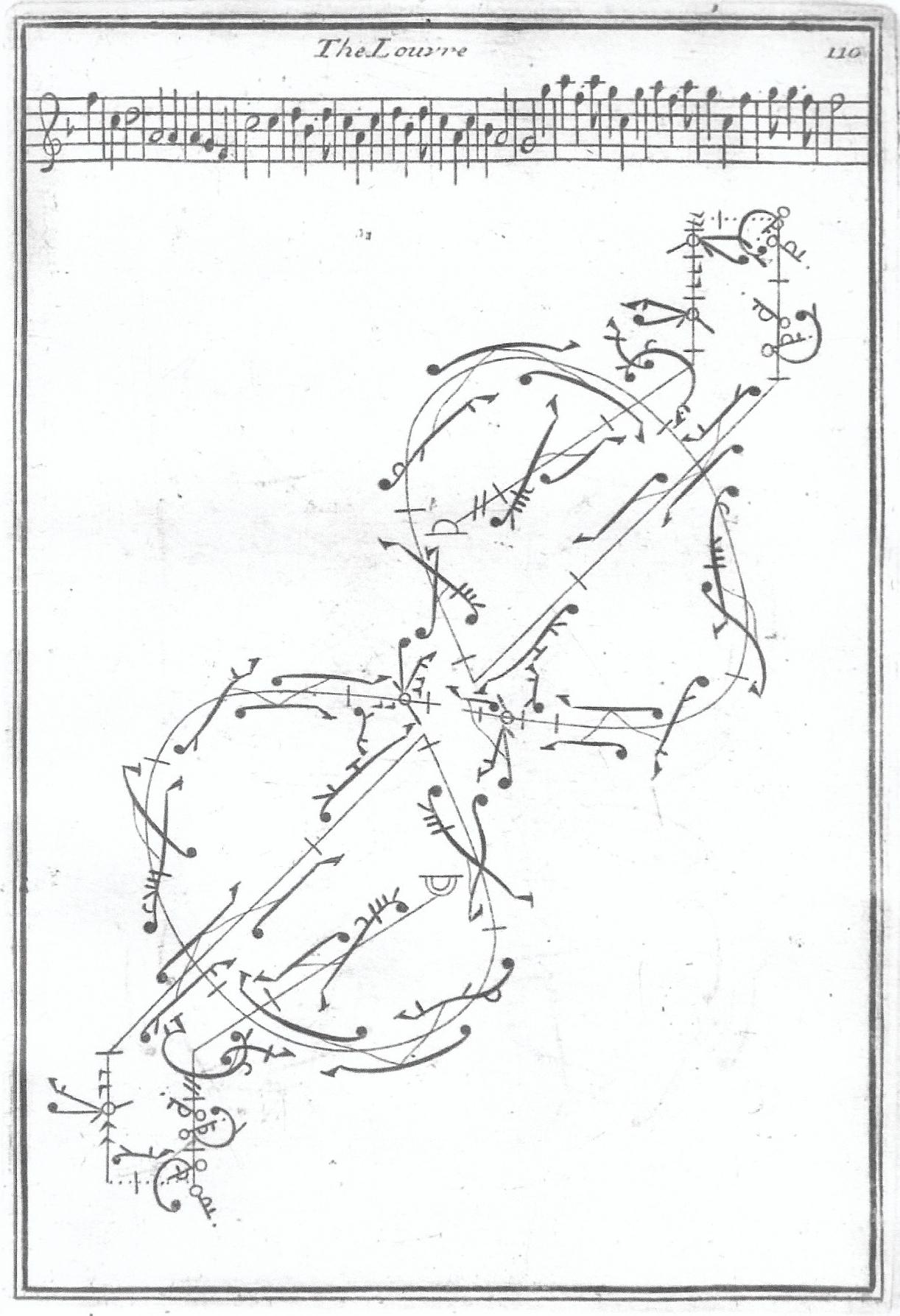
Weaver’s notation has some minor differences from Feuillet’s original, which suggest that he derived his version from Richard Shirley’s notation of the dance, published in London in 1715. Weaver copied Shirley’s floor patterns on the second plate as well as some of Shirley’s notations of individual steps – and he repeated some of Shirley’s mistakes. I assume that Shirley had access to Feuillet’s notation and either he, or possibly his engraver, made the changes. The Louvre has six plates of notation, with the dance divided between them in a way which reflects the music’s structure and phrasing. The music is AABB (A=14 B=24) and plate 1 has the first A, plate 2 has the second A, plate 3 has bars 1-8 of the first B, plate 4 has bars 9-24 of the first B and the second B section is similarly divided between plates 5 and 6.

The notation is clearly set out, although it is not without mistakes and the floor patterns do not always accurately reflect the spatial relationships between the two dancers. Regular users of such notated choreographies will know that it is not possible to entirely reconcile the patterns on the page with those to be performed within the dancing space. Here is the first plate of Weaver’s notation.

All the steps of The Louvre are from the basic vocabulary of baroque dance. The pas de bourée is most often used and the coupé appears in a number of different versions, including coupé simple, coupé à deux mouvements, coupé avec ouverture de jambe and coupé sans poser le corps. Pecour’s figures and step sequences have a classical simplicity (a feature of much of his choreography), although I can’t help feeling that Aimable Vainqueur may have been expressive rather than abstract in performance. The dance takes its title from the first words of an air sung by Venus in act 3 scene 5 of Hésione. The tune was used in the opera for a dance by ‘Ombres de Amans fortunéz’, the shades of happy lovers. At the Paris Opéra, the leading dancers were Claude Ballon and Marie-Thérèse Subligny and it seems unlikely that the choreography they performed closely resembled the ballroom duet created by Pecour for performance before Louis XIV at Marly by several pairs of courtiers – although the two may well have shared some passages. I have to admit that, when I am trying to reconstruct notated dances, it is important that I know about the context for both the music and the dance to help with my interpretation.

The Louvre is in mirror symmetry, except for the last 16 bars of the first B section and bars 9 to 18 of the second B in which the dancers are on the same foot and so in axial symmetry. The sequence within the first B section is of particular choreographic interest and I will analyse it in some detail.

The duet begins conventionally, with the couple side by side and the woman on the man’s right for a passage which travels directly towards the presence. I will use some stage terms to delineate the dancing space, although these are not really appropriate for the ballroom. The dance begins with two coupés à deux mouvements, followed by a pas de bourée and a tems de courante. The sequence is simple but nicely varied rhythmically and calls for a pleasing succession of arm movements. Fewer than a third of the steps in The Louvre are directed towards the presence, although it is apparent that the dancers remain mindful of it throughout – as they would have needed to be both at the court of Louis XIV and on the London stage. The next figure begins with a variant of the pas de bourée en presence, which allows the couple to acknowledge each other for the first time. Then, after another variant of the en presence, they curve away with a contretemps which moves first sideways and then forwards. I am beginning to wonder if such steps, so early in a duet, were a commonplace intended to allow the dancers to address those who surrounded the dancing space, whether in the ballroom or on stage. In The Louvre, the dancers turn back to face the presence, cross (with the woman upstage of the man) and then travel towards the presence again to complete the section with a pas de bourée and a tems de courante.

The second plate (the A repeat) uses much the same vocabulary of steps, although the dancers begin by turning to face one another and travelling sideways rather than forwards. They turn to face the presence for a few steps and then curve away from each other, turn to face and then curve away again before turning to face on the last bar.

Plate 3 begins the B section with the dancers again travelling sideways upstage. Pecour then gives them each a double loop figure, in opposite directions but still in mirror symmetry. They pass one another across the stage, the woman upstage of the man, and end their second loop facing each other up and down the dancing area. The man has his back to the presence. This sequence of 8 bars (five of which are pas de bourée) raises some questions about which way the dancers’ heads turn and where they direct their gaze as they move through the figure.  As they approach each other in the fourth bar, before they cross, do they look at each other rather than over their raised opposition arm (which would result in the man looking at the woman and the woman looking away from him)? In the fifth bar, in which they meet and then pass, do they both look over the raised arm towards the presence? Here is plate three of the dance, to give an idea of what might be happening.

In many ballroom choreographies there must surely have been a continual interplay between the dancers and their spectators, as they regarded each other, looked towards the presence or acknowledged members of the surrounding audience.

The last 16 bars of this first B section are on plate 4. They are surely the heart of this choreography, so I will explore the steps and figures in some detail. Here is the notation.

The dancers begin facing one another up and down the room and the man has his back to the presence. The couple keep to their own areas of the dancing space throughout. The step vocabulary is more varied than it has been, with the addition of half-turn pirouettes and balancé. I am not a musician, but much of the music for The Louvre seems to fall into 2-bar phrases, perhaps reproducing the 6/4 time signature found in other loures, which can seem like a call and response. This idea is clearly evident in this section of the choreography. First, the woman dances away from the man on a diagonal, with a contretemps and a coupé avec ouverture de jambe, turning her back and then turning again to face downstage (she could be looking towards him over her raised arm). She changes feet as she begins the contretemps, so that the symmetry becomes axial. The man waits as she does her steps and then responds by doing the same, ending facing upstage again. They then dance together for 4 bars, but the woman does two half-turn pirouettes followed by balancé, while the man does the balancé first and then the pirouettes. This little 8-bar sequence can surely be made expressive, in harmony with the dance’s original title Aimable Vainqueur. Was it part of Pecour’s choreography for the stage? The couple then travel towards one another on the diagonal with a pas de bourée and a tems de courante (echoing earlier pairings of these steps) before circling away and then coming to face one another across the dancing space. They do another balancé, but the man adds an extra step forward, returning to mirror symmetry.

The next figure, using the first 8 bars of the second B section, has the dancers tracing mirror-image figures of eight (although the notation blurs the pattern). They begin with jetté-chassés, followed by two pas de bourée, then jetté-chassés again and a pas de bourée followed by a coupé to first position facing one another.

In the last 16 bars of the dance, Pecour introduces some fresh choreographic devices. Here is the final plate of The Louvre.

The dancers turn away from each other, the man facing the presence and the woman with her back to it, with a quarter-turn pirouette followed by a demi-coupé sans poser le corps. They have returned to axial symmetry with their pirouettes. They travel sideways towards each other and away again, with a varied series of coupés.  Throughout this sequence the man faces the presence while the woman faces upstage. They curve away from each other, the woman passing directly in front of the presence while the man is further upstage, and come to face one another again, having changed sides. This sequence also poses challenges on where to look and the notation does not agree exactly on the steps of the two dancers (which may or may not be a mistake). This time, they could be looking towards each other as they approach with a pas de bourée – even though this means that the woman is ignoring the presence as she dances past. The sequence finishes with a coupé to first position, preparing a return to mirror symmetry.

The last six bars of The Louvre seem to be grouped in twos: half-turn pirouette, coupé avec ouverture de jambe, in which the couple turn away from each other and perhaps look towards the presence as they each extend their downstage leg; half-turn pirouette and a quarter-turn into a tems de courante travelling upstage, during which they might look at each other; finally a pas de bourée and a half-turn into the coupé which brings them side by side ready to bow to the presence.

The Louvre is certainly susceptible to interpretative choices which can change the focus of the dance and the interplay between the dancers. There is a great deal of information within the notation, although this is not always clear. There is much that is missing, too – not only the obvious, like arm movements, and the less obvious, like épaulement and the placing of the head, but also pointers to the meaning of the choreography. Is it abstract or is it expressive? We can make choices as we both reconstruct and recreate this delightful dance and try to understand what made it so popular for so long.