Tag Archives: Baroque Dance

BAROQUE DANCE IN PERFORMANCE

One of the many challenges facing dance historians who (like me) specialise in ‘baroque dance’, and in particular stage dancing, is the rarity of opportunities to see performances of the notated choreographies. The most difficult of the surviving stage dances are rarely, if ever taught at historical dance workshops or courses here in the UK. I confess that I have been unable to find videos of performances of most of them online.

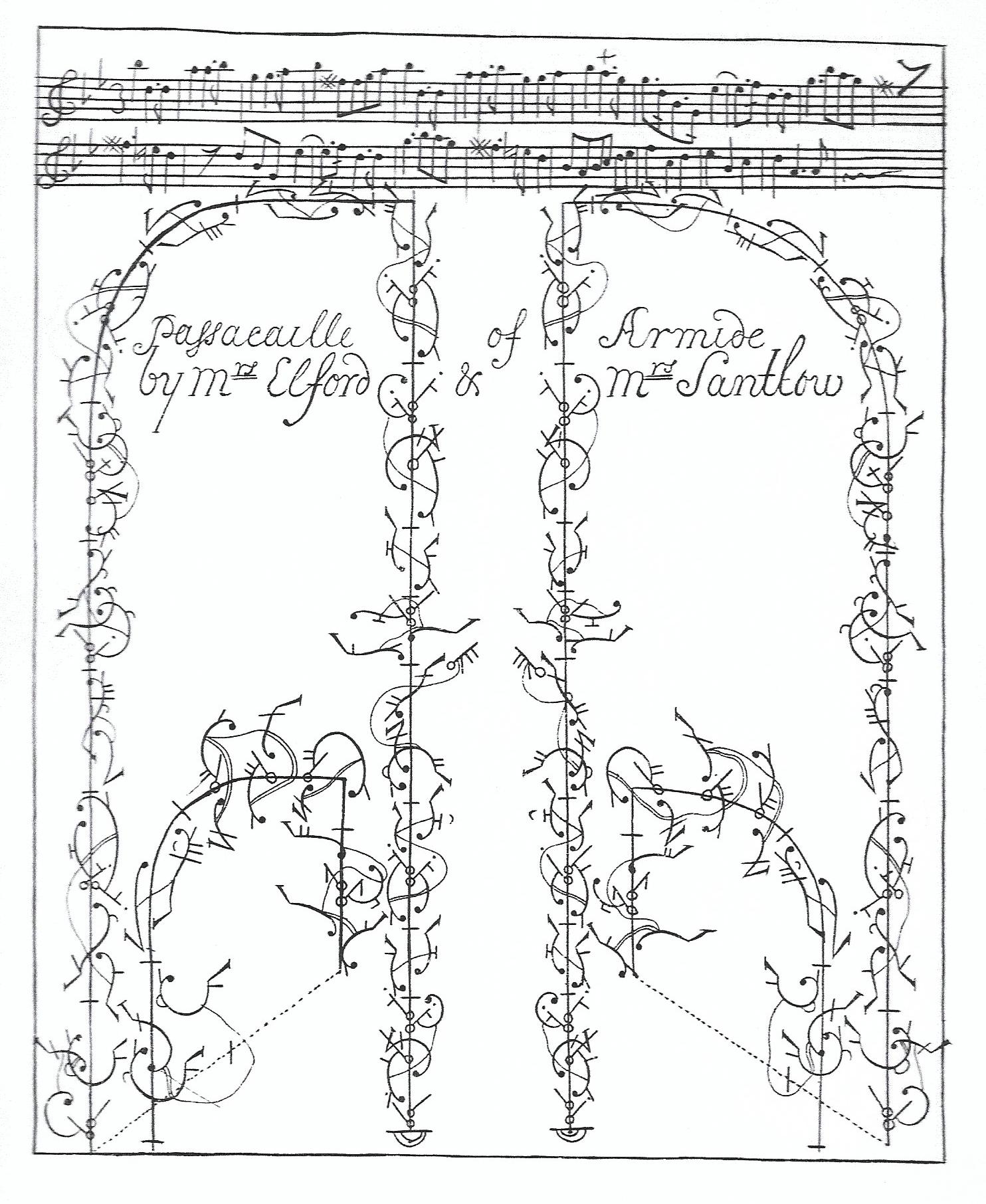
I have long been interested in Anthony L’Abbé’s A New Collection of Dances, thirteen choreographies created by him for professional dancers on the London stage notated and published around 1725 by F. Le Roussau. I have in my time performed four of them – the ‘Passacaille of Armide’, ‘Mrs Santlow’s Minuet’, the ‘Passagalia of Venüs & Adonis’ and the ‘Türkish Dance’ – and worked on another three – the ‘Chacone of Galathee’, the ‘Saraband of Issee’ and the following ‘Jigg’. However, until recently I had only seen four of them performed. When the chance arose to see three of the duets being taught in Paris as part of the Pecour Academy summer course 2025, I jumped at it. I am extremely grateful to Guillaume Jablonka and his fellow teachers Hubert Hazebroucq and Irène Feste for making an exception and allowing me to attend part of the course simply to watch and to learn. I have to say that it was a marvellous and truly rewarding experience.

The three choreographies were the ‘Loure or Faune’ danced by L’Abbé himself with his great compatriot Claude Ballon, the ‘Canaries’ performed by Charles Delagarde and Louis Dupré (the ‘London’ Dupré I wrote about a little while ago) and the ‘Passacaille of Armide’ danced by Mrs Elford and the very young Mrs Santlow.

Hubert Hazebroucq taught the ‘Loure or Faune’, Guillaume Jablonka the ‘Canaries’ and Irène Feste the ‘Passacaille of Armide’. The ‘Passacaille of Armide’ was one of the first baroque stage dances I worked on and inspired me to pursue the research which culminated in my book The Incomparable Hester Santlow. All three duets, particularly those for the men, are technically challenging and require teachers and dancers with an advanced level of training.  The Pecour Academy was attended by dancers who were well up to the task.

The three teachers, all professional dancers, differ in their dancing styles and approaches to teaching, but all recognisably belong to a shared French tradition of historical dance research and reconstruction based on the concept of ‘la belle dance’. Their individuality as well as their shared heritage was apparent in their warm-up sessions and their teaching of the notated dances. I was able to observe their work during the last three days of the course and the focus and energy in all three classes was inspiring. The teaching and dancing I watched has raised many questions about my own knowledge and understanding of baroque dance, at one end of the spectrum in relation to the performance of individual steps and at the other about the interpretation of the dances in L’Abbé’s New Collection.

An abiding issue for all who study the dancing of the decades around 1700 (when Feuillet first published Choregraphie and the associated collections of notated dances) is what the notations leave out when it comes to technique as well as style. Some questions are answered (although not definitively) by the descriptions of steps in Pierre Rameau’s Le Maître a danser of 1725. For others there are no answers, at least in print. I was aware that French interpretations of Rameau differ from those in the UK and this course reminded me of details I had forgotten. It also revealed new thinking about steps that I was unaware of. I hope to be able to pursue some of these in individual posts for Dance in History.

Two other issues came up that require me to undertake far more research and do a great deal more thinking. One is about the way in which L’Abbé’s dances use space, which relates to the stages for which he created these choreographies in London (not in Paris, with the possible exception of the ‘Loure or Faune’ even though this was undoubtedly performed at London’s Kensington Palace). This issue is difficult to address in any course which has several couples of dancers learning dances in the same space, who necessarily have nothing like the area for which L’Abbé created each choreography and who are also engaging with the most difficult steps in the baroque vocabulary. There are also the relationships, expressive as well as spatial, between the two dancers and between them and their audience (which these students were certainly very aware of). The placing of that audience in relation to the dancers is also a factor to be investigated – I suspect that this differed in Paris and London. I hope to be able to explore all of these aspects more fully in due course. The second issue that arose is the characters personified by the dancers, which may or may not derive from the music used by L’Abbé. The three teachers understandably thought of these choreographies in the context of the works given at the Paris Opéra from which L’Abbé took his music. I (equally understandably, I hope) have tended to think of them in performance on the London stage, where they would have been removed from their original operatic context (which may well have been unknown to their London audiences). I think these two views, which can surely be reconciled despite their differences, provide a rich environment for the development of a range of interpretations.

I have focussed here on L’Abbé’s three choreographies, but each day included workshops on other dances and aspects of baroque dance. Notable among these was Christine Bayle’s masterclass on Pecour’s La Nouvelle Forlane, in which she shared her great skill, experience and knowledge with a group of of dancers who were eager and extremely well prepared to benefit from it. That was a special moment, too. The whole course concluded with a public presentation of the dances that had been taught over the week. It was described as showing ‘Work in Progress’, but what marvellous Work – and fantastic Progress – it shared. I salute the teachers and their students for a wonderful achievement.

The 2025 Pecour Academy was a while ago now, but I am still thinking about it as I pursue my research into L’Abbé’s stage dances. I repeat my grateful thanks to Guillaume, Hubert and Irène for sharing their work with me.

What were Entr’acte Dances on the London Stage Like?

During the 18th century, entr’acte dances (dances given between the acts of plays) were an integral part of many performances in London’s theatres. The following advertisement, from the London Daily Post and General Advertiser for 25 March 1736, shows how these dances fitted into the evening’s entertainment:

This performance was for the benefit of one of Covent Garden’s leading dancers, Leach Glover.

As this bill shows, entr’acte dances could be quite varied. Nivelon’s Clown was a country bumpkin, possibly related to the ‘Peasant’ depicted by Lambranzi in his Neue und Curieuse Theatrialisches Tantz-Schul in 1716. I have used this image several times before but here it is again.

I continue to puzzle about the differences between ‘Clowns’ and ‘Peasants’ on the London stage, as well as the distinctions between those of different nationalities – in the 1720s both John Weaver and Francis Nivelon danced an English Clown, while Nivelon was also billed in a French Clown dance.

The Minuet and Louvre performed by Glover and Miss Rogers were ballroom dances (the Louvre was, of course, Pecour’s famous Aimable Vainqueur), although we don’t know whether the basic choreographies as set down in surviving notations were embellished for the stage.

This engraving from Kellom Tomlinson’s The Art of Dancing (1735) shows a moment from the ballroom minuet (the viewpoint is from the lower end of the room, looking towards the ‘Presence’). It raises questions about the performance of ballroom dances on stage, even though they shared with stage dances the concept of a ‘Presence’ as an important focus for their dancing.

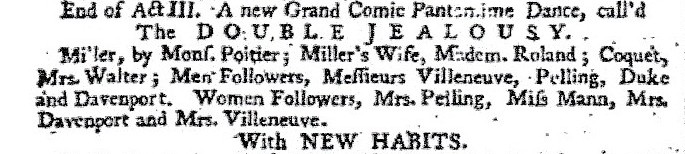
The Grand Ballet was different again, with several performers led by Lalauze and Mlle D’Hervigni, and was probably in the form of a divertissement with several dances one after the other. These more extended pieces could also be small ballets, for example the ‘new grand Comic Pantomime Dance’ The Double Jealousy given at Mlle Roland’s benefit at Drury Lane on 1 April 1736, as this detail from the advertisement in the London Daily Post and General Advertiser for that date shows (the mainpiece was King Henry the Fourth. With the Humours of Sir John Falstaff):

The Double Jealousy hints, through its title and its characters, at comic and expressive action, but what were the other dances – in particular the solos and duets – like?

Most entr’acte dances must have been short: solos and duets may have lasted between one and two minutes (for the early 18th century their duration can be compared with that of the dances surviving in notation); divertissements (the ‘Grand Dances’) and even small ballets seem likely to have lasted ten minutes at the most. So, we get the idea that during an evening in one of London’s theatres there were several short dances that contrasted with the action of the play they accompanied and presented a variety of characters and dance styles. They were also intended to showcase the leading professional dancers in the companies and could be, in themselves, a draw for audiences.

A little while ago, I was at a very different sort of event – a modern ballroom and Latin competition, with a Gala evening at which two couples of professional dancers performed. As they appeared alternately, dancing their way through the five standard ballroom dances and the five Latin ones, I was reminded of the entr’acte dances on the London stage and began to wonder what (if anything at all) they might have in common. These 21st-century dances had no context. They were simply intended to display the skills of the dancers and entertain the audience (many of whom were dancers themselves), so how might they tell us anything about the 18th-century entr’acte dances I have been describing?

First, was the length of the modern dances. They were short, at just a few minutes each, so the dancers had to make an immediate impact. Second, was their presentation without a specific background – they were danced to an audience seated around the ballroom floor with little decoration and no scenery. It is difficult to be sure what happened with 18th-century entr’acte dances, but it seems unlikely that they were provided with their own scenery (although, like the modern dances, they were presented in costume) and they were probably danced mainly on the forestage in the midst of their audience.

I was struck with the way in which the 21st-century dancers played with the conventions of the dances they performed, elaborating and subverting these by turns. The modern dances – waltz, tango, Viennese Waltz, foxtrot and quickstep for the ballroom and cha-cha, samba, rumba, paso doble and jive for the Latin – have different and well-defined characters as choreographies. Although it is usually only in the Latin dances that couples hint at drama, in the Gala performances both the ballroom and Latin couples did so. They also intensified the characters of the individual dances and one couple even incorporated props into their dancing. I couldn’t help feeling that early 18th-century dancers must have used similar techniques in the sarabands, chaconnes, passacailles, gigues, canaries, loures, bourrées, rigaudons, minuets and other dance types (divided between serious and comic) that they would have performed on the London stage three centuries ago. They, too, were trying to command the attention of their audience and display to the full their skills and individuality.

Reasons to be Bored by Early Dance. VIII: Vulgar Dancing

It is a little while since I’ve added to my short satirical series on boring early dance, so here is another episode. Fear not, we have nearly reached the end and I will, of course, be posting far more serious pieces along the way!

It goes without saying that only historical forms of dance are truly polite and authentic. Traditional and folk dancing share in their authenticity (if not necessarily their politeness), so early dance aficionados may be permitted to indulge in these genres. They may well have originally trained in them. All modern forms of dancing are, by definition, vulgar and must be avoided at all costs. If they are encountered by chance, they must be firmly put in their place – out of sight and out of mind.

What makes modern dancing so vulgar? I was going to craft an essay but a list will do just as well. It may be even better, for it limits verbal contact with these reprehensible styles of movement.

  1. Modern dancing is not historical or early. If it dates to later than 1900 A.D.  it cannot be historical. There is some debate about the date when early stops and modernity starts, but that doesn’t matter. Anything modern is vulgar.
  2. Modern dance clothes are too tight, too short or too revealing and too often all at once. They do not constrain and mould the body as the costumes of yore, nor do they obscure the beauty of the historical walking synonymous with early dance. The unwarranted display of tights, leotards, short skirts and tight trousers is vulgar – and quite unlike the padded doublets, wrinkled hose and low-necked dresses of the hallowed past.
  3. Modern dancers move their bodies in unseemly ways. In particular, in many modern styles, movements of the hips and shoulders are demanded. Arms move freely or are held in ways that contradict the ramrod straight arms (extended in a low ‘V’ shape) of baroque dance or the languidly suspended convex curves of the arms in 15th-century dance.
  4. Modern ballroom dancing affects politeness by concealing the decidedly rude close body contact between the partners behind elaborate frocks. For true politeness and authenticity only the fingertips should touch. The rot began with the waltz, so maybe the date for the beginning of modern dancing should be pushed back to 1800.
  5. Ballet requires extremely revealing clothing for practice, never mind performance, and it contorts the body in entirely unseemly ways. It requires steps that are, in fact, impossible for anyone to do (a feature that it shares with modern ballroom and Latin dancing). One simply cannot credit that it has anything to do with the utterly static beauty of 18th-century dancing which has no discernible steps.

There are other forms of modern social dancing that I will forbear to mention in case I am tainted by association. The sensation seekers who occasionally surface in even the best regulated historical dance circles (and I am acquainted with at least one of those) will know most if not all of them!

Anthony L’Abbé. The Prince of Wales’s Saraband

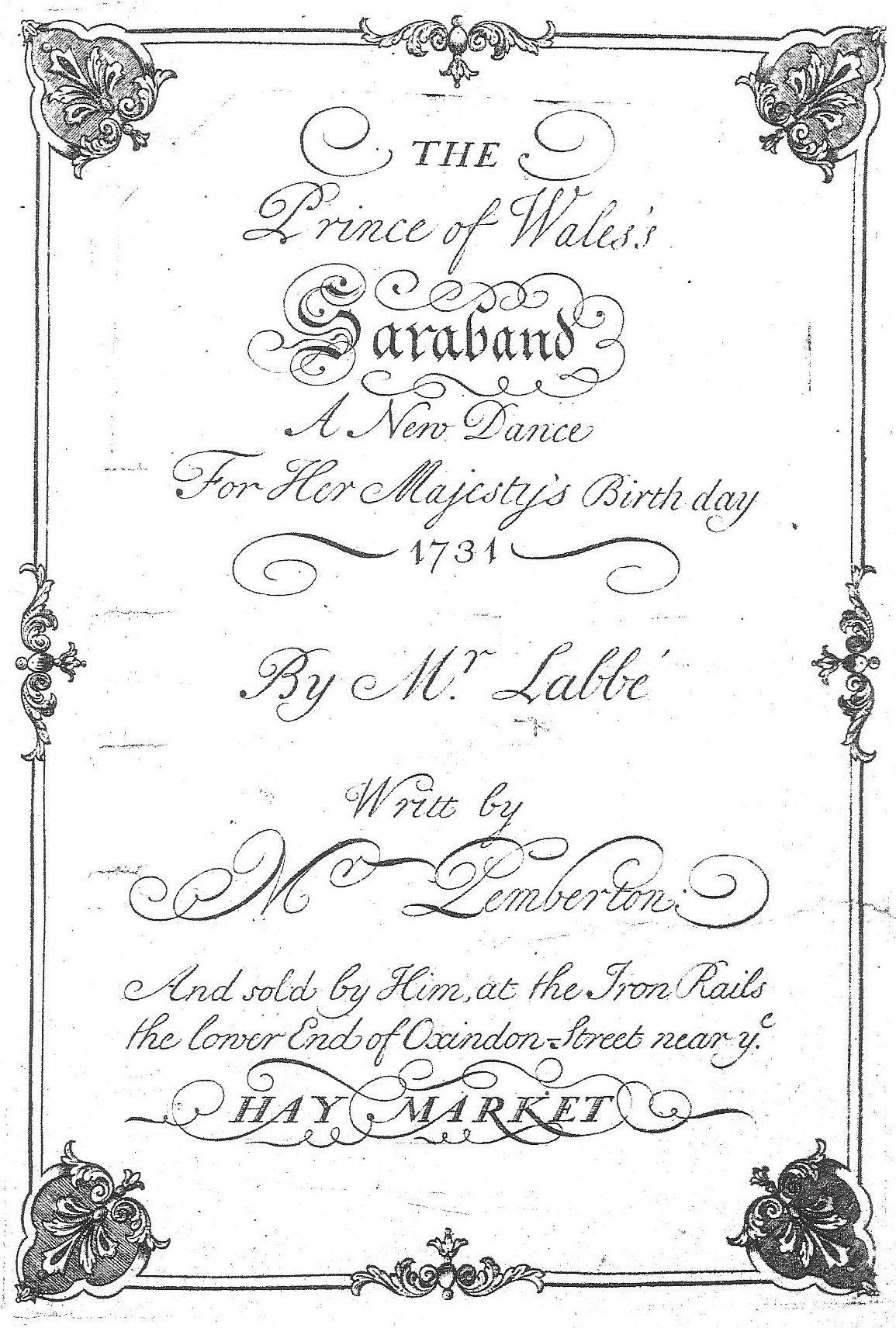
The notation for Anthony L’Abbé’s ballroom dance The Prince of Wales’s Saraband is one of the exhibits in Crown to Couture at Kensington Palace (the exhibition closes on 29 October 2023). It is shown out of context and with next to no explanation of its meaning so, although I have written about the dance elsewhere, I thought it would be worth a post in Dance in History to provide some information about this beguiling duet.

The Prince of Wales’s Saraband was one of a series of dances created by Anthony L’Abbé and published in Beauchamp-Feuillet notation by Edmund Pemberton following L’Abbé’s appointment by George I as royal dancing master around 1715. The title page makes clear that this was one of the dances choreographed by L’Abbé to celebrate the birthday of Queen Caroline, wife of King George II and mother of the Prince.

Her birthday was on 1 March and it had been celebrated at court since at least 1717, when L’Abbé’s ballroom dance The Royal George was created and published for that purpose. In that case, the title page of the dance makes no reference to the then Princess of Wales but the advertisements for the notation make it clear that the dance was in her honour.

By 1731, Caroline had been Queen for fewer than four years and L’Abbé had not published a dance since the Queen Caroline which honoured her birthday in 1728. In 1731, there was a birth night ball for the Queen and the report in the Daily Advertiser for 3 March 1731 gives us some details.

There is no mention of L’Abbé’s dance, although Frederick Prince of Wales ‘open’d the Ball’ by dancing a minuet with his sister Anne the Princess Royal. The reference to the illumination of the houses of all three of the actor-managers of the Theatre Royal, Drury Lane, is interesting, for The Prince of Wales’s Saraband was performed in the entr’actes at that theatre on 22 March 1731 by William Essex and Hester Booth. That first public performance was obviously also intended to honour the Queen.

The dance seems to have been admired, for it was revived at the Haymarket Theatre on 21 August 1734 and again at Drury Lane on 17 May 1735, each time performed by Davenport and Miss Brett. It was revived again at Covent Garden on 25 April and 13 May 1737, by Dupré (probably the dancer James Dupré) and Miss Norman.

Prince Frederick had remained in Hanover following the accession of his grandfather as George I in 1714. He came to England only in 1728, eighteen months after the accession of his parents to the British throne. By this time, the prince was twenty-one and he joined a family which included four sisters and a brother whom he scarcely knew. This portrait by Philippe Mercier shows Prince Frederick in the mid-1730s.

Prince Frederick’s relationship with his parents, particularly his mother Queen Caroline, became steadily more difficult after his arrival in England. In 1731, the year The Prince of Wales’s Saraband was created, this problem lay in the future.

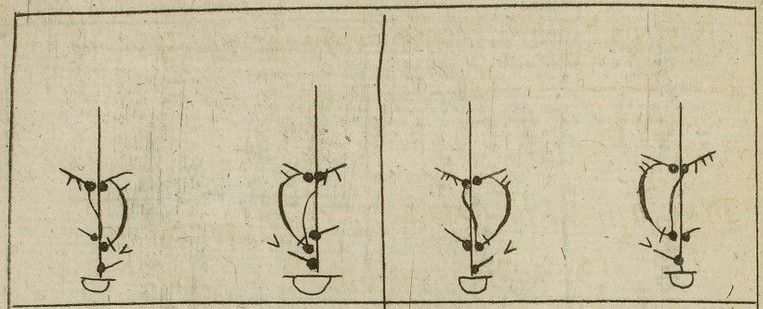
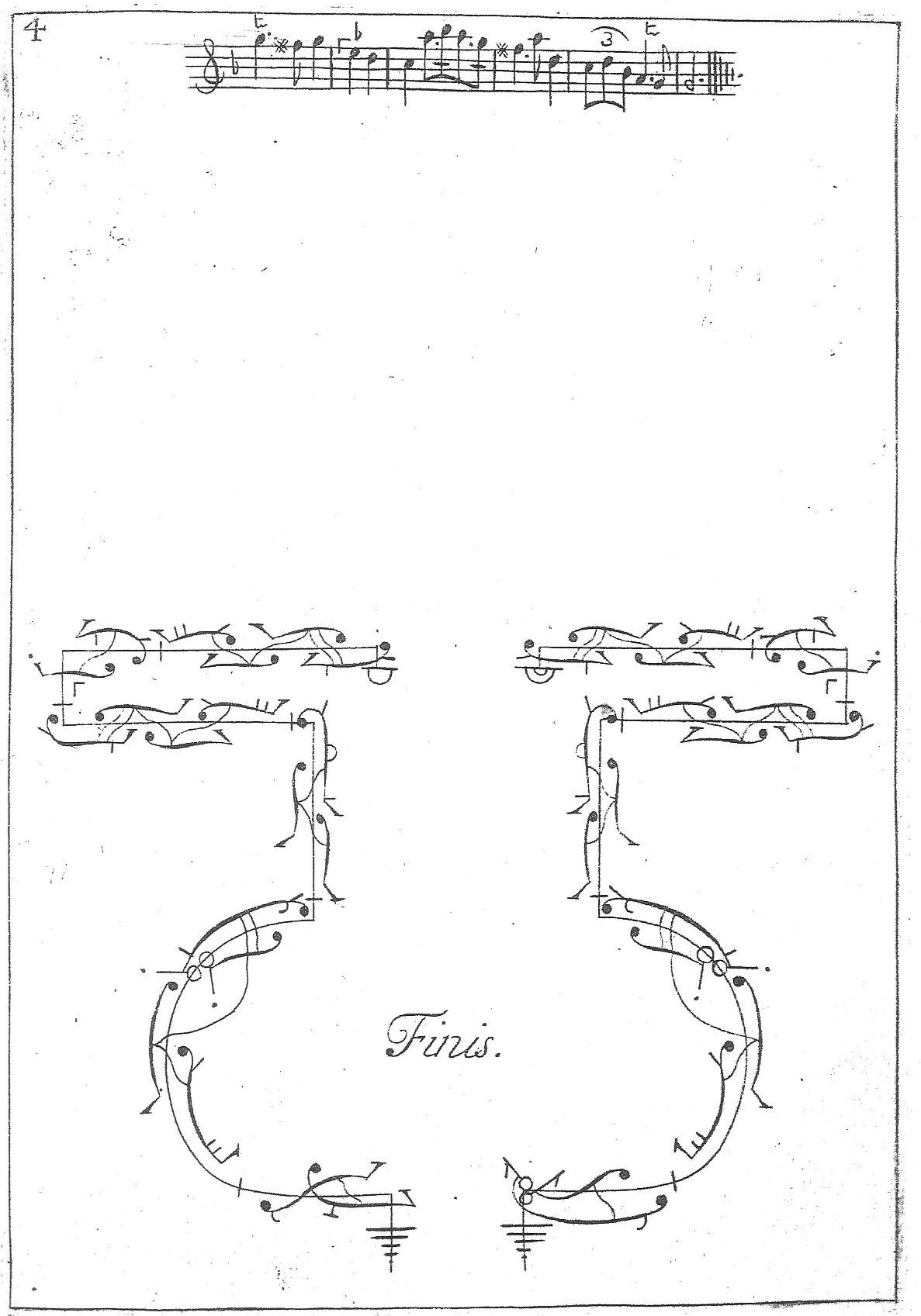
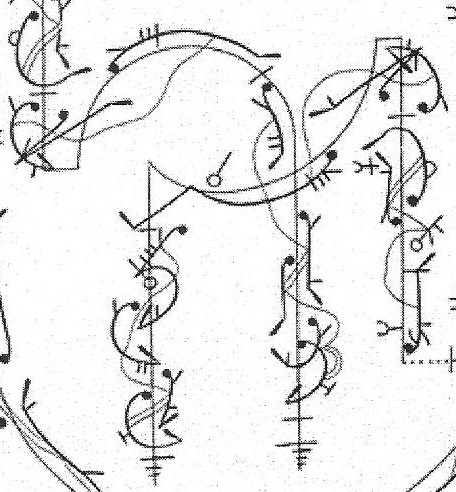
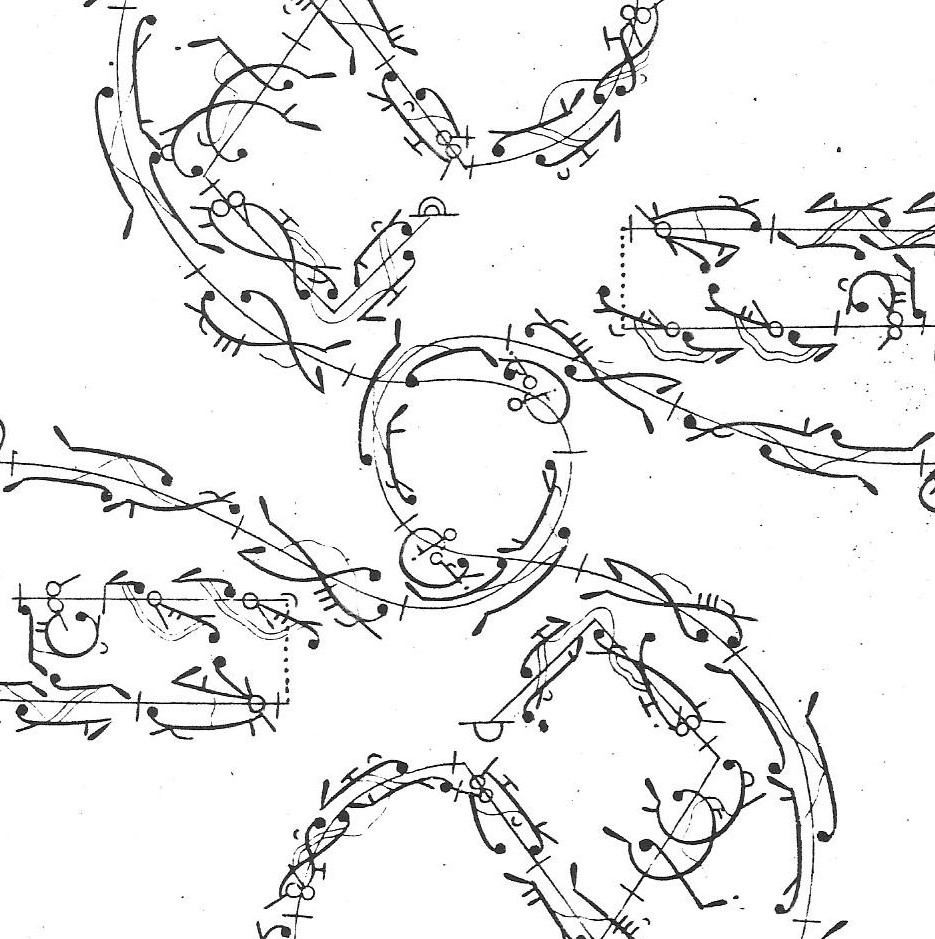
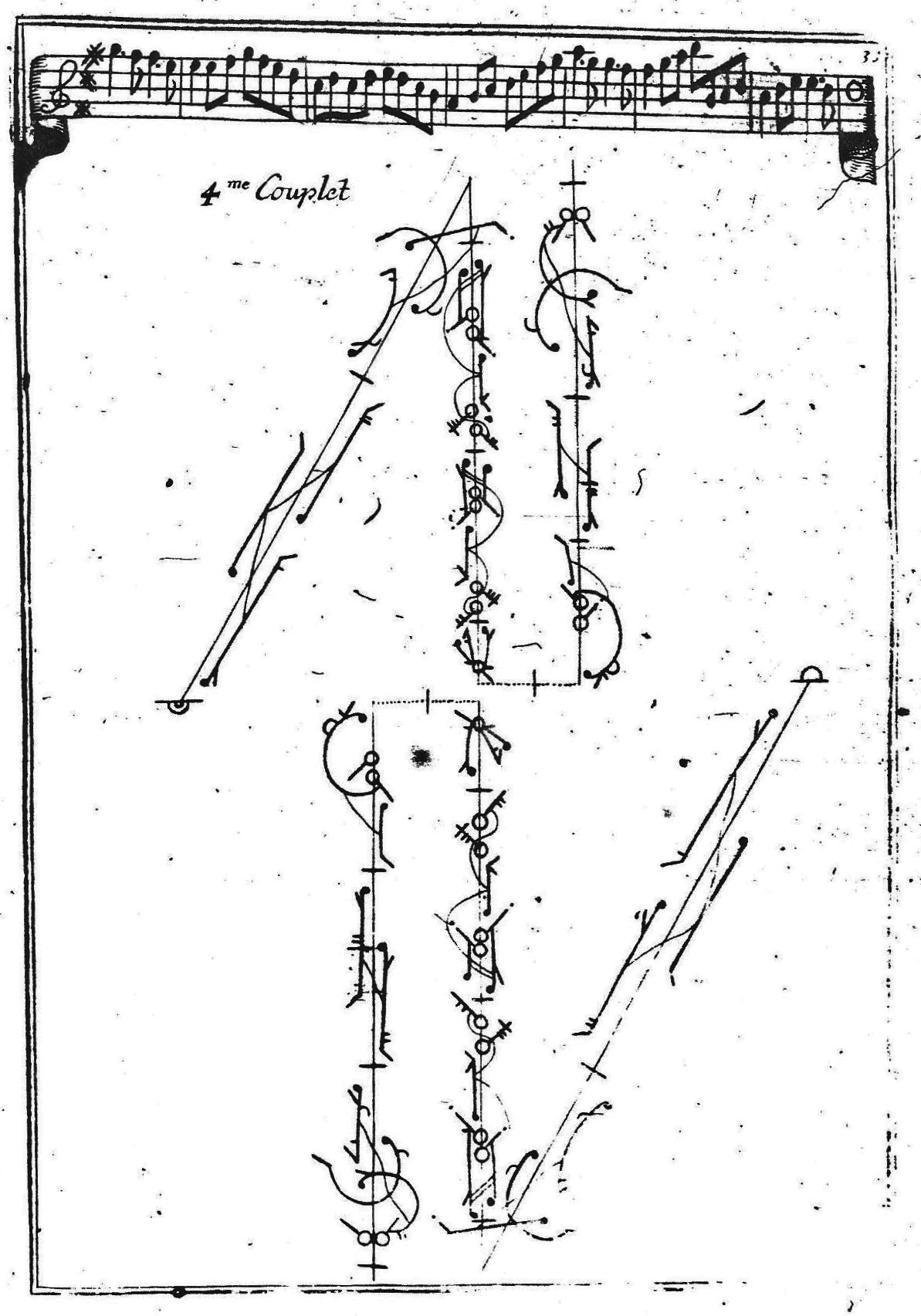
The Prince of Wales’s Saraband, as notated, is ostensibly an undemanding ballroom dance of 48 bars of music with the familiar AABB musical structure (A=10 B=14). The choreography is divided between four plates of notation (which by this time was Pemberton’s regular practice and probably reflects the expense of paper for printing). Plate 1 records the two A sections (20 bars of dance and music) and plate 2 the first B section. Plate 3 has bars 1 – 8 of the second B section and the dance ends on plate 4 with its final 6 bars. This division of the last section of the dance between two plates is dictated by the circular figures traced, which need to be shown separately so that they do not overlap, but also respects the musical phrasing. The layout on each plate may also reflect Pemberton’s aesthetic preferences – his notations for Isaac and L’Abbé include some of the most beautiful examples of this highly specialised genre of engraving.

Closer analysis of the notation reveals that this duet has some complexities and that it demands immaculate style and technique if it is to make an impact. Reconstructing the dance raises a number of questions about those aspects that are not notated – in particular arm movements and the use of the head. In all of these notated ballroom dances, the attention of the two performers seems to be divided between the presence (the guest of honour), each other and the surrounding audience. How much do we really know about the conventions that governed the performance of such dances, either at court or on stage, which should inform our dance reconstructions?

The Prince of Wales’s Saraband opens with a figure based around a temps de courante à deux, in which a temps is followed by a temps de courante, first on the inside foot and then on the outside foot. The notation indicates that the dancers turn their bodies towards the pointing foot on each temps, turning back towards the presence on each temps de courante. Did this mean that they turned their heads the same way or did they look steadfastly forward?

In the remaining bars of the first A section, they turn alternately towards one another and the presence but there are also opportunities to take in the surrounding audience.

The end of the dance, the steps and figures of the its last six bars on the final plate, has the dancers face the presence side-by-side for three bars travelling sideways away from each other and back again. They then turn to perform a pas de bourrée directly upstage, followed by a variant on the pas de bourrée vîte curving away from each other and coming face to face briefly before a coupé into their final réverence.

I can’t help wondering if this sequence was created, in part, to allow the dancers to acknowledge the audience that surrounded them before they made their final honours. The performance of The Prince of Wales’s Saraband at Drury Lane was part of a benefit for Mrs Booth, when some of the audience may have sat around the dancers on the stage (almost as they would have done in the ballroom) as well as in the auditorium. There is no evidence that Queen Caroline herself attended, but the royal box at this period would have been directly opposite the stage in the centre of the first tier just above the pit, providing the dancers with a specific focus.

The step vocabulary of this dance is dominated by the pas de bourrée, with and without a final jetté, extending to the pas de bourrée vîte. There are also a number of variants of the coupé, including the coupé sans poser and the coupé avec ouverture de jambe. It is interesting that, throughout, L’Abbé uses the jetté and not the demi-jetté in pas composés. These add energy and prevent the dance from becoming languid. He also likes to pair steps, although where he repeats these pairings he often introduces an element of variation the second time.

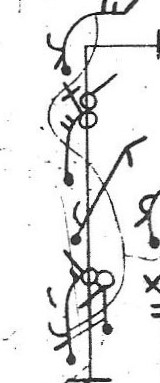
One sequence, on the second plate within the final bars of the B section, is noteworthy and quite challenging to perform.

L’Abbé introduces an element of suspension, in the opening coupé sans poser with a one-beat pause (which comes at the end of the preceding musical phrase), before a pas composé which demands unhurried speed – a pas plié, changement and coupé soutenu to fourth position with a quarter-turn. There is then a coupé avec ouverture de jambe (also with a one-beat pause) before the pas composé is repeated. This sequence ends with another coupé avec ouverture de jambe and a pause, before the B section is completed with two pas balancés.

The Prince of Wales’s Saraband was first performed on stage by Mrs Booth (née Hester Santlow), with whom L’Abbé had worked over many years and for whom he had created several notable choreographies. Could this ostensibly simple, yet demanding, ballroom duet have been created with and for her, intended specifically for performance at her benefit?

Further Reading:

Moira Goff, ‘Edmund Pemberton, Dancing Master and Publisher’, Dance Research, 11.1 (Spring 1993), 52-81

Moira Goff, The Incomparable Mrs Booth (London, 2007), pp. 138-139.

Mr Isaac’s The Richmond

Mr Isaac’s The Richmond was first published in notation in 1706 in A Collection of Ball-Dances Perform’d at Court.

The dance is named first on the title page, probably because the collection was dedicated to the Duke of Richmond, and it seems most likely that the title of the dance was meant as a tribute to him. It may well have been one of the dances that John Weaver (who notated the collection) declared in his dedication to ‘have been Honour’d with your Grace’s Performance’.

The American dance historian Carol Marsh, in her 1985 thesis ‘French Court Dance in England, 1706-1740’, suggested that the choreography dated to more than ten years earlier. As she pointed out, the music was published in The Self-Instructor on the Violin, advertised for publication on 15 July 1695. The duet could perhaps have been performed at the ball held at Whitehall Palace on 4 November 1694 to celebrate the birthday of King William III. The Duke of Richmond, son of Charles II and Louise de Keroualle the Duchess of Portsmouth, had initially been opposed to the changes wrought by the Glorious Revolution. He was reconciled with William III in 1692 and in January 1693 he married Anne Belasyse. He might well have performed The Richmond if and when it was performed at court. This portrait by Godfrey Kneller shows the Duke some ten years after The Richmond may have been created.

The Richmond is a hornpipe in 3/2, often described as a specifically ‘English’ dance and occasionally said to have pastoral connotations. It is distinct from the later duple-time hornpipe often associated with sailors. The dance type was evidently a favourite with Mr Isaac, who also used it in The Union (1707), The Royall (1711) and The Pastorall (1713). Anthony L’Abbé, who became royal dancing master around 1715, included a hornpipe in The Princess Ann’s Chacone (1719) and used the music from Isaac’s The Pastorall for a stage solo for a man, published in notation around 1725 but possibly performed the same year as Isaac’s ballroom duet. He may have been paying tribute to Isaac, who was also his brother-in-law.

This earlier form of hornpipe has attracted the attention of several dance historians (a number of references are given at the end of this post), who between them have noted that hornpipe music first emerges in the 1650s and that it was a dance type that appealed to Purcell, among other late 17th century composers, as well as investigating the characteristic steps of the dance. Purcell was certainly including triple-time hornpipes in his stage music by the 1690s. Among modern historical dance enthusiasts, there is particular interest in the hornpipes included within editions of Playford’s The Dancing Master, under the titles ‘Maggot’, ‘Delight’ or ‘Whim’ – ‘Mr Isaac’s Maggot’ appears in the 9th edition of 1695 – although, sadly, there seems to be little enthusiasm for the exploration of some of the hornpipe pas composés described below (I can’t help thinking that some of the fun in such dances must have been the steps). Triple-time hornpipes continued to be used for dances into the early decades of the 18th century. Fresh research is certainly needed to chart the emergence, rise and decline of this version of the hornpipe within a variety of dance contexts.

My interest here is, of course, the hornpipes within the notated ball dances – in my time, I have had the pleasure of dancing The Richmond, The Union, The Pastorall and The Princess Ann’s Chacone. Only The Richmond is a hornpipe throughout, the other dances pair it with different dance types. The musical structure of The Richmond is more complex than usual for ballroom dances – AABBCCDDEEFF’ (A = B = C = D = E = 4, F=8, F’ = 4) with 52 bars of music in all. The division of the choreography between the six plates of the notation seems to be pragmatic in terms of the steps and figures to be recorded rather than reflecting the musical structure.

As I noted in an earlier post, the opening figure of The Richmond is unorthodox.

The couple travel forwards away from each other on a diagonal before turning inwards to face each other. They turn to face the presence on bar 3, but maintain that orientation for only two bars before turning to face one another again for one bar, after which they turn to face the presence on bar 6. Their steps in the opening figures are rhythmically varied and two-thirds include pas sautés, an indication of the lively nature of this hornpipe.

Mr Isaac’s hornpipes have a distinctive vocabulary of steps. A particular characteristic is his use of three pas composés over two bars of music, found throughout The Richmond. This may take a form in which the same step begins and ends the sequence with two other steps between them (performed on either side of the bar line) which may or may not be the same. One example is found on plate 1 in the opening bars in the form pas de bourrée, saut / jetté, pas de bourrée, while another can be found on plate 2 as pas de bourrée, jetté / jetté, pas de bourrée. In the second case the first step is actually a pas de bourrée vîte, while the second step is a variant which inverts its two elements. In other cases, Isaac begins and ends the sequence with different steps but still has paired steps on either side of the bar line, as on plate 1 with a contretemps, jetté / jetté, pas de bourrée imparfait (i.e. to point). Or, as yet another variation, the sequence may divide a familiar pas composé at the bar line, as an example on plate 2 demonstrates with pas de sissonne, pas de sissonne, pas de bourrée, in which the second pas de sissonne begins in the first bar with its pas assemblé and ends in the second bar with its sissonne. In The Richmond, Isaac is endlessly inventive with this device.

The Richmond is one of the choreographies in which Isaac ornaments some of the man’s steps but not the woman’s. Although, among the six dances published in 1706, only The Spanheim and The Britannia are without such ornamentation. Throughout the dance, there are five bars where this happens and in all cases a pas battu is added on the man’s side. On plate 5 this ornamentation is added in two consecutive bars and coincides with a change from mirror to co-axial symmetry.

Isaac also ornaments the man’s steps right at the end of the dance, altering his sequence of pas composés. Over the final two bars, the woman has coupé emboîté battu, demi- contretemps / jetté, coupé simple, coupé soutenu (with a half-turn into a réverence). The man has coupé emboîté battu, demi-contretemps battu / contretemps à deux mouvements battu, coupé soutenu (the last is his réverence). She turns to travel forwards, while he turns to travel backwards. They do not take hands for these last steps, although they had done so for preceding bars.

There are more linear than circular figures in The Richmond, although Isaac makes effective use of the latter on plates 2 and 6. The relationship between the two dancers and between them and their audience is interesting. If this dance was performed at a formal ball, the couple would probably have had the presence (the King?) in the place of honour centre front as well as an audience of courtiers surrounding them on the other three sides. So where would they have looked as they danced? Plate 1 shows them dividing their attention between the presence and each other. In the first two bars on plate 3, they clearly address the spectators on each side (and at the bottom of the room) before turning towards one another to dance on a right line. There are similar opportunities on plate 5, although the couple are otherwise dancing beside one another and facing the presence.

Working again on this dance, after a gap of many years, I couldn’t help wondering if the arm movements might have been as unconventional as the steps and whether the dancers could direct their lines of vision quite freely as they moved, enabling them to acknowledge not just each other and the presence, but also the encircling audience.

My recent work has raised several questions about the performance of The Richmond and the other dances in the 1706 Collection. The title page states that they were ‘perform’d at court’, but what did this mean? Were they danced as part of a formal display, either at birth night balls or on other such occasions? Were they instead danced at one of the more informal balls at the English court? In his ‘Livre de la contredance du roy’, presented to Louis XIV in 1688 and retranscribed for Louis XV in 1721, André Lorin wrote:

‘Cette cour [the English royal court] divise ces divertissements en Bals serieux, et en Bals ordinaires.

Les serieux se dançent toujours dans un Lieu preparé, ou toute la Cour paroit superbe et magnifique.

Les ordinaires regardent les Contredances qu’on dance avec plus de negligence et dans les apartemens du Roy, où l’on ne va qu’avec les habits ordinaires, afin de dancer avec plus de liberté: …’

The manuscript is now in the Bibliothèque Nationale de France and can be found on Gallica. Lorin was concerned with English country dances, but could the ‘Bals ordinaires’ have included couple dances like The Richmond? Or, if they were indeed given at ‘Bals serieux’, should we think again about the conventions governing the dance displays at such events?

Further reading:

George S. Emmerson, A social history of Scottish dance (Montreal, 1972), chapter 14

The Hornpipe: papers from a conference held at Sutton House, Homerton, London E9 6QJ, Saturday 20th March 1993 (Cambridge, 1993)

Carol G. Marsh, ‘French court dance in England, 1706-1740: a study of the sources’ (PhD thesis, City University of New York, 1985), pp. 243-258.

Barbara Segal, ‘The Hornpipe: a dance for kings, commoners and comedians’, Kings and commoners: dances of display for court, city and country. proceedings of the seventh DHDS conference, 28-29 March 2009 (Berkhamsted, 2010), 33-44

Linda J. Tomko, ‘Issues of Nation in Isaac’s The Union’, Dance Research, XV.2 (Winter 1997), 99-125.

The Richmond is also mentioned in the following posts on Dance in History:

Mr Isaac’s Six Dances

Mr Isaac’s Choreography: The Six Dances – Opening and Closing Figures

Mr Isaac’s Choreography: The Six Dances – Motifs and Steps

‘Francis Thorpe … (known by the name of Isaac)’

Back in 2010, I published an article in Early Music with the title ‘The testament and last will of Jerome Francis Gahory’ in which I put forward the likely identity of the elusive Mr Isaac.  He was, of course, the dancing master who taught Queen Anne, among others, many of whose duets appeared in notation between 1706 and 1716. I have written about several of these dances in previous posts. In 2009, I made the chance discovery of Jerome Francis Gahory’s will which provided a significant clue as to who Mr Isaac actually was. I recently learnt that this information has not reached the wider UK early dance world, so I offer this post in the hope that this will change. Much more information is provided in my 2010 article.

The Frenchman Jerome Francis Gahory became dancing master to Charles II around Christmas 1660. He taught not only the King but also Queen Catherine of Braganza (whose dancing I have also written about), as well as the King’s nieces Princess Mary and Princess Anne. In September 1681, the reversion of Gahory’s post was granted to Francis Thorpe, the significance of which was not apparent until the discovery of Mr Isaac’s identity. Although Gahory is not mentioned in court records after 1688 (when James II fled to France and William III and Mary II became joint sovereigns), he continued to live in London until he died in 1703.

Gahory was buried at St Martin’s in the Fields on 4 June 1703, having made his will on 30 March that same year. The original will and its probate copy can both be found among the documents in the UK’s National Archives. It disposes separately of Gahory’s ‘estate and effects’ in France and in England. The latter are of particular interest to historians of dancing in England. Gahory leaves bequests to Anthony L’Abbé, already a professional dancer on the London stage and later to become a royal dancing master himself, and ‘Mary Thorpe his wife the testator’s niece’. As his executor and heir of the residue of his estate, Gahory names ‘Francis Thorpe his nephew (known by the name of Isaac)’.

If Gahory’s will is not evidence enough of Mr Isaac’s identity, more can be found elsewhere. Francis Thorpe was the son of Isaac Thorpe, who died in 1681 or 1682 and also left a will (now in the National Archives). This confirms that Isaac Thorpe and Jerome Gahory were brothers-in-law. Another source indicates that Isaac Thorpe was living and teaching dance in Paris in the early 1650s, under the name ‘Monsr. Isac’ and alongside ‘Mons. Gahorry’. The final piece of evidence I uncovered was that in 1721 Mary L’Abbé, the wife of Anthony L’Abbé, was granted the administration of her brother’s estate as he had died intestate. He was named as ‘Francis Thorpe alias Isaac’ and ‘Mr Francis Thorpe’ was buried at St James Piccadilly on 4 January 1721.

The only known surviving portrait of Mr Isaac is the mezzotint by the engraver George White after a painting by Louis Goupy, which may date to last decade of the dancing master’s life.

When I wrote my article back in 2010, I hoped that others would take my research forward and tell us more about this dancing master who is so important to the history of dancing in England. I remain hopeful that this will happen.

Reference:

Moira Goff, ‘The testament and last will of Jerome Francis Gahory’, Early Music, XXXVIII. 4 (November 2010), pp. 537-542.

Reasons to be Bored by Early Dance. VII: Walking to Music

What exactly is dancing? More to the point, what exactly is historical dancing? The answer to this question has been the subject of much debate among UK early dance theorists. Such questions as the reliability of the sources, the trustworthiness of those interpreting them and a full and correct understanding of politeness and authenticity have been known to generate pleasing feelings of utter despair among the greatest of historical dance aficionados. However, there is an easy answer to the conundrum which is widely applied in practice, if not universally agreed in principle. Dancing is no more and no less than ornamented (or, more often, unadorned) walking.

Once this truth has been recognised and accepted, the question arises – what is walking? More specifically and pertinently, what is historical walking? Is it like modern walking, or are there subtle differences only to be discovered through minute study of the sources? Let me delve into this extremely difficult topic through an examination of practice in different historical periods.

First, 15th-century dancing is so obviously walking that there can be no argument on that score. This is courtly dancing in very long clothes (apart from some of the men, who are obliged to show their legs in tight hose but are expected to wear doublets with very long sleeves). The longer the outfit, or the sleeves, the more polite and authentic the dancer. The truly extraordinary length of these garments will only permit walking, except that the wearer must adopt a lilting movement to prevent costly materials from getting under his or her feet.

I’m not an expert on the late 16th or early 17th century (and I don’t like the period very much) so I will move on to country dancing. This, of course, begins in the middle of the 17th century when the populace was weighed down by the English civil war – won by the puritans who promptly banned dancing. What was the answer? Walking in a military fashion! This quickly became a hallowed tradition and has been faithfully observed ever since, in honour of its folk origins.

Then, we come to baroque dance. The most important sources for the 18th century are those strange notations with straight and curved lines all over the page. Close scrutiny reveals that many of these take the form of steps by the right foot or the left foot. In the vast majority of cases, a step by the right foot is immediately followed by a step with the left foot (or vice versa). It rapidly becomes obvious that baroque dancing is, in fact, walking. We have a little problem here, in that other sources insist that dancers must turn out their feet while practising baroque dance. Just a little thought (and even less practice) reveals that this is the clinching evidence for baroque dancing being walking. Whoever would be able to dance, let alone dance historically, with turned-out feet?

These notations have music at the top of each page, showing that baroque dance must have been walking to music. However, the correlation between the music and the steps is so obscure that we may safely deduce that baroque dancing is not only walking to music but that it does not have to keep time with the music. Many baroque dancers have proved this in practice without having to fatigue themselves with research.

Mr Isaac’s The Spanheim

The Spanheim, from Mr Isaac’s 1706 A Collection of Ball-Dances Perform’d at Court, was one dance I had never learnt until now. It took me while to settle into its steps and figures, but once I became more familiar with the choreography I really enjoyed working on it. I have already mentioned this duet in some of my other posts about Mr Isaac’s dances and these are listed at the end of this one.

The music for this choreography is a gigue (or perhaps an English ‘jigg’ – a point it would be interesting to be able to discuss further). It has the musical structure AABBCCDD played through twice (A=4 B=6 C=4 D=6) to give 80 bars of music and dancing. There has been some doubt about when the duet was created and danced at court. In her 1985 thesis, Carol Marsh suggested that it could be dated between 1701 and 1705, pointing out that the music appeared not only in The Second Book of the Lady’s Banquet, published in 1706, but was also used in 1705 for a country dance. The title is said to refer to Ezekial Spanheim (1629-1710), Prussian ambassador to the English court from 1702. However, the chance discovery of a reference to a court ball suggests that The Spanheim was first danced in 1703 and that it might well have been named after Spanheim’s daughter Mary Ann, then aged around twenty. The reference comes from a letter written by E. Hinde to Mary Foley and dated 20 February 1703, transcribed in an article by Rob Jordan ‘An Addendum to The London Stage 1660-1700’ (the full citation is given at the end of this post).

‘The Birth night was solemnised with much joy. ye Court very Splended. … The Lady Manchester a head & Ruffles £200: all lace – who with Madamosll Spanheim, were ye two principal Dancers. ye Latter Dancing a perticular one, wch none but ye person who was her parttener knew … The Queen stay’d till ½ a hour after 11 & ye Company Danc’d Countrey Dances till 4 in ye Morning.’

The reference to Mlle Spanheim’s dance supports the idea that this was The Spanheim, but who might her partner have been?

Isaac’s choreography for The Spanheim has two motifs in particular – paired steps and repeated sequences (the latter usually with an element of variation). I will look at some examples of these, which are also intertwined. The dance begins and ends in mirror symmetry, but the couple are in axial symmetry for most of the time. The figures are not entirely straightforward, at least on the page. The relative placing of the two dancers is sometimes misrepresented by the needs of the notation, for example making it uncertain whether they actually face each other up and down or across the dancing space. This is occasionally corrected between the plates (as with the end of the notation on plate 2 and the beginning on plate 3) but sometimes has to be inferred (as on plate 3 with the figure on a right line). John Weaver, the notator of the six dances, may still have been finding his way into this new skill. It is also worth noting here that around half of the steps in this dance incorporate jumps, so it is quite lively.

There are interesting sequences on every plate of The Spanheim, although I won’t try to look at them all. On plate 2, bars 21-28 (the first two C sections), there are the first of the glissades which Isaac interweaves throughout the dance.  The first four steps are repeated for the second C, but with differences of alignment and variations in the steps themselves. Here is the man’s side (he is facing the presence as he begins).

Bars 29-34 on the same plate (to the first D section of the music) have a sequence which begins with a fleuret and a contretemps and ends with a contretemps and a fleuret.  The third step is a quarter-turn pirouette, which perhaps provides a moment of suspension when the couple turn to look at each other as they pass on a circular path. Sadly, I do not have a dancing partner with whom to tease out the range of possibilities when reconstructing this section.

The repeat of the music begins on plate 3. Bars 41-48 (the repeat of the AA section) include a pas battu motif as well as three sets of paired steps. The most interesting of these are the two coupés battus in which the couple (facing each other on a right line, the man with his back to the presence) turn to right and then left, returning to face each other with an assemblé at the end of each step. Here are these steps on the man’s side, which is a bit clearer on my copy of the notation – I have changed the orientation of the page, for he has his back to the presence while the woman (further upstage) faces it.

The last sequence I would like to look at is on plate 4, bars 61-68 (the CC repeat). It uses pas balonnés (with demi-jettés rather than jettés), in a sequence with glissades and a fleuret. The two dancers are side-by-side holding inside hands and begin on the same foot. They move forwards towards the presence with pas balonnés, using the other steps to travel to left and right and right and left in turn. Here is the second half of this sequence. In which the lady is shown slightly behind the man to accommodate the notation on the page.

Isaac’s The Spanheim is full of echoes as it repeats and varies steps and motifs within the choreography and at different points in the music.

There is also a related piece of music ‘The New Spanheim’, published in 1710 by Walsh, Randall and Hare in For the Flute A Collection of all the Choicest French Dances Perform’d at Court the Theatres and Publick Balls. This collection of music was advertised in the Post Man for 22-25 April 1710, raising the possibility that Mr Isaac created a new choreography to celebrate the marriage of Mary Ann Spanheim to François de la Rochefoucauld, Marquis de Montandre in London on 21 April 1710. If he did, it was sadly not recorded in notation – so far as we know.

Other posts mentioning The Spanheim:

Mr Isaac’s Six Dances

Mr Isaac’s Choreography: The Six Dances – Opening and Closing Figures

Mr Isaac’s Choreography: The Six Dances – Motifs and Steps

References

Carol Marsh, ‘French Court Dance in England, 1706-1740: a Study of the Sources’ (unpublished PhD thesis, City University of New York, 1985)

Rob Jordan, ‘An Addendum to The London Stage 1660-1700’, Theatre Notebook, 47.2 (1993), 62-75 (p. 69), citing the ‘Morgan Collection 783/Box 24’ in the Shropshire Archives.

Mr Isaac’s The Britannia

The Britannia is the last of the six dances named on the title page of A Collection of Ball-Dances perform’d at Court. It must have been the latest of these choreographies to be created, for the dance was first performed at the celebrations for Queen Anne’s birthday on 5 February 1706. Could it have been the first dance to be published in Beauchamp-Feuillet notation in London? It is engraved in a very different style to the other dances in this collection, as the following images show, and there is evidence to suggest that it may have been published separately before A Collection of Ball-Dances appeared.

The report of the birthday celebrations in the Post Boy, 5-7 February 1706, makes no mention of a dance by Isaac, although it does say ‘At Night there was a fine Ball, and a Play acted at Court’. In his Roscius Anglicanus of 1708, John Downes adds that Edward Ravenscroft’s The Anatomist was the play ‘there being an Additional Entertainment in’t of the best Singers and Dancers, Foreign and English’. Downes names the dancers as ‘Monsieur L’Abbe; Mr Ruel; Monsieur Cherrier; Mrs Elford; Miss Campion; Mrs Ruel and Devonshire Girl’. The ‘Additional Entertainment’ may have been a musical piece, England’s Glory composed by James Kremberg, inserted into The Anatomist in place of The Loves of Mars and Venus (which had been given with the play at its first performance in 1696). This provided plenty of opportunities for dancing and had Britannia as a central figure. Isaac’s The Britannia was likely to have been danced at the ball and, given the elaborate choreography and probably short rehearsal time, may well have been performed by two of the professional dancers – perhaps L’Abbé and Mrs Elford or Mr and Mrs Ruel (L’Abbé and Du Ruel were both French, while Mrs Elford and Mrs Du Ruel were English).

The publication of the music for The Britannia was advertised by John Walsh in the Post Man for 9-12 February 1706. No such record has been found for the publication of the dance itself in notation, although May 1706 has been suggested as a possible date for its appearance. The Daily Courant for 23 April 1706 advertised that ‘This Day is publish’d’ Orchesography (Weaver’s translation of Feuillet’s Choregraphie), while the Post Man for 7-9 May 1706 similarly advertised Weaver’s A Treatise of Time and Cadence in Dancing (his translation of the ‘Traité de la Cadance’ in the 1704 Recueil of Pecour’s ‘meillieures Entrées de Ballet’). The May advertisement refers to Orchesography but says nothing about the collection of Isaac’s ball dances. However, the Daily Courant for 25 June 1706 advertised it for publication ‘Next Week’ as the ‘Second Part’ of Orchesography – apparently after the separate publication in notation of The Britannia.

Could The Britannia have appeared as early as February 1706? Isaac’s dance for 1707, The Union, was advertised as published in notation on 6 February 1707 the Queen’s actual birthday. A copy of The Union now in the Euing Music Library of Glasgow University has an ‘Epistle Dedicatory’ from John Weaver to Mr Isaac bound with it but plainly not belonging to it. Weaver writes that Mr Isaac ‘encouraged my attempt [at dance notation] & in the following Dance has furnish’d me with the first Example that England has seen’. Towards the end of his ‘Epistle’, he adds:

‘Since therefore our Part of the World derives this first Essay from your Performance & Direction tis but just in me to let the World know it & to offer this first Fruit of my Labours to you by whose Encouragement I hope Success to my farther Endeavours, the effect of which I shall speedily give the World in a Treatise of Dancing; as also an Explanation of this Art, with a Collection of all the Dances perform’d at the Balls at Court, compos’d by you & now taught by the Masters throughout the Kingdom, all which I am preparing for the Press.’

Weaver makes no reference to the dance being a ‘royal’ choreography but perhaps he did not need to, for the now lost title page (perhaps with other preliminaries) would have said enough. The title The Britannia was, of course, in itself a fulsome compliment to the Queen.

I have recently been learning The Britannia, as best I can as I work alone on these dances, and I have very much enjoyed trying to master the complexities of its choreography. As I have said before, Isaac’s compositions are very different to those of his contemporary Guillaume-Louis Pecour – even though the two men may well have had a shared early training in la belle danse. The Britannia has three sections: the opening is in triple time, with a musical structure AA (A=10); this is followed by a bourrée, also AA (A=14); and a concluding minuet which is a musical rondeau AABACAA barred in 3 (A=B=C=8). The dance has 104 bars of music in all. I have written about it previously in four posts, listed at the end of this piece. The choreography exhibits to the full Isaac’s complex ornamentations, his favourite pas composés (many of his own creation), his teasing use of figures and orientations and, of course, his customary wit and liveliness.

The couple begin the dance facing the presence but immediately turn to face each other and then make a half-turn to face away. They begin their passage downstage facing each other again and moving sideways. The bourrée section begins (on plate 3) with them facing the presence (they are still ‘proper’)  and then travelling forwards and away from each other on a diagonal, before completing a half-circle to face each other across the dancing space (or perhaps not, the notation shows the woman in that position while the man apparently faces upstage. The omission of a quarter-turn sign on his ensuing contretemps is surely a mistake).

The minuet begins with the couple facing each other across the dancing space (again ‘proper’) before travelling diagonally towards the centre line but away from each other (the woman upstage and the man downstage) with a pas de menuet à trois mouvements. They then dance a variation on the contretemps du menuet on a right line away from each other. The figure seems to be an inversion of one used in the bourrée, where they travel towards one another. Here are both versions.

I have already written about the minuet to The Britannia, but it is worth mentioning again the closing figures in which the couple take both hands, finish their half-circle facing each other and then do a quarter-turn pirouette to face the presence before making a half turn to perform a jetté upstage. They do not turn back to the presence until their very last coupé.

In this dance, Isaac seizes the opportunity to repeat steps (with some variation) within the different sections. There are the paired jettés-chassés in the opening triple-time section, the bourrée and the minuet, which can be found on plates 1, 5 and 8 of the notation. Here is the example from plate 1.

There is the pas de bourrée emboîté to plié with a hop in the bourrée, incorporated into a variation on the contretemps du menuet in the minuet (and used twice in both cases), which can be found on plates 4, 6, 7 and 12 of the notation. Here is the example from plate 4 (the bourrée, on the left) and from plate 7 (the minuet, on the right).

One of the aspects that make Isaac’s duets so demanding but still fun to dance is his rhythmic variety. There is one sequence in the C section of the minuet that always makes me smile. It has a hop followed by a coupé battu in the first two bars and then four demi-coupés in the second two. This little motif is then repeated on the other foot. The dancers face one another, then do a quarter-turn to travel sideways towards each other on a diametrical line, before turning their backs and repeating the whole sequence in the opposite direction. Here it is.

You will observe that, although this is a minuet, the couple are on opposite feet in mirror symmetry.

The Britannia, even more than Isaac’s other dances, raises questions about dancing at the English court in the years around 1700. The title of the duet and the occasion of its first performance suggest formality and seriousness, if not grandeur, the choreography delivers something quite different.

Previous posts:

Mr Isaac’s Six Dances

Mr Isaac’s Choreography: The Six Dances – Opening and Closing Figures

Mr Isaac’s Choreography: The Six Dances – Motifs and Steps

Mr Isaac’s Minuets

References:

Olive Baldwin and Thelma Wilson. ‘England’s Glory and the Celebrations at Court for Queen Anne’s Birthday in 1706’, Theatre Notebook, 62.1 (2008), 7-19.

John Downes. Roscius Anglicanus, ed. Judith Milhous and Robert D. Hume (London, 1987), p. 98.

Meredith Ellis Little, Carol G. Marsh La Danse Noble: an Inventory of dances and Sources (Williamstown, 1992), [1707]-Unn.

William C. Smith. A Bibliography of the Musical Works Published by John Walsh during the Years 1695-1720 (London, 1968), nos. 196, 207.

Reasons to be Bored by Early Dance.  VI: Cultural Snobbery

Dancers in the UK early dance world are, it goes without saying, very cultured people. There are, in fact, two sources of true culture in historical dancing. One is the definitively high culture of classical music. The other is the indisputably low culture of folk music and dancing. Isn’t there a chasm between the two? Aren’t they mutually opposed cultural worlds? I’ll explore a bit further.

There are those in UK early dance, a sizeable minority I would say, who are devoted to proper music. They avoid any horrible modern styles of dancing because of the awful music. ‘Pop’ or ‘Rock’ – who needs those? Never mind all the latest styles (which I’ll leave others younger and more enlightened than I am to enumerate). I confess myself puzzled by the ‘high culture’ group. I am trying to think of any major classical composers whose music is actually used in early dance. In the world of baroque dance, we are talking about music by the likes of Lully, Campra, or other equally obscure and third-rate composers. Bach never wrote actual dance music. Although Handel was foolish enough to compose ballet music from time to time, who ever listens to it?

Much of the music for early dance was written by the dancing masters themselves, so does it qualify as folk music? The fons et origo of folk dance music is, of course, John Playford’s The English Dancing Master of 1651. These tunes are well known to derive from classical antiquity, when folk really were folk and totally traditional in their tastes. With such a pedigree, who would want to be listening to modern, vulgar popular music? This is the well-founded opinion of the folk music and dancing people who form the majority in UK early dance.

So far as I can tell, with music for folk dancing (or as the early dance world has it, country dancing), the instruments are really important. Now here we reach a small problem. Nowadays, music for folk dancing demands an accordion – but this instrument cannot be claimed as truly historical even so recently as the mid-19th century.  What to do? The answer is to play all the tunes on a scratchy fiddle, as slowly as possible. Cultural authenticity at a stroke!

It is the fiddle (or violin, if we wish to appeal to the other wing of UK early dance) that unites the ‘high’ classical and ‘low’ folk cultural aficionados. This could return us our very first reason to be bored by early dance – the music – but in my next post I will not go backwards, I will move on.