Tag Archives: Ann Teresa Fleming

French Dancing Masters in Bath, 1760-1820

A little while ago, I did quite a bit of research into dancing masters working in Bath as part of a project relating to the Upper Assembly Rooms there. My starting point was Trevor Fawcett’s article on the subject, published in 1988 but still a comprehensive and immensely valuable resource for subsequent work. One of the interesting things that emerged was the number of dancing masters in that city who were French and had worked in London’s theatres. I wrote a little ‘biographical dictionary’ with brief details of each of Bath’s dancing masters based there between the 1750s and the 1820s and I compiled a chart showing approximately how long each of them worked there and how their careers overlapped.

This study also relates to my separate investigation of French dancers in London during an earlier period (my recent post Monsieur Roger, Who Plays the Pierrot began what I hope will be a short series on them).

Apart from the article by Trevor Fawcett, much of my information about their work in Bath came from advertisements published in the Bath Chronicle, while details of their stage careers were mainly drawn from the volumes of The London Stage, 1660-1800 and the Biographical Dictionary of Actors (both referenced below). Far more detailed research, using a much wider range of archives, is needed to fill out the details of the lives and careers of Bath’s dancing masters and to ensure that all of them have been identified and their backgrounds charted.

John Deneuville seems to have arrived in Bath in the early 1760s. His advertisement in the Bath Chronicle for 31 March 1763 declares that he is ‘from the Opera in Paris, and last from the Theatres in London’. A few years later, in the Bath Chronicle for 24 September 1767, his advertisement says that he

‘having been at Paris during the late Vacation, proposes to teach the new Dances called the Minuet-Dauphin, and the Forlane, composed by Mr. Marcel Dancing-Master of the French Court; also the newest French Country dances, with the proper Steps of the Cotillion and Allemands, now in Vogue at Paris.’

Despite his reference to the Paris Opéra, home to the most famous ballet company in Europe, Deneuville may in fact have come from Paris’s less exalted Opéra-Comique – like so many of the French dancers who came to London at this period. There is no mention of his name in the Index to the London Stage, suggesting that either he was simply a supporting dancer in London’s principal theatres, or that he danced at venues beyond Drury Lane and Covent Garden. Deneuville taught in Bath for nearly 20 years. He died in 1782 and was buried there.

Jean-Baptiste Froment arrived in Bath to teach dancing in 1778. His advertisement in the Bath Chronicle for 25 June 1778 set out his credentials and what he intended to teach. He claimed to have been taught in Paris by Monsieur Marcel and to have himself taught at ‘the most eminent Academies’ in London. He offered tuition in:

‘all the fashionable Dances now in Vogue in London and Paris, viz. the Minuet in the present Taste, the Louvre, Minuets Dauphin, de la Reine, Allemandes, Cotillons, … and particularly that graceful Minuet de la Cour and Gavot.’

Froment had been a dancer in London’s theatres. His first billing (but probably not his first performance in London) was at Drury Lane on 10 March 1739, when he danced in the pantomime Harlequin Shipwreck’d. He seems mainly to have been a supporting dancer and his earlier career, presumably in France, is yet to be uncovered. Froment pursued his London career at the Sadler’s Wells and Goodman’s Fields theatres, as well as at Drury Lane, Covent Garden and the Haymarket Theatre. By the end of his stage career in 1777 his performances were limited to appearances with his daughter Mrs Sutton at her annual benefits (she was a dancer at Drury Lane). Froment’s career in London had not been straightforward, for in 1746 – in the wake of the 1745 rebellion – he had been identified as a Jacobite sympathiser, an accusation he was able to rebut. Froment taught in Bath and in London until the 1780s. He died in Bath in 1786 and was buried in Bath Abbey on 13 April.

In 1787, Pierre Bernard Michel opened his dancing school in Bath. His advertisement in the Bath Chronicle for 11 January 1787 informed ‘the Nobility and Gentry of the Cities of Bath and Bristol, that he has been one of the first Dancers, at most of the Courts in Europe, and at the Opera-House in London’. Michel may have been the ‘Master Mechel’ who had first appeared in London on 22 December 1739 at Covent Garden. He and his sister danced a varied repertoire and were very popular for three seasons, and Michel would later pursue a successful dancing career throughout Europe. He may well be the dancer referred to by Gennaro Magri, in his Trattato Teorico-Prattico di Ballo published in Naples in 1779, as ‘the best Ballerino grottesco that France has produced’. In Bath, Pierre Bernard Michel was assisted by his daughter Lucy, but when she married and became Mrs de Rossi she set up her own dance classes, provoking a serious quarrel with her father. This was played out, in part, through their competing advertisements in the Bath Chronicle. Lucy would later marry the dancer and dancing master James Byrne, well-known in London in the years around 1800. Her father’s final years are yet to be fully researched, but he is known to have died in Melksham in 1800.

There were two other dancing masters in Bath who, if they were not in fact French, seem to have had close links to French dancers appearing in London’s theatres. Charles Metralcourt was teaching in Bath by 1782, the year he advertised the opening of ‘his Academy’ in the Bath Chronicle for 28 March.
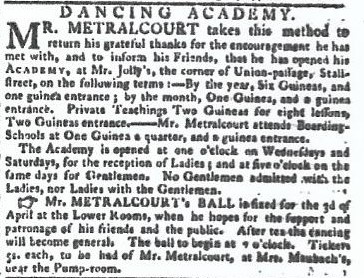
Fawcett describes him as a ‘versatile dancer and a ballet-master at the London Opera house’ (presumably referring to the King’s Theatre) without citing a source. He may have been the ‘Mettalcourt’ who appeared in ‘a new grand Polish Dance’ in the entr’actes at Covent Garden on 5 December 1780, described as making his first appearance at that theatre. Metralcourt did not generally refer to his connections with London’s theatre world in his advertisements. Notices in the Stamford Mercury indicate that he was working as a dancing master in Stamford between 1775 and 1780. He taught in Bath until 1786 and an advertisement in Saunders’s News-Letter for 29 November 1786 declares that he was teaching in Bath during the winter season and in Belfast during the summer season. After leaving Bath in 1786 (apparently as a result of the arrival of the of the dancing master John Second that year) he seems to have taught in Dublin and in Ipswich. He returned to Bath in 1795, taking over from Second and he continued to teach and to hold balls for his pupils at the Upper Assembly Rooms until 1811. Charles Metralcourt died in 1814 and was buried in the Catholic Burial Vault, Old Orchard Street, Bath on 12 October 1814.

John Second (who may or may not have been French) was invited to take over Jean-Baptiste Froment’s school in 1786, as he advertised in the Bath Chronicle for 18 May 1786 describing himself as ‘Of the King’s Theatre, but late of the Theatre Royal, Drury Lane, and Sole Assistant to Mr. Vestris, Senior’. His name appeared occasionally in advertisements for performances at the Covent Garden Theatre during the 1782-1783 season and at Drury Lane in 1783-1784. He may well have appeared more often, but was not important enough to be named in the bills. If he was indeed ‘Sole Assistant’ to Vestris Senior, Gaëtan Vestris, it must have been in the 1780-1781 season at the King’s Theatre during the first visit of the celebrated French dancer (who did not return until 1790-1791). Among the ballets mounted by Vestris Senior was Ninette à la Cour, with the Italian ballerina Giovanna Baccelli in the title role and Gaëtan’s son Auguste Vestris as her lover Colas. First given on 22 February 1781, it was an enormous success and the cast was printed – together with a synopsis of the ballet – in the Public Advertiser for 26 February 1781.
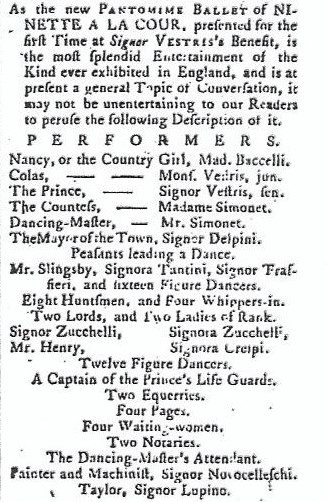
Second was not among the named dancers. He may have been one of the ‘Figure Dancers’ referred to simply as a group, or danced as one of the individual characters for whom no performers’ names are given. No evidence has yet come to light to support Second’s claim that he was Vestris Senior’s assistant, or to suggest why he might have been given that role. Second apparently left Bath in 1795, when his teaching practice was taken over by Charles Metralcourt, although he seems to have returned in late 1799. His subsequent career as a dancing master awaits further research, but he was buried at St James, Bath on 23 January 1826 (when his name was recorded as Paul John Second).

The most celebrated teacher of dancing in 18th-century Bath was half-French. Ann Teresa Fleming was the daughter of Irish violinist Francis Fleming and French dancer Ann Roland, younger sister of the well-known dancer Catherina Violanta Roland. Both girls danced in London for a number of seasons. Ann Teresa Fleming was never a stage dancer but built a very successful career teaching ballroom dancing. I wrote about her in my post Lady Dancing Masters in 18th-Century England but there is far more to say than I could include there.

Bath is a special case when it comes to the history of dancing. As the most fashionable spa in England, it was big enough to attract a number of dancing masters to teach the aristocracy and gentry who gathered there and attended the regular balls in both the upper and lower assembly rooms. It is surely significant that many of these dancing masters were French and had backgrounds in the theatre (it is worth noting that the dancing at the Theatres Royal in Bath and Bristol is yet to be researched). Bath was much smaller than London, providing an opportunity to chart in detail the community of dancing masters and their clientele, as well as the dancing that happened there and the wider social context which brought it all together. Far more research is needed to help us understand who was who and how it all worked.

References:

Trevor Fawcett, ‘Dance and Teachers of Dance in Eighteenth-Century Bath’, Bath History, 2 (1988), 27-48.

Philip J, Highfill Jr, Kalman A. Burnim and Edward A. Langhans. A Biographical Dictionary of Actors, Actresses, Musicians, Dancers, Managers & Other Stage Personnel in London, 1660-1800. 16 vols. (Carbondale, 1973-1993)

Index to the London Stage, compiled, with an introduction by Ben Ross Schneider, Jr. Second printing (Carbondale and Edwardsville, 1980)

The London Stage, 1660-1800. 5 Parts (Carbondale, 1960-1968).

Part 1: 1660-1700; Part 2: 1700-1729; Part 3: 1729-1747; Part 4: 1747-1776; Part 5: 1776-1800.

A calendar of stage performances at London’s major theatres, with a detailed introduction to each part.

Gennaro Magri, translated by Mary Skeaping. Theoretical and Practical Treatise on Dancing (London, 1988).

See p. 160 for the reference to Pierre Bernard Michel.

Lady Dancing Masters in 18th-Century England

I recently watched another dance history video in the very informative series compiled and published by Carlos Blanco, which draws inspiration from the rich resources of the Biblioteca Nacional de España. In this video (which can be found on YouTube) four historical dance experts consider the question ‘Is there Sexism or Misogyny in Dance Treatises?’ Inevitably, the topic of female dancing masters arose, in the context of the discussion focussing on the USA and Great Britain, and it proved difficult to identify or name any – indicating a gap in published research. In the course of my own work, which is mostly limited to England and particularly London, I have come across several women who taught dancing – lady dancing masters. My list is very far from exhaustive (and at least one name is questionable), but I thought it might be of interest to write a post about them and perhaps reveal or encourage further research. There has been some work which includes this topic and I have included a list for further reading at the end.

The first of these women is the questionable one. Peggy Fryer was billed as acting and dancing at the Little Theatre in the Haymarket on 28 January 1723. The advertisements declared that she was aged seventy-one and had ‘taught three Queens to dance’. She had previously appeared at the Lincoln’s Inn Fields Theatre on 11 January 1720, ‘it being the first time of her Appearing on any stage since the Reign of King Charles II’, and she was then said to be eighty-five years old. Without a great deal more research, it is difficult to discern whether there was any truth at all in these conflicting announcements. If Peggy Fryer had indeed ‘taught three Queens to dance’, who might they have been? My thoughts turned to Charles II’s Queen, Catherine of Braganza, and his two nieces Mary (later Queen Mary II) and Anne (later Queen Anne), although there are other candidates. Would someone like Peggy Fryer have been called in to teach any of them, when there was a royal dancing master – Jerome Gahory – to do so?

With the second of these lady dancing masters we are on much surer ground. Mrs Elford emerges into view on 5 July 1700 at Lincoln’s Inn Fields, where she is billed as dancing a ‘new Entry, never performed but once’, She was obviously already established as a leading dancer and would later be billed alongside Anthony L’Abbé as his regular dancing partner. The collection of L’Abbé’s stage dances published in the mid-1720s includes a duet to the passacaille from Lully’s opera Armide danced by Ann Elford and Hester Santlow. The earliest evidence for Mrs Elford as a teacher dates to 12 September 1705, when dancing ’By a little Girl, Mrs Elford’s scholar’ was advertised at Lincoln’s Inn Fields. Mrs Elford’s career as a stage dancer seems to have ended in 1706, by which time she was probably already teaching regularly. The first record of her work beyond the world of the London stage dates to 1711, when she was teaching Mary Bankes of the Bankes family of Kingston Lacey. Mrs Elford’s later activities are less easy to trace, although she is recorded as teaching the daughters of the second Duke of Montagu between 1720 and 1729.

The next woman to be recorded as teaching dance in England was one of the most notable dancers to appear on the 18th-century London stage. Marie Sallé first danced in London as a child, during the 1716-1717 season at Lincoln’s Inn Fields. She returned to dance there as a young woman in 1725-1726 and made her last London appearances at the Covent Garden Theatre during the 1734-1735 season. For Mlle Sallé’s benefit at Lincoln’s Inn Fields on 6 April 1727 the bill included a ‘Pastoral by Miss Rogers, a Child of Nine Years of Age, Scholar to Mlle Sallé’. Elizabeth Rogers would later enjoy a career as a singer and actress, as well as a dancer. When she was billed again at Lincoln’s Inn Fields on 5 April 1731, dancing a Saraband and Tambourin, she was advertised as ‘Scholar to Salle’. Marie Sallé’s brother Francis remained in London when she returned to France and made his career there. It is not surprising that he took over some of his sister’s teaching. However, a continuing link between Marie Sallé and Elizabeth Rogers is suggested by the latter’s appearance as a Bacchante in Bacchus and Ariadne (a ballet attributed to Mlle Sallé) when it was given within The Necromancer at Covent Garden on 26 February 1734. Marie Sallé is the first of my lady dancing masters for whom there is a portrait. In fact there are several, this is a print of the painting by Nicolas Lancret.

My third lady dancing master appeared on the London stage much later in the 18th century. Marie-Louise Hilligsberg began her career at the Paris Opéra in the early 1780s, making her first visit to London during the 1787-1788 season to appear at the King’s Theatre. She returned to Paris for a little over a year, but when she failed to get the promotion she expected at the Opéra she returned to London in 1789. Mme Hilligsberg continued to dance in London, mostly at the King’s Theatre but also elsewhere, until she retired from the stage in 1803. She was well-known for her travesti roles as well as her more conventional ones. Here are portraits of her in both guises: a print showing her in the ballet Le Jaloux Puni and a painting by Hoppner.

In 1796, she appeared in the ballet Little Peggy’s Love at the King’s Theatre (perhaps in the title role) for which the ‘Pantomime and Principal Steps’ were created by Didelot. Some years later, in 1799, this ballet was performed by several young aristocrats at a private party thrown by Lord and Lady Shaftesbury. As newspaper reports make clear, this amateur performance was mounted by Mme Hilligsberg, who also coached the child dancers in their roles. There are more details in my 2017 post A Favourite Ballet. Mme Hilligsberg is also known to have given dancing lessons to Lady Harriet Montagu and she may well have had other pupils during her years in England. She retired from the stage in 1803 and died in France the following year.

I have to return to the early 1700s for my next lady dancing master, who bridges a divide between professional dancers who became teachers and those who pursued the teaching of dance without having a stage career. Ann Roland was the sister of the well-known dancer Catherine Roland. She made her London debut at Drury Lane on 18 November 1735, described as ‘lately arrived from Paris’ and dancing alongside her sister. She continued to dance in London until 1743, mainly at the Covent Garden Theatre, and then moved to Dublin for the 1743-1744 season where she acted and apparently sang as well as dancing. Her extensive repertoire ranged from a Tambourine solo, through duets including The Louvre and the minuet, to leading dancing roles in a number of popular pantomimes. Around 1745 she married the Irish violinist Francis Fleming, with whom she had three daughters. Ann Fleming’s subsequent career as a lady dancing master is not easy to trace, but she is said to have begun teaching with her husband in and around Bath in the late 1740s. According to an advertisement in the Salisbury and Winchester Journal for 25 September 1752, announcing Mr Fleming’s return from Paris ‘where he has completed himself in the Art of Dancing’ he and his wife were then teaching at a boarding school in Bath as well as giving private lessons to young ladies and gentlemen. There is no known portrait of Ann Roland Fleming, who died in 1759.

Francis Fleming may have begun to involve his eldest daughter Ann Teresa in teaching soon after the death of her mother (when she would have been thirteen or fourteen years old). She was certainly his assistant by 1768, as the Bath Chronicle for 3 November 1768 reported that ‘Mr. and Miss Fleming, … have been in Paris this summer’ learning the ‘true Step of the Cotilions with the additional Graces of the Minuets’ and that they would both be teaching at another boarding school in Bath, as well as giving private lessons to ladies and gentlemen. Ann Teresa Fleming took over her father’s dancing academy when he died in 1778 and quickly became the most famous teacher of dancing in Bath, where she continued to work until her retirement in 1805. Her balls for her scholars, held several times each year at both the Upper and Lower Assembly Rooms, were often reported in detail in the Bath Chronicle. Her importance is perhaps best shown by the fact that she is one of very few dancing masters, male or female, for whom we have a portrait (now in the collections of the Victoria & Albert Museum), which has been linked to the studio of Sir Joshua Reynolds:

Miss Fleming died in 1823 and was accorded a quite lengthy obituary in the Bath Chronicle for 18 February 1823.

For nearly twenty years, Ann Teresa Fleming ran her school with her younger sister Kitty. When she retired she was succeeded by Miss Le Mercier, who had become her assistant in the mid-1790s and would continue the school – as another lady dancing master – until around 1811. Another assistant to Miss Fleming had been Elizabeth Rundall, who in 1796 married the actor Robert Elliston and around the same time set up her own school in Bath in partnership with Kitty Fleming. Mrs Elliston’s school was notably successful. Like Ann Teresa Fleming, she held regular balls for her pupils in Bath’s Upper Assembly Rooms – the Bath Chronicle for 10 December 1803 reports that the Duchess of Devonshire was to attend ‘Mrs Elliston’s Ball’. Elizabeth Elliston left Bath for London in 1812 (her husband was by then a leading actor in the company at Drury Lane) and her sister Miss D. C. Rundell took over her Bath school.

The ladies I have mentioned in this post were undoubtedly just a few of the many lady dancing masters who taught in England from the seventeenth to the early nineteenth century. Some worked with their dancing master husbands and were seldom mentioned as teachers in their own right. Others were well-known and admired for their dancing and teaching skills. Further research will surely uncover many more lady dancing masters within surviving historical records.

Further Reading:

Quotations from advertisements for stage performances are taken from the appropriate volumes of The London Stage, 1660-1800.

For Peg Fryer see: the entry ‘Fryer, Margaret, later Mrs Vandervelt, c.1635-1747, actress, dancer’ in Philip H. Highfill Jr et al. A Biographical Dictionary of Actors. 16 vols. (Carbondale, 1973-1993), Vol. 5.

For Ann Elford see: Jennifer Thorp, ‘Mrs Elford: stage dancer and teacher in London, 1700-1730’, in Ballroom, Stage and Village Green: Contexts for Early Dance, ed. Barbara Segal and William Tuck (Early Dance Circle, 2015), 53-60.

For Marie Sallé as a teacher, in Paris as well as in London, see: Sarah McCleave, ‘Marie Sallé, a Wise Professional Woman of Influence’, in Women’s Work: Making Dance in Europe before 1800, ed. Lynn Matluck Brooks (Madison, Wis., 2007), 160-182 (pp. 168-171)

For Marie-Louise Hilligsberg, see: the entry in A Biographical Dictionary of Actors, Vol. 7; Ivor Guest, The Ballet of the Enlightenment (London, 1996);  Katrina Faulds, ‘Opera Dances’, chapter 6 in A Passion for Opera: The Duchess and the Georgian Stage (Kettering, 2019), 91-99 (pp. 95-96).

For Ann Roland Fleming, see: the entry for Ann Roland in A Biographical Dictionary of Actors, Vol. 13, as well as the sources listed below for her daughter and successors.

For Ann Teresa Fleming, Miss Le Mercier and Elizabeth Elliston, together with other lady dancing masters in Bath, see: Trevor Fawcett, ‘Dance and Teachers of Dance in Eighteenth-Century Bath’, Bath History, 2 (1988), 27-48; Mathew Spring, ‘The Fleming family’s dance academy at Bath 1750-1800’, in Ballroom, Stage and Village Green: Contexts for Early Dance, ed. Barbara Segal and William Tuck (Early Dance Circle, 2015), 47-52.