Tag Archives: Ann Roland

Another Nivelon in London (and Canterbury), 1740-1741

A little while ago, Robert Kenny (author of the marvellous Monsieur Francisque’s Touring Troupe) kindly sent me transcriptions of advertisements in the Kentish Weekly Post or Canterbury Journal for 25 July and 26 August 1741 which billed performances at the theatre in Canterbury by a Monsieur Nivelon. I immediately began to wonder whether he was the famous Monsieur Nivelon (the subject of my last post Revisiting the Career of Francis Nivelon). Further research revealed that this Nivelon had danced in London as well as in Canterbury over a period extending from October 1740 to August 1741. There is no record of his return in subsequent seasons. So, who was he?

It is evident that he was not Francis Nivelon, making a return to the London stage where he starred for so long. The advertisement for this Nivelon’s first performance at Drury Lane in the London Daily Post and General Advertiser, 13 October 1740, includes:

‘… a Peasant Dance by Mons. Nivelon, lately arriv’d from Paris, (being the first Time of his Appearance in England) …’

The entry for this performance in The London Stage only partly transcribes the bill. ‘Mons. Nivelon’ apparently danced at Drury Lane  until around the middle of April 1741, where his entr’acte repertoire comprised this Peasant Dance (which may have been either a group dance or a solo, the wording of the bill is unclear), The Enchanted Garden (one of several group dances led by the Fausans, who were very popular visitors at Drury Lane in 1740-1741) in which he danced Pierot Man with Miss Thompson as Pierot Woman and a French Peasant duet with Mlle Duval. He also appeared in a number of afterpieces: The Rural Sports, as Hercules; Harlequin Shipwreck’d, as a Tryton; and The Fortune Tellers, as a Pilgrim in the ballet A Voyage to the Island of Cytherea. In addition, Nivelon was among the dancers in the mainpiece Comus (in which he may have given his last performance at Drury Lane on 16 April 1741).

His identity as another Nivelon is further suggested by his performances at the New Wells, Clerkenwell during April and May 1741, where he danced a solo Drunken Peasant, the duet Miller and His Wife with Mlle Duval, and the group dance Les Matelotes Provencale [sic] which he led (the other performers included ‘Mons. La Pierre, Madem. Duval, Madem. Nivelon’). These performances were advertised in the London Daily Post and General Advertiser for 6 April and 11 May 1741.  Nivelon seems then to have gone to Canterbury, returning to London only in late August, when he gave a French Peasant solo at Lee and Woodward’s Booth, Bartholomew Fair, on 26 August 1741. The following day, 27 August 1741, he was again advertised at the New Wells, Clerkenwell as ‘lately arriv’d from Paris’ (which seems not to be true as he had been dancing in Canterbury) and performing ‘several new dances’ for which no details are given. These appearances were advertised in the London Daily Post and General Advertiser for 26 and 27 August 1741.

This brings me back to his short season in Canterbury, where Nivelon was billed as dancing with ‘a Company of Comedians from the Royal Theatres in London’ from 8 June to 28 August 1741. I list the newspapers in which the advertisements can be found at the end of this post. So far as I can tell, he gave eleven performances over that period, dancing a varied repertoire and partnering Mlle Roland. I think she was probably the French dancer Ann Roland, who made her debut at Drury Lane in 1735-1736, then moved to Covent Garden for 1737-1738 where she was still dancing in 1740-1741. (Her sister Catherine Roland followed a similar career in London – it is sometimes difficult to tell them apart in the Drury Lane and Covent Garden bills – but danced principally with Michael Poitier and seems less likely to have ventured to Canterbury to appear with a new partner).

In Canterbury, Nivelon danced two solos: French Peasant, Drunken Peasant. Mlle Roland had three solos: Louvre, Serious Dance and Scotch Dance. They were billed together in three duets: Pierrot and Pierrette, Tambourin and a ‘French Dance’. There were also two ‘Pantomime’ dances in which they appeared together: The Art of Making Love in Switzerland and The Gardener and His Wife, as well as another piece entitled The Rambling Lovers, in which Mlle Roland was Colombine to Nivelon’s Harlequin. They both danced in The Beggar’s Opera, when it was given on 7 August 1741. Here is the advertisement from the Kentish Post or Canterbury News Letter, 1-5 August 1741.
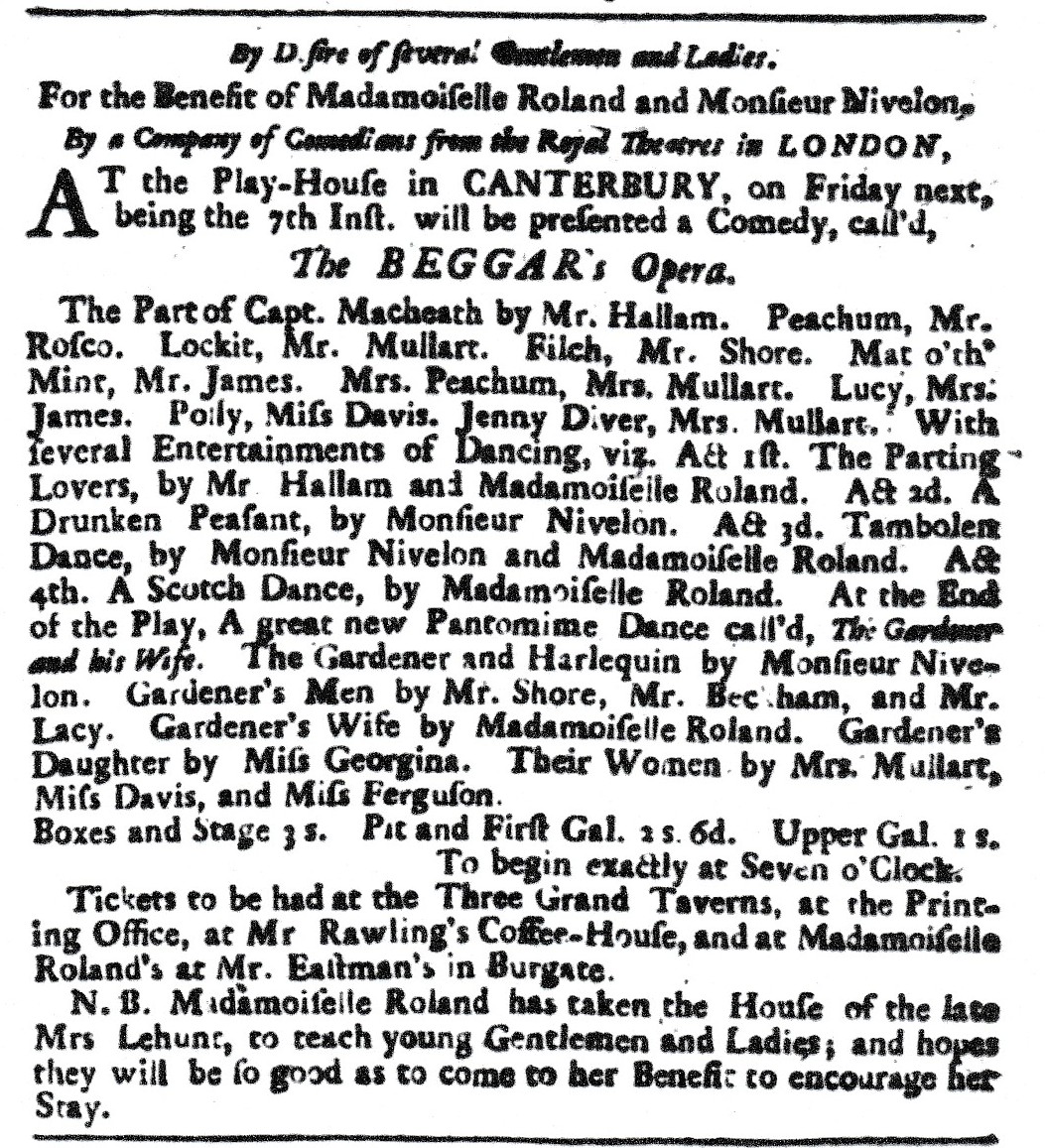
In addition, Nivelon danced among the Countrymen and Women in The Dragon of Wantley (given on 22 June and 8 July 1741) and as Harlequin in the ‘Favourite Scene of Harlequin Skeleton’ which ended the performance on 10 August 1741.

Nivelon was also advertised as teaching dancing while in Canterbury, albeit only once. Here is the advertisement in the Kentish Weekly Post or Canterbury Journal, 13 June 1741.

Mlle Roland was advertised as teaching at least three times during the Canterbury season.

The information about this other Nivelon dancing in London and Canterbury raises a number of questions about our knowledge and understanding of stage dancing in London and the provinces at this period. One concerns the relationship between dancing at the patent theatres and the lesser venues in the capital. Another is the importance of provincial touring for professional dancers employed in London during the season, which usually ran between September and the following June. Sybil Rosenfeld published an extensive exploration of the world of provincial performance in her Strolling Players and Drama in the Provinces 1660-1765 (Cambridge, 1939), which is yet to be built on by dance historians.

There is also the question as to who this Monsieur Nivelon was. His repertoire suggests a link with Francis Nivelon. Without further research it is impossible to be sure what this link might be, although it seems likely that it was a family relationship. Was he perhaps a nephew, the son of one of Francis Nivelon’s brothers? There is far more work to be done on Monsieur Nivelon and his performances in London and Canterbury in 1741.

Kent and Canterbury Newspapers:

Kentish Post, or Canterbury News Letter

30 May-3 June 1741; 8-12 July 1741; 23-25 July 1741; 1-5 August 1741; 5-8 August 1741; 15-19 August 1741; 19-22 August 1741; 22-26 August 1741

Kentish Weekly Post or Canterbury Journal

13 June 1741; 20 June 1741; 27 June 1741; 8 July 1741

Lady Dancing Masters in 18th-Century England

I recently watched another dance history video in the very informative series compiled and published by Carlos Blanco, which draws inspiration from the rich resources of the Biblioteca Nacional de España. In this video (which can be found on YouTube) four historical dance experts consider the question ‘Is there Sexism or Misogyny in Dance Treatises?’ Inevitably, the topic of female dancing masters arose, in the context of the discussion focussing on the USA and Great Britain, and it proved difficult to identify or name any – indicating a gap in published research. In the course of my own work, which is mostly limited to England and particularly London, I have come across several women who taught dancing – lady dancing masters. My list is very far from exhaustive (and at least one name is questionable), but I thought it might be of interest to write a post about them and perhaps reveal or encourage further research. There has been some work which includes this topic and I have included a list for further reading at the end.

The first of these women is the questionable one. Peggy Fryer was billed as acting and dancing at the Little Theatre in the Haymarket on 28 January 1723. The advertisements declared that she was aged seventy-one and had ‘taught three Queens to dance’. She had previously appeared at the Lincoln’s Inn Fields Theatre on 11 January 1720, ‘it being the first time of her Appearing on any stage since the Reign of King Charles II’, and she was then said to be eighty-five years old. Without a great deal more research, it is difficult to discern whether there was any truth at all in these conflicting announcements. If Peggy Fryer had indeed ‘taught three Queens to dance’, who might they have been? My thoughts turned to Charles II’s Queen, Catherine of Braganza, and his two nieces Mary (later Queen Mary II) and Anne (later Queen Anne), although there are other candidates. Would someone like Peggy Fryer have been called in to teach any of them, when there was a royal dancing master – Jerome Gahory – to do so?

With the second of these lady dancing masters we are on much surer ground. Mrs Elford emerges into view on 5 July 1700 at Lincoln’s Inn Fields, where she is billed as dancing a ‘new Entry, never performed but once’, She was obviously already established as a leading dancer and would later be billed alongside Anthony L’Abbé as his regular dancing partner. The collection of L’Abbé’s stage dances published in the mid-1720s includes a duet to the passacaille from Lully’s opera Armide danced by Ann Elford and Hester Santlow. The earliest evidence for Mrs Elford as a teacher dates to 12 September 1705, when dancing ’By a little Girl, Mrs Elford’s scholar’ was advertised at Lincoln’s Inn Fields. Mrs Elford’s career as a stage dancer seems to have ended in 1706, by which time she was probably already teaching regularly. The first record of her work beyond the world of the London stage dates to 1711, when she was teaching Mary Bankes of the Bankes family of Kingston Lacey. Mrs Elford’s later activities are less easy to trace, although she is recorded as teaching the daughters of the second Duke of Montagu between 1720 and 1729.

The next woman to be recorded as teaching dance in England was one of the most notable dancers to appear on the 18th-century London stage. Marie Sallé first danced in London as a child, during the 1716-1717 season at Lincoln’s Inn Fields. She returned to dance there as a young woman in 1725-1726 and made her last London appearances at the Covent Garden Theatre during the 1734-1735 season. For Mlle Sallé’s benefit at Lincoln’s Inn Fields on 6 April 1727 the bill included a ‘Pastoral by Miss Rogers, a Child of Nine Years of Age, Scholar to Mlle Sallé’. Elizabeth Rogers would later enjoy a career as a singer and actress, as well as a dancer. When she was billed again at Lincoln’s Inn Fields on 5 April 1731, dancing a Saraband and Tambourin, she was advertised as ‘Scholar to Salle’. Marie Sallé’s brother Francis remained in London when she returned to France and made his career there. It is not surprising that he took over some of his sister’s teaching. However, a continuing link between Marie Sallé and Elizabeth Rogers is suggested by the latter’s appearance as a Bacchante in Bacchus and Ariadne (a ballet attributed to Mlle Sallé) when it was given within The Necromancer at Covent Garden on 26 February 1734. Marie Sallé is the first of my lady dancing masters for whom there is a portrait. In fact there are several, this is a print of the painting by Nicolas Lancret.

My third lady dancing master appeared on the London stage much later in the 18th century. Marie-Louise Hilligsberg began her career at the Paris Opéra in the early 1780s, making her first visit to London during the 1787-1788 season to appear at the King’s Theatre. She returned to Paris for a little over a year, but when she failed to get the promotion she expected at the Opéra she returned to London in 1789. Mme Hilligsberg continued to dance in London, mostly at the King’s Theatre but also elsewhere, until she retired from the stage in 1803. She was well-known for her travesti roles as well as her more conventional ones. Here are portraits of her in both guises: a print showing her in the ballet Le Jaloux Puni and a painting by Hoppner.

In 1796, she appeared in the ballet Little Peggy’s Love at the King’s Theatre (perhaps in the title role) for which the ‘Pantomime and Principal Steps’ were created by Didelot. Some years later, in 1799, this ballet was performed by several young aristocrats at a private party thrown by Lord and Lady Shaftesbury. As newspaper reports make clear, this amateur performance was mounted by Mme Hilligsberg, who also coached the child dancers in their roles. There are more details in my 2017 post A Favourite Ballet. Mme Hilligsberg is also known to have given dancing lessons to Lady Harriet Montagu and she may well have had other pupils during her years in England. She retired from the stage in 1803 and died in France the following year.

I have to return to the early 1700s for my next lady dancing master, who bridges a divide between professional dancers who became teachers and those who pursued the teaching of dance without having a stage career. Ann Roland was the sister of the well-known dancer Catherine Roland. She made her London debut at Drury Lane on 18 November 1735, described as ‘lately arrived from Paris’ and dancing alongside her sister. She continued to dance in London until 1743, mainly at the Covent Garden Theatre, and then moved to Dublin for the 1743-1744 season where she acted and apparently sang as well as dancing. Her extensive repertoire ranged from a Tambourine solo, through duets including The Louvre and the minuet, to leading dancing roles in a number of popular pantomimes. Around 1745 she married the Irish violinist Francis Fleming, with whom she had three daughters. Ann Fleming’s subsequent career as a lady dancing master is not easy to trace, but she is said to have begun teaching with her husband in and around Bath in the late 1740s. According to an advertisement in the Salisbury and Winchester Journal for 25 September 1752, announcing Mr Fleming’s return from Paris ‘where he has completed himself in the Art of Dancing’ he and his wife were then teaching at a boarding school in Bath as well as giving private lessons to young ladies and gentlemen. There is no known portrait of Ann Roland Fleming, who died in 1759.

Francis Fleming may have begun to involve his eldest daughter Ann Teresa in teaching soon after the death of her mother (when she would have been thirteen or fourteen years old). She was certainly his assistant by 1768, as the Bath Chronicle for 3 November 1768 reported that ‘Mr. and Miss Fleming, … have been in Paris this summer’ learning the ‘true Step of the Cotilions with the additional Graces of the Minuets’ and that they would both be teaching at another boarding school in Bath, as well as giving private lessons to ladies and gentlemen. Ann Teresa Fleming took over her father’s dancing academy when he died in 1778 and quickly became the most famous teacher of dancing in Bath, where she continued to work until her retirement in 1805. Her balls for her scholars, held several times each year at both the Upper and Lower Assembly Rooms, were often reported in detail in the Bath Chronicle. Her importance is perhaps best shown by the fact that she is one of very few dancing masters, male or female, for whom we have a portrait (now in the collections of the Victoria & Albert Museum), which has been linked to the studio of Sir Joshua Reynolds:

Miss Fleming died in 1823 and was accorded a quite lengthy obituary in the Bath Chronicle for 18 February 1823.

For nearly twenty years, Ann Teresa Fleming ran her school with her younger sister Kitty. When she retired she was succeeded by Miss Le Mercier, who had become her assistant in the mid-1790s and would continue the school – as another lady dancing master – until around 1811. Another assistant to Miss Fleming had been Elizabeth Rundall, who in 1796 married the actor Robert Elliston and around the same time set up her own school in Bath in partnership with Kitty Fleming. Mrs Elliston’s school was notably successful. Like Ann Teresa Fleming, she held regular balls for her pupils in Bath’s Upper Assembly Rooms – the Bath Chronicle for 10 December 1803 reports that the Duchess of Devonshire was to attend ‘Mrs Elliston’s Ball’. Elizabeth Elliston left Bath for London in 1812 (her husband was by then a leading actor in the company at Drury Lane) and her sister Miss D. C. Rundell took over her Bath school.

The ladies I have mentioned in this post were undoubtedly just a few of the many lady dancing masters who taught in England from the seventeenth to the early nineteenth century. Some worked with their dancing master husbands and were seldom mentioned as teachers in their own right. Others were well-known and admired for their dancing and teaching skills. Further research will surely uncover many more lady dancing masters within surviving historical records.

Further Reading:

Quotations from advertisements for stage performances are taken from the appropriate volumes of The London Stage, 1660-1800.

For Peg Fryer see: the entry ‘Fryer, Margaret, later Mrs Vandervelt, c.1635-1747, actress, dancer’ in Philip H. Highfill Jr et al. A Biographical Dictionary of Actors. 16 vols. (Carbondale, 1973-1993), Vol. 5.

For Ann Elford see: Jennifer Thorp, ‘Mrs Elford: stage dancer and teacher in London, 1700-1730’, in Ballroom, Stage and Village Green: Contexts for Early Dance, ed. Barbara Segal and William Tuck (Early Dance Circle, 2015), 53-60.

For Marie Sallé as a teacher, in Paris as well as in London, see: Sarah McCleave, ‘Marie Sallé, a Wise Professional Woman of Influence’, in Women’s Work: Making Dance in Europe before 1800, ed. Lynn Matluck Brooks (Madison, Wis., 2007), 160-182 (pp. 168-171)

For Marie-Louise Hilligsberg, see: the entry in A Biographical Dictionary of Actors, Vol. 7; Ivor Guest, The Ballet of the Enlightenment (London, 1996);  Katrina Faulds, ‘Opera Dances’, chapter 6 in A Passion for Opera: The Duchess and the Georgian Stage (Kettering, 2019), 91-99 (pp. 95-96).

For Ann Roland Fleming, see: the entry for Ann Roland in A Biographical Dictionary of Actors, Vol. 13, as well as the sources listed below for her daughter and successors.

For Ann Teresa Fleming, Miss Le Mercier and Elizabeth Elliston, together with other lady dancing masters in Bath, see: Trevor Fawcett, ‘Dance and Teachers of Dance in Eighteenth-Century Bath’, Bath History, 2 (1988), 27-48; Mathew Spring, ‘The Fleming family’s dance academy at Bath 1750-1800’, in Ballroom, Stage and Village Green: Contexts for Early Dance, ed. Barbara Segal and William Tuck (Early Dance Circle, 2015), 47-52.