French Dancing Masters in Bath, 1760-1820

A little while ago, I did quite a bit of research into dancing masters working in Bath as part of a project relating to the Upper Assembly Rooms there. My starting point was Trevor Fawcett’s article on the subject, published in 1988 but still a comprehensive and immensely valuable resource for subsequent work. One of the interesting things that emerged was the number of dancing masters in that city who were French and had worked in London’s theatres. I wrote a little ‘biographical dictionary’ with brief details of each of Bath’s dancing masters based there between the 1750s and the 1820s and I compiled a chart showing approximately how long each of them worked there and how their careers overlapped.

This study also relates to my separate investigation of French dancers in London during an earlier period (my recent post Monsieur Roger, Who Plays the Pierrot began what I hope will be a short series on them).

Apart from the article by Trevor Fawcett, much of my information about their work in Bath came from advertisements published in the Bath Chronicle, while details of their stage careers were mainly drawn from the volumes of The London Stage, 1660-1800 and the Biographical Dictionary of Actors (both referenced below). Far more detailed research, using a much wider range of archives, is needed to fill out the details of the lives and careers of Bath’s dancing masters and to ensure that all of them have been identified and their backgrounds charted.

John Deneuville seems to have arrived in Bath in the early 1760s. His advertisement in the Bath Chronicle for 31 March 1763 declares that he is ‘from the Opera in Paris, and last from the Theatres in London’. A few years later, in the Bath Chronicle for 24 September 1767, his advertisement says that he

‘having been at Paris during the late Vacation, proposes to teach the new Dances called the Minuet-Dauphin, and the Forlane, composed by Mr. Marcel Dancing-Master of the French Court; also the newest French Country dances, with the proper Steps of the Cotillion and Allemands, now in Vogue at Paris.’

Despite his reference to the Paris Opéra, home to the most famous ballet company in Europe, Deneuville may in fact have come from Paris’s less exalted Opéra-Comique – like so many of the French dancers who came to London at this period. There is no mention of his name in the Index to the London Stage, suggesting that either he was simply a supporting dancer in London’s principal theatres, or that he danced at venues beyond Drury Lane and Covent Garden. Deneuville taught in Bath for nearly 20 years. He died in 1782 and was buried there.

Jean-Baptiste Froment arrived in Bath to teach dancing in 1778. His advertisement in the Bath Chronicle for 25 June 1778 set out his credentials and what he intended to teach. He claimed to have been taught in Paris by Monsieur Marcel and to have himself taught at ‘the most eminent Academies’ in London. He offered tuition in:

‘all the fashionable Dances now in Vogue in London and Paris, viz. the Minuet in the present Taste, the Louvre, Minuets Dauphin, de la Reine, Allemandes, Cotillons, … and particularly that graceful Minuet de la Cour and Gavot.’

Froment had been a dancer in London’s theatres. His first billing (but probably not his first performance in London) was at Drury Lane on 10 March 1739, when he danced in the pantomime Harlequin Shipwreck’d. He seems mainly to have been a supporting dancer and his earlier career, presumably in France, is yet to be uncovered. Froment pursued his London career at the Sadler’s Wells and Goodman’s Fields theatres, as well as at Drury Lane, Covent Garden and the Haymarket Theatre. By the end of his stage career in 1777 his performances were limited to appearances with his daughter Mrs Sutton at her annual benefits (she was a dancer at Drury Lane). Froment’s career in London had not been straightforward, for in 1746 – in the wake of the 1745 rebellion – he had been identified as a Jacobite sympathiser, an accusation he was able to rebut. Froment taught in Bath and in London until the 1780s. He died in Bath in 1786 and was buried in Bath Abbey on 13 April.

In 1787, Pierre Bernard Michel opened his dancing school in Bath. His advertisement in the Bath Chronicle for 11 January 1787 informed ‘the Nobility and Gentry of the Cities of Bath and Bristol, that he has been one of the first Dancers, at most of the Courts in Europe, and at the Opera-House in London’. Michel may have been the ‘Master Mechel’ who had first appeared in London on 22 December 1739 at Covent Garden. He and his sister danced a varied repertoire and were very popular for three seasons, and Michel would later pursue a successful dancing career throughout Europe. He may well be the dancer referred to by Gennaro Magri, in his Trattato Teorico-Prattico di Ballo published in Naples in 1779, as ‘the best Ballerino grottesco that France has produced’. In Bath, Pierre Bernard Michel was assisted by his daughter Lucy, but when she married and became Mrs de Rossi she set up her own dance classes, provoking a serious quarrel with her father. This was played out, in part, through their competing advertisements in the Bath Chronicle. Lucy would later marry the dancer and dancing master James Byrne, well-known in London in the years around 1800. Her father’s final years are yet to be fully researched, but he is known to have died in Melksham in 1800.

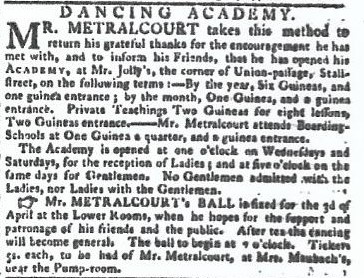
There were two other dancing masters in Bath who, if they were not in fact French, seem to have had close links to French dancers appearing in London’s theatres. Charles Metralcourt was teaching in Bath by 1782, the year he advertised the opening of ‘his Academy’ in the Bath Chronicle for 28 March.

Fawcett describes him as a ‘versatile dancer and a ballet-master at the London Opera house’ (presumably referring to the King’s Theatre) without citing a source. He may have been the ‘Mettalcourt’ who appeared in ‘a new grand Polish Dance’ in the entr’actes at Covent Garden on 5 December 1780, described as making his first appearance at that theatre. Metralcourt did not generally refer to his connections with London’s theatre world in his advertisements. Notices in the Stamford Mercury indicate that he was working as a dancing master in Stamford between 1775 and 1780. He taught in Bath until 1786 and an advertisement in Saunders’s News-Letter for 29 November 1786 declares that he was teaching in Bath during the winter season and in Belfast during the summer season. After leaving Bath in 1786 (apparently as a result of the arrival of the of the dancing master John Second that year) he seems to have taught in Dublin and in Ipswich. He returned to Bath in 1795, taking over from Second and he continued to teach and to hold balls for his pupils at the Upper Assembly Rooms until 1811. Charles Metralcourt died in 1814 and was buried in the Catholic Burial Vault, Old Orchard Street, Bath on 12 October 1814.

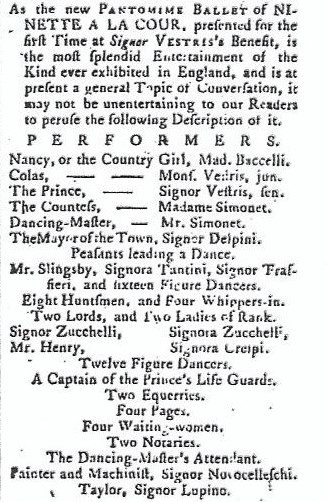
John Second (who may or may not have been French) was invited to take over Jean-Baptiste Froment’s school in 1786, as he advertised in the Bath Chronicle for 18 May 1786 describing himself as ‘Of the King’s Theatre, but late of the Theatre Royal, Drury Lane, and Sole Assistant to Mr. Vestris, Senior’. His name appeared occasionally in advertisements for performances at the Covent Garden Theatre during the 1782-1783 season and at Drury Lane in 1783-1784. He may well have appeared more often, but was not important enough to be named in the bills. If he was indeed ‘Sole Assistant’ to Vestris Senior, Gaëtan Vestris, it must have been in the 1780-1781 season at the King’s Theatre during the first visit of the celebrated French dancer (who did not return until 1790-1791). Among the ballets mounted by Vestris Senior was Ninette à la Cour, with the Italian ballerina Giovanna Baccelli in the title role and Gaëtan’s son Auguste Vestris as her lover Colas. First given on 22 February 1781, it was an enormous success and the cast was printed – together with a synopsis of the ballet – in the Public Advertiser for 26 February 1781.

Second was not among the named dancers. He may have been one of the ‘Figure Dancers’ referred to simply as a group, or danced as one of the individual characters for whom no performers’ names are given. No evidence has yet come to light to support Second’s claim that he was Vestris Senior’s assistant, or to suggest why he might have been given that role. Second apparently left Bath in 1795, when his teaching practice was taken over by Charles Metralcourt, although he seems to have returned in late 1799. His subsequent career as a dancing master awaits further research, but he was buried at St James, Bath on 23 January 1826 (when his name was recorded as Paul John Second).

The most celebrated teacher of dancing in 18th-century Bath was half-French. Ann Teresa Fleming was the daughter of Irish violinist Francis Fleming and French dancer Ann Roland, younger sister of the well-known dancer Catherina Violanta Roland. Both girls danced in London for a number of seasons. Ann Teresa Fleming was never a stage dancer but built a very successful career teaching ballroom dancing. I wrote about her in my post Lady Dancing Masters in 18th-Century England but there is far more to say than I could include there.

Bath is a special case when it comes to the history of dancing. As the most fashionable spa in England, it was big enough to attract a number of dancing masters to teach the aristocracy and gentry who gathered there and attended the regular balls in both the upper and lower assembly rooms. It is surely significant that many of these dancing masters were French and had backgrounds in the theatre (it is worth noting that the dancing at the Theatres Royal in Bath and Bristol is yet to be researched). Bath was much smaller than London, providing an opportunity to chart in detail the community of dancing masters and their clientele, as well as the dancing that happened there and the wider social context which brought it all together. Far more research is needed to help us understand who was who and how it all worked.

References:

Trevor Fawcett, ‘Dance and Teachers of Dance in Eighteenth-Century Bath’, Bath History, 2 (1988), 27-48.

Philip J, Highfill Jr, Kalman A. Burnim and Edward A. Langhans. A Biographical Dictionary of Actors, Actresses, Musicians, Dancers, Managers & Other Stage Personnel in London, 1660-1800. 16 vols. (Carbondale, 1973-1993)

Index to the London Stage, compiled, with an introduction by Ben Ross Schneider, Jr. Second printing (Carbondale and Edwardsville, 1980)

The London Stage, 1660-1800. 5 Parts (Carbondale, 1960-1968).

Part 1: 1660-1700; Part 2: 1700-1729; Part 3: 1729-1747; Part 4: 1747-1776; Part 5: 1776-1800.

A calendar of stage performances at London’s major theatres, with a detailed introduction to each part.

Gennaro Magri, translated by Mary Skeaping. Theoretical and Practical Treatise on Dancing (London, 1988).

See p. 160 for the reference to Pierre Bernard Michel.

Tambourins on the London Stage

The Tambourin (or Tambourine it was it was often called in advertisements) was apparently introduced to the London stage by Marie Sallé, who performed a solo with this title at Lincoln’s Inn Fields on 4 January 1731. It quickly became popular. Mlle Sallé danced it at least nine times before the end of the season, including at her own benefit on 25 March when it was titled a ‘New French Tambourin’. A solo Tambourin was also danced at Lincoln’s Inn Fields a couple of times by Miss Rogers ‘Scholar to Salle’ (Marie Sallé’s brother Francis), while at Drury Lane Miss Robinson danced a solo Tambourin several times (including at her own benefit on 14 April 1731 when she also performed ‘Les Characteres de la Dance’).

In 1730-1731, Marie Sallé was returning to dance in London after some years performing at the Paris Opéra, where she had made her official debut on 14 September 1727. She had appeared in a number of operas during her time in Paris, so it is possible that she was drawing on one of her dancing roles there. It is interesting to note that she appeared in Alcione by Marais, premièred in 1706 and cited as the first French opera to include a tambourin.  However the dance forms part of the ‘Feste Marine’ in the third act, whereas Mlle Sallé danced in acts one and four. Marais’s music was also closely associated with Matelots both in the opera and when it was appropriated for choreographies recorded in Beauchamp-Feuillet notation, so it is perhaps unlikely that it was used for Marie Sallé’s London Tambourin.

Mlle Sallé returned to dance in London in the 1733-1734 and 1734-1735 seasons, after which she never returned. She seems to have danced her Tambourin again only on 18 and 26 December 1734. By that time the dance had become a regular feature of the entr’actes. At Covent Garden it continued to be danced as a solo by Miss Rogers, as well as a duet by her and Leach Glover. At Drury Lane a solo ‘Tambourine’ was danced by Mlle Grognet, while Miss Robinson gave her solo ‘Tambourine’ at the Little Theatre in the Haymarket (where she performed with others who had taken part in the actors’ rebellion at Drury Lane at the end of the 1732-1733 season) and Miss Wherrit danced yet another solo ‘Tambourine’ at the Goodman’s Fields Theatre.  The Tambourin or Tambourine remained popular as both a solo and a duet into the 1740s.

The Tambourine was exceptionally popular during the 1739-1740 and 1740-1741 seasons, when it was performed frequently at Drury Lane by a visitor ‘lately arriv’d from Paris’ Mlle Chateauneuf. We do not know what music she used for her solo (which was sometimes advertised as by ‘Mlle Chateauneuf &c.’ as if it were a group dance). In 1740-1741, she had rivals at Covent Garden in the form of Desnoyer and Signora Barberini who danced a ‘new Tambourine’ together on 14 February 1741 which they repeated at numerous performances during the rest of the season. The music for their dance may have been related to the ‘Tambourine Sigra Barbarina’ published in the second of the set of eight volumes popularly known as Hasse’s Comic Tunes which appeared between 1741 and 1758. This particular volume was issued in four parts between September 1742 and October 1743, which includes a period when Desnoyer and Signora Barberini were still performing their duet. Here is her Tambourine (p. 67):

During the 1742-1743 season, the dancer Philip Cooke performed a Tambourine at Covent Garden and his music was also included in the same volume (p. 52). Here is the beginning (the music seems to continue onto the next page):

These two pieces (as well as a number of other tambourins in the same volume) are worth further research for the insights they might provide into music for dancing on the London stage at this period.

There is another entr’acte dance which might have links to yet another Parisian tambourin. Le Badinage de Provence was first performed at Dury Lane on 22 October 1735 by Michael Poitier and Catherine Roland with a supporting group of twelve dancers (six men and six women). It proved very popular, with at least seventeen performances before the end of the season and it would continue to be revived until 1739-1740. In its last season it was advertised, this time at Covent Garden, on 15 October 1739 as a ‘Tambourine Dance call’d La Badinage de Provence’. The title, and the later advertisement, raise the possibility that the music for the dance (which may well have been choreographed by Poitier) was one or both of the tambourins in the first Entrée ‘Le Turc Généreux’ of Jean-Philippe Rameau’s Les Indes galantes. This ‘ballet héroïque’, an opéra-ballet, was first performed at the Paris Opéra on 23 August 1735 and was still in the repertoire there when Le Badinage de Provence was first given at Drury Lane. The tambourins are played in the final scene of the Entrée, which has ‘Provençaux et Provençales’ onstage (presumably the ‘Matelots’ seen earlier) and a ‘Danse de Matelots’.  As the entries in Grove Music Online and the International Encyclopedia of Dance acknowledge, the tambourin was widely thought to be of Provençal origin. Poitier seems to have moved regularly between Paris and London and would undoubtedly have encountered Rameau’s opera.

The popularity of Tambourine dances waned in the 1750s. They were performed a handful of times each season at most and not given at all in several seasons. The dance enjoyed a significant revival in the mid-1760s, with the ‘new Tambourine Dance’ by Simon Slingsby and Miss Baker at Drury Lane on 29 September 1764. This duet was apparently a response to Le Tambourine danced by Fischar and others at the King’s Theatre during the 1763-1764 season, for the latter was repeated in response to Slingsby and Miss Baker’s dance throughout 1764-1765. Other sources suggest that these were very different dances to the earlier Tambourines. I hope to write about them, and about Slingsby, at a later date.

References:

For a listing of Marie Sallé’s dancing roles see: Émile Dacier. Une Danseuse de l’Opéra sous Louis XV: Mlle Sallé (1707-1756) (Paris, 1909), pp. 323-335.

For the text of scene VI of the first Entrée of Rameau’s opera, see: Louis Fuzelier, Les Indes galantes ([Paris], 1735), pp. 24-26.

Rebecca Harris-Warrick, ‘Tambourin’, International Encyclopedia of Dance. 6 Vols, (New York, 1998), vol. 6.

Hasse’s Comic Tunes to the Opera and Theatre Dances. [Volume II]. The Celebrated Comic Tunes to the Opera Dances, as Perform’d at the King’s Theatre in the Hay Market. To which is added, Several of the Most Celebrated Dances Perform’d at Both Theatres (London, 1742-1743).

Meredith Ellis Little, ‘Tambourin (i)’, Grove Music Online (2001, accessed 7/10/2024).

Monsieur Roger, Who Plays the Pierrot

‘There have been companies of Pantomimes raised in England; and some of those comedians have acted even at Paris dumb scenes which everybody understood. Tho’ Roger did not open his mouth, yet it was easy to understand what he meant.’

This quotation from Jean-Baptiste Dubos’s Réflexions critiques sur la poesie et sur la peinture, as translated by Thomas Nugent in 1748, is well-known. Roger himself is hardly known at all, yet his career is of great interest not only as part of the history of the English pantomime but also for what it tells us about theatrical exchange between Paris and London in the early 18th century.

Roger was probably the ‘Person, who plays Pierot at Paris, is just arrived from thence, and will perform this night’ advertised to appear at the Lincoln’s Inn Fields Theatre on 29 January 1719. He was joining Francisque Moylin’s company, which had been playing there since mid-November 1718 and would stay until 5 February before moving on to perform at the King’s Theatre until 21 March 1719. He presumably took the title role in the French three-act farce Pierot maître valet, et l’opera de campagne, ou la critique de l’opera. Roger was given a benefit on 5 February 1719, commanded by the Prince of Wales, at which he performed an acrobatic stunt (apparently as Octave in a one-act farce titled Grapignant; or, the French Lawyer) and ‘the Scene of the Monkey, which has never been performed in England before’. His mimetic and acrobatic skills had probably been acquired through his training and experience as a performer at the Paris fairs.

Roger returned to London in the spring of 1720, playing in De Grimbergue’s company at the King’s Theatre (which alternated its performances with those of an Italian opera company). He returned, again with De Grimbergue, for a season at the newly opened Little Theatre in the Haymarket between December 1720 and April 1721, after which he did not return to London until 1725. The Biographical Dictionary of Actors states that he was appointed as ballet master at the Opéra-Comique in Paris by its manager, the English Harlequin Richard Baxter, but gives no source for this assertion. It also repeats the suggestion by Ifan Kyrle Fletcher, in Famed for Dance, that Roger may have been an Englishman. Fletcher likewise offers no evidence for this and may simply have been misinterpreting the passage from Dubos referring to Roger. Further research is needed to see what can be discovered about Roger in French records, although I cannot pursue this here.

A new troupe of ‘Italian Comedians’ was billed at the Little Theatre in the Haymarket between 17 December 1724 and 13 May 1725. ‘Roger, the Pierrot’ was first advertised on 22 January 1725, as the creator of ‘un ballet nouveau’ given as part of a performance which included Molière’s Le Medecin malgré lui and Gherardi’s Les Filles errantes. Later in the season, he was billed as the creator of a ‘Nouveau ballet comique’ as well as a performer in a ‘Variety of new Dances’ and gave Pierrot and Country Dance solos. His benefit was on 18 March 1725 and included ‘Pierrot Grand Vizier, with the Turkish Ceremony of the Bourgeois Gentilhomme’ and ‘a new Sonata on the Violin of Mr. Roger’s composing, by himself’.

Although companies of ‘Italian Comedians’ would return to play in London during the 1725-1726 and 1726-1727 seasons, Roger did not appear with them for he had joined the company at the Drury Lane Theatre, where he was first advertised on 28 September 1725. The bill published in the Daily Courant on that date recorded his latest new dance.

La Follett (as it was first called) had already been advertised at Drury Lane on 23 September 1725, with no mention of the performers. Roger must surely have danced it then, and if it marked his first appearance with the company it is interesting that no mention was made of this.

In his first season at Drury Lane, Roger was billed in three solos, a duet, three group dances and three pantomimes. The solos were variations on the ubiquitous Peasant dance – a Peasant (28 October 1725), a Drunken Peasant (3 November 1725) and a French Peasant (13 May 1726). He was billed in a Drunken Peasant again in 1728-1729, but he seems not to have repeated the first two dances in later seasons. The duet, usually advertised as La Pieraite and created by Roger himself, was first given on 21 March 1726 and immediately became a staple of the entr’acte dance repertoire. It was performed every season until 1730-1731 by Roger, first with Mrs Brett and then with Mrs De Lorme, and was presumably a ‘Pierrot’ dance. This season also marked the first performances of Roger’s group dance Le Badinage Champetre, billed on 19 November 1725, in which there were five couples led by Roger and Mrs Booth. This dance was also popular and remained in the entr’acte repertoire until 1729-1730.

Drury Lane had lost its leading male dancer, the multi-talented John Shaw, who was absent from late in the 1724-1725 season and died in December 1725. Shaw had been the company’s Harlequin and had created that role in John Thurmond Junior’s The Escapes of Harlequin (first given 10 January 1722) and the overwhelmingly successful Harlequin Doctor Faustus (first given 26 November 1723). Drury Lane’s managers understandably wished to keep both pantomimes in the theatre’s repertoire, not least to counter the rivalry of John Rich at Lincoln’s Inn Fields, and seem to have given Roger the opportunity to try out the role of Harlequin in both pantomimes. The experiment (if that is what it was) was unsuccessful. The Escapes of Harlequin was not revived again and Roger instead took over the role of Pierrot in Harlequin Doctor Faustus, which he played regularly until 1730-1731.

In his first season at Drury Lane, Roger also took over the role of Pierrot in Thurmond Junior’s Apollo and Daphne; or, Harlequin’s Metamorphoses (first given under the title Apollo and Daphne; or, Harlequin Mercury in 1724-1725). He continued to dance in the pantomime until 1727-1728. Apollo and Daphne made a final appearance as a ‘Scene’ within a ‘New Entertainment’ The Comical Distresses of Pierrot which was given a single performance at Drury Lane on 10 December 1729. Roger played Pierrot, suggesting that the piece may have been created by him.

Roger danced at Drury Lane for six seasons, until his untimely death in 1731, and built a successful career there as both a choreographer and a dancer within the company. After his first season, he seems to have mainly appeared in pantomime afterpieces. He worked with John Thurmond Junior again in 1726-1727, as Pierot in The Miser; or, Wagner and Abericock, which was revised and re-titled Harlequin’s Triumph later that season. He then went on to create a number of pantomimes himself. Harlequin Happy and Poor Pierrot Married, first given on 11 March 1728, brought him and John Weaver together on stage for the first time. Weaver, who had not appeared in London since 1721, played Colombine’s Father, while Roger took his accustomed role of Pierrot. The pantomime lasted until 1729-1730 (with cast changes) and was revived for a single performance at Drury Lane on 4 December 1736.

Far more important was Perseus and Andromeda: With the Rape of Colombine; or, the Flying Lovers first given at Drury Lane on 15 November 1728 and successful enough to persuade John Rich to mount a rival production at Lincoln’s Inn Fields on 2 January 1730. The Drury Lane version was ‘In five different Interludes, viz. Three Serious, and two Comic’ and the scenario published to accompany performances stated that the serious part was by Roger and the comic part by John Weaver. Both Roger and Weaver appeared in the comic part, Roger as Pierrot (Doctor’s Man) and Weaver as Clown (Squire’s Man). From 15 March 1729, the comic part was changed to ‘the Devil upon Two Sticks’ and the new edition of the scenario (again published to accompany performances) made clear that this was by Roger.  Here are the title pages of the two editions.

Weaver had no role in the new comic plot and may have already decided to leave London by the end of the season. He had a shared benefit on 25 April 1729, at which he danced a Clown solo and Roger reprised his solo Drunken Peasant (perhaps an indication that there were no hard feelings between the two men over the change to the comic part of Perseus and Andromeda). Weaver’s last billing was on 2 May 1729 and he would not return to work in London until 1733. It is worth noting that in the serious part of Perseus and Andromeda Roger followed Thurmond Junior’s Apollo and Daphne in giving the title roles to two dancers.

The next of Roger’s afterpieces was wholly serious. Diana and Acteon was given on 23 April 1730 for Roger’s benefit, with Mrs Booth and Michael Lally in the title roles (they had also danced the title roles in Perseus and Andromeda). The afterpiece was not revived until 1733-1734, when it had two performances the first of which was as part of a benefit for Mr and Mrs Vallois. She was Roger’s widow and she repeated her role as one of the Followers of Diana, with Mrs Bullock as Diana and Vallois as Acteon.

Roger’s last afterpiece for Drury Lane was by far his most successful and the theatre’s most popular production for many years. Cephalus and Procris: With the Mistakes received its first performance on 28 October 1730. Like Perseus and Andromeda, the comic part was quickly changed – the ‘Dramatic Masque’ (as it was described in the bills) was advertised on 4 December 1730 with ‘a new Pantomime Interlude’ as Cephalus and Procris: With Harlequin Grand Volgi. This pantomime had seventy-four performances in its first season and continued to be played until 1734-1735. Roger was Pierrot, a role that went to Theophilus Cibber after his death. Cephalus and Procris broke new ground for Drury Lane by copying John Rich’s practice of giving pantomime title roles to singers. It may also have influenced John Weaver when he returned to Drury Lane in 1733 to mount his last ‘Dramatick Entertainment in Dancing and Singing’ The Judgment of Paris.

Without further research, I cannot tell whether Roger returned to Paris regularly each summer to perform at the Opéra-Comique and the fairs when Drury Lane was closed. He did play at the Opéra-Comique in July and August 1729, for the Mercure de France mentions him performing in two ballets given as divertissements within La Princesse de la Chine. The first was a ballet on the subject of ‘l’Amour et la Jalousie’ on 7 July 1729 and the writer was obviously convulsed by Roger’s performance.

‘Le Sieur Roger, qui a composé les pas du Balet, & dont la seule figure est capable de faire éclater de rire le plus grand stoïcien’

The piece Love and Jealousy given at Drury Lane on 18 October 1729, with no information other than its title in the bills, may well have been by Roger. The Opéra-Comique ballet was also the source for The Dutch and Scotch Contention; or, Love and Jealousy given at Lincoln’s Inn Fields on 22 October 1729. For more information about this afterpiece, which may have been by Francis Nivelon, see my post Highland Dances on the London Stage (21 February 2021) which transcribes in full the report in the Mercure de France for July 1729.

The other ‘nouveau Balet Pantomime’ was La Noce Angloise for which the Mercure de France for August 1729 provided a detailed description. This ballet included a singing ‘Sorcière’ with singing ‘camarades’, not long before Roger’s creation of Cephalus and Procris. The report does not name the ballet’s creator but does mention Roger.

‘La figure du Sr. Roger, en Paysan, a été trouvée très originale, & a fait autant de plaisir qu’il en a déja fait en Matelot Hollandais [in the Ballet de l’Amour et de la Jalousie]’

Although his performing career centred on Pierrot (about whom there is much more to say, particularly regarding this character’s appearances on the London stage), Roger did portray other comic characters.

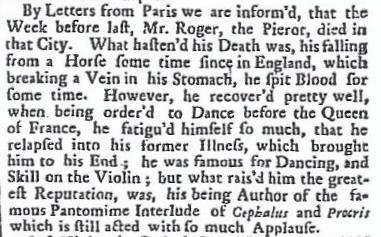
Tragically, Roger’s career was cut short by his sudden death in 1731 in Paris, reported in the Daily Advertiser for 11 November 1731.

I have been aware of Roger since the early days of my research into the life and career of Hester Santlow (later Hester Booth), who danced with and for him during his time at Drury Lane. My work on this short post has highlighted in new ways his significance for the development of stage dancing in early 18th-century London – there is much more to be uncovered about the dances and pantomimes he created at Drury Lane in the late 1720s. Roger was not the only French dancer to pursue a career in London’s theatres and I hope to look at some of the others in future posts.

References:

Jean-Baptiste Dubos, Réflexions critiques sur la poesie et sur la peinture. 4e. éd. 3 vols. (Paris, 1740). Roger is mentioned in volume III, pp. 288-289. I have not been able to check whether he was also mentioned in the previous edition of 1733.

Jean-Baptiste Dubos, translated by Thomas Nugent, Critical reflections on poetry, painting and music. 3 vols. (London, 1748). Roger is mentioned in volume III, p. 219.

Ifan Kyrle Fletcher, ‘Ballet in England, 1660-1740’ in Ifan Kyrle Fletcher, Selma Jeanne Cohen and Roger Lonsdale, Famed for Dance (New York, 1960), 5-20 Roger is mentioned on p. 17.

Philip H. Highfill Jr, Kalman A. Burnim and Edward A. Langhans, A Biographical Dictionary of Actors, Actresses, Musicians, Dancers … in London, 1660-1800. 16 vols. (Carbondale, 1973-1993). The entry for Roger is in volume 13.

Mercure de France, juillet 1729, p. 1661

Mercure de France, août 1729, p. 1846

Lady Dancing Masters in 18th-Century England

I recently watched another dance history video in the very informative series compiled and published by Carlos Blanco, which draws inspiration from the rich resources of the Biblioteca Nacional de España. In this video (which can be found on YouTube) four historical dance experts consider the question ‘Is there Sexism or Misogyny in Dance Treatises?’ Inevitably, the topic of female dancing masters arose, in the context of the discussion focussing on the USA and Great Britain, and it proved difficult to identify or name any – indicating a gap in published research. In the course of my own work, which is mostly limited to England and particularly London, I have come across several women who taught dancing – lady dancing masters. My list is very far from exhaustive (and at least one name is questionable), but I thought it might be of interest to write a post about them and perhaps reveal or encourage further research. There has been some work which includes this topic and I have included a list for further reading at the end.

The first of these women is the questionable one. Peggy Fryer was billed as acting and dancing at the Little Theatre in the Haymarket on 28 January 1723. The advertisements declared that she was aged seventy-one and had ‘taught three Queens to dance’. She had previously appeared at the Lincoln’s Inn Fields Theatre on 11 January 1720, ‘it being the first time of her Appearing on any stage since the Reign of King Charles II’, and she was then said to be eighty-five years old. Without a great deal more research, it is difficult to discern whether there was any truth at all in these conflicting announcements. If Peggy Fryer had indeed ‘taught three Queens to dance’, who might they have been? My thoughts turned to Charles II’s Queen, Catherine of Braganza, and his two nieces Mary (later Queen Mary II) and Anne (later Queen Anne), although there are other candidates. Would someone like Peggy Fryer have been called in to teach any of them, when there was a royal dancing master – Jerome Gahory – to do so?

With the second of these lady dancing masters we are on much surer ground. Mrs Elford emerges into view on 5 July 1700 at Lincoln’s Inn Fields, where she is billed as dancing a ‘new Entry, never performed but once’, She was obviously already established as a leading dancer and would later be billed alongside Anthony L’Abbé as his regular dancing partner. The collection of L’Abbé’s stage dances published in the mid-1720s includes a duet to the passacaille from Lully’s opera Armide danced by Ann Elford and Hester Santlow. The earliest evidence for Mrs Elford as a teacher dates to 12 September 1705, when dancing ’By a little Girl, Mrs Elford’s scholar’ was advertised at Lincoln’s Inn Fields. Mrs Elford’s career as a stage dancer seems to have ended in 1706, by which time she was probably already teaching regularly. The first record of her work beyond the world of the London stage dates to 1711, when she was teaching Mary Bankes of the Bankes family of Kingston Lacey. Mrs Elford’s later activities are less easy to trace, although she is recorded as teaching the daughters of the second Duke of Montagu between 1720 and 1729.

The next woman to be recorded as teaching dance in England was one of the most notable dancers to appear on the 18th-century London stage. Marie Sallé first danced in London as a child, during the 1716-1717 season at Lincoln’s Inn Fields. She returned to dance there as a young woman in 1725-1726 and made her last London appearances at the Covent Garden Theatre during the 1734-1735 season. For Mlle Sallé’s benefit at Lincoln’s Inn Fields on 6 April 1727 the bill included a ‘Pastoral by Miss Rogers, a Child of Nine Years of Age, Scholar to Mlle Sallé’. Elizabeth Rogers would later enjoy a career as a singer and actress, as well as a dancer. When she was billed again at Lincoln’s Inn Fields on 5 April 1731, dancing a Saraband and Tambourin, she was advertised as ‘Scholar to Salle’. Marie Sallé’s brother Francis remained in London when she returned to France and made his career there. It is not surprising that he took over some of his sister’s teaching. However, a continuing link between Marie Sallé and Elizabeth Rogers is suggested by the latter’s appearance as a Bacchante in Bacchus and Ariadne (a ballet attributed to Mlle Sallé) when it was given within The Necromancer at Covent Garden on 26 February 1734. Marie Sallé is the first of my lady dancing masters for whom there is a portrait. In fact there are several, this is a print of the painting by Nicolas Lancret.

My third lady dancing master appeared on the London stage much later in the 18th century. Marie-Louise Hilligsberg began her career at the Paris Opéra in the early 1780s, making her first visit to London during the 1787-1788 season to appear at the King’s Theatre. She returned to Paris for a little over a year, but when she failed to get the promotion she expected at the Opéra she returned to London in 1789. Mme Hilligsberg continued to dance in London, mostly at the King’s Theatre but also elsewhere, until she retired from the stage in 1803. She was well-known for her travesti roles as well as her more conventional ones. Here are portraits of her in both guises: a print showing her in the ballet Le Jaloux Puni and a painting by Hoppner.

In 1796, she appeared in the ballet Little Peggy’s Love at the King’s Theatre (perhaps in the title role) for which the ‘Pantomime and Principal Steps’ were created by Didelot. Some years later, in 1799, this ballet was performed by several young aristocrats at a private party thrown by Lord and Lady Shaftesbury. As newspaper reports make clear, this amateur performance was mounted by Mme Hilligsberg, who also coached the child dancers in their roles. There are more details in my 2017 post A Favourite Ballet. Mme Hilligsberg is also known to have given dancing lessons to Lady Harriet Montagu and she may well have had other pupils during her years in England. She retired from the stage in 1803 and died in France the following year.

I have to return to the early 1700s for my next lady dancing master, who bridges a divide between professional dancers who became teachers and those who pursued the teaching of dance without having a stage career. Ann Roland was the sister of the well-known dancer Catherine Roland. She made her London debut at Drury Lane on 18 November 1735, described as ‘lately arrived from Paris’ and dancing alongside her sister. She continued to dance in London until 1743, mainly at the Covent Garden Theatre, and then moved to Dublin for the 1743-1744 season where she acted and apparently sang as well as dancing. Her extensive repertoire ranged from a Tambourine solo, through duets including The Louvre and the minuet, to leading dancing roles in a number of popular pantomimes. Around 1745 she married the Irish violinist Francis Fleming, with whom she had three daughters. Ann Fleming’s subsequent career as a lady dancing master is not easy to trace, but she is said to have begun teaching with her husband in and around Bath in the late 1740s. According to an advertisement in the Salisbury and Winchester Journal for 25 September 1752, announcing Mr Fleming’s return from Paris ‘where he has completed himself in the Art of Dancing’ he and his wife were then teaching at a boarding school in Bath as well as giving private lessons to young ladies and gentlemen. There is no known portrait of Ann Roland Fleming, who died in 1759.

Francis Fleming may have begun to involve his eldest daughter Ann Teresa in teaching soon after the death of her mother (when she would have been thirteen or fourteen years old). She was certainly his assistant by 1768, as the Bath Chronicle for 3 November 1768 reported that ‘Mr. and Miss Fleming, … have been in Paris this summer’ learning the ‘true Step of the Cotilions with the additional Graces of the Minuets’ and that they would both be teaching at another boarding school in Bath, as well as giving private lessons to ladies and gentlemen. Ann Teresa Fleming took over her father’s dancing academy when he died in 1778 and quickly became the most famous teacher of dancing in Bath, where she continued to work until her retirement in 1805. Her balls for her scholars, held several times each year at both the Upper and Lower Assembly Rooms, were often reported in detail in the Bath Chronicle. Her importance is perhaps best shown by the fact that she is one of very few dancing masters, male or female, for whom we have a portrait (now in the collections of the Victoria & Albert Museum), which has been linked to the studio of Sir Joshua Reynolds:

Miss Fleming died in 1823 and was accorded a quite lengthy obituary in the Bath Chronicle for 18 February 1823.

For nearly twenty years, Ann Teresa Fleming ran her school with her younger sister Kitty. When she retired she was succeeded by Miss Le Mercier, who had become her assistant in the mid-1790s and would continue the school – as another lady dancing master – until around 1811. Another assistant to Miss Fleming had been Elizabeth Rundall, who in 1796 married the actor Robert Elliston and around the same time set up her own school in Bath in partnership with Kitty Fleming. Mrs Elliston’s school was notably successful. Like Ann Teresa Fleming, she held regular balls for her pupils in Bath’s Upper Assembly Rooms – the Bath Chronicle for 10 December 1803 reports that the Duchess of Devonshire was to attend ‘Mrs Elliston’s Ball’. Elizabeth Elliston left Bath for London in 1812 (her husband was by then a leading actor in the company at Drury Lane) and her sister Miss D. C. Rundell took over her Bath school.

The ladies I have mentioned in this post were undoubtedly just a few of the many lady dancing masters who taught in England from the seventeenth to the early nineteenth century. Some worked with their dancing master husbands and were seldom mentioned as teachers in their own right. Others were well-known and admired for their dancing and teaching skills. Further research will surely uncover many more lady dancing masters within surviving historical records.

Further Reading:

Quotations from advertisements for stage performances are taken from the appropriate volumes of The London Stage, 1660-1800.

For Peg Fryer see: the entry ‘Fryer, Margaret, later Mrs Vandervelt, c.1635-1747, actress, dancer’ in Philip H. Highfill Jr et al. A Biographical Dictionary of Actors. 16 vols. (Carbondale, 1973-1993), Vol. 5.

For Ann Elford see: Jennifer Thorp, ‘Mrs Elford: stage dancer and teacher in London, 1700-1730’, in Ballroom, Stage and Village Green: Contexts for Early Dance, ed. Barbara Segal and William Tuck (Early Dance Circle, 2015), 53-60.

For Marie Sallé as a teacher, in Paris as well as in London, see: Sarah McCleave, ‘Marie Sallé, a Wise Professional Woman of Influence’, in Women’s Work: Making Dance in Europe before 1800, ed. Lynn Matluck Brooks (Madison, Wis., 2007), 160-182 (pp. 168-171)

For Marie-Louise Hilligsberg, see: the entry in A Biographical Dictionary of Actors, Vol. 7; Ivor Guest, The Ballet of the Enlightenment (London, 1996);  Katrina Faulds, ‘Opera Dances’, chapter 6 in A Passion for Opera: The Duchess and the Georgian Stage (Kettering, 2019), 91-99 (pp. 95-96).

For Ann Roland Fleming, see: the entry for Ann Roland in A Biographical Dictionary of Actors, Vol. 13, as well as the sources listed below for her daughter and successors.

For Ann Teresa Fleming, Miss Le Mercier and Elizabeth Elliston, together with other lady dancing masters in Bath, see: Trevor Fawcett, ‘Dance and Teachers of Dance in Eighteenth-Century Bath’, Bath History, 2 (1988), 27-48; Mathew Spring, ‘The Fleming family’s dance academy at Bath 1750-1800’, in Ballroom, Stage and Village Green: Contexts for Early Dance, ed. Barbara Segal and William Tuck (Early Dance Circle, 2015), 47-52.

Season of Dancing: 1714-1715

It is quite some time since I have explored dancing in one of the seasons on the London stage, and quite a while since I have been able to publish a post on Dance in History as I have been busy with other research and writing. Nearly three years ago, I posted Season of Dancing: 1716-1717 to try to place in context the first performances of John Weaver’s The Loves of Mars and Venus. I have been thinking about Weaver and his work over the past year and more, so I thought I would look back a little further to see what was happening on the London stage in the preceding seasons and what light that might shed on Weaver’s ground-breaking ballet. The starting point of 1714-1715 is, of course, determined by the opening of the Lincoln’s Inn Fields Theatre that season and the return to theatrical competition for the first time since 1710-1711. In the past, I have also considered the wider context in my Year of Dance posts for 1714 to 1717.

Drury Lane opened for the 1714-1715 season on 21 September 1714 and the company gave 217 performances (including during its summer season) by the time it closed on 23 August 1715. The King’s Theatre opened on 23 October 1714 but, as London’s opera house, gave far fewer performances – only 42 by the time it closed on 27 August 1715. Lincoln’s Inn Fields reopened on 18 December 1714, following the decision of the new King George I to allow John Rich the use of his patent after some years of silence. By 31 August 1715 Rich’s new company had given 130 performances, a sign of its weakness against the senior established company at Drury Lane.

All three companies included dancing among their entertainments. The statistics for these offerings are interesting. Drury Lane offered entr’acte dancing in a little over 20% of its performances. At the King’s Theatre around 19% of its performances were advertised with dancing. Lincoln’s Inn Fields included entr’acte dancing in 96% of its performances, a startling statistic that proves the importance that Rich attached to dance from the very beginning of his career as the manager of one of London’s patent theatres.

The immediate change wrought by the reopening of Lincoln’s Inn Fields and the return to competition is highlighted by a few statistics from the 1713-1714 season, when the only theatres allowed to mount performances were Drury Lane and the then Queen’s Theatre. Drury Lane advertised 196 performances but included entr’acte dancing only during the benefit and summer seasons for around 11 % of the total. The Queen’s Theatre advertised dancing at only one of its 31 performances that season, with no mention of the dancers. However, the opera house’s practice of minimal advertising (because its performances were offered on subscription) make it very difficult to know how much dancing was actually offered there each season throughout much of the eighteenth century.

Returning to 1714-1715, Drury Lane billed a total of thirteen dancers (eight men and five women) in entr’acte dances, although only five of them – three men (Wade, Prince and Birkhead) and two women (Mrs Santlow and Mrs Bicknell) – gave more than a handful of performances. The advertisements suggest that Mrs Santlow and Mrs Bicknell were the chief draw when it came to entr’acte dancing. None of the men were named in advertisements before the early months of 1715, when Rich’s dance strategy had become obvious. Both Hester Santlow and Margaret Bicknell were well established as dancer-actresses with the company. John Wade and Joseph (or John) Prince were both specialist dancers, while Matthew Birkhead was an actor, singer and dancer.

Lincoln’s Inn Fields advertised eighteen dancers (fourteen men and four women) in the entr’actes during the season, but – as at Drury Lane – only ten of them were billed for more than a handful of performances. Ann Russell and Mrs Schoolding appeared throughout the season and both apparently made their London stage debuts following Rich’s opening of the theatre. Miss Russell was a dancer and would remain one throughout her career, without making the usual transition to a dancer-actress. She married Hildebrand Bullock, a member of the well-known acting family, on 3 May 1715 and would thereafter be billed as Mrs Bullock. Mrs Schoolding seems to have begun an acting career at Lincoln’s Inn Fields, alongside her appearances as a dancer. Letitia Cross was not billed until 5 July 1715 but gave at least ten performances before the end of the season. She had already enjoyed a long career as an actress, a singer and a dancer. Three of the men – Anthony Moreau, Louis Dupré and William Boval – made their London stage debuts this season. Newhouse may have appeared elsewhere in earlier seasons, but his appearance at Lincoln’s Inn Fields on 8 February 1715 is the first record of him dancing at one of the patent theatres. Charles Delagarde was well established as a dancer and dancing master. John Thurmond Junior had appeared in London in earlier seasons, as had Sandham. All the men were specialist dancers.

The dancers who appeared regularly in the entr’actes could be said to form a ‘company within the company’ at each playhouse, even though several of them (the women in particular) acted as well as danced. Both acting companies mounted plays that included significant amounts of dancing in 1714-1715, but no casts were listed by either theatre in advertisements so it is impossible to be sure of the involvement of the dancers alongside the actors and actresses who danced only occasionally.

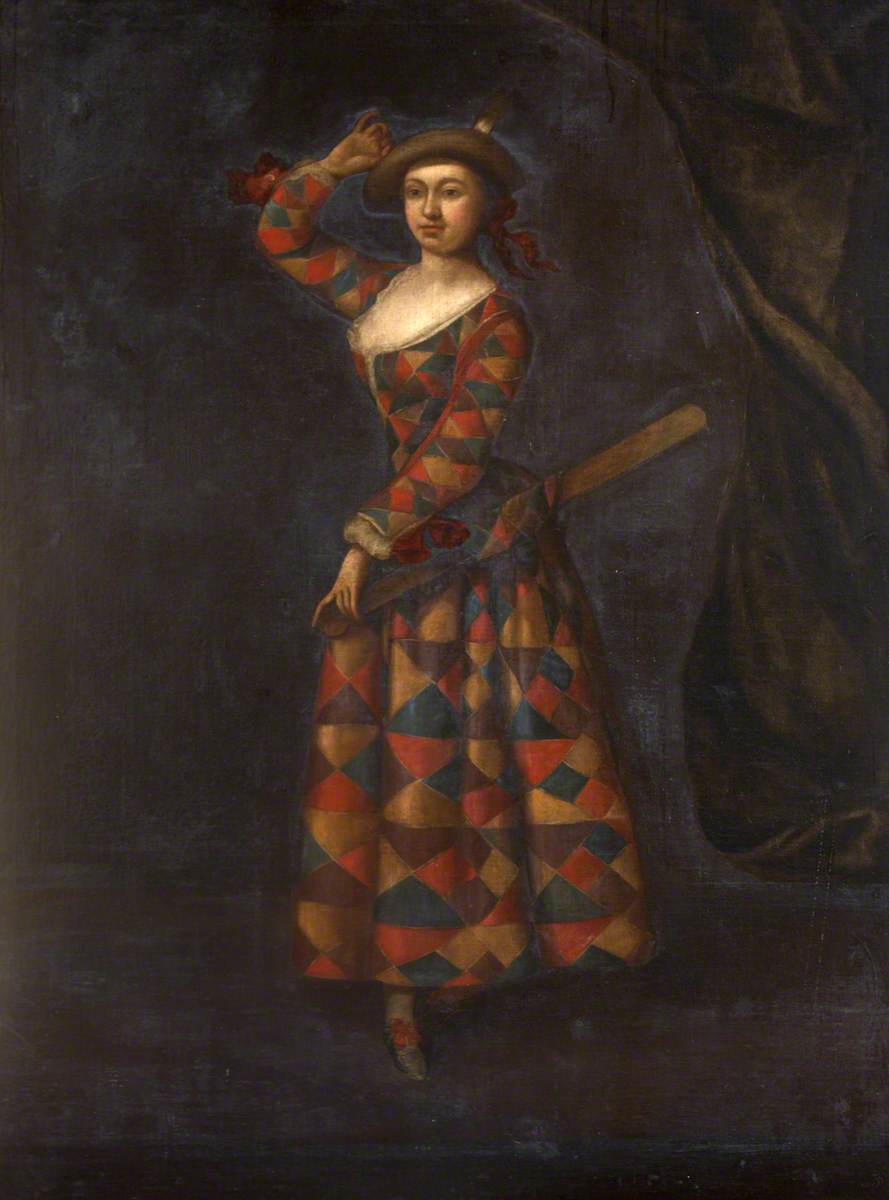
As for the entr’acte dances, Drury Lane offered nine, while Lincoln’s Inn Fields advertised seventeen. Drury Lane rarely mentioned specific dances in its advertisements, so it is impossible to know whether the repertoire was more extensive or which dances were the most popular.  It seems likely that Mrs Santlow’s solo Harlequin was among the latter. She was billed in it twice during 1714-1715 and the dance had been popular since she first performed it, perhaps as early as 1706. This is the less familiar version of her portrait as Harlequine, the one she owned herself which shows her skirt at the length she probably wore for performance.

It was one of only two dances advertised by Drury Lane before the opening of Lincoln’s Inn Fields, after which the theatre did not bill dance titles again until the benefit season began. The theatre’s managers were initially slow to grasp the value of dancing to attract audiences in the new atmosphere of rivalry. Other dances that may have been more popular than the bills suggest were the duets Dutch Skipper and French Peasant, the first given by Wade and Mrs Bicknell and the second by Wade and Mrs Santlow. Both had become part of the entr’acte repertoire not long after 1700 and would remain popular into the 1740s.

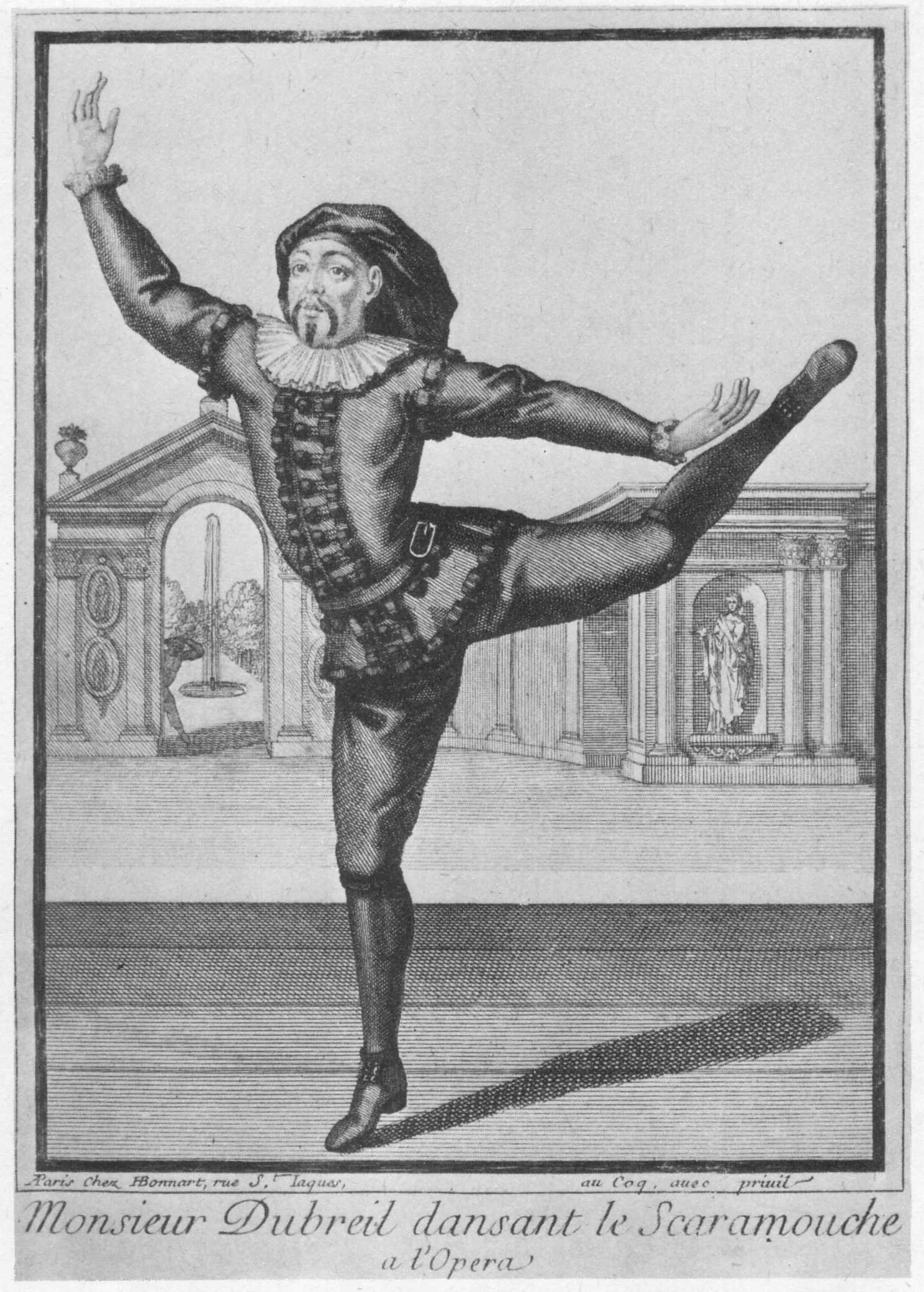
At Lincoln’s Inn Fields, the Dutch Skipper – first given on 6 January 1715 by Delagarde and Miss Russell – was far and away the most popular entr’acte dance, advertised twenty times by the end of the season. It was followed by a solo Scaramouch, performed on 5 February 1715 ‘by a Gentleman for his Diversion’ who gave it seven times during the season. John Thurmond Junior also danced a solo Scaramouch from 16 May 1715, when he was billed as ‘lately arrived from Ireland’. Scaramouch was already a familiar dancing character in London. John Thurmond Junior had been billed dancing the role ‘as it was performed by the famous Monsieur du Brill from the Opera at Brussels’ back in 1711. This print shows Pierre Dubreuil as Scaramouch about that time and suggests the acrobatic skills that Thurmond Junior may have emulated.

There were six entr’acte dances involving Scaramouch this season, with Lincoln’s Inn Fields leading the way and Drury Lane trying to catch up. At Lincoln’s Inn Fields, there was also an Italian Night Scene between Harlequin, Scaramouch and Punch (31 March 1715) and Scaramouches (18 April 1715, apparently a group dance although no dancers were named). Drury Lane replied with a Scaramouch and Harlequin (31 May 1715), a Tub Dance between a Cooper, his Wife, his Man, Scaramouch and Harlequin (2 June 1715) and Four Scaramouches (also 2 June 1715). In these dances, Harlequin would have been performed by one of the male dancers in the company. The four Scaramouches were probably danced by Prince, Wade, Sandham and Newhouse, who were listed in the bill (they also shared between them the male roles in the Tub Dance).

Delagarde and Miss Russell have a good claim to be the leading dancers at Lincoln’s Inn Fields this season, not only because of the number of their appearances (he was billed 65 times and she on 82 occasions) but also for their repertoire. As well as the Dutch Skipper, they performed a Spanish Entry, a Swedish Dance, a Venetian Dance and, most notably, The Friendship a new dance by Mr Isaac (who had been Queen Anne’s dancing master) which was also published in notation. The last of these may have been given before George I when he made his only visit of the season to Lincoln’s Inn Fields, on 10 March 1715 (he had visited Drury Lane on 5 January 1715). The new King was not proficient in English so limited his attendance at plays, preferring the Italian opera at the King’s Theatre. No serious dances were advertised at Drury Lane this season, whereas at Lincoln’s Inn Fields the Spanish Entry, an Entry and Mrs Bullock’s solo Chacone, given later in the season, can probably be assigned to the genre.

The 1714-1715 season should probably be seen as one of transition, at least so far as the dancing was concerned, as Drury Lane adjusted to the return of theatrical competition after enjoying several years of monopoly and Lincoln’s Inn Fields tried to gauge how it would deal with the dramatic superiority of its rival. Both theatres had to assess the impact of a new monarch and a new royal family on London’s theatrical life. In the following season of 1715-1716, they began to develop responses that would have a lasting effect on the entertainments of dancing to be seen on the London stage.

The Necromancer at 300

At the Lincoln’s Inn Fields Theatre, the manager John Rich had been watching Drury Lane’s developing repertoire of pantomimes and he was quick to respond to the success of Harlequin Dotor Faustus. On 20 November 1723, the afterpiece at Lincoln’s Inn Fields was ‘A New Dramatick Entertainment in Grotesque Characters’ entitled The Necromancer; or, Harlequin Doctor Faustus. Here is the advertisement from the Daily Courant that same day.

Rich himself, under his stage name ‘Lun’, took the title role. The new pantomime was given 51 performances before the end of the season and then played every season until 1744-1745. It was briefly revived in 1751-1752 and 1752-1753 before it finally disappeared from the repertoire.

The Necromancer was far more successful than Thurmond Junor’s Harlequin Doctor Faustus. It is thus interesting to note that in 1766-1767 Henry Woodward (who had been trained in the role of Harlequin by John Rich) produced a new pantomime at the Covent Garden Theatre titling it simply Harlequin Doctor Faustus. The advertisements declared that it drew on The Necromancer for some of its scenes, but it seems to have had little or nothing to do with Thurmond Junior’s original.

Rich’s pantomimes made much use of singing and The Necromancer had two scenes which exploited the talents of the singers in his company. The opening scene echoed that of Harlequin Doctor Faustus, as the Doctor is persuaded to sign away his soul, but Rich had a Good Spirit, a Bad Spirit and (instead of Mephostophilus) an Infernal Spirit, all of whom made their entreaties in song. A drawing now in the British Museum shows Faustus together with the Infernal Spirit in this scene.

There is a dance of five Furies in this same scene (which may have been a nod to French opera, which was a strong influence on Rich and his pantomime productions). The Infernal Spirit finally induces Faustus to take his fatal step by conjuring the appearance of Helen of Troy, who does not dance but sings. Rich’s creative response to his rival’s scenario can be seen from the very beginning of The Necromancer. The second episode of singing begins the final scene of the pantomime, when Faustus himself conjures Hero and Leander, who celebrate in song their eternal bliss in the Elysian Fields until Charon arrives and declares (again in song) his intention to ferry them to Hell.

The Lincoln’s Inn Fields pantomime was far more focussed than its rival at Drury Lane. It had only eight scenes, three of which were purely transitional – as characters entered and left the stage linking the scenes before and after with the minimum of action, a device that Thurmond Junior did not really use. The whole action of The Necromancer was published in An Exact Description of the Two Fam’d Entertainments of Harlequin Doctor Faustus … and The Necromancer of 1724. The first performances of the pantomime were accompanied by The Vocal Parts of an Entertainment, call’d The Necromancer : or, Harlequin Doctor Faustus which must have appeared before the end of 1723. There was also a series of editions of A Dramatick Entertainment call’d The Necromancer: or, Harlequin Doctor Faustus which gave only the sung texts. Without An Exact Description, we would know little about the comic action in The Necromancer.

There was dancing in five of the eight scenes. In scene 5, two men enter as Faustus is enjoying a meal with two Country Girls. He tells the men’s fortunes, which they reject and then try to make off without paying him. As they leave, Faustus ‘brings ‘em back on their Hands, making ‘em in that Posture dance a Minuet round the Room’.

In the following scene the dancing was probably more conventional, for the location moves to a Mill where the Miller’s Wife dances a solo before she is joined by the Miller for a duet. Their choreography may have owed something to the various Miller’s dances which had been given in the entr’actes at London’s theatres since the early 1700s. The scene carried on with one of the pantomime’s more daring scenic tricks, as Faustus tries to elude the Miller and make off with his wife, finally fixing the Miller to one of the sails of his own Mill and setting them turning.

Rich’s masterstroke was the finale of The Necromancer, which may have been developed in response to little more than a hint in Thurmond Junior’s Harlequin Doctor Faustus. In the latter, Mephostophilus ‘flies down upon a Dragon’ in the first scene, but Rich reserved the appearance of his monster to the end of his pantomime. As soon as Hero, Leander and Charon have vanished:

‘The Doctor waves his Wand, and the Scene changes to a Wood; a monstrous Dragon appears, and descends about half way down the Stage, and from each Claw drops a Daemon, representing divers grotesque Figures, viz. Harlequin, Punch, Scaramouch, and Mezzetin. Four Female Spirits rise in Character to each Figure, and join in an Antick Dance;’

This was probably the most substantial sequence of dancing in the pantomime, performed by the company’s leading dancers with Dupré and Mrs Rogier as the Harlequins, Nivelon Junior and Mrs Cross as the Pierrots (Punch is not listed among these dancing Spirits in the advertisements although he did appear in the pantomime, played by Nivelon Senior i.e. Francis Nivelon), Glover and Mrs Wall as the Mezzetins and Lanyon and Mrs Bullock as Scaramouches. Dupré was, of course, a dancing Harlequin and his performance in this last scene must have been very different from John Rich’s in the title role. The dance historian Richard Semmens has suggested that this ‘Antick Dance’ was performed to a chacone, a piece which is included among music for The Necromancer published some years later. The scene then moves inexorably to its tragic conclusion.

‘as they are performing, a Clock strikes; the Doctor is seiz’d by Spirits, and thrown into the Dragon’s Mouth, which opens and shuts several times, ‘till he has swallow’d the Doctor down, belching out Flames of Fire, and roaring in a horrible Manner. The Dragon rises slowly; the four Daemons that drop from his Claws, take hold of ‘em again, and rise with it; the Spirits vanish;’

Rich did not bother with a masque to point the moral of his tale. The Necromancer ends with a sung chorus:

Now triumph Hell, and Fiends be gay,

The Sorc’rer is become our Prey.

In contrast to Harlequin Doctor Faustus, evil apparently triumphs at the end of The Necromancer.

It has been suggested that Rich was preparing The Necromancer as a new pantomime for Lincoln’s Inn Fields well before Drury Lane mounted Harlequin Doctor Faustus, but the coincidence seems unlikely and does not fit with his later practice. Could he instead have been developing another theme and then quickly repurposed its tricks and transformations to outdo Drury Lane with its own story?

References:

Richard Semmens, Studies in the English Pantomime, 1712-1733 (Hillsdale, NY, 2016), chapter 3.

Olive Baldwin and Thelma Wilson, ‘“Heathen Gods and Heroes”: Singers and John Rich’s Pantomimes at Lincoln’s Inn Fields’, “The Stage’s Glory” John Rich, 1692-1761, ed. Berta Joncus and Jeremy Barlow (Newark, NJ, 2011), 157-168.

Harlequin Doctor Faustus at 300

How many people (including dance historians) have heard of the pantomime Harlequin Doctor Faustus, which celebrates its 300th birthday this year? It wasn’t the first English pantomime but it began a craze for these afterpieces which established this unique genre of entertainment on the London stage.

John Thurmond Junior’s Harlequin Doctor Faustus was first given at the Drury Lane Theatre on 26 November 1723. Here is the advertisement in the Daily Courant that same day:

It reveals the importance of commedia dell’arte characters, from Harlequin to Punch, as well as those from classical mythology, as part of its appeal to audiences. The emphasis on ‘Scenes, Machines, Habits and other Decorations’, all of which were ‘intirely New’ reveals the hopes of Drury Lane’s managers that the afterpiece would prove a money spinner. These were justified, at least for a while, for Harlequin Doctor Faustus was performed forty times before the end of 1723-1724 and was revived every season until 1730-1731. Its subsequent disappearance from the Drury Lane repertoire was probably due to the actors’ rebellion at the theatre at the end of the 1732-1733 season and the ensuing instability of the company. Harlequin Doctor Faustus was revived for eight performances in 1733-1734 but then disappeared altogether.

John Thurmond Junior was the son of the actor John Thurmond (hence his epithet) and seems to have begun his career on the Dublin stage. As a dancer, his repertoire ranged from the serious through the comic to the grotesque. His commedia dell’arte character was Scaramouch and he created the role of Mephostophilus in Harlequin Doctor Faustus. Thurmond Junior created several pantomimes for Drury Lane, notably Apollo and Daphne; or, Harlequin Mercury (first given on 20 February 1725) in which he used the serious part (with the title roles played by dancers – himself and Mrs Booth) to emulate John Weaver’s dramatic entertainments of dancing.

Harlequin Doctor Faustus and John Rich’s The Necromancer; or, Harlequin Doctor Faustus (first performed less than a month later, which I will also write about), Lincoln’s Inn Fields Theatre’s answer to Drury Lane’s pantomime, were so successful that scenarios for both were quickly printed. There are at least four different published versions of Harlequin Doctor Faustus, the most detailed of which brings both pantomimes together in print and probably appeared in 1724. Here is the title page:

This sets down the action in sixteen successive scenes, beginning in ‘The Doctor’s Study’ where Faustus signs away his soul and Mephostophilus ‘flies down upon a Dragon, which throws from its Mouth and Nostrils Flames of Fire’ to take the contract from him and present him with a white wand ‘by which he has the Gift and Power of Enchantment’. The following scenes present a frenzy of action with many tricks and transformations as well as a generous scattering of dances. Faustus was performed by John Shaw, whose formidable dance talents encompassed a wide range of styles (I have mentioned him in a number of previous posts).

The fourth scene turns to classical literature. Faustus and three ‘Students’ (in the characters of Scaramouch, Punch and Pierot) are drinking together when the table at which they are sitting:

‘… upon the Doctor’s waving his Wand, rises by degrees, and forms a stately Canopy, under which is discover’d the Spirit of Helen, who gets up and dances; and on her return to her Seat, the Canopy gradually falls, and is a Table again.’

‘Helen’ is, of course, Helen of Troy. Scene fourteen ends with a scenic spectacle as Doctor Faustus and his companions try to escape a pursuing mob by locking themselves into a barn. When the mob force a way in, they escape down the chimney ‘but the Doctor, as he quits the Barn-Top, waves his Wand and sets it all on Fire; it burns some time, very fiercely, and the Top at last falling in, the Mob, in utmost Dread, scour away’.

Scene fifteen returns to the Doctor’s study as his agreement with the Devil expires and he is accosted first by Time and then by Death, who strikes Faustus down.

‘Then two Fiends enter, in Lightning and Thunder, and laying hold of the Doctor, turn him on his Head, and so sink downwards with him, through Flames, that from below blaze up in a dreadful Manner; other Dæmons, at the same Time, as he is going down, tear him Limb from Limb, and, with his mangled Pieces, fly rejoicing upwards.’

Thurmond Junior’s pantomime did not end there, for a final scene revealed ‘A Poetical Heaven. The Prospect terminating in plain Clouds’ in which ‘several Gods and Goddesses are discover’d ranged on each Side, expressing the utmost Satisfaction at the Doctor’s Fall’. They perform a series of dances, beginning with a duet by Flora and Iris, then a ‘Pyrrhic’ solo by Mars (danced by Thurmond Junior), a duet by Bacchus and Ceres, followed by a solo for Mercury (danced by John Shaw) ‘compos’d of the several Attitudes belonging to the Character’. This ‘Grand Masque of the Heathen Deities’ was a divertissement of serious dancing and culminated as ‘the Cloud that finishes the Prospect flies up, and discovers a further View of a glorious transcendent Coelum’ revealing:

Diana, standing, in a fix’d Posture on an Altitude form’d by Clouds, the Moon transparent over her Head in an Azure Sky, tinctur’d with little Stars, she descends to a Symphony of Flutes; and having deliver’d her Bow and Quiver to two attending Deities, she dances.’

Diana was performed by Hester Booth, the leading dancer on the London stage. The newspapers were dismissive of the comic scenes in Harlequin Doctor Faustus, but they were agreed on the magnificence of the concluding masque and the beauty of Mrs Booth’s dancing. Both the comic and the serious parts of Thurmond Junior’s pantomime would influence many future productions.

It is frustrating that we have next to no evidence of this or most other 18th-century pantomimes. There are no records of costumes or scenery and such music as seems to survive may, or may not, belong to this production. No portrait of John Thurmond Junior is known. The nearest we can get is the satirical engraving ‘A Just View of the British Stage’ which castigates the Drury Lane management for their pantomime productions. Thurmond Junior may be the dancing master (identifiable by his pochette) shown hanging towards the top right of the print.

References:

Moira Goff, ‘John Thurmond Junior – John Weaver’s Successor?’, Proceedings, Society of Dance History Scholars, Twenty-Sixth Annual Conference, University of Limerick, Limerick, Ireland, 26-29 June 2003 (Stoughton, Wisconsin, 2003), pp, 40-44.

Moira Goff, The Incomparable Hester Santlow (Aldershot, 2007), pp. 115-117.

Richard Semmens, Studies in the English Pantomime, 1712-1733 (Hillsdale, NY, 2016), chapter 2

Anthony L’Abbé. The Prince of Wales’s Saraband

The notation for Anthony L’Abbé’s ballroom dance The Prince of Wales’s Saraband is one of the exhibits in Crown to Couture at Kensington Palace (the exhibition closes on 29 October 2023). It is shown out of context and with next to no explanation of its meaning so, although I have written about the dance elsewhere, I thought it would be worth a post in Dance in History to provide some information about this beguiling duet.

The Prince of Wales’s Saraband was one of a series of dances created by Anthony L’Abbé and published in Beauchamp-Feuillet notation by Edmund Pemberton following L’Abbé’s appointment by George I as royal dancing master around 1715. The title page makes clear that this was one of the dances choreographed by L’Abbé to celebrate the birthday of Queen Caroline, wife of King George II and mother of the Prince.

Her birthday was on 1 March and it had been celebrated at court since at least 1717, when L’Abbé’s ballroom dance The Royal George was created and published for that purpose. In that case, the title page of the dance makes no reference to the then Princess of Wales but the advertisements for the notation make it clear that the dance was in her honour.

By 1731, Caroline had been Queen for fewer than four years and L’Abbé had not published a dance since the Queen Caroline which honoured her birthday in 1728. In 1731, there was a birth night ball for the Queen and the report in the Daily Advertiser for 3 March 1731 gives us some details.

There is no mention of L’Abbé’s dance, although Frederick Prince of Wales ‘open’d the Ball’ by dancing a minuet with his sister Anne the Princess Royal. The reference to the illumination of the houses of all three of the actor-managers of the Theatre Royal, Drury Lane, is interesting, for The Prince of Wales’s Saraband was performed in the entr’actes at that theatre on 22 March 1731 by William Essex and Hester Booth. That first public performance was obviously also intended to honour the Queen.

The dance seems to have been admired, for it was revived at the Haymarket Theatre on 21 August 1734 and again at Drury Lane on 17 May 1735, each time performed by Davenport and Miss Brett. It was revived again at Covent Garden on 25 April and 13 May 1737, by Dupré (probably the dancer James Dupré) and Miss Norman.

Prince Frederick had remained in Hanover following the accession of his grandfather as George I in 1714. He came to England only in 1728, eighteen months after the accession of his parents to the British throne. By this time, the prince was twenty-one and he joined a family which included four sisters and a brother whom he scarcely knew. This portrait by Philippe Mercier shows Prince Frederick in the mid-1730s.

Prince Frederick’s relationship with his parents, particularly his mother Queen Caroline, became steadily more difficult after his arrival in England. In 1731, the year The Prince of Wales’s Saraband was created, this problem lay in the future.

The Prince of Wales’s Saraband, as notated, is ostensibly an undemanding ballroom dance of 48 bars of music with the familiar AABB musical structure (A=10 B=14). The choreography is divided between four plates of notation (which by this time was Pemberton’s regular practice and probably reflects the expense of paper for printing). Plate 1 records the two A sections (20 bars of dance and music) and plate 2 the first B section. Plate 3 has bars 1 – 8 of the second B section and the dance ends on plate 4 with its final 6 bars. This division of the last section of the dance between two plates is dictated by the circular figures traced, which need to be shown separately so that they do not overlap, but also respects the musical phrasing. The layout on each plate may also reflect Pemberton’s aesthetic preferences – his notations for Isaac and L’Abbé include some of the most beautiful examples of this highly specialised genre of engraving.

Closer analysis of the notation reveals that this duet has some complexities and that it demands immaculate style and technique if it is to make an impact. Reconstructing the dance raises a number of questions about those aspects that are not notated – in particular arm movements and the use of the head. In all of these notated ballroom dances, the attention of the two performers seems to be divided between the presence (the guest of honour), each other and the surrounding audience. How much do we really know about the conventions that governed the performance of such dances, either at court or on stage, which should inform our dance reconstructions?

The Prince of Wales’s Saraband opens with a figure based around a temps de courante à deux, in which a temps is followed by a temps de courante, first on the inside foot and then on the outside foot. The notation indicates that the dancers turn their bodies towards the pointing foot on each temps, turning back towards the presence on each temps de courante. Did this mean that they turned their heads the same way or did they look steadfastly forward?

In the remaining bars of the first A section, they turn alternately towards one another and the presence but there are also opportunities to take in the surrounding audience.

The end of the dance, the steps and figures of the its last six bars on the final plate, has the dancers face the presence side-by-side for three bars travelling sideways away from each other and back again. They then turn to perform a pas de bourrée directly upstage, followed by a variant on the pas de bourrée vîte curving away from each other and coming face to face briefly before a coupé into their final réverence.

I can’t help wondering if this sequence was created, in part, to allow the dancers to acknowledge the audience that surrounded them before they made their final honours. The performance of The Prince of Wales’s Saraband at Drury Lane was part of a benefit for Mrs Booth, when some of the audience may have sat around the dancers on the stage (almost as they would have done in the ballroom) as well as in the auditorium. There is no evidence that Queen Caroline herself attended, but the royal box at this period would have been directly opposite the stage in the centre of the first tier just above the pit, providing the dancers with a specific focus.

The step vocabulary of this dance is dominated by the pas de bourrée, with and without a final jetté, extending to the pas de bourrée vîte. There are also a number of variants of the coupé, including the coupé sans poser and the coupé avec ouverture de jambe. It is interesting that, throughout, L’Abbé uses the jetté and not the demi-jetté in pas composés. These add energy and prevent the dance from becoming languid. He also likes to pair steps, although where he repeats these pairings he often introduces an element of variation the second time.

One sequence, on the second plate within the final bars of the B section, is noteworthy and quite challenging to perform.

L’Abbé introduces an element of suspension, in the opening coupé sans poser with a one-beat pause (which comes at the end of the preceding musical phrase), before a pas composé which demands unhurried speed – a pas plié, changement and coupé soutenu to fourth position with a quarter-turn. There is then a coupé avec ouverture de jambe (also with a one-beat pause) before the pas composé is repeated. This sequence ends with another coupé avec ouverture de jambe and a pause, before the B section is completed with two pas balancés.

The Prince of Wales’s Saraband was first performed on stage by Mrs Booth (née Hester Santlow), with whom L’Abbé had worked over many years and for whom he had created several notable choreographies. Could this ostensibly simple, yet demanding, ballroom duet have been created with and for her, intended specifically for performance at her benefit?

Further Reading:

Moira Goff, ‘Edmund Pemberton, Dancing Master and Publisher’, Dance Research, 11.1 (Spring 1993), 52-81

Moira Goff, The Incomparable Mrs Booth (London, 2007), pp. 138-139.

Mr Isaac’s The Richmond

Mr Isaac’s The Richmond was first published in notation in 1706 in A Collection of Ball-Dances Perform’d at Court.

The dance is named first on the title page, probably because the collection was dedicated to the Duke of Richmond, and it seems most likely that the title of the dance was meant as a tribute to him. It may well have been one of the dances that John Weaver (who notated the collection) declared in his dedication to ‘have been Honour’d with your Grace’s Performance’.

The American dance historian Carol Marsh, in her 1985 thesis ‘French Court Dance in England, 1706-1740’, suggested that the choreography dated to more than ten years earlier. As she pointed out, the music was published in The Self-Instructor on the Violin, advertised for publication on 15 July 1695. The duet could perhaps have been performed at the ball held at Whitehall Palace on 4 November 1694 to celebrate the birthday of King William III. The Duke of Richmond, son of Charles II and Louise de Keroualle the Duchess of Portsmouth, had initially been opposed to the changes wrought by the Glorious Revolution. He was reconciled with William III in 1692 and in January 1693 he married Anne Belasyse. He might well have performed The Richmond if and when it was performed at court. This portrait by Godfrey Kneller shows the Duke some ten years after The Richmond may have been created.

The Richmond is a hornpipe in 3/2, often described as a specifically ‘English’ dance and occasionally said to have pastoral connotations. It is distinct from the later duple-time hornpipe often associated with sailors. The dance type was evidently a favourite with Mr Isaac, who also used it in The Union (1707), The Royall (1711) and The Pastorall (1713). Anthony L’Abbé, who became royal dancing master around 1715, included a hornpipe in The Princess Ann’s Chacone (1719) and used the music from Isaac’s The Pastorall for a stage solo for a man, published in notation around 1725 but possibly performed the same year as Isaac’s ballroom duet. He may have been paying tribute to Isaac, who was also his brother-in-law.

This earlier form of hornpipe has attracted the attention of several dance historians (a number of references are given at the end of this post), who between them have noted that hornpipe music first emerges in the 1650s and that it was a dance type that appealed to Purcell, among other late 17th century composers, as well as investigating the characteristic steps of the dance. Purcell was certainly including triple-time hornpipes in his stage music by the 1690s. Among modern historical dance enthusiasts, there is particular interest in the hornpipes included within editions of Playford’s The Dancing Master, under the titles ‘Maggot’, ‘Delight’ or ‘Whim’ – ‘Mr Isaac’s Maggot’ appears in the 9th edition of 1695 – although, sadly, there seems to be little enthusiasm for the exploration of some of the hornpipe pas composés described below (I can’t help thinking that some of the fun in such dances must have been the steps). Triple-time hornpipes continued to be used for dances into the early decades of the 18th century. Fresh research is certainly needed to chart the emergence, rise and decline of this version of the hornpipe within a variety of dance contexts.

My interest here is, of course, the hornpipes within the notated ball dances – in my time, I have had the pleasure of dancing The Richmond, The Union, The Pastorall and The Princess Ann’s Chacone. Only The Richmond is a hornpipe throughout, the other dances pair it with different dance types. The musical structure of The Richmond is more complex than usual for ballroom dances – AABBCCDDEEFF’ (A = B = C = D = E = 4, F=8, F’ = 4) with 52 bars of music in all. The division of the choreography between the six plates of the notation seems to be pragmatic in terms of the steps and figures to be recorded rather than reflecting the musical structure.

As I noted in an earlier post, the opening figure of The Richmond is unorthodox.

The couple travel forwards away from each other on a diagonal before turning inwards to face each other. They turn to face the presence on bar 3, but maintain that orientation for only two bars before turning to face one another again for one bar, after which they turn to face the presence on bar 6. Their steps in the opening figures are rhythmically varied and two-thirds include pas sautés, an indication of the lively nature of this hornpipe.

Mr Isaac’s hornpipes have a distinctive vocabulary of steps. A particular characteristic is his use of three pas composés over two bars of music, found throughout The Richmond. This may take a form in which the same step begins and ends the sequence with two other steps between them (performed on either side of the bar line) which may or may not be the same. One example is found on plate 1 in the opening bars in the form pas de bourrée, saut / jetté, pas de bourrée, while another can be found on plate 2 as pas de bourrée, jetté / jetté, pas de bourrée. In the second case the first step is actually a pas de bourrée vîte, while the second step is a variant which inverts its two elements. In other cases, Isaac begins and ends the sequence with different steps but still has paired steps on either side of the bar line, as on plate 1 with a contretemps, jetté / jetté, pas de bourrée imparfait (i.e. to point). Or, as yet another variation, the sequence may divide a familiar pas composé at the bar line, as an example on plate 2 demonstrates with pas de sissonne, pas de sissonne, pas de bourrée, in which the second pas de sissonne begins in the first bar with its pas assemblé and ends in the second bar with its sissonne. In The Richmond, Isaac is endlessly inventive with this device.

The Richmond is one of the choreographies in which Isaac ornaments some of the man’s steps but not the woman’s. Although, among the six dances published in 1706, only The Spanheim and The Britannia are without such ornamentation. Throughout the dance, there are five bars where this happens and in all cases a pas battu is added on the man’s side. On plate 5 this ornamentation is added in two consecutive bars and coincides with a change from mirror to co-axial symmetry.

Isaac also ornaments the man’s steps right at the end of the dance, altering his sequence of pas composés. Over the final two bars, the woman has coupé emboîté battu, demi- contretemps / jetté, coupé simple, coupé soutenu (with a half-turn into a réverence). The man has coupé emboîté battu, demi-contretemps battu / contretemps à deux mouvements battu, coupé soutenu (the last is his réverence). She turns to travel forwards, while he turns to travel backwards. They do not take hands for these last steps, although they had done so for preceding bars.

There are more linear than circular figures in The Richmond, although Isaac makes effective use of the latter on plates 2 and 6. The relationship between the two dancers and between them and their audience is interesting. If this dance was performed at a formal ball, the couple would probably have had the presence (the King?) in the place of honour centre front as well as an audience of courtiers surrounding them on the other three sides. So where would they have looked as they danced? Plate 1 shows them dividing their attention between the presence and each other. In the first two bars on plate 3, they clearly address the spectators on each side (and at the bottom of the room) before turning towards one another to dance on a right line. There are similar opportunities on plate 5, although the couple are otherwise dancing beside one another and facing the presence.

Working again on this dance, after a gap of many years, I couldn’t help wondering if the arm movements might have been as unconventional as the steps and whether the dancers could direct their lines of vision quite freely as they moved, enabling them to acknowledge not just each other and the presence, but also the encircling audience.

My recent work has raised several questions about the performance of The Richmond and the other dances in the 1706 Collection. The title page states that they were ‘perform’d at court’, but what did this mean? Were they danced as part of a formal display, either at birth night balls or on other such occasions? Were they instead danced at one of the more informal balls at the English court? In his ‘Livre de la contredance du roy’, presented to Louis XIV in 1688 and retranscribed for Louis XV in 1721, André Lorin wrote:

‘Cette cour [the English royal court] divise ces divertissements en Bals serieux, et en Bals ordinaires.

Les serieux se dançent toujours dans un Lieu preparé, ou toute la Cour paroit superbe et magnifique.

Les ordinaires regardent les Contredances qu’on dance avec plus de negligence et dans les apartemens du Roy, où l’on ne va qu’avec les habits ordinaires, afin de dancer avec plus de liberté: …’

The manuscript is now in the Bibliothèque Nationale de France and can be found on Gallica. Lorin was concerned with English country dances, but could the ‘Bals ordinaires’ have included couple dances like The Richmond? Or, if they were indeed given at ‘Bals serieux’, should we think again about the conventions governing the dance displays at such events?

Further reading:

George S. Emmerson, A social history of Scottish dance (Montreal, 1972), chapter 14

The Hornpipe: papers from a conference held at Sutton House, Homerton, London E9 6QJ, Saturday 20th March 1993 (Cambridge, 1993)

Carol G. Marsh, ‘French court dance in England, 1706-1740: a study of the sources’ (PhD thesis, City University of New York, 1985), pp. 243-258.

Barbara Segal, ‘The Hornpipe: a dance for kings, commoners and comedians’, Kings and commoners: dances of display for court, city and country. proceedings of the seventh DHDS conference, 28-29 March 2009 (Berkhamsted, 2010), 33-44

Linda J. Tomko, ‘Issues of Nation in Isaac’s The Union’, Dance Research, XV.2 (Winter 1997), 99-125.

The Richmond is also mentioned in the following posts on Dance in History:

Mr Isaac’s Six Dances

Mr Isaac’s Choreography: The Six Dances – Opening and Closing Figures

Mr Isaac’s Choreography: The Six Dances – Motifs and Steps

‘Francis Thorpe … (known by the name of Isaac)’

Back in 2010, I published an article in Early Music with the title ‘The testament and last will of Jerome Francis Gahory’ in which I put forward the likely identity of the elusive Mr Isaac.  He was, of course, the dancing master who taught Queen Anne, among others, many of whose duets appeared in notation between 1706 and 1716. I have written about several of these dances in previous posts. In 2009, I made the chance discovery of Jerome Francis Gahory’s will which provided a significant clue as to who Mr Isaac actually was. I recently learnt that this information has not reached the wider UK early dance world, so I offer this post in the hope that this will change. Much more information is provided in my 2010 article.

The Frenchman Jerome Francis Gahory became dancing master to Charles II around Christmas 1660. He taught not only the King but also Queen Catherine of Braganza (whose dancing I have also written about), as well as the King’s nieces Princess Mary and Princess Anne. In September 1681, the reversion of Gahory’s post was granted to Francis Thorpe, the significance of which was not apparent until the discovery of Mr Isaac’s identity. Although Gahory is not mentioned in court records after 1688 (when James II fled to France and William III and Mary II became joint sovereigns), he continued to live in London until he died in 1703.

Gahory was buried at St Martin’s in the Fields on 4 June 1703, having made his will on 30 March that same year. The original will and its probate copy can both be found among the documents in the UK’s National Archives. It disposes separately of Gahory’s ‘estate and effects’ in France and in England. The latter are of particular interest to historians of dancing in England. Gahory leaves bequests to Anthony L’Abbé, already a professional dancer on the London stage and later to become a royal dancing master himself, and ‘Mary Thorpe his wife the testator’s niece’. As his executor and heir of the residue of his estate, Gahory names ‘Francis Thorpe his nephew (known by the name of Isaac)’.

If Gahory’s will is not evidence enough of Mr Isaac’s identity, more can be found elsewhere. Francis Thorpe was the son of Isaac Thorpe, who died in 1681 or 1682 and also left a will (now in the National Archives). This confirms that Isaac Thorpe and Jerome Gahory were brothers-in-law. Another source indicates that Isaac Thorpe was living and teaching dance in Paris in the early 1650s, under the name ‘Monsr. Isac’ and alongside ‘Mons. Gahorry’. The final piece of evidence I uncovered was that in 1721 Mary L’Abbé, the wife of Anthony L’Abbé, was granted the administration of her brother’s estate as he had died intestate. He was named as ‘Francis Thorpe alias Isaac’ and ‘Mr Francis Thorpe’ was buried at St James Piccadilly on 4 January 1721.

The only known surviving portrait of Mr Isaac is the mezzotint by the engraver George White after a painting by Louis Goupy, which may date to last decade of the dancing master’s life.

When I wrote my article back in 2010, I hoped that others would take my research forward and tell us more about this dancing master who is so important to the history of dancing in England. I remain hopeful that this will happen.

Reference:

Moira Goff, ‘The testament and last will of Jerome Francis Gahory’, Early Music, XXXVIII. 4 (November 2010), pp. 537-542.