Category Archives: Thinking about Dancing

Reasons to be Bored by Early Dance. X: If People Aren’t Overdressed, They’re Dowdy

Let me transport you, in turn, to two quite different early dance events. My purpose is to examine the dress codes appropriate to each. Dress codes are of fundamental importance to the UK early dance world, for they are infallible signifiers of politeness, authenticity and status.

First, let us go to a Georgian ball. What will you see? ‘Georgian’ is a capacious term, covering the 18th century and the Regency period – and much more besides. Frock opportunities are almost overwhelming in their variety. Let me begin at the end, with the Regency period. You will see tasteful little numbers in colours and fabrics that were unknown to Jane Austen and her contemporaries, but all the shades will be authentically pastel. Hair will be scraped back historically into buns with little corkscrew curls (achieved with much application of curlers and hair gel) bouncing around the face. At the top, there will be tiaras, feathers and flowers. At the bottom, Greek sandals, ballet slippers and other footwear. From head to toe, everything will be entirely authentically becoming.

Far more eye-catching are the 18th-century gowns. These will have huge panniers and their wearers will be topped with enormous hair. There will be lots of frills and furbelows. Lots of lace and ribbons and lots of damask furnishing fabric. There should also be lots of face paint, but of course the UK early dance aficionados know that nobody before the modern period ever wore make up. Shoes range from Greek sandals, through glamorous trainers, to expensive stiletto heels – all carefully selected for their authenticity.  The effect of all this splendour, when the ladies come to dance, rather resembles an attempt at formation dancing by sofas on wheels.

One word of warning – if you do venture to attend a Georgian ball, you are likely to be frightened by any number of Madame de Pompadours in sacque-back dresses. I advise you to wear a mask to hide your discomfiture (and the fact that you are an outsider).

As for the men, look out for their entirely authentic ribbed wool socks and equally authentic walking shoes or trainers. Such footwear is completely authentic to the walking style required for English country dances.

Now, let us go to a more serious event – a UK historical dance festival, where the academic meets the practical head on. My focus here is on the academic. Serious early dance researchers do not have time to worry about their clothes. The research process is arduous and time-consuming. It will obviously be undermined by smart clothing (whatever the period). At a UK early dance festival you must expect to be welcomed (with properly authentic disdain) by the most serious academics of all – members of the organising committee. They will be wearing comfortable, serious and academically authentic clothing – tracksuits, crimplene skirts or trousers with elastic waistbands and trainers or other wide and comfortable shoes. Woe betide you if you commit the solecism of turning up to such an event fashionably dressed, with the mistaken idea that you are honouring the style and taste of the past. You will not be asked to leave, but your gaffe will be made all too clear to you. It is a fallacious idea that dancers of the past were lively and glamorous. Early dance academics know better – they, like librarians and archivists, have a highly authentic dress-dowdy code. Ignore it at your peril.

With this post, I must conclude my examination of the UK early dance world. You should now be fully equipped to be as polite and authentic as the best of them. Good luck and miserable dancing!

‘Jo.’ Priest, Dancer and Dancing Master, in Context

I have recently been revisiting John Weaver’s genres of dancing, as described in An Essay Towards an History of Dancing (1712) and revised in The History of the Mimes and Pantomimes (1728). In 1712, Weaver wrote that ‘A Master or Performer in Grotesque Dancing ought to be a Person bred up to the Profession and throughly [sic] skill’d in his Business’. A little further on in his text, Weaver continued:

‘As a Performer, his Perfection is to become what he performs; to be capable of representing all manner of Passions, which Passions have all their peculiar Gestures; and that those Gestures be just, distinguishing and agreeable in all Parts, Body, Head, Arms and Legs; in a Word, to be (if I may so say) all of a Piece. Mr. Joseph Priest of Chelsey. I take to have been the greatest Master of this kind of Dancing, that has appear’d on our Stage;’ (An Essay Towards an History of Dancing, pp. 166-167)

It is interesting that Weaver singled out an English dancer and dancing master in this context. The identity of ‘Joseph Priest of Chelsey’ and his relationship to the better-known Josias Priest, also closely associated with Chelsea, remain a mystery despite numerous attempts to discover exactly who they were (I list some of the articles that have addressed this conundrum at the end of this post).

My interest is in what made ‘Joseph Priest of Chelsey’ Weaver’s exemplar for grotesque dancing, a genre which he defines in a way which relates it to more natural ‘character’ dancing rather than the exaggerated masks of the commedia dell’arte with which it is now usually linked (and with which Weaver himself equated it in 1728). Although Richard Ralph, in his indispensable The Life and Works of John Weaver (London, 1985), says (on, p. 663) that ‘Weaver had not seen, and clearly did not know Priest, whose name was in fact Josias’, I think the opposite. Weaver’s first known billing on the London stage was in 1700, but it is likely that he arrived in the capital a few years earlier and so could well have seen Joseph Priest dance.

In this post, I want to concentrate on placing the little we know about the work of Josias and Joseph Priest on the London stage in a wider context. The difficulty with such an endeavour is the lack of evidence for the majority of performances given in London’s theatres between 1660 and the advent of the Daily Courant in 1702, after which the theatre companies began to advertise their daily programmes on a regular basis. The extent of the problem was succinctly set out by Robert D. Hume in his 2016 article ‘Theatre Performance Records in London, 1660-1705’. This is one underlying reason that we have only the following few references to go on.

15 August 1667, Lincoln’s Inn Fields, Sir Martin Mar-all

‘This Comedy was Crown’d with an Excellent Entry: in the last Act at the Mask, by Mr. Priest and Madam Davies’. (John Downes, Roscius Anglicanus, pp. 62-63)

18 February 1673, Dorset Garden, Macbeth

The Tragedy of Macbeth, alter’d by Sir William Davenant; being drest in all it’s [sic] Finery, as new Cloath’s, new Scenes, Machines, as flyings for the Witches; with all the Singing and Dancing in it: The first Compos’d by Mr. Lock, the other by Mr. Channell and Mr. Joseph Preist;’ (John Downes, Roscius Anglicanus, p. 71. Many sources of the period use the spelling ‘Preist’ rather than ‘Priest’.)

June 1690, Dorset Garden, The Prophetess

The Prophetess, or Dioclesian an Opera, wrote by Mr. Betterton; being set out with Coastly Scenes, Machines and Cloaths: The Vocal and Instrumental Musick, done by Mr. Purcel; and dances by Mr. Priest;’ (John Downes, Roscius Anglicanus, p. 89)

June 1691, Dorset Garden, King Arthur

King Arthur an Opera, wrote by Mr. Dryden; it was excellently Adorn’d with Scenes and Machines: The Musical Part set by Famous Mr. Henry Purcel; and Dances made by Mr. Jo. Priest;’ (John Downes, Roscius Anglicanus, p. 89)

2 May 1692, Dorset Garden, The Fairy Queen

The Fairy Queen, made into an Opera, from a Comedy of Mr. Shakespears: This in Ornaments was Superior to the other Two; especially in Cloaths, for all the Singers and Dancers, Scenes, Machines and Decorations, all most profusely set off; and excellently perform’d, chiefly the Instrumental and Vocal Part Compos’d by the said Mr. Purcel, and Dances by Mr. Priest.’ (John Downes, Roscius Anglicanus, p. 89)

Downes writes first of King Arthur, then The Prophetess and finally The Fairy Queen in three consecutive paragraphs. ‘Mr. Priest’ is thus ‘Mr. Jo. Priest’ for each of these dramatick operas. So, we have one single source for these five references, although John Downes is now generally thought to be reliable. There is another source of information about the activities of ‘Jo.’ Priest on the London stage, Thomas Bray’s Country Dances (London, 1699), which I will turn to in due course.

The first thing to note is that all of Downes’s references link Priest to Sir William Davenant, manager of the Duke’s Company, and his successor Thomas Betterton at the Lincoln’s Inn Fields Theatre and then Dorset Garden. Another is that, with the exception of the first, which belongs to the decade immediately following the Restoration of King Charles II, all the productions are forms of dramatick opera. So, one question to pursue is what Priest was choreographing, while another is which other such productions Priest might have been involved in.

There is every possibility that Priest was involved in earlier productions of Macbeth. Pepys attended a performance at Lincoln’s Inn Fields on 19 April 1667 and remarked that it was ‘one of the best plays for a stage and variety of dancing and musique that ever I saw’ (I quote from the entry in The London Stage, 1660-1700). This was the season when, according to Downes, Priest danced in Sir Martin Mar-all at the same theatre. Macbeth is known to have been performed regularly between 1666-1667 and the new production of 1672-1673, so Priest could have been involved in the production over several years. The 1674 edition of the play indicates that much, if not all, of the dancing was associated with the Witches. We do not know who played the speaking Witches, but they may have been some of the male low comedians in the Duke’s Company. They may have been joined by professional dancers (again men) for the scenes with dancing. So, Priest and Channell may have danced as well as creating the choreographies.

Luke Channell’s career can be traced back to 1660, if not before. He was apparently the choreographer of Shirley’s masque Cupid and Death, performed with music by Matthew Locke and others in 1653, and Pepys records him as running a dancing school in Broad Street, London in 1660. He was sworn as dancing master to the Duke’s Company for the 1664-1665 season, a post he seems to have retained until at least 1674-1675. Channell could have introduced ‘Jo.’ Priest to the London stage and, in particular, to the company run by Davenant and then Betterton. By the time he worked with Priest on Macbeth, Channell must have been approaching fifty.

Another of Davenant’s productions of the same period that could have involved Priest was his adaptation of Shakespeare’s The Tempest. This was performed during the 1667-1668 season, when Pepys commented on the inclusion of dancing at several of the performances he attended including The Tempest, although he referred only to ‘the tune of the Seamen’s dance’ after seeing the play on 3 February 1668. The 1670 edition of The Tempest has a Dance of Devils in act 2, a dance of ‘eight fat Spirits’ in act 3, together with dances by characters in the play (rather than dancers) in acts 4 and 5. Again, Priest may well have danced in this production.

According to Downes, The Tempest was ‘made into an Opera by Mr. Shadwell’ during the 1673-1674 season (Roscius Anglicanus, p. 73). The 1674 edition of this new dramatick opera has a Dance of Winds in act 2, a Dance of Fantastick Spirits in act 3, a Dance by Spirits in act 4 and, finally, a Masque of Neptune and Amphitrite to end act 5. The number of dancers needed for this extravaganza is not easy to determine from the surviving text, but certainly included dances by four and then twelve Tritons in the final masque which may also have had dancing Winds and Nereids (undoubtedly with some doubling of roles). There is no evidence to tell us who danced, or who choreographed the dances, but in view of his work for Macbeth the previous season, surely Priest is a candidate for involvement in The Tempest. This production was regularly revived, as shown by the repeated entries even in the distinctly sparse information provided by The London Stage 1660-1700.

According to Downes, on 27 February 1675 (which he misdates to February 1673):

‘… The long expected Opera of Psyche, came forth in all her Ornaments; new Scenes; new Machines, new Cloaths, new French Dances: This Opera was splendidly set out, especially in Scenes; … It had a Continuance of Performance about 8 Days together, it prov’d very Beneficial to the Company; yet the Tempest got them more Money.’ (Roscius Anglicanus, p. 75)

This ‘Opera’ was essentially an adaptation by Thomas Shadwell of the comédie-ballet Psyché by Molière and Lully, first given at the Tuileries Palace in Paris on 17 January 1671 (New Style dating). There is no record of the dancers in the London production, but the choreography was by St. André and it is possible that they included some (if not all) of the French dancers who had performed in the English court masque Calisto first given just a few days earlier on 22 February 1675. I have written about Psyche and its dancing elsewhere (see the general references at the end of this post). The dancers in Psyche may have included ‘Jo.’ Priest, for there is a later record of a payment to Joseph Priest for service ‘by him performed’ in Calisto – the inference being (perhaps) that he danced in the court masque, although if he was the same man as the ‘Joseph’ Priest later recorded in Chelsea he may have been only in his teens.

There are other productions during the 1670s and into the 1680s that are candidates for ‘Jo.’ Priest’s involvement, but I would like to jump forward to the 1690s and the plays and dramatick operas given in the wake of the success of Betterton and Purcell’s dramatick operas of the early 1690s. Here, I turn first to the source I mentioned earlier for clues. Part two of the 1699 first edition of Thomas Bray’s Country Dances has several references to members of the Priest family. It prints 39 dance tunes, of which number 7 is ‘The Spanish Entry Tune, and Dance compos’d by Mr. Josias Preist’ and number 16 is ‘An Entry by the late Mr. Henry Purcell, the Dance compos’d by Mr. Josias Preist’. The source for the ‘Spanish Entry’ is yet to be identified, but the ‘Entry by the late Mr. Henry Purcell’ is the dance for the Followers of Night in The Fairy Queen. Number 14 is ‘An Entry by the late Mr. Hen. Purcell, the Dance Compos’d by Mr. Preist’, this music is from The Indian Queen of 1695. Numbers 8 and 15, each with ‘the Dance compos’d by Mr. Preist’ have music from The Island Princess of 1699. The difference of name – ‘Mr. Preist’ instead of ‘Mr. Josias Preist’ – seems to point to Joseph Priest, suggesting at the same time that Josias was the choreographer of Purcell’s dramatick operas.

In 1695 Betterton had led a rebellion of the leading actors against the management of Christopher Rich, by then in charge of the United Company which had controlled both the Drury Lane and Dorset Garden Theatres since the merger of the King’s and Duke’s companies in 1682. Betterton and his fellow actors moved to the small, out-dated Lincoln’s Inn Fields Theatre which had been empty for some time. The Indian Queen and The Island Princess were both performed at Dorset Garden under Rich, which lends some credence to the idea that ‘Mr. Preist’ was Joseph and not Josias. Another source seems to point directly to Joseph Priest as working for Christopher Rich: Walsh’s The Second Book of Theatre Musick, published in 1699, includes an Entrée from act two of The Island Princess which it describes as danced by ‘Mr. Prist’.

Thomas Bray is named as dancing master for the United Company in 1689-1690 and again in 1693-1694 and he must surely have known both Josias and Joseph Priest. Bray is recorded as working for Betterton at Lincoln’s Inn Fields in 1694-1695, following the actors’ rebellion. He is identified as the choreographer for Europe’s Revels for the Peace, given at court on 4 November 1698 to celebrate the ending of the Nine Years’ War. Could ‘Mr. Preist’ have danced in that production?

The dancing characters in The Indian Queen are not easy to identify from the surviving sources. They seem to include the Followers of Envy in act 2 as well as Warlike Indians and Aerial Spirits at the beginning and then the end of act 3. The Island Princess is better documented and in act 2, which has the Entrée associated with Joseph Priest, the dancing characters are shepherds. The chacone belongs to the closing ‘musical Interlude’ The Four Seasons or Love in Every Age and accompanies the ‘Dutch-woman’ and ‘old Miser’ who personify Winter (both music and text are reproduced in the published facsimile cited below among the general references).

During the late 1690s, there were regular revivals at Drury Lane or Dorset Garden of several of the works I have mentioned as involving ‘Jo.’ Priest – The Indian Queen, The Prophetess and The Tempest in particular. There were also several new works at both of these theatres under Rich (as well as at Lincoln’s Inn Fields under Betterton) involving dancing. The most significant, in terms of its dancing, was Brutus of Alba first given at Dorset Garden in October 1696. This was essentially a pastiche drawing on earlier dramatick operas, including Albion and Albanius first given at Dorset Garden in June 1685 (another work with which ‘Jo.’ Priest might have been involved). Brutus of Alba did not outlast its first season and even its acting cast is unknown, but it included a dance of Statues as well as another dance for Harlequin men and women and Scaramouch men and women. If Joseph Priest did dance in these and other productions. Weaver could well have seen him take a variety of character roles and admired his performances.

The 1696-1697 season marked another new development in dancing on the London stage. At Lincoln’s Inn Fields, Betterton engaged Joseph Sorin, from the Paris fairs, as a dancer and dancing master and he would quickly be followed by other French dancers from the Paris Opéra. Anthony L’Abbé arrived during the 1697-1698 season and would enjoy a lengthy career in London. Claude Ballon made a brief visit – but a powerful impression – in 1698-1699. Between them, all three seem to have influenced London’s stage dancing to take new directions which may well have affected the career of ‘Jo.’ Priest among others. Detailed research into the dancing characters in plays, masques and dramatick operas given on the London stage in the late 17th century might help to unravel the mysteries surrounding ‘Jo.’ Priest, as well as contributing to a clearer understanding of the English and French influences on ‘character dancing’ in this period.

How does what I have set out so far help us with ‘Jo.’ Priest? I am strongly inclined to believe that Josias and Joseph Priest were two different individuals. The evidence surviving from parish registers tells us that Josias Priest and his wife Frances (usually called ‘Franck’) had at least ten children between 1665 and 1679. This suggests that they married around 1663 or 1664 and could place Josias’s birth in the years around 1640. By contrast, Joseph Priest and his unnamed wife had seven children between 1682 and 1693, pointing to a marriage in 1680 or 1681 and placing Joseph’s birth in the years around 1660. Josias and Joseph could have been father and son, or uncle and nephew, or even brothers. They could have worked together – with Josias as choreographer and Joseph as dancer – on the dramatick operas of the early 1690s when Joseph may have been in his early thirties.

Josias was apparently not involved in The Indian Queen. He may have decided to leave the London stage as relations worsened between Rich and Betterton (with whom he had worked for so long) but is it possible that it was he and not his son (also Josias) who was buried in Chelsea on 31 March 1692? He would thus have died while The Fairy Queen was in production, which seems possible but unlikely. However, it is interesting to note that advertisements for the Priest dancing school in Chelsea in A Collection for the Improvement of Husbandry and Trade from the issues of 1694-1695 onwards mention only ‘Mrs. Preist’ (I haven’t yet been able to access earlier issues of this newspaper or consult digitised images of the Chelsea parish registers to pursue this further). As I indicate above, I also wonder if Joseph Priest was a dancer rather than a choreographer, whereas Josias Priest was both earlier in his career. By the early 1690s, Josias was around fifty years old and more likely to have concentrated on creating rather than performing dances. Both Josias and Joseph Priest seem to have left the stage by 1700. No Priests are mentioned as dancers or dancing masters in London’s theatres in the following years, when the advent of the Daily Courant began to provide more information about dancers and dancing in London’s theatres.

In this post, I have speculated about fresh approaches to as well as different interpretations of the evidence surrounding ‘Jo.’ Priest and his involvement in dancing on the London stage. Unless fresh facts emerge about Josias and Joseph Priest, deeper and wider exploration of the context within which they worked seems to be the only way in which we might be able to shed new light on both of them.

Further Reading

On ‘Jo.’ Priest:

Selma Jeanne Cohen, ‘Theory and Practice of Theatrical Dancing: I Josias Priest’ in Famed for Dance, by Ifan Kyrle Fletcher, Selma Jeanne Cohen and Roger Lonsdale (New York, 1960), pp. 22-34.

David Falconer, ‘The Two Mr. Priests of Chelsea’, Musical Times, CXXVIII.1731 (May 1987), p. 263.

Jennifer Thorp, ‘Dance in late 17th-century London: Priestly Muddles’, Early Music, XXVI.2 (May 1998), pp. 198-210.

Josias Priest also merits entries in the Biographical Dictionary of Actors … 1660-1800, the Oxford Dictionary of National Biography and Grove Music Online, among other such sources.

General:

John Downes, Roscius Anglicanus, ed. Judith Milhous and Robert D. Hume (London, 1987).

Moira Goff, ‘Shadwell, Saint-André and the “curious dancing” in Psyche’, The Restoration of Charles II: Public Order, Theatre and Dance. Proceedings of a Conference held at Bankside House, London, on 23 February 2002, ed. David Wilson (Cambridge: Early Dance Circle, 2002), 25-33.

Robert D. Hume, ‘Theatre Performance Records in London, 1660-1705’, The Review of English Studies, 67.280 (2016), pp. 468-495.

Jennifer Thorp, ‘Dance in Opera in London, 1673-1685’, Dance Research, 33.2 (Winter 2015), 93-123.

The Island Princess. British Library Add. MS. 15318 (Tunbridge Wells, 1985)

BAROQUE DANCE IN PERFORMANCE

One of the many challenges facing dance historians who (like me) specialise in ‘baroque dance’, and in particular stage dancing, is the rarity of opportunities to see performances of the notated choreographies. The most difficult of the surviving stage dances are rarely, if ever taught at historical dance workshops or courses here in the UK. I confess that I have been unable to find videos of performances of most of them online.

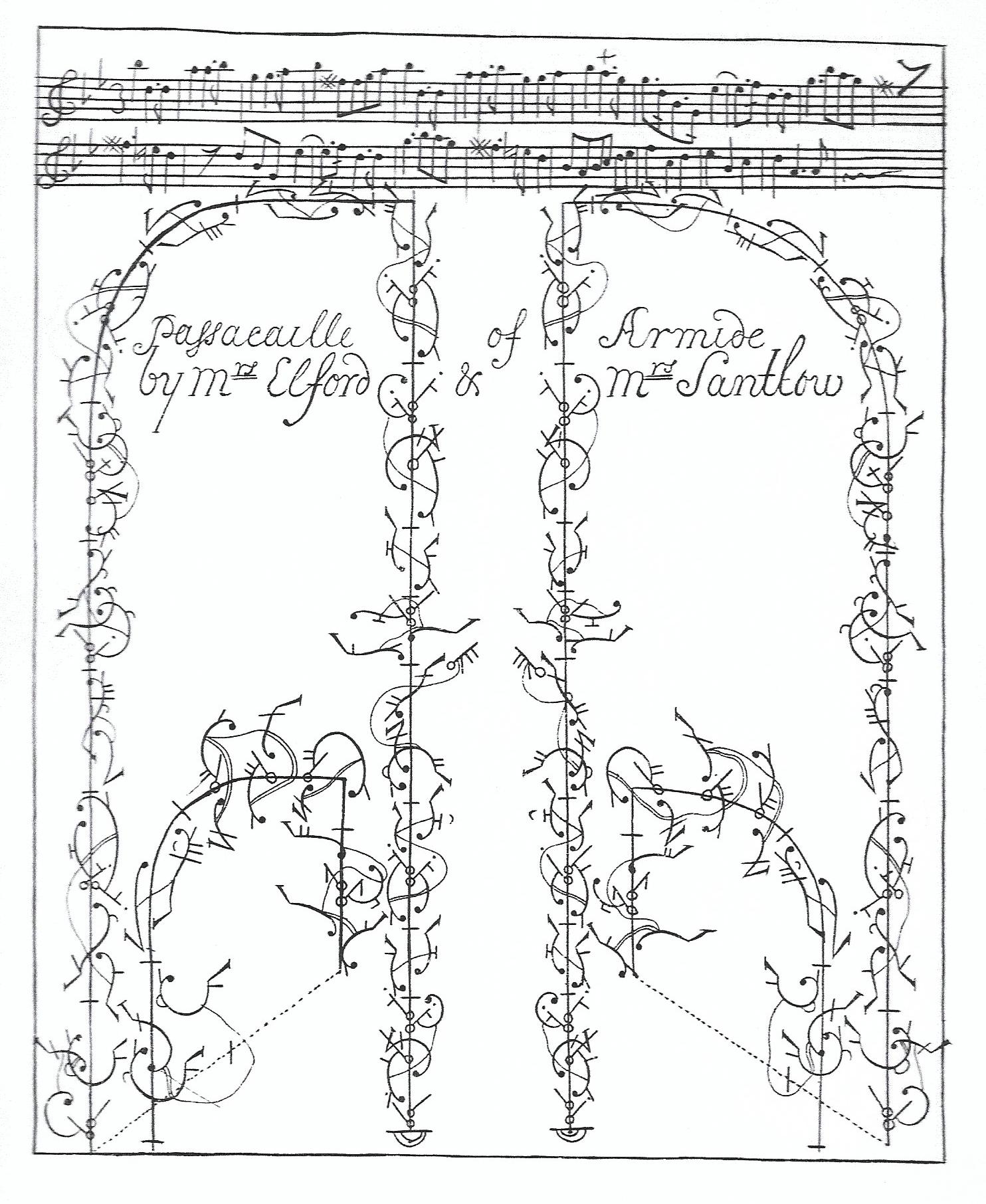
I have long been interested in Anthony L’Abbé’s A New Collection of Dances, thirteen choreographies created by him for professional dancers on the London stage notated and published around 1725 by F. Le Roussau. I have in my time performed four of them – the ‘Passacaille of Armide’, ‘Mrs Santlow’s Minuet’, the ‘Passagalia of Venüs & Adonis’ and the ‘Türkish Dance’ – and worked on another three – the ‘Chacone of Galathee’, the ‘Saraband of Issee’ and the following ‘Jigg’. However, until recently I had only seen four of them performed. When the chance arose to see three of the duets being taught in Paris as part of the Pecour Academy summer course 2025, I jumped at it. I am extremely grateful to Guillaume Jablonka and his fellow teachers Hubert Hazebroucq and Irène Feste for making an exception and allowing me to attend part of the course simply to watch and to learn. I have to say that it was a marvellous and truly rewarding experience.

The three choreographies were the ‘Loure or Faune’ danced by L’Abbé himself with his great compatriot Claude Ballon, the ‘Canaries’ performed by Charles Delagarde and Louis Dupré (the ‘London’ Dupré I wrote about a little while ago) and the ‘Passacaille of Armide’ danced by Mrs Elford and the very young Mrs Santlow.

Hubert Hazebroucq taught the ‘Loure or Faune’, Guillaume Jablonka the ‘Canaries’ and Irène Feste the ‘Passacaille of Armide’. The ‘Passacaille of Armide’ was one of the first baroque stage dances I worked on and inspired me to pursue the research which culminated in my book The Incomparable Hester Santlow. All three duets, particularly those for the men, are technically challenging and require teachers and dancers with an advanced level of training.  The Pecour Academy was attended by dancers who were well up to the task.

The three teachers, all professional dancers, differ in their dancing styles and approaches to teaching, but all recognisably belong to a shared French tradition of historical dance research and reconstruction based on the concept of ‘la belle dance’. Their individuality as well as their shared heritage was apparent in their warm-up sessions and their teaching of the notated dances. I was able to observe their work during the last three days of the course and the focus and energy in all three classes was inspiring. The teaching and dancing I watched has raised many questions about my own knowledge and understanding of baroque dance, at one end of the spectrum in relation to the performance of individual steps and at the other about the interpretation of the dances in L’Abbé’s New Collection.

An abiding issue for all who study the dancing of the decades around 1700 (when Feuillet first published Choregraphie and the associated collections of notated dances) is what the notations leave out when it comes to technique as well as style. Some questions are answered (although not definitively) by the descriptions of steps in Pierre Rameau’s Le Maître a danser of 1725. For others there are no answers, at least in print. I was aware that French interpretations of Rameau differ from those in the UK and this course reminded me of details I had forgotten. It also revealed new thinking about steps that I was unaware of. I hope to be able to pursue some of these in individual posts for Dance in History.

Two other issues came up that require me to undertake far more research and do a great deal more thinking. One is about the way in which L’Abbé’s dances use space, which relates to the stages for which he created these choreographies in London (not in Paris, with the possible exception of the ‘Loure or Faune’ even though this was undoubtedly performed at London’s Kensington Palace). This issue is difficult to address in any course which has several couples of dancers learning dances in the same space, who necessarily have nothing like the area for which L’Abbé created each choreography and who are also engaging with the most difficult steps in the baroque vocabulary. There are also the relationships, expressive as well as spatial, between the two dancers and between them and their audience (which these students were certainly very aware of). The placing of that audience in relation to the dancers is also a factor to be investigated – I suspect that this differed in Paris and London. I hope to be able to explore all of these aspects more fully in due course. The second issue that arose is the characters personified by the dancers, which may or may not derive from the music used by L’Abbé. The three teachers understandably thought of these choreographies in the context of the works given at the Paris Opéra from which L’Abbé took his music. I (equally understandably, I hope) have tended to think of them in performance on the London stage, where they would have been removed from their original operatic context (which may well have been unknown to their London audiences). I think these two views, which can surely be reconciled despite their differences, provide a rich environment for the development of a range of interpretations.

I have focussed here on L’Abbé’s three choreographies, but each day included workshops on other dances and aspects of baroque dance. Notable among these was Christine Bayle’s masterclass on Pecour’s La Nouvelle Forlane, in which she shared her great skill, experience and knowledge with a group of of dancers who were eager and extremely well prepared to benefit from it. That was a special moment, too. The whole course concluded with a public presentation of the dances that had been taught over the week. It was described as showing ‘Work in Progress’, but what marvellous Work – and fantastic Progress – it shared. I salute the teachers and their students for a wonderful achievement.

The 2025 Pecour Academy was a while ago now, but I am still thinking about it as I pursue my research into L’Abbé’s stage dances. I repeat my grateful thanks to Guillaume, Hubert and Irène for sharing their work with me.

What were Entr’acte Dances on the London Stage Like?

During the 18th century, entr’acte dances (dances given between the acts of plays) were an integral part of many performances in London’s theatres. The following advertisement, from the London Daily Post and General Advertiser for 25 March 1736, shows how these dances fitted into the evening’s entertainment:

This performance was for the benefit of one of Covent Garden’s leading dancers, Leach Glover.

As this bill shows, entr’acte dances could be quite varied. Nivelon’s Clown was a country bumpkin, possibly related to the ‘Peasant’ depicted by Lambranzi in his Neue und Curieuse Theatrialisches Tantz-Schul in 1716. I have used this image several times before but here it is again.

I continue to puzzle about the differences between ‘Clowns’ and ‘Peasants’ on the London stage, as well as the distinctions between those of different nationalities – in the 1720s both John Weaver and Francis Nivelon danced an English Clown, while Nivelon was also billed in a French Clown dance.

The Minuet and Louvre performed by Glover and Miss Rogers were ballroom dances (the Louvre was, of course, Pecour’s famous Aimable Vainqueur), although we don’t know whether the basic choreographies as set down in surviving notations were embellished for the stage.

This engraving from Kellom Tomlinson’s The Art of Dancing (1735) shows a moment from the ballroom minuet (the viewpoint is from the lower end of the room, looking towards the ‘Presence’). It raises questions about the performance of ballroom dances on stage, even though they shared with stage dances the concept of a ‘Presence’ as an important focus for their dancing.

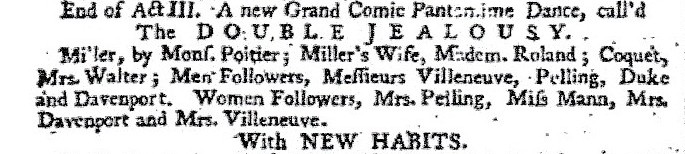
The Grand Ballet was different again, with several performers led by Lalauze and Mlle D’Hervigni, and was probably in the form of a divertissement with several dances one after the other. These more extended pieces could also be small ballets, for example the ‘new grand Comic Pantomime Dance’ The Double Jealousy given at Mlle Roland’s benefit at Drury Lane on 1 April 1736, as this detail from the advertisement in the London Daily Post and General Advertiser for that date shows (the mainpiece was King Henry the Fourth. With the Humours of Sir John Falstaff):

The Double Jealousy hints, through its title and its characters, at comic and expressive action, but what were the other dances – in particular the solos and duets – like?

Most entr’acte dances must have been short: solos and duets may have lasted between one and two minutes (for the early 18th century their duration can be compared with that of the dances surviving in notation); divertissements (the ‘Grand Dances’) and even small ballets seem likely to have lasted ten minutes at the most. So, we get the idea that during an evening in one of London’s theatres there were several short dances that contrasted with the action of the play they accompanied and presented a variety of characters and dance styles. They were also intended to showcase the leading professional dancers in the companies and could be, in themselves, a draw for audiences.

A little while ago, I was at a very different sort of event – a modern ballroom and Latin competition, with a Gala evening at which two couples of professional dancers performed. As they appeared alternately, dancing their way through the five standard ballroom dances and the five Latin ones, I was reminded of the entr’acte dances on the London stage and began to wonder what (if anything at all) they might have in common. These 21st-century dances had no context. They were simply intended to display the skills of the dancers and entertain the audience (many of whom were dancers themselves), so how might they tell us anything about the 18th-century entr’acte dances I have been describing?

First, was the length of the modern dances. They were short, at just a few minutes each, so the dancers had to make an immediate impact. Second, was their presentation without a specific background – they were danced to an audience seated around the ballroom floor with little decoration and no scenery. It is difficult to be sure what happened with 18th-century entr’acte dances, but it seems unlikely that they were provided with their own scenery (although, like the modern dances, they were presented in costume) and they were probably danced mainly on the forestage in the midst of their audience.

I was struck with the way in which the 21st-century dancers played with the conventions of the dances they performed, elaborating and subverting these by turns. The modern dances – waltz, tango, Viennese Waltz, foxtrot and quickstep for the ballroom and cha-cha, samba, rumba, paso doble and jive for the Latin – have different and well-defined characters as choreographies. Although it is usually only in the Latin dances that couples hint at drama, in the Gala performances both the ballroom and Latin couples did so. They also intensified the characters of the individual dances and one couple even incorporated props into their dancing. I couldn’t help feeling that early 18th-century dancers must have used similar techniques in the sarabands, chaconnes, passacailles, gigues, canaries, loures, bourrées, rigaudons, minuets and other dance types (divided between serious and comic) that they would have performed on the London stage three centuries ago. They, too, were trying to command the attention of their audience and display to the full their skills and individuality.

Reasons to be Bored by Early Dance. IX: People Are Unfriendly

I wrote this piece a few years ago, but looking at it again I can see that the basic topic is ultra-fashionable in academic circles at the moment!

A word I have not yet used in connection with early dance is sociability, that arena where politeness appears in its most scintillating lustre. I have not mentioned sociability before now because this is a very difficult concept for those outside the UK early dance world to understand. In my efforts to explain it I must consider the normal behaviour to be encountered at an early dance gathering in England. My observations hold good whether the gathering is in London or the provinces, whether it is small or large, whether it is a dance class, a ball or even a conference. At all of these events similar patterns emerge. They individually and collectively reveal the meaning of the word sociability within the context of UK early dance.

Imagine that you are a stranger coming to a UK historical dance event for the first time. What happens when you enter the room? People may be in small groups conversing together. They may be alone, observing some private but completely polite early dance ritual. All will, sooner or later, turn to look at you and scrutinise you from head to foot. If they do not recognise you, they will turn back to what they were doing and completely ignore you. Do not be offended by this. The UK early dance word has its own, absolutely authentic, hierarchy mirroring that of the historical periods in which they are completely immersed. As an outsider, you have been consigned to the bottom of the heap and must expect to be treated with disdain.

You must wait to be spoken to before you can utter a word. This is just one of the rules of historical dance society. Everyone – except you – will know this. If you put a foot wrong (particularly while you are dancing) you will be told of your error loudly and disdainfully. Do not respond! Blush and look down with modesty. If you know you are in the right, keep it to yourself. If you speak up on your own behalf, great offense will be taken and nobody will speak to you.  Of course, nobody will speak to you anyway because you are at the bottom of the UK early dance social scale.

 Here are a few rules to remember when it comes to sociability within UK early dance (unless you are an insider and may behave as you please).

  • Never speak unless you are spoken to;
  • Never ask anyone to dance if you are at a dance class or a ball;
  • Never expect anyone to ask you to dance at a dance class or a ball;
  • If you stand up to dance, at a dance class or a ball, expect to be ignored (unless the insiders present decide to criticise your dancing).

Always remember that those within the UK historical dance world are superior in every way to those outside and must be constantly treated with reverence and awe.

Reasons to be Bored by Early Dance. VIII: Vulgar Dancing

It is a little while since I’ve added to my short satirical series on boring early dance, so here is another episode. Fear not, we have nearly reached the end and I will, of course, be posting far more serious pieces along the way!

It goes without saying that only historical forms of dance are truly polite and authentic. Traditional and folk dancing share in their authenticity (if not necessarily their politeness), so early dance aficionados may be permitted to indulge in these genres. They may well have originally trained in them. All modern forms of dancing are, by definition, vulgar and must be avoided at all costs. If they are encountered by chance, they must be firmly put in their place – out of sight and out of mind.

What makes modern dancing so vulgar? I was going to craft an essay but a list will do just as well. It may be even better, for it limits verbal contact with these reprehensible styles of movement.

  1. Modern dancing is not historical or early. If it dates to later than 1900 A.D.  it cannot be historical. There is some debate about the date when early stops and modernity starts, but that doesn’t matter. Anything modern is vulgar.
  2. Modern dance clothes are too tight, too short or too revealing and too often all at once. They do not constrain and mould the body as the costumes of yore, nor do they obscure the beauty of the historical walking synonymous with early dance. The unwarranted display of tights, leotards, short skirts and tight trousers is vulgar – and quite unlike the padded doublets, wrinkled hose and low-necked dresses of the hallowed past.
  3. Modern dancers move their bodies in unseemly ways. In particular, in many modern styles, movements of the hips and shoulders are demanded. Arms move freely or are held in ways that contradict the ramrod straight arms (extended in a low ‘V’ shape) of baroque dance or the languidly suspended convex curves of the arms in 15th-century dance.
  4. Modern ballroom dancing affects politeness by concealing the decidedly rude close body contact between the partners behind elaborate frocks. For true politeness and authenticity only the fingertips should touch. The rot began with the waltz, so maybe the date for the beginning of modern dancing should be pushed back to 1800.
  5. Ballet requires extremely revealing clothing for practice, never mind performance, and it contorts the body in entirely unseemly ways. It requires steps that are, in fact, impossible for anyone to do (a feature that it shares with modern ballroom and Latin dancing). One simply cannot credit that it has anything to do with the utterly static beauty of 18th-century dancing which has no discernible steps.

There are other forms of modern social dancing that I will forbear to mention in case I am tainted by association. The sensation seekers who occasionally surface in even the best regulated historical dance circles (and I am acquainted with at least one of those) will know most if not all of them!

Reasons to be Bored by Early Dance. VII: Walking to Music

What exactly is dancing? More to the point, what exactly is historical dancing? The answer to this question has been the subject of much debate among UK early dance theorists. Such questions as the reliability of the sources, the trustworthiness of those interpreting them and a full and correct understanding of politeness and authenticity have been known to generate pleasing feelings of utter despair among the greatest of historical dance aficionados. However, there is an easy answer to the conundrum which is widely applied in practice, if not universally agreed in principle. Dancing is no more and no less than ornamented (or, more often, unadorned) walking.

Once this truth has been recognised and accepted, the question arises – what is walking? More specifically and pertinently, what is historical walking? Is it like modern walking, or are there subtle differences only to be discovered through minute study of the sources? Let me delve into this extremely difficult topic through an examination of practice in different historical periods.

First, 15th-century dancing is so obviously walking that there can be no argument on that score. This is courtly dancing in very long clothes (apart from some of the men, who are obliged to show their legs in tight hose but are expected to wear doublets with very long sleeves). The longer the outfit, or the sleeves, the more polite and authentic the dancer. The truly extraordinary length of these garments will only permit walking, except that the wearer must adopt a lilting movement to prevent costly materials from getting under his or her feet.

I’m not an expert on the late 16th or early 17th century (and I don’t like the period very much) so I will move on to country dancing. This, of course, begins in the middle of the 17th century when the populace was weighed down by the English civil war – won by the puritans who promptly banned dancing. What was the answer? Walking in a military fashion! This quickly became a hallowed tradition and has been faithfully observed ever since, in honour of its folk origins.

Then, we come to baroque dance. The most important sources for the 18th century are those strange notations with straight and curved lines all over the page. Close scrutiny reveals that many of these take the form of steps by the right foot or the left foot. In the vast majority of cases, a step by the right foot is immediately followed by a step with the left foot (or vice versa). It rapidly becomes obvious that baroque dancing is, in fact, walking. We have a little problem here, in that other sources insist that dancers must turn out their feet while practising baroque dance. Just a little thought (and even less practice) reveals that this is the clinching evidence for baroque dancing being walking. Whoever would be able to dance, let alone dance historically, with turned-out feet?

These notations have music at the top of each page, showing that baroque dance must have been walking to music. However, the correlation between the music and the steps is so obscure that we may safely deduce that baroque dancing is not only walking to music but that it does not have to keep time with the music. Many baroque dancers have proved this in practice without having to fatigue themselves with research.

Reasons to be Bored by Early Dance.  VI: Cultural Snobbery

Dancers in the UK early dance world are, it goes without saying, very cultured people. There are, in fact, two sources of true culture in historical dancing. One is the definitively high culture of classical music. The other is the indisputably low culture of folk music and dancing. Isn’t there a chasm between the two? Aren’t they mutually opposed cultural worlds? I’ll explore a bit further.

There are those in UK early dance, a sizeable minority I would say, who are devoted to proper music. They avoid any horrible modern styles of dancing because of the awful music. ‘Pop’ or ‘Rock’ – who needs those? Never mind all the latest styles (which I’ll leave others younger and more enlightened than I am to enumerate). I confess myself puzzled by the ‘high culture’ group. I am trying to think of any major classical composers whose music is actually used in early dance. In the world of baroque dance, we are talking about music by the likes of Lully, Campra, or other equally obscure and third-rate composers. Bach never wrote actual dance music. Although Handel was foolish enough to compose ballet music from time to time, who ever listens to it?

Much of the music for early dance was written by the dancing masters themselves, so does it qualify as folk music? The fons et origo of folk dance music is, of course, John Playford’s The English Dancing Master of 1651. These tunes are well known to derive from classical antiquity, when folk really were folk and totally traditional in their tastes. With such a pedigree, who would want to be listening to modern, vulgar popular music? This is the well-founded opinion of the folk music and dancing people who form the majority in UK early dance.

So far as I can tell, with music for folk dancing (or as the early dance world has it, country dancing), the instruments are really important. Now here we reach a small problem. Nowadays, music for folk dancing demands an accordion – but this instrument cannot be claimed as truly historical even so recently as the mid-19th century.  What to do? The answer is to play all the tunes on a scratchy fiddle, as slowly as possible. Cultural authenticity at a stroke!

It is the fiddle (or violin, if we wish to appeal to the other wing of UK early dance) that unites the ‘high’ classical and ‘low’ folk cultural aficionados. This could return us our very first reason to be bored by early dance – the music – but in my next post I will not go backwards, I will move on.

Reasons to be Bored by Early Dance. V: Those Who Can’t Dance Versus Those Who Can

How can you tell the dancers from the non-dancers in UK early dance? This is a difficult question to answer. Politeness and authenticity demand a very particular approach to dancing, whatever period you are doing. They affect everything.

  • How you should walk;
  • How you should do the steps;
  • How you should relate to your partner;
  • How you should relate to the others in a group or country dance;
  • How your movements should relate to whatever music is going on at the time.

Those who have had the misfortune to be trained in some modern dance form or other (ballet, ballroom & Latin, contemporary dance come immediately to mind) may mistakenly believe that what they see before them in a UK early dance workshop is bad dancing. This is completely wrong. What they fail to realise is the truly polite and authentic dancing that is being graciously proffered for their delectation. (NOTE: delectation has NOTHING to do with pleasure)

If you are being continually told off for dancing with too much energy, for trying to do the steps properly, for wanting to learn the dances quickly, for being eager to do more difficult steps and figures and for wanting to practice, you are obviously trying too hard. It is suspiciously likely that you are a ‘dancer’ of one of these abhorrent modern techniques. If you are, then you will never be polite and authentic and you can never reach the distinction of truly belonging within the UK early dance world.

Reasons to be Bored by Early Dance. IV: It’s Seriously Miserable

We are actually talking about two distinct but inseparable states of mind here – seriousness and misery. Both are indispensable within UK early dance and if the two can be combined, so much the better.

So, what makes early dance so serious in the UK? We have already explored authenticity and politeness, neither of which can tolerate any sign of levity. There is also the weight of history on the dancer’s back. One false step and you are misrepresenting the whole art of dancing as practised in times of yore. Of course, the music is enough to make the lightest-hearted person weep with serious misery.

Misery is occasioned by continual worry over authenticity. Am I being authentic enough? Am I sure that the other people in this dance class are being less authentic than I am? If the answer to either of those questions is ‘No’, the only way is down. Then there are those wretched teachers who not only teach complicated steps and sequences (while insisting on a totally spurious adherence to the sources) but can also dance them in front of you. These are the self-same teachers who take the liberty of changing the steps in the interest of fidelity to the very same sources they claim to be using. The only response is to wallow in misery at the inauthenticity of it all.

Some of these teachers actually add insult to injury by wanting you to ENJOY dancing historical dances. The very idea undermines the whole edifice of politeness. It seriously threatens the seriousness of the whole of the UK early dance world. It makes one miserable simply to contemplate the merest thought of pleasure while dancing.

Serious misery – that is the purpose of the UK early dance world. Nobody can call themselves an historical dancer without both!