Category Archives: Stage Dancing

Monsieur Roger, Who Plays the Pierrot

‘There have been companies of Pantomimes raised in England; and some of those comedians have acted even at Paris dumb scenes which everybody understood. Tho’ Roger did not open his mouth, yet it was easy to understand what he meant.’

This quotation from Jean-Baptiste Dubos’s Réflexions critiques sur la poesie et sur la peinture, as translated by Thomas Nugent in 1748, is well-known. Roger himself is hardly known at all, yet his career is of great interest not only as part of the history of the English pantomime but also for what it tells us about theatrical exchange between Paris and London in the early 18th century.

Roger was probably the ‘Person, who plays Pierot at Paris, is just arrived from thence, and will perform this night’ advertised to appear at the Lincoln’s Inn Fields Theatre on 29 January 1719. He was joining Francisque Moylin’s company, which had been playing there since mid-November 1718 and would stay until 5 February before moving on to perform at the King’s Theatre until 21 March 1719. He presumably took the title role in the French three-act farce Pierot maître valet, et l’opera de campagne, ou la critique de l’opera. Roger was given a benefit on 5 February 1719, commanded by the Prince of Wales, at which he performed an acrobatic stunt (apparently as Octave in a one-act farce titled Grapignant; or, the French Lawyer) and ‘the Scene of the Monkey, which has never been performed in England before’. His mimetic and acrobatic skills had probably been acquired through his training and experience as a performer at the Paris fairs.

Roger returned to London in the spring of 1720, playing in De Grimbergue’s company at the King’s Theatre (which alternated its performances with those of an Italian opera company). He returned, again with De Grimbergue, for a season at the newly opened Little Theatre in the Haymarket between December 1720 and April 1721, after which he did not return to London until 1725. The Biographical Dictionary of Actors states that he was appointed as ballet master at the Opéra-Comique in Paris by its manager, the English Harlequin Richard Baxter, but gives no source for this assertion. It also repeats the suggestion by Ifan Kyrle Fletcher, in Famed for Dance, that Roger may have been an Englishman. Fletcher likewise offers no evidence for this and may simply have been misinterpreting the passage from Dubos referring to Roger. Further research is needed to see what can be discovered about Roger in French records, although I cannot pursue this here.

A new troupe of ‘Italian Comedians’ was billed at the Little Theatre in the Haymarket between 17 December 1724 and 13 May 1725. ‘Roger, the Pierrot’ was first advertised on 22 January 1725, as the creator of ‘un ballet nouveau’ given as part of a performance which included Molière’s Le Medecin malgré lui and Gherardi’s Les Filles errantes. Later in the season, he was billed as the creator of a ‘Nouveau ballet comique’ as well as a performer in a ‘Variety of new Dances’ and gave Pierrot and Country Dance solos. His benefit was on 18 March 1725 and included ‘Pierrot Grand Vizier, with the Turkish Ceremony of the Bourgeois Gentilhomme’ and ‘a new Sonata on the Violin of Mr. Roger’s composing, by himself’.

Although companies of ‘Italian Comedians’ would return to play in London during the 1725-1726 and 1726-1727 seasons, Roger did not appear with them for he had joined the company at the Drury Lane Theatre, where he was first advertised on 28 September 1725. The bill published in the Daily Courant on that date recorded his latest new dance.

La Follett (as it was first called) had already been advertised at Drury Lane on 23 September 1725, with no mention of the performers. Roger must surely have danced it then, and if it marked his first appearance with the company it is interesting that no mention was made of this.

In his first season at Drury Lane, Roger was billed in three solos, a duet, three group dances and three pantomimes. The solos were variations on the ubiquitous Peasant dance – a Peasant (28 October 1725), a Drunken Peasant (3 November 1725) and a French Peasant (13 May 1726). He was billed in a Drunken Peasant again in 1728-1729, but he seems not to have repeated the first two dances in later seasons. The duet, usually advertised as La Pieraite and created by Roger himself, was first given on 21 March 1726 and immediately became a staple of the entr’acte dance repertoire. It was performed every season until 1730-1731 by Roger, first with Mrs Brett and then with Mrs De Lorme, and was presumably a ‘Pierrot’ dance. This season also marked the first performances of Roger’s group dance Le Badinage Champetre, billed on 19 November 1725, in which there were five couples led by Roger and Mrs Booth. This dance was also popular and remained in the entr’acte repertoire until 1729-1730.

Drury Lane had lost its leading male dancer, the multi-talented John Shaw, who was absent from late in the 1724-1725 season and died in December 1725. Shaw had been the company’s Harlequin and had created that role in John Thurmond Junior’s The Escapes of Harlequin (first given 10 January 1722) and the overwhelmingly successful Harlequin Doctor Faustus (first given 26 November 1723). Drury Lane’s managers understandably wished to keep both pantomimes in the theatre’s repertoire, not least to counter the rivalry of John Rich at Lincoln’s Inn Fields, and seem to have given Roger the opportunity to try out the role of Harlequin in both pantomimes. The experiment (if that is what it was) was unsuccessful. The Escapes of Harlequin was not revived again and Roger instead took over the role of Pierrot in Harlequin Doctor Faustus, which he played regularly until 1730-1731.

In his first season at Drury Lane, Roger also took over the role of Pierrot in Thurmond Junior’s Apollo and Daphne; or, Harlequin’s Metamorphoses (first given under the title Apollo and Daphne; or, Harlequin Mercury in 1724-1725). He continued to dance in the pantomime until 1727-1728. Apollo and Daphne made a final appearance as a ‘Scene’ within a ‘New Entertainment’ The Comical Distresses of Pierrot which was given a single performance at Drury Lane on 10 December 1729. Roger played Pierrot, suggesting that the piece may have been created by him.

Roger danced at Drury Lane for six seasons, until his untimely death in 1731, and built a successful career there as both a choreographer and a dancer within the company. After his first season, he seems to have mainly appeared in pantomime afterpieces. He worked with John Thurmond Junior again in 1726-1727, as Pierot in The Miser; or, Wagner and Abericock, which was revised and re-titled Harlequin’s Triumph later that season. He then went on to create a number of pantomimes himself. Harlequin Happy and Poor Pierrot Married, first given on 11 March 1728, brought him and John Weaver together on stage for the first time. Weaver, who had not appeared in London since 1721, played Colombine’s Father, while Roger took his accustomed role of Pierrot. The pantomime lasted until 1729-1730 (with cast changes) and was revived for a single performance at Drury Lane on 4 December 1736.

Far more important was Perseus and Andromeda: With the Rape of Colombine; or, the Flying Lovers first given at Drury Lane on 15 November 1728 and successful enough to persuade John Rich to mount a rival production at Lincoln’s Inn Fields on 2 January 1730. The Drury Lane version was ‘In five different Interludes, viz. Three Serious, and two Comic’ and the scenario published to accompany performances stated that the serious part was by Roger and the comic part by John Weaver. Both Roger and Weaver appeared in the comic part, Roger as Pierrot (Doctor’s Man) and Weaver as Clown (Squire’s Man). From 15 March 1729, the comic part was changed to ‘the Devil upon Two Sticks’ and the new edition of the scenario (again published to accompany performances) made clear that this was by Roger.  Here are the title pages of the two editions.

Weaver had no role in the new comic plot and may have already decided to leave London by the end of the season. He had a shared benefit on 25 April 1729, at which he danced a Clown solo and Roger reprised his solo Drunken Peasant (perhaps an indication that there were no hard feelings between the two men over the change to the comic part of Perseus and Andromeda). Weaver’s last billing was on 2 May 1729 and he would not return to work in London until 1733. It is worth noting that in the serious part of Perseus and Andromeda Roger followed Thurmond Junior’s Apollo and Daphne in giving the title roles to two dancers.

The next of Roger’s afterpieces was wholly serious. Diana and Acteon was given on 23 April 1730 for Roger’s benefit, with Mrs Booth and Michael Lally in the title roles (they had also danced the title roles in Perseus and Andromeda). The afterpiece was not revived until 1733-1734, when it had two performances the first of which was as part of a benefit for Mr and Mrs Vallois. She was Roger’s widow and she repeated her role as one of the Followers of Diana, with Mrs Bullock as Diana and Vallois as Acteon.

Roger’s last afterpiece for Drury Lane was by far his most successful and the theatre’s most popular production for many years. Cephalus and Procris: With the Mistakes received its first performance on 28 October 1730. Like Perseus and Andromeda, the comic part was quickly changed – the ‘Dramatic Masque’ (as it was described in the bills) was advertised on 4 December 1730 with ‘a new Pantomime Interlude’ as Cephalus and Procris: With Harlequin Grand Volgi. This pantomime had seventy-four performances in its first season and continued to be played until 1734-1735. Roger was Pierrot, a role that went to Theophilus Cibber after his death. Cephalus and Procris broke new ground for Drury Lane by copying John Rich’s practice of giving pantomime title roles to singers. It may also have influenced John Weaver when he returned to Drury Lane in 1733 to mount his last ‘Dramatick Entertainment in Dancing and Singing’ The Judgment of Paris.

Without further research, I cannot tell whether Roger returned to Paris regularly each summer to perform at the Opéra-Comique and the fairs when Drury Lane was closed. He did play at the Opéra-Comique in July and August 1729, for the Mercure de France mentions him performing in two ballets given as divertissements within La Princesse de la Chine. The first was a ballet on the subject of ‘l’Amour et la Jalousie’ on 7 July 1729 and the writer was obviously convulsed by Roger’s performance.

‘Le Sieur Roger, qui a composé les pas du Balet, & dont la seule figure est capable de faire éclater de rire le plus grand stoïcien’

The piece Love and Jealousy given at Drury Lane on 18 October 1729, with no information other than its title in the bills, may well have been by Roger. The Opéra-Comique ballet was also the source for The Dutch and Scotch Contention; or, Love and Jealousy given at Lincoln’s Inn Fields on 22 October 1729. For more information about this afterpiece, which may have been by Francis Nivelon, see my post Highland Dances on the London Stage (21 February 2021) which transcribes in full the report in the Mercure de France for July 1729.

The other ‘nouveau Balet Pantomime’ was La Noce Angloise for which the Mercure de France for August 1729 provided a detailed description. This ballet included a singing ‘Sorcière’ with singing ‘camarades’, not long before Roger’s creation of Cephalus and Procris. The report does not name the ballet’s creator but does mention Roger.

‘La figure du Sr. Roger, en Paysan, a été trouvée très originale, & a fait autant de plaisir qu’il en a déja fait en Matelot Hollandais [in the Ballet de l’Amour et de la Jalousie]’

Although his performing career centred on Pierrot (about whom there is much more to say, particularly regarding this character’s appearances on the London stage), Roger did portray other comic characters.

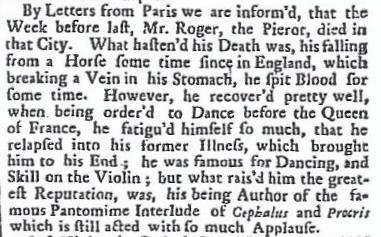
Tragically, Roger’s career was cut short by his sudden death in 1731 in Paris, reported in the Daily Advertiser for 11 November 1731.

I have been aware of Roger since the early days of my research into the life and career of Hester Santlow (later Hester Booth), who danced with and for him during his time at Drury Lane. My work on this short post has highlighted in new ways his significance for the development of stage dancing in early 18th-century London – there is much more to be uncovered about the dances and pantomimes he created at Drury Lane in the late 1720s. Roger was not the only French dancer to pursue a career in London’s theatres and I hope to look at some of the others in future posts.

References:

Jean-Baptiste Dubos, Réflexions critiques sur la poesie et sur la peinture. 4e. éd. 3 vols. (Paris, 1740). Roger is mentioned in volume III, pp. 288-289. I have not been able to check whether he was also mentioned in the previous edition of 1733.

Jean-Baptiste Dubos, translated by Thomas Nugent, Critical reflections on poetry, painting and music. 3 vols. (London, 1748). Roger is mentioned in volume III, p. 219.

Ifan Kyrle Fletcher, ‘Ballet in England, 1660-1740’ in Ifan Kyrle Fletcher, Selma Jeanne Cohen and Roger Lonsdale, Famed for Dance (New York, 1960), 5-20 Roger is mentioned on p. 17.

Philip H. Highfill Jr, Kalman A. Burnim and Edward A. Langhans, A Biographical Dictionary of Actors, Actresses, Musicians, Dancers … in London, 1660-1800. 16 vols. (Carbondale, 1973-1993). The entry for Roger is in volume 13.

Mercure de France, juillet 1729, p. 1661

Mercure de France, août 1729, p. 1846

Lady Dancing Masters in 18th-Century England

I recently watched another dance history video in the very informative series compiled and published by Carlos Blanco, which draws inspiration from the rich resources of the Biblioteca Nacional de España. In this video (which can be found on YouTube) four historical dance experts consider the question ‘Is there Sexism or Misogyny in Dance Treatises?’ Inevitably, the topic of female dancing masters arose, in the context of the discussion focussing on the USA and Great Britain, and it proved difficult to identify or name any – indicating a gap in published research. In the course of my own work, which is mostly limited to England and particularly London, I have come across several women who taught dancing – lady dancing masters. My list is very far from exhaustive (and at least one name is questionable), but I thought it might be of interest to write a post about them and perhaps reveal or encourage further research. There has been some work which includes this topic and I have included a list for further reading at the end.

The first of these women is the questionable one. Peggy Fryer was billed as acting and dancing at the Little Theatre in the Haymarket on 28 January 1723. The advertisements declared that she was aged seventy-one and had ‘taught three Queens to dance’. She had previously appeared at the Lincoln’s Inn Fields Theatre on 11 January 1720, ‘it being the first time of her Appearing on any stage since the Reign of King Charles II’, and she was then said to be eighty-five years old. Without a great deal more research, it is difficult to discern whether there was any truth at all in these conflicting announcements. If Peggy Fryer had indeed ‘taught three Queens to dance’, who might they have been? My thoughts turned to Charles II’s Queen, Catherine of Braganza, and his two nieces Mary (later Queen Mary II) and Anne (later Queen Anne), although there are other candidates. Would someone like Peggy Fryer have been called in to teach any of them, when there was a royal dancing master – Jerome Gahory – to do so?

With the second of these lady dancing masters we are on much surer ground. Mrs Elford emerges into view on 5 July 1700 at Lincoln’s Inn Fields, where she is billed as dancing a ‘new Entry, never performed but once’, She was obviously already established as a leading dancer and would later be billed alongside Anthony L’Abbé as his regular dancing partner. The collection of L’Abbé’s stage dances published in the mid-1720s includes a duet to the passacaille from Lully’s opera Armide danced by Ann Elford and Hester Santlow. The earliest evidence for Mrs Elford as a teacher dates to 12 September 1705, when dancing ’By a little Girl, Mrs Elford’s scholar’ was advertised at Lincoln’s Inn Fields. Mrs Elford’s career as a stage dancer seems to have ended in 1706, by which time she was probably already teaching regularly. The first record of her work beyond the world of the London stage dates to 1711, when she was teaching Mary Bankes of the Bankes family of Kingston Lacey. Mrs Elford’s later activities are less easy to trace, although she is recorded as teaching the daughters of the second Duke of Montagu between 1720 and 1729.

The next woman to be recorded as teaching dance in England was one of the most notable dancers to appear on the 18th-century London stage. Marie Sallé first danced in London as a child, during the 1716-1717 season at Lincoln’s Inn Fields. She returned to dance there as a young woman in 1725-1726 and made her last London appearances at the Covent Garden Theatre during the 1734-1735 season. For Mlle Sallé’s benefit at Lincoln’s Inn Fields on 6 April 1727 the bill included a ‘Pastoral by Miss Rogers, a Child of Nine Years of Age, Scholar to Mlle Sallé’. Elizabeth Rogers would later enjoy a career as a singer and actress, as well as a dancer. When she was billed again at Lincoln’s Inn Fields on 5 April 1731, dancing a Saraband and Tambourin, she was advertised as ‘Scholar to Salle’. Marie Sallé’s brother Francis remained in London when she returned to France and made his career there. It is not surprising that he took over some of his sister’s teaching. However, a continuing link between Marie Sallé and Elizabeth Rogers is suggested by the latter’s appearance as a Bacchante in Bacchus and Ariadne (a ballet attributed to Mlle Sallé) when it was given within The Necromancer at Covent Garden on 26 February 1734. Marie Sallé is the first of my lady dancing masters for whom there is a portrait. In fact there are several, this is a print of the painting by Nicolas Lancret.

My third lady dancing master appeared on the London stage much later in the 18th century. Marie-Louise Hilligsberg began her career at the Paris Opéra in the early 1780s, making her first visit to London during the 1787-1788 season to appear at the King’s Theatre. She returned to Paris for a little over a year, but when she failed to get the promotion she expected at the Opéra she returned to London in 1789. Mme Hilligsberg continued to dance in London, mostly at the King’s Theatre but also elsewhere, until she retired from the stage in 1803. She was well-known for her travesti roles as well as her more conventional ones. Here are portraits of her in both guises: a print showing her in the ballet Le Jaloux Puni and a painting by Hoppner.

In 1796, she appeared in the ballet Little Peggy’s Love at the King’s Theatre (perhaps in the title role) for which the ‘Pantomime and Principal Steps’ were created by Didelot. Some years later, in 1799, this ballet was performed by several young aristocrats at a private party thrown by Lord and Lady Shaftesbury. As newspaper reports make clear, this amateur performance was mounted by Mme Hilligsberg, who also coached the child dancers in their roles. There are more details in my 2017 post A Favourite Ballet. Mme Hilligsberg is also known to have given dancing lessons to Lady Harriet Montagu and she may well have had other pupils during her years in England. She retired from the stage in 1803 and died in France the following year.

I have to return to the early 1700s for my next lady dancing master, who bridges a divide between professional dancers who became teachers and those who pursued the teaching of dance without having a stage career. Ann Roland was the sister of the well-known dancer Catherine Roland. She made her London debut at Drury Lane on 18 November 1735, described as ‘lately arrived from Paris’ and dancing alongside her sister. She continued to dance in London until 1743, mainly at the Covent Garden Theatre, and then moved to Dublin for the 1743-1744 season where she acted and apparently sang as well as dancing. Her extensive repertoire ranged from a Tambourine solo, through duets including The Louvre and the minuet, to leading dancing roles in a number of popular pantomimes. Around 1745 she married the Irish violinist Francis Fleming, with whom she had three daughters. Ann Fleming’s subsequent career as a lady dancing master is not easy to trace, but she is said to have begun teaching with her husband in and around Bath in the late 1740s. According to an advertisement in the Salisbury and Winchester Journal for 25 September 1752, announcing Mr Fleming’s return from Paris ‘where he has completed himself in the Art of Dancing’ he and his wife were then teaching at a boarding school in Bath as well as giving private lessons to young ladies and gentlemen. There is no known portrait of Ann Roland Fleming, who died in 1759.

Francis Fleming may have begun to involve his eldest daughter Ann Teresa in teaching soon after the death of her mother (when she would have been thirteen or fourteen years old). She was certainly his assistant by 1768, as the Bath Chronicle for 3 November 1768 reported that ‘Mr. and Miss Fleming, … have been in Paris this summer’ learning the ‘true Step of the Cotilions with the additional Graces of the Minuets’ and that they would both be teaching at another boarding school in Bath, as well as giving private lessons to ladies and gentlemen. Ann Teresa Fleming took over her father’s dancing academy when he died in 1778 and quickly became the most famous teacher of dancing in Bath, where she continued to work until her retirement in 1805. Her balls for her scholars, held several times each year at both the Upper and Lower Assembly Rooms, were often reported in detail in the Bath Chronicle. Her importance is perhaps best shown by the fact that she is one of very few dancing masters, male or female, for whom we have a portrait (now in the collections of the Victoria & Albert Museum), which has been linked to the studio of Sir Joshua Reynolds:

Miss Fleming died in 1823 and was accorded a quite lengthy obituary in the Bath Chronicle for 18 February 1823.

For nearly twenty years, Ann Teresa Fleming ran her school with her younger sister Kitty. When she retired she was succeeded by Miss Le Mercier, who had become her assistant in the mid-1790s and would continue the school – as another lady dancing master – until around 1811. Another assistant to Miss Fleming had been Elizabeth Rundall, who in 1796 married the actor Robert Elliston and around the same time set up her own school in Bath in partnership with Kitty Fleming. Mrs Elliston’s school was notably successful. Like Ann Teresa Fleming, she held regular balls for her pupils in Bath’s Upper Assembly Rooms – the Bath Chronicle for 10 December 1803 reports that the Duchess of Devonshire was to attend ‘Mrs Elliston’s Ball’. Elizabeth Elliston left Bath for London in 1812 (her husband was by then a leading actor in the company at Drury Lane) and her sister Miss D. C. Rundell took over her Bath school.

The ladies I have mentioned in this post were undoubtedly just a few of the many lady dancing masters who taught in England from the seventeenth to the early nineteenth century. Some worked with their dancing master husbands and were seldom mentioned as teachers in their own right. Others were well-known and admired for their dancing and teaching skills. Further research will surely uncover many more lady dancing masters within surviving historical records.

Further Reading:

Quotations from advertisements for stage performances are taken from the appropriate volumes of The London Stage, 1660-1800.

For Peg Fryer see: the entry ‘Fryer, Margaret, later Mrs Vandervelt, c.1635-1747, actress, dancer’ in Philip H. Highfill Jr et al. A Biographical Dictionary of Actors. 16 vols. (Carbondale, 1973-1993), Vol. 5.

For Ann Elford see: Jennifer Thorp, ‘Mrs Elford: stage dancer and teacher in London, 1700-1730’, in Ballroom, Stage and Village Green: Contexts for Early Dance, ed. Barbara Segal and William Tuck (Early Dance Circle, 2015), 53-60.

For Marie Sallé as a teacher, in Paris as well as in London, see: Sarah McCleave, ‘Marie Sallé, a Wise Professional Woman of Influence’, in Women’s Work: Making Dance in Europe before 1800, ed. Lynn Matluck Brooks (Madison, Wis., 2007), 160-182 (pp. 168-171)

For Marie-Louise Hilligsberg, see: the entry in A Biographical Dictionary of Actors, Vol. 7; Ivor Guest, The Ballet of the Enlightenment (London, 1996);  Katrina Faulds, ‘Opera Dances’, chapter 6 in A Passion for Opera: The Duchess and the Georgian Stage (Kettering, 2019), 91-99 (pp. 95-96).

For Ann Roland Fleming, see: the entry for Ann Roland in A Biographical Dictionary of Actors, Vol. 13, as well as the sources listed below for her daughter and successors.

For Ann Teresa Fleming, Miss Le Mercier and Elizabeth Elliston, together with other lady dancing masters in Bath, see: Trevor Fawcett, ‘Dance and Teachers of Dance in Eighteenth-Century Bath’, Bath History, 2 (1988), 27-48; Mathew Spring, ‘The Fleming family’s dance academy at Bath 1750-1800’, in Ballroom, Stage and Village Green: Contexts for Early Dance, ed. Barbara Segal and William Tuck (Early Dance Circle, 2015), 47-52.

Season of Dancing: 1714-1715

It is quite some time since I have explored dancing in one of the seasons on the London stage, and quite a while since I have been able to publish a post on Dance in History as I have been busy with other research and writing. Nearly three years ago, I posted Season of Dancing: 1716-1717 to try to place in context the first performances of John Weaver’s The Loves of Mars and Venus. I have been thinking about Weaver and his work over the past year and more, so I thought I would look back a little further to see what was happening on the London stage in the preceding seasons and what light that might shed on Weaver’s ground-breaking ballet. The starting point of 1714-1715 is, of course, determined by the opening of the Lincoln’s Inn Fields Theatre that season and the return to theatrical competition for the first time since 1710-1711. In the past, I have also considered the wider context in my Year of Dance posts for 1714 to 1717.

Drury Lane opened for the 1714-1715 season on 21 September 1714 and the company gave 217 performances (including during its summer season) by the time it closed on 23 August 1715. The King’s Theatre opened on 23 October 1714 but, as London’s opera house, gave far fewer performances – only 42 by the time it closed on 27 August 1715. Lincoln’s Inn Fields reopened on 18 December 1714, following the decision of the new King George I to allow John Rich the use of his patent after some years of silence. By 31 August 1715 Rich’s new company had given 130 performances, a sign of its weakness against the senior established company at Drury Lane.

All three companies included dancing among their entertainments. The statistics for these offerings are interesting. Drury Lane offered entr’acte dancing in a little over 20% of its performances. At the King’s Theatre around 19% of its performances were advertised with dancing. Lincoln’s Inn Fields included entr’acte dancing in 96% of its performances, a startling statistic that proves the importance that Rich attached to dance from the very beginning of his career as the manager of one of London’s patent theatres.

The immediate change wrought by the reopening of Lincoln’s Inn Fields and the return to competition is highlighted by a few statistics from the 1713-1714 season, when the only theatres allowed to mount performances were Drury Lane and the then Queen’s Theatre. Drury Lane advertised 196 performances but included entr’acte dancing only during the benefit and summer seasons for around 11 % of the total. The Queen’s Theatre advertised dancing at only one of its 31 performances that season, with no mention of the dancers. However, the opera house’s practice of minimal advertising (because its performances were offered on subscription) make it very difficult to know how much dancing was actually offered there each season throughout much of the eighteenth century.

Returning to 1714-1715, Drury Lane billed a total of thirteen dancers (eight men and five women) in entr’acte dances, although only five of them – three men (Wade, Prince and Birkhead) and two women (Mrs Santlow and Mrs Bicknell) – gave more than a handful of performances. The advertisements suggest that Mrs Santlow and Mrs Bicknell were the chief draw when it came to entr’acte dancing. None of the men were named in advertisements before the early months of 1715, when Rich’s dance strategy had become obvious. Both Hester Santlow and Margaret Bicknell were well established as dancer-actresses with the company. John Wade and Joseph (or John) Prince were both specialist dancers, while Matthew Birkhead was an actor, singer and dancer.

Lincoln’s Inn Fields advertised eighteen dancers (fourteen men and four women) in the entr’actes during the season, but – as at Drury Lane – only ten of them were billed for more than a handful of performances. Ann Russell and Mrs Schoolding appeared throughout the season and both apparently made their London stage debuts following Rich’s opening of the theatre. Miss Russell was a dancer and would remain one throughout her career, without making the usual transition to a dancer-actress. She married Hildebrand Bullock, a member of the well-known acting family, on 3 May 1715 and would thereafter be billed as Mrs Bullock. Mrs Schoolding seems to have begun an acting career at Lincoln’s Inn Fields, alongside her appearances as a dancer. Letitia Cross was not billed until 5 July 1715 but gave at least ten performances before the end of the season. She had already enjoyed a long career as an actress, a singer and a dancer. Three of the men – Anthony Moreau, Louis Dupré and William Boval – made their London stage debuts this season. Newhouse may have appeared elsewhere in earlier seasons, but his appearance at Lincoln’s Inn Fields on 8 February 1715 is the first record of him dancing at one of the patent theatres. Charles Delagarde was well established as a dancer and dancing master. John Thurmond Junior had appeared in London in earlier seasons, as had Sandham. All the men were specialist dancers.

The dancers who appeared regularly in the entr’actes could be said to form a ‘company within the company’ at each playhouse, even though several of them (the women in particular) acted as well as danced. Both acting companies mounted plays that included significant amounts of dancing in 1714-1715, but no casts were listed by either theatre in advertisements so it is impossible to be sure of the involvement of the dancers alongside the actors and actresses who danced only occasionally.

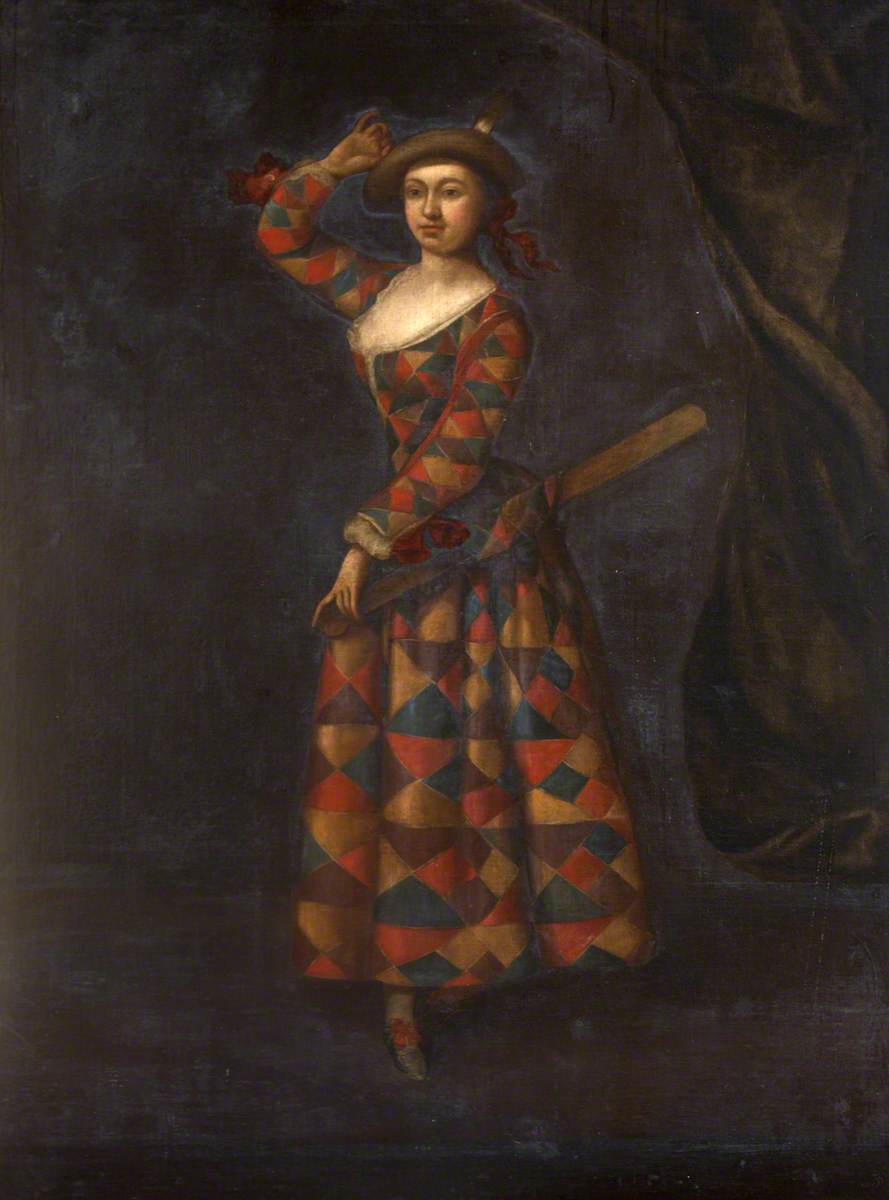
As for the entr’acte dances, Drury Lane offered nine, while Lincoln’s Inn Fields advertised seventeen. Drury Lane rarely mentioned specific dances in its advertisements, so it is impossible to know whether the repertoire was more extensive or which dances were the most popular.  It seems likely that Mrs Santlow’s solo Harlequin was among the latter. She was billed in it twice during 1714-1715 and the dance had been popular since she first performed it, perhaps as early as 1706. This is the less familiar version of her portrait as Harlequine, the one she owned herself which shows her skirt at the length she probably wore for performance.

It was one of only two dances advertised by Drury Lane before the opening of Lincoln’s Inn Fields, after which the theatre did not bill dance titles again until the benefit season began. The theatre’s managers were initially slow to grasp the value of dancing to attract audiences in the new atmosphere of rivalry. Other dances that may have been more popular than the bills suggest were the duets Dutch Skipper and French Peasant, the first given by Wade and Mrs Bicknell and the second by Wade and Mrs Santlow. Both had become part of the entr’acte repertoire not long after 1700 and would remain popular into the 1740s.

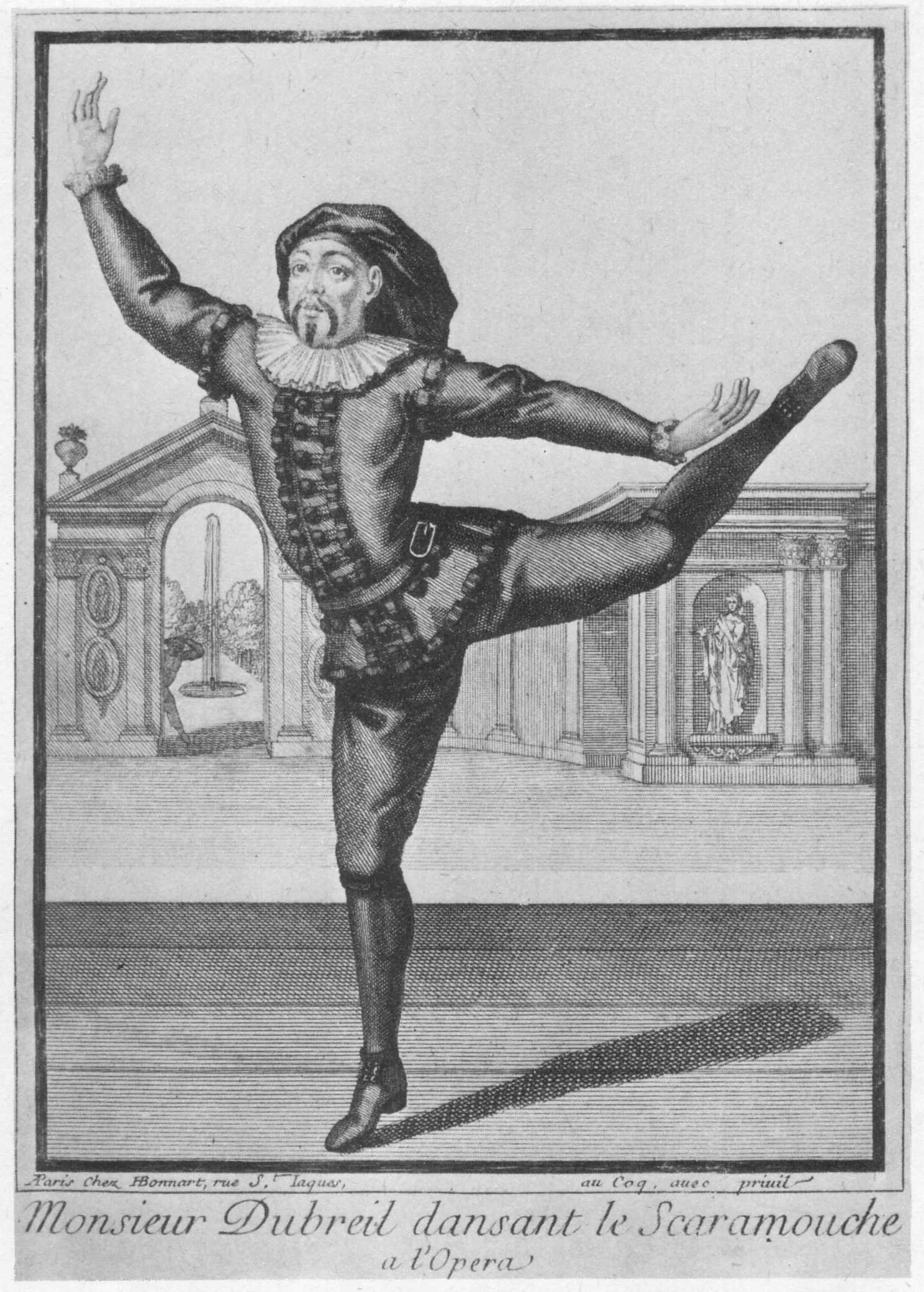
At Lincoln’s Inn Fields, the Dutch Skipper – first given on 6 January 1715 by Delagarde and Miss Russell – was far and away the most popular entr’acte dance, advertised twenty times by the end of the season. It was followed by a solo Scaramouch, performed on 5 February 1715 ‘by a Gentleman for his Diversion’ who gave it seven times during the season. John Thurmond Junior also danced a solo Scaramouch from 16 May 1715, when he was billed as ‘lately arrived from Ireland’. Scaramouch was already a familiar dancing character in London. John Thurmond Junior had been billed dancing the role ‘as it was performed by the famous Monsieur du Brill from the Opera at Brussels’ back in 1711. This print shows Pierre Dubreuil as Scaramouch about that time and suggests the acrobatic skills that Thurmond Junior may have emulated.

There were six entr’acte dances involving Scaramouch this season, with Lincoln’s Inn Fields leading the way and Drury Lane trying to catch up. At Lincoln’s Inn Fields, there was also an Italian Night Scene between Harlequin, Scaramouch and Punch (31 March 1715) and Scaramouches (18 April 1715, apparently a group dance although no dancers were named). Drury Lane replied with a Scaramouch and Harlequin (31 May 1715), a Tub Dance between a Cooper, his Wife, his Man, Scaramouch and Harlequin (2 June 1715) and Four Scaramouches (also 2 June 1715). In these dances, Harlequin would have been performed by one of the male dancers in the company. The four Scaramouches were probably danced by Prince, Wade, Sandham and Newhouse, who were listed in the bill (they also shared between them the male roles in the Tub Dance).

Delagarde and Miss Russell have a good claim to be the leading dancers at Lincoln’s Inn Fields this season, not only because of the number of their appearances (he was billed 65 times and she on 82 occasions) but also for their repertoire. As well as the Dutch Skipper, they performed a Spanish Entry, a Swedish Dance, a Venetian Dance and, most notably, The Friendship a new dance by Mr Isaac (who had been Queen Anne’s dancing master) which was also published in notation. The last of these may have been given before George I when he made his only visit of the season to Lincoln’s Inn Fields, on 10 March 1715 (he had visited Drury Lane on 5 January 1715). The new King was not proficient in English so limited his attendance at plays, preferring the Italian opera at the King’s Theatre. No serious dances were advertised at Drury Lane this season, whereas at Lincoln’s Inn Fields the Spanish Entry, an Entry and Mrs Bullock’s solo Chacone, given later in the season, can probably be assigned to the genre.

The 1714-1715 season should probably be seen as one of transition, at least so far as the dancing was concerned, as Drury Lane adjusted to the return of theatrical competition after enjoying several years of monopoly and Lincoln’s Inn Fields tried to gauge how it would deal with the dramatic superiority of its rival. Both theatres had to assess the impact of a new monarch and a new royal family on London’s theatrical life. In the following season of 1715-1716, they began to develop responses that would have a lasting effect on the entertainments of dancing to be seen on the London stage.

The Necromancer at 300

At the Lincoln’s Inn Fields Theatre, the manager John Rich had been watching Drury Lane’s developing repertoire of pantomimes and he was quick to respond to the success of Harlequin Dotor Faustus. On 20 November 1723, the afterpiece at Lincoln’s Inn Fields was ‘A New Dramatick Entertainment in Grotesque Characters’ entitled The Necromancer; or, Harlequin Doctor Faustus. Here is the advertisement from the Daily Courant that same day.

Rich himself, under his stage name ‘Lun’, took the title role. The new pantomime was given 51 performances before the end of the season and then played every season until 1744-1745. It was briefly revived in 1751-1752 and 1752-1753 before it finally disappeared from the repertoire.

The Necromancer was far more successful than Thurmond Junor’s Harlequin Doctor Faustus. It is thus interesting to note that in 1766-1767 Henry Woodward (who had been trained in the role of Harlequin by John Rich) produced a new pantomime at the Covent Garden Theatre titling it simply Harlequin Doctor Faustus. The advertisements declared that it drew on The Necromancer for some of its scenes, but it seems to have had little or nothing to do with Thurmond Junior’s original.

Rich’s pantomimes made much use of singing and The Necromancer had two scenes which exploited the talents of the singers in his company. The opening scene echoed that of Harlequin Doctor Faustus, as the Doctor is persuaded to sign away his soul, but Rich had a Good Spirit, a Bad Spirit and (instead of Mephostophilus) an Infernal Spirit, all of whom made their entreaties in song. A drawing now in the British Museum shows Faustus together with the Infernal Spirit in this scene.

There is a dance of five Furies in this same scene (which may have been a nod to French opera, which was a strong influence on Rich and his pantomime productions). The Infernal Spirit finally induces Faustus to take his fatal step by conjuring the appearance of Helen of Troy, who does not dance but sings. Rich’s creative response to his rival’s scenario can be seen from the very beginning of The Necromancer. The second episode of singing begins the final scene of the pantomime, when Faustus himself conjures Hero and Leander, who celebrate in song their eternal bliss in the Elysian Fields until Charon arrives and declares (again in song) his intention to ferry them to Hell.

The Lincoln’s Inn Fields pantomime was far more focussed than its rival at Drury Lane. It had only eight scenes, three of which were purely transitional – as characters entered and left the stage linking the scenes before and after with the minimum of action, a device that Thurmond Junior did not really use. The whole action of The Necromancer was published in An Exact Description of the Two Fam’d Entertainments of Harlequin Doctor Faustus … and The Necromancer of 1724. The first performances of the pantomime were accompanied by The Vocal Parts of an Entertainment, call’d The Necromancer : or, Harlequin Doctor Faustus which must have appeared before the end of 1723. There was also a series of editions of A Dramatick Entertainment call’d The Necromancer: or, Harlequin Doctor Faustus which gave only the sung texts. Without An Exact Description, we would know little about the comic action in The Necromancer.

There was dancing in five of the eight scenes. In scene 5, two men enter as Faustus is enjoying a meal with two Country Girls. He tells the men’s fortunes, which they reject and then try to make off without paying him. As they leave, Faustus ‘brings ‘em back on their Hands, making ‘em in that Posture dance a Minuet round the Room’.

In the following scene the dancing was probably more conventional, for the location moves to a Mill where the Miller’s Wife dances a solo before she is joined by the Miller for a duet. Their choreography may have owed something to the various Miller’s dances which had been given in the entr’actes at London’s theatres since the early 1700s. The scene carried on with one of the pantomime’s more daring scenic tricks, as Faustus tries to elude the Miller and make off with his wife, finally fixing the Miller to one of the sails of his own Mill and setting them turning.

Rich’s masterstroke was the finale of The Necromancer, which may have been developed in response to little more than a hint in Thurmond Junior’s Harlequin Doctor Faustus. In the latter, Mephostophilus ‘flies down upon a Dragon’ in the first scene, but Rich reserved the appearance of his monster to the end of his pantomime. As soon as Hero, Leander and Charon have vanished:

‘The Doctor waves his Wand, and the Scene changes to a Wood; a monstrous Dragon appears, and descends about half way down the Stage, and from each Claw drops a Daemon, representing divers grotesque Figures, viz. Harlequin, Punch, Scaramouch, and Mezzetin. Four Female Spirits rise in Character to each Figure, and join in an Antick Dance;’

This was probably the most substantial sequence of dancing in the pantomime, performed by the company’s leading dancers with Dupré and Mrs Rogier as the Harlequins, Nivelon Junior and Mrs Cross as the Pierrots (Punch is not listed among these dancing Spirits in the advertisements although he did appear in the pantomime, played by Nivelon Senior i.e. Francis Nivelon), Glover and Mrs Wall as the Mezzetins and Lanyon and Mrs Bullock as Scaramouches. Dupré was, of course, a dancing Harlequin and his performance in this last scene must have been very different from John Rich’s in the title role. The dance historian Richard Semmens has suggested that this ‘Antick Dance’ was performed to a chacone, a piece which is included among music for The Necromancer published some years later. The scene then moves inexorably to its tragic conclusion.

‘as they are performing, a Clock strikes; the Doctor is seiz’d by Spirits, and thrown into the Dragon’s Mouth, which opens and shuts several times, ‘till he has swallow’d the Doctor down, belching out Flames of Fire, and roaring in a horrible Manner. The Dragon rises slowly; the four Daemons that drop from his Claws, take hold of ‘em again, and rise with it; the Spirits vanish;’

Rich did not bother with a masque to point the moral of his tale. The Necromancer ends with a sung chorus:

Now triumph Hell, and Fiends be gay,

The Sorc’rer is become our Prey.

In contrast to Harlequin Doctor Faustus, evil apparently triumphs at the end of The Necromancer.

It has been suggested that Rich was preparing The Necromancer as a new pantomime for Lincoln’s Inn Fields well before Drury Lane mounted Harlequin Doctor Faustus, but the coincidence seems unlikely and does not fit with his later practice. Could he instead have been developing another theme and then quickly repurposed its tricks and transformations to outdo Drury Lane with its own story?

References:

Richard Semmens, Studies in the English Pantomime, 1712-1733 (Hillsdale, NY, 2016), chapter 3.

Olive Baldwin and Thelma Wilson, ‘“Heathen Gods and Heroes”: Singers and John Rich’s Pantomimes at Lincoln’s Inn Fields’, “The Stage’s Glory” John Rich, 1692-1761, ed. Berta Joncus and Jeremy Barlow (Newark, NJ, 2011), 157-168.

Harlequin Doctor Faustus at 300

How many people (including dance historians) have heard of the pantomime Harlequin Doctor Faustus, which celebrates its 300th birthday this year? It wasn’t the first English pantomime but it began a craze for these afterpieces which established this unique genre of entertainment on the London stage.

John Thurmond Junior’s Harlequin Doctor Faustus was first given at the Drury Lane Theatre on 26 November 1723. Here is the advertisement in the Daily Courant that same day:

It reveals the importance of commedia dell’arte characters, from Harlequin to Punch, as well as those from classical mythology, as part of its appeal to audiences. The emphasis on ‘Scenes, Machines, Habits and other Decorations’, all of which were ‘intirely New’ reveals the hopes of Drury Lane’s managers that the afterpiece would prove a money spinner. These were justified, at least for a while, for Harlequin Doctor Faustus was performed forty times before the end of 1723-1724 and was revived every season until 1730-1731. Its subsequent disappearance from the Drury Lane repertoire was probably due to the actors’ rebellion at the theatre at the end of the 1732-1733 season and the ensuing instability of the company. Harlequin Doctor Faustus was revived for eight performances in 1733-1734 but then disappeared altogether.

John Thurmond Junior was the son of the actor John Thurmond (hence his epithet) and seems to have begun his career on the Dublin stage. As a dancer, his repertoire ranged from the serious through the comic to the grotesque. His commedia dell’arte character was Scaramouch and he created the role of Mephostophilus in Harlequin Doctor Faustus. Thurmond Junior created several pantomimes for Drury Lane, notably Apollo and Daphne; or, Harlequin Mercury (first given on 20 February 1725) in which he used the serious part (with the title roles played by dancers – himself and Mrs Booth) to emulate John Weaver’s dramatic entertainments of dancing.

Harlequin Doctor Faustus and John Rich’s The Necromancer; or, Harlequin Doctor Faustus (first performed less than a month later, which I will also write about), Lincoln’s Inn Fields Theatre’s answer to Drury Lane’s pantomime, were so successful that scenarios for both were quickly printed. There are at least four different published versions of Harlequin Doctor Faustus, the most detailed of which brings both pantomimes together in print and probably appeared in 1724. Here is the title page:

This sets down the action in sixteen successive scenes, beginning in ‘The Doctor’s Study’ where Faustus signs away his soul and Mephostophilus ‘flies down upon a Dragon, which throws from its Mouth and Nostrils Flames of Fire’ to take the contract from him and present him with a white wand ‘by which he has the Gift and Power of Enchantment’. The following scenes present a frenzy of action with many tricks and transformations as well as a generous scattering of dances. Faustus was performed by John Shaw, whose formidable dance talents encompassed a wide range of styles (I have mentioned him in a number of previous posts).

The fourth scene turns to classical literature. Faustus and three ‘Students’ (in the characters of Scaramouch, Punch and Pierot) are drinking together when the table at which they are sitting:

‘… upon the Doctor’s waving his Wand, rises by degrees, and forms a stately Canopy, under which is discover’d the Spirit of Helen, who gets up and dances; and on her return to her Seat, the Canopy gradually falls, and is a Table again.’

‘Helen’ is, of course, Helen of Troy. Scene fourteen ends with a scenic spectacle as Doctor Faustus and his companions try to escape a pursuing mob by locking themselves into a barn. When the mob force a way in, they escape down the chimney ‘but the Doctor, as he quits the Barn-Top, waves his Wand and sets it all on Fire; it burns some time, very fiercely, and the Top at last falling in, the Mob, in utmost Dread, scour away’.

Scene fifteen returns to the Doctor’s study as his agreement with the Devil expires and he is accosted first by Time and then by Death, who strikes Faustus down.

‘Then two Fiends enter, in Lightning and Thunder, and laying hold of the Doctor, turn him on his Head, and so sink downwards with him, through Flames, that from below blaze up in a dreadful Manner; other Dæmons, at the same Time, as he is going down, tear him Limb from Limb, and, with his mangled Pieces, fly rejoicing upwards.’

Thurmond Junior’s pantomime did not end there, for a final scene revealed ‘A Poetical Heaven. The Prospect terminating in plain Clouds’ in which ‘several Gods and Goddesses are discover’d ranged on each Side, expressing the utmost Satisfaction at the Doctor’s Fall’. They perform a series of dances, beginning with a duet by Flora and Iris, then a ‘Pyrrhic’ solo by Mars (danced by Thurmond Junior), a duet by Bacchus and Ceres, followed by a solo for Mercury (danced by John Shaw) ‘compos’d of the several Attitudes belonging to the Character’. This ‘Grand Masque of the Heathen Deities’ was a divertissement of serious dancing and culminated as ‘the Cloud that finishes the Prospect flies up, and discovers a further View of a glorious transcendent Coelum’ revealing:

Diana, standing, in a fix’d Posture on an Altitude form’d by Clouds, the Moon transparent over her Head in an Azure Sky, tinctur’d with little Stars, she descends to a Symphony of Flutes; and having deliver’d her Bow and Quiver to two attending Deities, she dances.’

Diana was performed by Hester Booth, the leading dancer on the London stage. The newspapers were dismissive of the comic scenes in Harlequin Doctor Faustus, but they were agreed on the magnificence of the concluding masque and the beauty of Mrs Booth’s dancing. Both the comic and the serious parts of Thurmond Junior’s pantomime would influence many future productions.

It is frustrating that we have next to no evidence of this or most other 18th-century pantomimes. There are no records of costumes or scenery and such music as seems to survive may, or may not, belong to this production. No portrait of John Thurmond Junior is known. The nearest we can get is the satirical engraving ‘A Just View of the British Stage’ which castigates the Drury Lane management for their pantomime productions. Thurmond Junior may be the dancing master (identifiable by his pochette) shown hanging towards the top right of the print.

References:

Moira Goff, ‘John Thurmond Junior – John Weaver’s Successor?’, Proceedings, Society of Dance History Scholars, Twenty-Sixth Annual Conference, University of Limerick, Limerick, Ireland, 26-29 June 2003 (Stoughton, Wisconsin, 2003), pp, 40-44.

Moira Goff, The Incomparable Hester Santlow (Aldershot, 2007), pp. 115-117.

Richard Semmens, Studies in the English Pantomime, 1712-1733 (Hillsdale, NY, 2016), chapter 2

Anthony L’Abbé. The Prince of Wales’s Saraband

The notation for Anthony L’Abbé’s ballroom dance The Prince of Wales’s Saraband is one of the exhibits in Crown to Couture at Kensington Palace (the exhibition closes on 29 October 2023). It is shown out of context and with next to no explanation of its meaning so, although I have written about the dance elsewhere, I thought it would be worth a post in Dance in History to provide some information about this beguiling duet.

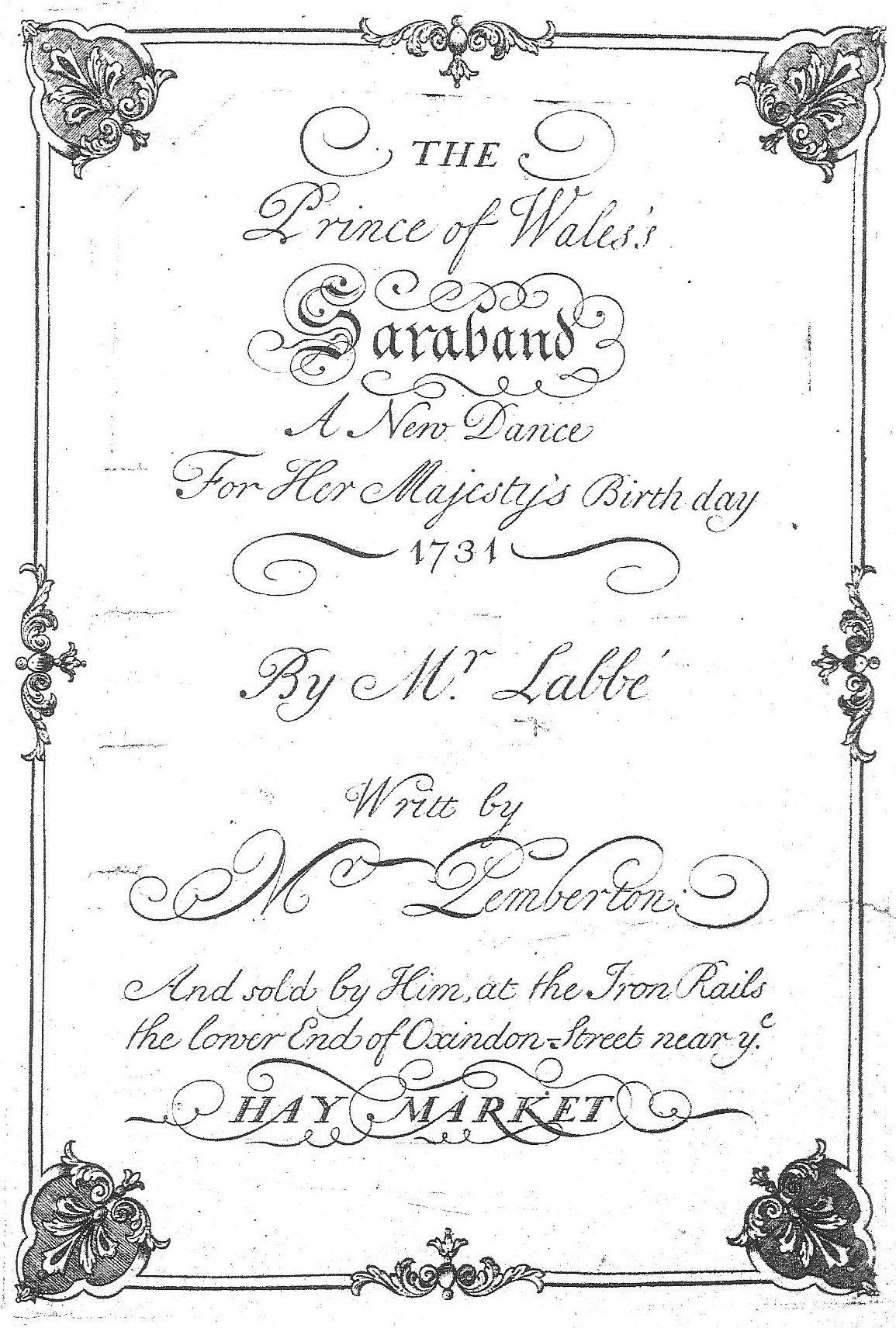
The Prince of Wales’s Saraband was one of a series of dances created by Anthony L’Abbé and published in Beauchamp-Feuillet notation by Edmund Pemberton following L’Abbé’s appointment by George I as royal dancing master around 1715. The title page makes clear that this was one of the dances choreographed by L’Abbé to celebrate the birthday of Queen Caroline, wife of King George II and mother of the Prince.

Her birthday was on 1 March and it had been celebrated at court since at least 1717, when L’Abbé’s ballroom dance The Royal George was created and published for that purpose. In that case, the title page of the dance makes no reference to the then Princess of Wales but the advertisements for the notation make it clear that the dance was in her honour.

By 1731, Caroline had been Queen for fewer than four years and L’Abbé had not published a dance since the Queen Caroline which honoured her birthday in 1728. In 1731, there was a birth night ball for the Queen and the report in the Daily Advertiser for 3 March 1731 gives us some details.

There is no mention of L’Abbé’s dance, although Frederick Prince of Wales ‘open’d the Ball’ by dancing a minuet with his sister Anne the Princess Royal. The reference to the illumination of the houses of all three of the actor-managers of the Theatre Royal, Drury Lane, is interesting, for The Prince of Wales’s Saraband was performed in the entr’actes at that theatre on 22 March 1731 by William Essex and Hester Booth. That first public performance was obviously also intended to honour the Queen.

The dance seems to have been admired, for it was revived at the Haymarket Theatre on 21 August 1734 and again at Drury Lane on 17 May 1735, each time performed by Davenport and Miss Brett. It was revived again at Covent Garden on 25 April and 13 May 1737, by Dupré (probably the dancer James Dupré) and Miss Norman.

Prince Frederick had remained in Hanover following the accession of his grandfather as George I in 1714. He came to England only in 1728, eighteen months after the accession of his parents to the British throne. By this time, the prince was twenty-one and he joined a family which included four sisters and a brother whom he scarcely knew. This portrait by Philippe Mercier shows Prince Frederick in the mid-1730s.

Prince Frederick’s relationship with his parents, particularly his mother Queen Caroline, became steadily more difficult after his arrival in England. In 1731, the year The Prince of Wales’s Saraband was created, this problem lay in the future.

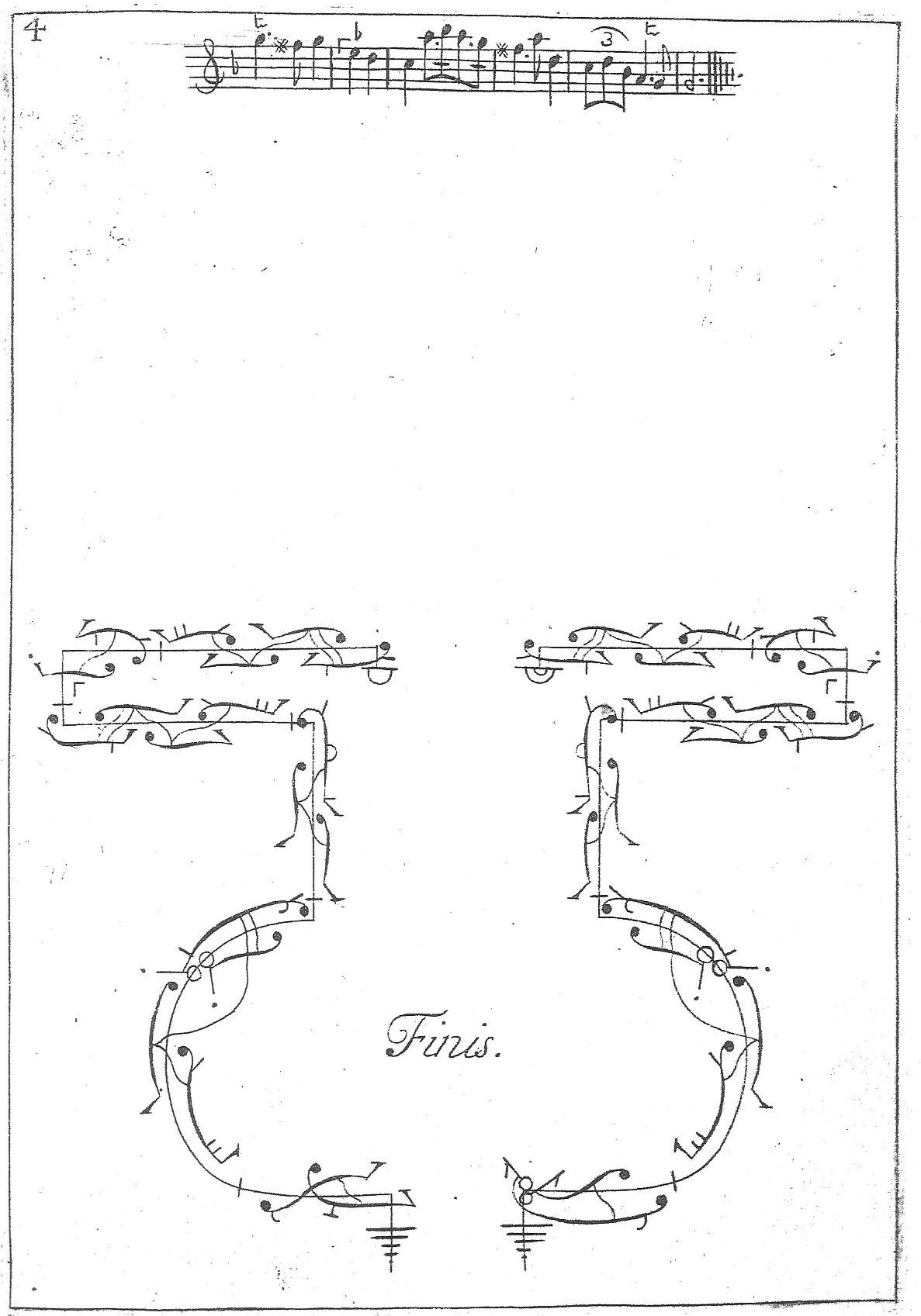
The Prince of Wales’s Saraband, as notated, is ostensibly an undemanding ballroom dance of 48 bars of music with the familiar AABB musical structure (A=10 B=14). The choreography is divided between four plates of notation (which by this time was Pemberton’s regular practice and probably reflects the expense of paper for printing). Plate 1 records the two A sections (20 bars of dance and music) and plate 2 the first B section. Plate 3 has bars 1 – 8 of the second B section and the dance ends on plate 4 with its final 6 bars. This division of the last section of the dance between two plates is dictated by the circular figures traced, which need to be shown separately so that they do not overlap, but also respects the musical phrasing. The layout on each plate may also reflect Pemberton’s aesthetic preferences – his notations for Isaac and L’Abbé include some of the most beautiful examples of this highly specialised genre of engraving.

Closer analysis of the notation reveals that this duet has some complexities and that it demands immaculate style and technique if it is to make an impact. Reconstructing the dance raises a number of questions about those aspects that are not notated – in particular arm movements and the use of the head. In all of these notated ballroom dances, the attention of the two performers seems to be divided between the presence (the guest of honour), each other and the surrounding audience. How much do we really know about the conventions that governed the performance of such dances, either at court or on stage, which should inform our dance reconstructions?

The Prince of Wales’s Saraband opens with a figure based around a temps de courante à deux, in which a temps is followed by a temps de courante, first on the inside foot and then on the outside foot. The notation indicates that the dancers turn their bodies towards the pointing foot on each temps, turning back towards the presence on each temps de courante. Did this mean that they turned their heads the same way or did they look steadfastly forward?

In the remaining bars of the first A section, they turn alternately towards one another and the presence but there are also opportunities to take in the surrounding audience.

The end of the dance, the steps and figures of the its last six bars on the final plate, has the dancers face the presence side-by-side for three bars travelling sideways away from each other and back again. They then turn to perform a pas de bourrée directly upstage, followed by a variant on the pas de bourrée vîte curving away from each other and coming face to face briefly before a coupé into their final réverence.

I can’t help wondering if this sequence was created, in part, to allow the dancers to acknowledge the audience that surrounded them before they made their final honours. The performance of The Prince of Wales’s Saraband at Drury Lane was part of a benefit for Mrs Booth, when some of the audience may have sat around the dancers on the stage (almost as they would have done in the ballroom) as well as in the auditorium. There is no evidence that Queen Caroline herself attended, but the royal box at this period would have been directly opposite the stage in the centre of the first tier just above the pit, providing the dancers with a specific focus.

The step vocabulary of this dance is dominated by the pas de bourrée, with and without a final jetté, extending to the pas de bourrée vîte. There are also a number of variants of the coupé, including the coupé sans poser and the coupé avec ouverture de jambe. It is interesting that, throughout, L’Abbé uses the jetté and not the demi-jetté in pas composés. These add energy and prevent the dance from becoming languid. He also likes to pair steps, although where he repeats these pairings he often introduces an element of variation the second time.

One sequence, on the second plate within the final bars of the B section, is noteworthy and quite challenging to perform.

L’Abbé introduces an element of suspension, in the opening coupé sans poser with a one-beat pause (which comes at the end of the preceding musical phrase), before a pas composé which demands unhurried speed – a pas plié, changement and coupé soutenu to fourth position with a quarter-turn. There is then a coupé avec ouverture de jambe (also with a one-beat pause) before the pas composé is repeated. This sequence ends with another coupé avec ouverture de jambe and a pause, before the B section is completed with two pas balancés.

The Prince of Wales’s Saraband was first performed on stage by Mrs Booth (née Hester Santlow), with whom L’Abbé had worked over many years and for whom he had created several notable choreographies. Could this ostensibly simple, yet demanding, ballroom duet have been created with and for her, intended specifically for performance at her benefit?

Further Reading:

Moira Goff, ‘Edmund Pemberton, Dancing Master and Publisher’, Dance Research, 11.1 (Spring 1993), 52-81

Moira Goff, The Incomparable Mrs Booth (London, 2007), pp. 138-139.

Contextualizing Mr Isaac’s Minuets

I thought it would be interesting, and perhaps informative, to try to place Mr Isaac’s minuets within the context of other minuet choreographies of approximately the same period. It isn’t easy to date the French notated dances, other than by their dates of publication, but given that some use music that appeared earlier they, too, may have been created a few years before their first appearance in print. I have taken my investigation as far as 1709, the year that Isaac’s The Royal Portuguez was published. Apart from the minuet in Favier’s Le Mariage de la Grosse Cathos of 1688, which I include here, there are six other minuets to be explored. Some are minuets only, while others are minuet sections within multi-partite dances.

La Bourée d’Achille was first published in Feuillet’s Recueil de dances composées par Mr. Pecour in Paris in 1700, one of the first two collections of dances to appear in notation. The minuet is the central section of the dance, with 48 bars of music in 3/4 time (2xAABB A=4 B=8), preceded and followed by a bourrée. The music is from Achille et Polixène, the opera begun by Lully and completed after his death by Colasse. It was first performed in 1687 and then not revived until 1712. So, the duet must antedate 1700 and could belong to the mid to late 1690s.

The Menuet à Deux was published by Feuillet in Recueil de dances contenant un tres grand nombres, de meillieures entrées de ballet de Mr. Pecour which appeared in Paris in 1704. This was the first collection of dances closely linked to the Paris Opéra (Feuillet had published a collection of his own ‘theatrical’ choreographies in 1700, but these seem not to have been associated with dancers on the professional stage). It was danced by Dumoulin l’aîné and Mlle Victoire in Campra’s Fragments de Mr de Lully in 1702 and the choreography obviously belongs to that date. As its title suggests, this is a minuet throughout which has 48 bars in 3/4 time (AABB A=8 B=16)

The Entrée pour un homme et une femme was also choreographed by Pecour and included in the 1704 Recueil de dances. The music is from Destouches’s opera Omphale, first given at the Paris Opéra in 1701 and then at court in 1702 (after which it was not revived until 1721). The notation declares that this duet was performed by Ballon and Mlle Subligny. It was, of course, a minuet for the stage rather than the ballroom with 68 bars of music in 3/4 time (a rondeau, ABACA A=16 B=8 C=12)

La Bavière, choreographed by Pecour, appeared in the IIIIe Recueil de dances de bal pour l’année 1706 published in Paris the previous year. This is a minuet followed by a forlana, to music from La Barre’s La Vénitienne first given at the Paris Opéra in 1705, so this ballroom dance must surely have been created with speedy publication in mind. The minuet has 32 bars of music in 3/4 time (AABB A=B=8)

The Brawl of Audenarde, by Siris, was published individually in London as his ‘new Dance for the year 1709’ and was obviously intended to celebrate the Duke of Marlborough’s victory at the Battle of Oudenarde as part of the War of the Spanish Succession in 1708. The title page says ‘The Tune by Mr. G.’, John Ernest Galliard, and the music was published separately the same year. This dance is a courante followed by a minuet and then a gigue, so it has structural affinities with some of Mr Isaac’s choreographies. The minuet has 32 bars of music in 3/4 time (ABAB A=B=8).

Le Menuet d’Alcide, another choreography by Pecour, was also published in 1709 but in Paris within the VIIe Recüeil de dances pour l’année 1709. Its music is from the opera Alcide by Louis Lully and Marin Marais, first performed at the Paris Opéra in 1693 and revived in 1705 (according to Francine Lancelot’s catalogue La Belle Dance (entry FL/1709.1/02) the music was also used in Ariane et Bacchus by Marais in 1696). This is another minuet throughout with 54 bars of music in 6/4 (3xAABB’ A=4 B=6 B’=4). It is possible, but perhaps unlikely, that Pecour’s choreography dates to the mid to late 1690s.

Leaving aside issues of dating, do any of these minuets have steps or figures in common with those by Mr Isaac that I explored in my earlier post?

Favier’s minuet ‘Entrée des 2. Garçons et des 2. filles de la Nopce’ in Le Mariage de la Grosse Cathos is analysed in detail by Rebecca Harris-Warrick and Carol Marsh in their 1994 book Musical Theatre at the Court of Louis XIV (see particularly pages 144-148). This choreography uses pas de menuet and contretemps du menuet, plus a single coupé and assemblé combination. The pas de menuet and contretemps du menuet differ from later versions, both in their component steps and their timing (see Harris-Warrick and Marsh, pp. 109, 111). There is no reference to any of the later conventional figures of the ballroom minuet. This ‘Entrée’ is a stage choreography performed within a work which uses music, songs and dances to portray an event – the marriage of ‘Fat Kate’. It is, perhaps, more surprising that it uses a standard and restricted vocabulary of steps than that it ignores the usual figures of the minuet, if these had indeed been established by 1688.

The French ballroom dances published in the early 1700s all reflect the menuet ordinaire as known from Rameau’s Le Maître à danser of 1725. The minuets in La Bourée d’Achille and La Bavière, as well as Le Menuet d’Alcide, all predominantly use the pas de menuet with some contretemps du menuet and occasional grace steps. In La Bourée d’Achille the pas de menuet à trois mouvements is favoured, while in Le Menuet d’Alcide preference is given to the pas de menuet à deux mouvements. The figures of these two minuets (particularly the latter) recognisably relate to the conventional figures of the ballroom minuet, but the minuet section in La Bavière is too short to do other than allude to the opening figure before moving on to another short figure which simply gets the dancers to their places to begin the following forlana.

Of the two minuets for the stage, the Menuet à Deux danced by Dumoulin l’aîné and Mlle Victoire is the most conventional. Of the twenty-four pas composés in this dance (which are written as if in 6/4), ten are pas de menuet à deux mouvements and eight are contretemps du menuet. Pecour begins the dance with a coupé sideways as the couple face each other, followed by a pas tombé and a jetté. The first B section of the music begins with the couple facing one another on a right line for a pas balancé forwards and backwards, incorporating a beat and an ouverture de jambe, before moving sideways away from each other with a fleuret and a pas balonné. They then repeat this sequence. Despite his choice of steps, Pecour seems not to reflect any of the ballroom minuet’s figures within his choreography – although this dance has quite a strong inward focus between the two dancers which is interesting in the context of a stage performance. Here is the first plate.

The Entrée pour un homme et une femme, danced by Ballon and Mlle Subligny in Omphale, has a far more varied vocabulary of steps with only four pas de menuet à deux mouvements and two contretemps du menuet. Otherwise Pecour uses pas composés based on a wider range of basic steps, some of which play with conventional steps from the minuet, for example the demi-contretemps followed by a pas tombé and a jetté, while others come together into sequences which echo those he uses in other dance types, like the coupé à deux mouvements followed by a coupé sans poser as the couple move sideways away from each other. There are no clear references to the conventional figures of the minuet, although the final retreat does have a contretemps du menuet as the pair move backwards upstage. Here is the final plate of this duet.

It is worth noting that this dance is far more outwardly focussed than Pecour’s Menuet à Deux. It is less easy to identify as a minuet from its choreography, but I suspect that a subtle relationship with the conventions of the ballroom minuet might emerge in the course of detailed reconstruction of the duet.

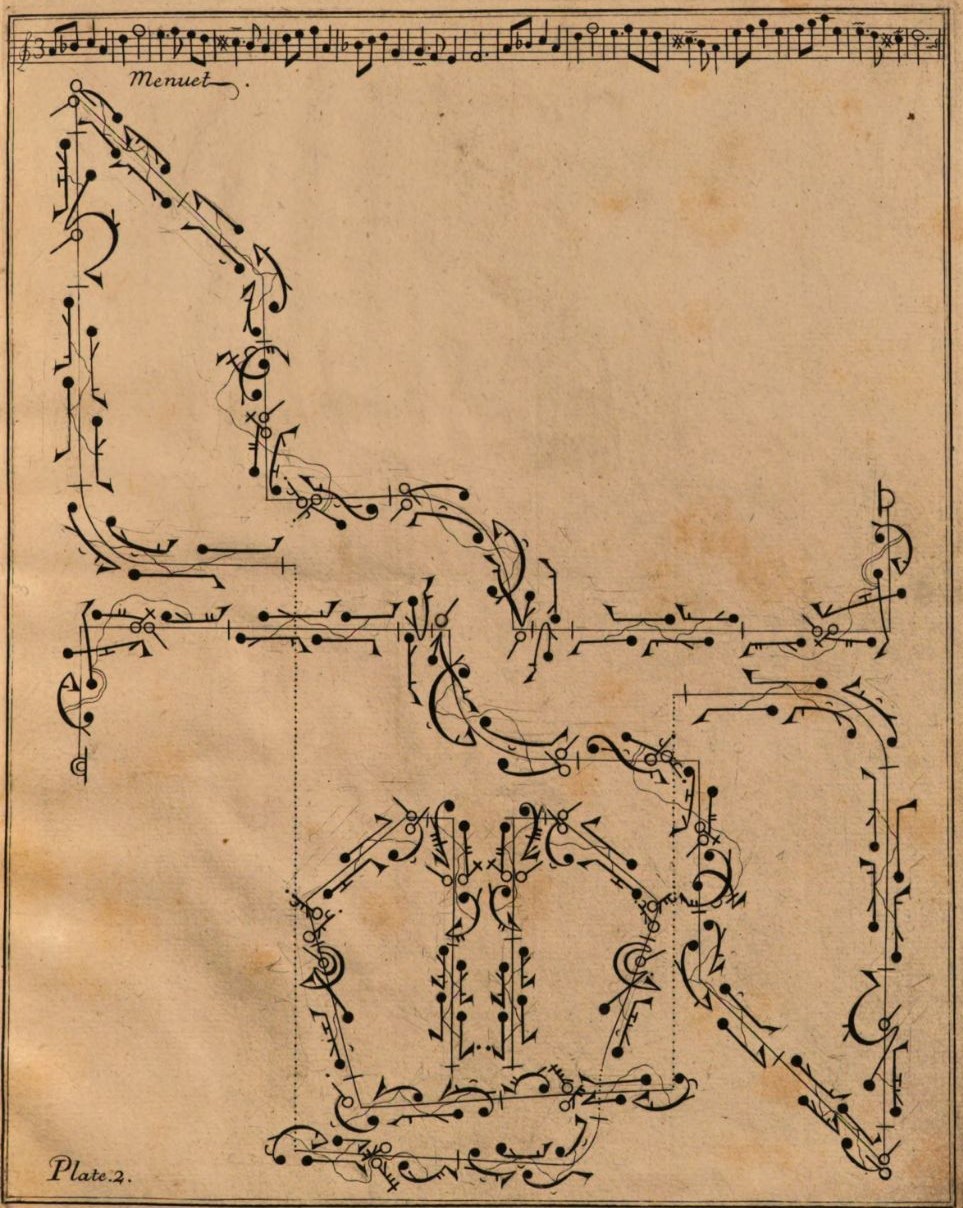
The last of the minuets seems to relate most closely to those by Mr Isaac, perhaps because Siris was working in London as well, or maybe because he was trying to emulate some aspects of Isaac’s choreographic style. Here is plate two of The Brawl of Audenarde with the whole of the minuet section.

The notation and engraving styles are strikingly different from those of the French notations and resemble those of Isaac’s dances (the printer John Walsh produced both Isaac’s and Siris’s dances). The dancers have just completed the courante, the opening section of the duet, and are facing each other offset across the dancing space. They begin by moving onto the same diametrical line with a variant of the pas de bourrée in which the last step is a pas glissé, recognisable from Isaac’s minuet for The Britannia, to which Siris adds a final plié. This is joined to a hop and a jetté, the final elements of the contretemps du menuet, to make a new hybrid pas composé emulating the sort of steps created by Isaac. Siris makes copious use of the pas de menuet à deux mouvements – there are seven in all within this 16-bar minuet (although the music is notated in 3/4, the dance steps are written in 6/4) and four are given small variations. There is a grace step, the pas de courante, which appears once in its usual guise of a tems de courante followed by a demi-jetté battu and then in an ornamented version (performed by the woman as well as the man) which has a double beat. The latter comes close to the end of the minuet section, by which time the couple are in mirror symmetry and so dancing on opposite feet. Like La Bavière, the minuet section of The Brawl of Audenarde is too short to include even allusions to the figures of the ballroom minuet. It ends with the man and woman side by side facing the presence, but improper, ready to begin the gigue with which the duet ends.

On the evidence of this small selection of early notated minuets, six French and one English (or, at least, published in London), Mr Isaac’s choreography was very idiosyncratic. The nearest to him in style is Siris. Should we read anything into the fact that, in his own translation of Feuillet’s Choregraphie entitled The Art of Dancing, Demonstrated by Characters and Figures and published in London in 1706, Siris claimed that he had been taught the notation by its inventor Pierre Beauchamp in the late 1680s? As we now know, Mr Isaac had begun his career in Paris by the early 1670s and was undoubtedly acquainted with Beauchamp. Did he and Siris enjoy similar early training in belle danse, contributing to the similarities between their approaches to choreography?

The Dancer in the Dancing Space: The ‘Chacone de Phaëton’

There are three choreographies to the chaconne from act two of Lully’s 1683 opera Phaëton:

  • Guillaume-Louis Pecour, ‘Chacone pour une femme’, Recüeil de dances (Paris, 1704). LMC 2020, FL/1704.1/03.
  • Guillaume-Louis Pecour, ‘Chacone de Phaëton pour un homme non Dancée a l’Opera’, also in the Recueil de dances (Paris, 1704). LMC 1960, FL/1704.1/29.
  • Anonymous, ‘La chaconne de phaestons’ a solo for a man surviving in the manuscript source held by the Bibliothèque Nationale de France, fr. 14884. LMC 1940, FL/Ms17.1/10.

All use a single iteration of the music, which in the opera is played through twice. Each of the choreographies thus has 152 bars of music with which to create a series of dance variations.

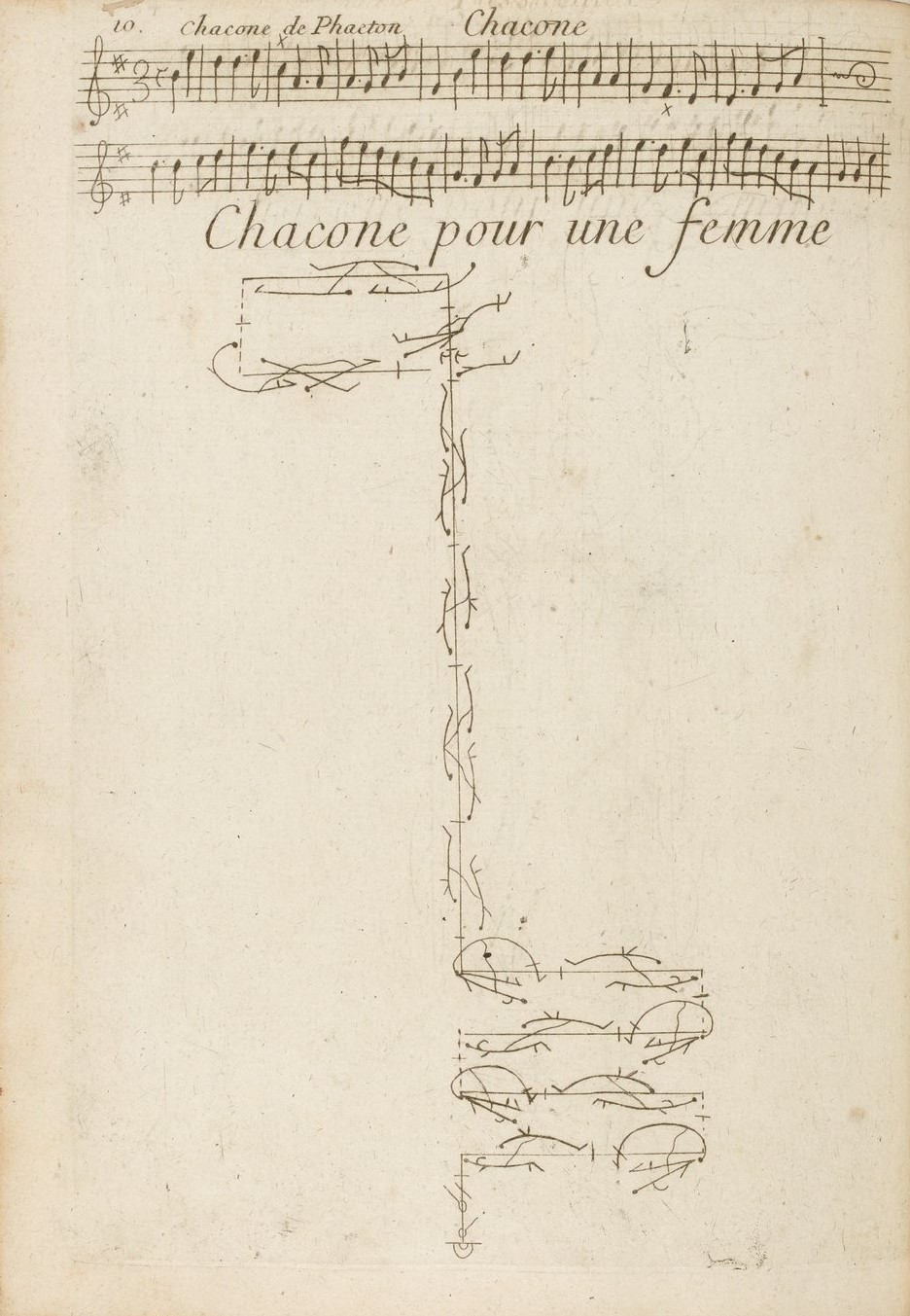
I have recently been working on the solo for a woman and become interested in the dancer’s relationship to the space within which she is dancing – or, perhaps more accurately, the space which surrounds her. We do not know when or where this solo was performed – it may or may not have been given within the opera. The step vocabulary is straightforward, with little in the way of embellishment, but its use of space and the changing orientation of the dancer as she traces her figures is worth some analysis.

A quick look at the notations for the two male solos indicates that both are very focussed on downstage centre (often referred to, particularly in ballroom contexts, as the ‘presence’), whether they are facing it or have their backs turned. These male dancers rarely turn to either stage right or stage left, or their ballroom equivalents. The use of space is quite different to that in the female solo.

Here, I would like to look at just three sequences from Pecour’s ‘Chacone pour une femme’ of 1704.

  • Plate 10, bars 1 – 16 (the first two musical variations), the beginning of this dance
  • Plate 17, bars 117 – 124, towards the end of the solo
  • Plate 19, bars 137 – 144, the penultimate variation of the dance.

I won’t say anything about the music, except that the notator of the dance respects the musical variations as he divides the choreography between plates – each plate has 16 bars of dance / music (two variations, each of 4 + 4 bars), except for plates 14 and 18 which each have 12 bars of dance / music to reflect changes in the structure of the music.

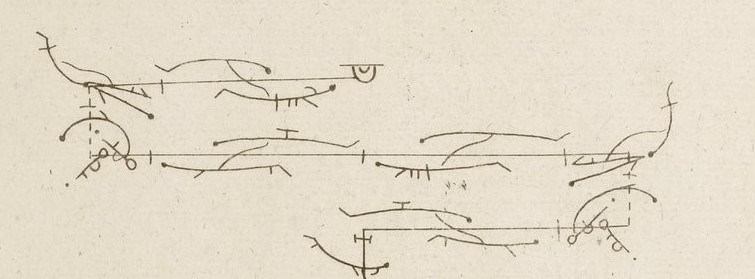
This chaconne begins with the dancer moving to right and left, before making a conventional passage downstage. According to the notation, she faces the presence as she waits to begin. She starts with a quarter-turn to the right for a coupé à deux mouvements, and then makes a quarter-turn to the left for a coupé battu avec ouverture de jambe. She repeats these two steps on the other foot, turning first to the left and then back to the right. So, she addresses each side of her dancing space before turning to the presence. I haven’t done any research to see if this is unusual among the notated dances, but in terms of the dancer’s successive orientations within her dancing space it is interesting. Here is the first plate of the ‘Chacone pour une femme’, with the first two dance / music variations, together with a detail of the passage I have described:

By plate 17, the dancer is within reach of the end of the choreography after a variety of steps and figures. Here, I want to look particularly at the second 8-bar variation – my focus is on the figure to the right of the plate.

This is not the first rectilinear figure in the chaconne. There is another in plate 12, in which the dancer performs seven coupés à deux mouvements with a final coupé simple. All travel sideways to the left and there is a quarter-turn to the left at the beginning of every other step, from the first to the seventh and then on the eighth as well. So, the dancer performs two coupés à deux mouvements facing downstage, two facing stage left, two facing upstage, one facing stage right and the final coupé simple facing downstage again. The turns in the figure on plate 17 are more subtle and varied and follow each other in quick succession. This was the sequence which set me thinking about the dancer’s use of space and orientation as I struggled to get it right. I also couldn’t help wondering how it might relate to later codifications of the directions of the body in ballet and in modern ballroom (two styles I am acquainted with).

This variation has eight pas de bourrée. The dancer begins facing the presence, having just done a pas de bourrée sideways. Her first step has a quarter-turn to the right and then a half-turn to the right on the demi-coupé and ensuing step of the pas de bourrée, so she faces stage right then stage left and has a final step backwards with no turn. The next pas de bourrée has a quarter-turn to the right at the beginning and she stays facing downstage for the rest of the step. The third and fourth pas de bourrée each have quarter-turns to the right on their first two steps, followed by no turn. The dancer faces stage right, upstage, stage left, downstage as she moves. Although she ends facing the presence, her fifth step has a quarter turn on its second step so, she turns away to face stage right. The sixth pas de bourrée has a quarter-turn to the right on the first step, so she faces upstage immediately (at the point when she must be directly in front of the presence). Her seventh step has quarter-turns to the right on the first and second steps, turning her back to face downstage, a direction she maintains for the eighth pas de bourrée (which moves sideways to the right, reflecting the step which preceded this sequence). I have said little about changes in the direction of the steps themselves (the second to the sixth pas de bourrée each begin with a sideways step), but they play a part in the surprising complexities of this variation.

As I worked on it, I began to wonder how important these degrees of turn were. They reminded me of the precise degrees of turn required in modern ballroom steps, in which the directions of the body relate to the centre lines, the outer lines (the walls) of the dancing space and the ‘line of dance’ (a concept that needs further analysis) itself. Both these rectilinear figures within the chaconne move anti-clockwise around the space, as do modern ballroom dancers, with the dancer herself turning clockwise as she moves. I understand that directions of the body and directions of travel were not codified, in either ballet or ballroom dancing, before the early 20th century, but here are the rudiments of them within baroque dance some 200 years earlier. Of course, this focus on the perimeter of the dancing space raises a question – was the ‘Chacone pour une femme’ created for the court ballroom rather than the stage?

The last sequence I want to look at comes close to the end of the dance, on the very last plate of the notation.

It is both an extension and a variation of the sequence with which this chaconne began, and also draws on another earlier version of that opening sequence in which the coupé à deux mouvements was replaced by a contretemps. This latest variation begins with a contretemps, followed by a coupé battu avec ouverture de jambe, but the dancer turns to the left first and does not turn back to the presence on her second step. Instead, she continues to face stage left and then does a half-turn pirouette to face stage right, followed by a coupé soutenu in the same direction. She then repeats the whole sequence on the other foot in the opposite direction, not really addressing the presence at all. She only turns to face downstage when she begins the final variation of the choreography directly before the presence, and then faces it until the very end of the dance.

I can’t guess at the significance of these changes of direction within this particular female solo, although I do feel that it is important to dance them accurately. I couldn’t readily find anything on the topic of body directions among the sources accessible to me, but I need to take another look. The concept of the presence needs revisiting, too. So, perhaps, there will be a follow-up to this post in due course.

Reading List:

Régine Astier, ‘Chaconne pour une femme: Chaconne de Phaëton. A performance Study’, Dance Research, XV.2 (Winter 1997), 150-169. (Papers from the 1996 conference Dance to Honour Kings)

Francine Lancelot. La Belle Dance: Catalogue Raisonnée (Paris, 1996) [FL]

Meredith Ellis Little and Carol G. Marsh. La Danse Noble: an Inventory of Dances and Sources (Williamstown, 1992) [LMC]

The Entrée Grave: A Touchstone of Male Virtuosity?

I am pursuing a line of research that has led me to the entrée grave and its use in musical works on the London stage in the late 17th century, so I thought I would take a closer look at this dance type through the choreographies surviving in notation. I have, of course, written about male dancing in other posts and I list these below for anyone who might be interested.

In her 2016 book Dance and Drama in French Baroque Opera (p. 56), Rebecca Harris-Warrick describes the entrée grave as ‘a slow dance in duple meter characterized by dotted quarter note /eighth-note patterns, rather like the opening portion of an overture’, cautioning that ‘“grave” is found in the headings for choreographies … in scores such a piece is generally identified simply as an entrée or an air’. She also tells us that ‘in choreographic sources entrées graves are always danced by men’ (although she does cite an opera in which one may have been danced by women, p. 332).

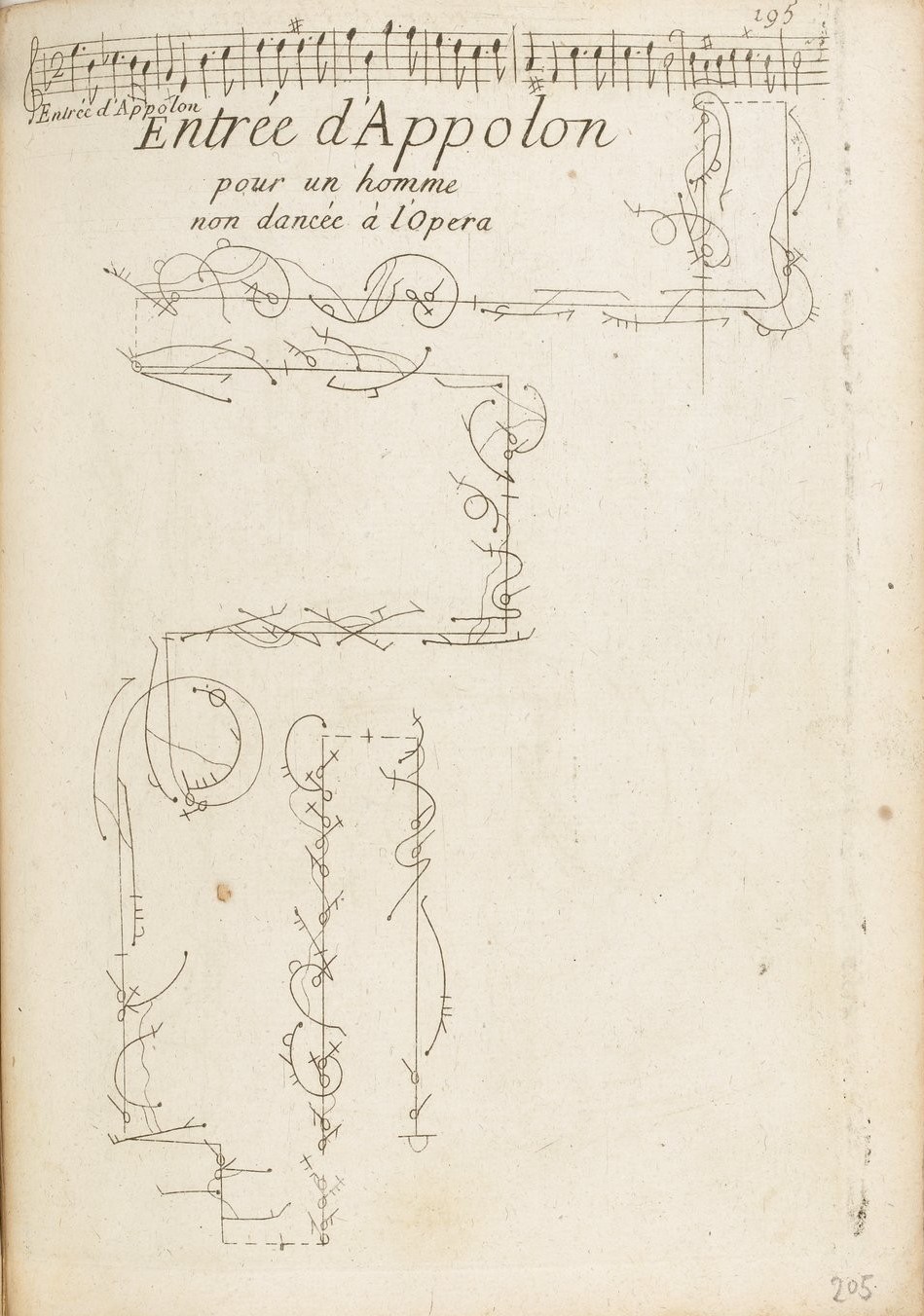
Here, I am concerned only with the ‘choreographic sources’, as I want mainly to look at the vocabulary and technique associated with the entrée grave. The most comprehensive listing of notated dances is provided by La Danse Noble by Meredith Little and Carol Marsh, published in 1992, which includes an ‘Index to Dance Types and Styles’. The authors point out that ‘classification by type and style is often a problematic matter’ and this is certainly the case with the entrée grave. They list eight notated choreographies as entrées graves, but Francine Lancelot in La Belle Dance identifies only two in her ‘Index of Dances according to the Number of Performers’ – adding another six through her detailed descriptions of individual notations. I include references to entries in both of these catalogues in my list of choreographies below – prefaced LMC for Little and Marsh and FL for Lancelot.

The dances they identify as entrées graves are not quite the same. Little and Marsh include two solo versions of the ‘Entrée de Saturne’ from the Prologue to Lully’s Phaëton which are not this dance type (LMC4000 and LMC4260) and are not so identified by Lancelot (FL/1700.1/11 and FL/MS05.1/13). These are omitted from the list below. However, Lancelot identifies two male duets which are not classified as entrées graves by Little and Marsh (LMC4220, FL/1704.1/23 and LMC2780, FL/1713.2/36) which have been added to the list. So, between them, these two catalogues identify eight notated choreographies which may be classed as entrées graves. The dancing characters are identified by Lancelot from the livrets for the individual operas from which the music for the dance is taken.

Feuillet, Recüeil de dances (Paris, 1700)

  • ‘Entrée grave pour homme’, music anonymous (AABBB’ A=8 B=9 B’=4 38 bars). No dancing character indicated. (LMC4140, FL/1700.1/13)
  • ‘Entrée d’Apolon’, music from Lully Le Triomphe de l’Amour (1681), entrée XV (AABBB’ A=9 B=19 B’=7 63 bars). Dancing character Apollo. (LMC2720, FL/1700.1/14)
  • ‘Balet de neuf danseurs’, opening section, music from Lully Bellérophon (1679), act V scene 3 (AABB A=B=11 44 bars). Dancing characters Lyciens. (LMC1320, FL/1700.1/15)

Pecour, Recüeil de dances (Paris, 1704)

  • ‘Entrée pour deux hommes’, music from Lully Cadmus et Hermione (1674), V, 3 (AABB A=4 B=9 26 bars). Lancelot notes that the music is a gavotte but implies that the choreography is actually an entrée grave (as indicated by the notation). Dancing characters Suivants de Comus. (LMC4220, FL/1704.1/23)
  • ‘Entrée d’Appolon pour homme’, music from Lully Le Triomphe de l’Amour (1681), entrée XV (AABBB’ A=9 B=19 B’=7 63 bars). Dancing character Apollo. (LMC2740, FL/1704.1/30)

Pecour, Nouveau Recüeil de dances (Paris, c1713)

  • ‘Entrée de Cithe’ (a male duet), music from Bourgeois, Les Amours déguiséz (1713), 3e Entrée (AAB A=10 B=16 36 bars). Dancing characters Scithes (Scythians). (LMC2780, FL/1713.2/36)
  • ‘Entré seul pour un homme’, music from Stuck Méléagre (1709), act II scene 7 (AABB A=8 B=13 42 bars). Dancing characters Guerriers. (LMC4580, FL/1713.2/38)

L’Abbé, A New Collection of Dances (London, c1725)

  • ‘Entrée’, music from Lully, Acis et Galatée (1686), Prologue (AABB A-10 B=13 46 bars). Dancing characters in the opera Suite de l’Abondance, Suite de Comus. (LMC4180, FL/1725.1/12)
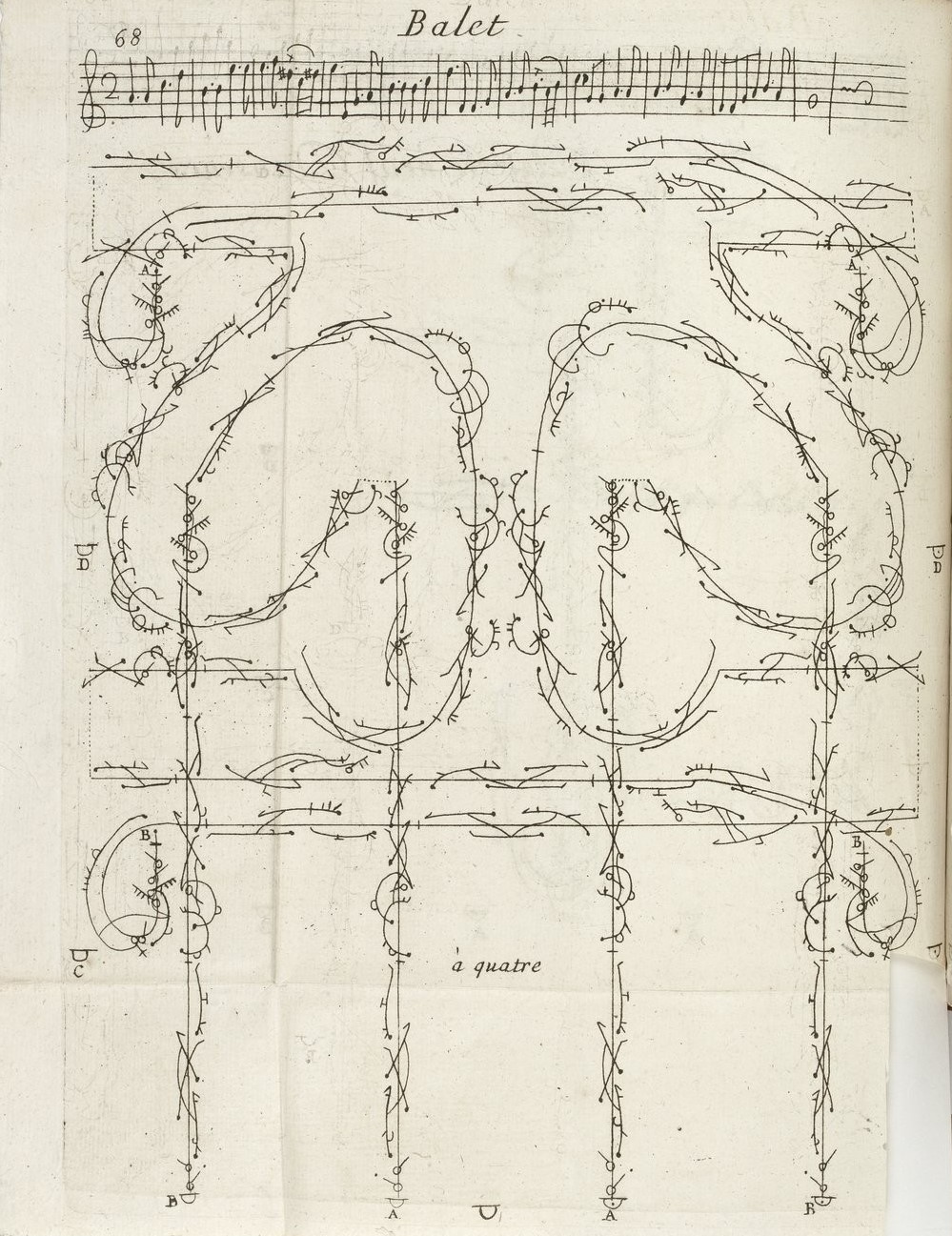
So, we have in all six male solos and two male duets published over the first quarter of the 18th century that might tell us something about the step vocabulary and the dance style of the entrée grave. The details given above provide quite a lot of information, before we turn to the notations themselves. All the choreographies are quite short. The longest are the two versions, by Feuillet and Pecour respectively, of the ‘Entrée’ for Apollo to music from Lully’s Le Triomphe de l’Amour of 1681, with 63 bars of music. The shortest is Pecour’s ‘Entrée pour deux hommes’ from Lully’s Cadmus et Hermione of 1674, with only 26 bars of music (and a question mark over the dance type it represents). It is worth remembering that, with the entrée grave, each bar of music has two pas composés of dancing many of which are complex or virtuosic. The music has to be slow to allow the dancers time to execute the steps.

None of Feuillet’s choreographies and none of Pecour’s solos are directly linked with performances at the Paris Opéra. Indeed, Pecour’s version of the ‘Entrée d’Appolon’ states that it was ‘non dancée à l’Opera’.  Only Pecour’s two duets record dances performed there – the dancers are named in the livrets for each opera as well as on the head-title for each notation. L’Abbé’s solo for Desnoyer was created for performance in London, as an entr’acte entertainment at the Drury Lane Theatre. Nevertheless, given that L’Abbé as well as Pecour had danced at the Paris Opéra and that Feuillet must also have been familiar with its repertoire as well as its dance conventions, it is worth considering the dancing characters for which the music was originally written as part of any choreographic analysis.

Apollo was, of course, the Olympian god identified with the sun (and with whom Louis XIV identified himself). The Lyciens were simply men of Lycia, celebrating the marriage of the Lycian princess Philonoé to the hero Bellérophon. The Suite (Followers) of Comus were the dancing characters in both Cadmus et Hermione and, probably, Acis et Galatée. The Cithes (Scythians), in other contexts known as warlike nomads from southern Russia, take part in celebrations in Les Amours déguiséz, but they also link to the Guerriers who dance an entrée grave in Méléagre. Between them, these characters carry three separate associations which might also overlap. Apollo represents power and control, yet there is an underlying hint of excess given the god’s many love affairs. The theme of revelry links the Followers of Comus with the Lyciens and the Cithes. The Guerriers, and perhaps the Cithes, suggest the portrayal of power and control. The messages conveyed by the entrée grave may be less clear and fixed than has been supposed.

An analysis of the notated dances reveals shared features. They routinely include some of the most virtuosic male steps – multiple pirouettes (with and without pas battus by the working leg), entre-chats à six and a variety of cabrioles, in particular the demie cabriole en tournant un tour en saut de basque. The first plate of Pecour’s ‘Entrée d’Appolon’, published in 1704, shows both an entre-chat and the demie cabriole en tournant, while the third plate shows two pirouettes, one without and one with pas battus.

All of these entrée grave choreographies include a number of basic steps, between a quarter and a third of the total in the surviving notations. They also routinely ornament such steps with beats and turns, making them far more complex. Examples of both (with some unadorned basic steps) can be seen in the second plate of Feuillet’s ‘Entrée grave pour homme’ from his collection of 1700.

The figures (floor patterns) traced by these male dancers are not easy to interpret. They seem mainly to move downstage and upstage on a central line, with occasional steps to right or left which quickly bring them back centre stage. Many of their steps, particularly those classed as virtuosic, are performed in place, so the dancer does not travel nearly as much as the notations imply. (Steps are, of course, written along the dance tracts, whether or not the dancer travels along these). The few circular figures are usually associated with the demie cabriole en tournant un tour en saut de basque, which makes a turn in the air so that the dancer lands close to where he began his jump. There are a few video recordings of some of the notated entrées graves which show the dancers traversing the stage quite freely, but I am not sure how much these owe to the demands of the dancing space rather than the notation. These male solos are certainly more compact and less varied in their figures than the corresponding female theatrical solos.

The only entrée grave for more than one or two male dancers is the ‘Balet de neuf Danseurs’ by Feuillet, again from his 1700 collection. It is danced by a leading man with eight ‘Followers’ who stand behind and to each side of him as he begins the choreography. Only the first section is an entrée grave, which is followed by two canaries. The soloist dances the first A section and then stands centre back while four of the eight Followers (those who were standing behind him) perform two parallel duets to the second A section. The soloist then dances to the first B section and is followed by the same four men, who resume their duets for the second B section. The dance continues with the soloist, who dances the first and second canary, and it finishes with all eight Followers dancing the repeat of the two canary tunes while the soloist again stands centre back. This choreography may reveal one way in which dancing masters could deploy a group of male dancers onstage for an entrée grave. Here are the first two plates of this choreography.

There is one other entrée grave choreography that I have not so far mentioned, but which is equally relevant to the research project that brought me to this topic. This is the ‘Air des Ivrognes’ in Le Mariage de la Grosse Cathos, a ballet performed at the court of Louis XIV in 1688. The ballet was recorded by its choreographer Jean Favier in a dance notation of his own invention, which was published in facsimile, decoded, set in context and analysed by Rebecca Harris-Warrick and Carol G. Marsh in 1994 in Musical Theatre at the Court of Louis XIV. They suggest that this duet, performed by two male dancers from the Paris Opéra in the guise of Peasants, ‘would have been immediately recognised as a burlesque of the entrée grave, the noblest and most difficult of the theatrical dances of the time’ (p. 55). As their analysis reveals, it is indisputably a comic number even as the dancers attempt some of the virtuosic feats associated with this dance type.

My research into the entrée grave has, necessarily, been limited. It would be useful to know how many more entrées graves there are in the operas of Lully and his immediate successors and which characters performed them, even though the choreographies are lost, but this is a task for musicologists. Although much of my work on baroque dance is practical, the demands of the entrée grave are well beyond my dancing skills – it is a shame that conference papers by those who have danced these difficult choreographies should remain unpublished and thus inaccessible. I have been able to answer some of my own immediate research questions, but my work has uncovered others. Was the entrée grave simply an expression of power and nobility or did it have other contexts with different meanings? How well was this dance known beyond France and how was it seen and understood elsewhere, for example in London? What was it really like in performance?

Reading list:

Rebecca Harris-Warrick. Dance and Drama in French Baroque Opera (Cambridge, 2016)

Rebecca Harris-Warrick and Carol G. Marsh, Musical Theatre at the Court of Louis XIV: Le Mariage de la Grosse Cathos (Cambridge, 1994)

Francine Lancelot. La Belle Dance: Catalogue Raisonnée (Paris, 1996)

Meredith Ellis Little and Carol G. Marsh. La Danse Noble: an Inventory of Dances and Sources (Williamstown, 1992)

Previous Dance in History Posts about Male Dancing:

Money for Entrechats: Valuing the Virtuosic Male Dancer – L’Abbé and Ballon

Money for Entrechats: Valuing the Virtuosic Male Dancer – Delagarde and Dupré

Demie Cabriole en Tournant un Tour en Saut de Basque – a Step Solely for a Man?

Demies Cabrioles in Male Solos and Duets

Pas de Sissonne Battu in Stage Dances for Men

Entre-Chats in Male Solos and Duets

Subscription Lists and London’s Dancing Masters: Anthony L’Abbé

Around 1725, Le Roussau published A New Collection of Dances – thirteen choreographies ‘That have been performed both in Druy-Lane [sic] and Lincoln’s Inn Fields, by the best Dancers’ created by Anthony L’Abbé and notated by Le Roussau himself. The dancers were named on the title page as Ballon, L’Abbé, Delagarde, Dupré and Desnoyer with Mrs Elford, Mrs Santlow, Mrs Bullock and Mrs Younger. All were leading dancers in London’s theatres. The collection provides a series of snapshots of stage dancing in London between 1698 and 1722. It also gives us an insight into the world of professional dancers and dancing masters, through the ‘List of the Masters, Subscribers’ which precedes the notated dances. They are the individuals who made publication possible by paying in advance for the printed copies.

The list of subscribers is on two preliminary pages and has 68 names.

All five of the male dancers represented among the notated choreographies subscribed, but not one of the women – there are no female subscribers to this collection. Given the popularity with audiences of the professional female dancers named on the title page, that absence is worth further investigation. Was it to do with their status within the dance worlds of Britain, France and Europe? Was it that they didn’t teach (or weren’t known as teachers, even if they did)? Were they excluded from learning and using Beauchamp-Feuillet notation? I can’t readily answer any of those questions, but this subscription list reveals the need for a great deal more research and much discussion about the 18th-century dance world.

Of the 68 male subscribers, 48 were British and apparently based in London, six were from English provincial towns and cities, seven were French and five were based elsewhere in Europe. L’Abbé himself subscribed for four copies, while Dezais (Feuillet’s successor as the publisher of notated dances in Paris) took two – the same as Edward Lally (who may have been the seasoned dancing master Edmund Lally, rather than the young Edward Lally – probably his son – just beginning to make a name for himself on the London stage), and John Shaw who was one of London’s leading professional dancers. Shaw died young in December 1725, providing an end date for the publication of L’Abbé’s Collection. It is interesting that, although he had been trained by the French dancer René Cherrier and assuredly had a mastery of French dance style and technique, Shaw was not one of the Collection’s male dancers. They were all French, by ancestry if not nationality. Even more interesting is the fact that all the female dancers were British.

The list of subscribers includes ‘Mr. Edw. Pemberton’, probably Edmund Pemberton, the notator and publisher of L’Abbé’s ballroom dances many of which were created for the Hanoverian court to which L’Abbé was dancing master. L’Abbé’s list overlaps with that of Pemberton’s 1711 An Essay for the Further Improvement of Dancing (which includes a solo version of L’Abbé’s passacaille to music from Lully’s opera Armide). Pemberton’s dedicatee Thomas Caverley did not subscribe to L’Abbé’s theatrical choreographies, perhaps because – although he was a champion of dance notation – he was dedicated to the teaching of amateurs and ballroom dancing. Among the other English dancing masters who were L’Abbé’s subscribers were Couch, Essex, Fairbank, Groscourt, Gery, two members of the Holt family, Shirley and John Weaver. All supported both Pemberton’s and L’Abbé’s collections.

A handful of London’s other male professional dancers also subscribed – Boval, Newhouse, John Thurmond and John Topham, who were to be seen dancing varied repertoires at Drury Lane and Lincoln’s Inn Fields. We don’t know how much it cost to purchase L’Abbé’s A New Collection of Dances by subscription, but Le Roussau’s title page advertised copies at 25 shillings (around £145 today). Was this within the means of such dancers, some of who were definitely below the top ranks? Was their interest in the notations chiefly to aid teaching, or might they have drawn upon these when creating new choreographies for their own use?

John Weaver had been the first London dancing master to publish by subscription, with Orchesography (his translation of Feuillet’s Choregraphie) in 1706. Among the subscribers to L’Abbé’s Collection several had subscribed to one or more of the three works published in that way by Weaver (the others were A Collection of Ball-Dances by Mr Isaac, also in 1706, and Anatomical and Mechanical Lectures upon Dancing in 1721). A few – Essex, Walter Holt and Pemberton – subscribed to all five of the treatises published by subscription between 1706 and 1735. The last to appear was Kellom Tomlinson’s The Art of Dancing, which he must have been planning if not writing close to the time when L’Abbé’s Collection was published, to which he subscribed.

Apart from a few continental dancers working in London’s theatres, there were no European subscribers to any of the dance treatises published in London – except for L’Abbé’s Collection, which had seven subscribers from Paris and five from elsewhere in Europe. Among the Parisians, I have already mentioned Dezais. His name is the only one that would be unfamiliar to non-specialists with an interest in dancing during the 18th century. Claude Ballon and Michel Blondy were close contemporaries of L’Abbé, as well as being leading dancers at the Paris Opéra from the 1690s and distinguished teachers of dancing. Ballon’s ballroom dances were published by Dezais. Dumoulin may well be David Dumoulin, the most celebrated of the four brothers who all pursued dancing careers at the Paris Opéra. He was noted for his mastery of the serious style. Like François Marcel, he was from a younger generation of dancers. He made his Opéra debut in 1705 followed by Marcel in 1708. Marcel was also making a reputation as a teacher. It is very unlikely that ‘Mr. Dupre, junior, of Paris’ was Louis ‘le grand’ Dupré, in fact he may have been related to London’s Louis Dupré the dancer in four of L’Abbé’s choreographies in the Collection.

The ’Mons. Pecour’ listed must have been Guillaume-Louis Pecour, ballet master at the Paris Opéra. His dancing career reached back to the early 1670s. L’Abbé’s A New Collection of Dances emulates the Nouveau Recüeil de Dance de Bal at Celle de Ballet notated and published by Gaudrau around 1713. Gaudrau’s collection of Pecour’s ballroom and stage choreographies has nine ballroom dances and thirty theatrical dances, to Le Roussau’s thirteen stage dances by L’Abbé. Gaudrau, ‘Mr. Gaudro, of Madrid in Spain’ is among L’Abbé’s subscribers. There is also ‘Mons’ Phi. Duruel, of Dusseldorp in Germany’ – John-Philippe Du Ruel had danced in London between 1703, when he was billed as ‘from the opera at Paris’ and described as a ‘Scholar’ of Pecour, and 1707, the year he danced at court for Queen Anne’s birthday celebrations. It seems likely that he was the dancing master based in Dusseldorf by the mid-1720s.

The subscription list to A New Collection of Dances surely represents L’Abbé’s own circle of dancers and dancing masters – those he knew and who knew him and his work. There were the men L’Abbé must have danced alongside at the Paris Opéra, as well as those he had worked with both onstage and off over the twenty years and more that he had been in London. What about the English provincial dancing masters and those in Europe? Did they know L’Abbé or did he know them, by reputation at least? Were they invited to subscribe and by whom? Did some of those who were more closely associated with L’Abbé act as intermediaries in this process? As you can see, I have rather more questions than answers about this particular list of subscribers.