Category Archives: Stage Dancing

Variations on the Pas Assemblé

Another dance that I have been working on, for the purposes of choreographic analysis, is the ‘Passacaille of Armide by Mrs Elford & Mrs Santlow’ in Anthony L’Abbé’s A New Collection of Dances published around 1725. This was the dance that sparked my interest in Hester Santlow when I first learnt and performed it many years ago. As I returned to it – changing sides (my marked-up notation indicates that I originally danced the left-hand side, probably performed by Mrs Elford) – the choreography began again to cast its spell. It is the most wonderful duet, with so many different aspects.

As I learnt the dance, many technical questions arose in my mind. I was taught three different ways to perform the pas assemblé ending in first position: as a jump from one to two feet ending in plié, much like the modern ballet assemblé; as a jump but landing on the balls of the feet with straight legs and absorbing the impact by lowering through the insteps; and as a form of relevé sauté ending with straight legs and on the balls of the feet. These three versions make different technical demands and are expressive in very different ways that are highly relevant to the passacaille, a dance that – because of its music – is exceptional in its affective range. Among the many notated stage dances I performed, I particularly loved the passacailles.

I have two questions. What evidence is there in the early 18th-century dance treatises for these various modes of performance of the pas assemblé? Where in the Passacaille of Armide duet could the different versions be used?

The pas assemblé is notated by Feuillet in Choregraphie (Paris, 1700) among examples in the main text, within the section entitled ‘De la manière que les Pas se terminent dans les Positions’ (p. 44). It is notated at the foot of the page and called ‘Pas assemblé’ but shown without a jump (or any other marking). In his translation of Feuillet, Orchesography (London, 1706), Weaver shows the same notation but calls it simply ‘a join’d Step’.

The pas assemblé is not described by Rameau in Le Maître à danser (Paris, 1725) but he does include it in his Abbregé de la nouvelle methode dans l’art d’ecrire ou de tracer toutes sortes de danse de ville (Paris, [1725]). Chapter XII of the Abbregé is titled ‘Des Assemblez, Pas de Gaillarde & de Rigaudon’. He describes the step as follows (there is no contemporary or modern translation of this treatise into English):

‘Le Pas Assemblé est un pas plié sur un pied, tandis que l’autre se rapproche en se relevant: si c’est en avant, ce doit être celui de derriere qui vient s’approcher à la premiere position: si c’est en l’arriere, celui de devant se raproche.

                Il se pratique de deux manieres; la premiere, en pliant & en se relevant lorsque les deux pieds sont près l’un de l’autre.

                Et la deuxieme en sautant: mais la Table de ces Pas est plus demonstrative que toute l’explication que l’on pourroit donner: il s’écrit sur toutes les lignes.

[Abbregé de la nouvelle methode, p. 59. I have not corrected Rameau’s spelling or use of accents]

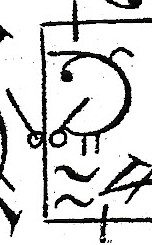
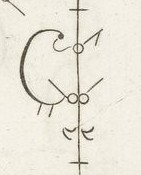
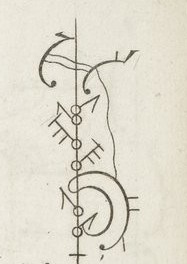
Here is a detail from Rameau’s notations of the pas assemblé:

Kellom Tomlinson devotes chapter XIII of Book the First of The Art of Dancing (London, 1735) to what he calls ‘the Close or Jump’. He begins:

‘What we call a Close in Dancing is, when, the Weight being upon one Foot, we sink, and in the Rise jump or close both Feet equal one to the other, in the first Position, or the Feet are inclosed either before or behind, in the third Position; and this Step generally concludes in the said Positions or Postures. It may be performed in two different Ways, viz. on the Ground, and off from the Ground, as in the Bound;

[The Art of Dancing. Book the First, Chapter XIII, p. 37]

Tomlinson refers to the notated steps he supplies in plates IV and V of Book I as examples, but in this context they are not entirely clear, and I won’t reproduce them here. He also dintinguishes further between ‘a Close on the Ground’ in which the dancer goes ‘no higher than you can rise without quitting the Ground with your Instep or Toe’ (pp. 37-38) and one ‘off from the Ground’ in which:

‘… you sink, in order to spring, as before; but, instead of rising to the Extremity or Point of the Toe, you only spring quite off from the Floor, lighting on both Feet’

He calls this ‘a Close or Jump’ (p. 38). Tomlinson also provides some interesting information relating to the timing of the step:

‘This Step in Dancing much resembles a Period or full Stop in Letters; for, as that closes or shuts up a Sentence, the Close in Dancing does the very same in Music, since nothing is more frequent than, at the End of a Strain in the Tune, to find the Strain or Couplet of the Dance to conclude in this Step, as also at other remarkable Places of the Music. (p. 39)

He adds ‘This Step generally takes up a Measure, that is to say, with the Time you rest or stand still’ (p. 39).

Between them, the descriptions in the various dance manuals indicate different versions of the pas assemblé, providing evidence for the versions I was taught.

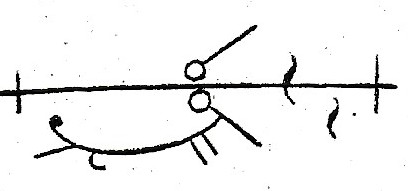
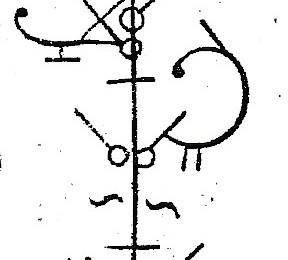
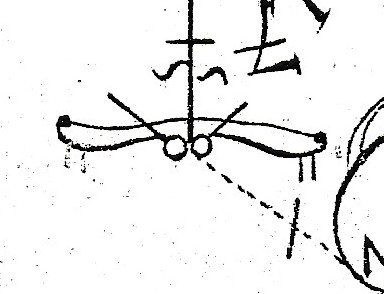
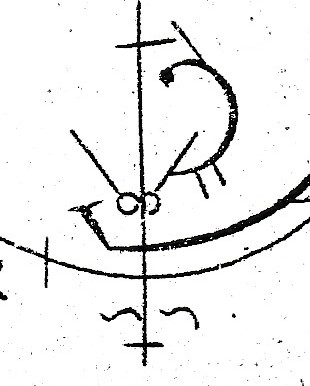
Returning to L’Abbé’s ‘Passacaille of Armide’, the pas assemblé occurs on its own in six bars (37, 53, 77, 81, 117, 141) each time as a new variation begins in the music. All are notated with a jump, but no plié at the end of the step. Here are the notations for each of them, as notated for the dancer who begins on the right, but performs much of the dance on the left side.

Bar 37
Bar 53
Bar 77
Bar 81
Bar 117
Bar 141

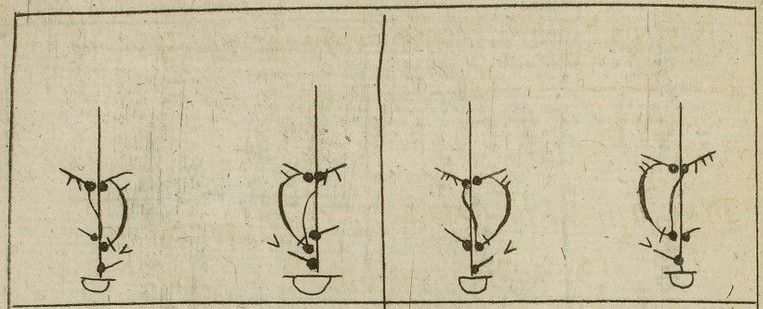
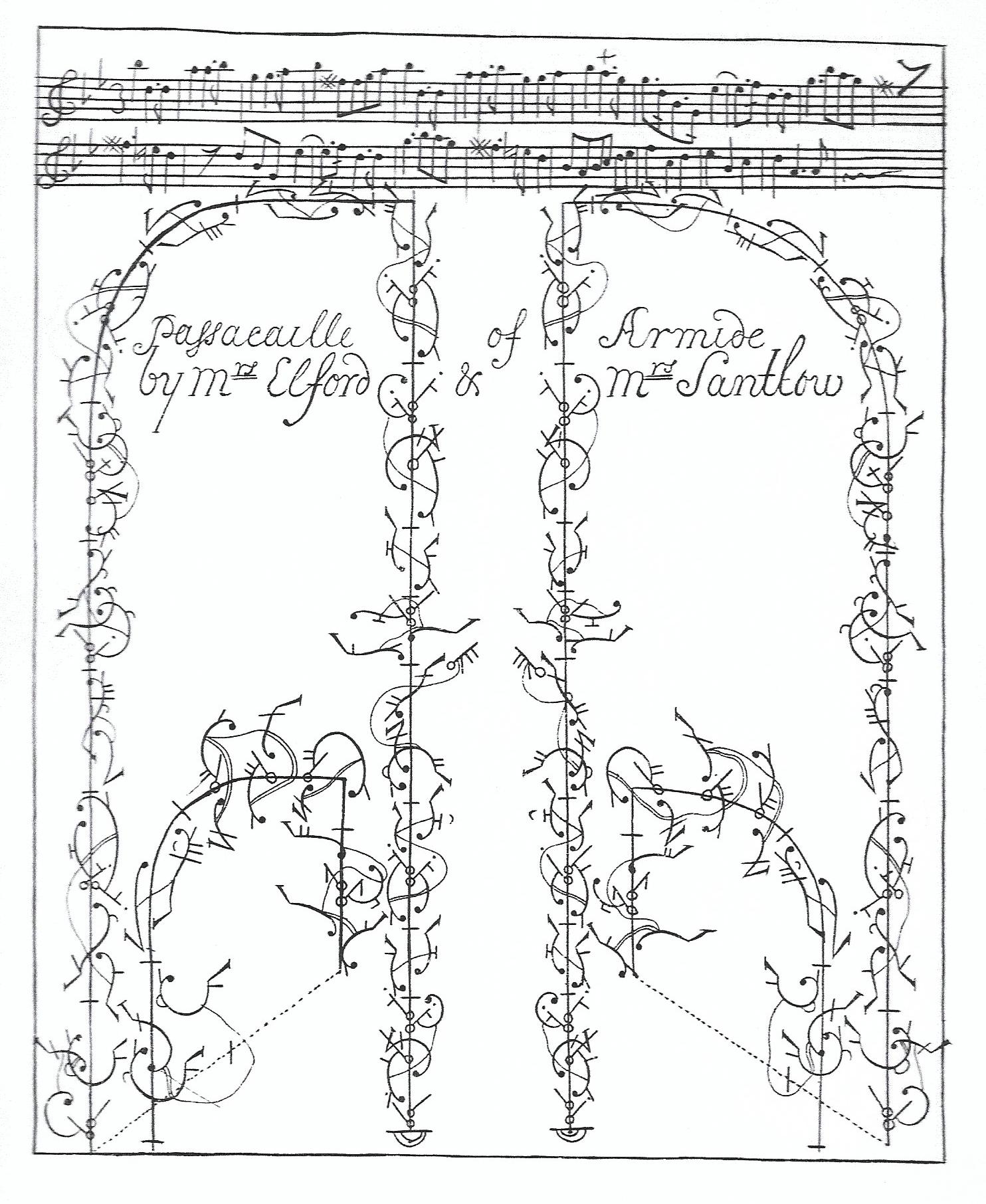
As you can see, the first two have a quarter-turn on the jump and all but one end facing downstage (in bar 53 the dancers face one another across the stage). Bar 81 is really a jump from second to first position rather than a pas assemblé. There is a seventh pas assemblé (bar 101), which incorporates a beat and also ends facing downstage. Here is the notation showing the two dancers side by side.

In addition, there are another five pas assemblés which form part of pas composés (Bars 61, 85, 93, 98, 144). I won’t include the notations here, but the pas assemblé begins most of these steps and some end in plié while others don’t. My interest is in the moment of stillness following the single pas assemblés, so I will not pursue these.

When I began to explore this particular step within L’Abbé’s choreography to the passacaille in Armide, I was looking for ways in which it might enhance the variety and intensify the drama of the duet. I expected to find bars where the stronger dynamic of a relevé sauté might be used instead of a close on straight legs – which might be soft or sharp – given that all the examples I list are notated with a jump and without a plié. However, after listening to three different recordings of the music I began to question this idea. L’Abbé’s choreography is complex, with many small jumps and much ornamentation (turns, slides, falls and beats) within the pas composés. In each of the recordings none of the bars concerned emphasise the end of the variation, minimising the effect of the the dancers’ stillness during beats 2 and 3.

I turned to Pecour’s choreography ‘Passacaille pour une femme dancée par Mlle Subligny en Angleterre de Lopera darmide’ – an obvious point of reference, as she probably danced it in London in 1702 while L’Abbé’s choreography may well date to 1706 – to see how he treated the same bars in the music. Of the seven instances I focus on, Pecour has a simple pas assemblé in only two (bars 37 and 141). In bar 101, where L’Abbé has an assemblé battu, Pecour uses the same step as the first element of a pas composé. Here are Pecour’s steps in notation:

Bar 37
Bar 141
Bar 101

What should I make of this? One obvious thought is that the pas assemblé does not mark a full stop either in the dance or in the music. It is, perhaps, closer to a pause with a breath before the dancers and the music continue. I am not musically trained in any way and there will doubtless be very different ideas among those who are.

The interpretations in the three recordings returned me to the livret and the dramatic context within which the passacaille is played. It opens act 5 scene 2 of Lully’s Armide and is woven throughout the scene. Armide has left Renaud alone while she visits the underworld for demonic advice. She uses her magic powers and:

‘Les Plaisirs et une troupe d’Amants fortunés et d’Amantes heureuses viennent divertir Renaud par des chants et par des danses.’ [Quinault, Livrets d’Opéra, vol. 2, p. 282]

This is a pastoral scene, ostensibly devoted to love and pleasure. When I first learnt the duet and explored its operatic context, I was struck by the idea these Pleasures and Happy Lovers were demons in disguise, and this has continued to colour my understanding and interpretation of L’Abbé’s choreography. Yet, as I returned to it and tried to look a little closer, I realised that this demonic aspect is carefully hidden. If it appears at all, it is only occasionally and momentarily. And, of course, there are the underlying questions of L’Abbé’s intentions in creating a duet for the London stage where it would have lacked its original operatic context, and what Mrs Elford and Miss Santlow may have been able to express when performing it.

As with all of these notated dances, there are more questions than answers, and great variety of choices when it comes to reconstructing L’Abbé’s ‘Passacaille of Armide’ duet whether for research or performance.

Further Reading:

Moira Goff, The Incomparable Hester Santlow (Aldershot, 2007), pp. 7-9

Rebecca Harris-Warrick, Dance and Drama in French Baroque Opera (Cambridge, 2016)

Philippe Quinault, Livrets d’Opéra présentés et annotés par Buford Norman. 2 vols. (Toulouse, 1999), Vol. 2, 249-287, ‘Armide’.

Judith L. Schwartz, ‘The passacaille in Lully’s Armide: phrase structure in the choreography and the music’, Early Music, XXVI.2 (May 1998), 301-320.

Three recordings of the Passacaille d’Armide:

Lully, Divertissements.  Capriccio Stravagante, Skip Sempé. 15. Passacaille d’Armide (Deutsche Harmonia Mundi, 1990)

Lully, Armide. Choeur et Orchestre du Collegium Vocale et de la Chapelle Royale, Dir. Philippe Herreweghe (Harmonia Mundi, 1993)

Lully, Les Divertissements de Versailles. William Christie, Les Arts Florissants. 14. Act 5 scene 2 (Erato, 2002)

‘Jo.’ Priest, Dancer and Dancing Master, in Context

I have recently been revisiting John Weaver’s genres of dancing, as described in An Essay Towards an History of Dancing (1712) and revised in The History of the Mimes and Pantomimes (1728). In 1712, Weaver wrote that ‘A Master or Performer in Grotesque Dancing ought to be a Person bred up to the Profession and throughly [sic] skill’d in his Business’. A little further on in his text, Weaver continued:

‘As a Performer, his Perfection is to become what he performs; to be capable of representing all manner of Passions, which Passions have all their peculiar Gestures; and that those Gestures be just, distinguishing and agreeable in all Parts, Body, Head, Arms and Legs; in a Word, to be (if I may so say) all of a Piece. Mr. Joseph Priest of Chelsey. I take to have been the greatest Master of this kind of Dancing, that has appear’d on our Stage;’ (An Essay Towards an History of Dancing, pp. 166-167)

It is interesting that Weaver singled out an English dancer and dancing master in this context. The identity of ‘Joseph Priest of Chelsey’ and his relationship to the better-known Josias Priest, also closely associated with Chelsea, remain a mystery despite numerous attempts to discover exactly who they were (I list some of the articles that have addressed this conundrum at the end of this post).

My interest is in what made ‘Joseph Priest of Chelsey’ Weaver’s exemplar for grotesque dancing, a genre which he defines in a way which relates it to more natural ‘character’ dancing rather than the exaggerated masks of the commedia dell’arte with which it is now usually linked (and with which Weaver himself equated it in 1728). Although Richard Ralph, in his indispensable The Life and Works of John Weaver (London, 1985), says (on, p. 663) that ‘Weaver had not seen, and clearly did not know Priest, whose name was in fact Josias’, I think the opposite. Weaver’s first known billing on the London stage was in 1700, but it is likely that he arrived in the capital a few years earlier and so could well have seen Joseph Priest dance.

In this post, I want to concentrate on placing the little we know about the work of Josias and Joseph Priest on the London stage in a wider context. The difficulty with such an endeavour is the lack of evidence for the majority of performances given in London’s theatres between 1660 and the advent of the Daily Courant in 1702, after which the theatre companies began to advertise their daily programmes on a regular basis. The extent of the problem was succinctly set out by Robert D. Hume in his 2016 article ‘Theatre Performance Records in London, 1660-1705’. This is one underlying reason that we have only the following few references to go on.

15 August 1667, Lincoln’s Inn Fields, Sir Martin Mar-all

‘This Comedy was Crown’d with an Excellent Entry: in the last Act at the Mask, by Mr. Priest and Madam Davies’. (John Downes, Roscius Anglicanus, pp. 62-63)

18 February 1673, Dorset Garden, Macbeth

The Tragedy of Macbeth, alter’d by Sir William Davenant; being drest in all it’s [sic] Finery, as new Cloath’s, new Scenes, Machines, as flyings for the Witches; with all the Singing and Dancing in it: The first Compos’d by Mr. Lock, the other by Mr. Channell and Mr. Joseph Preist;’ (John Downes, Roscius Anglicanus, p. 71. Many sources of the period use the spelling ‘Preist’ rather than ‘Priest’.)

June 1690, Dorset Garden, The Prophetess

The Prophetess, or Dioclesian an Opera, wrote by Mr. Betterton; being set out with Coastly Scenes, Machines and Cloaths: The Vocal and Instrumental Musick, done by Mr. Purcel; and dances by Mr. Priest;’ (John Downes, Roscius Anglicanus, p. 89)

June 1691, Dorset Garden, King Arthur

King Arthur an Opera, wrote by Mr. Dryden; it was excellently Adorn’d with Scenes and Machines: The Musical Part set by Famous Mr. Henry Purcel; and Dances made by Mr. Jo. Priest;’ (John Downes, Roscius Anglicanus, p. 89)

2 May 1692, Dorset Garden, The Fairy Queen

The Fairy Queen, made into an Opera, from a Comedy of Mr. Shakespears: This in Ornaments was Superior to the other Two; especially in Cloaths, for all the Singers and Dancers, Scenes, Machines and Decorations, all most profusely set off; and excellently perform’d, chiefly the Instrumental and Vocal Part Compos’d by the said Mr. Purcel, and Dances by Mr. Priest.’ (John Downes, Roscius Anglicanus, p. 89)

Downes writes first of King Arthur, then The Prophetess and finally The Fairy Queen in three consecutive paragraphs. ‘Mr. Priest’ is thus ‘Mr. Jo. Priest’ for each of these dramatick operas. So, we have one single source for these five references, although John Downes is now generally thought to be reliable. There is another source of information about the activities of ‘Jo.’ Priest on the London stage, Thomas Bray’s Country Dances (London, 1699), which I will turn to in due course.

The first thing to note is that all of Downes’s references link Priest to Sir William Davenant, manager of the Duke’s Company, and his successor Thomas Betterton at the Lincoln’s Inn Fields Theatre and then Dorset Garden. Another is that, with the exception of the first, which belongs to the decade immediately following the Restoration of King Charles II, all the productions are forms of dramatick opera. So, one question to pursue is what Priest was choreographing, while another is which other such productions Priest might have been involved in.

There is every possibility that Priest was involved in earlier productions of Macbeth. Pepys attended a performance at Lincoln’s Inn Fields on 19 April 1667 and remarked that it was ‘one of the best plays for a stage and variety of dancing and musique that ever I saw’ (I quote from the entry in The London Stage, 1660-1700). This was the season when, according to Downes, Priest danced in Sir Martin Mar-all at the same theatre. Macbeth is known to have been performed regularly between 1666-1667 and the new production of 1672-1673, so Priest could have been involved in the production over several years. The 1674 edition of the play indicates that much, if not all, of the dancing was associated with the Witches. We do not know who played the speaking Witches, but they may have been some of the male low comedians in the Duke’s Company. They may have been joined by professional dancers (again men) for the scenes with dancing. So, Priest and Channell may have danced as well as creating the choreographies.

Luke Channell’s career can be traced back to 1660, if not before. He was apparently the choreographer of Shirley’s masque Cupid and Death, performed with music by Matthew Locke and others in 1653, and Pepys records him as running a dancing school in Broad Street, London in 1660. He was sworn as dancing master to the Duke’s Company for the 1664-1665 season, a post he seems to have retained until at least 1674-1675. Channell could have introduced ‘Jo.’ Priest to the London stage and, in particular, to the company run by Davenant and then Betterton. By the time he worked with Priest on Macbeth, Channell must have been approaching fifty.

Another of Davenant’s productions of the same period that could have involved Priest was his adaptation of Shakespeare’s The Tempest. This was performed during the 1667-1668 season, when Pepys commented on the inclusion of dancing at several of the performances he attended including The Tempest, although he referred only to ‘the tune of the Seamen’s dance’ after seeing the play on 3 February 1668. The 1670 edition of The Tempest has a Dance of Devils in act 2, a dance of ‘eight fat Spirits’ in act 3, together with dances by characters in the play (rather than dancers) in acts 4 and 5. Again, Priest may well have danced in this production.

According to Downes, The Tempest was ‘made into an Opera by Mr. Shadwell’ during the 1673-1674 season (Roscius Anglicanus, p. 73). The 1674 edition of this new dramatick opera has a Dance of Winds in act 2, a Dance of Fantastick Spirits in act 3, a Dance by Spirits in act 4 and, finally, a Masque of Neptune and Amphitrite to end act 5. The number of dancers needed for this extravaganza is not easy to determine from the surviving text, but certainly included dances by four and then twelve Tritons in the final masque which may also have had dancing Winds and Nereids (undoubtedly with some doubling of roles). There is no evidence to tell us who danced, or who choreographed the dances, but in view of his work for Macbeth the previous season, surely Priest is a candidate for involvement in The Tempest. This production was regularly revived, as shown by the repeated entries even in the distinctly sparse information provided by The London Stage 1660-1700.

According to Downes, on 27 February 1675 (which he misdates to February 1673):

‘… The long expected Opera of Psyche, came forth in all her Ornaments; new Scenes; new Machines, new Cloaths, new French Dances: This Opera was splendidly set out, especially in Scenes; … It had a Continuance of Performance about 8 Days together, it prov’d very Beneficial to the Company; yet the Tempest got them more Money.’ (Roscius Anglicanus, p. 75)

This ‘Opera’ was essentially an adaptation by Thomas Shadwell of the comédie-ballet Psyché by Molière and Lully, first given at the Tuileries Palace in Paris on 17 January 1671 (New Style dating). There is no record of the dancers in the London production, but the choreography was by St. André and it is possible that they included some (if not all) of the French dancers who had performed in the English court masque Calisto first given just a few days earlier on 22 February 1675. I have written about Psyche and its dancing elsewhere (see the general references at the end of this post). The dancers in Psyche may have included ‘Jo.’ Priest, for there is a later record of a payment to Joseph Priest for service ‘by him performed’ in Calisto – the inference being (perhaps) that he danced in the court masque, although if he was the same man as the ‘Joseph’ Priest later recorded in Chelsea he may have been only in his teens.

There are other productions during the 1670s and into the 1680s that are candidates for ‘Jo.’ Priest’s involvement, but I would like to jump forward to the 1690s and the plays and dramatick operas given in the wake of the success of Betterton and Purcell’s dramatick operas of the early 1690s. Here, I turn first to the source I mentioned earlier for clues. Part two of the 1699 first edition of Thomas Bray’s Country Dances has several references to members of the Priest family. It prints 39 dance tunes, of which number 7 is ‘The Spanish Entry Tune, and Dance compos’d by Mr. Josias Preist’ and number 16 is ‘An Entry by the late Mr. Henry Purcell, the Dance compos’d by Mr. Josias Preist’. The source for the ‘Spanish Entry’ is yet to be identified, but the ‘Entry by the late Mr. Henry Purcell’ is the dance for the Followers of Night in The Fairy Queen. Number 14 is ‘An Entry by the late Mr. Hen. Purcell, the Dance Compos’d by Mr. Preist’, this music is from The Indian Queen of 1695. Numbers 8 and 15, each with ‘the Dance compos’d by Mr. Preist’ have music from The Island Princess of 1699. The difference of name – ‘Mr. Preist’ instead of ‘Mr. Josias Preist’ – seems to point to Joseph Priest, suggesting at the same time that Josias was the choreographer of Purcell’s dramatick operas.

In 1695 Betterton had led a rebellion of the leading actors against the management of Christopher Rich, by then in charge of the United Company which had controlled both the Drury Lane and Dorset Garden Theatres since the merger of the King’s and Duke’s companies in 1682. Betterton and his fellow actors moved to the small, out-dated Lincoln’s Inn Fields Theatre which had been empty for some time. The Indian Queen and The Island Princess were both performed at Dorset Garden under Rich, which lends some credence to the idea that ‘Mr. Preist’ was Joseph and not Josias. Another source seems to point directly to Joseph Priest as working for Christopher Rich: Walsh’s The Second Book of Theatre Musick, published in 1699, includes an Entrée from act two of The Island Princess which it describes as danced by ‘Mr. Prist’.

Thomas Bray is named as dancing master for the United Company in 1689-1690 and again in 1693-1694 and he must surely have known both Josias and Joseph Priest. Bray is recorded as working for Betterton at Lincoln’s Inn Fields in 1694-1695, following the actors’ rebellion. He is identified as the choreographer for Europe’s Revels for the Peace, given at court on 4 November 1698 to celebrate the ending of the Nine Years’ War. Could ‘Mr. Preist’ have danced in that production?

The dancing characters in The Indian Queen are not easy to identify from the surviving sources. They seem to include the Followers of Envy in act 2 as well as Warlike Indians and Aerial Spirits at the beginning and then the end of act 3. The Island Princess is better documented and in act 2, which has the Entrée associated with Joseph Priest, the dancing characters are shepherds. The chacone belongs to the closing ‘musical Interlude’ The Four Seasons or Love in Every Age and accompanies the ‘Dutch-woman’ and ‘old Miser’ who personify Winter (both music and text are reproduced in the published facsimile cited below among the general references).

During the late 1690s, there were regular revivals at Drury Lane or Dorset Garden of several of the works I have mentioned as involving ‘Jo.’ Priest – The Indian Queen, The Prophetess and The Tempest in particular. There were also several new works at both of these theatres under Rich (as well as at Lincoln’s Inn Fields under Betterton) involving dancing. The most significant, in terms of its dancing, was Brutus of Alba first given at Dorset Garden in October 1696. This was essentially a pastiche drawing on earlier dramatick operas, including Albion and Albanius first given at Dorset Garden in June 1685 (another work with which ‘Jo.’ Priest might have been involved). Brutus of Alba did not outlast its first season and even its acting cast is unknown, but it included a dance of Statues as well as another dance for Harlequin men and women and Scaramouch men and women. If Joseph Priest did dance in these and other productions. Weaver could well have seen him take a variety of character roles and admired his performances.

The 1696-1697 season marked another new development in dancing on the London stage. At Lincoln’s Inn Fields, Betterton engaged Joseph Sorin, from the Paris fairs, as a dancer and dancing master and he would quickly be followed by other French dancers from the Paris Opéra. Anthony L’Abbé arrived during the 1697-1698 season and would enjoy a lengthy career in London. Claude Ballon made a brief visit – but a powerful impression – in 1698-1699. Between them, all three seem to have influenced London’s stage dancing to take new directions which may well have affected the career of ‘Jo.’ Priest among others. Detailed research into the dancing characters in plays, masques and dramatick operas given on the London stage in the late 17th century might help to unravel the mysteries surrounding ‘Jo.’ Priest, as well as contributing to a clearer understanding of the English and French influences on ‘character dancing’ in this period.

How does what I have set out so far help us with ‘Jo.’ Priest? I am strongly inclined to believe that Josias and Joseph Priest were two different individuals. The evidence surviving from parish registers tells us that Josias Priest and his wife Frances (usually called ‘Franck’) had at least ten children between 1665 and 1679. This suggests that they married around 1663 or 1664 and could place Josias’s birth in the years around 1640. By contrast, Joseph Priest and his unnamed wife had seven children between 1682 and 1693, pointing to a marriage in 1680 or 1681 and placing Joseph’s birth in the years around 1660. Josias and Joseph could have been father and son, or uncle and nephew, or even brothers. They could have worked together – with Josias as choreographer and Joseph as dancer – on the dramatick operas of the early 1690s when Joseph may have been in his early thirties.

Josias was apparently not involved in The Indian Queen. He may have decided to leave the London stage as relations worsened between Rich and Betterton (with whom he had worked for so long) but is it possible that it was he and not his son (also Josias) who was buried in Chelsea on 31 March 1692? He would thus have died while The Fairy Queen was in production, which seems possible but unlikely. However, it is interesting to note that advertisements for the Priest dancing school in Chelsea in A Collection for the Improvement of Husbandry and Trade from the issues of 1694-1695 onwards mention only ‘Mrs. Preist’ (I haven’t yet been able to access earlier issues of this newspaper or consult digitised images of the Chelsea parish registers to pursue this further). As I indicate above, I also wonder if Joseph Priest was a dancer rather than a choreographer, whereas Josias Priest was both earlier in his career. By the early 1690s, Josias was around fifty years old and more likely to have concentrated on creating rather than performing dances. Both Josias and Joseph Priest seem to have left the stage by 1700. No Priests are mentioned as dancers or dancing masters in London’s theatres in the following years, when the advent of the Daily Courant began to provide more information about dancers and dancing in London’s theatres.

In this post, I have speculated about fresh approaches to as well as different interpretations of the evidence surrounding ‘Jo.’ Priest and his involvement in dancing on the London stage. Unless fresh facts emerge about Josias and Joseph Priest, deeper and wider exploration of the context within which they worked seems to be the only way in which we might be able to shed new light on both of them.

Further Reading

On ‘Jo.’ Priest:

Selma Jeanne Cohen, ‘Theory and Practice of Theatrical Dancing: I Josias Priest’ in Famed for Dance, by Ifan Kyrle Fletcher, Selma Jeanne Cohen and Roger Lonsdale (New York, 1960), pp. 22-34.

David Falconer, ‘The Two Mr. Priests of Chelsea’, Musical Times, CXXVIII.1731 (May 1987), p. 263.

Jennifer Thorp, ‘Dance in late 17th-century London: Priestly Muddles’, Early Music, XXVI.2 (May 1998), pp. 198-210.

Josias Priest also merits entries in the Biographical Dictionary of Actors … 1660-1800, the Oxford Dictionary of National Biography and Grove Music Online, among other such sources.

General:

John Downes, Roscius Anglicanus, ed. Judith Milhous and Robert D. Hume (London, 1987).

Moira Goff, ‘Shadwell, Saint-André and the “curious dancing” in Psyche’, The Restoration of Charles II: Public Order, Theatre and Dance. Proceedings of a Conference held at Bankside House, London, on 23 February 2002, ed. David Wilson (Cambridge: Early Dance Circle, 2002), 25-33.

Robert D. Hume, ‘Theatre Performance Records in London, 1660-1705’, The Review of English Studies, 67.280 (2016), pp. 468-495.

Jennifer Thorp, ‘Dance in Opera in London, 1673-1685’, Dance Research, 33.2 (Winter 2015), 93-123.

The Island Princess. British Library Add. MS. 15318 (Tunbridge Wells, 1985)

BAROQUE DANCE IN PERFORMANCE

One of the many challenges facing dance historians who (like me) specialise in ‘baroque dance’, and in particular stage dancing, is the rarity of opportunities to see performances of the notated choreographies. The most difficult of the surviving stage dances are rarely, if ever taught at historical dance workshops or courses here in the UK. I confess that I have been unable to find videos of performances of most of them online.

I have long been interested in Anthony L’Abbé’s A New Collection of Dances, thirteen choreographies created by him for professional dancers on the London stage notated and published around 1725 by F. Le Roussau. I have in my time performed four of them – the ‘Passacaille of Armide’, ‘Mrs Santlow’s Minuet’, the ‘Passagalia of Venüs & Adonis’ and the ‘Türkish Dance’ – and worked on another three – the ‘Chacone of Galathee’, the ‘Saraband of Issee’ and the following ‘Jigg’. However, until recently I had only seen four of them performed. When the chance arose to see three of the duets being taught in Paris as part of the Pecour Academy summer course 2025, I jumped at it. I am extremely grateful to Guillaume Jablonka and his fellow teachers Hubert Hazebroucq and Irène Feste for making an exception and allowing me to attend part of the course simply to watch and to learn. I have to say that it was a marvellous and truly rewarding experience.

The three choreographies were the ‘Loure or Faune’ danced by L’Abbé himself with his great compatriot Claude Ballon, the ‘Canaries’ performed by Charles Delagarde and Louis Dupré (the ‘London’ Dupré I wrote about a little while ago) and the ‘Passacaille of Armide’ danced by Mrs Elford and the very young Mrs Santlow.

Hubert Hazebroucq taught the ‘Loure or Faune’, Guillaume Jablonka the ‘Canaries’ and Irène Feste the ‘Passacaille of Armide’. The ‘Passacaille of Armide’ was one of the first baroque stage dances I worked on and inspired me to pursue the research which culminated in my book The Incomparable Hester Santlow. All three duets, particularly those for the men, are technically challenging and require teachers and dancers with an advanced level of training.  The Pecour Academy was attended by dancers who were well up to the task.

The three teachers, all professional dancers, differ in their dancing styles and approaches to teaching, but all recognisably belong to a shared French tradition of historical dance research and reconstruction based on the concept of ‘la belle dance’. Their individuality as well as their shared heritage was apparent in their warm-up sessions and their teaching of the notated dances. I was able to observe their work during the last three days of the course and the focus and energy in all three classes was inspiring. The teaching and dancing I watched has raised many questions about my own knowledge and understanding of baroque dance, at one end of the spectrum in relation to the performance of individual steps and at the other about the interpretation of the dances in L’Abbé’s New Collection.

An abiding issue for all who study the dancing of the decades around 1700 (when Feuillet first published Choregraphie and the associated collections of notated dances) is what the notations leave out when it comes to technique as well as style. Some questions are answered (although not definitively) by the descriptions of steps in Pierre Rameau’s Le Maître a danser of 1725. For others there are no answers, at least in print. I was aware that French interpretations of Rameau differ from those in the UK and this course reminded me of details I had forgotten. It also revealed new thinking about steps that I was unaware of. I hope to be able to pursue some of these in individual posts for Dance in History.

Two other issues came up that require me to undertake far more research and do a great deal more thinking. One is about the way in which L’Abbé’s dances use space, which relates to the stages for which he created these choreographies in London (not in Paris, with the possible exception of the ‘Loure or Faune’ even though this was undoubtedly performed at London’s Kensington Palace). This issue is difficult to address in any course which has several couples of dancers learning dances in the same space, who necessarily have nothing like the area for which L’Abbé created each choreography and who are also engaging with the most difficult steps in the baroque vocabulary. There are also the relationships, expressive as well as spatial, between the two dancers and between them and their audience (which these students were certainly very aware of). The placing of that audience in relation to the dancers is also a factor to be investigated – I suspect that this differed in Paris and London. I hope to be able to explore all of these aspects more fully in due course. The second issue that arose is the characters personified by the dancers, which may or may not derive from the music used by L’Abbé. The three teachers understandably thought of these choreographies in the context of the works given at the Paris Opéra from which L’Abbé took his music. I (equally understandably, I hope) have tended to think of them in performance on the London stage, where they would have been removed from their original operatic context (which may well have been unknown to their London audiences). I think these two views, which can surely be reconciled despite their differences, provide a rich environment for the development of a range of interpretations.

I have focussed here on L’Abbé’s three choreographies, but each day included workshops on other dances and aspects of baroque dance. Notable among these was Christine Bayle’s masterclass on Pecour’s La Nouvelle Forlane, in which she shared her great skill, experience and knowledge with a group of of dancers who were eager and extremely well prepared to benefit from it. That was a special moment, too. The whole course concluded with a public presentation of the dances that had been taught over the week. It was described as showing ‘Work in Progress’, but what marvellous Work – and fantastic Progress – it shared. I salute the teachers and their students for a wonderful achievement.

The 2025 Pecour Academy was a while ago now, but I am still thinking about it as I pursue my research into L’Abbé’s stage dances. I repeat my grateful thanks to Guillaume, Hubert and Irène for sharing their work with me.

Monsieur Roger, Who Plays the Pierrot – A Portrait?

Last year, I wrote a piece about Anthony Francis Roger – one of number of French dancers who came to work in London in the early 18th century. He turns up in a newly published book that I have just begun reading, Robert V. Kenny’s Monsieur Francisque’s Touring Troupe and Anglo-French Theatrical Culture, 1690-1770 (full details below). Kenny draws attention to a painting by Watteau, Les Comédiens Italiens, now in the National Gallery of Art in Washington, DC, in which the central figure is Pierrot. He cites an article (also referenced below), which suggests that the painting was created to commemorate Roger’s benefit performance at the King’s Theatre on 9 June 1720. Here is the advertisement for that performance from the Daily Courant of the same date.

He was appearing with De Grimbergh’s company of ‘French Comedians’. The implication is that Pierrot is a portrait of Monsieur Roger. If that is so, then we have a likeness to add to the very few we have of professional dancers working in London at this period. Here is the painting, with a detail of Pierrot himself.

References:

Robert V. Kenny. Monsieur Francisque’s Touring Troupe and Anglo-French Theatrical Culture, 1690-1770 (London, 2025), pp. 78-79.

Judy Sund. ‘Why So Sad? Watteau’s Pierrots’, The Art Bulletin, Vo. 98 no. 3 (September 2016), 321-347 (pp. 329-330)

What were Entr’acte Dances on the London Stage Like?

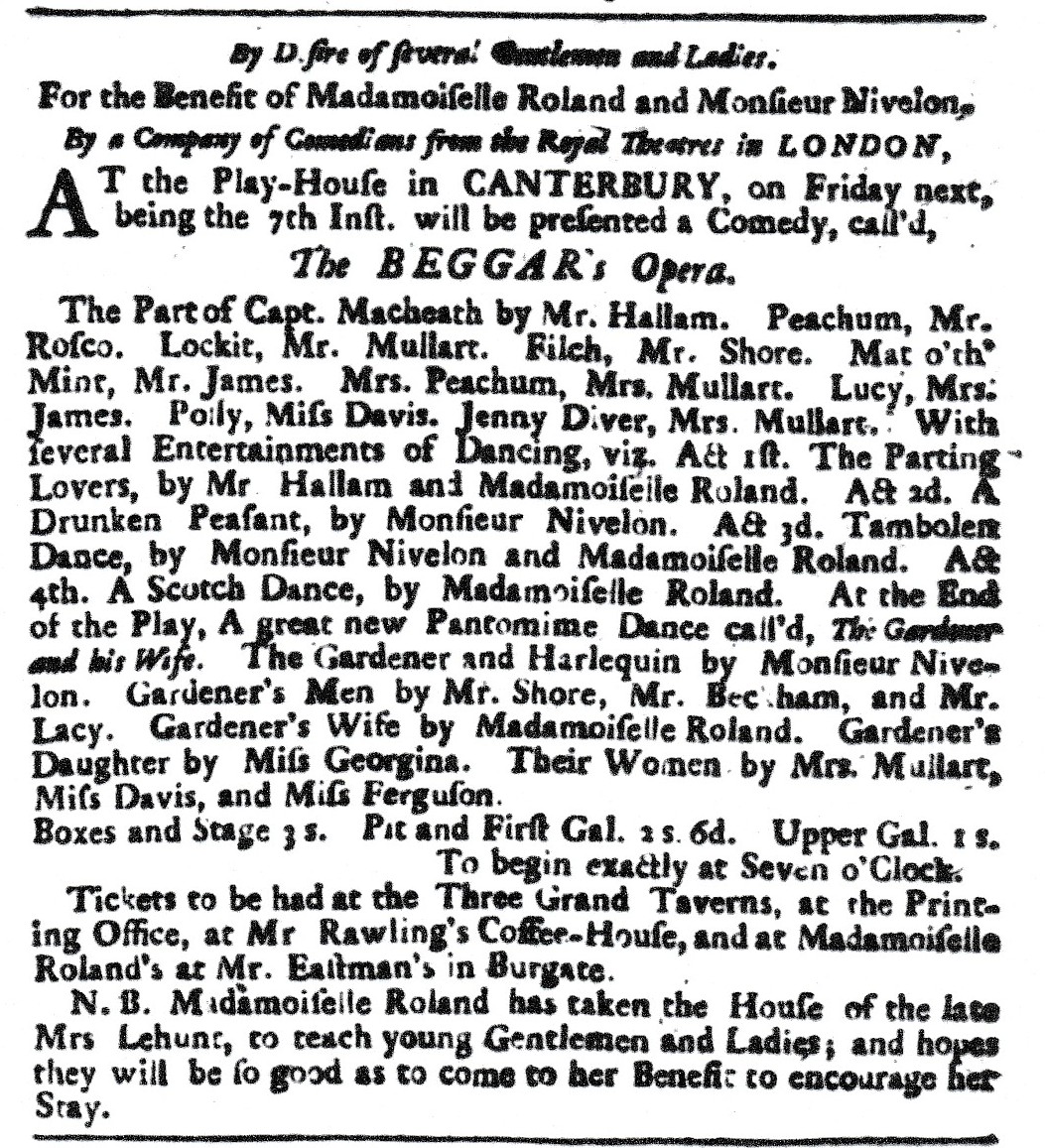
During the 18th century, entr’acte dances (dances given between the acts of plays) were an integral part of many performances in London’s theatres. The following advertisement, from the London Daily Post and General Advertiser for 25 March 1736, shows how these dances fitted into the evening’s entertainment:

This performance was for the benefit of one of Covent Garden’s leading dancers, Leach Glover.

As this bill shows, entr’acte dances could be quite varied. Nivelon’s Clown was a country bumpkin, possibly related to the ‘Peasant’ depicted by Lambranzi in his Neue und Curieuse Theatrialisches Tantz-Schul in 1716. I have used this image several times before but here it is again.

I continue to puzzle about the differences between ‘Clowns’ and ‘Peasants’ on the London stage, as well as the distinctions between those of different nationalities – in the 1720s both John Weaver and Francis Nivelon danced an English Clown, while Nivelon was also billed in a French Clown dance.

The Minuet and Louvre performed by Glover and Miss Rogers were ballroom dances (the Louvre was, of course, Pecour’s famous Aimable Vainqueur), although we don’t know whether the basic choreographies as set down in surviving notations were embellished for the stage.

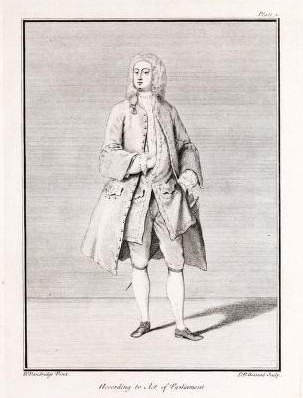
This engraving from Kellom Tomlinson’s The Art of Dancing (1735) shows a moment from the ballroom minuet (the viewpoint is from the lower end of the room, looking towards the ‘Presence’). It raises questions about the performance of ballroom dances on stage, even though they shared with stage dances the concept of a ‘Presence’ as an important focus for their dancing.

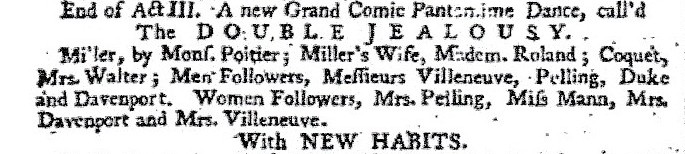
The Grand Ballet was different again, with several performers led by Lalauze and Mlle D’Hervigni, and was probably in the form of a divertissement with several dances one after the other. These more extended pieces could also be small ballets, for example the ‘new grand Comic Pantomime Dance’ The Double Jealousy given at Mlle Roland’s benefit at Drury Lane on 1 April 1736, as this detail from the advertisement in the London Daily Post and General Advertiser for that date shows (the mainpiece was King Henry the Fourth. With the Humours of Sir John Falstaff):

The Double Jealousy hints, through its title and its characters, at comic and expressive action, but what were the other dances – in particular the solos and duets – like?

Most entr’acte dances must have been short: solos and duets may have lasted between one and two minutes (for the early 18th century their duration can be compared with that of the dances surviving in notation); divertissements (the ‘Grand Dances’) and even small ballets seem likely to have lasted ten minutes at the most. So, we get the idea that during an evening in one of London’s theatres there were several short dances that contrasted with the action of the play they accompanied and presented a variety of characters and dance styles. They were also intended to showcase the leading professional dancers in the companies and could be, in themselves, a draw for audiences.

A little while ago, I was at a very different sort of event – a modern ballroom and Latin competition, with a Gala evening at which two couples of professional dancers performed. As they appeared alternately, dancing their way through the five standard ballroom dances and the five Latin ones, I was reminded of the entr’acte dances on the London stage and began to wonder what (if anything at all) they might have in common. These 21st-century dances had no context. They were simply intended to display the skills of the dancers and entertain the audience (many of whom were dancers themselves), so how might they tell us anything about the 18th-century entr’acte dances I have been describing?

First, was the length of the modern dances. They were short, at just a few minutes each, so the dancers had to make an immediate impact. Second, was their presentation without a specific background – they were danced to an audience seated around the ballroom floor with little decoration and no scenery. It is difficult to be sure what happened with 18th-century entr’acte dances, but it seems unlikely that they were provided with their own scenery (although, like the modern dances, they were presented in costume) and they were probably danced mainly on the forestage in the midst of their audience.

I was struck with the way in which the 21st-century dancers played with the conventions of the dances they performed, elaborating and subverting these by turns. The modern dances – waltz, tango, Viennese Waltz, foxtrot and quickstep for the ballroom and cha-cha, samba, rumba, paso doble and jive for the Latin – have different and well-defined characters as choreographies. Although it is usually only in the Latin dances that couples hint at drama, in the Gala performances both the ballroom and Latin couples did so. They also intensified the characters of the individual dances and one couple even incorporated props into their dancing. I couldn’t help feeling that early 18th-century dancers must have used similar techniques in the sarabands, chaconnes, passacailles, gigues, canaries, loures, bourrées, rigaudons, minuets and other dance types (divided between serious and comic) that they would have performed on the London stage three centuries ago. They, too, were trying to command the attention of their audience and display to the full their skills and individuality.

Who Was Francis Sallé?

Most people who have an interest in the history of dancing will have heard of the 18th-century French ballerina Marie Sallé. How many will know of Francis Sallé, her brother, who is mentioned only in passing in the various accounts of her career? I use the English form of his first name because, unlike Marie, he chose to pursue a career on the London stage.

Francis and Marie Sallé made their debuts together on the London stage, at the Lincoln’s Inn Fields Theatre on 18 October 1716. They were billed as ‘two Children, Scholars of M Ballon, lately arriv’d from the Opera at Paris’, with the warning to prospective audiences that ‘Their Stay will be short in England’. The ‘Opera’ was, of course, Paris’s Opéra-Comique rather than the Académie Royale de Musique, despite the link with Claude Ballon. Francis is generally said to have been born in 1705 and Marie in 1707, so they were eleven and nine years old when they first came to London. At their first performance, they danced the Harlequins in Two Punchanellos, Two Harlequins and a Dame Ragonde. They proved so popular that their stay was extended. In the bills from 5 to 10 December, Rich encouraged interest in their performances with successive announcements from the children ‘stay but Nine Days longer’  down to ‘the last Time but one of their Dancing during their Stay in England’. Their last performance was, ostensibly, their shared benefit on 11 December 1716, which according to the advertisement in the Daily Courant for that day, included

‘… several Entertainments of Dancing, both Serious and Comic, by the Children and others. A new Comic Dance, call’d The Drunken Man, to be perform’d by the Children. The last New Comic Dance, compos’d by Mons. Moreau, and to be perform’d by him, Mr. Kellom’s Schollar, Mr. Cook, Mrs. Schoolding, Mrs. Cross, Miss Smith, and the Children. Likewise a Scene in the French Andromache burlesqued, to be acted by the Children: Orestes to be perform’d by Mons. Salle, and Hermione by Mademoiselle Salle his Sister.’

On 18 December 1716, the bills announced ‘In Consideration of the Diversion the French Children have given the Town, Mr. Rich has engag’d their Stay in England for some time longer. The two children danced at Lincoln’s Inn Fields until 10 June 1717, with one performance at the King’s Theatre on 5 June, giving more than 100 performances in all. They were allowed a second benefit on 11 May 1717, when they gave a ‘French Scene’ with their father and danced with Moreau and Mrs Schoolding.

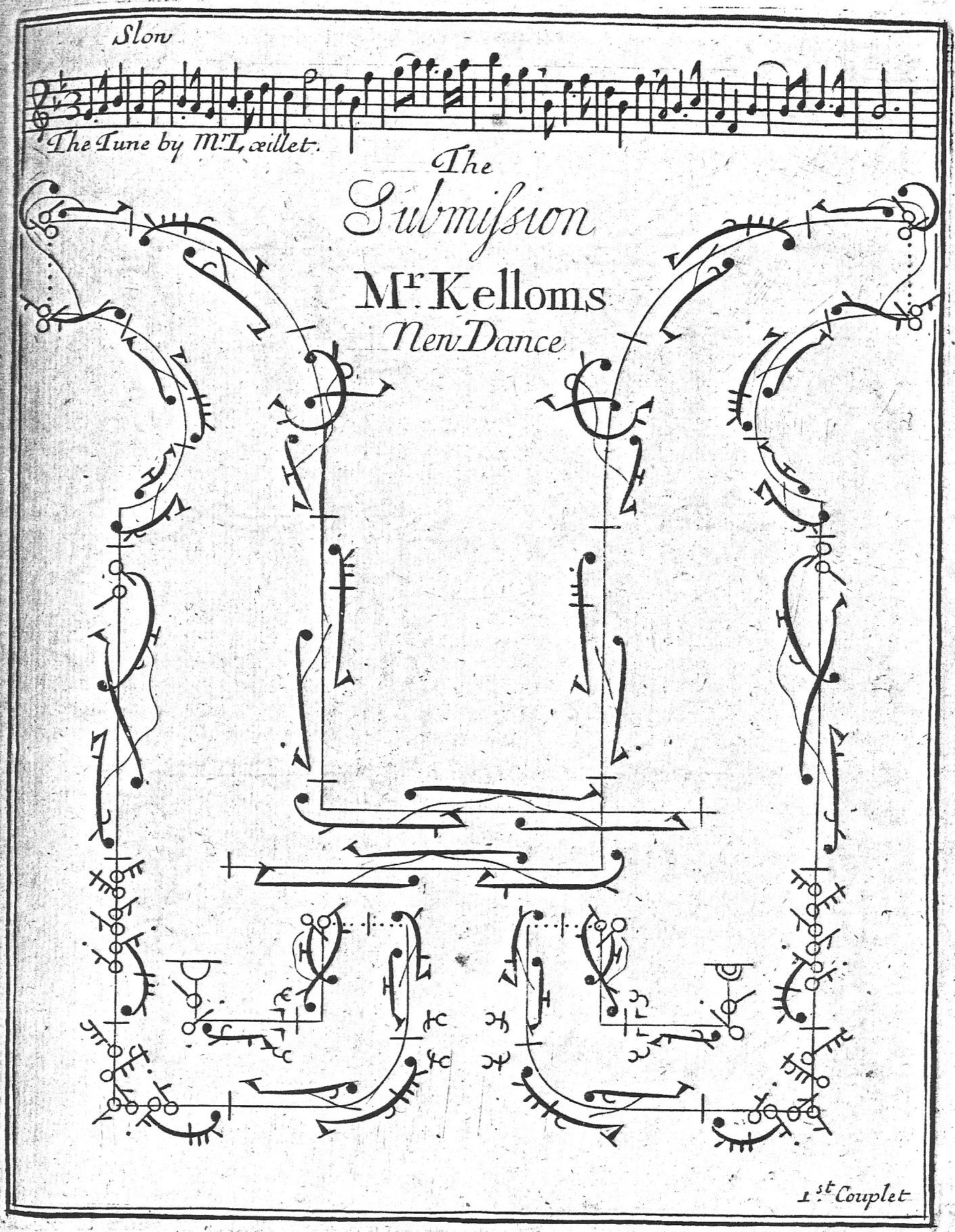
During the 1716-1717 season, the two children performed around a dozen entr’acte dances both serious and comic. Their repertoire included a ball dance by Kellom Tomlinson, The Submission first given on 21 February 1717 and published in notation the same year. The dance opens with a slow triple-time section, followed by a minuet and then a rigadon. Here is the first plate.

This is the only dance created for either Francis or Marie Sallé that survives in notation.

The two young dancers returned to London for the 1718-1719 season, this time appearing first at Lincoln’s Inn Fields and then at the King’s Theatre with the troupe of their uncle Francisque Moylin. At Lincoln’s Inn Fields, they were mentioned only once in the bills, on the 19 December 1718 (their benefit performance), when they were advertised as ‘M and Mlle Salle, the two Children, who dance in the Company of the French Comedians’. They were billed only three times when Moylin’s company moved to the King’s Theatre. However, the Lincoln’s Inn Fields bill suggests that they may have danced at most, if not all, of the 40 performances that the French Comedians gave at the two theatres between 7 November 1718 and 19 March 1719. The bills say nothing at all about their repertoire.

Francis and Marie Sallé did not return to London again until the 1725-1726 season, when they again danced for John Rich at Lincoln’s Inn Fields. By this time, Francis was twenty years old and Marie eighteen and they immediately became the company’s leading dancers. They performed the title roles in that season’s new pantomime, Apollo and Daphne; or, The Burgomaster Trick’d, Rich’s answer to Drury Lane’s Apollo and Daphne; or, Harlequin’s Metamorphoses of the previous season. At Drury Lane, the title roles had been taken by John Thurmond Jr (the pantomime’s creator) and Hester Booth and Rich followed suit with two dancers at Lincoln’s Inn Fields. The two Sallés also appeared as Zephyrus and Flora in the pantomime’s concluding divertissement. Apollo and Daphne; or, The Burgomaster Trick’d, first performed on 14 January 1726, was given 45 performances before the end of the season. Francis Sallé was billed for 106 performances during 1725-1726. As well as dancing four entr’acte  duets with Marie, he apparently gave a solo French Sailor (in addition to the French Sailor and His Wife with his sister) and danced Two Pierrots with Francis Nivelon as well as Two Harlequins with Louis Dupré. He also partnered Mrs Bullock in a Grand Dance with other dancers in the company. Francis and Marie Sallé shared a benefit on 18 April 1726, the last time they would do so. Their careers were already beginning to diverge.

Both Sallés returned to Lincoln’s Inn fields for the 1726-1727 season. They were first billed together, without comment, on 19 September 1726 dancing Shepherd and Shepherdess and French Sailors. Francis had already appeared a few days earlier, dancing First Fury in The Necromancer (a role he had initially performed the previous season). He and Marie repeated their roles in Apollo and Daphne and danced together in the entr’actes, although Francis was also billed (without Marie) alongside other dancers in the company for performances of The Prophetess as well as a new masque Pan and Syrinx, first given on 24 October 1726. Later in the season, on 30 May 1727, he was billed as Mezzetin Man (with the actress-dancer Elizabeth Younger as Mezzetin Woman) in The Necromancer as well as First Fury. By contrast, Marie’s only billing without her brother was on 27 April 1727, when she performed a new Ball Dance with Leach Glover at his benefit.

The main reason for the Sallés engagement at Lincoln’s Inn Fields in 1726-1727 was undoubtedly their appearance in the new pantomime, The Rape of Proserpine, introduced on 13 February 1727 and performed 32 times before the end of the season. This was a pantomime that Rich had long wished to produce. In the libretto for Harlequin a Sorcerer, first given at Lincoln’s Inn Fields on 21 February 1725, he had written of ‘The Expectation which has been rais’d in the Town of seeing a Dramatick Entertainment, call’d The Rape of Proserpine‘ explaining that ‘being disappointed of some very necessary Persons from abroad, on whom we depended, we have deferr’d the same for some time longer’. The ‘very necessary Persons’ must have been Francis and Marie Sallé, for all the other principal performers in The Rape of Proserpine appeared in Harlequin a Sorcerer. When Rich was able to engage the two Sallés for the 1725-1726 season, his focus had evidently turned immediately to the need to outdo Drury Lane’s Apollo and Daphne and he had deferred his pet project for another year.

In The Rape of Proserpine, the roles of Ceres, Pluto, Proserpine and Mercury were all performed by singers, although Marie and Francis danced in the serious part of the pantomime. She was the first of five female Sylvans, while he was the first of four Gods of the Woods and the first of five Demons. The most spectacular dancing was probably reserved for the ballet which ended the pantomime, described thus in the libretto, ‘Enter several Dancers, who represent the four Elements, and celebrate the Marriage of Pluto and Proserpine, by a Grand Ballet.’ Earth was danced by Louis Dupré, with Mrs Pelling as his Female. Air was Leach Glover, with Mrs Laguerre, and Fire was Poitier with Mrs Bullock. The ballet must have culminated with the appearance of Francis Sallé as Water, accompanied by his sister. The bills suggest that the men may have danced virtuoso solos as well as duets with their ‘Females’. The Rape of Proserpine drew on Lully’s 1680 opera Proserpine and the ballet of the elements may have had a French source too, although this has yet to be identified.

This season, Marie received her own benefit on 6 April 1727 at which she apparently did not dance, for the advertisement announced only a Pastoral by her scholar the nine-year-old Miss Rogers and Two Pierrots by Francis Nivelon and Francis Sallé. Her brother’s benefit was a week later, on 14 April, at which the mainpiece was The Prophetess (in which he may well have danced) and the dancing comprised a solo Harlequin by Miss Violante, his scholar, a solo version of Les Caractères de la Dance by Marie and a Fury Dance with Francis as First Fury (presumably taken from The Necromancer). It is worth noting that Marie’s benefit was more profitable than that of Francis and had higher attendance than his. Marie Sallé had already emerged as the more celebrated dancer and was probably the more ambitious too. During 1726-1727, Francis Sallé gave 97 performances and had evidently decided that his future lay with Rich’s company. The surviving Lincoln’s Inn Fields accounts for that season record a payment of 10 guineas on 9 June 1727 to ‘Mr Salle upon signing articles and in pt of next year’s contract’.

Marie Sallé would not return to London and Lincoln’s Inn Fields until the 1730-1731 season. Francis became one of Rich’s group of dancers, although he probably returned to dance in France regularly. His first London season without his sister, 1727-1728, may not have met his expectations. On 29 January 1728, the first performance of The Beggar’s Opera was given at Lincoln’s Inn Fields, and the production dominated the theatre’s repertoire until the end of the season. None of the bills for The Beggar’s Opera mention dancing, but the libretto does refer to dances and it is possible that at least one of them – the ‘Dance of Prisoners in Chains’ was performed by male dancers in the company. Otherwise, Francis Sallé was billed only four times in the entr’actes, although his appearances in The Necromancer, Apollo and Daphne and The Rape of Proserpine (with Mrs Laguerre in Marie Sallé’s roles in the two latter pantomimes) came to a total of 46 performances. His benefit, on 22 April 1728, was shared with Michael Poitier and he did not dance himself. Sallé’s last billing before that was on 25 March 1728 and he may have been absent for the rest of the season.

Although The Beggar’s Opera was given frequently in 1728-1729, there was more room for other repertoire in the course of the season. Francis Sallé danced from 21 October 1728 to 22 May 1729 and was billed in three entr’acte duets, two entr’acte group dances and five afterpieces (three of which were pantomimes). He was advertised in 67 performances altogether and allowed a solo benefit on 8 April 1729, when he danced the Mad Soldier in The Humours of Bedlam (a comic ballet always given with the play The Pilgrim) as well as two entr’acte duets with Mrs Laguerre – Highlander and Mistress and French Sailor. By this time he had established a dance partnership with Mrs Laguerre, their new duet Highlander and Mistress was repeated nine times before the end of the season and continued to be popular thereafter.

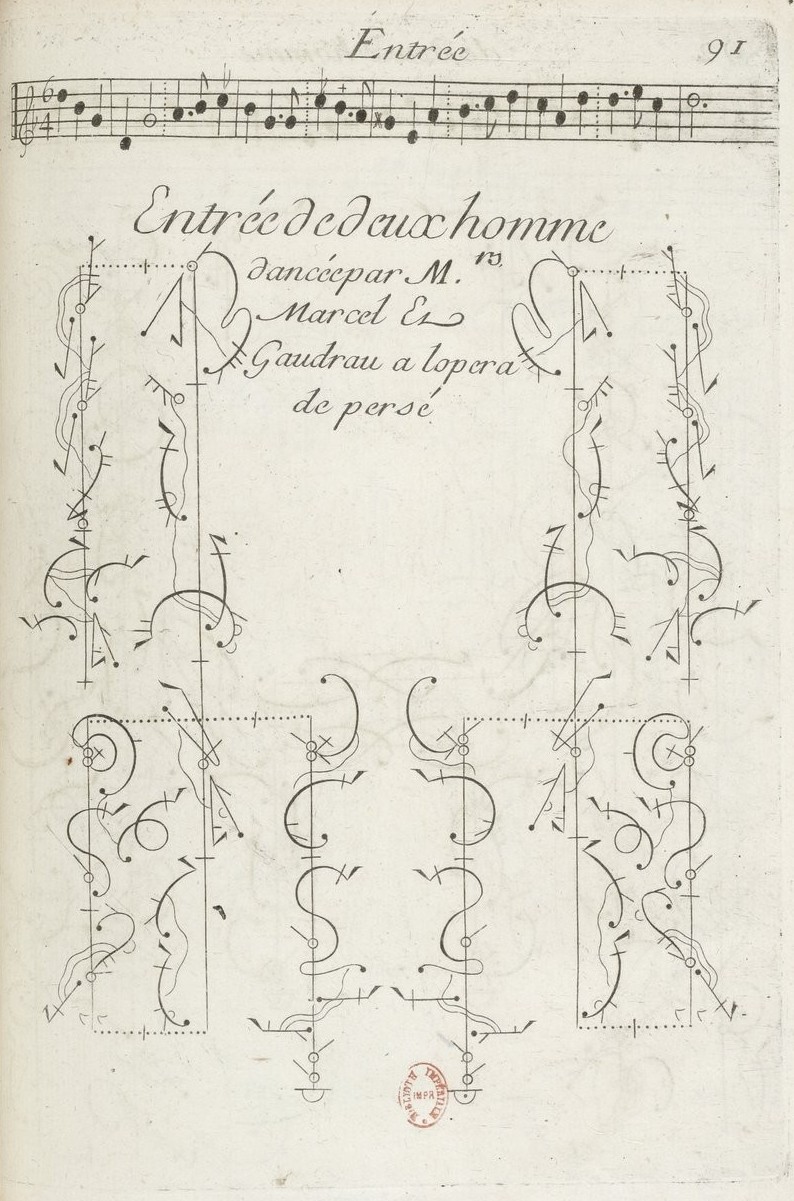
In 1729-1730, Sallé was billed for 117 performances. This season was dominated by another new pantomime, Perseus and Andromeda; or, The Cheats of Harlequin (or, The Flying Lovers), Rich’s response to Drury Lane’s Perseus and Andromeda: With the Rape of Colombine; or, The Flying Lovers by Roger and Weaver given the previous season. The Lincoln’s Inn Fields Perseus and Andromeda was performed 60 times before the end of 1729-1730. Francis Sallé was an Infernal in the serious part of the pantomime, for which Rich had drawn on Lully’s 1682 opera Persée, and it is tempting to speculate whether he and his fellow dancers (Poitier, Dupré, Pelling, Newhouse and Lanyon – Papillion, billed first, was actually a singer and probably did not dance) performed to the ‘Entrée des Divinités Infernales’ from the opera. A duet created by Guillaume-Louis Pecour to this music for Marcel and Gaudrau, performed at the Paris Opéra, was published in notation around 1713 and shows the demands that could be placed on male dancers at the period. Sallé’s early tuition by Claude Ballon (which could have continued beyond his childhood) indicates that he might well have been capable of similar virtuosity. Here is the first plate:

Sallé also danced in a smaller scale afterpiece in 1729-1730, The Dutch and Scotch Contention first given on 29 October 1729. This was probably taken from a ballet performed at the Opéra-Comique in Paris, in which Sallé had appeared ‘en Ecossois’ alongside Roger and Nivelon. I looked at this piece in some detail in my post Highland Dances on the London Stage, back in February 2021. Sallé’s duet Highlander and Mistress with Mrs Laguerre formed part of the action in the London ballet.

Marie Sallé returned to Lincoln’s Inn Fields for the 1730-1731 season, first appearing on 23 November 1730 and dancing until 4 June 1731. Francis made his first appearance some two months before the arrival of his sister, on 21 September 1730, and his last just a few days later, on 7 June 1731. His benefit was on 5 April 1731, in which he danced The Loyal and Generous Free-Mason with Dupré, Pelling and Newhouse – described in the advertisements as ‘all Brothers’- as well as the duets Les Caractères de la Dance and the Louvre and Bretagne with Marie. The last two were ballroom dances by Guillaume-Louis Pecour, among the most famous choreographies of the day and regularly given at benefit performances in London’s theatres. Sallé’s benefit brought in a little over £129. His sister’s benefit, held on 25 March 1731 and commanded by the King (who attended with the Queen, Prince William and the ‘three eldest princesses’), brought in more than £194. She and Francis performed Les Caractères de la Dance together, while Francis also contributed a Scottish Dance duet with Mrs Laguerre (perhaps the popular Highlander and Mistress introduced in 1729).

During 1730-1731, Francis danced with his sister at only 16 of his 50 appearances in the entr’actes and at only 22 of his 65 afterpiece performances. He danced with Marie in Apollo and Daphne and The Rape of Proserpine, but his most popular entr’acte dance was again Highlander and Mistress with Mrs Laguerre. While their respective benefits underlined Marie Sallé’s celebrity status, Francis demonstrated his independence from his sister and his importance as a dancer on the London stage.

The 1731-1732 season was marked by the absence of Marie Sallé. Francis danced at Lincoln’s Inn Fields from 4 October 1731 to 2 June 1732, giving 111 performances in all. His benefit on 12 April 1732 brought in a little over £80 and he was allowed a second benefit on 24 May 1732 which achieved receipts of just over £93. The receipts and the two benefits (an unusual arrangement) need analysis which I won’t undertake here, although there is no question that Francis Sallé was working hard for John Rich who certainly appreciated his contribution to the company. This season, his principal partner was Mrs Laguerre, with whom he performed several entra’cte dances including French Sailor and Wife (presumably the duet Francis had often performed with his sister), Highlander and Mistress and a new duet The Baulk which promised to be popular beyond 1731-1732. He again took leading dancing roles (partnering Mrs Laguerre) in Apollo and Daphne, The Rape of Proserpine and The Dutch and Scotch Contention. For his final performance of the season, Sallé danced as an Infernal in Perseus and Andromeda.

Just ten days after his last performance, the Daily Post for 12 June 1732 announced that:

 ‘On Friday last died at his Lodgings at Newington Green, after a tedious Indisposition, Mons. Salle, a celebrated Dancer belonging to Lincoln’s Inn Fields Playhouse.’

Francis Sallé was buried at St. John Hackney on 14 June 1732. He was little more than twenty-seven years old. According to Dacier in Une Danseuse de l’Opéra sous Louis XV (pp. 293-4), Marie Sallé was grief-stricken by her brother’s death and a portrait of Francis was found among her possessions after her own death.

Francis and Marie Sallé pursued separate careers alongside their performances together in London. She was far more successful, yet his career deserves much more attention than it has received. He was, for a time, the leading male dancer in John Rich’s company at Lincoln’s Inn Fields and – had he lived longer – would undoubtedly have gone on to star at the first Covent Garden Theatre, opened by Rich in December 1732 just a few months after Sallé’s untimely death.

Notes:

There seems to be no documentary proof of the birth dates of either Francis or Marie Sallé. In his biography, Une Danseuse de l’Opéra sous Louis XV: Mlle Sallé (1707-1756), Émile Dacier gives her birth year as 1707 (p. 4 n. 2). In their Mémoires pour servir à l’histoire des spectacles de la foire, 2 vols. (Paris, 1743) the Parfaicts declare that Francis was two years older than Marie (vol. 1, p. 207). Together, these sources presumably provide what evidence there is for his birth year.

For The Rape of Proserpine, Perseus and Andromeda and French dancing see: Moira Goff, ‘John Rich, French Dancing, and English Pantomimes’, “The Stage’s Glory” John Rich, 1692-1761, ed. Berta Joncus and Jeremy Barlow (Newark, NJ, 2011), 85-98.

There are numerous volumes of accounts for the Lincoln’s Inn Fields and Covent Garden theatres during the 18th century in the manuscript collections at the British Library. The entry for Francis Sallé quoted above comes from Egerton ms. 2266, f. 171r.

For dancing in The Beggar’s Opera, see Jeremy Barlow and Moira Goff, ‘Dancing in Early productions of The Beggar’s Opera’, Dance Research, 33.2 (2015), 143-158 (pp. 148-149 for the ‘Dance of Prisoners in Chains’).

Other Dance in History posts relating to the London career of Francis Sallé include:

Aimable Vainqueur on the London Stage

La Bretagne in London

Highland Dances on the London Stage

The Humours of Bedlam

The Necromancer at 300

Season of 1725-1726 (11 posts on various aspects of the dancing at Drury Lane and Lincoln’s Inn Fields this season)

Another French Dancer in London: The Other Louis Dupré

Way back in 1999, I wrote an article which I hoped would settle once and for all the question of the identity of the dancer who first performed the role of Mars in John Weaver’s 1717 ballet The Loves of Mars and Venus. As he continues to be wrongly identified with the French dancer known as Louis ‘le grand’ Dupré, I thought I ought to include London’s Louis Dupré in my series about French male dancers in England, even though there is no certain evidence that he was French.

My 1999 article provides a detailed comparison of the dates on which the two Louis Duprés were dancing in London and Paris respectively, showing that they were indeed different dancers pursuing quite separate careers on each side of the Channel. I also included a brief summary of ‘le grand’ Dupré’s career – he still awaits a properly detailed biography – so in this post I will look only at the ‘London’ Dupré.

The other Louis Dupré was first billed in London at Lincoln’s Inn Fields on 22 December 1714, as one of six dancers performing in the entr’actes. All of them may well have appeared on that theatre’s opening night on 18 December and then again on 20 and 21 December, when ‘Entertainments’ and ‘Singing and Dancing’ were advertised with no other details. John Rich had engaged six men and two women as dancers for his first season at Lincoln’s Inn Fields, because he saw dancing as an important draw for audiences while his new acting company gained the experience to challenge the established players at the rival Drury Lane Theatre. Dupré was undoubtedly Rich’s leading male dancer that season. He was billed for 71 performances in a repertoire that included a French Sailor duet with Mrs Schoolding, a Harlequin and Two Punches trio (with Moreau and Boval – Dupré was probably Harlequin) and a Grand Spanish Entry (with Moreau, Boval and the dancer Mrs Bullock). He was allowed a benefit performance on 7 April 1715, the second dancer’s benefit after Charles Delagarde who may have been the company’s dancing master.

This may have been the season that Dupré danced a ‘Canaries’ with Charles Delagarde and the ‘Saraband of Issee’ and ‘Jigg’ with Ann Bullock. Both dances were choreographed by Anthony L’Abbé and published in notation within A New Collection of Dances in the mid-1720s. Dupré could have come to L’Abbé’s notice through Delagarde, whose career on the London stage had begun in 1705 and who had subsequently worked with L’Abbé. If all these men were indeed French (Charles Delagarde’s origins are also uncertain) and had professional links – perhaps through their dance training, their association is easy to understand.

Charles Delagarde ‘who has not appeared these six years’ was billed at Lincoln’s Inn Fields from 1 January 1715 and 1714-1715 is the season in which he and Dupré were most likely to have danced together. L’Abbé’s ‘Canaries’ is to music from Lully’s 1677 opera Isis and is, as its title indicates, the dance type called a canary. The music is in 6/8 and has 48 bars in all. Here is the first plate.

Although it has its share of cabrioles and pas battus, as well as a passage with pas tortillés, on the page it is not a particularly demanding choreography for male dancers.

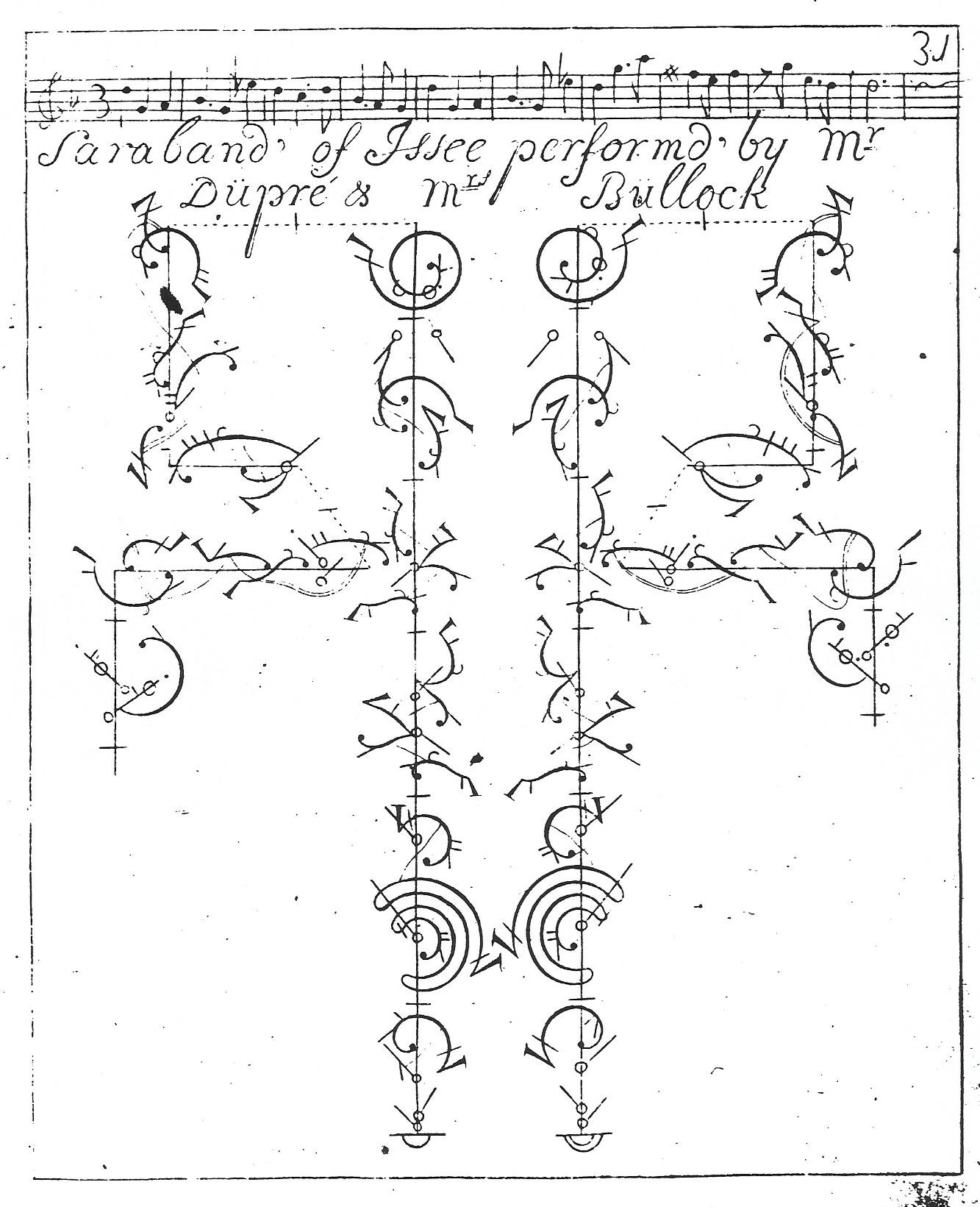
This was also the most likely season for Dupré to have danced with Mrs Bullock, a pupil of Delagarde who (as Miss Russell) began her dancing career in 1714-1715. L’Abbé’s ‘Saraband of Issee’, to music from Destouches’s 1697 opera Issé has Mrs Bullock matching Dupré with pas battus and pirouettes, although he gives her changements instead of Dupré’s entrechats-six. This dance has the time signature 3 and 64 bars of music. This is the first plate.

The ‘Jigg’ they danced together, either immediately following the ‘Saraband’ or quite separately, is to music from La Coste’s 1707 opera Bradamante and is in 6/4 with 48 bars of music. On the page, it has a straightforward vocabulary of steps.

I have glanced at these dances in earlier posts on Dance in History, but all are worth more detailed analysis.

Dupré moved to Drury Lane for the 1715-1716 season, his second on the London stage, perhaps because of the financial uncertainty surrounding John Rich and Lincoln’s Inn Fields. At Drury Lane, he immediately became the leading male dancer and partner to the dancer-actress Hester Santlow. They performed Spanish Entry and Harlequin duets together, as well as appearing as the lead couple in the popular entr’acte group dance Myrtillo. In 1716-1717, Dupré appeared with Hester Santlow and John Weaver in the latter’s The Loves of Mars and Venus. However, he seems not to have been happy at the Drury Lane Theatre, for he returned to Lincoln’s Inn Fields for the 1717-1718 season and would work for John Rich for the rest of his career.

Louis Dupré did not make his first appearance of the 1717-1718 season at Lincoln’s Inn Fields until 25 October 1717, when he was billed with ‘Mlle Gautier, from the opera at Paris, being the first time of her appearing upon the English Stage’. On 22 November, he took one of the title roles in a ‘New Dramatic Entertainment of dancing in Grotesque Characters’ entitled Mars and Venus; or, The Mouse Trap. He was Mars, with Mrs Schoolding as Venus and John Rich (under his stage name of Lun) as Vulcan. The afterpiece points to the possibility of past disagreements between Dupré and the Drury Lane management as well as Rich’s rivalry with John Weaver, and Dupré must surely have contributed his inside knowledge of Weaver’s ballet to the new entertainment.

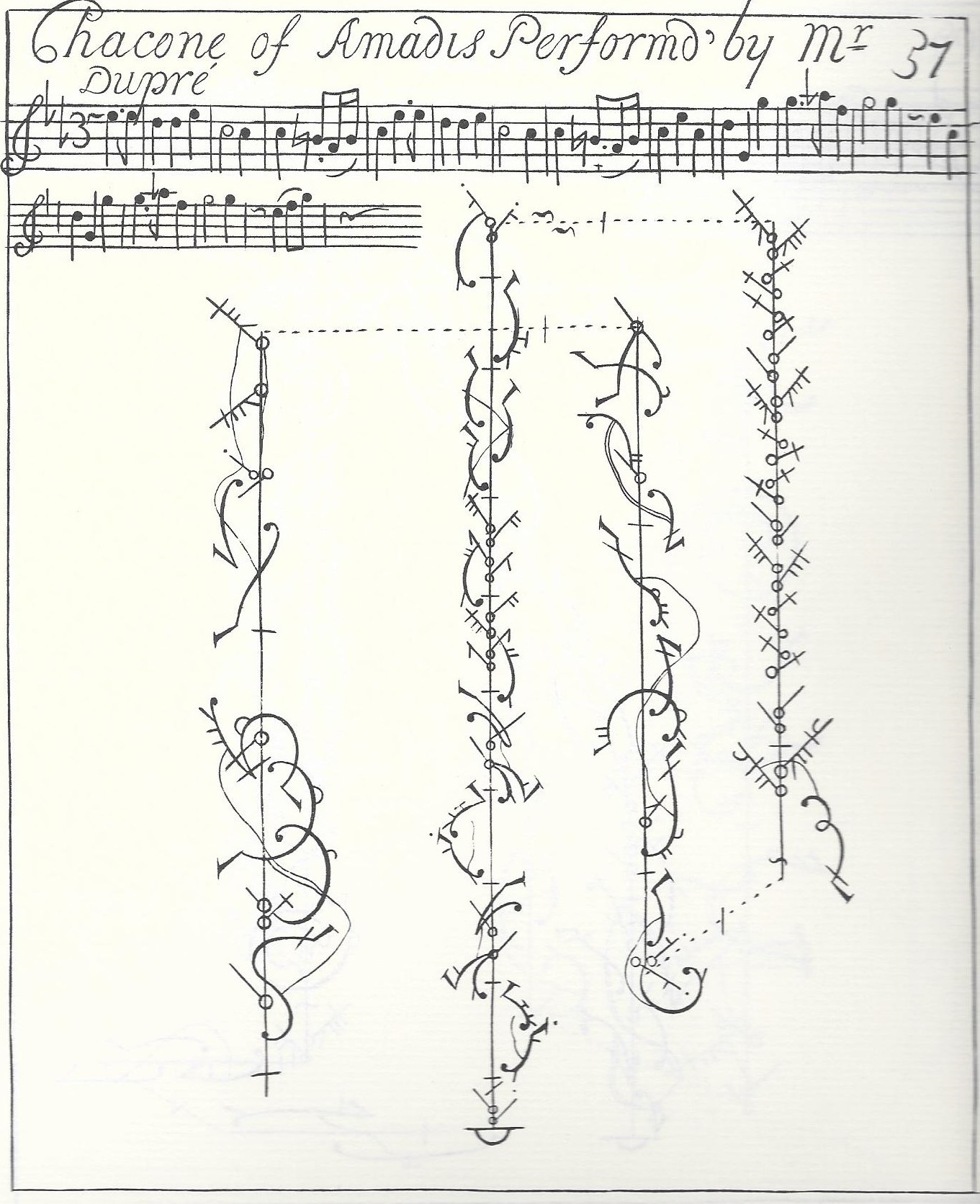
On 3 January 1718, another new afterpiece was advertised. The Professor of Folly was a ‘new Dramatick Entertainment of Vocal and Instrumental Musick after the Italian Manner, in Grotesque Characters’ for which Dupré had composed ‘all the Dances’ for himself and nine others (five men and four women), although it lasted for just a few performances. Then, on 24 January, Dupré appeared in the title role of Amadis; or, The Loves of Harlequin and Colombine with Mlle Gautier as Oriana and Lun (John Rich) with Mrs Schoolding as Harlequin and Colombine. This afterpiece was described as a ‘new Dramatick Opera in Dancing in Serious and Grotesque Characters’, although there were no singing roles. No scenario was published, but the characters in the serious part of the pantomime suggest a link with Lully’s 1684 opera Amadis and this is reinforced by Anthony L’Abbé’s solo for Dupré of around the same date to the chaconne from the opera. Here is the first plate of the notation from L’Abbé’s A New Collection of Dances.

I have elsewhere suggested that this solo was performed within the pantomime. It is certainly one of the most demanding of the male solos recorded in notation, and also seems to be one of the least known and least reconstructed by modern practitioners of baroque dance. It has 92 bars of music and its technical challenges include three entrechats-six in a single bar of music (1st plate) , a pirouette with two-and-a-half turns in a single bar (3rd plate) and a pirouette with four turns over three bars of music (6th and final plate). Again, I have looked briefly at this solo in earlier Dance in History posts, but it calls for both technical analysis and detailed comparison with other notated male solos.

During the late 1720s, Dupré danced in all of Rich’s most important pantomimes. In 1724-1725 he was billed as the first of three Furies in Harlequin a Sorcerer: With the Loves of Pluto and Proserpine (21 January 1725). In Apollo and Daphne; or, The Burgomaster Trick’d (14 January 1726) he danced as a Spaniard in the pantomime’s concluding divertissement, initially with Mrs Bullock as a Spanish Woman and later partnered by a succession of the company’s leading female dancers. This afterpiece marked the return to London of Francis and Marie Sallé, now young adults, who danced the title roles. These evidently required the expressive mime in which they excelled (a skill which Dupré may have lacked). In The Rape of Proserpine; or, The Birth and Adventures of Harlequin (13 February 1727), Dupré was one of three Gods of the Woods, one of five Demons and, in the final divertissement, the element Earth (with Mrs Pelling as his partner ‘Female’). This was another pantomime in which Francis and Marie Sallé were the leading dancers (although the title role and other roles in the serious part were performed by singers). In The Rape of Proserpine, Dupré was no longer billed first among the male supporting dancers. The last pantomime in which he danced was Perseus and Andromeda; or, The Cheats of Harlequin (or, The Flying Lovers) (2 January 1730). He was one of seven Infernals, but again he had lost his primacy among the men. However, in all these pantomimes Dupré danced serious roles which may well have required virtuosity, and he kept them until the end of his career.

His repertoire of entr’acte dances was also predominantly serious. As in the first years of his career in London, it included several ‘Spanish’ dances, either duets or for a group, as well as Chaconnes, which were mostly duets. He was never billed solo as Harlequin, although the trios and duets which he performed may well have had solo passages. Dupré’s last new entr’acte dance, first performed on 14 January 1734 at Covent Garden, was Pigmalion. This was Marie Sallé’s ballet, with Malter in the title role and Sallé herself as the statue Galatea. Dupré was billed as the first of six supporting male dancers, described in a review in the Mercure de France for April 1734 as Sculptors who performed a ‘danse caracterisée, le Maillet et le Ciseau à la main’. It seems that, at the end of his career when he must have been in his forties, Dupré was still capable of virtuosic dancing.

Dupré’s last recorded performance was at Covent Garden on 22 May 1734. That season, he had been billed for 34 performances in the entr’actes (the only dance named in the advertisements which featured him was Pigmalion) and 55 performances in three pantomimes (The Necromancer, Apollo and Daphne, and Perseus and Andromeda). If he was the ‘Lewis Dupre from the parish of St Anne Westminster’ who was buried at St James Paddington on 5 August 1734, then it seems he died suddenly. There was apparently no mention of his death in the newspapers, but he did not return to the stage in 1734-1735. The Dupré billed at Covent Garden that season danced a different repertoire and was probably the ‘Dupré Junior’ of earlier seasons. Louis Dupré’s death in 1734 or 1735 is confirmed by the acceptance of the ‘Widow Dupré’s tickets’ at Covent Garden on 2 December 1735. She continued to receive such benefit performances until at least 1740, underlining both Rich’s generosity to his players and Dupré’s value to him as a dancer in his company over nearly twenty years.

Louis Dupré’s career reveals both the opportunities and the difficulties faced by male professional dancers in London’s theatres during the early 18th century. His technical skills were exploited by John Rich, who needed dancers to draw audiences following the opening of Lincoln’s Inn Fields in December 1714. Dupré also faced competition from other dancers – like Francis Nivelon, who had exceptional abilities as a comic dancer, and Francis Sallé, who was probably no less virtuosic and of a younger generation. Both overtook Dupré in the ranks of dancers at Lincoln’s Inn Fields and then Covent Garden (and both will feature in my series on French male dancers working in London). Sadly, like most dancers, male and female, performing in London during the early 1700s, we have no portrait of the other Louis Dupré.

Further Reading:

Moira Goff, ‘The “London” Dupré’, Historical Dance, 3.6 (1999), 23-26

Linda Tomko, ‘Harlequin Choreographies: Repetition, Difference, and Representation’ in “The Stage’s Glory” John Rich, 1692-1761, ed. Berta Joncus and Jeremy Barlow (Newark, 2011), 99-137.

French Dancing Masters in Bath, 1760-1820

A little while ago, I did quite a bit of research into dancing masters working in Bath as part of a project relating to the Upper Assembly Rooms there. My starting point was Trevor Fawcett’s article on the subject, published in 1988 but still a comprehensive and immensely valuable resource for subsequent work. One of the interesting things that emerged was the number of dancing masters in that city who were French and had worked in London’s theatres. I wrote a little ‘biographical dictionary’ with brief details of each of Bath’s dancing masters based there between the 1750s and the 1820s and I compiled a chart showing approximately how long each of them worked there and how their careers overlapped.

This study also relates to my separate investigation of French dancers in London during an earlier period (my recent post Monsieur Roger, Who Plays the Pierrot began what I hope will be a short series on them).

Apart from the article by Trevor Fawcett, much of my information about their work in Bath came from advertisements published in the Bath Chronicle, while details of their stage careers were mainly drawn from the volumes of The London Stage, 1660-1800 and the Biographical Dictionary of Actors (both referenced below). Far more detailed research, using a much wider range of archives, is needed to fill out the details of the lives and careers of Bath’s dancing masters and to ensure that all of them have been identified and their backgrounds charted.

John Deneuville seems to have arrived in Bath in the early 1760s. His advertisement in the Bath Chronicle for 31 March 1763 declares that he is ‘from the Opera in Paris, and last from the Theatres in London’. A few years later, in the Bath Chronicle for 24 September 1767, his advertisement says that he

‘having been at Paris during the late Vacation, proposes to teach the new Dances called the Minuet-Dauphin, and the Forlane, composed by Mr. Marcel Dancing-Master of the French Court; also the newest French Country dances, with the proper Steps of the Cotillion and Allemands, now in Vogue at Paris.’

Despite his reference to the Paris Opéra, home to the most famous ballet company in Europe, Deneuville may in fact have come from Paris’s less exalted Opéra-Comique – like so many of the French dancers who came to London at this period. There is no mention of his name in the Index to the London Stage, suggesting that either he was simply a supporting dancer in London’s principal theatres, or that he danced at venues beyond Drury Lane and Covent Garden. Deneuville taught in Bath for nearly 20 years. He died in 1782 and was buried there.

Jean-Baptiste Froment arrived in Bath to teach dancing in 1778. His advertisement in the Bath Chronicle for 25 June 1778 set out his credentials and what he intended to teach. He claimed to have been taught in Paris by Monsieur Marcel and to have himself taught at ‘the most eminent Academies’ in London. He offered tuition in:

‘all the fashionable Dances now in Vogue in London and Paris, viz. the Minuet in the present Taste, the Louvre, Minuets Dauphin, de la Reine, Allemandes, Cotillons, … and particularly that graceful Minuet de la Cour and Gavot.’

Froment had been a dancer in London’s theatres. His first billing (but probably not his first performance in London) was at Drury Lane on 10 March 1739, when he danced in the pantomime Harlequin Shipwreck’d. He seems mainly to have been a supporting dancer and his earlier career, presumably in France, is yet to be uncovered. Froment pursued his London career at the Sadler’s Wells and Goodman’s Fields theatres, as well as at Drury Lane, Covent Garden and the Haymarket Theatre. By the end of his stage career in 1777 his performances were limited to appearances with his daughter Mrs Sutton at her annual benefits (she was a dancer at Drury Lane). Froment’s career in London had not been straightforward, for in 1746 – in the wake of the 1745 rebellion – he had been identified as a Jacobite sympathiser, an accusation he was able to rebut. Froment taught in Bath and in London until the 1780s. He died in Bath in 1786 and was buried in Bath Abbey on 13 April.

In 1787, Pierre Bernard Michel opened his dancing school in Bath. His advertisement in the Bath Chronicle for 11 January 1787 informed ‘the Nobility and Gentry of the Cities of Bath and Bristol, that he has been one of the first Dancers, at most of the Courts in Europe, and at the Opera-House in London’. Michel may have been the ‘Master Mechel’ who had first appeared in London on 22 December 1739 at Covent Garden. He and his sister danced a varied repertoire and were very popular for three seasons, and Michel would later pursue a successful dancing career throughout Europe. He may well be the dancer referred to by Gennaro Magri, in his Trattato Teorico-Prattico di Ballo published in Naples in 1779, as ‘the best Ballerino grottesco that France has produced’. In Bath, Pierre Bernard Michel was assisted by his daughter Lucy, but when she married and became Mrs de Rossi she set up her own dance classes, provoking a serious quarrel with her father. This was played out, in part, through their competing advertisements in the Bath Chronicle. Lucy would later marry the dancer and dancing master James Byrne, well-known in London in the years around 1800. Her father’s final years are yet to be fully researched, but he is known to have died in Melksham in 1800.

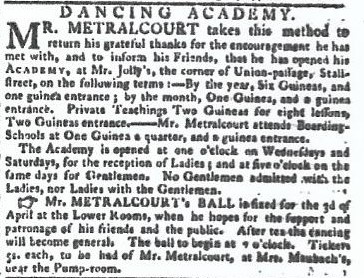
There were two other dancing masters in Bath who, if they were not in fact French, seem to have had close links to French dancers appearing in London’s theatres. Charles Metralcourt was teaching in Bath by 1782, the year he advertised the opening of ‘his Academy’ in the Bath Chronicle for 28 March.

Fawcett describes him as a ‘versatile dancer and a ballet-master at the London Opera house’ (presumably referring to the King’s Theatre) without citing a source. He may have been the ‘Mettalcourt’ who appeared in ‘a new grand Polish Dance’ in the entr’actes at Covent Garden on 5 December 1780, described as making his first appearance at that theatre. Metralcourt did not generally refer to his connections with London’s theatre world in his advertisements. Notices in the Stamford Mercury indicate that he was working as a dancing master in Stamford between 1775 and 1780. He taught in Bath until 1786 and an advertisement in Saunders’s News-Letter for 29 November 1786 declares that he was teaching in Bath during the winter season and in Belfast during the summer season. After leaving Bath in 1786 (apparently as a result of the arrival of the of the dancing master John Second that year) he seems to have taught in Dublin and in Ipswich. He returned to Bath in 1795, taking over from Second and he continued to teach and to hold balls for his pupils at the Upper Assembly Rooms until 1811. Charles Metralcourt died in 1814 and was buried in the Catholic Burial Vault, Old Orchard Street, Bath on 12 October 1814.

John Second (who may or may not have been French) was invited to take over Jean-Baptiste Froment’s school in 1786, as he advertised in the Bath Chronicle for 18 May 1786 describing himself as ‘Of the King’s Theatre, but late of the Theatre Royal, Drury Lane, and Sole Assistant to Mr. Vestris, Senior’. His name appeared occasionally in advertisements for performances at the Covent Garden Theatre during the 1782-1783 season and at Drury Lane in 1783-1784. He may well have appeared more often, but was not important enough to be named in the bills. If he was indeed ‘Sole Assistant’ to Vestris Senior, Gaëtan Vestris, it must have been in the 1780-1781 season at the King’s Theatre during the first visit of the celebrated French dancer (who did not return until 1790-1791). Among the ballets mounted by Vestris Senior was Ninette à la Cour, with the Italian ballerina Giovanna Baccelli in the title role and Gaëtan’s son Auguste Vestris as her lover Colas. First given on 22 February 1781, it was an enormous success and the cast was printed – together with a synopsis of the ballet – in the Public Advertiser for 26 February 1781.

Second was not among the named dancers. He may have been one of the ‘Figure Dancers’ referred to simply as a group, or danced as one of the individual characters for whom no performers’ names are given. No evidence has yet come to light to support Second’s claim that he was Vestris Senior’s assistant, or to suggest why he might have been given that role. Second apparently left Bath in 1795, when his teaching practice was taken over by Charles Metralcourt, although he seems to have returned in late 1799. His subsequent career as a dancing master awaits further research, but he was buried at St James, Bath on 23 January 1826 (when his name was recorded as Paul John Second).

The most celebrated teacher of dancing in 18th-century Bath was half-French. Ann Teresa Fleming was the daughter of Irish violinist Francis Fleming and French dancer Ann Roland, younger sister of the well-known dancer Catherina Violanta Roland. Both girls danced in London for a number of seasons. Ann Teresa Fleming was never a stage dancer but built a very successful career teaching ballroom dancing. I wrote about her in my post Lady Dancing Masters in 18th-Century England but there is far more to say than I could include there.

Bath is a special case when it comes to the history of dancing. As the most fashionable spa in England, it was big enough to attract a number of dancing masters to teach the aristocracy and gentry who gathered there and attended the regular balls in both the upper and lower assembly rooms. It is surely significant that many of these dancing masters were French and had backgrounds in the theatre (it is worth noting that the dancing at the Theatres Royal in Bath and Bristol is yet to be researched). Bath was much smaller than London, providing an opportunity to chart in detail the community of dancing masters and their clientele, as well as the dancing that happened there and the wider social context which brought it all together. Far more research is needed to help us understand who was who and how it all worked.

References:

Trevor Fawcett, ‘Dance and Teachers of Dance in Eighteenth-Century Bath’, Bath History, 2 (1988), 27-48.

Philip J, Highfill Jr, Kalman A. Burnim and Edward A. Langhans. A Biographical Dictionary of Actors, Actresses, Musicians, Dancers, Managers & Other Stage Personnel in London, 1660-1800. 16 vols. (Carbondale, 1973-1993)

Index to the London Stage, compiled, with an introduction by Ben Ross Schneider, Jr. Second printing (Carbondale and Edwardsville, 1980)

The London Stage, 1660-1800. 5 Parts (Carbondale, 1960-1968).

Part 1: 1660-1700; Part 2: 1700-1729; Part 3: 1729-1747; Part 4: 1747-1776; Part 5: 1776-1800.

A calendar of stage performances at London’s major theatres, with a detailed introduction to each part.

Gennaro Magri, translated by Mary Skeaping. Theoretical and Practical Treatise on Dancing (London, 1988).

See p. 160 for the reference to Pierre Bernard Michel.

Tambourins on the London Stage

The Tambourin (or Tambourine it was it was often called in advertisements) was apparently introduced to the London stage by Marie Sallé, who performed a solo with this title at Lincoln’s Inn Fields on 4 January 1731. It quickly became popular. Mlle Sallé danced it at least nine times before the end of the season, including at her own benefit on 25 March when it was titled a ‘New French Tambourin’. A solo Tambourin was also danced at Lincoln’s Inn Fields a couple of times by Miss Rogers ‘Scholar to Salle’ (Marie Sallé’s brother Francis), while at Drury Lane Miss Robinson danced a solo Tambourin several times (including at her own benefit on 14 April 1731 when she also performed ‘Les Characteres de la Dance’).

In 1730-1731, Marie Sallé was returning to dance in London after some years performing at the Paris Opéra, where she had made her official debut on 14 September 1727. She had appeared in a number of operas during her time in Paris, so it is possible that she was drawing on one of her dancing roles there. It is interesting to note that she appeared in Alcione by Marais, premièred in 1706 and cited as the first French opera to include a tambourin.  However the dance forms part of the ‘Feste Marine’ in the third act, whereas Mlle Sallé danced in acts one and four. Marais’s music was also closely associated with Matelots both in the opera and when it was appropriated for choreographies recorded in Beauchamp-Feuillet notation, so it is perhaps unlikely that it was used for Marie Sallé’s London Tambourin.

Mlle Sallé returned to dance in London in the 1733-1734 and 1734-1735 seasons, after which she never returned. She seems to have danced her Tambourin again only on 18 and 26 December 1734. By that time the dance had become a regular feature of the entr’actes. At Covent Garden it continued to be danced as a solo by Miss Rogers, as well as a duet by her and Leach Glover. At Drury Lane a solo ‘Tambourine’ was danced by Mlle Grognet, while Miss Robinson gave her solo ‘Tambourine’ at the Little Theatre in the Haymarket (where she performed with others who had taken part in the actors’ rebellion at Drury Lane at the end of the 1732-1733 season) and Miss Wherrit danced yet another solo ‘Tambourine’ at the Goodman’s Fields Theatre.  The Tambourin or Tambourine remained popular as both a solo and a duet into the 1740s.

The Tambourine was exceptionally popular during the 1739-1740 and 1740-1741 seasons, when it was performed frequently at Drury Lane by a visitor ‘lately arriv’d from Paris’ Mlle Chateauneuf. We do not know what music she used for her solo (which was sometimes advertised as by ‘Mlle Chateauneuf &c.’ as if it were a group dance). In 1740-1741, she had rivals at Covent Garden in the form of Desnoyer and Signora Barberini who danced a ‘new Tambourine’ together on 14 February 1741 which they repeated at numerous performances during the rest of the season. The music for their dance may have been related to the ‘Tambourine Sigra Barbarina’ published in the second of the set of eight volumes popularly known as Hasse’s Comic Tunes which appeared between 1741 and 1758. This particular volume was issued in four parts between September 1742 and October 1743, which includes a period when Desnoyer and Signora Barberini were still performing their duet. Here is her Tambourine (p. 67):

During the 1742-1743 season, the dancer Philip Cooke performed a Tambourine at Covent Garden and his music was also included in the same volume (p. 52). Here is the beginning (the music seems to continue onto the next page):

These two pieces (as well as a number of other tambourins in the same volume) are worth further research for the insights they might provide into music for dancing on the London stage at this period.

There is another entr’acte dance which might have links to yet another Parisian tambourin. Le Badinage de Provence was first performed at Dury Lane on 22 October 1735 by Michael Poitier and Catherine Roland with a supporting group of twelve dancers (six men and six women). It proved very popular, with at least seventeen performances before the end of the season and it would continue to be revived until 1739-1740. In its last season it was advertised, this time at Covent Garden, on 15 October 1739 as a ‘Tambourine Dance call’d La Badinage de Provence’. The title, and the later advertisement, raise the possibility that the music for the dance (which may well have been choreographed by Poitier) was one or both of the tambourins in the first Entrée ‘Le Turc Généreux’ of Jean-Philippe Rameau’s Les Indes galantes. This ‘ballet héroïque’, an opéra-ballet, was first performed at the Paris Opéra on 23 August 1735 and was still in the repertoire there when Le Badinage de Provence was first given at Drury Lane. The tambourins are played in the final scene of the Entrée, which has ‘Provençaux et Provençales’ onstage (presumably the ‘Matelots’ seen earlier) and a ‘Danse de Matelots’.  As the entries in Grove Music Online and the International Encyclopedia of Dance acknowledge, the tambourin was widely thought to be of Provençal origin. Poitier seems to have moved regularly between Paris and London and would undoubtedly have encountered Rameau’s opera.

The popularity of Tambourine dances waned in the 1750s. They were performed a handful of times each season at most and not given at all in several seasons. The dance enjoyed a significant revival in the mid-1760s, with the ‘new Tambourine Dance’ by Simon Slingsby and Miss Baker at Drury Lane on 29 September 1764. This duet was apparently a response to Le Tambourine danced by Fischar and others at the King’s Theatre during the 1763-1764 season, for the latter was repeated in response to Slingsby and Miss Baker’s dance throughout 1764-1765. Other sources suggest that these were very different dances to the earlier Tambourines. I hope to write about them, and about Slingsby, at a later date.

References:

For a listing of Marie Sallé’s dancing roles see: Émile Dacier. Une Danseuse de l’Opéra sous Louis XV: Mlle Sallé (1707-1756) (Paris, 1909), pp. 323-335.

For the text of scene VI of the first Entrée of Rameau’s opera, see: Louis Fuzelier, Les Indes galantes ([Paris], 1735), pp. 24-26.

Rebecca Harris-Warrick, ‘Tambourin’, International Encyclopedia of Dance. 6 Vols, (New York, 1998), vol. 6.

Hasse’s Comic Tunes to the Opera and Theatre Dances. [Volume II]. The Celebrated Comic Tunes to the Opera Dances, as Perform’d at the King’s Theatre in the Hay Market. To which is added, Several of the Most Celebrated Dances Perform’d at Both Theatres (London, 1742-1743).

Meredith Ellis Little, ‘Tambourin (i)’, Grove Music Online (2001, accessed 7/10/2024).

Monsieur Roger, Who Plays the Pierrot

‘There have been companies of Pantomimes raised in England; and some of those comedians have acted even at Paris dumb scenes which everybody understood. Tho’ Roger did not open his mouth, yet it was easy to understand what he meant.’

This quotation from Jean-Baptiste Dubos’s Réflexions critiques sur la poesie et sur la peinture, as translated by Thomas Nugent in 1748, is well-known. Roger himself is hardly known at all, yet his career is of great interest not only as part of the history of the English pantomime but also for what it tells us about theatrical exchange between Paris and London in the early 18th century.

Roger was probably the ‘Person, who plays Pierot at Paris, is just arrived from thence, and will perform this night’ advertised to appear at the Lincoln’s Inn Fields Theatre on 29 January 1719. He was joining Francisque Moylin’s company, which had been playing there since mid-November 1718 and would stay until 5 February before moving on to perform at the King’s Theatre until 21 March 1719. He presumably took the title role in the French three-act farce Pierot maître valet, et l’opera de campagne, ou la critique de l’opera. Roger was given a benefit on 5 February 1719, commanded by the Prince of Wales, at which he performed an acrobatic stunt (apparently as Octave in a one-act farce titled Grapignant; or, the French Lawyer) and ‘the Scene of the Monkey, which has never been performed in England before’. His mimetic and acrobatic skills had probably been acquired through his training and experience as a performer at the Paris fairs.

Roger returned to London in the spring of 1720, playing in De Grimbergue’s company at the King’s Theatre (which alternated its performances with those of an Italian opera company). He returned, again with De Grimbergue, for a season at the newly opened Little Theatre in the Haymarket between December 1720 and April 1721, after which he did not return to London until 1725. The Biographical Dictionary of Actors states that he was appointed as ballet master at the Opéra-Comique in Paris by its manager, the English Harlequin Richard Baxter, but gives no source for this assertion. It also repeats the suggestion by Ifan Kyrle Fletcher, in Famed for Dance, that Roger may have been an Englishman. Fletcher likewise offers no evidence for this and may simply have been misinterpreting the passage from Dubos referring to Roger. Further research is needed to see what can be discovered about Roger in French records, although I cannot pursue this here.

A new troupe of ‘Italian Comedians’ was billed at the Little Theatre in the Haymarket between 17 December 1724 and 13 May 1725. ‘Roger, the Pierrot’ was first advertised on 22 January 1725, as the creator of ‘un ballet nouveau’ given as part of a performance which included Molière’s Le Medecin malgré lui and Gherardi’s Les Filles errantes. Later in the season, he was billed as the creator of a ‘Nouveau ballet comique’ as well as a performer in a ‘Variety of new Dances’ and gave Pierrot and Country Dance solos. His benefit was on 18 March 1725 and included ‘Pierrot Grand Vizier, with the Turkish Ceremony of the Bourgeois Gentilhomme’ and ‘a new Sonata on the Violin of Mr. Roger’s composing, by himself’.

Although companies of ‘Italian Comedians’ would return to play in London during the 1725-1726 and 1726-1727 seasons, Roger did not appear with them for he had joined the company at the Drury Lane Theatre, where he was first advertised on 28 September 1725. The bill published in the Daily Courant on that date recorded his latest new dance.

La Follett (as it was first called) had already been advertised at Drury Lane on 23 September 1725, with no mention of the performers. Roger must surely have danced it then, and if it marked his first appearance with the company it is interesting that no mention was made of this.

In his first season at Drury Lane, Roger was billed in three solos, a duet, three group dances and three pantomimes. The solos were variations on the ubiquitous Peasant dance – a Peasant (28 October 1725), a Drunken Peasant (3 November 1725) and a French Peasant (13 May 1726). He was billed in a Drunken Peasant again in 1728-1729, but he seems not to have repeated the first two dances in later seasons. The duet, usually advertised as La Pieraite and created by Roger himself, was first given on 21 March 1726 and immediately became a staple of the entr’acte dance repertoire. It was performed every season until 1730-1731 by Roger, first with Mrs Brett and then with Mrs De Lorme, and was presumably a ‘Pierrot’ dance. This season also marked the first performances of Roger’s group dance Le Badinage Champetre, billed on 19 November 1725, in which there were five couples led by Roger and Mrs Booth. This dance was also popular and remained in the entr’acte repertoire until 1729-1730.

Drury Lane had lost its leading male dancer, the multi-talented John Shaw, who was absent from late in the 1724-1725 season and died in December 1725. Shaw had been the company’s Harlequin and had created that role in John Thurmond Junior’s The Escapes of Harlequin (first given 10 January 1722) and the overwhelmingly successful Harlequin Doctor Faustus (first given 26 November 1723). Drury Lane’s managers understandably wished to keep both pantomimes in the theatre’s repertoire, not least to counter the rivalry of John Rich at Lincoln’s Inn Fields, and seem to have given Roger the opportunity to try out the role of Harlequin in both pantomimes. The experiment (if that is what it was) was unsuccessful. The Escapes of Harlequin was not revived again and Roger instead took over the role of Pierrot in Harlequin Doctor Faustus, which he played regularly until 1730-1731.

In his first season at Drury Lane, Roger also took over the role of Pierrot in Thurmond Junior’s Apollo and Daphne; or, Harlequin’s Metamorphoses (first given under the title Apollo and Daphne; or, Harlequin Mercury in 1724-1725). He continued to dance in the pantomime until 1727-1728. Apollo and Daphne made a final appearance as a ‘Scene’ within a ‘New Entertainment’ The Comical Distresses of Pierrot which was given a single performance at Drury Lane on 10 December 1729. Roger played Pierrot, suggesting that the piece may have been created by him.

Roger danced at Drury Lane for six seasons, until his untimely death in 1731, and built a successful career there as both a choreographer and a dancer within the company. After his first season, he seems to have mainly appeared in pantomime afterpieces. He worked with John Thurmond Junior again in 1726-1727, as Pierot in The Miser; or, Wagner and Abericock, which was revised and re-titled Harlequin’s Triumph later that season. He then went on to create a number of pantomimes himself. Harlequin Happy and Poor Pierrot Married, first given on 11 March 1728, brought him and John Weaver together on stage for the first time. Weaver, who had not appeared in London since 1721, played Colombine’s Father, while Roger took his accustomed role of Pierrot. The pantomime lasted until 1729-1730 (with cast changes) and was revived for a single performance at Drury Lane on 4 December 1736.

Far more important was Perseus and Andromeda: With the Rape of Colombine; or, the Flying Lovers first given at Drury Lane on 15 November 1728 and successful enough to persuade John Rich to mount a rival production at Lincoln’s Inn Fields on 2 January 1730. The Drury Lane version was ‘In five different Interludes, viz. Three Serious, and two Comic’ and the scenario published to accompany performances stated that the serious part was by Roger and the comic part by John Weaver. Both Roger and Weaver appeared in the comic part, Roger as Pierrot (Doctor’s Man) and Weaver as Clown (Squire’s Man). From 15 March 1729, the comic part was changed to ‘the Devil upon Two Sticks’ and the new edition of the scenario (again published to accompany performances) made clear that this was by Roger.  Here are the title pages of the two editions.

Weaver had no role in the new comic plot and may have already decided to leave London by the end of the season. He had a shared benefit on 25 April 1729, at which he danced a Clown solo and Roger reprised his solo Drunken Peasant (perhaps an indication that there were no hard feelings between the two men over the change to the comic part of Perseus and Andromeda). Weaver’s last billing was on 2 May 1729 and he would not return to work in London until 1733. It is worth noting that in the serious part of Perseus and Andromeda Roger followed Thurmond Junior’s Apollo and Daphne in giving the title roles to two dancers.

The next of Roger’s afterpieces was wholly serious. Diana and Acteon was given on 23 April 1730 for Roger’s benefit, with Mrs Booth and Michael Lally in the title roles (they had also danced the title roles in Perseus and Andromeda). The afterpiece was not revived until 1733-1734, when it had two performances the first of which was as part of a benefit for Mr and Mrs Vallois. She was Roger’s widow and she repeated her role as one of the Followers of Diana, with Mrs Bullock as Diana and Vallois as Acteon.

Roger’s last afterpiece for Drury Lane was by far his most successful and the theatre’s most popular production for many years. Cephalus and Procris: With the Mistakes received its first performance on 28 October 1730. Like Perseus and Andromeda, the comic part was quickly changed – the ‘Dramatic Masque’ (as it was described in the bills) was advertised on 4 December 1730 with ‘a new Pantomime Interlude’ as Cephalus and Procris: With Harlequin Grand Volgi. This pantomime had seventy-four performances in its first season and continued to be played until 1734-1735. Roger was Pierrot, a role that went to Theophilus Cibber after his death. Cephalus and Procris broke new ground for Drury Lane by copying John Rich’s practice of giving pantomime title roles to singers. It may also have influenced John Weaver when he returned to Drury Lane in 1733 to mount his last ‘Dramatick Entertainment in Dancing and Singing’ The Judgment of Paris.

Without further research, I cannot tell whether Roger returned to Paris regularly each summer to perform at the Opéra-Comique and the fairs when Drury Lane was closed. He did play at the Opéra-Comique in July and August 1729, for the Mercure de France mentions him performing in two ballets given as divertissements within La Princesse de la Chine. The first was a ballet on the subject of ‘l’Amour et la Jalousie’ on 7 July 1729 and the writer was obviously convulsed by Roger’s performance.

‘Le Sieur Roger, qui a composé les pas du Balet, & dont la seule figure est capable de faire éclater de rire le plus grand stoïcien’

The piece Love and Jealousy given at Drury Lane on 18 October 1729, with no information other than its title in the bills, may well have been by Roger. The Opéra-Comique ballet was also the source for The Dutch and Scotch Contention; or, Love and Jealousy given at Lincoln’s Inn Fields on 22 October 1729. For more information about this afterpiece, which may have been by Francis Nivelon, see my post Highland Dances on the London Stage (21 February 2021) which transcribes in full the report in the Mercure de France for July 1729.

The other ‘nouveau Balet Pantomime’ was La Noce Angloise for which the Mercure de France for August 1729 provided a detailed description. This ballet included a singing ‘Sorcière’ with singing ‘camarades’, not long before Roger’s creation of Cephalus and Procris. The report does not name the ballet’s creator but does mention Roger.

‘La figure du Sr. Roger, en Paysan, a été trouvée très originale, & a fait autant de plaisir qu’il en a déja fait en Matelot Hollandais [in the Ballet de l’Amour et de la Jalousie]’

Although his performing career centred on Pierrot (about whom there is much more to say, particularly regarding this character’s appearances on the London stage), Roger did portray other comic characters.

Tragically, Roger’s career was cut short by his sudden death in 1731 in Paris, reported in the Daily Advertiser for 11 November 1731.

I have been aware of Roger since the early days of my research into the life and career of Hester Santlow (later Hester Booth), who danced with and for him during his time at Drury Lane. My work on this short post has highlighted in new ways his significance for the development of stage dancing in early 18th-century London – there is much more to be uncovered about the dances and pantomimes he created at Drury Lane in the late 1720s. Roger was not the only French dancer to pursue a career in London’s theatres and I hope to look at some of the others in future posts.

References:

Jean-Baptiste Dubos, Réflexions critiques sur la poesie et sur la peinture. 4e. éd. 3 vols. (Paris, 1740). Roger is mentioned in volume III, pp. 288-289. I have not been able to check whether he was also mentioned in the previous edition of 1733.

Jean-Baptiste Dubos, translated by Thomas Nugent, Critical reflections on poetry, painting and music. 3 vols. (London, 1748). Roger is mentioned in volume III, p. 219.

Ifan Kyrle Fletcher, ‘Ballet in England, 1660-1740’ in Ifan Kyrle Fletcher, Selma Jeanne Cohen and Roger Lonsdale, Famed for Dance (New York, 1960), 5-20 Roger is mentioned on p. 17.

Philip H. Highfill Jr, Kalman A. Burnim and Edward A. Langhans, A Biographical Dictionary of Actors, Actresses, Musicians, Dancers … in London, 1660-1800. 16 vols. (Carbondale, 1973-1993). The entry for Roger is in volume 13.

Mercure de France, juillet 1729, p. 1661

Mercure de France, août 1729, p. 1846