Category Archives: Dance Treatises & Notations

Le Menuet d’Espagne

I have been meaning to return to the minuet for a while, and I would like to open my discussions with a choreographed version of this most revered of ballroom dances. Le Menuet d’Espagne by Dezais was published in his XIII Recueil de danses pour l’année 1715 alongside Balon’s La Transilvanie (discussed in an earlier post). The collection appeared early in the year, aimed at the carnival season which took place several months before the death of Louis XIV on 1 September.

Le Menuet d’Espagne is one of a number of choreographed minuets published in notation during the 18th century. There are about 20 in all and a dozen or so of them date to the early 1700s. Among all these dances are several minuets for four, figured minuets for larger groups of dancers, solo minuets (mostly intended for the stage) and minuets within dance suites that display a number of different dance types in a single choreography. I will return to each of these in due course.

The music for Le Menuet d’Espagne is a rondeau with the structure ABACA (A has sixteen bars, B and C each have eight bars), but the source of the tune has not so far been identified. The choreography is almost a ballroom minuet in miniature. The steps are limited to pas de menuet à deux mouvements, pas de menuet à trois mouvements and contretemps du menuet, with just a couple of agréments or grace steps. The figures are essentially those of the ballroom minuet. The minuet’s opening figure has been simplified. The Z figure has been freely adapted – the sideways steps at the beginning and end are there, together with the crossing of the dancers, but the order of these elements, the paths of the dancers and the spatial relationships between them are quite different. The taking of right hands, then left hands and the closing figure, in which the dancers take both hands, are all clearly recognisable. The whole dance has just 64 bars of music, rather shorter than was expected for a ballroom minuet.

Why is this very French choreography titled Le Menuet d’Espagne? Could it have been a compliment to King Philip V of Spain, grandson of Louis XIV, who had married his second wife Elisabeth Farnese on 24 December 1714? Their proxy marriage on 16 September 1714 would have allowed Dezais plenty of time to create a new ballroom dance honouring the couple. What better duet to choose than a minuet,  performed at royal and other formal balls before (and sometimes by) the highest ranking guests?

I would like to have included a video of this charming duet, but the version I had in mind is not so far available on YouTube. Here is the close of the dance in notation, showing the couple taking both hands as they retreat from the presence.
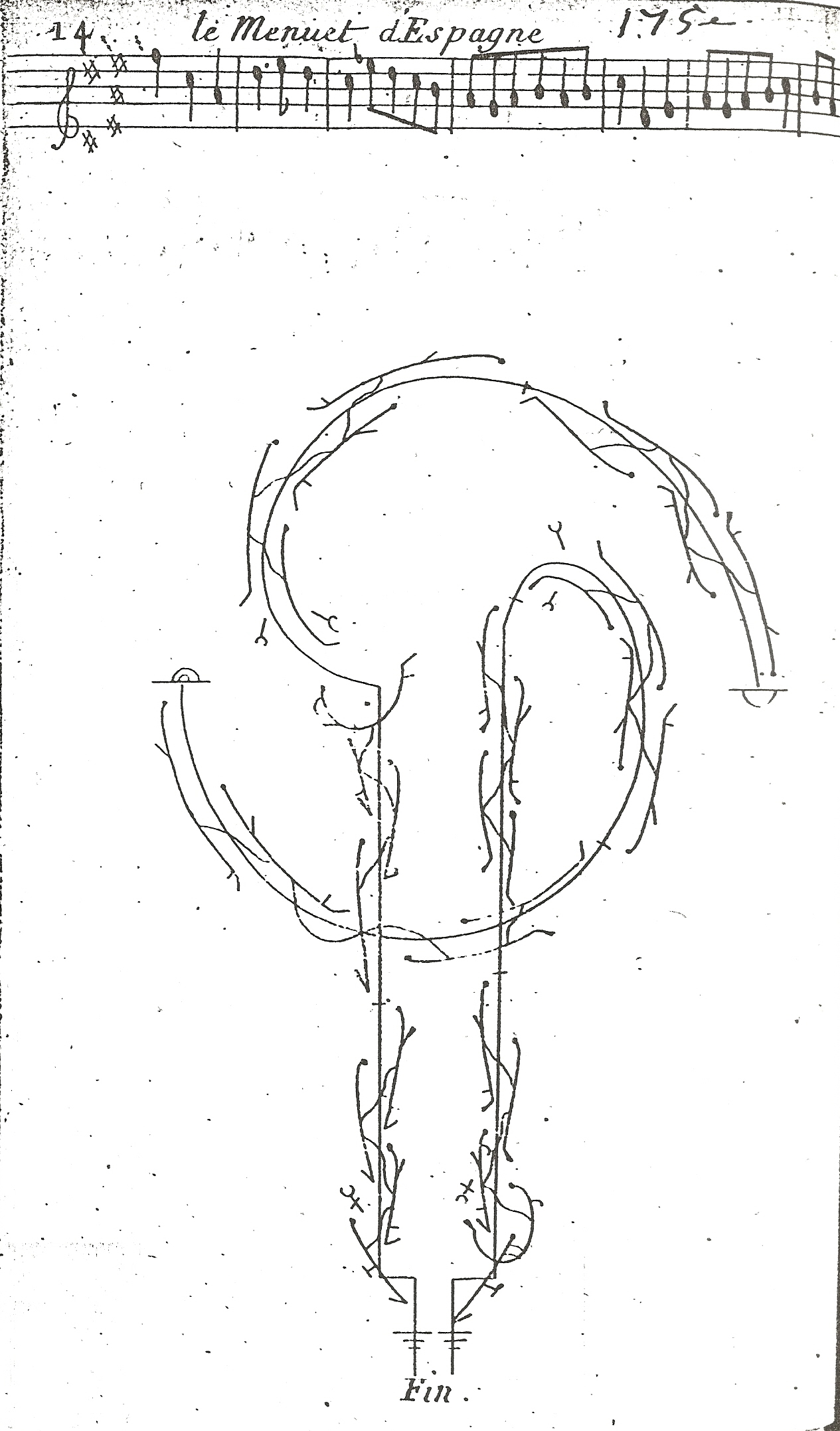
Dezais. Le Menuet d’Espagne (Paris, 1715), final plate

Dezais. Le Menuet d’Espagne (Paris, 1715), final plate

A Year of Dance: 1725

1725 was quite a busy year, both culturally and politically.

In Britain, one noteworthy event was George I’s foundation of the Order of the Bath. However, the hanging of the notorious thief-taker Jonathan Wild at Tyburn on 24 May 1725 probably attracted greater interest. In Europe, there were several events of undoubted political significance. Tsar Peter the Great died on 8 February and was succeeded by his second wife – Catherine I was the first woman to rule Russia. The Emperor Charles VI and King Philip V of Spain signed the Treaty of Vienna on 30 April, which included a guarantee of the Pragmatic Sanction allowing the Emperor to be succeeded by a daughter, despite the prevailing Salic law. In France, the fifteen year old Louis XV married the Polish Princess Marie Leszczyńska. She was seven years older than the King.

At the Paris Opéra, Les Eléments an opéra-ballet by Delalande and Destouches was given its first public performance on 29 May 1725. The work had initially been performed in 1721 as a court ballet, with Louis XV among the dancers. Its popularity on the public stage was to be long-lived. In London there were two notably diverse premieres within a week. Handel’s latest opera Rodelinda was performed at the King’s Theatre on 13 February. On 20 February, Drury Lane’s new pantomime Apollo and Daphne opened. It was described in the bills as a ‘Dramatick Entertainment of Dancing’ and it did indeed have a great deal of serious dancing in its main plot.

1725 was an unusually busy year for dance publishing. In London, L’Abbé’s new dance for the year was Prince Frederick, in honour of George I’s eldest grandson. L’Abbé’s A New Collection of Dances, notations for 13 choreographies performed in London’s theatres, may have appeared this year (it has no publication date). The undated 18th edition of The Dancing-Master has also been assigned to 1725, although some modern sources prefer 1728. The dancing master Siris published his own ‘dance for the year’ The Diana, in honour of the Duchess of Marlborough’s much-loved grand-daughter Lady Diana Spencer.

Siris. The Diana. First plate

Siris. The Diana. First plate

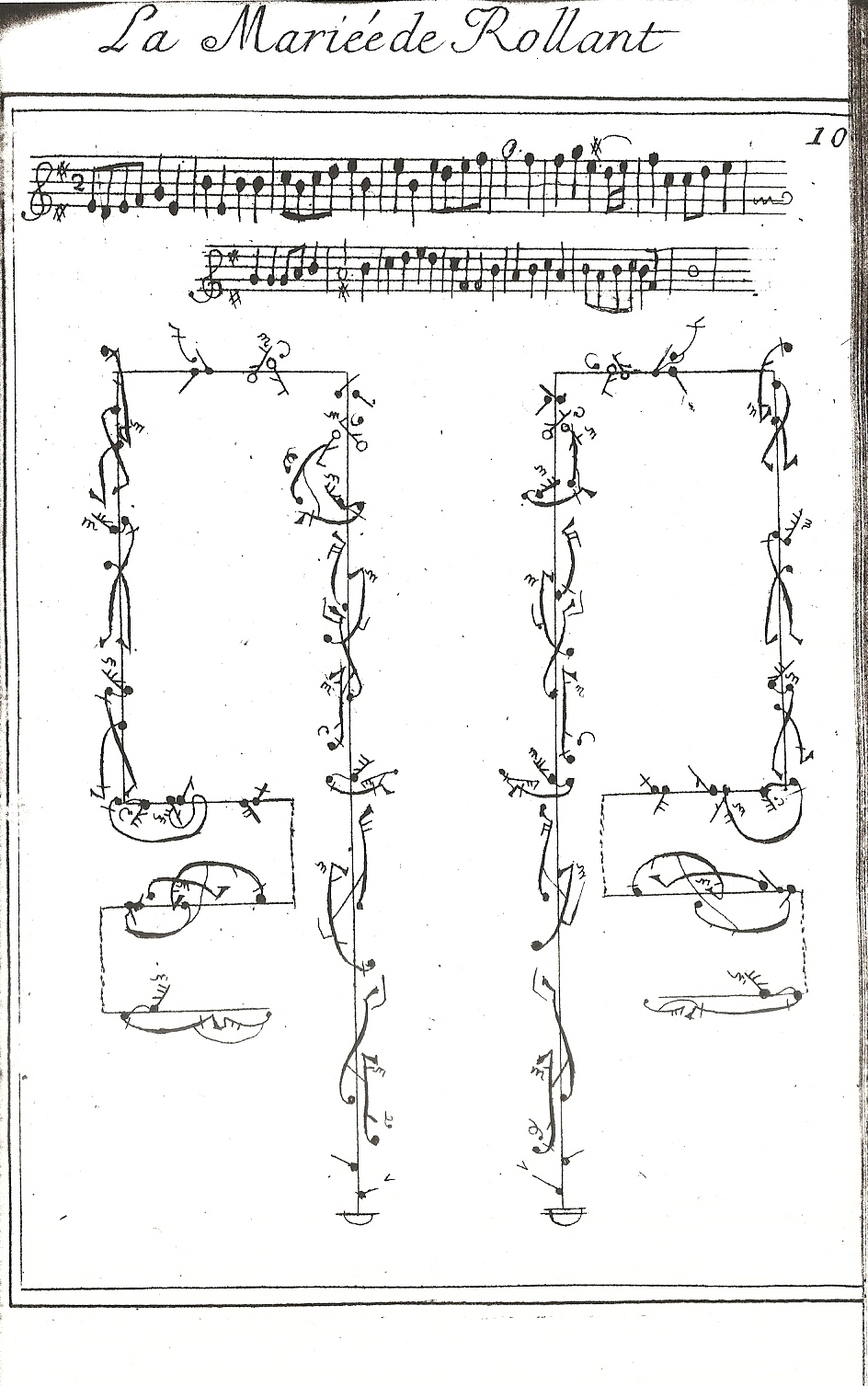
In Paris, the most important dance publication of 1725 was undoubtedly Pierre Rameau’s treatise Le Maître a danser. This work explains how to perform the steps recorded by Feuillet a quarter of a century earlier. Rameau’s revision of the Beauchamp-Feuillet system of notation, put forward in his Abbrégé de la Nouvelle Méthode, probably appeared in late 1725. He followed Feuillet by including a collection of twelve dances by Pecour as part two of the treatise, all in his revised notation. These dances, described as the most beautiful and best liked of Pecour’s many choreographies, were apparently still popular in the ballroom. They were given a new lease of life by their appearance in subsequent reissues of Rameau’s Abbrégé.

Pecour. La Mariée, notated by Rameau. First plate

Pecour. La Mariée, notated by Rameau. First plate

The regular annual collections of dances issued first by Feuillet and then by Dezais continued with the XXIII Recüeil de dances pour l’Année 1725. Dezais also published his Premier Livre de Contre-Dances, which I have written about in other posts. The title Premier Livre … suggests that he was intending to pursue a new series devoted to notations of contredanses. No more collections of either danses à deux or contredanses appeared after 1725. The abrupt cessation suggests that Dezais died before he could prepare or publish further collections. 1725 marks the end of the publication of notated dances in France, until the contredanses known as cotillons began to appear in a simplified form of notation in the early 1760s.

La Mariée on the London stage

La Mariée, a ballroom dance for a man and a woman, was one of the dances Pierre Rameau described as the most beautiful choreographies created by Guillaume-Louis Pecour. Rameau included his own notation of the dance in his Abbregé de la nouvelle methode,dans l’art d’ecrire ou de traçer toutes sortes de danse de ville, published in Paris probably in 1725. The duet already had a long history by then, for it was first published in 1700 in Feuillet’s Recueil de dances composées par M. Pecour, one of the collections that accompanied Choregraphie.

Guillaume-Louis Pecour. Recueil de dances (Paris, 1700), plate 12, opening of La Mariée

Guillaume-Louis Pecour. Recueil de dances (Paris, 1700), plate 12, opening of La Mariée

The dance historian Rebecca Harris-Warrick showed, in an essay published in 1989, that La Mariée was almost certainly originally a stage dance created for a revival of Lully’s opera Roland in 1690. She suggested that the dance entered the French ballroom repertoire during the 1690s. It may have been danced in mascarade entertainments during the 1700 carnival season at the French court. It may well have continued to be danced on the stage of the Paris Opéra in later revivals of Roland, by such stars as Ballon and Mlle Subligny (1705) and David Dumoulin and Mlle Prévost (1709). It was mentioned in many dance treatises and republished in notation many times between 1700 and 1765. After that it apparently faded from view.

Pecour’s popular duet had probably reached London by 1698, when the music was published in John Walsh’s compilation Theater Musick, being a Collection of the Newest Ayers for the Violin. Harris-Warrick speculates that it may have been danced at William III’s birth night ball that year. If so, one of the performers could have been Anthony L’Abbé who had already danced before the King in May 1698. On 1 June 1703, L’Abbé was billed at Lincoln’s Inn Fields in The Wedding Dance. This was described in advertisements as ‘compos’d by Monsieur L’Abbé, and perform’d by him, Mrs Elford, and others’. The piece seems to have been a divertissement, which may or may not have incorporated Pecour’s La Mariée.

In later years, ‘Wedding’ dances reappeared every so often among the entr’acte entertainments in London’s theatres. There was a Wedding Dance ‘by Prince and others’ at Drury Lane on 20 July 1713 and a Grand Comic Wedding Dance, created by Moreau, at Lincoln’s Inn Fields on 14 January 1717. Moreau’s Wedding Dance was performed by three men and three women together with the Sallé children, Francis and Marie. I am inclined to think that La Mariée was performed as part of Moreau’s divertissement, possibly by the Sallés. On 15 May 1718, a dance titled Marie was given at Drury Lane by Cook and Miss Schoolding. Apart from the ongoing dance rivalry between the theatres, which caused much copying of repertoire, Cook had danced in Moreau’s piece and Miss Schoolding was Mrs Moreau’s younger sister.

Thereafter The Marie (as it was often billed) was regularly given as an entr’acte dance. The Sallés performed it, as adult dancers, several times during the 1725-26 and 1726-27 seasons. The duet was later taken up by Leach Glover, one of the leading dancers in John Rich’s company, who gave it regularly at his benefit performances during the 1730s. Pecour’s famous ball dance apparently made its last London stage appearance, after a gap of many years, on 24 April 1759 at Covent Garden. It was performed ‘By Desire’ by Lalauze and Miss Toogood at his benefit. Did they really dance the choreography as created some seventy years earlier?

Learning to Dance: Kellom Tomlinson

According to his own testimony, Kellom Tomlinson completed his dance manual in 1724 but was obliged to defer publication following the appearance of The Dancing-Master in 1728. The Art of Dancing was finally published in 1735, complete with more than thirty engraved illustrations. It is probably the most beautiful of the dance treatises produced during the 18th century. Tomlinson brought out a second edition in 1744.

He provided an outline of the book’s contents at the very beginning:

‘The First Book treats of the beautiful Attitudes or Postures of Standing, the different Positions from whence the Steps of Dancing are to be taken and performed; and likewise the Manner of Walking gracefully. The several Sorts of Bows and Courtesies are also fully described, and all or most of the Steps used in Genteel Dancing’

Like Taubert (but unlike Rameau), Tomlinson also included ‘many of those [Steps] properly belonging to the Stage’. The second book of his treatise focuses on the minuet.

Tomlinson’s illustrations are integral to his manual of dancing:

‘the Piece which I here offer to the World will be of general Use to all, who either have learned, or are learning to dance: the Words describing the Manner in which the Steps are to be taken; and the Figures representing Persons as actually taking them’

The engravings were a selling point, but also provided an additional income stream since they could be purchased independently of the text.

Kellom Tomlinson. The Art of Dancing (London, 1735), Book II, Plate VIII.

Kellom Tomlinson. The Art of Dancing (London, 1735), Book II, Plate VIII.

The Art of Dancing begins with three chapters, ‘Of Standing’, ‘Of Walking’ and ‘Of Bowing’ respectively. After a discussion ‘Of the Dancing-Room’, intended to assist pupils in navigating the spaces within which they would be expected to dance duets, Tomlinson gets straight on to steps. Unlike Taubert and Rameau, he defers explanations of the steps and figures of the minuet until after he has dealt with the other steps would-be dancers might meet in danses à deux or figure dances.

The chapters on standing and walking are short, just a couple of pages each. ‘Of Bowing’ (which deals with both gentlemen and ladies) carries on through ten pages. Most of the first chapter, on standing, is devoted to a description of the five positions of the feet. Tomlinson relates these to the graceful and agreeable ways of standing to be used by gentlemen – ‘Position, then, is the different Placing or Setting our Feet on the Floor, whether in Conversation or Dancing’. In his second chapter, Tomlinson makes the link between walking and dancing explicit – ‘And it is further to be noted, that, in Walking with a good Grace, Time and Harmony must be observed, as well as in Dancing’.

Tomlinson begins his third chapter on ‘the different Sorts of Honours’ by explaining  ‘Bows or Courtesies are the outward Marks of Respect we pay to others, … and, if made in a regular Manner, they are, indeed, very grand, noble and highly ornamental’. He obviously saw such honours as integral to manners and polite deportment and very closely linked, in their performance, to dancing. He gives as much instruction on the disposition of the body as on the mechanics of the bow or courtesie, talking of:

‘the handsome Position of the Waiste, neither too much forwards nor backwards, the whole Poise of the Body  being beautiful and upright, directly perpendicular or right down over the Heel or Heels , on which the Poise rests’

The recommended stance contributes much to both the lady’s and the gentleman’s honours.

The fourth chapter, ‘Of the Dancing-Room’ ends with a survey of the dancing body and the elements of dancing. Tomlinson seems to be drawing on John Weaver’s Anatomical and Mechanical Lectures upon Dancing, published in 1721, as well as Feuillet’s Choregraphie. I will return to the ‘Actions and Motions of the Body’, first set out by Feuillet, ‘from whence the whole Body or Art of Dancing is produced’.  Kellom Tomlinson is not specific about his teaching methods, but he makes reference to these basic ‘Actions and Motions’ throughout his explanations of steps.

Learning to dance: Pierre Rameau

Pierre Rameau’s Le Maître a danser, published in Paris in 1725, is today the best-known and most widely consulted of the 18th-century dance manuals. The same may well have been true in its own time.  Rameau’s treatise was translated into English by John Essex as The Dancing-Master and published in London in 1728. Both versions went through a number of editions. There was a second edition of Le Maître a danser in 1734 and a third in 1748. The Dancing-Master appeared in a second edition in 1731, which was reissued around 1733 with new engraved illustrations, and there was another ‘second edition’ in 1744. Rameau’s influence elsewhere can be traced in a number of treatises. Among these are the translation into Portuguese by Joseph Thomas Cabreira, Arte de dançar à franceza (Lisbon, 1760), and Pablo Minguet e Yrol’s Arte de danzar à la francesa (Madrid, 1758) for which it was the principal source.

Rameau was well aware of the pre-eminence of French dancing (the quotation is from Essex’s translation, which I will use in these and other posts).

‘We may say to the Glory of our Nation that it has a true Taste of fine Dancing. Almost all Foreigners far from disallowing it, have very near an age admired our Dancing, and formed themselves in our Academies and Schools: Nay there’s not a Court in Europe but what has a Dancing-Master of our Nation.’

Rameau wrote ‘près d’un siécle’, translated by Essex as ‘near an age’, dating French dominance of the world of dance to the early 17th century and the reign of Louis XIII, father of the Sun King.

Like Taubert, who was following French practice, Rameau deals with standing, walking and bowing before turning to dancing itself. In his first chapter ‘Of the Manner of disposing the Body’, Rameau declares:

‘I have laid down a Plan, or Method of Teaching, for the Master to lead his Scholar from one Step to another, and at the same Time instruct him in the different Motions of the Arms, to make them agreeable to the different Steps in Dancing: …’

He goes on ‘And as it is essential to dispose the Body in a graceful Posture, that shall be explained in this first Chapter’, referring the reader to an illustration showing a man ready to begin walking. In his preface, Rameau had said ‘I have caused many Copper Plates to be engraved, which represents the Dancer in the several Positions: For Precepts communicated by the Eye have always a better Effect’. Undoubtedly, demonstration was a key element in Rameau’s teaching methods. It is interesting that Taubert did not try to illustrate his Rechtschaffener Tantzmeister. The illustration of 18th-century dance manuals, and indeed of dancing itself during that period, is a topic worth pursuing in its own right.

Rameau begins his second chapter, on walking, by referring back to his illustration of ‘The Disposition of the Body’ making clear that  ‘the Manner of Walking well is very useful, because on it depends the first Principle of Dancing a good Air’. In his third chapter, Rameau turns to ‘the Positions’. Taubert had paid little, if any, attention to the five positions of the feet, whereas Rameau devotes six chapters to them, explaining:

‘What is called a Position, is no more than a just Proportion, found out to divide, or bring the Feet nearer together, in a limited Distance, whether the Body be in an easy Balance, or perpendicularly upright; or whether it be in Walking, Dancing, or Standing.’

These positions have survived into the 21st century, although they are now mainly associated with classical ballet.

After the positions, Rameau turns to ‘Honours in General’. He begins with those for Gentlemen, for whom the management of the hat was an important skill – ‘It is very necessary for every one, in what Station of Life so ever he be, to know how to take off his Hat as he ought, and to make a handsome Bow’. There are four chapters on the various bows to be made by gentlemen, after which Rameau turns to the ladies and instructions for how they should walk and make their curtsies. Like Taubert, Rameau directs his treatise first and foremost to gentlemen.

Only after fourteen chapters – dealing with standing, walking, the positions of the feet and bowing – does Rameau feel his pupils are ready to begin dancing. Of course, he turns immediately to the minuet. Whether this was actually the approach he followed in his lessons is impossible to tell. Were pupils routinely taught alone, in couples (to learn the danses à deux) or groups? We have little real evidence, although one illustration to Le Maître a danser (copied by The Dancing-Master) shows a couple under the tuition of their dancing master, who is playing his pochette.

Pierre Rameau, translated by John Essex, The Dancing-Master (London, 1728). Plate facing opening page of chapter 1.

Pierre Rameau, translated by John Essex, The Dancing-Master (London, 1728). Plate facing opening page of chapter 1.

Learning to dance: Gottfried Taubert

The first dance manual to describe the minuet in detail was Gottfried Taubert’s Rechtschaffner Tantzmeister, published in Leipzig in 1717. This German treatise is a mine of information on all aspects of learning to dance but, without a complete and accessible translation into either English or French, it has remained little known compared to other dance manuals of the 18th century. With the publication in 2012 of a complete English translation it is now widely available for use and study. I will be drawing on this translation for my posts.

Gottfried Taubert. Rechtschaffener Tantzmeister (1717). Title Page.

Gottfried Taubert. Rechtschaffener Tantzmeister (1717). Title Page.

As Taubert’s translator Tilden Russell makes clear, the minuet was central to Taubert’s view of the 18th-century world of dancing. In this post, I will look at his general approach to teaching rather than his specific instructions for the steps and figures of the minuet. In his Foreword, Taubert declares he will provide ‘a clear, methodical and thorough introduction to the theory of the well established art of French dancing’. He makes clear that he will be ‘mainly concerned with presenting a comprehensive discussion of both the theory and practice of the three world-renowned fundamental dances’. He identifies these as the courante, the minuet and the bourée, although his focus throughout most of the treatise is the minuet. He uses the term ‘la belle danse’ for the style and technique used in ‘all ballroom dances’ and makes his debt to French dancing abundantly clear. So far as Taubert was concerned, the French were undisputed rulers of the world of dance.

Taubert lays great emphasis on the necessity for the systematic teaching of dance. He begins with la belle danse and ballroom dancing, setting out his ‘instruction of the fundamental dances and general method’.

  • First, standing, walking and bowing;
  • Second , ‘first principles and universal steps’;
  • Third, how to execute ‘the prescribed basic step for each fundamental dance correctly’;
  • Fourth, how to execute ‘the other most important simple and compound steps’ introducing theatrical steps alongside those for the ballroom;
  • Fifth, how to read and understand the symbols in Feuillet’s Choregraphie as well as the notated dances.

He promises that ‘all this shall be examined topic by topic, methodically and coherently’.

Standing and walking get a chapter each, followed by five chapters on bowing. Taubert is adamant that dance instruction should not begin until the student has mastered ‘how to stand gracefully; how to walk with ease; and how to bow politely and make the proper révérences for any occasion’.

When it comes to the dancing, Taubert says he will address:

  • ‘the formation of steps and motions’;
  • ‘the connection of steps’;
  • ‘the cadence and division of steps according to the meter’;
  • ‘the figures and tracts along which one dances’;
  • ‘the air or manner with which one should dance’.

Each and every one of these is as important to the modern student of baroque dance as it was to the 18th-century dancing master and his pupils. All are fundamental to an accomplished performance of the minuet.

Before I turn to the teaching of steps and figures of the minuet and other dances, I will take a look at what Pierre Rameau and Kellom Tomlinson have to say about the fundamental aspects of dance technique.

Favourite Ballroom Duets

I have reconstructed and performed many baroque dances in my time. Most have been theatrical solos or duets. It’s been a while since I worked on choreographies from the ballroom repertoire. However, I have long been curious about the handful of dances from the early 1700s that seem to have attained a special place in the dance culture of the period.

A dozen dances appear in multiple sources, some of which date to more than fifty years after their first publication, indicating that their fame lasted well beyond their own time. References by dancing masters such as Gottfried Taubert and Kellom Tomlinson as well as Pierre Rameau, in their respective dance manuals, suggest not only that these ballroom duets had travelled beyond France but also that they had become part of the course of instruction offered by leading dance teachers. Some of these duets even reached the stage, notably in London where a couple of them became staples of the entr’acte dance repertoire and were regularly featured during the benefit season.

The following may be described as favourite ballroom duets, dates of first publication are shown in parentheses:

La Bourée d’Achille, by Pecour (1700)

La Bourgogne, by Pecour (1700)

La Forlana, by Pecour (1700)

La Mariée, by Pecour (1700)

Le Passepied, by Pecour (1700)

Aimable Vainqueur, by Pecour (1701)

L’Allemande, by Pecour (1702)

La Bretagne, by Pecour (1704)

La Bacchante, by Pecour (1706)

The Rigadoon, by Isaac (1706)

Le Menuet d’Alcide, by Pecour (1709)

La Nouvelle Forlanne, by Pecour (1710)

Some of these dances have become familiar to baroque dance enthusiasts, while others are rarely (if ever) reconstructed. The list highlights the dominance of France, and of Guillaume-Louis Pecour, over European social dancing.

What made these dances special? Was it their music, their choreography or were there other reasons for their popularity? I will take a closer look at each of them to see if I can find out. I’ll also assess their modern status by checking YouTube for videos. In addition, I hope to find the time and the energy to work my way through at least some of the choreographies as part of my research.


A New Dance for a Girl

Among the dance notations published in London in the early years of the 18th century there are several intended for performance by a girl. The majority of these choreographies are minuets. I have written about the minuets elsewhere, but I will return to them in a later post.

I am currently reconstructing La Cybelline, a dance I haven’t worked on before.  This gavotte, described on its title page as ‘A New Dance for a Girl’, was published in 1719. Although the composer of the music is named as the dancing master Charles Fairbank, the dance itself is anonymous. It is the only dance published in notation in London with no choreographer named. The only other dance with music by Fairbank is also a ‘New Dance for a Girl’, Mr Caverley’s Slow Minuet.  Both were published by Edmund Pemberton, who provided them with a specially designed title page as if he envisaged a series of ‘Fairbank’ dances.  Like Caverley’s Slow Minuet, La Cybelline has the hallmarks of a piece designed to teach the refinements of belle danse style and technique for the ballroom. Who could have created the choreography?

La Cybelline (1719). Title page.

La Cybelline (1719). Title page.

On the page, La Cybelline looks deceptively easy. More than half of its steps are versions of the ubiquitous pas de bourée. In fact, I’ve been finding it quite difficult to learn and I wondered why.  An obvious source of problems is the delayed transfer of weight (known colloquially as a ‘foot fiddle’). There are five pas composés ending in a ‘point’, so that the final step is not completed. This allows the following step to begin on the ‘wrong’ foot, affecting steps and step sequences later in the choreography. It has taken several tries to break the ingrained habit of completing these pas composés in the conventional way.

My difficulties went beyond the foot fiddles, so I did some more detailed analysis of La Cybelline. The music has the structure ABAB (A has 25 bars and B has 15). I don’t read music, so I couldn’t do a proper analysis, but repeated listening to the recording I am using suggested a phrase structure for each section. I then tried to divide the choreography into dance phrases – a process which is rather subjective and not easy. It appears to me that the dance phrases do not coincide with the music phrases, in fact the former cross the latter in a number of places. This is probably another reason why this dance is a struggle to learn. I also tried to divide La Cybelline into its successive figures. Comparison with the dance and music phrases suggests that the figures occasionally cross both the others, compounding the confusion. I won’t explain any further.

One other source of problems is the near-repeat of individual dance phrases at different points within the choreography. This happens a lot in baroque dances, which make much use of ornamentation and variation. Some of the repeated phrases in La Cybelline use pas de sissonne, as follows:

Pas de sissonne, pas de sissonne, coupé emboîté (bars 23-25, end of first A)

Pas de sissonne, pas de sissonne, pas de bourée, pas de bourée (bars 30-33, within first B)

Pas de sissonne, pas de sissonne, coupé avec ouverture de jambe (bars 38-40, end of first B)

Pas de sissonne, pas de bourée, pas de bourée, pas de sissonne (bars 41-44, beginning of second A)

So, the end of the first B is very similar to the end of the first A. The sequence which puts pas de sissonne with pas de bourée changes the order of the steps when it is repeated. I found the transition between the end of the first B and the beginning of the second A the hardest to remember – although this may also have been because they come on consecutive plates, and I was learning the dance plate by plate.

La Cybelline. Plate 3, with the last of the pas de sissonne sequences.

La Cybelline. Plate 3, with the last of the pas de sissonne sequences.

All these small challenges seem to have been included in La Cybelline deliberately, as a way of developing the young dancer’s technical control, particularly her aplomb, and her musicality. I’ll see what happens with the dance as the steps become more secure and begin to flow.

There is also the question of style, from the varying dynamics of the steps to arm movements and the use of épaulement. How would an 18th-century girl have performed a little showpiece like La Cybelline?

The Minuet: Sources

The topic of Georgian balls brings me to that most terrifying of dances with which they all began – the minuet. This was the one duet that everyone had to learn, if not to master, if they hoped to gain a place within polite society.

The minuet disappeared from the ballroom, and from dancing lessons, some 200 years ago. There is no recognisable descendant among our modern ballroom dances. We must, therefore, turn to written sources if we wish to reconstruct the dance. None of the surviving dance manuals and notations is entirely clear and, between them, they pose many problems of interpretation.

The earliest surviving notated minuet is a dance for four (two men and two women) from the mascarade Le Mariage de la Grosse Cathos, created by Jean Favier the elder for performance at Versailles in 1688. Favier recorded the whole entertainment in his own system of dance notation. The steps of the ballroom minuet were published in Beauchamp-Feuillet notation in 1701. Feuillet inexplicably omitted them from the first edition of Choregraphie in 1700 and had to add a ‘Supplément de pas’ to the second edition.

The earliest dance manual to describe and explain the ballroom minuet in detail is Gottfried Taubert’s Rechtschaffener Tantzmeister, published in Leipzig in 1717. Better known, at least to baroque dance aficionados, is Pierre Rameau’s Le Maître a danser (Paris, 1725) with its translation by John Essex The Dancing-Master (London, 1728). Kellom Tomlinson, whose The Art of Dancing appeared in London in 1735, followed them by devoting several chapters to the steps and figures of the ballroom minuet. Like Taubert, he provided a notated version of the duet. It is reasonable to assume that all three treatises reflect the teaching practice of the dancing masters themselves.

During the 18th century dance treatises were published throughout Europe. Many drew on Rameau’s work and included the minuet as part of a course of instruction in ‘French Dancing’. Alongside these were the minuets published in notation. Many are duets for a man and a woman. There are also minuets for four (two men and two women), as well as dances for five or more and a number of solos. In addition, there are several dances that include the minuet as one of the sections in a small-scale ‘suite’ of differing dance types.

I will look more closely at these and other sources for the minuet in future posts, as I explore the various facets of this familiar but little-known and much-misunderstood dance.

The Illustration is from George Bickham the younger’s An Easy Introduction to Dancing: or the Movements in the Minuet Fully Explained published in London in 1738. This little work draws heavily on The Dancing-Master, for which Bickham had provided new illustrations when it was reissued in the early 1730s.

Bickham Minuet

A Year of Dance: 1715

The most significant event of 1715 was the death of Louis XIV on 1 September. He was succeeded by his five year old great-grandson, who became Louis XV. Philippe, duc d’Orléans, the son of Louis XIV’s brother (who had died in 1701) became Regent to the child-king. The new reign would usher in significant cultural as well as political changes.

In Britain, George I was briefly threatened by a Jacobite rising that sought to put the Catholic James Francis Edward Stuart, son of James II, on the throne. The rebellion began in September and was over before Christmas. With the succession assured, at least for the time being, the new Hanoverian dynasty began to settle into English court life.

In Paris, Dezais published the XIII Recüeil de danses pour l’année 1715. This contained only two duets – La Transilvanie by Claude Ballon and Le Menuet d’Espagne by Dezais himself. Another collection, notated and published by Gaudrau, was entitled Danses nouvelles presentées au Roy. Gaudrau had begun to publish dances by Guillaume-Louis Pecour a couple of years earlier, with a Nouveau recüeil de dance de bal et celle de ballet. The Danses nouvelles were two ballroom duets by Pecour, La Venitienne and Le Branle allemand. The former was to a piece of music from Mouret’s Les Fêtes de Thalie.

Pecour. Danses nouvelles (Paris, [1715?]), title page.

Pecour. Danses nouvelles (Paris, [1715?]), title page.

Dezais’s collection was probably published early in the year (perhaps even towards the end of the previous year). Gaudrau’s is undated, but has been ascribed to 1715. The collection must have appeared after the death of Louis XIV, for it is dedicated to his successor. Pecour wrote:

J’ay l’honneur de presenter a Votre Majesté les deux premieres dances que j’ay composées depuis son règne, je souhaitte avec ardeur les voir un jour éxécuter par Votre Majesté, …

Pecour was in his early sixties and had worked for the French court for more than forty years. It seems that he was hoping for further employment.

In London, at least nine dance publications appeared during 1715 as dancing masters vied for the patronage of the new royal family. The first to appear was Siris’s The Princess Anna, advertised towards the end of January. No copy of this dance is known to survive. A new edition of For the Further Improvement of Dancing, John Essex’s translation of Feuillet’s 1706 Recüeil de contredances, probably dates to 1715. Essex dedicated it to ‘Her Royal Highness the Princess of Wales’ and the only known copy may well have been the one presented to her. It included some new country dances and ‘a new French Dance, which I presume to call the Princess’s Passpied’. This duet may have been created with an eye to the Princess’s birthday on 1 March.

The dancing master Richard Shirley published his own notated versions of Ballon’s La Silvie (which had appeared in Paris in 1712) and Pecour’s Aimable vainqueur (first published 1701) in mid-March. He, too, may have had an eye on the birthday celebrations for the Princess of Wales.

George I’s birthday on 28 May was marked by the appearance of a duet honouring his eldest granddaughter Princess Anne, aged five. There were two competing editions of L’Abbé’s The Princess Royale. One was notated by Edmund Pemberton, who was to record and publish L’Abbé’s ballroom duets for many years. The other was by the music publisher John Walsh, who seems to have pirated Pemberton’s version.

L’Abbé. The Princess Royale (London, [1715]), title page.

L’Abbé. The Princess Royale (London, [1715]), title page.

Walsh also published Mr Isaac’s new ballroom dance The Friendship, which may have appeared early in the year. The Morris, Mr Isaac’s ‘new Dance for the year 1716’, was published towards the end of 1715 not by Walsh but by Pemberton.

The ninth of the dance publications was from an up-and-coming dancing master, Kellom Tomlinson. He produced his first published duet The Passepied Round O during the year. It may simply have been fortuitous that it appeared in 1715, but Tomlinson was soon to prove himself adept at attracting patronage.

One other dance may belong to 1715, although it was not published for several more years. L’Abbé’s stage dance Canaries ‘perform’d by Mr La Garde and Mr Dupré’ appeared in his A New Collection of Dances around 1725. Charles Delagarde and Louis Dupré were both among the dancers at Lincoln’s Inn Fields during the 1714-1715 season. This was the only time they are known to have danced together. The duet signals the new emphasis on dancing in London’s theatres, as well as the virtuosity of the male professional dancers working in them.