Category Archives: The Cotillon

Gallini’s cotillons

The first, and best-known, of the manuals on the cotillon published in London seems to have been Gallini’s. His A New Collection of Forty-Four Cotillons, appended to his Critical Observations on the Art of Dancing, appeared around 1765. Most of the book is taken up with music and written instructions for the cotillons themselves, but Gallini begins with ‘General Rules’. These aren’t as helpful as they might be since he assumes that would-be dancers are already familiar with the square formation and the numbering of couples around the set. (I write here as a relative newcomer myself to this dance).

He begins by explaining that every cotillon begins with a Grand Rond and that any of another 8 changes may be danced after the figure. Gallini assumes that his readers know the basic structure of the cotillon. He then lists and explains a number of figures and steps – but ‘only those which are used in the following Cotillons’. These are the ones he includes.

Allemande; Assemblé; Balancé; Chaines; Chassé; Contretems;

Moulinet; Pirouette; Poussette; Course or Promenade; Quarrés;

Queue du Chat; Ronds; Rigaudon

It is not surprising that the terminology is entirely French. Indeed, the ‘Frenchness’ of this dance probably added to its appeal in London.

In his instructions for each cotillon (all of which have appealing French titles), Gallini specifies only the opening Grand Rond and then describes the Figure. He does explain the musical structure. In some cotillons, he specifies the use of minuet steps. Some knowledge and interpretation is needed to actually perform these dances.
The Cotillon becomes fashionable

The growing popularity of the cotillon can be traced through advertisements and other mentions in the pages of London’s newspapers, particularly the Public advertiser. The dance begins to attract attention in 1768, although some of the references suggest that it was already being regularly performed at balls before then. (Newspaper references before 1768 have proved elusive, which doesn’t mean that there aren’t any). However, throughout 1768 and 1769 the cotillon is quite obviously becoming very fashionable – it’s the dance that everyone wants to do. It appears at least two or three times each month in different contexts.

There are advertisements by dancing masters offering to teach the cotillon alongside other ballroom dances, and even regular classes devoted to it. Cotillon music is advertised, encouraging enthusiasts to buy collections of tunes to play for their own private dances at home. Music publishers also printed treatises for those wishing to learn the dance (or perhaps for other dancing masters wanting to teach cotillons). There are critical or amusing letters, most written with satirical intent. Some of London’s leading entertainment venues, including Soho Square and Ranelagh Gardens, provided cotillon rooms – underlining the dance’s  importance to paying customers. The craze for cotillons was such that Drury Lane included one among the dances offered between the acts of the plays that were the theatre’s main fare.

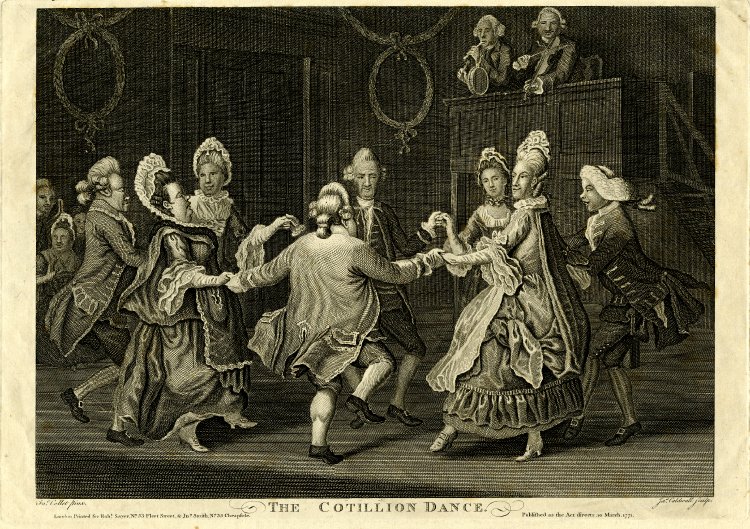
James Caldwell, after John Collet. The Cotillion Dance. 1771. © Trustees of the British Museum

James Caldwell, after John Collet. The Cotillion Dance. 1771. © Trustees of the British Museum

In due course, I will trace in more detail these various strands surrounding the cotillon.

The Cotillon arrives in London

Giovanni-Andrea Gallini’s Critical observations on the art of dancing, with its ‘collection of cotillons or French dances’ was probably first published in 1765. This was the year before he retired from the London stage as a dancer and director of dances at the King’s Theatre in the Haymarket (London’s opera house). Gallini was also a dancing master, teaching pupils from high society. 1765 seems to have been the year of his first subscription ball, given at the ‘Great Assembly Room, King Street, St James’s’ – later advertisements would make clear that this was Almack’s, the famous club which also opened that year. Gallini’s subscription balls would become an annual event in London’s social calendar.

Cotillons are frequently referred to as ‘French country dances’ in English sources. They have been identified with the contredanses françaises that began publication in Paris in the early 1760s. Did Gallini introduce the cotillon to London? He had trained in Paris and, although he had worked continuously in London since the late 1750s, he may well have returned there from time to time. He must surely have maintained his dance contacts in France, since they would have been useful for his work at the King’s Theatre.

There are several brief accounts of Gallini’s career in London, although none of them pay attention to his work as a dancing master. I will return to him, but my immediate concern is the success of the cotillon in London’s ballrooms.

The Cotillon

I’m a recent convert to the cotillon. I love these lively little French contredanses with their four couples facing inwards around a square engaging in a game of perpetual motion. I’d really like to dance more of them, but it is difficult to find enough good dancers who are able to get together regularly to learn and practice. Cotillons are not easy.

So, what is a cotillon? It’s a country dance but, as I said above, it is a French country dance – a contredanse – in which the couples stand in a square rather than in two lines (the usual English form). It alternates a figure, which can be quite complex, with a series of simpler changes. The dancers continually move around the set and they never stop dancing. Danced at a good speed, the cotillon is an 18th-century aerobic workout.

My ambition is to get together a group to work on a potpourri cotillon. In these little choreographies each change is followed by a different figure. Unlike the ordinary cotillon, which uses the same music throughout, the potpourri cotillon has new music for each successive change and its figure. So, it is a challenge to the dancers’ memory and musicality as well as their stamina.

Here’s an example of an early cotillon, which hasn’t yet developed into the structure found from the mid-18th century. It is danced with a pleasing energy and precision, although I can’t help feeling that no group of 18th-century dancers would have been quite so accurate in their performance.