Category Archives: Ballroom Dancing

Does Authenticity Matter?

Two performances I’ve seen recently brought the topic of authenticity back into my mind. Both were minuets that reminded me of ‘baroque dance’ I’d seen a good few years ago which owed very little to the surviving 18th-century dance manuals and notations.

In an earlier post, I voiced my uncertainty, and my scepticism, about ‘authenticity’ in historic dance. Yet, these performances reminded me that authenticity does sometimes matter. One took place in a gallery with a wonderful collection of 18th-century fine and decorative arts. The other was in a historic house dating originally from the mid-1700s. Both called for performances that were true to their surroundings in terms of style and technique.  Expert knowledge of the treasures on show, as well as accessibility, is important to galleries and historic houses open to the public. Why should the occasional dance performances in such venues be exempt from the same values?

One reason is, of course, the status of dancing – seen as merely a frivolous pastime rather than a socially and culturally significant art form.  Another is the widespread ignorance of the dancing of the 18th century. It is all too often seen as simple yet full of affectation – very far from the classically inspired beauties of the surviving choreographies. Yet another is the fixation on costume, at the expense of the dancing – even though deportment, so important to the correct wearing of period costume, was of fundamental importance in the 18th century. I should say here, that I believe that costuming does matter. After all, whatever the period, the dancing of the past was crafted around the prevailing style of dress – as indeed are modern dance genres.

The steps described in 18th-century manuals, as well as the choreographies preserved in notation bear witness to a refined and sophisticated style and technique in the ballroom as well as in the theatre. None of the modern attempts at ‘baroque dance’ routines I have seen come close to the originals for variety, energy or elegance. The dances of the 1700s reflect the complexities of the other arts of the period – from music to garden design. All share the same aesthetic space.

Unfortunately, baroque dance is difficult. It takes a great deal of time and much hard work to master. An effortless performance of the minuet is the result of years of practice of the steps and figures described in the original sources. I am uncertain whether any of the dancers in the performances I saw really understood that such work either could or should be done. I don’t want to enter into a critique of either of the ‘minuets’ on show, but I can’t help feeling sad that such a beautiful dance and such a wonderful dance form should still be so little known and so often poorly represented. The visitors to those and other wonderful places that preserve the material evidence of 18th-century life surely deserve better.


Le Menuet d’Espagne

I have been meaning to return to the minuet for a while, and I would like to open my discussions with a choreographed version of this most revered of ballroom dances. Le Menuet d’Espagne by Dezais was published in his XIII Recueil de danses pour l’année 1715 alongside Balon’s La Transilvanie (discussed in an earlier post). The collection appeared early in the year, aimed at the carnival season which took place several months before the death of Louis XIV on 1 September.

Le Menuet d’Espagne is one of a number of choreographed minuets published in notation during the 18th century. There are about 20 in all and a dozen or so of them date to the early 1700s. Among all these dances are several minuets for four, figured minuets for larger groups of dancers, solo minuets (mostly intended for the stage) and minuets within dance suites that display a number of different dance types in a single choreography. I will return to each of these in due course.

The music for Le Menuet d’Espagne is a rondeau with the structure ABACA (A has sixteen bars, B and C each have eight bars), but the source of the tune has not so far been identified. The choreography is almost a ballroom minuet in miniature. The steps are limited to pas de menuet à deux mouvements, pas de menuet à trois mouvements and contretemps du menuet, with just a couple of agréments or grace steps. The figures are essentially those of the ballroom minuet. The minuet’s opening figure has been simplified. The Z figure has been freely adapted – the sideways steps at the beginning and end are there, together with the crossing of the dancers, but the order of these elements, the paths of the dancers and the spatial relationships between them are quite different. The taking of right hands, then left hands and the closing figure, in which the dancers take both hands, are all clearly recognisable. The whole dance has just 64 bars of music, rather shorter than was expected for a ballroom minuet.

Why is this very French choreography titled Le Menuet d’Espagne? Could it have been a compliment to King Philip V of Spain, grandson of Louis XIV, who had married his second wife Elisabeth Farnese on 24 December 1714? Their proxy marriage on 16 September 1714 would have allowed Dezais plenty of time to create a new ballroom dance honouring the couple. What better duet to choose than a minuet,  performed at royal and other formal balls before (and sometimes by) the highest ranking guests?

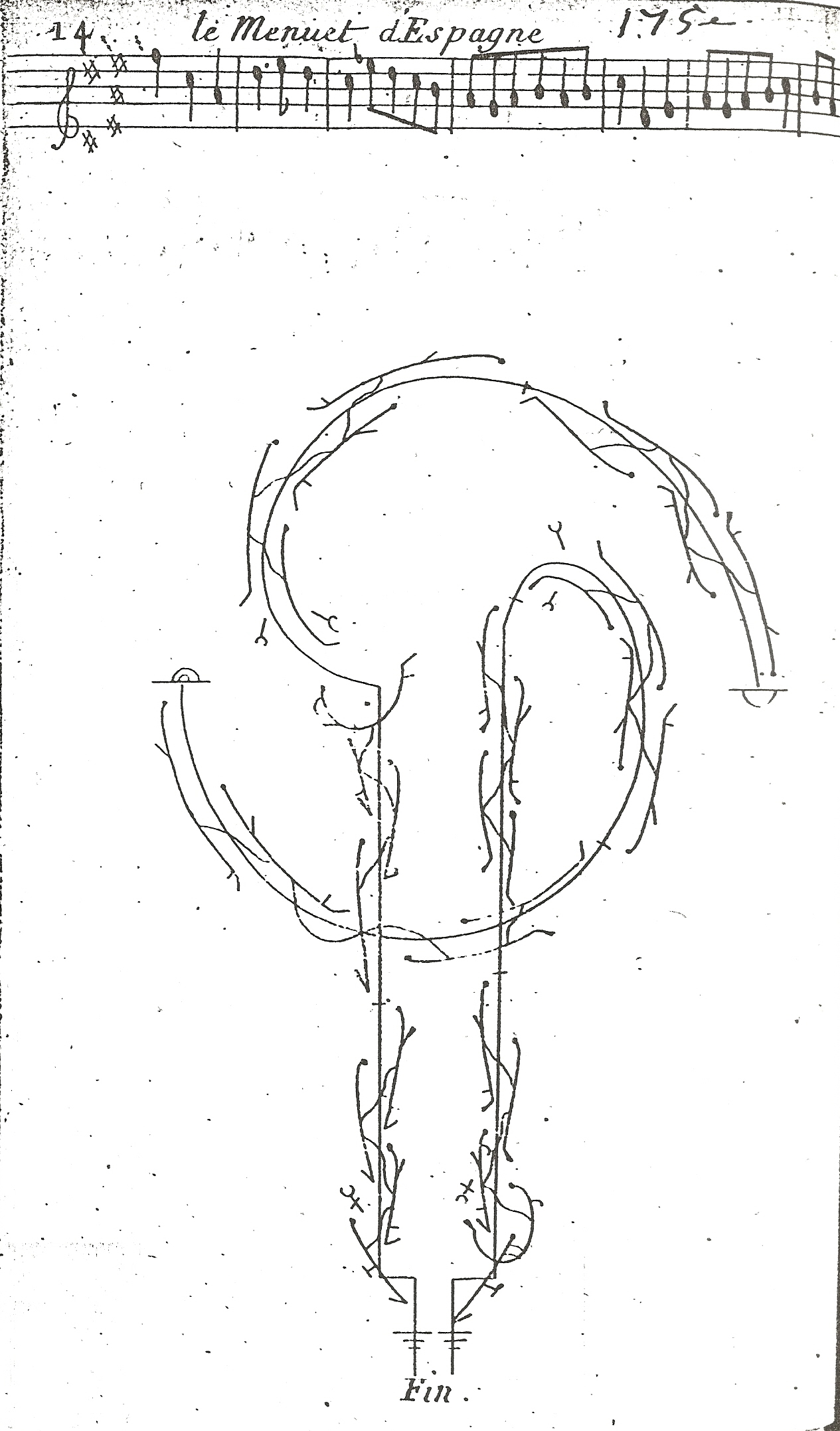
I would like to have included a video of this charming duet, but the version I had in mind is not so far available on YouTube. Here is the close of the dance in notation, showing the couple taking both hands as they retreat from the presence.

Dezais. Le Menuet d’Espagne (Paris, 1715), final plate

Dezais. Le Menuet d’Espagne (Paris, 1715), final plate

Aimable Vainqueur on the London stage

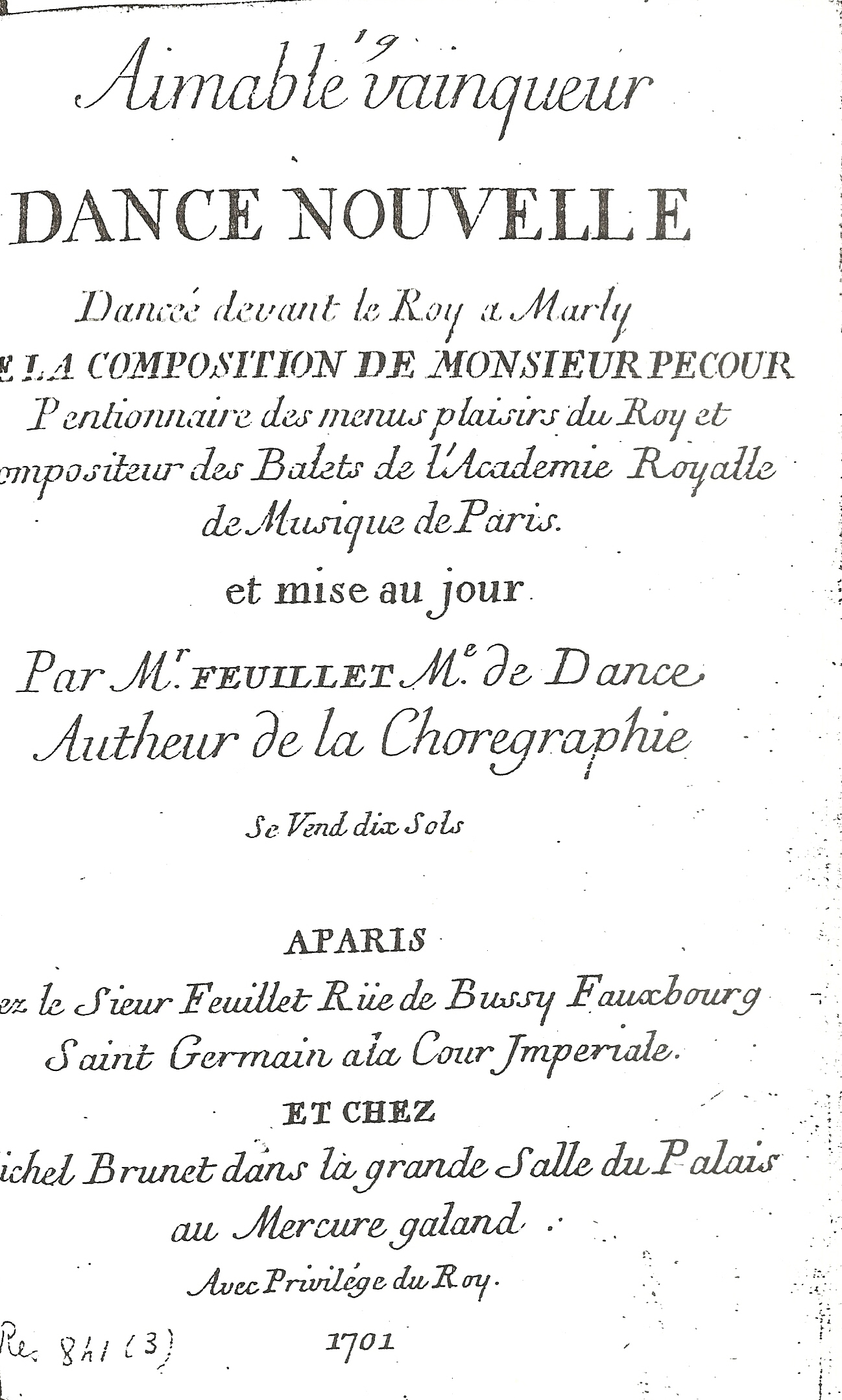
The most famous ballroom duet of the 18th century was undoubtedly Aimable Vainqueur. Pecour’s choreography was first performed before Louis XIV at Marly early in 1701 and published in notation later that same year.

Pecour. Aimable Vainqueur (Paris, 1701), Title page

Pecour. Aimable Vainqueur (Paris, 1701), Title page

By the time the dance appeared in Magny’s Principes de Choregraphie in 1765 it had been printed at least ten times. It also features in four manuscript collections of choreographies. Did all these copies drive the duet’s popularity, or did they simply reflect it?

Pecour took his music from Campra’s opera Hésione, given its premiere at the Paris Opéra in December 1700. Hésione proved popular, enjoying three revivals by 1743. Pecour was obviously quick to capitalise on its success. I will say more about the duet’s original performances in another post. Aimable Vainqueur attracted attention beyond the French court. A new notation by the dancing master Richard Shirley was published in London in 1715. The dance was mentioned by Taubert in his Rechtschaffener Tantzmeister published in Leipzig 1717. John Weaver included it, under the title The Louvre in response to its dance type – a loure, in the second edition of Orchesography (his translation of Feuillet’s treatise Choregraphie) which appeared in the early 1720s.

I haven’t pursued the performance history of Aimable vainqueur at the French court and in Paris, but it was first performed on the London stage on 14 May 1726 at the Lincoln’s Inn Fields Theatre by Dupré and Mrs Wall. He was not ‘le grand’ Dupré, as is often claimed, but he was probably French and may have been from the same family. The dance was almost always titled The Louvre in advertisements for its stage performances, perhaps following Weaver. It wasn’t given again until 5 April 1731, when Francis Sallé performed it at Lincoln’s Inn Fields with his sister Marie. Thereafter it quickly became a staple of the benefit performances of London’s leading dancers.

The dancer responsible for the popularity of Aimable Vainqueur on the London stage was probably Leach Glover, French-trained and a leading dancer at the Covent Garden Theatre. Glover performed The Louvre at his annual benefit performances from 1731 (when he partnered Marie Sallé) to 1741 (when he danced it with the Italian ballerina Barbara Campanini, known as ‘La Barberina’). Other leading dancers to perform Aimable Vainqueur regularly at benefit performances included Michael Lally, who pursued a very successful career in London’s theatres, and later Augustin Noverre, brother of the famous ballet master Jean-Georges Noverre. The last recorded performance of The Louvre on the London stage was on 23 April 1777 at Drury Lane, when the Miss Stageldoirs danced it with a Minuet and an Allemande. The bills are silent on whether one of the girls danced in ‘boy’s clothes’ although, given their repertoire together, this is quite likely.

What choreography did these dancers actually perform? I cannot give a definitive answer, but as well as the dance recorded in notation in 1701 there are some interesting possibilities. I will consider these in a later post.

Reconstructing Ballroom Dances: La Mariée

I am currently reconstructing La Mariée, one of the most famous ballroom dances of the early 18th century. I have performed many notated ballroom dances over the years, but this is my first encounter with Pecour’s much-loved duet. So far, it has been a bit of a struggle! In my own defence, one hour a week with no dancing partner is not the easiest way to learn such a long and complex choreography.

When I began on La Mariée, I had been working on a couple of English solos ‘for a Girl’. Turning to Pecour’s dance I felt like I was grappling with a completely different language – which, of course, I was. The only recording of the music I could find initially was too fast to use while I was learning the steps. I subsequently found another much slower version, but it only had the music once through instead of twice as required by the choreography. Such problems, of tempo and repeat structure, are all too common with commercial recordings of baroque dance music. Still, at least I have the music. There are far too many dances for which there is no recorded music at all.

After several weeks, I am finally getting to grips with this dance. I’ve pretty well committed to memory the steps and figures and my body is beginning to learn these too. Now, I’m ready to make decisions about how I want to perform the steps and sequences. Since I began to take baroque dance seriously, I have worked with many different teachers – all of whom have their own approaches to dance style and technique. I have drawn something from each of them. The various ways in which steps might be performed provide a wide range of interpretations for individual choreographies. Even in a single dance, I might perform particular step differently when it occurs within new context, although I do try to find a unified style.

My version of La Mariée will be shaped by the fast recording. At my last session working on the dance, I found myself considering how I should perform the pas de sissonne that punctuate the choreography. Should I follow the teacher who took the first assemblée to a small fourth position with the working leg on the following saut in a low attitude? Or should I go back to my earlier lessons (and, apparently, the notation) with an assemblée into fifth position and the raised foot on the saut close to the supporting ankle? I obviously need to go back to Rameau’s Le Maître a danser to see what he says. At the moment, I’m inclining to the more compact approach with an emphasis on the upward motion of the springs.

Whatever I decide to do with the individual steps, I want to create a lively and dynamically varied performing version of a teasing and witty choreography.


Various Authenticities

When I first began to study baroque dance, I tried very hard to be authentic – not least because I was so often criticised for my ‘balletic’ approach. It took me some time to realise that such authenticity is impossible. We know a great deal about dancing in the late 17th and early 18th centuries (far more than most people realise), but there is just as much that we don’t and indeed cannot know. My own reconstructions of dances, particularly the solos danced by Mrs Santlow and Mlles Subligny and Guiot, owe as much (if not more) to my personal style and technique as a ballet-trained dancer as they do to the notations and dance manuals of the early 1700s.

The subject of authenticity came into my mind again a week or so ago, when I went to a talk at the Wallace Collection. The speaker was the choreographer and Director of the Birmingham Royal Ballet David Bintley. His new ballet The King Dances is based on Le Ballet de la Nuit, the 1653 ballet de cour in which the fourteen-year-old Louis XIV appeared as the rising sun and became known ever after as the ‘Sun King’. Bintley talked about his forays into history and the world of baroque dance as he developed his choreography. He had gone so far as to have a baroque dance expert give instruction to his dancers – only to find that the unfamiliar style and technique was too difficult to learn in a short period. Although it marked the beginning of ballet, baroque dance was far from the strength and extension now characteristic of its descendant.

At the time of writing, I have not seen Bintley’s The King Dances so I cannot comment on the ballet. However, the photographs of the production are stunning. The young male dancers look as fabulously glamorous as their youthful antecedents at the French court must have done. When they are caught in mid-step the effect is strangely evocative of the ballet de cour, as we glimpse it through the few surviving designs for costumes and scenes. Could Bintley’s work possibly be ‘authentic’ in ways that a production consciously attempting complete ‘authenticity’ could not?

I thought about authenticity again this weekend, while I was taking part in a dance display for a heritage open day which also gave me time to watch. The dances – several cotillons by Dezais and a couple of ballroom duets – were all faithfully reconstructed from 18th-century sources. The costumes were handsome and in good period style, right down to the corsets. However, these were not the essential factors that made the display authentic. There was a range of skills and experience among the dancers and the dances were practised but not perfect. The dances were lively and all the dancers very evidently enjoyed performing them. They took pleasure in dancing with each other and for their audience. I couldn’t help thinking that it must have been very similar at many real balls in the 18th century – except that we may well have danced better than our forebears did.

Authenticity surely resides as much, if not more, in the spirit of the reconstruction as in the letter.


A Year of Dance: 1725

1725 was quite a busy year, both culturally and politically.

In Britain, one noteworthy event was George I’s foundation of the Order of the Bath. However, the hanging of the notorious thief-taker Jonathan Wild at Tyburn on 24 May 1725 probably attracted greater interest. In Europe, there were several events of undoubted political significance. Tsar Peter the Great died on 8 February and was succeeded by his second wife – Catherine I was the first woman to rule Russia. The Emperor Charles VI and King Philip V of Spain signed the Treaty of Vienna on 30 April, which included a guarantee of the Pragmatic Sanction allowing the Emperor to be succeeded by a daughter, despite the prevailing Salic law. In France, the fifteen year old Louis XV married the Polish Princess Marie Leszczyńska. She was seven years older than the King.

At the Paris Opéra, Les Eléments an opéra-ballet by Delalande and Destouches was given its first public performance on 29 May 1725. The work had initially been performed in 1721 as a court ballet, with Louis XV among the dancers. Its popularity on the public stage was to be long-lived. In London there were two notably diverse premieres within a week. Handel’s latest opera Rodelinda was performed at the King’s Theatre on 13 February. On 20 February, Drury Lane’s new pantomime Apollo and Daphne opened. It was described in the bills as a ‘Dramatick Entertainment of Dancing’ and it did indeed have a great deal of serious dancing in its main plot.

1725 was an unusually busy year for dance publishing. In London, L’Abbé’s new dance for the year was Prince Frederick, in honour of George I’s eldest grandson. L’Abbé’s A New Collection of Dances, notations for 13 choreographies performed in London’s theatres, may have appeared this year (it has no publication date). The undated 18th edition of The Dancing-Master has also been assigned to 1725, although some modern sources prefer 1728. The dancing master Siris published his own ‘dance for the year’ The Diana, in honour of the Duchess of Marlborough’s much-loved grand-daughter Lady Diana Spencer.

Siris. The Diana. First plate

Siris. The Diana. First plate

In Paris, the most important dance publication of 1725 was undoubtedly Pierre Rameau’s treatise Le Maître a danser. This work explains how to perform the steps recorded by Feuillet a quarter of a century earlier. Rameau’s revision of the Beauchamp-Feuillet system of notation, put forward in his Abbrégé de la Nouvelle Méthode, probably appeared in late 1725. He followed Feuillet by including a collection of twelve dances by Pecour as part two of the treatise, all in his revised notation. These dances, described as the most beautiful and best liked of Pecour’s many choreographies, were apparently still popular in the ballroom. They were given a new lease of life by their appearance in subsequent reissues of Rameau’s Abbrégé.

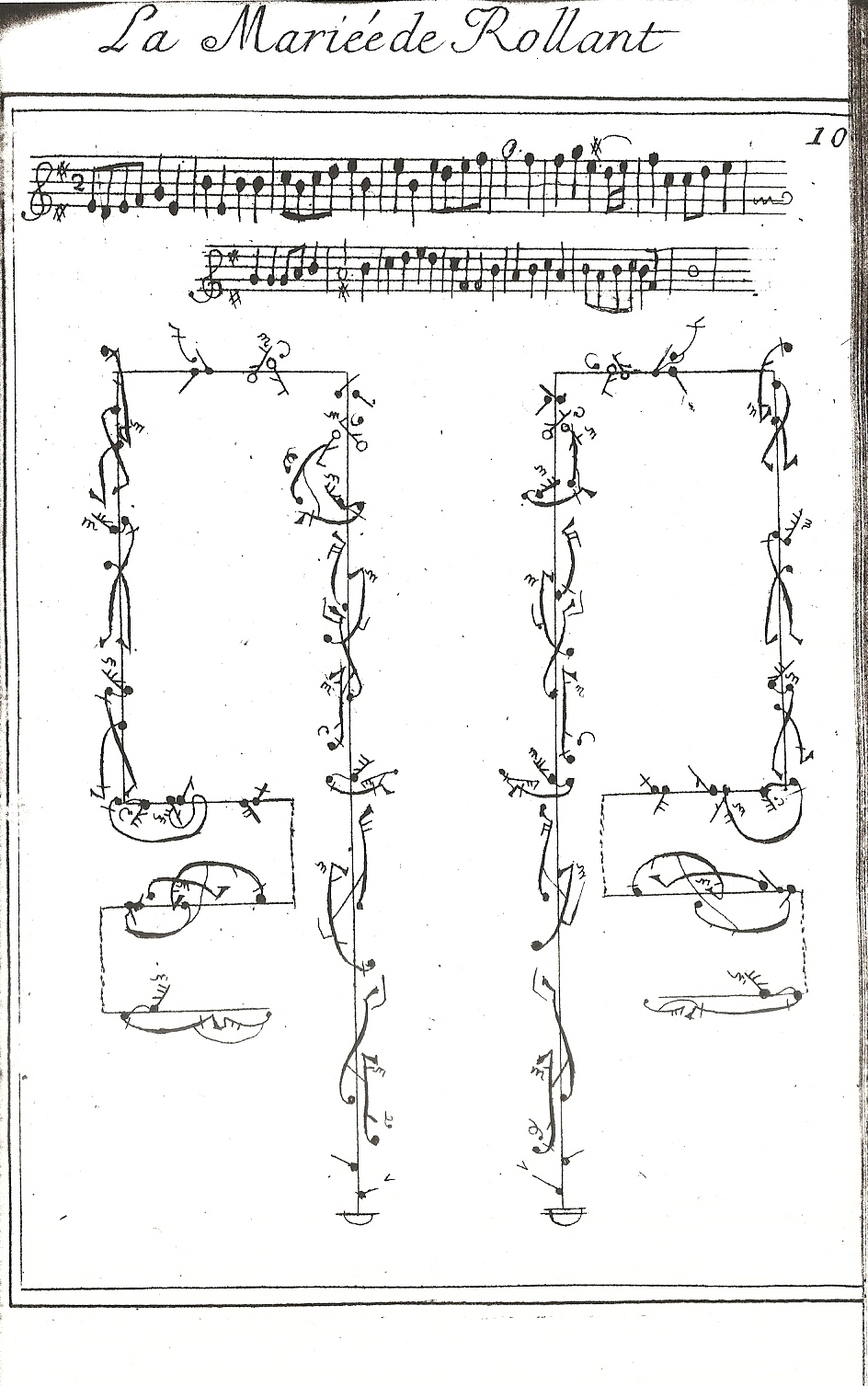
Pecour. La Mariée, notated by Rameau. First plate

Pecour. La Mariée, notated by Rameau. First plate

The regular annual collections of dances issued first by Feuillet and then by Dezais continued with the XXIII Recüeil de dances pour l’Année 1725. Dezais also published his Premier Livre de Contre-Dances, which I have written about in other posts. The title Premier Livre … suggests that he was intending to pursue a new series devoted to notations of contredanses. No more collections of either danses à deux or contredanses appeared after 1725. The abrupt cessation suggests that Dezais died before he could prepare or publish further collections. 1725 marks the end of the publication of notated dances in France, until the contredanses known as cotillons began to appear in a simplified form of notation in the early 1760s.

La Mariée on the London stage

La Mariée, a ballroom dance for a man and a woman, was one of the dances Pierre Rameau described as the most beautiful choreographies created by Guillaume-Louis Pecour. Rameau included his own notation of the dance in his Abbregé de la nouvelle methode,dans l’art d’ecrire ou de traçer toutes sortes de danse de ville, published in Paris probably in 1725. The duet already had a long history by then, for it was first published in 1700 in Feuillet’s Recueil de dances composées par M. Pecour, one of the collections that accompanied Choregraphie.

Guillaume-Louis Pecour. Recueil de dances (Paris, 1700), plate 12, opening of La Mariée

Guillaume-Louis Pecour. Recueil de dances (Paris, 1700), plate 12, opening of La Mariée

The dance historian Rebecca Harris-Warrick showed, in an essay published in 1989, that La Mariée was almost certainly originally a stage dance created for a revival of Lully’s opera Roland in 1690. She suggested that the dance entered the French ballroom repertoire during the 1690s. It may have been danced in mascarade entertainments during the 1700 carnival season at the French court. It may well have continued to be danced on the stage of the Paris Opéra in later revivals of Roland, by such stars as Ballon and Mlle Subligny (1705) and David Dumoulin and Mlle Prévost (1709). It was mentioned in many dance treatises and republished in notation many times between 1700 and 1765. After that it apparently faded from view.

Pecour’s popular duet had probably reached London by 1698, when the music was published in John Walsh’s compilation Theater Musick, being a Collection of the Newest Ayers for the Violin. Harris-Warrick speculates that it may have been danced at William III’s birth night ball that year. If so, one of the performers could have been Anthony L’Abbé who had already danced before the King in May 1698. On 1 June 1703, L’Abbé was billed at Lincoln’s Inn Fields in The Wedding Dance. This was described in advertisements as ‘compos’d by Monsieur L’Abbé, and perform’d by him, Mrs Elford, and others’. The piece seems to have been a divertissement, which may or may not have incorporated Pecour’s La Mariée.

In later years, ‘Wedding’ dances reappeared every so often among the entr’acte entertainments in London’s theatres. There was a Wedding Dance ‘by Prince and others’ at Drury Lane on 20 July 1713 and a Grand Comic Wedding Dance, created by Moreau, at Lincoln’s Inn Fields on 14 January 1717. Moreau’s Wedding Dance was performed by three men and three women together with the Sallé children, Francis and Marie. I am inclined to think that La Mariée was performed as part of Moreau’s divertissement, possibly by the Sallés. On 15 May 1718, a dance titled Marie was given at Drury Lane by Cook and Miss Schoolding. Apart from the ongoing dance rivalry between the theatres, which caused much copying of repertoire, Cook had danced in Moreau’s piece and Miss Schoolding was Mrs Moreau’s younger sister.

Thereafter The Marie (as it was often billed) was regularly given as an entr’acte dance. The Sallés performed it, as adult dancers, several times during the 1725-26 and 1726-27 seasons. The duet was later taken up by Leach Glover, one of the leading dancers in John Rich’s company, who gave it regularly at his benefit performances during the 1730s. Pecour’s famous ball dance apparently made its last London stage appearance, after a gap of many years, on 24 April 1759 at Covent Garden. It was performed ‘By Desire’ by Lalauze and Miss Toogood at his benefit. Did they really dance the choreography as created some seventy years earlier?

Hungarian dances in the ballroom

The first dance in the 1725 Premier livre de contre-dances is the Cotillon Hongrois for four. I cannot  identify with certainty a person or an event that might have inspired the name ‘Hongrois’ but in this post I will explore the wider context for the dance and put forward a suggestion.

Hungary was the largest territory within the Habsburg Austrian monarchy. Charles VI was Holy Roman Emperor, ruler of Austria and King of Hungary from 1711 until 1740. He was also Prince of Transylvania, which had once been part of Hungary and retained strong links with that country. The history of the area in the 17th and early 18th centuries is complex. I will not even attempt to summarise it, except to say that events there influenced and were influenced by what was happening in the rest of Europe.

In his XIIIe Recueil de danses pour l’année 1715, Dezais included La Transilvanie a ballroom duet by Claude Ballon. This choreography has some resemblance to a cotillon. The music is in duple time and, according to Francine Lancelot in La Belle Dance, it is very similar to a gavotte. The musical structure is AABACAA. The choreographic structure has ‘verses’ and a repeated ‘chorus’. The step sequence for the opening section is used again for the third and fourth A repeats, although the direction of travel and the floor pattern is varied each time. This, of course, is the collection in which Dezais advertises his manuscript versions of contredanses for eight, two of which (Le Cotillon de Surenne and L’Esprit Follet) were finally printed in 1725. Although it is not mentioned, was the Cotillon Hongrois another dance that significantly predated its appearance in the Premier livre?

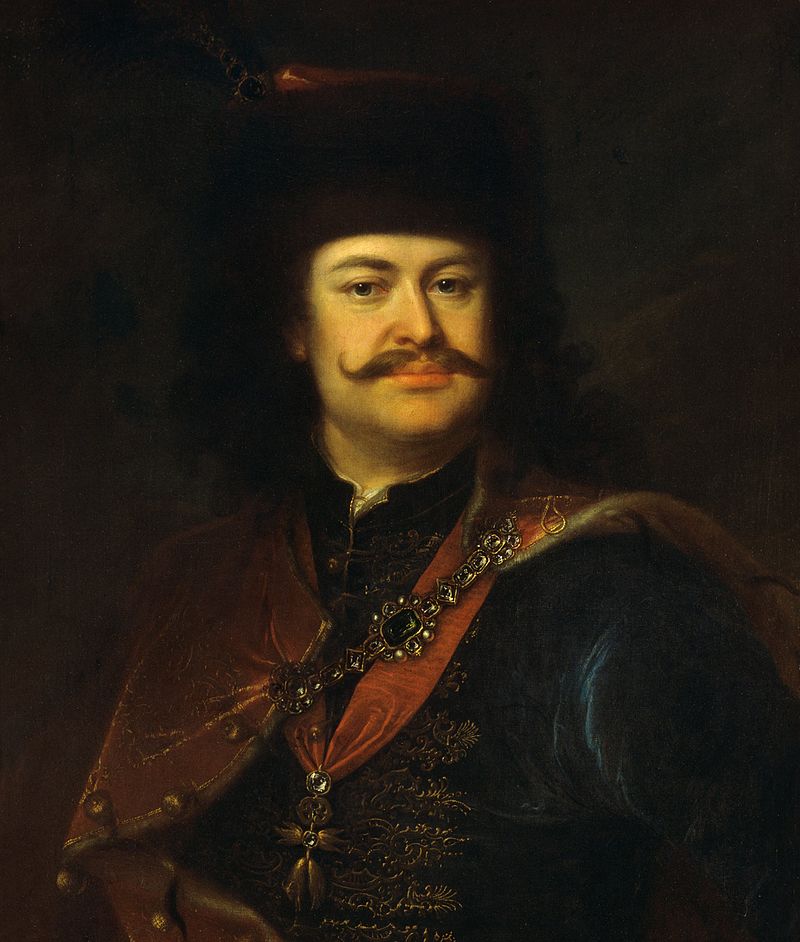
There may, perhaps, be a specific reason for the name La Transilvanie. Before the accession of Charles VI in 1711, the Prince of Transylvania had been Francis II Rácóczi. He led an unsuccessful uprising in Hungary in the early 1700s, with initial encouragement from the French. Between 1713 and 1717 he was in exile in France. Was La Transilvanie dedicated to him? Does the Cotillon Hongrois date to the mid-1710s rather than the mid-1720s and does it refer to Rácóczi and his exploits in Hungary?

Adám Mányoki. Francis II Rákoczi. 1724

Adám Mányoki. Francis II Rákoczi. 1724

A portrait of Rákoczi shows him in dress similar to a hussar. Did this depiction influence the Hungarian dances that were popular on the London stage in the 1720s and 1730s? I will look at these in a separate post.

What’s in a name?

Many ballroom duets and country dances have distinctive names. These might link the choreographies to their music, to a play, or to a place or a dedicatee. Dance names provide glimpses of the social and cultural milieu within which the dances were performed.

I’ve been looking at the Premier livre de contre-dances published by Dezais in 1725 and I thought it would be interesting to follow up some of the dance names in this collection. At first, it seemed unlikely that I would be able to discover very much but as I pursued my research I began to see links with other areas of my dance history interests – the ballet de cour of Louis XIV, royal and aristocratic dancers and dancing on the London stage, among other topics. I very quickly gathered enough information for several posts.

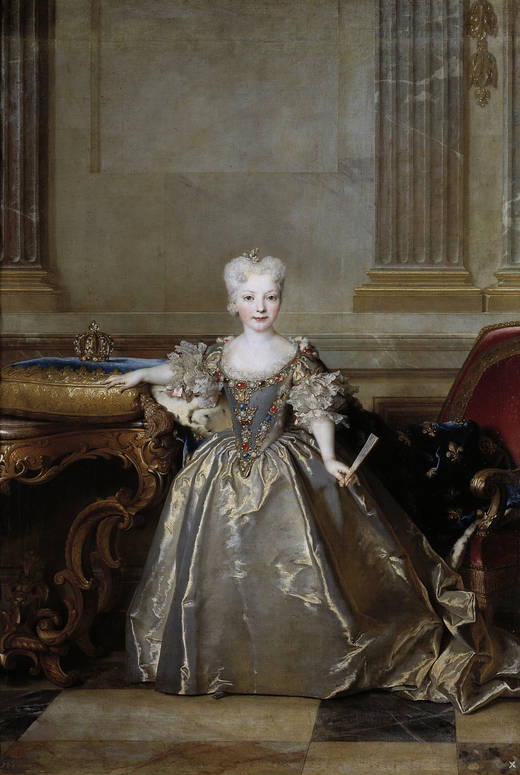
I’ll look at just a couple of the dance names here, both linked to royalty. L’Infante, the third dance in the collection, is a contredanse for eight with a structure similar to the later cotillon. The name obviously refers to a Spanish princess or Infanta. The French and Spanish royal families intermarried several times during the 17th and 18th centuries. Louis XIV’s mother was a Spanish princess and so was his wife. His successor Louis XV was briefly betrothed to the Spanish infanta Mariana Victoria. She was the daughter of King Philip V, younger brother to Louis’s father the duc de Bourgogne, so the two were first cousins. She arrived in Paris in 1721 to live at the Palais du Louvre until she was old enough for the marriage to take place. The young King was eleven, but his intended bride was only three years old. By 1725, following the King’s serious illness, the King’s ministers had realised they must find a princess who was old enough to be married and quickly provide an heir to the throne. The betrothal with the little Infanta was ended and she was sent back to Spain in March that year. In September 1725, Louis XV married the 22-year-old Polish princess Marie Leszczyńska. Mariana Victoria married the Prince of Brazil, heir to the Portuguese throne, in 1729. Was she the Infanta of Dezais’s contredanse?

Nicolas Largilliere. The Infanta Mariana Victoria. 1724

Nicolas Largilliere. The Infanta Mariana Victoria. 1724

La Carignan, the last dance in the Premier livre, is a minuet for four. The dance’s name links it to the royal house of Savoy. Victor-Amedée of Savoy, prince de Carignan was probably the dedicatee of Pecour’s ballroom duet La Carignan, published by Feuillet in the IIme Recueil de danses de bal pour l’année 1704. Dezais’s contredanse may have honoured another member of the Savoy-Carignan family. Victor-Amedée, his wife Marie-Victoire of Savoy and their children had been resident in France since the late 1710s. Their daughter Anne-Thérèse, born in Paris in 1717, is a possible dedicatee of the 1725 choreography.

These dance names, like many others, were topical, but were dances always created – and named – close to their publication date?


Dancing Masters’ Advertisements

Looking through my notes on dancing masters and their various treatises, I was reminded that some of them advertised for pupils in London and provincial newspapers. I haven’t yet done a comprehensive search, but in the course of my work on cotillons I came across some interesting examples of publicity from the 1760s. I quoted from some of these advertisements in my post Teaching the Cotillon. Here are some more, of particular relevance to learning to dance and favourite ballroom duets.

Messrs Hart and Welch, advertising in the Gazetteer and New Daily Advertiser for 2 May 1768, offered ‘The cotillons, minuet, louvre, passepied, matlotte, novelle, bretagne, the almand, françois and English country dances’, all of which would be ‘taught as usual at home or abroad’. In this context ‘abroad’ presumably meant their dancing school ‘at No. 109, near Exeter-change, in the Strand’. The list of dances offered is suggestive of the repertoire expected in the ballroom, although advertisements for balls refer only to minuets and country dances including (of course) the newly fashionable cotillon.

Hart and Welch appear to have been teaching several venerable danses à deux. The ‘louvre’ is probably Aimable Vainqueur,  first published in 1701. This duet was mentioned by Taubert, Rameau and Tomlinson and printed in notation, probably for the last time, as late as 1765. The ‘bretagne’, dating to 1704, was cited by the same three dancing masters. The ‘passepied’ and ‘novelle’ (perhaps La Nouvelle Forlanne of 1710) may both be linked to dances published in the early 18th century. The ‘matlotte’ may refer to a duet published by Feuillet in 1706. Is the ‘almand’ the famous duet by Pecour that was first published in 1702 and made its last appearance in print in 1765? The many references to these dances seem to suggest that they were still well-known more than fifty years after their creation.

Mr Patence also advertised in the Gazetteer and New Daily Advertiser. On 14 June 1768 he offered ‘the minuet, louvre, country and other dancing’ and promised to teach ‘in the most polite and expeditious manner’. The louvre would take sixteen lessons (the minuet needed only twelve). These dances would be taught ‘with all the proper steps, such as cupees, borees, bounds, rebounds, marches, periwits, danzas, brilloes, back and fore granade’. Mr Patence’s French seems to have been entirely phonetic and he apparently also drew on other languages for his dance terminology. Periwits are presumably pirouettes, but I’ll have to think about the translations of some of his other terms. He also reveals how changing fashions were affecting ballroom dancing:

‘Mr. Patence having practised dancing some years, has just reason to think, that the excellent dance the louvre, would be more introduced in our polite assemblies, but the insufficiency of masters, in not knowing the proper graces, steps and figures, is the reason of its decline, having known some to have had scholars four years, and then know very little of the matter.’

There is more than a hint of rivalry here and Mr Patence may even have had a particular dancing master in mind. However, by the late 1760s, dancing masters may simply have been unwilling to allow time for such danses à deux alongside the minuets which were integral to their balls. Although, if that was the case, why did Hart and Welch teach so many of them?