Let me transport you, in turn, to two quite different early dance events. My purpose is to examine the dress codes appropriate to each. Dress codes are of fundamental importance to the UK early dance world, for they are infallible signifiers of politeness, authenticity and status.
First, let us go to a Georgian ball. What will you see? ‘Georgian’ is a capacious term, covering the 18th century and the Regency period – and much more besides. Frock opportunities are almost overwhelming in their variety. Let me begin at the end, with the Regency period. You will see tasteful little numbers in colours and fabrics that were unknown to Jane Austen and her contemporaries, but all the shades will be authentically pastel. Hair will be scraped back historically into buns with little corkscrew curls (achieved with much application of curlers and hair gel) bouncing around the face. At the top, there will be tiaras, feathers and flowers. At the bottom, Greek sandals, ballet slippers and other footwear. From head to toe, everything will be entirely authentically becoming.
Far more eye-catching are the 18th-century gowns. These will have huge panniers and their wearers will be topped with enormous hair. There will be lots of frills and furbelows. Lots of lace and ribbons and lots of damask furnishing fabric. There should also be lots of face paint, but of course the UK early dance aficionados know that nobody before the modern period ever wore make up. Shoes range from Greek sandals, through glamorous trainers, to expensive stiletto heels – all carefully selected for their authenticity. The effect of all this splendour, when the ladies come to dance, rather resembles an attempt at formation dancing by sofas on wheels.
One word of warning – if you do venture to attend a Georgian ball, you are likely to be frightened by any number of Madame de Pompadours in sacque-back dresses. I advise you to wear a mask to hide your discomfiture (and the fact that you are an outsider).
As for the men, look out for their entirely authentic ribbed wool socks and equally authentic walking shoes or trainers. Such footwear is completely authentic to the walking style required for English country dances.
Now, let us go to a more serious event – a UK historical dance festival, where the academic meets the practical head on. My focus here is on the academic. Serious early dance researchers do not have time to worry about their clothes. The research process is arduous and time-consuming. It will obviously be undermined by smart clothing (whatever the period). At a UK early dance festival you must expect to be welcomed (with properly authentic disdain) by the most serious academics of all – members of the organising committee. They will be wearing comfortable, serious and academically authentic clothing – tracksuits, crimplene skirts or trousers with elastic waistbands and trainers or other wide and comfortable shoes. Woe betide you if you commit the solecism of turning up to such an event fashionably dressed, with the mistaken idea that you are honouring the style and taste of the past. You will not be asked to leave, but your gaffe will be made all too clear to you. It is a fallacious idea that dancers of the past were lively and glamorous. Early dance academics know better – they, like librarians and archivists, have a highly authentic dress-dowdy code. Ignore it at your peril.
With this post, I must conclude my examination of the UK early dance world. You should now be fully equipped to be as polite and authentic as the best of them. Good luck and miserable dancing!
As I continue to work on baroque notated choreographies, I constantly wonder how I should perform their steps. I learned the basic baroque dance technique a long time ago and I have worked on various approaches to it over the years, with different teachers. More recently, I have had to work mostly on my own, without access to the latest thinking and practice on what the treatises and the notations actually mean, so I have many questions.
I have been learning a couple of ballroom dances that include minuets and one question in particular arose. How should the basic pas de menuet travelling forwards be performed, should it be danced smoothly or have staccato elements? It begins with a demi-coupé (essentially a plié followed by a step forward and a rise as the weight is transferred) and continues with a fleuret (another demi-coupé followed by two steps on the balls of the feet) How should the demi-coupés be performed? Should the pliés be soft and controlled or should there be a quick and somewhat sharp bend of the knees and ankles? How should the transition at the end of this pas composé be managed? Is there a sharp lowering from the demi-pointe into a plié or does the final step end on a flat foot in preparation for the bend that begins the demi-coupé? I am not going to explore the timing of this step, because I looked at this in some detail in The Pas de Menuet and Its Timing a few years ago.
When I find myself in doubt about an aspect of baroque dance technique, I generally go back to the early treatises – Pierre Rameau’s Le Maître à danser (Paris, 1725), with its translation by John Essex The Dancing-Master (London, 1728), and Kellom Tomlinson’s The Art of Dancing (London, 1735). Here is what Rameau (as translated by Essex) has to say about the pas de menuet ‘of only two Movements’:
‘Having then the left Foot foremost, you rest the Body on it, bringing the right Foot up to the Left, in the first Position, and from thence sink without letting the right Foot rest on the Ground, and move the right Foot into the fourth Position, rising at the same Time on the Toes, and extending both Legs close together, as represented by the fourth Figure of the half Coupees, called the Equilibrium or Balance; and afterwards set the right Heel down to the Ground, that the Body may be the more steady, and sink at the same Time on the right, without resting on the Left, which move forwards the same as the right Foot, into the fourth Position, and rise upon it: Then make two Walks on the Toes of both Feet, observing to set down the Heel of the Left, that you may begin your Menuet Step again with more Firmness.’
The Dancing-Master, Chapter XX1, pp. 44-45.
By ‘Toes’, Essex means the ball of the foot, translating Rameau’s ‘la pointe du pied’ – in both cases the meaning is made clear by the engravings that accompany the description of the demi-coupé. Here is the fourth and final one:
It is interesting that in modern ballroom dancing ‘toe’ also means the ball of the foot.
Tomlinson explains the method of performing the pas de menuet and its timing together (I have omitted some of the text relating to the timing as it is given in my earlier post):
‘The Weight of the Body being upon the left foot in the first position the right, which is at liberty, begins the Minuet Step, by making the Half Coupee or first of the four Steps belonging to the Minuet, in a Movement or Sink and Stepping of the right Foot forwards, the gentle or easy Rising of which, either upon the Toe or the Heel, marks what is called Time to the first Note of the three in the first of the two Measures, … the second Note is the coming down of the Heel to the Floor, if the Rise was made upon the Toe, but if upon the Heel or the flat Foot, in the tight Holding of the Knees before the Sink is made that prepares for the Fleuret or Bouree following, in which is counted the third and last Note of the Measure aforesaid; …
The Sink or Beginning of the Movement, that prepares for the Fleuret or second Part of the Minuet Step, … being made, there only remains to rise from the Sink aforesaid in the stepping forwards of the left Foot to the first Note of the second Measure, and first of the Fleuret or three last Steps that compose the Minuet Step; …’
The Art of Dancing. Book the Second, Chap. I, pp. 105-106.
By ‘Heel’ Tomlinson means the flat foot, allowing for those dancers who do not wish to attempt a balance on the ball of the foot.
Neither passage directly answers my questions, although Tomlinson refers to ‘gentle or easy Rising’ in the demi-coupé. In the chapter preceding that on the minuet step, ‘Of the Manner of making half Coupees’, Rameau tells his reader ‘good Dancing very much depends on this first Step, since the knowing how to sink and rise well makes the fine Dancer.’ (The Dancing-Master, Chapter XX, p. 42). I would need to look further and more closely at what both Rameau and Tomlinson say about other steps before reaching firm conclusions about how to perform the basic pas de menuet.
Before I conclude this post, there are a couple of interesting issues I would like to touch on concerning the pas de menuet à trois mouvements. Rameau describes this version as follows:
‘This Menuet Step hath three Movements, and one March on the Toes; viz. the first is a half Coupee of the right Foot, and one of the left; a March on the Toes of the right Foot, and the Legs extended: At the End of this Step you set the right Heel softly down to bend its Knee, which by this Movement raises the left Leg, which moving forwards makes a Tack or Bound, which is the third Movement of this Menuet Step, and its fourth Step.’
The Dancing-Master, Chapter XXI, p. 43.
Rameau adds ‘But as this Step is not agreeable to every one, because it requires a very strong instep; for this Reason it is not so much used, but a more easy Method introduced’ (The Dancing-Master, Chapter XXI, p. 44) and he goes on to describe the basic pas de menuet. Tomlinson, writing around the same time (although The Art of Dancing was published ten years later) calls that basic minuet step ‘One and a Fleuret’ or the ‘New Minuet Step, … that is now danced in all polite Assemblies’ (The Art of Dancing. Book the Second. Chap. I, p. 104). Here are Tomlinson’s notations of his various minuet steps, from Plate O in The Art of Dancing:
I will leave aside the additional complexities introduced when minuet steps are performed sideways to the right and the left (which can be seen in the above illustration). Nor will I consider how the pas de menuet is shown in the notated stage minuets – although the solo ‘Menuet performd’ by Mrs Santlow’ in L’Abbé’s A New Collection of Dances begins with a sequence of pas de menuet à trois mouvements.
There are several other posts about the minuet on Dance in History. The most relevant to my topic here is probably Thomas Caverley’s Slow Minuet.
During the 18th century, entr’acte dances (dances given between the acts of plays) were an integral part of many performances in London’s theatres. The following advertisement, from the London Daily Post and General Advertiser for 25 March 1736, shows how these dances fitted into the evening’s entertainment:
This performance was for the benefit of one of Covent Garden’s leading dancers, Leach Glover.
As this bill shows, entr’acte dances could be quite varied. Nivelon’s Clown was a country bumpkin, possibly related to the ‘Peasant’ depicted by Lambranzi in his Neue und Curieuse Theatrialisches Tantz-Schul in 1716. I have used this image several times before but here it is again.
I continue to puzzle about the differences between ‘Clowns’ and ‘Peasants’ on the London stage, as well as the distinctions between those of different nationalities – in the 1720s both John Weaver and Francis Nivelon danced an English Clown, while Nivelon was also billed in a French Clown dance.
The Minuet and Louvre performed by Glover and Miss Rogers were ballroom dances (the Louvre was, of course, Pecour’s famous Aimable Vainqueur), although we don’t know whether the basic choreographies as set down in surviving notations were embellished for the stage.
This engraving from Kellom Tomlinson’s The Art of Dancing (1735) shows a moment from the ballroom minuet (the viewpoint is from the lower end of the room, looking towards the ‘Presence’). It raises questions about the performance of ballroom dances on stage, even though they shared with stage dances the concept of a ‘Presence’ as an important focus for their dancing.
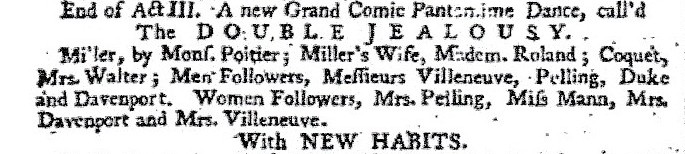
The Grand Ballet was different again, with several performers led by Lalauze and Mlle D’Hervigni, and was probably in the form of a divertissement with several dances one after the other. These more extended pieces could also be small ballets, for example the ‘new grand Comic Pantomime Dance’ The Double Jealousy given at Mlle Roland’s benefit at Drury Lane on 1 April 1736, as this detail from the advertisement in the London Daily Post and General Advertiser for that date shows (the mainpiece was King Henry the Fourth. With the Humours of Sir John Falstaff):
The Double Jealousy hints, through its title and its characters, at comic and expressive action, but what were the other dances – in particular the solos and duets – like?
Most entr’acte dances must have been short: solos and duets may have lasted between one and two minutes (for the early 18th century their duration can be compared with that of the dances surviving in notation); divertissements (the ‘Grand Dances’) and even small ballets seem likely to have lasted ten minutes at the most. So, we get the idea that during an evening in one of London’s theatres there were several short dances that contrasted with the action of the play they accompanied and presented a variety of characters and dance styles. They were also intended to showcase the leading professional dancers in the companies and could be, in themselves, a draw for audiences.
A little while ago, I was at a very different sort of event – a modern ballroom and Latin competition, with a Gala evening at which two couples of professional dancers performed. As they appeared alternately, dancing their way through the five standard ballroom dances and the five Latin ones, I was reminded of the entr’acte dances on the London stage and began to wonder what (if anything at all) they might have in common. These 21st-century dances had no context. They were simply intended to display the skills of the dancers and entertain the audience (many of whom were dancers themselves), so how might they tell us anything about the 18th-century entr’acte dances I have been describing?
First, was the length of the modern dances. They were short, at just a few minutes each, so the dancers had to make an immediate impact. Second, was their presentation without a specific background – they were danced to an audience seated around the ballroom floor with little decoration and no scenery. It is difficult to be sure what happened with 18th-century entr’acte dances, but it seems unlikely that they were provided with their own scenery (although, like the modern dances, they were presented in costume) and they were probably danced mainly on the forestage in the midst of their audience.
I was struck with the way in which the 21st-century dancers played with the conventions of the dances they performed, elaborating and subverting these by turns. The modern dances – waltz, tango, Viennese Waltz, foxtrot and quickstep for the ballroom and cha-cha, samba, rumba, paso doble and jive for the Latin – have different and well-defined characters as choreographies. Although it is usually only in the Latin dances that couples hint at drama, in the Gala performances both the ballroom and Latin couples did so. They also intensified the characters of the individual dances and one couple even incorporated props into their dancing. I couldn’t help feeling that early 18th-century dancers must have used similar techniques in the sarabands, chaconnes, passacailles, gigues, canaries, loures, bourrées, rigaudons, minuets and other dance types (divided between serious and comic) that they would have performed on the London stage three centuries ago. They, too, were trying to command the attention of their audience and display to the full their skills and individuality.
I wrote this piece a few years ago, but looking at it again I can see that the basic topic is ultra-fashionable in academic circles at the moment!
A word I have not yet used in connection with early dance is sociability, that arena where politeness appears in its most scintillating lustre. I have not mentioned sociability before now because this is a very difficult concept for those outside the UK early dance world to understand. In my efforts to explain it I must consider the normal behaviour to be encountered at an early dance gathering in England. My observations hold good whether the gathering is in London or the provinces, whether it is small or large, whether it is a dance class, a ball or even a conference. At all of these events similar patterns emerge. They individually and collectively reveal the meaning of the word sociability within the context of UK early dance.
Imagine that you are a stranger coming to a UK historical dance event for the first time. What happens when you enter the room? People may be in small groups conversing together. They may be alone, observing some private but completely polite early dance ritual. All will, sooner or later, turn to look at you and scrutinise you from head to foot. If they do not recognise you, they will turn back to what they were doing and completely ignore you. Do not be offended by this. The UK early dance word has its own, absolutely authentic, hierarchy mirroring that of the historical periods in which they are completely immersed. As an outsider, you have been consigned to the bottom of the heap and must expect to be treated with disdain.
You must wait to be spoken to before you can utter a word. This is just one of the rules of historical dance society. Everyone – except you – will know this. If you put a foot wrong (particularly while you are dancing) you will be told of your error loudly and disdainfully. Do not respond! Blush and look down with modesty. If you know you are in the right, keep it to yourself. If you speak up on your own behalf, great offense will be taken and nobody will speak to you. Of course, nobody will speak to you anyway because you are at the bottom of the UK early dance social scale.
Here are a few rules to remember when it comes to sociability within UK early dance (unless you are an insider and may behave as you please).
Never speak unless you are spoken to;
Never ask anyone to dance if you are at a dance class or a ball;
Never expect anyone to ask you to dance at a dance class or a ball;
If you stand up to dance, at a dance class or a ball, expect to be ignored (unless the insiders present decide to criticise your dancing).
Always remember that those within the UK historical dance world are superior in every way to those outside and must be constantly treated with reverence and awe.
A little while ago, I did quite a bit of research into dancing masters working in Bath as part of a project relating to the Upper Assembly Rooms there. My starting point was Trevor Fawcett’s article on the subject, published in 1988 but still a comprehensive and immensely valuable resource for subsequent work. One of the interesting things that emerged was the number of dancing masters in that city who were French and had worked in London’s theatres. I wrote a little ‘biographical dictionary’ with brief details of each of Bath’s dancing masters based there between the 1750s and the 1820s and I compiled a chart showing approximately how long each of them worked there and how their careers overlapped.
This study also relates to my separate investigation of French dancers in London during an earlier period (my recent post Monsieur Roger, Who Plays the Pierrot began what I hope will be a short series on them).
Apart from the article by Trevor Fawcett, much of my information about their work in Bath came from advertisements published in the Bath Chronicle, while details of their stage careers were mainly drawn from the volumes of The London Stage, 1660-1800 and the Biographical Dictionary of Actors (both referenced below). Far more detailed research, using a much wider range of archives, is needed to fill out the details of the lives and careers of Bath’s dancing masters and to ensure that all of them have been identified and their backgrounds charted.
John Deneuville seems to have arrived in Bath in the early 1760s. His advertisement in the Bath Chronicle for 31 March 1763 declares that he is ‘from the Opera in Paris, and last from the Theatres in London’. A few years later, in the Bath Chronicle for 24 September 1767, his advertisement says that he
‘having been at Paris during the late Vacation, proposes to teach the new Dances called the Minuet-Dauphin, and the Forlane, composed by Mr. Marcel Dancing-Master of the French Court; also the newest French Country dances, with the proper Steps of the Cotillion and Allemands, now in Vogue at Paris.’
Despite his reference to the Paris Opéra, home to the most famous ballet company in Europe, Deneuville may in fact have come from Paris’s less exalted Opéra-Comique – like so many of the French dancers who came to London at this period. There is no mention of his name in the Index to the London Stage, suggesting that either he was simply a supporting dancer in London’s principal theatres, or that he danced at venues beyond Drury Lane and Covent Garden. Deneuville taught in Bath for nearly 20 years. He died in 1782 and was buried there.
Jean-Baptiste Froment arrived in Bath to teach dancing in 1778. His advertisement in the Bath Chronicle for 25 June 1778 set out his credentials and what he intended to teach. He claimed to have been taught in Paris by Monsieur Marcel and to have himself taught at ‘the most eminent Academies’ in London. He offered tuition in:
‘all the fashionable Dances now in Vogue in London and Paris, viz. the Minuet in the present Taste, the Louvre, Minuets Dauphin, de la Reine, Allemandes, Cotillons, … and particularly that graceful Minuet de la Cour and Gavot.’
Froment had been a dancer in London’s theatres. His first billing (but probably not his first performance in London) was at Drury Lane on 10 March 1739, when he danced in the pantomime Harlequin Shipwreck’d. He seems mainly to have been a supporting dancer and his earlier career, presumably in France, is yet to be uncovered. Froment pursued his London career at the Sadler’s Wells and Goodman’s Fields theatres, as well as at Drury Lane, Covent Garden and the Haymarket Theatre. By the end of his stage career in 1777 his performances were limited to appearances with his daughter Mrs Sutton at her annual benefits (she was a dancer at Drury Lane). Froment’s career in London had not been straightforward, for in 1746 – in the wake of the 1745 rebellion – he had been identified as a Jacobite sympathiser, an accusation he was able to rebut. Froment taught in Bath and in London until the 1780s. He died in Bath in 1786 and was buried in Bath Abbey on 13 April.
In 1787, Pierre Bernard Michel opened his dancing school in Bath. His advertisement in the Bath Chronicle for 11 January 1787 informed ‘the Nobility and Gentry of the Cities of Bath and Bristol, that he has been one of the first Dancers, at most of the Courts in Europe, and at the Opera-House in London’. Michel may have been the ‘Master Mechel’ who had first appeared in London on 22 December 1739 at Covent Garden. He and his sister danced a varied repertoire and were very popular for three seasons, and Michel would later pursue a successful dancing career throughout Europe. He may well be the dancer referred to by Gennaro Magri, in his Trattato Teorico-Prattico di Ballo published in Naples in 1779, as ‘the best Ballerino grottesco that France has produced’. In Bath, Pierre Bernard Michel was assisted by his daughter Lucy, but when she married and became Mrs de Rossi she set up her own dance classes, provoking a serious quarrel with her father. This was played out, in part, through their competing advertisements in the Bath Chronicle. Lucy would later marry the dancer and dancing master James Byrne, well-known in London in the years around 1800. Her father’s final years are yet to be fully researched, but he is known to have died in Melksham in 1800.
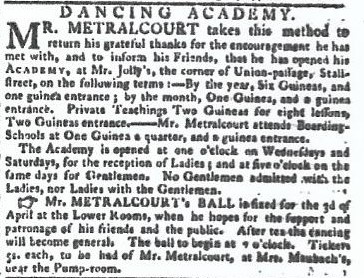
There were two other dancing masters in Bath who, if they were not in fact French, seem to have had close links to French dancers appearing in London’s theatres. Charles Metralcourt was teaching in Bath by 1782, the year he advertised the opening of ‘his Academy’ in the Bath Chronicle for 28 March.
Fawcett describes him as a ‘versatile dancer and a ballet-master at the London Opera house’ (presumably referring to the King’s Theatre) without citing a source. He may have been the ‘Mettalcourt’ who appeared in ‘a new grand Polish Dance’ in the entr’actes at Covent Garden on 5 December 1780, described as making his first appearance at that theatre. Metralcourt did not generally refer to his connections with London’s theatre world in his advertisements. Notices in the Stamford Mercury indicate that he was working as a dancing master in Stamford between 1775 and 1780. He taught in Bath until 1786 and an advertisement in Saunders’s News-Letter for 29 November 1786 declares that he was teaching in Bath during the winter season and in Belfast during the summer season. After leaving Bath in 1786 (apparently as a result of the arrival of the of the dancing master John Second that year) he seems to have taught in Dublin and in Ipswich. He returned to Bath in 1795, taking over from Second and he continued to teach and to hold balls for his pupils at the Upper Assembly Rooms until 1811. Charles Metralcourt died in 1814 and was buried in the Catholic Burial Vault, Old Orchard Street, Bath on 12 October 1814.
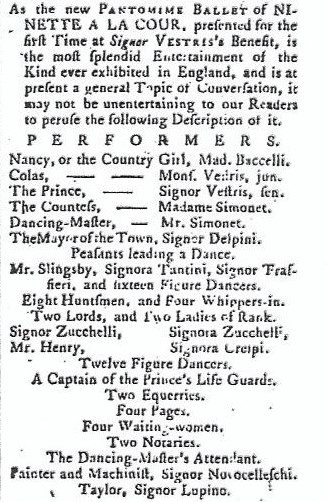
John Second (who may or may not have been French) was invited to take over Jean-Baptiste Froment’s school in 1786, as he advertised in the Bath Chronicle for 18 May 1786 describing himself as ‘Of the King’s Theatre, but late of the Theatre Royal, Drury Lane, and Sole Assistant to Mr. Vestris, Senior’. His name appeared occasionally in advertisements for performances at the Covent Garden Theatre during the 1782-1783 season and at Drury Lane in 1783-1784. He may well have appeared more often, but was not important enough to be named in the bills. If he was indeed ‘Sole Assistant’ to Vestris Senior, Gaëtan Vestris, it must have been in the 1780-1781 season at the King’s Theatre during the first visit of the celebrated French dancer (who did not return until 1790-1791). Among the ballets mounted by Vestris Senior was Ninette à la Cour, with the Italian ballerina Giovanna Baccelli in the title role and Gaëtan’s son Auguste Vestris as her lover Colas. First given on 22 February 1781, it was an enormous success and the cast was printed – together with a synopsis of the ballet – in the Public Advertiser for 26 February 1781.
Second was not among the named dancers. He may have been one of the ‘Figure Dancers’ referred to simply as a group, or danced as one of the individual characters for whom no performers’ names are given. No evidence has yet come to light to support Second’s claim that he was Vestris Senior’s assistant, or to suggest why he might have been given that role. Second apparently left Bath in 1795, when his teaching practice was taken over by Charles Metralcourt, although he seems to have returned in late 1799. His subsequent career as a dancing master awaits further research, but he was buried at St James, Bath on 23 January 1826 (when his name was recorded as Paul John Second).
The most celebrated teacher of dancing in 18th-century Bath was half-French. Ann Teresa Fleming was the daughter of Irish violinist Francis Fleming and French dancer Ann Roland, younger sister of the well-known dancer Catherina Violanta Roland. Both girls danced in London for a number of seasons. Ann Teresa Fleming was never a stage dancer but built a very successful career teaching ballroom dancing. I wrote about her in my post Lady Dancing Masters in 18th-Century England but there is far more to say than I could include there.
Bath is a special case when it comes to the history of dancing. As the most fashionable spa in England, it was big enough to attract a number of dancing masters to teach the aristocracy and gentry who gathered there and attended the regular balls in both the upper and lower assembly rooms. It is surely significant that many of these dancing masters were French and had backgrounds in the theatre (it is worth noting that the dancing at the Theatres Royal in Bath and Bristol is yet to be researched). Bath was much smaller than London, providing an opportunity to chart in detail the community of dancing masters and their clientele, as well as the dancing that happened there and the wider social context which brought it all together. Far more research is needed to help us understand who was who and how it all worked.
References:
Trevor Fawcett, ‘Dance and Teachers of Dance in Eighteenth-Century Bath’, Bath History, 2 (1988), 27-48.
Philip J, Highfill Jr, Kalman A. Burnim and Edward A. Langhans. A Biographical Dictionary of Actors, Actresses, Musicians, Dancers, Managers & Other Stage Personnel in London, 1660-1800. 16 vols. (Carbondale, 1973-1993)
Index to the London Stage, compiled, with an introduction by Ben Ross Schneider, Jr. Second printing (Carbondale and Edwardsville, 1980)
The London Stage, 1660-1800. 5 Parts (Carbondale, 1960-1968).
Part 1: 1660-1700; Part 2: 1700-1729; Part 3: 1729-1747; Part 4: 1747-1776; Part 5: 1776-1800.
A calendar of stage performances at London’s major theatres, with a detailed introduction to each part.
Gennaro Magri, translated by Mary Skeaping. Theoretical and Practical Treatise on Dancing (London, 1988).
See p. 160 for the reference to Pierre Bernard Michel.
I recently watched another dance history video in the very informative series compiled and published by Carlos Blanco, which draws inspiration from the rich resources of the Biblioteca Nacional de España. In this video (which can be found on YouTube) four historical dance experts consider the question ‘Is there Sexism or Misogyny in Dance Treatises?’ Inevitably, the topic of female dancing masters arose, in the context of the discussion focussing on the USA and Great Britain, and it proved difficult to identify or name any – indicating a gap in published research. In the course of my own work, which is mostly limited to England and particularly London, I have come across several women who taught dancing – lady dancing masters. My list is very far from exhaustive (and at least one name is questionable), but I thought it might be of interest to write a post about them and perhaps reveal or encourage further research. There has been some work which includes this topic and I have included a list for further reading at the end.
The first of these women is the questionable one. Peggy Fryer was billed as acting and dancing at the Little Theatre in the Haymarket on 28 January 1723. The advertisements declared that she was aged seventy-one and had ‘taught three Queens to dance’. She had previously appeared at the Lincoln’s Inn Fields Theatre on 11 January 1720, ‘it being the first time of her Appearing on any stage since the Reign of King Charles II’, and she was then said to be eighty-five years old. Without a great deal more research, it is difficult to discern whether there was any truth at all in these conflicting announcements. If Peggy Fryer had indeed ‘taught three Queens to dance’, who might they have been? My thoughts turned to Charles II’s Queen, Catherine of Braganza, and his two nieces Mary (later Queen Mary II) and Anne (later Queen Anne), although there are other candidates. Would someone like Peggy Fryer have been called in to teach any of them, when there was a royal dancing master – Jerome Gahory – to do so?
With the second of these lady dancing masters we are on much surer ground. Mrs Elford emerges into view on 5 July 1700 at Lincoln’s Inn Fields, where she is billed as dancing a ‘new Entry, never performed but once’, She was obviously already established as a leading dancer and would later be billed alongside Anthony L’Abbé as his regular dancing partner. The collection of L’Abbé’s stage dances published in the mid-1720s includes a duet to the passacaille from Lully’s opera Armide danced by Ann Elford and Hester Santlow. The earliest evidence for Mrs Elford as a teacher dates to 12 September 1705, when dancing ’By a little Girl, Mrs Elford’s scholar’ was advertised at Lincoln’s Inn Fields. Mrs Elford’s career as a stage dancer seems to have ended in 1706, by which time she was probably already teaching regularly. The first record of her work beyond the world of the London stage dates to 1711, when she was teaching Mary Bankes of the Bankes family of Kingston Lacey. Mrs Elford’s later activities are less easy to trace, although she is recorded as teaching the daughters of the second Duke of Montagu between 1720 and 1729.
The next woman to be recorded as teaching dance in England was one of the most notable dancers to appear on the 18th-century London stage. Marie Sallé first danced in London as a child, during the 1716-1717 season at Lincoln’s Inn Fields. She returned to dance there as a young woman in 1725-1726 and made her last London appearances at the Covent Garden Theatre during the 1734-1735 season. For Mlle Sallé’s benefit at Lincoln’s Inn Fields on 6 April 1727 the bill included a ‘Pastoral by Miss Rogers, a Child of Nine Years of Age, Scholar to Mlle Sallé’. Elizabeth Rogers would later enjoy a career as a singer and actress, as well as a dancer. When she was billed again at Lincoln’s Inn Fields on 5 April 1731, dancing a Saraband and Tambourin, she was advertised as ‘Scholar to Salle’. Marie Sallé’s brother Francis remained in London when she returned to France and made his career there. It is not surprising that he took over some of his sister’s teaching. However, a continuing link between Marie Sallé and Elizabeth Rogers is suggested by the latter’s appearance as a Bacchante in Bacchus and Ariadne (a ballet attributed to Mlle Sallé) when it was given within The Necromancer at Covent Garden on 26 February 1734. Marie Sallé is the first of my lady dancing masters for whom there is a portrait. In fact there are several, this is a print of the painting by Nicolas Lancret.
My third lady dancing master appeared on the London stage much later in the 18th century. Marie-Louise Hilligsberg began her career at the Paris Opéra in the early 1780s, making her first visit to London during the 1787-1788 season to appear at the King’s Theatre. She returned to Paris for a little over a year, but when she failed to get the promotion she expected at the Opéra she returned to London in 1789. Mme Hilligsberg continued to dance in London, mostly at the King’s Theatre but also elsewhere, until she retired from the stage in 1803. She was well-known for her travesti roles as well as her more conventional ones. Here are portraits of her in both guises: a print showing her in the ballet Le Jaloux Puni and a painting by Hoppner.
In 1796, she appeared in the ballet Little Peggy’s Love at the King’s Theatre (perhaps in the title role) for which the ‘Pantomime and Principal Steps’ were created by Didelot. Some years later, in 1799, this ballet was performed by several young aristocrats at a private party thrown by Lord and Lady Shaftesbury. As newspaper reports make clear, this amateur performance was mounted by Mme Hilligsberg, who also coached the child dancers in their roles. There are more details in my 2017 post A Favourite Ballet. Mme Hilligsberg is also known to have given dancing lessons to Lady Harriet Montagu and she may well have had other pupils during her years in England. She retired from the stage in 1803 and died in France the following year.
I have to return to the early 1700s for my next lady dancing master, who bridges a divide between professional dancers who became teachers and those who pursued the teaching of dance without having a stage career. Ann Roland was the sister of the well-known dancer Catherine Roland. She made her London debut at Drury Lane on 18 November 1735, described as ‘lately arrived from Paris’ and dancing alongside her sister. She continued to dance in London until 1743, mainly at the Covent Garden Theatre, and then moved to Dublin for the 1743-1744 season where she acted and apparently sang as well as dancing. Her extensive repertoire ranged from a Tambourine solo, through duets including The Louvre and the minuet, to leading dancing roles in a number of popular pantomimes. Around 1745 she married the Irish violinist Francis Fleming, with whom she had three daughters. Ann Fleming’s subsequent career as a lady dancing master is not easy to trace, but she is said to have begun teaching with her husband in and around Bath in the late 1740s. According to an advertisement in the Salisbury and Winchester Journal for 25 September 1752, announcing Mr Fleming’s return from Paris ‘where he has completed himself in the Art of Dancing’ he and his wife were then teaching at a boarding school in Bath as well as giving private lessons to young ladies and gentlemen. There is no known portrait of Ann Roland Fleming, who died in 1759.
Francis Fleming may have begun to involve his eldest daughter Ann Teresa in teaching soon after the death of her mother (when she would have been thirteen or fourteen years old). She was certainly his assistant by 1768, as the Bath Chronicle for 3 November 1768 reported that ‘Mr. and Miss Fleming, … have been in Paris this summer’ learning the ‘true Step of the Cotilions with the additional Graces of the Minuets’ and that they would both be teaching at another boarding school in Bath, as well as giving private lessons to ladies and gentlemen. Ann Teresa Fleming took over her father’s dancing academy when he died in 1778 and quickly became the most famous teacher of dancing in Bath, where she continued to work until her retirement in 1805. Her balls for her scholars, held several times each year at both the Upper and Lower Assembly Rooms, were often reported in detail in the Bath Chronicle. Her importance is perhaps best shown by the fact that she is one of very few dancing masters, male or female, for whom we have a portrait (now in the collections of the Victoria & Albert Museum), which has been linked to the studio of Sir Joshua Reynolds:
Miss Fleming died in 1823 and was accorded a quite lengthy obituary in the Bath Chronicle for 18 February 1823.
For nearly twenty years, Ann Teresa Fleming ran her school with her younger sister Kitty. When she retired she was succeeded by Miss Le Mercier, who had become her assistant in the mid-1790s and would continue the school – as another lady dancing master – until around 1811. Another assistant to Miss Fleming had been Elizabeth Rundall, who in 1796 married the actor Robert Elliston and around the same time set up her own school in Bath in partnership with Kitty Fleming. Mrs Elliston’s school was notably successful. Like Ann Teresa Fleming, she held regular balls for her pupils in Bath’s Upper Assembly Rooms – the Bath Chronicle for 10 December 1803 reports that the Duchess of Devonshire was to attend ‘Mrs Elliston’s Ball’. Elizabeth Elliston left Bath for London in 1812 (her husband was by then a leading actor in the company at Drury Lane) and her sister Miss D. C. Rundell took over her Bath school.
The ladies I have mentioned in this post were undoubtedly just a few of the many lady dancing masters who taught in England from the seventeenth to the early nineteenth century. Some worked with their dancing master husbands and were seldom mentioned as teachers in their own right. Others were well-known and admired for their dancing and teaching skills. Further research will surely uncover many more lady dancing masters within surviving historical records.
Further Reading:
Quotations from advertisements for stage performances are taken from the appropriate volumes of The London Stage, 1660-1800.
For Peg Fryer see: the entry ‘Fryer, Margaret, later Mrs Vandervelt, c.1635-1747, actress, dancer’ in Philip H. Highfill Jr et al. A Biographical Dictionary of Actors. 16 vols. (Carbondale, 1973-1993), Vol. 5.
For Ann Elford see: Jennifer Thorp, ‘Mrs Elford: stage dancer and teacher in London, 1700-1730’, in Ballroom, Stage and Village Green: Contexts for Early Dance, ed. Barbara Segal and William Tuck (Early Dance Circle, 2015), 53-60.
For Marie Sallé as a teacher, in Paris as well as in London, see: Sarah McCleave, ‘Marie Sallé, a Wise Professional Woman of Influence’, in Women’s Work: Making Dance in Europe before 1800, ed. Lynn Matluck Brooks (Madison, Wis., 2007), 160-182 (pp. 168-171)
For Marie-Louise Hilligsberg, see: the entry in A Biographical Dictionary of Actors, Vol. 7; Ivor Guest, The Ballet of the Enlightenment (London, 1996); Katrina Faulds, ‘Opera Dances’, chapter 6 in A Passion for Opera: The Duchess and the Georgian Stage (Kettering, 2019), 91-99 (pp. 95-96).
For Ann Roland Fleming, see: the entry for Ann Roland in A Biographical Dictionary of Actors, Vol. 13, as well as the sources listed below for her daughter and successors.
For Ann Teresa Fleming, Miss Le Mercier and Elizabeth Elliston, together with other lady dancing masters in Bath, see: Trevor Fawcett, ‘Dance and Teachers of Dance in Eighteenth-Century Bath’, Bath History, 2 (1988), 27-48; Mathew Spring, ‘The Fleming family’s dance academy at Bath 1750-1800’, in Ballroom, Stage and Village Green: Contexts for Early Dance, ed. Barbara Segal and William Tuck (Early Dance Circle, 2015), 47-52.
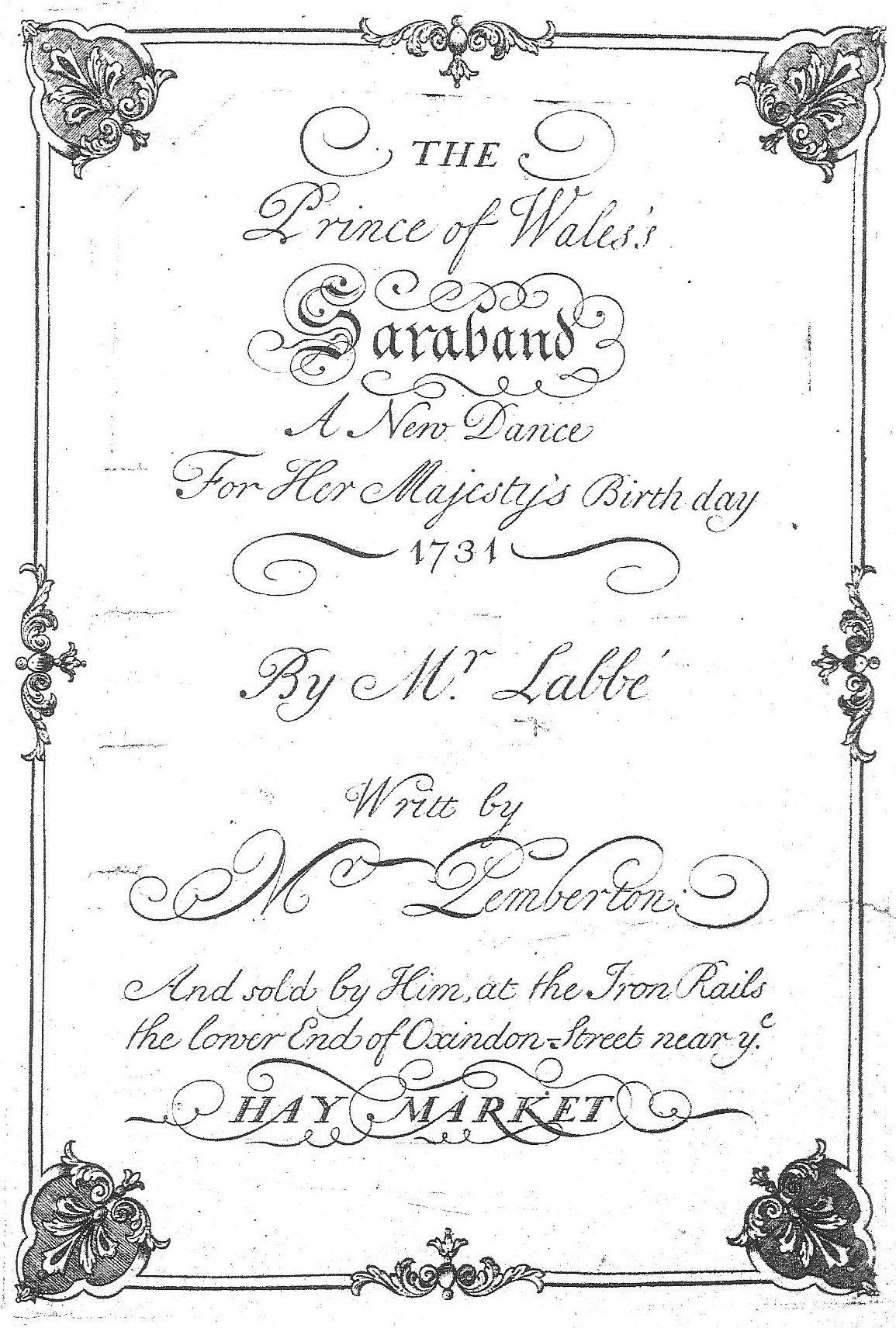
The notation for Anthony L’Abbé’s ballroom dance The Prince of Wales’s Saraband is one of the exhibits in Crown to Couture at Kensington Palace (the exhibition closes on 29 October 2023). It is shown out of context and with next to no explanation of its meaning so, although I have written about the dance elsewhere, I thought it would be worth a post in Dance in History to provide some information about this beguiling duet.
The Prince of Wales’s Saraband was one of a series of dances created by Anthony L’Abbé and published in Beauchamp-Feuillet notation by Edmund Pemberton following L’Abbé’s appointment by George I as royal dancing master around 1715. The title page makes clear that this was one of the dances choreographed by L’Abbé to celebrate the birthday of Queen Caroline, wife of King George II and mother of the Prince.
Her birthday was on 1 March and it had been celebrated at court since at least 1717, when L’Abbé’s ballroom dance The Royal George was created and published for that purpose. In that case, the title page of the dance makes no reference to the then Princess of Wales but the advertisements for the notation make it clear that the dance was in her honour.
By 1731, Caroline had been Queen for fewer than four years and L’Abbé had not published a dance since the Queen Caroline which honoured her birthday in 1728. In 1731, there was a birth night ball for the Queen and the report in the Daily Advertiser for 3 March 1731 gives us some details.
There is no mention of L’Abbé’s dance, although Frederick Prince of Wales ‘open’d the Ball’ by dancing a minuet with his sister Anne the Princess Royal. The reference to the illumination of the houses of all three of the actor-managers of the Theatre Royal, Drury Lane, is interesting, for The Prince of Wales’s Saraband was performed in the entr’actes at that theatre on 22 March 1731 by William Essex and Hester Booth. That first public performance was obviously also intended to honour the Queen.
The dance seems to have been admired, for it was revived at the Haymarket Theatre on 21 August 1734 and again at Drury Lane on 17 May 1735, each time performed by Davenport and Miss Brett. It was revived again at Covent Garden on 25 April and 13 May 1737, by Dupré (probably the dancer James Dupré) and Miss Norman.
Prince Frederick had remained in Hanover following the accession of his grandfather as George I in 1714. He came to England only in 1728, eighteen months after the accession of his parents to the British throne. By this time, the prince was twenty-one and he joined a family which included four sisters and a brother whom he scarcely knew. This portrait by Philippe Mercier shows Prince Frederick in the mid-1730s.
Prince Frederick’s relationship with his parents, particularly his mother Queen Caroline, became steadily more difficult after his arrival in England. In 1731, the year The Prince of Wales’s Saraband was created, this problem lay in the future.
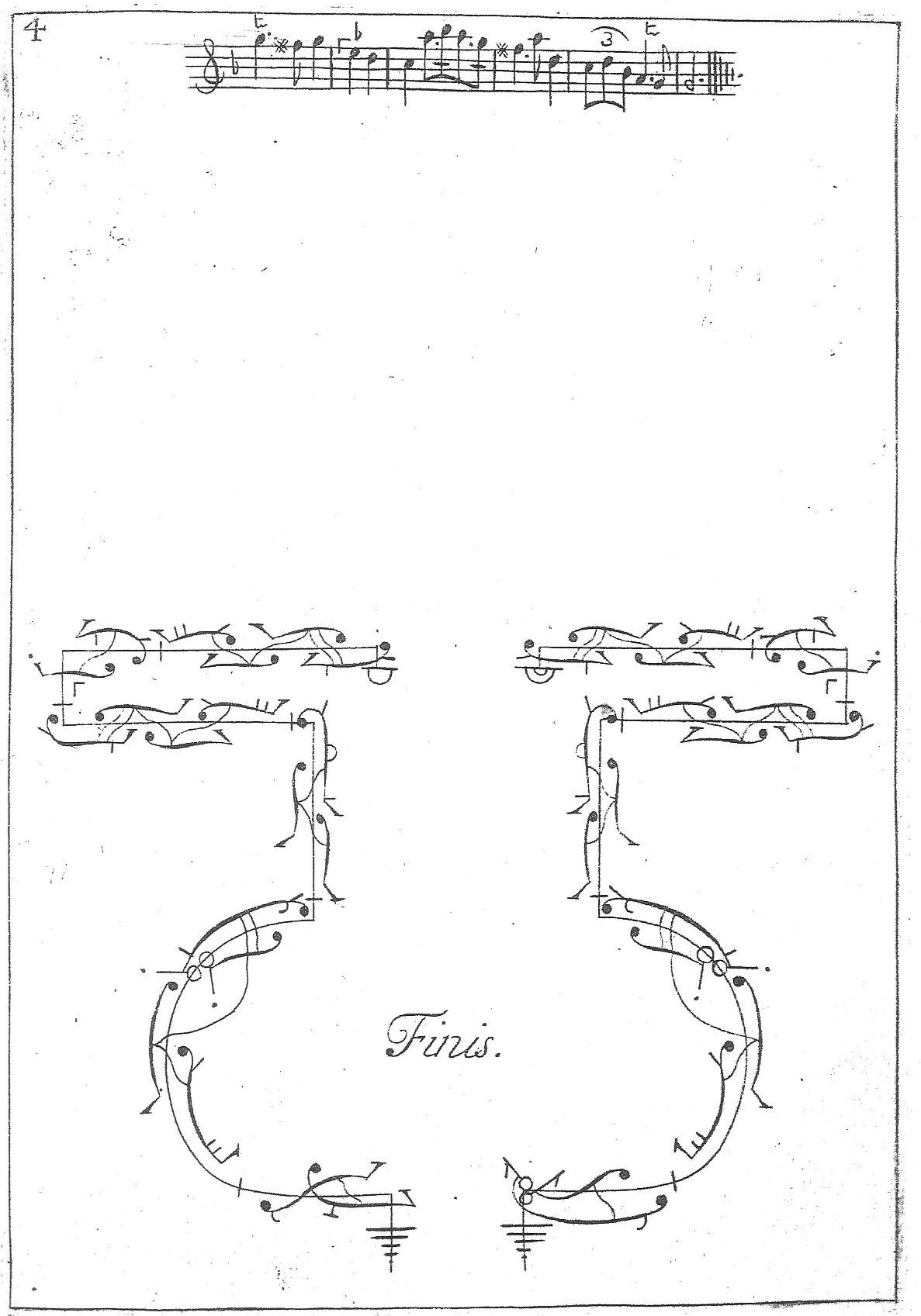
The Prince of Wales’s Saraband, as notated, is ostensibly an undemanding ballroom dance of 48 bars of music with the familiar AABB musical structure (A=10 B=14). The choreography is divided between four plates of notation (which by this time was Pemberton’s regular practice and probably reflects the expense of paper for printing). Plate 1 records the two A sections (20 bars of dance and music) and plate 2 the first B section. Plate 3 has bars 1 – 8 of the second B section and the dance ends on plate 4 with its final 6 bars. This division of the last section of the dance between two plates is dictated by the circular figures traced, which need to be shown separately so that they do not overlap, but also respects the musical phrasing. The layout on each plate may also reflect Pemberton’s aesthetic preferences – his notations for Isaac and L’Abbé include some of the most beautiful examples of this highly specialised genre of engraving.
Closer analysis of the notation reveals that this duet has some complexities and that it demands immaculate style and technique if it is to make an impact. Reconstructing the dance raises a number of questions about those aspects that are not notated – in particular arm movements and the use of the head. In all of these notated ballroom dances, the attention of the two performers seems to be divided between the presence (the guest of honour), each other and the surrounding audience. How much do we really know about the conventions that governed the performance of such dances, either at court or on stage, which should inform our dance reconstructions?
The Prince of Wales’s Saraband opens with a figure based around a temps de courante à deux, in which a temps is followed by a temps de courante, first on the inside foot and then on the outside foot. The notation indicates that the dancers turn their bodies towards the pointing foot on each temps, turning back towards the presence on each temps de courante. Did this mean that they turned their heads the same way or did they look steadfastly forward?
In the remaining bars of the first A section, they turn alternately towards one another and the presence but there are also opportunities to take in the surrounding audience.
The end of the dance, the steps and figures of the its last six bars on the final plate, has the dancers face the presence side-by-side for three bars travelling sideways away from each other and back again. They then turn to perform a pas de bourrée directly upstage, followed by a variant on the pas de bourrée vîte curving away from each other and coming face to face briefly before a coupé into their final réverence.
I can’t help wondering if this sequence was created, in part, to allow the dancers to acknowledge the audience that surrounded them before they made their final honours. The performance of The Prince of Wales’s Saraband at Drury Lane was part of a benefit for Mrs Booth, when some of the audience may have sat around the dancers on the stage (almost as they would have done in the ballroom) as well as in the auditorium. There is no evidence that Queen Caroline herself attended, but the royal box at this period would have been directly opposite the stage in the centre of the first tier just above the pit, providing the dancers with a specific focus.
The step vocabulary of this dance is dominated by the pas de bourrée, with and without a final jetté, extending to the pas de bourrée vîte. There are also a number of variants of the coupé, including the coupé sans poser and the coupé avec ouverture de jambe. It is interesting that, throughout, L’Abbé uses the jetté and not the demi-jetté in pas composés. These add energy and prevent the dance from becoming languid. He also likes to pair steps, although where he repeats these pairings he often introduces an element of variation the second time.
One sequence, on the second plate within the final bars of the B section, is noteworthy and quite challenging to perform.
L’Abbé introduces an element of suspension, in the opening coupé sans poser with a one-beat pause (which comes at the end of the preceding musical phrase), before a pas composé which demands unhurried speed – a pas plié, changement and coupé soutenu to fourth position with a quarter-turn. There is then a coupé avec ouverture de jambe (also with a one-beat pause) before the pas composé is repeated. This sequence ends with another coupé avec ouverture de jambe and a pause, before the B section is completed with two pas balancés.
The Prince of Wales’s Saraband was first performed on stage by Mrs Booth (née Hester Santlow), with whom L’Abbé had worked over many years and for whom he had created several notable choreographies. Could this ostensibly simple, yet demanding, ballroom duet have been created with and for her, intended specifically for performance at her benefit?
Mr Isaac’s The Richmond was first published in notation in 1706 in A Collection of Ball-Dances Perform’d at Court.
The dance is named first on the title page, probably because the collection was dedicated to the Duke of Richmond, and it seems most likely that the title of the dance was meant as a tribute to him. It may well have been one of the dances that John Weaver (who notated the collection) declared in his dedication to ‘have been Honour’d with your Grace’s Performance’.
The American dance historian Carol Marsh, in her 1985 thesis ‘French Court Dance in England, 1706-1740’, suggested that the choreography dated to more than ten years earlier. As she pointed out, the music was published in The Self-Instructor on the Violin, advertised for publication on 15 July 1695. The duet could perhaps have been performed at the ball held at Whitehall Palace on 4 November 1694 to celebrate the birthday of King William III. The Duke of Richmond, son of Charles II and Louise de Keroualle the Duchess of Portsmouth, had initially been opposed to the changes wrought by the Glorious Revolution. He was reconciled with William III in 1692 and in January 1693 he married Anne Belasyse. He might well have performed The Richmond if and when it was performed at court. This portrait by Godfrey Kneller shows the Duke some ten years after The Richmond may have been created.
The Richmond is a hornpipe in 3/2, often described as a specifically ‘English’ dance and occasionally said to have pastoral connotations. It is distinct from the later duple-time hornpipe often associated with sailors. The dance type was evidently a favourite with Mr Isaac, who also used it in The Union (1707), The Royall (1711) and The Pastorall (1713). Anthony L’Abbé, who became royal dancing master around 1715, included a hornpipe in The Princess Ann’s Chacone (1719) and used the music from Isaac’s The Pastorall for a stage solo for a man, published in notation around 1725 but possibly performed the same year as Isaac’s ballroom duet. He may have been paying tribute to Isaac, who was also his brother-in-law.
This earlier form of hornpipe has attracted the attention of several dance historians (a number of references are given at the end of this post), who between them have noted that hornpipe music first emerges in the 1650s and that it was a dance type that appealed to Purcell, among other late 17th century composers, as well as investigating the characteristic steps of the dance. Purcell was certainly including triple-time hornpipes in his stage music by the 1690s. Among modern historical dance enthusiasts, there is particular interest in the hornpipes included within editions of Playford’s The Dancing Master, under the titles ‘Maggot’, ‘Delight’ or ‘Whim’ – ‘Mr Isaac’s Maggot’ appears in the 9th edition of 1695 – although, sadly, there seems to be little enthusiasm for the exploration of some of the hornpipe pas composés described below (I can’t help thinking that some of the fun in such dances must have been the steps). Triple-time hornpipes continued to be used for dances into the early decades of the 18th century. Fresh research is certainly needed to chart the emergence, rise and decline of this version of the hornpipe within a variety of dance contexts.
My interest here is, of course, the hornpipes within the notated ball dances – in my time, I have had the pleasure of dancing The Richmond, The Union, The Pastorall and The Princess Ann’s Chacone. Only The Richmond is a hornpipe throughout, the other dances pair it with different dance types. The musical structure of The Richmond is more complex than usual for ballroom dances – AABBCCDDEEFF’ (A = B = C = D = E = 4, F=8, F’ = 4) with 52 bars of music in all. The division of the choreography between the six plates of the notation seems to be pragmatic in terms of the steps and figures to be recorded rather than reflecting the musical structure.
As I noted in an earlier post, the opening figure of The Richmond is unorthodox.
The couple travel forwards away from each other on a diagonal before turning inwards to face each other. They turn to face the presence on bar 3, but maintain that orientation for only two bars before turning to face one another again for one bar, after which they turn to face the presence on bar 6. Their steps in the opening figures are rhythmically varied and two-thirds include pas sautés, an indication of the lively nature of this hornpipe.
Mr Isaac’s hornpipes have a distinctive vocabulary of steps. A particular characteristic is his use of three pas composés over two bars of music, found throughout The Richmond. This may take a form in which the same step begins and ends the sequence with two other steps between them (performed on either side of the bar line) which may or may not be the same. One example is found on plate 1 in the opening bars in the form pas de bourrée, saut / jetté, pas de bourrée, while another can be found on plate 2 as pas de bourrée, jetté / jetté, pas de bourrée. In the second case the first step is actually a pas de bourrée vîte, while the second step is a variant which inverts its two elements. In other cases, Isaac begins and ends the sequence with different steps but still has paired steps on either side of the bar line, as on plate 1 with a contretemps, jetté / jetté, pas de bourrée imparfait (i.e. to point). Or, as yet another variation, the sequence may divide a familiar pas composé at the bar line, as an example on plate 2 demonstrates with pas de sissonne, pas de sissonne, pas de bourrée, in which the second pas de sissonne begins in the first bar with its pas assemblé and ends in the second bar with its sissonne. In The Richmond, Isaac is endlessly inventive with this device.
The Richmond is one of the choreographies in which Isaac ornaments some of the man’s steps but not the woman’s. Although, among the six dances published in 1706, only The Spanheim and The Britannia are without such ornamentation. Throughout the dance, there are five bars where this happens and in all cases a pas battu is added on the man’s side. On plate 5 this ornamentation is added in two consecutive bars and coincides with a change from mirror to co-axial symmetry.
Isaac also ornaments the man’s steps right at the end of the dance, altering his sequence of pas composés. Over the final two bars, the woman has coupé emboîté battu, demi- contretemps / jetté, coupé simple, coupé soutenu (with a half-turn into a réverence). The man has coupé emboîté battu, demi-contretemps battu / contretemps à deux mouvements battu, coupé soutenu (the last is his réverence). She turns to travel forwards, while he turns to travel backwards. They do not take hands for these last steps, although they had done so for preceding bars.
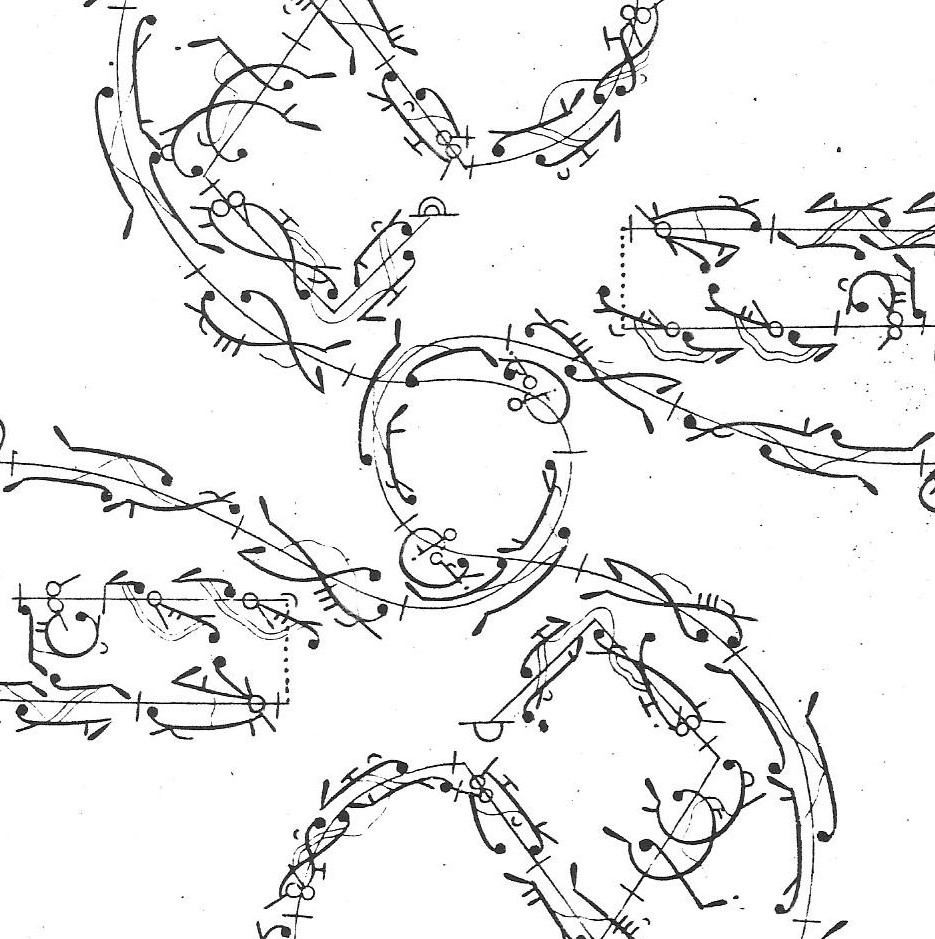
There are more linear than circular figures in The Richmond, although Isaac makes effective use of the latter on plates 2 and 6. The relationship between the two dancers and between them and their audience is interesting. If this dance was performed at a formal ball, the couple would probably have had the presence (the King?) in the place of honour centre front as well as an audience of courtiers surrounding them on the other three sides. So where would they have looked as they danced? Plate 1 shows them dividing their attention between the presence and each other. In the first two bars on plate 3, they clearly address the spectators on each side (and at the bottom of the room) before turning towards one another to dance on a right line. There are similar opportunities on plate 5, although the couple are otherwise dancing beside one another and facing the presence.
Working again on this dance, after a gap of many years, I couldn’t help wondering if the arm movements might have been as unconventional as the steps and whether the dancers could direct their lines of vision quite freely as they moved, enabling them to acknowledge not just each other and the presence, but also the encircling audience.
My recent work has raised several questions about the performance of The Richmond and the other dances in the 1706 Collection. The title page states that they were ‘perform’d at court’, but what did this mean? Were they danced as part of a formal display, either at birth night balls or on other such occasions? Were they instead danced at one of the more informal balls at the English court? In his ‘Livre de la contredance du roy’, presented to Louis XIV in 1688 and retranscribed for Louis XV in 1721, André Lorin wrote:
‘Cette cour [the English royal court] divise ces divertissements en Bals serieux, et en Bals ordinaires.
Les serieux se dançent toujours dans un Lieu preparé, ou toute la Cour paroit superbe et magnifique.
Les ordinaires regardent les Contredances qu’on dance avec plus de negligence et dans les apartemens du Roy, où l’on ne va qu’avec les habits ordinaires, afin de dancer avec plus de liberté: …’
The manuscript is now in the Bibliothèque Nationale de France and can be found on Gallica. Lorin was concerned with English country dances, but could the ‘Bals ordinaires’ have included couple dances like The Richmond? Or, if they were indeed given at ‘Bals serieux’, should we think again about the conventions governing the dance displays at such events?
Further reading:
George S. Emmerson, A social history of Scottish dance (Montreal, 1972), chapter 14
The Hornpipe: papers from a conference held at Sutton House, Homerton, London E9 6QJ, Saturday 20th March 1993 (Cambridge, 1993)
Carol G. Marsh, ‘French court dance in England, 1706-1740: a study of the sources’ (PhD thesis, City University of New York, 1985), pp. 243-258.
Barbara Segal, ‘The Hornpipe: a dance for kings, commoners and comedians’, Kings and commoners: dances of display for court, city and country. proceedings of the seventh DHDS conference, 28-29 March 2009 (Berkhamsted, 2010), 33-44
Linda J. Tomko, ‘Issues of Nation in Isaac’s The Union’, Dance Research, XV.2 (Winter 1997), 99-125.
The Richmond is also mentioned in the following posts on Dance in History:
Mr Isaac’s Six Dances
Mr Isaac’s Choreography: The Six Dances – Opening and Closing Figures
Mr Isaac’s Choreography: The Six Dances – Motifs and Steps
What exactly is dancing? More to the point, what exactly is historical dancing? The answer to this question has been the subject of much debate among UK early dance theorists. Such questions as the reliability of the sources, the trustworthiness of those interpreting them and a full and correct understanding of politeness and authenticity have been known to generate pleasing feelings of utter despair among the greatest of historical dance aficionados. However, there is an easy answer to the conundrum which is widely applied in practice, if not universally agreed in principle. Dancing is no more and no less than ornamented (or, more often, unadorned) walking.
Once this truth has been recognised and accepted, the question arises – what is walking? More specifically and pertinently, what is historical walking? Is it like modern walking, or are there subtle differences only to be discovered through minute study of the sources? Let me delve into this extremely difficult topic through an examination of practice in different historical periods.
First, 15th-century dancing is so obviously walking that there can be no argument on that score. This is courtly dancing in very long clothes (apart from some of the men, who are obliged to show their legs in tight hose but are expected to wear doublets with very long sleeves). The longer the outfit, or the sleeves, the more polite and authentic the dancer. The truly extraordinary length of these garments will only permit walking, except that the wearer must adopt a lilting movement to prevent costly materials from getting under his or her feet.
I’m not an expert on the late 16th or early 17th century (and I don’t like the period very much) so I will move on to country dancing. This, of course, begins in the middle of the 17th century when the populace was weighed down by the English civil war – won by the puritans who promptly banned dancing. What was the answer? Walking in a military fashion! This quickly became a hallowed tradition and has been faithfully observed ever since, in honour of its folk origins.
Then, we come to baroque dance. The most important sources for the 18th century are those strange notations with straight and curved lines all over the page. Close scrutiny reveals that many of these take the form of steps by the right foot or the left foot. In the vast majority of cases, a step by the right foot is immediately followed by a step with the left foot (or vice versa). It rapidly becomes obvious that baroque dancing is, in fact, walking. We have a little problem here, in that other sources insist that dancers must turn out their feet while practising baroque dance. Just a little thought (and even less practice) reveals that this is the clinching evidence for baroque dancing being walking. Whoever would be able to dance, let alone dance historically, with turned-out feet?
These notations have music at the top of each page, showing that baroque dance must have been walking to music. However, the correlation between the music and the steps is so obscure that we may safely deduce that baroque dancing is not only walking to music but that it does not have to keep time with the music. Many baroque dancers have proved this in practice without having to fatigue themselves with research.
The Spanheim, from Mr Isaac’s 1706 A Collection of Ball-Dances Perform’d at Court, was one dance I had never learnt until now. It took me while to settle into its steps and figures, but once I became more familiar with the choreography I really enjoyed working on it. I have already mentioned this duet in some of my other posts about Mr Isaac’s dances and these are listed at the end of this one.
The music for this choreography is a gigue (or perhaps an English ‘jigg’ – a point it would be interesting to be able to discuss further). It has the musical structure AABBCCDD played through twice (A=4 B=6 C=4 D=6) to give 80 bars of music and dancing. There has been some doubt about when the duet was created and danced at court. In her 1985 thesis, Carol Marsh suggested that it could be dated between 1701 and 1705, pointing out that the music appeared not only in The Second Book of the Lady’s Banquet, published in 1706, but was also used in 1705 for a country dance. The title is said to refer to Ezekial Spanheim (1629-1710), Prussian ambassador to the English court from 1702. However, the chance discovery of a reference to a court ball suggests that The Spanheim was first danced in 1703 and that it might well have been named after Spanheim’s daughter Mary Ann, then aged around twenty. The reference comes from a letter written by E. Hinde to Mary Foley and dated 20 February 1703, transcribed in an article by Rob Jordan ‘An Addendum to The London Stage 1660-1700’ (the full citation is given at the end of this post).
‘The Birth night was solemnised with much joy. ye Court very Splended. … The Lady Manchester a head & Ruffles £200: all lace – who with Madamosll Spanheim, were ye two principal Dancers. ye Latter Dancing a perticular one, wch none but ye person who was her parttener knew … The Queen stay’d till ½ a hour after 11 & ye Company Danc’d Countrey Dances till 4 in ye Morning.’
The reference to Mlle Spanheim’s dance supports the idea that this was The Spanheim, but who might her partner have been?
Isaac’s choreography for The Spanheim has two motifs in particular – paired steps and repeated sequences (the latter usually with an element of variation). I will look at some examples of these, which are also intertwined. The dance begins and ends in mirror symmetry, but the couple are in axial symmetry for most of the time. The figures are not entirely straightforward, at least on the page. The relative placing of the two dancers is sometimes misrepresented by the needs of the notation, for example making it uncertain whether they actually face each other up and down or across the dancing space. This is occasionally corrected between the plates (as with the end of the notation on plate 2 and the beginning on plate 3) but sometimes has to be inferred (as on plate 3 with the figure on a right line). John Weaver, the notator of the six dances, may still have been finding his way into this new skill. It is also worth noting here that around half of the steps in this dance incorporate jumps, so it is quite lively.
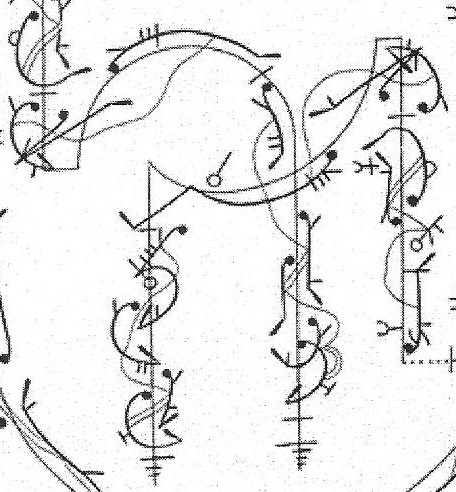
There are interesting sequences on every plate of The Spanheim, although I won’t try to look at them all. On plate 2, bars 21-28 (the first two C sections), there are the first of the glissades which Isaac interweaves throughout the dance. The first four steps are repeated for the second C, but with differences of alignment and variations in the steps themselves. Here is the man’s side (he is facing the presence as he begins).
Bars 29-34 on the same plate (to the first D section of the music) have a sequence which begins with a fleuret and a contretemps and ends with a contretemps and a fleuret. The third step is a quarter-turn pirouette, which perhaps provides a moment of suspension when the couple turn to look at each other as they pass on a circular path. Sadly, I do not have a dancing partner with whom to tease out the range of possibilities when reconstructing this section.
The repeat of the music begins on plate 3. Bars 41-48 (the repeat of the AA section) include a pas battu motif as well as three sets of paired steps. The most interesting of these are the two coupés battus in which the couple (facing each other on a right line, the man with his back to the presence) turn to right and then left, returning to face each other with an assemblé at the end of each step. Here are these steps on the man’s side, which is a bit clearer on my copy of the notation – I have changed the orientation of the page, for he has his back to the presence while the woman (further upstage) faces it.
The last sequence I would like to look at is on plate 4, bars 61-68 (the CC repeat). It uses pas balonnés (with demi-jettés rather than jettés), in a sequence with glissades and a fleuret. The two dancers are side-by-side holding inside hands and begin on the same foot. They move forwards towards the presence with pas balonnés, using the other steps to travel to left and right and right and left in turn. Here is the second half of this sequence. In which the lady is shown slightly behind the man to accommodate the notation on the page.
Isaac’s The Spanheim is full of echoes as it repeats and varies steps and motifs within the choreography and at different points in the music.
There is also a related piece of music ‘The New Spanheim’, published in 1710 by Walsh, Randall and Hare in For the Flute A Collection of all the Choicest French Dances Perform’d at Court the Theatres and Publick Balls. This collection of music was advertised in the Post Man for 22-25 April 1710, raising the possibility that Mr Isaac created a new choreography to celebrate the marriage of Mary Ann Spanheim to François de la Rochefoucauld, Marquis de Montandre in London on 21 April 1710. If he did, it was sadly not recorded in notation – so far as we know.
Other posts mentioning The Spanheim:
Mr Isaac’s Six Dances
Mr Isaac’s Choreography: The Six Dances – Opening and Closing Figures
Mr Isaac’s Choreography: The Six Dances – Motifs and Steps
References
Carol Marsh, ‘French Court Dance in England, 1706-1740: a Study of the Sources’ (unpublished PhD thesis, City University of New York, 1985)
Rob Jordan, ‘An Addendum to The London Stage 1660-1700’, Theatre Notebook, 47.2 (1993), 62-75 (p. 69), citing the ‘Morgan Collection 783/Box 24’ in the Shropshire Archives.













 Dance in History