Author Archives: moiragoff

Mr. Siret, A Set of Cotillons, c1770

A Set of Cotillons, or French Dances by Mr Siret is undated, but has been ascribed to around 1770. This places it among the collections published soon after the cotillon first became popular in London. The title page declares that Siret’s cotillons are ‘properly explain’d and illustrated, by Corographical Lines, drawn on a plan entirely new & far superior to those which have been before Published’, adding that both the tunes and the figures are by him.

Unlike the other treatises that appeared in London around this time, which all have verbal descriptions, Siret records his dances in a form of notation like that used in France for the publication of contredanses. He was probably French – he is very likely the Siret recorded as a musician in Paris around 1780 who had earlier published music in London. He may have been a relation of the French organist and composer Nicolas Siret (1663-1754).

Siret explains the notation he uses. He gives the same symbols to the ladies and the gentlemen, except that the ladies are shown in white and the gentlemen in black, with partners sharing identical shapes. He makes a mistake when he says ‘every Gentleman has his partner on his left hand’.  In his diagram of the couples standing in a square, Siret does show the ladies on the right according to convention.

He lists seven changes, plus the grand rond ‘all eight hands round and back again’. These, he says, are ‘the most fashionable’. Each dance has an ‘Explanation of the Plan’, which is a verbal description of the figures, and a ‘Plan of the Figures’, which notates them. The ‘Explanation’ names some steps, for which Siret provides no descriptions. His six cotillons all have French titles.

Siret obviously intended to make his mark among the dancing masters competing for attention, and dance students, in late 18th-century London. All these cotillon collections raise the question of dancing masters and their lessons, my next topic.

Henry Kingsbury. A Cotilion. [Detail, right hand side]. 1788. © Trustees of the British Museum

Henry Kingsbury. A Cotilion. [Detail, right hand side]. 1788. © Trustees of the British Museum

George Villeneuve Junior, A Collection of Cotillons, 1769

The 1769 Collection of Cotillons by George Villeneuve ‘Junior’ advertises its ‘plain and easy Directions’ on the title page. He lists seven steps and nine changes. His twelve cotillons all have French titles.

The epithet ‘Junior’ presumably distinguished George Villeneuve from his father. It is likely that he was the son of the Mr Villeneuve (also George) who danced at Drury Lane and then Covent Garden between 1734 and 1756. The elder Villeneuve married another dancer, Elizabeth Oates, at Lincoln’s Inn Chapel on 8 September 1735. George Junior was apparently born on 7 November 1738. Unusually for dancing masters at this period, his family tree can be traced a little further. George Villeneuve Junior married Susannah Smart on 20 May 1769 at St Mary in Marylebone Road, shortly before his book was first advertised. The couple had at least four children between 1770 and 1778.

There are no records to suggest that George Villeneuve Junior ever worked as a dancer on the London stage. He presumably taught ballroom dancing to amateurs, perhaps working with or in succession to his father. He may also have been a musician, as many dancing masters were, although the title page to the collection says nothing about the composer of the music. The collection was obviously designed to capitalise on the dance’s popularity and probably to draw attention to Villeneuve as a dancing master.

Henry Kingsbury. A Cotilion. [Detail, centre right]. 1788. © Trustees of the British Museum

Henry Kingsbury. A Cotilion. [Detail, centre right]. 1788. © Trustees of the British Museum

Fraternising with the Enemy?

In Britain early dance has tended to keep itself to itself. There are some links with folk dancing, but relatively few with the wider dance world. Some forms of dancing have even occasionally been viewed with hostility. I have to admit that I’ve also been affected by these attitudes.

I’ve recently been working on baroque dance with dancers trained in different styles and it has been very rewarding. As a ballet and baroque dancer, who has spent many years focussing on just those two styles, I’ve also recently begun to branch out into other forms of dance. I really wish I’d done this much, much earlier!

I’ve wondered for quite a while how to attract ballet dancers into baroque dance. These two styles should be a marriage made in heaven, as baroque dance is really the earliest form of ballet and the foundation of its style and technique.  It isn’t as easy as that of course, not least because the relationship between early and modern ballet is complex.

I recently did a short course in Spanish classical dance (escuela bolera). I’ve wanted to try this for a long time, and I was really glad I’d seized the opportunity. For the uninitiated (of whom I am one) it seems like a cross between ballet and flamenco. As a ballet dancer, I found I could cope reasonably well and I enjoyed the challenge of unfamiliar steps and arm movements. Escuela bolera has lots to offer baroque dance, for Spanish dance forms (including the playing of castanets) were very influential in France in the late 17th and early 18th centuries.  As Spanish classical dance is also a historic style, some of the baroque steps would surely be of interest. I know that others have pursued this cross-over, but it has never filtered down widely into British early dance.

I’ve also been dipping my toes into modern ballroom and Latin American dance.  I’m finding these dances very difficult, as both the partnering and the steps are miles outside my dance experience and hence my comfort zone. I can’t readily see a connection between these and 18th-century dances (though there must surely be one between them and the couple dances of the 18th and early 19th century). However, good ballroom and Latin dancers can surely bring a sense of performance as well as technical skill to earlier dance forms. They can also challenge our perceptions and understanding and so help with the process of change and development. How can we attract them into early dance?


Thomas Hurst, The Cotillons Made Plain and Easy, 1769

On the titlepage of his 1769 collection, The Cotillons Made Plain and Easy, Thomas Hurst describes himself as ‘Of  the Theatre Royal in Drury Lane, Late Pupil and Assistant to Mr. Grimaldi Ballet-Master’. Giuseppe Grimaldi (d.1788) worked at Drury Lane from 1758 to 1785 and was the father of the famous clown Joseph Grimaldi. Hurst seems to have worked at Drury Lane from 1755, when he was a child dancer, until at least 1782.

Given his background, Hurst’s remarks in his preface are surprising. He refers to the many books already published on the cotillon, complaining that they ‘cannot be of service to any but great proficients’ and declaring that he will avoid the terminology and steps of theatre dancing. He offers no French tunes, preferring instead English, Irish and Scotch airs for his cotillons. Hurst dedicates his book ‘to the Dancing-Masters of these Kingdoms’. Perhaps he was just setting up as a teacher of social dancing.

Hurst provides a diagram of the ‘Dancing-Room’ which shows clearly the placing and numbering of the four couples. He briefly explains how to perform a cotillon – the bows, the alternation of changes and the figure, and the changes themselves. He lists fourteen changes, explaining that he has added ‘several new ones, to those now in use’. He says nothing about steps. Thomas Hurst’s sixteen cotillons all have French titles, which he translates into English.

Henry Kingsbury. A Cotilion. [Detail, centre left]. 1788. © Trustees of the British Museum

Henry Kingsbury. A Cotilion. [Detail, centre left]. 1788. © Trustees of the British Museum

Giovanni Battista Gherardi’s Three Books of Cotillons, 1768-1770

Three collections of ‘Cotillons or French Dances’ were compiled by Giovanni Battista Gherardi and published in the late 1760s. Notices in the Public Advertiser for 9 March 1768 and 2 March 1769, together with the date 1770 on Gherardi’s dedication in the third volume, suggest that they appeared over two to three years. Gherardi himself dates the first volume to1767 and the second to 1768, a discrepancy which is worth further research although this is not the place for it. If he did not initially conceive them as a set, Gherardi obviously developed this idea as he went on, for each of the three volumes provides additional information about the cotillon.

Fourteen Cotillons or French Dances, of 1767 or 1768, lists nine changes and nine step sequences. The fourteen cotillons all have French titles, perhaps suggesting a Parisian origin for the choreographies. The book also has music for four allemandes, indicating the parallel growth in popularity of the allemande country dances (like cotillons, performed in a square formation by four couples) as well as the couple allemande.

The Second Book of Cotillons or French Dances, of 1768 or 1769, includes an additional explanation of twelve ‘Figures the most in Vogue’. It lists the same nine sequences of steps as the first volume, referring also to ‘the steps necessary for the Country Dance in Allemande’ although Gherardi does not list or explain these. This book has twelve cotillons, three of which are also titled ‘Allemande’. At the end of his introductory text, Gherardi proposes ‘to the Nobility and Gentry, admirers of these fashionable performances, a Subscription for a Cotillon Academy’. He intends to teach not only cotillons ‘of his own composing’ but also all other fashionable dances, including Allemandes. The beau monde would be protected from interlopers ‘as the Subscription shall be wholly confin’d to Ladies & Gentlemen of Rank, Fashion, & Fortune’.

In his A Third Book of French Country Dances or Cotillons, Gherardi explains ‘several Figures not much used’. There are nine of these. The nine step sequences are the same as before, but the nine changes differ from those in the first book. Does this suggest an evolution of the cotillon, or merely alternatives in use in London’s ballrooms? Gherardi provides twelve more cotillons, all with French names. He also advertises his ‘Academy … for the Winter’ to begin in the following January. He must have had to work hard to maintain his position as one of London’s leading dancing masters.

I will return to Gherardi’s explanations and descriptions later.

Henry Kingsbury. A Cotilion. [Detail, left hand side]. 1788. © Trustees of the British Museum

Henry Kingsbury. A Cotilion. [Detail, left hand side]. 1788. © Trustees of the British Museum

Cotillons in print

Apart from Gallini’s New Collection, the 1760s saw the appearance of a number of small books offering instruction in the cotillon along with several choreographies for enthusiasts to dance. Giovanni Battista Gherardi ‘some Time since principal Dancer at the Opera in Paris’ led the way with ‘A Collection of the most favourite Cotillons now in vogue in Paris’, announced for imminent publication in the Public Advertiser for 9 March 1768. This was presumably the Fourteen Cotillons or French Dances published by Welcker. Gherardi followed this up with A Second Book of Cotillons or French Dances, which appeared a year later, and then A Third Book in 1770. The Second Book was advertised as costing 2 shillings (10 pence, around £20 in today’s money although an exact equivalent value is hard to calculate).

Thomas Hurst’s The Cotillons, Made Plain and Easy was published in April 1769. It, too, cost 2 shillings. A Collection of Cotillons by George Villeneuve Junior came out in May 1769, at the slightly cheaper price of one shilling and sixpence (around 8 pence, say £15 today). There was also Mr Siret’s A Set of Cotillons or French Dances, perhaps published a year later in 1770.

All these books offered advice on dancing the changes, figures and steps in cotillons. For the dances, Gherardi, Hurst and Villeneuve followed the English practice of describing country dances in words. Siret adopted the French convention of a simplified form of notation. Between them, these manuals provide a detailed introduction to the cotillon when it first became fashionable.

I will look at each cotillon manual in more detail in later posts.

The Ballets de Cour of Louis XIV

Among the most significant works for the creation of modern ballet were the ballets de cour of Louis XIV. Louis succeeded to the throne of France in 1643, before he had reached the age of five. Between 1648 and 1669, some 26 ballets de cour were performed. Louis XIV made his dancing debut at the age of twelve in 1651, in the Ballet de Cassandre. His last performance may have been in 1670, in the comédie-ballet Les Amants magnifiques, when he was 31 (his appearance in this work is uncertain). He danced in many ballets de cour, alongside his family and his courtiers. These high-ranking amateurs were trained and supported by skilled professional dancers, who must have created the choreographic content of these hybrid works.

Nicolas de Larmessin. Louis XIV. 1661. © Trustees of the British Museum

Nicolas de Larmessin. Louis XIV. 1661. © Trustees of the British Museum

The ballets de cour ultimately gave way to the comèdies-ballets created by the actor and dramatist Molière and the court composer and dancer Lully. These works, performed between 1661 and 1671 (the most important date to 1669 – 1671), had a largely professional cast. They were succeeded from 1672 by Lully’s operas, which included much dancing and were performed in Paris on the public stage by professionals. I will return to the dancers and dancing in these.

Louis XIV’s ballets de cour have been studied in some detail, although little attention has been paid to the development of the style and technique, and the conventions, of the dancing we now call ballet. Apart from the King himself, one of the most important dancers in the court ballets was a professional – Pierre Beauchamps, his dancing master, who performed several roles in nearly every ballet de cour. Louis XIV and Beauchamps, between them, established the danseur noble – the leading male dancer in ballets ever since.

Beauchamps was credited with technical innovations, including the codification of the five positions of the feet still used in ballet today (Pierre Rameau, Le Maître a danser. Paris, 1725, p. 9). This was only possible once turn-out of the legs and feet had become the norm. Beauchamps must surely have developed this and other ideas in the course of his work in the ballets de cour.

The ballets de cour also saw the emergence of the ballerina – the leading female dancer in ballets – and laid the foundation of a repertoire of stories and characters that have not entirely been relinquished by theatre dance even today. I will also return to these themes.

Gallini’s Additional Tunes

At the end of the New Collection of Forty-Four Cotillons, Gallini includes ‘Music for Six select Dances, Two of which may be used as Cotillons’. The tunes are individually titled:

Allemande (a cotillon, numbered 45)

Le Prince de Galles (a cotillon, numbered 46)

Le Charmant Vainqueur

La Fourlane Venitienne ou La Barcariuole

Menuet du Dauphin

Le Passe-pied de la Reine

In his Treatise upon Dancing of 1762, Gallini had listed the dances ‘most in request’, although he did not include the allemande. This dance, which had a long history, was enjoying a revival in a new and fashionable form alongside the cotillon.  Gallini did list some titles which dated back to the early 1700s, alongside others which seem to be little more than generic dance types. Among the former are the Bretagne and La Mariée, while the latter include the Forlana and the Passepied. The Menuet du Dauphin is the title of a choreography by the famous French dancing master Marcel, published in notation in Paris in 1765, although Gallini supplies different music. In the late 1760s, other dancing masters advertised a similar repertoire. It is all but impossible to know what choreographies were actually danced. Were amateur dancers still expected to perform dances from the court of Louis XIV in London’s ballrooms? Were fashionable French ballroom duets performed in London as well as Paris?

I will return to dancing masters and their lessons. The survival of dances from an earlier era is a topic for exploration at a later date, as is the allemande.

Gallini’s cotillons

The first, and best-known, of the manuals on the cotillon published in London seems to have been Gallini’s. His A New Collection of Forty-Four Cotillons, appended to his Critical Observations on the Art of Dancing, appeared around 1765. Most of the book is taken up with music and written instructions for the cotillons themselves, but Gallini begins with ‘General Rules’. These aren’t as helpful as they might be since he assumes that would-be dancers are already familiar with the square formation and the numbering of couples around the set. (I write here as a relative newcomer myself to this dance).

He begins by explaining that every cotillon begins with a Grand Rond and that any of another 8 changes may be danced after the figure. Gallini assumes that his readers know the basic structure of the cotillon. He then lists and explains a number of figures and steps – but ‘only those which are used in the following Cotillons’. These are the ones he includes.

Allemande; Assemblé; Balancé; Chaines; Chassé; Contretems;

Moulinet; Pirouette; Poussette; Course or Promenade; Quarrés;

Queue du Chat; Ronds; Rigaudon

It is not surprising that the terminology is entirely French. Indeed, the ‘Frenchness’ of this dance probably added to its appeal in London.

In his instructions for each cotillon (all of which have appealing French titles), Gallini specifies only the opening Grand Rond and then describes the Figure. He does explain the musical structure. In some cotillons, he specifies the use of minuet steps. Some knowledge and interpretation is needed to actually perform these dances.

The Cotillon becomes fashionable

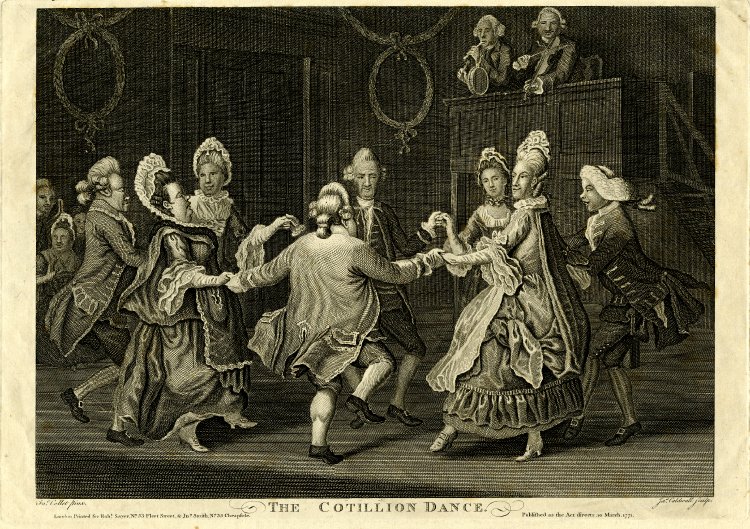
The growing popularity of the cotillon can be traced through advertisements and other mentions in the pages of London’s newspapers, particularly the Public advertiser. The dance begins to attract attention in 1768, although some of the references suggest that it was already being regularly performed at balls before then. (Newspaper references before 1768 have proved elusive, which doesn’t mean that there aren’t any). However, throughout 1768 and 1769 the cotillon is quite obviously becoming very fashionable – it’s the dance that everyone wants to do. It appears at least two or three times each month in different contexts.

There are advertisements by dancing masters offering to teach the cotillon alongside other ballroom dances, and even regular classes devoted to it. Cotillon music is advertised, encouraging enthusiasts to buy collections of tunes to play for their own private dances at home. Music publishers also printed treatises for those wishing to learn the dance (or perhaps for other dancing masters wanting to teach cotillons). There are critical or amusing letters, most written with satirical intent. Some of London’s leading entertainment venues, including Soho Square and Ranelagh Gardens, provided cotillon rooms – underlining the dance’s  importance to paying customers. The craze for cotillons was such that Drury Lane included one among the dances offered between the acts of the plays that were the theatre’s main fare.

James Caldwell, after John Collet. The Cotillion Dance. 1771. © Trustees of the British Museum

James Caldwell, after John Collet. The Cotillion Dance. 1771. © Trustees of the British Museum

In due course, I will trace in more detail these various strands surrounding the cotillon.