
During the 18th century, entr’acte dances (dances given between the acts of plays) were an integral part of many performances in London’s theatres. The following advertisement, from the London Daily Post and General Advertiser for 25 March 1736, shows how these dances fitted into the evening’s entertainment:

This performance was for the benefit of one of Covent Garden’s leading dancers, Leach Glover.
As this bill shows, entr’acte dances could be quite varied. Nivelon’s Clown was a country bumpkin, possibly related to the ‘Peasant’ depicted by Lambranzi in his Neue und Curieuse Theatrialisches Tantz-Schul in 1716. I have used this image several times before but here it is again.

I continue to puzzle about the differences between ‘Clowns’ and ‘Peasants’ on the London stage, as well as the distinctions between those of different nationalities – in the 1720s both John Weaver and Francis Nivelon danced an English Clown, while Nivelon was also billed in a French Clown dance.
The Minuet and Louvre performed by Glover and Miss Rogers were ballroom dances (the Louvre was, of course, Pecour’s famous Aimable Vainqueur), although we don’t know whether the basic choreographies as set down in surviving notations were embellished for the stage.

This engraving from Kellom Tomlinson’s The Art of Dancing (1735) shows a moment from the ballroom minuet (the viewpoint is from the lower end of the room, looking towards the ‘Presence’). It raises questions about the performance of ballroom dances on stage, even though they shared with stage dances the concept of a ‘Presence’ as an important focus for their dancing.
The Grand Ballet was different again, with several performers led by Lalauze and Mlle D’Hervigni, and was probably in the form of a divertissement with several dances one after the other. These more extended pieces could also be small ballets, for example the ‘new grand Comic Pantomime Dance’ The Double Jealousy given at Mlle Roland’s benefit at Drury Lane on 1 April 1736, as this detail from the advertisement in the London Daily Post and General Advertiser for that date shows (the mainpiece was King Henry the Fourth. With the Humours of Sir John Falstaff):
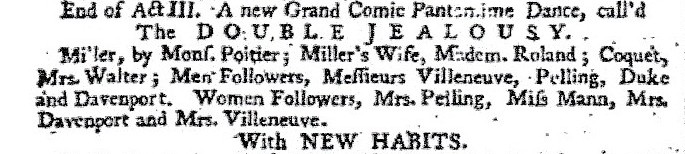
The Double Jealousy hints, through its title and its characters, at comic and expressive action, but what were the other dances – in particular the solos and duets – like?
Most entr’acte dances must have been short: solos and duets may have lasted between one and two minutes (for the early 18th century their duration can be compared with that of the dances surviving in notation); divertissements (the ‘Grand Dances’) and even small ballets seem likely to have lasted ten minutes at the most. So, we get the idea that during an evening in one of London’s theatres there were several short dances that contrasted with the action of the play they accompanied and presented a variety of characters and dance styles. They were also intended to showcase the leading professional dancers in the companies and could be, in themselves, a draw for audiences.
A little while ago, I was at a very different sort of event – a modern ballroom and Latin competition, with a Gala evening at which two couples of professional dancers performed. As they appeared alternately, dancing their way through the five standard ballroom dances and the five Latin ones, I was reminded of the entr’acte dances on the London stage and began to wonder what (if anything at all) they might have in common. These 21st-century dances had no context. They were simply intended to display the skills of the dancers and entertain the audience (many of whom were dancers themselves), so how might they tell us anything about the 18th-century entr’acte dances I have been describing?
First, was the length of the modern dances. They were short, at just a few minutes each, so the dancers had to make an immediate impact. Second, was their presentation without a specific background – they were danced to an audience seated around the ballroom floor with little decoration and no scenery. It is difficult to be sure what happened with 18th-century entr’acte dances, but it seems unlikely that they were provided with their own scenery (although, like the modern dances, they were presented in costume) and they were probably danced mainly on the forestage in the midst of their audience.
I was struck with the way in which the 21st-century dancers played with the conventions of the dances they performed, elaborating and subverting these by turns. The modern dances – waltz, tango, Viennese Waltz, foxtrot and quickstep for the ballroom and cha-cha, samba, rumba, paso doble and jive for the Latin – have different and well-defined characters as choreographies. Although it is usually only in the Latin dances that couples hint at drama, in the Gala performances both the ballroom and Latin couples did so. They also intensified the characters of the individual dances and one couple even incorporated props into their dancing. I couldn’t help feeling that early 18th-century dancers must have used similar techniques in the sarabands, chaconnes, passacailles, gigues, canaries, loures, bourrées, rigaudons, minuets and other dance types (divided between serious and comic) that they would have performed on the London stage three centuries ago. They, too, were trying to command the attention of their audience and display to the full their skills and individuality.
 Dance in History